Singapore
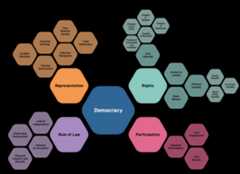
Singaporeexhibits mid-range performance in three categories of theGlobal State of Democracy Framework: Representation, Rights and Participation, and high performance in Rule of Law. It is among the top 25 per cent of countries with regard to several aspects of Rule of Law and Rights, but among the bottom 25 per cent in Freedom of the Press, Freedom of Association and Assembly and Local Democracy. Over the last five years, it has experienced improvements in Personal Integrity and Security as well as declines in Economic Equality. Singapore is a high-income economy, focused on export-oriented economic policies, with key exports including electronics, pharmaceuticals, and refined petroleum.
Previously a British colony in the 19th century and briefly occupied by Japan after its invasion of the Malay Peninsula in 1942, Singapore gained independence in 1959. Lee Kuan Yew, leader of the People’s Action Party (PAP), dominated as prime minister and an influential politician for half a century, after rising to power in the 1950s. During his rule, he prioritized economic liberalisation over democratic freedoms. In 1963, Singapore, together with North Borneo and Sarawak, merged with the Federation of Malaya to form Malaysia (all were former British colonies). Soon thereafter, however, a spate of racial violence broke out, sparked by the imbalanced Malay-Chinese population in both countries. Singaporewas expelled in 1965.
Today, Singapore is home to a diverse society. The racial categorization of the majority Chinese and the minority Malays, Indians and Other Ethnicities (CMIO) stem from British colonization and informs social and education policiesbased on multiculturalism. Minority representation in electoral politics was mandated by a 1988 constitutional amendment. Liberal immigration policies have resulted in a significant migrant population in both high and low paying jobs. In recent years, a fault line has emerged between newer immigrants and more established groups, with the latter expressing ‘anti-immigrant’ sentiment. At the same time, the government has pushed for measures to help low-income citizens and hire locals over foreigners.
Singapore does not hold fully competitive elections. The PAP has maintained power since 1959 and holds sway over state institutions despite the constitutionally guaranteed separation of powers. It has the power to manipulate information, drive specific narratives and perpetuate its ideologies in the public sphere. Freedom of expression has been curtailed due to the passing of laws (POFMA 2019; FICA 2021), which undermine the right tofree speech. Singapore ranks in the top 25 per cent for Absence of Corruption, yet recent investigations have challenged the ruling party's and city-state’s reputation for being corruption-free.
Singapore ranks highly in gender equality and parity. The country has institutionalised the protection and advancement of women through its Women’s Charter (1961). However, gender discrimination and traditional gender roles are still prevalent. While same-sex sexual relations were decriminalised in 2023, legal protections for LGBQTIA+ rights individuals remain limited.
Looking ahead, it will be important to watch thePAP’s renewed mandate under the leadership of Prime Minister Lawrence Wong, following Prime Minister Lee Hsien Long’s (the oldest son of Singapore’s first prime minister) departure in 2024. As the first post-Lee era prime minister, Wong faces the challenge of maintaining stability amidst economic challenges and a cost of living crisis. The government’s crackdown on corruption and free speech will also need monitoring regarding Freedom of Expression and Absence of Corruption.
Last Updated: June 2025
https://www.idea.int/democracytracker/
May 2025
Ruling party retains supermajority in general election
On 3 May, Singapore’s People’s Action Party won a decisive victory in the country’s general election, securing 87 of 97 seats and 65.6 per cent of the popular vote. The main opposition Workers’ Party maintained its 10 seats. The Elections Department reported 92.5 per cent turnout, a decrease from 95.8 per cent in the previous 2020 election. Voting is compulsory in Singapore. According to preliminary results, a record 31 (31.9 per cent) women were elected to parliament, up from 27 (29.0 per cent) in the previous Congress.
Sources: Elections Department Singapore,Lianhe Zaobao, CSIS, Reuters


October 2024
Former minister sentenced in rare landmark corruption case
On 3 October, former Transport Minister and People’s Action Party (PAP) member S. Iswaran was sentenced to 12 months in prison for obstructing justice and accepting more than SDG 403,000 (approximately USD 311,882) worth of gifts. Iswaran’s sentencing follows a year-long investigation linked to dealings involving billionaire property businessman Ong Ben Sen. This case marks the first trial of a political figure in Singapore in nearly 50 years. Justice Vincent Hoong of Singapore’s High Court underscored that Iswaran’s crimes represented an abuse of power that undermined public trust in government institutions. Legal experts note that the sentencing demonstrates the court’s intolerance of corrupt conduct.
Sources: International IDEA,Strait Times,BBC News,The New York Times
April 2024
Defendants sentenced in largest-ever money laundering scandal
In April, Singapore began sentencing five out of ten foreign nationals accused of laundering over SGD 3 billion (approximately USD 2.2 billion) acquired from criminal activities overseas. The ten foreigners were apprehended during an island-wide raid in August 2023, during which their assets were seized or frozen. Political analysts have labelled the case as the country’s biggest-ever money laundering incident, challenging Singapore’s corruption-free reputation. The case ensnared numerous banks, property agents and precious metal traders, prompting authorities to establish an inter-ministerial panel tasked with reviewing anti-money laundering protocols and investigating any potential complicity of financial institutions. Legal proceedings against the remaining defendants are ongoing.
Sources:BBC News,Asia Financial,The Strait Times,Nikkei Asia
February 2024
Singapore enacts indefinite detention and expands police powers
On 5 February, Singapore’s parliament passed the Sentence for Enhanced Public Protection (SEPP) law, allowing for the indefinite detention of “dangerous offenders” beyond their completed sentences. The SEPP law applies to individuals above 21 years of age convicted of serious crimes like rape and homicide. Offenders will now require the approval of the Home Affairs Minister to determine if they are no longer a threat to the public in order to be released. Law and Home Affairs Minister K. Shanmugam said the decision to impose a normal versus SEPP sentence lies with the court in which the person is first convicted, with a review board consisting of retired judges and psychologists to aid in assessing each case at a later point. The law was passed with broad support from parliament; however, rights experts have raised concerns about the law violating due process rights and the potential for over-detention. Simultaneously, parliament passed the Criminal Procedures (Miscellaneous Amendments) Bill on 5 February, granting police officers more powers to conduct searches without a warrant as well as force suspects to undergo a forensic medical examination, if relevant.

See all event reports for this country
Global ranking per category of democratic performance in 2024

Basic Information

Human Rights Treaties
 State party
 Signatory
 No action
Create your monthly alerts
and receive a customized selection of reports directly in your inbox
Performance by category over the last 6 months
 Representation
 Rights
 Rule of law
 Participation
Global State of Democracy Indices
Hover over the trend lines to see the exact data points across the years


Factors of Democratic Performance Over Time
Use the slider below to see how democratic performance has changed over time