Portugal
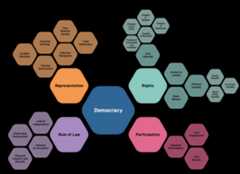
Portugalperforms in the high range in Representation and in the mid-range in the remaining three categories (Rights, Rule of Law and Participation) of theGlobal State of Democracy framework. The country ranks in the top 25 percent of countries globally in a majority of factors of democratic quality. Between 2019 and 2024, it experienced declines in multiple factors of Representation, Rights and Rule of Law. Portugal is home to a high-income economy dominated by services and manufacturing.
Portugal transitioned from the authoritarian Estado Novo regime, which had been in place since the 1930s, to democracy between 1974 and 1976. This transition began with a peaceful military coup known as the Carnation Revolution and culminated in a new Constitution that established the country as a democratic parliamentary republic. The transition also triggered the decolonization of the Portugal’sAfrican colonies. Since then, judicial independence has been strengthened through reforms promoting a citizen-centered system, alongside enhanced checks and balances between the executive and legislative branches.
A driver of current Portuguese politics is the weakening of the traditional two-party system, withnew political parties and a more fragmented Parliament. This shift has changed the political landscape after years of stability and reflects voter concerns over the economy, particularlythe cost of living, a housing crisis andstagnant wages. At the same time,corruption, including at the highest levels of the government, has underminedpublic trust, particularly the integrity of the central government and its employees. Despite an extensive anti-corruption framework, and a newly introducedAnti-Corruption Agenda, difficulties remain in implementation, efficiency and accessibility, particularly to improve public access to information.
These tensions have coincided with a rise in populist attitudes and anti-immigration sentiments, which have been amplified by frequentpolitical campaigns driven byrecurrent elections. In spite of the approval of a National Plan to combat racism and discrimination, which focuses on the country’s colonial legacy, both issuespersist, withpolice violence having sparked protests. Immigrants from former colonies as well as Roma communities continue to experience disproportionately high rates of housing deprivation relative to the rest of the population and struggle to access essential services.
Portugal performs in the high-range in Gender Equality; however, the lack of a specific law criminalizing femicide and the absence of provisions that classify rape as a public crimeremain key societal concerns.Wage inequality also persists, although the gender pay gap is smaller than the EU average. Portugal has seen recent advances in LGBTQIA+ rights, such as the passage of legislation enabling legal gender recognition based on self-determination and prohibiting health service providers from discriminating between blood donors based on sexual orientation or gender identity.
Looking ahead, it will be important to watch developments impacting Rule of Law, particularly the effectiveness of anti-corruption initiatives. Monitoring both Access to Justice and Predictable Enforcement will also be relevant, particularly in view of issues with drawn-out investigations and court judgments leading to delayed accountability for corruption cases. Rising political polarization adds to the challenges, reflecting deeper social and economic divides. In this regard, persistingsocio-economic exclusion andyouth unemployment will make Social Group Equality and Economic Equality relevant to watch in coming years.
Last updated: June 2025
https://www.idea.int/democracytracker/
December 2025
Portugal holds first major general strike in a decade
On 11 December, the first major general strike in over a decade took place in Portugal. Organized by the country’s main labor unions, the strike mobilized approximately three million workers, representing 60 per cent of the workforce, according to organizers. Participants protested against a proposed labour reform, which they fear could increase employment insecurity by making dismissals easier, facilitating outsourcing, and restricting certain forms of compassionate leave. The strike mainly disrupted transport, education, healthcare and public administration services, impacting daily life across the country. Some limited clashes between security forces and protestors took place, with a total of six people arrested.
Sources: El País, Euronews, Diário de Notícias, Observador


October 2025
Parliament approves ban on face coverings in public spaces
On 17 October, Parliament approved a bill prohibiting face coverings in public for 'gender or religious' reasons, with exceptions for places of worship, airports and diplomatic premises, and for health, professional or artistic purposes. Proposed by the right-wing Chega party under the rationale of protecting women’s rights and ‘cultural preservation’, the law will effectively restrict the wearing of burqas and niqabs, which are worn by some Muslim women for religious reasons. Violations will carry fines of up to EUR 4,000 and forcing someone to cover her face may result in up to three years’ imprisonment. Rights groups have expressed concerns that the bill will disproportionately impact a minority of Muslim women. The law is now pending a review by the Parliament’s Constitutional Affairs Committee, which may introduce amendments. Following the review, it will proceed for a final parliamentary vote before being sent to President Rebelo de Sousa for potential ratification, a decision for which he will have 20 days.
Sources:Associated Press,Euronews,Público,EFE,The Resident

August 2025
Constitutional Court rules immigration reforms to be unconstitutional
On 8 August, the Constitutional Court ruled several parts of a new immigration reform that had been approved by Parliament on 16 July and referred for review by President Marcelo Rebelo de Sousa to be unconstitutional. The bill aimed to tighten family reunification rules for immigrants. The Court found that measures such as imposing a two-year waiting period before applying, excluding spouses and adult children, extending processing times and limiting judicial appeals violated protections of family unity. However, it upheld provisions granting preferential treatment to Golden Visa holders and highly qualified workers. As a result, the law has not taken effect, with Parliament expected to revise it when it reconvenes in September.
Sources: Reuters, La Vanguardia, Público
May 2025
Democratic Alliance (AD) wins snap legislative election
On 18 May, Portugal held a snap legislative election after the minority government of Prime Minister Luis Montenegro lost a confidence vote. The Democratic Alliance (AD) won the election with 31.8 per cent of the vote, securing 91 seats in the 230-seat parliament. Chega emerged as the second-largest party, receiving 22.8 per cent of the vote and 60 seats. The Socialist Party (PS) also polled 22.8 per cent of the vote but won 58 seats. Voter turnout reached 58.2 per cent, down from 59.8 per cent in the last election in 2024. A total of 77 of the 230 seats in the new Parliament were won by women (33.5 per cent), down from the previously held 80 seats. Following the election, President Marcelo Rebelo de Sousa invited Montenegro to form a minority government, which was sworn in on 5 June. This marks the third snap legislative election held in the country in three years.
Sources: EuroEFE, Comissão Nacional de Eleições, Ministry of Interior of Portugal, International IDEA, IPU Parline
See all event reports for this country
Global ranking per category of democratic performance in 2024

Basic Information

Human Rights Treaties
 State party
 Signatory
 No action
Create your monthly alerts
and receive a customized selection of reports directly in your inbox


Global State of Democracy Indices
Hover over the trend lines to see the exact data points across the years


Factors of Democratic Performance Over Time
Use the slider below to see how democratic performance has changed over time