Panama
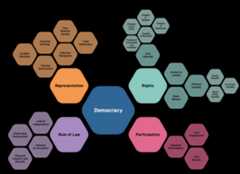
In theGlobal State of Democracy Framework, Panama performs in the high range in Representation and in the mid-range in Rights, Rule of Law and Participation. It is among the top 25 per cent of countries in several factors. Compared to 2019, it has maintained steady performance, improving in Freedom of Expression and declining in Economic Equality. Panama is a high income country, with an economyreliant on servicesand on the Panama Canal as a major trade hub.
Panama became independent from Spain in 1821 and seceded from Colombia in 1903. MostPanamanians are Mestizo, with Indigenous, Black, Mulatto and White minorities. Indigenous peoples make up 17.2 per cent of the population and have a significant degree of autonomy, with six self-governed comarcas. Remote communities, however, often lack access to basic services, and large-scale development projects encroach on Indigenous land despite thecodification in law of free, prior and informed consent. Indigenous and rural communities are particularly affected by extraction activities, an increasingly salient issue in a country with a strong environmental protection legal framework and acarbon-negative footprint. This is illustrated by mass protests in 2023 against a mining contract, eventually struck down by the Supreme Court.
Afro-Panamanians, who make up around 30 per cent of the population, face disproportionate levels of unemployment, poverty, and discrimination in practice. Migration is a significant cleavage and featured prominently in the 2024 national election. More recent south-bound flows ofreturning migrants and theeffects of U.S. migration policy highlightchallenges forreceiving states.
After a two-party system dominated Panamanian politics between 1989 and 2004, the 2009 election of a centre-leaning and liberal party enabled more diverse representation and wider competition. Politics are largely driven by unrest about corruption, poverty and high levels ofinequality, withdemands for action on the high cost of living. More recently, social mobilization againstmining, reforms to the pension system, and more broadly toprotest government policies have resulted in some clashes with police,reports of excessive use of force, and a regionalstate of emergency.
Panama’s legal framework promotes gender equality. However, gender-based vulnerabilities, including domestic violence and femicide, were exacerbated during the Covid-19 pandemic andremain to this day. Women’s political representation also remains a challenge. Although electoral law requires parity in nomination of candidacies, normative loopholes allow for parties to bypass this obligation. In thelast national elections (May 2024), only 19 per cent of candidacies were held by women. Consensual same-sex relations weredecriminalized in 2008, but the Supreme Courtrejected marriage equality in 2023, and Panama has no specific legislation to protect members of the LGBTQIA+ from discrimination.
In the coming years, the government’s efforts to address social and economic inequality will be key to Panama’s democratic performance. Measures to alleviate poverty, particularly for Indigenous peoples, Afro-Panamanians, children and adolescents, will be vital to addressdiscontent. Relatedly,compliance with judicial decisions on mining and theright to assemble will be consequential for Rule of Law and Rights.
Last Updated: July 2025
https://www.idea.int/democracytracker/
March 2025
Shelters in Darien region to be closed, migration control to tighten
President José Raúl Mulino has announced the gradual closure of the Bajo Chiquito and Canal Membrillo migrant shelters in the Darien region. According to the government, the facilities will no longer be needed, given the rapid and substantial decrease in the flow of migrants traveling from South America to the United States. Migrants arriving to those shelters received aid and medical attention from Panamanian institutions and NGOs. During his campaign and upon his election last year, Mulino promised to introduce stricter migration controls and ‘close’ the Darien Gap; now, those attempting to enter from the Darien after the shelters close will be deported. Although the number of people entering Panama from Colombia is decreasing, the number of migrants making the journey back south from the U.S. is increasing. Notably, Costa Rica and Panama agreed in February to coordinate assistance to returning migrants through means such as bussing, but the closure of the shelters in the Darien will negatively impact people in transit.
Sources: La Estrella de Panamá, AP, France 24, Panamá América, Telemundo


October 2024
President launches new security strategy
On 10 October, President José Raúl Mulino announced his government’s strategy to combat gang activity. Known as operation Panama 3.0, the strategy aims to eradicate gang violence and crime by strengthening the national police with the incorporation of 1,032 additional agents, as well as through patrolling, checkpoints and community outreach. The strategy will be implemented in regions particularly affected by violence, including Colón, Panama West and San Miguelito. The strategy comes weeks after Mulino announced the implementation of regional curfews for minors, which have now been extended and will continue to be assessed periodically. According to government officials, by late October the rate of certain crimes considered of high impact had reduced by 71 per cent; over 2,900 people had been detained and illicit drugs, vehicles and cash had been seized and secured.
Sources:Presidencia Panamá,International IDEA,Telemetro,Prensa Latina,En Segundos

September 2024
Measures announced to contain increase in crime and gang activity
President José Raúl Mulino announced the implementation of temporary regional curfews for minors and enhanced security in response to an increase in gang activity and organized crime. The nighttime curfews were established in the regions of Colón and San Miguelito, followed by one in Bocas del Toro. President Mulino has expressed that the measure would be assessed periodically and, if necessary, further measures, including curfews for people over 18 years old, would be implemented. He also announced that the National Aeronaval Service (SENAN) would take over security tasks in all airports and would increase its presence in coastal areas through patrolling. By early October, Mulino stated that in Colón and San Miguelito the curfews had resulted in a five per cent reduction of crime, however the long-term impact of the strategy is yet to be seen.
Sources:Presidencia Panamá (1),Presidencia Panamá (2), La Prensa Panama, Telemetro
May 2024
José Raúl Mulino is elected President
On 5 May, Panama held elections to choose its president, members of the National Assembly, members of the Central American Parliament, mayors and other local leaders. José Raúl Mulino was elected president with the support of 34.3 per cent of voters, nearly ten percentage points ahead of second place Ricardo Lombana. Former president Martin Torrijos came in third place, while the ruling Revolutionary Democratic party (Partido Revolucionario Democrático) candidate only attained around 5.8 per cent of votes. Mulino entered the race as the candidate for the Achieving Goals (Realizando Metas) opposition party after the original candidate, former President Martinelli, was deemed ineligible for having been convicted for money laundering. Just days before the election, the Supreme Court confirmed that Mulino could run for president, denying a challenge to his eligibility for not having participated in his party’s primary process.
In Congress, independent candidates earned enough seats to become the largest group in the Legislature. According to preliminary results, 15 women were elected to the National Assembly out of 71 members (one less than in the previous legislature). Voting is mandatory but not enforced in Panama, and electoral participation was around 78 per cent (up five percentage points compared to 2019).
Sources:El Pais,Organization of American States,EFE, The Guardian
See all event reports for this country
Global ranking per category of democratic performance in 2024

Basic Information

Human Rights Treaties
 State party
 Signatory
 No action
Create your monthly alerts
and receive a customized selection of reports directly in your inbox
Performance by category over the last 6 months
 Representation
 Rights
 Rule of law
 Participation
Election factsheets

Global State of Democracy Indices
Hover over the trend lines to see the exact data points across the years


Factors of Democratic Performance Over Time
Use the slider below to see how democratic performance has changed over time