Israel
Note: This profile only covers Israel’s sovereign territory and does not reflect Israel’s actions in the West Bank and Gaza.
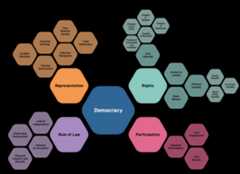
Israelperforms in the high range in the Representation and Participation categories of theGlobal State of Democracy framework, and mid- range in Rights and the Rule of Law. Over the past five years, it has seen significant declines in Access to Justice. Despite an advanced, export-oriented economy including high-technology goods, Israel has one of the highestinequality levels among advanced economies.
The state of Israel was established in 1948 following a UN resolution to partition Palestine. Its roots are in the nineteenth-century Zionist movement, which encouraged Jewish migration to Ottoman and later British Palestine as a refuge from violent antisemitism in Europe, a point that took on additional urgency after the Holocaust. Its creation between 1947 and 1949 involved the forced expulsion and displacement of hundreds of thousands of Palestinians. Today, Israel maintains a separated regime of governance between its internationally recognized territory, the annexed Golan Heights, and its military occupation of parts of the West Bank and Gaza. Israel controls the latter through physical military presence, and in the West Bank, through the application of a twofold legal system of military law for Palestinians and civil law for Israelis.
Israel’s dual commitment to being a democratic and Jewish state has proven difficult to balance. This issue was exacerbated by the controversial Nation State Law of 2018, which defines Israel as ‘the nation state of the Jewish People’. This has also given rise to inequitable rules, laws, and practices that discriminate against non-Jewish citizens, which include Christian, Muslim and Druze minorities. Non-Jews are, for example, discriminated against in terms of family reunification, land ownership, and access to education. In recent years, the divide between religious and secular Jews has also grown. Further, there are divisions along ethnic and socioeconomic background, as well as views on the country’s compulsorymilitary service and the illegal Israeli settlements in the Palestinian West Bank.
Israel’s political landscape is highly polarized, manifested in the efforts of Israel’s ascendent far right parties to reduce the powers of the country’s Supreme Court, which they perceive as obstructing their policy agenda. Intensified efforts toreform the judiciary, includinglegislation that grants the government greater control over judicial appointments, have deepened public mistrust and reignitedprotests. Thecorruption trial of Prime Minister Benjamin Netanyahu has further exacerbated tensions between the executive and judiciary.
Israel’s war in Gaza has also intensifiedrestrictions on civic space, with dissent fromopposition politicians, journalists, academics and conscientious objectors (includingreservists) increasingly suppressed. The conditions ofmigrant workers have deteriorated, and there have been growing allegations oftorture and mistreatment againstPalestinians detained in Israel’s prison system.
WhileIsrael is among the world’s top 25 per cent with regard to performance on Gender Equality, women still face gaps inpolitical representation,pay, and access toleadership roles. AlthoughLGBTQ+ protections exist—allowing same-sex couples to adopt and serve openly in the military—same-sex marriages are not performed. Additionally, the country’s progressive LGBTQ+ image has been criticized as "pink-washing," used to distract from broader human rights issues.
Looking ahead, Rule of Law and Rights will be an area to watch, particularly with respect to developments in the judiciary and the evolution of Access to Justice. This will be especially relevant given the rights violations within the prison system as well as in relation to International Court of Justice (ICJ) case and International Criminal Court (ICC) proceedings against Israel and its leaders. The political climate, shaped by the government’s responses to the ongoing war in Gaza, also warrants close attention, as it may impact performance across all Global State of Democracy Indices indicators moving forward.
Last updated: May 2025
https://www.idea.int/democracytracker/
November 2025
Arrests over prisoner abuse ‘leak’ raise concerns over whistleblower protections
On 3 November, authorities arrested Yifat Tomer-Yerushalmi, the former top military lawyer, and Matan Solomesh, the former chief military prosecutor, for disclosing a video showing Israeli soldiers abusing a Palestinian detainee at Sde Teiman prison. The footage documented severe violence, including acts of sexual violence. Tomer-Yerushalmi, who resigned from her post, admitted authorizing the disclosure to counter misinformation about military investigations and to ensure the abuse was not concealed. The prosecution has sparked concern that, in a legal framework that offers limited protection for whistleblowing (with no statutory ‘public interest’ defense to shield whistleblowers), the case is likely to further deter others in the military from exposing serious wrongdoing, reinforcing a broader climate of impunity.
Sources: The New Arab,Al Jazeera,Haaretz,International IDEA,The Israel Democracy Institute


Knesset approves death penalty bill on first reading
On 10 November, the Knesset passed in its first reading (39–16) a bill that would amend the penal code to require courts to impose the death penalty on anyone convicted of killing an Israeli if the act was motivated by ‘racism’ or intended to harm ‘the State of Israel’ or ‘the rebirth of the Jewish people.’ Rights groups have condemned the bill, warning that it overturns decades of progress on abolishing the death penalty (which was removed for murder in Israel in 1954). Further, they caution it is inherently discriminatory, as it would in practice apply primarily to Palestinians while imposing no comparable mandatory penalty on Israeli Jews convicted of killing Palestinians. The bill, which would be applied retroactively, will now move to committee review and must pass two additional parliamentary readings before being approved into law.
Sources:Knesset,The Jerusalem Post,The Times of Israel,Al Jazeera,Amnesty International


PM Netanyahu requests pardon for ongoing corruption probe
On 30 November, Prime Minister Benjamin Netanyahu submitted a formal request for a presidential pardon to President Isaac Herzog in connection with his ongoing corruption trial. In the request, Netanyahu argued that the proceedings 'harm national unity' and 'distract' him from governing. The move is highly unusual, as pardons in Israel are typically granted only after a conviction. The request is currently under legal review by the Justice Ministry and the Office of the President.
Sources: The Jerusalem Post,Al Jazeera,The Israel Democracy Institute
September 2025
Palestinian prisoners have been deprived of adequate nutrition, Supreme Court confirms
Palestinian prisoners held in Israeli prisons have been deprived of adequate food in violation of their basic rights, the Supreme Court acknowledged in a ruling on 7 September. The Court found that the Israel Prison Service has failed to meet its legal obligations to provide sufficient nutrition, expressing ‘serious doubts’ that current rations met basic subsistence standards. Rights groups that brought the case had argued that government policy deliberately reduced food rations, leaving prisoners without the nutrition necessary for health and survival. The Court’s decision requires prison authorities to take corrective action to guarantee all detainees receive adequate nutrition to meet basic needs.
Sources:The Times of Israel,The Association for Civil Rights in Israel,Associated Press


July 2025
Far-right mob attacks Knesset member Ayman Odeh
On 19 July, Member of the Knesset (MK) Ayman Odeh, a Palestinian citizen of Israel and leader of the Hadash-Ta’al party, was attacked by a far-right mob while travelling to a protest against Israel’s war on Gaza. The assailants vandalized his car, smashing the windshield, throwing objects, and shouting racist slurs, including ‘death to Arabs’. This attack came just days after a failed Knesset motion to expel Odeh from parliament, due to his open criticism of Israel’s actions in Gaza. It also occurred amid a broader reported increase in violence against Palestinian citizens of Israel. Although police arrested three suspects in connection to the attack, all were later released. Following the latest 2022 parliamentary elections, only 10 of the Knesset’s 120 seats are held by representatives of Arab origin.
Sources:The Times of Israel (1),The Times of Israel (2),The Legal Center for Arab Minority Rights in Israel,The National,The Times of Israel (3)
June 2025
Israel bans entry of five international organizations documenting human rights abuses
On 25 June, Israel issued a directive banning five international organizations and approximately 50 of their staff members from entering the country. These groups, primarily based in Europe and the United States, work to promote justice and accountability in Israel and Palestine by documenting human rights abuses and supporting international legal mechanisms. The affected staff members were designated as persona non grata. By denying them entry to Israel (and by extension to Palestine, as access to the West Bank and Gaza is controlled by Israel), the directive restricts their ability to document human rights violations, including those allegedly committed by Israeli officials and military forces during the war in Gaza. It also prevents them from engaging with local communities and collaborating with local civil society organisations.
Sources: Israeli Ministry of Diaspora Affairs, Middle East Eye,Quds News Network,Bhol

See all event reports for this country
Global ranking per category of democratic performance in 2024

Basic Information

Human Rights Treaties
 State party
 Signatory
 No action
Create your monthly alerts
and receive a customized selection of reports directly in your inbox
Performance by category over the last 6 months


Global State of Democracy Indices
Hover over the trend lines to see the exact data points across the years


Factors of Democratic Performance Over Time
Use the slider below to see how democratic performance has changed over time