00:00:02.16Hello, my name is Stan Falkow.
00:00:04.28I'm a professor of Microbiology and Immunology and Medicine
00:00:09.08at Stanford University School of Medicine.
00:00:11.12I wanted to talk with you today about host-pathogen interactions
00:00:18.13and human disease and how we learn about human biology
00:00:24.03from the studies of microorganisms that have studied us.
00:00:29.09This is a picture that you see of a macrophage eating bacteria
00:00:36.04as a kind of symbol of the host-pathogen interaction,
00:00:41.10although it's rather one-sided, and I think you'll see, before the end
00:00:46.02that it works both way.
00:00:48.21So, I will begin by telling you that I'm going to talk about one microorganism,
00:00:55.21Helicobacter pylori, and its relationship to gastric cancer.
00:01:02.08This study, we think, has helped us understand human biology
00:01:11.16by the study of how this organism establishes a persistent bacterial infection in humans.
00:01:19.06Twenty years ago, we thought that ulcers were caused by stress.
00:01:28.07And you can see for yourself the list of things that are supposed to be least stressful
00:01:32.03versus most stressful, and I don't know where you put yourself on that list,
00:01:37.13but 20 years ago, when people had ulcer disease
00:01:40.23and gastritis (dyspepsias they call it),
00:01:44.08we treated them with Alka-Seltzer and all kinds of antacids.
00:01:49.02And some people ended up being on the psychiatrist's couch,
00:01:54.16trying to reduce their stress.
00:01:56.02Not everybody believed that it was a stress-related disease.
00:02:02.06There were 2 scientists in Australia: Barry Marshall and Rob Warren
00:02:07.23who did not believe that.
00:02:10.00Barry Marshall, at the time, was a gastroenterologist
00:02:14.07and he had studied with a microbiologist in Australia
00:02:18.09who had told him that there were bacteria that you could find
00:02:21.26in the stomachs of animals, and Barry thought that he saw
00:02:28.17those very same organisms or kind of organisms
00:02:31.10in the stomachs of humans, but he made the association that
00:02:35.13he only saw it in the stomachs of people who had gastritis and ulcer disease.
00:02:39.24Rob Warren, who he worked with in Perth,
00:02:43.04was a pathologist who concurred with this idea.
00:02:45.27Barry tried very hard to be able to grow these organisms he could see
00:02:53.00in culture, and he actually failed.
00:02:55.21And, he was so frustrated that he took a holiday and went to a place south of Perth,
00:03:02.06to do a little relaxation, and he forgot the Petri dishes
00:03:07.01that he had streaked with patients' material
00:03:09.00on the bench. And when he came back after several weeks, lo and behold,
00:03:13.01there was colonies of bacteria growing
00:03:16.12on the Petri dish.
00:03:18.05So, he took some of these and put them in the microscope,
00:03:21.12and they looked like the same bacteria that he could see in the stomachs of people.
00:03:26.17So, at that point, Marshall and Warren were wondering
00:03:32.26what they could do to establish the fact that the organisms that they had seen in the stomach
00:03:38.13were actually the cause of ulcers and dyspepsia.
00:03:44.04So, as Barry tells the story, he convinced Rob Warren to drink some of this culture
00:03:50.12of this organism that he had grown,
00:03:52.08and, in fact, poor Rob came down with gastritis and ulcer disease,
00:03:57.06and this is a picture of the biopsy that came from Rob's stomach,
00:04:00.25showing that, in fact, these organisms were alive and well in his stomach,
00:04:05.01and Barry, to his great credit, had also drank the culture. He also got ill.
00:04:09.24But not as ill as poor Rob did.
00:04:12.27So, it's nice to have a friend in high places.
00:04:15.17Now, as many of you will know, particularly some of you young scientists watching
00:04:19.27scientists like to talk about their work.
00:04:22.28But, you also probably know that not everybody wants to listen!
00:04:26.18And so, Rob and Barry submitted a paper describing their results
00:04:32.04to a learned society in Australia,
00:04:36.11and they got a letter back saying that they were sorry that their paper
00:04:42.09wasn't accepted. This says, if you can't read it,
00:04:47.20that it wasn't accepted, but they noted that the number of abstracts they received
00:04:51.29increased, and 67 were submitted, and they were only able to accept 56, so
00:04:59.10that was supposed to be something that would relieve them of their anxiety
00:05:04.24of being refused to this thing.
00:05:06.19However, in the end, they were right,
00:05:12.00so Barry Marshall and Rob Warren in 2005 received the Nobel Prize in Physiology and Medicine
00:05:18.18for the discovery that the bacterium that they found in the stomachs,
00:05:22.28which they called Helicobacter pylori,
00:05:26.17played a role in gastritic and peptic ulcer disease.
00:05:29.15And, it all worked out well in the end for them,
00:05:32.22as you can see.
00:05:34.15So, the organism Helicobacter pylori that they discovered, not that many years ago,
00:05:40.21is quite remarkable.
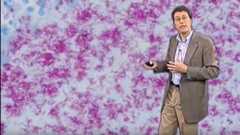
00:05:42.09It is a spiral organism, and it has flagella attached to it that makes it motile.
00:05:51.05And, it is transmitted, we now know, by the fecal-oral route or the oral-oral route.
00:06:00.00Helicobacter has been with humans since the very beginning.
00:06:06.22And we actually have molecular data now that indicates
00:06:10.28that at the beginning of what we consider
00:06:15.14mankind, that there was a single source in Eastern Africa that moved to the south
00:06:23.22to South Africa, one went to West Africa,
00:06:25.27but the major source went out and literally, with humans, populated the world.
00:06:30.20And that went all the way over here to the Bering Strait,
00:06:34.04and eventually came across here, into the United States.
00:06:38.23And you can see, it's been there for a very long period of time.
00:06:42.11So, Helicobacter and humans have been together from the beginning.
00:06:47.13We now understand that Helicobacter pylori really colonizes the majority of people
00:06:58.06in the world, or it did.
00:07:00.24And in the developing world, one still sees that about 90% of the people
00:07:05.09carry Helicobacter pylori. Now, in more technologically advanced countries
00:07:10.22like Italy, you get a different kind of pattern now, when you look,
00:07:16.09and you can see that it appears to increase over time and age.
00:07:20.10And originally, this was thought to mean that the likelihood of acquiring Helicobacter
00:07:25.24was greater the older you got,
00:07:28.11but actually, it's not. It's an age cohort effect.
00:07:32.00And so, people who are older were infected with Helicobacter
00:07:36.25when they were young and still carried it.
00:07:39.08But now, people who are really young no longer acquire Helicobacter quite so often,
00:07:47.24so the incidence is much lower.
00:07:49.19If you look at something like Mexico,
00:07:52.01which is in between, which is this line,
00:07:54.23you can see that it's beginning to show signs of this cohort effect.
00:07:58.21You're less likely to have it earlier in life than you are in Ethiopia.
00:08:04.25So, Helicobacter prevalence is still great in many parts of the world...
00:08:10.29the developing world, and it's becoming less and less common now
00:08:14.14in more technologically advanced countries.
00:08:18.05I'll talk about that later on because it has some significance.
00:08:22.00Helicobacter pylori colonizes the mucus layer of the human stomach,
00:08:28.25and I should point out that Helicobacter pylori is only found in humans.
00:08:32.28There are Helicobacters found in many different animals,
00:08:36.21but pylori is human specific.
00:08:39.12Now, just to remind you or to inform you about the stomach,
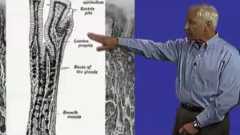
00:08:44.18the stomach is a glandular organ that is lined with epithelial cells,
00:08:52.06and it has a considerable amount of muscle mass.
00:08:55.00If you look at it, the upper part has a surface epithelium, and these
00:09:00.24epithelial cells secrete mucus.
00:09:03.09And then there are also cells -- the parietal cells --
00:09:08.01which are down further in the gland which secrete acid,
00:09:11.25of course, which the stomach is known for.
00:09:15.13The ability to secrete mucus and make acid
00:09:20.27are two distinct kinds of cells found in the stomach,
00:09:24.14and actually, there's a mid-zone where there are stem cells which make both kinds...
00:09:29.14which are actually the progenitors for both kinds of cells.
00:09:32.15So, it's a fairly simple kind of organ, as it were.
00:09:37.06It's constantly producing epithelial cells that are shed at its surface,
00:09:40.08and it has cells further on down in the gland that secrete acid and also hormones, like gastrin.
00:09:48.00Now, the stomach is a pretty drastic place to live
00:09:53.04if you're a microorganism. It's an acid environment
00:09:57.06and rich as you know in hydrochloric acid.
00:09:59.26However, the stomach cells themselves -- the epithelia --
00:10:04.25are protected because the secretion of mucus by the epithelial cells
00:10:09.18gives an overlying gel of protection, if you will,
00:10:13.11and so the pH really close to the surface of cells
00:10:17.10is closer to neutral pH. It's only out in the middle of the stomach
00:10:22.10where you really see the high amount of acid
00:10:25.06and, in fact, Helicobacter lives in the mucus gel
00:10:31.00very close to the surface of the epithelium.
00:10:34.05It's an organism, then, that lives in the stomach. It lives very close to the epithelium.
00:10:41.22And, it it has been associated with a number of diseases.
00:10:46.21So, Helicobacter pylori and its presence
00:10:49.10has been associated with a variety of diseases.
00:10:51.27However, it's important to understand at the outset
00:10:57.01that the vast majority of people who are infected with Helicobacter pylori
00:11:00.23are infected when they're young, they're infected for life,
00:11:04.07and about 3/4 of these people or more have no symptoms whatsoever
00:11:09.29in their whole lifetime. They would never know they had Helicobacter
00:11:12.22unless somebody either cultured them or did another kind of test.
00:11:17.02A subset of people who have Helicobacter pylori
00:11:22.01actually develop what is called gastritis.
00:11:24.23Gastritis is really an inflammatory response that is relatively severe,
00:11:32.03and there is destruction, actually, of the glandular substance
00:11:35.16of the stomach. Some of these people go on to develop ulcer disease.
00:11:42.07They either have peptic ulcer or duodenal ulcer.
00:11:45.03So, here you see an endoscopic view of a normal stomach
00:11:50.23and someone who has Helicobacter pylori gastritis.
00:11:55.08And, depending on the degree of gastritis, there may or may not be symptoms.
00:12:00.00However, in people who have ulcers,
00:12:04.22you can see that there is really erosion of the gastric mucosa,
00:12:11.12and you actually have a severe lesion,
00:12:14.03and this can be severe enough so that you actually have perforation of the stomach
00:12:18.19and you have serious side effects.
00:12:21.16And, of course, you have a great deal of pain and discomfort
00:12:24.03because you literally have a hole in your stomach.
00:12:27.12And this is because the inflammatory effects of Helicobacter pylori
00:12:31.22have been severe enough that there has been destruction of the gland
00:12:35.17and there is no longer the same protection that one had seen before
00:12:39.24from acid, and also because there's been a change in the epithelium
00:12:43.29because of the constant irritation due to the inflammation.
00:12:47.20In a smaller group of people, about 1%,
00:12:56.21they not only go on to have atrophic gastritis,
00:13:01.16they may or may not have ulcer disease, but a subset of these people
00:13:04.16will actually develop frank cancer.
00:13:07.17And so, gastric cancer is the result of having had a Helicobacter pylori
00:13:14.18infection in many, in fact most, cases.
00:13:18.10Now, the association with Helicobacter pylori and cancer
00:13:22.01is the same as one sees for the risk of having smoking and lung cancer.
00:13:29.26So, it's a very high risk. If you have Helicobacter pylori,
00:13:32.25you have a reasonable chance of developing gastric cancer.
00:13:36.25And gastric cancer, over a century ago, was the leading cause of cancer in humans.
00:13:43.06It's been surpassed now by other things.
00:13:47.11As, again, we'll discuss in a little bit.
00:13:50.01But, the fact is, it's a very high correlation. And 1% sounds like it's low,
00:13:57.04but when you think, at one point, the entire population of the world
00:14:01.12had Helicobacter pylori that meant that 1% of the people in the world
00:14:05.27were doomed to die of gastric cancer.
00:14:08.18Not a good thing.
00:14:09.28Helicobacter is so good at what it does that
00:14:15.12the World Health Organization has now classified it as a Type 1 carcinogen.
00:14:21.02No other microorganism has that degree of fame.
00:14:25.27And finally, just to remind you again, even today
00:14:30.14when there has been declining prevalence of Helicobacter pylori,
00:14:35.10one can still say that 50% of the world has been exposed to this organism
00:14:40.22since childhood, and that, of these individuals,
00:14:45.01at least 1% or more will develop gastric cancer over time.
00:14:49.10So, how does the organism do this?
00:14:51.16How does it establish itself in the stomach, and how does it cause disease in some people?
00:14:57.19Well, Helicobacter makes the most potent urease that's known.
00:15:05.15And, the urease is set up in a way that it actually makes sure that the cytoplasm
00:15:11.19of the microbe always remains neutral.
00:15:13.29So, if Helicobacter gets too close to the acidic environment,
00:15:17.26or at that period of time when it has to be in...
00:15:22.10When it first comes into a host, it has to swim through that highly acid environment
00:15:27.06to reach the mucus gel.
00:15:29.04It utilizes this. So this is a very powerful enzyme that it uses.
00:15:34.02Without urease, the organism is not virulent for humans any longer.
00:15:39.05Now, it's motile. And so, Helicobacter, I showed you, has flagella, and it swims along,
00:15:48.07and it's a little corkscrew-shaped organism
00:15:50.23perfect for swimming through a mucus gel.
00:15:53.29And, it uses this motility to swim to the surface of cells and stick,
00:16:01.22and you can see bacterium just coming there and sticking
00:16:05.17to the surface of the cell, swimming through.
00:16:08.09Helicobacter also has, on its surface, proteins and other molecules
00:16:16.01that permit it to stick to the surface of gastric epithelial cells.
00:16:22.00And, the best known of these is, in fact, a protein found on the bacterium
00:16:27.07that binds to a known blood-group antigen that's found on the gastric epithelium.
00:16:32.16And this is thought to be the primary way that Helicobacter can stick to the surface of cells.
00:16:38.23But there are a number of other kinds of adhesins that have been described.
00:16:44.02When you examine an infected stomach, you find that some of the Helicobacter
00:16:50.05actually are swimming around in the lumen, and only
00:16:54.02about 30% or so of the bacteria are actually attached to the surface of a cell.
00:16:59.21So, you can think of it as a population in which you have organisms
00:17:04.18that are constantly in the mucus layer, swimming around and replicating.
00:17:09.11And then a proportion of those will stick to the surface of the cell,
00:17:13.20and it's widely believed by people in the field that once the organism sticks to the cell,
00:17:18.03it will stay there until it dies or it replicates.
00:17:23.05And, here's a scanning electron micrograph,
00:17:31.12and you can see the bacteria sitting on the top of the cells.
00:17:31.27And so, this attachment turns out to be a critical point in Helicobacter pylori pathogenesis.
00:17:40.12Now Helicobacter also secretes a molecule which is called Vacuolating Cytotoxin A.
00:17:47.13VacA kind of looks like a flower, if you can see the picture of the molecule here.
00:17:53.11It looks like a flower, but it attaches to the surface of the cell,
00:17:57.13it's taken into the cell, and it has profound effects. And you can see
00:18:02.04in this video, that the cells in fact get full of these vacuoles
00:18:06.03so that normal trafficking that goes on inside those cells is affected
00:18:11.24and you have an accumulation of these vacuoles,
00:18:14.12and you can also see that the net result is
00:18:17.20that the cells die, and you see a cell here that's undergoing cell death.
00:18:21.16So, VacA is a fairly potent kind of poison
00:18:25.20that exists that Helicobacter makes.
00:18:28.23But, the most important virulence determinant that's been described so far
00:18:34.12is a protein that's called CagA, and it was initially described
00:18:39.29as Cancer-associated protein A.
00:18:43.15And, this was done because antibodies were found
00:18:47.29in the serum of patients who had Helicobacter
00:18:50.18that recognized this particular protein on the surface of the bacterium.
00:18:54.18And, this protein was on some strains and not other strains of bacteria isolated from humans.
00:19:01.16So, the Helicobacter that came from patients who had gastritis
00:19:06.24and ulcers were much more likely to have this protein, called CagA,
00:19:11.07than those that did not.
00:19:13.12And, people who had ulcers and cancer were associated with CagA
00:19:18.04so they talked about CagA+ strains and CagA- strains.
00:19:21.08And CagA+ strains were the ones that were the most likely to be associated with disease.
00:19:27.22No one understood why for a while.
00:19:29.18However, with the onset of genomics and genetics,
00:19:34.14it's now clear why some organisms have CagA and some don't.
00:19:39.07And it turns out CagA is a protein that is synthesized only by certain bacteria,
00:19:44.22and they only synthesize it because they have an insertion
00:19:48.09of DNA in their chromosome, which is missing from those that are CagA-.
00:19:55.05Now, these genes that are inserted are a group,
00:20:00.05and they include, at one end, the actual structural protein,
00:20:06.09the encoding capacity, to encode for CagA protein.
00:20:09.26So, CagA is actually encoded as part of this island.
00:20:13.26And there are other genes here, that you see around.
00:20:17.16And, what has now been understood from, not only the genomic sequence,
00:20:25.01but also by doing a variety of studies is that the actual pathogenicity island
00:20:31.04is enough to encode for a needle-like structure.
00:20:36.09And, through this needle-like structure, the bacterium makes contact
00:20:45.23with the membrane of the host cell.
00:20:49.04And it actually secretes the CagA protein from the bacterium,
00:20:53.26through the needle, into the cytoplasm of the host cell.
00:20:58.29So, in essence, the pathogenicity island encodes for a kind of hypodermic syringe --
00:21:06.07a molecular syringe --
00:21:07.20that injects a protein from the bacterium into the host cell.
00:21:11.02And you can see a picture here of the bacterium in contact with
00:21:15.14the cell, and you can see, I think, the little spikes that come out
00:21:19.01that are this protein bridge between the organism and the host.
00:21:24.20Now, we now understand some of the details of this.
00:21:29.21The organism attaches to the surface.
00:21:33.12It injects CagA into the host cell.
00:21:38.20So, the bacterial protein is put inside the host cell,
00:21:41.25and then, remarkably, a host cell kinase phosphorylates tyrosine residues
00:21:49.20found on the bacterial protein.
00:21:51.24So, the host cell takes a bacterial protein, and puts phosphates on a tyrosine group,
00:21:57.17and that activated CagA molecule, with a phosphorylated tyrosine,
00:22:05.06will now go and bind and affect host cell cellular phosphatases,
00:22:12.19and actually it will also stimulate a kind of gross cell response
00:22:18.20by host cells.
00:22:22.01The other parts of the surface of the bacterium
00:22:25.17also go on, are taken up, and perhaps injected through the secretory apparatus
00:22:31.29to turn on the inflammatory regulatory pathways of the cell, NFKB.
00:22:40.06Now, this growth factor effect is something you can see in culture,
00:22:45.04so you see here, now, a cell, that's a CagA- bacterium
00:22:49.23that's been added to this culture of tissue culture cells,
00:22:54.09and you can see that the cells jiggle around,
00:22:56.28but nothing much happens. That's pretty normal movement
00:23:00.13for a host cell under any circumstances.
00:23:04.13However, the cells that have been infected... the same kind of cells infected
00:23:10.17by a CagA+ strain, you can see change shape, they elongate,
00:23:15.25and they look as if they're moving.
00:23:17.16So, CagA has a profound impact on the host cell
00:23:23.04and leads to this effect.
00:23:24.26Now, my laboratory, among others, wanted to understand what the function of CagA was.
00:23:31.28And, we used a kind of research tool which is called DNA microarray analysis
00:23:41.05in order to find out.
00:23:42.25So, we have on a plate, we have basically a representation
00:23:46.21of all the known genes of the human.
00:23:53.08Karen Guillemin, who was a student in my lab... she now has a laboratory of her own in Oregon.
00:24:00.07Karen went ahead and she took two sets of tissue culture.
00:24:08.11One she infected with Helicobacter pylori, both CagA+ and CagA-.
00:24:18.18And she then compared this to the messages that she extracted from
00:24:26.02uninfected gastric epithelial cells.
00:24:28.27So, the idea is that you have the transcripts, that is the gene message,
00:24:35.20from an uninfected epithelial cell, you have the gene messages
00:24:40.10from an epithelial cell that's been infected with a CagA+ strain,
00:24:45.14and you have messages from an epithelial cell infected with a CagA- strain.
00:24:52.05And she takes the RNAs and she does an analysis,
00:24:56.17and the idea is to find out what messages are different
00:25:02.01from uninfected cells, versus infected cells,
00:25:04.13and is there a difference between CagA+ and CagA- bacteria?
00:25:08.27And, there were a number of clear differences.
00:25:13.02Some genes were turned on by infection by wildtype CagA+ strains
00:25:17.23as compared to those that were not carrying a CagA.
00:25:25.12When she looked at this, and this is the output of this kind of an experiment,
00:25:30.12And simply said, red means that genes are upregulated
00:25:35.23green means that they're downregulated compared to uninfected cells.
00:25:39.16And the way you try to look at these is like looking at a piece of modern art.
00:25:44.27You kind of squint and look for a pattern.
00:25:46.21And what you can see is that the wild-type, the strain that's CagA+,
00:25:52.12you see this group of red genes... that means they're genes that are turned on
00:25:56.17in the presence of CagA, as compared to the uninfected.
00:26:01.09And you can also see that the genes are not turned on if the cell's infected with a CagA- strain.
00:26:09.18So, this little block of genes here, actually is a signature for what happens
00:26:17.19to a host cell infected with CagA.
00:26:20.13And, when this was examined in some detail, there was a clear answer.
00:26:25.13And that is that the CagA-specific genes were associated with the tight junctions
00:26:31.25of epithelial cells.
00:26:34.20So, the question then came up from this one experiment.
00:26:38.03All good experiments, you ask one question, you get an answer,
00:26:42.26and that leads to another question.
00:26:44.06So, the question was, does Helicobacter pylori somehow interact
00:26:50.01with the tight junction of gastric epithelial cells?
00:26:52.09And, to answer this question, Manuel Amieva, who was a pediatrician
00:26:58.05with an MD-PhD looked at this.
00:27:02.02And, he looked at this microscopically, and you can see
00:27:07.02that the bacterium has stuck to the surface. This is the tight junction.
00:27:11.14And the question was does this really ... is this really a biological effect?
00:27:18.14Now, the tight junction of epithelial cells is a fairly complicated
00:27:23.29and multi-functional group of elements,
00:27:27.03and there are some things that basically hold cells together,
00:27:31.01and there are other things that communicate from cell to cell.
00:27:34.11And, the tight junction is associated with, obviously, barrier --
00:27:40.27it keeps things out and things in.
00:27:44.25It's involved with polarity, because many of you will know epithelial cells
00:27:48.19have a top and a bottom, an apical and basolateral aspect.
00:27:52.22And, the cell morphology, the cell movement, cell division, cell differentiation...
00:27:57.16the tight junction is involved in all of these functions.
00:28:00.29So, you can see here that some tight junctions bar movement of material into the cell.
00:28:09.21Some, make a meshwork, almost like a coat of mail on the surface.
00:28:13.28And others are involved in gluing cells together,
00:28:17.10and some are involved in talking, one cell to another.
00:28:21.09And this is important, of course, in division.
00:28:23.29So, it's a complicated group of proteins.
00:28:27.27And you get some idea of this... this is a 3D view of an epithelial surface.
00:28:33.15Now, looking down on the apical surface, you see...
00:28:35.17here, it is... you can see how closely cemented one cell is to another
00:28:42.00through these junctions.
00:28:43.21And you do get the impression that it's almost like having... we have a molecular coat of armor
00:28:49.14that surrounds us all the time.
00:28:51.17And you can see that the underpart of the cells are here, and the top part is here.
00:28:56.27The top part really would communicate with the lumen
00:29:01.01of the stomach, or the intestine, or any epithelial surface and mucosa in the body.
00:29:06.29And the bottom part is going to communicate with the bloodstream
00:29:10.05and is important for getting nutrients into the cells
00:29:12.17and for cells secreting products into the bloodstream.
00:29:15.17So, we know that CagA works on this,
00:29:20.06and was CagA involved in the tight junctions? And the answer
00:29:27.21that Manuel Amieva found is that he took a wild-type
00:29:31.26organism, and he added it to the epithelial surface,
00:29:36.27and indeed the bacteria stuck to what looked like the tight junctions.
00:29:43.03If he took exactly the same strain with a mutation in CagA that made it non-functional,
00:29:48.04there was no association of the bacteria with the junctions.
00:29:51.15And you can see that here, in closer magnification.
00:29:56.11The bacterium is red, and you can see that it sits exactly in opposition to the tight junction.
00:30:03.16So, the data were that it stuck to the tight junction,
00:30:07.21and Amieva found that actually it was associated with a particular kind of molecule,
00:30:14.25which is called Zone Occludens Protein 1,
00:30:17.25but it's a protein that's in the part of the tight junction
00:30:22.18that is closest to the surface of the cell.
00:30:25.04And, you can see here in 3-dimensions now, as it turns, you can see
00:30:29.29how the bacterium is really sitting on the surface of the cell.
00:30:34.24We've stained for a molecule that we know is more basolateral
00:30:39.24in blue, and the tight junctions in green, and the bacterium is in red.
00:30:43.15And so you can see that it's at the surface,
00:30:46.06and we now also know that when Helicobacter attaches
00:30:51.15to the surface of the cell at the tight junction,
00:30:53.24that is the place for phosphorylated CagA protein is found.
00:30:58.24So, the data indicate that the bacteria attaches to the cell
00:31:03.03at the tight junction, it interacts with the ZO-1 protein,
00:31:06.28somehow the CagA molecule is translocated from the bacterium
00:31:11.22into the host cell, and right underneath the point of injection of the CagA protein,
00:31:17.23one finds phosphorylated CagA.
00:31:20.15This effect, as you can see here, is also associated with a loss
00:31:28.02in polarity. So, one of the things that happens here...
00:31:31.21Here's an organism that doesn't have CagA. It's sticking to the surface of the cell.
00:31:35.13And the tight junctions, you can see here are intact.
00:31:38.22The same organism with a functional CagA
00:31:43.01attaches to the surface of the cell, and in fact, it now opens up.
00:31:48.05The barrier is gone from the cell.
00:31:50.00Now, in order to understand CagA in a little more detail,
00:31:55.11we went ahead, and Fabio Bagnoli, together with Amieva,
00:31:59.29took a molecule of CagA, and they basically divided it into 2 parts:
00:32:05.07the amino-terminal part, and a carboxy-terminal part.
00:32:09.11And they could identify each one, using microscopic analysis.
00:32:13.16Now, when we did that, one of the things we found is that
00:32:18.02the first part of the CagA molecule is associated with attachment
00:32:23.01to the surface of an epithelial cell.
00:32:25.20And since this had been tagged with a fluorescent marker,
00:32:28.13you can see that the cell that receives CagA is now
00:32:31.09fluorescent green, and it's just the outline of the cell.
00:32:34.24Now, the carboxy-terminal part of the molecule
00:32:38.21is the part that's phosphorylated by the host cell kinase.
00:32:42.22And, when that's injected into a cell,
00:32:45.21what you see is that the cell elongates.
00:32:49.21It stays in place, but it becomes very long. It loses its usual morphology.
00:32:55.01If you take the entire molecule -- both parts that are labelled --
00:33:01.04and put it into a cell, what you can see is that the cell not only elongates,
00:33:06.12it actually moves, and you can perhaps appreciate this a little better here,
00:33:11.01where we have pseudocolored the surrounding cells,
00:33:15.03and what you can see is that a cell that has CagA,
00:33:16.22which is going to be in green,
00:33:17.28takes and moves away.
00:33:20.15And you can see this cell simply move out of the monolayer.
00:33:24.11So, CagA binds to the tight junctions,
00:33:32.04it breaks down the junctions between cells,
00:33:34.20polarity is lost, and the cells migrate.
00:33:38.09Now, when one looks at those different parameters
00:33:42.27and asks, "What is this reminiscent of?"
00:33:46.05One of the things its reminiscent of is something that happens
00:33:49.24during embryonic development, and that is gastrulation during embryogenesis.
00:33:54.17And this is a transition of epithelial cells to mesenchymal cells.
00:34:00.07And this is actually a picture, not of cells with CagA moving,
00:34:03.26but in fact of cells in a developing embryo moving
00:34:07.15from an epithelial site and becoming mesenchymal.
00:34:12.10This is this kind of transition which is called epithelial-mesenchymal
00:34:18.13transition, or EMT, is known to occur in tumor progression,
00:34:23.01and it's been also described as being important in the evolution of cancer.
00:34:32.16So, is that the function, then of CagA?
00:34:35.24To come in and change a cell and somehow make it move and as a result of this
00:34:42.10cancer occurs?
00:34:44.14So, one has to ask then, what is the role of CagA in malignant transformation?
00:34:50.03We know CagA is associated with a probability of developing cancer.
00:34:54.03That much is clear.
00:34:56.13And, one could make the argument that, because CagA comes in,
00:35:02.07disrupts the junction, it causes a loss of polarity,
00:35:07.09and this cell that has CagA now moves out of the monolayer
00:35:12.00and begins to migrate,
00:35:14.05that this is a malignant kind of event.
00:35:18.24Or, really, this is a malignant transformation.
00:35:21.06So, we know that CagA is associated with cancer,
00:35:26.20but it takes decades. So, one can't argue that
00:35:33.19Helicobacter pylori comes in, attaches to the surface of the mucosa,
00:35:36.11immediately causes a malignancy. It doesn't.
00:35:39.26It takes decades to occur, so people are infected with Helicobacter early in their
00:35:45.04childhood. They can either be symptomatic or have gastritis.
00:35:51.10If the gastritis is very serious, you have destruction of the stomach,
00:35:55.24They may get ulcers, they may go on and develop cancer.
00:36:00.24But, one sees cancer in elderly people, rather than children.
00:36:05.17So, what is CagA's role in this?
00:36:10.21It's clearly associated with cancer. It's clearly associated with inflammation.
00:36:15.01But, what's in it for the bug?
00:36:19.08So, CagA... does it really evolve so that the organism causes cancer?
00:36:26.02Or is cancer more or less an accident of the host-pathogen interaction...
00:36:30.25More or less a souvenir left by the organism
00:36:34.06in some people of the right genetic disposition?
00:36:37.08So, Helicobacter pylori is not the only microorganism
00:36:44.04that affects tight junctions. There are other organisms.
00:36:49.07Cholera, for example, can also affect the junctions.
00:36:53.09There are a number of organisms and even viruses
00:36:57.20that affect tight junctions.
00:37:00.02Now, one of the organisms that affects tight junctions is
00:37:03.16an organism called Enteropathic E. Coli or EPEC.
00:37:07.04You probably know it best as the organism that causes hemolytic diarrhea
00:37:12.14the EHEC strain that everyone talks about that you see in contaminated beef.
00:37:16.19And what is known about EPEC is that it goes to the tight junctions,
00:37:21.13and it also causes a change in the polarity of the epithelial cells.
00:37:29.23Now, remarkably, EPEC, like Helicobacter... or Helicobacter, like EPEC,
00:37:36.11is a microbe that sits on the surface of the cell and communicates
00:37:42.08with the host cell and the bacterium through a tube.
00:37:46.17And it secretes a protein from the bacterium into the host cell.
00:37:52.04In this case, it's a protein called Tir.
00:37:56.11And interestingly, Tir is also phosphorylated by a host cell kinase,
00:38:01.25just like CagA.
00:38:04.03And, the Tir protein actually acts as a special site
00:38:10.19for further bacterial attachment -- a tighter kind of attachment
00:38:15.06through a protein on the surface of the organism called Intimin.
00:38:18.28This interaction between the bacterium and the Tir receptor
00:38:23.13that was put there by the bacterium really leads to a change in the cytoskeletal distribution
00:38:29.12of proteins.
00:38:31.11And when you look at the net result, you can see that you have the organism
00:38:36.13sitting essentially like a queen on a throne of actin,
00:38:41.23which it has induced.
00:38:44.26And when you look at this during infection of tissue,
00:38:46.26you can see that you get microcolonies of bacteria
00:38:51.10on the surface of the epithelial cell.
00:38:54.15Does CagA have a similar colonization function?
00:38:59.29If you look at long-term infection of tissue culture,
00:39:04.06with CagA, you can see that you get accumulations of bacteria
00:39:09.12all along the tight junctions.
00:39:12.14And, in fact, in some cases, where bacteria accumulate,
00:39:16.00you get pieces of ZO-1 protein or tight junctional protein
00:39:21.04that are accumulated below the bacteria, as if this is
00:39:26.29an aberrant synthesis of tight junctions around the bacterial cell.
00:39:32.05And if you look at infected tissue, you can see that in the case of Helicobacter pylori
00:39:38.19you see microcolonies on the surface.
00:39:41.00So, the question is whether or not the CagA is actually evolved
00:39:48.27to cause cancer, which is unlikely, or actually evolved to help the organism colonize better.
00:39:56.00That's a question now for continuing research,
00:40:00.11but we do know that the pathogenesis
00:40:04.22of bacterial infection is reflective of ongoing evolution between a parasite and a particular host.
00:40:11.07And, the study of Helicobacter pylori and the host is one that raises questions
00:40:17.27about this intimate relationship.
00:40:20.05Now, is disease the result of an actual microbial strategy?
00:40:33.09Or is it an experiment or a mistake?
00:40:36.03It's something that's gone wrong.
00:40:38.15Are; the things like CagA that we call virulence factors
00:40:43.14actually have a biological role in another context?
00:40:47.23So, while we look at Helicobacter from the standpoint of cancer and ulcer disease and gastritis
00:40:54.24one has to remember that is the exception, rather than the rule.
00:41:00.11Now, if one reflects about this,
00:41:03.25and asks what we know about pylori...
00:41:07.08We know it's associated with cancer and ulcer disease.
00:41:10.20We know that most humans in the world have it.
00:41:13.27And, we ask, what does that mean in a larger context?
00:41:20.06Well, one of the things that we can do is take a step backwards
00:41:25.21and say, we know medical progress has reduced the mortality
00:41:30.21due to infectious diseases dramatically.
00:41:34.04So, the rate here was high at one time, and over from 1900 until the new millennium,
00:41:43.18it was down to very small numbers.
00:41:46.13Now, we also know, in other parts of the world,
00:41:51.12that's no longer true.
00:41:53.28That's not true, I should say.
00:41:56.24The percentage of deaths due to infectious diseases worldwide
00:42:00.12is still largely due to infections.
00:42:02.22So, we still see that people who die in the world outside of the technologically advanced one
00:42:10.19die because they have infections.
00:42:12.15For example, diarrheal diseases still account for 17% of the overall deaths in the world.
00:42:19.02If one talks about children, it's even greater.
00:42:23.11The vast majority of deaths in children
00:42:28.17five years or less, worldwide, are due to infections.
00:42:33.29So, we don't suffer from infections in the United States
00:42:38.16and other technologically advanced countries in the world,
00:42:41.24but in the rest of the world, it is still the leading cause of death or infection.
00:42:45.25Now, coincident with the reduction in infectious diseases in the United States
00:42:52.09and other parts of the world, there's been a reduction
00:42:57.18in the number of people who carry Helicobacter pylori.
00:43:01.03More importantly, with the reduction of Helicobacter pylori,
00:43:08.09there's been a reduction in stomach cancer
00:43:11.11in both males and in females.
00:43:15.14So, stomach cancer has declined abruptly
00:43:19.12over the years.
00:43:22.00One aspect, however, that is perhaps surprising is that
00:43:29.08Helicobacter infection has gone down, gastric cancer has gone down,
00:43:34.05but diseases of the esophagus -- gastric reflux,
00:43:38.01a disease called Barrett's esophagus, and indeed esophageal cancer --
00:43:42.29have been coming up
00:43:45.14And there is now evidence that, if you've had Helicobacter pylori,
00:43:53.05you're actually protected against esophageal disease.
00:43:57.04And, the data on this are relatively good.
00:44:01.07And not only are the data that having Helicobacter pylori
00:44:06.17is somehow protective against esophagitis, Barrett's esophagus,
00:44:13.07it's that it's actually having a CagA+ strain that is protective against it.
00:44:19.29Now, I want to take a step back and remind you
00:44:25.10that Helicobacter pylori has been with humans since the beginning of humanity as we know it.
00:44:32.15So, if over 90% of all humans had Helicobacter pylori through most of history,
00:44:40.26should we consider pylori as being part of the normal human flora
00:44:49.06that betrays itself only by making an occasional person ill?
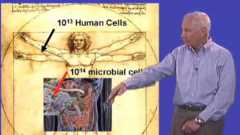
00:44:53.15And, I want to remind you that we carry an enormous number of microbial cells --
00:45:00.0310 times more than we do our own cells.
00:45:03.02And, we don't know yet what the contribution of these different organisms
00:45:10.04that we can consider normal are in health or disease
00:45:15.07because most of them have never been cultured.
00:45:18.03And indeed, we didn't know about Helicobacter pylori
00:45:20.26until about 25 years ago.
00:45:23.24So, Helicobacter pylori has decreased.
00:45:30.27It may have been a normal species of bacteria for humans
00:45:34.09that played, perhaps, a role.
00:45:36.22And we have to ask, is pylori a surrogate for other organisms
00:45:41.24that are being wiped out by human progress?
00:45:44.26So, I want to emphasize that the information is that there is a correlation between
00:45:49.17having Helicobacter and being protected against disease.
00:45:55.09Not necessarily that it is pylori itself that protected against disease.
00:46:00.14So, Helicobacter is more-or-less a marker.
00:46:03.19So, if we ask, then, have we technologically advanced to the point
00:46:09.28where we're removing organisms that once were normal parts of our flora
00:46:15.02have gone by the wayside because of antibiotics
00:46:18.14and changes in public health?
00:46:21.16And what one can look at is the following:
00:46:26.03and that is that, yes, infectious diseases have all come down over time.
00:46:31.11Tuberculosis, hepatitis, rheumatic fever, measles.
00:46:36.18On the other hand, diseases like multiple sclerosis,
00:46:39.25diabetes, and asthma, which have been called immune disorders
00:46:44.22have all come up.
00:46:46.12And so, is it that we are actually changing the human condition
00:46:55.26in terms of its microbial flora and that protective effects
00:47:00.20are being lost for protection against disease?
00:47:06.18One can only say that, if we talk about the interaction between microbes and host,
00:47:14.20and humans, included...
00:47:18.10We can quote Rene Dubos, who was a microbiologist who lived
00:47:22.25in the middle part of the last century
00:47:26.15and worked at Rockefeller University,
00:47:29.02and he was very interested in what were normal microbes.
00:47:32.22And he said that to regard any form of life
00:47:35.24as a slave or a foe will one day be considered poor philosophy,
00:47:39.29for all living things constitute an integral part of the cosmic order.
00:47:44.29So, the idea that all microbes are evil
00:47:49.15and ferocious and need to be wiped out may be an oversimplification
00:47:54.03of modern society.
00:47:56.00So, one can't give the answers to this.
00:47:59.21Helicobacter pylori is an interesting organism.
00:48:03.06CagA has taught us a fair amount about how tight junctions work
00:48:09.08and also something about how cancer can be initiated
00:48:14.13in humans.
00:48:17.03There is no doubt about it that the research will pay some dividends.
00:48:21.19I don't know where the Helicobacter, CagA story will end.
00:48:28.17It's still a work in progress.
00:48:30.05I can tell you one thing
00:48:33.10after 50 years, and that is, microbes always have the last laugh.
00:48:39.00Even if you study them carefully.
00:48:41.24