Hauser Lab
The Hauser Lab’s research program focuses on the effect of environmental chemical exposures on male and female fertility, pregnancy outcomes, women’s health, and children’s health. Of interest are chemicals that disrupt the endocrine system, called endocrine disruptors.
665 Huntington Ave.
Building 1, Room 1408
Boston, MA 02115
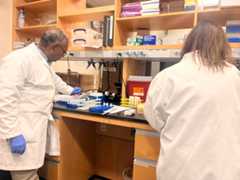
Hauser Lab Research Program
Effect of Environmental Exposures on Fertility, Pregnancy Outcomes, Women’s Health, and Children’s Health
The Hauser Lab’s research focuses on reproductive, perinatal, and pediatric epidemiology. Dr. Hauser led the NIH-funded Environment and Reproductive Health (EARTH) Study in collaboration with physicians and staff from Massachusetts General Hospital, Harvard Medical School. The study investigated the effects of chemicals classified as endocrine disruptors on male and female reproductive health endpoints. He is also conducting an NIH-funded study on the effect of maternal and paternal preconception exposures to environmental chemicals on children’s health. This study, referred to as the Preconception Environmental exposure And Childhood health Effect (PEACE) study, is co-led with faculty from Brown University School of Public Health. The goal of our research is to increase understanding of the health effects of chemical exposures so healthcare and public health professionals can use this information to educate the public, guide government policies, and improve patient care.
What We Do
The NIH-funded Environment and Reproductive Health (EARTH) Study, conducted between 2004 and 2019, was designed to explore how environmental chemicals and lifestyle factors (such as diet and stress) affect male and female fertility and pregnancy and perinatal outcomes. Women and men who sought fertility treatment at the Massachusetts General Hospital (MGH) Fertility Center were eligible for participation. Those men and women who enrolled were followed from preconception through pregnancy and delivery.
The NIH-funded Preconception Environmental Exposure and Childhood Health Effect(PEACE) Study, led in collaboration with Dr. Joe Braun of Brown University, investigates the effect of maternal and paternal preconception exposures and maternal prenatal exposures to environmental chemicals on children’s health. The PEACE Study research team collected information on somatic growth, metabolic health, and neurobehavior outcomes in children.
Dr. Hauser conducted an NIH- and EPA-funded prospective cohort study on five hundred boys in a Russian community where he investigated the relationship of exposure to environmental chemicals with boys’ growth and pubertal development. Children in this community were exposed to environmental chemicals (i.e., dioxins) due to historic environmental contamination from a large complex of chemical plants in the city. He investigated the association of lead, dioxins, PCBs, organochlorine pesticides, and phthalates measured in childhood with growth and pubertal development. The study was conducted in collaboration with Russian investigators.
Conducted between 2010 and 2018, the Mesalamine and Reproductive Health Study(MARS) investigated the relationship of high exposure to dibutyl phthalate (DBP) from the use of Asacol (mesalamine) with clinical and intermediate markers of male fertility, including semen quality, sperm DNA damage, transcript profiles of sperm messenger RNA (mRNA) and small non-coding RNAs (sncRNAs), and reproductive hormones. Men between the ages of 18 and 55 taking mesalamine medications for inflammatory bowel disease (IBD) were eligible for participation.
The Hauser Lab has also previously conducted research on environmental chemical exposures from medical equipment used in neonatal intensive care units (NICUs). They found that the use of some medical devices and equipment contributed to higher exposure to phthalates and phenols.
Dr. Hauser previously conducted an NIH- and EPA-funded prospective cohort study on five hundred boys in a Russian community, where he investigated the relationship of childhood exposure to environmental chemicals with later life testicular function and semen quality. He investigated the association of lead, dioxins, PCBs, organochlorine pesticides and phthalates measured in childhood with semen quality and sperm epigenetics in semen samples collected when the participants were young men. The study was conducted in collaboration with Russian investigators.
Our People
Russ Hauser, MD, ScD, MPH
Frederick Lee Hisaw Professor of Reproductive Physiology, Professor of Environmental and Occupational Epidemiology, Department of Environmental Health, Harvard T.H. Chan School of Public Health.

Jorge E. Chavarro, MD, ScD, ScM
Professor of Nutrition and Epidemiology, Harvard T.H. Chan School of Public Health; Faculty Affiliate in the Department of Epidemiology, Harvard T.H. Chan School of Public Health; Professor of Medicine, Brigham and Women’s Hospital, Harvard Medical School.

Jennifer Ford, BS, RN
Research Nurse Manager, Department of Environmental Health, Harvard T.H. Chan School of Public Health.

Lidia Minguez Alarcon, PhD
Department Associate – Environmental Health, Harvard T.H. Chan School of Public Health; Assistant Professor of Medicine, Brigham and Women’s Hospital, Harvard Medical School.

Paige L. Williams, PhD, MS
Senior Lecturer on Biostatistics, Harvard T.H. Chan School of Public Health.

Charles Bormann, PhD, HCLD
Director of the Vincent Embrology Laboratory, Mass General Fertility Center.
John Petrozza, MD
Chief, Division of Reproductive Medicine and IVF; Director, Massachusetts General Fertility Center; Co-Director, Massachusetts General Hospital Integrated Fibroid Program.
Irene Souter, MD
Director, Preimplantation Genetic Diagnosis Program; Physician, Mass General Fertility Center.
Current Lab Members:
Ramace Dadd – Research Assistant III

Roe Keshet – Research Assistant II

Former Lab Members:
Olivia Chagnon (2022 – 2024) – Research Assistant II
Jordana Leader (2018 – 2023) – Doctoral Student
Alex Azevedo (2017 – 2022) – Research Assistant II
Sarah Abdelmessih (2018 – 2020) – Research Assistant II
Myra Keller (2007-2019) – Research Nurse
Our Research
The relation between environmental chemical exposures and diet with male and female fertility, such as semen quality and ovarian reserve.
The relation between environmental chemical exposures and diet with pregnancy and perinatal outcomes, such as pregnancy loss, pre-term birth and low birth weight.
The relation between childhood environmental chemical exposures to organochlorine chemicals, phthalates and lead with pubertal development into adulthood (i.e. pubertal onset and sexual maturity).
Maternal and paternal preconception exposures and pregnancy exposures to environmental chemicals and their independent and joint effects on childhood growth and behavior.
Environmental chemicals used as excipients in medications and their relationship with health outcomes such as testicular function and semen quality, and thyroid hormones.
The Digital Apple Women’s Health Study is designed to understand the impact of demographic and lifestyle factors on menstrual cycles and gynecologic conditions including infertility, menopause, and polycystic ovary syndrome (PCOS).
Publications






Time-varying exposure to air pollution and outcomes of in vitro fertilization among couples from a fertility clinic
Resources
Unleash your potential at Harvard Chan School.
In addition to our degree programs, we offer highly targeted executive and continuing education, directed and taught by Harvard faculty.