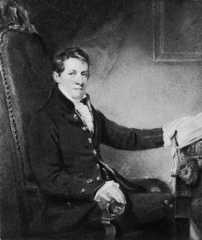
HUMPHRY DAVY.
ÆTAT 45.
(From a painting by Jackson)
Transcriber’s Note
Cover created by Transcriber and placed in the Public Domain.
THE CENTURY SCIENCE SERIES
Edited by SIR HENRY E. ROSCOE, D.C.L., LL.D., F.R.S.
EDITED BY
SIR HENRY E. ROSCOE, D.C.L., F.R.S.
John Dalton and the Rise of Modern Chemistry.
By SirHenry E. Roscoe, F.R.S.Major Rennell, F.R.S., and the Rise of EnglishGeography.
By SirClements R. Markham, C. B., F.R.S., Presidentof the Royal Geographical Society.Justus von Liebig: his Life and Work (1803–1873).
ByW. A. Shenstone, F.I.C., Lecturer on Chemistry inClifton College.The Herschels and Modern Astronomy.
ByAgnes M. Clerke, Author of “A Popular Historyof Astronomy during the 19th Century,” &c.Charles Lyell and Modern Geology.
By Rev. ProfessorT. G. Bonney, F.R.S.James Clerk Maxwell and Modern Physics.
ByR. T. Glazebrook, F.R.S., Fellow of Trinity College,Cambridge.Humphry Davy, Poet and Philosopher.ByT. E. Thorpe, LL.D., F.R.S., Principal Chemist ofthe Government Laboratories.
In Preparation.
Michael Faraday: his Life and Work.
By ProfessorSilvanus P. Thompson, F.R.S.Pasteur: his Life and Work.
ByM. Armand Ruffer, M.D., Director of the BritishInstitute of Preventive Medicine.Charles Darwin and the Origin of Species.
ByEdward B. Poulton, M.A., F.R.S., Hope Professorof Zoology in the University of Oxford.Hermann von Helmholtz.
ByA. W. Rücker, F.R.S., Professor of Physics in theRoyal College of Science, London.
MACMILLAN & CO.,Limited,New York.
HUMPHRY DAVY.
ÆTAT 45.
(From a painting by Jackson)
THE CENTURY SCIENCE SERIES
Humphry Davy
POET AND PHILOSOPHER
BY
T. E. THORPE, LL.D., F.R.S.
New York
MACMILLAN & CO.,Limited
1896
For the details of Sir Humphry Davy’s personal history, asset forth in this little book, I am mainly indebted to thewell-known memoirs by Dr. Paris and Dr. John Davy. Asbiographies, these works are of very unequal value. To beginwith, Dr. Paris is not unfrequently inaccurate in his statementsas to matters of fact, and disingenuous in his inferencesas to matters of conduct and opinion. The very extravaganceof his laudation suggests a doubt of his judgment or of hissincerity, and this is strengthened by the too evident relishwith which he dwells upon the foibles and frailties of hissubject. The insincerity is reflected in the literary style ofthe narrative, which is inflated and over-wrought. Sir WalterScott, who knew Davy well and who admired his genius andhis many social gifts, characterised the book as “ungentlemanly”in tone; and there is no doubt that it gave pain to manyof Davy’s friends who, like Scott, believed that justice hadnot been done to his character.
Dr. Davy’s book, on the other hand, whilst perhaps toopartial at times—as might be expected from one who writesof a brother to whom he was under great obligations, andfor whom, it is evident, he had the highest respect andaffection—is written with candour, and a sobriety of toneand a directness and simplicity of statement far more effectivethan the stilted euphuistic periods of Dr. Paris, even whenhe seeks to be most forcible. When, therefore, I have hadto deal with conflicting or inconsistent statements in the twoworks on matters of fact, I have generally preferred to acceptthe version of Dr. Davy, on the ground that he had access tosources of information not available to Dr. Paris.
Davy played such a considerable part in the social andintellectual world of London during the first quarter of thecentury that, as might be expected, his name frequentlyoccurs in the personal memoirs and biographical literatureof his time; and a number of journals and diaries, such asthose of Horner, Ticknor, Henry Crabb Robinson, Lockhart,Maria Edgeworth, and others that might be mentioned, makereference to him and his work, and indicate what his contemporariesthought of his character and achievements. Someviof these references will be found in the following pages. Itwill surprise many Londoners to know that they owe theZoological Gardens, in large measure, to a Professor ofChemistry in Albemarle Street, and that the magnificentestablishment in the Cromwell Road, South Kensington, isthe outcome of the representations, unsuccessful for a time,which he made to his brother trustees of the British Museumas to the place of natural history in the national collections.Davy had a leading share also in the foundation of theAthenæum Club, and was one of its first trustees.
I am further under very special obligations to Dr.Humphry D. Rolleston, the grand-nephew of Sir HumphryDavy, for much valuable material, procured through thekind co-operation of Miss Davy, the granddaughter ofDr. John Davy. This consisted of letters from Priestley,Kirwan, Southey, Coleridge, Maria Edgeworth, Mrs. Beddoes(Anna Edgeworth), Sir Joseph Banks, Gregory Watt, andothers; and, what is of especial interest to his biographer, alarge number of Davy’s own letters to his wife. In addition werepapers relating to the invention of the Safety Lamp. Some ofthe letters have already been published by Dr. John Davy,but others now appear in print for the first time. I am alsoindebted to Dr. Rolleston for the loan of the portrait representingDavy in Court dress and in the presidential chair of theRoyal Society, which, reproduced in photogravure, forms thefrontispiece to this book. The original is a small highly-finishedwork by Jackson, and was painted about 1823. Thepicture originally belonged to Lady Davy, who refers to itin the letter to Davies Gilbert (quoted by Weld in his“History of the Royal Society”), in which she offersLawrence’s well-known portrait to the Society, and which,by the way, the Society nearly lost through the subsequentaction of the painter.
For the references to the early history of the RoyalInstitution I am mainly indebted to Dr. Bence Jones’s book.I have, moreover, to thank the Managers of the Institutionfor their kindness in giving me permission to see the minutesof the early meetings, and also for allowing me to consult themanuscripts and laboratory journals in their possession. Theseinclude the original records of Davy’s work, and also the notestaken by Faraday of his lectures. The Managers have alsoallowed me to reproduce Miss Harriet Moore’s sketch—firstviibrought to my notice by Professor Dewar—of the chemicallaboratory of the Institution as it appeared in the time ofDavy and Faraday, and I have to thank them for the loanof Gillray’s characteristic drawing of the Lecture Theatre, fromwhich the illustration on p.70 has been prepared.
I have necessarily had to refer to the relations of Davy toFaraday, and I trust I have said enough on that subject.Indeed, in my opinion, more than enough has been saidalready. It is not necessary to belittle Davy in order to exaltFaraday; and writers who, like Dr. Paris, unmindful of GeorgeHerbert’s injunction, are prone to adopt an antithetical stylein biographical narrative have, I am convinced, done Davy’smemory much harm.
I regret that the space at my command has not allowedme to go into greater detail into the question of GeorgeStephenson’s relations to the invention of the safety lamp.I have had ample material placed at my disposal for a discussionof the question, and I am specially indebted to Mr.John Pattinson and the Council of the Literary and PhilosophicalSociety of Newcastle-upon-Tyne for their kindness inlending me a rare, if not unique, collection of pamphletsand reprints of newspaper articles which made their appearancewhen the idea of offering Davy some proof of the valuewhich the coal owners entertained of his invention was firstpromulgated. George Stephenson’s claims are not to be dismissedsummarily as pretensions. Indeed, his behaviourthroughout the whole of the controversy increases one’s respectfor him as a man of integrity and rectitude, conscious ofwhat he thought due to himself, and showing only a properassurance in his own vindication. I venture to think, however,that the conclusion to which I have arrived, andwhich, from the exigencies of space, is, I fear, somewhatbaldly stated, as to the apportionment of the merit of thismemorable invention, is just and can be well established.Stephensonmight possibly have hit upon a safety lamp ifhe had been allowed to work out his own ideas independentlyand by the purely empirical methods he adopted, and it isconceivable that his lampmight have assumed its presentform without the intervention of Davy; but it is difficultto imagine that an unlettered man, absolutely without knowledgeof physical science, could have discovered the philosophicalprinciple upon which the security of the lamp depends.
T. E. T.
May, 1896.
| CHAPTER | PAGE |
| I.—Penzance: 1778–1798 | 9 |
| II.—The Pneumatic Institution, Bristol: 1798–1801 | 26 |
| III.—The Pneumatic Institution, Bristol: 1798–1801 (continued) | 54 |
| IV.—The Royal Institution | 66 |
| V.—The Chemical Laboratory of the Royal Institution | 90 |
| VI.—The Isolation of the Metals of the Alkalis | 110 |
| VII.—Chlorine | 134 |
| VIII.—Marriage—Knighthood—“Elements of Chemical Philosophy”—Nitrogen Trichloride—Fluorine | 155 |
| IX.—Davy and Faraday—Iodine | 173 |
| X.—The Safety Lamp | 192 |
| XI.—Davy and the Royal Society—His Last Days | 213 |
Humphry Davy, the eldest son of “Carver” RobertDavy and his wife Grace Millett, was born on the 17thDecember, 1778.A His biographers are not wholly agreedas to the exact place of his birth. In the “Lives ofPhilosophers of the Time of George III.” Lord Broughamstates that the great chemist was born at Varfell, ahomestead or “town-place” in the parish of Ludgvan,in the Mount’s Bay, where, as the registers and tombstonesof Ludgvan Church attest, the family had beensettled for more than two hundred years.
A In some biographical notices—e.g. in theGentleman’s Magazine,xcix. pt. ii. 9—the year is given as 1779.
Mr. Tregellas, in his “Cornish Worthies” (vol. i.,p. 247), also leaves the place uncertain, hesitating,apparently, to decide between Varfell and Penzance.
According to Dr. John Davy, his brother Humphrywas born in Market Jew Street, Penzance, in a housenow pulled down, but which was not far from the statueof him that stands in front of the Market House ofthis town. Dr. Davy further states that Humphry’sparents removed to Varfell some years after his birth,when he himself was taken charge of by a Mr. Tonkin.
10The Davys originally belonged to Norfolk. Thefirst member of the family that settled in Cornwallwas believed to have acted as steward to the Dukeof Bolton, who in the time of Elizabeth had a considerableproperty in the Mount’s Bay. They were,as a class, respectable yeomen in fairly comfortablecircumstances, who for generations back had receiveda lettered education. They took to themselves wivesfrom the Eusticks, Adamses, Milletts, and other oldCornish families, and, if we may credit the testimonyof the tombstones, had many virtues, were not overgivento smuggling or wrecking, and, for the mostpart, died in their own beds.
The grandfather of Humphry, Edmund Davy, wasa builder of repute in the west of Cornwall, who marriedwell and left his eldest son Robert, the father of thechemist, in possession of the small copyhold propertyof Varfell, to which reference has already been made.Robert, although a person of some capacity, seemsto have been shiftless, thriftless, and lax in habits.In his youth he had been taught wood-carving, andspecimens of his skill are still to be seen in and aboutPenzance. But he practised his art in an irregularfashion, his energies being mainly spent in fieldsports, in unsuccessful experiments in farming, and inhazardous, and for the most part fruitless, venturesin mining. At his death, which occurred when hewas forty-eight, his affairs were found to be sadlyembarrassed; his widow and five children were left invery straitened circumstances, and Varfell had to begiven up.
Fortunately for the children, the mother possessedthe qualities which the father lacked. Casting aboutfor the means of bringing up and educating her family,11she opened a milliner’s shop in the town, in partnershipwith a French lady who had fled to England duringthe Revolution.
By prudence, good management, and the forbearanceof creditors, she not only succeeded in rearing andeducating her children, but gradually liquidated thewhole of her husband’s debts. Some years later, by anunexpected stroke of fortune, she was able to relinquishher business. She lived to a good old age, cheerfuland serene, happy in the respect and affection of herchildren and in the esteem and regard of her townspeople.Such a woman could not fail to exercise astrong and lasting influence for good on her children.That it powerfully affected the character of her sonHumphry, he would have been the first to admit.Nothing in him was more remarkable or more beautifulthan his strong and abiding love for his mother. Nomatter how immersed he was in his own affairs, hecould always find time amidst the whirl and excitementof his London life, amidst the worry and anxiety ofofficial cares—or, when abroad, among the peaks of theNoric Alps or the ruins of Italian cities—to think ofhis far-away Cornish home and of her round whom itwas centred. To the last he opened out his heart toher as he did to none other; she shared in all hisaspirations, and lived with him through his triumphs;and by her death, just a year before his own, she washappily spared the knowledge of his physical decay andapproaching end.
Davy was about sixteen years of age when his fatherdied. At that time he was a bright, curly-haired,hazel-eyed lad, somewhat narrow-chested and undergrown,awkward in manner and gait, but keenly fond12of out-door sport, and more distinguished for a love ofmischief than of learning.
Dr. Cardew, of the Truro Grammar School, where,by the kindness of the Tonkins, he spent the yearpreceding his father’s death, wrote of him that he didnot at that time discover any extraordinary abilities,or, so far as could be observed, any propensity to thosescientific pursuits which raised him to such eminence.“His best exercises were translations from the classicsinto English verse.” He had previously spent nineyears in the Penzance Grammar School under thetyranny of the Rev. Mr. Coryton, a man of irregularhabits and as deficient in good method as in scholarship.As Davy used to come up for the customarycastigation, the worthy follower of Orbilius was wont torepeat—
He had, too, an unpleasant habit of pulling the boys’ears, on the supposition, apparently, that their receptivityfor oral instruction was thereby stimulated. Itis recorded that on one occasion Davy appeared beforehim with a large plaster on each ear, explaining, witha very grave face, that he had “put the plasters on toprevent mortification.” Whence it may be inferredthat, in spite of all the caning and the ear-pulling,there was still much of the unregenerate Adam left in“good Master Davy.”
Mr. Coryton’s method of inculcating knowledge andthe love of learning, happily, had no permanent ill-effecton the boy. Years afterwards, when reflecting on hisschool-life, he wrote, in a letter to hismother—
“After all, the way in which we are taught Latin and Greekdoes not much influence the important structure of our minds. Iconsider it fortunate that I was left much to myself when a child,and put upon no particular plan of study, and that I enjoyed muchidleness at Mr. Coryton’s school. I perhaps owe to these circumstancesthe little talents that I have and their peculiar application.”
If Davy’s abilities were not perceived by his masters,they seemed to have been fully recognised by his school-fellows—tojudge from the frequency with which theysought his aid in their Latin compositions, and fromthe fact that half the love-sick youths of Penzanceemployed him to write their valentines and letters.His lively imagination, strong dramatic power, and retentivememory combined to make him a good story-teller,and many an evening was spent by his comradesbeneath the balcony of the Star Inn, in Market JewStreet, listening to his tales of wonder or horror, gatheredfrom the “Arabian Nights” or from his grandmotherDavy, a woman of fervid mind stored with traditionsand ancient legends, from whom he seems to havederived much of his poetic instinct.
Those who would search in environment for theconditions which determine mental aptitudes, will findit very difficult to ascertain what there was in Davy’sboyish life in Penzance to mould him into a naturalphilosopher. At school he seems to have acquirednothing beyond a smattering of elementary mathematicsand a certain facility in turning Latin into Englishverse. Most of what he obtained in the way of generalknowledge he picked up for himself, from such books ashe found in the library of his benefactor, Mr. JohnTonkin. Dr. John Davy has left us a sketch of thestate of society in the Mount’s Bay during the latter partof the eighteenth century, which serves to show how unfavourable14was the soil for the stimulation and developmentof intellectual power. Cornwall at that time hadbut little commerce; and beyond the tidings carried bypedlars or ship-masters, or contained in theSherborneMercury—the only newspaper which then circulated inthe west of England—it knew little or nothing of whatwas going on in the outer world. Its roads were mostlymere bridle-paths, and a carriage was as little known inPenzance as a camel. There was only one carpet inthe town, the floors of the rooms being, as a rule, sprinkledwith sea-sand:—
“All classes were very superstitious; even the belief in witchesmaintained its ground, and there was an almost unboundedcredulity respecting the supernatural and monstrous....Amongst the middle and higher classes there was little taste forliterature and still less for science, and their pursuits wererarely of a dignified or intellectual kind. Hunting, shooting,wrestling, cock-fighting, generally ending in drunkenness, werewhat they most delighted in. Smuggling was carried on to agreat extent, and drunkenness and a low scale of morals werenaturally associated with it.”
Davy, an ardent, impulsive youth of strong socialinstincts, fond of excitement, and not over studious,seems, now that he was released from the restraint ofschool-life, to have come under the influence of suchsurroundings. For nearly a year he was restless andunsettled, spending much of his time like his father inrambling about the country and in fishing and shooting,and passing from desultory study to occasional dissipation.The death of his father, however, made aprofound impression on his mind, and suddenly changedthe whole course of his conduct. As the eldest son,and approaching manhood, he seems at once to haverealised what was due to his mother and to himself.The circumstances of the family supplied the stimulus15to exertion, and he dried his mother’s tears with theassurance that he would do all in his power for hisbrothers and sisters. A few weeks after the deceaseof his father he was apprenticed to Mr. Bingham Borlase,an apothecary and surgeon practising in Penzance, andat once marked out for himself a course of study andself-tuition almost unparalleled in the annals of biography,and to which he adhered with a strength of mind andtenacity of purpose altogether unlooked for in one of hisyears and of his gay and careless disposition. That itwas sufficiently ambitious will be evident from thefollowing transcript from the opening pages of hisearliest note-book—a small quarto, with parchmentcovers, dated 1795:—
1. Theology,
or Religion, } { taught by Nature;
Ethics or Moral virtues } { by Revelation.
2. Geography.
3. My Profession.
1. Botany.
2. Pharmacy.
3. Nosology.
4. Anatomy.
5. Surgery.
6. Chemistry.
4. Logic.
5. Languages.
1. English.
2. French.
3. Latin.
4. Greek.
5. Italian.
6. Spanish.
7. Hebrew.
6. Physics.
1. The doctrines and properties of natural bodies.
2. Of the operations of nature.
3. Of the doctrines of fluids.
4. Of the properties of organised matter.
5. Of the organisation of matter.
6. Simple astronomy.
7. Mechanics.
8. Rhetoric and Oratory.
9. History and Chronology.
10. Mathematics.
The note-book opens with “Hints Towards the Investigationof Truth in Religious and Political Opinions, composedas they occurred, to be placed in a more regular16manner hereafter.” Then follow essays “On the Immortalityand Immateriality of the Soul”; “Body, OrganisedMatter”; on “Governments”; on “The Credulity ofMortals”; “An Essay to Prove that the ThinkingPowers depend on the Organisation of the Body”; “ADefence of Materialism”; “An Essay on the UltimateEnd of Being”; “On Happiness”; “On Moral Obligation.”
These early essays display the workings of an originalmind, intent, it may be, on problems beyond its immaturepowers, but striving in all sincerity to work out its ownthoughts and to arrive at its own conclusions. Of course,the daring youth of sixteen who enters upon an inquiryinto the most difficult problems of theology and metaphysics,with, what he is pleased to call, unprejudicedreason as his sole guide, quickly passes into a cold fitof materialism. His mind was too impressionable, however,to have reached the stage of settled convictions;and in the same note-book we subsequently find theheads of a train of argument in favour of a rationalreligious belief founded on immaterialism.
Metaphysical inquiries seem, indeed, to have occupiedthe greater part of his time at this period; and his note-booksshow that he made himself acquainted with thewritings of Locke, Hartley, Bishop Berkeley, Hume, Helvetius,Condorcet, and Reid, and that he had some knowledgeof the doctrines of Kant and the Transcendentalists.
That he thought for himself, and was not undulyswayed by authority, is evident from the general tenourof his notes, and from the critical remarks and commentsby which they are accompanied. Some of these areworthquoting:—
“Science or knowledge is the association of a number of ideas,with some idea or term capable of recalling them to the mind ina certain order.”
17“By examining the phenomena of Nature, a certain similarityof effects is discovered. The business of science is to discoverthese effects, and to refer them to some common cause; that isto generalise ideas.”
As his impulsive, ingenuous disposition led him, evento the last, to speak freely of what was uppermost inhis mind at the moment, we may be sure that his elders,the Rev. Dr. Tonkin, his good friend John Tonkin, andhis grandmother Davy, with whom he was a greatfavourite, as he was with most old people, must havebeen considerably exercised at times with the metaphysicaldisquisitions to which they were treated; andwe can well imagine that their patience was occasionallyas greatly tried as that of the worthy member of theSociety of Friends who wound up an argument with theremark, “I tell thee what, Humphry, thou art the mostquibbling hand at a dispute I ever met with in my life.”Whether it was in revenge for this sally that the youngdisputant composed the “Letter on the Pretended Inspirationof the Quakers” which is to be found in oneof his early note-books, does not appear.
We easily trace in these early essays the evidencesof that facility and charm of expression which a fewyears later astonished and delighted his audiences atthe Royal Institution, and which remained the characteristicfeatures of his literary style. These qualities werein no small degree strengthened by his frequent exercisesin poetry. For Davy had early tasted of the Pierianspring, and, like Pope, may be said to have lisped innumbers. At five he was animprovisatore, recitinghis rhymes at some Christmas gambols, attired in afanciful dress prepared by a playful girl who was relatedto him. That he had the divine gift was acknowledgedby no less an authority than Coleridge, who18said that “if Davy had not been the first Chemist, hewould have been the first Poet of his age.” Southeyalso, who knew him well, said after his death, “Davywas a most extraordinary man; he would have excelledin any department of art or science to which he haddirected the powers of his mind. He had all theelements of a poet; he only wanted the art. I haveread some beautiful verses of his. When I went toPortugal, I left Davy to revise and publish my poem of‘Thalaba.’”
Throughout his life he was wont, when deeplymoved, to express his feelings in verse; and at timeseven his prose was so suffused with the glow of poetrythat to some it seemed altiloquent and inflated. Someof his first efforts appeared in the “Annual Anthology,”a work printed in Bristol in 1799, and edited by Southeyand Tobin, and interesting to the book-hunter as oneof the first of the literary “Annuals” which subsequentlybecame so fashionable.
Davy had an intense love of Nature, and nothingstirred the poetic fire within him more than the sightof some sublime natural object such as a storm-beatencliff, a mighty mountain, a resistless torrent, or somespectacle which recalled the power and majesty of thesea. Not that he was insensible to the simpler charmsof pastoral beauty, or incapable of sympathy withNature in her softest, tenderest moods. But thesethings never seemed to move him as did some scene ofgrandeur, or some manifestation of stupendous naturalenergy.
The following lines, written on Fair Head duringthe summer of 1806, may serve as an example of howscenery when associated in his mind with the sentimentsof dignity or strength affectedhim:—
In spite of a love-passage which seems to haveprovoked a succession of sonnets, his devotions toCalliope were by no means so unremitting as to preventhim from following the plan of study he had markedout for himself. His note-books show that in the earlypart of 1796 he attacked the mathematics, and withsuch ardour that in little more than a year he hadworked through a course of what he called “MathematicalRudiments,” in which he included “fractions,vulgar and decimal; extraction of roots; algebra (as faras quadratic equations); Euclid’s elements of geometry;trigonometry; logarithms; sines and tangents; tables;application of algebra to geometry, etc.”
In 1797 he began the study of natural philosophy,and towards the end of this year, when he was close onnineteen, he turned his attention to chemistry, merely,however, at the outset as a branch of his professionaleducation, and with no other idea than to acquainthimself with its general principles. His good fortuneled him to select Lavoisier’s “Elements”—probably Kerr’stranslation, published in 1796—as his text-book. Nochoice could have been happier. The book is well suited20to a mind like Davy’s, and he could not fail to be impressedby the boldness and comprehensiveness of itstheory, its admirable logic, and the clearness and precisionof its statements.
From reading and speculation he soon passed toexperiment. But at this time he had never seen achemical operation performed, and had little or no acquaintancewith even as much as the forms of chemicalapparatus. Phials, wine-glasses, tea-cups, and tobacco-pipes,with an occasional earthen crucible, were all theparaphernalia he could command; the common mineralacids, the alkalis, and a few drugs from the surgeryconstituted his stock of chemicals. Of the nature ofthese early trials we know little. It is, however, almostcertain that the experiments with sea-weed, described inhis two essays “On Heat, Light and the Combinationsof Light” and “On the Generation of Phosoxygen andthe Causes of the Colours of Organic Beings” (see p.30),were made at this time, and it is highly probable thatthe experiments on land-plants, which are directly relatedto those on theFuci and are described in connectionwith them, were made at the same period. That hepursued his experiments with characteristic ardour isborne out by the testimony of members of his family,particularly by that of his sister, who sometimes actedas his assistant, and whose dress too frequently sufferedfrom the corrosive action of his chemicals. The goodMr. Tonkin and his worthy brother, the Reverend Doctor,were also from time to time abruptly and unexpectedlymade aware of his zeal. “This boy Humphry is incorrigible!He will blow us all into the air!” were occasionalexclamations heard to follow the alarming noises whichnow and then proceeded from the laboratory. The well-knownanecdote of the syringe which had formed part21of a case of instruments of a shipwrecked Frenchsurgeon, and which Davy had ingeniously convertedinto an air-pump, although related by Dr. Paris “witha minuteness and vivacity worthy of Defoe,” is, in allprobability, apocryphal. Nor has Lord Brougham’s story,that his devotion to chemical experiments and “his disliketo the shop” resulted in a disagreement with hismaster, and that “he went to another in the sameplace,” where “he continued in the same course,” anysurer foundation in fact.
Two or three circumstances conduced to developDavy’s taste for scientific pursuits, and to extend hisopportunities for observation and experiment. One washis acquaintance with Mr. Gregory Watt; another washis introduction to Mr. Davies Gilbert (then Mr. DaviesGiddy), a Cornish gentleman of wealth and position,who lived to succeed him in the presidential chair ofthe Royal Society.
Gregory Watt, the son of James Watt, the engineer,by his second marriage, was a young man of singularpromise who, had he lived, would—if we may judgefrom his paper in thePhilosophical Transactions—havealmost certainly acquired a distinguished position inscience. Of a weakly, consumptive habit, he was orderedto spend the winter of 1797 in Penzance, where helodged with Mrs. Davy, boarding with the family.Young Watt was about two years older than Davy, andhad just left the University of Glasgow, “his mindenriched beyond his age with science and literature,with a spirit above the little vanities and distinctionsof the world, devoted to the acquisition of knowledge.”He remained in Penzance until the following spring, andby his example, and by the generous friendship whichhe extended towards him, he developed and strengthened22Davy’s resolve to devote himself to science. Davy’sintroduction to Mr. Gilbert, “a man older than himself,with considerable knowledge of science generally, andwith the advantages of a University education,” was alsoa most timely and propitious circumstance. Accordingto Dr.Paris—
“Mr. Gilbert’s attention was attracted to the future philosopher,as he was carelessly swinging over the hatch, or half-gate, of Mr.Borlase’s house, by the humorous contortions into which he threwhis features. Davy it may be remarked, when a boy, possessed acountenance which even in its natural state was very far fromcomely; while his round shoulders, inharmonious voice and insignificantmanner, were calculated to produce anything ratherthan a favourable impression: in riper years, he was what mightbe called ‘good-looking,’ although as a wit of the day observed,his aspect was certainly of the ‘bucolic’ character. The changewhich his person underwent, after his promotion to the RoyalInstitution, was so rapid that in the days of Herodotus, it wouldhave been attributed to nothing less than the miraculous interpositionof the Priestesses of Helen. A person, who happened tobe walking with Mr. Gilbert upon the occasion alluded to, observedthat the extraordinary looking boy in question was young Davy,the carver’s son, who, he added, was said to be fond of makingchemical experiments.”
Mr. Gilbert was thus led to interest himself in theboy, whom he invited to his house at Tredrea, offeringhim the use of his library, and such other assistance inhis studies as he could render. On one occasion he wastaken over to the Hayle Copper-House, and had theopportunity of seeing a well-appointed laboratory:
“The tumultuous delight which Davy expressed on seeing, forthe first time, a quantity of chemical apparatus, hitherto onlyknown to him through the medium of engravings, is described byMr. Gilbert as surpassing all description. The air-pump moreespecially fixed his attention, and he worked its piston, exhaustedthe receiver, and opened its valves, with the simplicity and joy ofa child engaged in the examination of a new and favourite toy.”
23It has already been stated that in the outset Davyattacked science as he did metaphysics, approaching itfrom the purely theoretical side. As might be surmised,his love of speculation quickly found exercise for itself,and within four months of his introduction to the studyof science he had conceived and elaborated a newhypothesis on the nature of heat and light, which hecommunicated to Dr. Beddoes.
Dr. Thomas Beddoes was by training a medical man,who in various ways had striven to make a name forhimself in science. He is known to the chemical bibliographeras the translator of the Chemical Essays ofScheele, and at one time occupied the Chair of Chemistryat Oxford. The geological world at the end of theeighteenth century regarded him as a zealous and uncompromisingPlutonist. His character was thus describedby Davy, who in the last year of his life jotteddown, in the form of brief notes, his reminiscences ofsome of the more remarkable men of hisacquaintance:—
“Beddoes was reserved in manner and almost dry; but hiscountenance was very agreeable.He was cold in conversation,and apparently much occupied with his own peculiar views andtheories. Nothing could be a stronger contrast to his apparentcoldness in discussion than his wild and active imagination,which was as poetical as Darwin’s.... On his deathbedhe wrote me a most affecting letter, regretting his scientificaberrations.”
One of Dr. Beddoes’s “scientific aberrations” was theinception and establishment of the Pneumatic Institution,which he founded with a view of studying the medicinaleffects of the different gases, in the sanguine hope thatpowerful remedies might be found amongst them. TheInstitution, which was supported wholly by subscription,was to be provided with all the means likely to promote24its objects—a hospital for patients, a laboratory forexperimental research, and a theatre for lecturing.
In seeking for a person to take charge of the laboratory,Dr. Beddoes bethought him of Davy, who had beenrecommended to him by Mr. Gilbert. In a letter datedJuly 4th, 1798, Dr. Beddoes thus writes to Mr.Gilbert:—
“I am glad that Mr. Davy has impressed you as he has me.I have long wished to write to you about him, for I think I canopen a more fruitful field of investigation than any body else.Is it not also his most direct road to fortune? Should he notbring out a favourable result he may still exhibit talents forinvestigation, and entitle himself to public confidence moreeffectually than by any other mode. He must be maintained,but the fund will not furnish a salary from which a man canlay up anything. He must also devote his time for two orthree years to the investigation. I wish you would conversewith him upon the subject.... I am sorry I cannot at thismoment specify a yearly sum, nor can I say with certaintywhether all the subscribers will accede to my plan; most of themwill, I doubt not. I have written to the principal ones, and willlose no time in sounding them all.”
A fortnight later, Dr. Beddoes again wrote to Mr.Gilbert:—
“I have received a letter from Mr. Davy since I wrote toyou. He has oftener than once mentioned agenteel maintenance,as a preliminary to his being employed to superintend thePneumatic Hospital. I fear the funds will not allow an amplesalary; he must however be maintained. I can attach no ideato the epithetgenteel, but perhaps all difficulties would vanishin conversation; at least I think your conversing with Mr. Davywill be a more likely way of smoothing difficulties than our correspondence.It appears to me, that this appointment will bearto be considered as a part of Mr. Davy’s medical education,and that it will be a great saving of expense to him. It mayalso be the foundation of a lucrative reputation; and certainlynothing on my part shall be wanting to secure to him the credithe may deserve. He does not undertake to discover cures for25this or that disease; he may acquire just applause by bringingout clear, though negative results. During my journeys intothe country I have picked up a variety of important and curiousfacts from different practitioners. This has suggested to me theidea of collecting and publishing such facts as this part of thecountry will from time to time afford. If I could procure chemicalexperiments that bore any relation to organised nature, I wouldinsert them. If Mr. Davy does not dislike this method ofpublishing his experiments I would gladly place them at thehead of my first volume, but I wish not that he should makeany sacrifice of judgment or inclination.”
Thanks to Mr. Gilbert, the negotiation was broughtto a successful issue. Mrs. Davy yielded to her son’swishes, and Mr. Borlase surrendered his indenture, onthe back of which he wrote that he released him from“all engagements whatever on account of his excellentbehaviour”; adding, “because being a youth of greatpromise, I would not obstruct his present pursuits, whichare likely to promote his fortune and his fame.” Theonly one of his friends who disapproved of the schemewas his old benefactor, Mr. John Tonkin, who had hopedto have established Davy in his native town as a surgeon.Mr. Tonkin was so irritated at the failure of his plansthat he altered his will, and revoked the legacy of hishouse, which he had bequeathed to him.
On October 2nd, 1798, Davy set out for Clifton with suchbooks and apparatus as he possessed, and the MSS. ofhis essays on Heat and Light safely stowed away amonghis baggage. He was in the highest spirits, and full ofconfidence in the future. On his way through Okehamptonhe met the London coach decked with laurelsand ribbons, and bringing the news of Nelson’s victory ofthe Nile, which he interpreted as a happy omen. A fewdays after his arrival, he thus wrote to hismother:—
“October 11th, 1798. Clifton.
“My dear Mother,—I have now a little leisure time, andI am about to employ it in the pleasing occupation of communicatingto you an account of all thenew andwonderfulevents that have happened to me since my departure.
“I suppose you received my letter, written in a great hurrylast Sunday, informing you of my safe arrival and kind reception.I must now give you a more particular account of Clifton, theplace of my residence, and of my new friends Dr. and Mrs.Beddoes and their family.
“Clifton is situated on the top of a hill, commanding a viewof Bristol and its neighbourhood, conveniently elevated abovethe dirt and noise of the city. Here are houses, rocks, woods,town and country in one small spot; and beneath us, the sweetly-flowingAvon, so celebrated by the poets. Indeed there canhardly be a more beautiful spot; it almost rivals Penzance andthe beauties of Mount’s Bay.
“Our house is capacious and handsome; my rooms are verylarge, nice and convenient; and, above all, I have an excellentlaboratory. Now for the inhabitants, and, first, Dr. Beddoes,27who, between you and me, is one of the most original men I eversaw—uncommonly short and fat, with little elegance of manners,and nothing characteristicexternally of genius or science;extremely silent, and in a few words, a very bad companion.His behaviour to me, however, has been particularly handsome.He has paid me the highest compliments on my discoveries,and has, in fact, become a convert to my theory, which I littleexpected. He has given up to me the whole of the businessof the Pneumatic Hospital, and has sent to the editor of theMonthly Magazine a letter, to be published in November, inwhich I have the honour to be mentioned in the highest terms.Mrs. Beddoes is the reverse of Dr. Beddoes—extremely cheerful,gay and witty; she is one of the most pleasing women I haveever met with. With a cultivated understanding and an excellentheart, she combines an uncommon simplicity of manners. We arealready very great friends. She has taken me to see all the finescenery about Clifton; for the Doctor, from his occupations andhis bulk, is unable to walk much. In the house are two sonsand a daughter of Mr. Lambton, very fine children, from five tothirteen years of age.
“I have visited Mr. Hare, one of the principal subscribers tothe Pneumatic Hospital, who treated me with great politeness.I am now very much engaged in considering of the erection ofthe Pneumatic Hospital, and the mode of conducting it. I shallgo down to Birmingham to see Mr. Watt and Mr. Keir in abouta fortnight, where I shall probably remain a week or ten days;but before then you will again hear from me. We are just goingto print at Cottle’s; in Bristol, so that my time will bemuch taken up the ensuing fortnight in preparations for thepress. The theatre for lecturing is not yet open; but, if I canget a large room in Bristol, and subscribers, I intend to give acourse of chemical lectures, as Dr. Beddoes seems much towish it.
“My journey up was uncommonly pleasant; I had the goodfortune to travel all the way with acquaintances. I came intoExeter in a most joyful time, the celebration of Nelson’s victory.The town was beautifully illuminated, and the inhabitants loyaland happy....
“It will give you pleasure when I inform you that all myexpectations are answered and that my situation is just what I28could wish. But, for all this, I very often think of Penzance andmy friends, with a wish to be there; however that time willcome. We are some time before we become accustomed to newmodes of living and new acquaintances.
“Believe me, your affectionate son,
“Humphry Davy.”
Mrs. Beddoes, of whom Davy speaks in such appreciativeterms, was one of the many sisters of MariaEdgeworth. She seems to have possessed much of theintelligence, wit, vivacity, and sunny humour of theaccomplished authoress of “Castle Rackrent”; and, byher charm of manner and her many social gifts, to havemade her husband’s house the centre of the literary andintellectual life of Clifton. Thanks to her influence,Davy had the good fortune to be brought into contact,at the very outset of his career, with Southey, Coleridge,the Tobins, Miss Edgeworth, and other notable literarymen and women of his time, with many of whom heestablished firm and enduring friendships. He hadalways a sincere admiration for his fair patroness, anda grateful memory of her many acts of kindness to himat this period of his life. That she in turn had anesteem amounting to affection for the gifted youth isevident from the language of tender feeling and warmregard in which her letters to him are expressed.The sonnets accompanying these letters are couchedin terms which admit of no doubt of the strength ofher sentiments of sympathy and admiration, and someof the best efforts of his muse were addressed to herin return.
His work and prospects at the Pneumatic Institutionare sufficiently indicated in the following letter to hisfriend and patron, Mr. Davies Gilbert, written five weeksafter his arrival atClifton:—
“Clifton,November 12, 1798.
“Dear Sir,—I have purposely delayed writing until I couldcommunicate to you some intelligence of importance concerningthe Pneumatic Institution. The speedy execution of the planwill, I think, interest you both as a subscriber and a friend toscience and mankind. The present subscription is, we supposenearly adequate to the purpose of investigating the medicinalpowers of factitious airs; it still continues to increase, and wemay hope for the ability of pursuing the investigation to its fullextent. We are negotiating for a house in Dowrie Square, theproximity of which to Bristol, and its general situation andadvantages, render it very suitable to the purpose. The fundswill, I suppose, enable us to provide for eight or ten patients inthe hospital, and for as many out of it as we can procure.
“We shall try the gases in every possible way. They may becondensed by pressure and rarefied by heat.Quere,—Would nota powerful injecting syringe furnished with two valves, one openinginto an air-holder and the other into the breathing chamber,answer the purpose of compression better than any otherapparatus? Can you not, from your extensive stores ofphilosophy, furnish us with some hints on this subject? May notthe non-respirable gases furnish a class of different stimuli? ofwhich the oxymuriatic acid gas [chlorine] would stand thehighest, if we may judge from its effects on the lungs; then,probably,gaseous oxyd of azote [nitrous oxide?] andhydrocarbonate[the gases obtained by passing steam over red-hotcharcoal].
“I suppose you have not heard of the discovery of the nativesulphate of strontian in England. I shall perhaps surprise youby stating that we have it in large quantities here. It had longbeen mistaken forsulphate of barytes, till our friend Clayfield,on endeavouring to procure themuriate of barytes from it bydecomposition, detected the strontian. We opened a fine veinof it about a fortnight ago at the Old Passage near the mouth ofthe Severn.B...
“We are printing in Bristol the first volume of the ‘West30Country Collection,’ which will, I suppose, be out in the beginningof January.
“Mrs. Beddoes ... is as good, amiable, and elegant aswhen you saw her.
“Believe me, dear Sir, with affection and respect, truly yours,
“Humphry Davy.”
B Cf. An account of several veins of Sulphate of Strontites, found inthe neighbourhood of Bristol, with an Analysis of the different varieties.By W. Clayfield. “Nicholson’s Journ.,” III., 1800, pp. 36–41.
The work alluded to in this letter made its appearancein the early part of 1799, under the title of “Contributionsto Physical and Medical Knowledge, principallyfrom the West of England; collected by ThomasBeddoes, M.D.” The first half of the volume, inaccordance with the editor’s promise, is occupied bytwo essays from Davy: the first “On Heat, Light, andthe Combinations of Light, with a new Theory ofRespiration”; the second “On the Generation ofPhosoxygen (Oxygen Gas), and on the Causes of theColours of Organic Beings.”
To the student these essays have no other interestthan is due to the fact that they are Davy’s first contributionto the literature of science. No beginningcould be more inauspicious. It is the first step thatcosts, and Davy’s first step had well nigh cost him allthat he lived for. As additions to knowledge they areworthless; indeed, a stern critic might with justicecharacterise them in much stronger language. Nowadayssuch writings would hopelessly damn the reputationof any young aspirant for scientific fame, for itis indeed difficult to believe, as we read paragraph afterparagraph, that their author had any real conceptionof science, or that he was capable of understanding theneed or appreciating the value of scientific evidence.
The essays are partly experimental, partly speculative,and the author apparently would have us believethat the speculations are entirely subservient to and31dependent on the experiments. Precisely the oppositeis the case. Davy’s work had its origin in Lavoisier’s“Traité Elémentaire,” almost the only text-book ofchemistry he possessed. Lavoisier taught, in conformitywith the doctrine of his time, that heat was a materialsubstance, and that oxygen was essentially a compoundbody, composed of a simple substance associated withthe matter of heat, or caloric. The young novitiate putson his metaphysical shield and buckler; and with thesame jaunty self-confidence that he assailed Locke andcriticised Berkeley, enters the lists against this doctrine,determined, as he told Gregory Watt, “to demolish theFrench theory in half an hour.”
After a few high-sounding but somewhat disconnectedintroductory sentences, and a complimentary allusion to“the theories of a celebrated medical philosopher, Dr.Beddoes,” he proceeds to put Lavoisier’s question, “Lalumière, est-elle une modification du calorique, ou bienle calorique est-il une modification de la lumière?” tothe test of experiment. This he does by repeatingHawksbee’s old experiment of snapping a gunlock “armedwith an excellent flint” in an exhausted receiver. Theexperiment fails in his hands; such phenomena as heobserves he misinterprets, and he at once concludes thatlight and heat have nothing essentially in common.“Nor can light be as some philosophers suppose, avibration of the imaginary fluid ether. For even grantingthe existence of this fluid it must be present in theexhausted receiver as well as in atmospheric air; and iflight is a vibration of this fluid, generated by collisionbetween flint and steel in atmospheric air, it shouldlikewise be produced in the exhausted receiver, wherea greater quantity of ether is present, which is not thecase.” Since, then, it is neither an effect of caloric nor of32an ethereal fluid, and “as the impulse of a material bodyon the organ of vision is essential to the generation ofa sensation,light is consequently matter of a peculiarkind, capable when moving through space with thegreatest velocity, of becoming the source of a numerousclass of our sensations.”
By experiments, faultless in principle but whollyimperfect in execution, he next seeks to show thatcaloric, or the matter of heat, has no existence. Hisreasoning is clear, and his conceptions have the meritof ingenuity, but any real acquaintance with the conditionsunder which the experiments were made wouldhave convinced him that the results were untrustworthyand equivocal; and yet, in spite of the dubious characterof his observations, he arrived at a theory of the essentialnature of heat which is in accord with our presentconvictions, and which he states in the followingterms:—
“Heat, or that power which prevents the actual contact ofthe corpuscles of bodies, and which is the cause of our peculiarsensations of heat and cold, may be defined a peculiar motion,probably a vibration, of the corpuscles of bodies, tending toseparate them.”
This conception of the nature of heat did not, ofcourse, originate with him, and it was a question withhis contemporaries how far he was influenced byRumford’s work and teaching. On this point Dr.Beddoes’s testimony is direct and emphatic. Hesays:—
“The author [Davy] derived no assistance whatever from theCount’s ingenious labours. My first knowledge of him arose froma letter written in April 1798, containing an account of his researcheson heat and light; and his first knowledge of CountRumford’s paper was conveyed by my answer. The two Essayscontain proofs enough of an original mind to make it credible33that the simple and decisive experiments on heat were independentlyconceived. Nor is it necessary, in excuse or in praise ofhis system, to add, that, at the time it was formed, the author wasunder twenty years of age, pupil to a surgeon-apothecary, in themost remote town of Cornwall, with little access to philosophicalbooks, and none at all to philosophical men.”
Having thus, with Beddoes, expunged caloric fromhis chemical system, Davy proceeds to elevate thematter of light into its place. According to Lavoisieroxygen gas was a compound of a simple substance andcaloric; Davy seeks to show that it is a compound of asimple substance and light. He objects to the use ofthe word “gas,” since, according to French doctrine, itis to be taken as implying not merely a state of aggregationbut a combination of caloric with another substance,and suggests therefore that what was called oxygengas should henceforth be known asphosoxygen. His“proofs” that oxygen is really a compound of a simplesubstance with “matter in a peculiar state of existence”are perhaps the most futile that could be imagined.Charcoal, phosphorus, sulphur, hydrogen, and zinc werecaused to burn in oxygen;light was evolved, oxideswere formed,and a deficiency of weight was in eachcase observed. He regrets, however, that he “possessedno balance sufficiently accurate to determine exactly thedeficiency of weight from the light liberated in differentcombustive processes.”
“From these experiments, it appears that in the chemicalprocess of the formation of many oxyds and acids, light is liberated,the phosoxygen and combustible base consumed, and a new bodyformed.... Since light is liberated in these processes, it isevident that it must be liberated either from the phosoxygen orfrom the combustible body.... If the light liberated in combustionbe supposed (according to Macquer’s and Hutton’s theories)to arise from the combustible body, then phosoxygen must be34considered as a simple substance; and it follows on this supposition,that whenever phosoxygen combines with combustiblebodies, either directly or by attraction from any of its combinations,light must be liberated, which is not the case, as carbon,iron and many other substances, may be oxydated by the decompositionof water without the liberation of light.”
Davy is here on the horns of a dilemma, but heignores the difficulty, and, with characteristic “flexibilityof adaptation,” proceeds to offer synthetical proofs “thatthe presence of light is absolutely essential to the productionof phosoxygen.” The character of the “proofs”is sufficiently indicated by the followingextracts:—
“When pure oxyd of lead is heated as much as possible,included from light, it remains unaltered; but when exposed tothe light of a burning-glass, or even of a candle, phosoxygen isgenerated and the metal revivified.”
“Oxygenated muriatic acid [chlorine] is a compound ofmuriatic acid, oxygen and light, as will be hereafter proved.The combined light is not sufficient to attract the oxygen fromthe base [muriatic acid] to form phosoxygen; but its attractionfor oxygen renders the [oxygenated muriatic] acid decomposable.If this acid be heated in a close vessel and light excluded nophosoxygen is formed; but if it be exposed to the solar light,phosoxygen is formed; the acid loses its oxygen and light andbecomes muriatic acid.”
“A plant of Arenaria Tenuifolia planted in a pot filled withvery dry earth, was inserted in carbonic acid, under mercury.The apparatus was exposed to the solar light, for four dayssuccessively, in the month of July. By this time the mercuryhad ascended considerably. The gas in the vessel was nowmeasured. There was a deficiency of one-sixth of the wholequantity. After the carbonic acid was taken up by potash, theremaining quantity, equal to one-seventh of the whole, wasphosoxygenalmost pure. From this experiment, it is evident thatcarbonic acid is decomposed by two attractions; that of thevegetable for carbon and of light for oxygen: the carbon combineswith the plant, and the light and oxygen combined areliberated in the form of phosoxygen.”
35The accounts which Davy gives of his experiments,as well as of the phenomena which he professes to haveobserved, may awaken an uneasy doubt as to his absoluteintegrity; for, it is hardly necessary to point out, hecould not possibly have obtained the results which hedescribes. The presence or absence of light in no wiseaffects the decomposition by heat of minium; chlorine,as he himself subsequently established, contains nooxygen; and a plant is incapable of decomposing pureundiluted carbonic acid, even in the brightest sunshine.But the work of a youth of nineteen, imaginative,sanguine, and impetuous, with no training as an experimentalist,and with only a limited access to scientificmemoirs, cannot be judged by too severe a canon. Thefaculty of self-deception, even in the largest and mostreceptive minds, often in those of matured power andripened experience, is boundless. Davy himself affordsan exemplification of the truth of his own words,written years afterwards: “The human mind is alwaysgoverned not by what it knows, but by what it believes;not by what it is capable of attaining, but by what itdesires.”
It is not necessary to show how the presumptuousyouth drove his hobby with all the reckless daring of aPhæton. Phlogiston and oxygen had in turn been thecentral conceptions of theories of chemistry; phosoxygenwas to supplant them. It was to explain everything—theblue colour of the sky, the electric fluid,the Aurora Borealis, the phenomena of fiery meteors,the green of the leaf, the red of the rose, and the sablehue of the Ethiopian; perception, thought, and happiness;and why women are fairer than men. ButJupiter, in the shape of a Reviewer, soon hurled theadventurous boy from the giddy heights to which he36had soared. The “West Country Collection” receivedscant sympathy from the critics, and the phosoxygentheory was either mercilessly ridiculed, or treated withcontempt.
There is no doubt that Davy keenly felt the positionin which he now stood. His pride was humbled,and the humiliation was as gall and wormwood.The vision of fame which his ardour had conjured upon the top of the Bristol coach—was it all a baselessfabric, and its train of honours and emoluments aninsubstantial pageant? All he could plead was that hiscritics had not understood that these experimentswere made when he had studied chemistry only fourmonths, when he had never seen a single experimentexecuted, and when all his information was derivedfrom Nicholson’s “Chemistry” and Lavoisier’s “Elements.”But his good sense quickly came to his rescue. Afterthe first feelings of anger and mortification had passed,he recognised the justice of his punishment, much as hemight resent the mode in which it was inflicted. Howkeen was the smart will appear from the following reflection,written in the August of the year in which theessays werepublished:—
“When I consider the variety of theories that may be formedon the slender foundation of one or two facts, I am convincedthat it is the business of the true philosopher to avoid themaltogether. It is more laborious to accumulate facts than toreason concerning them; but one good experiment is of morevalue than the ingenuity of a brain like Newton’s.”
About the same time hewrote:—
“I was perhaps wrong in publishing, with such haste, a newtheory of chemistry. My mind was ardent and enthusiastic.I believed that I had discovered the truth. Since that time myknowledge of facts is increased—since that time I have becomemore sceptical.”
37In the October of the same year hewrote:—
“Convinced as I am that chemical science is in its infancy, thatan infinite variety of new facts must be accumulated before ourpowers of reasoning will be sufficiently extensive, I renounce myown particular theory as being a complete arrangement of facts:it appears to me now only as the mostprobable arrangement.”
By the end of the year the repentance was complete,and recantation followed. In a letter which appearedin Nicholson’s Journal in February, 1800, he correctssome of the errors into which he had fallen, andsays, “I beg to be considered as a sceptic with regardto my own particular theory of the combinationsof light, and theories of light in general.” To theend of his days Davy never forgot the lesson whichhis earliest effort had taught him; and there is noquestion that the memory of it acted as a salutarycheck on the exuberance of his fancy and the flight ofhis imagination. The wound to his self-love was,however, never wholly healed. Nothing annoyed himmore than any reference to Beddoes’s book, and hedeclared to Dr. Hope that he would joyfully relinquishany little glory or reputation he might have acquired byhis later researches were it possible to withdraw hisshare in that work and to remove the impression hefeared it was likely to produce.
And yet, in spite of the unqualified censure withwhich they were received, and of the severe condemnationof them by their own author, we are disposed toagree with Dr. Davy that posterity will not sufferthese essays to be wholly blotted out from the recordsof science. That the experimental part was for themost part radically bad, that the generalisation washasty and presumptuous, and the reasoning imperfect,cannot be gainsaid. But, withal, the essays display38some of Davy’s best and happiest characteristics. Thereis dignity of treatment and a sense of the nobility of thetheme on which he is engaged; the literary quality isadmirable; there is clearness of perception and perspicuityof statement; the facts as he knew them—oras he thought he knew them—are marshalled withingenuity and with a logical precision worthy of hismodel and teacher Lavoisier; his style is sonorous andcopious, even to redundancy—some of the periodsindeed glow with all the fervour and richness of hisRoyal Institution lectures. However wild and visionaryhis speculations may seem, minds like those of Coleridgeand Southey were not insensible to the intrinsicbeauty of some of his ideas. His theory of respirationmight not be true, but it had at least the merit of poeticcharm in its consequence that the power and perspicacityof a thinker had some relation to the amount oflight secreted by his brain. Even good old Dr. Priestley,whose Pegasus could never be stirred beyond thegentlest of ambles, tells us in the Appendix to his“Doctrine of Phlogiston Established” that Mr. H.Davy’s essays had impressed him with a high opinionof the philosophical acumen of their author. “His ideaswere to me new and very striking; but,” he adds,with a caution that was not habitual, “they are of toogreat consequence to be decided upon hastily.”
Among the letters entrusted to me is one fromPriestley, which must have been particularly gratifyingto the young man. It is asfollows:—
“Northumberland,Oct. 31, 1801.
“Sir,—I have read with admiration your excellent publications,and have received much instruction from them. It givesme peculiar satisfaction that, as I am far advanced in life, andcannot expect to do much more, I shall leave so able a fellow-39labourerof my own country in the great fields of experimentalphilosophy. As old an experimenter as I am, I was near fortybefore I made any experiments on the subject of Air, and thenwithout, in a manner, any previous knowledge of chemistry.This I picked up as I could, and as I found occasion for it, frombooks. I was also without apparatus, and laboured under manyother disadvantages. But my unexpected success induced thefriends of science to assist me, and then I wanted for nothing.I rejoice that you are so young a man; and perceiving theardour with which you begin your career, I have no doubt ofyour success.
“My son, for whom you express a friendship, and which hewarmly returns, encourages me to think that it may not be disagreeableto you to give me information occasionally of what ispassing in the philosophical world, now that I am at so great adistance from it, and interested, as you may suppose, in whatpasses in it. Indeed, I shall take it as a great favour. But youmust not expect anything in return. I am here perfectly insulated,and this country furnishes but few fellow-labourers, andthese are so scattered, that we can have but little communicationwith each other, and they are equally in want of information withmyself. Unfortunately, too, correspondence with England is veryslow and uncertain, and with France we have not as yet anyintercourse at all, tho we hope to have it soon....
“I thank you for the favourable mention you so frequentlymake of my experiments, and have only to remark that in Mr.Nicholson’s Journal you say that the conducting power ofcharcoal was first observed by those who made experiments onthe pile of Volta; whereas it was one of the earliest that I made,and gave an account of in my History of Electricity, and inthe Philosophical Transactions. And in your treatise on theNitrous Oxide p. 55 you say, and justly, that I concluded thisair to be lighter than that of the atmosphere. This, however, wasan error in the printing that I cannot account for. It shouldhave beenalkaline air, as you will see the experiment necessarilyrequires.
“With the greatest esteem, I am Sir, yours sincerely
“J. Priestley.”
In Davy’s next contribution, “On the Silex composingthe Epidermis, or External Bark, and contained40in other parts of certain Vegetables,” published inNicholson’s Journal in the early part of 1800, we findthe evidence of a chastened and contrite spirit. Thetheme is humble enough, and the language as soberand sedate as that of Mr. Cavendish. The chanceobservation of a child that two bonnet-canes rubbedtogether in the dark produced a luminous appearance,led him to investigate the cause, which he found toreside in the crystallised silica present in the epidermis.Reeds and grasses, and the straw of cereals, were alsofound to be rich in silica, from which he concludesthat “the flint entering into the composition of thesehollow vegetables may be considered as analogousto the bones of animals; it gives to them stabilityand form, and by being situated in the epidermismore effectively preserves their vessels from externalinjury.” It is doubtful, however, whether the rigidityof the stems of cereals is wholly due to the silica theycontain.
From a letter to Mr. Davies Gilbert, dated April 10th,1799, we learn that he had now begun to investigatethe effects of gases in respiration. In the early part ofthe year he had removed to a house in Dowry Square,Clifton, where he had fitted up a laboratory. Afterthanking his friend for his critical remarks on hisrecently published essays, he says:
“Your excellent and truly philosophic observations will induceme to pay greater attention to all my positions.... I madea discovery yesterday which proves how necessary it is to repeatexperiments. The gaseous oxide of azote is perfectly respirablewhen pure. It is never deleterious but when it contains nitrousgas. I have found a mode of obtaining it pure, and I breathedto-day, in the presence of Dr. Beddoes and some others, sixteenquarts of it for near seven minutes. It appears to support lifelonger than even oxygen gas, and absolutely intoxicated me.41Pure oxygen gas produced no alteration in my pulse, nor anyother material effect; whereas this gas raised my pulse upwardsof twenty strokes, made me dance about the laboratory as amadman, and has kept my spirits in a glow ever since. Is notthis a proof of the truth of my theory of respiration? for thisgas contains more light in proportion to its oxygen than anyother, and I hope will prove a most valuable medicine.
“We have upwards of eighty out-patients in the PneumaticInstitution, and are going on wonderfully well.”
This observation of the respirability of nitrous oxide,and of the effects of its inhalation, was quickly confirmed.Southey, Coleridge, Tobin (the dramatist),Joseph Priestley, the son of the chemist, the twoWedgwoods, and a dozen other people of lesser notewere induced to breathe the gas and to record theirsensations. The discovery was soon noised abroad;Dr. Beddoes dispatched a short note to Nicholson’sJournal, and the fame of the Pneumatic Institutionwent up by leaps and bounds.
Maria Edgeworth, who was at the time on a visitto her sister, thuswrites:—
“A young man, a Mr. Davy, at Dr. Beddoes’, who has appliedhimself much to chemistry, has made some discoveries of importance,and enthusiastically expects wonders will be performed bythe use of certain gases, which inebriate in the most delightfulmanner, having the oblivious effects of Lethe, and at the sametime giving the rapturous sensations of the Nectar of the Gods!Pleasure even to madness is the consequence of this draught.But faith, great faith, is I believe necessary to produce any effectupon the drinkers, and I have seen some of the adventurousphilosophers who sought in vain for satisfaction in the bag ofGaseous Oxyd, and found nothing but a sick stomach and a giddyhead.”
Laughing-gas, indeed threatened to become, likePriestley’s dephlogisticated air, “a fashionable article inluxury.” Monsieur Fiévée, in his “Lettres sur l’Angleterre,421802,” names it in the catalogue of follies to which theEnglish were addicted, and says the practice of breathingit amounted to a national vice!
Davy had no sooner discovered that the gas mightbe respired, than he proceeded to attack the whole subjectof the chemistry of the oxides of nitrogen, and of nitrousoxide in particular, and after ten months of incessantlabour he put together the results of his observationsin an octavo volume, entitled, “Researches, Chemicaland Philosophical, chiefly concerning Nitrous Oxide,or Dephlogisticated Nitrous Air, and its Respiration. ByHumphry Davy, Superintendent of the Medical Institution.”The book appeared in the summer of 1800, andimmediately re-established its author’s character as anexperimentalist. Thomson, in his “History of Chemistry,”says of it: “This work gave him at once a high reputationas a chemist, and was really a wonderful performance,when the circumstances under which it was producedare taken into consideration.” In spite, however, of theeulogies with which it was welcomed, its sale was neververy extensive, and a second edition was not required.In fact, the work as a whole was hardly calculated toattract the general public, whose only concern withlaughing-gas was in its powers as an exhilarant. Indeed,this aspect of the question is not wholly lost on Davyhimself, who is careful to point out that “if the pleasurableeffects or medical properties of the nitrous oxideshould ever make it an article of general request, it maybe procured with much less time, labour, and expensethan most of the luxuries, or even necessaries, of life”;and in a footnote he adds. “A pound of nitrate ofammonia costs 5s. 10d. (its present price is 9d.!). Thispound, properly decomposed, produces rather more than34 moderate doses of the air, so that the expense of a43dose is about 2d. What fluid stimulus can be procuredat so cheap a rate?”
To the chemical student the book had, and still has,many features of interest. It contains a number ofimportant facts, based on original and fairly accurateobservation. In the arrangement of these facts “I havebeen guided as much as possible,” says their author, “byobvious and simple analogies only. Hence, I have seldomentered into theoretical discussions, particularly concerninglight, heat, and other agents, which are knownonly by isolated effects. Early experience has taughtme the folly of hasty generalisation.” The work isdivided into four main sections. The first chiefly relatesto the production of nitrous oxide, and the analysisof nitrous gas and nitrous acid. He minutely studiesthe mode of decomposition of ammonium nitrate (firstobserved by Berthollet), and shows that it is an endothermicphenomenon, varying in character with thetemperature and manner of heating. He is thus led tooffer the followingSpeculations on the Decompositionsof Nitrate of Ammonia:—
“All the phenomena of chemistry concur in proving that theaffinity of one body, A, for another, B, is not destroyed by itscombination with a third, C, but only modified; either by condensationor expansion, or by the attraction of C for B. On thisprinciple the attraction of compound bodies for each other mustbe resolved into the reciprocal attractions of their constituents,and consequently the changes produced in them by variationsof temperature explained from the alterations produced in theattractions of those constituents.”
The singular property possessed by ammonium nitrateof decomposing in several distinct modes according tothe rapidity of heating and the temperature to whichthe substance is raised, first indicated by Davy, has beenminutely studied by M. Berthelot, who has shown that44this comparatively simple salt may be decomposed inas many as six different ways. It may be (1) dissociatedinto gaseous nitric acid and ammonia; (2) decomposedinto nitrous oxide and water; (3) resolved into nitrogen,oxygen, and water, (4) or into nitric oxide, nitrogen, andwater, (5) or into nitrogen, nitrogen peroxide, and water;or lastly (6), under the influence of spongy platinum, itmay be resolved into gaseous nitric acid, nitrogen, andaqueous vapour. These different modes of decompositionmay be distinct or simultaneous; or, more exactly, thepredominance of any one of them depends on relativerapidity and on the temperature at which decompositionis produced. This temperature is not fixed, but is itselfsubordinate to the rapidity of heating (cf. Berthelot’s“Explosives and Their Power,” translated by Hake andMacnab). The assertion of De la Metherie, that thegas produced by the solution of platinum in nitromuriaticacid was identical with the dephlogisticatednitrous air of Priestley (nitrous oxide), led Davy toexamine the gaseous products of this reaction moreparticularly. He had no difficulty in disproving thestatement of the French chemist; but his observations,although accurate, led him to no definite conclusion.“It remains doubtful,” he says, “whether the gasconsists simply of highly oxigenated muriatic acid andnitrogen, produced by the decomposition of nitric acidfrom the coalescing affinities of platina and muriaticacid for oxygen; or whether it is composed of apeculiargas, analogous to oxigenated muriatic acid and nitrogen,generated from some unknown affinities.” The real natureof the gas, which has also been considered by Lavoisieras a particular species, not hitherto described, was firstestablished by Gay Lussac, when Davy had himself provedthat “oxigenated muriatic acid” was a simple substance.
45In the second section the combinations and compositionof nitrous oxide are investigated, and an account isgiven of its decomposition by combustible bodies, and aseries of experiments are described which are now amongthe stock illustrations of the chemical lecture-room. Asto its composition, he says, “taking the mean estimationsfrom the most accurate experiments, we may concludethat 100 grains of the known ponderable matter ofnitrous oxide consist of about 36·7 oxygen and 63·3nitrogen”—no very great disparity from modern numbers,viz. 36·4 oxygen and 63·6 nitrogen. He concludes thissection with a short review of the characteristic propertiesof the combinations of oxygen and nitrogen, amongwhich he is led to class atmospheric air.
“That the oxygen and nitrogen of atmospheric air exist inchemical union, appears almost demonstrable from the followingevidences.
“1st. The equable diffusion of oxygen and nitrogen throughevery part of the atmosphere, which can hardly be supposedto depend on any other cause than an affinity between theseprinciples.
“2dly. The difference between the specific gravity of atmosphericair, and a mixture of 27 parts oxygen and 73 nitrogen,as found by calculation; a difference apparently owing to expansionin consequence of combination.”
These “evidences” had already been adduced byothers, as stated by Davy; the first was subsequentlydisproved by Dalton, the second was based on inaccurateanalyses of air.
To these Davy added two other “proofs” whichoriginated withhim:—
“3dly. The conversion of nitrous oxide into nitrous acid,and a gas analogous to common air, by ignition.
“4thly. The solubility of atmospheric air undecompounded.”
46Of these it may be stated that the first is invalid,and the second not true. Nitrous oxide may, undercertain circumstances, give rise to a mixture of oxygenand nitrogen, but not necessarily in the same proportionas in common air; and the air boiled out from water hasnot the same composition as atmospheric air.
Davy a few years afterwards obtained much clearerviews as to the real nature of the atmosphere, and was,in fact, one of the earliest to recognise that it is merelya mixture of oxygen and nitrogen.
The third section consists of an account of observationson the action of nitrous oxide upon animals, and aninvestigation of the changes effected in it by respiration;whilst the fourth and last gives a history of the respirabilityand of the extraordinary effects of nitrous oxide,with details of experiments on its powers made bydifferent individuals.
The last portion of the inquiry—in time of executionthe first—is particularly interesting to the biographer ofDavy, not only because the work in it was originated andcarried out by him, but also from the light it incidentallythrows on his character andgenius:—
“A short time,” he says, “after I began the study of chemistry,in March 1798, my attention was directed to the dephlogisticatednitrous gas of Priestley, by Dr. Mitchell’s Theory of Contagion.”“Dr. Mitchell,” he tells us in a foot-note, “attempted to provefrom some phenomenon connected with contagious diseases, thatdephlogisticated nitrous gas which he called oxide of septon,was the principle of contagion, and capable of producing themost terrible effects when respired by animals in the minutestquantities, or even when applied to the skin or muscular fibre.”“The fallacy of this theory,” he continues, “was soon demonstratedby a few coarse experiments made on small quantities of the gasprocured from zinc and diluted nitrous [nitric] acid. Woundswere exposed to its action, the bodies of animals were immersedin it without injury; and I breathed it mingled in small quantities47with common air, without remarkable effects. An inability toprocure it in sufficient quantities prevented me at this time frompursuing the experiments to any greater extent. I communicatedan account of them to Dr. Beddoes.”
In the early part of April, 1799, he obtained nitrousoxide in a state of purity, and, as already stated, madethe attempt to respire it.
“I was aware,” he says, “of the danger of this experiment. Itcertainly would never have been made if the hypothesis of Dr.Mitchell had in the least influenced my mind. I thought that theeffects might be possibly depressing and painful, but there weremany reasons which induced me to believe that a single inspirationof a gas apparently possessing no immediate action on theirritable fibre, could neither destroy nor immediately injure thepowers of life.”
The experiment was made: the gas passed into thebronchia without stimulating the glottis, and producedno uneasy feeling in the lungs. There was a sense offulness in the head accompanied with loss of distinctsensation and voluntary power—a feeling analogous tothat produced in the first stage of intoxication, butunattended by pleasurable sensation. In company withDr. Beddoes the experiment was repeated, with thefollowingresults:—
“Having previously closed my nostrils and exhausted mylungs, I breathed four quarts of nitrous oxide from and in to asilk bag. The first feelings were similar to those produced inthe last experiment; but in less than half a minute, the respirationbeing continued, they diminished gradually, and were succeededby a sensation analogous to gentle pressure on all themuscles attended by a highly pleasurable thrilling, particularlyin the chest and the extremities. The objects around me becamedazzling, and my hearing more acute. Towards the last inspirations,the thrilling increased, the sense of muscular power becamegreater, and at last an irresistible propensity to action wasindulged in; I recollect but indistinctly what followed; I knowthat my motions were various and violent. These effects very48soon ceased after respiration. In ten minutes I had recoveredmy natural state of mind. The thrilling in the extremitiescontinued longer than the other sensations. This experimentwas made in the morning; no langour or exhaustion was consequent,my feelings throughout the day were as usual, and Ipassed the night in undisturbed repose. The next morning therecollections of the effects of the gas were very indistinct, andhad not remarks written immediately after the experiment recalledthem to my mind I should have even doubted of their reality.I was willing indeed to attribute some of the strong emotion tothe enthusiasm, which I supposed must have been necessarilyconnected with the perception of agreeable feelings, when I wasprepared to experience painful sensations. Two experiments,however, made in the course of this day, with scepticism, convincedme that the effects were solely owing to the specificoperation of the gas.”
Having thus ascertained the powers of the gas, hemade many experiments to ascertain the length of timeit might be breathed with safety, its action on the pulse,and its general effects on the health when often respired.
After a number of experiments made to determineits effect in allaying fatigue, in inducing sleep, or inalleviating the after-effects of vinous intoxication, heresolved
“to breathe the gas for such a time and in such quantities asto produce excitement equal in duration and superior in intensityto that occasioned by high intoxication from opium or alcohol.”
For this purpose he was enclosed in an air-tightor box-chamber, into which from time to time, by thehelp of Dr. Kinglake, successive quantities of twentyquarts of nitrous oxide were introduced. As he breathedthe gas, he found that his temperature and pulsegradually increased. He experienced a generally diffusedwarmth without the slightest moisture of the skin, asense of exhilaration similar to that produced by a smalldose of wine, and disposition to muscular motion and to49merriment. Luminous points seemed frequently to passbefore his eyes, his hearing became more acute, and hefelt a pleasant lightness and power of exertion in themuscles; and, on account of the great desire of action,rest was painful. After having been in the box foran hour and a quarter he began to respire twenty quartsof unmingled nitrous oxide. What followed is bestdescribed in his ownwords:—
“A thrilling, extending from the chest to the extremities, wasalmost immediately produced. I felt a sense of tangible extensionhighly pleasurable in every limb; my visible impressions weredazzling, and apparently magnified, I heard distinctly every soundin the room, and was perfectly aware of my situation. By degrees,as the pleasurable sensations increased, I lost all connection withexternal things; trains of vivid visible images rapidly passedthrough my mind, and were connected with words in such amanner, as to produce perceptions perfectly novel. I existed in aworld of newly connected and newly modified ideas: I theorised,I imagined that I made discoveries. When I was awakened fromthis semi delirious trance by Dr. Kinglake, who took the bag frommy mouth, indignation and pride were the first feelings producedby the sight of the persons about me. My emotions were enthusiasticand sublime, and for a minute I walked round the roomperfectly regardless of what was said to me. As I recovered myformer state of mind I felt an inclination to communicate thediscoveries I had made during the experiment. I endeavoured torecall the ideas: they were feeble and indistinct; one collectionof terms however presented itself; and with a most intensebelief and prophetic manner, I exclaimed to Dr. Kinglake,‘Nothing exists but thoughts! The universe is composed of impressions,ideas, pleasures and pains!’”
As might be anticipated, the friend of Coleridge andSouthey, himself a youth of sensibility and poetic feeling,was curious to learn whether this wonderful gas wouldincrease his stock of the divine afflatus. He walkedamidst the scenery of the Avon, “rendered exquisitelybeautiful by bright moonshine,” and, with a mind filled50with pleasurable feelings, he breathed the gas, and wehave as a consequence the followingeffusion:—
Whether, as the result of this effort, Davy ever againessayed to tempt the muse when under the influenceof nitrous oxide is doubtful. Nowadays the gas is toofrequently associated with unhappy memories of thedentist’s chair to call up pleasurable associations in apoet’s mind.
Davy concludes his memoir with some cautious speculationsas to the mode of action of nitrous oxide. Thatit acts on the blood he was well aware, but it has beenleft for subsequent research to determine in what manner.He points out that “as nitrous oxide in its extensiveoperation appears capable of destroying physical pain, itmay probably be used with advantage during surgicaloperations in which no great effusion of blood takesplace.” As is well known, nitrous oxide is now one ofthe commonest anæsthetic agents.
As regards the general question how far the gases arelikely to subserve the interests of medicine, he is veryguarded.
“Pneumatic chemistry,” he says, “in its application tomedicine is an art in infancy, weak, almost useless, but apparentlypossessed of capabilities of improvement. To be renderedstrong and mature, she must be nourished by facts, strengthenedby exercise, and cautiously directed in the application of herpowers by rational scepticism.”
51Davy’s success with nitrous oxide led him to attemptto respire other gases—such as hydrogen, nitric oxide,carbonic acid—with in one or two cases almost fatal consequences.On one occasion he tried to breathe water-gas,made by passing steam over charcoal, and was withdifficulty brought to life again. These deleterious experiments,carried on with all the ardour and impetuosity ofhis nature, and at the expense of much nervous energy,reacted prejudicially on his health, and he was obliged toseek relaxation and quiet in the pure atmosphere of hisnative place.
With the approach of winter he was back again inBristol, with health restored and vigour renewed. Thefollowing letter to Mr. Davies Gilbert is interesting asfixing the time at which he entered on the path of inquirywhich was to lead him to his greatesttriumphs:—
“Pneumatic Institution,Oct. 20, 1800.
“In pursuing experiments on galvanism, during the last twomonths, I have met with unexpected and unhoped-for success.Some of the new facts on this subject promise to afford instrumentscapable of destroying the mysterious veil which Nature hasthrown over the operations and properties of ethereal fluids.
“Galvanism I have found, by numerous experiments, to bea process purely chemical, and to depend wholly on the oxidationof metallic surfaces, having different degrees of electric conductingpower.
“Zinc is incapable of decomposingpure water; and if thezinc plates be kept moist withpure water, the galvanic piledoes not act; but zinc is capable of oxidating itself whenplaced in contact with water, holding in solution either oxygen,atmospheric air, or nitrous or muriatic acid, &c.; and under suchcircumstances the galvanic phenomena are produced, and theirintensity is in proportion to the rapidity with which the zinc isoxidated.
“The galvanic pile only acts for a few minutes, when introducedinto hydrogen, nitrogen, or hydrocarbonate [the gas obtainedby the action of steam on charcoal]; that is, only as long as the52water between its plates holds some oxygen in solution; immerseit for a few moments in water containing air, and it actsagain.
“It acts very vividly in oxygen gas, and less so in the atmosphere.When its plates are moistened by marine acid, its actionis very powerful, but infinitely more so when nitrous [nitric] acidis employed. Five plates with nitrous [nitric] acid gave sparksequal to those of the common pile. From twenty plates the shockwas insupportable.
“I had almost forgotten to mention, that charcoal is a goodgalvanic exciter, and decomposes water, like the metals, in thepile; but I must stop, without being able to expatiate on theconnection which is now obvious between galvanism and some ofthe phenomena of organic motion....
“I remain with sincere respect and affection, yours
“Humphry Davy.”
To his mother hewrites:—
“Hotwells,November 19, 1800.
“My dear Mother,—Had I believed that my silence of sixweeks would have given you a moment’s uneasiness, I shouldhave written long ago. But I have been engaged in my favouritepursuit of experimenting, and in endeavouring to amuse two ofmy friends who have spent some days at the Institute. One ofthem is your quondam lodger, Gregory Watt, who desired to bekindly remembered to you and the family....
“Accept my affectionate thanks for your presents. I havereceived them all, and I have made a good use of them all. Severaltimes has a supper on the excellent marinaded pilchards mademe recollect former times, when I sat opposite to you, my dearmother, in the little parlour, round the little table eating of thesame delicious food, and talking of future unknown things. Littledid I then think of my present situation, or of the mode in whichI am, and am to be, connected with the world. Little did I thenthink that I should ever be so long absent from the place of mybirth as to feel longings so powerful as those I now feel for visitingit again....
“I shall see with heartfelt pleasure the time approaching whenI shall again behold my first home—when I shall endeavour torepay some of the debts of gratitude I owe to you, to the Doctor53[Tonkin], and to my aunts. My next visit shall not be so short aone as the last. I will stay with you at least two or three months.You have let half your house. Have you a bed-room reserved forme, and a little room for a laboratory? Which part have youlet? When I come to Penzance we will settle all about John;till then I should like for him to learn French and Latin withMr. Dugart. The expense of this or any other part of his educationI will be glad to defray. Do not by any means put him withMr. Coryton.... I will write to Kitty in the course of nextmonth. I am glad to hear Grace is better....
“All in the way of progress goes on nobly. My health wasnever better than it has been since I left Cornwall last. I shallbe very glad to hear from you soon. You have a hundred objectsto write about interesting to me. I can only write of myself....Love to Kitty, Grace, Betsy and John.
“Farewell, my dear mother. I am your affectionate son
“H. Davy.”
The following letter is to his old friend and benefactor,Mr. JohnTonkin:—
“Dowry Square, Clifton,Jan. 12, 1801.
“Respected Sir, ... Natural philosophy has lately beenenriched with many curious discoveries, amongst which galvanism,a phenomenon that promises to unfold to us some of the laws ofour nature is one of the most important. In medicine, the inoculationfor the cow-pox is becoming general, not in England alone,but over the whole of Europe; and taking circumstances as theynow stand, it promises gradually to annihilate small-pox. Mydiscoveries relating to the nitrous oxide, the pleasure-producingair, are beginning to make some noise; the experiments havebeen repeated, with the greatest success, by the professors of theUniversity of Edinburgh, who have taken up the subject withgreat ardour; and I have received letters of thanks and of praisesfor my labours from some of the most respectable of the Englishphilosophers. I am sorry to be so much of an egotist; yet Icannot speak of the Pneumatic Institution and its success withoutspeaking of myself. Our patients are becoming daily morenumerous, and our Institution, in spite of the political odiumattached to its founder, is respected, even in the trading city ofBristol.... I am at this moment very healthy and very54happy; I have had great success in my experiments and I gaina competence by my pursuits, at the same time that I am (inhopes at least) doing something towards promoting the publicgood. If I feel any anxiety, it is that of being removed so farfrom you, my mother, and my relations and friends. If I wasnearer, I would endeavour to be useful to you: I would endeavourto pay some of the debts of gratitude, I owe to you, my firstprotector and earliest friend. As it is, I must look forward to afuturity that will enable me to do this; but, believe me, whereverI am, and whatever may be my situation, I shall never lose theremembrance of obligations conferred on me, or the sense ofgratitude which ought to accompany them.
“I remain, respected Sir, with unfeigned duty and affection,yours
“H. Davy.”
Perhaps at no time of his life was Davy more keenlysensible of the joy of living than at this period—“in theflower and freshness of his youth,” as Southey says.That he was eager, active, buoyant, happy, is obviousfrom his letters. He had the sweet consciousness ofsuccess, and all the sweeter that it had so quicklyfollowed the bitterness of disappointment. He hadbeen able to measure himself against some of the ablestminds of the time—of men who were making the intellectualhistory of the early part of this century—andthe comparison, we may be sure, was not altogetherunpleasing to him.
The love of fame—“the honourable meed of theapplause of enlightened men,” as he called it—was hisruling passion and the motive principle of his life. Ashis experience and the range of his knowledge widened,he felt a growing conviction that with health and55strength he need set no bounds to the limits of hisambition.
Of the impression he made on others, and of theinfluence and power he exerted on minds far morematured than his own, we have abundant evidence in theletters of his contemporaries. Miss Edgeworth’s good-humouredpatronage quickly passed into amazementand ended in awe. Writing to William Taylor ofNorwich, Southey calls Davy “a miraculous young man,whose talents I can only wonder at.” Amos Cottle,poet and publisher, to whom he was introduced shortlyafter his arrival at Bristol, says of him in the “Reminiscencesof Coleridge andSouthey”:—
“I was much struck with the intellectual character of his face.His eye was piercing, and when not engaged in converse, wasremarkably introverted, amounting to absence, as though hismind had been pursuing some severe train of thought scarcely tobe interrupted by external objects; and, from the first interviewalso, his ingenuousness impressed me as much as his mentalsuperiority.”
Cottle on one occasion said to Coleridge, “Duringyour stay in London you doubtless saw a great manyof what are called the cleverest men—how do youestimate Davy in comparison with these?” Mr. Coleridge’sreply was strong but expressive: “Why, Davycan eat them all! There is an energy, an elasticity, inhis mind which enables him to seize on and analyse allquestions, pushing them to their legitimate consequences.Every subject in Davy’s mind has the principle ofvitality. Living thoughts spring up like turf underhis feet.” It can hardly be doubted that Davy’s connectionwith that remarkable literary coterie whichmade its headquarters in the neighbourhood of Bristolin the last year of the eighteenth century, strongly56stimulated his intellectual activity. In one of his poemswritten at this period he speaks of having
That these “congenial souls” in turn felt his influenceno less strongly will be apparent from the followingletters—the first from Southey, who then resided atWestbury, the others from Coleridge, who had justremoved to the Lakecountry:—
“Thursday,May 4th, 1799.
“Your ‘Mount’s Bay,’ my dear Davy, disappointed me in itslength. I expected more, and wished more, because what thereis is good; there is a certain swell, an elevation in the flow of theblank verse, which, I do not know how, produces an effect likethe fulness of an organ-swell upon the feeling. I have felt itfrom the rhythm of Milton, and sometimes of Akenside, a pleasurewholly independent from that derived from the soul of the poetry,arising from the beauty of the body only. I believe a man whodid not understand a word of it would feel pleasure and emotionat hearing such lines read with the tone of a poet....
“I must not press the subject of poetry upon you, only do notlose the feeling and the habit of seeing all things with a poet’seye; at Bristol you have a good society, but not a man whoknows anything of poetry. Dr. Beddoes’ taste is very pessimism.Cottle only likes what his friends and himself write. Everyperson fancies himself competent to pronounce upon the meritsof a poem, and yet no trade requires so long an apprenticeship,or involves the necessity of such multifarious knowledge....
“At Lymouth I saw Tobin’s friend Williams who openedupon me with an account of the gaseous oxide. I had theadvantage of him, having felt what he it seems had only seen.Lymouth where he is fixed is certainly the most beautiful placeI have seen in England, so beautiful that all the after-scenescome flat and uninteresting. The Valley of Stones is about halfa mile distant, a strange and magnificent place, which ought tohave filled the whole neighbourhood with traditions of giants,devils, and magicians, but I could find none, not even a lie57preserved. I know too little of natural history to hypothesizeupon the cause of this valley; it appeared to me that nothingbut water could have so defleshed and laid bare the bones of theearth—that any inundation which could have overtopped theseheights must have deluged the kingdom; but the opposite hillsare clothed with vegetable soil and verdure, therefore the causemust have been partial—a waterspout might have occasioned itperhaps—and there my conjectures rested, or rather took a newdirection to the pre-Adamite kings, the fiends who marriedDiocletian’s fifty daughters—their giant progeny, old Merlin andthe builders of the Giant’s Causeway.
“For the next Anthology I project a poem on our Cliftonrocks; the scenery is fresh in my sight, and these kind of poemsderive a more interesting cast asrecollections than as immediatepictures. Farewell. Yours truly,
“Robert Southey.”
“Keswick, Friday Evening,July 25, 1800.
“My dear Davy,—Work hard, and if success do not danceup like the bubbles in the salt (with the spirit lamp under itC)may the Devil and his dam take success! My dear fellow! fromthe window before me there is a greatcamp of mountains. Giantsseem to have pitched their tents there. Each mountain is agiant’s tent, and how the light streams from them! Davy! Iache for you to be with us.
“W. Wordsworth is such a lazy fellow, that I bemire myselfby making promises for him: the moment I received your letter,I wrote to him. He will, I hope, write immediately to Biggsand Cottle. At all events, these poems must not as yet bedelivered up to them, because that beautiful poem, ‘The Brothers,’which I read to you in Paul Street, I neglected to deliver to you,and that must begin the volume. I trust, however, that I haveinvoked the sleeping bard with a spell so potent, that he willawake and deliver up that Sword of Argantyr, which is to rivethe enchanterGaudyverse from his crown to his feet.
“What did you think of that case I translated for you fromthe German? That I was a well-meaning sutor who had ultra-crepidatedwith more zeal than wisdom!! I give myself creditfor that word ‘ultra-crepidated,’ it started up in my brain likea creation....
58“We drank tea the night before I left Grasmere, on the islandin that lovely lake; our kettle swung over the fire, hanging fromthe branch of a fir-tree, and I lay and saw the woods, and mountains,and lake all trembling, and as it were idealized through thesubtle smoke, which rose up from the clear red embers of the fir-appleswhich we had collected; afterwards we made a gloriousbonfire on the margin, by some elder bushes, whose twigs heavedand sobbed in the uprushing column of smoke, and the image ofthe bonfire, and of us that danced round it, ruddy, laughing facesin the twilight; the image of this in a lake, smooth as that sea,to whose waves the Son of God had said,Peace! May God, andall his sons, love you as I do.
“S. T. Coleridge.
“Sara desires her kind remembrances. Hartley is a spiritthat dances on an aspen leaf: the air that yonder sallow-facedand yawning tourist is breathing, is to my babe a perpetualnitrous oxide....”
C Doubtless an allusion to the decomposition of ammonium nitrate,which Coleridge had frequently seen Davy effect.
“Thursday night,Oct. 9, 1800.
“My dear Davy,—I was right glad, glad with astagger ofthe heart, to see your writing again. Many a moment have Ihad all my France and England curiosity suspended and lost,looking in the advertisement front column of the Morning PostGazetteer, forMr. Davy’s Galvanic habitudes of charcoal. Uponmy soul, I believe there is not a letter in those words round whicha world of imagery does not circumvolve; your room, the garden,the cold bath, the moonlit rocks ... and dreams of wonderfulthings attached to your name.... I pray you do writeto me immediately, and tell me what you mean by the possibilityof your assuming a new occupation; have you been successfulto the extent of your expectations in your late chemicalinquiries?...
“As to myself, I am doing little worthy the relation. I writefor Stuart in the Morning Post, and I am compelled by the godPecunia, which was one name of the supreme Jupiter, to give avolume of letters from Germany, which will be a decentloungebook, and not an atom more. The Christabel was running upto 1,300 lines, and was so much admired by Wordsworth, that hethought it indelicate to print two volumes with his name, inwhich so much of another man’s was included.... We meanto publish the Christabel, therefore, with a long blank-verse ofWordsworth’s, entitled The Pedlar [afterwards changed to ‘The59Excursion’]. I assure you I think very differently ofChristabel.I would rather have written Ruth and Nature’s Lady, than amillion such poems. But why do I calumniate my own spirit bysaying I would rather? God knows it is as delightful to me thattheyare written....
“Wordsworth is fearful you have been much teazed by theprinters on his account, but you can sympathise with him....
“When you write, and do write soon, tell me how I can getyour Essay on the Nitrous Oxide.... Are your galvanicdiscoveries important? What do they lead to? All this isultra-crepidation,but would to heaven I had as much knowledge as Ihave sympathy!...
“God bless you! Your most affectionate
“S. T. Coleridge.”
“Greta Hall, Tuesday night,Dec. 2, 1800.
“My dear Davy,—By an accident I did not receive yourletter till this evening. I would that you had added to theaccount of your indisposition the probable causes of it. It hasleft me anxious whether or no you have not exposed yourselfto unwholesome influences in your chemical pursuits. There arefew beings both of hope and performance, but few who combinethe ‘are’ and the ‘will be.’ For God’s sake, therefore, my dearfellow, do not rip open the bird that lays the golden eggs....
“At times, indeed, I would fain be somewhat of a moretangible utility than I am; but so I suppose it is with all of us—onewhile cheerful, stirring, feeling in resistance nothing but ajoy and a stimulus; another while drowsy, self-distrusting, proneto rest, loathing our own self-promises, withering our own hopes—ourhopes, the vitality and cohesion of our being?
“I purpose to have Christabel published by itself—this Ipublish with confidence—but my travels in Germany come fromme now with mortal pangs.
“Wordsworth has nearly finished the concluding poem. Itis of a mild, unimposing character, but full of beauties tothose short-necked men who have their hearts sufficiently neartheir heads—the relative distance of which (according to citizenTourder, the French translator of Spallanzani) determines thesagacity or stupidity of all bipeds and quadrupeds....
“God love you!
“S. T. Coleridge.”
60“No man ever had genius who did not aim toexecute more than he was able.” So wrote Davy in oneof his early note-books; and of no man was this moretrue than of Davy himself. Busy as he was with experimentalresearch at this time, his mind was by no meanswholly occupied with it. Change of mental occupationwas, indeed, a necessity to him. At no period of hislife could he exercise that power of sustained and concentratedthought which so strikingly characterisedNewton or Dalton or Faraday. The following scheme ofintellectual work which he marked out for himselfshortly after his arrival in Bristol, is characteristic ofthe restless, changeful activity of hismind:—
“Resolution: To work two hours with pen beforebreakfast on the ‘Lover of Nature’; and ‘The Feelingsof Eldon’ from six till eight; from nine till two inexperiments; from four to six, reading; seven till ten,metaphysical reading (i.e. ‘System of the Universe’).”The “Lover of Nature” and “The Feelings of Eldon”were two among the half-dozen romances he projectedat one time or other, and of which fragments were foundamongst his papers, and by means of which he intendedto inculcate his own metaphysical and philosophicalideas and his views on education and the developmentof character. Dr. John Davy tells us that his note-booksat this period were not less characteristic; “they contain,mixed together, without the least regard to order,schemes and minutes of experiments, passing thoughtsof various kinds, lines of poetry (but these are in smallproportion), fragments of stories and romances, metaphysicalfragments, and sketches of philosophicalessays.”
Many of these jottings and reflections are evidentlybased on his own experience, and hence serve to illustrate61his temperament and the workings of his mind. In anessay on “Genius,” written at this time, hesays:—
“Great powers have never been exerted independent of strongfeelings. The rapid arrangements of ideas, from their variousanalogies to the equally rapid comparisons of these analogies,with facts uniformly occurring during the progress of discovery,have existed only in those minds where the agency of strongand various motives is perceived—of motives modifying eachother, mingling with each other, and producing that fever ofemotion, which is the joy of existence and the consciousnessof life.”
The following extracts relate to science andphilosophy:—
“Philosophy is simple and intelligible. We owe confusedsystems to men of vague and obscure ideas.”
“We ought to reason from effects alone. False philosophyhas uniformly depended upon making use of words which signifyno definite ideas.”
“Experimental science hardly ever affords us more thanapproximations to truth; and whenever many agents are concernedwe are in great danger of being mistaken.”
“Scepticism in regard to theory is what we ought mostrigorously to adhere to.”
“The feeling generally connected with new facts enables usto reason more rapidly upon them, and is peculiarly active incalling up analogies.”
“Probabilities are the most we can hope for in our generalisation,and whenever we can trace the connection of a series offacts, without being obliged to imagine certain relations, we mayesteem ourselves fortunate in our approximations.”
“One use of physical science is, that it gives definite ideas.”
To the same period belongs the sketch or plan ofa poem, in blank verse, in six books, on the deliveranceof the Israelites from Egypt, which either Southey or62Coleridge had proposed to him as a joint-work, fragmentsof which are to be found amongst the note-books.
Towards the end of 1800 Davy’s visions of futuregreatness began to take more definite shape. This ishinted at in the letter from Coleridge of October 9th,1800, already given, and also in one to his mother, datedSeptember 27th, 1800, in which he says, “My futureprospects are of a very brilliant nature, and they havebecome more brilliant since I last wrote to you; butwherever there is uncertainty I shall refrain fromanticipating.”
In a few months the uncertainty was practically atan end.
He had been drawn into the great vortex calledLondon, “full,” as he says in a letter to Hope, “of theexpectation of scientific discovery from the action ofmind upon mind in this great hot-bed, of human power.”He thus informs hismother:—
“31st January, 1801.
“My dear Mother,—During the last three weeks I havebeen very much occupied by business of a very serious nature.This has prevented me from writing to you, to my aunt, and toKitty. I now catch a few moments only of leisure to informyou that I am exceedingly well, and that I have had proposals ofa very flattering nature to induce me to leave the PneumaticInstitution for a permanent establishment in London.
“You have perhaps heard of the Royal Philosophical Institution,established by Count Rumford, and others of the aristocracy.It is a very splendid establishment, and wants only a combinationof talents to render it eminently useful.
“Count Rumford has made proposals to me to settle myselfthere, with the present appointment of assistant lecturer onchemistry, and experimenter to the Institute; but this only toprepare the way for my being in a short time sole professor ofchemistry, &c.; an appointment as honourable as any scientificappointment in the kingdom, with an income of at least 500la year.
63“I write to-day to get the specific terms of the presentappointment, when I shall determine whether I shall accept of itor not. Dr. Beddoes has honourably absolved me from all engagementsat the Pneumatic Institution, provided I choose to quit it.However, I have views here which I am loath to leave, unless forvery great advantages.
“You will all, I dare say, be glad to see me getting amongsttheRoyalists, but I will accept of no appointment except uponthe sacred terms ofindependence....
“I am your most affectionate son
“H. Davy.”
In the middle of February he was in London negotiatingwith Rumford. He wrote to his mother, “Hisproposals have not been unfair, and I have nearly settledthe business.” How the business was actually settledappears from the following extract from the MinuteBook of the Royal Institution of a resolution adopted ata Meeting of the Managers on February 16th, 1801:—
“Resolved—That Mr. Humphry Davy be engaged in theservice of the Royal Institution, in the capacities of AssistantLecturer in Chemistry, Director of the Laboratory, and AssistantEditor of the Journals of the Institution, and that he be allowedto occupy a room in the house, and be furnished with coals andcandles; and that he be paid a salary of one hundred guineasper annum.”
He returned to Bristol to hand over his charge ofthe Pneumatic Institution, and to take leave of hismany friends in that city. The following letter to Mr.Davies Gilbert is interesting andcharacteristic:—
“Hotwells,March 8th, 1801.
“I cannot think of quitting the Pneumatic Institution, withoutgiving you intimation of it in a letter; indeed, I believe I shouldhave done this some time ago, had not the hurry of business, andthe fever of emotion produced by the prospect of novel changesin futurity, destroyed to a certain extent my powers of consistentaction.
64“You, my dear Sir, have behaved to me with great kindness,and the little ability I possess you have very much contributedto develope; I should therefore accuse myself of ingratitudewere I to neglect to ask your approbation of the measures Ihave adopted with regard to the change of my situation, and theenlargement of my views in life.
“In consequence of an invitation from Count Rumford, givento me with some proposals relative to the Royal Institution, Ivisited London in the middle of February, where, after severalconferences with that gentleman, I was invited by the Managersof the Royal Institution to become the Director of their laboratory,and their Assistant Professor of Chemistry; at the sametime I was assured that, within the space of two or three seasons,I should be made sole Professor of Chemistry, still continuingDirector of the laboratory.
“The immediate emolument offered was sufficient for mywants; and the sole and uncontrolled use of the apparatus of theInstitution, for private experiments, was to be granted me. Thebehaviour of Count Rumford, Sir Joseph Banks, Mr. Cavendish,and the other principal managers, was liberal and polite; andthey promised me any apparatus that I might need for newexperiments.
“The time required to be devoted to the services of theInstitution was but short, being limited chiefly to the winter andspring. The emoluments to be attached to the office of soleProfessor of Chemistry are great; and, above all, the situation ispermanent, and held very honourable.
“These motives, joined to the approbation of Dr. Beddoes, whowith great liberality has absolved me from my engagements atthe Pneumatic Institution, and the strong wishes of most of myfriends in London and Bristol, determined my conduct.
“Thus I am quickly to be transferred to London, whilst mysphere of action is considerably enlarged, and as much power asI could reasonably expect, or even wish for at my time of life,secured to me without the obligation of labouring at a profession.
“The Royal Institution will, I hope, be of some utility toSociety. It has undoubtedly the capability of becoming a greatinstrument of moral and intellectual improvement. Its fundsare very great. It has attached to it the feelings of a greatnumber of people of fashion and property, and consequently may65be the means of employing, to useful purposes, money whichwould otherwise be squandered in luxury, and in the productionof unnecessary labour. Count Rumford professes that it will bekept distinct from party politics; I sincerely wish that such maybe the case, though I fear it. As for myself, I shall becomeattached to it full of hope, with the resolution of employing allmy feeble powers towards promoting its true interests.
“So much of my paper has been given to pure egotism, thatI have but little room left to say anything concerning the stateof science....
“Here, at the Pneumatic Institution, the nitrous oxide hasevidently been of use. Dr. Beddoes is proceeding in the executionof his great popular physiological work, which, if it equals theplan he holds out, ought to supersede every work of the kind.
“I have been pursuing Galvanism with labour, and somesuccess. I have been able to produce galvanic power from simpleplates, by effecting on them different oxidating and de-oxidatingprocesses; but on this point I cannot enlarge in the small remainingspace of paper....
“It will give me sincere pleasure to hear from you, when youare at leisure. After the 11th I shall be in town—my direction,Royal Institution, Albemarle Street. I am, my dear friend,with respect and affection,
“Yours,
“Humphry Davy.”
With Davy’s departure we, too, may take our leaveof the Pneumatic Institution. Like most of Dr.Beddoes’s performances, it—to use Davy’s words—failedto equal the plan its projector held out. It struggledon for awhile, living on such success as Davy hadbrought it, and ultimately died of inanition. Itsfounder ended his days a disappointed man, and onhis deathbed wrote to his former assistant, in connectionwith whom his memory mainly lives, “like one who hasscattered abroad theAvena fatua of knowledge, fromwhich neither branch, nor blossom, nor fruit, has resulted,I require the consolations of a friend.”
The Royal Institution, as originally conceived, was anestablishment for the benefit of the poor. It wasfounded at the close of the last century by BenjaminThomson, a Royalist American in the service of theElector Palatine of Bavaria, by whom he was createda Count of the Holy Roman Empire. Count Rumford,as he is commonly called, was a practical philanthropistand a man of science, best known to this age by hisassociation with the present-day doctrine of the natureof heat; and to his contemporaries, by his constantefforts to apply science to domestic economy. In 1796Rumford put forth a “proposal for forming in Londonby private subscription an establishment for feeding thepoor, and giving them useful employment, and also forfurnishing food at a cheap rate to others who maystand in need of such assistance, connected with aninstitution for introducing and bringing forward intogeneral use new inventions and improvements, particularlysuch as relate to the management of heat andthe saving of fuel, and to various other mechanicalcontrivances by which domestic comfort and economymay be promoted.” Rumford, as he says in one of hisletters to Thomas Bernard—another practical philanthropist,and one of his earliest associates in the undertakinghere referred to—was “deeply impressed with thenecessity of rendering itfashionable to care for thepoor and indigent.” The immediate result was the67foundation of the Society for Bettering the Conditionof the Poor; but as regards the associated Institution,it was eventually considered that it would be “tooconspicuous, and too interesting and important, to bemadean appendix to any other existing establishment,and consequently it must stand alone, and onits own proper basis.”
In 1799, Rumford conferred with the Committeeof the Society for Bettering the Condition of the Pooras to the steps to be taken to found, “by privatesubscription, a public institution for diffusing theknowledge and facilitating the general and speedyintroduction of new and useful mechanical inventionsand improvements; and also for teaching, by regularcourses of philosophical lectures and experiments, theapplications of the new discoveries in science to theimprovement of arts and manufactures, and in facilitatingthe means of procuring the comforts and conveniencesof life.” The Institution was duly launchedin March, 1799, with Sir Joseph Banks as Chairmanof Managers, Count Rumford as Secretary, and Mr.Thomas Bernard, the promoter of the Institution forthe Protection and Instruction of Climbing Boys, andof the Society for the Relief of Poor Neighbours inDistress, as Treasurer. The second volume of the“Reports of the Society for Bettering the Conditionof the Poor” contains a long account of the Institution,“so far as it may be expected to affect the poor,” fromthe pen of Mr. Bernard, concerning which Dr. BenceJones, a former Secretary of the Institution, drilyremarks, “It is difficult to believe that the Royal Institutionof the present day was ever intended to resemblethe picture given of it in this Report.”
Rumford, from the outset, threw himself with great68zeal and ardour into the work of organising and startingthe Institution, and it was mainly by his energy andadministrative ability that so speedy a beginning wasmade. Mr. Mellish’s house in Albemarle Street wasbought, and its apartments were quickly transformedinto lecture rooms, model rooms, library, offices, etc. InMay “a good cook was engaged for the improvement ofculinary advancement—one object, and not the leastimportant—for the Royal Institution.” Rumford wasrequested by the Managers to live in the house, tosuperintend the servants, to preserve order and decorum,and to control the expenses of housekeeping.
Towards the end of 1799 Dr. Garnett was securedas Lecturer and Scientific Secretary. Thomas Garnett,a physician, who at one time practised at Harrogate,and who is known to chemists for his researches into thecomposition of the Harrogate mineral waters, was atthe time Professor of Chemistry and ExperimentalPhilosophy at Anderson’s Institution in Glasgow. Hehad a considerable reputation as a lecturer, on thestrength of which he was invited by Rumford to cometo London. Garnett’s lectures began in March, 1800,in what is now the upper Library of the Institution,and which had been fitted up to accommodate thegreatest possible number of auditors “with a greaterdeference to their curiosity than to their convenience.”
Although not altogether unsuccessful at the Institution,Garnett—in spite of “the Northern accent whichhe still retained in a slight degree, and which renderedhis voice somewhat inharmonious to a London audience”—washardly the type of man required for such a place,and differences soon arose between him and Rumford.To add to his difficulties he had, just prior to his removalfrom Glasgow, lost his wife, and the event seems to have69wholly unnerved him. He grew listless and melancholy;and eventually, in 1801, he was called upon to resign.After leaving the Institution, he struggled on for a time,giving courses of scientific lectures in his own house,and at Tom’s Coffee-House in the City, and seeking forpractice as a physician. Sick in mind and weak inbody, he soon broke down, and died in 1802, at theage of thirty-six, leaving his children penniless. TheManagers so far bettered the condition of the poor as tosubscribe, on behalf of the Institution, £50 towards thepublication of his posthumous work on the “Laws ofAnimal Life,” and to allow the book to be dedicated tothem.
The accompanying illustration (p.70), from adrawing by Gillray, entitled “Pneumatic Experimentsat the Royal Institution,” shows the theatre during alecture by Garnett, with Davy acting as assistant. SirJohn Hippesley is represented as breathing the“pleasure-giving air.” The standing figure near thedoor is Rumford, and among the audience are IsaacDisraeli, Lord Stanhope, Earl Pomfret, and Sir H.Englefield.
Accounts differ as to the precise means by whichDavy was brought to the notice of Count Rumford, noris it very important to know whether it was through theintervention of Davies Gilbert, or Dr. Hope, or Mr.Underwood, or, as was most probably the case, of allthree.
In a letter to Hope now before me Davywrites:—
“I believe it is in a great measure owing to your kind mentionof me to Count Rumford, that I occupy my present situation inthe Royal Institution. I ought to be very thankful to you; formost of my wishes through life are accomplished, as I am enabledto pursue my favourite study, and at the same time to be of somelittle utility to Society.”
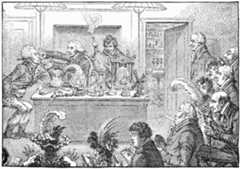
71This much, at least, is certain: there was an absoluteagreement among those who had the best means ofjudging that no better appointment was possible. Andyet, if we are to credit Dr. Paris, the first impressionproduced on Rumford by Davy’s personal appearancewas highly unfavourable, and the Count would notallow him to lecture in the theatre until he had givena specimen of his abilities in the smaller lecture-room,which oldhabitués of the Royal Institution well remember.Dr. Paris adds that his first lecture entirelyremoved every prejudice, and at its conclusion Rumfordexclaimed, “Let him command any arrangementswhich the Institution can afford.” And hewas accordingly on the next day promoted to thetheatre.
Six weeks after his arrival, he gave his first publiclecture. How he acquitted himself, may be gleaned fromthe following account, given under the heading of the“Royal Institution of Great Britain” in thePhilosophicalMagazine, vol. x., p. 281 (1801):—
“It must give pleasure to our readers to learn that this newand useful institution, the object of which is the application ofscience to the common purposes of life, may be now consideredas settled on a firm basis....
“We have also to notice a course of lectures, just commencedat the institution, on a new branch of philosophy—we mean theGalvanic Phenomena. On this interesting branch Mr. Davy (lateof Bristol) gave the first lecture on the 25th of April. He beganwith the history of Galvanism, detailed the successive discoveries,and described the different methods of accumulating galvanicinfluence.... He showed the effects of galvanism on thelegs of frogs, and exhibited some interesting experiments on thegalvanic effects on the solutions of metals in acids....
“Sir Joseph Banks, Count Rumford, and other distinguishedphilosophers were present. The audience were highly gratified,and testified their satisfaction by general applause. Mr. Davy,72who appears to be very young, acquitted himself admirably well;from the sparkling intelligence of his eye, his animated manner,and thetout ensemble, we have no doubt of his attaining adistinguished eminence.”
The Managers were so far satisfied, that at a meetingheld on June 1st they passed the followingresolutions:—
“Resolved—That Mr. Humphry Davy, Director of theChemical Laboratory, and Assistant Lecturer in Chemistry,has, since he has been employed at the Institution, given satisfactoryproofs of his talents as a Lecturer.”
“Resolved—That he be appointed, and in future denominated,Lecturer in Chemistry at the Royal Institution, instead of continuingto occupy the place of Assistant Lecturer, which he hashitherto filled.”
In the following July, Dr. Young (“PhenomenonYoung,” as he was called at Cambridge), the greatexponent of the Undulatory Theory of Light, was engagedas Professor of Natural Philosophy, Editor of theJournals, and General Superintendent of the House.D
D Young’s connection with the Royal Institution was comparativelybrief. On July 4th, 1803, it was resolved “That Dr. Young be paid thebalance of two years’ complete salary, and that his engagement with theInstitution terminate from this time.”
At a meeting held in the same month, the Managers
“Resolved—That a Course of Lectures on the ChemicalPrinciples of the Art of Tanning be given by Mr. Davy. Tocommence the second of November next; and that respectablepersons of the trade, who shall be recommended by Proprietorsof the Institution, be admitted to these lectures gratis.”
To order a young man of twenty-two, who had probablynever seen the inside of tannery, to give an account ofthe art and mystery of leather-making, would seem tosavour somewhat of what Coleridge would style “ultra-crepidation,”and accordingly the Managers further
“Resolved—That Mr. Davy have permission to absent himself—duringthe months of July, August, and September for the73purpose of making himself more particularly acquainted with thepractical part of the business of tanning, in order to preparehimself for giving the above-mentioned course of lectures.”
Lectures on “The Chemical Principles of the Processof Tanning Leather, and of the objects that mustparticularly be had in view in attempts to improvethat most useful art” are mentioned in Rumford’s firstprospectus, and the foregoing resolutions were probablypassed in consequence. Davy did a considerable amountof experimental work in connection with these lectures,and the Journal of the Royal Institution contains severalshort communications from him on the chemistry of thesubject, but the main facts he discovered are containedin a memoir read to the Royal Society on February 24th,1803, and published in thePhilosophical Transactionsof that year, under the title of an “Account of SomeExperiments and Observations on the constituent Partsof certain astringent Vegetables; and on their Operationin Tanning.”
Although Davy, by his earnestness, his knowledge,his felicity of expression, and by a certain dignity oftreatment which seemed to invest even the homeliestsubjects with unlooked-for importance, could interestan audience on almost any subject he brought beforethem, we may be sure that his soul soon sighed for aloftier theme than leather. He found it on the occasionof his lecture of January 21st, 1802, when he deliveredthe introductory discourse of that session. The date,indeed, is a red-letter day not only in Davy’s historybut also in that of the Royal Institution. From thattime the position of the Institution in the scientific andsocial world of London would seem to be assured.
Its affairs up to this time had been gradually goingfrom bad to worse. The enthusiasm with which it was74started a couple of years back had apparently spent itself,and Rumford, by hishauteur and high-handed management,had alienated many powerful friends. The subscriptions,which in 1800 had reached £11,047, had fallenin 1802 to £2,999, whilst the expenses were annually increasing.The outlook was gloomy in the extreme, andeverything seemed to portend that the latest scheme forthe amelioration of humanity was about to share thetoo common fate of such projects. The young man oftwenty-three, however, changed all this as if by thestroke of a magician’s wand. No Prince Fortunatuscould have done more.
His theme was not too ambitious; it would be consideredeven trite and commonplace to-day, and the manwould be very bold or very simple who would nowattempt to deal with it in the theatre of the RoyalInstitution; for this introductory lecture was nothingmore than an exordium on the worth of science as anagent in the improvement of society. It was, and wasfelt to be, however, anapologia for the very existenceof the Institution. Rumford and his fellow managerswould seem to have staked everything on a single throw.Davy’s power as a lecturer had been noised abroad, andwe may be sure that Coleridge and his other friendsdid not keep their tongues still. Coleridge, indeed, toldthe literary world that he assiduously attended Davy’slectures, to increase his stock of metaphors. The youthwho had discovered “the pleasure-producing air” wastalked about in fashionable circles; and Mr. Bernard andthe Count used their persuasiveness, and Sir JosephBanks his social power, to secure for him the mostcultured audience in London. If we may credit Dr.Paris, other influences, too, were at work. Davy’sassociation with Beddoes had probably gained for him75the goodwill of the Tepidarians, even if it did notactually give him theentrée to the Society; and theseRed Republicans, whose “pious orgies” at Old Slaughter’sCoffee-House in St. Martin’s Lane consisted mainly inlibations of tea, vied with the Royalists in their effortsto pave his triumphal way. His success was instantand complete. In a series of lofty and impassionedperiods he traced the services of science to humanity;he dwelt upon its dignity and nobility as a pursuit,upon its value as a moral and educational force. Thesmall, spare youth, with his earnestness, his eloquence,his unaffected manner, the play of his mobile features,his speaking eyes—“eyes which,” as one of his fairauditors was heard to remark, “were made for somethingbesides poring over crucibles”—held his hearersspellbound as he declaimed such sentences asthese:—
“Individuals influenced by interested motives or false viewsmay check for a time the progress of knowledge;—moral causesmay produce a momentary slumber of the public spirit;—theadoption of wild and dangerous theories, by ambitious or deludedmen, may throw a temporary opprobrium on literature; but theinfluence of true philosophy will never be despised; the germsof improvement are sown in minds, even where they are not perceived;and sooner or later the springtime of their growth mustarrive. In reasoning concerning the future hopes of the humanspecies, we may look forward with confidence to a state of society,in which the different orders and classes of men will contributemore effectually to the support of each other than they havehitherto done. This state, indeed, seems to be approaching fast;for, in consequence of the multiplication of the means of instructionthe man of science and the manufacturer are daily becomingmore assimilated to each other. The artist, who formerly affectedto despise scientific principles, because he was incapable of perceivingthe advantages of them, is now so far enlightened as tofavour the adoption of new processes in his art, whenever theyare evidently connected with the diminution of labour; and theincrease of projectors, even to too great an extent, demonstrates76the enthusiasm of the public mind in its search after improvement....
“The unequal division of property and of labour, the differencesof rank and condition amongst mankind, are the sources ofpower in civilised life—its moving causes, and even its very soul.In considering and hoping that the human species is capable ofbecoming more enlightened and more happy, we can only expectthat the different parts of the great whole of society should beintimately united together, by means of knowledge and the usefularts; that they should act as the children of one great parent,with one determinate end, so that no power may be rendered useless—noexertions thrown away.
“In this view, we do not look to distant ages, or amuse ourselveswith brilliant though delusive dreams, concerning theinfinite improveability of man, the annihilation of labour, disease,and even death, but we reason by analogy from simple facts, weconsider only a state of human progression arising out of its presentcondition,—we look for a time that we may reasonably expect—FORA BRIGHT DAY, OF WHICH WE ALREADY BEHOLD THE DAWN.”
Those who may read these sentences will either smileat their seeming archaism, or wonder at the antiquity oftheir argument; for the lesson which Davy inculcatedat the beginning of the century is still at its close dinnedinto our ears, and practically all the stock reasons urgedby latter-day writers and platform speakers on technicaleducation and the abstract value of science are to befound in his lectures. But the circumstances of 1802were widely different from those of 1896. The birth ofthe century was a singularly auspicious time for science;and many cultured men who knew nothing of science,yet felt in a dim sort of way that it was destined to be amighty factor in civilisation. Davy’s words struck asympathetic chord; they served to formulate and defineideas of which all who lived in the spirit of the times andshared in its movement must have been conscious.Speaking to willing and receptive ears, and with every77attribute of manner, speech, and interest in his favour,he saw his chance: and with a practical sagacity beyondhis years, he seized it.
Davy’s triumph is recorded in many contemporarynotices, and it lives as one of the traditions of the RoyalInstitution.
Francis Horner thus records his impressions in hisjournal, under date March 31st, 1802:—
“I have been once to the Royal Institution and heard Davylecture to a mixed and large assembly of both sexes, to thenumber perhaps of three hundred or more. It is a curious scene;the reflections it excites are of an ambiguous nature, for the prospectof possible good is mingled with the observation of muchactual folly. The audience is assembled by the influence offashion merely; and fashion and chemistry form a very incongruousunion....
“Davy’s style of lecturing is much in favour of himself, thoughnot, perhaps, entirely suited to the place; it has rather a littleawkwardness, but it is that air which bespeaks real modesty andgood sense; he is only awkward because he cannot condescendto assume that theatrical quackery of manner which might have amore imposing effect. This was my impression from his lecture.I have since (April 2nd) met Davy in company, and was muchpleased with him; a great softness and propriety of manner,which might be cultivated into elegance; his physiognomy struckme as being superior to what the science of chemistry, on itspresent plan, can afford exercise for; I fancied to discover in itthe lineaments of poetical feeling.” (“Memoirs of Horner,” vol. i.,p. 182.)
Davy’s friend Purkis has left us the following stillmore glowingaccount:—
“The sensation created by his first [second] course of Lecturesat the Institution, and the enthusiastic admiration which theyobtained, is at this period scarcely to be imagined. Men of thefirst rank and talent,—the literary and the scientific, the practicaland the theoretical, blue stockings, and women of fashion, the oldand the young, all crowded—eagerly crowded the lecture-room.78His youth, his simplicity, his natural eloquence, his chemicalknowledge, his happy illustrations, and well-conducted experiments,excited universal attention and unbounded applause.Compliments, invitations, and presents were showered upon himin abundance from all quarters; his society was courted by all,and all appeared proud of his acquaintance.... A talented lady,since well-known in the literary world, addressed him anonymouslyin a poem of considerable length, replete with delicatepanegyric and genuine feeling.... It was accompanied with ahandsome ornamental appendage for the watch, which he wasrequested to wear when he delivered his next lecture, as a token ofhaving received the poem and pardoned the freedom of the writer.”
The anonymous poem “replete with delicate panegyricand genuine feeling” is before me as I write. It is signed“Fidelissima,” and is one of several which the sametalented lady addressed to him at different times, andwhich were found among his papers at his death. Someof them, as sonnets, are of considerable merit, and, hadspace permitted, are well worthy of reproduction.
The Tepidarians—again on the authority of Dr.Paris—were delighted. Sanguine in the success of theirchild—for so they considered Davy—they purposelyappointed their anniversary festival on the day of hisanticipated triumph. Their dinner was marked by everydemonstration of hilarity, and the day was ended by amasquerade at Ranelagh.
Dr. John Davy, it should be said, rather sniffs at theTepidarians and their “ultra-principles,” and doubts if hisbrother ever belonged to their society. Be this as it may,it is certain that the “Royalists” and the fashionableworld into which he was drawn soon influenced Davy’ssocial and political views. Dr. Davy, whilst willingenough to appreciate at their proper value his brother’snatural and intellectual advantages as contributing tohis success, points out that other circumstances connected79with the Institution and the period conspired to helphim:—
“The Royal Institution was a new experiment. Novelty initself is delightful, especially to people of rank and fortune, whoat that time in consequence of the Continent being closed, andowing to the war, must have been delighted to have had openedto them a new and unexpected source of interest, fitted to amusethose who were suffering fromennui, and to instruct those whowere anxious for instruction. The Royal Institution, moreover,was the creation of a large number of influential persons, both inthe higher ranks of society and of science. This alone might havesufficed to render it fashionable, and, if fashionable, popular.The period, morally and politically considered, aided the effect; atime of great political excitement had just terminated; a time ofgloom and despondency was then commencing. Whatever divertedthe public mind and afforded new objects of contemplation, pureand independent sources of amusement and gratification, musthave been very welcome to all reflecting persons, even withouttaking into account the possible and probable good which mightbe conferred by the Institution on society, in accordance with theintentions with which it was first established.”
Davy thus expressed his own feeling of satisfactionto hismother:—
“London.
“My dear Mother,—I have been very busy in the preparationfor my lectures; and for this reason I have not written to you. Idelivered my second lecture to-day, and was very much flatteredto find the theatre overflowing at this, as well as at the first. Iam almost surprised at the interest taken by so many people ofrank, in the progress of chemical philosophy; and I hope I amdoing a great deal of good, in being the means of producing anddirecting the taste for it.
“I have been perfectly well since I visited Cornwall; and Ienter upon my campaign in high health and spirits. After fourmonths of hard but pleasant labour, I shall again be free!
“I hope you are all well. I very often reflect upon the timesthat are past; and my mind is always filled with gratitude to theSupreme Being, who has made us all happy; and that, in placingus in distant parts, and in different circles, neither our feelingsor affections have been disturbed....
80“I shall be very glad to see you again. I intend in June topass through Scotland and to visit the Western Isles; but I hopeI shall spend a part of the autumn with you.
“Pray write to me and give me a little news. Beg Kitty andGrace and Betsy and John to recollect me.
“I am, my dear mother, your very affectionate son
“H. Davy.”
The interest and spirit of enthusiasm thus rousedwas sedulously cultivated by Davy, and turned to thepurposes of the Institution which he served. Rumfordwas no longer its moving and controlling spirit: his dutyto the Elector of Bavaria, and his ill-starred devotion toMadame Lavoisier, had gradually drawn him away fromLondon, and in 1803 he ceased to take any active partin the fortunes of his offspring. Shortly afterwards SirJoseph Banks also withdrew. In a letter written April,1804, he tells Rumford that his continued absence fromEngland is a great detriment to theInstitution:—
“It is now entirely in the hands of the profane. I have declaredmy dissatisfaction at the mode in which it is carried on,and my resolution not to attend in future. Had my health andspirits not failed me, I could have kept matters in their properlevel, but sick, alone, and unsupported, I have given up whatcannot now easily be recovered.”
Sir John Hippesley, who became treasurer, strove tomake the Institution above all things fashionable. Hehad a project for placing private boxes in the theatre, andwas concerned about its want of a proper coat-of-arms.Mr. Bernard still continued to hope that Sydney Smith’slectures on Moral Philosophy might somehow betterthe condition of the poor. They would, at least, saidHorner, “make the real blue-stockings a little more disagreeablethan ever, and sensible women a little moresensible.” But the real directing power was Davy, andhe gradually stamped upon the place the character it81now possesses. How he felt his power and used it, maybe gleaned from the following extract from a lecture in1809, in reference to a fund which had been raised tosupply him with a great voltaicbattery:—
“In a great country like this, it was to be expected thata fund could not long be wanting for pursuing or perfectingany great scientific object. But the promptitude with which thesubscription filled was so great, as to leave no opportunity to manyzealous patrons of science for showing their liberality. Themunificence of a few individuals has afforded means more ampleand magnificent than those furnished by the Government of arival nation; and I believe we have preceded them in the applicationof the means. In this kind of emulation, our superiority,I trust, will never be lost; and I trust that the activity belongingto our sciences will always flow from the voluntary efforts of individuals,from whom the support will be an honour—to whomit will be honourable....
“Without facilities for pursuing his object, the greatestgenius in experimental research may live and die useless andunknown. Talents of this kind cannot, like talents for literatureand the fine arts, call forth attention and respect. They canneither give popularity to the names of patrons, nor ornamenttheir houses. They are limited in their effects, which are directedtowards the immutable interests of society. They cannot be madesubservient to fashion or caprice; they must forever be attachedto truth, and belong to nature. If we merely considerinstructionin physical science, this even requires an expensive apparatus tobe efficient; for without proper ocular demonstrations, all lecturesmust be unavailing,—things rather than words should bemade the objects of study. A certain knowledge of the beingsand substances surrounding us must be felt as a want by everycultivated mind. It is a want which no activity of thought, nobooks, no course of reading or conversation, can supply. That aspirit for promoting experimental science is not wanting in thecountry, is proved by the statement which I have just made, bythe foundation in which I have the honour of addressing you, and bythe number of institutions rising in different parts of the metropolisand in the provinces. But it is clear that this laudable spirit mayproduce little effect from want of just direction. To divide and to82separate the sources of scientific interest, is to destroy all their justeffect. To attempt, with insufficient means, to support philosophy,is merely to humiliate her and render her an object of dirision.Those who establish foundations for teaching the sciences ought,at least, to understand their dignity. To connect pecuniaryspeculation, or commercial advantages, with schemes for promotingthe progress of knowledge, is to take crops without employingmanure; is to create sterility, and to destroy improvement. Ascientific institution ought no more to be made an object of profitthan an hospitable, or a charitable establishment. Intellectualwants are at least as worthy of support as corporeal wants, and theyought to be provided for with the same feeling of nobleness andliberality. The language expected by the members of a scientificbody from the directors ought not to be, ‘We have increased yourproperty, we have raised the value of your shares.’ It oughtrather to be, ‘We have endeavoured to apply your funds to usefulpurposes, to promote the diffusion of science, to encourage discovery,and to exalt the scientific glory of your country.’
“What this institution has done, it would ill become a personin my place to detail; but that it has tended to the progress ofknowledge and invention, will not, I believe, be questioned.Compare the expenditure with the advantages. It would notsupport the least of your public amusements; and the income ofan establishment, which, in its effects, may be said to be national,is derived from annual subscriptions scarcely greater than thosewhich a learned professor of Edinburgh obtains from a singleclass....
“The progression of physical science is much more connectedwith your prosperity than is usually imagined. You owe toexperimental philosophy some of the most important and peculiarof your advantages. It is not by foreign conquests chiefly thatyou are become great, but by a conquest of nature in your owncountry. It is not so much by colonization that you have attainedyour preeminence or wealth, but by the cultivation of the richesof your own soil. Why, at this moment, are you able to supplythe world with a thousand articles of iron and steel necessary forthe purposes of life? It is by arts derived from chemistry andmechanics, and founded purely upon experiments. Why is thesteam engine now carrying on operations which formerly employed,in painful and humiliating labour, thousands of our robust83peasantry, who are now more nobly or more usefully serving theircountry either with the sword or with the plough? It was inconsequence of experiments upon the nature of heat and purephysical investigations.
“In every part of the world manufactures made from themere clay and pebbles of your soil may be found; and to what isthis owing? To chemical arts and experiments. You have excelledall other people in the products of industry. But why?Because you have assisted industry by science. Do not regard asindifferent what is your true and greatest glory. Except in theserespects, and in the light of a pure system of faith, in what areyou superior to Athens or to Rome? Do you carry away fromthem the palm in literature and the fine arts? Do you not ratherglory, and justly too, in being, in these respects, their imitators?Is it not demonstrated by the nature of your system of publiceducation, and by your popular amusements? In what, then, areyou their superiors? In every thing connected with physicalscience; with the experimental arts. These are your characteristics.Do not neglect them. You have a Newton, who is theglory, not only of your own country, but of the human race. Youhave a Bacon, whose precepts may still be attended to with advantage.Shall Englishmen slumber in that path which thesegreat men have opened, and be overtaken by their neighbours?Say, rather, that all assistance shall be given to their efforts;that they shall be attended to, encouraged, and supported.”
On a subsequent occasion, when the subjugation ofEurope was threatened by the restless military spirit ofFrance, he thus dilated upon the influence of experimentalphilosophy in strengthening the desire forrationalfreedom:—
“The scientific glory of a country may be considered, in somemeasure, as an indication of its innate strength. The exaltationof reason must necessarily be connected with the exaltation of theother noble faculties of the mind; and there is one spirit of enterprise,vigour, and conquest, in science, arts, and arms.
“Science for its progression requires patronage,—but it mustbe a patronage bestowed, a patronage received, with dignity. Itmust be preserved independent. It can bear no fetters, not even84fetters of gold, and least of all those fetters in which ignoranceor selfishness may attempt to shackle it.
“And there is no country which ought so much to glory in itsprogress, which is so much interested in its success, as this happyisland. Science has been a prime cause of creating for us theinexhaustible wealth of manufactures, and it is by science that itmust be preserved and extended. We are interested as a commercialpeople,—we are interested as a free people. The age ofglory of a nation is likewise the age of its security. The samedignified feeling, which urges men to endeavour to gain a dominionover nature, will preserve them from the humiliation of slavery.Natural, and moral, and religious knowledge, are of one family;and happy is that country, and great its strength, where theydwell together in union.”
It was, of course, to be expected that amidst thegeneral chorus of approval some discordant notes shouldbe heard. People who preferred the severe and formalmanner of his colleague, Dr. Young, who, in spite of hisprofound knowledge, could never keep an audiencetogether, said that Davy’s style was too florid andimaginative; that his imagery was inappropriate, and hisconceits violent; that he was affected and swayed by amawkish sensibility. Dr. Paris would have us believethere was some show of justice in this accusation, buthe thinks that “the style which cannot be tolerated ina philosophical essay may under peculiar circumstancesbe not only admissible but even expedient in a popularlecture.” The “peculiar circumstance” in Davy’s casewas, in Dr. Paris’s opinion, the Royal Institution audience.
“Let us consider for a moment,” he says, “the class of personsto whom Davy addressed himself. Were they students preparedto toil with systematic precision, in order to obtain knowledge asa matter of necessity?—No—they were composed of the gay andthe idle, who could only be tempted to admit instruction by theprospect of receiving pleasure,—they were children, who couldonly be induced to swallow the salutary draught by the honeyaround the rim of the cup.”
85That Davy himself was not wholly unconscious ofthis fact may be gathered from a letter which he wroteto Mr. Davies Gilbert at about this time. Hesays:—
“My labours in the Theatre of the Royal Institution havebeen more successful than I could have hoped from the nature ofthem. In lectures, the effect produced upon the mind is generallytransitory; for the most part, they amuse rather than instruct,and stimulate to enquiry rather than give information. Myaudience has often amounted to four and five hundred, andupwards; and amongst them some promise to become permanentlyattached to chemistry. This science is much thefashion of the day.”
Whatever may be urged against Davy’s style oflecturing, his purely scientific memoirs are unquestionablymodels of their kind. His language is so simple,and his mode of expression so uniformly clear, and sofree from technicality, that even an ordinary reader canfollow them with delight. In this respect he was consistentlyfaithful to the direction he gives in his “LastDays”:—
“In detailing the results of experiments, and in giving themto the world, the chemical philosopher should adopt the simpleststyle and manner; he will avoid all ornaments, as somethinginjurious to his subject, and should bear in mind the saying ofthe first King of Great Britain, respecting a sermon which wasexcellent in doctrine, but overcharged with poetical allusions andfigurative language,—‘that the tropes and metaphors of the speakerwere like the brilliant wild flowers in a field of corn, very pretty,but which did very much hurt the corn.’”
Dr. Paris’s remarks concerning Davy’s personal mannerand his style of lecturing were warmly controvertedat the time of their publication by several of Davy’sfriends. Dr. John Davy’s account is so clear andexplicit, and so obviously based upon personal observation,for which he had ample opportunities, that, evenafter making every allowance for brotherly bias, we prefer86to regard it as giving a more just impression of Davy’sbearing in the lecture-theatre, and of the care and painshe took to ensure success.
“He was,” says Dr. Davy, “always in earnest; and when heamused most, amusement appeared most foreign to his object.His great and first object was to instruct, and, in conjunctionwith this, maintain the importance and dignity of science; indeedthe latter, and the kindling a taste for scientific pursuits, mightrather be considered his main object, and the conveying instructiona secondary one.”
His lecture was almost invariably written expresslyfor the occasion, and usually on the day before he deliveredit.
“On this day he generally dined in his own room, and madea light meal on fish. He was always master of his subject; andcomposed with great rapidity, and with a security of his powersnever failing him.... It was almost an invariable rulewith him, the evening before, to rehearse his lecture in thepresence of his assistants, the preparations having been madeand everything in readiness for the experiments; and this he did,not only with a view to the success of the experiments, and thedexterity of his assistants, but also in regard to his own discourse,the effect of which, he knew, depended upon the manner in whichit was delivered. He used, I remember, at this recital, to markthe words which required emphasis and study the effect of intonation;often repeating a passage two or three different times,to witness the difference of effect of variations in the voice. Hismanner was perfectly natural, animated and energetic, but notin the least theatrical. In speaking, he never seemed to considerhimself as an object of attention; he spoke as if devoted to hissubject, and as if his audience were equally devoted to it andtheir interest concentrated in it. The impressiveness of hisoratory was one of its great charms ... and his eloquence,—thedeclamation, as it might be called by some, in which heindulged on the beauty and order of Nature ... was so wellreceived because it was not affected; merely his own strongimpressions and feelings embodied in words, and delivered withan earnestness which marked their sincerity.”
87It must, however, be admitted that this extraordinarysuccess was not without its evil influence on Davy’smoral qualities. Considering his age, and his temperament,his ambition and love of applause, he would havebeen something more than human if he could haveremained wholly unaffected by the conditions in whichhe was placed. “The bloom of his simplicity wasdulled by the breath of adulation.” He assumed thegarb and the airs of a man of fashion, and courted thesociety of the rich and the aristocratic. Time whichwould have been more profitably spent in the study,or in the society of his intellectual fellows, was fritteredaway in the frivolities of London society, or in thesalons, or at thesoirées of leaders of the “smart” peopleof the period. The peculiar circumstances of the RoyalInstitution, and the necessity for the continued adhesionto it of persons of rank and wealth, may to some extenthave led him away from the quieter and serener joys ofthe philosophic life.
“In the morning,” says Paris, “he was the sage interpreter ofNature’s laws; in the evening, he sparkled in the galaxy offashion; and not the least extraordinary point in the characterof this great man, was the facility with which he could castaside the cares of study, and enter into the trifling amusementsof society.—‘Ne otium quidem otiosum,’ was the exclamation ofCicero; and it will generally apply to the leisure of men activelyengaged in the pursuits of science; but Davy, in closing the doorof his laboratory, opened the temple of pleasure.... Inordinary cases, the genius of evening dissipation is an arrantPenelope; but Davy, on returning to his morning labours,never found that the thread had been unspun during theinterruption.”
The following letter from Coleridge will serve toshow how this change was foreseen and deplored by histruestfriends:—
“Nether Stowey,Feby. 17, 1803.
“My dear Purkis, ... I have been here nearly a fortnight;and in better health than usual. Tranquillity, warm roomsand a dear old friend, are specifics for my complaints. Poole isindeed a very, very good man. I like even his incorrigibility insmall faults and deficiencies; it looks like a wise determination ofNature to let well alone; and is a consequence, a necessary oneperhaps, of his immutability in his important good qualities....
“I rejoice in Davy’s progress. There are three suns recordedin Scripture:—Joshua’s, that stood still; Hezekiah’s, that wentbackward; and David’s that went forth, and hastened on hiscourse, like a bridegroom from his chamber. May our friend’sprove the latter! It is a melancholy thing to see a man, like theSun in the close of the Lapland summer, meridional in his horizon;or like wheat in a rainy season, that shoots up well in the stalk,but does notkern. As I have hoped, and do hope, more proudlyof Davy than of any other man; and as he has been endeared tome more than any other man, by the being a Thing of Hope tome (more, far more than my self to my own self in my most genialmoments,)—so of course my disappointment would be proportionallysevere. It were falsehood, if I said that I think his presentsituation most calculated, of all others, to foster either his genius, orthe clearness and incorruptness of his opinions and moral feelings.I see two Serpents at the cradle of his genius: Dissipation with aperpetual increase of acquaintances, and the constant presence ofInferiors and Devotees, with that too great facility of attainingadmiration which degrades Ambition into Vanity—but theHercules will strangle both the reptile monsters. I have thoughtit possible to exert talents with perseverance, and to attain truegreatness wholly pure, even from the impulses; but on this subjectDavy and I always differed.... Yours sincerely
“S. T. Coleridge.”
It would seem that Coleridge’s doubts and fears wereshared also by his host, and were communicated by himto the object of them. This, at least, may be inferred fromthe following extract from a letter from Davy toPoole:—
“London,May 1, 1803.
“My dear Poole, ... Be not alarmed, my dearfriend, as to the effect of worldly society on my mind. The age89of danger has passed away. There are in the intellectual being ofall men, permanent elements, certain habits and passions thatcannot change. I am a lover of Nature, with an ungratifiedimagination. I shall continue to search for untasted charms—forhidden beauties.
“Myreal, mywaking existence is amongst the objects ofscientific research: common amusements and enjoyments arenecessary to me only as dreams, to interrupt the flow of thoughtstoo nearly analogous to enlighten and to vivify.
“Coleridge has left London for Keswick; during his stay intown, I saw him seldomer than usual; when I did see him, it wasgenerally in the midst of large companies, where he is the imageof power and activity. His eloquence is unimpaired; perhaps itis softer and stronger. His will is probably less than ever commensuratewith his ability. Brilliant images of greatness float uponhis mind: like the images of the morning clouds upon the waters,their forms are changed by the motion of the waves, they areagitated by every breeze, and modified by every sunbeam. He talkedin the course of one hour, of beginning three works, and he recitedthe poem of Christabel unfinished, and as I had before heard it.What talent does he not waste in forming visions, sublime, butunconnected with the real world! I have looked to his efforts, asto the efforts of a creating being; but as yet, he has not even laidthe foundation for the new world of intellectual form....
“Your affectionate friend
“Humphry Davy.”
Space will not permit of any more detailed accountof Davy’s career as a lecturer at the Royal Institution.During the twelve years he occupied its Chair of Chemistryhe held undisputed sway as the greatest living expositorof chemical doctrine, and session after session sawthe theatre crowded with eager and expectant audiences.
This continued and increasing success was due notmerely to his art and skill as a speaker, but to theremarkable and astonishing character of what he had totell—of work which made the laboratory of the RoyalInstitution even more famous than its lecture-rooms.
The chemical laboratory of the Royal Institution, as thescene of Davy’s greatest discoveries—discoveries whichmark epochs in the development of natural knowledge—willfor ever be hallowed ground to the philosopher.The votaries of Hermes have raised far more statelytemples: to-day they follow their pursuit in edificeswhich in architectural elegance and in equipment arepalaces compared with the subterranean structurewhich lies behind the Corinthian façade in AlbemarleStreet. But to the chemist this spot is what the Ka’ba atMecca is to the follower of Mohammed, or what Iona wasto Dr. Johnson: and, if we may venture to adapt thelanguage of the English moralist, that student has littleto be envied whose enthusiasm would not grow warmeror whose devotion would not gain force within the placemade sacred by the genius and labours of Davy andFaraday.
And yet, were these great men to revisit the scene oftheir triumphs, they would hardly recognise it, so completelyaltered is it by adaptations and rearrangementsrendered necessary by their discoveries. How it appearedin their own time may be seen from the illustration onpage91, taken from a water-colour drawing by MissHarriet Moore, in the possession of the Managers of theRoyal Institution.
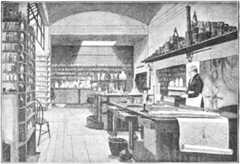
The first year of the century is memorable for theinvention of the voltaic pile, and for the discovery, byNicholson and Carlisle, on April 30th, 1800, of the electrolytic92decomposition of water. As Davy said, “the voltaicbattery was an alarm-bell to experimenters in every partof Europe; and it served no less for demonstrating newproperties in electricity, and for establishing the laws ofthis science, than as an instrument of discovery in otherbranches of knowledge; exhibiting relations between subjectsbefore apparently without connection, and servingas a bond of unity between chemical and physicalphilosophy.” The capital discovery of Volta was madeknown in England at the earliest possible moment throughthe mediation of Sir Joseph Banks, and the study ofvoltaic electricity, its effects and applications, wasimmediately afterwards entered upon by many Englishmenof science with great zeal and ardour. Davy at thistime had just completed his work on Nitrous Oxide; and,powerfully impressed with the significance of Nicholsonand Carlisle’s observation, he at once turned his attentionto the subject, and even before leaving Bristol he had senta number of short papers on what was then usuallytermed the galvanic electricity to Nicholson’s Journal.He showed that oxygen and hydrogen were evolved fromseparate portions of water, though vegetable and evenanimal substances intervened; and conceiving that alldecomposition might be polar, he “electrised” differentcompounds at the different extremities, and found thatsulphur and metallic substances appeared at the negativepole, and oxygen and nitrogen at the positive pole, thoughthe bodies furnishing them were separate from eachother. The papers, however, are mainly remarkable forthe fact that they served to establish the intimate connectionbetween the electrical effects and the chemicalchanges going on in the pile, and for the conclusiondrawn concerning their mutual dependence. Withina few days after his removal to the Royal Institution93he resumed his inquiries, publishing his results in aseries of notices in the short-lived Journal of the RoyalInstitution.
In 1801 he sent his first communication to theRoyal Society, on “An Account of some Galvanic Combinations,formed by the Arrangement of single metallicPlates and Fluids, analogous to the new Galvanic Apparatusof Mr. Volta.”
But at this period, and for some time afterwards,Davy was not altogether free to develop his own ideas,as the work of the laboratory was controlled by a committeewhich met, from time to time, to deliberate andsettle upon the researches which were to be undertakenby their Professor. As we have seen, he was requested,in the first place, to turn his attention to tanning, and toinvestigate the astringent principles employed in themanufacture of leather. Afterwards, when the Managersdetermined to form a mineralogical collection, and toinstitute an assay office for the improvement of mineralogyand metallurgy, he was ordered to make analyses ofrocks and minerals. And lastly, in consequence of anarrangement between the Managers and the Board ofAgriculture, effected by Arthur Young, he was requiredto take up the subject of Agricultural Chemistry. To aman of Thomas Young’s temperament the fussy activityof committees, directed by such people as Bernard andHippesley, would have been resented as an irksome, ifnot intolerable, interference; but Davy invariably actedas if he considered that their decisions promoted thetrue interests of the Institution, and entered withardour into each new scheme. There was no irksomenessto him in being called upon to change thecurrent of his ideas, for he delighted in the opportunityof exhibiting his versatility; and, confident in his94powers, he had the ambition to touch everything inturn, and to adorn it. That he should have succeededso well under such conditions is perhaps the strongestevidence that could be adduced of the strength andelasticity of his eager, active mind, and of his astonishingpower of rapid, well-directed work.
We have already dealt with his researches in connectionwith tanning. The efforts of the Managerstowards the improvement of mineralogy and metallurgy,in spite of the generous assistance of Mr. Greville, Sir J.St. Aubin, and Sir A. Hume, and the “activity andintelligence of Mr. Davy,” proved abortive.
One outcome of Davy’s association with the mattermay be seen in his paper, published by the Royal Societyin 1805, on “An Account of some analytical Experimentson a mineral Production from Devonshire, consistingprincipally of Alumine and Water.” Themineral referred to was discovered by Dr. Wavel in anargillaceous slate near Barnstaple, and hence was termedwavellite. Davy failed to recognise its true nature, whichwas first correctly ascertained by Berzelius. A fewweeks later, he sent to the Royal Society a secondpaper “On a Method of Analyzing Stones containingfixed Alkali, by Means of the Boracic Acid.” Themethod, however, is of comparatively limited application,and is seldom, if ever, now used in analysis. Determinativechemistry was never one of Davy’s strong points,and few of his analytical processes are now employed.Patient manipulation, and minute and sustained attentionto detail, were altogether foreign to his dispositionand habits, although he had the highest appreciation ofthese qualities in men like Cavendish and Wollaston.
The lectures on agriculture however, were a greatsuccess, and brought increased fame and no small95profit to the lecturer. His association with the Boardof Agriculture developed into a permanent appointment;for ten successive years he continued to lecture on thesubject before its members, and in 1813 he put togetherthe results of his labours in his well-known “Elementsof Agricultural Chemistry.” In simplicity and absenceof ornament the style of these lectures is in markedcontrast to that which he usually employed at the RoyalInstitution. Dealing with men to whom the matterwas of paramount importance, he had no need to stimulatetheir interest by the arts he employed in the theatrein Albemarle Street. The very nature of the subject,perhaps, served to remind him that tropes and metaphorswere here as much out of place as “the brilliantwild flowers in the field of corn—very pretty, but whichdid very much hurt the corn.”
It would be impossible in the space at our disposalto attempt to give a minute analysis of Davy’s work inconnection with agriculture. Its interest now is, for themost part, historical; what is of permanent importancein the way of fact has long since been woven into thecommon web of knowledge. Its greatest value was notin the novelty or the abundance of its facts, but ratheras a closely-reasoned exposition of the relation of agricultureto science, and of the necessity for applying theprinciples and methods of science to the art. Thephilosophic breadth of his views, supported, on occasion,by apt example and striking analogy, might be illustratedby many extracts. This, for example, is how hespeaks of the value of the scientific method, and ofchemistry, tohusbandry:—
“Nothing is more wanting in agriculture than experiments,in which all the circumstances are minutely and scientificallydetailed. This art will advance with rapidity in proportion96as it becomes exact in its methods. As in physical researchesall the causes should be considered; a difference in the resultsmay be produced, even by the fall of a half an inch of rain moreor less in the course of a season, or a few degrees of temperature,or even by a slight difference in the subsoil, or in the inclinationof the land.
“Information collected, after views of distinct inquiry, wouldnecessarily be more accurate, and more capable of being connectedwith the general principles of science; and a few histories of theresults of truly philosophical experiments in agricultural chemistrywould be of more value in enlightening and benefitting the farmer,than the greatest possible accumulation of imperfect trials conductedmerely in the empirical spirit. It is no unusual occurrence,for persons who argue in favour of practice and experience, tocondemn generally all attempts to improve agriculture byphilosophical inquiries and chemical methods. That muchvague speculation may be found in the works of those whohave lightly taken up agricultural chemistry, it is impossible todeny. It is not uncommon to find a number of changes rungupon a string of technical terms, such as oxygen, hydrogen,carbon, and azote, as if the science depended upon words ratherthan upon things. But this is, in fact, an argument for thenecessity of the establishment of just principles of chemistry onthe subject. Whoever reasons upon agriculture, is obliged torecur to this science. He feels that it is scarcely possible toadvance a step without it; and if he is satisfied with insufficientviews, it is not because he prefers them to accurate knowledge,but, generally, because they are more current.... It hasbeen said, and undoubtedly with great truth, that a philosophicalchemist would most probably make a very unprofitable businessof farming; and this certainly would be the case, if he were amere philosophical chemist; and unless he had served hisapprenticeship to the practice of the art, as well as to the theory.But there is reason to believe that he would be a more successfulagriculturist than a person equally uninitiated in farming, butignorant of chemistry altogether; his science, as far as it went,would be useful to him. But chemistry is not the only kind ofknowledge required: it forms a part of the philosophical basisof agriculture; but it is an important part, and whenever appliedin a proper manner must produce advantages.”
97How highly these lectures were appreciated will beevident from the terms in which they were referred toby Sir John Sinclair in his address of 1806 to theBoard. Hesays:—
“In the year 1802, when my Lord Carrington was in the chair,the Board resolved to direct the attention of a celebrated lecturer,Mr. Davy, to agricultural subjects; and in the following year,during the presidency of Lord Sheffield, he first delivered to themembers of this Institution, a course of lectures on the Chemistryof Agriculture. The plan has succeeded to the extent whichmight have been expected from the abilities of the gentlemanengaged to carry it into effect. The lectures have hitherto beenexclusively addressed to the members of the Board; but to such adegree of perfection have they arrived, that it is well worthy ofconsideration, whether they ought not to be given to a largeraudience.”
The “degree of perfection” was in no small degreedue to the amount of experimental and observationalwork which Davy introduced into his lectures. Mr.Bernard allotted him a considerable piece of ground onhis property at Roehampton for experimental purposes,and the Duke of Bedford carried out trials for him atWoburn. He studied from time to time all the operationsof practical farming, examined a great variety ofsoils, and investigated the nature and action of manures.He was thus brought into contact with some of thelargest landowners and agriculturists of his time, andwas an honoured guest in the houses of men like LordSheffield, Lord Thanet, Mr. Coke of Holkham, andothers.E In the practical interest he thus displayed inthe most useful of all the arts he sought to emulatethe example of his illustrious prototype Lavoisier, and98his work constitutes the foundation of every treatise onthe subject since the appearance, in 1840, of Liebig’swell-known book.
E In the print of the “Woburn Sheep-Shearing,” Davy is representedas one of a group comprising Mr. Coke, Sir Joseph Banks, SirJohn Sinclair, and Mr. Arthur Young.
Professor Warington, than whom no one is morefitted to express an opinion, has favoured me with thefollowing critical estimate of the value of Davy’swork:—
“The lectures profess to be exhaustive and thus present allthat Davy had been able to collect on the subject of the relationsof chemistry to agriculture during a period of at least 10 years.He appears to have made a careful study of the problems ofagriculture for many years, and to be acquainted with Englishpractice, and English experiments. There is but little referenceto foreign practice, or foreign opinion, save where the work donehas been purely chemical, ase.g. that of Gay Lussac, or Vauquelin.He approaches his subject in a thoroughly scientificmanner, taking an independent view of each question, bringingall the knowledge at his disposal to bear upon it, and nothesitating to come to conclusions different from those usuallyreceived. Thegreat step taken in these lectures is the assertionthat Agriculture must look to Natural Science, and especially toChemistry, for the explanation of its problems and the improvementof its practice. Davy seems to have been the first, at leastin this country, who boldly claimed for ‘Agricultural Chemistry’the position of a distinct branch of science. He was probablythe earliest example of a first-class chemist, who seriously andcontinuously devoted his best attention to the subject of agriculture.
“The lectures, looked at from a modern standpoint, are ofunequal value. The method of food-analysis is very poor, and itis somewhat surprising that the accurate mode of determiningnitrogen employed by Gay Lussac is not made use of in Davy’sanalyses. Nevertheless he manages to ascertain that springsown wheat is richer in gluten than autumn sown, and the wheatof hot countries richer than the wheat of temperate regions,statements which are quite correct.
“Lecture VI. is decidedly poor. Davy believes that plantsfeed on carbonaceous matter by their roots, and this mistakentheory leads him to assign an undue value to organic substances asmanures. It seems curious nowadays to find the whole subject99of manures treated with hardly any reference to their contents innitrogen, phosphoric acid, or potash.
“Lecture IV. is one of his best lectures, full of keen observationand suggestive experiment.
“The references to his own agricultural experiments are verynumerous; he seems to have made experiments on every subjectof inquiry that came before him. There is however no attemptat an extended and thorough investigation of any subject, andfor want of this the truth is sometimes missed. Thus in histrials of various ammonium salts as manures he finds the carbonateto be effective, the chloride to be of little value, and thesulphate of no good at all, whereas the last-named salt is nowgenerally chosen as a manure.
“There are some paragraphs that read like the inspirationsof genius, though it is now of course difficult to tell to whatextent his statements and opinions were warranted by the factsthen known. He gives a wonderfully correct idea of the actionof peas or beans in rotation, even including the statement thatthey obtain their nitrogen from the atmosphere.”
Although his time and energy were necessarily largelyabsorbed by the demands of the Managers, Davy neverlost sight of the subject of voltaic electricity, and atintervals he was able to resume his inquiries upon it.What specially impressed him was the power of thevoltaic pile as an analytic agent; and his laboratoryjournals, preserved at the Royal Institution, record theresults of numerous trials on the behaviour of compoundsubstances under its influence. In spite of innumerabledistractions and constant interruptions, due mainly tothe precarious position of the Institution, Davy graduallysucceeded in unravelling the fundamental laws of electro-chemistry,and in thus importing a new order of conceptions,altogether unlooked for and undreamt of, intoscience. This really constitutes his greatest claim asa philosopher to our admiration and gratitude. Theisolation of the metals of the alkalis, and the proof of100the compound nature of the alkaline earths, were unquestionablyachievements of the highest brilliancy, andas such appeal strongly to the popular imagination.But they were only the necessary and consequentiallinks in a chain of discovery which, had Davy neglectedto make them, would have been immediately forged byothers. It is significant that almost immediately afterthe capital discovery of Nicholson and Carlisle, Dr.Henry of Manchester, the well-known friend andcollaborator of Dalton, should have made the attemptto separate the presumed metallic principle of potashby the agency of voltaic electricity.
Davy communicated the results of his inquiries madeprior to the summer of 1806 in a paper to the RoyalSociety, which was made the Bakerian lecture of theyear.F It is entitled “On some chemical Agencies ofElectricity,” and is divided in nine sections and anintroduction. In the first section, “On the Changesproduced by Electricity in Water,” he set at rest thedisputed question as to the origin of the acid andalkaline matter which had been observed to form duringthe electrolysis of this liquid. By some these substanceswere supposed to begenerated from pure water by the101action of electricity; and M. Brugnatelli had even attemptedto prove the existence of a bodysui generiswhich he termed theelectric acid. By a series ofconvincing experiments Davy showed that the substanceswere due to the presence of saline matter inthe water, derived either from faulty purification, orfrom the solvent action of the water on the vessels, etc.,with which it was in contact. Cruickshank had foundthat in some cases the acid was nitric acid and thealkali ammonia: these substances were shown by Davyto be due to the presence of dissolved air. When purewater, contained in vessels on which it exerted nosolvent action, was “electrised”in vacuo, not a trace ofeither acid or alkali was produced.
F This lecture, which is one of the events of each session of the RoyalSociety, owes its origin to Mr. Henry Baker, F.R.S., a learned antiquaryand naturalist, who, by his will of July, 1763, bequeathed the sum of£100 to the Society, the interest of which was to be applied “for anoration or discourse to be spoken or read yearly by someone of the Fellowsof that Society, on such part of Natural History or Experimental Philosophy,at such time, and in such manner, as the President and Councilof the said Society for the time being, shall please to order and appoint.”Baker died in 1774, and the bequest came into operation during thepresidency of Sir John Pringle; and Peter Woulfe—one of the last of theEnglish alchemists—was appointed to deliver the lecture, which he didfor three successive years.
In the second section, “On the Agencies of Electricityin the Decomposition of various Compounds,” he beginsby pointing out that in all the experiments recorded inthe preceding section—that is, in all changes in whichacid and alkaline matter had been present—the acidmatter collected in the water round the positive pole,and the alkaline matter round the negative pole. Thishe shows to be true even of such sparingly solublesubstances as gypsum, the sulphates of strontium andbarium, and fluorspar. By connecting together cupsor vessels made of the substances under investigationby a thread of well-washed asbestos, as suggested byWollaston, he found that in all cases the acid elementcollected round the positive, and the earthy base roundthe negative pole. Basalt from Antrim, a zeolite fromthe Giant’s Causeway, vitreous lava from Etna, andeven glass, in like manner yielded alkaline matter towater when subjected to the action of voltaic electricity.Soluble salts, such as the sulphates of sodium, potassium,and ammonium, the nitrates of potassium and barium,102the succinate, oxalate and benzoate of ammonium, weresimilarly decomposed: the acids in a certain timecollected in the tube containing the positive wire, andthe alkalis and earths in that containing the negativewire. When metallic solutions, such as those of iron,zinc, and tin were employed, metallic crystals or depositionswere formed on the negative wire, and oxidewas likewise deposited round it; and a great excess ofacid was soon found in the opposite cup.
In the next section, “On the Transfer of Certain ofthe Constituent Parts of Bodies by the Action of Electricity,”he points out that the observations of Gautherotand of Hisinger and Berzelius rendered it probable thatthe saline elements evolved in decompositions by electricitywere capable of being transferred from oneelectrified surface to another, according to their usualorder of arrangement, but that exact observations onthis point were wanting. He connected a cup of gypsumwith one of agate by means of asbestos, and filling eachwith purified water, he inserted the negative wire of thebattery in the agate cup, and the positive wire in that ofthe sulphate of lime. In about four hours he founda strong solution of lime in the agate cup, and sulphuricacid in that of gypsum. By reversing the order, andcarrying on the process for a similar length of time, thesulphuric acid appeared in the agate cup, and the solutionof lime on the opposite side. Many trials were madewith other saline substances with analogous results.
The time required for these transmissions (thequantity and intensity of the electricity, and othercircumstances remaining the same) seemed to be relatedto the length of the intermediate column ofwater.
To ascertain whether the contact of the saline103solution with a metallic surface was necessary for thedecomposition and transference, he introduced purifiedwater into two glass tubes; a vessel containing solution ofpotassium chloride was connected with each of the tubesby means of asbestos; on introducing the wires into thetubes alkaline matter soon appeared in one tube, andacid matter in the other; and in the course of a fewhours moderately strong solutions of potash and ofhydrochloric acid were formed.
Two tubes, one containing distilled water, the othera solution of potassium sulphate, were each connected byasbestos threads with a vessel containing a dilute solutionof litmus; the saline matter was negatively electrified;and as it was natural to suppose that the sulphuric acidin passing through the water to the positive side wouldredden the litmus in its course, some slips of litmuspaper were placed above and below the pieces of asbestos,directly in the circuit: it was found that the acid andalkali passed through the litmus solution withouteffecting any change in colour.
“As acid and alkaline substances during the time of theirelectrical transfer passed through water containing vegetablecolours without affecting them, or apparently combining withthem, it immediately became an object of inquiry whether theywould not likewise pass through chemical menstrua havingstronger attractions for them; and it seemed reasonable tosuppose that the same power which destroyed elective affinityin the vicinity of the metallic points would likewise destroy it,or suspend its operation, throughout the whole of the circuit.”
To test this supposition, solution of potassium sulphatewas placed in contact with the negative wire, andpure water in contact with the positive wire and a weaksolution of ammonia was made the middle link of theconducting chain, so that no sulphuric acid could pass104to the positive pole in the distilled water without passingthrough the solution of ammonia.
In less than five minutes it was found that acid wascollecting round the positive pole, and in half an hourthe water was sour to the taste, and gave a precipitatewith barium nitrate. Hydrochloric acid from commonsalt, and nitric acid from nitre were transmitted throughconcentrated alkaline menstrua under similar circumstances.Strontia and baryta readily passed, like theother alkaline substances, through hydrochloric andnitric acids; andvice versâ these acids passed withfacility through aqueous solution of baryta and strontia;but it was impossible to pass sulphuric acid throughbaryta or strontia, or to pass baryta and strontia throughsulphuric acid, as precipitates of insoluble barium andstrontium sulphate were formed.
In the next section, “On Some General Observationson these Phenomena, and on the Mode of Decompositionand Transition,” he summarises the foregoingresults:—
“It will be a general expression of the facts that have beendetailed, relating to the changes and transitions by electricity, incommon philosophical language, to say that hydrogen, the alkalinesubstances, the metals, and certain metallic oxides, are attractedby negatively electrified metallic surfaces, and repelled by positivelyelectrified metallic surfaces; and contrariwise, that oxygenand acid substances are attracted by positively electrified metallicsurfaces, and repelled by negatively electrified metallic surfaces;and these attractive and repulsive forces are sufficiently energeticto destroy or suspend the usual operation of elective affinity.
“It is very natural to suppose, that the repellent and attractiveenergies are communicated from oneparticle to anotherparticle of the same kind, so as to establish a conducting chainin the fluid; and that the locomotion takes place in consequence;and that this is really the case seems to be shown by manyfacts. Thus, in all the instances in which I examined alkaline105solutions through which acids had been transmitted, I alwaysfound acid in them whenever any acid matter remained at theoriginal source....
“In the cases of the separation of the constituents of water,and of solutions of neutral salts forming the whole of the chain,there may possibly be a succession of decompositions, and recompositionsthroughout the fluid. And this idea is strengthenedby the experiments on the attempt to pass barytes throughsulphuric acid, and muriatic acid through solution of sulphate ofsilver, in which as insoluble compounds are formed and carriedout of the sphere of the electrical action, the power of transferis destroyed.”
In the next section, “On the General Principles ofthe Chemical Changes produced by Electricity,” hepoints out that it had been already shown by Bennetthat many bodies brought into contact and afterwardsseparated exhibitedopposite states of electricity; andthat this observation had been confirmed and extendedby Volta, who had supposed that it also takes place withregard to metals and fluids. In his paper in thePhilosophicalTransactions of 1801, the first he sent to theRoyal Society, Davy had shown that when alternationsof single metallic plates and acid and alkaline solutionswere employed in the construction of voltaic combinations,the alkaline solutions always received the electricityfrom the metal, and the acid always transmittedit to the metal.
In the simplest case of electrical action, the alkaliwhich receives electricity from the metal would necessarily,on being separated from it, appear positive, whilstthe acid under similar circumstances would be negative;and these bodies, having respectively with regardto the metals that which may be called a positiveand a negative electrical energy, in their repellent andattractive functions seem to be governed by laws the106same as the common laws of electrical attraction andrepulsion.
The seventh section treats of “The Relations betweenthe Electrical Energies of Bodies and their ChemicalAffinities”:—
“As the chemical attraction between two bodies seems to bedestroyed by giving one of them an electrical state different fromthat which it naturally possesses; that is, by bringing it artificiallyinto a state similar to the other, so it may be increased by exaltingits natural energy. Thus, whilst zinc, one of the most oxidable ofthe metals, is incapable of combining with oxygen when negativelyelectrified in the circuit, even by a feeble power; silver, one ofthe least oxidable, easily unites to it when positively electrified;and the same thing might be said of other metals. Amongst thesubstances that combine chemically, all those, the electricalenergies of which are well known, exhibit opposite states; thuscopper and zinc, gold and quicksilver, sulphur and the metals,the acid and alkaline substances, afford opposite instances; andsupposing perfect freedom of motion in their particles or elementarymatter, they ought according to the principles laid down, toattract each other in consequence of their electrical powers. Inthe present state of our knowledge it would be useless to attemptto speculate on the remote cause of the electrical energy, or thereason why different bodies, after being brought into contactshould be found differently electrified; its relation to chemicalaffinity is however, sufficiently evident. May it not be identicalwith it, and an essential property of matter?”
How Davy sought to elaborate a theory of chemicalaffinity on these facts will be sufficiently obvious fromthe followingextracts:—
“Supposing two bodies, the particles of which are in differentelectrical states, and those states sufficiently exalted to give theman attractive force superior to the power of aggregation, a combinationwould take place which would be more or less intenseaccording as the energies were more or less perfectly balanced;and the change of properties would be correspondently proportional.”
107“When two bodies repellent of each other act upon the samebody with different degrees of the same electrical attractingenergy, the combination would be determined by the degree; andthe substance possessing the weakest energy would be repelled;and this principle would afford an expression of the causes ofelective affinity and the decompositions produced in consequence.”
“Or where the bodies having different degrees of the sameenergy, with regard to the third body, had likewise differentenergies with regard to each other, there might be such a balanceof attractive and repellent powers as to produce a triple compound;and by the extension of this reasoning, complicated chemicalunion may be easily explained.”
As the combined effect of many particles possessinga feeble electrical energy may be conceived equal oreven superior to the effect of a few particles possessing astrong electrical energy, the same principle may explainthe influence of mass action, as elucidated by Berthollet.
He conceives also that it may be possible to obtainameasure of chemical affinity founded upon the energyof the voltaic apparatus required to destroy the chemicalequilibrium. He points out that, as light and heat arethe common consequences of the restoration of theequilibrium between bodies in a high state of oppositeelectricities, so it is perhaps an additional circumstancein favour of his theory to state that heat and light arelikewise the result of all intense chemical action. And asin certain forms of the voltaic battery when large quantitiesof electricity of low intensity act, heat is producedwithout light; so in slow combinations there is anincrease of temperature without luminous appearance.The effect of heat in producing combination may, heassumes, be also explained according to these ideas. Itnot only gives more freedom of motion to the particles,but in a number of cases—e.g. tourmaline, sulphur, etc.—itseems to exalt the electrical energies of bodies.
108In the eighth section he seeks to apply these principlesto the mode of action of the voltaic pile, and to explainthe nature of the changes which occur between theplates and the exciting fluid, and he points out that thetheory in some measure reconciles the hypotheticalprinciples of the action of the pile adopted by its inventorwith the opinions concerning the chemical originof galvanism held by the majority of British men ofscience at that period. At the same time, Davy arguesthat the facts are in contradiction to the assumptionthat chemical changes are theprimary causes of thephenomena of galvanism. Moreover, in mere cases ofchemical change—as in iron burning in oxygen, thedeflagration of nitre with charcoal, the combination ofpotash with sulphuric acid, the amalgamation of zinc,—electricityis never exhibited.
In the concluding section he trusts that manyapplications of the general facts and principles thusindicated to the processes of chemistry, both in artand in nature, may suggest themselves to the philosophicalinquirer. It is not improbable, he thinks, thatthe electric decomposition of the neutral salts in differentcases may admit of economical uses. He is induced tohope that the new mode of analysis may lead to thediscovery of thetrue elements ofbodies:—
“For if chemical union be of the nature which I have venturedto suppose, however strong the natural electrical energies of theelements of bodies may be, yet there is every probability of alimit to their strength: whereas the powers of our artificial instrumentsseem capable of indefinite increase.”
Phenomena similar to those occurring in the voltaiccell must be produced in various parts of the interiorstrata of our globe, and it is very probable that manymineral formations have been materially influenced, or109even occasioned, by such action. The electrical powerof transference may serve to explain some of theprincipal and most mysterious facts in geology.
“Natural electricity has hitherto been little investigated,except in the case of its evident and powerful concentration inthe atmosphere. Its slow and silent operations in every part ofthe surface will probably be found more immediately and importantlyconnected with the order and economy of nature; andinvestigations on this subject can hardly fail to enlighten ourphilosophical systems of the earth, and may possibly place newpowers within our reach.”
The publication of this paper exercised a profoundsensation, both at home and abroad. Berzelius, yearsafterwards, spoke of it as one of the most remarkablememoirs that had ever enriched the theory of chemistry—andthe praise is the more significant when it is rememberedthat Davy had thereby seemed to have takenpossession of a field of inquiry which the Swedishchemist, who was only a year younger than Davy, hadbeen among the first to enter. Still more significantwas the action of the French Institute. Bonaparte,when First Consul, had announced to the Institute hisintention of founding a medal “for the best experimentwhich should be made in the course of each year on thegalvanic fluid,” and had further expressed his desire togive the sum of sixty thousand francs “à celui qui, parses expériences et ses découvertes fera à faire à l’electricitéet au galvanisme un pas comparable à celui qu’ont faitfaire à ces sciences Franklin et Volta.” A committeeof the Institute, consisting of La Place, Halle, Coulomb,Hauy and Biot, was appointed to consider the bestmeans of accomplishing the wishes of the First Consul,and twelve months after the publication of the Bakerianlecture they awarded its author the medal. Whether110the Institute had the means of awarding the sixtythousand francs as well is more than doubtful, for itdoes not appear that the sum named by Bonaparte everwent beyond the promise of it. All that the Institutegot for themselves was, as Maria Edgeworth said, “arating all round in imperial Billingsgate.” The twocountries at this period were at war, and the feeling ofanimosity was most bitter. Of course, there werepersons who said that patriotism should forbid theacceptance of the award. Davy’s own view was moresensible and politic. “Some people,” he said to hisfriend Poole, “say I ought not to accept this prize;and there have been foolish paragraphs in the papersto that effect; but if the two countries or governmentsare at war, the men of science are not. That would,indeed, be a civil war of the worst description: weshould rather, through the instrumentality of men ofscience, soften the asperities of national hostility.”
However devoted Davy might be to scientific investigation,he was no less mindful of the sacred claims ofthe long vacation. In the summer of 1805 he went tothe Lake Country, where he met Scott in companywith Wordsworth; and the occasion on which the party“climbed the dark brow of the mighty Helvellyn,” andwhich gave rise to Scott’s well-known poem, is thusreferred to byLockhart:—
“This day they were accompanied by an illustrious philosopher[Davy], who was also a true poet—and might have been one of thegreatest of poets had he chosen; and I have heard Mr.111 Wordsworthsay, that it would be difficult to express the feelings withwhich he, who so often had climbed Helvellyn alone, found himselfstanding on its summit with two such men as Scott and Davy.”
But the greater part of this summer he spent in thenorth of Ireland, examining the extraordinary geologicalfeatures of that district. Lady Brownrigg, the sister ofthe Bishop of Raphoe, has given a spirited little accountof her impressions of his appearance and manner atthat period. She was, she says, very young at the time.
“We had been invited (I saywe, for I was then with theBishop of Raphoe) by Dr. Richardson to go to his cottage atPortrush, ‘to meet the famous Mr. Davy.’ We arrived a shorttime before dinner. In passing through a room we saw a youth,as he appeared, who had come in from fishing, and who, with alittle note-book, was seated in a window-seat, having left a bag,rod &c., on the ground. He was very intent upon this littlebook, and we passed through unnoticed. We shook hands withour host and hostess, and prepared for dinner. I went intothe drawing-room, under some little awe of this great philosopher,annexing to such a character at least the idea of anelderly grave gentleman, not perhaps, with so large a wig as Dr.Parr, or so sententious a manner as Dr. Johnson,—but certainlyI never calculated on being introduced to the identical youth,with a little brown head, like a boy, that we had seen with hisbook, and who, when I came into the drawing-room was in themost animated manner recounting an adventure on the Causewaywhich had entertained him and from his manner of telling it wascausing loud laughing in the whole room.”
Davy also spent much of the summer of 1806 inIreland, and the journal which he kept during his tourcontains many interesting notes of his impressions ofthe country and the people. In the course of hisjourney he visited Edgeworthstown—“the moral andintellectual paradise of the author of ‘Castle Rackrent,’”as he calls it. That gifted lady tells her cousinSophy Ruxton that as the result her head “was stuffed112full of geological and chemical facts.” “Mr. Davy,”she adds, “is wonderfully improved since you saw himat Bristol; he has an amazing fund of knowledge uponall subjects, and a great deal of genius.”
There was much in Davy’s own temperament tomake him understand and appreciate the Irish character;himself a man of quick impulse and activesympathy, he was profoundly moved by the spectacle ofIreland’s political degradation. In a letter to his friendPoole, written after his return to London, hesays:—
“I long very much for the intercourse of a week with you:I have very much to say about Ireland. It is an island whichmight be made a new and a great country. It now boasts afertile soil, an ingenious and robust peasantry, and a rich aristocracy;but the bane of the nation is the equality of povertyamongst the lower orders. All are slaves, without the probabilityof becoming free; they are in the state of equality which thesans culottes wished for in France; and until emulation, andriches, and the love of clothes and neat houses are introducedamong them, there will be no permanent improvement.
“Changes in political institutions can, at first, do littletowards serving them; it must be by altering their habits, bydiffusing manufactories, by destroyingmiddlemen, by dividingfarms, and by promoting industry by making the pay proportionalto the work: but I ought not to attempt to say anything on thesubject when my limits are so narrow; I hope soon to conversewith you about it.”
With the exception of a rapid journey into Cornwall,for the sake of seeing his family, he spent the greaterpart of the summer and autumn of 1807 in town. Hehad been made Secretary of the Royal Society insuccession to Gray, and was obliged to be in or nearLondon in order to see thePhilosophical Transactionsthrough the press. From the Laboratory Journal it wouldappear that he was occupied at this time on a variety of113disconnected investigations such as the nature ofAntwerp Blue, and the effect of electricity on flame.In a letter to Davies Gilbert, dated September 12th, hestates that he has been a good deal engaged in experimentson distillation for revenue purposes.
Towards the end of this month, or during the firstweek of October, he resumed his experiments with thevoltaic battery, and he was led to study its action onthe alkalis. There is some evidence that he had attackedthe same question at Bristol. In a note-book of thatperiod, under date August 6th, 1800, is the following sentence:“I cannot close this notice without feeling gratefulto M. Volta, Mr. Nicholson, and Mr. Carlisle, whose experiencehas placed such a wonderful and importantinstrument of analysis in my power”—evidently ajotting to be used in one of the short communications toNicholson’s Journal. This is immediately followed by“Query: Would not potash, dissolved in spirits of wine,become a conductor?” And he then gives an accountof some experiments on the action of voltaic electricityon aqueous solutions of ammonia, caustic potash, andhydrochloric acid, which apparently led to the sameresult as that already obtained by Nicholson and Carlislein the case of water.
It is difficult to determine whether he had any preciseidea in again attacking the problem, or any expectationof a definite result. In one of his lectures at the RoyalInstitution on Electro-Chemical Science, delivered sometime subsequently, he said he had a suspicion at thattime that potash might turn out to be “phosphorus, orsulphur united to nitrogen”:
“For as the volatile alkali was regarded as composed of anextremely light inflammable body—hydrogen—united to nitrogen,I conceived thatphosphorus andsulphur, much denser bodies,114might produce denser alkaline matter; and as there were noknown combination of these withnitrogen, it was probable thatthere might be unknown combinations.”
Davy once said that “analogy was the fruitfulparent of error”; and the whole history of scienceprobably furnishes no more extraordinary instance ofperverted analogy, or one more unexpected in its consequences.In another of his lectures he said of thealchemists that “even theirfailures developed someunsought-for object partaking of the marvellous”—andthe statement in this case is even more true of himself.Each phase in the story of this discovery indeed partakesof the marvellous. Sometime during the first fortnightin October, 1807, he obtained his first decisive result; andon the 19th of November he delivered what is generallyregarded as the most memorable of all his Bakerianlectures, “On some new Phenomena of chemicalChanges produced by Electricity, particularly the Decompositionof the fixed Alkalies, and the Exhibitionof the new substances which constitute their bases;and on the general Nature of alkaline Bodies.” Fewdiscoveries of like magnitude have been made andperfected in so short a time, and few memoirs have beenmore momentous in result than that which Davy puttogether in a few hours, and in which he announced hisresults to the world. The whole work was done underconditions of great mental excitement. His cousinEdmund Davy, who at the time acted as his assistant,relates that when he saw the minute globules of thequicksilver-like metal burst through the crust of potashand take fire, his joy knew no bounds; he actuallydanced about the room in ecstasy, and it was some timebefore he was sufficiently composed to continue hisexperiments. The rapidity with which he accumulated115results after this first feeling of delirious delight hadpassed was extraordinary. Before the middle of Novemberhe had obtained most of the leading facts. In aletter dated November 13th he tells W. H.Pepys—
“I have decomposed and recomposed the fixed alkalies, anddiscovered their bases to be two new inflammable substancesvery like metals; but one of them lighter than ether, and infinitelycombustible. So that there are two bodies decomposed,and two new elementary bodies found.”
The stories told by Paris of his habits at this period,and of his various expedients to gain time—of his rushingoff to dinner with persons of the highest rank with nofewer than five shirts on, and as many pairs of stockings,because in his haste he could not put on fresh linenwithout removing that which was underneath; of hiscontinuing his chemical labours on his return to thelaboratory until three or four in the morning; and ofhis then being up before the servants, are certainlymuch exaggerated, if not wholly apocryphal. He was,it is true, not very systematic in the disposal of histime, but he seldom entered the laboratory before ten oreleven in the morning, and rarely left it later than four,and he was scarcely ever known to visit it after he haddressed for dinner. Except when preparing a lecture,he seldom dined in his rooms at the Institution:his brother tells us that his invitations to dinner wereso numerous that he was, or might have been, constantlyengaged; and after dinner he was much in the habit ofattending evening parties, and devoting the evening toamusement, “so that to the mere frequenters of suchparties he must have appeared a votary of fashion ratherthan of science.”
It was characteristic of him, that on the very eve ofthe announcement of the discovery which raised him to116the summit of his scientific fame, he could unbendthe strung bow and thus write to his youngestsister:—
“My dear Sister, ... I looked last week at the pattern ofthe gown that my sister put into my hands, and found it so wornand tattered that nothing can be made of it; I cannot thereforeget your gowns made till you send me another. The best waywill be to give me measure of the waist, shoulders, length &c.,in this way, and there can then be no difficulties: thus waist,15 inches, or whatever it may be; between shoulders: lengthfrom waist to skirt or train.
“I do not wish to send gowns you cannot wear, and in thisway they can be well made. By a piece of tape you can easilymeasure and then try the length by a carpenter’s rule, and giveme the results for yourself, and for Kitty, and Grace, and I shallthen be able to send your gowns a few days after I receive yourletter....
“I shall write to my mother soon, about John. And now, mydear sister, having written you as stupid a letter as ever waswritten about gowns, I shall end with love to my mother, Kitty,Grace, and my aunts.
“Your affectionate brother
“H. Davy.”
The Bakerian lecture in which Davy announces thediscovery of the compound nature of the fixed alkalisopens with a reference to the concluding remarks of hislecture of the previous year, “that the new methods ofinvestigation promised to lead to a more intimate knowledgethan had hitherto been obtained concerning thetrue elements of bodies. This conjecture, then sanctionedonly by strong analogies, I am now happy to be able tosupport by some conclusive facts.”
In the first attempts he made to decompose the fixedalkalis he acted upon concentrated aqueous solutions ofpotash and soda with the highest electrical power hecould then command at the Royal Institution—viz. fromvoltaic batteries containing 24 plates of copper and zincof 12 inches square, 100 plates of 6 inches, and 150117of 4 inches, charged with solutions of alum and nitricacid; but although there was high intensity of actionnothing but hydrogen and oxygen was disengaged. Henext tried potash in igneous fusion, and here the resultswere more encouraging: there were obvious and strikingsigns of decomposition: combustible matter was producedaccompanied with flame and a most intense light.He had observed that although potash when dry is a non-conductor,it readily conducts when it becomes damp byexposure to air, and in this state “fuses and decomposesby strong electrical powers.”
“A small piece of pure potash, which had been exposed for afew seconds to the atmosphere, so as to give conducting power tothe surface was placed upon an insulated disc of platina, connectedwith the negative side of the battery of the power of 250of 6 and 4, in a state of intense activity;G and a platina wirecommunicating with the positive side was brought in contact withthe upper surface of the alkali....
“Under these circumstances a vivid action was soon observedto take place. The potash began to fuse at both its points ofelectrization. There was a violent effervescence at the upper surface;at the lower, or negative surface, there was no liberationof elastic fluid; but small globules having a high metallic lustre,and being precisely similar in visible characters to quicksilverappeared, some of which burnt with explosion and bright flame, assoon as they were formed, and others remained, and were merelytarnished, and finally covered by a white film which formed ontheir surfaces.”
G It is frequently stated that Davy was enabled to isolate the metals ofthe alkalis because of thelarge and powerful voltaic battery which he hadat his disposal in the Royal Institution. This is not correct. The batteryhe employed was of very moderate dimensions, and not by any meansextraordinary in power. It was the success he thus achieved that causedthe large battery, which is probably referred to, to be constructed, byspecial subscription, in 1809.
The platina, as such, was, he found, in no wayconnected with the result: a substance of the same118kind was produced when copper, silver, gold, plumbago,or even charcoal was employed for completing thecircuit.
“Soda when acted upon in the same manner as potash,exhibited an analogous result; but the decomposition demandedgreater intensity of action in the batteries, or the alkali wasrequired to be in much thinner and smaller pieces.”
“The substance produced from potash remained fluid at thetemperature of the atmosphere at the time of its production; thatfrom soda, which was fluid in the degree of heat of the alkaliduring its formation, became solid on cooling, and appearedhaving the lustre of silver.”
It would seem from his description of its propertiesthat the potassium he obtained was most probablyalloyed with sodium derived from impure potash.Potassium is solid up to 143° F.; but, as Davy subsequentlyfound, an alloy of potassium and sodium isfluid at ordinary temperatures.
When the potassium was exposed to air its metalliclustre was immediately destroyed, and it was ultimatelywholly reconverted into potash by absorption of oxygenand moisture.
With the substance from soda the appearance andeffects were analogous.
When heated in oxygen to a sufficiently hightemperature, both substances burnt with a brilliantwhite flame.
On account of their alterability on exposure to air,Davy had considerable difficulty in preserving andconfining them so as to examine the properties ofthe new substances. As he says, like thealkahestsimagined by the alchemists, they acted more orless upon almost every body to which they wereexposed.
119He eventually found that they might be preserved innaphtha.
The “basis” of potash at 50° F. was a soft andmalleable solid with the lustre of polished silver.
“At about the freezing point of water it becomes harder andbrittle, and when broken in fragments, exhibits a crystallizedtexture, which in the microscope seems composed of beautifulfacets of a perfect whiteness and high metallic splendour.”
It may be converted into vapour at a temperatureapproaching a red-heat, and may be distilled unchanged;it is a perfect conductor of electricity and an excellentconductor of heat. Its most marked difference fromthe common run of metals was its extraordinarily lowspecific gravity. Davy endeavoured to gain an approximationto its relative weight by comparing the weight ofa globule with that of an equal-sized globule of mercury.
“Taking the mean of 4 experiments, conducted with greatcare, its specific gravity at 62° Fahrenheit, is to that of mercuryas 10 to 223, which gives a proportion to that of water nearly as6 to 10; so that it is the lightest fluid body known. In its solidform it is a little heavier.”
Although no great stress can be laid on numbers soobtained, they serve to indicate that Davy had not yetobtained the pure metal. The real ratio of the specificgravities of potassium and mercury is as 10 to 154.
An account is then given of the behaviour ofpotassium towards oxygen, oxymuriatic acid gas[chlorine], hydrogen, water, alcohol, ether, the variousmineral acids, phosphorus, sulphur, mercury, a numberof metallic oxides, and the various forms of glass.
The “basis” of soda is described as a white opaquesubstance of the lustre and general appearance of silver.It is soft and malleable, and is a good conductor ofheat and electricity. Its specific gravity was found by120flotation in a mixture of oil of sassafras and naphtha tobe 0·9348 (the true specific gravity of sodium is 0·974).It was found to fuse at about 180° F. (the real melting-pointof sodium is 197·5°). Its action on a number ofsubstances—oxygen, hydrogen, water, etc.—is then described,and its general behaviour contrasted with thatof the “basis” of potash.
Davy then attempted, by synthetical experiments, todetermine the amount of the “metallic bases” in potashand soda respectively, and, considering the extremelysmall quantities he had to operate upon, the results arefairly accurate.
He then enters upon some general observations on therelations of the “bases” of potash and soda to other bodies.
“Should the bases of potash and soda be called metals? Thegreater number of philosophical persons to whom this questionhas been put, have answered in the affirmative. They agree withmetals in opacity, lustre, malleability, conducting powers as toheat and electricity, and in their qualities of chemical combination.
“Their low specific gravity does not appear a sufficient reasonfor making them a new class; for amongst the metals themselvesthere are remarkable differences in this respect, ... and inthe philosophical division of the classes of bodies, the analogybetween the greater number of properties must always be thefoundation of arrangement.
“On this idea, in naming the bases of potash and soda, it willbe proper to adopt the termination which, by common consent,has been applied to other newly discovered metals, and which,though originally Latin, is now naturalized in our language.
“Potasium [sic] and sodium are the names by which I haveventured to call the new substances; and whatever changes oftheory, with regard to the composition of bodies, may hereaftertake place, these terms can scarcely express an error; for theymay be considered as implying simply the metals produced frompotash and soda. I have consulted with many of the mosteminent scientific persons in this country, upon the methods of121derivation, and the one I have adopted has been the one mostgenerally approved. It is perhaps more significant than elegant.But it was not possible to found names upon specific propertiesnot common to both; and though a name for the basis of sodamight have been borrowed from the Greek, yet an analogous onecould not have been applied to that of potash, for the ancients donot seem to have distinguished between the two alkalies.”
He thinks there is the greater necessity for avoidingany theoretical views in terms because the time is yetfar distant for a complete generalisation of chemicalfacts, and although the antiphlogistic explanation of thephenomena has been uniformly adopted, the motive foremploying it has been rather a sense of its beauty andprecision than a conviction of its permanency and truth.
“The discovery of the agencies of the gases destroyed thehypothesis of Stahl. The knowledge of the powers and effects ofthe etherial substances may at a future time possibly act a similarpart with regard to the more refined and ingenious hypothesis ofLavoisier; but in the present state of our knowledge, it appearsthe best approximation that has been made to a perfect logic ofchemistry.”
Led by analogy, Davy soon convinced himself thatthe volatile alkali—ammonia—also contained oxygen,and in amount not less than 7 or 8 per cent. It is notnecessary to go into detail concerning the experimentson which this erroneous conclusion was founded. Davywas subsequently made aware of his error; but at thetime he seemed anxious to overturn—as, indeed, he did inthe end, but on other grounds—the Lavoisierian doctrinethat oxygen was the principle of acidity, by showing thatit was equally the principle of alkalescence.
In concluding his paper, he mentions that he hasbegun experiments on the alkaline earths.
“From analogy alone it is reasonable to expect that thealkaline earths are compounds of a similar nature to the fixed122alkalies, peculiar highly combustible metallic bases united tooxygen. I have tried some experiments upon barytes andstrontites, and they go far towards proving that this must bethe case.”
“Barytes and strontites have the strongest relations to thefixed alkalies of any of the earthy bodies; but there is a chain ofresemblances through lime, magnesia, glucina, alumina, and silex.And by the agencies of batteries sufficiently strong, and by theapplication of proper circumstances, there is no small reason tohope that even these refractory bodies will yield their elementsto the methods of analysis by electrical attraction and repulsion.”
Although certain of the conjectures with which thepaper terminates have been proved to be erroneous,others have been shown to be sound. Thus he pointsout that the metals of the alkalis will undoubtedly provepowerful agents for analysis:
“Having an affinity for oxygen stronger than any other knownsubstances they may possibly supersede the application ofelectricity to some of the undecompounded bodies.”
Such is a brief summary of the contents of one ofthe most classical papers in thePhilosophical Transactions.Its publication created an extraordinary sensation,not less profound, and certainly more general fromthe very nature of the subject, than that which followedhis first Bakerian lecture. That potash and soda shouldcontain metals—and such metals!—was undreamt of,and was a shock to the settled convictions of personswho, like the Aberdonian professor, declared thatthis “ane Davy was a vera troublesome person inchemistry.”
But this “troublesome person” had well nigh ceasedfrom troubling any more. Almost immediately afterthe delivery of his lecture he collapsed—struck down byan illness which nearly proved fatal, and for weeks hislife hung on a thread. He had been in a low feverish123condition for some time previously, and a great dreadhad fallen upon him that he should die before he hadcompleted his discoveries. It was in this condition ofbody and mind that he applied himself to the task ofputting together an account of his results. Four daysafter this was given to the world he took to his bed,and he remained there for nine weeks. Such a blowfollowing hard on such a triumph, aroused the liveliestsympathy. The doors of the Royal Institution werebeset by anxious inquirers. His physicians, Babington,Frank, and Baillie, tended him with the greatestassiduity. Mrs. Greenwood, the housekeeper, and hiscousin, Edmund Davy, nursed him night and day. Sogreat was the popular feeling that, when he was at theworst, written reports of his condition at various periodsof the day had to be posted in the hall. The strengthof the feeling may be gleaned, too, from the sentenceswith which Dr. Dibdin began his lecture introductory tothe session of 1808:—
“The Managers of this Institution have requested me toimpart to you that intelligence, which no one who is alive to thebest feelings of human nature can hear without the mixed emotionsof sorrow and delight.
“Mr. Davy, whose frequent and powerful addresses from thisplace, supported by his ingenious experiments, have been so longand so well known to you, has for the last five weeks been strugglingbetween life and death. The effects of these experiments recentlymade in illustration of his late splendid discovery, addedto consequent bodily weakness, brought on a fever so violent as tothreaten the extinction of life. Over him it might emphaticallybe said in the language of our immortal Milton, that
‘... Death his dart
Shook, but delayed to strike.’“If it had pleased Providence to deprive the world of allfurther benefit from his original talents and intense application124there has certainly been sufficient already effected by him toentitle him to be classed among the brightest scientific luminariesof his country.”
After having given an outline of Davy’s investigations“at the particular request of the Managers,” Dr. Dibdinproceeds:—
“These may justly be placed amongst the most brilliant andvaluable discoveries which have ever been made in chemistry, fora great chasm in the chemical system has been filled up; a blazeof light has been diffused over that part which before was utterlydark; and new views have been opened, so numerous and interesting,that the more any man who is versed in chemistryreflects on them, the more he finds to admire and to heighten hisexpectation of future important results.
“Mr. Davy’s name, in consequence of these discoveries, willbe always recorded in the annals of science amongst those of themost illustrious philosophers of his time. His country withreason will be proud of him, and it is no small honour to theRoyal Institution that these great discoveries have been madewithin its walls; in that laboratory, and by those instruments,which from the zeal of promoting useful knowledge have, with somuch propriety, been placed at the disposal and for the use of itsmost excellent professor of chemistry.”
Dr. Dibdin then informs his auditors that Davy’sillness, severe as it had been, was now beginning toabate, and that it may be reasonably hoped that theperiod of convalescence was not very remote.
His bodily weakness, however, continued for sometime, and it was not until the middle of March that hewas able to resume his duties as lecturer. His mind,as his note-books show, much more quickly recoveredits wonted vigour. Perhaps it was in that condition ofmelancholy and debility produced by sickness, which heregarded as favourable to intellectual exertion, when, ashe says, “the mind necessarily becomes contemplativewhen the body is no longer active, and the empire of125sensation yields to that of imagination,” that he finishedthe poembeginning:—
It is too long to give here, but of all his poetical effusionsit is perhaps the best, as it certainly is the mosthighly-polished.
One proof of what Davy was to the Royal Institutionis seen in the position to which it was reduced in consequenceof his protracted illness. In the early part ofthe previous December the Managers made the followingannouncement:—
“Mr. Davy, having been confined to his bed this last fortnightby a severe illness, the Managers are under the painful necessityof giving notice that the lectures will not commence until thefirst week of January next.”
By the interruption of the lectures the income ofthe Institution was greatly diminished; it fell from £4,141in the preceding year to £1,560. This was the low-watermark of its financial state. How acute was thecondition may be seen from the report of the Visitors in1808.
Davy, although better, was still in bed, confinedthere by the want of a sofa in his room. This was notprovided by the Managers until January 25th, when, as theminutes tell us, they furnished him with one at a cost ofthree guineas. One would have thought he might havehad Albemarle Street blocked with sofas if some of thoselady-friends who sent him sonnets, and intrigued for hiscompany at their salons, had only known of his condition.
The laboratory journals show that on April 19thhe was able to resume his experiments, and that he126proceeded to attack the composition of muriatic [hydrochloric]acid. The note runs, “Indications of the decompositionof muriatic acid. To use every effort toensure accuracy in the results.” He seems to havedecomposed muriatic acid gas by means of charcoalterminals, and also to have acted on a mixture of drycalcium chloride and mercury.
On June 30th he contributed a paper to the RoyalSociety on “Electro-Chemical Researches on the Decompositionof the Earths; with Observations on theMetals obtained from the alkaline Earths, and on theAmalgam procured from Ammonia.”
That the earths would turn out to be related to themetals was surmised by Becher and Stahl. Boyleconsidered it possible that metals might be producedfrom them, and Neumann described unsuccessful experimentsto obtain a metal from quicklime. Bergmanimagined that baryta was a metallic calx, and Baronthat alumina contained a metal. The supposition thatthe calces were all compounds of metals was, of course, apart of the antiphlogistic doctrine; but Lavoisier neverhazarded any conjecture as to the nature of potash andsoda. It went almost without saying therefore thatwhen Davy had demonstrated the real character of thefixed alkalis, the alkaline earths would be found to havean analogous constitution.
The attempts made by Davy to decompose thealkaline earths by methods similar to those adopted inthe case of potash or soda were not very successful, andit was only when he had received intimation fromBerzelius that they might be procured in the form ofamalgams by operating in contact with mercury thathe obtained any decisive results. In no case, however,was he able to prepare a pure metal, and his description127of the physical properties of the substances he actuallyprocured is exceedingly meagre. He seems to havebeen satisfied for the moment in demonstratingthat—
“The evidence for the composition of the alkaline earths isof the same kind as that for the composition of the commonmetallic oxides; and the principles of their decomposition areprecisely similar, the inflammable matters in all cases separatingat the negative surface in the voltaic circuit, and the oxygen atthe positive surface.”
“These new substances will demand names; and on the sameprinciples as I have named the bases of the fixed alkalies, potassiumand sodium, I shall venture to denominate the metals from thealkaline earths barium, strontium, calcium and magnium; thelast of these words is undoubtedly objectionable but magnesiumhas been already applied to metallic manganese [by Bergman]and would consequently have been an equivocal term.”
However, as he states in his “Elements of ChemicalPhilosophy,” “the candid criticisms of some philosophicalfriends” induced him to subsequently change the nameto magnesium.
He next made “Inquiries Relative to the Decompositionof Alumine, Silex, Zircone, and Glucine,” butalthough he made a large number of trials, the resultswere equivocal.
“Had I been so fortunate,” he says, “as to have obtainedmore certain evidences on this subject, and to have procuredthe metallic substances I was in search of, I should have proposedfor them the names of silicium, alumium, zirconium,and glucium.”
One of the most interesting sections of the paperrelates to the production of a so-called amalgam fromammonia, first obtained by Berzelius and Pontin. Thiscurious substance has been the subject of much investigation,and little doubt is now entertained that it ismerely a mercurial froth, as first stated by Daniell—that128is, mercury distended by ammonia and hydrogen gases.Davy, however, saw in it the proof of the presence ofoxygen in ammonia, and of the existence of what hecalled “the compound basis” of ammonia. Hesays:—
“The more the properties of the amalgam obtained fromammonia are considered the more extraordinary do they appear.Mercury by combination with about 1/12000 part of its weight ofnew matter is rendered a solid, yet has its specific gravity diminishedfrom 13·5 to 3, and it retains all its metallic characters;its colour, lustre, opacity, and conducting powers remaining unimpaired.It is scarcely possible to conceive that a substancewhich forms with mercury so perfect an amalgam, should not bemetallic in its own nature; and on this idea to assist the discussionconcerning it, it may be conveniently termed ammonium.”
Davy’s term “ammonium” is still retained in chemicalnomenclature, but there is at present no evidence forthe independent existence of such an entity; the so-calledammonium amalgam is certainly no proof.
On December 15th, 1808, he delivered his thirdBakerian lecture. It was entitled “An Account of somenew analytical Researches on the Nature of certainBodies, particularly the Alkalies, Phosphorus, Sulphur,Carbonaceous Matter, and the Acids hitherto undecompounded,with some general Observations on ChemicalTheory.” Although this is one of the longest andmost laboured of Davy’s papers, it is, perhaps, oneof the least satisfactory. It is a record of many experimentswith few definite results. Few as thesewere, they yet paved the way for consequences of thegreatest importance. Gay Lussac and Thenard, onthe publication of Davy’s second Bakerian lecture,succeeded in devising a method by which largerquantities of potassium might be obtained than by theelectrolytic process. It consisted in passing molten129potash over heated metallic iron and condensing thevolatilised potassium in naphtha. On heating potassiumin ammonia, they found that hydrogen was obtainedtogether with potash, whence they concluded thatpotassium was ahydruret of potash. This experimentwas repeated by Davy; he observed the formation of asubstance since known aspotassamide, and completelydisproved the conjecture of the French chemists. Hisexperiments on sulphur, phosphorus, and the variousforms of carbon were, however, wholly fallacious, and hisconclusions as to the non-elementary nature of thesesubstances were erroneous, and were subsequentlycorrected by him. His work on the decomposition ofboracic acid is, however, accurate, and he has everyright to be considered as an independent discoverer,with Thenard, of the element subsequently called byhimboron. At first Davy was inclined “to considerthe boracic basis as metallic in its nature,” and topropose for it the name ofboracium. His experimentswith “fluoric acid” were vitiated by the circumstancethat he worked with a mixture of hydrofluoric acid andsilicon fluoride. Unwittingly he obtained small quantitiesof silicon, although he failed to recognise theindividuality of this substance. Nor were the experimentswith muriatic acid more decisive. Incidentallyhe obtained the two chlorides of phosphorus, but for atime their true nature escaped him, although he givesa fairly accurate description of their main properties.
The paper, although containing an account of muchexperimental work, was evidently put together in haste;it would have been better for his reputation had hedelayed its publication. He seems to have been consciousof its imperfections, and to have sought tostrengthen his conclusions by new experiments which130he gives in an appendix. These, so far from substantiatinghis views, increased his doubts, and it is remarkablehow he misinterpreted the phenomena he observed.Thus in one series of experiments he obtained considerablequantities of the “alcohol of sulphur ofLampadius,” and attempted to ascertain its nature, buthis preconceptions as to the non-elementary nature ofcarbon and sulphur prevented him from recognising thatit is a sulphide of carbon.
One explanation of this untoward haste is to befound in the position in which Davy was placed. Hesimplyhungered for scientific fame, and his appetitegrew by what it fed on. There was at the time themost intense spirit of rivalry between the English andFrench chemists—it was a phase of the national feelingwhich actuated the two peoples—and, in spite of hisphrases, Davy keenly felt what he considered an intrusioninto his own field of work. His illness had thrown himback, and the French chemists had stolen a march onhim in the meantime. Moreover, he had Berzelius onhis flank. All these circumstances, whilst they impelledhim to activity, were unfavourable in a man of Davy’stemperament to the incubatory period, “the wamblingin the wame” process, which is often needed before thetrue aspect and meaning of things are perceived; andthere is no doubt that the fear of being anticipated urgedhim to the expression of hypotheses and surmises whichat a later and calmer period he regretted and renounced.
But such was his position in England at this period,that a Bakerian lecture seemed to be expected from himat each succeeding session of the Royal Society as amatter of course, and he was always ready to respondto the expectation, even if he did not invariably satisfy it.
On November 16th, 1809, he read his fourth Bakerian131lecture. It was “On some new Electrochemical Researcheson various Objects, particularly the metallicBodies, from the Alkalies and Earths, and on someCombinations of Hydrogene.” He begins by againdrawing attention to the various surmises which hadbeen made respecting the true nature of potassiumand sodium. Although these substances had beenisolated, and in the hands of chemists for upwards oftwo years, their properties were so extraordinary whencompared with those of the metals in general, thatmany philosophers hesitated to consider them as truemetals. Gay Lussac and Thenard, as already mentioned,regarded them as compounds of potash or sodawith hydrogen; Curaudau as combinations of carbonor carbon and hydrogen with the alkalis; whilst aningenious inquirer in this country communicated toNicholson’s Journal his belief that they were reallycomposed of oxygen and hydrogen! Davy, in the lightof the fuller knowledge he obtained from Gay Lussacand Thenard’s paper in the “Mem. d’Arcueil”—a copy ofwhich he owed to Berthollet—had no difficulty in againproving “that by the operation of potassium upon ammonia,it is not ametallic body that is decompounded,but the volatile alkali, and that the hydrogen produceddoes not arise from the potassium, as is asserted by theFrench chemists, but from theammonia.”
M. Curaudau’s hypothesis is shown to be based uponthe accidental association of naphtha with the metals heemployed. In repeating some experiments of Ritter’s,designed to show that potassium contained hydrogen,Davy was led to the discovery oftelluretted hydrogen,the properties of which he describes in some detail.Tellurium at that time was regarded as a metal, butDavy points out its strong analogies to sulphur, with132which element, indeed, it is now classed. Incidentallyhe throws light upon the nature of the intolerably fetidproduct known as “the fuming liquor of Cadet,” obtainedby distilling acetate of potash with arsenious oxide. Onaccount of its extreme inflammability, it was thought byDavy that this liquid might possibly be a pyrophorus orvolatile alloy of potassium and arsenic.
“From a repetition of the process I find that though potash isdecompounded in this operation yet that the volatile substanceis not an alloy of potassium but contains charcoal and arsenicprobably with hydrogen. The gases not absorbable by watergiven off in this operation are peculiar. Their smell is intenselyfetid. They are inflammable, and seem to contain charcoal,arsenic and hydrogen: whether they are mixtures of variousgases, or a single compound, I am not at present able to decide.”
So far as it goes, this description of the nature of thesubstance is correct; it was Bunsen, in 1837, who firstdemonstrated the real character of “the fuming liquor ofCadet.”
The paper is noteworthy for the clear distinctionwhich is drawn for the first time between potash hydrate(potassium hydroxide of modern nomenclature) andpotassium oxide, the product formed by heating themetal in ordinary oxygen.
There is much in the rest of the paper that isingenious and suggestive, and not a few isolated factsthat seem to have been lost sight of, or rediscoveredby subsequent observers, such, for example, as theaction of potassium upon metallic iron—an action whichhas vitiated the attempts to determine the vapour densityof that metal in iron vessels. It is curious to notewith what persistency Davy clings to the belief thatnitrogen will turn out to be a compound substance,and with what pertinacity he importunes it to give up133its components. At times he thinks he is on the vergeof proof. “I hope on Thursday,” he wrote to his friendChildren, “to show you nitrogen as a complete wreck,torn to pieces in different ways.” But still nitrogen, withthat passive immutability which is characteristic of it,in spite of every form of torture, remained whole andindissoluble. On this point he wrote in the LaboratoryJournal under date February 15th:—“Were a description,indeed, to be given of all the experiments I havemade, of all the difficulties I have encountered, of thedoubts that have occurred, and the hypotheses formed——.”But the sentence was not finished. The attackwas renewed and continued throughout the whole ofthe spring and summer, until, fairly baffled, Davy confessedhimself beaten, and turned his attention to othermatters. The condition of his laboratory at this timemay be gleaned from the following note in theJournal:—
“Objects much wanted in the laboratory of the Royal Institution:cleanliness, neatness and regularity.
“The laboratory must be cleaned every morning when operationsare going on before ten o’clock.
“It is the business of W. Payne to do this, and it is the dutyof Mr. E. Davy to see that it is done and to take care of and keepin order the apparatus.
“There must be in the laboratory pen, ink, paper, and wafers,and these must not be kept in the slovenly manner in whichthey are usually kept. I am now writing with a pen and inksuch as was never used in any other place.”
Then follows a list of articles wanting, “includingmost of the common metallic and saline solutions.”
“The laboratory is constantly in a state of dirt and confusion.
“There must be a roller with a coarse towel for washing thehands and a basin of water and soap, and every week at least awhole morning must be devoted to the inspection and ordering ofthe voltaic battery.”
134It would be interesting to know the comments ofthe persons named in this note as to the cause of thedirt and confusion which reigned in the laboratory.Davy was perfectly reckless with apparatus; with himto think was to act, and he frequently had half a dozenexperiments going on simultaneously, upon disconnectedparts of the same inquiry. Anyone who has had theopportunity of seeing his laboratory notes, or of glancingover the rough drafts of his memoirs, which have beenpreserved by the pious care of Faraday, will appreciatethe significance of the remarks upon his writing materials.His usual method of erasure was by dipping his fingerin the ink-pot; and, if we may be pardoned the use ofthe colloquialism, he was simply “Death on pens!”
The rivalry between the French and English chemistscontinued, but it took a new departure. Gay Lussacand Thenard had stolen a march on Davy by theirdiscovery of a chemical method of making the metalsof the alkalis, whereby they were able to use thesemetals as chemical reagents to greater advantage; butthe tables were quickly turned. On July 12th, 1810,Davy read to the Royal Society his memorable paper“On the oxymuriatic Acid, its Nature and Combinations;and on the Elements of the muriatic Acid; withsome Experiments on Sulphur and Phosphorus, made inthe Laboratory of the Royal Institution.” This paper,in which he first demonstrates the nature of chlorine,is very short—only some twenty-six quarto pages—but135it is unquestionably one of the most brilliant, as it isone of the most forcible of his productions.
Davy is here seen at his best. He is bold and yetwary, and as dexterous as trenchant; so confident ishe in the strength of his position that he casts asideevery argument that might tell in his favour, unless itis based on the most unimpeachable evidence. It isdifficult to know what to admire most—the clearnessof perception, the precision of the statement, the strictnessof the logic, the aptness of the illustration, or theargumentative skill with which the whole is marshalledand presented. As a piece of induction, the memoir is amodel of its kind, and as an exercise in “the scientificuse of the imagination” it has few equals. Most scientificpapers will stand a considerable amount of winnowing,and there is no assay-master more scrupulously strictthan Time. “The more a science advances, the more itbecomes concentrated in little books,” says Leibnitz; butthe most fastidious of critics might read and re-read thiswork without wishing to omit or amend a sentence.
Every chemical student to-day is told that theelementary nature of chlorine was firstdemonstrated byDavy, and if the student is informed what Davy meant bythe term “element,” the statement is not incorrect. What,however, Davy actually did was to demonstrate that thesubstance called oxymuriatic acid contained no oxygen;that it was a peculiar substance which “has not as yetbeen decompounded,” and therefore is “elementary asfar as our knowledge extends.” The very character ofthe name which he suggested indicates this cautiousand philosophical view. In making the suggestion, hesays:—
“To call a body which is not known to contain oxygen and whichcannot contain muriatic acid, oxymuriatic acid, is contrary to the136principles of that nomenclature in which it is adopted; and analteration of it seems necessary to assist the progress of discussion,and to diffuse just ideas on the subject. If the greatdiscoverer of this substance [Scheele, who first observed it in1774] had signified it by any simple name, it would have beenproper to have recurred to it; but,dephlogisticated marine acidis a term which can hardly be adopted in the present advancedera of the science.
“After consulting some of the most eminent chemicalphilosophers in this country, it has been judged most proper tosuggest a name founded upon one of its obvious and characteristicproperties—its colour, and to call itchlorine, orchloric gas.H
“Should it hereafter be discovered to be compound, and evento contain oxygen, this name can imply no error, and cannotnecessarily require a change.”
H [Fromχλωρος.]
As the actual facts and arguments on which Davybased his views are seldom set forth in text-books, orpresented to the student by teachers, it may be desirableto give a detailed account of his famous memoir. Hebegins bysaying:—
“The illustrious discoverer of the oxymuriatic acid consideredit as muriatic acid freed from hydrogen; and the commonmuriatic acid as a compound of hydrogen and oxymuriatic acid;and on this theory he denominated oxymuriatic acid dephlogisticatedmuriatic acid.
“M. Berthollet, a few years after the discovery of Scheele,made a number of important and curious experiments on thisbody; from which he concluded that it was composed of muriaticacid and oxygen; and this idea for nearly twenty years has beenalmost universally adopted.”
Having thus accurately stated the position, heproceeds to attack it. In the first place, he points outthat Henry, ten years before, had shown that hydrogencould be produced from muriatic acid gas by theagency of electricity; this hydrogen was assumed by137Henry to be due to water contained in the gas. Davy,in his Bakerian lecture of 1808, had shown that muriaticacid gas gave hydrogen when treated with potassium,and he had stated “that muriatic acid can in no instancebe procured from oxymuriatic gas, or from dry muriates,unless water or its elements be present.”
Gay Lussac and Thenard had concluded “thatmuriatic acid gas contains about one-quarter of itsweight of water; and that oxymuriatic acid is notdecomposableby any substances but hydrogen, or suchas can form triple combinations with it.”
He then points out, what he had already stated ina former paper, that charcoal freed from hydrogenand moisture by intense ignitionin vacuo may beheated to whiteness by the voltaic battery in oxymuriaticor muriatic acid gases without affecting anychange in them.
It now occurred to him that if the liquor of Libavius(stannic chloride) is a combination of muriatic acid andoxide of tin, as then surmised, oxide of tin ought to beseparated from it by means of ammonia. On admittingammonia gas to the tin chloride over mercury, thesubstances combined with great heat, a white solid wasobtained; “some of it was heated to ascertain if itcontained oxide of tin, but the whole volatilised, producingdense pungent fumes.” The experiment wasrepeated with every care, but no oxide of tin could beobtained.
He was next led to study the behaviour of ammoniawith the substances he had formerly obtained, by theaction of oxymuriatic gas on phosphorus (see p.129).One of these is solid, and is now known as phosphoruspentachloride; the other is liquid, and is termed phosphorustrichloride.
“The first,” he says, “on the generally received theory of thenature of oxymuriatic acid, must be considered as a compound ofmuriatic acid and phosphoric acid. It occurred to me that if theacids of phosphorus really existed in these combinations, it wouldnot be difficult to obtain them, and thus to gain proof of theexistence of oxygen in oxymuriatic acid.”
He therefore brought ammonia gas into contact withthe solid compound of oxymuriatic acid and phosphorus.Much heat was produced, and a white opaque powderwas formed.
“Supposing that this substance was composed of the drymuriate and phosphate of ammonia; as muriate of ammonia isvery volatile, and as ammonia is driven off from phosphoric acid,by a heat below redness I conceived that by igniting the productobtained I should procure phosphoric acid ... but foundto my great surprise that it was not at all volatile nor decomposableat this degree of heat, and that it gave off no gaseousmatter. The circumstance that a substance composed principallyof oxymuriatic acid and ammonia should resist decomposition orchange at so high a temperature induced me to pay particularattention to the properties of this new body.”
What he actually obtained was mainly a mixture ofthe so-calledphospham andchlorophosphamide, remarkablystable substances, the characteristic propertiesof which he describes with accuracy. He then examinedthe action of ammonia gas on sulphur chloride,“the sulphuretted muriatic liquor of Dr. Thomson,” butas the compounds formed
“did not present the same uniform and interesting properties asthat from the phosphoric sublimate, I did not examine themminutely: I contented myself by ascertaining that no substanceknown to contain oxygen could be procured from oxymuriaticacid in this mode of operation.”
He then shows that ammonia and oxymuriatic acid,in condensing to sal ammoniac with liberation of139nitrogen, contrary to the general belief, form no water.According to Cruickshank, who appears to have beenthe first to make the observation, “hydrogenous gas”required rather more than its own volume of oxygenatedmuriatic acid to saturate it when a mixture of the twowas exploded by means of the electric spark, “theproducts being water and muriatic acid.” Gay Lussacand Thenard had stated that no water was thus formed.
“I have attempted,” says Davy, “to make the experimentstill more refined by drying the oxymuriatic acid and the hydrogenby introducing them into vessels containing muriate of lime[calcium chloride] and by suffering them to combine at commontemperatures; but I have never been able to avoid a slight condensation;though in proportion as the gases were free fromoxygen or water, this condensation diminished.I
“MM. Gay Lussac and Thenard have proved by a copiouscollection of instances, that in the usual cases where oxygen isprocured from oxymuriatic acid, water is always present, andmuriatic acid gas is formed; now as it is shewn that oxymuriaticacid gas is converted into muriatic acid gas by combining withhydrogen, it is scarcely possible to avoid the conclusion, that theoxygen is derived from the decomposition of the water, andconsequently that the idea of the existence of water in muriaticacid gas, is hypothetical, depending upon an assumption whichhas not yet been proved—the existence of oxygen in oxymuriaticacid gas.
“MM. Gay Lussac and Thenard indeed have stated an experiment,which they consider as proving that muriatic acid gascontains one-quarter of its weight of combined water. Theypassed this gas over litharge, and obtained so much water; butit is obvious, that in this case, they formed the same compound asthat produced by the action of oxymuriatic acid on lead; and inthis process the muriatic acid must lose its hydrogen and thelead its oxygen; which of course would form water; these able140chemists, indeed, from the conclusion of their memoir, seemaware, that such an explanation may be given, for they say, thatthe oxymuriatic acidmay be considered as a simple body.”
I Theoretically, there should be no contraction. One volume ofchlorine combines with one volume of hydrogen to form two volumes ofhydrogen chloride [muriatic acid gas]. Dalton’s law of gaseous volumeshad been established by Gay Lussac before 1810.
He then repeats the experiments which first ledhim to suspect the existence of combined water inmuriatic acid.
“When mercury is made to act upon 1 volume of muriaticacid gas, by voltaic electricity, all the acid disappears, calomel isformed, and about ·5 of hydrogen evolved.”
The same result is obtained by the use of potassium.
“And in some experiments made very carefully by my brother,Mr. John Davy, on the decomposition of muriatic acid gas, byheated tin and zinc, hydrogen, equal to about half its volume,was disengaged, and metallic muriates, the same as those producedby the combustion of tin and zinc in oxymuriatic gas, resulted.”
“It is evident from this series of observations, that Scheele’sview (though obscured by terms derived from a vague andunfounded general theory) of the nature of the oxymuriatic andmuriatic acids, may be considered as an expression of facts;whilst the view adopted by the French school of chemistry, andwhich, till it is minutely examined, appears so beautiful andsatisfactory rests in the present state of our knowledge uponhypothetical grounds.”
He then proceeds to explain the action of waterupon the chlorides of tin, and phosphorus; and showsthat it is by the decomposition of the water that thehydrogen is furnished to the oxymuriatic acid, and theoxygen to the tin and phosphorus.
“The vivid combustion of bodies in oxymuriatic acid gas, atfirst view, appears a reason why oxygen should be admitted init; but heat and light are merely results of the intense agencyof combination. Sulphur and metals, alkaline earths and acidsbecome ignited during their mutual agency; and such an effectmight be expected in an operation so rapid as that of oxymuriaticacid upon metals and inflammable bodies.”
“That the quantity of hydrogen evolved during the decomposition141of muriatic acid gas by metals, is the same that would beproduced during the decomposition of water by the same bodies,appears, at first view, an evidence in favour of the existence ofwater in muriatic acid gas; but as there is only one known combinationof hydrogen with oxymuriatic acid, one quantity mustalways be separated. Hydrogen is disengaged from its oxymuriaticcombination by a metal, in the same manner as onemetal is disengaged by another from similar combinations.”
He once more shows that by the strongest analyticalpower he can command oxymuriatic acid fails to yieldany substance differing from itself:
“I have caused strong explosions from an electrical jar, topass through oxymuriatic gas, by means of points of platina, forseveral hours in succession; but it seemed not to undergo theslightest change.”
Such, then, are the reasons which induced Davy toconsider that oxymuriatic acid contains no oxygen; thatit had hitherto been “undecompounded,” and that,therefore, by the strict logic of chemistry, it was tobe regarded as an elementary body. Had his paperconcluded at this point, his position would have beenunassailable, even in the light of nearly ninety yearsof subsequent work. But he could not stop here.Berthollet, the author of the prevailing theory, haddiscovered a salt then known ashyper-oxymuriate ofpotash, presumably capable of furnishing an acid termedby Chenevixhyper-oxygenised muriatic acid. Thissalt is now termed potassium chlorate, after the acidwhich Davy subsequently succeeded in isolating, andwhich, when the chlorine theory was generally accepted,was called chloric acid by Gay Lussac. The existenceof the hyper-oxymuriate of potash was for a time astumbling-block, and Davy sought to explain it on theassumption that it was nothing more than a triplecompound of oxymuriatic acid, potassium, and oxygen.
“We have no right to assume the existence of any peculiaracid in it, or of a considerable portion of combined water; andit is perhaps more conformable to the analogy of chemistry tosuppose the large quantity of oxygen combined with the potassium,which we know has an intense affinity for oxygen, and which fromsome experiments, I am inclined to believe, is capable of combiningdirectly with more oxygen than exists in potash, than withthe oxymuriatic acid which, as far as is known, has no affinity forthat substance.”
It is perfectly true, as Davy surmised, that potassiumcan combine with more oxygen than is contained inpotash, but it is no less true, as he himself proved byhis discovery of the so-calledeuchlorine, that chlorinecan combine with oxygen. Although he made severalattempts to isolate Mr. Chenevix’s hyper-oxygenisedmuriatic acid, he was not successful at the time, andwas evidently disposed to doubt its separate existence.
The remaining portion of the paper, although ofinterest as exemplifying Davy’s power of dealing withthe broad issues which his views raise, need not detainus now. He seizes the opportunity, however, to correcthis statements with regard to the presumed compoundnature of sulphur and phosphorus, and gives details ofobservations, some of which, as in other of his papers,have been “discovered” by subsequent observers. Thushestates:—
“I have never been able to burn sulphur in oxygen withoutforming sulphuric acid in small quantities; but in several experimentsI have obtained from 92 to 98 parts of sulphurous acidfrom 100 of oxygen in volume; from which I am inclined tobelieve that sulphurous acid consists of sulphur dissolved in anequal volume of oxygen.”
It was hardly to be expected that views so entirelyopposed to the convictions of chemists at the timeshould pass unchallenged. Berzelius, the countryman143of Scheele, warmly defended the doctrine of the FrenchSchool, and yet another Scotch professor sought toshow that Davy was still “vera troublesome.” Thecontroversy, in which Davy himself took little part,occasioned considerable stir at the period, and waseven of interest outside philosophical circles. Thediscussion was not without its uses, inasmuch as itled to fresh discoveries. The noise of it all, however,is now forgotten. Berzelius eventually enjoined hiscook to speak no longer of oxymuriatic acid: “Thoumust call itchlorine, Anna; that is better.” Dr. Murray,with the pertinacity of his race, still clung to theold doctrine, and defended it with no little dialecticalsubtlety, but he alone was faithful among the faithless.It is true there has been an occasional flutter inthe dovecots since these times, and the faith ofchemists in the validity of Davy’s teaching has beenonce or twice assailed, but as yet it has survived allassaults.
The Royal Institution possesses a book which nolover of science can regard with other than reverentialinterest. It is a small, well-bound quarto of some 386manuscript pages, of notes taken by Michael Faraday,when a bookbinder’s apprentice, of the last of Davy’slectures at the Institution. A Mr. Dance—his namedeserves to be held in remembrance—had giventhe youth a ticket for the lectures, and Faraday,perched in the gallery over the clock, had zealouslyfollowed the expositions of the brilliant lecturer, andhad subsequently, when asking for an engagement atthe Institution, sent in these notes, neatly written outand embellished with drawings of the apparatus, to theProfessor as evidence of the applicant’s “knowledge,diligence and order.” Among the lectures is one on144chlorine, given on March 14th, 1812, the notes of whichare as characteristic of the auditor as of the lecturer.Weread:—
“Accustomed for years to consider the chemical principles ofthe French School of Physical Sciences as correct, I had adoptedthem and put faith in them until they became prejudices, and Ieven felt unwilling to give them up when my judgment wasfully convinced by experiment that they were erroneous. I knowthat this is the case in some degree with almost every person; heis unwilling to believe that he is wrong and therefore feels averseto adopt what is right when it opposes his principles.”
Then follows an account of various experimentsshowing the properties of chlorine, and the proofs thatit contains nooxygen:—
“Oxygen does combine with chlorine. I have ventured toname the compoundeuchlorine; it is of a very bright yellow-greencolour. Names should represent things not opinions for inthe last case they often tend to misrepresent and mislead.
“Had Mr. Berthollet obtained oxygen from chlorine therewould have been no error in his theory, but by not attending tothe minute circumstances of his experiment, by not ascertainingthat the water present acted no part and was not decomposedhe fell into an error, and of course all the conclusions he drewwere false and erroneous. Nothing should be allowed but whatcan be proved by experiment, and nothing should be taken forgranted upon analogy or supposition.”
Faraday concludes asfollows:—
“Mr. Davy now proceeded to comment and make observationson the former theory of chlorine gas. Here I was unable tofollow him. The plan which I pursue in taking of notes is convenientand self-sufficient with respect to the theoretical and alsothe practical part of the lecture, but for the embellishments andornaments of it it will not answer. Mr. Davy’s language at thosetimes is so superior (and indeed throughout the whole course ofthe lecture) that then I am infinitely below him, and am incapableof following him even in an humble style. Therefore I shall notattempt it; it will be sufficient to give a kind of contents of it.145He said that hypotheses should not be considered as facts andbuilt upon accordingly. Nevertheless, if cautiously pursued, theymight lead to mature fruit. That nothing should be taken forgranted unless proved. By considering oxygen as contained inchlorine the whole chemical world had been wrapped in errorrespecting that body for more than one-third of a century.
“He noticed that all the truly great scientific men werepossessed of great humility and diffidence of their own opinionsand powers. He spoke of Scheele, the discoverer of chlorine;observed that he possessed a truly philosophical spirit, gave uphis opinions when he supposed them to be erroneous, and withouthesitation or reluctance adopted those of others which he consideredmore correct; admired his spirit and recommended it toall philosophers; compared it to corn, which looked but simpleand insignificant in blossom, and asked for little praise, yet wasthe support of man.”
In his fifth Bakerian lecture, “On some of theCombinations of Oxymuriatic Gas and Oxygene, and onthe chemical Relations of these Principles to inflammableBodies,” read before the Royal Society on November15th, 1810, he still further developed his ideas respectingthe nature of chlorine. Gay Lussac and Thenard, whohad convinced themselves that potassium and sodiumare not hydrates of potash and soda, had made knownthe fact that potassium can combine with oxygen inmore than one proportion; and Davy had confirmedtheir conclusion, seeing in it a further proof of hisviews concerning the constitution of the hyper-oxymuriateof potash. He then studied the behaviourof a large number of the metals and their oxides withchlorine, making in many cases quantitative determinations,from which very fair approximations tothe combining proportions or atomic weights of thesubstances may be deduced. Thus, he says “the numberrepresenting the proportion in which mercury combinesmust be about 200,” and that “the quantity of chlorine146in corrosive sublimate is exactly double that in calomel,and that the orange oxide contains twice as muchoxygen as the black, the mercury being considered thesame in all.” The atomic weight of silver deduciblefrom the amount of chlorine taken up by that metalduring its conversion into horn-silver is almost exactlythe value obtained by the most rigorous analyses ofmodern times. It is, however, noteworthy that in thispaper Davy is brought into sharp conflict with Dalton,and there is a characteristic exhibition of temper in theway in which he protests against the manner in whichDalton had sought to use certain of his numericalestimations in deducing the weights of atoms. Thecomparative merits of Mr. Higgins and John Daltonas the real authors of the explanation of the laws ofchemical combination have now been fully and finallyassessed, but it was wholly unnecessary for the purposeof Davy’s contention to underrate the originality of theManchester chemist. Dalton was no doubt wrong inthe assumption that 47 represented the weight of theatom of nitrogen, and Davy was right in pointing outthe invalidity of the basis on which this assumptionrested, and in his statement that 13·4 more nearlyrepresented the smallest proportion in which nitrogen isknown to combine. Davysays:—
“I shall enter no further at present into an examination ofthe opinions, results, and conclusions of my learned friend; Iam however obliged to dissent from most of them, and to protestagainst the interpretations that he has been pleased to make ofmy experiments; and I trust to his judgment and candour for acorrection of his views.
“It is impossible not to admire the ingenuity and talent withwhich Mr. Dalton has arranged, combined, weighed, measured,and figured his atoms; but it is not, I conceive, on any speculationsupon the ultimate particles of matter, that the true theory147of definite proportions must ultimately rest. It has a surer basisin the mutual decomposition of the neutral salts, observed byRichter and Guyton de Morveau, in the mutual decompositionsof the compounds of hydrogen and nitrogen, of nitrogen andoxygen, of water and the oxymuriatic compounds; in themultiples of oxygen in the nitrous compounds; and those ofacids in salts, observed by Drs. Wollaston and Thomson; andabove all, in the decompositions by the Voltaic apparatus, whereoxygen and hydrogen, oxygen and inflammable bodies, acids andalkalies, &c., must separate in uniform ratios.”
It has been alleged that Davy in thus expressinghimself offered a kind of factious opposition to the viewsof Dalton. In so far as they wereatomic, this is possiblytrue, for Davy never brought himself to regard the factof chemical combination occurring in definite proportionsas admitting of the simple mechanical explanationof Dalton, which he considered too speculative. That,however, he did ample justice to Dalton’s meritsultimately will be seen from the terms in which hespeaks of them on the occasion of the award to Daltonin 1826 of the first of the Royal medals. In one of hisunfinished Dialogues, written shortly before his death,“On the Powers which act upon Matter and produceChemical Changes,” he thus expresseshimself:—
“The atomic doctrine, or theory, has been embraced by severalmodern chemists; but the development of it is owing to Mr.Dalton who seems to have been the first person to generalize thefacts, of chemistry relating to definite proportions.... Mr.W. Higgins appears to have had only some loose idea of particlescombining with particles, without any profound views of thequantity being unalterable; and there is good reason for thinkingthat these ideas, as he expresses them, were gained from anothersource, Dr. Bryan Higgins, who many years before supported thenotion, that chemical substances were formed of molecules, eithersimple or compound, surrounded by an atmosphere of heat; andhis views, though not developed with precision, approached nearerto those of Mr. Dalton, than those of his cousin. But neither of148these gentlemen attempted any statical expressions; and toRichter and Dalton belongs the exclusive merit of having madethe doctrine practicable. As a theoretical view, other authorshave a claim to it, and the early followers of Newton, such asKiel, Hartley, and Marzucchi, all attempted a corpuscularchemistry, founded upon figure, weight, and attractive power ofthe ultimate particles of matter; but this chemistry was of noreal use, and had no other foundation than in the imagination.Indeed, in my opinion, Mr. Dalton is too much of anAtomicPhilosopher; and in making atoms arrange themselves accordingto his own hypothesis, he has often indulged in vain speculation;and the essential and truly useful part of his doctrine, the expressionof the quantities in which bodies combine, is perfectlyindependent of any views respecting the ultimate nature either ofmatter or its elements.”
He concludes the paper in which he so minutelystudied the action of chlorine upon oxides by asking, ifit be said that the oxygen arises from the decompositionof the oxymuriatic gas and not from the oxides, why isit always the quantity contained in the oxide that isevolved? And why in some cases, as those of the peroxidesof potassium and sodium, it bears no relation tothe quantity of oxymuriatic gas?
“When potassium is burnt in oxymuriatic gas, a dry compoundis obtained. If potassium combined with oxygen is employed,the whole of the oxygen is expelled, and the same compoundformed. It is contrary to sound logic to say, that this exactquantity of oxygen is given off from a body not known to becompound, when we are certain of its existence in another; andall the cases are parallel.”
An argument in favour of the existence of oxygen inchlorine might be derived from the circumstance of theformation of the latter gas by the action of muriatic acidon peroxides. Davy found that, by heating muriaticacid gas in contact with dry peroxide of manganese,water was rapidly formed and oxymuriatic gas produced.
“Now as muriatic acid gas is known to consist of oxymuriaticgas and hydrogen, there is no simple explanation of the result,except by saying that the hydrogen of the muriatic acid combinedwith oxygen from the peroxide to produce water.”
The bleaching power of chlorine had been explainedby Scheele on the supposition that it destroyed coloursby combining with phlogiston. Berthollet consideredit to act by supplying oxygen. Davy then made thewell-known experiment proving that the dry gas “isincapable of altering vegetable colours, and that itsoperation in bleaching depends entirely upon itsproperty of decomposing water and liberating itsoxygen.” It had been supposed that oxymuriatic acidgas was capable of being condensed and crystallised ata low temperature. He shows that it was only dampchlorine or its solution in water that yielded any solidproduct. He exposed the pure gas, dried by muriate oflime, to a temperature of -40° F., without observing anychange. It is curious, however, that liquid chlorine hadactually been obtained by Northmore five years beforeby heating the so-called hydrate of chlorine underpressure. The phenomenon was misunderstood, and itwas reserved for Faraday, in 1823, to show that theproduct was actually the liquefied gas.
Davy, who was not always happy in his suggestionsas to chemical nomenclature, proposed to denote thecompounds of oxymuriatic gas by the names of theirbases with the terminationane.
“Thus, argentane may signify horn-silver; stannane Libavius’sliquor; antimonane, butter of antimony; sulphurane, Dr. Thomson’ssulphuretted liquor, and so on for the rest.... Incases when two or more proportions of inflammable mattercombine with one of gas; or two or more of gas with one ofinflammable matter, it may be convenient to signify the proportionsby affixing vowels before the name, when the inflammable150matter predominates, and after the name when the gas is inexcess; and in the order of the alphabet,a signifying two,e,three,i, four and so on.”
Thus he called phosphorus pentachloridephosphorana,and the trichloridephosphorane, because therewas a larger percentage proportion of phosphorus in thelatter compound than in the former. That Davy wasnot unaware of the difficulties and inconveniences ofsuch a system of nomenclature may be inferred fromwhat he says in his “Elements” concerning the namesfor the two chlorides of mercury, the true compositionof which he was the first todiscover:—
“The namesmercurane andmercurana which may be adoptedto signify the relations of their composition, are too similar toeach other to be safely used as familiar appellations for the twosubstances, as corrosive sublimate is a powerful poison, calomelan excellent medicine.”
In matters of chemical nomenclature Davy was a greatlatitudinarian. All that he contended for was that namesshould be independent of all speculative views, and shouldrather be derived from some simple and invariable property.It is remarkable, however, that he who inventedthe happy term “chlorine” should have objected to theword “cyanogen.” At the close of the short paper “On thePrussic Basis and Acid,” in which he first made knownthe existence of the cyanides of phosphorus and of iodine,hesaid:—
“I wish M. Gay Lussac could be prevailed upon to give upthe inexpressive and difficult names of cyanogen and hydrocyanicacid, and to adopt the simple ones of prussic gas and prussicacid.”
By treating the potassium hyper-oxymuriate ofBerthollet (potassium chlorate) with hydrochloric acid, agreenish-yellow explosive gas is obtained which Chenevix151had referred to as “hyper-oxygenised muriatic acid,” andas indicating the existence of a compound of oxymuriaticgas and oxygen in a separate state. Davy, as we haveseen, was at first inclined to doubt the existence of thissubstance, and to consider the gas as simply chlorine.But on comparing it with chlorine prepared in other wayshe perceived a difference; its solution in water was oflemon yellow or orange colour; when treated with mercuryit becomes of a brilliant yellow green. It is, moreover,highly explosive, especially when heated, even at thewarmth of the hand, when it loses its vivid colour, and isresolved into a mixture of oxygen and chlorine. Metals,arsenic, phosphorus, charcoal, nitric oxide, act upon it ina manner different from that of chlorine. Davy makesuse of these differences as a proof of the correctness ofhis views of the nature of chlorine.
“If the power of bodies to burn in oxymuriatic gas dependedupon the presence of oxygen, they all ought to burn with muchmore energy in the new compound; but copper and antimony, andmercury and arsenic and iron and sulphur have no action upon it,till it is decomposed; and they act then according to their relativeattractions on the oxygen, or on the oxymuriatic gas. There isa simple experiment which illustrates this idea. Let a glassvessel containing brass foil be exhausted, and the new gasadmitted, no action will take place; throw in a little nitrous gas[nitric oxide], a rapid decomposition occurs, and the metal burnswith great brilliancy.
“As the new compound in its purest form is possessed of abright yellow-green colour, it may be expedient to designate it bya name expressive of this circumstance and its relation to oxymuriaticgas. As I have named that elastic fluid Chlorine; so Iventure to propose for this substance the name Euchlorine, orEuchloric gas fromευ andχλωρος. The point of nomenclatureI am not inclined to dwell upon. I shall be content to adoptany name that may be considered as most appropriate by theable chemical philosophers attached to this Society” [the RoyalSociety].
152Euchlorine was subsequently discovered by Soubeiranto be a mixture of chlorine and chlorine peroxide, a gaswhich Davy himself afterwards isolated in a pure state.It is however obvious from the accounts he gives that evenin his first paper he must have been experimenting witha fairly pure product, due probably to the circumstancethat he had collected the mixed gases over mercury, whichretains the greater part of the chlorine. Former experimentershad collected the gas over water, which dissolvesthe chlorine peroxide more readily than the chlorine.Madame de Staël once observed that an interesting bookmight be written on the important consequences whichhave sprung from little differences. It ought to be noted,however, that Davy had himself doubts whether hiseuchlorine was not a mixture of chlorine and the gaswhich he subsequently discovered, and to which he says:“I shall not propose to give any name till it is determinedwhether euchlorine is a mixture or a definitecompound.”
It has been stated that Davy discovered the twochlorides of phosphorus. In a paper read to the RoyalSociety on June 18th, 1812, “On some Combinationsof Phosphorus and Sulphur and on some other Subjectsof Chemical Inquiry,” he reverts to these substances, asthey “offer decided evidences in favour of an idea thathas been for some time prevalent among many enlightenedchemists and which I have defended informer papers published in the Philosophical Transactions;namely that bodies unite in definite proportions,and that there is a relation between thequantities in which the same element unites withdifferent elements.”
He first makes a determination, singularly accuratefor the time, of the amount of chlorine contained in the153lower chloride, and finds that 13·6 grains on decompositionwith water afforded 43 grains of horn-silver; theoryrequires 42·6 grains. By synthetical experiments he cameto the conclusion that the amount of chlorine absorbed byphosphorus to form the higher chloride was exactly doublethat contained in the lower chloride: he found that 3grains of phosphorus combined with 20 grains of chlorine:in reality it should require only 17¾ grains.
He shows that by treatment with water the lowerchloride yieldsphosphorous acid, the properties and modeof decomposition of which by heat he accurately describes.He further concludes, as the logical consequence of hisview of the composition of the two chlorides, and themode of their decomposition by water, that phosphorousacid contains half the amount of oxygen present in phosphoricacid, the quantity of phosphorus being the same.It is noteworthy that in his argument, as indeed on allsubsequent occasions when he speaks of the decompositionof water in definite proportions, he regards water ascomposed of 2 combining proportions of hydrogen and1 of oxygen, and the number representing it as 17, oxygenbeing regarded as 15. Certain of his statements consideredin the light of subsequent work are interesting.Thus hesays:—
“A solid acid volatile at a moderate degree of heat, may beproduced by burning phosphorus in very rare air, and this seemsto be phosphorous acid free from water; but some phosphoricacid, and some yellow oxide of phosphorus are always formed atthe same time.”
He also observes that unless the product of the combustionof phosphorus is strongly heated in oxygen itcontains phosphorous acid as well as phosphoric acid.He further states that sulphurous acid (sulphur dioxide)consists of equal weights of oxygen and sulphur, which is154almost strictly true, and that sulphuretted hydrogen iscomposed of 1 combining proportion of sulphur and2 of hydrogen, although his values for the combiningproportions of sulphur and oxygen are incorrect. Herepeats Dalton’s experiment of the formation of “solidsulphuric acid” by the mutual action of sulphur dioxideand nitric oxide, and shows that the substance is onlyproduced in presence of vapour of water; the two substances,he says, then “form a solid crystalline hydrate;which when thrown into water gives off nitrous gas andforms a solution of sulphuric acid.” This substanceis the so-called “leaden-chamber crystal,” or nitrosulphonicacid, the existence of which was first madeknown by Scheele.
Davy’s conclusions concerning the composition of theoxides and chlorides of phosphorus were subsequentlycontested by Berzelius and Dulong, who showed thatalthough the amount of chlorine in the lower chloridewas identical with that which he had found, the ratioof this amount to that in the higher chloride was as 3to 5, and not as 1 to 2, and that the same ratio heldgood as regards the oxygen in phosphorous oxide andphosphoric oxide. Davy, six years afterwards, repeatedhis experiments, but without discovering the fallacy inhis first observations.
The other incidents in Davy’s scientific career maybe most conveniently dealt with in connection with hispersonal history.
Davy was now (1810) thirty-two years of age, and nearthe summit of his scientific fame, and perhaps also, sayshis brother John, who was then in daily associationwith him, at the height of his happiness.
“He had earned an unsullied and noble reputation; he wasloved and admired by friends, who had cheered him on in hiscareer; he had hardly passed the prime of manhood; he was inpossession of excellent health; he had open to him almost everysource of ordinary recreation and enjoyment; and he had, besides,the unfailing pleasures derived from the active and successfulpursuit of science. His letters written at this time, [to his motherand sisters] strongly mark a happy contentment, as well as a veryamiable and affectionate state of mind.”
His popularity at the Royal Institution was unbounded;indeed, he was the very prop of its existence,and was so recognised. But honourable as his positionwas, it brought him little more than a competency; andhowever generously disposed the Managers might havefelt towards him, the financial circumstances of theInstitution afforded no certainty of a future independence.The Bishop of Durham and Sir ThomasBernard sought to induce him to enter the Church, inthe hope that his talents and eloquence would ministerno less to the cause of religion than to his ownprospects of preferment. At this period he had seriousthoughts of again applying himself to the study ofmedicine, with a view of practising as a physician, and heactually entered his name at Cambridge and kept some156terms there. But whether the unfortunate experienceof his colleagues Wollaston and Young deterred him,or whether, as is more probable, Science had too stronga hold upon his affections, it is certain he made noresolute attempt to abandon her.
Money was never an object with Davy, except as themeans of procuring him the advantages which themoneyed classes can command; had he cared for it, histalents were a marketable commodity, and would havebrought him riches in many ways. The smiling goddessnow showed him one way as honourable as it waslucrative and pleasurable. The Dublin Society invitedhim to lecture to them on the discoveries which hadmade him famous, with the promise of a more substantialtoken of their appreciation than the sound oftheir applause.
The following minutes from the Proceedings of theSociety serve to explainthis:—
“May 3, 1810.Resolved—That it is the wish of the Societyto communicate to the Irish public in the most extended manner(consistent with the engagements of the Society), the knowledgeof a science so intimately connected with the improvement ofagriculture and the arts, which is their great object to promote;and that, with this view, it appears to them extremely desirableto obtain the fullest communication of the recent discoveries inelectro-chemical science which have been made by Mr. Davy.
“Resolved—That application be made to the Royal Societyrequesting that they be pleased to dispense with the engagementsof Mr. Davy [as Secretary], so far as to allow the Dublin Society tosolicit the favour of his delivering a course of electro-chemicallectures in their new laboratory, as soon as may be convenientafter the present course of chemical lectures shall have beencompleted by their professor, Mr. Higgins.
“Resolved—That the sum of 400 guineas be appropriated outof the funds of the Society, to be presented to Mr. Davy, as aremuneration, which they propose him to accept, and as a markof the importance they attach to the communication they solicit.”
157We further read: “Mr. Davy arrived in Dublin anddelivered his course of lectures to a crowded auditory.”At the close of his lectures the following resolution waspassed:—
“November 29th, 1810.Resolved—That the thanks of theSociety be communicated to Mr. Professor Davy, for the excellentcourse of lectures which, at their request, he has delivered intheir new laboratory; and to assure him, that the views whichled the Society to seek for these communications have beenanswered even beyond their hopes; that the manner in whichhe has unfolded his discoveries has not only imparted new andvaluable information, but, further, appears to have given adirection of the public mind towards chemical and philosophicalinquiries, which cannot fail in its consequences to produce theimprovement of the sciences, arts, and manufactures in Ireland.That Mr. Davy be requested to accept the sum of five hundredguineas from the Society.”
From Mr. Hare’s “Life and Letters of Maria Edgeworth”we gain some further information of the mannerin which these lectures were received. In a letter to hercousin, Miss Ruxton, Miss Edgeworth writes:
“We are to set out for Dublin on the 13th [November] to hearDavy’s lectures.”
Mrs. Edgeworth adds:
“We spent a few weeks in Dublin. Davy’s lectures not onlyopened a new world of knowledge to ourselves and to our youngpeople, but were especially gratifying to Mr. Edgeworth andMaria, confirming, by the eloquence, ingenuity, and philosophywhich they displayed, the high idea which they had so earlyformed of Mr. Davy’s powers.”
Additional evidence of his success is seen in thecircumstance that the Society decided to repeat theirinvitation:
“June 13th, 1811.Resolved—That a letter be written toMr. Professor Davy requesting him to favour the Dublin Societyand the Irish public with a further communication of the recent158discoveries in chemical philosophy, and to deliver a course oflectures in their laboratory for that purpose, in the months ofNovember and December next; and requesting that he will alsorepeat to them, at the same time, the course of lectures ingeological science which he has read this year to the RoyalInstitution; and that he will be so good as to procure for theSociety copies of as many of the geological sketches referred to inthat course as he may think necessary for the elucidation of thesubject; and further requesting him to superintend the constructionof a voltaic battery of large plates, for the use of theSociety, to be transmitted to them in time for these lectures.”
We next read:
“December 5th, 1811.Resolved unanimously—That thethanks of the Society be communicated to Mr. Davy, for thetwo excellent courses of lectures in chemical and geological sciencewhich, at their request, he has delivered in their laboratory, fullof valuable information; and which have not merely continued,but materially increased, the spirit of philosophical research inIreland.
“Resolved unanimously—That Mr. Davy be requested toaccept the sum of £750 as a remuneration on the part of theSociety.”
On the occasion of his second visit Trinity College,Dublin, conferred on him the degree of LL.D. It wasthe only mark of distinction he ever received from anyUniversity. Before he gave his lectures he visitedEdgeworthstown, as we learn in a letter from Maria toMiss Ruxton:
“Davy spent a day here last week, and was as usual full ofentertainment and information of various kinds. He has goneto Connemara, I believe, to fish, for he is a little mad aboutfishing; and very ungrateful it is of me to say so, for he sent tous from Boyle the finest trout! and a trout of Davy’s catchingis, I presume, worth ten trouts caught by vulgar mortals.”
To his mother he writes:
“Ballina, Ireland,October 24th.
“My dear Mother,—I am safe and well, in a remote andbeautiful part of Ireland, where I have been making an excursion159with two of my friends. I shall return to Dublin in two or threedays, and shall be very glad to hear from you or my sisters there.I hope you are all well and happy.
“I heard from John a few days ago; he was quite well and ingood spirits.
“The laboratory in Dublin, which has been enlarged so as tohold 550 people, will not hold half the persons who desire toattend my lectures. The 550 tickets issued for the course by theDublin Society, at two guineas each, were all disposed of the firstweek; and I am told now that from ten to twenty guineas areoffered for a ticket.
“This is merely for your eye; it may please you to know thatyour son is not unpopular or useless. Every person here, fromthe highest to the lowest, shows me every attention and kindness.
“I shall come to see you as soon as I can. I hear with infinitedelight of your health, and I hope Heaven will continue to preserveand bless a mother who deserves so well of her children.
“I am your very affectionate son
“H. Davy.“My kindest love to my sisters and aunts.”
But Davy’s affections at the moment were not whollyspent upon his kindred, and another mistress thanScience had become the object of his devotion. The“little madness” of which Maria Edgeworth wrote wasalways a vulnerable point with Davy, for he followedthe calling of the Apostles with all the zeal and ardourhe gave to philosophy, and to engage him upon thesubject of angling was a more direct road to hissympathies than to talk to him of science.
The wooing began in this wise:
“Mr. Davy regrets that he cannot send Walton to Mrs.Apreece this morning. He did not recollect that he had lent thebook to a friend who lives a little way out of town. He will sendhonest Isaac to Mrs. Apreece to-morrow or Thursday.
“Mrs. Apreece is already of the true faith of the genuineangler, the object of whose art and contemplation is to exaltspirit above matter, to enable the mind to create its own enjoymentsand to find society even in the bosom of Nature.”
160Matters went on apace. Shortly afterwards weread:
“I return the ticket. I begin to like the opera from association.The same association would, I think, make me love adesert, and perhaps, in a long time, might make me an admirerof routs.”
Again:
“To avoid studiously what other people seek would have thesemblance of affectation and though sincerely I have no ambitionto shine in courts or to become a courtier; yet I have sympathymore than enough to wish to be where you like to go.”
On another occasion he wrote:
“I find an invitation from Mr. T—— on my return last nightfor Wednesday. Pray do you go to the Miss Ch——’s to-nightor to Miss S——’s to-morrow night? I wish to know as you aremy magnet (though you differ from a magnet in having no repulsivepoint) and direct my course. Your society always delightfulto me is really at this moment balm to a wounded mind.”
The following is a New Year’s Day letter written toarrive on January 1st, 1812:—
“I hope the cold weather has not increased your indispositionand that the foggy sky has not made you melancholy. I trustyou are now well and happy: I give myself pleasure by believingthat you are.
“I have a motive for writing this day besides that of doingwhat I like. I find that Friday the 10th is a Royal Society Clubday and that I ought to dine with the Club. All other days areyours andthat shall be yours if you command it, but I knowyou wish me to do what Iought to do, and younow cannot doubtthe exclusive nature of your influence and the absolute nature ofyour power.
“I spent the last two days very pleasantly at Wilderness,Lord Camden’s; there was a very agreeable social party and aChristmas country ball: a fine park had lost its beauty fromthe old age of the year and everything was white; the circleround the fire had in consequence more charms and my friendand I left it this morning very well amused.
161“To-day we celebrate the old Mr. Children’s birthday who is70. He bears his years healthfully and joyfully. Such winter’sdays as his are rather to be desired than feared—sunny, calmand warm.
“I hope, my darling friend, that you bear no uneasiness inyour kind and good heart and that you give its true meaning tomy unlucky sentence. Indeed I never in the whole course ofour social converse ever intended to offend you or give you amoment of uneasiness and I do not think I should feel anythinglong painful that I thought would promote your happiness eventhough it should require from me the greatest of all sacrifices.You know what this is and I trust you will never oblige me tomake it.
“I go on Thursday to a wild part of Kent to shoot pheasants:the house is Mr. Hodges, the post-town Cranbrook. I shallaccompany Children to town on Sunday; and I hope you willpermit me to see you that evening if I come in time, or Mondaymorning. I am going on steadily for three hours a day withRadiant Heat and Light. I might petition for one of yourdistant beams of light. You know it would delight me; butwhether it comes or no you shall not cease to be my sun.”
These letters, with many others addressed by himto the lady, are now before me. They had been carefullytied up and preserved, and are all dated byher on the back—even down to the little missives sentacross from Albemarle Street to Berkeley Square, whereshe resided. From the number and frequency of theseit is evident that the porter suffered from no lack ofexercise. After her death in 1855 these letters came intothe possession of Dr. John Davy, together with otherpapers, and some have been published already in his“Fragmentary Remains.” The correspondence is ofespecial interest from the sidelight it throws on Davy’sdisposition and character. Many of the letters aredelightful in tone and feeling; not even Amadis deGaul, that cream and flower of gentility, or that mirrorof chivalry, the Knight of the Woful Figure, could have162been more courteous in bearing, or have shown awarmer and at the same time a more deferential admirationof the lady he wooed. But the world, after all, hasno concern with their tender confidences. It is sufficientto say that Davy’s letters are such as might be expectedfrom his ardent temperament and active imagination;from his love of natural scenery, his faculty ofhappy expression, and graphic power of description.
Early in 1812 Sir Joseph Banks, whose constantthought was of and for the Royal Society, thus wrote tohis friend Sir GeorgeStanton:—
“The Royal Society has been well supplied with papers, andcontinues to be so. Davy, our secretary, is said to be on thepoint of marrying a rich and handsome widow, who has fallen inlove with Science and marries him in order to obtain a footingin the Academic Groves; her name is Apreece, the daughter ofMr. Carr, [Kerr] who made a fortune in India, and the niece ofDr. Carr, [Kerr] of Northampton. If this takes place, it willgive to science a kind of newéclat; we want nothing so muchas the countenance of the ladies to increase our popularity.”
The lady was the widow of Shuckburgh AshbyApreece, the eldest son of Sir Thomas Apreece; she wasthe daughter and heiress of Charles Kerr of Kelso,who had been secretary to Lord Rodney, and hadmade a fortune in the West Indies. She was alsoa “far-away cousin” of Sir Walter Scott, and onthe occasion of his tour in the Hebrides with hisfamily, “his dear friend and distant relation,” as he callsher, accompanied them. She had been, he says, “alioness of the first magnitude in Edinburgh” during thepreceding winter; and in one of his letters to Byron in1812, inviting him to Abbotsford, he mentions as one ofthe visitors that would make his house attractive “thefair or shall I say the sage Apreece that was, Lady Davy163that is, who is soon to show us how much science sheleads captive in Sir Humphry; so your lordship sees,as the citizen’s wife says in the farce, ‘ThreadneedleStreet has some charms,’ since they procure us suchcelebrated visitants.” How Scott regarded her is furtherindicated in the letters which he addressed to her on theoccasion of his son’s marriage, and during the financialcrash which overwhelmed him.
When the marriage was arranged Davy thus wroteto hismother:—
“My dear Mother,—You possibly may have heard reports ofmy intended marriage. Till within the last few days it wasmere report. It is I trust now a settled arrangement. I amthe happiest of men, in the hope of a union with a woman equallydistinguished for virtues, talents and accomplishments....
“You, I am sure, will sympathise in my happiness. I believeI should never have married, but for this charming woman, whoseviews and whose tastes coincide with my own, and who iseminently qualified to promote my best efforts and objects inlife....
“I am your affectionate son,
“H. Davy.”
In the following letter to Dr. John Davy, who wasthen in Edinburgh as a student of medicine, we havealso the announcement of anotherevent:—
“Friday,April 10th, 1812.
“My dear Brother,—You will have excused me for notwriting to you on subjects of science. I have been absorbed byarrangements on which the happiness of my future life depends.Before you receive this these arrangements will, I trust, besettled; and, in a few weeks, I shall be able to return to myhabits of study and of scientific research.
“I am going to be married to-morrow; and I have a fairprospect of happiness, with the most amiable and intellectualwoman I have ever known.
“The Prince Regent, unsolicited by me, or by any of my164intimate friends, was pleased to confer the honour of knighthoodon me at the lastlevée. This distinction has not often beenbestowed on scientific men; but I am proud of it, as the greatestof human geniuses bore it; and it is at least a proof that thecourt has not overlooked my humble efforts in the cause ofscience.
“I have discovered pure phosphorous acid (a solid body, veryvolatile); and a pure hydro-phosphorous acid, containing two proportionsof water and four of phosphorous acid, and decomposingby heat into phosphoric acid and a new gas containing fourproportions of hydrogen and one of phosphorus....
“Pray address to me Sir H. Davy, Beechwood Park, nearMarket St. Alban’s.
“Believe me, my dear John, I shall always take the warmestinterest in your welfare and happiness, and will do everything topromote your views. I shall have some ideas on your studiessoon to communicate.
“I am, my dear brother most affectionately yours
“H. Davy.”
He was knighted by the Prince Regent at alevéeheld at Carlton House on the 8th April, 1812, being thefirst person on whom that honour was conferred by theRegent. On the following day he delivered his farewelllecture as Professor of Chemistry at the Royal Institution.It was on the Metals, and a report of it is contained inFaraday’s manuscript notes before referred to. Faradaysays:—
“Having thus given the general character of the metals, SirH. Davy proceeded to make a few observations on the connectionof science with the other parts of polished and social life. Hereit would be improper for me to follow him. I should merelyinjure and destroy the beautiful, the sublime observations thatfell from his lips. He spoke in the most energetic and luminousmanner of the advancement of the arts and sciences, of the connectionthat had always existed between them and other parts ofa nation’s economy. He noticed the peculiar congeries of greatmen in all departments of life that generally appeared together,165noticed Anaximander, Anaximenes, Socrates, Newton, Bacon,Elizabeth, etc., but, by an unaccountable omission, forgot himself,though I venture to say no one else present did.
“During the whole of these observations his delivery was easy,his diction elegant, his tone good, and his sentiments sublime.”
Two days afterwards he was married, and Lady Davyand he passed most of the spring and summer in theNorth of England and in Scotland, on a round of visits,cultivating those patrician instincts and susceptibilitiesto the charms of rank that his new station served toaccentuate.
Writing to Miss Margaret Ruxton, Maria Edgeworthsays:—
“I suppose you have heard variousjeux d’esprit on the marriageof Sir Humphry Davy and Mrs. Apreece? I scarcely think anyof them worth copying.”
But she gives thefollowing:—
Shortly after his wedding he wrote to his brotherJohn:—
“I communicated to you in a former letter, my plans, as theywere matured. I have neither given up the Institution, nor amI going to France; and, wherever I am, I shall continue tolabour in the cause of science with a zeal not diminished byincrease of happiness and (with respect to the world) increasedindependence.
“I have just finished the first part of my ‘Chemistry’ to myown satisfaction, and I am going to publish my ‘AgriculturalLectures’ for which I am to get 1,000 guineas for the copyrightand 50 guineas for each edition, which seems a fair price....
“I was appointed Professor (honorary) to the Institution, atthe last meeting. I do not pledge myself to give lectures....166If I lecture it will be on some new series of discoveries, shouldit be my fortune to make them; and I give up theroutine oflecturing, merely that I may have more time to pursue originalinquiries, and forward more the great objects of science. Thishas been for some time my intention, and it has been hastenedby my marriage.
“I shall have great pleasure in making you acquainted withLady D. She is a noble creature (if I may be permitted so tospeak of a wife), and every day adds to my contentment by thepowers of her understanding, and her amiable and delightfultones of feeling.”
The allusion to the Institution is thus more circumstantiallydealt with in the following Minutes of theMeetings of theManagers:—
“May 11, 1812. Mr. Hatchett reported that Sir H. Davy,though he cannot pledge himself to deliver lectures, will bewilling to accept the offices of Professor of Chemistry andDirector of the Laboratory and Mineralogical Collection withoutsalary.”
Following which weread—
“That the Managers hear with great regret the notificationwhich they have just received that Sir H. Davy cannot pledgehimself to continue the lectures which he has been accustomed todeliver with so much honour to the Institution and advantage tothe public; but at the same time, they congratulate themselveson the liberal offer which Sir Humphry Davy has made tosuperintend the chemical department, and to assist and adviseany lecturer the Managers may be pleased to appoint.”
The Managers thereupon ordered a special generalmeeting to nominate him Professor of Chemistry, andhe was elected on June 1st. How necessary Davy wasto the very existence of the Institution may be gleanedfrom the fact that the balance in its favour at the endof the year was £3 9s. 11d.
The “Chemistry” above referred to is his “Elements167of Chemical Philosophy,” which was published a fewmonths after his marriage, with a dedication to LadyDavy. She is asked to receive it as a proof of his ardentaffection, which must be unalterable, as it is foundedupon the admiration of her moral and intellectualqualities. The work was begun in the autumn of 1811,and was composed with great rapidity, the “copy” beingsent to the press as it left his pen. The introductorypart on the History of Chemistry, and that on the GeneralLaws of Chemical Changes and on Radiant or EtherealMatter, and probably some other portions, are eithertranscripts or amplifications of his Royal Institutionlectures. Other sections are avowedly based upon hisown work as published in thePhilosophical Transactions.Indeed, it was remarked by a critic that thework could never be completed upon the plan onwhich it was commenced, which was little less thana system of chemistry in which all the facts were to beverified by the author.
Thomas Young, his former colleague at the RoyalInstitution, in theQuarterly Review for September,1812, thus speaks ofit:—
“With all its excellencies this work must be allowed to bearno inconsiderable marks of haste, and we would easily haveconjectured, even if the author had not expressly told us so inhis dedication, that the period employed on it has been the‘happiest of his life’....
“The style and manner of this work are nearly the same withthose of the author’s lectures delivered in the theatre of theRoyal Institution. They have been much admired by some ofthe most competent judges of good language and good taste,and it has been remarked that Davy was born a poet, and hasonly become a chemist by accident. Certainly the situation inwhich he was placed induced him to cultivate an ornamented andpopular style of expression and embellishment, and what wasencouraged by temporary motives has become natural to him168from habit. Hence have arisen a multitude of sentimentalreflections and appeals to the feelings, which many will thinkbeauties and some only prettinesses; nor is it necessary for usto decide in which of the two classes of readers we wish ourselvesto be arranged, conceiving that in matters so indifferent to theimmediate object of the work a great latitude may be allowed tothe diversity of taste and opinion.”
Despite its egoism and the obvious marks of hasteand imperfection it displays, the work may still be readwith interest by the chemical student. We wouldrecommend him before perusing it to study Dalton’s“New System of Chemical Philosophy,” and he willgain a vivid impression of the extraordinary strideswhich the science had made during the four years whichintervened between the publication of these memorablebooks. Each work, too, is strongly typical of its author,and reflects in the most striking manner the range andlimitations of his powers and the characteristics of hisgenius.
Towards the middle of October Davy returned totown. In a letter written to his friend Children, fromEdinburgh, hesays:—
“I have received a very interesting letter from Ampère. Hesays that a combination of chlorine and azote has been discoveredat Paris, which is a fluid, and explodes by the heat of the hand;the discovery of which cost an eye and a finger to the author.He gives no details as to the mode of combining them. I havetried in my little apparatus with ammonia cooled very low, andchlorine, but without success.”
The substance here referred to is nitrogen chloride,one of the most formidable explosives known to chemists,and which seriously maimed Dulong, its discoverer, asstated. The “little apparatus” refers to a portablechemical chest which accompanied Davy on all his169travels. Any new combination of nitrogen was certainto attract his immediate attention. He seems to haveremained to the last convinced that nitrogen would turnout to be a non-elementary substance, and it is remarkablehow eagerly he caught at any hint or surmise whichappeared likely to afford support to his conjecture. Heat once repeated Dulong’s experiments in Children’slaboratory at Tunbridge, and succeeded in obtainingconsiderable information concerning the chemical andphysical properties of this extraordinary substance, whenhe was wounded in the eye by its explosion.
He thus breaks the news of his accident to LadyDavy:—
“... Yesterday I began some new experiments towhich a very interesting discovery and a slight accident put anend. I made use of a compound more powerful than gunpowderdestined perhaps at some time to change the nature ofwar and influence the state of society. An explosion tookplace which has done me no other harm than that of preventingme from working this day [Sunday] and the effects of which willbe gone to-morrow and which I should not mention at all, exceptthat you may hear some foolish exaggerated account of it, forit really is not worth mentioning....”
In reality the accident was more serious than hewould have Lady Davy believe, and the injury preventedhim from resuming his work for some time.
In a letter written about the middle of January, 1813,from Wimpole, where he was staying with Lord Hardwicke,hesays:—
“I have had another severe attack of inflammation in the eye,and was obliged to have the conjunctiva and cornea punctured.I suspect the cause was some little imperceptible fragment. Iam just recovering, and hope I shall see as well soon as with theother eye.”
170In the following April he was sufficiently recoveredto resume the study of Dulong’s compound, and in aletter to Sir Joseph Banks, dated June 20th, 1813, andsubsequently published in thePhilosophical Transactions,he gives a number of details concerning itsnature and composition. He accurately determined itsspecific gravity—viz. 1·653—but although he made anumber of determinations of the amounts of its constituentsby various methods, his deduction that itconsisted of one proportion of nitrogen to four of chlorinewas incorrect. The experiments of Gattermann, madewith great skill and courage, have conclusively shownthat the compound is, as long surmised, a trichloride ofnitrogen.
At about the same period, as we learn from a letterto his brother, dated April 4th, 1813, he attacked thechemistry offluorine:—
“I am now quite recovered, and Jane [Lady Davy] is verywell, and we have both enjoyed the last month in London. Ihave been hard at work. I have expelled fluorine from fluateof lead, fluate of silver, and fluate of soda by chlorine. It isa new acidifier, forming three powerful acids; hydrofluoric,silicated fluoric, and fluo-boric. It has the most intense energiesof combination of any known body, instantly combining with allmetals, and decomposing glass. Like the fabled waters of theStyx, it cannot be preserved, not even in the ape’s hoof. Wehave now a triad of supporters of combustion.”
The results of Davy’s work were communicated tothe Royal Society on July 8th, 1813. In his paper hestates that M. Ampère of Paris had furnished him withmany ingenious and original arguments in favour of theanalogy between the muriatic and fluoric compounds,based partly upon his (Davy’s) views of the nature ofchlorine, and partly upon reasonings drawn from the171experiments of Gay Lussac and Thenard. After a shortaccount of the main properties of the silicated fluoricacid gas (silicon fluoride), discovered by Scheele, fluoricacid (hydrofluoric acid), discovered by Scheele butfirst obtained pure by Gay Lussac and Thenard, andfluoric acid (boron fluoride), discovered by Gay Lussacand Thenard, he states that, on the hypothesis ofM.Ampère—
“the silicated fluoric acid is conceived to consist of a peculiarundecompounded principle, analogous to chlorine and oxygen,united to the basis of silica, orsilicum; the fluo-boric acid of thesame principle united to boron; and the pure liquid fluoric acidas this principle united to hydrogen,”
He then seeks to put the hypothesis to the test ofexperiment by combining fluoric acid with ammonia ina platinum apparatus; the white solid substance heobtained—so-called fluate of ammonia—contained nomoisture, and hence he inferred that no water waspresent and that therefore fluoric acid was free fromoxygen. The inference was more correct than theexperiment warranted. He further found that theaction of potassium upon fluate of ammonia is preciselysimilar to its action upon muriate of ammonia, whenammonia and hydrogen are disengaged and muriateof potassa formed. He then attempted to electrolysesolutions of hydrofluoric acid. He says:
“I undertook the experiment of electrizing pure liquid fluoricacid, with considerable interest, as it seemed to offer the mostprobable method of ascertaining its real nature; but considerabledifficulties occurred in executing the process. The liquid fluoricacid immediately destroys glass, and all animal and vegetablesubstances; it acts on all bodies containing metallic oxides; andI know of no substances which are not rapidly dissolved ordecomposed by it except [certain] metals, charcoal, phosphorus,sulphur and certain combinations of chlorine.”
172After various unsuccessful attempts to make tubesof sulphur and of the chlorides of lead and copper, hesucceeded
“in boring a piece of horn-silver in such a manner that I wasable to cement a platina wire into it by means of a spirit lamp,and by inverting this in a tray of platina filled with liquid fluoricacid, I contrived to submit the fluid to the agency of electricity.”
He found that the platina wire at the positive polerapidly corroded, and became covered with a chocolatepowder, and what appeared by its inflammability to behydrogen separated at the negative pole. He tried anumber of other experiments with different vessels andvarious electrodes, but with no better success.
He suffered great inconvenience from the fumes ofhydrofluoric acid; they acted vigorously on the nails,and produced a most painful sensation when in contactwith the eyes. The conclusion he drew from his experimentswas that fluoric acid is “composed of hydrogen,and a substance as yet unknown in a separate form,possessed like oxygen and chlorine, of the negativeelectrical energy, and hence determined to the positivesurface, and strongly attracted by metallic substances.”
He then attempted to isolate the fluoric principle bytreating various fluates in a platinum apparatus withchlorine gas, but although there was evidence of decompositionand the platinum was violently acted upon,he could obtain no new gaseous matter.
“From the general tenour of the results that I have stated,it appears reasonable to conclude that there exists in the fluoriccompounds a peculiar substance, possessed of strong attractionsfor metallic bodies and hydrogen, and which combined withcertain inflammable bodies forms peculiar acids, and which inconsequence of its strong affinities and high decomposing agencies,it will be very difficult to examine in a pure form, and for the173sake of avoiding circumlocution, it may be denominatedfluorine,a name suggested to me by M. Ampère.
“It is easy to perceive in following the above theory, that allthe ideas current in chemical authors respecting the fluoriccombinations, must be changed. Fluor-spar, and other analogoussubstances, for instance, must be regarded as binary compoundsof metals and fluorine.”
Davy’s views are now part of current chemicaldoctrine, and his previsions as to the nature of fluorineand its extraordinary chemical activity have beenverified in the most striking manner by the admirableinvestigations of Moissan.
The year 1813 is memorable in the history of the RoyalInstitution, from the fact that Faraday’s long andhonourable association with it dates from that time.The circumstances which led to this connection weresubsequently stated by himself in the following letterto Dr.Paris:—
“Royal Institution,Dec. 23rd, 1829.
“My dear Sir,—You ask me to give you an account of myfirst introduction to Sir H. Davy, which I am very happy todo, as I think the circumstances will bear testimony to hisgoodness of heart.
“When I was a bookseller’s apprentice, I was very fond ofexperiment and very averse to trade. It happened that a gentleman,a member of the Royal Institution, took me to hear someof Sir H. Davy’s last lectures in Albemarle Street. I took notes,and afterwards wrote them out more fairly in a quarto volume.
“My desire to escape from trade, which I thought viciousand selfish, and to enter into the service of Science which Iimagined made its pursuers amiable and liberal, induced me atlast to take the bold and simple step of writing to Sir H. Davy,174expressing my wishes, and a hope that, if an opportunity came inhis way, he would favour my views; at the same time I sentthe notes I had taken at his lectures.
“The answer, which makes all the point of my communication,I send you in the original, requesting you to take great care of it,and to let me have it back, for you may imagine how much I value.
“You will observe that this took place at the end of theyear 1812, and early in 1813 he requested to see me, and toldme of the situation of assistant in the laboratory of the RoyalInstitution, then just vacant.
“At the same time that he thus gratified my desires as toscientific employment, he still advised me not to give up theprospects I had before me, telling me that Science was a harshmistress; and, in a pecuniary point of view, but poorly rewardingthose who devoted themselves to her service. He smiled at mynotion of the superior moral feelings of philosophic men, andsaid he would leave me to the experience of a few years to setme right on that matter.
“Finally, through his good efforts I went to the RoyalInstitution early in March of 1813, as assistant in the laboratory;and in October of the same year went with him abroad as hisassistant in experiments and in writing. I returned with him inApril 1815, resumed my station in the Royal Institution, andhave, as you know, ever since remained there.
“I am, dear Sir, very truly yours
“M. Faraday.”
The answer which Faraday characteristically saysmakes all the point of the foregoing communication isasfollows:—
“December 24th, 1812.
“Sir,—I am far from displeased with the proof you have givenme of your confidence, and which displays great zeal, power ofmemory, and attention. I am obliged to go out of town, andshall not be settled in town till the end of January: I will thensee you at any time you wish.
“It would gratify me to be of any service to you. I wish itmay be in my power.
“I am, Sir, your obedient humble servant,
“H. Davy.”
175The immediate cause of the connection was verytrivial and commonplace.
Mr. W. Payne, whose name may be recalled in connectionwith Davy’s memorandum respecting the statein which the Laboratory of the Institution was kept, inthe latter part of February, 1813, had a disagreementwith Mr. Newman, the instrument-maker, and so farforgot himself as to strike that gentleman. Whereuponthe Managers immediately resolved that Mr. Payneshould be dismissed from the Royal Institution, andthat a gratuity of £10 should be paid him in considerationof his long services. Davy appears then to havecalled to mind the modest, bright-eyed, active youthwith the pleasant smile, who had expressed his desireto devote himself to science.
In the minutes of the meeting of Managers onMarch 1st, 1813, weread—
“Sir Humphry Davy has the honour to inform the Managersthat he has found a person who is desirous to occupy the situationin the Institution lately filled by William Payne. His name isMichael Faraday. He is a youth of twenty-two years of age.As far as Sir H. Davy has been able to observe or ascertain, heappears well fitted for the situation. His habits seem good, hisdisposition active and cheerful, and his manner intelligent. Heis willing to engage himself on the same terms as those given toMr. Payne at the time of quitting the Institution.
“Resolved—That Michael Faraday be engaged to fill thesituation lately occupied by Mr. Payne on the same terms.”
In the minutes of the general monthly meeting ofthe members on April 5th, 1813, for putting in nominationfrom the chair the professors for the year ensuing,weread:—
“Sir H. Davy rose, and begged leave to resign his situation ofProfessor of Chemistry; but he by no means wished to give uphis connection with the Royal Institution, as he should ever be176happy to communicate his researches in the first instance to theInstitution ..., and to do all in his power to promote theinterest and success of this Institution. Sir H. Davy havingretired, Earl Spencer moved That the thanks of this Meeting bereturned to Sir H. Davy for the estimable services rendered byhim to the Royal Institution. This motion was seconded by theEarl of Darnley, and, on being put, was carried unanimously.Earl Spencer further moved, That in order more strongly tomark the high sense entertained by this Meeting of the merits ofSir H. Davy, he be elected Honorary Professor of Chemistry;which, on being seconded by the Earl of Darnley, met withunanimous approbation.”
Mr. Brande was subsequently elected Professor.
During the autumn Davy obtained permission fromNapoleon to pass through France in the course of anextended tour on the Continent which Lady Davy andhe now projected. He thus announced his intention tohismother:—
“Andover,Oct. 14, 1813.
“My dear Mother,—We are just going to the Continent upona journey of scientific inquiry which I hope will be pleasant tous and useful to the world. We go rapidly through France toItaly, and from there to Sicily; and we shall return throughGermany. We have every assurance from the governments ofthe countries through which we pass, that we shall not bemolested, but assisted. We shall stay probably a year ortwo....
“As soon as I have settled a plan of correspondence abroad,I will write to you, and shall hear of you from John as often aspossible. As I am permitted to pass through an enemy’s country,there must be no politics in any letters to me; and you hadbetter not write except through the channel I shall hereafterpoint out....
“When I return I shall peacefully fix my abode for life inmy own country. Pray take care of Betsy. When the wind iscold she should not think of going out. Tell Grace not to beafraid, though I am going through France. My love to Kitty,and to Grace and Betsy. I am, my dear mother, wishing you allhealth and happiness, your very affectionate son
“H. Davy.”
177On October 4th we find that he reported to theManagersthat—
“Michael Faraday had expressed a wish to accompany himon his scientific travels, but that he would not engage Mr. Faradayif the Professor of Chemistry considered his services as at allessential to the Institution, or if the Managers had the slightestobjection to the measure.”
Mr. Brande reported that arrangements could bemade to allow Mr. Faraday to leave,
“and that as he had shown considerable diligence and attentionin cleaning and arranging the mineral collection he recommendedhis services to the Managers’ attention, as this was not his immediateduty.”
A few days afterwards the party, consisting of SirH. and Lady Davy, Mr. Faraday, and Lady Davy’s maid,together with the chemical cabinet, crossed in a cartelfrom Plymouth to Morlaix. Here they were arrested,but after a week’s detention, allowed to depart for Paris,where they arrived on October 27th. Nothing couldexceed the cordiality and warmth of Davy’s receptionby the Frenchsavants. On November 2nd he attendeda sitting of the First Class of the Institute, and wasplaced on the right hand of the President, who announcedto the meeting that it was honoured by the presence of“Le Chevalier Davy.” Each day saw some reception orentertainment in his honour. On November 10th hedined with Rumford at Auteuil. How much hadhappened in the ten years since last they met, and howdifferent their situations now! Davy at the very summitof his scientific eminence, courted and caressed by society,honoured and admired by his intellectual peers; Rumford,his former patron, a broken-hearted, disappointed manabout to sink into the grave, worried to death, in fact,by his wife, and the victim of the spiteful persecutions178she instigated. Of the remarkable men of science whomDavy met on these occasions he has left us some slightsketches composed during his last illness, some of whichare of interest to the student who desires to know somethingof the men whose names are as household wordsin the history of chemistry. Guyton de Morveau—whoplayed such a leading part in the political Revolution ofFrance, as well as in the revolution of its chemistry, andwho, with Fourcroy, popularised the doctrines of Lavoisierwhilst bringing his head to the scaffold—was found tobe a gentleman of mild and conciliatory manners.
Vauquelin gave him the idea of the French chemistsof another age, belonging rather to the pharmaceuticallaboratory than to the philosophical one.
“Nothing could be more singular than his manners, his life,and hisménage. Two old maiden ladies, Mdlles. de Fourcroy,sisters of the professor of that name, kept his house. I rememberthe first time that I entered it, I was ushered into a sort of bed-chamber,which likewise served as a drawing-room. One ofthese ladies was in bed, but employed in preparations for thekitchen; and was actually paring truffles.... Nothingcould be more extraordinary than the simplicity of his conversation;—hehad not the slightest tact, and even in the presence ofyoung ladies, talked of subjects which, since the paradisaicaltimes, never have been the objects of common conversation.”
“Cuvier had even in his address and manner the character ofa superior man;—much general power and eloquence in conversation,and a great variety of information on scientific as well aspopular subjects. I should say of him, that he is the mostdistinguished man oftalents I have known; but I doubt if he isentitled to the appellation of a man of genius.”
“Humboldt was one of the most agreeable men I have everknown, social, modest, full of intelligence, with facilities ofevery kind: almosttoo fluent in conversation. His travelsdisplay a spirit of enterprise. His works are monuments of thevariety of his knowledge and resources.”
179Of his great rival his comment is asfollows:—
“Gay Lussac was quick, lively, ingenious, and profound,with great activity of mind and great facility of manipulation.I should place him at the head of living chemists of France.”
“Berthollet was a most amiable man; when the friend ofNapoleon even, always good, conciliatory and modest, frank andcandid. He had no airs, and many graces. In every way belowLa Place in intellectual powers, he appeared superior to him inmoral qualities. Berthollet had no appearance of a man ofgenius; but one could not look on La Place’s physiognomywithout being convinced that he was a very extraordinary man.”
All accounts appear to show that Davy hardly treatedhis hosts with the cordiality and respect they extendedto him. His Chauvinism seemed to get the better of hiscourtesy. There was, it is said, a flippancy in his mannerand a superciliousness and hauteur in his deportmentwhich surprised as much as they offended. Napoleon,with characteristic bluntness, told one of the membersof the Institute that he had heard the young Englishchemist had a poor opinion of them all. Dr. Paris, whocould certainly speak from personal knowledge, statesthat Davy’s unfortunate manner was not so much theexpression of a haughty consciousness of superiority asthe desire to conceal amauvaise honte andgaucherie—anungraceful timidity he could never conquer, andwhich often led him to force himself into a state ofeffrontery and with a violence of effort which passed fora sally of pride or the ebullition of temper.
Whatever Davy’s manner might have been, it wasnot allowed to affect the admiration felt for his genius,and on December 13th, 1813, he was with practicalunanimity elected a Corresponding Member of the FirstClass of the Institute.
During the last week of the preceding November180Ampère had given Davy a small quantity of a substancewhich he had obtained from Clement, and which hadbeen discovered by Courtois, a soap-boiler and manufacturerof saltpetre in Paris, in kelp or the ashes ofsea-weeds. The substance had the extraordinaryproperty of giving a violet-coloured vapour, but its truenature and relations were unknown, and it was commonlydesignated as X. Although actually known for sometime previously, the first public notice of its existencewas made by Clement at a meeting of the Institute onNovember 29th, 1813, and at the meeting on December6th Gay Lussac presented a short note on the substance, towhich he gave the nameiode, and stated that it hadanalogies to chlorine. A week later—that is, on theday of Davy’s election to the Institute—a letter fromhim to Cuvier was read, in which he gave a generalview of the chemical characters of the body; and onJanuary 20th, 1814, a paper by him, dated Paris, December10th, 1813, and entitled “Some Experiments andObservations on a new Substance which becomes aviolet-coloured Gas by Heat,” was read to the RoyalSociety.
After reciting the above facts he explains why hehas ventured to take up a subject on which Gay Lussacwas still engaged. The explanation was no doubtnecessary; he had evidently not forgotten Gay Lussac’sintrusion into his own field of work on the occasion ofthe discovery of the metals of the alkalis. He firstdraws attention to the peculiarities of the combinationof the new substance with silver; this, he shows, ismarkedly different from silver chloride. He thenforms this compound synthetically; forms also thecombination with potassium by direct union, anddescribes its properties; studies the action of chlorine181on the new substance, and notes the formationof the yellow solid chloride and the mode of its decompositionby water; prepares a number of metallic compounds;studies the action of the new substance onphosphorus, the nature of the product, and its mode ofdecomposition by water, with formation of the whitecrystalline phosphonium iodide and hydriodic acid gas.By acting on this gas with potassium he shows thatit yields half its volume of hydrogen and forms the sameproduct as by the direct union of the alkali metal withthe new substance. He further finds that this gas isformed when the new substance and hydrogen are passedthrough a heated tube; it has a very strong attractionfor water, which dissolves it to a large extent, and theconcentrated solution rapidly becomes tawny. Whenthe new substance is treated with potash solution itforms the same product as by its direct union withpotassium, together with a salt precisely similar topotassium hyper-oxymuriate, and which, like that salt,is decomposed when heated, with evolution of oxygen.He shows that the new substance is expelled from itscompounds when these are heated with chlorine. Hestudies the nature of the black fulminating compounddiscovered by Desormes and Clement by acting on thenew substance with solution of ammonia, and concludesthat it is analogous to the detonating oil of Dulong.He attempts to determine the combining proportion ofthe new substance, on the assumption that its compoundsare analogous to those of chlorine, but he has to admitthat his experiments have been made upon quantitiestoo small to afford exact results. Nevertheless theyprove that the value is much higher than those of thesimple inflammable bodies, and higher even than thoseof most of the metals. He further shows that the182combination with hydrogen must be one of the heaviestelastic fluids existing.
“From all the facts that have been stated, there is everyreason to consider this new substance asan undecompounded body.In its specific gravity, lustre, colour, and the high number in whichit enters into combination, it resembles the metals; but in allits chemical agencies it is more analogous to oxygen and chlorine;it is a non-conductor of electricity, and possesses, like thesebodies, the negative electrical energy with respect to metals,inflammable and alkaline substances, and hence when combinedwith these substances in aqueous solution and electrized in thevoltaic circuit, it separates at the positive surface; but it has apositive energy with respect to chlorine.... It agrees withchlorine and fluorine in forming acids with hydrogen.
“The nameione has been proposed in France for this newsubstance from its colour in the gaseous state, fromῐον, viola; andits combination with hydrogen has been namedhydroionic acid.The nameione, in English, would lead to confusion, for itscompounds would be calledionic andionian. By terming itiodine, fromἱώδης violaceous, this confusion will be avoided, andthe name will be more analogous to chlorine and fluorine.”
The rapidity with which Davy ascertained theproperties and relations of the new substance wascharacteristic of him. A fortnight’s work—done partlyat his hotel and partly in the laboratory of the youngChevreul, amidst a succession of interruptions caused byfêtes, levées, and visits of ceremony—sufficed to accumulatethe material for his Royal Society paper, in whichhe gives with unerring precision, in spite of the smallquantity of the matter at his disposal, the broad outlinesof the chemistry of iodine. The paper shows him at hisbest: he seems to have seized, as if by instinct, upon thecentral fact of the analogy of iodine to chlorine, and heworked out the clue with a perspicacity and insightworthy of his genius.
As may be surmised, Davy’s action hardly contributed183to his popularity with a certain section of thesavants of Paris. Gay Lussac and Thenard were extremelyangry with Ampère and Clement for havinggiven him the material for his investigation, and thefeeling broke out after the publication of Gay Lussac’smemoir in the Annales de Chimie in 1814. Davy ina note published in the Journal of the Royal Institutionsays:—
“Who had most share in developing the chemical historyof that body [iodine], must be determined by a review of thepapers that have been published upon it, and by an examinationof their respective dates. When M. Clement showed Iodine tome, he believed that the hydriodic acid was muriatic acid; andM. Gay Lussac, after his early experiments, made originally withM. Clement, formed the same opinion, andmaintained it, when Ifirst stated to him my belief that it was a new and peculiar acid,and that Iodine was a substance analogous in its chemical relationsto Chlorine.”
Davy left Paris towards the end of December, passinginto Auvergne and thence to Montpellier, where heresumed his work on iodine. He then went to Genoa,where he made some experiments on the electricity ofthe torpedo, and about the middle of March arrived atFlorence. In a letter to his brother John hesays:—
“I have worked a good deal on iodine and a little on thetorpedo. Iodine had been in embryo for two years. I came toParis; Clement requested me to examine it, and he believedthat it was a compound, affording muriatic acid. I worked uponit for some time, and determined that it was a new body, andthat it afforded a peculiar acid by combining with hydrogen, andthis I mentioned to Gay Lussac, Ampère, and other chemists.The first immediately ‘took the word of the Lord out of themouth of His servant,’ and treated this subject as he had treatedpotassium and boron. The paper which I sent to the RoyalSociety on iodine I wrote with Clement’s approbation and a notepublished in the ‘Journal de Physique’ will vindicate my priority.184I have just got ready for the Royal Society a second paper on thisfourth supporter of combustion.
“The old theory is nearly abandoned in France. Berthollet,with much candour, has decided in favour of chlorine. I knowno chemist but Thenard who upholds it at Paris, and he upholdsit feebly, and by this time, probably, has renounced it.
“I doubt if the organ of the torpedo is analogous to the pileof Volta. I have not been able to gain any chemical effectsby the shock sent through water; but I tried on small and notvery active animals. I shall resume the inquiry at Naples, whereI hope to be about the middle of May. In my journey I metwith no difficulties of any kind, and received every attentionfrom the scientific men of Paris, and the most liberal permissionto go where I pleased from the government.
“I lived very much with Berthollet, Cuvier, Chaptal, Vauquelin,Humboldt, Morveau, Clement, Chevreul, and Gay Lussac. Theywere all kind and attentive to me; and, except for Gay Lussac’slast turn of publishing without acknowledgement what he hadfirst learnt from me, I should have had nothing to complain of;but who can control self-love?
“It ought not to interfere with truth and justice; but I willnot moralise nor complain. Iodine is as useful an ally to me asI could have found at home.”
At Florence he worked in the laboratory of theAccademia del Cimento on iodine and on the diamond.The results of his work on iodine he embodied in apaper read to the Royal Society on June 16th, 1814,which deals mainly with the iodates, or, as he preferredto call them, theoxyiodes. The object of his workon the diamond was to determine whether any peculiarmatter separated from it during its combustion, andwhether the gas formed in the process was preciselythe same in its chemical nature as that produced bythe combustion of plumbago and charcoal. At Florencehe made use of the great burning-glass originallyemployed in the trials on the action of solar heat onthe diamond instituted by Cosmo III., Grand Duke of185Tuscany; he completed the research in the laboratoryof the Accademia dei Lincei at Rome.
From the results of his different experiments, whichwere communicated to the Royal Society on June 23rd,1814, it appeared that the diamond affords no othersubstance by its combustion in oxygen than purecarbonic acid gas, and that the only chemical differenceperceptible between diamond and the purest charcoalis that the latter contains a minute proportion ofhydrogen. “But,” he asks, “can a quantity of anelement, less in some cases than 1/50000 part of theweight of the substance, occasion so great a differencein physical and chemical characters?” This he concludesis most unlikely, for, as he points out, evenwhen the minute quantity of hydrogen is expelled byheating the charcoal in chlorine, the specific differencesremain.
The doctrine at that time current, and which seemedindeed almost axiomatic, “That bodies cannot beexactly the same in composition or chemical nature, andyet totally different in all their physical properties,”received its first great shock. Davy’s work, no doubt,paved the way for the recognition of the fact of allotropy,and thereafter of isomerism.
In May he went to Naples and made his first ascentof Vesuvius, which he revisited on several subsequentjourneys. He commissioned one of the guides to informhim from time to time of the condition of the volcano,and the man’s letters, in spite of their phonetic address—“Siromfredevi-Londra”—dulyfound their way toAlbemarle Street. He also interested himself in theexcavations at Pompeii instituted by direction of Murat,then King of Naples, and he performed a number ofexperiments on the colours used by the ancients in186painting, an account of which was communicated tothe Royal Society on February 23rd, 1815.
He then passed northwards with the intention ofspending the summer at Geneva. On his way he calledat Milan to pay his respects to Volta. Of this visit hewrote:—
“Volta I saw at Milan, in 1814, at that time advanced inyears,—I think nearly seventy and in bad health. His conversationwas not brilliant; his views rather limited, but marking greatingenuity. His manners were perfectly simple. He had not theair of a courtier, or even of a man who had seen the world.”
If Dr. Paris’s story is to be credited, the lack ofbrilliancy in the conversation of the great Italianphysicist may be attributed to the circumstances of thismeeting. Davy, we are told, had written to announcehis intended visit, and on the appointed day and hourVolta, in full dress, awaited his arrival.
“On the entrance of the great English philosopher into theapartment, not only indéshabille, but in a dress of which anEnglish artisan would have been ashamed, Volta started back inastonishment, and such was the effect of his surprise, that he wasfor some time unable to address him.”
The party remained at Geneva until the middle ofSeptember, partaking freely of the intellectual life whichthat charming city afforded. Here he met SaussurePictet, De la Rive, Madame de Staël, Benjamin Constant,Necker, and Talma, whose society he greatly enjoyed.With the approach of winter he returned to Italyviâthe Brenner and Venice, and on November 2nd arrivedat Rome, where he remained until March 1st, 1815,occupying himself with his inquiry into the compositionof ancient colours. In this he was greatly assisted by thekindness of his friend Canova, the celebrated sculptor, whowas then charged with the care of the works connected187with ancient art in Rome, and who supplied him withmaterial from the colours found in the Baths of Titus andof Livia, and other palaces and baths of ancient Romeand Pompeii. Davy’s memoir, which appears in thePhilosophical Transactions for 1815, displays considerableantiquarian and bibliographical research, and, consideringhis limited means, much analytical skill andingenuity. The ancient reds he found to consist ofminium, several varieties of iron ochre, and vermilionor cinnabar. The yellows were mixtures of ochres andchalks, or of ochre with minium. He was unable todiscover that orpiment was used; a deep orange yellowon stucco in the ruins near the monument of CaiusCestius consisted of a mixture of massicot and minium.The blues were mainly mixtures of the Egyptian orAlexandrine blue, with more or less chalk. ThisEgyptian blue, he found, was afrit, made by heatingsoda, sand, and copper, either used as an ore or as metal.He gives a method of making it, and speaks highly ofits permanence and beauty. The greens were, as a rule,compounds of copper. The exact nature of the purpleshe was unable to determine; they were probably organic,but whether obtained from shell-fish or madder couldnot be ascertained. The purplish reds in the Baths ofTitus were found to be mixtures of red ochres, and theblues were copper compounds. The blacks and brownswere mixtures of carbonaceous matter with oxides ofiron or manganese. The whites were mainly chalk, oroccasionally clay; cerusse, or white-lead, was apparentlynot used.
Before leaving Italy he again went to Naples, forthe purpose of witnessing Vesuvius in eruption, and onseveral occasions he was as near the crater as he couldget. He left Naples on March 21st, and came home by188way of Verona, Innsbruck, Ulm, Stuttgart, Heidelberg,and the Rhine, arriving in London April 23rd, 1815. Afew days after his arrival he wrote to hismother:—
“We have had a very agreeable and instructive journey andLady Davy agrees with me in thinking that England is the onlycountry tolive in, however interesting it may be tosee othercountries.
“I yesterday bought a good house in Grosvenor Street, and weshall sit down in this happy land.
“I beg you to give my best and kindest love to my sisters, andto remember me with all affection to my aunts.”
Faraday was again engaged as assistant in thelaboratory of the Royal Institution and superintendentof the apparatus (at a salary of 30s. a week), and wasaccommodated with apartments at the top of the house.
In Dr. Bence Jones’s “Life of Faraday” we havemore detailed information concerning this tour, derivedfrom the journal which Faraday kept whilst he wasabroad. Faraday describes in considerable detail thelife in Paris and the work on Iodine; we have accountsof Chevreul’s laboratory at the Jardin des Plantes, andof Gay Lussac’s lectures at the École Polytechnique; ofthe work on the torpedo at Genoa; of the combustionof the diamond at the Accademia del Cimento, and adescription of the great burning-glass, and how it wasactually employed; of the experiments of Morichini onthe alleged magnetisation of a needle by the solar rays;of his meeting Volta—“an hale, elderly man, bearingthe red ribbon, and very free in conversation”; of thework at Rome on chlorous oxide and iodic acid, and onthe pigments employed by the ancients.
“The constant presence of Sir Humphry Davy,” wrote Faradayto his friend Abbott, “is a mine inexhaustible of knowledge andimprovement.” But he adds: “I have several times been more189than half decided to return hastily home; but second thoughtshave still induced me to try what the future may produce ...the glorious opportunities I enjoy of improving in the knowledge ofchemistry and the sciences continually determine me to finishthis voyage with Sir H. D. But if I wish to enjoy these advantagesI have to sacrifice much, and though these sacrifices aresuch as an humble man would not feel, yet I cannot quietly makethem.”
Faraday’s troubles arose from his anomalous positionin the party. When Davy elected to go abroad, hearranged to take his valet with him; but at the eleventhhour this man, moved by the tears of his wife—to whomthe “Corsican Ogre” was a kind of bogey—refused toproceed. “When Sir H. informed me of this circumstance,”says Faraday, “he expressed his sorrow at it,and said—that if I would put up with a few things onthe road until he got to Paris, doing those things whichcould not be trusted to strangers or waiters ... hewould get a servant.... At Paris he could find noservant to suit him,” nor was he more successful atMontpellier or at Genoa. It was, doubtless, difficult atthis period to find a man in such places who understoodEnglish and was in other respects suitable. Faradaygoes on tosay:—
“Sir Humphry has at all times endeavoured to keep me fromthe performance of those things which did not form a part ofmy duty, and which might be disagreeable.... I shouldhave but little to complain of, were I travelling with SirHumphry alone, or were Lady Davy like him; but her tempermakes it oftentimes go wrong with me, with herself and withSir H....
“She likes to show her authority, and at first I found herextremely earnest in mortifying me. This occasioned quarrelsbetween us, at each of which I gained ground and she lost it; forthe frequency made me care nothing about them, and weakenedher authority, and after each she behaved in a milder manner.”
190How Davy and his wife appeared to the world atthis time may be seen from the following extracts fromTicknor’sLife:—
“1815. June 13.—I breakfasted this morning with Sir H.Davy, of whom we have heard so much in America. He is nowabout thirty-three [he was actually thirty-seven], but with all thefreshness and bloom of twenty-five, and one of the handsomest menI have seen in England. He has a great deal of vivacity—talksrapidly, though with great precision—and is so much interested inconversation that his excitement amounts to nervous impatience,and keeps him in constant motion. He has just returned fromItaly, and delights to talk of it; thinks it, next to England, thefinest country in the world, and the society of Rome surpassed onlyby that of London, and says he should not die contented withoutgoing there again.”
“15 June.—As her husband had invited me to do, I called thismorning on Lady Davy. I found her in her parlour, working ona dress, the contents of her basket strewed about the table, andlooking more like home than anything since I left it. She issmall, with black eyes and hair and a very pleasant face, an uncommonlysweet smile; and when she speaks has much spiritand expression in her countenance. Her conversation is agreeable,particularly in the choice and variety of her phraseology, and hasmore the air of eloquence than I have ever heard before from alady. But, then, it has something of the appearance of formalityand display, which injures conversation. Her manner is graciousand elegant; and though I should not think of comparing her toCorinne yet I think she has uncommon powers.”
In Henry Crabb Robinson’s Diary we read, underdate May 31st, 1813:—
“Dined with Wordsworth at Mr. Carr’s. Sir Humphryand Lady Davy there. She and Sir H. seem to have hardlyfinished their honeymoon. Miss Joanna Baillie said to Wordsworth,‘We have witnessed a picturesque happiness.’”
In 1815 it was very evident the honeymoon hadwaned and that the picturesque happiness was at an191end. However fitted her ladyship might be to shine insalons, at routs and fashionable gatherings, she lackedthe homelier, kindlier charms which grace theplacensuxor. An accomplished woman, of fastidious taste, fondof study, upright in her dealings, and charitable to thepoor, she was withal cold and unsympathetic, self-willedand independent, “fitted to excite admiration ratherthan love, and neither by nature happy in herself,or qualified to impart, in the best sense of the term,happiness to others.” Such is the character given ofher by Dr. Davy; and he adds, “There was an oversight,if not a delusion, as to the fitness of their union”;and “it might have been better for both if they hadnever met.” It was, no doubt, from the fulness of hisown experience that Davy once wrote to afriend:—
“Upon points of affection it is only for the parties themselvesto form just opinions of what is really necessary to ensure thefelicity of the marriage state. Riches appear to me not at allnecessary, but competence, I think is; and after this moredepends upon thetemper of the individual than upon personal, oreven intellectual circumstances. The finest spirits, the mostexquisite wines, the nectars and ambrosias of modern tables, willbe all spoilt by a few drops of bitter extract; and a bad temper hasthe same effect in life, which is made up, not of great sacrifices orduties, but of little things, in which smiles and kindness, andsmall obligations given habitually, are what win and preserve theheart, and secure comfort.”
Shortly after Davy’s return to England his sympathywas enlisted in a cause which enabled him to displayall the attributes of his genius, and to achieve a triumphwhich, while greatly enhancing his popular reputation,added no little to his scientific fame. To show him howhe might be useful, was at all times a certain methodof securing his interest; for, like Lavoisier, he was evenmore the friend of humanity than of science, and tomake science serviceable to humanity was, he considered,the highest object of his calling.
During the early years of this century the countrywas repeatedly shocked by the occurrence of a successionof disastrous colliery explosions, especially in the northof England, attended by great destruction of life andproperty and widespread misery and destitution. Thedevelopment of our iron-trade, the improvements inthe steam-engine, and the more general application ofmachinery to industry had greatly stimulated the openingout of our coal-fields; and the working of coal was beingextended with a rapidity that greatly aggravated theevils and dangers at all times inseparable from it. Inthe early days of coal-getting, when the pits were shallowand the workings comparatively near the shafts, fire-damp,although not unheard of, was little dreaded, andexplosions were rare—so rare, indeed, that when theyoccurred they were thought worthy of mention in thePhilosophical Transactions of the Royal Society. Asthe pits became deeper, and the ways more extended,193explosions became more frequent, and at times it wasimpossible to work the coal, owing to the accumulationof fire-damp and its liability to “fire” at the candlesof the miners. In 1732 attempts were first made toventilate the pits by “fire-lamps” or furnaces, and bymechanical means, so as to sweep out the “sulphur” bymeans of fresh air. Carlisle Spedding, a little later,invented the steel mill—a contrivance by which a discof steel was caused to revolve against a piece of flint,so as to throw off a shower of sparks sufficiently luminousto enable the miner to carry on his business.
In spite of the “spark-emitting wheel,” and of thesystems of ventilation introduced by Ryan, JamesSpedding, John Buddle, and others, “the swart demonof the mine” grew more and more formidable, anddemanded a greater number of victims every year.Mechanical science would appear to have spent itself,and the mining world was gradually coming to lookupon fire-damp with the fatalism with which ignorantand superstitious people regard the plague. Someof the great coal owners—powerless to do more, butafraid of the rising tide of public opinion—used theirinfluence with the newspapers to suppress all allusionto these calamities. But many persons, especially thephysicians and clergymen in the mining districts, whowere witnesses of the suffering and distress which the“firing” of a mine occasioned, kept public attentionalive by means of pamphlets and letters and notices tosuch journals as would insert their communications.One colliery—the Brandling Main or Felling Colliery,near Gateshead-on-Tyne—acquired an unenviablenotoriety from the frequency with which it fired. OnMay 25th, 1812, an explosion occurred which killedninety-two men and boys. No calamity of such magnitude194had ever happened before in a coal mine. Eighteenmonths afterwards a second explosion took place bywhich twenty-three lives were lost. In the followingyear explosions occurred at Percy Main, Hebburn, andSeafield. In June, 1815, Newbottle Colliery explodedwith the loss of fifty-seven men and boys, and thiswas immediately followed by a similar disaster atSheriff Hill. The Rev. Mr. Hodgson—the historian ofNorthumberland—in whose parish the Brandling Mainwas situated, published a particular account of the firstFelling Colliery Explosion. This was widely circulated,and ultimately found its way into Thomson’sAnnalsof Philosophy, which continued to print accounts ofsimilar accidents as they occurred. At length Mr. J. J.Wilkinson, a barrister resident in the Temple, suggestedthe formation of a society to investigate the wholesubject and to seek for remedies. The Bishop ofDurham and the Rev. Dr. Gray, afterwards Bishop ofBristol, but then Rector of Bishopwearmouth, led theway, and ultimately the society was instituted on October1st, 1813, with Sir Ralph Millbanke, afterwards Sir RalphNoel, as President. Its first report contains a letterfrom Mr. John Buddle, the great authority on theventilation of coal mines, in which he expresses hisconviction that mechanical agencies are practicallypowerless to prevent explosions in mines subjected tosudden bursts of fire-damp, and he concludes
“that the hopes of this society ever seeing its most desirableobject accomplished must rest upon the event of some methodbeing discovered of producing such a chemical change uponcarburetted hydrogen gas as to render it innoxious as fast as it isdischarged, or as it approaches the neighbourhood of lights. Inthis view of the subject, it is to scientific men only that we mustlook up for assistance in providing a cheap and effectualremedy.”
195The society received a number of suggestions, for themost part wholly impracticable, and generally of thecharacter of that of Dr. Trotter, who proposed to floodthe mines with chlorine. A variety of air-tight or insulatedlamps were suggested by Clanny, Brandling,Murray, and others, much on the same lines as thatdevised by Humboldt, but none of them appears to havebeen seriously tried.
Under these circumstances it was decided to ask forthe co-operation of Davy, and with that object Mr.Wilkinson called upon him at the Royal Institution, inthe autumn of 1813, but found he had left for Paris.A few months after his return the Rev. Dr. Gray wroteto him on the subject, and received the following letterinreply:—
“August 3, 1815.
“....
“It will give me great satisfaction if my chemical knowledgecan be of any use in an enquiry so interesting to humanity,and I beg you will assure the committee of my readiness toco-operate with them in any experiments or investigations on thesubject.
“If you think my visiting the mines can be of any use, I willcheerfully do so.
*****“I shall be here ten days longer, and on my return South,will visit any place you will be kind enough to point out tome, where I may be able to acquire information on the subjectof coal gas.”
Dr. Gray, in reply, referred him to Mr. John Buddle,of the Wallsend Colliery.
On August 24th, 1815, Mr. Buddle wrote to Dr.Gray:—
“Permit me to offer my best acknowledgments for the opportunitywhich your attention to the cause of humanity has affordedme of being introduced to Sir Humphry Davy.
196“I was this morning favoured with a call from him, and hewas accompanied by the Rev. Mr. Hodgson. He made particularenquiries into the nature of the danger arising from the dischargeof the inflammable gas in our mines. I shall supply him with aquantity of the gas to analyze; and he has given me reason toexpect that a substitute may be found for the steel mill, whichwill not fire the gas. He seems also to think it possible togenerate a gas, at a moderate expense, which, by mixing with theatmospheric current, will so far neutralise the inflammable air, asto prevent it firing at the candles of the workmen.
“If he should be so fortunate as to succeed in either the oneor the other of these points, he will render the most essentialbenefit to the mining interest of this country, and to the cause ofhumanity in particular.”
After spending a few days in the district with Mr.Hodgson and Dr. Gray, in the course of which he sawand experimented with Dr. Clanny’s lamp, he went on around of visits in Durham and Yorkshire, and arrivedin London at the end of September. Early in Octobera quantity of fire-damp was sent to him by Mr. Hodgson,the receipt of which he acknowledged on the 15th,saying:—
“My experiments are going on successfully and I hope in afew days to send you an account of them; I am going to befortunate far beyond my expectations.”
Four days afterwards he again wrote to Mr. Hodgsonstating that he had discovered
“that explosive mixtures of mine-damp will not pass throughsmall apertures or tubes; and that if a lamp or lanthorn be madeair-tight on the sides, and furnished with apertures to admit theair, it will not communicate flame to the outward atmosphere.”
On the 25th October he gave an account of his workto the Chemical Club. On October 30th he wrote toDr. Gray and to Mr. Hodgson, giving a description of197three forms ofsafe lamps. His letter to Dr. Gray wasasfollows:—
“As it was the consequence of your invitation that I endeavouredto investigate the nature of the fire-damp, I owe toyou the first notice of the progress of my experiments.
“My results have been successful far beyond my expectations.I shall enclose a little sketch of my views on the subject; and Ihope in a few days to be able to send a paper with the apparatusfor the committee. I trust thesafe lamp will answer all theobjects of the collier.
“I consider this at present as a private communication. Iwish you to examine the lamps I have had constructed, before yougive any account of my labours to the committee.
“I have never received so much pleasure from the result ofany of my chemical labours; for I trust the cause of humanitywill gain something by it.”
Mr. Hodgson’s letter was shown to several persons,and appears to have been copied by some, on or aboutNovember 2nd, and an extract from it appeared inDunn’s “View of the Coal Trade.”
On November 9th Davy read his first paper on thesubject before the Royal Society; it was entitled “Onthe fire-damp of coal mines, and on the methods of lightingthe mines so as to prevent its explosion.” After describingthe manner in which his attention had beenspecially called to the subject, he states that he firstmade experiments with a variety of phosphori (Kunckel’s,Canton’s, and Baldwin’s), and also with the electricallight in close vessels, in the hope that they might befound to afford the requisite amount of illumination; butthe results were not encouraging.
After an account of the chemical characters of thefire-damp sent to him by Mr. Hodgson, he describes theresults of experiments on its combustibility and explosivenature, and on the degree of heat required to explode it198when mixed with air. In respect of its combustibilityfire-damp was found to differ most materially from theother common inflammable gases in that it required afar higher temperature to effect its inflammation orexplosion. Moreover, it was found that the flame formedby the union of air and fire-damp would not pass throughtubes of a certain minimum diameter;
“and in comparing the power of tubes of metal and those ofglass, it appeared that the flame passed more readily through glasstubes of the same diameter; and that explosions were stopped bymetallic tubes of one-fifth of an inch when they were an inch anda half long; and this phenomenon probably depends upon theheat lost during the explosion in contact with so great a coolingsurface, which brings the temperature of the first portions explodedbelow that required for the firing of the other portions. Metal is abetter conductor of heat than glass; and it has been already shownthat fire-damp requires a very strong heat for its inflammation.”
The observation that mixtures of air and coal-gas wouldnot explode in very narrow tubes had been previouslymade, unknown to Davy, by Wollaston and Tennant.Davy likewise found that explosions would not passthrough very fine wire sieves or wire gauze. He alsonoted that an admixture of carbonic acid and nitrogen,even in small proportions, with explosive mixtures of fire-dampgreatly diminished the velocity of the inflammation.
“... It is evident then, that to prevent explosions incoal mines it is only necessary to use air-tight lanterns, suppliedwith air from tubes or canals of small diameter, or from aperturescovered with wire-gauze placed below the flame, through whichexplosions cannot be communicated and having a chimney atthe upper part, as a similar system for carrying off the foul air;and common lanterns may be easily adapted to the purpose bybeing made air-tight in the door and sides, by being furnishedwith the chimney and the system of safety apertures below andabove. The principle being known, it is easy to adapt andmultiply practical applications of it.”
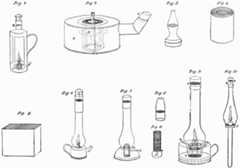
200He then devised a number of lamps on this principle,and subjected them to trial with explosive mixtures invarious ways. The plate on page199, copied from theoriginal paper in thePhilosophical Transactions, showsthe successive forms through which thelamps passed.
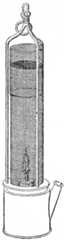
On January 11th, 1816, he read asecond paper to the Royal Society,entitled, “An account of an inventionfor giving light in explosive mixtures offire-damp in coal mines by consumingthe fire-damp,” in which he shows thatthe tubes or canals as well as the sidesof the lanterns may be replaced bycages or cylinders of wire gauze. Theinflammable mixture will readily passthrough the meshes of the gauze andwill burn within it, filling the cylinderwith a bright flame, but no explosionwill pass outwards, even although thewire becomes heated to redness.
A fortnight later he read a thirdpaper to the Society, “On the Combustionof Explosive Mixtures confinedby Wire Gauze, with some Observationson Flame,” in which he gives the resultsof further inquiries respecting the limitsof the size of the apertures, and of the wire in themetallic gauze required to shield the flame of an oil-lamp,and describes a number of illustrations of theaction of the gauze in lowering the temperature of theexplosive mixture below the point of ignition. Some ofthese illustrations are now among the stock experimentsof the lecture theatre. He offers some observations201concerning the essential nature of flame, and concludesby informing the Society that his “cylinder lamps[i.e. lamps of which the flames are enclosed within acylinder of gauze: seeFig. 11, p. 199] have been triedin two of the most dangerous mines near Newcastlewith perfect success.”
The form which the lamp finally took in the handsof Mr. Newman, the instrument-maker, is seen on p.200.
The trials above referred to were first made byMr. Matthias Dunn and the indefatigable Mr. Hodgsonin the Hebburn Colliery, and shortly afterwards by Mr.John Buddle in the Wall’s End Colliery. Mr. Buddle hasplaced on record his impressions of his first experience.
“I first tried it,” he says, “in an explosive mixture on thesurface; and then took it into a mine; ... it is impossiblefor me to express my feelings at the time when I first suspendedthe lamp in the mine and saw it red hot.... I said to thosearound me ‘We have at last subdued this monster.’”
Some months afterwards Davy accompanied Mr.Buddle into the pit and saw his lamp in actual use.
“Sir Humphry was delighted,” says Mr. Buddle, “and I wasoverwhelmed with feelings of gratitude to that great genius whichhad produced it.”
Further testimony of Mr. Buddle’s appreciation ofthis memorable invention may be seen from the followingextract from a letter by him to Davy. It is not onlyinteresting in view of Davy’s remark that “the evidenceof the use of a practical discovery is of most value whenfurnished by practical men,” but also as showing therapidity with which the discovery was taken advantageof:—
“Walls End Colliery, Newcastle,June 1st, 1816.
“After having introduced your safety lamp into general usein all the collieries under my direction, where inflammable air202prevails, and after using them daily in every variety of explosivemixture, for upwards of three months, I feel the highest possiblegratification in stating to you that they have answered to myentire satisfaction.
“The safety of the lamps is so easily proved by taking theminto any part of a mine charged with fire-damp, and all theexplosive gradations of that dangerous element are so easily andsatisfactorily ascertained by their application, as to strike theminds of the most prejudiced with the strongest conviction oftheir high utility; and our colliers have adopted them with thegreatest eagerness.
“Besides the facilities afforded by this invention to theworking of coal mines abounding in fire-damp, it has enabledthe directors and superintendents to ascertain, with the utmostprecision and expedition, both the presence, the quantity, and thecorrect situation of the gas. Instead of creeping inch by inchwith a candle, as is usual, along the galleries of a mine suspectedto contain fire-damp, in order to ascertain its presence, we walkfirmly in with the safe lamps, and with the utmost confidenceprove the actual state of the mine. By observing attentivelythe several appearances upon the flame of the lamp, in anexamination of this kind, the cause of accidents which havehappened to the most experienced and cautious miners is completelydeveloped; and this has been, in a great measure, matterof mere conjecture.
“I feel peculiar satisfaction in dwelling upon a subject whichis of the utmost importance, not only to the great cause ofhumanity, and to the mining interest of the country, but also tothe commercial and manufacturing interests of the UnitedKingdom; for I am convinced that by the happy invention of thesafe lamp large proportions of the coal mines of the empire willbe rendered available, which otherwise might have remainedinaccessible, at least without an invention of similar utility, whichcould not have been wrought without much loss of the mineral,and risk of life and capital.
“It is not necessary that I should enlarge upon the nationaladvantages which must necessarily result from an inventioncalculated to prolong our supply of mineral coal, because I thinkthem obvious to every reflecting mind; but I cannot conclude,without expressing my highest sentiments of admiration for203those talents which have developed the properties, and controlledthe power, of one of the most dangerous elements which humanenterprise has hitherto had to encounter.”
This letter is only one of many received by Davyfrom practical men, all telling the same story of wonderand astonishment “that so simple a looking instrumentshould defy an enemy heretofore unconquerable”;and all expressing the deepest gratitude to him as itsinventor, often in language which gains in force, andeven in eloquence, from its very homeliness and simplepathos.
The following address from the Whitehaven collierswas among the papers lent to me by Dr.Rolleston:—
“September 18, 1816.
“We, the undersigned, miners at the Whitehaven Collieries,belonging to the Earl of Lonsdale, return our sincere thanks toSir Humphry Davy, for his invaluable discovery of the safelamps, which are to us life preservers; and being the only returnin our power to make, we most humbly offer this, our tribute ofgratitude.”
The names of eighty-two miners are appended—themajority of them—viz. forty-seven—with their mark (+)affixed.
What the learned world thought may be judgedfrom the following extracts from an article in theEdinburgh Review—a periodical not always characterisedby a just appreciation of the work of the RoyalInstitution professors, for the literature of science containsfew things more disingenuous or more spiteful thanthe attack of “the young gentleman from Edinburgh”—afterwardsknown as Lord Brougham—on ThomasYoung when he first made known the undulatory theoryof light. In theReview for February, 1816, Mr. Playfair204begins his article on Davy’s discovery by pointing outthat—
“The safe lamp is a present from philosophy to the arts, andto the class of men furthest removed from the influence of science.The discovery is in no degree the effect of accident; and chance,which comes in for so large a share in the credit of humaninventions, has no claims on one which is altogether the result ofpatient and enlightened research....
“This is exactly such a case as we should choose to placebefore Bacon, were he to revisit the earth, in order to give him,in a small compass, an idea of the advancement which philosophyhas made, since the time when he had pointed out to her theroute which she ought to pursue. The great use of an immediateand constant appeal to experiment cannot be better evinced thanin this example. The result is as wonderful as it is important.An invisible and impalpable barrier made effectual against aforce the most violent and irresistible in its operations; and apower, that in its tremendous effects seemed to emulate thelightning and the earthquake, confined within a narrow space,and shut up in a net of the most slender texture,—are facts whichmust excite a degree of wonder and astonishment from whichneither ignorance nor wisdom can defend the beholder. Whento this we add the beneficial consequences and the saving of thelives of men and consider that the effects are to remain as long ascoal continues to be dug from the bowels of the earth, it may fairlybe said that there is hardly in the whole compass of art or science asingle invention of which one would rather wish to be the author.”
Davy was urged by several of his friends to protecthis invention by a patent. Among them was Mr. Buddle,who pointed out to him that he might have received hisfive or ten thousand a year from it.
“My good friend,” was his answer, “I never thought of sucha thing: my sole object was to serve the cause of humanity; andif I have succeeded, I am amply rewarded in the gratifying reflectionof having done so.... More wealth could not increaseeither my fame or my happiness. It might undoubtedly enableme to put four horses to my carriage; but what would it avail meto have it said that Sir Humphry drives his carriage and four?”
205The gratitude of some of the leading colliery proprietorsfor an invention so unselfishly placed at theirdisposal found expression in a letter from the chairmanof a general meeting of the coal-owners held at Newcastleon March 18th, 1816, conveying the terms of a voteof thanks. A few months afterwards it was determinedthat their appreciation should take a more substantialform, and a general meeting of the coal-owners was heldat Wallsend Colliery on August 31st, 1816, at which itwas resolved to make Davy a present of plate.
A note of opposition was at once sounded, and itcame from one of the proprietors of the Felling Colliery.Mr. W. Brandling urged that it was not proved that SirHumphry Davy was the first and true inventor of thesafety lamp, or even the discoverer of the principle onwhich it was based.
“The conviction,” he said, “upon my mind is, that Mr. GeorgeStephenson, of Killingworth Colliery, is the person who firstdiscovered and applied the principle upon which safe lamps maybe constructed; for whether the hydrogen gas is admitted throughcapillary tubes, or through the apertures of wire-gauze, whichmay be considered as merely the orifices of capillary tubes, doesnot, as I conceive, in the least affect the principle.”
The opposition thus started very quickly gatheredstrength, and by appeals to local prejudice and toignorance a degree of heat and even animosity wasimported into the question, which served no otherpurpose than to confuse the true issue. At an adjournedmeeting of the coal-owners held on October 11th, 1816,Mr. William Brandlingmoved—
“That the meeting do adjourn, until by a comparison of datesit shall be ascertained whether the merit of the safety lampbelongs to Sir Humphry Davy, or to Mr. George Stephenson.”
206Although Mr. Brandling failed to convince themeeting, it becomes necessary in the interests of truthand justice to examine the grounds upon which GeorgeStephenson—a man of undoubted genius, and of anintegrity as blameless as that of Davy, and who, as thepioneer of railway enterprise, subsequently acquireda fame as high and as deserved as that of the greatchemist—has claims to be regarded as an inventor ofthe safety lamp. In equity, it must be admitted thatthe question is not merely a question of dates, for inassigning merit in a matter of this kind the calmerjudgment of posterity is not wholly swayed by priorityof date; it looks to circumstances, conditions, motives,and it apportions its meed of approbation accordingly.The glory of Priestley as an independent discoverer ofoxygen is in nowise dimmed by the circumstance thatScheele is now known to have discovered it before him.It cannot be truthfully asserted that Davy was not anindependent inventor of the safety lamp. What has tobe determined is, has George Stephenson any suchclaim?
Stephenson’s claim has been ably and temperatelystated by Dr. Smiles in his biography of GeorgeStephenson, in “The Lives of the Engineers,” butan unbiassed review of the evidence will convincemost people that, however certain it may be thatthe Killingworth engine-tenter was an independentsearcher after a method of protecting a flame, it isequally certain that he was not the discoverer of thetrue principle on which the safety lamp is constructed,and that the lamp associated with his name, althoughit bears the impress of the crude ideas with whichhe started, owes its real merit to the discoveries ofDavy.
207This controversy and the feeling it gave rise to greatlyexasperated Davy, and his anger is manifested in hisletters at the time. The action of the Brandlings heseemed to think was inspired by the most unworthymotives. As to his rival, hesays:—
“I never heard a word of George Stephenson and his lampstill six weeks after my principle of security had been published;and the general impression of the scientific men in London, whichis confirmed by what I heard at Newcastle, is, that Stephensonhad some loose idea floating in his mind, which he had unsuccessfullyattempted to put in practice till after my labours were madeknown;—then, he made something like a safe lamp, except thatit is notsafe, for the apertures below are four times, and thoseabove twenty times too large; but, even if Stephenson’s planshad not been posterior to my principles, still there is no analogybetween his glass exploding machine, and my metallic tissuepermeable to light and air, and impermeable to flame.”
On the 25th of September, 1817, as Davy passedthrough Newcastle on his return from Scotland, thecoal-owners who had subscribed to his testimonialinvited him to a banquet and presented him with theplate, which, in accordance with his wishes, took theform of a dinner-service. “I wish,” he had said, “thateven the plate from which I eat should awaken myremembrance of their liberality, and put me in mind ofan event which marks one of the happiest periods of mylife.” The chairman—his friend Mr. Lambton, afterwardsthe Earl of Durham, and who was with him under thecare of Dr. Beddoes at Bristol—made the presentation inan impressive and felicitous speech, and Davy acknowledgedit in terms worthy of himself and of the occasion.In a subsequent speech, in response to the toast of hishealth, he dilated upon the theme always uppermost inhis mind, and to which he never neglected the opportunityto give utterance, namely, the benefit of abstract science208to mankind. He had an admirable moral to which topoint, and it was driven home with all his wonted skilland power.
In what manner this plate, which was valued atabout £2,500, was subsequently made subservient tothe interests of science will be seen hereafter.
The friends of Stephenson were not wanting in thecourage of their convictions or in determination to givesubstantial proof of it. In the following November theymet and resolved that as in their opinion Mr. G. Stephensonhad been the first to discover the principle of safetyand to apply it, he was entitled to some reward. WhereuponDavy’s friends again assembled in public meetingon November 26th, 1817, and passed resolutions to theeffect that in their opinion the merit belonged toSir Humphry Davy alone, and that Stephenson’s latestlamps were evident imitations of those of Sir HumphryDavy; and they further ordered that copies of theirresolutions should appear in a number of local, London,and Edinburgh papers, and be sent to the principalowners and lessors of collieries upon the Tyne and Wear.Davy’s friends in London also exerted themselves in hisbehalf, and a copy of resolutions similar in purport tothose passed in Newcastle, signed by Sir Joseph Banks,P.R.S., Brande, Hatchett, and Wollaston, was sent to thenewspapers.
Mr. Brandling and his friends eventually collectedabout £800 (including 100 guineas which the meetingof October 11th had awarded Stephenson as an acknowledgmentof his efforts to construct a safe lamp), andgave it, together with a silver tankard, to Mr. Stephensonat a public dinner in January, 1818.
This is not the place to follow the subsequent historyof the Davy lamp, or to describe the various modifications209which have grown out of it, or even to show the dangerswhich a larger experience reveals as latent in itsoriginal form. These dangers have in great measurearisen from the development of the very system ofventilation which Buddle himself instituted; and hewho in his joy exultingly exclaimed, “At last, we havesubdued this monster!” has unwittingly contributed tothe maleficent activity of the monster in coping with thelamp as Buddle knew it.
In the course of his numerous trials made to elucidatethe principle of the safety lamp, Davy observed certainpeculiarities connected with flame which led him to takeup the general question. Hence arose a series of investigations,which have contributed in no small degree toour knowledge of a particularly difficult and intricatesubject.
He proved, in the first place, that flame must be consideredas anexplosive mixture of inflammable gas orvapour and air, and that the heat communicated by itmust depend upon its mass. The different appearanceof a flame of coal gas burning in a jet in the open air,and in his safety lamp mixed with common air, ledhim to investigate the cause of luminosity in flame.Hesays:—
“In reflecting on the circumstances of the two species ofcombustion I was led to imagine that the cause of the superiorityof the light of thestream of coal gas might be owing to thedecompositionof a part of the gas towards the interior of the flame,where the air was in smallest quantity, and the deposition of solidcharcoal, which, first by itsignition, and afterwards by its combustion,increased in a high degree the intensity of the light.”
The principle of the increase of the brilliancy anddensity of flame by the production and ignition of solidmatter explains the appearance of the different parts of210the flames of burning bodies, and of the blow-pipeflame; it also explains the intensity of the light of thoseflames in which fixed solid matter is produced in combustion,e.g. phosphorus and zinc in oxygen, potassiumin chlorine; and, on the other hand, the feebleness ofthe light of flames in which gaseous and volatile matteris alone produced,e.g. hydrogen in oxygen, phosphorusin chlorine. Davy’s theory has not been unchallenged,but all subsequent research, when pushed sufficientlyfar, has shown that, as regards all ordinary illuminatingflames,i.e. carbonaceous flames—e.g. coal-gas, oil, paraffin,candle—the presence of solid incandescent carbon is aprime cause of their luminosity. It had been observedthat the rarefaction of a mixture of inflammable gasesdiminishes its combustibility: Davy proved that thisdiminution was not the result of the removal of pressureper se, but of the cooling effect thus indirectly produced.Hence, the lower the temperature of ignition of a gaseousmixture the more it may be rarefied without becominguninflammable. In like manner he shows that byheating the gaseous mixture it may be caused to explodeat a lower temperature, and that when gases combine bysudden compression, the combination is caused by theheat evolved. Also that the power of an indifferent gasto prevent the explosion of a gaseous mixture dependsupon its power of abstracting heat, and that the higherthe temperature of ignition of the explosive mixturethe less is the amount of indifferent gas required to stopthe explosion. He proved that it was quite possible toeffect the gradual combination of gases without flame—thatis, without the production of heat sufficient to raisethe products to incandescence; and he discovered thesingular fact that platinum would induce the combinationof many inflammable gases and vapours, and on211this circumstance based the construction of his flamelesslamp.
In the early summer of 1818, he thus wrote to hismother:—
“My dear Mother,—We are just going on a very interestingjourney. I am first to visit the coal miners of Flanders, whohave sent me a very kind letter of invitation and of thanks forsaving their lives. We are then going to Austria, where I shallshow Vienna to Lady Davy, and then visit the mines; andlastly, before I return, we are going to visit Naples.
“I have the commands of his Royal Highness the PrinceRegent to make experiments upon some very interesting ancientmanuscripts, which I hope to unfold. I had yesterday the honourof an audience from his Royal Highness, and he commissionedme to pursue this object in the most gracious and kind manner....
“We shall be absent some months. With kindest love to mysisters and my aunts,
“I am, my dear mother,
“Your most affectionate son,
“H. Davy.”
A few months after this visit to the Prince Regenthe received the intimation that he had been created abaronet.
He arrived at Naples in the autumn, and began hisresearches on the Herculaneum manuscripts referred toin his letter. His first results were sufficiently encouragingto induce him to make some prolongedexperiments with a view of discovering a method ofunfolding them. He found that the papyri had sufferednot so much from fire, as was believed, as from a gradualchange in vegetable structure, similar to that whichaccompanies the transformation of vegetable matterinto lignite. He managed to unroll a number, and anaccount of his results was communicated to the RoyalSociety in 1821. But from the fragmentary character212of the papyri these were found to be of little value toliterature. Subsequently difficulties were put in hisway by the curators of the museum, and ultimatelyhis investigations were abandoned, not without somelittle exhibition of temper and resentment on hispart.
During his stay at Naples he again interested himselfin the volcanic phenomena of Vesuvius, and his observationsconstitute the material of a paper which waspublished in thePhilosophical Transactions in 1827,and many of his personal experiences in connectionwith the subject are referred to in his last work,“Consolations in Travel.”
He left Naples in the spring of 1819, and after ashort stay at the baths of Lucca he went for the summerand early autumn into the Tyrol, whence he again proceededto Lucca, and on the approach of winter returnedto Naples, where he arrived on December 1st. He quittedit in the spring of 1820, and travelled slowly home bythe south of France and Bordeaux, arriving in Englandabout the middle of June. On the 19th of that monthSir Joseph Banks died, and so terminated his forty-twoyears’ presidency of the Royal Society, to which positionhe was elected before Davy was even born. Davyimmediately announced his intention of becoming acandidate for the vacant chair, and was elected at thefollowing anniversary meeting on November 30th.
Davy was elected into the Royal Society in 1803. Hiscertificate describes him as “a gentleman of very considerablescientific knowledge, and author of a paper inthe Philosophical Transactions.” Two years afterwards—thatis, in his twenty-seventh year—he was awardedthe Copley medal; from which we may infer either thatthe Society considered their medal not to have thelustre it now possesses, or that they had a confidentbelief in the power and coming greatness of therecipient, since the papers for which it was given areperhaps the least meritorious of Davy’s productions.His active interest in the affairs of the Society led tohis election—or rather selection, for the appointmentin those days was made by the President—as one of theSecretaries, a position he held until 1812, when heresigned it at the time of his marriage. In 1816 hereceived the Rumford medal of the Society for his workin connection with flame and the safety lamp—an awardwhich would have given a peculiar satisfaction toRumford had he lived to witness it.
On the death of Sir Joseph Banks the general voiceof the Fellows seemed to designate Wollaston as hissuccessor. It was, indeed, Sir Joseph Banks’s desire thatDr. Wollaston should be nominated. “So excellent aman,” he remarked to Barrow, “of such superior talents,and everyway fitted for the situation. Davy is a livelyand talented man, and a thorough chemist; but ...he is rather too lively to fill the chair of the Royal Society214with that degree of gravity which it is most becomingto assume.” Oh this gravity! “La gravité,” says LaRochefoucauld, “est un mystère du corps, inventé pourcacher les défauts de l’esprit.” And Sir Joseph hadenough of it and to spare. Wollaston—a man of wideknowledge, steady, cautious, and sure,—of cool judgmentand sagacious views, as Davy said of him—felt noinclination to accept a position for which his retiringhabits and reticent disposition to some extent unfittedhim, and he declined to be put in nomination. Davy’sattitude is indicated in the following letter to his friendPoole:—
“I feel that the President’s chair, after Sir Joseph, will be nolight matter; and unless there is a strong feeling in the majorityof the body that I am the most proper person, I shall not sacrificemy tranquillity for what cannot add to my reputation, though itmay increase my power of being useful.
“I feel it a duty that I owe to the Society to offer myself;but if they do not feel that they want me, (and the most activemembers, I believe, do) I shall not force myself upon them.”
The “strong feeling in the majority” was shown on theday of election. A few votes were given in favour of LordColchester, but Davy’s triumph was practically complete.
He thus writes to Mr. Poole in answer to a letter ofcongratulation:—
“I have never needed any motive to attach me to science,which I have pursued with equal ardour under all circumstances,for its own sake, and for the sake of the public, uninfluenced bythe fears of my friends, or the calumnies of my enemies. I gloryin being in the chair of the Royal Society, because I think itought to be a reward of scientific labours, and not an appendageto rank or fortune; and because it will enable me to be useful ina higher degree in promoting the cause of science.”
Davy was re-elected to the Presidential Chair withoutopposition for seven successive years—until, in short, his215failing health compelled him to resign. Although theSociety owes much to him, he himself derived littlesatisfaction or pleasure from the position. He soonfound, as he anticipated, that the President’s Chair, afterSir Joseph, was no light matter; and there is little doubtthat the worries and cares of the office contributed to hisuntimely death. In bearing, manner, temperament—infact, in almost every particularity—he was the very oppositeto his predecessor; and when the discontent whichhad slumbered, with an occasional awakening, during SirJoseph’s long reign, and which his firmness, tact, and theweight of his personal character had for the time allayed,broke out, Davy was too impulsive and irascible to dealwith it as Banks had done, and matters which a lesssensitive or a more impassive man would have unheededwere causes of annoyance and ill-temper to him, andserved to add to the spirit of disunion which prevailed.But if he occasionally lacked discretion, he was neverwanting in zeal. He laboured incessantly to add to thedignity and usefulness of the Society. He strove inevery way to enhance the character of its publicationsand to raise the standard of Fellowship. His greatambition was to bring the Society into more intimaterelation with the State.
“It was his wish,” says his brother, “to have seen the RoyalSociety an efficient establishment for all the great practicalpurposes of science, similar to the college contemplated by LordBacon, and sketched in his New Atlantis; having subordinateto it the Royal Observatory at Greenwich for astronomy; theBritish Museum, for natural history, in its most extensiveacceptation.”
Realising in his own case what such a laboratory asthat of the Royal Institution, supported wholly by privateliberality, had done for science, it was his desire that216similar laboratories, amply provided with all meansrequisite for original inquiry, should be maintained andadministered by the Society. But, as his brother adds,the Government, although ready enough to consult himwhen in want of his knowledge or of that of other Fellowsof the Society, was lukewarm and indifferent in mattersof science, and he received no effectual support. It istrue that towards the end of his Presidency the Societyreceived a mark of Royal favour by the foundation ofthe Royal Medals in 1825, but from various causes themedals were not actually forthcoming until 1833, whenthe Duke of Sussex was in the Chair, although no fewerthan ten awards had been made in the meantime. In hisattention to the personal duties of his office Davy wasunremitting. His addresses were a feature of the session;in these he displayed all the ardour, eloquence andpoetical fervour, and, it may be added, all the egoism,which characterised his lectures. He delighted to dwellupon the power and dignity of science, its worth as amental instrument, and its value to the national life.In his announcements of the awards of the Society’smedals the range of his knowledge, his power of exposition,and his faculty of felicitous expression found ampleopportunity for exercise. He was the first President tointroduce obituary notices of Fellows, and hiséloges aremarked by judgment, taste, and warmth of feeling.
In everything that related to the dignity and ceremonyof his office he was, as might have been expected, mostpunctilious. Although as a rule somewhat careless indress, he invariably took the chair in full Court dress,sitting covered, and with the mace of office—the veritable“bauble” which Cromwell ordered to be removed fromthe table of the House of the Commons—in front of him,as is still the custom.
217To enhance his dignity we are told that he petitionedGovernment for the Red Ribbon of his predecessor, andit was said that he felt so certain his request would begranted that his name was printed with the covetedletters K.B. appended.
During the session he followed the practice of SirJoseph Banks in assembling the Fellows at a weeklyconversazione at his house in Lower Grosvenor Street.Subsequently, on his removal to Park Street, thesemeetings were held in the apartments of the Society atSomerset House. Davy’s vivacity and conversationalpowers made the gatherings in the outset a great success,but when the tide of his unpopularity as President setin, the attendance fell off, and they were eventuallydiscontinued.
During the autumn preceding his first election hespent some time with Scott at Abbotsford, in companywith Wollaston and Mackenzie (the Man of Feeling), andLockhart gives some account of him as the party startedon a sporting expedition on a September morning.
“But the most picturesque figure was the illustrious inventorof the safety lamp. He had come for his favourite sport ofangling ... and his fisherman’s costume—a brown hat withflexible brims, surrounded with line upon line, and innumerablefly-hooks; jack-boots worthy of a Dutch smuggler, and a fustiansurtout dabbled with the blood of salmon—made a fine contrastto the smart jackets, white-cord breeches, and well polishedjockey-boots of the less distinguished cavaliers about him. Dr.Wollaston was in black, and with his noble serene dignity ofcountenance might have passed for a sporting archbishop....I have seen Sir Humphry in many places, and in company ofmany different descriptions; but never to such advantage as atAbbotsford. His host and he delighted in each other, and themodesty of their mutual admiration was a memorable spectacle.Davy was by nature a poet—and Scott, though anything but aphilosopher in the modern sense of that term, might, I think it218very likely, have pursued the study of physical science with zealand success, had he happened to fall in with such an instructor asSir Humphry would have been to him, in his early life. Eachstrove to make the other talk—and they did so in turn morecharmingly than I have ever heard either on any other occasionwhatsoever. Scott in his romantic narratives touched a deepercord of feeling than usual, when he had such a listener as Davy;and Davy, when induced to open his views upon any question ofscientific interest in Scott’s presence, did so with a degree ofclear energetic eloquence, and with a flow of imagery and illustration,of which neither his habitual tone of table-talk (least of all inLondon), nor any of his prose writings (except, indeed, theposthumous Consolations in Travel) could suggest an adequatenotion. I say his prose writings—for who that has read hissublime quatrains on the doctrine of Spinoza can doubt that hemight have united, if he had pleased, in some great didacticpoem, the vigorous ratiocination of Dryden and the moralmajesty of Wordsworth? I remember William Laidlaw whisperingto me, one night, when their ‘wrapt talk’ had kept thecircle round the fire until long after the usual bed-time ofAbbotsford—‘Gude preserve us! This is a very superioroccasion! Eh, sirs!’ he added, cocking his eye like a bird, ‘Iwonder if Shakspeare and Bacon ever met to screw ilk other up?’”
In spite of the many calls upon his time and energiesentailed by his duties as President, he still foundopportunity to work in his laboratory, and one outcomeof his labours was a paper “On the magnetic phenomenaproduced by electricity,” published in thePhilosophicalTransactions for 1821—the sequel of a letter addressedto Wollaston and also printed in the Transactions. Thismemoir was followed a few months later by a communication“On the Electrical phenomena exhibitedin vacuo.”
These papers, together with one on a New Phenomenonof Electro-Magnetism, published in 1823, areinteresting in relation to the development of Oersted’sgreat discovery, and in connection with the subsequentwork of Faraday.
219With that power of generalisation which is one of thedistinguishing marks of his genius, he shows the possibleconnection of the facts he had observed with thephenomena of terrestrial magnetism. He concludes hisfirst paper by asking
“whether the magnetism of the earth may not be owing to itselectricity, and the variation of the needle to the alterations inthe electrical currents of the earth, in consequence of its motions,internal changes, or its relations to solar heat; and whether theluminous effects of the auroras at the poles are not shown, bythese new facts, to depend on electricity. This is evident, thatif strong electrical currents be supposed to follow the apparentcourse of the sun, the magnetism of the earth ought to be such asit is found to be.”
It is perhaps idle to speculate on such a matter,but it is more than likely that had Davy been freefrom the cares and restraints of office, and from theinnumerable distractions inseparable from his positionin the social and scientific world of London, he mighthave revealed the possibilities in electro-magnetismwith the same brilliant success as he had done thoseof voltaic electricity. He was now at the maturity ofhis mental power, and had still much of the enthusiasmand ardour which characterised his earliest work, andunder serener conditions he might have achievedtriumphs not less striking than those reserved forFaraday. His few short papers on the subject indicatethat he fully realised the great wealth of the newterritory thus opened out to science, and into which hewas one of the first to penetrate. But it is sad to thinkthat he might have extended a more generous hand toone who, equally with himself, was striving to enter thenew land, and who eventually did enter and for atime possessed it. In the concluding words of Davy’s220last paper on electro-magnetism, we discern in theallusion to Wollaston’s idea of the possibility of therotation of the electro-magnetic wire round its axis“the rift within the lute” in his relations towards hisassistant, which widened in the matter of the condensationof chlorine, and which threatened to becomean open breach when Faraday was elected into theRoyal Society.
The jealousy thus manifested by Davy is one ofthe most pitiful facts in his history. It was a signof that moral weakness which was at the bottom ofmuch of his unpopularity, and which revealed itselfin various ways as his physical strength decayed.
Greedy as he was of fame—that infirmity of nobleminds—many incidents in his life up to this periodprove that he was not wanting on occasion in agenerous appreciation of the work of his contemporaries,even in fields he might reasonably claim as his own.But, although in his intellectual combats he could show attimes a certain knightly courtesy, it must be confessedthat he was lacking in the magnanimity which springsfrom the charity that envieth not.
In genius he was unquestionably superior to Faraday;in true nobility of character he was far belowhim. It is almost impossible to avoid comparing himwith Faraday. Indeed it is one of the penalties of hisposition that he has to be tried by so severe astandard, and it may well be that his good name,which, as Bacon says, is the proper inheritance of thedeceased, has suffered unduly in consequence. Histrue place in the history of science is defined by hisdiscoveries; it is a sad reflection that the lustre ofhis fame has been dimmed rather than heightenedby what has been styled the greatest of them all—221Faraday.But there has undoubtedly been injusticein the comparisons which have been made. WhatDavy was to Faraday, Faraday would have been thefirst to admit. Davy made himself what he was bythe sheer force of his unaided genius; what Faradaybecame was in large measure due to his connectionwith Davy, and the germs of his greatest works areto be traced to this association. This fact has beenfrankly acknowledged by Faraday. To the end of hisdays he regarded Davy as his true master, preservingto the last, in spite of his knowledge of the moral frailtiesof Davy’s nature, the respect and even reverence whichis to be seen in his early lecture notes and in hisletters to his friend Abbott. Faraday was not easilyroused to anger, but nothing so effectually moved himas any aspersion of Davy’s character as a man ofscience, or any insinuation of ungenerous treatmentof himself by Davy.
At about this time—that is, in the autumn of 1823—Davygave the first signs of the obscure maladywhich ultimately occasioned his death. In a letter tohis brother, in which he describes his symptoms, wehave a reference, also, to his domestic worries: “To addto my annoyances, I find my house, as usual, after thearrangements made by the mistress of it, withoutfemale servants; but in this world we have to sufferand bear, and from Socrates down to humble mortals,domestic discomfort seems a sort of philosophical fate.”
He was able, however, to continue his scientific work,but instead of the fame and applause on which he soconfidently counted, he found only disappointment andchagrin.
In 1823 the Admiralty sought the advice of theRoyal Society as to “the best means of securing to the222service copper of the most durable quality, and suchas will preserve the smoothest surface.” A committeeof the Society was appointed, under Davy’sdirection, to consider the question, which ultimatelyresolved itself into one of preventing the corrosionof the metal. In this matter Davy’s special experienceproved most useful, and, as a fact, he took all theexperimental part of the inquiry upon himself, andwith what result may be seen from the following letterto hisbrother:—
“Firle, Jany 30, 1824.
“I have lately made a discovery of which you will for manyreasons be glad. I have found a complete method of preservingthe copper sheeting of ships, which now readily corrodes. It isby rendering it negatively electrical. My results are of the mostbeautiful and unequivocal kind: a mass of tin renders a surfaceof copper 200 or 300 times its own size sufficiently electrical tohave no action on sea water.
“I was led to this discovery by principle, as you will easilyimagine; and the saving to government and the country by it willbe immense. I am going to apply it immediately to the navy. Imight have made an immense fortune by a patent for this discovery,but I have given it to my country; for in everything connectedwith interest, I am resolved to live and die at least ‘sanstâche.’”
His method of rendering the copper negativelyelectric consisted in affixing to the sheets a numberof short bars of iron or zinc, properly curved to theshape of the vessel. In this way the “protectors,”as the zinc or iron bars were called, gradually corroded,whilst the copper remained unattacked. But, as Dr.Paris remarks, the truth of the theory was completelyestablished by the failure of the remedy. The ship’sbottom became so foul by the adhesion of shells andweed that her speed was greatly impeded, and aftera number of trials, in the course of which a steam223vessel was placed at his disposal, in which he madea voyage to Norway and back, the Admiralty directedthe protectors to be removed. To add to his mortification,the order was issued immediately after a communicationto the Royal Society announcing thecomplete success of his plan. Throughout the wholeof this business he was exposed to a number ofvexatious attacks, which greatly embittered him andreacted disastrously upon his health and character.So long as there was the hope of success and theprospect of reward his claims to the originality of theinvention were contested: no sooner was the projectabandoned than he was assailed in the periodical pressand made an object of sarcasm and censure. Asmight be imagined, his philosophy was not proofagainst such attacks. He wrote to his friendChildren—
“A mind of much sensibility might be disgusted, and onemight be induced to say why should I labour for public objects,merely to meet abuse?—I am irritated by them more than Iought to be; but I am getting wiser every day—recollectingGalileo, and the times when philosophers and public benefactorswere burnt for their services.”
During the autumn his indisposition increased, andhis home letters show that the wonderful elasticity ofspirit, which, as his brother remarks, had hitherto carriedhim lightly and joyously through life, over all its rubsand cares, now seemed to flag. He had an ailing winter,and with the spring came news of his mother’s illness.He could only write with difficulty:—“If it please God,I will certainly be at Penzance the last week in Octoberor the first in November.” He never saw her again; sherallied for a time, but died somewhat suddenly in224September. Davy never really recovered from the shockof her death. It was with the greatest difficulty thathe was able to preside at the anniversary meeting of theSociety on the ensuing St. Andrew’s Day. The effort wasso marked that those near him feared he was on theverge of apoplexy, and he was too ill to attend thedinner. A few weeks later he had a slight attack ofparalysis, from which he only slowly recovered. Hisgood friend Dr. BabingtonJ ordered him abroad, awayfrom “the convivial epicurean habits of London society,”and from “the many annoyances and causes of injuriousexcitement to which he was exposed at home.” He setout with his brother John, in the depth of winter—“adreary beginning of a dreary journey.” He avoidedParis; he would not even pass through it, so apprehensivewas he that he should not escape from “theallurement—or, rather, excitement—of its society” ifhe stopped there. The roads were in a wretched state,the country covered with snow, and “no object to arrestthe eye, except a village here and there rising out of thewhite waste, or a distant steeple, or some solitary tree.”The cold was intense, and once or twice the travellerswere benighted, the wheels of their carriage being lockedin the frozen ruts. As they passed through the townsDavy, who seemed to cling to life with a passionatetenacity, would visit the churches, and, falling on hisknees, would offer up a silent prayer. They crossedMont Cenis in a storm of wind and amidst driftingsnow, and with great difficulty got down to Susa on225sledges. The snow in Lombardy was deeper than inthe passes of the Alps, and even at Ravenna, where theyarrived in the first week of March, it was still to be seenin the ditches. Here his brother left him, his duties asan army surgeon calling him to Corfu. In spite ofsevere weather, the discomforts of travelling at such atime, and the forced delays at wretched inns, Davygradually improved; his brother noted before he leftthat he was certainly stronger, less paralytic, and moreactive. He wrote to his friendPoole:—
J “Babington, the best and warmest-hearted friend, the kindesthusband and father, and perhaps the most disinterested physician ofhis time; with good talents, and a fine tact, and a benevolence whichcreated sympathy for him wherever he appeared, and I believe oftencured his patients.”
“I am, thank God, better, but still very weak, and whollyunfit for any kind of business and study. I have, however, considerablyrecovered the use of all the limbs that were affected;and as my amendment has been slow and gradual, I hope in timeit may be complete. But I am leading the life of an anchorite,obliged to abstain from flesh, wine, business, study, experiments,and all things that I love; but this discipline is salutary, and forthe sake of being able to do something more for science, and Ihope for humanity, I submit to it, believing that the GreatSource of intellectual being so wills it for good.”
He tells Poole that he had chosen Ravenna—this spotof the declining Empire of Rome—as one of solitude andrepose, and as out of the way of travellers and in a goodclimate. He was interested, too, in its many associationswith his friend Byron, with Dante, and in its old-worldmemories of Theodoric and his lost legions. How theplace affected him in his state of physical enfeeblement,but with his mind chastened and purified, may be seenin the character of much that he wrote there, andparticularly in his poems, with their many notes ofsadness and hope, trust and resignation. He was lodgedin the Apostolical Palace by the kindness of the Vice-Legate—agraceful, learned, and accomplished man, withwhom he contracted a warm friendship. He says he226could not speak of his goodness without tears of gratitudein his eyes, and with this exception and an occasional visitfrom the Countess Guiccioli he had no society. Mostof his time was spent in riding amidst the pines andjunipers, or following the petzardone among the marshesof La Classe; or in reading and in the study of naturalhistory.
“The natural strength of his mind,” says his brother, “wasvery clearly manifested under these circumstances. Dependententirely on his own resources; no friend to converse with; no onewith him to rely on for aid, and in a foreign country, withouteven a medical adviser; destitute of all the amusements ofsociety; without any of the comforts of home—month aftermonth, he kept on his course, wandering from river to river, fromone mountain lake and valley to another, in search of favourableclimate; amusing himself with his gun and rod, when sufficientlystrong to use them, with ‘speranza’ for his rallying word.”
With the approach of spring he passed by way ofGorizia into Illyria, and, as the heat increased, intoUpper Austria, Bavaria, and Switzerland, and back, inthe late summer, to Illyria. His journals give a fairlyfull account of his movements and of the manner inwhich he spent his time; they also indicate his stateof mind, the alternations of hope and despondency, andhis constant struggles with the insidious disease whichwas gradually exhausting his physical powers.
He wrote to his wife fromLaybach:—
“You oncetalked of passingthis winter in Italy; but I hopeyour plans will be entirely guided by the state of your health andfeelings. Your society would undoubtedly be a very great resourceto me, but I am so well aware of my own present unfitnessfor society, that I would not have you risk the chance of an uncomfortablemoment on my account. I often read Lord Byron’sEuthanasia: it is the only case, probably, where my feelingsperfectly coincide with what his were.”
227At times the feeling of despair was so intense that heactually seemed apprehensive of suicide. It was probablyunder the influence of such a fear that he wrote in hisjournal that he had too strong a faith in the optimism ofthe system of the universe ever to accelerate his dissolution.
“I have been and am taking a care of my health which I fearit is not worth; but which, hoping it may please Providence topreserve me for wise purposes, I think it myduty.”
On another occasion he wrote to LadyDavy:—
“I am glad to hear of your perfect re-establishment, and withhealth and the society of London, which you are so well fitted toornament and enjoy, your ‘viva la felicità’ is much more securethan any hope belonging to me.”
Subsequently hewrote:—
“Should your feelings or inclination lead youto the land ofthe sun, I need not say what real pleasure it would give me toenjoy your society; but do not make any sacrifice on my account.”
A couple of days afterwards hewrote:—
“I hope I shall have the delight of seeing you at Baden Baden.If not, I shall come to England.... Pray let my physiciansknow what an obedient patient I am.... God bless you,my dear Jane!”
Towards the end of September, and at Baden, thesolitary manwrote:—
“I fear my light of life is burnt out, and that there remainsnothing but stink, and smoke and dying snuff....Dubitofortissime restaurationem meum.—Decidedly worse and havedecided to go home immediately.”
At Mayence he informed his wife that he trustedsoon to see her in Park Street. He had a lingering hopethat she might still be induced to cross the water, andthat he might meet her at Calais.
“I think you will find me altered in many things—with aheart still alive to value and reply to kindness, and a disposition228to recur to the brighter moments of my existence of fifteen yearsago, and with a feeling that though a burnt-out flame can neverbe rekindled, a smothered one may be.... I hope it is agood omen that my paper by accident iscouleur de rose.”
He had previously determined to resign the chair ofthe Royal Society, and announced his decision in a letterto his old friend Davies Gilbert, the treasurer. To hiswife hewrote:—
“If I had perfectly recovered I know not what I should havedone with respect to the P. under the auspices of a new and moreenlightened government; but my state of health renders theresignationabsolutely necessary. To attempt business this yearwould be to prepare for another attack.”
He is pleased with the idea that Sir Robert Peel,who had “no scientific glory to awaken jealousy,” maybe his successor; and heresumes:—
“The prosperity of the Royal Society will always be very dearto me, and there is no period of my life to which I look back withmore real satisfaction than the six years of labour for the interestsof that body. I neverwas, and never could be, unpopular withthe active and leading members, as six unanimous elections proved;but because I did not choose the Society to be a tool of Mr. ——’sjournal jobs, and resisted the admission of improper members, Ihad some enemies, who were listened to and encouraged fromLady ——’s chair. I shall not name them, but as Lord Byronhas said ‘my curse shall be forgiveness.’”
He arrived in London in the first week in October,and towards the end of the month he wrote to his friendPoole that he had consulted all the celebrated men whohad written upon or studied the nervous system.
“They all have a good opinion of my case, and they all orderabsolute repose for at least twelve months longer, and will not allowme to resume my scientific duties or labours at present;and they insist upon my leaving London for the next three orfour months and advise a residence in the West of England.”
229Poole promptly asked him down to Nether Stowey.His friend relates that although his bodily infirmity wasvery great and his sensibility painfully acute—(“HereI am, the ruin of what I was!” he exclaimed on hisarrival)—his mind still showed much of its wontedardour and vigour. He spent his mornings in literarywork, mainly on his “Salmonia; or, Days of Fly-fishing,”a philosophical disquisition on angling, published in1828, and which, despite the rollicking banter of ChristopherNorth, passed through five or six editions. Davyhad the ambition to do for fly-fishing what Walton haddone for the humbler art of bottom-fishing. But Davy’sbook, although constructed on much the same lines as“The Compleat Angler,” lacks every feature which hasmade honest Izaak’s work immortal—the quaint simplicity,the homely wit, the delicate humour, the delightfulcharm—the reflection, in a word, of the mentalfeatures of a lovable man blessed with the ornament ofa meek and quiet spirit. The egotism and garrulity ofPiscator are delicious; the loquacity and self-confidenceof Davy’s Halieus are tiresome to the last degree. Weare bored with his long didactic speeches, his consciousnessof superiority, and his cheap and tawdry sentiment.It was a poor return for all the kindness and skill ofBabington, that his patient should have seen in such acreation the character of one of the most charming andestimable of men.
More than one mention has been made in thisbiography of what Maria Edgeworth termed Davy’s“little madness.” Indeed, the love of angling amountedto a passion with him; and he told Ticknor that hethought if he were obliged to renounce either fishingor philosophy he should find the struggle of his choicepretty severe. Whenever he could escape from town230he would hie him to some favourite stream and spendthe day in the practice of his beloved art. Hewas known to have posted a couple of hundred milesfor the sake of a day’s fishing, and to have returnedcontented, although he had never a rise. When confinedto Albemarle Street, and chafing at his inabilityto get away, he would sometimes turn over the leavesof his fly-book and derive much consolation from thesight of his hackles and harles, his green-tails, dun cuts,red spinners, and all the rest of the deadly paraphernaliaassociated in his mind with the memories of pleasantdays and exciting combats. He greatly prided himselfon his skill, and his friends were often secretly amusedto notice his ill-concealed chagrin when a brother-angleroutvied him in the day’s catch or in the narration ofsome piscatorial triumph. They were amused, too, atthe costume which he was wont to don on such occasions—hisbroad-brimmed, low-crowned hat, lined with greenand garnished with flies; his grey-green jacket, with amultitude of pockets for the various articles of hisangling gear; his wading-boots and knee-caps—all madeup an attire as original as it was picturesque. In thesefishing expeditions he enjoyed some of the happiesthours of his life; at such times he threw off his cares andannoyances; he was cheerful even to hilarity, and neverwas his conversation more sprightly or more entertaining.
In spite of the thoughtful care of his friend Poole,Davy’s health showed no material improvement, and attimes his feeling of despondency was very great. Hisconfidence in his mental powers, however, never forsookhim. He said on oneoccasion:—
“I do not wish to live, as far as I am personally concerned;but I have views which I could develope, if it please God to savemy life, which would be useful to science and to mankind.”
“His inherent love of the laboratory (if I may so speak),” saysMr. Poole, “was manifested in a manner which much interestedme at the moment. On his visiting with me a gentleman in thisneighbourhood who had offered to let him his house, and who hasan extensive philosophical apparatus, particularly complete inelectricity and chemistry, he was fatigued by the journey; andas we were walking round the house very languidly, a dooropened, and we were in the laboratory. He threw his eyes roundthe room, which brightened in the action—a glow came over hiscountenance, and he appeared himself twenty years ago. Hewas surprised and delighted and seemed to say, ‘This is thebeloved theatre of my glory.’ I said ‘You are pleased.’ Heshook his head and smiled.”
In the spring he determined to quit England for hisbeloved Illyria, and towards the end of May arrived byeasy stages at Wurzen. In his journal hewrote:—
“May 22. To my old haunt, Wurzen, which is sublime in themajesty of Alpine grandeur; the snowy peaks of the Noric Alpsrising above thunder clouds, whilst spring in all its bloom andbeauty blooms below; its buds and blossoms adorning the faceof Nature under a frowning canopy of dark clouds, like someJudith beauty of Italy—a Transteverene brow and eye, and amouth of Venus and the Graces.”
From Aussee he wrote to hisbrother:—
“It suits me better to wile away my days in this solitary stateof existence, in the contemplation of Nature, than to attempt toenter into London society, where recollections call up the idea ofwhat I was, and the want of bodily power teaches me what ashadow I am.... I am now going to Ischl, where there arewarm salt baths to try if they will renovate the muscular powersof my arm and leg.... I wish to go to Trieste in October,to make the experiments I have long projected on the torpedo.”
He derived some little benefit from the treatment atIschl, and in October went to Trieste, where he carriedout his projected experiments on the electricity of thetorpedo, the results of which he communicated to theRoyal Society. This paper was the last of his scientific232memoirs. In the middle of November he arrived atRome, where he learnt that Wollaston also had beenstricken with paralysis.K On February 6th, 1829, hewrote toPoole:—
K He died on December 22nd, 1828.
“I am herewearing away the winter,—a ruin amongst ruins!... I hope you got a copy of my little trifle ‘Salmonia.’...I write and philosophise a good deal, and have nearly finisheda work with a higher aim than the little book I speak of above,which I shall dedicate to you. It contains the essence ofmy philosophical opinions, and some of my poetical reveries. Itis like the ‘Salmonia,’ an amusement of my sickness; but ‘paulomajora canamus.’ I sometimes think of the lines of Waller, andseem to feel theirtruth—
‘The soul’s dark cottage, batter’d and decay’d,
Lets in new light through chinks that Time has made.’”
The work to which he here alludes, and which hedid not live to see printed, was his “Consolations inTravel; or, The Last Days of a Philosopher.” He hadpractically finished it at the date of his letter, and hadwritten in his journal: “Si moro, spero che ho fatto ilmio dovere, e che mia vita, non e stato vano ed inutile.”On February 20th he was seized with a new attack, andhis right side was quite powerless. On the 23rd hedictated the following letter to his brother, who wasthen atMalta:—
“Notwithstanding all my care and discipline, and asceticliving, I am dying from a severe attack of palsy, which has seizedthe whole of the body with the exception of the intellectual organ... the weakness increases and a few hours or days willfinish my mortal existence. I shall leave my bones in the EternalCity. I bless God that I have been able to finish all my philosophicallabours.... I hope you will have the goodness tosee these works published.... I have given you, by acodicil to my will, the copyright of these books.... Godbless you, my dear John! May you be happy and prosperous!”
233The letter was signed by him, and he added in hisown handwriting, only just legible, “Come as quickly aspossible.”
Two days afterwards he dictated another letter, inwhich he gives minute directions concerning some experimentson the torpedo which he wished his brother tomake. He describes the apparatus which may be employedand indicates where the torpedoes may be procured,and he concludes: “Pray do not neglect this subject,which I leave to you as another legacy.” It was the 16thof March before Dr. Davy could reach Rome. Thestricken man’s pale and emaciated countenance lightedup as he saw his brother at his bedside. He spoke as if hehad only a few hours to live, and rejected all expectationand hope of recovery, saying he was sure his career was run.
Under the care and medical skill of Dr. Davy,however, he rallied.
“As he mended,” says his brother, “the sentiment of gratitudeto Divine Providence was overflowing, and he was most amiableand affectionate in manner. He often inculcated the propriety,in regard to happiness, of the subjugation of self, in all selfishness,as the very bane of comfort, and the most active cause of thedereliction of social duties, and the destruction of good andfriendly feelings; and he expressed frequently the intention, if hislife were spared, of devoting it to purposes of utility (seeming tothink lightly of what he had already done), and to the service ofhis friends, rather than to the pursuits of ambition, pleasure, orhappiness, with himself for their main object.”
But, Dr. Davyadds:—
“Now that he was intent on recovery, he no longer took thesame interest inmy examination of the torpedo, as if he lookedforward to the time whenhe should be able to enter into theinvestigation actively again.”
At the beginning of April Lady Davy arrived fromEngland, and he had so far improved that it was decided234to remove him to Geneva. By easy stages, and occasionalhalts of two or three days at the more interesting places,he arrived at Geneva on May 28th. He bore the journeywell: the delightful freshness of the spring, the burstingvegetation, the many streams, the pure mountain air, andthe indescribable influence of Alpine scenery, seemed toinvigorate him. On his arrival at the inn (“La Couronne”)he walked to the window, looked out upon the lake,and expressed a longing wish to throw a fly upon itsblue waters. Lady Davy here broke to him the news ofthe death of his old friend and colleague, Thomas Young.This, coming so soon after the loss of Wollaston, profoundlyaffected him. During the evening he struckhis elbow against the projecting arm of the sofa onwhich he sat; the blow gave him great pain, and seemedto have the most extraordinary effect. He was got tobed as soon as possible. He took an anodyne, anddesired to be left alone. Soon after midnight he wasfound to be insensible, and shortly before three on themorning of the 29th of May he died. In his will he hadenjoined that he should be buried where he died:Natura curat suas reliquias, he had written.
The City gave him a public funeral, and representativesof every institution in the town followed hisremains to their resting-place in the cemetery at Plain-Palais.A simple monument, with the followinginscription, marks thespot:—
Hic jacet
HUMPHRY DAVY
Eques Magnæ Britanniæ Baronetus
Olim Regiæ Societ. Londin. Præses
Summus Arcanorum Naturæ indigator.
Natus Penzantiæ Cornubiensum XVII Decemb. MDCCLXXVIII.
Obiit Genevæ Helvetiorum XXIX Mai MDCCCXXIX.
235His widow placed a tablet to his memory in thenorth transept of Westminster Abbey. His baronetcydied with him. By his will he directed that the serviceof plate given to him by the coal-owners should, afterLady Davy’s death, pass to his brother, and that in theevent of his having no heirs in a position to make use ofit, it should be melted and given to the Royal Society,“to found a medal to be given annually for the mostimportant discovery in chemistry anywhere made inEurope or Anglo-America.” This is the origin of theDavy Medal which has been awarded annually by theSociety since 1877.
Many eloquent tributes have been paid to the geniusand labours of Davy, and some of these eulogies areamong the most brilliant passages in the literature ofscience. One of the best-known is from the giftedpen of Dr. Henry in the preface to his “Elements ofChemistry,” published soon after Davy’s death. Hethus sketches the more striking characteristics of thegreat chemist.
“Davy,” he says, “was imbued with the spirit, and was amaster of the practice, of the inductive logic; and he has left ussome of the noblest examples of the efficacy of that great instrumentof human reason in the discovery of truth. He applied itnot only to connect classes of facts of more limited extent andimportance but to develope great and comprehensive laws, whichembrace phenomena that are almost universal to the naturalworld. In explaining these laws, he cast upon them the illuminationsof his own clear and vivid conceptions;—he felt an intenseadmiration of the beauty, order and harmony which are conspicuousin the perfect chemistry of Nature;—and he expressedthese feelings with a force of eloquence which could issue onlyfrom a mind of the highest powers and of the finest sensibilities.”
Not less forcible or eloquent, although hardly so wellknown, is the estimate in Silliman’sAmerican Journalof Science and Arts for January, 1830. After an analysis,236of Davy’s mental attributes the writerconcludes:—
“We look upon Sir Humphry Davy as having afforded astriking example of what the Romans calleda man of good fortune;—whosesuccess, even in their view, was not however the resultof accident, but of ingenuity and wisdom to devise plans, and ofskill and industry to bring them to a successful issue. He wasfortunate in his theories, fortunate in his discoveries, and fortunatein living in an age sufficiently enlightened to appreciate his merits;—unlike,in this last particular, to Newton, who (says Voltaire), althoughhe lived forty years after the publication of thePrincipia,had not, at the time of his death, twenty readers out of Britain.Some might even entertain the apprehension that so extensive apopularity among his contemporaries is the presage of a short-livedfame; but his reputation is too intimately associated with theeternal laws of Nature to suffer decay; and the name of Davy,like those of Archimedes, Galileo and Newton, which grow greenerby time, will descend to the latest posterity.”
Such, then, is the story of a life of fruitful endeavourand splendid achievement;—the record of one who, ifnot wholly good or truly noble, has left a track ofgreatness in his passage through the world.
Printed by Cassell & Company, Limited, La Belle Sauvage, London, E.C.
Punctuation, hyphenation, and spelling were made consistent when a predominantpreference was found in this book; otherwise they were not changed.
Simple typographical errors were corrected; occasional unbalancedquotation marks retained.
Ambiguous hyphens at the ends of lines were retained.
Index not checked for proper alphabetization or correct page references.