The Project Gutenberg eBook of The Mathematicall Praeface to Elements of Geometrie of Euclid of Megara, by John Dee
Produced by: Louise Hope, David Starner, Suzanne Lybarger and the Online Distributed Proofreading Team
 .ii
.ii❧ The Translator to the Reader.
 Here is (gentle Reader) nothing (the word of God onely set apart)which so much beautifieth and adorneth the soule and minde of mã, asdoth the knowledge of good artes and sciences: as the knowledge ofnaturall and morall Philosophie. The one setteth before our eyes, thecreatures of God, both in the heauens aboue, and in the earth beneath:in which as in a glasse, we beholde the exceding maiestie and wisedomeof God, in adorning and beautifying them as we see: in geuing vnto themsuch wonderfull and manifolde proprieties, and naturall workinges, andthat so diuersly and in such varietie: farther in maintaining andconseruing them continually, whereby to praise and adore him, as byS. Paule we are taught. The other teacheth vs rules and preceptesof vertue, how, in common life amongest men, we ought to walkevprightly: what dueties pertaine to our selues, what pertaine to thegouernment or good order both of an housholde, and also of a citie orcommon wealth. The reading likewise of histories, conduceth not a litle,to the adorning of the soule & minde of man, a studie of allmen cõmended: by it are seene and knowen the artes and doinges ofinfinite wise men gone before vs. In histories are contained infiniteexamples of heroicall vertues to be of vs followed, and horribleexamples of vices to be of vs eschewed. Many other artes also there arewhich beautifie the minde of man: but of all other none do more garnishe& beautifie it, then those artes which are called Mathematicall.Unto the knowledge of which no man can attaine, without the perfecteknowledge and instruction of the principles, groundes, and Elementes ofGeometrie. But perfectly||to be instructed in them, requireth diligent studie and reading of oldeauncient authors. Amongest which, none for a beginner is to be preferredbefore the most auncient PhilosopherEuclide ofMegara.For of all others he hath in a true methode and iuste order, gatheredtogether whatsoeuer any before him had of these Elementes written:inuenting also and adding many thinges of his owne: wherby he hath indue forme accomplished the arte: first geuing definitions, principles,& groundes, wherof he deduceth his Propositions or conclusions, insuch wonderfull wise, that that which goeth before, is of necessitierequired to the proufe of that which followeth. So that without thediligent studie ofEuclides Elementes, it is impossible toattaine vnto the perfecte knowledge of Geometrie, and consequently ofany of the other Mathematicall sciences. Wherefore considering the want& lacke of such good authors hitherto in our Englishe tounge,lamenting also the negligence, and lacke of zeale to their countrey inthose of our nation, to whom God hath geuen both knowledge, & alsoabilitie to translate into our tounge, and to publishe abroad such goodauthors, and bookes (the chiefe instrumentes of all learninges): seingmoreouer that many good wittes both of gentlemen and of others of alldegrees, much desirous and studious of these artes, and seeking for themas much as they can, sparing no paines, and yet frustrate of theirintent, by no meanes attaining to that which they seeke: I haue fortheir sakes, with some charge & great trauaile, faithfullytranslated into our vulgare toũge, & set abroad in Print, this bookeofEuclide. Whereunto I haue added easie and plaine declarationsand examples by figures, of the definitions. In which booke also yeshall in due place finde manifolde additions, Scholies, Annotations, andInuentions: which I haue gathered out of many of the most famous &chiefe Mathematiciẽs, both of old time, and in our age: as by diligentreading it in course, ye shall.iijwell perceaue. The fruite and gaine which I require for these my painesand trauaile, shall be nothing els, but onely that thou gentle reader,will gratefully accept the same: and that thou mayest thereby receauesome profite: and moreouer to excite and stirre vp others learned, to dothe like, & to take paines in that behalfe. By meanes wherof, ourEnglishe tounge shall no lesse be enriched with good Authors, then areother straunge tounges: as the Dutch, French, Italian, and Spanishe: inwhich are red all good authors in a maner, found amongest the Grekes orLatines. Which is the chiefest cause, that amongest thẽ do florishe somany cunning and skilfull men, in the inuentions of straunge andwonderfull thinges, as in these our daies we see there do. Which fruiteand gaine if I attaine vnto, it shall encourage me hereafter, in suchlike sort to translate, and set abroad some other good authors, bothpertaining to religion (as partly I haue already done)
and also pertaining to the Mathematicall Artes.
Thus gentle reader farewell.
(?¿)
[.iiij]❧TO THE VNFAINED LOVERS
of truthe, and constant Studentes of Noble
Sciences,IOHN DEE of London, hartily
wisheth grace from heauen, and most prosperous
successe in all their honest attemptes and
exercises.
 IuinePlato, the great Master of many worthy Philosophers, andthe constant auoucher, and pithy perswader ofVnum,Bonum,andEns: in his Schole and Academie, sundry times (besides hisordinary Scholers) was visited of a certaine kinde of men, allured bythe noble fame ofPlato, and the great commendation of hysprofound and profitable doctrine. But when such Hearers, after longharkening to him, perceaued, that the drift of his discourses issuedout, to conclude, thisVnum,Bonum, andEns, to beSpirituall, Infinite, Æternall, Omnipotent, &c. Nothyng beyngalledged or expressed, How, worldly goods: how,worldly dignitie: how,health, Strẽgth or lustines of body: nor yet the meanes, how amerueilous sensible and bodyly blysse and felicitie hereafter, might beatteyned: Straightway, the fantasies of those hearers, were dampt: theiropinion ofPlato, was clene chaunged: yea his doctrine was bythem despised: and his schole, no more of them visited. Which thing, hisScholer,Aristotle, narrowly cõsidering, founde the cause therof,to be,“For that they had noforwarnyng and information, in generall,” whereto his doctrine tended. For, so, might they haue hadoccasion, either to haue forborne his schole hauntyng: (if they, then,had misliked his Scope and purpose) or constantly to haue continuedtherin: to their full satisfaction: if such his finall scope &intent, had ben to their desire. Wherfore,Aristotle, euer, afterthat, vsed in brief, to forewarne his owne Scholers and hearers,“both of what matter, and also to what ende,he tooke in hand to speake, or teach.”While I consider the diuerse trades of these two excellent Philosophers(and am most sure, both, thatPlato right well, otherwise couldteach: and thatAristotle mought boldely, with his hearers, hauedealt in like sorte asPlato did) I am in no little pang ofperplexitie: Bycause, that, which I mislike, is most easy for me toperforme (and to hauePlato for my exãple.) And that, which Iknow to be most commendable: and (in this first bringyng, into commonhandling, theArtes Mathematicall) to be most necessary: is fullof great difficultie and sundry daungers. Yet, neither do I think itmete, for so straunge matter (as now is ment to be published) and to sostraunge an audience, to be bluntly, at first, put forth, without apeculiar Preface: Nor (ImitatyngAristotle) well can I hope, thataccordyng to the amplenes and dignitie of theStateMathematicall, I am able, either playnly to prescribe themateriall boundes: or precisely to expresse the chief purposes, and mostwonderfull applications therof. And though I am sure, that such as didshrinke fromPlato his schole, after they had perceiued hisfinall||conclusion, would in these thinges haue ben his most diligenthearers (soinfinitely mought their desires, in fine and at length, by ourArtesMathematicall be satisfied) yet, by this my Præface &forewarnyng, Aswell all such, may (to their great behofe) the soner,hither be allured: as also thePythagoricall, andPlatonicall perfect scholer, and the constant profoundPhilosopher, with more ease and spede, may (like the Bee,) gather,hereby, both wax and hony.
Wherfore, seyng I finde great occasion (for the causes alleged, andfarder, in respect of myArt Mathematike generall) to vse“a certaine forewarnyng and Præface, whosecontent shalbe,The intent of this Preface.that mighty, most plesaunt, and frutefullMathematicall Tree,with his chief armes and second (grifted) braunches: Both, what eueryone is, and also, what commodity, in generall, is to be looked for,aswell of griff as stocke: And forasmuch as this enterprise is so great,that, to this our tyme, it neuer was (to my knowledge) by any achieued:And also it is most hard, in these our drery dayes, to such rare andstraunge Artes, to wyn due and common credit:” Neuertheles, if, for my sincere endeuour tosatisfie your honest expectation, you will but lend me your thãkefullmynde a while: and, to such matter as, for this time, my penne (withspede) is hable to deliuer, apply your eye or eare attentifely:perchaunce, at once, and for the first salutyng, this Preface you willfinde a lesson long enough. And either you will, for a second (by this)be made much the apter: or shortly become, well hable your selues, ofthe lyons claw, to coniecture his royall symmetrie, and farderpropertie. Now then, gentle, my frendes, and countrey men, Turne youreyes, and bend your myndes to that doctrine, which for our presentpurpose, my simple talent is hable to yeld you.
All thinges which are, & haue beyng, are found vnder a triplediuersitie generall. For, either, they are demed Supernaturall,Naturall, or, of a third being. Thinges Supernaturall, are immateriall,simple, indiuisible, incorruptible, & vnchangeable. Things Naturall,are materiall, compounded, diuisible, corruptible, and chaungeable.Thinges Supernaturall, are, of the minde onely, comprehended: ThingsNaturall, of the sense exterior, ar hable to be perceiued. In thingesNaturall, probabilitie and coniecture hath place: But in thingsSupernaturall, chief demõstration, & most sure Science is to be had.By which properties & comparasons of these two, more easily may bedescribed, the state, condition, nature and property of those thinges,which, we before termed of a third being: which, by a peculier namealso, are calledThynges Mathematicall. For, these, beyng (in amaner) middle, betwene thinges supernaturall and naturall: are not soabsolute and excellent, as thinges supernatural: Nor yet so base andgrosse, as things naturall: But are thinges immateriall: andneuerthelesse, by materiall things hable somewhat to be signified. Andthough their particular Images, by Art, are aggregable and diuisible:yet the generallFormes, notwithstandyng, are constant,vnchaungeable, vntrãsformable, and incorruptible. Neither of the sense,can they, at any tyme, be perceiued or iudged. Nor yet, for all that, inthe royall mynde of man, first conceiued. But, surmountyng theimperfectiõ of coniecture, weenyng and opinion: and commyng short ofhigh intellectuall cõceptiõ, are the Mercurial fruite ofDianœticall discourse, in perfect imagination subsistyng.A meruaylous newtralitie haue these thingesMathematicall,and also a straunge participatiõ betwene thinges supernaturall,immortall, intellectual, simple and indiuisible: and thynges naturall,mortall, sensible, compounded and diuisible. Probabilitie and sensibleprose, may well serue in thinges naturall: and is commendable: InMathematicall reasoninges, a probable Argument, is nothyngregarded: nor yet the testimony of sense, any whit credited: But onely aperfect demonstration, of truthes certaine, necessary, and inuincible:vniuersally and necessaryly concluded:*.iis allowed as sufficient for“anArgument exactly and purely Mathematical.”
OfMathematicall thinges, are two principall kindes: namely,Number, andMagnitude.Number.Number, we define, to be, a certayne Mathematicall Sũme, ofVnits.Note the worde, Vnit, to expresse the Greke Monas, & not Vnitie: aswe haue all, commonly, till now, vsed.And, anVnit, is that thing Mathematicall, Indiuisible, byparticipation of some likenes of whose property, any thing, which is indeede, or is counted One, may resonably be called One. We account anVnit, a thingMathematicall, though it be no Number,and also indiuisible: because, of it, materially, Number doth consist:which, principally, is a thingMathematicall.Magnitude.Magnitude is a thingMathematicall, by participation ofsome likenes of whose nature, any thing is iudged long, broade, orthicke.“A thickeMagnitudewe call aSolide, or aBody. WhatMagnitude soeuer, is Solide or Thicke, is also broade, & long. A broademagnitude, we call aSuperficies or a Plaine. Euery playnemagnitude, hath also length. A long magnitude, we terme aLine. A Line is neither thicke nor broade, but onelylong: Euery certayne Line, hath two endes:A point.The endes of a line, arePointes called. A Point,is a thingMathematicall, indiuisible, which may haue a certaynedetermined situation.” If a Poynt mouefrom a determined situation, the way wherein it moued, is also aLine: mathematically produced, whereupon, of the auncientMathematiciens,A Line.a Line is called the race or course of aPoint.A Poynt we define, by the name of a thing Mathematicall: though itbe no Magnitude, and indiuisible: because it is the propre ende, andbound of a Line: which is a trueMagnitude.Magnitude.AndMagnitude we may define to be that thingMathematicall, which is diuisible for euer, in partes diuisible,long, broade or thicke. Therefore though a Poynt be noMagnitude,yetTerminatiuely, we recken it a thingMathematicall (asI sayd) by reason it is properly the end, and bound of a line. NeitherNumber, norMagnitude, haue any Materialitie. First, wewill consider ofNumber, and of the ScienceMathematicall,to it appropriate, calledArithmetike: and afterward ofMagnitude, and his Science, calledGeometrie. But thatname contenteth me not: whereof a word or two hereafter shall be sayd.How Immateriall and free from all matter,Number is, who doth notperceaue? yea, who doth not wonderfully wõder at it? For, neitherpureElement, norAristoteles, Quinta Essentia, is hableto serue for Number, as his propre matter. Nor yet the puritie andsimplenes of Substance Spirituall or Angelicall, will be found propreenough thereto. And therefore the great & godly PhilosopherAnitius Boetius, sayd:Omnia quæcunquea primæua rerum natura constructa sunt, Numerorum videntur rationeformata. Hoc enim fuit principale in animo Conditoris Exemplar. Thatis:All thinges (which from the very firstoriginall being of thinges, haue bene framed and made) do appeare to beFormed by the reason of Numbers. For this was the principall example orpatterne in the minde of the Creator. O comfortableallurement, O rauishing perswasion, to deale with a Science, whoseSubiect, is so Auncient, so pure, so excellent, so surmounting allcreatures, so vsed of the Almighty and incomprehensible wisdome of theCreator, in the distinct creation of all creatures: in all theirdistinct partes, properties, natures, and vertues, by order, and mostabsolute number, brought, fromNothing, to theFormalitieof their being and state. ByNumbers propertie therefore, of vs,by all possible meanes, (to the perfection of the Science) learned, wemay both winde and draw our selues into the inward and deepe search andvew, of all creatures distinct vertues, natures, properties, andFormes: And also, farder, arise, clime, ascend, and mount vp(with Speculatiue winges) in spirit, to behold in the Glas of Creation,theForme of Formes, theExemplar Number of all thingesNumerable: both visible and inuisible, mortall and||immortall, Corporall and Spirituall. Part of this profound and diuineScience, hadIoachim the Prophesier atteyned vnto: byNumbersFormall, Naturall, andRationall, forseyng, concludyng, andforshewyng great particular euents, long before their comming. Hisbookes yet remainyng, hereof, are good profe: And the noble Earle ofMirandula, (besides that,) a sufficient witnesse: thatIoachim, in his prophesies, proceded by no other way, then by NumbersFormall. And this Earle hym selfe, in Rome,Ano. 1488.*set vp 900. Conclusions, in all kinde of Sciences, openly to bedisputed of: and among the rest, in his ConclusionsMathematicall, (in the eleuenth Conclusion) hath in Latin, thisEnglish sentence.By Numbers, a way is had, to the searchyngout, and vnderstandyng of euery thyng, hable to be knowen. For theverifying of which Conclusion, I promise to aunswere to the 74.Questions, vnder written, by the way of Numbers. Which Cõclusions,I omit here to rehearse: aswell auoidyng superfluous prolixitie:as, bycauseIoannes Picus, workes, are commonly had. But, in anycase, I would wish that those Conclusions were red diligently, andperceiued of such, as are earnest Obseruers and Considerers of theconstant law of nũbers: which is planted in thyngs Naturall andSupernaturall: and is prescribed to all Creatures, inuiolably to bekept. For, so, besides many other thinges, in those Conclusions to bemarked, it would apeare, how sincerely, & within my boundes,I disclose the wonderfull mysteries, by numbers, to be atteynedvnto.
Of my former wordes, easy it is to be gathered, thatNumberhath a treble state: One, in the Creator: an other in euery Creature (inrespect of his complete constitution:) and the third, in Spirituall andAngelicall Myndes, and in the Soule of mã. In the first and thirdstate,Number, is termedNumber Numbryng. But in allCreatures, otherwise,Number, is termedNũber Numbred. Andin our Soule, Nũber beareth such a swaye, and hath such an affinitietherwith: that some of the oldPhilosophers taught,MansSoule, to be a Number mouyng it selfe. And in dede, in vs, though itbe a very Accident: yet such an Accident it is, that before allCreatures it had perfect beyng, in the Creator, Sempiternally.NumberNumbryng therfore, is the discretion discerning, and distincting ofthinges. But in God the Creator, This discretion, in the beginnyng,produced orderly and distinctly all thinges. For hisNumbryng,then, was his Creatyng of all thinges. And his ContinuallNumbryng, of all thinges, is the Conseruation of them in being:And, where and when he will lacke anVnit: there and then, thatparticular thyng shalbeDiscreated. Here I stay. But ourSeuerallyng, distinctyng, andNumbryng, createth nothyng: but ofMultitude considered, maketh certaine and distinct determination. Andalbeit these thynges be waighty and truthes of great importance, yet (bythe infinite goodnes of the AlmightyTernarie,) ArtificiallMethods and easy wayes are made, by which the zelous Philosopher, maywyn nere this RiuerishIda, this Mountayne of Contemplation: andmore then Contemplation. And also, thoughNumber, be a thyng soImmateriall, so diuine, and æternall: yet by degrees, by litle andlitle, stretchyng forth, and applying some likenes of it, as first, tothinges Spirituall: and then, bryngyng it lower, to thynges sensiblyperceiued: as of a momentanye sounde iterated: then to the least thyngesthat may be seen, numerable: And at length, (most grossely,) to amultitude of any corporall thynges seen, or felt: and so, of thesegrosse and sensible thynges, we are trayned to learne a certaine Imageor likenes of numbers: and to vse Arte in them to our pleasure andproffit. So grosse is our conuersation, and dull is our apprehension:while mortall Sense, in vs, ruleth the common wealth of our litle world.Hereby we say, Three Lyons, are three: or aTernarie. ThreeEgles, are three, or aTernarie. Which*Ternaries, are eche, theVnion,knot, andVniformitie, of three discrete and distinctVnits. Thatis, we may in echeTernarie, thrise, seuerally pointe, and shew apart,One,One, andOne. Where, in Numbryng, we sayOne, two,*.ijThree. But how farre, these visible Ones, do differre from ourIndiuisible Vnits (in pureArithmetike, principally considered)no man is ignorant. Yet from these grosse and materiall thynges, may webe led vpward, by degrees, so, informyng our rude Imagination, towardthe cõceiuyng ofNumbers, absolutely (:Not supposing, noradmixtyng any thyng created, Corporall or Spirituall, to support,conteyne, or represent thoseNumbers imagined:) that at length,we may be hable, to finde the number of our owne name, gloriouslyexemplified and registred in the booke of theTrinitie mostblessed and æternall.
But farder vnderstand, that vulgar Practisers, haue Numbers,otherwise, in sundry Considerations: and extend their name farder, thento Numbers, whose least part is anVnit. For the common Logist,Reckenmaster, or Arithmeticien, in hys vsing of Numbers: of an Vnit,imagineth lesse partes: and calleth themFractions. As of anVnit, he maketh an halfe, and thus noteth it, ½. and so of other,(infinitely diuerse) partes of anVnit. Yea and farder, hath,Fractions of Fractions. &c. And, forasmuch, as,Addition,Substraction,Multiplication,Diuision andExtraction of Rotes, are the chief, andsufficient partes ofArithmetike:Arithmetike.which is, theScience that demonstrateth the properties, of Numbers,and all operatiõs, in numbers to be performed:Note.“How often, therfore, these fiue sundrysortes of Operations, do, for the most part, of their execution,differre from the fiue operations of like generall property and name, inour Whole numbers practisable, So often, (for a more distinct doctrine)we, vulgarly account and name it, an other kynde ofArithmetike.” And by thisreason:1.the Consideration, doctrine, and working, in whole numbers onely: where,of anVnit, is no lesse part to be allowed: is named (as it were)anArithmetike by it selfe. And so of theArithmetike ofFractions.2.In lyke sorte, the necessary, wonderfull and Secret doctrine ofProportion, and proportionalytie hath purchased vnto it selfe a peculiermaner of handlyng and workyng: and so may seme an other forme ofArithmetike.3.Moreouer, theAstronomers, for spede and more commodiouscalculation, haue deuised a peculier maner of orderyng nũbers, abouttheyr circular motions, by Sexagenes, and Sexagesmes. By Signes, Degreesand Minutes &c. which commonly is called theArithmetike ofAstronomical orPhisicall Fractions. That, haue I brieflynoted, by the name ofArithmetike Circular. Bycause it is alsovsed in circles, notAstronomicall. &c.4.Practise hath ledNumbers farder, and hath framed them, to takevpon them, the shew ofMagnitudes propertie: Which isIncommensurabilitie andIrrationalitie. (For in pureArithmetike, anVnit, is the common Measure of allNumbers.) And, here, Nũbers are become, as Lynes, Playnes and Solides:some tymesRationall, some tymesIrrationall. And hauepropre and peculier characters, (as2√.3√. and soof other.AWhich is to signifieRote Square, Rote Cubik: and so forth:)& propre and peculier fashions in the fiue principall partes:Wherfore the practiser, estemeth this, a diuerseArithmetikefrom the other. Practise bryngeth in, here, diuerse compoundyng ofNumbers: as some tyme, two, three, foure (or more)Radicallnũbers, diuersly knit, by signes, of More & Lesse: as thus2√12 +3√15. Or thus4√19 +3√12 -2√2. &c. And some tyme with wholenumbers, or fractions of whole Number, amõg them: as 20 +2√24.3√16 + 33 -2√10.4√44+ 12¼ +3√9. And so, infinitely, may hap the varietie. Afterthis: Both the one and the other hath fractions incident: and so is thisArithmetike greately enlarged, by diuerse exhibityng and vse ofCompositions and mixtynges. Consider how, I (beyng desirous todeliuer the student from error and Cauillation) do giue to thisPractise, the name of theArithmetike of Radicall numbers:Not, ofIrrationall orSurd Numbers: which other while,are Rationall: though they haue the Signe of a Rote before||them, which,Arithmetike of whole Numbers most vsuall, would saythey had no such Roote: and so account themSurd Numbers: which,generally spokẽ, is vntrue: asEuclides tenth booke may teachyou. Therfore to call them, generally,Radicall Numbers, (byreason of the signe √. prefixed,) is a sure way: and a sufficientgenerall distinction from all other ordryng and vsing of Numbers: Andyet (beside all this) Consider: the infinite desire of knowledge, andincredible power of mans Search and Capacitye: how, they, ioyntly hauewaded farder (by mixtyng of speculation and practise) and haue foundout, and atteyned to the very chief perfection (almost) ofNumbers Practicall vse. Which thing, is well to be perceiued inthat great Arithmeticall Arte ofÆquation: commonly called theRule of Coss. orAlgebra. The Latines termed it,Regulam Rei & Census, that is, theRule of the thyng and his value. With an aptname: comprehendyng the first and last pointes of the worke. And thevulgar names, both in Italian, Frenche and Spanish, depend (in namyngit,) vpon the signification of the Latin word,Res:A thing: vnleast they vse the name ofAlgebra. And therin (commonly) is a dubble error. The one, ofthem, which thinke it to be ofGeber his inuentyng: the other ofsuch as call itAlgebra. For, first, thoughGeber for hisgreat skill in Numbers, Geometry, Astronomy, and other maruailous Artes,mought haue semed hable to haue first deuised the sayd Rule: and alsothe name carryeth with it a very nere likenes ofGeber his name:yet true it is, that aGreke Philosopher and Mathematicien, namedDiophantus, beforeGeber his tyme, wrote 13. bookes therof(of which, six are yet extant: and I had them to *vse,* Anno. 1550.of the famous Mathematicien, and my great frende,PetrusMontaureus:) And secondly, the very name, isAlgiebar, andnotAlgebra: as by the ArabienAuicen, may be proued: whohath these precise wordes in Latine, byAndreas Alpagus (mostperfect in the Arabik tung) so translated.Scientia faciendi Algiebar& Almachabel. i. Scientia inueniendi numerum ignotum, per additionemNumeri, & diuisionem & æquationem. Which is to say:The Science of workyng Algiebar andAlmachabel, that is, theScience offindyng an vnknowen number, by Addyng of a Number, & Diuision &æquation. Here haue you the name: and also the principallpartes of the Rule, touched. To name it,The rule, or Art ofÆquation, doth signifie the middle part and the State of the Rule.This Rule, hath his peculier Characters:5.and the principal partes ofArithmetike, to it appertayning, dodifferre from the otherArithmeticall operations. ThisArithmetike, hath Nũbers Simple, Cõpound, Mixt: and Fractions,accordingly. This Rule, andArithmetike of Algiebar, is soprofound, so generall and so (in maner) conteyneth the whole power ofNumbers Application practicall: that mans witt, can deale with nothyng,more proffitable about numbers: nor match, with a thyng, more mete forthe diuine force of the Soule, (in humane Studies, affaires, orexercises) to be tryed in. Perchaunce you looked for, (long ere now,) tohaue had some particular profe, or euident testimony of the vse, proffitand Commodity of Arithmetike vulgar, in the Common lyfe and trade ofmen. Therto, then, I will now frame my selfe: But herein great careI haue, least length of sundry profes, might make you deme, that eitherI did misdoute your zelous mynde to vertues schole: or els mistrust yourhable witts, by some, to gesse much more. A profe then, foure,fiue, or six, such, will I bryng, as any reasonable man, therwith may bepersuaded, to loue & honor, yea learne and exercise the excellentScience ofArithmetike.
And first: who, nerer at hand, can be a better witnesse of the frutereceiued byArithmetike, then all kynde of Marchants? Though notall, alike, either nede it, or vse it. How could they forbeare the vseand helpe of the Rule, called the Golden *.iijRule? Simple and Compounde: both forward and backward? How might theymisseArithmeticall helpe in the Rules of Felowshyp: eitherwithout tyme, or with tyme? and betwene the Marchant & his Factor?The Rules of Bartering in wares onely: or part in wares, and part inmoney, would they gladly want? Our Marchant venturers, and Trauaylersouer Sea, how could they order their doynges iustly and without losse,vnleast certaine and generall Rules for Exchaũge of money, andRechaunge, were, for their vse, deuised? The Rule of Alligation, in howsundry cases, doth it conclude for them, such precise verities, asneither by naturall witt, nor other experience, they, were hable, els,to know? And (with the Marchant then to make an end) how ample &wonderfull is the Rule of False positions? especially as it is now, bytwo excellent Mathematiciens (of my familier acquayntance in their lifetime) enlarged? I meaneGemma Frisius, andSimonIacob. Who can either in brief conclude, the generall and CapitallRules? or who can Imagine the Myriades of sundry Cases, and particularexamples, in Act and earnest, continually wrought, tried and concludedby the forenamed Rules, onely? How sundry otherArithmeticallpractises, are commonly in Marchantes handes, and knowledge: Theythem selues, can, at large, testifie.
The Mintmaster, and Goldsmith, in their Mixture of Metals, either ofdiuerse kindes, or diuerse values: how are they, or may they, exactly bedirected, and meruailously pleasured, ifArithmetike be theirguide? And the honorable Phisiciãs, will gladly confesse them selues,much beholding to the Science ofArithmetike, and that sundrywayes: But chiefly in their Art of Graduation, and compounde Medicines.And thoughGalenus,Auerrois,Arnoldus,Lullus, and other haue published their positions, aswell in thequantities of the Degrees aboue Temperament, as in the Rules, concludingthe newForme resulting: yet a more precise, commodious, and easyMethod, is extant: by a Countreyman of oursR. B.(aboue 200. yeares ago) inuented. And forasmuch as I am vncertaine, whohath the same: or when that litle Latin treatise, (as the Author writit,) shall come to be Printed: (Both to declare the desire I haue topleasure my Countrey, wherin I may: and also, for very good profe ofNumbers vse, in this most subtile and frutefull, PhilosophicallConclusion,) I entend in the meane while, most briefly, and with myfarder helpe, to communicate the pith therof vnto you.
First describe a circle: whose diameter let be an inch. Diuide theCircumference into foure equall partes. Frõ the Center, by those 4.sections, extend 4. right lines: eche of 4. inches and a halfe long: orof as many as you liste, aboue 4. without the circumference of thecircle: So that they shall be of 4. inches long (at the least) withoutthe Circle. Make good euident markes, at euery inches end. If you list,you may subdiuide the inches againe into 10. or 12. smaller partes,equall. At the endes of the lines, write the names of the 4. principallelementall Qualities.Hote andColde, one against theother. And likewiseMoyst andDry, one against the other.And in the Circle writeTemperate. WhichTemperature hatha good Latitude: as appeareth by the Complexion of man. And therefore wehaue allowed vnto it, the foresayd Circle: and not a point Mathematicallor Physicall.B
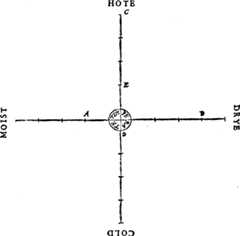
*Take some part of Lullus counsayle in his booke de Q.Essentia.Now, when you haue two thinges Miscible, whose degrees are * truelyknowen: Of necessitie, either they are of one Quantitie and waight, orof diuerse. If they be of one Quantitie and waight: whether theirformes, be Contrary Qualities, or of one kinde (but of diuerseintentions and degrees) or aTemperate, and a Contrary,Theforme resulting of their Mixture, is in the Middle betwene the degreesof||the formes mixt. As for example, letA, beMoist inthe first degree: andB,Dry in the third degree. Adde 1.and 3. that maketh 4: the halfe or middle of 4. is 2. This 2. is themiddle, equally distant fromA andB (for the*Note.*Temperament is counted none. And for it, you must put a Ciphre,if at any time, it be in mixture). Counting then fromB, 2.degrees, towardA: you finde it to beDry in the firstdegree: So is theForme resulting of the Mixture ofA, andB, in our example. I will geue you an other example.Suppose, you haue two thinges, asC, andD: and ofC, the Heate to be in the 4. degree: and ofD, the Colde,to be remisse, euen vnto theTemperament. Now, forC, youtake 4: and forD, you take a Ciphre: which, added vnto 4,yeldeth onely 4. The middle, or halfe, whereof, is 2. Wherefore theForme resulting ofC, andD, is Hote in the seconddegree: for, 2. degrees, accounted fromC, towardD, endeiuste in the 2. degree of heate. Of the third maner, I will geuealso an example: which let be this:Note.I haue a liquid Medicine whose Qualitie of heate is in the 4.degree exalted: as wasC, in the example foregoing: and an otherliquid Medicine I haue: whose Qualitie, is heate, in the first degree.Of eche of these, I mixt a like quantitie: Subtract here, the lessefrõ the more: and the residue diuide into two equall partes: whereof,the one part, either added to the lesse, or subtracted from the higherdegree, doth produce the degree of the *.iiijForme resulting, by this mixture ofC, andE. As, if from4. ye abate 1. there resteth 3. the halfe of 3. is 1½: Adde to 1. this1½: you haue 2½. Or subtract from 4. this 1½: you haue likewise 2½remayning. Which declareth, theForme resulting, to beHeate, in the middle of the third degree.
“The Second Rule.But if the Quantities of two thinges Commixt, be diuerse, and theIntensions (of their Formes Miscible) be in diuerse degrees, andheigthes. (Whether those Formes be of one kinde, or of Contrary kindes,or of a Temperate and a Contrary,What proportion is of the lessequantitie to the greater, the same shall be of the difference, which isbetwene the degree of the Forme resulting, and the degree of the greaterquantitie of the thing miscible, to the difference, which is betwene thesame degree of the Forme resulting, and the degree of the lessequantitie. As for example. Let two pound of Liquor be geuen, hote inthe 4. degree: & one pound of Liquor be geuen, hote in the thirddegree.” I would gladly know theForme resulting, in the Mixture of these two Liquors. Set downe yournũbers in order, thus.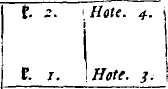 Now by the rule of Algiebar, haue I deuised a very easie, briefe, andgenerall maner of working in this case. Let vs first, suppose thatMiddle Forme resulting, to be 1X: asthat Rule teacheth. And because (by our Rule, here geuen) as the waightof 1. is to 2: So is the difference betwene 4. (the degree of thegreater quantitie) and 1X: to thedifference betwene 1X and 3: (the degree ofthe thing, in lesse quãtitie. And with all, 1X, being alwayes in a certaine middell, betwene the twoheigthes or degrees). For the first difference, I set 4-1X: and for the second, I set 1X-3. And, now againe, I say, as 1. is to 2. so is4-1X to 1X-3.Wherfore, of these foure proportionall numbers, the first and the fourthMultiplied, one by the other, do make as much, as the second and thethird Multiplied the one by the other. Let these Multiplications be madeaccordingly. And of the first and the fourth, we haue 1X-3. and of the second & the third, 8-2X. Wherfore, our Æquation is betwene 1X-3: and 8-2X. Which may bereduced, according to the Arte of Algiebar: as, here, adding 3. to echepart, geueth the Æquation, thus, 1X=11-2X. And yet againe,contracting, or Reducing it: Adde to eche part, 2X: Then haue you 3X æquallto 11: thus represented 3X=11. Wherefore,diuiding 11. by 3: the Quotient is 3⅔: theValew of our 1X,Coss, orThing, first supposed.And that is the heigth, or Intension of theForme resulting:which is,Heate, in two thirdes of the fourth degree: And here Iset the shew of the worke in conclusion, thus. The proufe hereof iseasie: by subtracting 3. from 3⅔,
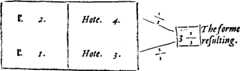 resteth ⅔. Subtracte the same heigth of the Forme resulting, (which is3⅔) frõ 4: then resteth ⅓: You see, that ⅔ is double to ⅓: as2.P. is double to 1.P. So should it be: by the rule here geuen. Note. As youadded to eche part of the Æquation, 3: so if ye first added to eche part2X, it would stand, 3X-3=8. And now adding to eche part 3: you haue (as afore)3X=11.
And though I, here, speake onely of two thyngs Miscible: and mostcommonly mo then three, foure, fiue or six, (&c.) are to be Mixed:(and in one Compound||to be reduced: & the Forme resultyng of the same, to serue theturne) yet these Rules are sufficient: duely repeated and iterated.Note.In procedyng first, with any two: and then, with the Forme Resulting,and an other: & so forth: For, the last worke, concludeth the Formeresultyng of them all: I nede nothing to speake, of the Mixture(here supposed) what it is. Common Philosophie hath defined it, saying,Mixtio est miscibilium, alteratorum, per minima coniunctorum,Vnio. Euery word in the definition, is of great importance.I nede not also spend any time, to shew, how, the other manner ofdistributing of degrees, doth agree to these Rules. Neither nede I ofthe farder vse belonging to the Crosse of Graduation (before described)in this place declare, vnto such as are capable of that, which I haueall ready sayd. Neither yet with examples specifie the Manifoldvarieties, by the foresayd two generall Rules, to be ordered. The wittyand Studious, here, haue sufficient: And they which are not hable toatteine to this, without liuely teaching, and more in particular: wouldhaue larger discoursing, then is mete in this place to be dealt withall:And other (perchaunce) with a proude snuffe will disdaine this litle:and would be vnthankefull for much more. I, therfore conclude: andwish such as haue modest and earnest Philosophicall mindes, to laude Godhighly for this: and to Meruayle, that the profoundest and subtilestpoint, concerningMixture of Formes and Qualities Naturall, is soMatcht and maryed with the most simple, easie, and short way of thenoble Rule ofAlgiebar. Who can remaine, therfore vnpersuaded, toloue, alow, and honor the excellent Science ofArithmetike? For,here, you may perceiue that the litle finger ofArithmetike, isof more might and contriuing, then a hunderd thousand mens wittes, ofthe middle sorte, are hable to perfourme, or truely to conclude, without helpe thereof.
Now will we farder, by the wise and valiant Capitaine, be certified,what helpe he hath, by the Rules ofArithmetike: in one of theArtes to him appertaining: And of the Grekes namedΤακτικὴ.Τακτικὴ.“That is, the Skill of Ordring Souldiers in Battellray after the best maner to all purposes.” This Art so much dependeth vppon Numbers vse, andthe Mathematicals, thatÆlianus (the best writer therof,) in hisworke, to theEmperour Hadrianus, by his perfection, in theMathematicals, (beyng greater, then other before him had,) thinketh hisbooke to passe all other the excellent workes, written of that Art, vntohis dayes. For, of it, had writtenÆneas:Cyneas ofThessaly:Pyrrhus Epirota: andAlexander his sonne:Clearchus:Pausanias:Euangelus:Polybius,familier frende toScipio:Eupolemus:Iphicrates,Possidonius: and very many other worthy Capitaines, Philosophersand Princes of Immortall fame and memory: Whose fayrest floure of theirgarland (in this feat) wasArithmetike: and a litleperceiuerance, inGeometricall Figures. But in many other casesdothArithmetike stand the Capitaine in great stede. As inproportionyng of vittayles, for the Army, either remaining at a stay: orsuddenly to be encreased with a certaine number of Souldiers: and for acertain tyme. Or by good Art to diminish his company, to make thevictuals, longer to serue the remanent, & for a certaine determinedtyme: if nede so require. And so in sundry his other accountes,Reckeninges, Measurynges, and proportionynges, the wise, expert, andCircumspect Capitaine will affirme the Science ofArithmetike, tobe one of his chief Counsaylors, directers and aiders. Which thing (bygood meanes) was euident to the Noble, the Couragious, the loyall, andCurteous Iohn, late Earle of Warwicke. Who was a yong Gentleman, throughlyknowne to very few. Albeit his lusty valiantnes, force, and Skill inChiualrous feates and exercises: his humblenes, and frendelynes to allmen, were thinges, openly, of the world perceiued. But what rotes(otherwise,) vertue had fastened in his brest, what Rules of godly andhonorablea.jlife he had framed to him selfe: what vices, (in some then liuing)notable, he tooke great care to eschew: what manly vertues, in othernoble men, (florishing before his eyes,) he Sythingly aspired after:what prowesses he purposed and ment to achieue: with what feats andArtes, he began to furnish and fraught him selfe, for the better seruiceof his Kyng and Countrey, both in peace & warre. These (I say)his Heroicall Meditations, forecastinges and determinations, no twayne,(I thinke) beside my selfe, can so perfectly, and truely report.And therfore, in Conscience, I count it my part, for the honor,preferment, & procuring of vertue (thus, briefly) to haue put hisName, in the Register ofFame Immortall.
To our purpose. ThisIohn, by one of his actes (besides manyother: both in England and Fraunce, by me, in him noted.) did disclosehis harty loue to vertuous Sciences: and his noble intent, to excell inMartiall prowesse: When he, with humble request, and instantSolliciting: got the best Rules (either in time past by Greke orRomaine, or in our time vsed: and new Stratagemes therin deuised) forordring of all Companies, summes and Numbers of mẽ, (Many, or few) withone kinde of weapon, or mo, appointed: with Artillery, or without: onhorsebacke, or on fote: to giue, or take onset: to seem many, being few:to seem few, being many. To marche in battaile or Iornay: with many suchfeates, to Foughten field, Skarmoush, or Ambushe appartaining:This noble Earle, dyed Anno. 1554. skarse of 24. yeares of age: hauingno issue by his wife: Daughter to the Duke of Somerset.And of all these, liuely designementes (most curiously) to be in velameparchement described: with Notes & peculier markes, as the Arterequireth: and all these Rules, and descriptions Arithmeticall, inclosedin a riche Case of Gold, he vsed to weare about his necke: as his Iuellmost precious, and Counsaylour most trusty. Thus,Arithmetike, ofhim, was shryned in gold: OfNumbers frute, he had good hope.Now, Numbers therfore innumerable, inNumbers prayse, his shryneshall finde.
What nede I, (for farder profe to you) of the Scholemasters ofIustice, to require testimony: how nedefull, how frutefull, howskillfull a thingArithmetike is? I meane, the Lawyers ofall sortes. Vndoubtedly, the Ciuilians, can meruaylously declare: how,neither the Auncient Romaine lawes, without good knowledge ofNumbersart, can be perceiued: Nor (Iustice in infinite Cases) without dueproportion, (narrowly considered,) is hable to be executed. How Iustly,& with great knowledge of Arte, didPapinianus institute alaw of partition, and allowance, betwene man and wife after a diuorce?But howAccursius,Baldus,Bartolus,Iason,Alexander, and finallyAlciatus, (being otherwise, notablywell learned) do iumble, gesse, and erre, from the æquity, art andIntent of the lawmaker:Arithmetike can detect, and conuince: andclerely, make the truth to shine. GoodBartolus, tyred in theexamining & proportioning of the matter: and withAccursiusGlosse, much cumbred: burst out, and sayd:Nulla est in toto libro,hac glossa difficilior: Cuius computationem nec Scholastici nec Doctoresintelligunt. &c. That is:In the wholebooke, there is no Glosse harder then this: Whose accoumpt or reckenyng,neither the Scholers, nor the Doctours vnderstand. &c.What can they say ofIulianus law,Si ita Scriptum.&c. Of the Testators will iustly performing, betwene the wife,Sonne and daughter? How can they perceiue the æquitie ofAphricanus,Arithmeticall Reckening, where he treateth ofLex Falcidia? How can they deliuer him, from his Reprouers: andtheir maintainers: asIoannes,Accursius Hypolitus andAlciatus? How Iustly and artificially, wasAfricanusreckening made? Proportionating to the Sommes bequeathed, theContributions of eche part? Namely, for the hundred presently receiued,17 1/7. And for the hundred, receiued after ten monethes,12 6/7: which make the 30: which were to be cõtributed by thelegataries to the heire.||For, what proportion, 100 hath to 75: the same hath 17 1/7 to12 6/7: Which is Sesquitertia: that is, as 4, to 3. which make 7.Wonderfull many places, in the Ciuile law, require an expertArithmeticien, to vnderstand the deepe Iudgemẽt, & Iustdeterminatiõ of the Auncient Romaine Lawmakers. But much more expertought he to be, who should be hable, to decide with æquitie, theinfinite varietie of Cases, which do, or may happen, vnder euery one ofthose lawes and ordinances Ciuile. Hereby, easely, ye may nowconiecture: that in the Canon law: and in the lawes of the Realme (whichwith vs, beare the chief Authoritie), Iustice and equity might begreately preferred, and skilfully executed, through due skill ofArithmetike, and proportions appertainyng. The worthy Philosophers, andprudent lawmakers (who haue written many bookesDe Republica: Howthe best state of Common wealthes might be procured and mainteined,)haue very well determined of Iustice: (which, not onely, is the Base andfoundacion of Common weales: but also the totall perfection of all ourworkes, words, and thoughtes:) defining it,Iustice.“to be that vertue, by which, to eueryone, is rendred, that to him appertaineth.” God challengeth this at our handes, to be honoredas God: to be loued, as a father: to be feared as a Lord & master.Our neighbours proportiõ, is also prescribed of the Almighty lawmaker:which is, to do to other, euen as we would be done vnto. Theseproportions, are in Iustice necessary: in duety, commendable: and ofCommon wealthes, the life, strength, stay and florishing.Aristotle in hisEthikes (to fatch the sede of Iustice,and light of direction, to vse and execute the same) was fayne to fly tothe perfection, and power of Numbers: for proportions Arithmeticall andGeometricall.Plato in his booke calledEpinomis (whichboke, is the Threasury of all his doctrine) where, his purpose is, toseke a Science, which, when a man had it, perfectly: he might seme, andso be, in dede,Wise. He, briefly, of other Sciences discoursing,findeth them, not hable to bring it to passe: But of the Science ofNumbers, he sayth.Illa, quæ numerum mortalium generi dedit, idprofecto efficiet. Deum autem aliquem, magis quam fortunam, ad salutemnostram, hoc munus nobis arbitror contulisse. &c. Nam ipsum bonorumomnium Authorem, cur non maximi boni, Prudentiæ dico, causam arbitramur?That Science, verely, which hath taught mankyndenumber, shall be able to bryng it to passe. And, I thinke,a certaine God, rather then fortune, to haue giuen vs this gift,for our blisse. For, why should we not Iudge him, who is the Author ofall good things, to be also the cause of the greatest good thyng,namely, Wisedome? There, at length, he prouethWisedome to be atteyned, by good Skill ofNumbers. Withwhich great Testimony, and the manifold profes, and reasons, beforeexpressed, you may be sufficiently and fully persuaded: of the perfectScience ofArithmetike, to make this accounte: That of all Sciences, next toTheologie, it is most diuine, most pure,most ample and generall, most profounde, most subtile, most commodiousand most necessary. Whose next Sister, is the Absolute Science ofMagnitudes: of which (by the Direction and aide of him, whoseMagnitude is Infinite, and of vs Incomprehensible) I nowentend, so to write, that both with theMultitude, and also withtheMagnitude of Meruaylous and frutefull verities, you (myfrendes and Countreymen) may be stird vp, and awaked, to behold whatcertaine Artes and Sciences, (to our vnspeakable behofe) our heauenlyfather, hath for vs prepared, and reuealed, by sundryPhilosophers andMathematiciens.
Both,Number andMagnitude, haue a certaine Originallsede, (as it were) of an incredible property: and of man, neuer hable,Fully, to be declared. OfNumber, an Vnit, and ofMagnitude, a Poynte, doo seeme to be much like Originalla.ijcauses: But the diuersitie neuerthelesse, is great. We defined anVnit, to be a thing Mathematicall Indiuisible: A Point,likewise, we sayd to be a Mathematicall thing Indiuisible. And farder,that a Point may haue a certaine determined Situation: that is, that wemay assigne, and prescribe a Point, to be here, there, yonder. &c.Herein, (behold) our Vnit is free, and can abyde no bondage, or to betyed to any place, or seat: diuisible or indiuisible. Agayne, by reason,a Point may haue a Situation limited to him: a certainemotion, therfore (to a place, and from a place) is to a Point incidentand appertainyng. But anVnit, can not be imagined to haue anymotion. A Point, by his motion, produceth, Mathematically,a line: (as we sayd before) which is the first kinde of Magnitudes,and most simple: AnVnit, can not produce any number.A Line, though it be produced of a Point moued, yet, it doth notconsist of pointes: Number, though it be not produced of anVnit,yet doth it Consist of vnits, as a materiall cause. But formally,Number.Number, is the Vnion, and Vnitie of Vnits. Which vnyting and knitting,is the workemanship of our minde: which, of distinct and discrete Vnits,maketh a Number: by vniformitie, resulting of a certaine multitude ofVnits. And so, euery number, may haue his least part, giuen: namely, anVnit: But not of a Magnitude, (no, not of a Lyne,) the least part can begiuẽ: by cause, infinitly, diuision therof, may be conceiued. AllMagnitude, is either a Line, a Plaine, or a Solid. Which Line,Plaine, or Solid, of no Sense, can be perceiued, nor exactly by hãd (anyway) represented: nor of Nature produced: But, as (by degrees) Numberdid come to our perceiuerance: So, by visible formes, we are holpen toimagine, what our Line Mathematicall, is. What our Point, is. Soprecise, are our Magnitudes, that one Line is no broader then an other:for they haue no bredth: Nor our Plaines haue any thicknes. Nor yet ourBodies, any weight: be they neuer so large of dimensiõ. Our Bodyes, wecan haue Smaller, then either Arte or Nature can produce any: andGreater also, then all the world can comprehend. Our least Magnitudes,can be diuided into so many partes, as the greatest. As, a Line ofan inch long, (with vs) may be diuided into as many partes, as may thediameter of the whole world, from East to West: or any way extended:What priuiledges, aboue all manual Arte, and Natures might, haue our twoSciences Mathematicall? to exhibite, and to deale with thinges of suchpower, liberty, simplicity, puritie, and perfection? And in them, socertainly, so orderly, so precisely to procede: as, excellent is thatworkemã Mechanicall Iudged, who nerest can approche to the representingof workes, Mathematically demonstrated? And our two Sciences, remaining pure, and absolute, in their propertermes, and in their owne Matter: to haue, and allowe, onely suchDemonstrations, as are plaine, certaine, vniuersall, and of an æternallveritye?Geometrie.This Science ofMagnitude, his properties, conditions, andappertenances: commonly, now is, and from the beginnyng, hath of allPhilosophers, ben calledGeometrie. But, veryly, with a name tobase and scant, for a Science of such dignitie and amplenes. And,perchaunce, that name, by cõmon and secret consent, of all wisemen,hitherto hath ben suffred to remayne: that it might carry with it aperpetuall memorye, of the first and notablest benefite, by thatScience, to common people shewed: Which was, when Boundes and meres ofland and ground were lost, and confounded (as inEgypt, yearely,with the ouerflowyng ofNilus, the greatest and longest riuer inthe world) or, that ground bequeathed, were to be assigned: or, groundsold, were to be layd out: or (when disorder preuailed) that Commõs weredistributed into seueralties. For, where, vpon these & such likeoccasiõs, Some by ignorãce, some by negligẽce, Some by fraude, and someby violence, did wrongfully limite, measure, encroach, or challenge (by||pretence of iust content, and measure) those landes and groundes: greatlosse, disquietnes, murder, and warre did (full oft) ensue: Till, byGods mercy, and mans Industrie, The perfect Science of Lines, Plaines,and Solides (like a diuine Iusticier,) gaue vnto euery man, his owne.The people then, by this art pleasured, and greatly relieued, in theirlandes iust measuring: & other Philosophers, writing Rules for landmeasuring: betwene them both, thus, confirmed the name ofGeometria, that is, (according to the very etimologie of theword) Land measuring. Wherin, the people knew no farder, of Magnitudesvse, but in Plaines: and the Philosophers, of thẽ, had no feet hearers,or Scholers: farder to disclose vnto, then of flat, plaineGeometrie. And though, these Philosophers, knew of farder vse,and best vnderstode the etymologye of the worde, yet this nameGeometria, was of them applyed generally to all sortes ofMagnitudes: vnleast, otherwhile, ofPlato, andPythagoras:When they would precisely declare their owne doctrine. Then, was*Plato. 7. de Rep.*Geometria, with them,Studium quod circa planum versatur.But, well you may perceiue byEuclides Elementes, that more ampleis our Science, then to measure Plaines: and nothyng lesse therin istought (of purpose) then how to measure Land. An other name, therfore,must nedes be had, for our Mathematicall Science of Magnitudes: whichregardeth neither clod, nor turff: neither hill, nor dale: neither earthnor heauen: but is absoluteMegethologia: not creping on ground,and dasseling the eye, with pole perche, rod or lyne: but“liftyng the hart aboue the heauens, by inuisiblelines, and immortall beames meteth with the reflexions, of the lightincomprehensible: and so procureth Ioye, and perfectionvnspeakable.” Of which true vse of ourMegethica, orMegethologia,Diuine Plato seemed tohaue good taste, and iudgement: and (by the name ofGeometrie) sonoted it: and warned his Scholers therof: as, in hys seuenthDialog, of the Common wealth, may euidently be sene. Where (inLatin) thus it is: right well translated:Profecto, nobis hoc nonnegabunt, Quicunque vel paululum quid Geometriæ gustârunt,quin hæc Scientia, contrà, omnino se habeat, quàm de ea loquuntur, quiin ipsa versantur. In English, thus.Verely (saythPlato)whosoeuer haue, (but euen very litle) tasted of Geometrie,will not denye vnto vs, this: but that this Science, is of an othercondicion, quite contrary to that, which they that are exercised in it,do speake of it. And there it followeth, of ourGeometrie,Quòd quæritur cognoscendi illius gratia, quodsemper est, non & eius quod oritur quandoque &interit. Geometria, eius quod est semper, Cognitio est. Attollet igitur(ô Generose vir) ad Veritatem, animum: atque ita, adPhilosophandum preparabit cogitationem, vt ad supera conuertamus: quæ,nunc, contra quàm decet, ad inferiora deijcimus. &c. Quàm maximèigitur præcipiendum est, vt qui præclarissimam hanc habitãt Civitatem,nullo modo, Geometriam spernant. Nam & quæ præter ipsius propositum,quodam modo esse videntur, haud exigua sunt. &c. It must nedesbe confessed (saithPlato)That[Geometrie]islearned, for the knowyng of that, which is euer: and not of that, which,in tyme, both is bred and is brought to an ende. &c. Geometrie isthe knowledge of that which is euerlastyng. It will lift vp therfore(O Gentle Syr) our mynde to the Veritie: and by that meanes, itwill prepare the Thought, to the Philosophicall loue of wisdome: that wemay turne or conuert, toward heauenly thinges[both mynde and thought]which now, otherwise then becommeth vs, we cast down on baseor inferior things. &c. Chiefly, therfore, Commaundement must begiuen, that such as do inhabit this most honorable Citie, by no meanes,despise Geometrie. For euen those thinges[done by it]which, inmanner, seame to be, beside the purpose of Geometrie: are ofa.iijno small importance. &c. Andbesides the manifold vses ofGeometrie, in matters appertainyngto warre, he addeth more, of second vnpurposed frute, and commoditye,arrising byGeometrie: saying:Scimus quin etiam, adDisciplinas omnes facilius per discendas, interesse omnino, attigerit neGeometriam aliquis, an non. &c. Hanc ergo Doctrinam, secundo locodiscendam Iuuenibus statuamus. That is.But, also, we know, that for the more easy learnyng of allArtes, it importeth much, whether one haue any knowledge in Geometrie,or no. &c. Let vs therfore make an ordinance or decree, that thisScience, of young men shall be learned in the second place.This wasDiuine Plato his Iudgement, both of the purposed, chief,and perfect vse ofGeometrie: and of his second, dependyng,deriuatiue commodities. And for vs, Christen men, a thousandthousand mo occasions are, to haue nede of the helpe of*I. D.
* Herein, I would gladly shake of, the earthly name, ofGeometrie.Megethologicall Contemplations: wherby, to trayne ourImaginations and Myndes, by litle and litle, to forsake and abandon, thegrosse and corruptible Obiectes, of our vtward senses: and to apprehend,by sure doctrine demonstratiue, Things Mathematicall. And by them,readily to be holpen and conducted to conceiue, discourse, and concludeof things Intellectual, Spirituall, æternall, and such as concerne ourBlisse euerlasting: which, otherwise (without Speciall priuiledge ofIllumination, or Reuelation frõ heauen) No mortall mans wyt (naturally)is hable to reach vnto, or to Compasse. And, veryly, by my small Talent(from aboue) I am hable to proue and testifie, that the litterallText, and order of our diuine Law, Oracles, and Mysteries, require moreskill in Numbers, and Magnitudes: then (commonly) the expositors hauevttered: but rather onely (at the most) so warned: & shewed theirown want therin. (To name any, is nedeles: and to note the places, is,here, no place: But if I be duely asked, my answere is ready.) Andwithout the litterall, Grammaticall, Mathematicall or Naturall veritiesof such places, by good and certaine Arte, perceiued, no Spirituallsense (propre to those places, by AbsoluteTheologie) willthereon depend. “No man, therfore, can doute, buttoward the atteyning of knowledge incomparable, and Heauenly Wisedome:Mathematicall Speculations, both of Numbers and Magnitudes: are meanes,aydes, and guides: ready, certaine, and necessary.” From henceforth, in this my Preface, will I framemy talke, toPlato his fugitiue Scholers: or, rather, to such,who well can, (and also wil,) vse their vtward senses, to the glory ofGod, the benefite of their Countrey, and their owne secret contentation,or honest preferment, on this earthly Scaffold. To them, I willorderly recite, describe & declare a great Number of Artes, from ourtwo Mathematicall fountaines, deriued into the fieldes ofNature.Wherby, such Sedes, and Rotes, as lye depe hyd in the groũd ofNature, are refreshed, quickened, and prouoked to grow, shote vp,floure, and giue frute, infinite, and incredible. And these Artes,shalbe such, as vpon Magnitudes properties do depende, more, then vponNumber. And by good reason we may call them Artes, and ArtesMathematicall Deriuatiue: for (at this tyme) I DefineAn Arte.An Arte, to be a Methodicall cõplete Doctrine,hauing abundancy of sufficient, and peculier matter to deale with, bythe allowance of the Metaphisicall Philosopher: the knowledge whereof,to humaine state is necessarye. And that I account,Art Mathematicall Deriuatiue.An Art Mathematicall deriuatiue, which byMathematicall demonstratiue Method, in Nũbers, or Magnitudes, ordrethand confirmeth his doctrine, as much & as perfectly, as the mattersubiect will admit. And for that,||I entend to vse the name and propertie of aA Mechanitien.Mechanicien, otherwise, then (hitherto) it hath ben vsed,I thinke it good, (for distinction sake) to giue you also a briefdescription, what I meane therby.A Mechanicien,or a Mechanicall workman is he, whose skill is, without knowledge ofMathematicall demonstration, perfectly to worke and finishe any sensibleworke, by the Mathematicien principall or deriuatiue, demonstrated ordemonstrable. Full well I know, that he which inuenteth, ormaketh these demonstrations, is generally calledA speculatiueMechanicien: which differreth nothyng from aMechanicallMathematicien. So, in respect of diuerse actions, one man may hauethe name of sundry artes: as, some tyme, of a Logicien, some tymes (inthe same matter otherwise handled) of a Rethoricien. Of these trifles,I make, (as now, in respect of my Preface,) small account: to fylethẽ for the fine handlyng of subtile curious disputers. In other places,they may commaunde me, to giue good reason: and yet, here, I willnot be vnreasonable.
1.First, then, from the puritie, absolutenes, and Immaterialitie ofPrincipallGeometrie, is that kinde ofGeometrie deriued,which vulgarly is countedGeometrie: and is theArte of Measuring sensible magnitudes, their iust quãtities andcontentes.Geometrie vulgar.This, teacheth to measure, either at hand: and the practiser, to be bythe thing Measured: and so, by due applying of Cumpase, Rule, Squire,Yarde, Ell, Perch, Pole, Line, Gaging rod, (or such like instrument) tothe Length, Plaine, or Solide measured,1.*to be certified, either of the length, perimetry, or distance lineall:and this is called,Mecometrie. Or2.*to be certified of the content of any plaine Superficies: whether it bein ground Surueyed, Borde, or Glasse measured, or such like thing: whichmeasuring, is namedEmbadometrie.3.*Or els to vnderstand the Soliditie, and content of any bodily thing: asof Tymber and Stone, or the content of Pits, Pondes, Wells, Vessels,small & great, of all fashions. Where, of Wine, Oyle, Beere, or Alevessells, &c, the Measuring, commonly, hath a peculier name: and iscalledGaging. And the generall name of these Solide measures, isStereometrie.2.Or els, thisvulgar Geometrie, hath consideration to teach thepractiser, how to measure things, with good distance betwene him and thething measured: and to vnderstand thereby, either1.*how Farre, a thing seene (on land or water) is from the measurer:and this may be calledApomecometrie:2.Or, how High or depe, aboue or vnder the leuel of the measurers stãding,any thing is, which is sene on land or water, calledHypsometrie.3.*Or, it informeth the measurer, how Broad any thing is, which is in themeasurers vew: so it be on Land or Water, situated: and may be calledPlatometrie. Though I vse here to condition, the thing measured,to be on Land, or Water Situated:Note.yet, know for certaine, that the sundry heigthe of Cloudes, blasingStarres, and of the Mone, may (by these meanes) haue their distancesfrom the earth: and, of the blasing Starres and Mone, the Soliditie(aswell as distances) to be measured: But because, neither these thingsare vulgarly taught: nor of a common practiser so ready to be executed:I, rather, let such measures be reckened incident to some of our otherArtes, dealing with thinges on high, more purposely, then this vulgarLand measuring Geometrie doth: as inPerspectiue andAstronomie, &c.
OF these Feates (farther applied) isSprong the Feate ofGeodesie, or Land Measuring: more cunninglyto measure & Suruey Land, Woods, and Waters, a farre of. Morecunningly, I say: But God knoweth (hitherto) in these Realmes ofEngland and Ireland (whether through ignorance or fraude, I can nottell, in euery particular)Note.how great wrong and iniurie hath (in my time) bene committeda.iijby vntrue measuring and surueying of Land or Woods, any way. And, this Iam sure: that the Value of the difference, betwene the truth and suchSurueyes, would haue bene hable to haue foũd (for euer) in eche of ourtwo Vniuersities, an excellent Mathematicall Reader: to eche, allowing(yearly) a hundred Markes of lawfull money of this realme: which,in dede, would seme requisit, here, to be had (though by other wayesprouided for) as well, as, the famous Vniuersitie of Paris, hath twoMathematicall Readers: and eche, two hundreth French Crownes yearly, ofthe French Kinges magnificent liberalitie onely. Now, againe, to ourpurpose returning: Moreouer, of the former knowledge Geometricall, aregrowen the Skills ofGeographie,Chorographie,Hydrographie, andStratarithmetrie.
“Geographie teacheth wayes, by which, insũdry formes, (asSphærike,Plaine or other), theSituation of Cities, Townes, Villages, Fortes, Castells, Mountaines,Woods, Hauens, Riuers, Crekes, & such other things, vpõ the outfaceof the earthly Globe (either in the whole, or in some principall mẽberand portion therof cõtayned) may be described and designed, incõmensurations Analogicall to Nature and veritie: and most aptly to ourvew, may be represented.” Of this Artehow great pleasure, and how manifolde commodities do come vnto vs, dailyand hourely: of most men, is perceaued. While, some, to beautifie theirHalls, Parlers, Chambers, Galeries, Studies, or Libraries with: othersome, for thinges past, as battels fought, earthquakes, heauenlyfyringes, & such occurentes, in histories mentioned: therby liuely,as it were, to vewe the place, the region adioyning, the distance fromvs: and such other circumstances. Some other, presently to vewe thelarge dominion of the Turke: the wide Empire of the Moschouite: and thelitle morsell of ground, where Christendome (by profession) is certainlyknowen. Litle, I say, in respecte of the rest. &c. Some, eitherfor their owne iorneyes directing into farre landes: or to vnderstand ofother mens trauailes. To conclude, some, for one purpose: and some, foran other, liketh, loueth, getteth, and vseth, Mappes, Chartes, &Geographicall Globes. Of whose vse, to speake sufficiently, wouldrequire a booke peculier.
Chorographie seemeth to be anvnderling, and a twig, ofGeographie: and yet neuerthelesse, isin practise manifolde, and in vse very ample.“This teacheth Analogically to describe a smallportion or circuite of ground, with the contentes: not regarding whatcommensuration it hath to the whole, or any parcell, without it,contained. But in the territory or parcell of ground which it taketh inhand to make description of, it leaueth out (or vndescribed) no notable,or odde thing, aboue the ground visible. Yea and sometimes, of thingesvnder ground, geueth some peculier marke: or warning: as of Mettallmines, Cole pittes, Stone quarries. &c.” Thus, a Dukedome, a Shiere,a Lordship, or lesse, may be described distinctly. But marueilouspleasant, and profitable it is, in the exhibiting to our eye, andcommensuration, the plat of a Citie, Towne, Forte, or Pallace, in trueSymmetry: not approching to any of them: and out of Gunne shot. &c.Hereby, theArchitect may furnishe him selfe, with store of whatpatterns he liketh: to his great instruction: euen in those thingeswhich outwardly are proportioned: either simply in them selues: orrespectiuely, to Hilles, Riuers, Hauens, and Woods adioyning. Some also,terme this particular description of places,Topographie.
“Hydrographie, deliuereth to ourknowledge, on Globe or in Plaine, the perfect Analogicall description ofthe Ocean Sea coastes, through the whole world: or in the chiefe andprincipall partes thereof:” with theIles and chiefe||particular places of daungers, conteyned within the boundes, and Seacoastes described: as, of Quicksandes, Bankes, Pittes, Rockes, Races,Countertides, Whorlepooles. &c. This, dealeth with the Element ofthe water chiefly: asGeographie did principally take the Elementof the Earthes description (with his appertenances) to taske. Andbesides thys,Hydrographie, requireth a particular Register ofcertaine Landmarkes (where markes may be had) from the sea, well hableto be skried, in what point of the Seacumpase they appeare, and whatapparent forme, Situation, and bignes they haue, in respecte of anydaungerous place in the sea, or nere vnto it, assigned: And in allCoastes, what Mone, maketh full Sea: and what way, the Tides and Ebbes,come and go, theHydrographer ought to recorde. The Soundingeslikewise: and the Chanels wayes: their number, and depthes ordinarily,at ebbe and flud, ought theHydrographer, by obseruation anddiligence ofMeasuring, to haue certainly knowen. And many otherpointes, are belonging to perfecteHydrographie, and for to makeaRutter, by: of which, I nede not here speake: as of thedescribing, in any place, vpon Globe or Plaine, the 32. pointes of theCompase, truely: (wherof, scarsly foure, in England, haue rightknowledge: bycause, the lines therof, are no straight lines, norCircles.) Of making due proiection of a Sphere in plaine. Of theVariacion of the Compas, from true Northe: And such like matters (ofgreat importance, all) I leaue to speake of, in this place:bycause, I may seame (al ready) to haue enlarged the boundes, andduety of anHydrographer, much more, then any man (to this day)hath noted, or prescribed. Yet am I well hable to proue, all thesethinges, to appertaine, and also to be proper to the Hydrographer. Thechief vse and ende of this Art, is the Art of Nauigation: but it hathother diuerse vses: euen by them to be enioyed, that neuer lacke sightof land.
Stratarithmetrie, is the Skill,(appertainyng to the warre,) by which a man can set in figure,analogicall to anyGeometricall figure appointed, any certainenumber or summe of men: of such a figure capable: (by reason of thevsuall spaces betwene Souldiers allowed: and for that, of men, can bemade no Fractions. Yet, neuertheles, he can order the giuen summe ofmen, for the greatest such figure, that of them, cã be ordred) andcertifie, of the ouerplus: (if any be) and of the next certaine summe,which, with the ouerplus, will admit a figure exactly proportionall tothe figure assigned. By which Skill, also, of any army or company ofmen: (the figure & sides of whose orderly standing, or array, isknowen) he is able to expresse the iust number of men, within thatfigure conteined: or (orderly) able to be conteined.*Note.*And this figure, and sides therof, he is hable to know: either beyngby, and at hand: or a farre of. Thus farre, stretcheth the descriptionand property ofStratarithmetrie: sufficient for this tyme andplace.The difference betwene Stratarithmetrie and Tacticie.“It differreth from the FeateTacticall,De aciebus instruendis. bycause, there, isnecessary the wisedome and foresight, to what purpose he so ordreth themen: and Skillfull hability, also, for any occasion, or purpose, todeuise and vse the aptest and most necessary order, array and figure ofhis Company and Summe of men.” Byfigure, I meane: as, either of aPerfect Square,Triangle,Circle,Ouale,long square, (ofthe Grekes it is calledEteromekes)Rhombe,Rhomboïd,Lunular,Ryng,Serpentine, and such other Geometricall figures: Which, inwarres, haue ben, and are to be vsed: for commodiousnes, necessity, andauauntage &c. And no small skill ought he to haue, that should maketrue report, or nere the truth, of the numbers and Summes, of footemenor horsemen, in the Enemyes ordring. A farre of, to make anestimate, betwene nere termes of More and Lesse, is not a thyng veryrife, among those that gladly wouldb.j.do it.I. D.
Frende,
you will finde it hard, to performe my description of this Feate. But byChorographie, you may helpe your selfe some what: where the Figuresknowne (in Sides and Angles) are not Regular: And where, Resolution intoTriangles can serue. &c. And yet you will finde it strange to dealethus generally with Arithmeticall figures: and, that for Battayle ray.Their contentes, differ so much from like Geometricall Figures.Great pollicy may be vsed of the Capitaines, (at tymes fete, and inplaces conuenient) as to vse Figures, which make greatest shew, of somany as he hath: and vsing the aduauntage of the three kindes of vsuallspaces: (betwene footemen or horsemen) to take the largest: or when hewould seme to haue few, (beyng many:) contrarywise, in Figure, andspace. The Herald, Purseuant, Sergeant Royall, Capitaine, or who soeueris carefull to come nere the truth herein, besides the Iudgement of hisexpert eye, his skill of OrderingTacticall, the helpe of hisGeometricall instrument: Ring, or Staffe Astronomicall: (commodiouslyframed for cariage and vse) He may wonderfully helpe him selfe, byperspectiue Glasses. In which, (I trust) our posterity will prouemore skillfull and expert, and to greater purposes, then in these dayes,can (almost) be credited to be possible.
Thus haue I lightly passed ouer the Artificiall Feates, chieflydependyng vpon vulgarGeometrie: & commonly and generallyreckened vnder the name ofGeometrie. But there are other (verymany)Methodicall Artes, which, declyning from the purity,simplicitie, and Immateriality, of our Principall Science ofMagnitudes: do yet neuertheles vse the great ayde, direction, andMethod of the sayd principall Science, and haue propre names, anddistinct: both from the Science ofGeometrie, (from which theyare deriued) and one from the other. AsPerspectiue, Astronomie, Musike, Cosmographie, Astrologie,Statike, Anthropographie, Trochilike, Helicosophie, Pneumatithmie,Menadrie, Hypogeiodie, Hydragogie, Horometrie, Zographie, Architecture,Nauigation, Thaumaturgike andArchemastrie. I thinke it necessary, orderly, ofthese to giue some peculier descriptions: and withall, to touch some oftheir commodious vses, and so to make this Preface, to be a littleswete, pleasant Nosegaye for you: to comfort your Spirites, beyng almostout of courage, and in despayre, (through brutish brute) Weenyng thatGeometrie, had but serued for buildyng of an house, or a curiousbridge, or the roufe of Westminster hall, or some witty pretty deuise,or engyn, appropriate to a Carpenter, or a Ioyner &c. That the thingis farre otherwise, then the world, (commonly) to this day, hath demed,by worde and worke, good profe wilbe made.
Among these Artes, by good reason,Perspectiue ought to be had, ere ofAstronomicallApparences, perfect knowledge can be atteyned. And bycause of theprerogatiue ofLight, beyng the first ofGods Creatures:and the eye, the light of our body, and his Sense most mighty, and hisorgan most Artificiall andGeometricall: AtPerspectiue,we will begyn therfore.Perspectiue, is an ArtMathematicall, which demonstrateth the maner, and properties, of allRadiations Direct, Broken, and Reflected. This Description, orNotation, is brief: but it reacheth so farre, as the world is wyde. Itconcerneth all Creatures, all Actions, and passions, by Emanation ofbeames perfourmed. Beames, or naturall lines, (here) I meane, notof light onely, or of colour (though they, to eye, giue shew, witnes,and profe, wherby to ground the Arte vpon) but also of otherFormes, bothSubstantiall, andAccidentall, thecertaine and determined actiue Radiall emanations. By this Art (omittingto speake of the highest pointes) we may vse our eyes, and the light,with greater pleasure: and perfecter Iudgement: both of things, in lightseen, & of other: which by like order of Lightes Radiations, workeand produce their effectes. We may be ashamed to be ignorant of thecause, why so sundry wayes our eye is deceiued, and abused: as, whilethe eye weeneth a roũd Globe or Sphere (beyng farre of) to be a flat andplaine Circle, and so likewise iudgeth||a plaine Square, to be roũd: supposeth walles parallels, to approche,a farre of: rofe and floure parallels, the one to bend downward,the other to rise vpward, at a little distance from you. Againe, ofthinges being in like swiftnes of mouing, to thinke the nerer, to mouefaster: and the farder, much slower. Nay, of two thinges, wherof the one(incomparably) doth moue swifter then the other, to deme the slower tomoue very swift, & the other to stand: what an error is this, of oureye? Of the Raynbow, both of his Colours, of the order of the colours,of the bignes of it, the place and heith of it, (&c) to know thecauses demonstratiue, is it not pleasant, is it not necessary? of two orthree Sonnes appearing: of Blasing Sterres: and such like thinges: bynaturall causes, brought to passe, (and yet neuertheles, of fardermatter, Significatiue) is it not commodious for man to know the verytrue cause, & occasion Naturall? Yea, rather, is it not, greatly,against the Souerainty of Mans nature, to be so ouershot and abused,with thinges (at hand) before his eyes? as with a Pecockes tayle, and aDoues necke: or a whole ore, in water, holden, to seme broken. Thynges,farre of, to seeme nere: and nere, to seme farre of. Small thinges, toseme great: and great, to seme small. One man, to seme an Army. Or a manto be curstly affrayed of his owne shaddow. Yea, so much, to feare,that, if you, being (alone) nere a certaine glasse, and proffer, withdagger or sword, to foyne at the glasse, you shall suddenly be moued togiue backe (in maner) by reason of anA marueilous Glasse. Image, appearing in the ayre, betwene you & the glasse, with likehand, sword or dagger, & with like quicknes, foyning at your veryeye, likewise as you do at the Glasse. Straunge, this is, to heare of:but more meruailous to behold, then these my wordes can signifie. Andneuerthelesse by demonstration Opticall, the order and cause therof, iscertified: euen so, as the effect is consequent. Yea, thus much more,dare I take vpon me, toward the satisfying of the noble courrage, thatlongeth ardently for the wisedome of Causes Naturall: as to let himvnderstand, that, in London, he may with his owne eyes, haue profe ofthat, which I haue sayd herein. A Gentleman, (which, for his goodseruice, done to his Countrey, is famous and honorable:S. W. P.and for skill in the Mathematicall Sciences, and Languages, is the Odman of this land. &c.) euen he, is hable: and (I am sure) will,very willingly, let the Glasse, and profe be sene: and so I (here)request him: for the encrease of wisedome, in the honorable: and for thestopping of the mouthes malicious: and repressing the arrogancy of theignorant. Ye may easily gesse, what I meane. This Art ofPerspectiue, is of that excellency, and may be led, to thecertifying, and executing of such thinges, as no man would easilybeleue: without Actuall profe perceiued. I speake nothing ofNaturall Philosophie, which, withoutPerspectiue, can notbe fully vnderstanded, nor perfectly atteined vnto. Nor, ofAstronomie: which, withoutPerspectiue, can not well begrounded: NorAstrologie, naturally Verified, and auouched. Thatpart hereof, which dealeth with Glasses (which name, Glasse, is agenerall name, in this Arte, for any thing, from which, a Beamereboundeth) is calledCatoptrike: and hath so many vses, bothmerueilous, and proffitable: that, both, it would hold me to long, tonote therin the principall conclusions, all ready knowne: And also(perchaunce) some thinges, might lacke due credite with you: And I,therby, to leese my labor: and you, to slip into light Iudgement*, Before you haue learned sufficiently the powre of Nature and Arte.
Now, to procede:Astronomie,is an Arte Mathematicall, which demonstrateth thedistance, magnitudes, and all naturall motions, apparences, and passionspropre to the Planets and fixed Sterres: forb.ijany time past, present and to come: in respect ofa certaine Horizon, or without respect of any Horizon. By thisArte we are certified of the distance of the Starry Skye, and of echePlanete from the Centre of the Earth: and of the greatnes of anyFixed starre sene, orPlanete, in respect of the Earthesgreatnes. As, we are sure (by this Arte) that the Solidity, Massines andBody of theSonne, conteineth the quantitie of the whole Earthand Sea, a hundred thre score and two times, lesse by ⅛ one eightparte of the earth. But the Body of the whole earthly globe and Sea, isbigger then the body of the Mone, three and forty times lesse by ⅛ ofthe Mone. Wherfore theSonne is bigger then theMone, 7000times, lesse, by 59 39/64 that is, precisely 6940 25/64 bigger then theMone. And yet the vnskillfull man, would iudge them a like bigge.Wherfore, of Necessity, the one is much farder from vs, then the other.TheSonne, when he is fardest from the earth (which, now, in ourage, is, when he is in the 8. degree, of Cancer) is, 1179 Semidiametersof the Earth, distante. And theMone when she is fardest from theearth, is 68 Semidiameters of the earth and ⅓ The nerest, that theMone commeth to the earth, is Semidiameters 52¼ The distance ofthe Starry Skye is, frõ vs, in Semidiameters of the earth 20081½ Twentythousand fourescore, one, and almost a halfe. Subtract from this, theMones nerest distance, from the Earth: and therof remainethSemidiameters of the earth 20029¼ Twenty thousand nine and twenty and aquarter.Note.So thicke is the heauenly Palace, that thePlanetes haue alltheir exercise in, and most meruailously perfourme the Commaũdement andCharge to them giuen by the omnipotent Maiestie of the king of kings.This is that, which inGenesis is calledHa Rakia.Consider it well. The Semidiameter of the earth, cõteineth of our commonmiles 3436 4/11 three thousand, foure hundred thirty six and foureeleuenth partes of one myle: Such as the whole earth and Sea, roundabout, is 21600. One and twenty thousand six hundred of our myles.Allowyng for euery degree of the greatest circle, thre score myles. Nowif you way well with your selfe but this litle parcell of fruteAstronomicall, as concerning the bignesse, Distances ofSonne,Mone,Sterry Sky, and the huge massines ofHa Rakia, will you not finde your Consciences moued, with thekingly Prophet, to sing the confession of Gods Glory, and say,The Heauens declare the glory of God, and theFirmament[Ha Rakia]sheweth forth the workes of hishandes. And so forth, for those fiue first staues, of thatkingly Psalme. Well, well, It is time for some to lay hold on wisedome,and to Iudge truly of thinges: and notso to expound the Holy word, allby Allegories: as to Neglect the wisedome, powre and Goodnes of God, in,and by his Creatures, and Creation to be seen and learned. By parablesand Analogies of whose natures and properties, the course of the HolyScripture, also, declareth to vs very many Mysteries. The whole Frame ofGods Creatures, (which is the whole world,) is to vs, a brightglasse: from which, by reflexion, reboundeth to our knowledge andperceiuerance, Beames, and Radiations: representing the Image of hisInfinite goodnes, Omnipotẽcy, and wisedome. And we therby, are taughtand persuaded to Glorifie our Creator, as God: and be thankefulltherfore. Could the Heathenistes finde these vses, of these most pure,beawtifull, and Mighty Corporall Creatures: and shall we, after that thetrueSonne of rightwisenesse is risen aboue theHorizon,of our temporallHemisphærie, and hath so abundantly streamedinto our hartes, the direct beames of his goodnes, mercy, and grace:Whose heat All Creatures feele: Spirituall and Corporall: Visible and||Inuisible. Shall we (I say) looke vpon theHeauen,Sterres, andPlanets, as an Oxe and an Asse doth: nofurder carefull or inquisitiue, what they are: why were they Created,How do they execute that they were Created for? Seing, All Creatures,were for our sake created: and both we, and they, Created, chiefly toglorifie the Almighty Creator: and that, by all meanes, to vs possible.Nolite ignorare (saithPlato in Epinomis)Astronomiam,Sapientissimũ quiddam esse.Be ye notignorant, Astronomie to be a thyng of excellent wisedome.Astronomie, was to vs, from the beginning commended, and in manercommaunded by God him selfe. In asmuch as he made theSonne,Mone, andSterres, to be to vs, forSignes, andknowledge of Seasons, and for Distinctions of Dayes, and yeares. Manywordes nede not. But I wish, euery man should way this word,Signes. And besides that, conferre it also with the tenth ChapterofHieremie. And though Some thinke, that there, they haue founda rod: Yet Modest Reason, will be indifferent Iudge, who ought to bebeaten therwith, in respect of our purpose. Leauing that: I prayyou vnderstand this: that without great diligence of Obseruation,examination and Calculation, their periods and courses (wherbyDistinction of Seasons, yeares, and New Mones might precisely beknowne) could not exactely be certified. Which thing to performe, isthatArt, which we here haue Defined to beAstronomie.Wherby, we may haue the distinct Course of Times, dayes, yeares, andAges: aswell for Consideratiõ of Sacred Prophesies, accomplished in duetime, foretold: as for high Mysticall Solemnities holding: And for allother humaine affaires, Conditions, and couenantes, vpon certaine time,betwene man and man: with many other great vses: Wherin, (verely), wouldbe great incertainty, Confusion, vntruth, and brutish Barbarousnes:without the wonderfull diligence and skill of this Arte: continuallylearning, and determining Times, and periodes of Time, by the Record ofthe heauenly booke, wherin all times are written: and to be read with anAstronomicall staffe, in stede of a festue.
Musike, of Motion, hath his Originallcause: Therfore, after the motions most swift, and most Slow, which arein the Firmament, of Nature performed: and vnder theAstronomersConsideration: now I will Speake of an other kinde ofMotion,producing sound, audible, and of Man numerable.Musike I callhere thatScience, which of the Grekes is calledHarmonice. Not medling with the Controuersie betwene the auncientHarmonistes, andCanonistes.Musikeis a Mathematicall Science, which teacheth, by sense and reason,perfectly to iudge, and order the diuersities of soundes, hye andlow.Astronomie andMusike are Sisters, saithPlato. As, forAstronomie, the eyes: So, forHarmoniousMotion, the eares were made. But asAstronomie hath a morediuine Contemplation, and cõmodity, then mortall eye can perceiue: So,isMusike to be considered, that the1.*Minde may be preferred, before the eare. And from audible sound, weought to ascende, to the examination: which numbers areHarmonious, and which not. And why, either, the one are: or theother are not. I could at large, in the heauenly2.*motions and distances, describe a meruailous Harmonie, ofPythagoras Harpe3.with eight stringes. Also, somwhat might be sayd ofMercurius*4.two Harpes, eche of foure Stringes Elementall. And very straunge matter,might be alledged of theHarmonie, to our5.*Spirituall part appropriate. As inPtolomaus third boke, in thefourth and sixth Chapters may appeare.*6.And what is the cause of the apt bonde, and frendly felowship, of theIntellectuall and Mentall part of vs, with our grosse & corruptiblebody: but a certaine Meane, andHarmonious Spiritualitie, withb.iiiboth participatyng, & of both (in a maner) resultynge In the7.*Tune of Mans voyce, and also8.* the sound of Instrument, what might be sayd, ofHarmonie:No common Musicien would lightly beleue.I. D.
Read in Aristotle his 8. booke of Politikes: the 5, 6, and 7.chapters. Where you shall haue some occasion farder to thinke of Musike,than commonly is thought.But of the sundry Mixture (as I may terme it) and concurse, diuersecollation, and Application of theseHarmonies: as of thre, foure,fiue, or mo: Maruailous haue the effectes ben: and yet may be founde,and produced the like: with some proportionall consideration for ourtime, and being: in respect of the State, of the thinges then: in which,and by which, the wondrous effectes were wrought.Democritus andTheophrastus affirmed, that, byMusike, griefes anddiseases of the Minde, and body might be cured, or inferred. And wefinde in Recorde, thatTerpander,Arion,Ismenias,Orpheus,Amphion,Dauid,Pythagoras,Empedocles,Asclepiades andTimotheus, byHarmonicall Consonãcy, haue done, and brought to pas, thinges,more then meruailous, to here of. Of them then, making no farderdiscourse, in this place: Sure I am, that CommonMusike, commonlyvsed, is found to theMusiciens and Hearers, to be so Commodiousand pleasant, That if I would say and dispute, but thus much: That itwere to be otherwise vsed, then it is, I should finde morerepreeuers, then I could finde priuy, or skilfull of my meaning. Inthinges therfore euident, and better knowen, then I can expresse: and soallowed and liked of, (as I would wish, some other thinges, had the likehap) I will spare to enlarge my lines any farder, but consequentlyfollow my purpose.
Of Cosmographie, I appointed brieflyin this place, to geue you some intelligence.Cosmographie, is the whole and perfect description of theheauenly, and also elementall parte of the world, and their homologallapplication, and mutuall collation necessarie. This Art,requirethAstronomie,Geographie,Hydrographie andMusike. Therfore, it is no small Arte, nor so simple, as incommon practise, it is (slightly) considered. This matcheth Heauen, andthe Earth, in one frame, and aptly applieth parts Correspõdent: So, as,the Heauenly Globe, may (in practise) be duely described vpon theGeographicall, and Hydrographicall Globe. And there, for vs to consideranÆquonoctiall Circle,an Ecliptike line,Colures,Poles,Sterres in their true Longitudes, Latitudes,Declinations, and Verticalitie: also Climes, and Parallels: and by anHorizon annexed, and reuolution of the earthly Globe (as theHeauen, is, by thePrimouant, caried about in 24. æquall Houres)to learne the Risinges and Settinges of Sterres (ofVirgill inhisGeorgikes: ofHesiod: ofHippocrates in hisMedicinall Sphære, to Perdicca King of the Macedonians: ofDiocles, to KingAntigonus, and of other famousPhilosophers prescribed) a thing necessary, for due manuringof the earth, forNauigation, for the Alteration of mans body:being, whole, Sicke, wounded, or brused. By the Reuolution, also, ormouing of the Globe Cosmographicall, the Rising and Setting of theSonne: the Lengthes, of dayes and nightes: the Houres and times (bothnight and day) are knowne: with very many other pleasant and necessaryvses: Wherof, some are knowne: but better remaine, for such to know andvse: who of a sparke of true fire, can make a wonderfull bonfire, by applyingof due matter, duely.
Of Astrologie, here I make an Arte,seuerall fromAstronomie: not by new deuise, but by good reasonand authoritie: for,Astrologie, is an ArteMathematicall, which reasonably demonstrateth the operations andeffectes, of the naturall beames, of light, and secrete influence: ofthe Sterres and Planets: in euery element and elementall body:||at all times, in any Horizon assigned.This Arte is furnished with many other great Artes and experiences: Aswith perfectePerspectiue,Astronomie,Cosmographie,Naturall Philosophie of the 4. Elementes,the Arte of Graduation, and some good vnderstãding inMusike: andyet moreouer, with an other great Arte, hereafter following,though I, here, set this before, for some considerations me mouing.Sufficient (you see) is the stuffe, to make this rare and secrete Arte,of: and hard enough to frame to the Conclusion Syllogisticall. Yet boththe manifolde and continuall trauailes of the most auncient and wisePhilosophers, for the atteyning of this Arte: and by examples ofeffectes, to confirme the same: hath left vnto vs sufficient proufe andwitnesse: and we, also, daily may perceaue, That mans body, and allother Elementall bodies, are altered, disposed, ordred, pleasured, anddispleasured, by the Influentiall working of theSunne,Mone, and the other Starres and Planets. And therfore, saythAristotle, in the first of hisMeteorologicall bookes, inthe second Chapter:Est autem necessariò Mundus iste, supernislationibus ferè continuus. Vt, inde, vis eius vniuersa regatur. Easiquidem Causà prima putanda omnibus est, vnde motus principiumexistit. That is:This[Elementall]World is of necessitie, almost, next adioyning, to theheauenly motions: That, from thence, all his vertue or force may begouerned. For, that is to be thought the first Cause vnto all: fromwhich, the beginning of motion, is. And againe, in the tenthChapter.Oportet igitur & horum principia sumamus, & causasomnium similiter. Principium igitur vt mouens, præcipuumque& omnium primum, Circulus ille est, in quo manifeste Solis latio,&c. And so forth. HisMeteorologicall bookes, are full ofargumentes, and effectuall demonstrations, of the vertue, operation, andpower of the heauenly bodies, in and vpon the fower Elementes, and otherbodies, of them (either perfectly, or vnperfectly) composed. And in hissecond booke,De Generatione & Corruptione, in the tenthChapter.Quocirca & prima latio, Ortus & Interitus causa nonest: Sed obliqui Circuli latio: ea namque & continua est,& duobus motibus fit: In Englishe, thus.Wherefore the vppermost motion, is not the cause ofGeneration and Corruption, but the motion of the Zodiake: for, that,both, is continuall, and is caused of two mouinges. And inhis second booke, and second Chapter of hysPhysikes.Homonamque generat hominem, atque Sol.For Man (sayth he) and the Sonne, are cause of mansgeneration. Authorities may be brought, very many: both of1000. 2000. yea and 3000. yeares Antiquitie: of greatPhilosophers,Expert,Wise, and godly men, for thatConclusion: which, daily and hourely, we men, may discerne and perceaueby sense and reason: All beastes do feele, and simply shew, by theiractions and passions, outward and inward: All Plants, Herbes, Trees,Flowers, and Fruites. And finally, the Elementes, and all thinges of theElementes composed, do geue Testimonie (asAristotle sayd) thattheyrWhole Dispositions, vertues, andnaturall motions, depend of the Actiuitie of the heauenly motions andInfluences. Whereby, beside the specificall order and forme, due toeuery seede: and beside the Nature, propre to the Indiuiduall Matrix, ofthe thing produced: What shall be the heauenly Impression, the perfectand circumspecte Astrologien hath to Conclude. Not onely (byApotelesmes)τὸ ὁτὶ.but by Naturall and Mathematicall demonstrationτὸ διότι. Whereunto, what Sciences arerequisite (without exception) I partly haue here warned: And in myPropædeumes (besides other matter there disclosed) I haueMathematically furnished vp the whole Method: To this our age, not socarefully handled by any, thatb.iiijeuer I saw, or heard of. I was,* Anno. 1548 and 1549. in Louayn.(for *21. yeares ago) by certaine earnest disputations, of the LearnedGerardus Mercator, andAntonius Gogaua, (and other,)therto so prouoked: and (by my constant and inuincible zeale to theveritie) in obseruations of Heauenly Influencies (to the Minute oftime,) than, so diligent: And chiefly by the Supernaturall influence,from the Starre of Iacob, so directed: That any Modest and SoberStudent, carefully and diligently seking for the Truth, will both finde& cõfesse, therin, to be the Veritie, of these my wordes: And alsobecome a Reasonable Reformer, of three Sortes of people: about theseInfluentiall Operations, greatly erring from the truth.Note.Wherof, the one, isLight Beleuers, theother,Light Despisers, and the thirdLight Practisers. The first, & mostcõmon Sort, thinke the Heauen and Sterres, to be answerable to any theirdoutes or desires:1.which is not so: and, in dede, they, to much, ouer reache. The Secondsorte thinke no Influentiall vertue (frõ the heauenly bodies) to beareany Sway in Generation2.and Corruption, in this Elementall world. And to theSunne,Mone andSterres (being so many, so pure, so bright, sowonderfull bigge, so farre in distance, so manifold in their motions, soconstant in their periodes. &c.) they assigne a sleight, simpleoffice or two, and so allow vnto thẽ (according to their capacities) asmuch vertue, and power Influentiall, as to the Signe of theSunne,Mone, and seuen Sterres, hanged vp (for Signes) inLondon, for distinction of houses, & such grosse helpes, in ourworldlyaffaires: And they vnderstand not (or will not vnderstand) of the otherworkinges, and vertues of the HeauenlySunne,Mone, andSterres: not so much, as the Mariner, or Husband man: no, not somuch, as theElephant doth, as theCynocephalus, as thePorpentine doth: nor will allow these perfect, and incorruptible mightybodies, so much vertuall Radiation, & Force, as they see in a litlepeece of aMagnes stone: which, at great distance, sheweth hisoperation. And perchaunce they thinke, the Sea & Riuers (as theThames) to be some quicke thing, and so to ebbe, and flow, run in andout, of them selues, at their owne fantasies. God helpe, God helpe.Surely, these men, come to short: and either are to dull: or willfullyblind: or, perhaps, to malicious. The third man, is the common andvulgareAstrologien, or Practiser: who, being not duely,artificially, and perfectly3.furnished: yet, either for vaine glory, or gayne: or like a simple dolt,& blinde Bayard, both in matter and maner, erreth: to the discreditof theWary, and modestAstrologien: and to the robbing ofthose most noble corporall Creatures, of their Naturall Vertue: beingmost mighty: most beneficiall to all elementall Generation, Corruptionand the appartenances: and most Harmonious in their Monarchie: For whichthinges, being knowen, and modestly vsed: we might highly, andcontinually glorifie God, with the princely Prophet, saying.The Heauens declare the Glorie of God: who made the Heauẽsin his wisedome: who made the Sonne, for to haue dominion of the day:the Mone and Sterres to haue dominion of the nyght: whereby, Day to dayvttereth talke: and night, to night declareth knowledge. Prayse him, allye Sterres, and Light. Amen.
In order, now foloweth, ofStatike,somewhat to say, what we meane by that name: and what commodity, doth,on such Art, depend.Statike, is an ArteMathematicall, which demonstrateth the causes of heauynes, and lightnesof all thynges: and of motions and properties, to heauynes and lightnes,belonging. And for asmuch as, by the Bilanx, or Balance (as thechief sensible Instrument,) Experience of these demonstrations may||be had: we call this Art,Statike: that is,the Experimentesof the Balance. Oh, that men wist, what proffit, (all maner ofwayes) by this Arte might grow, to the hable examiner, and diligentpractiser.“Thou onely, knowest allthinges precisely (O God) who hast made weight and Balance, thyIudgement: who hast created all thinges inNumber, Waight, andMeasure: and hast wayed the mountaines and hils in a Balance: whohast peysed in thy hand, both Heauen and earth. We therfore warned bythe Sacred word, to Consider thy Creatures: and by that consideration,to wynne a glyms (as it were,) or shaddow of perceiuerance, that thywisedome, might, and goodnes is infinite, and vnspeakable, in thyCreatures declared: And being farder aduertised, by thy mercifullgoodnes, that, three principall wayes, were, of the, vsed in Creation ofall thy Creatures, namely,Number,Waight andMeasure, And for as much as, ofNumber andMeasure,the two Artes (auncient, famous, and to humaine vses most necessary,)are, all ready, sufficiently knowen and extant: This third key, webeseche thee (through thy accustomed goodnes,) that it may come to thenedefull and sufficient knowledge, of such thy Seruauntes, as in thyworkemanship, would gladly finde, thy true occasions (purposely of thevsed) whereby we should glorifie thy name, and shew forth (to theweaklinges in faith) thy wondrous wisedome and Goodnes. Amen.”
Meruaile nothing at this pang (godly frend, you Gentle and zelousStudent.) An other day, perchaunce, you will perceiue, what occasionmoued me. Here, as now, I will giue you some ground, and withallsome shew, of certaine commodities, by this Arte arising. And bycausethis Arte is rare, my wordes and practises might be to darke: vnleastyou had some light, holden before the matter: and that, best will be, ingiuing you, out ofArchimedes demonstrations, a fewprincipal Conclusions, as foloweth.
1.
The Superficies of euery Liquor, by it selfe consistyng, and in quyet,is Sphæricall: the centre whereof, is the same, which is the centre ofthe Earth.
2.
If Solide Magnitudes, being of the same bignes, or quãtitie, that anyLiquor is, and hauyng also the same Waight: be let downe into the sameLiquor, they will settle downeward, so, that no parte of them, shall beaboue the Superficies of the Liquor: and yet neuertheles, they will notsinke vtterly downe, or drowne.
3.
If any Solide Magnitude beyng Lighter then a Liquor, be let downe intothe same Liquor, it will settle downe, so farre into the same Liquor,that so great a quantitie of that Liquor, as is the parte of the SolidMagnitude, settled downe into the same Liquor: is in Waight, æquall, tothe waight of the whole Solid Magnitude.
4.
c.j.Any Solide Magnitude, Lighter then a Liquor, forced downeinto the same Liquor, will moue vpward, with so great a power, by howmuch, the Liquor hauyng æquall quantitie to the whole Magnitude, isheauyer then the same Magnitude.
5.
Any Solid Magnitude, heauyer then a Liquor, beyng let downe into thesame Liquor, will sinke downe vtterly: And wilbe in that Liquor, Lighterby so much, as is the waight or heauynes of the Liquor, hauing bygnes orquantitie, æquall to the Solid Magnitude.
6.
I. D.
The Cutting of a Sphære according to any proportion assigned may by thisproposition be done Mechanically by tempering Liquor to a certaynewaight in respect of the waight of the Sphære therein Swymming.If any Solide Magnitude, Lighter then a Liquor, be let downe into thesame Liquor, the waight of the same Magnitude, will be, to the Waight ofthe Liquor. (Which is æquall in quantitie to the whole Magnitude,) inthat proportion, that the parte, of the Magnitude settled downe, is tothe whole Magnitude.
BY these verities, great Errors may bereformed, in Opinion of the Naturall Motion of thinges, Light and Heauy.Which errors, are in Naturall Philosophie (almost) of all mẽ allowed: tomuch trusting to Authority: and false Suppositions. As,Of any two bodyes, the heauyer, to moue downward faster thenthe lighter.A common error, noted.This error, is not first by me, Noted: but by oneIohn Baptist deBenedictis. The chief of his propositions, is this: which seemeth aParadox.
A paradox.If there be two bodyes of one forme, and ofone kynde, æquall in quantitie or vnæquall,they will moue by æquall space, in æquall tyme: So that both theyrmouynges be in ayre, or both in water: or in any one Middle.
Hereupon, in the feate ofN. T.Gunnyng, certaine good discourses(otherwise) may receiue great amendement, and furderance.The wonderfull vse of these Propositions.In the entended purpose, also, allowing somwhat to the imperfection ofNature: not aunswerable to the precisenes of demonstration. Moreouer, bythe foresaid propositions (wisely vsed.) The Ayre, the water, the Earth,the Fire, may be nerely, knowen, how light or heauy they are (Naturally)in their assigned partes: or in the whole. And then, to thingesElementall, turning your practise: you may deale for the proportion ofthe Elementes, in the thinges Compounded. Then, to the proportions ofthe Humours in Man: their waightes: and the waight of his bones, andflesh. &c. Than, by waight, to haue consideration of the Force ofman, any maner of way: in whole or in part. Then, may you, of Shipswater drawing, diuersly, in the Sea and in fresh water, haue pleasantconsideration: and of waying vp of any thing, sonken in Sea or in freshwater &c. And (to lift vp your head a loft:) by waight, you may, asprecisely, as by any instrument els, measure the Diameters ofSonne andMone. &c. Frende, I pray you, way thesethinges, with the iust Balance of Reason. And you will finde Meruailesvpon Meruailes: And esteme one Drop of Truth (yea in NaturallPhilosophie) more worth, then whole Libraries of Opinions,vndemonstrated: or not aunswering to Natures Law, and your experience.Leauing these||thinges, thus: I will giue you two or three, light practises, togreat purpose: and so finish my AnnotationStaticall. InMathematicall matters, by the Mechaniciens ayde, we will behold, here,the Commodity of waight.The practise Staticall, to know the proportion, betwene the Cube, andthe Sphære.Make a Cube, of any one Vniforme: and through like heauy stuffe: of thesame Stuffe, make a Sphære or Globe, precisely, of a Diameter æquall tothe Radicall side of the Cube. Your stuffe, may be wood, Copper, Tinne,Lead, Siluer. &c. (being, as I sayd, of like nature, condition, andlike waight throughout.) And you may, by Say Balance, haue prepared agreat number of the smallest waightes: which, by those Balance can bediscerned or tryed: and so, haue proceded to make you a perfect Pyle,company & Number of waightes: to the waight of six, eight, or tweluepound waight: most diligently tryed, all. And of euery one, the Contentknowen, in your least waight, that is wayable. [They that can not hauethese waightes of precisenes: may, by Sand, Vniforme, and well dusted,make them a number of waightes, somewhat nere precisenes: by halfingeuer the Sand: they shall, at length, come to a least common waight.Therein, I leaue the farder matter, to their discretion, whom nedeshall pinche.] TheVenetians consideration of waight, may semeprecise enough: by eight descentes progressionall,** I. D.
For, so, haue you .256. partes of a Graine.halfing, from a grayne. Your Cube, Sphære, apt Balance, and conuenientwaightes, being ready: fall to worke.❉. First, way your Cube. Note theNumber of the waight. Way, after that, your Sphære. Note likewise, theNũber of the waight. If you now find the waight of your Cube, to be tothe waight of the Sphære, as 21. is to 11: Then you see, how theMechanicien andExperimenter, without Geometrie andDemonstration, are (as nerely in effect) tought the proportion of theCube to the Sphere: as I haue demonstrated it, in the end of the twelfthboke ofEuclide. Often, try with the same Cube and Sphære. Then,chaunge, your Sphære and Cube, to an other matter: or to an otherbignes: till you haue made a perfect vniuersall Experience of it.Possible it is, that you shall wynne to nerer termes, in theproportion.
When you haue found this one certaine Drop of Naturall veritie,procede on, to Inferre, and duely to make assay, of matter depending.As, bycause it is well demonstrated, that a Cylinder, whose heith, andDiameter of his base, is æquall to the Diameter of the Sphære, isSesquialter to the same Sphære (that is, as 3. to 2:) To the number ofthe waight of the Sphære, adde halfe so much, as it is: and so haue youthe number of the waight of that Cylinder. Which is also Comprehended ofour former Cube: So, that the base of that Cylinder, is a Circledescribed in the Square, which is the base of our Cube. But the Cube andthe Cylinder, being both of one heith, haue their Bases in the sameproportion, in the which, they are, one to an other, in their Massinesor Soliditie. But, before, we haue two numbers, expressing theirMassines, Solidities, and Quantities, by waight: wherfore, we haue* The proportion of the Square to the Circle inscribed.*the proportion of the Square, to the Circle, inscribed in the sameSquare. And so are we fallen into the knowledge sensible, andExperimentall ofArchimedes great Secret: of him, by greattrauaile of minde, sought and found. Wherfore, to any Circle giuen, youcan giue a Square æquall:* The Squaring of the Circle, Mechanically.*as I haue taught, in my Annotation, vpon the first proposition of thetwelfth boke, And likewise, to any Square giuen, you may giue a Circleæquall:* To any Square geuen, to geue a Circle, equall.*If you describe a Circle, which shall be in that proportion, to yourCircle inscribed, as the Square is to the same Circle: This, you may do,by my Annotations, vpon the second proposition of the twelfth boke ofEuclide, in my third Probleme there. Your diligence may come to aproportion, of the Square to the Circle inscribed, nerer the truth, thenis the proportion of 14. to 11. And consider, that you may begyn at theCircle and Square, and so come to conclude of the Sphære, & theCube, whatc.ijtheir proportion is: as now, you came from the Sphære to the Circle.For, of Siluer, or Gold, or Latton Lamyns or plates (thorough one holedrawẽ, as the maner is) if you make a Square figure & way it: andthen, describing theron, the Circle inscribed: & cut of, & fileaway, precisely (to the Circle) the ouerplus of the Square: you shallthen, waying your Circle, see, whether the waight of the Square, be toyour Circle, as 14. to 11. As I haue Noted, in the beginning ofEuclides twelfth boke. &c. after this resort to my lastproposition, vpon the last of the twelfth. And there, helpe your selfe,to the end. And, here, Note this, by the way.Note Squaring of the Circle without knowledge of the proportion betweneCircumference and Diameter.That we may Square the Circle, without hauing knowledge of theproportion, of the Circumference to the Diameter: as you haue hereperceiued. And otherwayes also, I can demonstrate it. So that, manyhaue cumberd them selues superfluously, by trauailing in that pointfirst, which was not of necessitie, first: and also very intricate. Andeasily, you may, (and that diuersly) come to the knowledge of theCircumference: the Circles Quantitie, being first knowen. Which thing,I leaue to your consideration: making hast to despatch an otherMagistrall Probleme: and to bring it, nerer to your knowledge, andreadier dealing with, then the world (before this day,) had it for you,that I can tell of. And that is,A Mechanicall Dubblyng of the Cube:&c. Which may, thus, be done:To Dubble the Cube redily: by Art Mechanicall: depending vpponDemonstration Mathematicall.Make of Copper plates, or Tyn plates,a foursquare vpright Pyramis, or a Cone: perfectly fashioned in theholow, within. Wherin, let great diligence be vsed, to approche (as nereas may be) to the Mathematicall perfection of those figures. At theirbases, let them be all open: euery where, els, most close, and iust to.From the vertex, to the Circumference of the base of the Cone: & tothe sides of the base of the Pyramis:I. D.
The 4. sides of this Pyramis must be 4. Isosceles Triangles alike andæquall.Let 4. straight lines be drawen, in the inside ofthe Cone and Pyramis: makyng at their fall, on the perimeters of thebases, equall angles on both sides them selues, with the saydperimeters. These 4. lines (in the Pyramis: and as many, in the Cone)diuide: one, in 12. æquall partes: and an other, in 24. an other, in 60,and an other, in 100. (reckenyng vp from the vertex.) Or vse othernumbers of diuision, as experience shall teach you. Then,*I. D.
* In all workinges with this Pyramis or Cone, Let their Situations be inall Pointes and Conditions, alike, or all one: while you are about oneWorke. Els you will erre.set your Cone or Pyramis, with the vertexdownward, perpendicularly, in respect of the Base. (Though it beotherwayes, it hindreth nothyng.) So let thẽ most stedily bestayed. Now, if there be a Cube, which you wold haue Dubbled.Make you a prety Cube of Copper, Siluer, Lead, Tynne, Wood, Stone, orBone. Or els make a hollow Cube, or Cubik coffen, of Copper, Siluer,Tynne, or Wood &c. These, you may so proportiõ in respect of yourPyramis or Cone, that the Pyramis or Cone, will be hable to conteine thewaight of them, in water, 3. or 4. times: at the least: what stuff soeuer they be made of. Let not your Solid angle, at the vertex, be tosharpe: but that the water may come with ease, to the very vertex, ofyour hollow Cone or Pyramis. Put one of your Solid Cubes in a Balanceapt: take the waight therof exactly in water. Powre that water, (withoutlosse) into the hollow Pyramis or Cone, quietly. Marke in your lines,what numbers the water Cutteth: Take the waight of the same Cube againe:in the same kinde of water, which you had before: put that* also,I. D.
* Consider well whan you must put your waters togyther: and whan, youmust empty your first water, out of your Pyramis or Cone. Els you willerre.into the Pyramis or Cone, where you did put the first. Marke now againe,in what number or place of the lines, the water Cutteth them. Two||wayes you may conclude your purpose: it is to wete, either by numbers orlines. By numbers: as, if you diuide the side of your Fundamentall Cubeinto so many æquall partes, as it is capable of, conueniently, with yourease, and precisenes of the diuision. For, as the number of your firstand lesse line (in your hollow Pyramis or Cone,) is to the second orgreater (both being counted from the vertex) so shall the number of theside of your Fundamentall Cube, be to the nũber belonging to theRadicall side, of the Cube, dubble to your Fundamentall Cube: Whichbeing multiplied Cubik wise, will sone shew it selfe, whether it bedubble or no, to the Cubik number of your Fundamentall Cube. By lines,thus: As your lesse and first line, (in your hollow Pyramis or Cone,) isto the second or greater, so let the Radical side of your FundamẽtallCube, be to a fourth proportionall line, by the 12. proposition, of thesixth boke ofEuclide. Which fourth line, shall be the RoteCubik, or Radicall side of the Cube, dubble to your Fundamentall Cube:which is the thing we desired. God be thanked for this Inuention, & the fruite ensuing.For this, may I (with ioy) say,ΕΥΡΗΚΑ, ΕΥΡΗΚΑ, ΕΥΡΗΚΑ: thanking the holy andglorious Trinity: hauing greater cause therto, then* Vitruuius. Lib. 9. Cap. 3.*Archimedes had (for finding the fraude vsed in the KingesCrowne, of Gold): as all men may easily Iudge: by the diuersitie of thefrute following of the one, and the other. Where I spake before, of ahollow Cubik Coffen: the like vse, is of it: and without waight. Thus.Fill it with water, precisely full, and poure that water into yourPyramis or Cone. And here note the lines cutting in your Pyramis orCone. Againe, fill your coffen, like as you did before. Put that Water,also, to the first. Marke the second cutting of your lines. Now, as youproceded before, so must you here procede.* Note.*And if the Cube, which you should Double, be neuer so great: you haue,thus, the proportion (in small) betwene your two litle Cubes: And then,the side, of that great Cube (to be doubled) being the third, will hauethe fourth, found, to it proportionall: by the 12. of the sixth ofEuclide.
Note, as concerning the Sphæricall Superficies of the Water.Note, that all this while, I forget not my first PropositionStaticall, here rehearsed: that, the Superficies of the water, isSphæricall. Wherein, vse your discretion: to the first line, adding asmall heare breadth, more: and to the second, halfe a heare breadthmore, to his length. For, you will easily perceaue, that the differencecan be no greater, in any Pyramis or Cone, of you to be handled. Whichyou shall thus trye.For finding the swelling of the water aboueleuell. “Square the Semidiameter, from theCentre of the earth, to your first Waters Superficies. Square then,halfe the Subtendent of that watry Superficies (which Subtendent musthaue the equall partes of his measure, all one, with those of theSemidiameter of the earth to your watry Superficies): Subtracte thissquare, from the first: Of the residue, take the Rote Square. That Rote,Subtracte from your first Semidiameter of the earth to your watrySuperficies: that, which remaineth, is the heith of the water, in themiddle, aboue the leuell.” Which, youwill finde, to be a thing insensible. And though it were greatlysensible,** Note.yet, by helpe of my sixt Theoreme vpon the last Proposition of Euclidestwelfth booke, noted: you may reduce all, to a true Leuell. But, fartherdiligence, of you is to be vsed, against accidentall causes of thewaters swelling: as by hauing (somwhat) with a moyst Sponge, before,made moyst your hollow Pyramis or Cone, will preuent an accidentallcause of Swelling, &c. Experience will teach you abundantly: withgreat ease, pleasure, and cõmoditie.
Thus, may you Double the Cube Mechanically, Treble it, and so forth,in any proportion.Note this Abridgement of Dubbling the Cube. &c.Now will I Abridge your paine, cost, and Care herein. Without allpreparing of your Fundamentall Cubes: you may (alike) worke thisConclusion. For, that, was rather a kinde of Experimentall demõstration,then the shortest way:c.iijand all, vpon one Mathematicall Demonstration depending.“Take water (as much as conueniently will serue yourturne: as I warned before of your Fundamentall Cubes bignes) Way itprecisely. Put that water, into your Pyramis or Cone. Of the same kindeof water, then take againe, the same waight you had before: put thatlikewise into the Pyramis or Cone. For, in eche time, your marking ofthe lines, how the Water doth cut them, shall geue you the proportionbetwen the Radicall sides, of any two Cubes, wherof the one is Double tothe other: working as before I haue taught you:* Note. *sauing that for you Fundamentall Cube his Radicall side: here, you maytake a right line, at pleasure.”
Yet farther proceding with our droppe of Naturall truth:To giue Cubes one to the other in any proportion, Rationall orIrrationall.you may (now) geue Cubes, one to the other, inany proportiõ geuẽ: Rationall or Irrationall: on this maner. Makea hollow Parallelipipedon of Copper or Tinne: with one Base wãting, oropen: as in our Cubike Coffen. Frõ the bottome of that Parallelipipedon,raise vp, many perpendiculars, in euery of his fower sides. Now if anyproportion be assigned you, in right lines: Cut one of yourperpendiculars (or a line equall to it, or lesse then it) likewise: bythe 10. of the sixth of Euclide. And those two partes, set in two sundrylines of those perpendiculars (or you may set them both, in one line)making their beginninges, to be, at the base: and so their lengthes toextend vpward. Now, set your hollow Parallelipipedon, vpright,perpendicularly, steadie. Poure in water, handsomly, to the heith ofyour shorter line. Poure that water, into the hollow Pyramis or Cone.Marke the place of the rising. Settle your hollow Parallelipipedonagaine. Poure water into it: vnto the heith of the second line, exactly.Poure that water**Emptying the first.duely into the hollow Pyramis or Cone: Marke now againe, where the watercutteth the same line which you marked before. For, there, as the firstmarked line, is to the second: So shall the two Radicall sides be, oneto the other, of any two Cubes: which, in their Soliditie, shall hauethe same proportion, which was at the first assigned: were it Rationallor Irrationall.
Thus, in sundry waies you may furnishe your selfe with such straungeand profitable matter: which, long hath bene wished for. And though itbe Naturally done and Mechanically: yet hath it a good DemonstrationMathematicall.The demonstrations of this Dubbling of the Cube, and of the rest.Which is this: Alwaies, you haue two Like Pyramids: or two Like Cones,in the proportions assigned: and like Pyramids or Cones, are inproportion, one to the other, in the proportion of their Homologallsides (or lines) tripled. Wherefore, if to the first, and second lines,found in your hollow Pyramis or Cone, you ioyne a third and a fourth, incontinuall proportion: that fourth line, shall be to the first, as thegreater Pyramis or Cone, is to the lesse: by the 33. of the eleuenth ofEuclide. If Pyramis to Pyramis, or Cone to Cone, be double, then shall*I. D.
* Hereby, helpe your self to become a præcise practiser. And soconsider, how, nothing at all, you are hindred (sensibly) by theConuexitie of the water.Line to Line, be also double, &c. But, as our first line, is to thesecond, so is the Radicall side of our Fundamentall Cube, to theRadicall side of the Cube to be made, or to be doubled: and therefore,to those twaine also, a third and a fourth line, in continuallproportion, ioyned: will geue the fourth line in that proportion to thefirst, as our fourth Pyramidall, or Conike line, was to his first: butthat was double, or treble, &c. as the Pyramids or Cones were, oneto an other (as we haue proued) therfore, this fourth, shalbe alsodouble or treble to the first, as the Pyramids or Cones were one to another: But our made Cube, is described of the second in proportion, ofthe fower proportionall lines: therfore** By the 33. of the eleuenth booke of Euclide.as the fourth line, is to the first, so is that Cube, to the first Cube:and we haue proued the fourth line, to be to the first, as the Pyramisor Cone, is to the Pyramis or Cone: Wherefore the Cube is||to the Cube, as Pyramis is to Pyramis, or Cone is to Cone. But we*I. D.
* And your diligence in practise, can so (in waight of water) performeit: Therefore, now, you are able to geue good reason of your wholedoing.Suppose Pyramis to Pyramis, or Cone to Cone, to be double or treble.&c. Therfore Cube, is to Cube, double, or treble, &c. Which wasto be demonstrated. And of the Parallelipipedõ, it is euidẽt, that thewater Solide Parallelipipedons, are one to the other, as their heithesare, seing they haue one base. Wherfore the Pyramids or Cones, made ofthose water Parallelipipedons, are one to the other, as the lines are(one to the other) betwene which, our proportion was assigned. But theCubes made of lines, after the proportiõ of the Pyramidal or Conikhomologall lines, are one to the other, as the Pyramides or Conesare, one to the other (as we before did proue) therfore, the Cubes made,shalbe one to the other, as the lines assigned, are one to the other:Which was to be demonstrated. Note.* Note this Corollary.*This, my Demonstratiõ is more generall, then onely in Square Pyramis orCone: Consider well. Thus, haue I, both Mathematically andMechanically, ben very long in wordes: yet (I trust) nothingtedious to them, who, to these thinges, are well affected. And verily Iam forced (auoiding prolixitie) to omit sundry such things, easie to bepractised: which to the Mathematicien, would be a great Threasure: andto the Mechanicien, no small gaine.* The great Commodities following of these new Inuentions.*Now may you,Betwene two lines giuen, finde twomiddle proportionals, in Continuall proportion: by the hollowParallelipipedon, and the hollow Pyramis, or Cone. Now, anyParallelipipedon rectangle being giuen: thre right lines may be found,proportionall in any proportion assigned, of which, shal be produced aParallelipipedon, æquall to the Parallelipipedon giuen. Hereof,I noted somwhat, vpon the 36. proposition, of the 11. boke ofEuclide. Now, all those thinges, whichVitruuius in hisArchitecture, specified hable to be done, by dubbling of the Cube: Or,by finding of two middle proportionall lines, betwene two lines giuen,may easely be performed. Now, that Probleme, which I noted vnto you, inthe end of my Addition, vpon the 34. of the 11. boke ofEuclide,is proued possible. Now, may any regular body, be Transformed into another, &c. Now, any regular body: any Sphere, yea any Mixt Solid:and (that more is) Irregular Solides, may be made (in any proportiõassigned) like vnto the body, first giuen. Thus, of aManneken,(as theDutch Painters terme it) in the sameSymmetrie,may a Giant be made: and that, with any gesture, by the Manneken vsed:and contrarywise. Now, may you, of any Mould, or Modell of a Ship, makeone, of the same Mould (in any assigned proportion) bigger or lesser.Now, may you, of any**Gunne, or little peece of ordinaũce, make an other, with the sameSymmetrie (in all pointes) as great, and as little, as you will.Marke that: and thinke on it. Infinitely,may youapply this, so long sought for, and now so easily concluded: andwithall, so willingly and frankly communicated to such, as faithfullydeale with vertuous studies.Such is the Fruite of the Mathematicall Sciences and Artes.Thus, can the Mathematicall minde, deale Speculatiuely in his own Arte:and by good meanes, Mount aboue the cloudes and sterres: And thirdly, hecan, by order, Descend, to frame Naturall thinges, to wonderfull vses:and when he list, retire home into his owne Centre: and there, preparemore Meanes, to Ascend or Descend by: and, all, to the glory of God, andour honest delectation in earth.
Although, the Printer, hath looked for this Præface, a day ortwo, yet could I not bring my pen from the paper, before I had giuen youcomfortable warning, and brief instructions, of some of the Commodities,byStatike, hable to be reaped: In the rest, I willtherfore, be as brief, as it is possible: and with all, describing them,somwhat accordingly. And that, you shall perceiue, by this, which inorder commethc.iiijnext. For, wheras, it is so ample and wonderfull, that, an whole yearelong, one might finde fruitfull matter therin, to speake of: and also inpractise, is a Threasure endeles: yet will I glanse ouer it, with wordesvery few.
THis do I callAnthropographie. Which is an Art restored, and of mypreferment to your Seruice. I pray you, thinke of it, as of one ofthe chief pointes, of Humane knowledge. Although it be, but now, firstCõfirmed, with this new name: yet the matter, hath from the beginning,ben in consideration of all perfect Philosophers.Anthropographie, is the description of the Number, Measure,Waight, figure, Situation, and colour of euery diuerse thing, conteynedin the perfect body of MAN: with certain knowledge of the Symmetrie,figure, waight, Characterization, and due locall motion, of any parcellof the sayd body, assigned: and of Nũbers, to the sayd parcellappertainyng. This, is the one part of the Definition, mete forthis place: Sufficient to notifie, the particularitie, and excellency ofthe Arte: and why it is, here, ascribed to the Mathematicals. Yf thedescription of the heauenly part of the world, had a peculier Art,calledAstronomie: If the description of the earthly Globe, hathhis peculier arte, calledGeographie. If the Matching of both,hath his peculier Arte, calledCosmographie: Which is theDescriptiõ of the whole, and vniuersall frame of the world: Why shouldnot the description ofMAN is the Lesse World.him, who is the Lesse world: and, frõ the beginning, calledMicrocosmus (that is.The Lesse World.) And for whosesake, and seruice, all bodily creatures els, were created: Who, also,participateth with Spirites, and Angels: and is made to the Image andsimilitude ofGod: haue his peculier Art? and be called theArte of Artes: rather, then, either to want a name, or to haue tobase and impropre a name? You must of sundry professions, borow orchallenge home, peculier partes hereof: and farder procede: as, God,Nature, Reason and Experience shall informe you. The Anatomistes willrestore to you, some part: The Physiognomistes, some: The Chyromantistessome. The Metaposcopistes, some: The excellent,Albert Durer,a good part: the Arte of Perspectiue, will somwhat, for the Eye,helpe forward:Pythagoras,Hipocrates,Plato,Galenus,Meletius, & many other (in certaine thinges)will be Contributaries. And farder, the Heauen, the Earth, and all otherCreatures, will eche shew, and offer their Harmonious seruice, to fillvp, that, which wanteth hereof: and with your own Experience,concluding: you may Methodically register the whole, for the posteritie:Whereby, good profe will be had, of our Harmonious, andMicro Cosmus.Microcosmicall constitution.*The outward Image, and vew hereof: to the Art ofZographie andPainting, to Sculpture, and Architecture: (for Church, House, Fort, orShip) is most necessary and profitable: for that, it is the chiefe baseand foundation of them. Looke in* Lib. 3. Cap. 1.*Vitruuius, whether I deale sincerely for your behoufe, or no.Looke inAlbertus Durerus,De Symmetria humani Corporis.Looke in the 27. and 28. Chapters, of the second booke,De occultaPhilosophia. Consider theArke ofNoe. And by that,wade farther. Remember theDelphicall Oracle NOSCE TEIPSVM(Knowe thy selfe) so long agoepronounced: of so many a Philosopher repeated: and of theWisestattempted: And then, you will perceaue, how long agoe, you haue benecalled to the Schole, where this Arte might be learned. Well. I amnothing affrayde, of the disdayne of some such, as thinke Sciences andArtes, to be but Seuen. Perhaps, those Such, may, with ignorance, andshame enough, come short of them Seuen also: and yet neuerthelesse||they can not prescribe a certaine number of Artes: and in eche, certainevnpassable boundes, to God, Nature, and mans Industrie. New Artes, daylyrise vp: and there was no such order taken, that, All Artes, should in one age, or in one land, or of one man, be madeknowen to the world. Let vs embrace the giftes of God, and wayes towisedome, in this time of grace, from aboue, continually bestowed onthem, who thankefully will receiue them:Et bonis Omnia Cooperabunturin bonum.
Trochilike,isthat Art Mathematicall, which demonstrateth the properties of allCircular motions, Simple and Compounde. And bycause the frutehereof, vulgarly receiued, is in Wheles, it hath the name ofTrochilike: as a man would say,Whele Art. By this art,a Whele may be geuen which shall moue ones about, in any tymeassigned. Two Wheles may be giuen, whose turnynges about in one and thesame tyme, (or equall tymes), shall haue, one to the other, anyproportion appointed. By Wheles, may a straight line be described:Likewise, a Spirall line in plaine, Conicall Section lines, andother Irregular lines, at pleasure, may be drawen. These, and such like,are principall Conclusions of this Arte: and helpe forward many pleasantand profitable Mechanicall workes:Saw Milles.As Milles, to Saw great and very long Deale bordes, no man being by.Such haue I seene in Germany: and in the Citie of Prage: in the kingdomeof Bohemia: Coyning Milles, Hand Milles for Corne grinding: And allmaner of Milles, and Whele worke: By Winde, Smoke, Water, Waight,Spring, Man or Beast, moued. Take in your hand,Agricola De reMetallica: and then shall you (in all Mines) perceaue, how greatnede is, of Whele worke. By Wheles, straunge workes and incredible, aredone: as will, in other Artes hereafter, appeare. A wonderfullexample of farther possibilitie, and present commoditie, was sene in mytime, in a certaine Instrument: which by the Inuenter and Artificer(before) was solde for xx. Talentes of Golde: and then had (bymisfortune) receaued some iniurie and hurt: And oneIanellus ofCremona did mend the same, and presented it vnto the EmperourCharles the fifth.Hieronymus Cardanus, can be mywitnesse, that therein, was one Whele, which moued, and that, in suchrate, that, in 7000. yeares onely, his owne periode should be finished.A thing almost incredible: But how farre, I keepe me within myboundes: very many men (yet aliue) can tell.
Helicosophie, is nere Sister toTrochilike: and is,An Arte Mathematicall,which demonstrateth the designing of all Spirall lines in Plaine, onCylinder, Cone, Sphære, Conoid, and Sphæroid, and their propertiesappertayning. The vse hereof, inArchitecture, and diuerseInstrumentes and Engines, is most necessary. For, in many thinges, theSkrue worketh the feate, which, els, could not be performed. By helpehereof, it is* Atheneus Lib. 5. cap. 8.*recorded, that, where all the power of the Citie of Syracusa, was nothable to moue a certaine Ship (being on ground) mightieArchimedes, setting to, his Skruish Engine, causedHierothe king, by him self, at ease, to remoue her, as he would.Proclus. Pag. 18.Wherat, the King wondring:Απὸ τάυτης τῆςἡμήρας, περὶ παντὸς,Αρχιμήδει λέγοντιπιϛευτέομ.From thisday, forward (said the King)Credit ought to be giuen toArchimedes, what soeuer he sayth.
Pneumatithmiedemonstrateth by close hollow Geometricall Figures, (regularand irregular) the straunge properties (in motion or stay) of the Water,Ayre, Smoke, and Fire, in theyr cõtinuitie,d.jand as they are ioyned to the Elementes nextthem. This Arte, to the Naturall Philosopher, is veryproffitable: to proue, thatVacuum, orEmptines is not inthe world. And that, all Nature, abhorreth it so much: that, contrary toordinary law, the Elementes will moue or stand. As, Water to ascend:rather then betwene him and Ayre, Space or place should be left, morethen (naturally) that quãtitie of Ayre requireth, or can fill. Againe,Water to hang, and not descend: rather then by descending, to leaueEmptines at his backe. The like, is of Fire and Ayre: they will descend:when, either, their Cõtinuitie should be dissolued: or their nextElement forced from them. And as they will not be extended, todiscontinuitie: So, will they not, nor yet of mans force, can be prestor pent, in space, not sufficient and aunswerable to their bodilysubstance. Great force and violence will they vse, to enioy theirnaturall right and libertie.To go to the bottom of the Sea without daunger.Hereupon, two or three men together, by keping Ayre vnder a greatCauldron, and forcyng the same downe, orderly, may without harme descendto the Sea bottome: and continue there a tyme &c. Where, Note, howthe thicker Element (as the Water) giueth place to the thynner (as, isthe ayre:) and receiueth violence of the thinner, in maner. &c.Pumps and all maner of Bellowes, haue their ground of this Art: and manyother straunge deuises. As,Hydraulica, Organes goyng by water.&c. Of this Feat, (called commonlyPneumatica,) goodly workesare extant, both in Greke, and Latin. With old and learned Schole men,it is calledScientia de pleno & vacuo.
Menadrie, is anArte Mathematicall, which demonstrateth, how, aboue Natures vertue andpower simple: Vertue and force may be multiplied: and so, to direct, tolift, to pull to, and to put or cast fro, any multiplied or simple,determined Vertue, Waight or Force: naturally, not, so, directible ormoueable. Very much is this Art furdred by other Artes: as, insome pointes, byPerspectiue: in some, byStatike: insome, byTrochilike: and in other, byHelicosophie: andPneumatithmie. By this Art, all Cranes, Gybbettes, & Inginesto lift vp, or to force any thing, any maner way, are ordred: and thecertaine cause of their force, is knowne: As, the force which one manhath with the Duche waghen Racke: therwith, to set vp agayne,a mighty waghen laden, being ouerthrowne. The force of theCrossebow Racke, is certainly, here, demonstrated. The reason, why onemã, doth with a leauer, lift that, which Sixe men, with their handesonely, could not, so easily do. By this Arte, in our common Cranes inLondon, where powre is to Crane vp, the waight of 2000. pound: by twoWheles more (by good order added) Arte concludeth, that there may beCraned vp 200000. pound waight &c. So well knewArchimedesthis Arte: that he alone, with his deuises and engynes, (twise orthrise) spoyled and discomfited the whole Army and Hoste of theRomaines, besiegingSyracusa,Plutarchus in Marco Marcello.Marcus Marcellus the Consul, being their Generall Capitaine.Synesius in Epistolis.Such huge Stones, so many, with such force, and so farre, did he withhis engynes hayle among them, out of the Citie.Polybius.Plinius.Quintilianus.T. Liuius.And by Sea likewise: though their Ships might come to the walls ofSyracusa, yet hee vtterly confounded the Romaine Nauye. What withhis mighty Stones hurlyng: what with Pikes of** Athenæus.18 fote long, made like shaftes: which he forced almost a quarter of amyle. What, with his catchyng hold of their Shyps, and hoysing them vpaboue the water, and suddenly letting them fall into the Sea againe:what with his** Galenus.Anthemius.Burning Glasses: by which he fired their other Shippes a far-of: what,with his other pollicies, deuises, and engines, he so manfully acquithim selfe: that all the Force, courage, and pollicie of the Romaines(for a great season)||could nothing preuaile, for the winning of Syracusa. Wherupon, theRomanes namedArchimedes,Briareus, andCentimanus.Zonaras maketh mention of oneProclus, who so well hadperceiuedArchimedes Arte ofMenadrie, and had so wellinuented of his owne, that with his Burning Glasses,Burning Glasses.being placed vpon the walles of Bysance, he multiplied so the heate ofthe Sunne, and directed the beames of the same against his enemies Nauiewith such force, and so sodeinly (like lightening) that he burned anddestroyed both man and ship. AndDionspecifieth ofPriscus, a Geometricien in Bysance, who inuented andvsed sondry Engins, of Force multiplied: Which was cause, that theEmperour Seuerus pardoned him, his life, after he had wonneBysance: Bycause he honored the Arte, wytt, and rare industrie ofPriscus. But nothing inferior to the inuention of these enginesof Force, was the inuention of Gunnes.Gunnes.Which, from an English man, had the occasion and order of firstinuenting: though in an other land, and by other men, it was firstexecuted. And they that should see the record, where the occasion andorder generall, of Gunning, is first discoursed of, would thinke: that,“small thinges, slight, and cõmon:comming to wise mens consideration, and industrious mens handling, maygrow to be of force incredible.”
Hypogeiodie, isan Arte Mathematicall, demonstratyng, how, vnder the SphæricallSuperficies of the earth, at any depth, to any perpendicular lineassigned (whose distance from the perpendicular of the entrance: and theAzimuth, likewise, in respect of the said entrance, is knowen) certaineway may be præscribed and gone: And how, any way aboue the Superficiesof the earth designed, may vnder earth, at any depth limited, be kept:goyng alwayes, perpendicularly, vnder the way, on earth designed: And,contrarywise, Any way, (straight or croked,) vnder the earth, beynggiuen: vppon the vtface, or Superficies of the earth, to Lyne out thesame: So, as, from the Centre of the earth, perpendiculars drawen to theSphæricall Superficies of the earth, shall precisely fall in theCorrespondent pointes of those two wayes. This, with all other Cases andcircumstances herein, and appertenances, this Arte demonstrateth.This Arte, is very ample in varietie of Conclusions: and very profitablesundry wayes to the Common Wealth. The occasion of my Inuenting thisArte, was at the request of two Gentlemen, who had a certaine worke (ofgaine) vnder ground: and their groundes did ioyne ouer the worke: and byreason of the crokednes, diuers depthes, and heithes of the way vnderground, they were in doubt, and at controuersie, vnder whose ground, asthen, the worke was. The name onely (before this) was of me published,De Itinere Subterraneo: The rest, be at Gods will. For Pioners,Miners, Diggers for Mettalls, Stone, Cole, and for secrete passagesvnder ground, betwene place and place (as this land hath diuerse) andfor other purposes, any man may easily perceaue, both the great fruiteof this Arte, and also in this Arte, the great aide of Geometrie.
Hydragogie,demonstrateth the possible leading of Water, by Natures lawe, and byartificiall helpe, from any head (being a Spring, standing, or runningWater) to any other place assigned.d.ijLong, hath this Arte bene in vse: and much thereof written: and verymarueilous workes therein, performed: as may yet appeare, in Italy: bythe Ruynes remaining of the Aqueductes. In other places, of Riuersleading through the Maine land, Nauigable many a Mile. And in otherplaces, of the marueilous forcinges of Water to Ascend. which all,declare the great skill, to be required of him, who should in this Artebe perfecte, for all occasions of waters possible leading. To speake ofthe allowance of the Fall, for euery hundred foote: or of the Ventills(if the waters labour be farre, and great) I neede not: Seing, athand (about vs) many expert men can sufficiently testifie, in effecte,the order: though the Demonstration of the Necessitie thereof, they knownot: Nor yet, if they should be led, vp and downe, and about Mountaines,from the head of the Spring: and then, a place being assigned: andof them, to be demaunded, how low or high, that last place is, inrespecte of the head, from which (so crokedly, and vp and downe) they become: Perhaps, they would not, or could not, very redily, or nerelyassoyle that question.Geometrie therefore, is necessary toHydragogie. Of the sundry wayes to force water to ascend, eytherbyTympane,Kettell mills,Skrue,Ctesibike,or such like: inVitruuius,Agricola, (and other,) fully,the maner may appeare. And so, thereby, also be most euident, how theArtes, ofPneumatithmie,Helicosophie,Statike,Trochilike, andMenadrie, come to the furniture of this,in Speculation, and to the Commoditie of the Common Wealth, inpractise.
Horometrie, isan Arte Mathematicall, which demõstrateth, how, at all times appointed,the precise vsuall denominatiõ of time, may be knowen, for any placeassigned. These wordes, are smoth and plaine easie Englishe, butthe reach of their meaning, is farther, then you woulde lightly imagine.Some part of this Arte, was called in olde time,Gnomonice: andof late,Horologiographia: and in Englishe, may be termed,Dialling. Auncient is the vse, and more auncient, is theInuention. The vse, doth well appeare to haue bene (at the least) abouetwo thousand and three hundred yeare agoe: in*4. Reg. 20.KingAchaz Diall, then, by the Sunne, shewing the distinction oftime. By Sunne, Mone, and Sterres, this Dialling may be performed, andthe precise Time of day or night knowen. But the demonstratiuedelineation of these Dialls, of all sortes, requireth good skill, bothofAstronomie, andGeometrie Elementall, Sphæricall,Phænomenall, and Conikall. Then, to vse the groundes of the Arte, forany regular Superficies, in any place offred: and (in any possible aptposition therof) theron, to describe (all maner of wayes) how, vsuallhowers, may be (by theSunnes shadow) truely determined: will befound no sleight Painters worke. So to Paint, and prescribe the SunnesMotion, to the breadth of a heare. In this Feate (in my youth)I Inuented a way,How in any Horizontall,Murall, or Æquinoctiall Diall, &c. At all howers (the Sunne shining)the Signe and Degree ascendent, may be knowen. Which is a thingvery necessary for the Rising of those fixed Sterres: whose Operation inthe Ayre, is of great might, euidently. I speake no further, of thevse hereof. Bur forasmuch as, Mans affaires require knowledge of Times& Momentes, when, neither Sunne, Mone, or Sterre, can be sene:Therefore, by Industrie Mechanicall, was inuented, first, how, by Water,running orderly, the Time and howers might be knowen: whereof, thefamousCtesibius, was Inuentor: a man, ofVitruuius,to the Skie (iustly) extolled. Then, after that, by Sand running, werehowers measured: Then, byTrochilike with waight: And of latetime, byTrochilike with Spring: without waight. All these,||by Sunne or Sterres direction (in certaine time) require ouersight andreformation, according to the heauenly Æquinoctiall Motion: besides theinæqualitie of their owne Operation. There remayneth (withoutparabolicall meaning herein) among the Philosophers,A perpetuall Motion.a more excellent, more commodious, and more marueilous way, thenall these: of hauing the motion of the Primouant (or first æquinoctiallmotion,) by Nature and Arte, Imitated: which you shall (by furder searchin waightier studyes) hereafter, vnderstand more of. And so, it is tymeto finish this Annotation, of Tymes distinction, vsed in our common, andpriuate affaires: The commoditie wherof, no man would want, that cantell, how to bestow his tyme.
Zographie, isan Arte Mathematicall, which teacheth and demonstrateth, how, theIntersection of all visuall Pyramides, made by any playne assigned, (theCentre, distance, and lightes, beyng determined) may be, by lynes, anddue propre colours, represented. A notable Arte, is this: andwould require a whole Volume, to declare the property thereof: and theCommodities ensuyng. Great skill ofGeometrie,Arithmetike,Perspectiue, andAnthropographie, withmany other particular Artes, hath theZographer, nede of, for hisperfection. For, the most excellent Painter, (who is but the propreMechanicien, & Imitator sensible, of the Zographer) hath atteined tosuch perfection, that Sense of Man and beast, haue iudged thingespainted, to be things naturall, and not artificiall: aliue, and notdead. This Mechanicall Zographer (commonly called the Painter) ismeruailous in his skill: and seemeth to haue a certaine diuine power:As, of frendes absent, to make a frendly, present comfort: yea, and offrendes dead, to giue a continuall, silent presence: not onely with vs,but with our posteritie, for many Ages. And so procedyng, Consider, How,in Winter, he can shew you, the liuely vew of Sommers Ioy, and riches:and in Sommer, exhibite the countenance of Winters dolefull State, andnakednes. Cities, Townes, Fortes, Woodes, Armyes, yea whole Kingdomes(be they neuer so farre, or greate) can he, with ease, bring with him,home (to any mans Iudgement) as Paternes liuely, of the thingesrehearsed. In one little house, can he, enclose (with great pleasure ofthe beholders,) the portrayture liuely, of all visible Creatures, eitheron earth, or in the earth, liuing: or in the waters lying, Creping,slyding, or swimming: or of any foule, or fly, in the ayre flying. Nay,in respect of the Starres, the Skie, the Cloudes: yea, in the shew ofthe very light it selfe (that Diuine Creature) can he match our eyesIudgement, most nerely. What a thing is this? thinges not yet being, hecan represent so, as, at their being, the Picture shall seame (in maner)to haue Created them. To what Artificer, is not Picture, a greatpleasure and Commoditie? Which of them all, will refuse the Directionand ayde of Picture? The Architect, the Goldsmith, and the Arras Weauer:of Picture, make great account. Our liuely Herbals, our portraitures ofbirdes, beastes, and fishes: and our curious Anatomies, which way, arethey most perfectly made, or with most pleasure, of vs beholden? Is itnot, by Picture onely? And if Picture, by the Industry of the Painter,be thus commodious and meruailous: what shall be thought ofZographie, the Scholemaster of Picture, and chief gouernor?Though I mencion notSculpture, in my Table of ArtesMathematicall: yet may all men perceiue, How, thatPicture andSculpture, are Sisters germaine: and both, right profitable, in aCommõ wealth. and ofSculpture, aswell as of Picture, excellentArtificers haue written great bokes in commendation. Witnesse I take, ofGeorgio Vasari,Pittore Aretino: ofPomponiusGauricus: and other. To these two Artes, (with other,) is a certaineod Arte, calledAlthalmasat, much beholdyng: more, then thecommonSculptor,Entayler,Keruer,Cutter,Grauer,Founder,d.iijorPaynter (&c) know their Arte, to be commodious.
An objection.Architecture, to many may seme notworthy, or not mete, to be reckned among theArtes Mathematicall.To whom, I thinke good, to giue some account of my so doyng. Notworthy, (will they say,) bycause it is but for building, of a house,Pallace, Church, Forte, or such like, grosse workes. And you, also,defined theArtes Mathematicall, to be such, as dealed with noMateriall or corruptible thing: and also did demonstratiuely procede intheir faculty, by Number or Magnitude. First,The Answer.you see, that I count, here,Architecture, among thoseArtesMathematicall, which are Deriued from the Principals: and you know,that such, may deale with Naturall thinges, and sensible matter. Ofwhich,“some draw nerer, to the Simpleand absolute Mathematicall Speculation, then other do. And though, theArchitect procureth, enformeth, & directeth,theMechanicien, to handworke, & the building actuall, ofhouse, Castell, or Pallace, and is chief Iudge of the same: yet, withhim selfe (as chiefMaster andArchitect,) remaineth theDemonstratiue reason and cause, of the Mechaniciens worke: in Lyne,plaine, and Solid: byGeometricall,Arithmeticall,Opticall,Musicall,Astronomicall,Cosmographicall” (& tobe brief) by all the former DeriuedArtes Mathematicall, andother Naturall Artes, hable to be confirmed and stablished. If this beso: then, may you thinke, thatArchitecture, hath good and dueallowance, in this honest Company ofArtes MathematicallDeriuatiue. I will, herein, craue Iudgement of two most perfectArchitectes: the one, beingVitruuius, the Romaine: whodid write ten bookes thereof, to the EmperourAugustus (in whosedaies our Heauenly Archemaster, was borne): and the other,LeoBaptista Albertus, a Florentine: who also published ten bookestherof.Architectura (saythVitruuius)est Scientiapluribus disciplinis & varijs eruditionibus ornata: cuius Iudicioprobantur omnia, quæ ab cæteris Artificibus perficiuntur opera. Thatis.Architecture, is a Science garnished withmany doctrines & diuerse instructions: by whose Iudgement, allworkes, by other workmen finished, are Iudged. It followeth.Ea nascitur ex Fabrica, & Ratiocinatione. &c. Ratiocinatioautem est, quæ, res fabricatas, Solertia ac ratione proportionis,demonstrare atque explicare potest.Architecture, groweth of Framing, and Reasoning. &c.Reasoning, is that, which of thinges framed, with forecast, andproportion: can make demonstration, and manifest declaration.Againe.Cùm, in omnibus enim rebus, tùm maximè etiam in Architectura,hæc duo insunt: quod significatur, & quod significat. Significaturproposita res, de qua dicitur: hanc autem Significat Demonstratio,rationibus doctrinarum explicata.Forasmuch as,in all thinges: therefore chiefly in Architecture, these two thingesare: the thing signified: and that which signifieth. The thingpropounded, whereof we speake, is the thing Signified. ButDemonstration, expressed with the reasons of diuerse doctrines, dothsignifie the same thing. After that.Vt literatus sit,peritus Graphidos, eruditus Geometriæ, & Optices non ignarus:instructus Arithmetica: historias complures nouerit, Philosophosdiligenter audiuerit: Musicam sciuerit: Medicinæ non sit ignarus,responsa Iurisperitorũ nouerit: Astrologiam, Cælique rationescognitas habeat.An Architect (saythhe)ought to vnderstand Languages, to beskilfull of Painting, well instructed in Geometrie, not ignorant ofPerspectiue, furnished with Arithmetike, haue knowledge of manyhistories, and diligently haue heard Philosophers, haue skill of Musike,not ignorant of Physike, know the aunsweres of Lawyers, and haueAstronomie,||and the courses Cælestiall, in goodknowledge. He geueth reason, orderly, wherefore all theseArtes, Doctrines, and Instructions, are requisite in an excellentArchitect. And (for breuitie) omitting the Latin text, thus hehath.Secondly, it is behofefull for anArchitect to haue the knowledge of Painting: that he may the moreeasilie fashion out, in patternes painted, the forme of what worke heliketh. And Geometrie, geueth to Architecture many helpes: and firstteacheth the Vse of the Rule, and the Cumpasse: wherby (chiefly andeasilie) the descriptions of Buildinges, are despatched in Groundplats:and the directions of Squires, Leuells, and Lines. Likewise, byPerspectiue, the Lightes of the heauen, are well led, in the buildinges:from certaine quarters of the world. By Arithmetike, the charges ofBuildinges are summed together: the measures are expressed, and the hardquestions of Symmetries, are by Geometricall Meanes and Methodsdiscoursed on. &c. Besides this, of the Nature of thinges (which inGreke is calledφυσιολογία) Philosophie doth make declaration.Which, it is necessary, for an Architect, with diligence to hauelearned: because it hath many and diuers naturall questions: asspecially, in Aqueductes. For in their courses, leadinges about, in theleuell ground, and in the mountinges, the naturall Spirites or breathesare ingendred diuers wayes: The hindrances, which they cause, no man canhelpe, but he, which out of Philosophie, hath learned the originallcauses of thinges. Likewise, who soeuer shall read Ctesibius, orArchimedes bookes, (and of others, who haue written such Rules) can notthinke, as they do: vnlesse he shall haue receaued of Philosophers,instructions in these thinges. And Musike he must nedes know: that hemay haue vnderstanding, both of Regular and Mathematicall Musike: thathe may temper well his Balistes, Catapultes, and Scorpions. &c.Moreouer, the Brasen Vessels, which in Theatres, are placed byMathematicall order, in ambries, vnder the steppes: and the diuersitiesof the soundes (which ye Grecians callηχεῖα) are ordred according to MusicallSymphonies & Harmonies: being distributed in yeCircuites, by Diatessaron, Diapente, and Diapason. That the conuenientvoyce, of the players sound, whẽ it came to these preparations, made inorder, there being increased: with yt increasing, might comemore cleare & pleasant, to ye eares of the lokers on.&c. And of Astronomie, is knowẽ ye East, West, South, andNorth. The fashion of the heauen, the Æquinox, the Solsticie, and thecourse of the sterres. Which thinges, vnleast one know: he can notperceiue, any thyng at all, the reason of Horologies. Seyng therforethis ample Science, is garnished, beautified and stored, with so manyand sundry skils and knowledges: I thinke, that none can iustlyaccount them selues Architectes, of thesuddeyne. But they onely, who from theirchildes yeares, ascendyng by these degrees of knowledges, beyng fosteredvp with the atteynyng of many Languages and Artes, haue wonne to thehigh Tabernacle of Architecture. &c. And to whom Nature hath giuensuch quicke Circumspection, sharpnes of witt, and Memorie, that they maybe very absolutely skillfull in Geometrie, Astronomie, Musike, and therest of the Artes Mathematicall:d.iiijSuch, surmount and passe the callyng, andstate, of Architectes:A Mathematicien.and are become Mathematiciens. &c. Andthey are found, seldome. As, in tymes past, was Aristarchus Samius:Philolaus, and Archytas, Tarentynes: Apollonius Pergęus: EratosthenesCyreneus: Archimedes, and Scopas, Syracusians. Who also, left to theyrposteritie, many Engines and Gnomonicall workes: by numbers and naturallmeanes, inuented and declared.
Thus much, and the same wordes (in sense) in one onely Chapter ofthis IncõparableArchitect Vitruuius, shall you finde. And if youshould, but take his boke in your hand, and slightly loke thorough it,you would say straight way:Vitruuius.This isGeometrie,Arithmetike,Astronomie,Musike,Anthropographie,Hydragogie,Horometrie.&c. and (to cõclude) the Storehouse of allworkmãship. Now, let vs listen to our other Iudge, our Florentine,Leo Baptista: and narrowly consider, how he doth determine ofArchitecture.Sed anteque vltra progrediar. &c.But before I procede any further(sayth he)I thinke, that I oughtto expresse, what man I would haue to bee allowed an Architect. For,I will not bryng in place a Carpenter: as though you might Comparehim to the Chief Masters of other Artes. For the hand of the Carpenter,is the Architectes Instrument.VVho is an Architect.But I will appoint the Architect to be“that man, who hath the skill, (by a certaineand meruailous meanes and way,) both in minde and Imagination todetermine and also in worke to finish: what workes so euer, by motion ofwaight, and cuppling and framyng together of bodyes, may most aptly beCommodious for the worthiest Vses of Man.” And that he may be able to performe these thinges,he hath nede of atteynyng and knowledge of the best, and most worthythynges. &c. The whole Feate of Architecture in buildyng, consistethin Lineamentes, and in Framyng. And the whole power and skill ofLineamentes, tendeth to this: that the right and absolute way maybe had, of Coaptyngand ioyning Lines and angles: by which, the face of the buildyng orframe, may be comprehended and concluded. And it is the property ofLineamentes, to prescribe vnto buildynges, and euery part of them, anapt place, & certaine nũber: a worthy maner, and a semelyorder: that, so, ye whole forme and figure of the buildyng,may rest in the very Lineamentes. &c. And we may prescribe in myndeand imagination the whole formes,** The Immaterialitie of perfect Architecture.all material stuffe beyng secluded. Whichpoint we shall atteyne, by Notyng and forepointyng the angles, andlines, by a sure and certaine direction and connexion. Seyng then, thesethinges, are thus:What, Lineament is.Lineamente, shalbe the certaine and constantprescribyng, conceiued in mynde: made in lines and angles: and finishedwith a learned minde and wyt.“We thanke you MasterBaptist, that you haueso aptly brought your Arte, and phrase therof, to haue someMathematicall perfection:Note.by certaine order, nũber, forme, figure, andSymmetriementall:” all naturall & sensiblestuffe set a part. Now, then, it is euident, (Gentle reader) how aptelyand worthely, I haue preferredArchitecture, to be bred andfostered vp in the Dominion of the perelesPrincesse,Mathematica: and to be a naturall Subiect of hers. And the nameofArchitecture, is of the principalitie, which this Sciencehath, aboue all other Artes. AndPlato affirmeth, theArchitect to beMaster ouer all, that make any worke.Wherupon, he is neither Smith, nor Builder: nor, separately, anyArtificer: but the||Hed, the Prouost, the Directer, and Iudge of all Artificiall workes, andall Artificers. For, the trueArchitect, is hable to teach,Demonstrate, distribute, describe, and Iudge all workes wrought. And he,onely, searcheth out the causes and reasons of all Artificiall thynges.Thus excellent, isArchitecture: though few (in our dayes)atteyne thereto: yet may not the Arte, be otherwise thought on, then invery dede it is worthy. Nor we may not, of auncient Artes, make new andimperfect Definitions in our dayes: for scarsitie of Artificers: Nomore, than we may pynche in, the Definitions ofWisedome, orHonestie, or ofFrendeshyp or ofIustice. No morewill I consent, to Diminish any whit, of the perfection and dignitie,(by iust cause) allowed to absoluteArchitecture. Vnder theDirection of this Arte, are thre principall, necessaryMechanicallArtes. Namely,Howsing,Fortification, andNaupegie.Howsing, I vnderstand, both for DiuineSeruice, and Mans common vsage: publike, and priuate. OfFortification andNaupegie, straunge matter might be toldyou: But perchaunce, some will be tyred, with this Bederoll, all readyrehearsed: and other some, will nycely nip my grosse and homelydiscoursing with you: made in post hast: for feare you should wante thistrue and frendly warnyng, and tast giuyng, of thePowerMathematicall. Lyfe is short, and vncertaine: Tymes are perilouse:&c. And still the Printer awayting, for my pen staying: All thesethinges, with farder matter of Ingratefulnes, giue me occasion to passeaway, to the other Artes remainyng, with all spede possible.
THeArte ofNauigation,demonstrateth how, by the shortest good way, by the aptest Directiõ,& in the shortest time, a sufficient Ship, betwene any twoplaces (in passage Nauigable,) assigned: may be cõducted: and in allstormes, & naturall disturbances chauncyng, how, to vse the bestpossible meanes, whereby to recouer the place first assigned.What nede, theMaster Pilote, hath of other Artes, here beforerecited, it is easie to know: as, ofHydrographie,Astronomie,Astrologie, andHorometrie.Presupposing continually, the common Base, and foundacion of all: namelyArithmetike andGeometrie. So that, he be hable tovnderstand, and Iudge his own necessary Instrumentes, and furnitureNecessary: Whether they be perfectly made or no: and also can, (if nedebe) make them, hym selfe. As Quadrantes, The Astronomers Ryng, TheAstronomers staffe, The Astrolabe vniuersall. An Hydrographicall Globe.Charts Hydrographicall, true, (not with parallell Meridians). The CommonSea Compas: The Compas of variacion: The Proportionall, and ParadoxallCompassesAnno. 1559.(of me Inuented, for our two Moscouy Master Pilotes, at the request ofthe Company) Clockes with spryng: houre, halfe houre, and three houreSandglasses: & sundry other Instrumẽtes: And also, be hable, onGlobe, or Playne to describe the Paradoxall Compasse: and duely to vsethe same, to all maner of purposes, whereto it was inuented. And also,be hable to Calculate the Planetes places for all tymes.
Moreouer, with Sonne Mone or Sterre (or without) be hable to definethe Longitude & Latitude of the place, which he is in: So that, theLongitude & Latitude of the place, from which he sayled, be giuen:or by him, be knowne. whereto, appertayneth expert meanes, to becertified euer, of the Ships way. &c. And by foreseing the Rising,Settyng, Nonestedyng, or Midnightyng of certaine tempestuous fixedSterres: or their Coniunctions, and Anglynges with the Planetes, &c.he ought to haue expert coniecture of Stormes, Tempestes, and Spoutes:and such lyke Meteorologicall effectes, daungerous on Sea. For (asPlato sayth,)Mutationes,A.jopportunitatesque temporum presentire, non minus reimilitari, quàm Agriculturæ, Nauigationique conuenit.To foresee the alterations and opportunities of tymes,is conuenient, no lesse to the Art of Warre, then to Husbandry andNauigation. And besides such cunnyng meanes, more euidenttokens in Sonne and Mone, ought of hym to be knowen: such as (thePhilosophicall Poëte)Virgilius teacheth, in hysGeorgikes. Where he sayth,C
Sol quoque & exoriens & quum se condet invndas,
Signa dabit, Solem certissima signa sequuntur. &c.
Georgic. 1. ———— Nam sæpe videmus,
Ipsius in vultu varios errare colores.
Cæruleus, pluuiam denunciat, igneus Euros.
Sin maculæ incipient rutilo immiscerier igni,
Omnia tum pariter vento, nimbisque videbis
Feruere: non illa quisquam me nocte per altum
Ire, neque a terra moueat conuellere funem. &c.
Sol tibi signa dabit. Solem quis dicere falsum
Audeat? ———— &c.
And so of Mone, Sterres, Water, Ayre, Fire, Wood, Stones, Birdes, andBeastes, and of many thynges els, a certaine Sympathicallforewarnyng may be had: sometymes to great pleasure and proffit, both onSea and Land. Sufficiently, for my present purpose, it doth appeare, bythe premisses, howMathematicall, theArte ofNauigation, is: and how it nedeth and also vseth otherMathematicall Artes: And now, if I would go about to speake ofthe manifold Commodities, commyng to this Land, and others, by ShyppsandNauigation, you might thinke, that I catch at occasions, tovse many wordes, where no nede is.
Yet, this one thyng may I, (iustly) say. InNauigation, noneought to haue greater care, to be skillfull, then our English Pylotes.And perchaunce, Some, would more attempt: And other Some, more willinglywould be aydyng, it they wist certainely, What Priuiledge, God hadendued this Iland with, by reason of Situation, most commodious forNauigation, to Places most Famous & Riche. And though,* Anno. 1567 S. H. G.(of* Late) a young Gentleman, a Courragious Capitaine, was ina great readynes, with good hope, and great causes of persuasion, tohaue ventured, for a Discouerye, (eitherWesterly, byCape deParamantia: orEsterly, aboueNoua Zemla, and theCyremisses) and was, at the very nere tyme of Attemptyng, calledand employed otherwise (both then, and since,) in great good seruice tohis Countrey, as the Irish Rebels haue *tasted:* Anno. 1569Yet, I say, (though the same Gentleman, doo not hereafter, dealetherewith) Some one, or other, should listen to the Matter: and by goodaduise, and discrete Circumspection, by little, and little, wynne to thesufficient knowledge of thatTrade andVoyage: Which, now, I would be sory,(through Carelesnesse, want of Skill, and Courrage,) should remayneVnknowne and vnheard of. Seyng, also, we are herein, halfe Challenged,by the learned, by halfe request, published. Therof, verely, might growCommoditye, to this Land chiefly, and to the rest of the Christen Commonwealth, farre passing all riches and worldly Threasure.
Thaumaturgike,is that Art Mathematicall, which giueth certaine order to make straungeworkes, of the sense to be perceiued, and of men greatly to be wondredat. By sundry meanes, thisWonder-worke is wrought. Some,byPneumatithmie. As the workes ofCtesibius andHero,||Some by waight. wherofTimæus speaketh. Some, by Stringesstrayned, or Springs, therwith Imitating liuely Motions. Some, by othermeanes, as the Images of Mercurie: and the brasen hed, made byAlbertus Magnus, which dyd seme to speake.Boethius wasexcellent in these feates. To whom,Cassiodorus writyng, sayth.Your purpose is to know profound thynges: andto shew meruayles. By the disposition of your Arte, Metals do low:Diomedes of brasse, doth blow a Trumpet loude: a brasen Serpenthisseth: byrdes made, sing swetely. Small thynges we rehearse of you,who can Imitate the heauen. &c. Of the straungeSelfmouyng, which, at Saint Denys, by Paris,* Anno. 1551*I saw, ones or twise (Orontius beyng then with me, in Company)it were to straunge to tell. But some haue written it. And yet,(I hope) it is there, of other to be sene. And byPerspectiue also straunge thinges, are done. As partly (before)I gaue you to vnderstand inPerspectiue. As, to see in theAyre, a loft, the lyuely Image of an other man, either walkyng toand fro: or standyng still. Likewise, to come into an house, and thereto see the liuely shew of Gold, Siluer or precious stones: and commyngto take them in your hand, to finde nought but Ayre. Hereby, haue somemen (in all other matters counted wise) fouly ouershot thẽ selues:misdeaming of the meanes. Therfore saydClaudius Cælestinus.De his quæ Mundo mirabiliter eueniunt. cap. 8.Hodie magnæ literaturæ viros & magna reputationis videmus, operaquedam quasi miranda, supra Naturã putare: de quibus in Perspectiuadoctus causam faciliter reddidisset. That is.Now a dayes, we see some men, yea of great learnyng andreputation, to Iudge certain workes as meruaylous, aboue the power ofNature: Of which workes, one that were skillfull in Perspectiue mighteasely haue giuen the Cause. OfArchimedes Sphære,Cicero witnesseth.Tusc. 1.Which is very straunge to thinke on.For whenArchimedes (sayth he)did fasten ina Sphære, the mouynges of the Sonne, Mone, and of the fiue otherPlanets, he did, as the God, which (in Timæus of Plato) did make theworld. That, one turnyng, should rule motions most vnlike in slownes,and swiftnes. But a greater cause of meruayling we haue byClaudianus report hereof. Who affirmeth thisArchimedesworke, to haue ben of Glasse. And discourseth of it more at large:which I omit. The Doue of wood, which theMathematicien Archytasdid make to flye, is byAgellius spoken of. OfDædalusstraunge Images,Plato reporteth.Homere ofVulcansSelfmouers, (by secret wheles) leaueth in writyng.Aristotle,in hysPolitikes, of both, maketh mention. Meruaylous was theworkemanshyp, of late dayes, performed by good skill ofTrochilike.&c. For in Noremberge, A flye of Iern, beyng let out of theArtificers hand, did (as it were) fly about by the gestes, at the table,and at length, as though it were weary, retourne to his masters handagayne. Moreouer, an Artificiall Egle, was ordred, to fly out of thesame Towne, a mighty way, and that a loft in the Ayre, toward theEmperour comming thether: and followed hym, beyng come to the gate ofthe towne.** Thus, you see, what, Arte Mathematicall can performe, when Skill, will,Industry, and Hability, are duely applyed to profe.
A Digression.And for these, and such like marueilous Actes and Feates, Naturally,Mathematically, and Mechanically, wrought and contriued:Apologeticall.ought any honest Student, and Modest Christian Philosopher, be counted,& called aConiurer? Shall the follyof Idiotes, and the Mallice of the Scornfull, so much preuaile, that He,who seeketh no worldly gaine or glory at their handes: But onely, ofGod, the threasor of heauenly wisedome, & knowledge of pure veritie:Shall he (I say) in the meaneA.ijspace, be robbed and spoiled of his honest name and fame? He that seketh(by S. Paules aduertisement) in the Creatures Properties, andwonderfull vertues, to finde iuste cause, to glorifie the Æternall, andAlmightie Creator by: Shall that man, be (in hugger mugger) condemned,as a Companion of the Helhoundes, and a Caller, and Coniurer of wickedand damned Spirites? He that bewaileth his great want of time,sufficient (to his contentation) for learning of Godly wisdome, andGodly Verities in: and onely therin setteth all his delight: Will thatmã leese and abuse his time, in dealing with the Chiefe enemie of Christour Redemer: the deadly foe of all mankinde: the subtile and impudentperuerter of Godly Veritie: the Hypocriticall Crocodile: the EnuiousBasiliske, continually desirous, in the twinke of an eye, to destroy allMankinde, both in Body and Soule, æternally? Surely (for my part,somewhat to say herein) I haue not learned to make so brutish, andso wicked a Bargaine. Should I, for my xx. or xxv. yeares Studie:for two or three thousand Markes spending: seuen or eight thousand Milesgoing and trauailing, onely for good learninges sake: And that, in allmaner of wethers: in all maner of waies and passages: both early andlate: in daunger of violence by man: in daunger of destruction by wildebeastes: in hunger: in thirst: in perilous heates by day, with toyle onfoote: in daungerous dampes of colde, by night, almost bereuing life:(as God knoweth): with lodginges, oft times, to small ease: and somtimeto lesse securitie. And for much more (then all this) done &suffred, for Learning and attaining of Wisedome: Should I (I prayyou) for all this, no otherwise, nor more warily: or (by Godsmercifulnes) no more luckily, haue fished, with so large, and costly,a Nette, so long time in drawing (and that with the helpe andaduise of Lady Philosophie, & Queene Theologie): but at length, tohaue catched, and drawen vp,** A prouerb. Fayre fisht, and caught a Frog.a Frog? Nay, a Deuill? For, so, doth the Common peuish PratlerImagine and Iangle: And, so, doth the Malicious skorner, secretly wishe,& brauely and boldly face down, behinde my backe. Ah, what amiserable thing, is this kinde of Men? How great is the blindnes &boldnes, of the Multitude, in thinges aboue their Capacitie? What aLand: what a People: what Maners: what Times are these? Are they becomeDeuils, them selues: and, by false witnesse bearing against theirNeighbour, would they also, become Murderers? Doth God, so long geuethem respite, to reclaime them selues in, from this horrible slaunderingof the giltlesse: contrary to their owne Consciences: and yet will theynot cease? Doth the Innocent, forbeare the calling of them, Iuridicallyto aunswere him, according to the rigour of the Lawes: and will theydespise his Charitable pacience? As they, against him, by name, doforge, fable, rage, and raise slaunder, by Worde & Print: Will theyprouoke him, by worde and Print, likewise, to Note their Names to theWorld: with their particular deuises, fables, beastly Imaginations, andvnchristen-like slaunders? Well: Well. O (you such) my vnkindeCountrey men. O vnnaturall Countrey men. O vnthankfullCountrey men. O Brainsicke, Rashe, Spitefull, and DisdainfullCountrey men. Why oppresse you me, thus violently, with your slaunderingof me: Contrary to Veritie: and contrary to your owne Consciences?And I, to this hower, neither by worde, deede, or thought, hauebene, any way, hurtfull, damageable, or iniurious to you, or yours?Haue I, so long, so dearly, so farre, so carefully, so painfully,so daungerously sought & trauailed for the learning of Wisedome,& atteyning of Vertue: And in the end (in your iudgemẽt) am Ibecome, worse, then when I begã? Worse, thẽ a Mad man? A dangerousMember in the Common Wealth: and no Member of the Church of Christ? Callyou this, to be Learned? Call you this, to be a Philosopher? and a louerof Wisedome? To forsake the straight heauenly way: and to wallow in thebroad way of||damnation? To forsake the light of heauenly Wisedome: and to lurke inthe dungeon of the Prince of darkenesse? To forsake the Veritie of God,& his Creatures: and to fawne vpon the Impudent, Craftie, ObstinateLier, and continuall disgracer of Gods Veritie, to the vttermost of hispower? To forsake the Life & Blisse Æternall: and to cleaue vnto theAuthor of Death euerlasting? that Murderous Tyrant, most gredilyawaiting the Pray of Mans Soule? Well: I thanke God and our LordeIesus Christ, for the Comfort which I haue by the Examples of other men,before my time: To whom, neither in godlines of life, nor in perfectionof learning, I am worthy to be compared: and yet, they sustainedthe very like Iniuries, that I do: or rather, greater. PacientSocrates, hisApologie will testifie:Apuleius hisApologies, will declare the Brutishnesse of the Multitude.Ioannes Picus, Earle of Mirandula, hisApologie will teachyou, of the Raging slaunder of the Malicious Ignorant against him.Ioannes Trithemius, hisApologie will specifie, how he hadoccasion to make publike Protestation: as well by reason of the RudeSimple: as also, in respect of such, as were counted to be of the wisestsort of men.“Many could I recite: ButI deferre the precise and determined handling of this matter: being lothto detect the Folly & Mallice of my Natiue Countrey men.** Who, so hardly, can disgest or like any extraordinary course ofPhilosophicall Studies: not falling within the Cumpasse of theirCapacitie: or where they are not made priuie of the true and secretecause, of such wonderfull Philosophicall Feates.” These men, are of fower sortes, chiefly. The first,I may name,Vaine pratling busie bodies: The second,FondFrendes: The third,Imperfectly zelous: and the fourth,Malicious Ignorant. To eche of these (briefly, and in charitie)I will say a word or two, and so returne to my Præface.1.Vaine pratling busie bodies, vse your idle assemblies, andconferences, otherwise, then in talke of matter, either aboue yourCapacities, for hardnesse: or contrary to your Consciences, in Veritie.2.Fonde Frendes, leaue of, so to commend your vnacquainted frend,vpon blinde affection: As, because he knoweth more, then the commonStudent: that, therfore, he must needes be skilfull, and a doer, in suchmatter and maner, as you termeConiuring. Weening, thereby, youaduaunce his fame: and that you make other men, great marueilers of yourhap, to haue such a learned frend. Cease to ascribe Impietie, where youpretend Amitie. For, if your tounges were true, then were that yourfrend,Vntrue, both to God, and his Soueraigne. SuchFrendes andFondlinges, I shake of, and renounce you:Shake you of, your Folly.3.Imperfectly zelous, to you, do I say: that (perhaps) well, do youMeane: But farre you misse the Marke: If a Lambe you will kill, to feedethe flocke with his bloud. Sheepe, with Lambes bloud, haue no naturallsustenaunce: No more, is Christes flocke, with horrible slaunders, duelyædified. Nor your faire pretense, by such rashe ragged Rhetorike, anywhit, well graced. But such, as so vse me, will finde a fowle Cracke intheir Credite. Speake that you know: And know, as you ought: Know not,by Heare say, when life lieth in daunger. Search to the quicke, &let Charitie be your guide.4.Malicious Ignorant, what shall I say to thee?Prohibe linguamtuam a malo. A detractione parcite linguæ.Cause thy toung to refraine frõ euill. Refraine your toung fromslaunder. Though your tounges be sharpned, Serpent like,& Adders poyson lye in your lippes:Psal. 140.yet take heede, and thinke, betimes, with your selfe,Vir linguosusnon stabilietur in terra. Virum violentum venabitur malum, donecpræcipitetur. For, sure I am,Quia faciet Dominus Iudiciumafflicti: & vindictam pauperum.
Thus, I require you, my assured frendes, and Countrey men (youMathematiciens, Mechaniciens, and Philosophers, Charitable and discrete)to deale in myA.iijbehalf, with the light & vntrue tounged, my enuious Aduersaries, orFond frends. And farther, I would wishe, that at leysor, you wouldconsider, howBasilius Magnus, layethMoses andDaniel, before the eyes of those, which count all such StudiesPhilosophicall (as mine hath bene) to be vngodly, or vnprofitable. WayewellS. Stephen his witnesse ofMoses.Act. 7. C.Eruditus est Moses omni Sapientia Ægyptiorũ: & erat potens inverbis & operibus suis.Moses was instructedin all maner of wisedome of the Ægyptians: and he was of power both inhis wordes, and workes. You see this Philosophicall Power& Wisedome, whichMoses had, to be nothing misliked of theHoly Ghost. YetPlinius hath recorded,Moses to be awickedMagicien. And that (of force) must be, either for thisPhilosophicall wisedome, learned, before his calling to the leading ofthe Children ofIsrael: or for those his wonders, wrought beforeKingPharao, after he had the conducting of theIsraelites. As concerning the first, you perceaue, howS. Stephen, at his Martyrdome (being full of the Holy Ghost)in his Recapitulation of the olde Testament, hath made mention ofMoses Philosophie: with good liking of it: AndBasiliusMagnus also, auoucheth it, to haue bene toMoses profitable(and therefore, I say, to the Church of God, necessary). But ascõcerningMoses wonders, done before KingPharao: God, himselfe, sayd:Vide vt omnia ostenta, quæ posui in manu tua, faciascoram Pharaone.See that thou do all thosewonders before Pharao, which I haue put in thy hand. Thus,you euidently perceaue, how rashly,Plinius hath slaunderedMoses,Lib. 30. Cap. 1.of vayne fraudulentMagike, saying:Est & alia MagicesFactio, a Mose, Iamne, & Iotape, Iudæis pendens: sed multismillibus annorum post Zoroastrem. &c.1.Let all such, therefore, who, in Iudgement and Skill of Philosophie, arefarre Inferior toPlinie,“takegood heede, least they ouershoote them selues rashly,” in Iudging ofPhilosophers straunge Actes: and the Meanes, how theyare done.2.But, much more, ought they to beware of forging, deuising, and imaginingmonstrous feates, and wonderfull workes, when and where, no such weredone: no, not any sparke or likelihode, of such, as they, without allshame, do report.3.And (to conclude) most of all, let them be ashamed of Man, and afraideof the dreadfull and Iuste Iudge: both Folishly or Maliciously todeuise: and then, deuilishly to father their new fond Monsters on me:Innocent, in hand and hart: for trespacing either against the lawe ofGod, or Man, in any my Studies or Exercises, Philosophicall, orMathematicall: As in due time, I hope, will be more manifest.
NOw end I, withArchemastrie. Which name, is not so new, as this Arteis rare. For an other Arte, vnder this, a degree (for skill andpower) hath bene indued with this English name before. And yet, this,may serue for our purpose, sufficiently, at this present.This Arte, teacheth to bryng to actuall experience sensible,all worthy conclusions by all the Artes Mathematicall purposed, & bytrue Naturall Philosophie concluded: & both addeth to them a farderscope, in the termes of the same Artes, & also by hys propre Method,and in peculier termes, procedeth, with helpe of the foresayd Artes, tothe performance of complet Experiẽces, which of no particular Art, arehable (Formally) to be challenged. If you remember, how weconsideredArchitecture, in respect of all common handworkes:some light may you haue, therby, to vnderstand the Souerainty andpropertie of this Science.Science I may call it, rather, then anArte: for the excellency and Mastershyp it hath, ouer so many, and somighty Artes and||Sciences. And bycause it procedeth byExperiences, and searchethforth the causes of Conclusions, byExperiences: and also putteththe Conclusions them selues, inExperience, it is named of some,Scientia Experimentalis. TheExperimentall Science.Nicolaus Cusanustermeth it so, in hysExperimentes Statikall, And an otherPhilosopher,R. B.of this land Natiue (the floure of whose worthy fame, can neuer dye norwither) did write therof largely, at the request ofClement thesixt. The Arte carrieth with it, a wonderfull Credit: Byreason, it certefieth, sensibly, fully, and completely to the vtmostpower of Nature, and Arte. This Arte, certifieth byExperiencecomplete and absolute: and other Artes, with their Argumentes, andDemonstrations, persuade: and in wordes, proue very well theirConclusions.* But wordes, and Argumentes, are no sensible certifying: nor the full andfinall frute of Sciences practisable. And though some Artes, haue inthem,Experiences, yet they are not complete, and brought to thevttermost, they may be stretched vnto, and applyed sensibly. As forexample: the Naturall Philosopher disputeth and maketh goodly shew ofreason: And the Astronomer, and the Opticall Mechanicien, put somethynges inExperience: but neither, all, that they may: nor yetsufficiently, and to the vtmost, those, which they do, There, then, theArchemaster steppeth in, and leadeth forth on, theExperiences, by order of his doctrineExperimentall, tothe chief and finall power of Naturall and Mathematicall Artes. Of twoor three men, in whom, this Description ofArchemastry wasExperimentally, verified, I haue read and hard: and goodrecord, is of their such perfection. So that, this Art, is nofantasticall Imagination: as some Sophister, might,Cum suisInsolubilibus, make a florish: and dassell your Imagination: anddash your honest desire and Courage, from beleuing these thinges, sovnheard of, so meruaylous, & of such Importance. Well: as you will.I haue forewarned you. I haue done the part of a frende:I haue discharged my Duety toward God: for my small Talent, at hysmost mercyfull handes receiued. To this Science, doth theScienceAlnirangiat, great Seruice. Muse nothyng of this name.I chaunge not the name, so vsed, and in Print published by other:beyng a name, propre to the Science. Vnder this, commethArsSintrillia, byArtephius, briefly written. But the chiefScience, of the Archemaster, (in this world) as yet knowen, is an other(as it were) OPTICAL Science: wherof, the name shall be told (Godwillyng) when I shall haue some, (more iust) occasion, therof, toDiscourse.
Here, I must end, thus abruptly (Gentle frende, and vnfayned louer ofhonest and necessary verities.) For, they, who haue (for your sake, andvertues cause) requested me, (an old forworne Mathematicien) to take penin hand: (through the confidence they reposed in my long experience: andtryed sincerity) for the declaryng and reportyng somewhat, of the fruteand commodity, by theArtes Mathematicall, to beatteyned vnto: euen they, Sore agaynst their willes, are forced,for sundry causes, to satisfie the workemans request, in endyngforthwith: He, so feareth this, so new an attempt, & so costly: Andin matter so slenderly (hetherto) among the common Sorte of Studentes,considered or estemed.
And where I was willed, somewhat to alledge, why, in our vulgareSpeche, this part of the Principall Science ofGeometrie, calledEuclides Geometricall Elementes, is published, to your handlyng:being vnlatined people, and not Vniuersitie Scholers: Verily,I thinke it nedelesse.
1.For, the Honour, and Estimation of theVniuersities, and Graduates, is, hereby, nothingdiminished. Seing, from, and by their Nurse Children, you receaue allthis Benefite: how great soeuer it be.
A.iiij2.Neither are their Studies, hereby, any whit hindred. No more, then theItalianVniuersities, asAcademia Bononiensis,Ferrariensis,Florentina,Mediolanensis,Patauina,Papiensis,Perusina,Pisana,Romana,Senensis, or any one of them, finde them selues,any deale, disgraced, or their Studies any thing hindred, byFraterLucas de Burgo, or byNicolaus Tartalea, who in vulgarItalian language, haue published, not onelyEuclides Geometrie,but ofArchimedes somewhat: and in Arithmetike and PracticallGeometrie, very large volumes, all in their vulgar speche. Nor inGermany haue the famousVniuersities, any thing bene discontentwithAlbertus Durerus, his Geometricall Institutions in Dutch: orwithGulielmus Xylander, his learned translation of the firstsixe bookes ofEuclide, out of the Greke into the high Dutch. NorwithGualterus H. Riffius, his Geometricall Volume: verydiligently translated into the high Dutch tounge, and published. Nor yettheVniuersities of Spaine, or Portugall, thinke their reputationto be decayed: or suppose any their Studies to be hindred by theExcellentP. Nonnius, his Mathematicall workes, in vulgarespeche by him put forth. Haue you not, likewise, in the French tounge,the whole Mathematicall Quadriuie? and yet neither Paris, Orleance, orany of the other Vniuersities of Fraunce, at any time, with theTranslaters, or Publishers offended: or any mans Studie therebyhindred?
3.And surely, the Common and Vulgar Scholer (much more, the Gramarian)before his comming to theVniuersitie, shall (or may) be, now(according toPlato his Counsell) sufficiently instructed inArithmetike andGeometrie, for the better and easierlearning of all maner ofPhilosophie,Academicall, orPeripateticall. And by that meanes, goe more cherefully, moreskilfully, and spedily forwarde, in his Studies, there to be learned.And, so, in lesse time, profite more, then (otherwise) he should, orcould do.
4.Also many good and pregnant Englishe wittes, of young Gentlemen, and ofother, who neuer intend to meddle with the profound search and Studie ofPhilosophie (in theVniuersities to be learned) mayneuerthelesse, now, with more ease and libertie, haue good occasion,vertuously to occupie the sharpnesse of their wittes: where, els(perchance) otherwise, they would in fond exercises, spend (or ratherleese) their time: neither seruing God: nor furdering the Weale, commonor priuate.
5.And great Comfort, with good hope, may theVniuersities haue, byreason of thisEnglisheGeometrie, andMathematicall Præface, that they (hereafter) shall be the moreregarded, esteemed, and resorted vnto. For, when it shall be knowen andreported, that of theMathematicall Sciences onely, such greatCommodities are ensuing (as I haue specified): and that in dede, some ofyou vnlatined Studentes, can be good witnesse, of such rare fruite byyou enioyed (thereby): as either, before this, was not heard of: or els,not so fully credited:“Well, may allmen coniecture, that farre greater ayde, and better furniture, to winneto the Perfection of all Philosophie,Vniuersities.may in the Vniuersities be had: being the Storehouses & Threasory ofall Sciences, and all Artes, necessary for the best, and most noble State of CommonWealthes.”
6.Besides this, how many a Common Artificer, is there, in these Realmes ofEngland and Ireland, that dealeth with Numbers, Rule, & Cumpasse:Who, with their owne Skill and experience, already had, will be hable(by these good helpes and informations) to finde out, and deuise, newworkes, straunge Engines, and Instrumentes: for sundry purposes in theCommon Wealth? or for priuate pleasure? and for the better maintayningof their owne estate? I will not (therefore)||fight against myne owne shadowe. For, no man (I am sure) will openhis mouth against this Enterprise. No mã (I say) who either hathCharitie toward his brother (and would be glad of his furtherance invertuous knowledge): or that hath any care & zeale for the betteringof the Cõmon state of this Realme. Neither any, that make accompt, whatthe wiser sort of men (Sage and Stayed) do thinke of them. To none(therefore) will I make anyApologie, for a vertuous acte doing:and for cõmending, or setting forth, Profitable Artes to English men, inthe English toung.“But, vnto God ourCreator, let vs all be thankefull: for that,As he, of his Goodnes, by his Powre, and in his wisedome, hath Created all thynges, in Number, Waight, and Measure: So,to vs, of hys great Mercy, he hath reuealed Meanes, whereby, to atteynethe sufficient and necessary knowledge of the foresayd hys threeprincipall Instrumentes: Which Meanes, I haue abundantly prouedvnto you, to be theSciences andArtes Mathematicall.”
And though I haue ben pinched with straightnes of tyme: that, no way,I could so pen downe the matter (in my Mynde) as I determined:hopyng of conuenient laysure: Yet. if vertuous zeale, and honest Intentprouoke and bryng you to the readyng and examinyng of this Compendioustreatise, I do not doute, but, as the veritie therof (accordyng toour purpose) will be euident vnto you: So the pith and force therof,will persuade you: and the wonderfull frute therof, highly pleasure you.And that you may the easier perceiue, and better remember, theprincipall pointes, whereof my Preface treateth,The Ground platt of this Præface in a Table.I will giue you theGroundplatt of mywhole discourse, in a Table annexed: from the first to the last,somewhat Methodically contriued.
If Hast, hath caused my poore pen, any where, to stumble: You will,(I am
sure) in part of recompence, (for my earnest and sincere good will topleasure
you), Consider the rockish huge mountaines, and the perilous
vnbeaten wayes, which (both night and day, for the while) it
hath toyled and labored through, to bryng you this good
Newes, and Comfortable profe, of Vertues frute.
So, I Commit you vnto Gods Mercyfull direction, for the rest:hartely
besechyng hym, to prosper your Studyes, and honest Intentes:
to his Glory, & the Commodity of our Countrey.Amen.
Written at my poore House
At Mortlake.
Anno. 1570. February. 9.
published in our Englishe tounge. An. 1570.Febr. 3.