


As Anne Akiko Meyers continues in her quest to forge heartfelt connections with contemporary composers – her new album is dedicated to works by Philip Glass – Thomas May meets the violinist and some of her key collaborators
‘Curiosity’ doesn’t do justice to the force that drives Anne Akiko Meyers. A better word might be the GermanNeugier (literally, ‘greed for the new’), which suggests not just a hunger for the unknown, but an urgent, almost ravenous pursuit – a term that has a more active and impassioned meaning than does its English counterpart.
This relentless quest for discovery has been a defining feature of the US violinist’s career, most notably through her bold commissioning of works from composers who captivate her – among them Philip Glass, the focus of her latest album on Platoon. The centrepiece is Glass’s Violin Concerto No 1 (1987), a seminal work in his orchestral output and a personal touchstone for Meyers. The album also features the premiere recording ofNew Chaconne (2024), a chamber duo Glass composed specifically for her, as well asEchorus (1995) for two violins and string orchestra (performed with emerging violinist Aubree Oliverson from her alma mater, the Colburn School) – an earlier take on the chaconne form.
Now 55, Meyers remains unflaggingly committed to commissioning and learning new works for her instrument – a dedication reflected not only in her extensive discography, but also in the vitality she brings to her concerts, ensuring that the pieces she commissions continue to be heard well beyond their premieres.
‘He said to just play it the way you hear it. And I love that. Philip Glass is a huge proponent of the idea that a work breathes and becomes its own when an artist is given that freedom’
Even by her own prolific standards, 2025 stands out as a particularly productive year in terms of recordings, with three major releases having appeared in close succession, and a possible fourth still to come. In April, Naxos released an album of works by Michael Daugherty, notably his violin concertoBlue Electra (2022), inspired by the aviation pioneer Amelia Earhart. In May came ‘Beloved’, a collection of three world premiere recordings of works for violin and choir (and in one case also solo piano), featuring the Los Angeles Master Chorale conducted by Grant Gershon: Los Angeles-based composer Billy Childs’s tender requiemIn the Arms of the Beloved(2023), Ola Gjeilo’sSerenity (in the composer’s violin arrangement of 2024) and Eric Whitacre’sTheSeal Lullaby (a violin arrangement made in 2024 by Jonathan Newman). This marked the violinist’s second release on Platoon – her label debut, ‘Fandango’ (featuring a 2021 concerto of that name which she commissioned from Mexican composer Arturo Márquez), having garnered two Latin Grammys in 2024 (Best Classical Album and Best Contemporary Classical Composition). Still to come, by year’s end or early 2026, is Meyers’s recording ofOrchard in Fog(2017), a concerto she commissioned from the American composer Adam Schoenberg and premiered in 2018 with the San Diego Symphony, led by Sameer Patel.
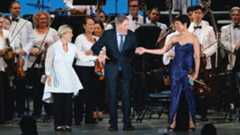
Meyers takes a bow with Karen Kamensek and Philip Glass after performing his Violin Concerto No 1 at the Hollywood Bowl, Los Angeles, in September 2023(photography: Farah Sosa)
One of Meyers’s secret weapons to navigate such dizzying stylistic diversity – let alone the sheer pace of her schedule – is her self-deprecating humour: ‘It takes lots of dark chocolate – and caramel!’ she laughs. Indeed, she’s known for her warmth, wit and fondness for dark chocolate, as well as the way she balances glamour with disarming modesty, and an unshakeable belief in music’s ability to connect. ‘I’ve been so fortunate in that every composer I’ve asked has written something so original, so different. Each of these pieces tells a beautiful story that needs to be shared.’ For Meyers, a new commission represents far more than an invitation to learn a new score or perhaps even to clear a novel technical hurdle; it’s an opportunity to immerse herself in the world of a composer she admires.
An early calling
That openness to artistic worlds beyond her own has shaped Meyers since early childhood. She grew up surrounded by the values of creativity and learning: her American father led a university, and her mother, a painter from Tokyo, would drive her from their home in California’s Mojave Desertto study with Alice and Eleonor Schoenfield. A formative trip to the Hollywood Bowl – where she saw Itzhak Perlman perform the Tchaikovsky Violin Concerto – sparked her dream of becoming a professional violinist. Meyers studied with Alice and Eleonore Schoenfeld at what is now the Colburn School in downtown Los Angeles and continued at the Juilliard School with Dorothy DeLay, whose legendary roster included many of the last century’s great string players.
At just 11, Meyers made her professional debut with the Los Angeles Philharmonic and was featured onThe Tonight Show with Johnny Carson. She has long drawn attention beyond the concert hall. Alongside later guest spots on major talk shows, she has been featured in campaigns by the celebrity photographer Annie Leibovitz and even inspired a fictional virtuoso in J Courtney Sullivan’s best-selling novelThe Engagements(2013).
That mix of cultural visibility and artistic seriousness is mirrored in the instrument she’s played since 2012: the 1741 ‘Vieuxtemps’ Guarneri del Gesù violin, one of the most prized in existence. Its storied past and centuries-old craftsmanship form a striking counterpoint to the contemporary music that Meyers champions.
In 1988, at 18, Meyers made her debut recording at Abbey Road studios, performing the Barber Violin Concerto and Bruch’s First with the Royal Philharmonic Orchestra. Joseph Schwantner was the first composer to write a piece for her,Angelfire (2002), a fantasy for amplified violin and orchestra, thus marking the start of a mission to invite contemporary composers into dialogue with her instrument.
In Glass's orbit
Among the most vital of these contemporary voices is Glass, whose music has become a lodestar in Meyers’s artistic journey. It was in the early 2000s that she first met the composer in person. She recalls falling ‘so completely in love’ withMetamorphosis II(1988) from Glass’s album ‘Solo Piano’ – the piece received widespread circulation as part of the soundtrack to the 2002 filmThe Hours – that she asked if he might consider arranging it for violin and piano. Michael Riesman, music director of the Philip Glass Ensemble and a longtime collaborator with the composer, obliged and provided the arrangement. Meyers includedMetamorphosis II on her album ‘Mirror in Mirror’ (recorded 2016-18), where it appears alongside music by Arvo Pärt and others. ‘It’s very meditative and reflective, one of his most famous works,’ Meyers notes. She has performed it in several other formats as well, including as a duo with guitarist Jason Vieaux.
Meyers later worked directly with Glass while preparing to perform his Violin Concerto No 1 (1987) for the Los Angeles Philharmonic’s 2023 Hollywood Bowl summer season. Composed when Glass was 50, it is a pivotal work that marked the beginning of his ongoing engagement with more traditional long-form orchestral genres such as the symphony and the concerto. He has since become one of the pre-eminent symphonists of our time, with a catalogue now approaching Shostakovich’s in number.
The First Violin Concerto also carries deep personal significance for Glass. He wrote it in memory of his late father, Ben, and has spoken of his desire to create something that would have appealed to a man who loved all the great violin concertos (Tchaikovsky, Beethoven, Brahms, Mendelssohn and so on). Meyers points out that the very first notes she plays spell ‘D–A–D’, adding: ‘Even though Ben Glass had passed away 13 years prior to this composition, he was very much in Philip’s mind.’
The composer himself was seated in the audience when Meyers performed the concerto under Karen Kamensek’s baton in the open-air setting of the Hollywood Bowl in September 2023. (The recording of the concerto was made later, captured in the reverberant acoustic of the city’s Walt Disney Concert Hall.) ‘I have footage of him sitting in the Bowl and watching his own music being performed by us,’ she says. ‘It gave me goosebumps.’
A new chaconne
Although Meyers recalls posing questions about interpretation and intention, she was reassured by the composer’s response – and the fact that it chimed with her own aesthetic. ‘He said to just play it the way you hear it. And I love that. Philip Glass is a huge proponent of the idea that a work breathes and becomes its own when an artist is given that freedom.’
Reflecting on her performance, Glass has said he is ‘very happy’ with the result. Meyers furnished me with the following quote from the composer: ‘When I hear my music played, interpreted and reinterpreted, I am more interested in hearing what artists themselves can bring to the work than my own ideas about how things “should be”. In other words, I want to hear something that I have never heard before. In fact, finding new ideas about a piece, while keeping its integrity intact, is the lifeblood of music throughout time. Anne brought a sensitivity and understanding to the music which I really enjoyed.’
Some months before the Hollywood Bowl performance, during a preparatory visit to the composer’s Manhattan town house to discuss the concerto, Meyers mustered the courage to ask whether he would be willing to write something new for her. ‘I was hoping for a concerto, but that just wasn’t on the cards. But I was elated to receive theNew Chaconne,’ she says. ‘He sat down at his Baldwin piano one day and wrote it very quickly. It just came out of his pen.’ Meyers gave the world premiere in February 2024, at the Laguna Beach Music Festival in southern California, where she was serving as artistic director. She was joined by the Los Angeles Philharmonic’s principal harp, Emmanuel Ceysson, who also performs with Meyers on the new recording.
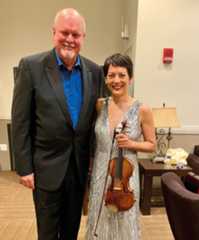
Meyers with Blue Electra composer Michael Daugherty
Discussion of the First Violin Concerto, with its personal connections, seems to have prompted a retrospective attitude atypical for Glass. Meyers even believesNew Chaconne may represent the 88-year-old composer’s swansong. Although it lasts only around five minutes, she doesn’t regard it as a ‘miniature’ by any means. Its intimate instrumentation – for violin and piano (or bass instrument) – recalls the language Glass speaks in solo piano works like the études. Meyers cites as a personal favourite recording Glass’s own album of his piano music, recorded during the pandemic lockdown (‘Philip Glass Solo’). ‘It’s like a meditative practice for Philip to feel the vibration of the piano itself as he plays,’ she says.
While the principle of a chaconne involves review of an idea from ever-shifting angles,New Chaconne at the same time takes a fresh look at its Baroque model, which Glass had used in several earlier works, including the slow movement of the First Violin Concerto. As Richard Guérin, director of Glass’s Orange Mountain Music label, writes in his booklet notes for the new recording, ‘Unlike the established form of a chaconne which Glass more or less adhered to in the past, in sitting down to compose a new piece, he was simply unable to write a piece as he had done in the past.’
The traditional chaconne, Meyers observes, has ‘a minor-key, sad element’ and is in a slow triple metre, while Glass’s piece is ‘the opposite – it symbolises joy, especially the joy of a new friendship. It reminds me of a marble that goes through a maze and then repeats – it’s like you’re going through the course of life.’
From the soul
When asked what she thinks accounts for Glass’s ongoing appeal –including to audiences not usually drawn to classical music – Meyers homes in on a quality that mirrors what many observe about her own playing style: ‘His music draws you in because it’s very soulful, and it comes from such an organic place. People just want to listen. They want to calmly meditate with this music. His music resonates with us on such a deep level because it’s from the soul.’
‘I’ve always understood Anne’s remarkability to be based on her soulfulness – the depth of her playing,’ says Adam Schoenberg (no relation to the Viennese modernist, but, by marriage, a distant relative of George Gershwin). He first connected with Meyers about a decade ago when she asked him to create an arrangement of ‘When You Wish upon a Star’ from the classic Disney filmPinocchio, which she recorded in 2015 for inclusion on ‘Serenade: The Love Album’.
This reflects how, alongside concertos, Meyers has also been expanding the violin repertoire across other genres,New Chaconne being the latest example. Another such work is John Corigliano’sLullaby for Natalie, written for Meyers’s first daughter. It began life in 2010 as a violin and piano work and the following year was orchestrated to form a heartfelt alternative to a traditional concerto. Meyers had initially hoped to commission a concerto, but Corigliano declined, explaining that he had already expressed all he had to express in that form with hisThe Red Violin Concerto (2003). Instead, he offered the lullaby – intimate, lyrical and personal.
It was Corigliano who first introduced Schoenberg – one of his students at Juilliard – to Meyers. She found herself drawn to the lyricism, colour and emotional immediacy of Schoenberg’s music and, following her initial commission for the ‘Serenade’ album, asked him to write a concerto. The result wasOrchard in Fog, a musical response to a photograph by Adam Laipson of an apple orchard in winter, which happens to be where the composer was married. Schoenberg describes himself as ‘a very programmatic composer’ whose music always involves ‘a deeper narrative’ – in this case, one rooted in landscape and memory, about ‘love, loss and passing’.
‘Anne trusted me to write something that would be suitable and showcase her talents,’ Schoenberg recalls. ‘Lyrical music is her greatest strength. She can emote and bring out melodies in such a profound way. I think Anne prefers that emotional dimension over a super-technical, experimental concerto that’s more postmodern or Eurocentric. My music is very American, very tonal and accessible, which fits her sensibility.’
ButOrchard in Fog – which Meyers recently recorded with Gemma New and the New Zealand Symphony Orchestra – held a surprise: Schoenberg wrote it usingscordatura tuning, lowering the G string to F. ‘Because the piece is about passing, and going closer to Earth, I wanted to lower the sound. It became the most technical component, because you have to rewire your thinking.’ Meyers embraced the challenge and soon surprised the composer in turn. ‘Not only did Anne get the essence of what I was trying to write – she knew how to convey it in a way that went beyond what I had imagined,’ Schoenberg says. ‘The overtones that were generated from the F string in the slow movement made the violin speak in such a different way.’
Beloved collaborations
Meyers intuitively seeks out composers with whom she can build this kind of connection, artists whose emotional language resonates with her own, and whose work invites a sense of mutual trust and creative intimacy. Whitacre – one of today’s most successful choral composers – entered her orbit during his tenure as artist-in-residence with the Los Angeles Master Chorale. As in the case of Glass and Schoenberg, her first collaboration involved an arrangement (by Newman, as Whitacre was unable to take it on himself owing to time constraints) of an already existing piece: Whitacre’sSeal Lullaby,originally composed in 2008 as a choral setting of Rudyard Kipling’s bedtime poem. Whitacre admired the honesty of Meyers’s interpretation: ‘Anne loved the melody so much, unadorned, and didn’t want it to be flashy. This speaks to one of her great strengths. There’s such a singing quality to her soul.’
That quality takes centre stage on the ‘Beloved’ album, with its themes of motherhood, loss and healing. Childs’sIn the Arms of the Beloved, a requiem for his mother, serves as the album’s emotional centrepiece alongside the newly arranged Whitacre piece and Gjeilo’sSerenity (a setting of the hymnO magnum mysterium in a version specially adapted for Meyers by the composer). The album’s conductor Gershon says, ‘I’ve known Anne since she was an 11-year-old prodigy. It’s been incredibly rewarding to see her develop into one of the great artists of our time. I’m particularly gratified to see her use her stature to champion new works from interesting composers. Anne brought so much humanity, depth of emotion and insight to the recording of Billy Childs’s masterpiece. All of us in the room that day were deeply moved and inspired by her artistry.’
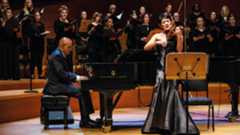
Premiere of In the Arms of the Beloved by Billy Childs (at the piano) with the Los Angeles Master Chorale in November 2023(Photography: Jamie Pham)
Childs cast the solo piano part of his requiem as himself and the solo violin part as the voice of his late mother. ‘I’m thinking of her as I’m playing the notes, so I try almost to embody her spirit,’ says Meyers. She draws a parallel with Daugherty’sBlue Electra concerto, which similarly inspires her to channel its subject. ‘It’s the same thing with Amelia Earhart. Every time I play that piece, I’m thinking of the courage and the bravery she had to cross the Atlantic by herself in one of those Lockheed planes.’
If Meyers instinctively brings to life the stories composers embed in their music, her new collaboration with Whitacre,The Pacific Has No Memory (2025), strikes a particularly personal chord. In January 2025, wildfires swept through the Pacific Palisades, destroying many homes near her own. Whitacre’s new work for solo violin and strings is inspired by a scene in the filmThe Shawshank Redemption, in which the main character sees the ocean as offering ‘a fresh start, where the waves wash away all traces of the old’, Meyers explains. ‘That’s what the music is meant to symbolise.’
Alongside Meyers’s soulfulness and lyrical sensitivity, Whitacre admires ‘her strength, the amount of sound she is able to make. There’s a confidence, a stoicism that is almost steely, with a kind of calligraphy about it – and then she can let the ends of phrases vanish in the air. WithThe Pacific Has No Memory, I leaned into that kind of writing for her.’
Fandango and beyond
That balance of expressive depth and technical mastery likewise captivated Márquez when he set out to writeFandango, which adapts the festive vitality of Mexican and Caribbean folk traditions into a virtuosic concerto. ‘Anne Akiko Meyers is one of the greatest violinists I’ve heard,’ he says. ‘Before I started composing, I studied all her performances – her Vivaldi, her Mendelssohn, and all the new music she’s making.’
Fandango has become a signature piece for Meyers through frequent performances since she gave the premiere in 2021 at the Hollywood Bowl with Gustavo Dudamel and the Los Angeles Philharmonic. With characteristic modesty, she credits its enormous success to the composer: ‘Arturo Márquez has written a concerto with immense texture and colour that everybody wants to play, and that makes you feel joy and happiness. That’s the sign of a piece that has grown all on its own.’
Fandango is just one example of how Meyers strives to ensure that new works take root in the repertoire. ‘Part of her mission is to continue this legacy of breathing life into new works,’ says Schoenberg. ‘Anne is really the only superstar soloist I know who believes in expanding the repertoire and consistently does that. Besides touring the world and releasing so many albums, I think that’s going to be the greatest part of her legacy’ – a legacy shaped by Meyers’s gift for hearing the composer’s voice, and helping it sing.