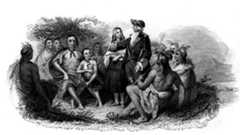














Fort Daniel, located on Hog Mountain inGwinnett County, near the head of the Apalachee River, was one of several small frontier forts or “stations” built in northwest Georgia during the late eighteenth and early nineteenth centuries. These forts were established during the settlement of the state’s western territories because of frequent conflicts between white settlers and the region’s Indians. The precise locations for many of these forts are no longer known, but many were situated along treaty boundaries negotiated with theCherokee andCreek Indians.

Courtesy of The Fort Daniel Foundation, Inc.
Early written descriptions place the location of the “fort at Hog Mountain,” as it was originally known, at the southern boundary of the Cherokee hunting grounds. This boundary line, established more formally in 1798 by Indian affairs agentBenjamin Hawkins, was subsequently known as “the Hawkins Line.” Although questions remain about the date and exact location of the original fort at the site, local historians and archaeologists have documented the location of the fort’s second incarnation.
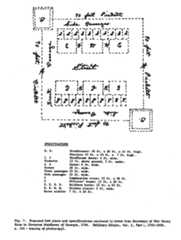
In a letter dated October 21, 1813, Major General Allen Daniel, commander of the Fourth Division of the Georgia Militia, wrote to Brigadier General Frederick Beall, commander of the Second Brigade of the Georgia Militia: “The fort at the hog mountain is not only formed of old, dry and insufficient timbers, but is also badly constructed, consequently easily destroy’d by fire and inadequate for defence.” Daniel ordered Beall to provide thirty of his militiamen to relieve those stationed at the Hog Mountain fort and to set up a system for rotation every ten days. He also ordered Beall to supervise the construction of “a new fort at or near the place whereon the present fort stands which shall be sufficient for the reception of two hundred men.” He gave specific instructions as to the number and height of “port holes” from which to defend the fort from attackers and outlined other details relating to the fort’s roof and internal structures. It is likely that the name Fort Daniel was given to the newly built fort.

Courtesy of James D'Angelo
In the same month that Beall received orders to rebuild Fort Daniel, LieutenantGeorge R. Gilmer, who later served as thegovernor of Georgia, received orders to build a fort at the Indian town of Standing Peachtree, located at the confluence of theChattahoochee River and Peachtree Creek, in what is now the Buckhead community ofAtlanta. The fort was laid out on March 14, 1814, and completed in two months. At the same time, construction began on a road connecting Fort Daniel with the new fort at Standing Peachtree, which was sometimes referred to as Fort Gilmer. The road is still known as “Old Peachtree Road.”
Daniel’s letter to Beall was discovered during preparations for an archaeological investigation, which the Gwinnett Archaeological Research Society, a chapter of theSociety for Georgia Archaeology, began in 2007. The letter raised new questions about Fort Daniel, and researchers have been working to discover whether Beall built an entirely new fort on Hog Mountain or simply rebuilt the existing fort. By 2011 excavations had yielded hundreds of artifacts, including ceramics, nails, musket balls, buttons, coins,Indian pottery, trade items, and stone tools. The site also yielded intact buried features, not the least of which is the entire stockade wall trench, with evidence of corner blockhouses in the southwest and northeast.
Cite this Article
D'Angelo, James. "Fort Daniel." New Georgia Encyclopedia, last modified Oct 31, 2018. https://www.georgiaencyclopedia.org/articles/history-archaeology/fort-daniel/
D'Angelo, J. J. (2011). Fort Daniel. InNew Georgia Encyclopedia. Retrieved Oct 31, 2018, from https://www.georgiaencyclopedia.org/articles/history-archaeology/fort-daniel/
D'Angelo, James. "Fort Daniel."New Georgia Encyclopedia, 15 July 2011, https://www.georgiaencyclopedia.org/articles/history-archaeology/fort-daniel/.
Article Feedback
Share this Article

Fort Daniel
Fort Daniel, located on Hog Mountain in Gwinnett County, near the head of the Apalachee River, was one of several small frontier forts or “stations”…
Share this Snippet
Fort Daniel
Fort Daniel, located on Hog Mountain in Gwinnett County, near the head of the Apalachee River, was one of several small frontier forts or “stations”…