



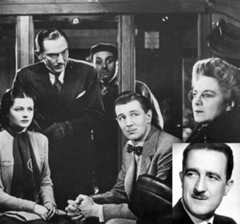
by Stephen Vagg
We look at the career of one of the most successful British film moguls in history, Ted Black.
One doesn’t normally encounter the adjective “successful” before the words “film mogul” in British film history. You tend to read a lot more about disasters – Alex Korda having to be bailed out by the government, the incompetence and vindictiveness of Sir John Davis, J. Arthur Rank burning through his dad’s flour fortune, Michael Carreras overseeing the implosion of Hammer, Michael Balcon passing up the chance to makeTom Jones. Partly, this is because the British love their disasters – they’re a glass half empty kind of people. Partly, because filmmaking is such a dicey proposition, particularly in Britain, that most moguls end their careers with failure.
Ted Black also ended his career with failure – but the failure wasn’t really his fault, and he died quite young, aged only 48 years old (the cigarettes did him in), so we think that he would’ve made a comeback. Because, up until then, he was a very successful mogul, whose output included such classics asThe Lady Vanishes, The Man in Grey, Young and Innocent, the best Will Hay and Arthur Askey films, and the best early Carol Reed (Bank Holiday, Night Train to Music, Kipps); Black was the original champion of Val Guest and the team of Frank Launder and Sidney Gilliat, and who ran the most efficient British film studio in perhaps history. Most notably, Ted Black seemed to have the greatest understanding of what a British movie star was and should be – not only did he construct the best cinematic vehicles enjoyed by stage comics such as Hay, Askey and the Crazy Gang, it was Black who discovered and nurtured film-only stars like Margaret Lockwood, Pat Roc, Phyllis Calvert, James Mason, Stewart Granger and John Mills.
Other studio heads had more colourful personalities, less ordinary surnames, greater output and higher profile hits than Ted Black – notably Nat Cohen, Michael Balcon, James Carreras, Alex Korda, Earl St John, and Sydney Box. But, for sheer ordinary common sense, Black was perhaps the greatest (or most sensible) mogul of them all. He established a template of filmmaking that could be used for not just Britain, but any smaller country. A template that was routinely ignored.
Black was a nepo baby, in a way – or, more accurately, he was born (in 1900) into a showbiz family in northern England. Dad ran a waxworks exhibit and moved into cinema ownership during the early silent days, and Ted and his two brothers (George and Arthur) grew up learning the family trade. Black’s bother George moved into live performance – he ran the London Pavillion, which probably won’t mean a lot to you unless you’re British, but it was a big deal.
Ted entered the film production in 1930, joiningGaumont British, a company that made, distributed and exhibited movies, in association with its sister company, Gainsborough Pictures. The corporate structure of Gaumont and Gainsborough was confusing, but basically Gainsborough, run by Michael Balcon, was based at studios in Islington while Gaumont, controlled by theOstrer brothers was at Shepherd’s Bush.
Black managed the studios and was assistant to Michael Balcon, working on movies such asTudor Rose andThe Man Who Lived Againwith Boris Karloff. In late 1936, Balcon quit to go work at MGM and Black was put in charge of the studio. Well, kind of in charge – he had to deal with the Ostrers, particularly Maurice, who ran the company, but most accounts from the time said Black basically ran the show (writer-director Sidney Gilliat claimed the operation was “nine-tenths Black”).
Black took over at Gaumont/Gainsborough at a tricky time – the British industry was going through a crisis (the boom that followed the success ofThe Private Life of Henry VIII in 1933 had been followed by a crash) and the studio was on such shaky financial ground that its Shepherd’s Bush studio had to be shut (later on, during the war, the Islington Studios were shut down and everyone moved back to Shepherd’s Bush). However, Black soon turned things around and Gainsborough became one of the most consistently profitable studios in British film history.
Black didn’t do this through being a genius or a fluke foreign hit or being underpinned by some other fortune, but through firm, practical measures. In particular, he used the seven following principles:
Careful planning.Gaumont-Gainsborough was not a cheapskate outfit like Butchers (for instance, when Hitchcock was going to directThe Lady Vanishes, Black added money to the budget), but he was frugal. He was a strong believer in careful scripting and planning, using a scenario department and lots of story conferences. Black respected writers – he made sure that they stuck to schedules and agreed storylines – but did not fancy himself a writer, which is often fatal when running a studio (eg Bryan Forbes at EMI, Sydney Box at Gainsborough.
Black did not like to waste anything – for instance,The Lady Vanishes had been developed for another director, Roy William Neill, only for filming to run into trouble in Yugoslavia; Hitchcock owed the studio a film and the Ostrers wanted to pay him off, but Black thought this was a waste of a director and a script and so put them together onThe Lady Vanishes, thus creating cinema history. There were very few cost overruns on Black films (which makes what happened at the end of his career so odd).
A commercial, yet diverse slate that still has quality control. Black leant towards specific genres – comedies, women in peril thrillers, war stories, classical literature adaptations – but always made sure he had a mix. He also didn’t overexpand – which is what killed Gainsborough in the late 1940s under Sydney Box.
Make films that the British could do better than anyone else. Comedies were uniquely local. So too were war films (We Dive at Dawn, Millions Like Us, Waterloo Road). Black greenlit adaptations of British literary classics (Kipps, Owld Bob, Dr Syn) and biopics (The Young Mr Pitt). His women in peril films were identifiably British – whether modern day tales likeThe Lady VanishesandNight Train to Munich or costume melodramas such asThe Women in Grey andFanny by Gaslight. His comedy dramas such asBank Holiday had a uniquely British setting.
Build your own stars and support them. This is probably Black’s greatest claim to fame. Black did not want to be reliant on second-tier Hollywood names, who plagued many British films of the 1930s for little appreciable result – he wanted to build British movie stars. He started off making vehicles for comedy stars who were well established on stage such as Will Hay, Will Fyffe, The Crazy Gang, and Arthur Askey but made sure he used them in well-prepared vehicles featuring solid plots as well as pre-scripted comedy sequences. (His writers included Val Guest, Sidney Gilliat, and Frank Launder.)
Later, he expanded to promote British-orientated film stars: Margaret Lockwood (ordinary girl next door), Phyllis Calvert (girl next door), John Mills (boy next door), James Mason (caddish Lord of the Manor), Stewart Granger (hunky Lord of the Manor), Pat Roc (English rose), Jean Kent (slightly sexier English rose). His greatest achievement was arguably Lockwood, who he plucked out of standard ingenue roles, recognised something in the actress that “would make every woman in Britain identify with her” and turned her into a star in such films asBank Holiday, then later a superstar withThe Man in Grey.
Except for John Mils – who thrived in ‘50s war films– and maybe Michael Redgrave (who was always more of a theatre star), it’s significant that none of the stars promoted by Black were as effective as stars in British movies when they worked without him.
For instance, Will Hay’s later films for Ealing simply aren’t as good as the ones he did for Gainsborough under Black. The Gainsborough melodrama team of Lockwood, Mason, Granger and Calvert did alright for a few years, off the back of the template Black had established (egThe Wicked Lady), but all went into decline soon afterwards – Mason and Granger survived as stars only by going to Hollywood, but Roc, Kent, Calvert and Lockwood saw their careers go into free fall without Black. Executives at Rank, for instance, ran the Gainsborough melodramas into the ground.
Support the director. While Black counted his pennies, he was known to be very supportive of directors. Many did their best British work for Black – Alfred Hitchcock, Anthony Asquith, Carol Reed, Leslie Arliss. Arliss, in particular, really struggled without Black. Phyllis Calvert claimed that Black rather than Arliss was responsible for the success ofThe Man in Grey, saying the producer was “the one who would watch it, cut it, and know exactly what the audience would take. I don’t say he wanted to do really good films, but he knew where the money was, and he made all those escapist films during the war.”
Promote from within. Black was not opposed to importing talent but also liked to promote from within. He enabled people such as Val Guest (writer), Leslie Arliss (cameraman) and Launder and Gilliat (writers) to move up to director.
Critics can get stuffed. Black made a few prestigious movies –Kipps, The Young Mr Pitt – but even those were populist. His eye was always on the audience. Indeed, Alfred Roome, an editor under Black said that Black deliberately avoided fancy film functions out of risk he would “get contaminated” by fancy pancy opinions. “If I mix with the intellectual lot, it’ll impair my judgement,” he said.
By November 1943, Black was riding high. His had just releasedThe Man in Grey, the first of the legendary Gainsborough melodramas, which had been a box office sensation, launching Calvert, Mason and Granger as stars and boosting Lockwood’s popularity. A range of exciting projects were awaiting release or had started filming includingFanny By Gaslight andWaterloo Road.
So, of course, Black was forced out of the company.
Huh?
There were a few reasons. First, the studio had been brought by J Arthur Rank, who was gobbling up British film interests, and while Gainsborough was semi-autonomous, Black was chaffing under their management. More significantly, there was conflict between Black and the Ostrer brothers, particularly Maurice, who were upset that Black was getting all the credit for Gainsborough success. Black accepted an offer to work for Alex Korda, and then MGM British. Maurice Ostrer ran Gainsborough until 1946, benefiting from the hard work Black had done, particularly setting the template for melodramas likeThe Wicked Lady. But he clashed with Rank and left in 1946; Ostrer would only make one more movie (Idol of Paris) before leaving filmmaking altogether.
To be fair, Black might have been more dependent on the Ostrers than he realised, because after he left them, his career went into free fall. Over the next five years, he would only make two movies, and one of them was one of the biggest disasters in British cinematic history. Black didn’t intend for this to happen. A bunch of projects were announced from the producer – including adaptations of John Buchan’sGreenmantle, Arnold Bennett’sOld Wives’ Tale, and Dickens’Pickwick Papers – but, for whatever reason, these did not eventuate.
Black’s next credit wasn’t until A Man About the House in 1947. This movie – which is actually quite good – is consistent with much of Black’s earlier work: it’s a woman in peril film (the Gaslighting, my-husband-is-my-poisoner kind), there are juicy roles for stars, Leslie Arliss directed. And it was popular. However, it cost a heap of money, so probably wasn’t that financially successful (they shot it in Italy, which is nice, but not really essential, especially as they filmed it in black and white). Also, the stars aren’t quite there: Dulcie Grey and Margaret Johnson are excellent, but they lacked the everyday appeal of the Gainsborough girls like Lockwood, Calvert and Roc, and male lead Keiron Moore never lived up to his original hype. Still, nothing to be ashamed of here.
Bonnie Prince Charlie was something else – an epic about the pretender to the British throne who led the 1745 Rebellion. Korda developed it in the 1930s as a vehicle for Leslie Howard; after Howard’s death in the war, it was turned into a vehicle for David Niven. Korda assigned the project to Black, possible because Black had wanted to make a version of another Scottish history saga,Rob Roy, in the late 1930s with Fyffe, Lockwood and Michael Redgrave (war intervened). FilmingBonnie Prince Charlietook over a year (if you include second unit work) and involved countless writers and at least four directors (Robert Stevenson, Leslie Arliss, Anthony Kimmins and Korda). Black reportedly quit during filming but he is credited as sole producer (on loan from MGM British). The movie cost £760,000 and returned £150,000, helping push Korda towards bankruptcy.
What happened?
In fairness to Black, the whole British film industry went a little mad after the war. J Arthur Rank was dreaming of world film domination, but so was the British government, which got in a trade war with Hollywood. Costs blew out on British movies everywhere –The Red Shoes, Hamlet, Caesar and Cleopatra, Anna Karenina, Eureka Stockade. It wasn’t until the early 1950s, after Black’s death, that the industry calmed down and stabilised – British film would be very strong until around 1971.
It’s interesting to imagine what Black might’ve done had he lived. When he died, he was planning to make a film about the police force,To Watch and to Ward, which might have enjoyed the popularity of Ealing’sThe Blue Lamp in 1950. He was also linked with the comedyThe Perfect Woman which was a surprise hit in 1949.
Black would have been a natural to run a studio in the 1950s – British Lion, London Films, Rank, or Associated British. All of these badly needed someone like Ted Black. One area he might have made a real difference in, is servicing the female audience – they were looked after by the British film industry in the 1940s but not in the ‘50s, which was dominated by war movies and comedies. A studio run by Ted Black may have stopped that.
In 1949,Frank Launder suggested that the British film industry follow the Ted Black template, specifically: “basing our programme upon a diversity of product, a properly planned economy, a star-building system and a careful selection and preparation of story material, we might be able to produce a very consistent stream of product, which the public would welcome.”
The most successful British-based film producers of the 1950s and 1960s are ones who did this: Launder and Gilliat, Betty Box and Ralph Thomas, Nat Cohen and Stewart Levy at Anglo-Amalgamated, Albert Broccoli at Warwick Productions. These principles have not aged, incidentally – they could be used in Australia, but the only Australian company to attempt it on a consistent basis was Cinesound in the 1930s.
Anyway, Ted Black. Gone but not forgotten. Just.