ESO Timeline
This timeline shows highlights and important events in the history of ESO. One of ESO’s original aims was to allow the Member States to work together to build and operate advanced astronomical facilities that were beyond the capabilities of any individual country. In particular, it would allow European astronomers to access the parts of the sky best visible from the southern hemisphere, such as the centre of the Milky Way, or our neighbouring galaxies, the Magellanic Clouds.
An excerpt from the preamble to the ESO Convention of 1962 reads "The Governments of the States parties to this convention [...] desirous of jointly creating an observatory equipped with powerful instruments in the Southern Hemisphere and accordingly promoting and organising co-operation in astronomical research [...]".

 21 June 1953 — A shared European Observatory is discussed for the first time by a group of astronomers at Leiden, the Netherlands. Immediately thereafter, the subject was further discussed, also in the Netherlands, at the Groningen conference.
 26 January 1954 — ESO declaration by leading astronomers from six European countries expressing the wish that a joint European observatory be established in the southern hemisphere.
 December 1955 — Site testing begins in South Africa and later in South America, to identify the best location for the ESO observatory.

- 5 October 1962 — Founding Members Belgium, France, Germany, the Netherlands and Sweden sign the ESO Convention.
- 1 November 1962 — Otto Heckmann (1901–1983) becomes the first Director General of ESO, and ESO offices open in the Hamburg-Bergedorf Observatory, where he was Director.
- November 1962 — ESO starts site testing in Chile.
 6 November 1963 — Chile is chosen as the site for the ESO observatory and theConvenio (also known as theAcuerdo), the agreement between Chile and ESO, is signed.
- 15 November 1963 — The decision to build headquarters in Santiago, Chile’s capital is made.
- 17 January 1964 — The ESO Convention takes effect following its ratification in by France, Germany, the Netherlands and Sweden (Founding Members, Member States 1–4).
- 5 February 1964 — The ESO Council ratifies theConvenio.
- 17 April 1964 — The Chilean government ratifies theConvenio.
- 26 May 1964 — The ESO Council selects the mountain Cinchado Nord — later to become La Silla — as the site of its observatory.
 30 October 1964 — Acquisition of La Silla Mountain and land for the Chile headquarters in Vitacura.
- March 1965 — ESO acquires the Guesthouse in Las Condes.
 March 1965 — Construction of the La Silla Observatory begins.
 24 March 1966 — Dedication ceremony for the road to the summit of La Silla.
- 30 November 1966 — First light for the ESO 1-metre Telescope at La Silla, the first telescope to be used by ESO in Chile.
 November 1966 — First light of the mid-infrared Kapteyn photometer on the ESO 1-metre Telescope.
 January 1967 — Construction of ESO Headquarters in Santiago’s Vitacura district, Chile begins.
 May 1967 — First light of the near-infrared photometer on the ESO 1-metre Telescope.
- 24 August 1967 — Denmark formally joins ESO (Member State 6).
- 2 October 1967 — Belgium formally joins ESO (Founding Member, Member State 5).
 July 1968 — First light for the Grand Prisme Objectif Telescope at La Silla, the first telescope ever used by ESO (used in the South Africa tests campaign).
 July 1968 — First light for the ESO 1.52-metre Telescope.
 7 September 1968 — First light for the Bochum 0.6-metre Telescope.
- December 1968 — ESO helps found the journalAstronomy and Astrophysics.
 February 1969 — First light for the Danish 0.5-metre Telescope.
 25 March 1969 — Inauguration of the ESO site at La Silla by the President of the Republic of Chile, Eduardo Frei Montalva, and of the ESO Chile headquarters in Santiago’s Vitacura district.

 1 January 1970 — Adriaan Blaauw (1914–2010) takes over as Director General of ESO.
- 16 September 1970 — ESO signs an agreement with CERN to collaborate in the realisation of the ESO 3.6-metre Telescope.
 October 1970 — ESO’s Telescope Division moves into offices on the CERN premises in Geneva.
 December 1971 — First light for the ESO 0.5-metre Telescope.
 21 December 1971 — First light for the ESO 1-metre Schmidt Telescope.
- May 1974 —The first edition of theMessenger, ESO’s quarterly in-house magazine, is published by ESO.
- 1 January1975 —Lodewijk Woltjer (1930– ) takes over as Director General of ESO.
- 10 November 1975 —First Light of the Swiss 0.4-m Telescope.
- 2 December 1975 — The ESO Council approves Garching bei München, Germany, as the newhome for ESO’s Headquarters.
 7 November 1976 —First light for the ESO 3.6-metre Telescope.
- 1978 —Completion of the Quick Blue Survey done with the 1-m Schmidt Telescope.
- 2 October 1978 —Construction of the new ESO Headquarters in Garching begins.
 20 November 1978 —First light for the Danish 1.5-metre Telescope.
- 31 January 1979 — An agreement is signed between ESO and the German government for the new ESO Headquarters.
 March 1979 —First light for the Dutch 0.9-metre Telescope.

- Summer 1980 — First Light for the Swiss T70 Telescope
 December 1980 — First light of the infrared photometer/spectrophotometer on the ESO 3.6-metre Telescope.
 5 May 1981 — First light of the 1.4-metre Coudé Auxiliary Telescope (CAT), and its Coudé Echelle Spectrometer (CES).
 5 May 1981 —Inauguration of the new ESO Headquarters in Garching, Germany.
- 1 March 1982 —Switzerland formally joins ESO (Member State 7).
- 24 May 1982 —Italy formally joins ESO (Member State 8).
 June 1982 — First light of the infrared photometer/spectrophotometer on the ESO 1-metre Telescope.
- June 1983 —First Light of the Cassegrain Echelle Spectrograph (CASPEC) at the ESO 3.6-metre Telescope.
 22 June 1983 —First light for the MPG/ESO 2.2-metre Telescope.
- 1 March 1984 —The Space Telescope European Coordinating Facility — the European home for Hubble — opens within ESO as a collaboration with the European Space Agency.
- June 1984 — The first tests for remote-controlling a telescope are carried out on the 2.2-metre Telescope.
- September 1984 — First light of the Lyon Specklegraph on the ESO 3.6-metre Telescope.
- November 1984 —First light of the F/35 chopping secondary system and the infrared photometers on the ESO 3.6-metre Telescope.
 November 1985 —First light of IRSPEC on the ESO 3.6-metre Telescope.
- March 1987 —First light of the F/35 photometers on the MPG/ESO 2.2-metre Telescope (with the Max-Planck Institute of Astronomy, MPIA).
 24 March 1987 —First light for the 15-metre Swedish–ESO Submillimetre Telescope (SEST).
 8 December 1987 —Decision is taken by the ESO Council to build the Very Large Telescope (VLT).
 1 January 1988 —Harry van der Laan (1936– ) takes over as Director General of ESO.
 July 1988 —First light of IRAC on the MPG/ESO 2.2-metre Telescope.
- October 1988 — The Chilean Government donates the land around Cerro Paranal to ESO.
- 23 March 1989 —First light of the New Technology Telescope (NTT).
 11 May 1989 —First light of the second ESO Faint Object Spectrograph and Camera (EFOSC2) instrument on the NTT.

- 16 April 1990 —First light of the COME-ON instrument on the ESO 3.6-metre Telescope.
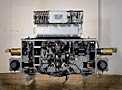 June 1990 — First Light of the ESO Multi-Mode Instrument (EMMI) on the NTT.
 4 December 1990 —Paranal is selected by ESO as the site for the VLT.
 - 23 September 1991 —Construction of the Paranal Observatory begins with the levelling of the mountain.
- 30 May 1992 — First light of the IRAC2 instrument on the MPG/ESO 2.2-metre Telescope.
- 21 July 1992 — First light of the Thermal Infrared MultiMode Instrument (TIMMI) on the ESO 3.6-metre Telescope.
- 15 December 1992 —First light of the COME-ON+ instrument on the ESO 3.6-metre Telescope.
 1 January 1993 —Riccardo Giacconi (1931– ) takes over as Director General of ESO.
 April 1995 — Site testing for the future Atacama Large Millimeter/submillimeter Array (ALMA) takes place in Chile together with National Radio Astronomy Observatory and National Astronomical Observatory of Japan.
 - 18 April 1995 —Amendment to theConvenio between the Chilean Government and ESO is signed.
- Summer 1996 — First Light for the Marly 1-metre Telescope
 5 September 1996 —The Chilean Senate ratifies the Amendment to theConvenio with ESO.
- 4 December 1996 —Paranal Foundation Ceremony.
 6 December 1997 —First light for the Son OF ISAAC instrument (SOFI) on the NTT.
- 11 February 1998 —First light for the second Superb-Seeing Imager (SuSI2) on the NTT.
 12 April 1998 — First light for theSwiss 1.2-metre Leonhard Euler Telescope at La Silla.
 25 May 1998 —First light for the VLT’s first Unit Telescope (UT1), Antu.
 15 September 1998 —First light for the first visual and near UV FOcal Reducer and the low dispersion Spectrograph (FORS1) on the VLT’s UT1, Antu.
 - 6 October 1998 —First light of the Fibre-fed Extended Range Optical Spectrograph (FEROS) on the ESO 1.52-metre Telescope.
 16 November 1998 —First light of the Infrared Spectrometer And Array Camera (ISAAC) instrument on VLT UT1, Antu.
  15 December 1998 — Two independent research teams, with work partly based on observations of exploding stars with astronomical telescopes at La Silla, show that the expansion of the Universe is accelerating.The 2011 Nobel Prize in Physics was awarded for this result.
 15 January 1999 —First light with the 67-million-pixel Wide Field Imager (WFI) camera on the MPG/ESO 2.2-metre Telescope.
  1 March 1999 —First light for the VLT’s second Unit Telescope (UT2), Kueyen.
- 5 March 1999 —Official inauguration of Paranal Observatory.
- June 1999 — Chajnantor in the Atacama Desert in Chile is endorsed by ESO Council as the site for ALMA.
 1 September 1999 —Catherine Cesarsky (1943– ) takes over as Director General of ESO.
  27 September 1999 —First light for the Ultraviolet Visual Echelle Spectrograph (UVES) on the VLT’s UT2, Kueyen.
 29 October 1999 —First light for the second visual and near-UV FOcal Reducer and low dispersion Spectrograph (FORS2) at VLT’s UT2, Kueyen.

 26 January 2000 —First light for the VLT’s third Unit Telescope (UT3), Melipal.
 27 June 2000 —Portugal signs the Accession Agreement.
  4 September 2000 —First light for the VLT’s fourth Unit Telescope (UT4), Yepun.
 11 October 2000 —First light of the second Thermal Infrared MultiMode Instrument (TIMMI2) on the ESO 3.6-metre telescope.
 17 March 2001 —First light for the Very Large Telescope Interferometer (VLTI).
 5 April 2001 —Representatives from ESO, Japan, and North America sign a resolution affirming their mutual intent to construct and operate ALMA.
- 7 May 2001 — Portugal formally joins ESO (Member State 9).
 25 November 2001 —First light for the combined NAOS–CONICA instrument (NACO) on the VLT’s UT4 Yepun.
 26 February 2002 —First light of the VIsible Multi-Object Spectrograph (VIMOS) on the VLT’s UT3, Melipal.
  1 April 2002 —First light of the Fibre Large Array Multi Element Spectrograph (FLAMES) on the VLT’s UT2, Kueyen.
- 21 May 2002 — The United Kingdom signs the Accession Agreement.
- 24 June 2002 —The United Kingdom formally joins ESO (Member State 10). See the ESO Press Releaseeso0218 or the relatedMessenger article.
- 24 October 2002 — First light of the Fibre-fed Extended Range Optical Spectrograph (FEROS) on the MPG/ESO 2.2-metre telescope.
 15 December 2002 —First light of the MID-infrared Interferometric instrument (MIDI) on the VLTI.
 11 February 2003 —First light of the High Accuracy Radial Velocity Planet Searcher (HARPS) at ESO’s 3.6-metre telescope at the La Silla Observatory.
 25 February 2003 —ESO and the US National Science Foundation (NSF) sign a bilateral agreement to construct and operate ALMA.
 18 April 2003 —First light of the MACAO–VLTI facility.
 24 June 2003 —The 0.6-metre Rapid Eye Mount (REM) telescope starts operations at La Silla.
 - 25 July 2003 — The Republic of Chile granted free concession of the land on Chajnantor for the execution of the ALMA project .
- 6 November 2003 —Ground-breaking ceremony at the 5000-m altitude ALMA site.
 24 January 2004 —First light for the first Auxiliary Telescope (AT1).
 - 9 February 2004 —Finland signs the Accession Agreement.
- 21 March 2004 —First fringes of the Astronomical Multi-BEam combineR (AMBER) on the VLTI.
 6 April 2004 — After more than 1000 nights of observations at La Silla, spread over 15 years, astronomersdetermine the motions of more than 14 000 solar-like stars residing in the neighbourhood of the Sun, showing that our home galaxy has led a much more turbulent and chaotic life than previously assumed.
 - 30 April 2004 —First light for the VLT Imager and Spectrometer in the InfraRed (VISIR) on the VLT’s UT3, Melipal.
 7 July 2004 —Finland formally joins ESO (Member State 11).
  9 July 2004 —First light for the Spectrograph for INtegral Field Observation in the Near-Infrared (SINFONI) on the VLT’s UT4, Yepun.
 17 August 2004 — Using the VLT, astronomers measure the age of the oldest star known in the Milky Way: 13.2 billion years old. Read more in ESO Press Releaseeso0425and in the ESO Press Releaseeso0106.
 10 September 2004 — The VLT obtains thefirst-ever image of a planet outside the Solar System.
- 14 September 2004 —Agreement signed between ESO, the US National Science Foundation and the National Institutes of Natural Sciences, Japan, for the joint construction of the enhanced ALMA.
 2 February 2005 — First light for the second Auxiliary Telescope (AT2).
  14 July 2005 —First light for the submillimetre Atacama Pathfinder Experiment (APEX).
  6 October 2005 — ESO telescopes provide definitive proof that long gamma-ray bursts are linked with the ultimate explosions of massive stars, solving a long-standing puzzle. Read more in the ESO Press Releaseeso0318, ESO Press Releaseeso0533 and in ESO Press Releaseeso0633.
- 1 November 2005 — First light for the third Auxiliary Telescope (AT3).
- 7 December 2005 —ESO signs the European contract for the production of up to 32 ALMA antennas. This is the largest ever contract for industrial work on a ground-based astronomy project.
- 28 January 2006 —First light of the VLT laser guide star, on the VLT’s UT4, Yepun.
- 28 February 2006 — Decision to host the ALMA Santiago Central Office at ESO Vitacura.
 4 June 2006 —First light for the CRyogenic high-resolution InfraRed Echelle Spectrograph (CRIRES) at VLT’s UT1.
 - 15 September 2006 —The robotic TAROT–South Telescope starts work at La Silla.
 11 December 2006 — TheESO Council agrees to proceed with studies for the Extremely Large Telescope (ELT).
  15 December 2006 —First light for the fourth Auxiliary Telescope (AT4).
 - 22 December 2006 —Czechia signs the Accession Agreement.
 29 December 2006 —Spain signs the Accession Agreement.
 - 14 February 2007 — Spain formally joins ESO (Member State 12).
 25 March 2007 —First light for the Multi-Conjugate Adaptive Optics Demonstrator (MAD) at the visitor focus of Melipal.
 - 30 April 2007 —Czechia formally joins ESO (Member State 13).
- 6 July 2007 —First light of the Gamma-ray burst Optical/Near-infrared Detector (GROND) on the MPG/ESO 2.2-metre Telescope.
 5 August 2007 —First light for the LArge BOlometer CAmera (LABOCA) instrument on APEX.
 - 22 August 2007 —First light for the High Acuity, Wide field K-band Imaging (HAWK-I) instrument on the VLT’s UT4, Yepun.
 1 September 2007 —Tim de Zeeuw (1956 –) takes over as Director General of ESO.
 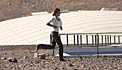 March 2008 —Filming of scenes from the 22nd James Bond movie Quantum of Solace at ESO’s Paranal Observatory.
  13 May 2008 — The VLT detects carbon monoxide molecules in a galaxy located almost 11 billion light-years away for the first time, allowing astronomers to obtainthe most precise measurement of the cosmic temperature at such a remote epoch.
 30 June 2008 —Austria signs the Accession Agreement.
 - 8 September 2008 —First light for the Phase Referenced Imaging and Microarcsecond Astrometry (PRIMA) instrument on the VLTI.
 6 October 2008 — First light for the Submillimetre APEX Bolometer Camera (SABOCA) instrument onAPEX.
  9 November 2008 —First light for X-shooter on the VLT.
 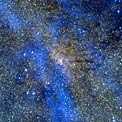 18 November 2008 — The VLT and APEX team up to studythe violent flares from the supermassive black hole at the centre of the Milky Way, revealing material being stretched out as it orbits in the intense gravity close to the central black hole.
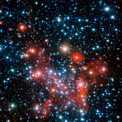 10 December 2008 — Several of ESO's flagship telescopes were used in a 16-year long study to obtain the most detailed view ever of the surroundings of the monster lurking at the heart of our galaxy — a supermassive black hole. Read more in theESO Press Release eso0226, eso0846, eso1151, eso1332 andeso1512. TheCrafoord Prize in Astronomy 2012 was awarded for this result.
- 18 December 2008 —The ALMA Observatory is equipped with its first antenna.
- 30 April 2009 — The contract for the ALMA headquartersbuilding in Santiago, the Santiago Central Office, is awarded.
- 1 July 2009 — Austria formally joins ESO (Member State 14).
- 6 July 2009 —Start of construction of the new ALMA headquarters in Santiago’s Vitacura district.
 17 Sep 2009 —First ALMA antenna arrives at 5000-metre-altitude Chajnantor site.
  25 November 2009 —First three ALMA antennas are successfully linked (phase closure) at 5000-metre-altitude Chajnantor site.
  11 December 2009 —VISTA, the pioneering new survey telescope, starts work.

 13 January 2010 —The first direct spectrum of an exoplanet is observed with the VLT.
 26 April 2010 —Cerro Armazones is chosen as site for the ELT.
 8 June 2010 —First light of the TRAPPIST telescope at La Silla.
 24 August 2010 — Astronomers using HARPS discoverthe richest planetary system so far, containing at least five planets around the Sun-like star HD 10180.
  5 November 2010 —ALMA’s Santiago Central Office (SCO), built for the ALMA project by ESO, is handed over.
 1 December 2010 — The first direct measurements of the spectra of exoplanets and their atmospheres are made with the VLT. Read more in the ESO Press Releaseeso1047and in the ESO Press Releaseeso1002.
 29 December 2010 —Brazil signs the Accession Agreement to become member of ESO.
- 20 April 2011 — Thelight from all four VLT Unit Telescopes is combined for the first time.

- 8 June 2011 —First images from the VLT Survey Telescope.

- 27 July 2011 —The first European ALMA antenna arrives at Chajnantor.

- 24 August 2011 —The first 7-metre ALMA antenna arrives at Chajnantor.

- 30 September 2011 —ALMA starts Early Science and first image is published.

 13 October 2011 —ESO and Chile sign an agreement on the land for the ELT.
 11 June 2012 —ELT Programme approved by ESO Council.
 11 June 2012 —Foundation stone laying ceremony for ESO Headquarters extension building.
 5 October 2012 —ESO Celebrates 50th Anniversary.
 12 December 2012 —KMOS instrument achieves first light on VLT UT1.
 13 March 2013 —ALMA Observatory inaugurated.
 6 November 2013 —ESO Celebrates 50 Years of Collaboration with Chile.
 5 December 2013 —Extension to ESO Headquarters in Garching, Germany inaugurated.
 5 March 2014 —MUSE instrument achieves first light on VLT UT4.
 4 June 2014 —SPHERE instrument achieves first light on VLT UT3.
 19 June 2014 —Groundbreaking ceremony for the European Extremely Large Telescope (ELT) takes place at Paranal Observatory.
 28 October 2014 —Poland to Join the European Southern Observatory.
 6 November 2014 —Revolutionary ALMA image reveals planetary genesis.
 4 December 2014 —Green Light for ELT Construction.
 14 January 2015 —Next-Generation Transit Survey (NGTS) facility achieves first light.
 5 August 2015 —Poland ratifies ESO membership and becomes the fifteenth Member State.
 13 January 2016 —GRAVITY achieves first light on VLTI.
 27 April 2016 —First Light for the Four Laser Guide Star Facility (4LGSF).
 25 May 2016 —ESO Signs Largest Ever Ground-based Astronomy Contract for ELT Dome and Telescope Structure.
 24 August 2016 —Pale Red Dot project reveals Earth-mass world in orbit around Proxima Centauri.
 22 February 2017 —Temperate Earth-sized Worlds Found in Extraordinarily Rich Planetary System.
 25 April 2017 —ALMA Residencia Handed Over.
 19 July 2017 —First Light for the MASCARA telescope.
 6 December 2017 —First Light for the ESPRESSO instrument.
 24 January 2018 —First Light for the ExTrA telescope.
 13 February 2018 —The VLT Works as 16-metre Telescope for First Time.
 26 April 2018 —The ESO Supernova opens.
 26 September 2018 —Ireland signs the Accession Agreement to become member of ESO.
 5 December 2018 —First Light for SPECULOOS.
 20 December 2018 —ESO Signs Contract to Host Cherenkov Telescope Array-South at Paranal.
 10 April 2019 —Astronomers Capture First Image of a Black Hole.
 3 July 2019 —La Silla’s 50th anniversary and Total Solar Eclipse.
 27 September 2019 —Construction of the ELT Dome Foundations Begins.

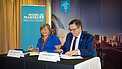 11 February 2020 —ESO signs agreement with UN Women.
- 6 October 2020 —2020 Nobel Prize in Physics awarded for research with ESO telescopes on Milky Way's supermassive black hole.
 4 December 2020 —Funding boost for ESO’s Extremely Large Telescope.
 1 February 2021 —CRIRES+ sees first light.
 27 April 2021 —Test-Bed Telescope 2: New telescope at ESO’s La Silla joins effort to protect Earth from risky asteroids.
 6 July 2021 —First light for CONCERTO.
 1 October 2021 —ALMA celebrates 10 years of science.
 29 October 2021 —20 years of the VLTI.
 12 November 2021 —ESO adopts new measures to improve its environmental sustainability.
 15 December 2021 —ESO and Chile sign agreement to foster scientific and technological cooperation on the ELT.
 10 February 2022 —ESO and Australia strengthen their strategic partnership.
 12 May 2022 —First image of the black hole at the heart of our galaxy.
 27 June 2022 —A new planet hunter awakens: NIRPS instrument sees first light.
 5 October 2022 (ESO 60th anniversary) —ESO images a wondrous star factory to mark 60 years of collaboration.
 23 November 2022 —Sharper infrared eyes for the VLT: ERIS sees first light.
 13 March 2023 —ALMA and its Partners Celebrate 10 Years of Groundbreaking Science.
 16 May 2023 —BlackGEM telescopes begin hunt for gravitational-wave sources at ESO's La Silla Observatory.
 25 May 2023 —25 Years of Fantastic Science and Engineering with ESO’s Very Large Telescope.
 11 July 2023 —ESO’s Extremely Large Telescope is now half completed.
 12 October 2023 —ESO and Chile celebrate 60 years of collaboration in astronomy.
 15 November 2023 —ALMA achieves its highest resolution observations.
 18 December 2023 —First segments of the world's largest telescope mirror shipped to Chile.
 14 November 2024 —Expanding Horizons: crowdsourcing to shape the next ESO programme.