


Design elements
Architectural images
The design of the Europa series is based on the “ages and styles” theme of the first series. However, the new banknotes have been modified in order to give them a fresh look and to accommodate a range of new and enhanced security features, which will also make it easy to differentiate between the two series.
An independent banknote designer based in Berlin, Reinhold Gerstetter, was selected to refresh the design of the notes.
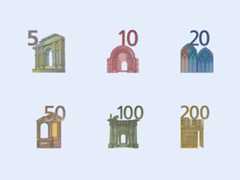
On the front of both series of euro banknotes, windows and doorways are shown. They symbolise the European spirit of openness and cooperation. The bridges on the back symbolise communication between the people of Europe and between Europe and the rest of the world.
Like the first series, the new Europa series banknotes show architectural styles from various periods in Europe's history, but do not show any actual existing monuments or bridges. The styles are as follows:
- €5: Classical
- €10: Romanesque
- €20: Gothic
- €50: Renaissance
- €100: Baroque and rococo
- €200: 19th century iron and glass architecture
Map of Europe
A geographical representation of Europe is shown on the back of both series of euro banknotes. The Europa series has a revised map of Europe, including Malta and Cyprus. The tiny boxes near the bottom of the banknote show the Canary Islands and some overseas territories of France where the euro is also used. Very small islands are not shown on the banknotes because they cannot be accurately reproduced using high-volume offset printing.
Colours
Each note has a quite distinct colour. The Europa series banknotes are the same colour as those of the first series, i.e. grey for €5, red for €10, blue for €20, orange for €50, green for €100 and yellow-brown for €200.
Other design elements are:
- the name of the currency – euro – in both the Latin (EURO) and the Greek (EYPΩ) alphabets for the first series; the Europa series also has the name in the Cyrillic alphabet (EBPO), as a result of Bulgaria joining the EU;
- the initials of the European Central Bank in nine linguistic variants for the new €5, €10 and €20 banknotes and in ten linguistic variants for the new €50, €100, €200 banknotes, taking into account Croatia’s accession to the EU in 2013. The abbreviations are printed according to the EU protocol order for countries and for the official languages.
- BCE (French, Irish, Italian, Portuguese, Romanian, Spanish)
- ECB (Czech, Danish, Dutch, English, Latvian, Lithuanian, Slovak, Slovenian, Swedish)
- ЕЦБ (Bulgarian)
- EZB (German)
- EKP (Estonian, Finnish)
- EKT (Greek)
- ESB (Croatian)
- EKB (Hungarian)
- BĊE (Maltese)
- EBC (Polish)
- the symbol © indicating copyright protection; and
- the EU flag.
As with the first series of banknotes, visually impaired users were consulted during the design phase of the Europa series, which led to the inclusion of specific features in the final designs.
Signatures
Each banknote bears the signature of either Willem F. Duisenberg, Jean-Claude Trichet, Mario Draghi or Christine Lagarde – the first, second, third and fourth Presidents of the European Central Bank respectively. These banknotes are all equally valid.
First series
Europa series
Serial numbers on the Europa series of banknotes
The serial numbers on this series are the two numbers printed on the back of the banknote: a horizontal number printed in black and a vertical number printed in a different colour.
The horizontal number comprises two letters and ten digits. The first letter identifies the printing works – see the list below. The second letter has no particular meaning; it simply makes more serial numbers possible.
Printing works and letters
| Nationale Bank van België/Banque Nationale de Belgique | Z |
| Bank of Greece | Y |
| Giesecke & Devrient GmbH (Munich) | X |
| Giesecke & Devrient GmbH (Leipzig) | W |
| IMBISA | V |
| Banque de France | U |
| Central Bank of Ireland | T |
| Banca d'Italia | S |
| Bundesdruckerei GmbH | R |
| Joh. Enschede Security Printing BV | P |
| Oesterreichische Banknoten und Sicherheitsdruck GmbH | N |
| Valora | M |
| Not assigned | L |
| Not assigned | K |
| De La Rue Currency (Gateshead) | J |
| De La Rue Currency (Loughton) | H |
| Not assigned | G |
| Oberthur Fiduciaire AD (Sofia) | F |
| Oberthur Fiduciaire SAS (Chantepie) | E |
| Polska Wytwórnia Papierów Wartościowych | D |
| Not assigned | C |
| Not assigned | B |
| Not assigned | A |
Country codes on the first series of banknotes
The central bank that commissioned the printing of a banknote (but not necessarily the country of printing) is indicated by a letter or country code preceding the serial number, as shown here:
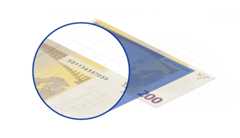
This particular banknote, bearing the letter 'S', was printed for the Banca d'Italia. The country codes are listed below.
Country codes
| ¹ Uncirculated euro banknotes issued by the Banque centrale du Luxembourg bear the code of the central banks of the countries where the banknotes for Luxembourg are produced. | |
| Belgium | Z |
| Germany | X |
| Estonia | D |
| Ireland | T |
| Greece | Y |
| Spain | V |
| France | U |
| Italy | S |
| Cyprus | G |
| Latvia | C |
| Lithuania | B |
| Luxembourg | ¹ |
| Malta | F |
| Netherlands | P |
| Austria | N |
| Portugal | M |
| Slovenia | H |
| Slovakia | E |
| Finland | L |