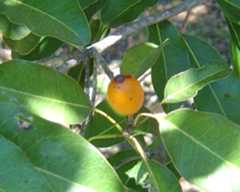
False Mastic. Photo by Trade Wind Fruits
On a chance wander this week in south Florida — Pine Island — we happened upon a False Mastic tree (Sideroxylon foetidissimum, Sy-der-oh ZY Lon fet-uh, DISS ih mum) which means “very bad smelling iron wood.” Downwind from a blossoming tree smells like rotting cadavers or intense cheese (which might help you find it before the blossoms turn in to ripe yellow fruit.
The tasty sweet ripe fruit is eaten in moderation and can be gummy if not acidic. Medicinally the sap was used to treat hernias, and in washing the body. It has triterpenoid saponins which might be responsible for its anti-inflammatory action. Eating the fruit of related species might stick your lips together. Identify carefully.
Mastic is from the Greekmastikon and in subsequent Dead Latinmasyticus, and in English as masticate, to chew. Sap that can be chewed is often also used for glue, coating, and coloring which was how the natives used the false mastic (“false” as it is not the true mastic (Manilkara chicle) from the Nahuati word for latex,tsictli, meaning sticky stuff. The sub-tropical species now has some three dozen common names often using “mastic” or “Jacuma” Some Caribbean examples include in The French Antillesapricot des bois, tree apricot; in Cuba the almendrillo, little almond; almendro silvestre, wild almond; and, almendron flesh almond in Puerto Rico.
Nine Sideroxylons are commonly mentioned as edible, or chewable at least:S. celastrina, S. foetidissimum, S. laetevirens, S. lanuginosa, S. lyciodes, S. reclinatum S. salicifolium, and S. tenax. TheS. tenax is rather rare in the wild but a native landscape plant. One used to grow not 2.5 miles west from me where the land abutted an overpass over Interstate 4. A road crew dutifully took it down and the road since widened. However, I recently spotted one inside a locked cemetery about a mile north of me.
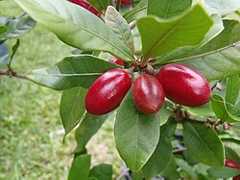
Miracleberry, Miracle fruit
The ninth Sideroxylon,seeSaffron Plum, received a lot attention in the 1970s and has occasional revivials. The red fruitedSideroxylon dulcificumis now called Synsepalum dulcificum. You may not recognize the name but if you eat the berries — the Miracle Berry — for about a half an hour afterwards you cannot taste anything sour. You can eat a lemon after the berries and the lemon will taste sweet. It also counters a metallic taste some experience while undergoing chemotherapy. The ability of the berries to alter taste perception was noted as early as 1725. It was touted as a possible “sweetener” in the 70’s and the role of the sugar industry — if any — in its demise is controversial. Tablets of the berries can be bought over the Internet. How they work is not known but one theory is that it temporarily alters the physical shape of the taste receptors on the tongue.
Green Deane’s “Itemized” Plant Profile
Identification: A fast-growing evergreen tree with a dense, irregular crown, generally growing around 45 feet tall, occasionally up to 100 feet. Wind resistant. The yellow fruit is ellipsoid, about an inch long and three-quarters of an inch wide, containing a single large seed, grows along branches. The trunk and bark can have warty looking growths and the bark flakey.Leaves yellowish green to dark green, shiny, elliptical to oblong. The toothless leaves can be wavy and cluster toward the end of branches.
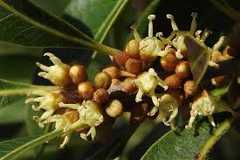
False Mastic Blossom. Photo by Levy Preserve.org
Time of year: Dense yellow flowers in early summer, fruit ripens in winter or spring. (I snacked on mine in early January.)
Environment: Sandy or rock lime, tolerates some salty wind but not brackish water. Can tolerate moist to long dry conditions once established. Full sun, prefers elevation under 2000 feet. Common to Central America – Belize, Guatemala to southern Mexico; in the Caribbean – Trinidad to Cuba, and the Bahamas; Southeast North America particularly Florida.
Method of preparation: Ripe fruit out of hand. The durable wood was used by the native for mortars, pestles, food paddles and war tools. Settlers later use it in cabinets and boats.