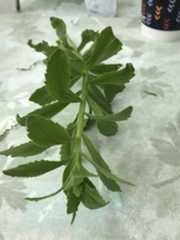
Sedum with mild flavored leaves. Photo by Green Deane
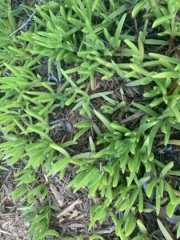
Edible Ice Plant,Carpobrotus edulis, is a common ornamental and popular on the Greek Island of Santorini. Photo by Green Deane
Confessions of forager: In a general sense I have known for many years that “Stonecrops” were edible. I avoided them as they were usually associated by writers with cactus (In that they grow well where it is warm and dry and rocky. Where I live it is hot, wet and no rocks.) So I ignored “stonecrops” for decades except for two: a distant edible relative I stumble across in Florida, Ice Plant, Carpobrotus edulis, and Sedum ternatum (now (Hylotelephium telephium.)which I played with as a kid in Maine.
I grew up on a dirt road out in the country, five miles west of the famous L.L.Bean store in Freeport Maine. Of course back then it was a relatively small store over the post office. Now it’s the entire town. My grandfather printed catalogues for L.L. himself and invented their one-wheel deer carrier.
Down the road from our house in Pownal was a seasonal pond with alder trees and pollywogs and what we called Frog Bellies growing right beside the road. It wasHylotelephium telephium. As kids we didn’t know what it was but we would suck on the leaves. The upper layer of the leaf would separate and balloon up, filled with air which to a kid looked close enough to a frog’s puffy belly. There are between 400 and 475 different species of Sedum. Several species of stonecrop have a history of edibility, the genus is native to Europe, Northern Africa and Asia where varieties grow in rock crevices, on ravine edges and in scrubby areas. It’s among the few plants that can survive in the very-common rocky Greek landscape.
Among the edibles are:Sedum, sarmentosum (which is high in vitamin C) S. roseum, S. rhodanthum, S. reflexum, S. telephium var. purpureum, and S. acre. Roots of Sedum roseum are eaten after being cooked. The roots of S. roseum are also a common supplement sold under the name Rhodiola rosea. The roots of S. telephium var. purpureum have also been eaten. Sedum telephium var telephium is a cultivated salad plant in Europe, the leaves are used. S. acre has pungent leaves and is used as a condiment. Native Americans used S. divergens, and S. laxum for food, the latter rolled with salt grass. The red tops of Sedum integriforlim ssp. integrifolium were used to make a tea, or the leaves eaten fresh or with fat, the root was also eaten. S. rosea (The rhodiola) was eaten fresh, cooked or fermented. Roots eaten with fat or fermented. Interestingly kalanchoe is in the wider stonecrop group though I have never heard of any of them being edible. Avoid Sedum alfredii which is known to accumulate cadmium.
Contemporary references say Sedum means “House Leek” in Dead Latin. Merritt Fernald, the Big Botanical Man at Harvard from 1900 to 1950, author of Gray’s Manual of Botany 1950 (the year he died) says the: “Name [is] fromsedire, to sit, alluding to the manner in which many species affix themselves to rocks or walls.Hylo is the Greek word meaning forest or woodland. The genus honorsTelephus, King of Mysia, who was the son of Hercules.
Green Dean’s Itemized Plant Profile
IDENTIFICATION: Sedum acre, tuberous-rooted, carpet-forming, evergreen succulent to 3” tall spreads moss-like along the ground to often making an impressive ground cover. Plants are thickly clothed with blunt, conical, pale green leaves. Leaves overlap in shingle-like fashion. Small, terminal clusters of tiny, star-shaped, five-petaled, yellow flowers to half an inch blooms most of the summer.
TIME OF YEAR: warm weather, most like it sunny and dry
ENVIRONMENT: Sunny locations, Varies. Some like to cling to rock faces and well-drained gravely soil others like lawns. Like Ice Plant a good plant to cultivate near the sea. Can tolerate some shade, rarely needs to be watered
METHOD OF PREPARATION: Varies with species, some just the young and tender leaves, others the entire plant, often roots are eaten with fat. Or dried and powdered and use for tea. The sap of S acre, can irritate the skin of some people and the leaves, eaten in quantity, can cause stomach upsets.