Movatterモバイル変換


[0]ホーム

URL:


Buy Walt Disney Treasures: Mickey Mouse in Living Color from Amazon.com

Disc One opens with a short introduction from Leonard Maltin, in which he greets us from the corner of Mickey Avenue and Dopey Drive at the Walt Disney Studios and gives us a brief outline of the history of Mickey Mouse and the shorts on the set that established him as an icon.

From the main menu on Disc One, you are presented with a Play All feature, which provides the shorts in chronological order, or you can select either of the two years 1935 or 1936 to individually choose a short.

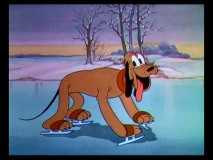
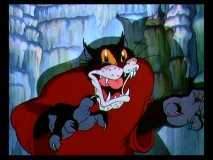
Mickey is about to become lunch in "Mickey's Garden."Pluto takes to the ice in "On Ice."Pluto has to pay for chasing cats in one of the set's more stunning shorts, "Pluto's Judgement Day."

The Band Concert (1935) (9:17)
In his first Technicolor short, Mickey conducts an orchestra full of familiar faces who each have their own unique methods of playing their instruments. Hot dog seller Donald Duck arrives on the scene and wastes no time in frustrating Mickey, by trying to join in with a seemingly endless supply of flutes. Things don’t improve when the band finds itself swept up by a tornado.

Mickey’s Garden (1935) (8:47)
With his garden full of insects devouring everything in sight, Mickey resorts to bug poison to rid himself of the pests. When he accidentally sprays himself with the poison, he finds everything around him suddenly growing, and soon both he and Pluto are smaller than the mushrooms. With the bugs now towering above them, they decide to take revenge.

On Ice (1935) (8:07)
A frozen lake is the setting for this ensemble short. While Mickey is set upon dazzling Minnie with his skating ability, Goofy tries his hand at ice fishing, naturally with his own unorthodox method. Elsewhere, Donald finds fun in putting ice skates on Pluto’s feet and watching the dog struggle across the ice, but he soon gets his comeuppance when a gust of wind blows him up into the air like a kite, over an icy waterfall.

Pluto’s Judgement Day (1935) (8:14)
Mickey gives Pluto a stern warning that if he continues to chase cats, he’ll have plenty to answer for on his judgment day. As Mickey bathes a kitten that he has rescued from Pluto, Pluto is lured from the house by the spirit of a cat and into a cave shaped like a cat’s head which bears a certain resemblance to the Cave of Wonders from 1992’sAladdin. Once inside, the cave snaps its mouth shut and trapped inside Pluto is clapped in irons and put on trial by the felines for crimes he has committed against cats. This is one of the more stunning shorts of the disc, in terms of both story and animation.

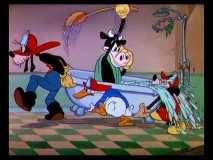
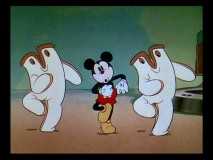
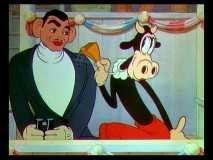
Clarabelle Cow takes offense at being rescued in "Mickey's Fire Brigade.""Thru the Mirror" gives Mickey the chance to show us his moves.Donald has a mishap in "Mickey's Circus."

Mickey’s Fire Brigade (1935) (7:44)
Firefighters Mickey, Donald, and Goofy come to the rescue of a burning building. As expected, things don’t go smoothly; Mickey has troubles with the fire hose and the ladder, while Donald struggles to put out flames that are more keen on playing "Who’s Afraid of the Big Bad Wolf?" on the piano. Meanwhile, Goofy tries to rescue the furniture but only succeeds in ensuring it is all destroyed. When they discover Clarabelle Cow taking a bath blissfully unaware that the building is on fire, they try to rescue her, only she mistakenly believes she is being kidnapped and does her best to hinder the rescue.

Thru the Mirror (1936) (8:50)
This is an adaptation of Lewis Carroll’s follow-up Alice novelThrough the Looking Glass with Mickey in the lead role. After falling asleep reading, Mickey arises from his own body and steps through his bedroom mirror to an alternate land where usually inanimate objects are alive. Eating a walmut causes Mickey to shrink to a size which enables him to dance with two gloves and a pack of cards. When he begins to dance with the Queen of Hearts, however, the jealous King of Hearts takes action.

Mickey’s Circus (1936) (8:06)
Ringmaster Mickey begins by introducing Donald and his performing seals to an audience of orphans. Whilst Donald struggles to gets a seal to play the horns, a baby seal provides further annoyance by trying to eat all of Donald’s fish. When the seals trap both Mickey and Donald in the cannon, both are fired into the air and land on a high wire.

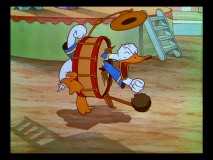
Pluto plots revenge in "Mickey's Elephant."Clara Cluck, Donald, and Pluto bring the house down in "Mickey's Grand Opera."They should be watching the game, but Clarabelle Cow instead makes a move on Clark Gable in "Mickey's Polo Team."

Mickey’s Elephant (1936) (8:37)
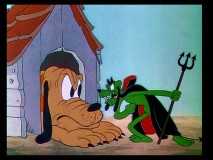
The Rajah of Ghaboon sends Bobo the elephant to Mickey as a playmate for Pluto. While Mickey tries to build an elephant house, Bobo's ball-playing leads him to Pluto. Though the dog is less than impressed, Bobo takes a liking to Pluto. When a green devil pops out of his head, Pluto convinces himself he is being replaced and sets about trying to make Bobo sneeze with some pepper.

Mickey’s Grand Opera (1936) (7:39)
As the audience fills the Opera House, Pluto knocks open a magician’s trunk backstage. Needless to say, trouble ensues as Pluto struggles with the tricks which have escaped. Meanwhile, conductor Mickey gets the show going, Clara Cluck takes to the balcony with her own unique style of opera singing and soon Donald appears to serenade her. As Pluto makes his way onto the stage, the tricks are unleashed and Mickey’s Grand Opera quite literally brings the house down.

Mickey’s Polo Team (1936) (8:48)
In this, the most star-studded polo match you’re ever likely to see, Mickey, Donald, Goofy (still credited here as "The Goof") and The Big Bad Wolf take on Laurel and Hardy, Harpo Marx and Charlie Chaplin. Before the game beginsm the two teams parade before the celebrity audience (which features such faces as The Three Little Pigs, Shirley Temple and Max Hare, to name but a few). As referee Jack Holt starts the match, the players all struggle to play the game due to the many slapstick hindrances, while in the audience, Clarabelle Cow makes goo-goo eyes at Clark Gable. One may note that both Donald and Goofy appear to have taken a step back the evolution of their design, the reason being that the cartoon was originally produced in early 1935, but was delayed after intended star Will Rogers died in a plane crash and had to be replaced with Charlie Chaplin.

Pluto and friend have a bit too much to drink in "Alpine Climbers."When Mickey, Donald, and Goofy fail to pay the rent, Sheriff Pete arrives to dispossess in "Moving Day."Mickey's all tied up in "Orphans' Picnic."

Alpine Climbers (1936) (9:35)
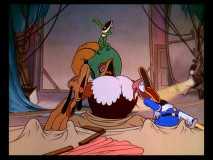
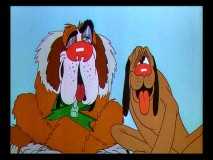
Mickey, Donald and Pluto are climbing in the Alps. Donald contentedly picks Edelweiss until he runs into a baby goat that succeeds in eating the flowers Donald has gathered. Spying an eagle's nest, Mickey tries to poach the eggs, until the mother eagle spots him. When the eggs begin to hatch, he has more trouble than he can handle. Pluto becomes frozen in the snow, but a St. Bernard turns up to save the day.

Moving Day (1936) (9:24)
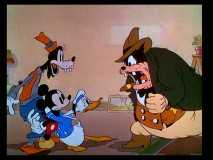
With the rent six months overdue, Mickey and Donald anxiously pace the living room when Sheriff Pete arrives with a notice to dispossess. As Goofy arrives at the back door with his ice truck, the three friends set about trying to pack their belongings and vamoose before Pete returns to sell them. As Mickey and Donald struggle to pack, Goofy has trouble loading a piano onto his truck.

Mickey’s Rival (1936) (8:19)
A picnic in the country for sweethearts Mickey and Minnie goes awry when Minnie’s old sweetheart Mortimer Mouse arrives on the scene. With a fast car and a fast mouth, he wastes no time in charming Minnie and making a fool out of Mickey. As Mickey’s temper builds, Mortimer shows off to Minnie by infuriating a bull in a nearby field. But when Mortimer discovers the gate is open, he disappears in a flash, leaving Mickey and Minnie to deal with charging bull. An interesting note to this cartoon is that Mortimer is the name Walt originally wanted to call Mickey. It's also no coincidence that Mortimer bears a striking resemblance to Walt.

Orphans’ Picnic (1936) (7:58)
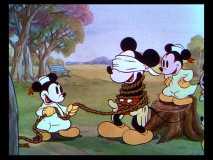
Loaded into the back of a truck, a group of orphans is taken for a picnic by Mickey and Donald. Naturally, the orphans’ angelic faces conceal their mischievous intentions and as Donald sets out the picnic, they try to steal the food when he’s not looking. They also blindfold Mickey for a game of hide and seek, during which it becomes clear that the concept of fair play is foreign to the orphans. Matters are only made worse when Donald upsets a hive of bees.
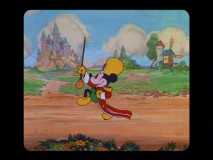
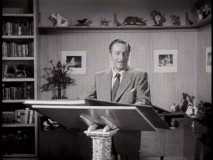
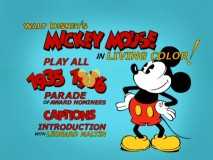
Mickey leads the "Parade of Award Nominees."In an Easter Egg, Walt looks at Mickey's evolution in a clip from the first-ever anthology episode, "The Disneyland Story."Disc One's simple Main Menu.

Parade of the Award Nominees (with introduction by Leonard Maltin) (3:25)
In truth, this is Mickey’s first color appearance, even though this 1932 short film was never commercially released. Mickey and company lead a parade of movie stars nominated for that year's Oscars. The actors seen in the parade are Wallace Beery, Jackie Coogan, Alfred Lunt, Lynn Fontaine, Helen Hayes, Frederic March and Marie Dressler.
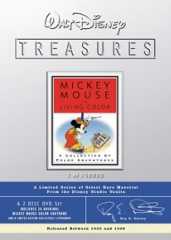
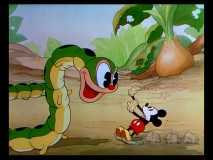
Originally shown at the 1932 Academy Awards Banquet, it was never intended to be seen by the general public. Pluto appears gray here, having only appeared in black and white up to that point his yellow coloring had obviously not been decided on at this stage. The majority of animation and the background are recycled from the 1931 Silly SymphonyMother Goose Melodies.

Also included on this disc are three complete cartoons at the pencil test stage. Before the time-consuming and expensive process of inking and painting were done, animators’ drawings were put together just as they would be in the final product, in order to check the quality of the short and, if necessary, make changes. As Leonard Maltin explains, these three pencil tests exist only because the renowned Disney director Ben Sharpsteen kept them safe in his garage and his family donated them back to the studio. The three shorts presented in this stage areMickey’s Fire Brigade,Pluto’s Judgement Day andOn Ice. Their inclusion makes for a fascinating insight into the production of an animated film during the 1930s, especially since it’s safe to say that the whereabouts of most of the animators’ pencil drawings are sadly no longer known. The angle feature can be used to switch between the pencil test and the final fully-animated cartoon.

On Disc One’s main menu, by selecting Mickey’s head, you will be presented with an excerpt from Walt's very first anthology episode, 1954's "The Disneyland Story." The clip, which runs 2:37, features Walt with his scrapbook, discussing Mickey’s evolution, as he reminds us that “It all started with a Mouse.”

The menus are simple but pleasant enough, featuring still images taken from the theatrical posters and music from the various shorts.

Buy from Amazon.com MarketplaceBuy from Amazon.com


ONTO PAGE TWO

Review posted September 23, 2006.


[8]ページ先頭

©2009-2026 Movatter.jp