The Criterion Collection
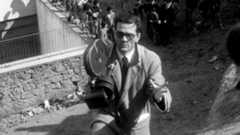
“I love life so fiercely, so desperately, that nothing good can come of it,” Pier Paolo Pasolini declared in 1960, just before he embarked on a career as a film director. In that characteristic union of euphoria and fatalism, one hears the contrarian voice of the most courageous and dangerous Italian artist of his generation. A heretic till the end—risking the calumny, harassment, fines, prospect of imprisonment, and death threats that afflicted his final decades, culminating in his violent demise in 1975—Pasolini stated on the last day of his life: “The saints, the hermits, the intellectuals . . . the ones that shaped history, are the people who said no. This refusal should not be small or sensible but large and total.” That final credo is amply evident in each of the features Pasolini produced over the decade of the sixties—a period of daunting and prolific accomplishment—which exalt the life he loved so fiercely by refusing, largely if not totally, the prevailing culture of postwar Italy.
Polymath proves an inadequate term to describe the prodigious Pasolini, who gained fame in Italy first as a poet, having begun writing verse as early as the age of seven, and eventually as a critic, linguist, journalist, painter, novelist, playwright, essayist, and scriptwriter, before achieving international prominence as a film director. Pasolini’s early recognition that power inheres in language, and that Indigenous and demotic speech are the truest repositories of authentic culture, motivated him to write poetry in the Friulian dialect, which he learned “as a sort of mysterious act of love,” and which allied him with his sainted mother, Susanna, a schoolteacher born in Friuli. Mother and son both grieved the death of his teenage brother, Guido, who had joined the antifascist partisans and was killed in an ambush by soldiers affiliated with the Communist Yugoslav revolutionary Josip Broz Tito. And together the two fled the tyrannical household of patriarch Carlo Alberto Pasolini, an alcoholic military officer adamantly enamored of the Fascist army, when Pasolini was in his late twenties—“like in a novel,” he would later recall. Susanna lived with her beloved son until his death.
Born in Bologna in 1922—he depicts his infancy as a maternal paradise in the rhapsodic prelude of his autobiographicalOedipus Rex(1967)—Pasolini spent much of his youth in Casarsa della Delizia, in the northern region of Friuli, whose “blue rivers and transparent millstreams” and swarms of fireflies he would memorialize in an essay just months before his death. Like Ettore inMamma Roma (1962), who cries out on his prison deathbed that he wants only to return to the village where he grew up, Pasolini always longed for the innocence and belonging that he associated with his arcadian origins—an aching of what he called his “elegiac heart . . . My life possesses nothing else.” Pasolini’s yearning for a prelapsarian past, which would eventually lead him in his search for the unsullied to what was then known as “the Third World,” was accompanied by an increasing revulsion at the transformation of Italy during its postwar economic miracle (il boom), evident in the scalding satire of The Hawks and the Sparrows (1966) and the pessimistic coda ofOedipus Rex, intensified in the dire portraits of patriarch industrialists inTeorema (1968) andPorcile (1969)—and reaching its most extreme expression in the terminal vision of his final film,Salò, or The 120 Days of Sodom (1976).

After the war, the country had rapidly transformed from an agrarian to a modern industrial society, ripe for the incursion of consumer capitalism. Decrying its effects like a latter-day Girolamo Savonarola, Pasolini condemned what he called “homologation,” the standardization of culture that flattened or denatured distinctive local speech and customs. Across all of his pursuits, he searched out and celebrated provincial idioms and urban argot (including Romanaccio, or “ugly Roman”), expression that resisted an imposed lexicon,la lingua dei padroni—the language of the masters. Given this passion for authenticity, it was inevitable that, when Pasolini initially turned to filmmaking, he was inspired by neorealist cinema and its emphasis on nonprofessional actors, even as he rejected what he saw as the naivete of that tradition. Pasolini sought among the rough denizens of Rome’s peripheral slums—theborgate—faces and bodies that would invest his films with a pure, obdurate corporeality that “the consumer revolution” (as he called it) was rapidly rendering extinct, completing an acculturation that the Fascists attempted but could not achieve themselves. Here and elsewhere, Pasolini followed the ideas of one of his heroes, Marxist philosopher Antonio Gramsci, who was imprisoned by the Fascists for years and died mere days after the expiration of his sentence, leaving his notebooks as a testament. Pasolini, who elegized the revolutionary in a celebrated 1954 poem called “The Ashes of Gramsci” and frequently quoted him, nevertheless rejected the maestro’s belief that popular literature—adventure stories, detective novels, feuilletons, melodramas—constituted an important conduit for the creation of a new class consciousness. For Pasolini, mass culture, whose nadir was television, was just another noxious facet of the consumerism that was overwhelming the native traditions he revered.
In his allegiances to Marx, Freud, and (occasionally) Jesus Christ, Pasolini transcended dogma and resisted affiliations, his divided self reflecting the fissures in postwar Italian culture. Born the year that Mussolini seized power in Rome, Pasolini was a Fascist sympathizer in his youth and even attended a gathering in Nazi Germany when he was a teenager, but moved ever leftward as he matured. Expelled from the Italian Communist Party after being convicted on a morals charge in his twenties, he remained an ardent defender of the party despite its frequent criticism of his novels and films for their fatalism, sexual explicitness, and rejection of socialist-realist strictures. The right pursued Pasolini relentlessly in the press and in person for being both a Communist and a homosexual. The premieres of his early films invariably turned into scuffles and melees, as neofascist agitators hurled liquids at the screen, set off stink bombs, or attacked attendees. The rightist press and the prevailing Christian Democratic Party, which Pasolini denounced as a form of “clerico-fascism,” exploited the case of a young gas-station attendant who accused Pasolini—who was at the time writing the script forMamma Roma—of holding him hostage with a black pistol that contained a single golden bullet, and of trying to steal some money from a cash register, foiled only when the young man slashed the director’s hand with a knife. Though the police found no evidence—no gun, no golden bullet, no knife wound—the case proceeded to trial, the press piled on, and Pasolini was forced to undergo a psychiatric examination that concluded he was “a socially dangerous person.” He was that, but only as a scourge and a truth teller.

Pasolini had taken up scriptwriting in the midfifties, contributing, sometimes uncredited, to the scenarios for such films as Mario Soldati’sThe River Girl (1954), Federico Fellini’sNights of Cabiria (1957) andLa dolce vita(1960)—“I wrote all the low-life parts,” Pasolini claimed ofCabiria—and Mauro Bolognini’sIl bell’Antonio (1960). But he soon turned to directing out of frustration with the collaborative nature of this work, and from an intensified desire to capture the richness and clamor of the world. He wanted to extend the themes of his poetry and fiction in order to express what one of his longtime friends and supporters, novelist Alberto Moravia, called “a lament for the devastated, disheartened, prostrated homeland, and nostalgia for the rural culture.” Pasolini had by the late fifties been enjoying growing success as a poet in Italy, but, ironically, it was the grim setting in which he and his mother initially lived, in Rome’sborgate,that provided the inspiration for the novels and films that would bring him to a new level of renown. Pasolini set his first two novels,Ragazzi di vita (1955) andUna vita violenta (1959), among the pimps and hustlers of theborgate,as he did his first two films,Accattone (1961) andMamma Roma;the four works constitute a kind of quartet, just as Pasolini’s mythological films of the late sixties,Oedipus Rex andMedea (1969), form a thematic pair. Though the settings of his films varied greatly over the course of that decade, from the violent streets of contemporary Rome to the stark landscapes of ancient Greece, Pasolini’s themes remained constant: the sacred purity of the dispossessed and the inevitability of their destruction. “The road begins and the journey is over,” a line fromThe Hawks and the Sparrows, andMamma Roma’s contention that “the evil you do is like a highway the innocent have to walk down” evoke a cardinal theme of Pasolini’s perambulatory cinema—his characters walk la strada della vita toward certain madness or death.
Pasolini became a cinephile as a young man, luxuriating in the films of René Clair and Jean Renoir at a local film club before the war reached Italy. He was later tutored in cinema by his mentor, the art historian Roberto Longhi, at the University of Bologna. However, as much as Pasolini was inspired by movies such as Carl Theodor Dreyer’sThe Passion of Joan of Arc,his filmic determinants derived more from literature and painting. “My cinematic taste does not have its origins in cinema,” Pasolini stated, “but in the figurative. That which I carry in my head as vision, as a visual field, are the frescoes of Masaccio and Giotto.” He wanted to make films with the freedom and intensity with which he wrote his poetry and novels, “to be author of my own work at every moment,” despite the technically complex and collaborative nature of filmmaking, a desire that correlates with Agnès Varda’s concept ofcinécriture,or cine-writing. (Coincidentally, Varda listedThe Hawks and the Sparrows andTeorema among her fifty favorite films, and also made a short film about Pasolini.)


Under Longhi’s tutelage, Pasolini recognized his penchant for painterly pastiche, which would greatly influence his approach to cinema. Pasolini characterized his use of pastiche with a typically provocative statement: “I work under the sign of contamination.” The termcontamination is often used in philology to describe the conjunction of literary or refined discourse with street language—an intermingling that Pasolini perceived in the work of Dante, his prime exemplar—but the director expanded its meaning to suggest the infiltration of foreign or disparate elements into a work of art. The artist, he suggested, “contaminates” his work by appropriating styles, icons, and ideologies from other periods and works of art, producing not a “random mixture . . . [but] an amalgam with a stylistic unity.” For example,Accattone falls into the tradition of Italian neorealism in its setting (the slums of Rome), its casting of nonprofessionals in central roles, and its concern with the downtrodden. But Pasolini insisted that this tale of a doomed pimp marked the end of neorealism, and his contention is borne out by the film’s many classical influences and allusions, invoked to make sacred the shabby and the abject. Like Roberto Rossellini, Luchino Visconti, and Fellini before him, Pasolini refashioned neorealism to his own ends, planting Lamberto Maggiorani, the lead from Vittorio De Sica’sBicycle Thieves,among the supporting players inMamma Roma as both a salute to that cinematic tradition and a fond farewell to its dominance.
Pasolini’s taste for mannerist painting, particularly that of Jacopo da Pontormo and Rosso Fiorentino—both of whose depictions of the deposition of Christ he recreates as tableaux vivants in the blasphemous short La ricotta (part of the 1963 omnibus film Ro.Go.Pa.G.)—reached its apogee in his appreciation for Caravaggio, whose use of light he had analyzed as an art historian. “In front of this admirable film, one is eventually unable to resist thinking of Caravaggio,” French critic Jean-Louis Bory wrote aboutThe Gospel According to Matthew (1964). It is always impossible to avoid Caravaggio when thinking of Pasolini. The baroque deviser of chiaroscuro and the postmodernist reviser of neorealism each transformed a reigning style for his own purposes, finding new truth in the shadows. Homosexual artists intimately acquainted with the demimonde—ofuna vita violenta,with its brawling proles and prostitutes—Pasolini and Caravaggio combined high and low in their art, the religious, serene, and reverential with the squalid and scurrilous, scandalizing the pious with their street-sullied Madonnas and Maddalenas taken from real life, their begrimed saints, and their luscious, long-haired boys, startling at a lizard bite or capering with a talking crow. (Pasolini’s adorable faun Ninetto Davoli seems a distant heir of Caravaggio’s peasantragazzi.) That both artists dwelled on the apostle Matthew and both died young, on desolate beaches and under circumstances that have been the source of proliferating apocrypha and endless speculation—did Caravaggio collapse from malaria, syphilis, or lead poisoning, or was he assassinated for political reasons? Did a hustler working alone or with others kill Pasolini, or was he a victim of neofascists, or of a conspiracy of Italian political elites?—confirms the artists’ confraternity.

Militant in his apostasy, Pasolini tests the ability of dialectics to resolve contradictions. Prosecuted for insulting the church inLa ricotta—in one of the countless lawsuits and complaints launched against his novels and films by the police, the Vatican, and individual citizens—Pasolini would go on to dedicate the surprisingly reverentThe Gospel According to Matthew to “the dear, familiar memory of John XXIII.” (Raised a Catholic, Pasolini later considered himself an atheist, but one who yearned to be a believer.) With Medea, Pasolini refashioned the myth to elicit sympathy for the woman who kills her two children in vengeance, but he adamantly opposed abortion as a “legalization of homicide.” His documentaryLove Meetings (1964) makes a strong case for the legalization of divorce in Italy, yet Pasolini was firmly against any such measure. His own films frequently adopt radical means, but he vehemently rejected various avant-gardes in music, literature, and film. Addicted to cruising for a certain type of working-class youth—braininess was an especial turnoff—Pasolini had no use for the gay liberation movement, considering his homosexuality a private matter, once calling it “my enemy.” His greatest and most enduring passion was for Davoli, whom he met when Davoli, as a young teen, was watching the shoot ofLa ricotta on the streets of Rome. “Everything about him has a magical air . . . an endless reserve of happiness,” declared Pasolini, who repeatedly cast the actor as an angelic innocent. Davoli devastated the besotted Pasolini when he announced that he planned to marry, sending the director into a severe depression, after which their relationship became increasingly fraught, though they continued to work together.
Marxist champion of outcasts and rebels, Pasolini turned against leftist university students in a notorious poem about the 1968 student revolts, “The Communist Party to Youth!,” siding with the police as sons of the proletariat fighting against the spoiled offspring of the bourgeoisie, “a member of which, whatever he does, is always wrong,” as he claimed elsewhere. (Some critics have read the poem in a more ambiguous fashion.) Pursuing the role of provocateur, Pasolini continued to denounce youth culture in general—an article containing his thoughts on the politics of the student movement was headlined “Dear Students, I Hate You”—mocking the younger generation’s naive belief in sexual freedom and personal autonomy (for Pasolini, merely a new manifestation of capitalism’s habit of turning bodies into commodities), as well as its fashions: “What do the young people of 1968 talk of with their barbaric hair and Edwardian clothes, vaguely militaristic in style?” he asked in a poem included in the book version ofTeorema. (Ironically,Teorema became afilm féticheamong European youths, particularly in France.)

Bernardo Bertolucci, who was Pasolini’s assistant onAccattone—a film that shaped his own first feature,La commare secca—claimed that Pasolini was too much of a loner with a singular style to inspire a cinematic school. Unlike Fellini, whose films tend to elicit imitation, Pasolini has influenced other artists more as a moral exemplar, with his many forms of radical resistance. His legacy is immense, incalculable. A list of auteurs who have paid homage to his cinema runs into the dozens, including Martin Scorsese, Jean-Luc Godard, Catherine Breillat, João Pedro Rodrigues—who salutesThe Hawks and the Sparrows in the coda of 2016’sThe Ornithologist—and, most recently, Alice Diop, with her nod toMedea in 2022’sSaint Omer.Countless artists, playwrights, video makers, choreographers, and designers have invoked Pasolini’s films, most oftenTeorema andSalò,in their works, while risking none of the vilification that he endured.
On this 101st anniversary of Pasolini’s birth, with fascism resurging around the globe and again assuming the seat of power in Italy—as it did in the year he came into the world—and as the censure of critical voices by both the left and the right escalates, Pasolini’s manifold refusals take on new importance and urgency. Contrary to Pasolini’s pessimistic prophecy in 1960, something far better than good did come of his fierce and desperate love of life, even as that passion transformed into a profound alienation from the world in his final years. Like those other heretics he praised on his last day of life, he counted among those who shaped history by repeatedly saying no.


More:Essays

Birth:Love Eternal
Jonathan Glazer’s enigmatic second feature explores the terrors of being desperate for love—and the vulnerability, loneliness, and difficulty in understanding other people that might drive this state.

Kiss of the Spider Woman:Revolutionary Transgressions
A resounding critical and popular success upon its release, Héctor Babenco’s adaptation of a literary masterpiece by Manuel Puig was an unprecedented cinematic fusion of a radical politics of sex with a sexual politics of revolution.

House Party: What’s Understood
Unencumbered by the white gaze, Reginald Hudlin’s groundbreaking feature-film debut is a celebration of a Black community in all its diversity, featuring fully realized characters who exist not as spectacle but as reality.

Martin Scorsese’s World Cinema Project No. 5
Yam daabo:On Idrissa Ouédraogo’s Humanist Cinema
A deft mixture of family epic, romantic melodrama, landscape cinema, and comedy, Burkinabe director Idrissa Ouédraogo’s landmark film balances the universality of its themes with the fierce individuality of its characters.