Movatterモバイル変換


[0]ホーム

URL:


CNN values your feedback

1. How relevant is this ad to you?
2. Did you encounter any technical issues?
Thank You!
Your effort and contribution in providing this feedback is much appreciated.
Close
Ad Feedback

Chinese anger after terracotta warrior’s thumb stolen in US

3 min read
Updated 4:33 AM EST, Tue February 20, 2018
Link Copied!
CNN  — 

Chinese authorities are livid over the theft of a thumb from a 2,000-year-old terracotta warrior on loan to a US museum, calling for the perpetrator to be “severely” punished.

The ancient statue is valued at $4.5 million and considered a “priceless part of China’s cultural heritage.” It was on display at Philadelphia’s Franklin Institute when the vandalism took place.

“We call on the United States to severely punish those who have done [this],” Shaanxi Provincial Cultural Relic Exchange Center’s director told the Beijing Youth Daily, a state-run Chinese newspaper.

The warrior statues date back to 209 B.C., when the Qin Dynasty ruled China. The life-size statues were constructed to guard the tomb of China’s first emperor, Qin Shi Huang.Now a UN world heritage site, they were discovered by a Chinese farmer in 1974 in Shaanxi province, according to the Franklin Institute’s exhibit page.
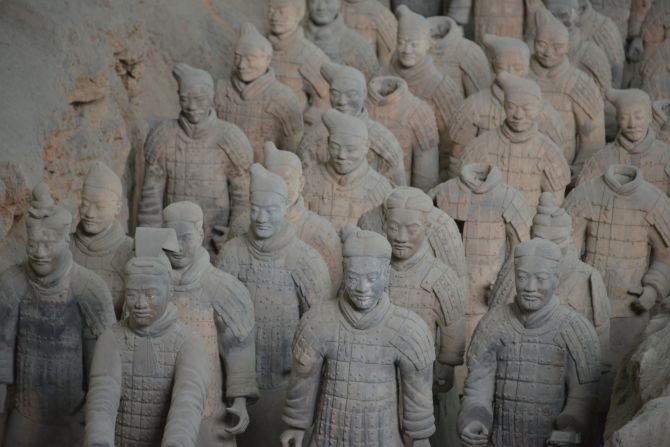
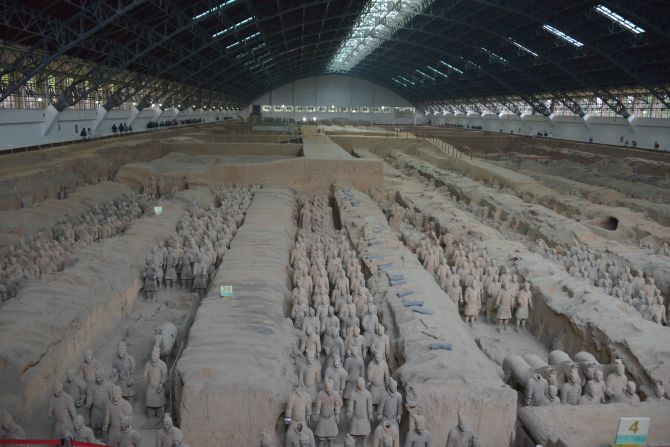
Excavation of the world's largest underground army started after local farmers discovered the first Terra-cotta warrior while digging a well in 1974 in Xi'an, China.
Xi'an's Terra-cotta Army —
Excavation of the world's largest underground army started after local farmers discovered the first Terra-cotta warrior while digging a well in 1974 in Xi'an, China.
Shen Lu/CNN
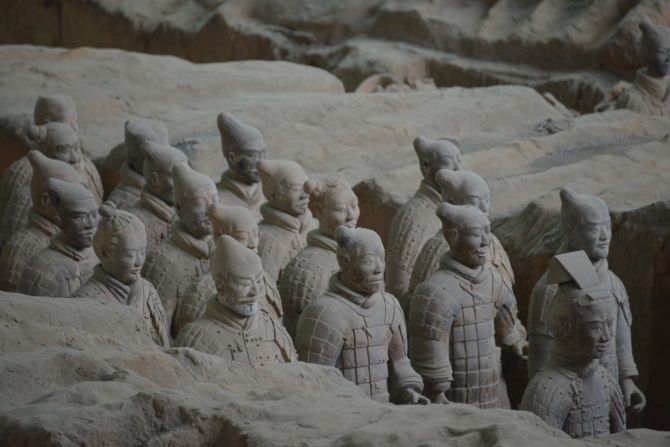
Pit 1 is the largest and most famous excavation site of terra-cotta soldiers. Some 6,000 warriors have been discovered here, but the majority remain unearthed.
Big dig —
Pit 1 is the largest and most famous excavation site of terra-cotta soldiers. Some 6,000 warriors have been discovered here, but the majority remain unearthed.
Shen Lu/CNN
The army is only party of a garrison in the mausoleum of Qin Shi Huang, the ruler who first unified various Chinese states in 221 BC. Experts say the Terra-cotta Army showcases  the high level of craftsmanship in play 2,200 years ago.
Royal work —
The army is only party of a garrison in the mausoleum of Qin Shi Huang, the ruler who first unified various Chinese states in 221 BC. Experts say the Terra-cotta Army showcases the high level of craftsmanship in play 2,200 years ago.
Shen Lu/CNN
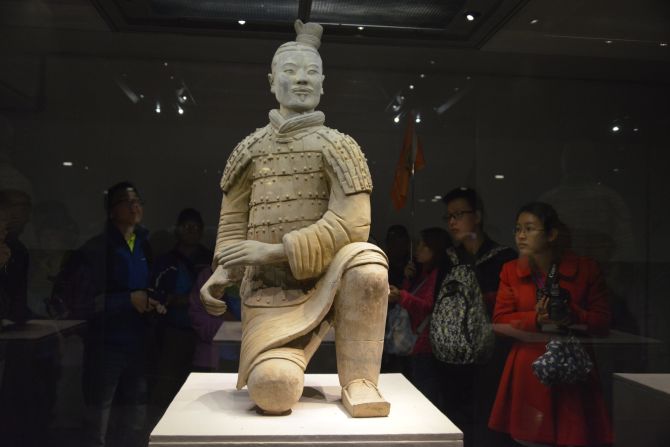
The most famous warrior statue depicts a crossbow soldier. It was excavated from Pit 2 in 1994.
Ancient arms —
The most famous warrior statue depicts a crossbow soldier. It was excavated from Pit 2 in 1994.
Shen Lu/CNN
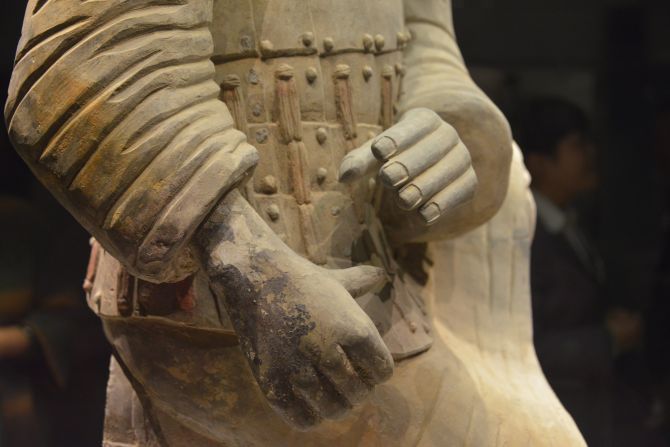
Details were painstakingly sculpted by ancient craftsmen -- even fingernails can be clearly seen.
Exquisite carving —
Details were painstakingly sculpted by ancient craftsmen -- even fingernails can be clearly seen.
Shen Lu/CNN
Pit 3 is the smallest among the three Terracotta Army pits, but it houses the highest-ranked commanders of the army, as well as war chariots.
Prestige pit —
Pit 3 is the smallest among the three Terracotta Army pits, but it houses the highest-ranked commanders of the army, as well as war chariots.
Shen Lu/CNN
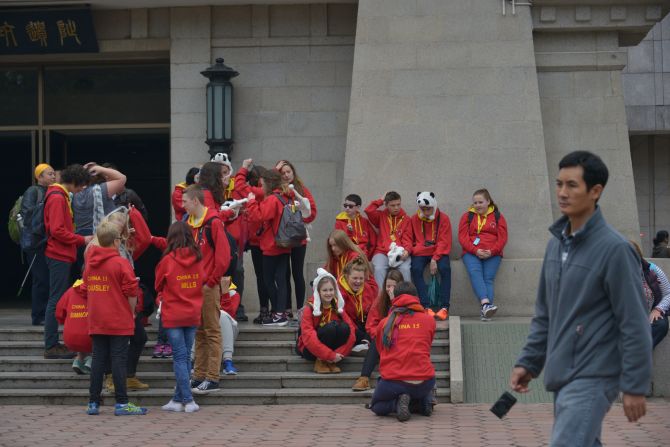
Not everyone has the same reaction to the figure. Fiona Gazzola, a 15-year-old British girl on a school trip, told CNN she found the warriors chilling. "It made me realize how powerful the emperor was, and he was quite selfish," she said. "He built all these warriors for the afterlife just for himself, and it cost a lot of people's lives and a lot of time."
Selfish emperor? —
Not everyone has the same reaction to the figure. Fiona Gazzola, a 15-year-old British girl on a school trip, told CNN she found the warriors chilling. "It made me realize how powerful the emperor was, and he was quite selfish," she said. "He built all these warriors for the afterlife just for himself, and it cost a lot of people's lives and a lot of time."
Shen Lu/CNN
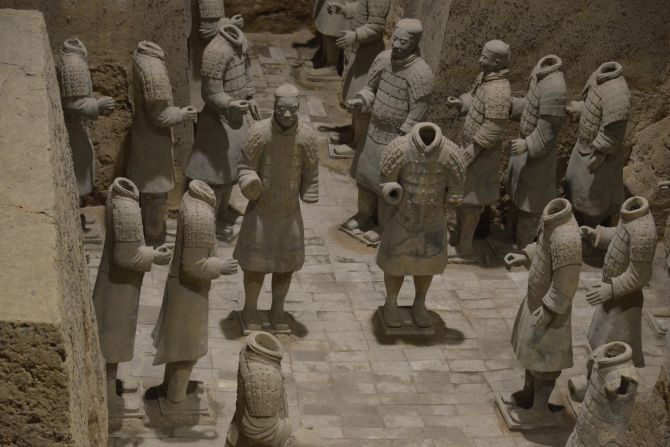
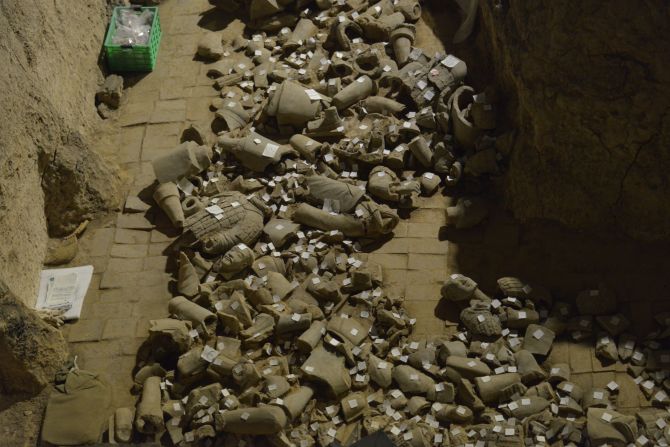
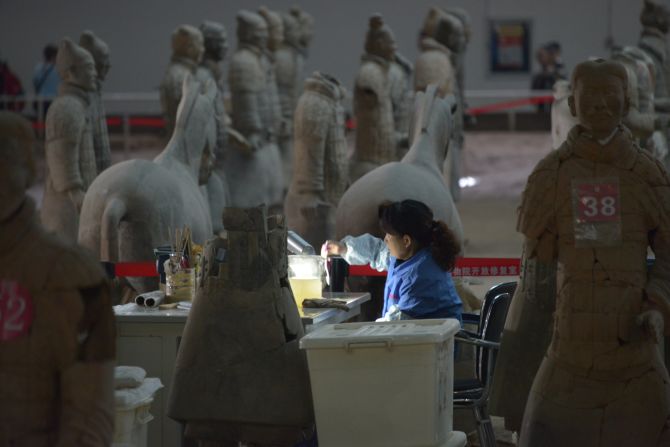
Excavation and restoration of terra-cotta figures is ongoing. In coming years, hundreds of warriors are expected to be restored from pottery pieces dug from the museum's three main pits.
More to come —
Excavation and restoration of terra-cotta figures is ongoing. In coming years, hundreds of warriors are expected to be restored from pottery pieces dug from the museum's three main pits.
Shen Lu/CNN
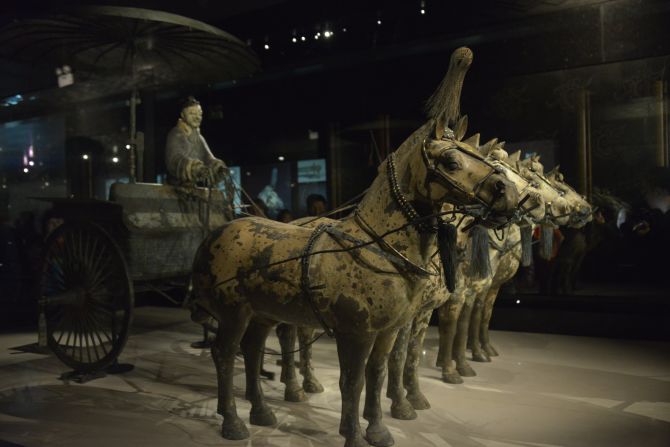
Near the Terra-cotta Army, Chinese archaeologists discovered hundreds of pits with buried funeral treasures. This bronze chariot excavated in 1980 highlights the metallurgical technology in the Qin Dynasty. It's believed it was meant to serve as the emperor's ride into the afterlife.
Not just soldiers —
Near the Terra-cotta Army, Chinese archaeologists discovered hundreds of pits with buried funeral treasures. This bronze chariot excavated in 1980 highlights the metallurgical technology in the Qin Dynasty. It's believed it was meant to serve as the emperor's ride into the afterlife.
Shen Lu/CNN
Each year, millions visit the Terra-cotta Army. It's located in Lintong, 25 miles from the Xi'an city center. The entire area benefits from tourism, which generated 4.6 billion yuan ($720 million) in 2014, according to the local government.
Shen Lu/CNN
China xi'an terracotta army

Delaware-resident Michael Rohana was arrested last week, US officials said, accused of stealing the thumb in December during an ugly sweater party hosted by the museum.

During the event, Rohana and a few of his friends entered the closed off terracotta warrior exhibit, and after his friends left, Rohana took a selfie with one of the statues, according to surveillance footage and court documents.

He then put his hand on the left hand of one of the warriors and snapped something off, the documents said. Rohana pocketed the warrior’s thumb and took it home with him to Delaware that evening.

A museum worker discovered the missing thumb on January 8, and the FBI Art Crime Unit began to investigate. Surveillance video helped lead the FBI to both the thumb and their suspect, Rohana.

One of the people who went to the museum with Rohana told law enforcement officials that on the ride back to Delaware, Rohana was bragging about sneaking into the exhibit and having a thumb from one of the warriors.

FBI says a US man stole the thumb of a 2,200-year-old Chinese terracotta warrior statue being displayed at the Franklin Institutepic.twitter.com/ZwzRrSq8V2

— CGTN (@CGTNOfficial)February 18, 2018

When FBI agent Jacob Archer went to interview Rohana and asked if he had anything “that he wanted to turn over to the FBI,” Rohana handed over the thumb, which was in the desk in his bedroom.

Rohana has been charged with theft of an object of cultural heritage from a museum, concealment of an object of cultural heritage stolen from a museum, and interstate transportation of stolen goods.

He was released on bail on February 13. Rohana did not immediately respond to CNN’s request for comment.

Some Chinese social media users were scathing in their criticism of the museum and the United States for failing to take care of their country’s cultural artifacts.

“The warriors in Xi’an are kept far away from the public. How come the sculptures in Philadelphia are not displayed inside glass cases?” one user on Weibo said.

Others said the vandalism was ironic given the reputation Chinese tourists have gained forbad behavior on vacation. “It seems the Americans are guilty of that too. See how the tables have been turned,” said another Weibo user.

The Shaanxi Provincial Cultural Relic Exchange Center plans to send two experts to the United States to repair the thumb, according to China’s state news agency Xinhua.

Over the past 40 years, the center has organized about 260 exhibits around the world featuring the warriors, and there has never been a situation like this, an official toldXinhua.

Intern Yu Qiaoqiao contributed to this report

Ad Feedback
Ad Feedback
Ad Feedback
Ad Feedback
Ad Feedback
Ad Feedback
Ad Feedback
Ad Feedback

Download the CNN app

Scan the QR code to download the CNN app on Google Play.

Scan the QR code to download the CNN app from Google Play.

Download the CNN app

Scan the QR code to download the CNN app from the Apple Store.

Scan the QR code to download the CNN app from the Apple Store.

[8]ページ先頭

©2009-2026 Movatter.jp