
Killer Whale
Orcinus orca
Killer Whale
Orcinus orca
Orcas are the largest member of the dolphin family and one of the most impressive marine predators. Attitudes toward killer whales have fortunately improved in recent decades. Although the species has long been idolized in many aboriginal maritime cultures, other societies feared, damned and commonly persecuted them.
Physical Description & Behaviour
The orca’s social organization is probably the best described of any cetacean and there is high diversity within this taxon. Evidence from genetic studies shows that orca populations have diverged, primarily as a result of feeding specialization. There are distinct mammal-eating and fish-eating populations. The main division is between “residents” – stable populations strongly associated with coastal habitats, predominantly feeding on fish – and “transients” – highly migratory populations in the high seas, specialized on hunting marine mammals, such as seals and other cetaceans. This differentiation has long been known e.g. for the Pacific coast off Canada. Recently, however, two distinct types of killer whales have also been described the North Atlantic.
Killer whales usually travel in groups of about 50 individuals. Resident societies can be arranged into a number of family groupings called pods based on their maternal genealogy. Highly organized clans of killer whales are known to have their own vocal communication dialects. In recent years orcas have become the focus of many commercial whale-watching operations in several regions.
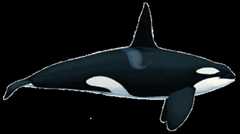
Killer whales are familiar to most people due to their unmistakable black-and-white colour pattern, including a large white eye patch. Adult males can weigh twice as much as females, about 6 tons, and can reach up to 9 meters in length. Males also have proportionally larger flippers, tails and a remarkable tall dorsal fin.
The diet of killer whales comprises an extremely diverse array of prey species. Transients are known to prey on more than 35 marine mammal species, such as mysticetes, odontocetes, pinnipeds and sirenians. Fish-feeding populations prey predominantly on gregarious salmon, herring, cod and tuna. Large numbers of killer whales gather each autumn in the Norwegian Tysk Fjord to prey on spawning herring.
Distribution & Abundance
Killer whales are a truly cosmopolitan species, distributed throughout the world’s oceans and in all climatic zones.
They are common around the northern part of the British Isles, along the Norwegian coast and throughout the eastern North Atlantic. They occasionally enter the North Sea and Skagerrak. The killer whales occurring in the ASCOBANS area are likely to be part of a wider North Atlantic population but their precise relationships are not known and neither is their abundance. Sighting surveys in the eastern north Atlantic (mainly from Iceland to the Faeroes) suggest that a population of between 3,500 and 12,500 individuals is present (Reid et al. 2003).
IUCN Red List of Threatened Species™ Assessment
- DD (data deficient)
Threats
Historically, killer whales have been the target of direct hunts in several regions, e.g. in Japan and Norway. Nowadays, killer whales are known to be in conflict with fisheries as they compete for many commercial fish species. They have been harassed or shot in Alaska and other regions to prevent them from taking fish from long-line fisheries. Since the 1960s, orcas have beencaptured live to be displayed in aquaria all over the world. The improved success of captive breeding in recent decades has reduced the need for live capture from wild populations.
Other conservation concerns include the direct effects of marine pollution (oil spills and toxic pollution). Also, as they are at a high level in the food chain, orcas are susceptible to bioaccumulation. Other potential human-induced impacts include underwater noise, habitat degradation and climate change.
More information on the killer whale can be found at
http://www.cms.int/reports/small_cetaceans/data/o_orca/o_orca.htm.
Gallery

Low
Low