
Reactions at the Benzylic Position
Thebenzylic position is quite reactive and presents a useful synthetic tool for preparing many aromatic compounds.The reason for this reactivity is theresonance stabilization of the benzylic carbon, regardless of whether the reaction goes through an ionic or radical mechanism. We will discuss each of these in the next sections.
Substitution and Elimination Reactions at the Benzylic Position
Going all the way back to thenucleophilic substitution andelimination reactions, we can recall thatbenzylic substrates readily undergoSN1,SN2,E1, andE2 reactions. For theSN2 and E2 mechanisms, it is simply a matter of having astrong base/nucleophile and a non-hindered carbon atom:

On the other hand, the reactivity inunimolecularSN1 and E1 reactions is explained by the resonance-stabilization of the benzylic carbocation formed in the rate-determining step:

Remember that carbocations aresp2-hybridized and theempty p orbital of the positively charged carbon is nicelyaligned with the p orbitals of the aromatic system, which makes the cation resonance-stabilized:

Don’t confuse the benzylic carbocation with thephenyl carbocation. Yes, they are bothsp2 carbons, but unlike the benzylic carbon, the positive charge of the phenyl cation is a result of the empty sp2 orbital, which lies perpendicular to the conjugated aromatic system and cannot beresonance stabilized:

This is the reason, for example, why aryl and vinyl halides do undergoFiedel-Crafts alkylation:

Halogenation of the Benzylic Position
Chlorination and bromination of the benzylic position are achieved whenLewis acid catalysts are not used:

Thebromination can also be done using N-Bromosuccinimide (NBS), like in the allylic bromination:

All the halogenation reactions go by a radical mechanism, and the reactivity of the benzylic carbon is again explained by itsresonance stability. Remember,radicals can also be resonance-stabilized,and that is how benzylic radicals are also quite stable.

Oxidation of the Benzylic Carbon
Strong oxidizing agents such asKMnO4 and Na2Cr2O7oxidize a primary or secondary benzylic carbon to the carboxy group. The only requirement here is tohave at least one hydrogen on the benzylic carbon. Therefore,the oxidation only works for primary and secondary alcohols:

Notice that even for longer alkyl groups,the remaining carbon atoms are cleaved off in the oxidation, and benzoic acids are formed.
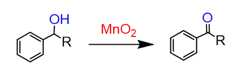
A mild oxidizing agent can be used to oxidize benzylic alcohols to their corresponding ketones under carefully chosen conditions:
Reduction of the Benzylic Carbon
Aryl ketones prepared by theFriedel-Crafts acylation can bereduced to alkyl benzenes by the Clemenson or Wolff-Kishner reactions:

The mechanism and more details of these reactions are covered inthis article.
Notice also that other ketones are reduced to alcohols, and only aryl ketones can be reduced to a methylene group by catalytic hydrogenation (H2 + Pt or Pd/C):

Reduction of the Nitro Group
Even though this is not a reaction at the benzylic position, I’d still like to add here the reduction of the nitro group on a benzene ring:

This reaction is important sincethere is no direct way of converting benzene intoaniline, which is an essential precursor in the preparation of many aromatic compounds.
It is also used to preparearenediazonium salts, which are again a great source for performing aromatic transformations.

The Effect of the -COOH Group in EAS Reactions
Thebenzylic oxidation is a great way to prepare substituted benzoic acids since thecarboxy group cannot be added directly by electrophilic aromatic substitution.
Once again, preparation of benzoic acids can be achieved through aFriedel-Crafts reaction followed by oxidation:

Another strategy forconverting benzene or its certain derivativesto benzoic acids is the use of theGrignard reaction between phenylmagnesium halides and carbon dioxide. We can firsthalogenate the aromatic ring, add the Mg in dry conditions, and finally react it with carbon dioxide.”

Going back to the method ofalkylating benzene, then oxidizing the benzylic position, we should also emphasize theadvantage of this method becausealkyl groups areortho,para–directing, while thecarboxyl group is adeactivator and ametadirector.

This allows us tosynthesize some benzene derivatives that arenot so trivial by the standard order of adding ortho, para-, or meta-directors
For example,how could you preparep-Nitrobenzoic acid from benzene?

The problem here is thatboth groups aremeta-directors,so there is no correct order of adding them to the benzene ring to have them inpara orientation:

And this is where the method of oxidizing alkyl benzenes can be very useful. We can first add the methyl group byFriedel-Crafts alkylation, then nitrate the para position of the resultingp-Nitrotoluene, and only then oxidize the CH3 group to obtainp-Nitrobenzoic acid:

Notice that the reverse order would require aFriedel-Crafts alkylation of the nitrobenzene, butFriedel-Crafts reactions do not generally work withdeactivated benzene rings. But evenif we pretend they do, it still gives the undesired meta product:

Ok, since we mentioned it:how do you prepare themeta-Nitrobenzoicacid then?

Since themethylation of nitrobenzene does not work, we need to go the other way, i.e., install thecarboxy group first and then do thenitration, which will occur at the meta position since the carbonyl group is ameta director:

These are related to the synthesis of disubstituted benzenes, and if you need more practice problems on this, you can find them here:
Synthesis of Aromatic Compounds from Benzene
You can also try solving these multistep problems, which include a lot of aromatic chemistry. I will put one here, and you can check the rest on the linked article:
Organic Chemistry Multistep Synthesis Practice Problems

More on Electrophilic Aromatic Substitution
- Electrophilic Aromatic Substitution – The Mechanism
- The Halogenation of Benzene
- The Nitration of Benzene
- The Sulfonation of Benzene
- Friedel-Crafts Alkylation with Practice Problems
- Friedel-Crafts Acylation with Practice Problems
- Vilsmeier-Haack Reaction
- The Alkylation of Benzene by Acylation-Reduction
- Ortho, Para, Meta in EAS with Practice Problems
- Ortho, Para, and Meta in Disubstituted Benzenes
- Why Are HalogensOrtho-,Para– Directors yet Deactivators?
- Is Phenyl an Ortho/Para or Meta Director?
- Limitations of Electrophilic Aromatic Substitution Reactions
- Orientation in Benzene Rings With More Than One Substituent
- Synthesis of Aromatic Compounds From Benzene
- Arenediazonium Salts in Electrophilic Aromatic Substitution
- Benzylic Bromination
- Nucleophilic Aromatic Substitution
- Nucleophilic Aromatic Substitution Practice Problems
- Reactions of Phenols
- Reactions of Aniline
- Meta Substitution on Activated Aromatic Ring
- Electrophilic Aromatic Substitution Practice Problems
- Aromatic Compounds Quiz
- Reactions Map of Aromatic Compounds
