
Radical Halogenation in Organic Synthesis
Importance of radical Halogenation
The source of the large majority of organic materials used for a countless number of applications, which can be plastics, drugs, paints, clothes, electronics and many more is thecrude oil.

We need to have a hydrocarbon chain to start building on it. A great part of the crude oil is the alkanes which, based on the hydrocarbon chain length, make the natural gas, gasoline, diesel, asphalt and etc.
All of that is important, however, hasnothing to do withthe beauty of organic chemistry which gives the ability to design and create new molecules with sophisticated geometries and properties.

The reason for this limitation is that, if you paid attention, in all the chapters where you did some synthesis, you always needed afunctional group. The functional group(s) is what brings the unique properties and reactivity of organic molecules. There is not much you can do from, for example, propane except for burning it like fossil fuel.
One of the few, chemistry-wise meaningful things to do with alkanes is reacting them with halogens. This reaction produces alkyl halides which can be used in many reactions. The simplest would thesubstitution andelimination reactions.
For example, thebromination of propane will selectively produce the2-bromopropane which can then be used as an electrophile in substitution and elimination reactions:

Organic Synthesis and Radical Halogenation
Let’s see how the following molecules can be synthesized from3-methylpentane.
Try to solve the problems before checking the solutions and as a hint, remember that you need to start from a halogenation of the starting alkane.
Show how each molecule can be synthesized from cyclohexane:

a) Seeing two halogens inanti orientation indicates that this is a product ofalkene halogenation. Putting this in a retrosynthetic scheme, we can see that the precursor to theanti-dibromo substrate is the 3-methylpent-2-ene:

Therefore, we need to think about how to prepare this alkene from the starting alkane.

The first step has to be a halogenation and we need to do a bromination since it is the onlyregioselective halogenation. Remember, the Br goes to the more substituted carbon:
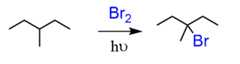
Treating the 3-bromo-3-methylpentane with a strong base will result in anE2 reaction. However, you should pay attention to the regiochemistry and choose between theZaitsev and Hofmann elimination.

In this case, we need the more substituted alkene, so a non-hindered strong base is needed to promote the Zaitsev product:

In the last step, you need to do a bromination of the alkene. Remember, thehalogenation of alkenes goes through the formation of halonium ion followed by the nucleophilic attack from the opposite side of the halogen:

The final product is obtained as a mixture of twoenantiomers since the bromination is not stereoselective.
b) Looking at the starting material and the target product, it is clear that the number of carbons has changed. It is always a good idea to number the carbons so that you can keep track of their number. In this case, we started with five carbons in the main chain and ended up with four in the product. And only three are part of the original main chain:

Another thing to pay attention here is the ketonefunctional group in the product.
To decrease the number of carbon atoms, we need to cleave a C-C bond. What oxidative cleavage reaction have you learned so far? Do you see howozonolysis could be used here?

Remember the shortcut inozonolysis of alkenes, you needto replace the C=C bond with a carbonyl.
The alkene can be synthesized as we discussed in the previous problem.
c) Cis hydroxyl groups next to each other is a hint that this must have come from a double bond again:

We already know how to synthesize the cyclohexene and you need to remember that alkenes allowsyn andanti dihydroxylation. The cis dihydroxylation is achieved using either a cold solution of KMnO4or OsO4.
d) In this product, you need to recognize the heteroatom (any atom except C and H is a heteroatom). You have an oxygen-carbon bond which must have come from a substitution reaction:

The good leaving group bromide allows performing a substitution reaction which must be anSN1 reaction since we have a tertiary substrate.
e) If you have already made a habit of numbering carbons, that is great because you have probably noticed that the product has one carbon less than the starting material.

This means there was C-C bond cleavage. What C-C cleavage reactions do you know?
The ozonolysis is what most likely comes to your mind. And here you need to remember thatozonolysis of alkenes andalkynes gives different products. Namely, alkenes produce aldehydes or ketones, while alkynes produce carboxylic acid and carbon dioxide for a terminal alkyne.
Therefore, the product here is a result of the ozonolysis of a triple bond:

Our aim is now to convert the starting alkane to the alkyne. What do you suggest?

Recall thepreparation of alkynes. You need an alkyl dihalide to react with a strong base such as the sodium amide:

This alkyl dihalide would, in turn, come from the corresponding alkene:

And at this point, the question is how do you go from 3-bromo-3-methylpentane to the terminal alkene?

To choose correctly which alkene you need, go overchanging the position of a double bond andleaving group posts. You need to move the double bond in the desired direction, which means theZaitsev product is needed here:

Next,anti Markovnikov hydrobromination followed by a Hofmann elimination gives the desired alkene:
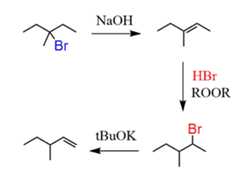
The conversion of the alkene to the corresponding terminal alkyne can be done by chlorination or bromination followed by elimination with NaNH2as we already discussed above.
Overall, this is the synthetic scheme:

f) Comparing the product and starting material, it is evident that the carbon chain had been extended. And if you have numbered the carbon chain, you know that it has increased by two carbons.

How do you extend the carbon chain organic chemistry? Well, there are many ways of doing that but; if you have only covered alkenes and alkynes in your organic class,you should always think aboutalkylation of terminal alkynes whenever the hydrocarbon chain is extended.
Do you see how you could apply the alkyne from the previous question here?
What about reacting with the ethyl group bearing a good leaving group?

This is an example ofSN2 substitution reaction and will form our target internal alkyne.
Let’s now compare the structures of the alkyne and the final product alkene. So, obviously we need to do a reduction of the alkyne and you should also notice that it is acis (or Z in our case) alkene which requires a special reducing agent.
What reagent reduces an alkyne to the corresponding cis alkene?
If you remember theLindlar’s reagent, great job!

And this summarizes the importance ofradical halogenation and some of the strategies used in organic chemistry that I wanted to cover today.

Practice
Use radical halogenation to functionalize the following alkanes and perform efficient syntheses of each compound:


This content is for registered users only.
By joining Chemistry Steps, you will gain instant access to theanswers and solutions for all the Practice Problems, including over 40 hours of problem-solving videos, Multiple-Choice Quizzes, Puzzles, Reaction Maps,and the powerful set ofOrganic Chemistry 1 and 2 Summary Study Guides.
This content is for registered users only.
By joining Chemistry Steps, you will gain instant access to theanswers and solutions for all the Practice Problems, including over 40 hours of problem-solving videos, Multiple-Choice Quizzes, Puzzles, Reaction Maps,and the powerful set ofOrganic Chemistry 1 and 2 Summary Study Guides.
This content is for registered users only.
By joining Chemistry Steps, you will gain instant access to theanswers and solutions for all the Practice Problems, including over 40 hours of problem-solving videos, Multiple-Choice Quizzes, Puzzles, Reaction Maps,and the powerful set ofOrganic Chemistry 1 and 2 Summary Study Guides.
This content is for registered users only.
By joining Chemistry Steps, you will gain instant access to theanswers and solutions for all the Practice Problems, including over 40 hours of problem-solving videos, Multiple-Choice Quizzes, Puzzles, Reaction Maps,and the powerful set ofOrganic Chemistry 1 and 2 Summary Study Guides.
This content is for registered users only.
By joining Chemistry Steps, you will gain instant access to theanswers and solutions for all the Practice Problems, including over 40 hours of problem-solving videos, Multiple-Choice Quizzes, Puzzles, Reaction Maps,and the powerful set ofOrganic Chemistry 1 and 2 Summary Study Guides.
This content is for registered users only.
By joining Chemistry Steps, you will gain instant access to theanswers and solutions for all the Practice Problems, including over 40 hours of problem-solving videos, Multiple-Choice Quizzes, Puzzles, Reaction Maps,and the powerful set ofOrganic Chemistry 1 and 2 Summary Study Guides.
