
Racemic Mixtures
In the previous post, we talked aboutoptical rotation which is caused bychiral compounds when plane-polarized light passes through their samples. An interesting feature about optical rotation was the discovery thatenantiomersrotate the plane-polarized light to anequal extent but in theopposite direction.
For example, thespecific rotation of (R)-2-butanol and (S)-2-butanol are -13.52 o and +13.52o respectively.

So, one question that comes to mind is what happens to the plane of a polarized light when it passes through a mixture containsequal amounts of enantiomers. A mixture containingequal amounts of two enantiomers is called aracemic mixture or a racemate.
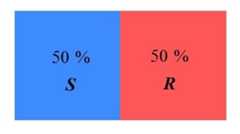
What happens is that as the light passes through the sample, each enantiomer rotates the plane-polarized light to an equal extent but in opposite directions and the overall rotation levels up to zero.In other words, each molecule of one enantiomer cancels the rotation caused by a molecule of other enantiomer and therefore,no net rotation is observed.And thus, we know that racemic mixtures are optically inactiveand therefore they areachiral.
Because each enantiomer rotates the plane of the light clockwise (+) or counterclockwise (-), theracemic mixture of a sample is often labeled as being(±). For example, a racemic mixture of(R)-(−)-2-butanol and(S)-(+)-2-butanol can be designated as (±)-2-butanol.
To highlight the most important peace of information about racemic mixture, remember thatracemic mixtures are optically inactive and therefore they are achiral.
Enantiomeric Excess and Optical Activity
Another possibility for a mixture of enantiomers is when they are present indifferent quantities. In this case, the extent and the direction of the rotation is determined by the enantiomer with the greater amount.
For example, if the mixture contains 60% of the R enantiomer and 40% of the S enantiomer, thedegree and direction will be based on the specific rotation of the R enantiomer because it is in excess. If it is (+), then the rotation is going to be clockwise and if it is an R-(-) enantiomer, then the rotation will be counterclockwise.
The degree of the rotation is calculated by using the excess amount of the enantiomer. It this case, theenantiomeric excess is 60-40=20%. This means that the specific rotation of this sample will 20% of the specific rotation of the R enantiomer.
For example, if the specific rotation of the R enantiomer is +8.40o, then the mixture containing 60%R will have a specific rotation of +8.4o x 0.20 = +1.68o (sorry about the significant figures).
There is more to theenantiomeric excess and its relation to optical activity and we will cover this in thenext article.
Check out this 108-question,Multiple-Choice Quiz with a 3-hour Video Solutioncovering the most important concepts you need to know in Stereochemistry:

Check Also
- How to Determine the R and S Configuration
- The R and S Configuration Practice Problems
- What is Nonsuperimposable in Organic Chemistry
- Chirality and Enantiomers
- Diastereomers-Introduction and Practice Problems
- Enantiomers vs Diastereomers
- Cis and Trans Stereoisomerism in Alkenes
- E and Z Alkene Configuration with Practice Problems
- Enantiomers vs Diastereomers
- Enantiomers, Diastereomers, the Same or Constitutional Isomers with Practice Problems
- Configurational Isomers
- Optical Activity
- Specific Rotation
- Enantiomeric Excess (ee): Percentage of Enantiomers from Specific Rotation with Practice Problems
- Symmetry and Chirality. Meso Compounds
- Fischer Projections with Practice Problems
- R and S Configuration in the Fischer Projection
- R and S configuration on Newman projections
- R and S Configuration of Allenes
- Converting Bond-Line, Newman Projection, and Fischer Projections
- Resolution of Enantiomers: Separate Enantiomers by Converting to Diastereomers
- Stereochemistry Practice Problems
- Stereochemistry Practice Quiz
1 thought on “Racemic Mixtures”
Stereochemistry have been simplified for us students, best presentation like I am having a live lecturer
Reply
