
Preparation of Epoxides – Epoxidation
There are a few main strategies for preparing epoxides, and the good news is that we have seen all of them in earlier chapters. Therefore, this post is a review of reactions leading to epoxidation with additional emphasis on the stereochemistry of these reactions, supported by some practice problems.
Oxidation of Alkenes with Peroxycarboxylic Acids
One of the most common ways of epoxidation is the addition of an oxygen atom to an alkene with peroxycarboxylic acids (sometimes referred to as peroxyacids):

Representative examples of peroxycarboxylic acids areMCPBA (meta-chloroperoxy benzoic acid) or Peroxyacetic acid, which we have seen in theanti-dihadroxylation of alkenes.
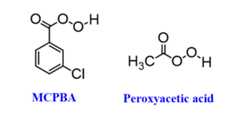
The reason for thepopularity of mCPBAis that, unlike many peroxycarboxylic acids, which need to be prepared right before the reaction by mixing a carboxylic acid and hydrogen peroxide, it isa quite stable crystalline solid and can be purchased commercially.
This does not, however, exclude it from the characteristic of thedanger of detonation if not handled properly.
Now, the fact that peroxides have low stability indicates that they arevery reactive, and this is explained by the presence of theweak O-O bond. This, in the presence of a weak π bond, is a good combination to drive the epoxidation reaction forward.
The mechanism of epoxidation byPeroxycarboxylic Acids
The oxygen in the peroxide is electron-deficient and is attacked by the p electrons of the π bond. At the same time, the lone pair of the oxygen also acts as a nucleophile, attacking one of the carbon atoms of the alkene.

The weakness of the O-O bond makes the bond-cleavage easier, thus acting as a driving force for the epoxidation.
This mechanism is similar to the formation of halonium ion and oxymercuration, which we have also discussed in the other addition reactions of alkenes.
An alternative, short version of the reaction can be drawn when the nucleophilic attack of the peroxide originates from the O-H bond instead of the lone pair of the oxygen.

In any case, one thing is for sure –epoxidation is a concerted mechanism, meaning that all the bonds are formed and broken simultaneously (recall the old and sweetSN2mechanism).
There are two arguments we can bring to support the concerted nature of the mechanism.
First,carbocation rearrangements are not observed, and second, thestereochemistry of the reaction is astereospecificsyn-addition. Let’s look at this in a little more detail.
The Stereochemistry of Epoxidation byPeroxycarboxylic Acids
The epoxidation is a syn addition, and the stereochemistry of the product is determined based on the structure of the alkene.Cis alkenes givecis epoxides, and trans alkenes give trans epoxides.

Remember, when the stereochemistry of the product is dictated by the stereochemistry of the substrate, the reaction is said to bestereospecific, i.e. it has no choice-cis givescis,trans givestrans regardless of their stability.
The epoxide can react with the alkene from both faces; therefore, theoxygen can add to either face of the alkene.
As a result, a mixture of enantiomers is obtained when substituted alkenes react with acid peroxides:

You can selectively produce one of the enantiomers in excess by enantioselective epoxidation, for example, by Sharpless epoxidation, but we will skip this for now, as it is often not needed in an undergraduate course of Organic Chemistry.
As usual, watch for meso compounds, as not every compound with stereogenic centers is going to bechiral. For example, when a symmetricalcis alkene is used, the corresponding meso epoxide is obtained:

Notice that this is the same reaction/product shown a little earlier above.
Epoxides by Cyclization of Halohydrins
Another approach for preparing epoxides is the intramolecularSN2 reaction of halohydrins upon treatment with a strong, non-nucleophilic base such as sodium hydride, NaH.

This is a variation of theWilliamson ether synthesis, and what happens is that the sodium hydride deprotonates the alcohol, converting it into a better nucleophile.

This is an intramolecular SN2 reaction, and the OH and Br must be in atrans configuration in order to accomplish the proper orbital alignment. We can see this better by drawing the chair conformations of the molecule.
Not only must the groups betrans, but they also need to be in anaxial position because there is no good alignment of HOMO and LUMO orbitals for the substitution to occur:

Although the equilibrium is favored for the conformation with the two groups being equatorial, thediaxial conformation quickly undergoes a substitution reaction, thus moving the process forward.
Check also this article on the SN2 and E2 reactions of cycloalkanes, where we discuss the importance of the leaving group being in the axial position.
Check Also
