
Naming Ethers
Ethers are named by both common and systematic nomenclature of the IUPAC rules. The common names are used for ethers with simple alkyl groups. To do this, wefirst identify the alkyl groups and arrange them inalphabetical order, followed by the word“ether”.
For example,

The molecules above are examples ofunsymmetrical ethers, i.e., different alkyl groups are bridged with the oxygen.
If the groups areidentical – symmetrical ethers, theprefix “di” is added. For example,

The Systematic Nomenclature of Ethers
The systematic nomenclature is used for ethers withcomplex substituents. The idea here is to treat one of the alkoxy (alkyl with the oxygen) groups as asubstituentconnected to aparent chain. Theparent chain is determined just like we always do, based on thelongest carbon chain.
For example,

It is important to mention thatalkoxy groups do not rank in thepriority chart of the functional groups. This means that, just like alkyl groups and halides,they are only treated as substituents and therefore, they do not change the suffix of the parent chain.
For example, let’s compare the effects of the OH and OR groups on naming structurally similar compounds:

TheOH group has the highest priority and the parent chain is alteredfrom “ane”to “ol”. TheOR group, on the other hand, has no priority and is added as aprefix in alphabetical order.
Now, considering this, let’s name the following ether with alkyl and halide substituents:
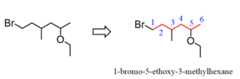
Notice again that theethoxy group has no priority over the methyl and bromide, and they are all added as substituents in alphabetical order.
Check Also
- Preparation of Epoxides
- Ring-Opening Reactions of Epoxides
- Reactions of Epoxides Practice Problems
- The Williamson Ether Synthesis
- Reactions of Ethers-Ether Cleavage
- Nomenclature of Alcohols: Naming Alcohols based on IUPAC Rules with Practice Problems
- Preparation of Alcohols via Substitution or Addition Reactions
- Reaction of Alcohols with HCl, HBr, and HI Acids
- Mesylates and Tosylates as Good Leaving Groups
- SOCl2 and PBr3 for Conversion of Alcohols to Alkyl Halides
- Alcohols in Substitution Reactions Practice Problems
- POCl3 for Dehydration of Alcohols
- Dehydration of Alcohols by E1 and E2 Elimination
- The Oxidation States of Organic Compounds
- LiAlH4 and NaBH4 Carbonyl Reduction Mechanism
- Alcohols from Carbonyl Reductions – Practice Problems
- Grignard Reaction in Preparing Alcohols with Practice Problems
- Grignard Reaction in Organic Synthesis with Practice Problems
- Protecting Groups For Alcohols in Organic Synthesis
- Oxidation of Alcohols: PCC, PDC, CrO3, DMP, Swern, and All of That
- Diols: Nomenclature, Preparation, and Reactions
- NaIO4 Oxidative Cleavage of Diols
- The Pinacol Rearrangement
- The Williamson Ether Synthesis
- Alcohol Reactions Practice Problems
- Naming Thiols and Sulfides
- Reactions of Thiols
- Alcohols Quiz – Naming, Preparation, and Reactions
- Reactions Map of Alcohols
Practice
Name the following ethers according to their IUPAC nomenclature rules:

This content is for registered users only.
By joining Chemistry Steps, you will gain instant access to theanswers and solutions for all the Practice Problems, including over 40 hours of problem-solving videos, Multiple-Choice Quizzes, Puzzles, Reaction Maps,and the powerful set ofOrganic Chemistry 1 and 2 Summary Study Guides.
This content is for registered users only.
By joining Chemistry Steps, you will gain instant access to theanswers and solutions for all the Practice Problems, including over 40 hours of problem-solving videos, Multiple-Choice Quizzes, Puzzles, Reaction Maps,and the powerful set ofOrganic Chemistry 1 and 2 Summary Study Guides.
This content is for registered users only.
By joining Chemistry Steps, you will gain instant access to theanswers and solutions for all the Practice Problems, including over 40 hours of problem-solving videos, Multiple-Choice Quizzes, Puzzles, Reaction Maps,and the powerful set ofOrganic Chemistry 1 and 2 Summary Study Guides.
This content is for registered users only.
By joining Chemistry Steps, you will gain instant access to theanswers and solutions for all the Practice Problems, including over 40 hours of problem-solving videos, Multiple-Choice Quizzes, Puzzles, Reaction Maps,and the powerful set ofOrganic Chemistry 1 and 2 Summary Study Guides.
This content is for registered users only.
By joining Chemistry Steps, you will gain instant access to theanswers and solutions for all the Practice Problems, including over 40 hours of problem-solving videos, Multiple-Choice Quizzes, Puzzles, Reaction Maps,and the powerful set ofOrganic Chemistry 1 and 2 Summary Study Guides.
This content is for registered users only.
By joining Chemistry Steps, you will gain instant access to theanswers and solutions for all the Practice Problems, including over 40 hours of problem-solving videos, Multiple-Choice Quizzes, Puzzles, Reaction Maps,and the powerful set ofOrganic Chemistry 1 and 2 Summary Study Guides.
This content is for registered users only.
By joining Chemistry Steps, you will gain instant access to theanswers and solutions for all the Practice Problems, including over 40 hours of problem-solving videos, Multiple-Choice Quizzes, Puzzles, Reaction Maps,and the powerful set ofOrganic Chemistry 1 and 2 Summary Study Guides.
This content is for registered users only.
By joining Chemistry Steps, you will gain instant access to theanswers and solutions for all the Practice Problems, including over 40 hours of problem-solving videos, Multiple-Choice Quizzes, Puzzles, Reaction Maps,and the powerful set ofOrganic Chemistry 1 and 2 Summary Study Guides.
6 thoughts on “Naming Ethers”
Shouldn’t the third ether be named propyl-tertbutyl ether as per the alphabetical order?
Replywhat if you have a cyclopentene with a propoxy group attached
ReplyThe parent is cyclopentene, which, although does not require a locant to identify the position of the double bond, because it is assumed to be between C1 and C2, you need to make sure the locant for the alkoxy group is assigned correctly. For example, the molecule on the right should not be 2-propoxycyclopentene because in that case the C=C would be between carbons 1 and 5. Other than that, just treat the alkoxy group as an alkyl, or halide – groups that do not takepriorityover alkenes.
Reply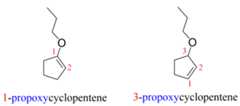
Are positions needed in the common naming of ethers? Or is it just the IUPAC naming?
Reply
