
Fischer Projections
What are the Fischer Projections?
Fischer projections are just another way of drawing compounds contacting chirality centers. They were initially proposed by Emil Fischer for making it easier to draw the structures of compounds containing multiple chirality centers, with themain idea of not having to draw the wedge and dash lines for every single chiral center.This is especially applicable and used mostly for drawing sugars.
How to draw Fischer projections
Suppose you have this compound with onechirality center:

Before getting to drawing its Fischer projection, let’s number the carbons in any order (noIUPAC rules needed). Remember, numbering carbons will always be helpful, no matter what you need to do with an organic structure.

Here is what Fischer suggested:
If you look at the molecule from the top, you will see the following representation where the twogroups on the side are pointing towards you and the ones on the top and the bottom are pointing away from you. We will show the ones on the sides withwedge lines and the others withdashed lines:

There are twowedge and two dash lines, which may look strange to you since we always have one of each, and then the two solid lines, but it is okay-it all depends on the direction we are looking at the molecule.
This, however, is not the Fischer projection yet, since, remember, we said the main idea was to avoid showing wedge and dash lines, yet being able to convey theabsolute configuration of the chirality centers (R,S).
For this, we are going to draw the molecule and simply show all the bonds with plane solid lines,keeping in mind that thehorizontal groups are pointing towards you and the ones on thevertical line are pointing away from you:

So, how do you remember which ones are pointing towards you?
Well, you can remember that Fischer projections like you and they are coming to give you a hug with open arms:

Or, you look at theFischer projection like you are in the gym and need to grab the molecule. In this case, as well, thehorizontal groups have to be pointing towards you.

Determining the absolute configuration (R, S) of Fischer projections
To determine the absolute configuration ofchirality centers in a Fischer projection, we need to follow the same steps as we do for any other representation, such asBond-line orNewman, according to theCahn-Ingold-Prelog rules.
In this molecule, for example, we need to assign the priorities of the groups on the chiral center based on the atomic numbers:
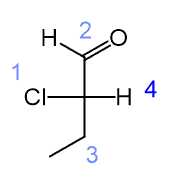
Next, draw the arrow going from priority 1-2-3:
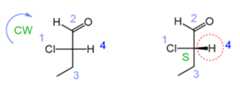
The arrow goes clockwise, which indicatesR configuration. However, this is where you need to remember that thehorizontal groups (Cl and H) are pointing towards you; therefore, the configuration must beswitched fromR toS. This is because one of the rules of the Cahn-Ingold-Prelog system is that thelowest priority must point away from the viewer.
How to draw the enantiomer and a diastereomer of a Fischer projection
Fischer projections make it easy to draw different stereoisomers. As an example, if you are asked to draw the enantiomer of the following molecule with three chiral centers, you can draw an imaginary mirror plane and draw the reflection of the molecule, which is achieved simply by swapping the two groups of a chiral center:

To confirm that these two are enantiomers, assign the absolute configuration of the chirality centers. They are all inverted fromR toS andS toR.
If you need to draw adiastereomer of the molecule, you need to switch only one chilaity center or, alternatively, switch all except one. In other words, the two representations should be non-mirror-image stereoisomers:

Fischer projections are especially useful indrawing carbohydratessince they contain multiple chiral centers, which are more time-consuming to draw.
For example, glucose, one of the most common and important carbohydrates, also used extensively for the initial studies, was found to exist naturally as one enantiomer designated as theD isomer. The enantiomer, L-glucose, can still be prepared synthetically:

What can be done with a Fischer Projection, and what is disallowed?
When redrawing a Fischer projection shown from a different direction, you areallowed to rotate the molecule by 180o, but NOT by 90o.
The reason for this is the fact that the absolute configuration of the chirality centers must be retained since it is the same molecule. This is only possible if the horizontal groups stay horizontal and the vertical groups stay vertical as well:

If you rotate the molecule by 90o, the horizontal groups get in the vertical positions, which in Fischer projections means that they are now pointing away from you. This changes the absolute configuration fromS to R, and therefore, you are showing the enantiomer if the molecule:

This video is a fragment of a 108-question, multiple-choiceStereochemistry quiz and explains therules for drawing Fischer projections in the context of determining the relationship between given compounds. The quiz comes with a 3-hour video solution.

In the following practice problems, you can practice converting Fischer projections to bond-line representation and assigning theR andS absolute configuration of chirality centers on Fischer projections.

Practice
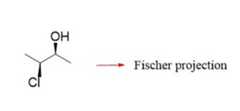
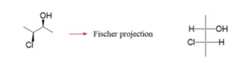
This content is for registered users only.
By joining Chemistry Steps, you will gain instant access to theanswers and solutions for all the Practice Problems, including over 40 hours of problem-solving videos, Multiple-Choice Quizzes, Puzzles, Reaction Maps,and the powerful set ofOrganic Chemistry 1 and 2 Summary Study Guides.
This content is for registered users only.
By joining Chemistry Steps, you will gain instant access to theanswers and solutions for all the Practice Problems, including over 40 hours of problem-solving videos, Multiple-Choice Quizzes, Puzzles, Reaction Maps,and the powerful set ofOrganic Chemistry 1 and 2 Summary Study Guides.
Identify all the chiral centers in eachFischer projection and determine theabsolute configuration asR orS: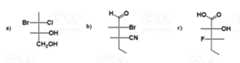
This content is for registered users only.
By joining Chemistry Steps, you will gain instant access to theanswers and solutions for all the Practice Problems, including over 40 hours of problem-solving videos, Multiple-Choice Quizzes, Puzzles, Reaction Maps,and the powerful set ofOrganic Chemistry 1 and 2 Summary Study Guides.
This content is for registered users only.
By joining Chemistry Steps, you will gain instant access to theanswers and solutions for all the Practice Problems, including over 40 hours of problem-solving videos, Multiple-Choice Quizzes, Puzzles, Reaction Maps,and the powerful set ofOrganic Chemistry 1 and 2 Summary Study Guides.
Somemore practice example of the Fischer projection
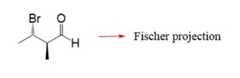
Convert the following Bond-Line, Newman and Fischer projections as indicated below:

The answers can be found under the following article:
Converting Bond-Line, Newman Projection, and Fischer Projections
The following questions are from theStereochemistry Quiz and the video is a fragment of a 3-hour solution.
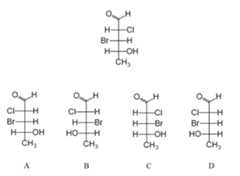
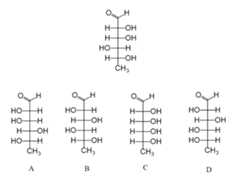
Select the enantiomer for the following compound:
a)

b)
c)
This content is for registered users only.
By joining Chemistry Steps, you will gain instant access to theanswers and solutions for all the Practice Problems, including over 40 hours of problem-solving videos, Multiple-Choice Quizzes, Puzzles, Reaction Maps,and the powerful set ofOrganic Chemistry 1 and 2 Summary Study Guides.
This content is for registered users only.
By joining Chemistry Steps, you will gain instant access to theanswers and solutions for all the Practice Problems, including over 40 hours of problem-solving videos, Multiple-Choice Quizzes, Puzzles, Reaction Maps,and the powerful set ofOrganic Chemistry 1 and 2 Summary Study Guides.
Which of the following is a meso compound?

This content is for registered users only.
By joining Chemistry Steps, you will gain instant access to theanswers and solutions for all the Practice Problems, including over 40 hours of problem-solving videos, Multiple-Choice Quizzes, Puzzles, Reaction Maps,and the powerful set ofOrganic Chemistry 1 and 2 Summary Study Guides.
What is the relationship between these two structures?
a)

b)

This content is for registered users only.
By joining Chemistry Steps, you will gain instant access to theanswers and solutions for all the Practice Problems, including over 40 hours of problem-solving videos, Multiple-Choice Quizzes, Puzzles, Reaction Maps,and the powerful set ofOrganic Chemistry 1 and 2 Summary Study Guides.
Check Also
- How to Determine the R and S Configuration
- The R and S Configuration Practice Problems
- What is Nonsuperimposable in Organic Chemistry
- Chirality and Enantiomers
- Diastereomers-Introduction and Practice Problems
- Cis and Trans Stereoisomerism in Alkenes
- E and Z Alkene Configuration with Practice Problems
- Enantiomers vs Diastereomers
- Enantiomers Diastereomers the Same or Constitutional Isomers with Practice Problems
- Configurational Isomers
- Optical Activity
- Specific Rotation
- Racemic Mixtures
- Enantiomeric Excess (ee): Percentage of Enantiomers from Specific Rotation with Practice Problems
- Symmetry and Chirality. Meso Compounds
- R and S Configuration in the Fischer Projection
- R and S configuration on Newman projections
- R and S Configuration of Allenes
- Converting Bond-Line, Newman Projection, and Fischer Projections
- Resolution of Enantiomers: Separate Enantiomers by Converting to Diastereomers
- Stereochemistry Practice Problems Quiz
4 thoughts on “Fischer Projections”
Good explanation. One question though, would it be accurate to say that the group pointing forward is always going to be on the right?
ReplyThank you for this 🙂
ReplyI like the right and left hand notation, so helpful.
Reply
