
E1 vs. E2: How to Tell if the Mechanism is E1 or E2 with Practice Problems
Common features of E1 and E2 mechanisms
BothE1 andE2 are elimination reactions with some common features.
First, in both reactions, there is a loss of hydrogen and the leaving group, and the result is the formation of a π bond. This hydrogen must be at the β position:

Difference between E1 and E2 mechanisms
The key differences between the E2 andE1 mechanisms are:
1)E2 is a concerted mechanism where all the bonds are broken and formed in a single step. The E1, on the other hand, is a stepwise mechanism.
2) E2 reactions are favored by strong bases such as the methoxide (MeO–), ethoxide (EtO–), potassium tert-butoxide (tBuOK), DBN, DBU, LDA and etc.
TheE1 reactions are favored by weak bases. The most common weak bases are water and alcohols:

Because theE1 goes by forming a carbocation,rearrangements are possible just like in SN1 reactions:

3) E2 is a second-order reaction, and the rate depends on the concentration of both the substrate and the base.
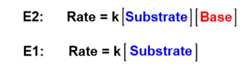
Both reactions are regio- and stereoselective, and this will be covered in separate posts.
Choosing Between E1 and E2 mechanisms
The key factor in determining if the mechanism is E1 or E2 is to look at the base:
If it is astrong base, the mechanism isE2
If aweak base is used, then the mechanism isE1
Remember also thatE1 reactions cannot occur on primary substrates sinceprimary carbocations are very unstable. Other than this, the reactivity pattern is the same for bothE1 and E2 – they go faster with more substituted alkyl halides:

AlthoughSN2is a substitution and not an elimination reaction, it is themain competitor of the E2 elimination. The reason for this is thatE2 and SN2 are both bimolecular reactionsfavored by strong bases or good nucleophiles. Once again,E1 is a unimolecular, stepwise mechanism that proceeds via formation of acarbocation. In that sense, it iscloser to theSN1 reaction, and both are favored whenweak bases and nucleophiles are used.
Check these two articles for comparison, competition, and deciding betweenSN1/E1 andSN2/E2 reactions.
For a broader coverage of deciding betweenSN1, SN2, E1, and E2, check the linked article.

Practice
Determine if the following reactions will go through E2 or E1 mechanism and draw the structure of the major product expected in each reaction:


This content is for registered users only.
By joining Chemistry Steps, you will gain instant access to theanswers and solutions for all the Practice Problems, including over 40 hours of problem-solving videos, Multiple-Choice Quizzes, Puzzles, Reaction Maps,and the powerful set ofOrganic Chemistry 1 and 2 Summary Study Guides.
What are products A and B when the following cyclohexane derivative is treated with sodium ethoxide in ethanol and ethanol only?

This content is for registered users only.
By joining Chemistry Steps, you will gain instant access to theanswers and solutions for all the Practice Problems, including over 40 hours of problem-solving videos, Multiple-Choice Quizzes, Puzzles, Reaction Maps,and the powerful set ofOrganic Chemistry 1 and 2 Summary Study Guides.
This content is for registered users only.
By joining Chemistry Steps, you will gain instant access to theanswers and solutions for all the Practice Problems, including over 40 hours of problem-solving videos, Multiple-Choice Quizzes, Puzzles, Reaction Maps,and the powerful set ofOrganic Chemistry 1 and 2 Summary Study Guides.
Check Also
- General Features of Elimination
- The E2 Mechanism
- Zaitsev’s Rule – Regioselectivity of E2 Elimination Reactions
- The Hofmann Elimination of Amines and Alkyl Fluorides
- Stereoselectivity of E2 Elimination Reactions
- Stereospecificity of E2 Elimination Reactions
- SN2 and E2 Rates of Cyclohexanes
- Elimination Reactions of Cyclohexanes with Practice Problems
- POCl3 for Dehydration of Alcohols
- The E1 Mechanism with Practice Problems
- Regioselectivity of E1 Reactions
- Stereoselectivity of E1 Reactions
- How to tell if it is E2 or E1 Mechanism
- SN1 vs E1 Reactions
- Dehydration of Alcohols by E1 and E2 Elimination
- Mesylates and Tosylates as Good Leaving Groups
- Mitsunobu Reaction
- SN1 SN2 E1 E2 – How to Choose the Mechanism
- Polar Protic and Polar Aprotic Solvents
- SN1 SN2 E1 or E2 – the Largest Collection of Practice Problems
- The Hammond Postulate
- The E1cB Elimination Mechanism
- Nucleophilic Substitution and Elimination Practice Quiz
- Reactions Map of Alkyl Halides
2 thoughts on “E1 vs. E2: How to Tell if the Mechanism is E1 or E2 with Practice Problems”
so much helpful and educative
Reply
i love its contentsVery helpful content, covered most of the the organic chemistry mechanism reactions. I’d love to join and learn more from all your organic chemistry contents.
Reply
