
Molecular Dipole – The Overall Polarity of the Molecule
Thedipole moment of a molecule and its overall polarity depends on themagnitude anddirection of individual polar bonds and their dipole moments.
Remember, for molecules with one polar bond, the molecular dipole is determined simply based on the dipole moment of that bond:
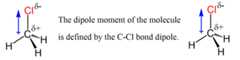
Now, if there aremultiple polar bonds, the molecular dipole moment is determined by thevector sumof those dipole moments.
For example, if we replace one more hydrogen atom in dichloromethane (CH2Cl2 shown above), we need to find thevector sum of the two C-Cl dipoles to determine the overall dipole of the molecule:

Lone Pairs and Dipole Moment
It is important to mention thatlone pairs of electrons also affect the magnitude and direction of themolecular dipole.
For example, thewater molecule has two polar bonds and one lone pair of electrons. Oxygen pulls the bonding electrons shared with the hydrogens since it is more electronegative. The lone pairs, on the other hand, point the dipole moment towards them. Although the resulting dipole vectors are not linearly aligned at 0o, they all point in the same direction, and when combining them, we see that all thedipoles reinforce each other. This can be proved by the greater value of the water dipole moment (1.85 D) compared to the dipole moment of the individual O-H bonds (1.5 D).
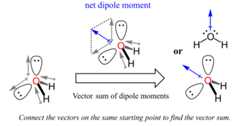
It is very helpful to learn thehybridization andVSEPR theories at his point which suggest that the hydrogens and the lone pairs on the oxygen are insp3 orbitals at ~109.5o.
Therefore, 1.85 D is the vector sum of the two dipoles of 1.5 D at 104.5o plus the reinforcing effect of the lone pairs.
Similarly,ammonia has a greater dipole moment (1.47 D) than each N-H bond itself (1.3 D). The dipole moment of the lone pair is reinforced by the vector sum of the three N-H bonds:

Geometry and Molecular Dipole
We just discussed examples where the dipole moments were enforced by one another according to their vector sum. So what about molecules when thedipole moments are in the opposite direction?
There are two scenarios here. If the dipole moments have the same magnitude at 180o, then the molecule is nonpolar sine the diple moments are canceled.
So, to generalize, remember thatsymmetrical molecules have no dipole moment regardless of how polar the covalent bonds are because the overall dipole moment of the molecule depends on the magnitude and direction of individual dipoles.
For example, carbon dioxide has two polar C=O bonds, however, theirdipole moments, being at 180o, arecanceled, and therefore, the molecule hasno net dipole and isnonpolar:

If the dipole moments are of different magnitudes but in opposite directions, then the net dipole moment will be the vector sum (subtraction) of these dipole moments. See the practice question below.
What if IDon’t know the Molecular Geometries?
There may be a lot of cases where the molecule is not drawn or thegeometry is not given, and you are asked to determine whether the given molecule ispolar or not.
To answer this question, you need tofirst determine the geometry of the molecule following the rules ofVSEPR theory. These are summarized in the following table, but are also covered in detailhere, so feel free to check them and theLewis structures before we go over the next example:

Example:
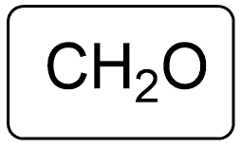 Determine if the molecule is polar or not by showing the corresponding dipole moment(s).
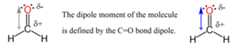
This molecule is formaldehyde and has atrigonal planar geometry according to the VSEPR rules:
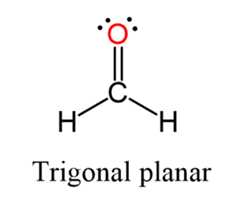
The C-H bonds are nonpolar and therefore, themolecular dipole is mostly defined by the magnitude and direction of theC=O bond. Oxygen, being more electronegative, pulls the electron density of the C=O bond, and thus defining the direction of the molecular dipole:
Dipole Moment of Organic Molecules
For organic molecules containing a hydrocarbon chain with few polar bonds, the molecular dipole is determined by the sum of these dipole moments.
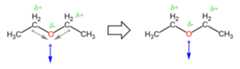
For example, diethyl ether possesses a net dipole moment which is thevector sum of two C-O polar bonds:
For larger molecules withlots of sigma bonds, it is more difficult to determine the net dipole moment because of thefree rotation about these single bonds. However, the presence ofdouble bonds thatrestrict the constant change of the dipole moment direction makes it possible to determine the molecular dipole moment.
This can be illustrated by comparing the boiling points of thecis– andtrans-1,2-Dichloroethene:

The dipole moments of the C-Cl bonds incis-1,2-Dichloroethene reinforce and the moleculeexhibits a net dipole. In contrast, thetrans isomer hasno molecular dipole since the C-Cl bonds are at the opposite direction and their dipole effects are canceled:
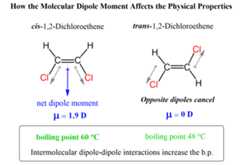
As a result, thetrans isomer is a non-polar molecule with a lower boiling point (48o vs 60o C) than thecis-dichloroethene because of theintermolecular dipole-dipole interactions in the latter.
Interestingly, thetransisomer has ahigher melting point!Why is that the case?
We will answer this question in the next post about theboiling and melting points.
To summarize, themolecular dipole moment depends on the magnitude and direction ofall the dipole moments in the molecule. The larger the molecular dipole, the more polar the molecule is.Symmetrical molecules with comparable structure areless polar since their individual dipole are canceled and there is no net dipole moment.
As always, below are some practice problems on the molecular dipole moment.
Practice
Identify the polar bonds and indicate the direction of the net molecular dipole moment if there is one.

This content is for registered users only.
By joining Chemistry Steps, you will gain instant access to theanswers and solutions for all the Practice Problems, including over 40 hours of problem-solving videos, Multiple-Choice Quizzes, Puzzles, Reaction Maps,and the powerful set ofOrganic Chemistry 1 and 2 Summary Study Guides.
Considering that hydrogen is more electronegative than deuterium,which of the following molecule would you expect to have a larger dipole moment?

This content is for registered users only.
By joining Chemistry Steps, you will gain instant access to theanswers and solutions for all the Practice Problems, including over 40 hours of problem-solving videos, Multiple-Choice Quizzes, Puzzles, Reaction Maps,and the powerful set ofOrganic Chemistry 1 and 2 Summary Study Guides.
As we have seen in the article,CO2 has no molecular dipole since the sum of the two C=O bonds is zero. However,SO2 does have a molecular dipole despite the similar chemical formula.How would you explain this observation?

This content is for registered users only.
By joining Chemistry Steps, you will gain instant access to theanswers and solutions for all the Practice Problems, including over 40 hours of problem-solving videos, Multiple-Choice Quizzes, Puzzles, Reaction Maps,and the powerful set ofOrganic Chemistry 1 and 2 Summary Study Guides.
Check Also
- Lewis Structures in Organic Chemistry
- Valency and Formal Charges in Organic Chemistry
- How to Determine the Number of Lone Pairs
- Bonding Patterns in Organic Chemistry
- sp3, sp2, and sp Hybridization in Organic Chemistry with Practice Problems
- How to Quickly Determine The sp3, sp2, and sp Hybridization
- Bond Lengths and Bond Strengths
- VSEPR Theory – Molecular and Electron Geometry of Organic Molecules
- Dipole-dipole, London Dispersion, and Hydrogen Bonding Interactions
- Boiling Point and Melting Point in Organic Chemistry
- Boiling Point and Melting Point Practice Problems
- Solubility of Organic Compounds
- General Chemistry Overview Quiz
- Bond-Line or Skeletal Structures
- Functional Groups in Organic Chemistry with Practice Problems
- Bond-line, Lewis, and Condensed Structures with Practice Problems
- Curved Arrows with Practice Problems
- Resonance Structures in Organic Chemistry with Practice Problems
- Rules for Drawing Resonance Structures
- Bonding Patterns in Organic Chemistry
- Major and Minor Resonance Contributor
- Significant Resonance Structures
- How to Choose the More Stable Resonance Structure
- Drawing Complex Patterns in Resonance Structures
- Localized and Delocalized Lone Pairs with Practice Problems
- Molecular Representations Quiz
