
Changing the Position of a Leaving Group
In theprevious post, we talked about a simple strategy you can use for changing the position of a double bond.
A similar tool-set, commonly used in organic synthesis, is the change of the position for a leaving group:

Here as well, we need to identify the direction where the leaving group is moving and apply theregioselective elimination based on the Zaitsev and Hofmann rules followed by regioselective addition to alkenes (Markovnikov’s rule).
Remember, you can selectively add a halogen to the most and least substituted positions of a double bond:

And you can also selectively introduce a double bond by E2 reactions using a non-hindered (Zaitsev) and a bulky (Hofmann) base:

So, let’s follow these steps to solve our problem:
- Indicate the direction where the leaving group is moving:

- Introduce a double bond to the left of Br.In this case, it doesn’t matter what base we use for the regioselectivity (hindered on unhindered) but we can use a bulky base to enforce elimination over substitution.

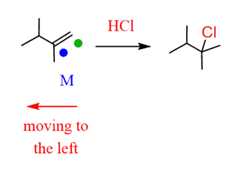
- Still moving to the left, so aMarkovnikov addition is needed:
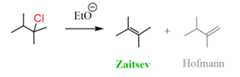
- Another elimination to the left, and this time we must use a small base to obtain the Zaitsev product:
- We needone more addition to the asymmetrical double bond:
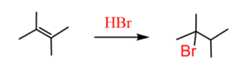
So, to summarize, forchanging the position of a leaving group, you need to repeatedly apply regioselective addition and elimination reactions to the direction where the leaving group had moved:

Practice
Identify the reagents you would use to change the position of the leaving group in each of the following alkenes:

This content is for registered users only.
By joining Chemistry Steps, you will gain instant access to theanswers and solutions for all the Practice Problems, including over 40 hours of problem-solving videos, Multiple-Choice Quizzes, Puzzles, Reaction Maps,and the powerful set ofOrganic Chemistry 1 and 2 Summary Study Guides.

This content is for registered users only.
By joining Chemistry Steps, you will gain instant access to theanswers and solutions for all the Practice Problems, including over 40 hours of problem-solving videos, Multiple-Choice Quizzes, Puzzles, Reaction Maps,and the powerful set ofOrganic Chemistry 1 and 2 Summary Study Guides.

This content is for registered users only.
By joining Chemistry Steps, you will gain instant access to theanswers and solutions for all the Practice Problems, including over 40 hours of problem-solving videos, Multiple-Choice Quizzes, Puzzles, Reaction Maps,and the powerful set ofOrganic Chemistry 1 and 2 Summary Study Guides.

This content is for registered users only.
By joining Chemistry Steps, you will gain instant access to theanswers and solutions for all the Practice Problems, including over 40 hours of problem-solving videos, Multiple-Choice Quizzes, Puzzles, Reaction Maps,and the powerful set ofOrganic Chemistry 1 and 2 Summary Study Guides.
This content is for registered users only.
By joining Chemistry Steps, you will gain instant access to theanswers and solutions for all the Practice Problems, including over 40 hours of problem-solving videos, Multiple-Choice Quizzes, Puzzles, Reaction Maps,and the powerful set ofOrganic Chemistry 1 and 2 Summary Study Guides.
Complete the following synthesis by adding the missing reagent(s) for each step and the structures for compounds A and B:

This content is for registered users only.
By joining Chemistry Steps, you will gain instant access to theanswers and solutions for all the Practice Problems, including over 40 hours of problem-solving videos, Multiple-Choice Quizzes, Puzzles, Reaction Maps,and the powerful set ofOrganic Chemistry 1 and 2 Summary Study Guides.
Complete the following synthesis by adding the missing reagent(s) for each step and the structures for compound A and B:

This content is for registered users only.
By joining Chemistry Steps, you will gain instant access to theanswers and solutions for all the Practice Problems, including over 40 hours of problem-solving videos, Multiple-Choice Quizzes, Puzzles, Reaction Maps,and the powerful set ofOrganic Chemistry 1 and 2 Summary Study Guides.
Complete the following synthesis by adding the missing reagent(s) for each step and the structures for compound A and B:

This content is for registered users only.
By joining Chemistry Steps, you will gain instant access to theanswers and solutions for all the Practice Problems, including over 40 hours of problem-solving videos, Multiple-Choice Quizzes, Puzzles, Reaction Maps,and the powerful set ofOrganic Chemistry 1 and 2 Summary Study Guides.
Complete the following synthesis by adding the missing reagent(s) for each step and the structures for compound A and B:

This content is for registered users only.
By joining Chemistry Steps, you will gain instant access to theanswers and solutions for all the Practice Problems, including over 40 hours of problem-solving videos, Multiple-Choice Quizzes, Puzzles, Reaction Maps,and the powerful set ofOrganic Chemistry 1 and 2 Summary Study Guides.
This content is for registered users only.
By joining Chemistry Steps, you will gain instant access to theanswers and solutions for all the Practice Problems, including over 40 hours of problem-solving videos, Multiple-Choice Quizzes, Puzzles, Reaction Maps,and the powerful set ofOrganic Chemistry 1 and 2 Summary Study Guides.
Complete the following synthesis by adding the missing reagent(s) for each step and the structures for compound A and B:

This content is for registered users only.
By joining Chemistry Steps, you will gain instant access to theanswers and solutions for all the Practice Problems, including over 40 hours of problem-solving videos, Multiple-Choice Quizzes, Puzzles, Reaction Maps,and the powerful set ofOrganic Chemistry 1 and 2 Summary Study Guides.
This content is for registered users only.
By joining Chemistry Steps, you will gain instant access to theanswers and solutions for all the Practice Problems, including over 40 hours of problem-solving videos, Multiple-Choice Quizzes, Puzzles, Reaction Maps,and the powerful set ofOrganic Chemistry 1 and 2 Summary Study Guides.
Check Also in Addition Reactions of Alkenes
- Electrophilic Addition Reactions to Alkenes
- Markovnikov’s Rule
- Markovnikov’s Rule with Practice Problems
- Addition of Water to Alkenes
- Acid-Catalyzed Hydration of Alkenes with Practice Problems
- Rearrangements in Alkene Addition Reactions
- Oxymercuration-Demercuration
- Addition of Alcohols to Alkenes
- Free-Radical Addition of HBr: Anti-Markovnikov Addition
- Hydroboration-Oxidation: The Mechanism
- Hydroboration-Oxidation of Alkenes: Regiochemistry and Stereochemistry with Practice Problems
- Halogenation of Alkenes and Halohydrin Formation
- The Regiochemistry of Alkene Addition Reactions
- The Stereochemistry of Alkene Addition Reactions
- Cis product in an anti Addition Reaction of Alkenes
- Ozonolysis of Alkenes with Practice Problems
- Syn Dihydroxylation of Alkenes with KMnO4 and OsO4
- Anti Dihydroxylation of Alkenes with MCPBA and Other Peroxides with Practice Problems
- Oxidative Cleavage of Alkenes with KMno4 and O3
- Alkene Reactions Practice Problems
- Changing the Position of a Double Bond
- Alkenes Multi-Step Synthesis Practice Problems
- Alkene Addition Reactions Practice Quiz
