
Alkylation of Enolates Alpha Position
We have seen, in thealpha halogenation andaldol condensation reactions, that enolates are good nucleophiles capable of attacking halogens and carbonyl groups.
In addition to these,enolates can also be alkylatedwhen reacted with alkyl halides viaSN2 mechanism:
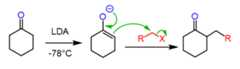
Like any other SN2 reaction, the alkylation of enolates works best with 1o, 1o benzylic, and 1o allylic substrates. Secondary and tertiary substrates would mostly undergo anE2 elimination forming an alkene.
Thealkylation works also with other functional groups such asesters, nitriles, and nitro compounds since they also have an acidic ɑ position:

Aldehydes, on the other hand, are problematic for alkylation because of the competing aldol condensation.
Regiochemistry of Enolate Alkylation
Unsymmetricalketones can be alkylated on both sides depending on the base and the temperature. Alkylation of theless substituted carbon is achieved by using a stericallyhindered base, and LDA is, by far, the most common base you are going to see being used for this purpose. Themore substituted carbon is usually deprotonated bysodium hydride:

Theless substituted enolate is the kinetic product (red pathway below) as seen from the lower activation energy (Ea) and therefore occurs faster.
Thethermodynamic enolate (blue pathway) is themore stable enolate because of the more substituted C=C double bond.

For a symmetrical ketone, it wouldn’t matter which of these bases is used.
The only thing is to make sure a strong base is used. Sodium hydroxide and ethoxides don’t work here because the enolate is not formed irreversibly and self-condensation reactions can occur because there is still a lot of carbonyl present in the equilibrium mixture. This is especially true for aldehydes which tend to undergo aldol condensation a lot faster than ketones do.
And, as always, if you are ready to test your skills, here is a good set of comprehensive problems on alpha carbon chemistry and also a separate one for the alkylation of enolates:
Enolate Alkylation Practice Problems
Enolates in Organic Synthesis – a Comprehensive Practice Problem
Practice
Pethidine, also known as meperidine and marketed under the name Demerol, is a fully synthetic opioid of the phenylpiperidine class. The following synthesis scheme illustratestwo approaches to synthesize Pethidine, and both include analkylation of the α-position.
Add the missing reagents and intermediates in the synthesis of Pethidine.

This content is for registered users only.
By joining Chemistry Steps, you will gain instant access to theanswers and solutions for all the Practice Problems, including over 40 hours of problem-solving videos, Multiple-Choice Quizzes, Puzzles, Reaction Maps,and the powerful set ofOrganic Chemistry 1 and 2 Summary Study Guides.
Check Also
- Alpha Halogenation of Enols and Enolates
- The Haloform and Iodoform Reactions
- Alpha Halogenation of Carboxylic Acids
- Alpha Halogenation of Enols and Enolates Practice Problems
- Aldol Reaction – Principles and Mechanism
- Aldol Condensation – Dehydration of Aldol Addition Product
- Intramolecular Aldol Reactions
- Aldol Addition and Condensation Reactions – Practice Problems
- Crossed Aldol And Directed Aldol Reactions
- Crossed Aldol Condensation Practice Problems
- Alkylation of Enolates Alpha Position
- Enolate Alkylation Practice Problems
- Acetoacetic Ester Synthesis
- Acetoacetic Ester Enolates Practice Problems
- Malonic Ester Synthesis
- Michael Reaction: The Conjugate Addition of Enolates
- Robinson Annulation, Shortcut, and Retrosynthesis
- Claisen Condensation
- Dieckmann condensation – An Intramolecular Claisen Reaction
- Crossed Claisen and Claisen Variation Reactions
- Claisen Condensation Practice Problems
- Stork Enamine Synthesis
- Enolates in Organic Synthesis – a Comprehensive Practice Problem
