


- About CBP
- Mobile Apps Directory
- Contact Us
- Leadership & Organization
- Congressional Resources
- Environmental Management
- Laboratories and Scientific Services
- Intergovernmental Public Liaison
- History
- In Memoriam
- Civil Rights and Civil Liberties
- Equal Employment Opportunity
- CBP Innovation Team
- Law Enforcement Officers Safety Act (LEOSA)
- Archive
- Searching for Someone in CBP Custody
- Buscando a alguien bajo la custodia de CBP
- Se Busca Campaigns
- CBP RSS Feeds
- Mobile Apps Directory
- Contact Us
- Leadership & Organization
- Congressional Resources
- Environmental Management
- Laboratories and Scientific Services
- Intergovernmental Public Liaison
- History
- In Memoriam
- Civil Rights and Civil Liberties
- Equal Employment Opportunity
- CBP Innovation Team
- Law Enforcement Officers Safety Act (LEOSA)
- Archive
- Searching for Someone in CBP Custody
- Buscando a alguien bajo la custodia de CBP
- Se Busca Campaigns
- CBP RSS Feeds
Environmental Management

CBP is committed to environmental and cultural stewardship while performing our core missions of border security and the facilitation of legitimate trade and travel. CBP works hand-in-hand with other Federal, Tribal, state, and local agencies, as well as non-governmental organizations (NGOs), to fulfill environmental compliance regulations and to ensure protection of the Nation's natural andcultural resources. Additionally, CBP works diligently to integrate responsible environmental practices into all aspects of our decision making and operations.
CBP is committed to responsible environmental stewardship and engages in environmental planning for all construction and maintenance projects—including facilities, physical barriers, roads, lighting, surveillance systems and detection technology.
CBP’s environmental planning process includes 30- to 60-day public comment periods to gather information and data from interested stakeholders about potential impacts to the environment, habitat, wildlife, culture, quality of life and commerce—including socioeconomic impacts—that may result from the proposed project. To date, CBP has reviewed and considered feedback provided by tens of thousands stakeholders.
Environmental Planning Process
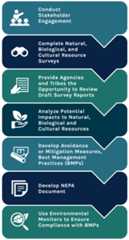
CBP’s environmental planning includes the preparation of an Environmental Assessment (EA) or Environmental Impact Statement (EIS), in compliance with the National Environmental Policy Act (NEPA). For some projects, the Secretary of the Department of Homeland Security (DHS) may determine it is necessary to exercise his or her authority in Section 102(c) of the Illegal Immigration Reform and Immigrant Responsibility Act of 1996 (IIRIRA) to waive certain environmental laws, including NEPA, to expedite construction of border infrastructure. In this case, CBP seeks to accomplish responsible environmental planning within a managed timeframe to meet operational needs.
CBP believes environmental stewardship is best achieved through community involvement. If you have data or information that can inform our environmental planning, we want to hear from you!
States
| New Mexico |
|---|
| Border Barrier System Construction - Luna and Hidalgo Counties, New Mexico - October 2025 |
| Border Barrier Construction - Doña Ana County, New Mexico – June 2025 |
States
| Idaho |
|---|
| Bog Creek Road- Boundary County - January 2020 |
| National |
|---|
| Border Barrier Remediation – San Diego and Imperial Counties, CA; Yuma County, AZ; Hidalgo and Luna Counties, NM – May 2023 |
| Border Barrier Remediation Plan - Update - September 2022 |
Additional Information
- Preserving Cultural Resources
- For general questions about CBP's environmental planning process, please email theCBP Environmental Program.