
The breathtaking journey of a giant container ship
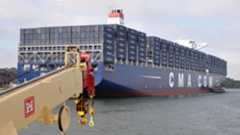
The breathtaking journey of a giant container ship
Overview of the container ship Estelle Maersk.
Contunico © ZDF Studios GmbH, Mainz; Thumbnail USACE NY
- Contunico © ZDF Studios GmbH, Mainz; Thumbnail USACE NYOverview of the container ship Estelle Maersk.
- Encyclopædia Britannica, Inc.Learn more about what could have happened if theTitanic hadn't sunk.
- Encyclopædia Britannica, Inc.Learn about the Japanese attack on the U.S. naval base at Pearl Harbor, Oahu, Hawaii, by watching historical footage and viewing the USSArizona National Memorial there.
- Encyclopædia Britannica, Inc.In the Battle of the Coral Sea (May 1942), U.S. naval airplanes thwarted Japanese plans to occupy Port Moresby, New Guinea. FromThe Second World War: Allied Victory (1963), a documentary by Encyclopædia Britannica Educational Corporation.
- Contunico © ZDF Studios GmbH, Mainz; Thumbnail © Jldelawter/Dreamstime.comRemembering the Pearl Harbor attack, with a discussion of the USS Arizona Memorial.
- Contunico © ZDF Studios GmbH, Mainz; Thumbnail Vladimir Kosov (CC BY-SA 4.0)The Soviet sinking of MVWilhelm Gustloff in January 1945, one of the greatest maritime disasters in history.
- Encyclopædia Britannica, Inc.On the deck of the battleship USS Missouri, Gen. Douglas MacArthur inviting representatives of Japan to sign the terms of surrender that would formally end World War II. FromThe Second World War: Allied Victory (1963), a documentary by Encyclopædia Britannica Educational Corporation.
- Globe Film Company—George Kleine Collection/Library of Congress, Washington, D.C.Take a tour of theTitanic through rare footage of the doomed ocean liner.
- Contunico © ZDF Studios GmbH, Mainz; Thumbnail © Sergey Kohl/Dreamstime.comWatch as a cruise ship is readied for a journey.


Related Articles: container ship, ship
Transcript
NARRATOR: At 397 meters long and 56 meters wide, the Estelle Maersk is one of the biggest container ships in the world. This ocean-going giant traverses the route between China and Europe, taking six weeks to complete the journey - making her one of the fastest freighters there is. The ship is propelled forward by a 12-cylinder, 109,000-horse power diesel engine - the biggest engine in the world. When fully loaded, the bottom of the Estelle Maersk's hull is almost 17 meters below the waterline. The sheer size of the vessel represents a headache for many ports with shallow turning basins. The port in Bremerhaven expanded its turning basin by 600 meters, yet this is still a little too tight for the Estelle Maersk.
FINN JENSEN: "Here, if something goes wrong, the damage is bigger here. So the loss you can end up with is enormous. So that's why we always have to do it very, very safely."
NARRATOR: The Estelle Maersk has seven sister ships - truly a family of superlatives. For example, these ships have the greatest volume of any vessel, being able to transport 11,000 standard containers. And these gigantic freighters of the so-called super post-Panamax class can carry around 30 percent more freight than their largest predecessors. If the freight of all the containers on the Estelle were to be loaded onto a train, that train would be 80 kilometers long. Yet it seems that even bigger ships are possible.
JENSEN: "Of course there will be some bigger ships in the future, no doubt. But all the port facilities have to follow. So that's why it's not just so easy. There's no need just to build a ship. You need to build many ships - eight, ten ships to a service. And then all the port facilities, entrance to the port, cargo wise, things need to be prepared and be ready. So it's a huge process actually."
NARRATOR: Many shipping companies are following Maersk's example and ordering greater numbers of these XXL container ships. The reason is clear: they're fast, can carry more and consume less fuel. When fully loaded, the Estelle uses 2.6 liters of heavy oil per container to travel 100 kilometers - that's a record. The world's ports will have to adapt. The floating giants are on the advance.
FINN JENSEN: "Here, if something goes wrong, the damage is bigger here. So the loss you can end up with is enormous. So that's why we always have to do it very, very safely."
NARRATOR: The Estelle Maersk has seven sister ships - truly a family of superlatives. For example, these ships have the greatest volume of any vessel, being able to transport 11,000 standard containers. And these gigantic freighters of the so-called super post-Panamax class can carry around 30 percent more freight than their largest predecessors. If the freight of all the containers on the Estelle were to be loaded onto a train, that train would be 80 kilometers long. Yet it seems that even bigger ships are possible.
JENSEN: "Of course there will be some bigger ships in the future, no doubt. But all the port facilities have to follow. So that's why it's not just so easy. There's no need just to build a ship. You need to build many ships - eight, ten ships to a service. And then all the port facilities, entrance to the port, cargo wise, things need to be prepared and be ready. So it's a huge process actually."
NARRATOR: Many shipping companies are following Maersk's example and ordering greater numbers of these XXL container ships. The reason is clear: they're fast, can carry more and consume less fuel. When fully loaded, the Estelle uses 2.6 liters of heavy oil per container to travel 100 kilometers - that's a record. The world's ports will have to adapt. The floating giants are on the advance.