


Our editors will review what you’ve submitted and determine whether to revise the article.
- Texas State Historical Association - The Handbook of Texas Online - Civil Rights
- Stanford Encyclopedia of Philosophy - Civil Rights
- Learning for Justice - Latino Civil Rights Timeline, 1903 to 2006
- University of Central Florida Pressbooks - What are Civil Rights and How do we identify them?
- U.S. Departmaent of Health and Human Services - Civil Rights
- OpenStax - American Government 3e - Civil Rights Introduction

civil rights
What are civil rights?
Civil rights are an essential component of democracy. They’re guarantees of equal social opportunities and protection under the law, regardless of race, religion, or other characteristics. Examples are the rights to vote, to a fair trial, to government services, and to a public education. In contrast to civil liberties, which are freedoms secured by placing restraints on government, civil rights are secured by positive government action, often in the form of legislation.
Where do civil rights come from?
Unlike human rights or natural rights, in which people acquire rights inherently—perhaps from nature—civil rights must be given and guaranteed by the power of the state. Therefore, they vary greatly over time, culture, and form of government and tend to follow societal trends that condone or abhor types of discrimination. For example, the civil rights of the LGBTQ community have only recently come to the forefront of political debate in some democracies.
What is a civil rights movement?
When the enforcement of civil rights is found by many to be inadequate, a civil rights movement may emerge in order to call for equal application of the laws without discrimination.
What was the civil rights movement in the U.S.?
The marginalization of African Americans spurred the American civil rights movement, beginning in the 1950s and growing throughout the early 1960s. That movement, based mainly in African American churches and colleges of the South, involved marches, boycotts, and civil disobedience, such as sit-ins. Most efforts were local, but the impact was felt at the national level—a model of civil rights organizing that has since spread all over the globe.
News•
civil rights, guarantees of equal social opportunities andequal protection under thelaw, regardless ofrace,religion, or other personalcharacteristics.
Examples of civil rights include theright to vote, the right to a fairtrial, the right to government services, the right to apublic education, and the right to use public facilities. Civil rights are an essential component ofdemocracy; when individuals are being denied opportunities to participate in political society, they are being denied their civil rights. In contrast tocivil liberties, which are freedoms that are secured by placing restraints on government, civil rights are secured by positive government action, often in the form of legislation. Civil rights laws attempt to guarantee full and equal citizenship for people who have traditionally been discriminated against on the basis of some group characteristic. When the enforcement of civil rights is found by many to be inadequate, a civil rights movement may emerge in order to call for equal application of the laws withoutdiscrimination. Members of the movement may also engage inidentity politics.
Unlike other rights concepts, such ashuman rights ornatural rights, in which people acquire rights inherently, perhaps from God or nature, civil rights must be given and guaranteed by the power of the state. Therefore, they vary greatly over time,culture, and form of government and tend to follow societal trends thatcondone orabhor particular types of discrimination. For example, the civil rights of thelesbian,gay,bisexual,transgender, andqueer (LGBTQ)community have only recently come to the forefront of political debate in some Westerndemocracies.
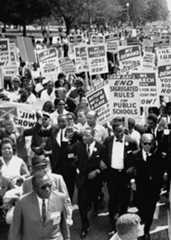
TheAmerican civil rights movement


Civil rights politics in theUnited States has its roots in the movement to end discrimination againstAfrican Americans. Though slavery was abolished and former slaves were officially granted political rights after theCivil War, in most Southern states African Americans continued to be systematicallydisenfranchised and excluded from public life, leading them to become perpetual second-class citizens. By the 1950s the marginalization of African Americans, often taking an extremely violent form, had spurred asocial movement of epic proportions. TheAmerican civil rights movement, based mainly in African American churches and colleges of the South, involved marches,boycotts, and extensive efforts ofcivil disobedience, such assit-ins, as well as voter education and voting drives. Most of these efforts were local in scope, but the impact was felt at the national level—a model of civil rights organizing that has since spread all over the globe.
Civil rights movements across the globe
In the 1960s theRoman Catholic-led civil rights movement inNorthern Ireland was inspired by events in the United States. Its initial focus was fighting discriminatorygerrymandering that had been securing elections for Protestant unionists. Later,internment of Catholic activists by the British government sparked both a civil disobedience campaign and the more radical strategies of theIrish Republican Army (IRA), resulting in the violent sectarian conflict that became known asthe Troubles (1968–98).

A high-profile civil rights movement led to the end of theSouth African system ofracial segregation known asapartheid. The resistance movement began in the 1940s and intensified in the 1950s and ’60s, when civil rights as a concept was sweeping the globe, but it was forced underground as most of its leaders were imprisoned, and it did not regain strength until the 1980s. International pressure combined with internal upheaval led to the eventual lifting of the ban on theAfrican National Congress, the major Black party inSouth Africa, and the release from prison ofNelson Mandela in 1990. Mandela later became the first Black president of South Africa, in 1994.

A more recent movement that has striking parallels to both the American civil rights movement and the South African struggle againstapartheid is the civil disobedience and political activism of theDalits inIndia. The Dalits—formerly known as "untouchables" and now officially designatedScheduled Castes—constitute some one-sixth of the Indian population. However, for centuries they were forced to live as second-class citizens, and many were not even considered to be a part of India’svarna system of socialhierarchy. Dalit activism, including the efforts ofBhimrao Ramji Ambedkar, led to great victories, including the election ofKocheril Raman Narayanan to the presidency. The fact that thepresident of India is elected by parliament, whose members come principally from the upper castes, underlines how much the mentality has changed.

In addition to these international movements, many groups in the United States have been inspired by the successes of the American civil rights movement to fight for government protections, with varying degrees of success. Most notably,women, having gained the right to vote in 1920 viaconstitutional amendment, also have made many gains in the area of employment rights. Thewomen’s rights movement has thus far been stopped short of passage of theEqual Rights Amendment, which would havecodifiedequal rights for women in theU.S. Constitution. Since its failure to be ratified in 1982, women have seen many gains in court decisions that ruled againstsex discrimination and have seen the passing of legislation such as theCivil Rights Act of 1991, which established a commission designed to investigate the persistence of the “glass ceiling” that has prevented women from advancing to top management positions in the workplace.
A number of other groups were the focus of civil rights movements since the 1960s. In 1968 the U.S. Congress passed theIndianCivil Rights Act. Latinos and Asian Americans fought for increased civil rights based on a history of discrimination over race, religion, language, and immigrant status. There were some successes in the form of provisions for bilingual education andaffirmative action programs.
More recently,Arab Americans and the LGBTQ community took centre stage in the struggle to achieve equal protection andequal opportunity in American society. After theterrorist attacks of September 11, 2001, Arab Americans suffered from heightened levels of discrimination and hate crimes and had to conform to government policies that restricted their liberties, as codified in the controversialUSA PATRIOT Act of 2001.

Thegay rights movement made some major gains in the late 1990s and early 2000s. Some states allowedsame-sex marriage, and others granted benefits to same-sex civil partnerships, but at the beginning of the 21st century the majority of the U.S. population opposed same-sex marriage. Moreover, some socialconservatives in the U.S. demanded aconstitutionalamendment banning same-sex marriage. By 2010, however, about half of the U.S. population supported legalization of same-sex marriage, and, in June 2015 in its decision on theObergefell v.Hodges case, the Supreme Court ruled that state bans on same-sex marriage and on recognizing same-sex marriages duly performed in other jurisdictions were unconstitutional under thedue process and equal protection clauses of theFourteenth Amendment, thereby legalizing same-sex marriage in all 50 states.
Almost all countries actively deny civil rights to some minority groups. Because civil rights are enforced by countries, it is difficult to establish an international standard for civil rights protection, despite the efforts of international governance bodies such as theUnited Nations. TheUniversal Declaration of Human Rights, which was adopted by the General Assembly of the United Nations in 1948, includes civil rights language but is not binding on member states. Civil rights tend to increase as governments feel pressure, either from national movements or other countries, toenact change.