


Our editors will review what you’ve submitted and determine whether to revise the article.

church
church, in Christian doctrine, the Christian religiouscommunity as a whole, or a body or organization of Christian believers.
The Greek wordekklēsia, which came to mean church, was originally applied in the Classical period to an official assembly of citizens. In theSeptuagint (Greek) translation of theOld Testament (3rd–2nd centurybce), the termekklēsia is used for the general assembly of the Jewish people, especially when gathered for a religious purpose such as hearing the Law (e.g., Deuteronomy 9:10, 18:16). In theNew Testament it is used of the entire body of believing Christians throughout the world (e.g., Matthew 16:18), of the believers in a particular area (e.g.,Acts 5:11), and also of thecongregation meeting in a particular house—the “house-church” (e.g., Romans 16:5).
After theCrucifixion andResurrection ofJesus Christ, his followers went forth according to hismandate to preach theGospel and developed facilities for those who were converted. Rebuffed by the Jewish authorities, the Christians established their owncommunities, modeled on the Jewishsynagogue. Gradually, the church worked out a governmental system based on the office of thebishop (episcopacy).
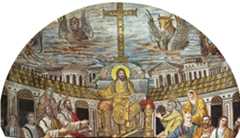
Various controversies threatened the unity of the church from its earliest history, but, except for small sects that did not ultimately survive, it maintained unity for several centuries. Since theEast-West Schism that split the Eastern and Western churches in 1054 and the disruption of the Western church during the 16th-centuryProtestant Reformation, however, the church has been split into various bodies, most of which consider themselves either the one true church or at least a part of the true church.
A traditional means of discussing the nature of the church has been to consider the four marks, orcharacteristics, by which it is distinguished in theNicene Creed: one, holy, catholic, and apostolic. The first, that of oneness or unity, appears to be contradicted by the divisions in the church. It has been held, however, that sincebaptism is the rite of entry into the church, the church must consist of all baptized people, who form a single body irrespective of denomination. The holiness of the church does not mean that all its members are holy but derives from its creation by theHoly Spirit. The termcatholic originally meant the universal church as distinct from local congregations, but it came to imply thechurch of Rome. Finally,apostolic implies that, in both its church and ministry, the church is historically continuous with theApostles and thus with the earthly life of Jesus.
The fact that many Christians holdnominal beliefs and do not act like followers of Christ has been noted since the 4th century, when the church ceased to be persecuted. To account for this,St. Augustine proposed that the real church is an invisible entity known only to God.Martin Luther used this theory to excuse the divisions of the church at the Reformation, holding that the true church has its members scattered among the various Christian bodies but that it is independent of any organization known on earth. Many Christians, however, believing that Jesus intended to found one visible church here on earth, have worked to restore the unity of the church in theecumenical movement.Evangelical Christians believe that for church unity to come to pass,fidelity to apostolic doctrine and practice must be restored. In 1948 theecumenicalWorld Council of Churches (WCC) was founded as “a fellowship of Churches which accept Jesus Christ our Lord as God and Saviour” in order to foster the unity and renewal of the Christian denominations.