

Our editors will review what you’ve submitted and determine whether to revise the article.
- Harvard University - The Pluralism Project - Diaspora Community
- Friedrich-Ebert-Stiftung - Bibliothek der Friedrich-Ebert-Stiftung - Diaspora Migration: Definitional Ambiguities and a Theoretical Paradigm
- Livius - Diaspora
- CORE - The Paradox of Creativity in Diaspora: The Yiddish Language and Jewish Identity (PDF)
- JewishEncyclopedia.com - Diaspora
- Fisher Digital Publications - The Effect of Diaspora on Modern Jewish Belief (PDF)
- Pew Research Center - Views of the Jewish state and the diaspora
- Jewish Virtual Library - The Diaspora

Jewish Diaspora
What is the Jewish Diaspora?
The Jewish Diaspora refers to the dispersion of Jews among non-Jews after the Babylonian Exile, or the aggregate of Jewish communities scattered outside Palestine or present-day Israel, especially after the destruction of Jerusalem by the Romans in 70ce.
What was the first significant Jewish Diaspora?
The first significant Jewish Diaspora was the result of the Babylonian Exile of 586bce when part of the Jewish population was deported into slavery. Even after Cyrus the Great allowed their return, some Jews remained in Babylonia.
How did the Jewish Diaspora change over time?
The centers of Judaism have shifted from country to country, with communities adopting distinctive languages, rituals, and cultures. Some have lived peacefully, while others faced violent antisemitism.
Jewish Diaspora, the dispersion ofJews among theGentiles after theBabylonian Exile or theaggregate of Jews or Jewishcommunities scattered “in exile” outsidePalestine or present-dayIsrael, particularly after theSiege of Jerusalem by theRoman Empire in 70ce. (For a discussion ofdiaspora as a general sociological phenomenon,seediaspora.) Although the termdiaspora (fromGreekdiaspeirein, “to scatter”) in thecontext of Judaism refers to the physical dispersal of Jews throughout the world, it also carries religious, philosophical, political, andeschatologicalconnotations, inasmuch as the Jews perceive a special relationship between the land ofIsrael and themselves. Interpretations of this relationship range from the messianic hope of traditional Judaism for the eventual “ingathering of the exiles” to the view ofReform Judaism that the dispersal of the Jews was providentially arranged by God to foster puremonotheism throughout the world.
Historical dispersions

The first significant Jewish Diaspora was the result of theBabylonian Exile of 586bce. After the Babylonians conquered the kingdom of Judah, part of the Jewish population was deported into slavery. AlthoughCyrus the Great, the Persian conqueror of Babylonia, permitted the Jews to return to their homeland in 538bce, part of the Jewishcommunity voluntarily remained behind in Babylonia.
The largest, most significant, and culturally most creative Jewish Diaspora in early Jewish history flourished inAlexandria, where in the 1st centurybce 40 percent of the population was Jewish. About the 1st centuryce an estimated 5,000,000 Jews lived outside Palestine, about four-fifths of them within theRoman Empire, but they looked to Palestine as the center of their religious and cultural life. Diaspora Jews far outnumbered the Jews in Palestine even before the destruction ofJerusalem and theSecond Temple in 70ce.
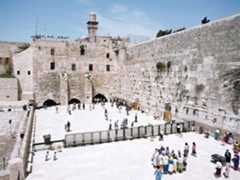
The destruction of the Second Temple in 70 was followed by the Jews’ defeat at theBar Kokhba Revolt in 132, after which Roman laws forbade Jews from entering the holy city of Jerusalem. These events and Roman suppression of Jewish religious life and leadership forced a reorientation of Jewish thinking and practice. Withpilgrimage andsacrifice at the Temple no longer possible, leaders placed emphasis on the study of theTorah, prayer, and works of piety.Rabbinic Judaism arose, and along with it theTalmud and Midrash were written, as part of this increased focus onassiduous study. Jewish life became centered around dispersed houses of worship and study,synagogues.
Thereafter, the chief centers of Judaism shifted from country to country (e.g.,Babylonia,Persia,Spain,France,Germany,Poland,Russia, and theUnited States), and Jewish communities gradually adopted distinctive languages, rituals, andcultures, some submerging themselves in non-Jewishenvironments more completely than others. While some lived in peace, others became victims of violentantisemitism.
Zionism in the Diaspora

Jews hold widely divergent views about the role of Diaspora Jewry and the desirability and significance of maintaining a national identity. While the vast majority ofOrthodox Jews support theZionist movement (the return of Jews to Israel), some Orthodox Jews, such as theNeturei Karta, go so far as to oppose the modern nation of Israel as a godless andsecular state, defying God’s will to send hismessiah at the time he has preordained.
According to the theory ofshelilat ha-galut (“denial of the exile”), espoused by many Israelis, Jewish life andculture are doomed in the Diaspora because ofassimilation andacculturation, and only those Jews who migrate to Israel have hope for continued existence as Jews. It should be noted that neither this position nor any other favorable to Israel holds that Israel is the fulfillment of the biblical prophecy regarding the coming of the messianic era.


Although Reform Jews still commonly maintain that the Diaspora in the United States and elsewhere is a valid expression of God’s will, the Central Conference of American Rabbis in 1937 officiallyabrogated thePittsburgh Platform of 1885, which declared that Jews should no longer look forward to a return to Israel. This new policy actively encouraged Jews to support the establishment of a Jewish homeland. On the other hand, the American Council for Judaism, founded in 1943 but nowmoribund, declared that Jews are Jews in a religious sense only and any support given to a Jewish homeland in Palestine would be an act of disloyalty to their countries of residence.
- Hebrew:
- Galut (Exile)
- Yiddish:
- Golus
- Related Topics:
- diaspora
- shelilat ha-galut
- On the Web:
- JewishEncyclopedia.com - Diaspora (Feb. 02, 2026)
Support for a national Jewish state was notably greater after the wholesale annihilation of Jews duringWorld War II. Of the estimated 14.6 million “core” Jews (those who identify as Jewish and do not profess another monotheistic religion) in the world in the early 21st century, about 6.2 million resided in Israel, about 5.7 million in the United States, and more than 300,000 in Russia, Ukraine, and other republics formerly of theSoviet Union.