





Our editors will review what you’ve submitted and determine whether to revise the article.
- Central Intelligence Agency - The World Factbook - Eritrea
- University of Oxford - Faculty of History - Conflict between Tigray and Eritrea � the long standing faultline in Ethiopian politics
- Official Site of Eritrean Embassies and Consulates
- CRW Flags - Flag of Eritrea
- GlobalEDGE - Eritrea: Introduction
Eritrea
- Where is Eritrea located?
- What is the capital city of Eritrea?
- What are the main languages spoken in Eritrea?
- What are some important facts about Eritrea’s geography or climate?
- How did Eritrea gain its independence?
- What are some challenges and unique cultural aspects of Eritrea today?
News•

Eritrea,country of theHorn of Africa, located on theRed Sea. Eritrea’s coastal location has long been important in its history and culture—a fact reflected in its name, which is an Italianized version ofMare Erythraeum, Latin for “Red Sea.” The Red Sea was the route by whichChristianity andIslam reached the area, and it was an important trade route that such powers asTurkey,Egypt, andItaly hoped to dominate by seizing control of ports on the Eritrean coast. Those ports promised access to the gold, coffee, and slaves sold by traders in the Ethiopian highlands to the south, and, in the second half of the 20th century,Ethiopia became the power from which the Eritrean people had to free themselves in order to create their own state.
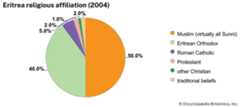
In 1993, after a war of independence that lasted nearly three decades, Eritrea became asovereign country. During the long struggle, the people of Eritrea managed to forge a common nationalconsciousness, but, with peace established, they faced the task of overcoming their ethnic and religious differences in order to raise the country from a poverty made worse by years ofdrought, neglect, and war. Eritrea’s capital and largest city isAsmara (Asmera).

- Head Of State And Government:
- President:Isaias Afwerki
- Capital:
- Asmara
- Population:
- (2025 est.) 6,416,000
- Form Of Government:
- transitional regime2 with one interim legislative house ([transitional] National Assembly [1503])
- Official Language:
- none4
- Official Religion:
- none
- Official Name:
- State of Eritrea1
- Total Area (Sq Km):
- 121,100
- Total Area (Sq Mi):
- 46,757
- Monetary Unit:
- nakfa (Nfa)
- Population Rank:
- (2025) 113
- Population Projection 2030:
- 6,718,000
- Density: Persons Per Sq Mi:
- (2025) 137.2
- Density: Persons Per Sq Km:
- (2025) 53
- Urban-Rural Population:
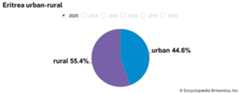
- Urban: (2024) 43.9%
- Rural: (2024) 56.1%
- Life Expectancy At Birth:
- Male: (2022) 64.3 years
- Female: (2022) 69.5 years
- Literacy: Percentage Of Population Age 15 And Over Literate:
- Male: (2018) 84%
- Female: (2018) 69%
- Gni (U.S.$ ’000,000):
- (2011) 1,941
- Gni Per Capita (U.S.$):
- (2011) 650
- The name in Tigrinya, the most widely spoken local language, is Hagere Iertra.
- New constitution ratified in May 1997 was not yet implemented in May 2016.
- All seats indirectly elected; last elections were held in 1994.
- The de facto “working” languages of government are Tigrinya, English, and Arabic.
Land
Eritrea’s coastline, forming the northeastern edge of the country, extends for roughly 600 miles (1,000 km) from Cape Kasar, in the north, to the Strait of Mandeb, separating the Red Sea from theGulf of Aden in the south. The country is bounded to the southeast byDjibouti, to the south byEthiopia, and to the west bySudan.
Relief
Eritrea’s land is highly variegated. Running on a north-southaxis through the middle of the country are the central highlands, a narrow strip of country some 6,500 feet (2,000 metres) abovesea level that represents the northern reaches of theEthiopian Plateau. The highest point isMount Soira, at 9,885 feet (3,013 metres). Geologically, the plateau consists of a foundation ofcrystalline rock (e.g., granite, gneiss, and mica schist) that is overlain bysedimentary rock (limestone and sandstone) and capped by basalt (rock of volcanic origin). The upper layers have been highly dissected by deep gorges and river channels, forming small, steep-sided, flat-topped tablelands known asambas. Encouraged by the steady expansion of cultivation, soil erosion on the plateau has left few wooded areas.
In the north of Eritrea the highlands narrow and then end in a system of hills, where erosion has cut down to the basement rock. To the east theplateau drops abruptly into a coastal plain. North of the Gulf of Zula, the plain is only 10 to 50 miles (15 to 80 km) wide, but to the south it widens to include theDanakil Plain. This barren region contains a depression known as theKobar Sink (more than 300 feet [90 metres] below sea level), the northern end of which extends into Eritrea. The coastal plain and the Danakil Plain are part of theEast African Rift System and are sharply delimited on the west by the eastern escarpment of the plateau, which, although deeply eroded, presents aformidable obstacle to travelers from the coast.
The western flank of the central highlands is a broken and undulating plain that slopes gradually toward the border with Sudan. It lies at an average elevation of 1,500 feet (460 metres). The vegetation is mostlysavanna, consisting of scattered trees, shrubs, and seasonal grasses.
Off the coast in the Red Sea is theDahlak Archipelago, a group of more than 100 small coral and reef-fringed islands. Only a few of these islands have a permanent population.

Drainage
The Eritrean highlands are drained by four major rivers and numerous streams. Two of the rivers, theGash and the Tekezē, flow westward into Sudan. TheTekezē River (also known as the Satit) is a major tributary of theAtbara River, which eventually joins the Nile. The Gash River reaches the Atbara only during flood season. As it crosses the western lowlands, the Tekezē forms part of Eritrea’s border with Ethiopia, while the upper course of the Gash, known as theMereb River, forms the border on the plateau.
The other two major rivers that drain the highlands of Eritrea are theBaraka and theAnseba. Both of these rivers flow northward into a marshy area on the eastern coast of Sudan and do not reach the Red Sea. Several seasonal streams that flow eastward from the plateau reach the sea on the Eritrean coast.
Climate
Eritrea has a wide variety of climatic conditions, produced mainly by differences in elevation. The effects of elevation are seen most clearly in the wide range of temperatures experienced throughout the country. On the coast,Massawa (Mitsiwa) has one of the highest averages in the world (the mid-80s F [about 30 °C]), whileAsmara, only 40 miles (65 km) awayyet roughly 7,500 feet (2,300 metres) higher on the plateau, averages in the low 60s F (about 17 °C).
Mean annual rainfall on the plateau is about 16 to 20 inches (400 to 500 mm), while on the western plain it is less than 16 inches. In both the highlands and the western lowlands, rainfall comes in summer, carried on a southwesterly airstream. Toward the northeastern extremes of the plateau, the amount ofprecipitation decreases, and the length of the rainy season becomes shorter. The eastern edges of the plateau and, to a lesser extent, the coastal fringes receive much smaller quantities of rain from a northeasterly airstream that arrives in winter and spring. The interior regions of the Danakil Plain are practically rainless.
People
Ethnic groups and languages
Eritrea’s population consists of several ethnic groups, each with its own language and cultural tradition. In addition to the languages spoken by the various ethnic groups, Arabic and English are widely understood. Italian is occasionally used as well.
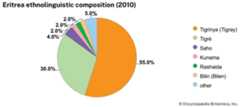
The bulk of the people in theEritrean highlands areTigray. In Eritrea that group is sometimes called Tigrinya, though linguists ofSemitic languages note that-nya is anAmharic suffix meaning “language of.” In any case, propernomenclature for the people is fluid, given contemporary political sensitivities. The Tigray make up about half the country’s total population. They also occupy theadjacentEthiopian region ofTigray. TheTigrinya language is one of two majorindigenous languages in Eritrea.
Inhabiting the northernmost part of the Eritrean plateau, as well as lowlands to the east and west, are theTigre people. The Tigre, whoconstitute nearly one-third of Eritrea’s population, speak the other major Eritrean language—Tigré.Tigré andTigrinya are written in the same script and are both related to the ancient SemiticGeʿez language, but they are mutually unintelligible.
Also occupying the northern plateau are Bilin speakers, whose language belongs to theCushitic family. TheRashaida are a group of Arabic-speaking nomads whotraverse the northern hills. On the southern part of the coastal region liveAfar nomads. The Afars—who also live across the borders in Djibouti and Ethiopia—are known to surrounding peoples as the Danakil, after the region that they inhabit. The coastal strip south of Massawa, as well as the eastern flanks of the plateau, are occupied bySaho pastoralists. In the western plain the dominant people areBeja pastoralists; Beja also live across the border in Sudan. Two small groups speakingNilotic languages, the Kunama and the Nara, also live in the west.