


Our editors will review what you’ve submitted and determine whether to revise the article.
- LiveScience - Emperor Nero: Facts & biography
- Heritage History - The Childhood of Nero
- ABC listen - Conversations - Shushma Malik: Ancient Rome's most loved and despised emperor, Nero
- Independent - Investigating an ancient mystery: What really happened during Nero�s Great Fire of Rome?
- JewishEncyclopedia.com - Nero
- Jewish Virtual Library - Biography of Nero
- The Roman Empire - Biography of Emperor Nero
- Encyclopedia Romana - Nero as the Antichrist
- UNRV History - Biography of Nero
- BBC - Great Lives - The Roman Emperor Nero
- Scholar Works at Harding - Rome and Her Greatest Theatric: The Controversies of Emperor Nero (PDF)

Nero
How did Nero become famous?
Rome burned while he was emperor, and the eagerness with which he rebuilt led many to believe that he was responsible for the fire. He tried to shift the blame to theChristians, beginning the Roman persecution of that young religion. This led the Christians to label him theAntichrist.
What was Nero’s childhood like?
His father died when Nero was about three. His mother,Julia Agrippina, poisoned her second husband when Nero was 12. She then married her uncle, the emperorClaudius. It is widely believed that she poisoned Claudius when Nero was 16 and poisoned Claudius’s son Britannicus to seal Nero’s claim to the throne.
What were Nero’s accomplishments?
Nero built a palace, theGolden House, which was apparently magnificent, but it was so resented by the public and by his successors that it was almost completely dismantled. His armies put down rebellions inBritain andJudaea, he was an enthusiastic patron of the arts, and he was lenient toward his enemies.
How did Nero die?
As Nero’s behavior became more erratic—he believed that he could singGaul into submission—his enemies became bolder. TheSenate condemned him to death bycrucifixion, and hishousehold guard abandoned him. Nero was just 30 years old when he fled Rome and committed suicide.
News•
Nero (born December 15, 37ce,Antium, Latium—died June 9, 68, Rome) was the fifthRomanemperor (54–68ce), stepson and heir of the emperorClaudius. He became infamous for his personaldebaucheries and extravagances and, on doubtful evidence, for his burning ofRome and persecutions of Christians.
Upbringing
Nero’s father,Gnaeus Domitius Ahenobarbus, died about 40ce, and Nero was brought up by his mother,Julia Agrippina, a great-granddaughter of the emperorAugustus. After poisoning her second husband, Agrippina incestuously became the wife of her uncle, the emperorClaudius, and persuaded him to favour Nero for the succession, over the rightful claim of Claudius’s own son,Britannicus, and to marry his daughter,Octavia, to Nero. Agrippina—having already helped bring about the murder ofValeria Messalina, her predecessor as the wife of Claudius, in 48, and ceaselessly pursuing her intrigues to bring Nero to power—eliminated her opponents among Claudius’s palace advisers, probably had Claudius himself poisoned in 54, and completed her work with the poisoning of Britannicus in 55. Upon the death of Claudius, she at once had Nero proclaimed emperor by thePraetorian Guard, whose prefect,Sextus Afranius Burrus, was her partisan; the Senate thus had to accept a fait accompli. For the first time, absolute power in theRoman Empire was vested in a mere boy, who was not yet 17.
Early reign

Agrippina immediately eliminated the powerfulfreedmanNarcissus, who had always opposed her aims. She hoped to control the government, but Burrus and Nero’s old tutor, theStoic philosopherLucius Annaeus Seneca, though they owed their influence to Agrippina, were not content to remain her tools. They encouraged Nero to act independently of her, and a growing coolness resulted in Nero’s relations with his mother. In 56 Agrippina was forced into retirement. From that time until 62, Burrus andSeneca were the effective rulers of the empire.
Brought up in this atmosphere, Nero might well have begun to behave like a monster upon his accession as emperor in 54 but, in fact, behaved quite otherwise. He put an end to the more odious features of the later years of Claudius’s reign, including secret trials before the emperor and the dominance of corrupt freedmen, and he accorded more independence to the Senate. The testimony of contemporaries depicts Nero at this time as a handsome young man of fine presence but with soft, weak features and a restless spirit. Up to the year 59, Nero’s biographers cite only acts of generosity andclemency on his account. His government forbade contests in the circus involving bloodshed, bannedcapital punishment, reduced taxes, and accorded permission to slaves to bring civil complaints against unjust masters. Nero himself pardoned writers ofepigrams against him and even those who plotted against him, and secret trials were few. The law of treason was dormant: Claudius had put 40 senators to death, but, between the murders instigated by Agrippina in 54 and the year 62, there were no like incidents in Nero’s reign. Nero also inaugurated competitions in poetry, in the theatre, and in athletics as counterattractions to gladiatorial combats. He saw to it that assistance was provided to cities that had suffered disaster and, at the request of the Jewish historianFlavius Josephus, gave aid to the Jews.
Artistic pretensions and irresponsibility
While directing the government themselves, Burrus and Seneca had largely left Nero uncontrolled to pursue his own tastes and pleasures. Senecaurged Nero to use his autocratic powers conscientiously, but he obviously failed to harness the boy’s more generous impulses to his responsibilities. At first Nero hated signing death sentences, and the extortions of Roman tax collectors upon the populace led him in 58 to unrealistically suggest that the customs dues should be abolished. Even later Nero was capable of conceiving grandiose plans for conquests or the creation ofpublic works, but for the most part he used his position simply to gratify his own personal pleasures. His nocturnal rioting in the streets was a scandal as early as 56, but the emergence of real brutality in Nero can be fixed in the 35-month period between the putting to death of his mother at his orders in 59 and his similar treatment of his wife Octavia in June 62. He was led to the murder of Agrippina by her insanity and her fury at seeing her son slip out of her control, to the murder of Octavia by his having fallen in love withPoppaea Sabina, the young wife of the senator (and later emperor)Otho, and by his fear that hisrepudiated wife was fomenting disaffection at court and among the populace. He married Poppaea in 62, but she died in 65, and he subsequently married the patrician lady Statilia Messalina.
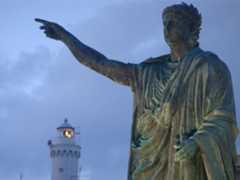
Seeing that he could do what he liked without fear ofcensure orretribution, Nero began to give rein to inordinate artistic pretensions. He fancied himself not only a poet but also a charioteer andlyre player, and in 59 or 60 he began to give public performances; later he appeared on the stage, and the theatre furnished him with the pretext to assume every kind of role. To the Romans these antics seemed to be scandalousbreaches of civic dignity anddecorum. Nero even dreamed of abandoning the throne of Rome in order to fulfill his poetical and musical gifts, though he did not act on thesepuerile ambitions. Beginning about 63, he also developed strange religious enthusiasms and became increasingly attracted to the preachers of novel cults. By now Seneca felt that he had lost all influence over Nero, and he retired after Burrus’s death in 62.
- In full:
- Nero Claudius Caesar Augustus Germanicus
- Also called (50–54 ce):
- Nero Claudius Drusus Germanicus
- Original name:
- Lucius Domitius Ahenobarbus
- Born:
- December 15, 37ce,Antium, Latium
- Died:
- June 9, 68,Rome (aged 30)
- Title / Office:
- emperor (54-68),Roman Empire
- Notable Family Members:
- motherJulia Agrippina
- On the Web:
- Heritage History - The Childhood of Nero (Jan. 24, 2026)

Thegreat fire that ravaged Rome in 64 illustrates how low Nero’s reputation had sunk by this time. Taking advantage of the fire’s destruction, Nero had the city reconstructed in the Greek style and began building a prodigious palace—theGolden House—which, had it been finished, would have covered a third of Rome. During the fire, Nero was at his villa at Antium 35 miles (56 km) from Rome and therefore cannot be held responsible for the burning of the city. But the Roman populace mistakenly believed that he himself had started the fire in Rome in order to indulge hisaesthetic tastes in the city’s subsequent reconstruction. According to theAnnals of the Roman historianTacitus and to theNero of the Roman biographerSuetonius, Nero in response tried to shift responsibility for the fire to theChristians, who were popularly thought to engage in many wicked practices. Hitherto the government had not clearly distinguished Christians from Jews. Almost by accident, Nero initiated the later Roman policy of halfhearted persecution of the Christians, in the process earning himself the reputation ofAntichrist in the early Christian tradition.
