


Our editors will review what you’ve submitted and determine whether to revise the article.
Latin American architecture
- What is Latin American architecture?
- Which countries are included in Latin America?
- What are some common features of ancient Latin American buildings?
- How did Spanish and Portuguese colonization influence Latin American architecture?
- What are some famous modern buildings in Latin America?
- How do climate and culture affect architectural styles in Latin America?
Latin American architecture, history of architecture in Mesoamerica, Central America,South America, and the Caribbean beginning after contact with the Spanish and Portuguese in 1492 and 1500, respectively, and continuing to the present.
For centuries before about 1500,indigenous American peoples had civilizations with unique architectural traditions; for these traditions, which continue to the present day,seeNative American arts. After about 1500, these traditions often became intertwined with those ofEurope andNorth America; for these European and North American histories,seeWestern architecture. The technical and theoretical aspects ofarchitecture are treated elsewhere;seearchitecture. For a thorough treatment of the often-related visual art traditions of Latin America after about 1500,seeLatin American art.
The colonial period,c. 1492–1810
The conquest of Amerindian cities and the first American building
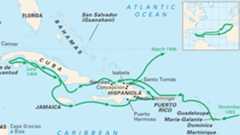
WhenChristopher Columbus returned toSpain in 1493 and brought news of his “discovery” of the island of “La Española” (orHispaniola), the present-dayDominican Republic, the “New World” was born. Over the course of the next 30 years, Spanish explorersencountered severalNative American cities as large and as complex as any in Europe.
Before returning, Columbus ordered his men to build a fort—the first European building constructed in the Americas. TheSanta Maria, being no longer seaworthy, was turned upside down on the beach, dragged up the coast, and recycled into a fort housing the first Spanish settlers.
UntilEngland’s conquest of Barbados in 1625, Spain, together withPortugal in the south, controlled all of the New World. Though political governance was absolute and centralized in Madrid—viaSevilla—the cultural landscape of the New World remained decentralized and open to influence fromFlanders,Germany, andItaly. In some cases Jesuit, Dominican, and Franciscan priests and architects imported knowledge from Europe to the Americas even before it reached Spain. Architectural and artistic production in the New World emerged as acreative product of this new cultural and geographical freedom.
In 1524 the Spanish explorerHernán Cortés describedTenochtitlán, present-day Mexico City, in a letter toCharles V, the king of Spain:
There are in the city many large and beautiful houses.…All these houses have very large and very good rooms and also very pleasant gardens of various sorts of flowers both on the upper and lower floors. These people live almost like those in Spain and in as much harmony andorder as there, and considering that they are barbarous and so far from the knowledge of God and cut off from all civilized nations, it is truly remarkable to see what they have achieved in all things.
The first Spanish viceroyalties and their capitals
Spain initially organized its management and governance of the New World according toviceroyalties—geographical regions administered by aviceroy, a direct representative of the Spanish crown vested with executive, legislative, judicial, military, andecclesiastical power.

TheViceroyalty of New Spain, established in 1535, included what are nowMexico,Central America,Florida, and the southwesternUnited States. TheViceroyalty of Peru, established in 1543, included territories from present-dayChile,Argentina,Bolivia,Peru,Ecuador,Colombia,Venezuela, andPanama.
In New Spain the ancientAztec city of Tenochtitlán was systematically rebuilt as Mexico City and designated the capital of the viceroyalty. This transformation establishedMexico City as a continuing locus of power for the Viceroyalty of New Spain.
Cuzco, the ancient capital of theInca empire, andLima, a new city founded by the Spanish in 1535, functioned as the two great cities of colonial Peru, and governance shifted between them. Cuzco’s urban structure featured streets, doors, and walls thatutilized existing Inca masonry techniques; the new structures adapted and reused existing earthquake-resistant stone foundations. The original layout of the Inca city was also preserved. In 1553 theconquistadorPedro de Cieza de León stated: “At Cuzco the buildings commence on the sides of a high hill and extend over a wide plain. The city has long wide streets and very large squares. For Cuzco, with regard to the Inca Empire, was anotherRome and the one city may be well compared to the other.” Thecathedral of Cuzco (mid-16th to mid-17th century), by Francisco Becerra, is one of the few buildings that survived the strong earthquake of 1650. Its rectilinear plan, with three naves of equal height, is Renaissance in its spatial characteristics, but the stone reinforcements in the vaults are similar to those of late Gothic Spanish churches. Theaustere character of the almost fortresslike walls of the exterior is reinforced by symmetrical bell towers on the corners and an elaboratelyarticulated entrance portal.
The new urban strategy: Checkerboard plans and the Laws of the Indies
In 1532 the founding ceremony of “La Puebla de los Angeles” (nowPuebla, Mexico) was held on a desolate spot between the ancient cities ofTlaxcala andCholula. It was the first new city in Spanish America to apply a regularorthogonal grid system, anurban design model that became the norm for all the Americas. Origins of this grid-based urban plan had previously been found in varied sources dating back to the colonies of the Greek empire and then inRenaissance treaties. Such sources may have been relevant, but it is also important to understand that theorthogonal grid was used in pre-Columbian America long before these sources were known. For example, the ancient city ofCholula is a pre-Columbian grid city that Cortés called “the most beautiful city of all I have seen outside of Spain.” (It remains, along with Cuzco, the oldest city of theWestern Hemisphere to be continuously inhabited—perhaps for as long as 8,000 years.)
By the end of the 16th century, many of the major cities now existing in Latin America had been established. Spanish and Portuguese settlers created and developed Amerindian cities according to the preestablished Renaissance grid system. Generally speaking, these cities shared a grid plan featuring large, open squares defined by a cathedral and other institutional buildings. By contrast, architects and planners in European cities were often limited by the existingmedieval urban fabric in the application of this model.
The application of this grid system in Latin America was eventually enforced by theLaws of the Indies, a series of guidelines formulated by Spain for theplanning and development of all new American cities as well as for theadaptation of the old Amerindian capitals. These laws promoted the ideal of the pure geometry of the Renaissance city. This strategy was reinforced by the architecture of cathedrals that adapted prevailinginnovations by European Renaissance and Mannerist architects (see below) to thevernacular and local conditions found in the New World.
- Related Topics:
- architecture
- Puuc style
- Mestizo style
The founding of new towns and the construction of large monasteries in Mexico provided an opportunity forenlightened European settlers to realize some of the utopian ideals of Renaissance planning.Antonio de Mendoza, the first viceroy of New Spain, oversaw the creation ofmission establishments. Representing different religious orders, these missions were inspired by the theories of Europeans such asLeon Battista Alberti,Erasmus, andSir Thomas More. The plan usually included a single navechurch, a convent around a patio, a large walled atrium or churchyard with an open-air chapel for outdoor masses, and small corner chapels calledposas. By 1590 more than 300 churches had been built in Mexico alone.