FAQ
Q:Where are test vectors?
A:https://github.com/BLAKE2/BLAKE2/tree/master/testvectors
Q:How can I be sure the BLAKE2 is secure?
A:We have no proof that BLAKE2 is as secure as we claim, but there aregood reasons to believe it:BLAKE2 relies on (essentially) the same core algorithm as BLAKE, whichhas been intensively analyzed since 2008 within the SHA-3 competition,and which was one of the 5 finalists. NIST'sfinalreport writes that BLAKE has a "very large security margin", andthat the the cryptanalysis performed on it has "a great deal ofdepth".The best academic attack on BLAKE (and BLAKE2) works on a reducedversion with 2.5 rounds, whereas BLAKE2b does 12 rounds, and BLAKE2sdoes 10 rounds.But even this attack is not practical: it only shows for example thatwith 2.5 rounds, the preimage security of BLAKE2b is downgraded from 512bits to 481 bits, or that the collision security of BLAKE2s isdowngraded from 128 bits to 112 bits (which is similar to the securityof 2048-bit RSA).
Q:Why is BLAKE2 so fast?
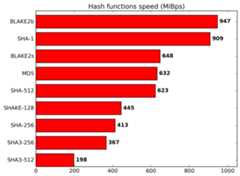
A:BLAKE2 is fast in software because it exploits features of modern CPUs,namely instruction-level parallelism, SIMD instruction set extensions,and multiple cores. BLAKE2 also benefits from the optimization work performed during theSHA-3 competition (see for examplethis paper by two ofthe designers of BLAKE2).
Q:Why do you want BLAKE2 to be fast? Aren't fast hashes bad?
A:You want your hash function to be fast if you are using it to compute thesecure hash of a large amount of data, such as in distributed filesystems (e.g.Tahoe-LAFS), cloud storage systems (e.g. OpenStack Swift), intrusion detectionsystems (e.g. Samhain), integrity-checking local filesystems (e.g. ZFS),peer-to-peer file-sharing tools (e.g. BitTorrent), or version controlsystems (e.g. git). You only want your hash function to be slow if you're using it to"stretch" user-supplied passwords, in which case see the next question.
Q:So I shouldn't use BLAKE2 for hashing user passwords?
A:You shouldn't use *any* general-purpose hash function for userpasswords, not BLAKE2, and not MD5, SHA-1, SHA-256, or SHA-3. Instead you should use a password hashing function such as thePHC winnerArgon2 withappropriate time and memory cost parameters, tomitigate the risk of bruteforce attacks—Argon2's core uses avariant of BLAKE2's permutation.
Q:BLAKE2bp gives different results from BLAKE2b. Is that normal?
A:Yes. BLAKE2bp is a different algorithm from BLAKE2b and BLAKE2sp is adifferent algorithm from BLAKE2s. Each algorithm produces a different hash value.
BLAKE2b and BLAKE2s are designed to be efficient on a single CPU core(BLAKE2b is more efficient on 64-bit CPUs and BLAKE2s is more efficient on8-bit, 16-bit, or 32-bit CPUs). BLAKE2bp and BLAKE2sp are designed to be efficient on multicore or SIMDchips, by processing the input in parallel. This parallel approach results in different secure hash values from thesingle-core variants.
More generally, two instances of BLAKE2b or BLAKE2s with two distinctsets of parameters will produce different results.For example, BLAKE2b in some tree mode (say, with fanout 2) will producedifferent results than BLAKE2b in a modified tree mode (say, with fanout3).
Q:Which should I use? BLAKE2b, BLAKE2s, BLAKE2bp, or BLAKE2sp?
A:A rule of thumb is that on 64-bit platforms the best choice is BLAKE2b,whereas on 32-bit (or smaller) platforms BLAKE2s is recommended.Or, you could try each of the four of them and see which oneperforms best on your deployment platform. If you do that, please write to us and let us know what you found.
Q:The BLAKE2 documentation only describes differences with the originalBLAKE, where can I find a complete specification?
A:TheRFC includes acomplete specification of BLAKE2b and BLAKE2s (though not of the treemode).