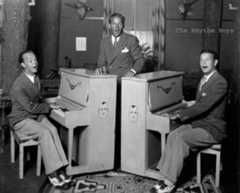
February 28-March 6,Sunday-Saturday.The Syncopation Idea (advertised as "Ideas of Syncopation") is at the Senator Theater inSacramento.
March 11-13,Thursday-Saturday.The Syncopation Idea (with Crosby & Rinker heading the bill) closes at theCalifornia Theater, Santa Rosa having also been seen at Glendale. The film being shown isHands Up starring Raymond Griffith. Bing and Al areinvited to a party at San Simeon by William Hearst Jr., and they eventuallyreturn to Los Angeles where they rent an apartment.
TheWest Coast presentation of Fanchon and Marco’s “Syncopation Idea” will alsoclose their highly successful engagement. With Crosby and Rinker pianologue, BobbyThompson and Doreen Wilde in some fast dancing, Mac Curry, who is greeted with aroar over his eccentric dancing and Mabel Hollis, with her wonderful voice, whois popularly known as 100 pounds of blues and with that wonderfully trainedFanchon and Marco 16 streaks of lightning.
“Webelieve that this is the fastest dancing act that was ever staged in SantaRosa, bar none, and with the closing number on the slanting stage creates a goodimpression and makes the public look forward to the next Idea with relish,”says the management.
(Santa Rosa Republican, March 13, 1926)
April (undated). Bing and Al are hired forWill Morrissey’s Music Hall Revue at the Orange Grove Theater inLos Angeles at $150 weekly for the act. Rehearsals take place in readiness forthe planned opening on April 29.
April 26, Monday. Tedand Hazel Crosby have a daughter, Patricia Antonia.
April 30–June 19, Friday–Saturday.Will Morrissey’s Music Hall Revue at the Orange Grove Theater. Theshow opens a day late, having been postponed one hour before it was due to openon April 29 because of a lack of costumes.
Ralph Spence, playwright,is financing Will Morrissey Music Hall Revue to the extent of $10,000for a one-third interest in it. Arthur Freed and Morrissey havethe other two-thirds between them.
(Variety, May 5, 1926)
Bing and Al worked on an elevated stand in thepit for four months until the revue hit San Diego. The show'schiefattractions were Midge Miller, Morrissey'swife; Eddie Borden, a sketch comedian whoparodied Aimee Semple McPherson and others;singerLee Kent; comedian Eddie Lambert; an adagio team; and a chorusline. Thosewere the acts expected to entice customers. Bing andAlwere gravy. Yet night after night, the audiences - richwith important Hollywood movers and shakers - responded mostly toTwoBoys and a Piano,demanding encores that stopped the show.
(Gary Giddins,A Pocketful of Dreams,page 133)
May 4, Tuesday. LarryCrosby, then an editor at the Wallace-Press Times,Idaho, weds Elaine Couper of Spokane.
May 22, Saturday (possibly).Bing and Al perform at a Hollywood party for thecast ofCharlot’s Revue (includingBea Lillie,Jack Buchanan, andGertrude Lawrence). The show had opened at the El Capitan theater on May 3rd. Bing makes an impact singing“Montmartre Rose.”
Morrissey, by thistime feeling no pain, rose and asked if everyone would like to hear a few songsby the young men inhis show. “Wewere full of champagne and ready,” Al (Rinker) recalled. He went to the pianoas Bing pulled out his pocket cymbal, and they dashed through “When the Red,Red, Robin ComesBob, Bob, Bobbin' Along.” Asked for asecond number, Al suggestedthe Tommy Lyman number Mildred alwaysplayed, “MontmartreRose.” Bing agreed and ladled his best syrup on the plight of thatsorrowfulfille de joie,hishigh notes receiving full attention andmuchapplause, notablyfrom the three English stars, who rushed tohimwith compliments. It was a heady moment:the beginningof hisascendancy as Hollywood's own crooner. Lillie and Buchanan laterworked with him,but Bing never recorded “Montmartre Rose.”
(Gary Giddins,A Pocketful of Dreams,pages 133-134)
June 20–August 7, Sunday–Saturday.Will Morrissey’s Music Hall Revue moves to the Majestic Theater, LosAngeles. During this period there is publicity about Morrissey being arrestedfor drunken driving and also about checks payable to the cast being dishonored.Partway through a show on July 27, Morrissey tells the audience that theperformance cannot continue as he has not been paid by his partner. The agentEdward Small is in the audience and he puts up $1,000 to allow the show to becompleted.
June 22,Tuesday. Morrissey provides the entertainment at the Hollywood Shrine Club breakfast meeting, Crosby and Rinker are included.
June 28,Monday.Morrissey arranges for several of his troupe, including Crosby andRinker, to entertain at a dinner party given by Eddie Cantor for FrankNewman (of Publix Theaters) at the Biltmore Hotel.
July 27, Tuesday. Bing and Al take part in a huge entertainmentevening for the American Legion at the Olympic Auditorium in Los Angeles. Starssuch asEddie Cantor,Fanny Brice, Bebe Daniels,George Jessel, and CharlesChaplin perform.
August 9–12, Monday–Thursday.WillMorrissey’s Music Hall Revue at Spreckels Theater in San Diego. A matineeperformance is given on August 11.
“Just Two Boys and a Piano”as Crosby and Rinker are known, are appearing tonight, Tuesday, Wednesday andThursday with the Will Morrissey Music Hall Revue, at the Spreckels theatre.Although strangers to the theatre going public of the Pacific coast, whereverthis “different revue” has played the boys have won instantaneous recognitionfor their splendid work. Previous to Will Morrissey engaging this team ofentertainers their days behind the footlights had been spent in the largeeastern cities where they had played all the large eastern vaudeville circuits,as well as with some of the best known musical successes. They will do theirstuff on a specially constructed stage down among the audience. This is said tobe only one of the usual stunts that will be offered the Bohemian San Dieganstonight.
(San Diego newspaper, August9, 1926)
“If they like that, give ‘emsome more. There’s a few things about our show they don’t like.” So WillMorrissey instructed Crosby and Rinker, two young men whom the audience atMorrissey’s revue at the Spreckels Theater last night wanted to take home anduse for permanent amusement. Crosby and Rinker, who, by the way, sang all ofthe “red hot mamma” songs that have been written in months, did “give ‘em somemore,” stealing the show from those billed as stars.
(The San Diego Sun, August 10, 1926.)
…In addition tothe principals,Eddie Borden and Midgie Miller, are Crosby and Rinker who havestopped the show at every performance here with their singing…
(The San Diego Sun, August 12, 1926)
August 13/14, Friday/Saturday.WillMorrissey’s Music Hall Revue at the Lobero Theater, Santa Barbara. Bing andAl are advertised in the local newspaper as “Corsey and Rinker.”
…Crosby andRinker, the two who sang the vulgar “Paddlin’ Madeline Home,” as Morrisseyannounced it.
(Santa Barbara News-Press, August 14,1926)
August 16–September 11, Monday–Saturday. The Revue moves to theCapitol Theater in San Francisco where it finishes with the midnightperformance on September 11, having struggled throughout its run. During thisperiod,William Hearst Jr. invites the entire cast to the campus at Berkeleywhere he is a student. The entertainment put on by the troupe outrages thecampus officials and they issue a prohibition order banning the students fromattending the Morrissey show.
…Crosby andRinker, who specialize vocal harmony at the piano, are unique and receive manyencores.
(San Francisco Bulletin, August 17, 1926)
…Crosby and Rinkerhave several very fine singing numbers, which lose their glamous(sic) when Morrissey asks them to singsomething “ruffined.”
(Tom W. Bailey,San Francisco Chronicle, August 17,1926)
Crosby and Rinkerare prominent in the musical portion of the revue. Their songs are of the unusualtype and are well done.
(A. F. Gillaspey, San Francisco Bulletin, August 18, 1926)
Crosby and Rinker,harmonists, fairly stop the show and demand repeated encores.
(San Francisco Bulletin, August 21, 1926)
Crosby and Rinkerare immensely popular with their super-syncopated jazz.
(San Francisco Bulletin, August 25, 1926)
“If they likethat, give them some more. There’s a few things about our show that they don’tlike.” So Will Morrissey, who is offering his successful Music Hall Revue at the CapitolTheater nightly, instructs Crosby and
Rinker, whom audiences do not seen to getenough of. Crosby and Rinker sing all the “red hot mama” songs that have beenwritten of late, and seem to steal the show from others billed as stars. But itcan hardly be said that there is anything that Crosby and Rinker do that theaudiences does not go wild over,
(San Francisco Bulletin, August 27, 1926)
August 23,Monday.Rudolph Valentino dies in New York at the age of 31.
August 28,Saturday.In San Francisco, Bing’s sister, Catherine, obtains a licence tomarry Edward J. Mullin (age 23) of Spokane. The marriage eventuallytakes place at St. Ignatius CatholicChurch, San Francisco.
September 14, Tuesday. Bing and Al go to Union Station in LosAngeles to see thePaul Whiteman Orchestra’s arrival at 2:00 p.m.The Whiteman troupe are transported intwenty cars in a parade to City Hall where Mayor Cryer crowns Whiteman the‘King of Jazz’.
September 18–October 14,Saturday–Thursday. Paul Whiteman and his orchestra are at the Million DollarTheater in Los Angeles.
September 18–24, Saturday–Friday. Under contract to Paramount-Publix for eight weeks,the duo appears at the Granada in San Francisco in Jack Partington’sPurple and Gold Revue. They are billedas “Crosby and Rinker—Two Boys and a Piano—Singing Songs Their Own Way.” Theact is paid $300 per week.
…Crosby andRinker, the two boys who sing their own songs and play their own music, provedas popular as last week. The crowds make them sing everything they know and thencry for more.
(San Francisco Bulletin, September 20,1926)
The teamworkedsans orchestra—in fact, we didn’t even knowwhat the duo was going to do until the first show. Afterthe M.C.’s announcement, we played the boys on with a shortintro, duringwhich theyemerged from thewings pushing asmall upright piano which had asmall sock cymbal at one end.What followed was (for1926) someof the farthest-out jazz we hadever heard. Even at that time our Mr.Crosby had thatwonderfullyloose-jointed,totallyrelaxed vocal style which later madehim aworld figure.At that time, most ofthe audience didn’tknow what thehellwasgoing on, but wein thebandwere completelygassed. Oh, yes—Bing,without ever being abelter, somehowmanaged to project without benefit of microphone inatheaterseating 1,750,which ain’t bad at all.
(Hugo Friedhofer, arrangerfor the orchestra at the Granada, as quoted inThe Great American Popular Singers by Henry Pleasants, page 138)
September 25–October 1, Saturday–Friday. The boys continue at theGranada in another Partington revue calledBitsof Broadway and their repertoire of songs includes “Mary Lou.” They receivefavorable comment from the local press and fromVariety.
…and Crosby andRinker delight with their repertoire of songs, beginning with “Mary Lou.”
(George C. Warren,San Francisco Chronicle, September 27,1926)
…Crosby and Rinkerwith their songs and original ways of singing them are a decided hit of theperformance.
(San Francisco Bulletin, September 27,1926)
Two boys from Spokane and notnew to show business but new to picture house work. They appeared with Will Morrissey’sMusic Hall Revue and were a success in a show that was a flop. Bringing theirmethods to the Granada, they registered solidly and on the crowded Sundayperformances practically stopped the show. The duo works with a piano and minusorchestral accompaniment. Blues of the feverish variety are their speciality.They are well equipped with material, presumably their own. Young and cleancut, the boys found a quick welcome. When they have completed their weekslocally, they will unquestionably find a market for their wares in otherpresentation houses. Wherever the public goes for “hot” numbers served hot,Crosby and Rinker ought to have an easy time.
(Variety, October 6, 1926)
October 8–14, Friday–Thursday. Bing and Al sing at the MetropolitanTheater in Los Angeles in a cine-variety show, which is also calledBits of Broadway and starsEddiePeabody. They do four shows a day and five at weekends. Having seen the recentfavorable review inVariety, PaulWhiteman’s manager, Jimmy Gillespie, goes to see the act and the boys arecalled to meet Whiteman at the Million Dollar Theater. To their amazement,Whiteman hires them for $150 weekly each. They are to join Whiteman in Chicagoin December when the duo will have completed their existing commitments.
…Crosby and Rinkeroffered a treat with their song and piano melody
(Los Angeles Evening Post-Record, October9, 1926)
Novelty musical numbers,which hit the popular fancy immediately, were offered by Crosby and Rinker, whosing and play the piano and treat old and new popular songs with their ownpersonal fantasy to the delight of their hearers.
(Los Angeles Examiner, October 9, 1926)
…Two newcomers areCrosby and Rinker, youthful singers, who were last seen here with Will Morrisey’srevue. These young men have personality as well as good voices, also anoriginal and amusing way of interpreting the latest songs.
(Daily News, October 11, 1926)
…the Metropolitan framed apresentation that got over because of two teams,Crosby and Rinker, harmony boys, last seen in Will Morrissey’sRevue, got most of the cream, and Barnett and Clark, boy and girl tap dancers,were next in popularity.
(Variety, October 13, 1926)
Los Angeles, a tougher town,Bits of Broadwayexpandedto include a fourteen-piece pit orchestra, additional acts, and thebanjo-playing emcee, Eddie Peabody, who was entrusted with much of theresponsibility for keeping the show running on time (a necessity as the fourand five daily performances were programmed around an unwavering movieschedule). For their spot, Crosby and Rinker commenced with the surefire “FiveFoot Two” and then debuted their version of the new song appropriated fromWhiteman, “In a Little Spanish Town.” The stage was dimmed except for smallblue spots trained on each of them. Microphones were not yet in use, but as Alrecounted, the team had the complete attention of a capacity audience of 2,500when they did the tune. It instantly became one of their biggest successes, asignature song like “Mary Lou,” and the first in a long string of modernstandards associated with Bing – if only during his season in vaudeville.
(A Pocketful of Dreams, pages 137-138)
October 15–21, Friday–Thursday. Bing and Al continue at theMetropolitan and the show this week is calledRussian Revels. During their spare time they golf at Griffith Park.
Eddie Peabody and his bandare seen in “Russian Revels” this week. Settings and costumings are among thebest seen there recently, but some chorus numbers could stand some morerehearsing. Crosby and Rinker, two lively, personable lads, seen here recentlywith the Morrissey revue, got a big reception with their songs.
(Marquis Busby,Los Angeles Times, October 16, 1926)
October 16–29,Saturday–Friday. Paul Whiteman is at the California Theater in San Francisco.
October 18, Monday. Bing and Al make their first record, “I’ve Gotthe Girl,” singing the chorus without label credit with Don Clark’s Los Angeles BiltmoreHotel Orchestra in a converted warehouse at Sixth and Bixel in Los Angeles forColumbia Records. Peggy Bernier also makes recordings at the same session.
Eddie King, theentrepreneur and recording chief of the Victor Phonograph Company(Note: King had just left Victor to go back to Columbia), brought hissound crew to Los Angeles to make some platters of our Biltmore outfit. I hadknown them all in New York, and had always admired Eddie’s unfailing ability topick talent for discs that would prove to be commercially profitable for boththe artists and the company. Sound stages with their cunningly contrivedacoustics were unheard of at that time; electronic recording hadn’t beeninvented. Eddie rented a loft somewhere in the commercial district, and wearrived to find the customary array of megaphones sticking their blunt snoutsout of something resembling a voting booth. Stools were provided for us to siton when we weren’t doing our “juggling act” before the inquisitive microphone.The recorders took the wraps off their highly secret device within the booth.
Eddie had hired a pairof teen-age singers who were doing a bit at the near-by Paramount Theatre –novices both – and who, he thought, might add a fresh fillip to our renditionof “I’ve Got The Girl.” The youngsters arrived, disheveled but comfortable insweaters or slacks, one carrying a small cymbal. Eddie introduced us. One wasnamed Al Rinker and the other Bing Crosby. The latter, friends tell me, is nowsinging solos and quite well …
(Excerpt from “If It Isn’t Fun, It’sNo Damn Good!” -the unpublished autobiography ofDonald E. Clark, 1962)
Therecordwascut on 18October1926,in aconvertedwarehousein LosAngeles.Thesong:avocal duetcalled ‘I’veGottheGirl’.Itwas the first disc Bing ever made...
Thestudiowas primitive. Against one wall stoodanancient,battered uprightpiano.Opposite,amegaphone-type contraption—whichBing hadtosing into—protrudedfromapine-plankedrecordingbooth.
The recordingmachine was a great hulk ofathingandasteel needle carved the sound of Crosbyand Rinkerinto the thickwax that was used in thosedays. But therewasnostopping and starting, as there is with thetape of today, whenvarious ‘takes’ can be edited and joined.Once you began to recordyou kept right on to the end. After a coupleof takes, Crosby and Rinker had a master discand recordinghistory had been made.For Bing it was the first of thousands...
But ‘I’ve Got theGirl’,issued on the Columbialabel,didn’t set theworld alight.It didn’t sell a million. Nordid it bring anyonerunningwitharecording contract. Itwas a start andthatwasthenicestthing thatcouldbe saidaboutit.
(The Complete Crosby, pages22-23)
Clarkgavethemleadsheets for two tunes,asking them to work up a harmonized chorus on each. The material wasundistinguished: “I’ve Got the Girl!,” a weak tune by Walter Donaldson, wholater wrote some of their most important Whiteman records, and “Don’t SomebodyNeed Somebody,” a throwaway by Abe Lyman, the cowriter of “Mary Lou.” No majorrecording career got off to a more dismal start than Bing’s.
The sessiontook place in a hastily converted warehouse at Six and Bixel, and wasengineered electrically. Bing and Al had to sing into a megaphone-like mikebuilt into the planks of the recording booth. The Lyman tune was abandoned whenBing and Al could make nothing of it, and Peggy Bernier, a vaudeville trouperwith pretty eyes and long bangs, fared no better. For all the good it did theboys or Clark, “I’ve Got the Girl!” ought to have been junked, too. Singinginto a horn for the first time, Bing and Al could not sustain the blend oftheir voices. As a result, their recorded chorus is dominated by Al’s highervoice, though it is moored by Bing’s weighty, more controlled timbre. They singRinker’s treatment of the nattering tune energetically, inserting a measure ofscat at the first turnback and attempting a unison portamento that got awayfrom them. The performance did not do justice to their act - but then again, itwasn’t meant to. Their names did not appear on the label, and their complicitywas further disguised by an accident: the record—backed with another Clarkperformance, “Idolizing,” vocal by one Betty Patrick—was inadvertently releasedat a fast speed. Bing and Al sound like chipmunks.
(Gary Giddins,Bing Crosby, A Pocketful of Dreams, TheEarly Years, 1903-1940, page 146.)
October 22–28, Friday–Thursday. The show at the Metropolitan iscalledJoy Week and althoughEddiePeabody is still the star, Crosby and Rinker are billed second.
Crosby and Rinker,clever harmony hounds, scored quite a success with their own melodies.
(Los Angeles Evening Post-Record, October23, 1926)
…Two Californiaboys will be placed under contract by Whiteman before he leaves San Francisco.They are “Bing” Crosby and “Chuck” Rinker, original singers who play the pianoin a unique manner and use a small cymbal in their act. Crosby and Rinker madean impression here in a recent musical revue, and also on the stage of localmotion picture theaters.
(San Francisco Bulletin, October 23,1926)
Aside from the band and EddiePeabody, but five people were used on the stage, and of the five, three gotover.Crosby and Rinker, afuture Van and Schenck, stopped the show.
(Variety, October 27, 1926)
October 30–November 5, Saturday–Friday. Crosby and Rinker back atthe Granada in San Francisco in another Partington show called Dancing Around.Peggy Bernier is alsoin the show.
Peggy Berneir(sic), with her original manner of singing her songs is just as popular asever, which says everything for this little entertainer. Crosby and Rinker,with their songs and tiny cymbal, are on a farewell engagement before they jointhe Paul Whiteman organization.
(San Francisco Bulletin, November 1,1926)
November 3,Wednesday.Varietycarriesan article about an agent named Mort Harris (who worked withParamount-Publix) attempting to sign Crosby and Rinker for a 3-yearperiod taking 10% on all the duo's earnings by implying that thecontract was with Paramount-Publix. The advent of the engagement with PaulWhiteman fortunately stopped the Harris contract proceeding.
There is an interestingpostscript to this story, however. Just before Whiteman approached Crosby andRinker, the duo were offered a three-year contract by Mort Harris,Paramount-Publix assistant to Jack Partington. This was in addition to thecontract the two had already signed with Partington. At first, the contractsounded great to the boys, but when the time came to sign it, they balked, forthe contract was not with Paramount-Publix, but solely with Mort Harris.Furthermore, it stated that Harris would receive 10 percent of their earningsand royalties from stage engagements, recordings, or other sources of income.Suspicious, Al and Bing sent the contracts back home for their parents toscrutinize.
While Mort Harris’s unfavorable contractwas still in limbo, Whiteman made his offer. After Whiteman talked with Crosbyand Rinker, booking agent Leonard Goldstein brought Rinker’s father, Charles,in to talk with Whiteman. They had a good conversation, during which Mr. Rinkerpointed out that he could not see any tangible benefits for the boys under theHarris contract, and that if Whiteman had a definite salary to discuss he wouldbe interested in talking. Whiteman repeated the offer he had made to Bing andAl personally. Mr. Rinker thought it very promising and signed the contract forAl. By this time, Bing had signed on his own. When word got back to Harris thatWhiteman had the duo under contract, he was furious. He sent threatening wiresto Goldstein and Whiteman and put through an official request that Crosby andRinker be banned from appearing at any Paramount-Publix theatres. Whitemanstood his ground firmly, however, and soon a detailed report appeared inVariety, exonerating Whiteman as well asCrosby and Rinker.
(Paul Whiteman, Pioneer in American Music, page 144)
November 6–12, Saturday–Friday. Bing and Al continue at the Granadain a show calledJazz a La Carte.Peggy Bernier is again in the show.
…Crosby and Rinkerare also bright spots in the show. The boys and Peggy (Bernier) do a numbertogether which is very effective.
(San Francisco Bulletin, November 8,1926)
November 13–19, Saturday–Friday. Crosby and Rinker continue at theGranada, San Francisco, and this time the revue is calledWay Down South.
…The orchestra plays“Mary Lou,” building it up into a big number, and the favorites, Crosby andRinker, sing three or four songs at their little piano.
(George C. Warren,San Francisco Chronicle, November 15,1926.
November 15, Monday.NBC Radio goes on the air using 3600 miles of telephone wire to carry itssignal from New York to ten million listeners through nineteen stations as farwest as Kansas City.
November 22, Monday. Bing and Al arrive back in Spokane. His mothersays that Bing has put on weight.
November 24–28, Wednesday–Sunday.Starting at 11:00 p.m. on November 24 for the “midnight” performance, Bing andAl perform at the Libe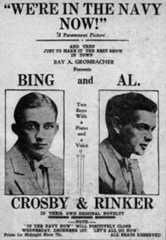 rty Theater in Spokane (alternating with the filmWe’re in the Navy Now) giving fourperformances each day and earning $175 each. During their stay, a thief stealstheir money from the dressing room while they are on stage.
CROSBY, RINKERWIN HOME TOWN
Spokane Boys Who AreCatapulting Into Fame “Get Over” at Liberty.
“Bing” Crosby and “Al” Rinker, two Spokane Boys with anunquenchable desire to burst into music and song, last night “arrived” in theirhome town with presentation of their act at the Liberty midnight matinee.
The two Spokane entertainers left the city a year ago to seektheir fortune on the Coast. Gradually reports drifted back to old friends oftheir marked success before audiences of California. After the manner of friends the reports werediscounted, but last night every one in the audience who knew the pair even bysight at once joined the "I knew him when” club.
Rinker plays the piano and adds his bit of vocal acrobatics tothe singing of Crosby. About the only innovation from the usual piano and songnumbers of vaudeville, is that the piano is only an abridged edition in sizeand Crosby spices the jazz selections with timely crashes on a diminutivecymbal. It isn’t what the boys do, but the way they do it.
The pair has been signed by Paul Whiteman and his band toappear on Broadway this winter. After their remarkable reception last night bya “hard-boiled” hometown audience there is little doubt that they will succeedin the East.
(Spokane Daily Chronicle, November 25, 1926)
…then,in addition to “We’re in the Navy Now,” there is “Bing” Crosby and “Al” Rinker.What an ovation the boys received as they appeared behind the lights. Timeafter time they were called back for more songs. If they doubted they would notmake a hit in their home town it was dispelled last night. After the show bothboys admitted that it was the most trying and nerve racking time they ever wentthrough.
BingCrosby said: “It’s easy to appear before people you don’t know, but when youknow your brothers, sisters and parents besides most of the old gang you wentto school with are in the audience it makes one a little shaky.”
(The Spokane Press, November 25, 1926)
November 27, Saturday. (10:00-12:00 p.m.) Bing and Al perform atthe after-theatre dance in the Italian Gardens at the Davenport Hotel inSpokane. They are billed as “Two Boys with a Piano and a Voice.”
November 28, Sunday. After their performance at the LibertyTheatre, the boys catch a train for Chicago where they stay at the EastgateHotel on Michigan Avenue.
November 29–December 4,Monday–Saturday. Paul Whiteman is at the Chicago Theater, Chicago.
December 6–12, Monday–Sunday. Bing and Al open with Whiteman at theTivoli Theater in Chicago and are a hit. They give four shows a day.
The first evening show wasabout to start and we were all made-up and ready. There was a full house outfront. Whiteman told us that we would go on about the middle of the show andthat he would introduce us as Crosby and Rinker, who were making their firstappearance with his band. Well, our turn finally came and Paul walked out andstarted our introduction. What he said was far different than what we hadexpected. He told the audience that he had heard two young boys singing in anice cream parlor in a little town out west, called Walla Walla. “They sang somesongs and I wondered what they were doing in Walla Walla. These kids were good,too good for Walla Walla, so I asked them to join my band. This is their firstappearance with the band and here they are. I want you to meet Crosby andRinker. Come on out boys.” The little piano was moved on stage and Bing and Icame out from the wings. All I know is that we got a big hand after our firstsong and even more applause on our second number. To top it all, we were calledback for an encore. That was our first appearance on the big time. You can betwe were two happy guys. Whiteman came over to us after the show and said,“Well, how do you feel? I knew they’d like you. Welcome to the band!”
(Al Rinker, writing in hisunpublished memoir, as reproduced on page 149 ofBing Crosby, A Pocketful of Dreams, The Early Years, 1903-1940 byGary Giddins)
“Music’s the same all over,” Popssaid. “They liked you in Los Angeles and they’ll like you here. You’ve nothingto worry about. Just do your stuff the way you’ve already done it.”
We listened, and when we walked outthere to face our first matinee audience, we were cocky on the outside, butinside the butterflies were fluttering restlessly.
Pops introduced us by telling thecrowd, “I want you to meet a couple of boys I found in an ice-cream parlor inWalla Walla.” Afterward he told us he’d picked Walla Walla because its namesounded funny to him. Funny or not, it struck exactly the right note. We wentout there, did our stuff, and if I do say it, we were very big. I’m confidentthat oldsters who attended the Tivoli Theater on Chicago’s South Side in thosedays will bear me out in this.
(CallMe Lucky, page 44)
December (undated). Bing sees Louis Armstrong perform at theSunsetCafe, Chicago.
December 13–19, Monday–Sunday. The Whiteman show moves to theUptown Theater in Chicago.
December 16,Thursday. Paul Whiteman and his band appear in anall-star program for the 15th. Annual Chicago Herald and Examiner ChristmasBasket at the Erlanger Theatre. Also appearing are George Jessel, the MarxBrothers, Ethel Waters and the Brox Sisters.
December 22, Wednesday. (2:00–5:20 p.m.) In the Orchestra Hall, Chicago, Bing and Alrecord “Wistful and Blue” with Paul Whiteman and his Orchestra for the VictorTalking Machine Company. Another song “Pretty Lips” is rejected after fourtakes.
The first recordby Crosby and Rinker, Spokane boys now with Paul Whiteman, the “king of jazz,” incollaboration with Whiteman’s orchestra was released recently by Victor and isbeing sold in local music houses. “Wistful and Blue” is the name of theselection, and is said to be an excellent reproduction of their unusual methodof putting over their numbers. Spokane people who heard this team at theLiberty theatre and at the Davenport hotel during their stay here in Decemberwill recognise their style of syncopation.
(Spokane Daily Chronicle, February 22, 1927)
The session’sonly acceptable number was a rendition of Ruth Etting’s “Wistful and Blue.” Coupledwith an instrumental from the day before, it was the first of nearly onehundred titles Bing and Al recorded under Whiteman’s aegis. Dated as it istoday, their record debut was novel in 1926. Max Farley, a Whitemansaxophonist, arranged “Wistful and Blue”’s oddeighteen-bar theme forthe orchestra, but the vocal chorus was treated separately; the singers werebacked by viola, guitar, and bass. Matty Malneck, waiting for this kind ofopportunity, arrangedthe vocal passage, using his viola as a thirdvoice in unison with Bing and Al. With Wilbur Hall strumming guitar and JohnSperzel keeping a yeoman beat on bass, they sing a straight chorus with atwo-bar break, followed by a stop-time scat chorus that evolves into a chasebetween voices and viola. Rinker’s voice dominates the duet, but it was thegeneral jazziness of the vocal interlude—not the individual talents of thesingers—that made the record a turning point for Whiteman; this zesty brand ofsinging was unknown to most of his public. Bing credited Malneck’s arrangementwith helping him and Al forge “a new style ... a vocal without words.”
(Gary Giddins,BingCrosby, A Pocketful of Dreams, The Early Years, 1903-1940, pages 150-151)
December 24,Friday. The Whiteman troupe travel to St. Louis.
December 25–January 8, Saturday–Saturday. The Whiteman ensemble is at theAmbassador Theater, St. Louis, where they break all house records as a total of113,223 people pay $57,761 to see them in the first week. They give five showseach day at 1, 3, 5, 7 & 9 p.m. as part of a cine-variety show. They hadonly been booked for one week but they are held over because of the demand tosee them.
Paul Whiteman and his band,making their first appearance in a local movie house, is the main attraction,and he gives the audience just what it wants and almost as long as it wants itfrom Gershwin’s ‘Rhapsody in Blue’ to ‘Pop Goes the Weasel.’
(St. Louis Post-Dispatch, December 27, 1926)
There are other features onthe Ambassador program this week, but they pale before the stage presentationof Paul Whiteman in person and his orchestra of thirty. ‘The Girl Friend’serves to get the audiences acquainted with the band as a whole and ‘Meet theBoys’, the bandsmen as individuals. Whiteman says: “I am so proud of them, Iwant you to meet them personally.”
Gershwin’s ‘Rhapsody in Blue’ is on the list, as are severalother selections, offered as harmony numbers, solos, duets and otherwise bysingers, and in various ways by the musicians. ‘Mary Lou’ and ‘Pop Goes theWeasel’ form the backbone of two other stunts. The band is excellent, but it ison Whiteman himself, that the interest centers at all times.
Whiteman’s cherubic grin, roly poly wiggles of syncopation andjazz squeal that seems to say: “Well, how do you like us?” had the Christmascrowds at the Ambassador literally crying for more…
(St. Louis Daily Globe-Democrat, December 27, 1926)
…Crosby and Rinker,the two who were discovered by Paul in Seattle, are next heard from, oneplaying the piano while they both sing. Their stuff clicks and they were forcedto take three encores when reviewed. (December 28).
(Billboard, January 8, 1927)
... Then there is Paul Whiteman on the stage for a second week. It is wellworth anyone’s while to spend another half-hour or so listening to him again.He has changed the color scheme of his stage to blacks and dull golds, carriedout in the suits, the instruments and the really gorgeous beaded curtain thatserves as a background. His music is the same so far as excellence goes. It isjazz at its pinnacle. What more need be said? The program has been changed, ofcourse, to ‘In a Spanish Town’ and other numbers Whiteman has made popular onthe air, on records, in theaters, at dances, and such.
His musicians, individually, are given opportunities again toscore with specialties of their own—particularly the two-man jazz band, whose‘Baby’ and ‘Red-Hot Mamma’ lyrics have made harmony history.
Last, but by no means, least, his cherubic-faced majesty, Paulhimself, is even more willing to please and more genial than he was last week—if that is at all possible!
(St. Louis Daily Globe-Democrat, January 3, 1927)
1927
January 7,Friday.Whiteman plays at The Palm Room of the Hotel Chase in St. Louis.
January 9–15, Sunday–Saturday.Whiteman show at the Allen Theater, Cleveland, Ohio.
Program is a diversified,expertly staged affair, offering first rate entertainment. There is someingratiating clowning between Henry Busse, a clever cornetist, and Whiteman,whom he resembles. Wilbur Hall cuts up on a violin a la Joe Termini’s style,and provides some melody with a bicycle pump. Rinker and Crosby put acrossseveral familiar songs in a rousing fashion, while ‘Snowball’ Harris isespecially good in his dancing and banjo specialties.
(Cleveland Plain-Dealer, January 11, 1927)
By the third day, word hadspread that there would be no Whiteman broadcast. The crowds then began toflock to the Allen, breaking attendance records. And the music soon madebelievers out of even the most hardened critics like Eleanor Clarage of theCleveland Plain-Dealer. . . . ToClarage, accustomed to symphonic offerings, Al Rinker and Bing Crosby wereindeed an enigma. She couldn’t fathom “why the band allowed itself to beinterrupted for the none-too-clever pair of young men who did the occasionalharmony stunt at the piano in scarcely audible voices. It seemed a crime to letanything hold up the gorgeous orchestral music, yet the audience stamped andhowled and drowned out Whiteman’s next orchestral section with its insistentapplause after these mediocre entertainers signified that their last encore hadbeen given.” This gives one some idea of how well Rinker and Crosby were faringwith Midwestern audiences. Their act represented something new and fresh thatgreatly appealed to Whiteman’s followers. The lack of volume in their singingwithout the aid of microphones, would soon catch up with them, however.
(Paul Whiteman, Pioneer in American Music, page 152)
January 16–22, Sunday–Saturday.The Whiteman troupe moves on to the Hippodrome, Youngstown, Ohio, where theygive four shows daily at 2:00 p.m., 4:30 p.m., 7:00 p.m., and 9:30 p.m.
Paul Whiteman has taken theword jazz and made it signify joy, art, zip, and zest…Two of the boys in theband [Crosby & Rinker] sing a la Van and Schenk, and are artists of realability.
(TheYoungstown Vindicator,January 17, 1927)
January 21,Friday.The Orchestra plays for the Youngstown Kiwanis at the YMCA, beginning at 12:15p.m.
January 23–29,Sunday–Saturday. Whiteman and his group are at the Circle Theatre,Indianapolis. The show is put on four times daily.
He has a positive sensationin Rinker and Crosley [sic], two harmony singers, one playing the piano. Hereis an intimate singing duo that uses a new way of putting over their numbers.Stopped the show cold, and Whiteman was so grand that he allowed them to be asensation. The man knows how to please an organization.
(Indianapolis Times, January 24, 1927)
January 29,Saturday.The Whiteman band plays a dance date at the Columbia Club in Indianapolis at10:00 p.m.
January 30–February 5, Sunday–Saturday. Whiteman at the newly remodeled Castle Farm, Cincinnati.
February 7,Monday. The Whiteman troupe arrives at Grand Central Station, New York, in themorning and Whiteman is taken by motor parade down Broadway to City Hall wherethe acting mayor greets him. The parade goes on to the Paramount for a “grandballyhoo” and then to the Hotel Astor for a “welcome home” lunch.
February 10,Thursday (1:30–5:20 p.m.). Bing and Al are part of a vocal group which recordswith Paul Whiteman in New York for Victor.
February 12–18,Saturday–Friday. Whiteman is at theParamount Theater in New York in acine-variety show. He is paid a salary of $9500 for the week. The 48-minute show opens onFebruary 12 and Bing and Al receive favorable comment inVariety magazine of February 16.
From the coast, he hasbrought in Rinker and Crosby, a smart two man piano act who sing pop dittiesdifferently and are of the Van and Schenck class. After Whiteman gets throughgrooming the boys, they’ll be plenty in the money. At the Whiteman restaurant,they will be even more impressive. . . . Rinker and Crosby vocalized twonumbers and accepted as many encores.
Unfortunately, the Crosby and Rinker actcannot be heard in certain parts of the theater and, at the request of thetheater management, is withdrawn after only three performances. Thereafter Bingand Al sing in the lobby to the overflow crowd waiting to enter the theater.
February 18,Friday. Paul Whiteman’s “Broadway at 48th” Club opens on the site of the formerTrianon at 11:00 p.m. in front of a host of celebrities, including the brotherof the King of Spain and Charlie Chaplin. The orchestra is advertised asplaying during dinner and supper. Crosby and Rinker are hardly noticed whenthey perform during the intermission and they are eventually relegated to fillin as stagehands pulling back the curtains.
Whiteman’sorchestra of 33 is guaranteed $6,000 a week, which isincluded in the running expenses of the room.This about covers the Whiteman salary “nut.” Of the profits, Whiteman receives50 per cent, which is estimated shouldrun over $10,000 a week for Whiteman personally at that gait.
(Variety, March 2, 1927)
February 25,Friday. (1:45–4:15 p.m.) More group work for Bing and Al on “That SaxophoneWaltz” at a recording session in New York with Whiteman for Victor.
February 28,Monday. (1:45–4:30 p.m.) Bing and Al record “Pretty Lips” with Whiteman, thistime successfully.
March 3, Thursday.Bing and Al record “I’m Coming Virginia” but all four takes are rejected.Elsewhere, a son, John Dennis, is born toLarry and Elaine Crosby.
March 7, Monday.(1:45–4:00 p.m.) Bing records “Muddy Water” with Whiteman in New York forVictor. His first solo, albeit only a chorus, and without label credit.
Victor No. 20513 and No. 20508. Three-quartersPaul Whiteman on these two records. The first is all Whiteman. “It All Dependson You” and “That Saxophone Waltz” are an excellent coupling and “Muddy Water”with “Ain’t She Sweet” (Nat Shilkret) are equally fetching.
(Variety,April 20, 1927)
Three days after that, on March 7,at New York’s Liederkranz Hall, Whiteman’s faith was rewarded as the band essayedanother Malneck arrangement, “Muddy Water,” a song recently introduced by HarryRichman, the egocentric headliner who graduated from burnt cork totop-hat-and-cane elegance.Itwasthe work of white composer Peter De Rose, at the outset of a career thatproduced “Deep Purple” and “Wagon Wheels,” and black lyricist Jo Trent, whose“Georgia Bo-Bo” Louis Armstrong had recorded the previous year.Thistime Al was left out altogether.
“Muddy Water” did not electrify the music world.Itwas no “Heebie Jeebies” or “Heartbreak Hotel,” thoughsales were respectable. Yet Crosby’sfirst recorded chorus—thirty-two measures—was every bit as radical. Nothingremotely like it had been heard before. The song, with its bucolic theme of anidyllic life “down Dixie way,” wascannilyappropriate for a Dixiephile like Bing. Yet his delivery is neverpatronizing or sentimental. He bets everything on his rhythmic phrasing andgives each word its due. The introductory trombone, answered by strings, and abold unison ensemble chorus promise a jazz record; but only the vocal, backedby viola and rhythm, make good on the promise. Though stilted and even formal,Bing’s time and articulation are assured, especially onthe bridge, where he emphasizesthereandcarewithtrilling vibrato that displays his growing affinity for swing.
No singer had ever come close to swinging on aWhiteman record or with any other white ballroom band…Crosby’s very presence was singular. He was the first ever full-time band singer,not an instrumentalist who doubled vocals.
(Gary Giddins,Bing Crosby, A Pocketful of Dreams, TheEarly Years, 1903-1940, pages 156-157)
March 9,Wednesday.Variety quotes the cabaretbill at the Paul Whiteman Club as being the Paul Whiteman Orchestra and the“Whiteman Boys.” The latter act presumably includes Bing and Al Rinker.
March 22–May 21,Tuesday–Saturday. The Whiteman troupe is featured in the musical comedyLucky starringMary Eaton at the New AmsterdamTheater.Ruby Keeler andSkeets Gallagher are also in the cast. The Whitemanband appears each night for twenty-five minutes at about 11:00 p.m. in a NewYork cabaret sequence late in Act Two and plays five numbers. Bing and Al sing“Sam, the Old Accordion Man.” High prices have to be charged to cover the costof including the Whiteman orchestra. The show, which has matinees on Wednesdaysand Saturdays, lasts for only seventy-one performances. The orchestra alsocontinues to perform at the Whiteman night club during this period.
…Thebig smash in the second act is Whiteman and regardless of Whiteman’s ultrasyncopation, it is a far better second half than the first act. The dramaticaction is excellently built up, and where the initial stanza relied too much onimpressive scenic gorgeousness for general effect, there is more genuineentertainment and comedy in the first two scenes of the last act when, ofcourse, the Whiteman smash cinches everything. Discounting a favorable positionfor the ultra type of Whiteman’s symphonic syncopation, there is no questionbut that Whiteman is the biggest individual click of the evening. His concertalone makes the show very worthwhile.
Comingon at close to 11— about five minutes of— he held them until 20 after, and thatis no small assignment, considering the hour. The tardiness of the getaway isprobably the only criticism of the entertainment. It should be speeded up foran earlier curtain, and there is room for elision in that first half.
Whitemanwas impressively set in a maize and blue setting, opening with “When Day IsDone,” followed by an unabridged version of “Rhapsody in Blue.” Wilbur Hall wasbut mild with his fiddling, and might concentrate only on the bicycle pump“music.” The colored midget clicked heavily with his banjo and hoofingcontributions, and Whiteman showed how “Sunday,” “Sam, the Old Accordion Man”and “In a Little Spanish Town” should be glorified musically.
Whiteman’s score at the Amsterdam determines beyond a doubtthat Whiteman belongs primarily on the stage. It is only in the confines of atheatre or concert hall auditorium, with an attentive audience, not confused bybooze or babble, that the charm of Whiteman’s blah-grade syncopation is bestappreciated. His 28 men are the last word in ultra syncopation.
(Variety, March 30, 1927)
With book andlyrics by Otto Harbach, Bert Kalmar, and Harry Ruby and score by Jerome Kern,and with supporting performances by Walter Catlett, Skeets Gallagher, and RubyKeeler, it seemed to have everything going for it. Paul Whiteman’s orchestraalso played in the second act ofLucky,including a version of Gershwin’s “Rhapsody in Blue.” And even though that wasa very popular attraction, it was not enough to keep the show going very long.(It seems clear, looking back, that any musical comedy that pauses for“Rhapsody in Blue” in its second act is bound to have problems.) Each evening,the show ran until a quarter to midnight, and even those who liked the showthought that it was simply too long. And there was not a compelling story tohold it all together or memorable songs (“Dancing the Devil Away,” “When theBo-Tree Blossoms Again,” and “The Same Old Moon”). That same year, Kern wasdoubtless pouring his genius intoShowBoat, not intoLucky. While ithad a lot going for it, the show’s tragic flaw was its extravagance, Dillinghamtried to outdo Ziegfeld in extravagance and splendor and it proved very costly.The reports were that Dillingham ended up losing $133,000.
During the run,Charlie (Eaton) got acquainted with Bing Crosby, who was one of the threeRhythm Boys with the Whiteman orchestra, and they would visit each other inHollywood in the years to come. It was Charlie who introduced Dixie Lee to Bingon a movie set in Hollywood in 1929, when Charlie was filmingHarmony at Home.
(Doris Eaton Travis,The Days We Danced, page 111)
Inorder to appear in a Broadway show, Paul won a release from his Publix contracttwo weeks before the new production opened on March 22. Producer CharlesDillingham had offered the Whiteman orchestra $9,500 a week, a record high in1927.Lucky proved to be misnamed.Though it had songs by Jerome Kern, Bert Kalmer [sic], Harry Ruby, and OttoHarbach, and a cast led by Mary Eaton, Ruby Keeler, and Walter Catlett, theproduction generated little enthusiasm when it came into the New AmsterdamTheatre. There was not much Paul and his men could do with the lacklusterscore. In every direction, theater marquees beckoned with competing offerings:The Desert Song, Oh, Kay!, Honeymoon Lane,Rio Rita, andPeggy Ann.Lucky remained among them for only nineweeks.
…Oneof the few bright moments inLuckycameabout because Paul insisted on giving Crosby and Rinker a feature spot. Becauseno number in the score seemed suitable for the duo, he picked up a Tin PanAlley tune, “Sam, the Old Accordion Man,” and added his band’s Mario Perry onthe accordion. The number went over big at a time when Paul was wondering whatto do with the two musicians from Spokane.
(Thomas A. DeLong,Pops – Paul Whiteman, King of Jazz)
April 13,Wednesday.The new floorshow at the Paul Whiteman Club opening today is said to include“the following entertainers from Whiteman’sOrchestra:Henry Busse, Jack Sperzel,Wilbur Hall and Big Crosby[sic].”
Duringthe spring of 1927 Whiteman endeavoured to break into the night-club businesswith his ill-fated “Whiteman Club”, but though the venture as a whole wasdoomed to failure, it was responsible for the recognition one afternoon of thetalents of a young rhythmic vocalist-composer, Harry Barris, then appearingwith the orchestra of George Olsen. Whiteman gave him an immediate contract andthus, with Rinker and Crosby, completed the unique vocal trio who were toachieve world fame as “Paul Whiteman's Rhythm Boys”.
Thencame the most significant move of all. In April, 1927, Whiteman approached RedNichols and his Five Pennies to join his orchestra en masse. Red Nichols andJimmy Dorsey signed on with the maestro at once and were in time for animportant session on the 29th April, at which “Side by Side” and “I’m Coming,Virginia” were recorded. Of the remaining Pennies, Joe Venuti, Eddie Lang andVic Berton all joined Whiteman within the next few weeks, though in eachinstance their stay was of short duration. Venuti, who preferred playingone-nighters, and his partner Eddie Lang, soon returned to Atlantic City; andVic Berton, who did not find the Whiteman style greatly to his liking, left atthe end of May, having, nevertheless,” contributed his distinctivecymbal-beating to the various recordings made during that month.
(Charles H.Wareing and George Garlick,Bugles forBeiderbecke, page 136)
April (undated).The duo becomes a trio whenHarry Barris joins them onMatty Malneck’ssuggestion and the new group becomesPaul Whiteman’s Rhythm Boys one monthlater.
Byan odd quirk of fate, it was Paul’s father who rescued Bing and Al. TheProfessor had urged one of his popular vocal students to go to New York for anaudition with his son. The young man had demonstrated his talent in manymusical productions in Denver. Wilberforce wrote Paul, “He can write songs. Heis a quick and a very bright boy.” Harry Barris arrived at Paul’s office inMarch 1927, brim-full of ideas and suggestions.
“Tellme what you think I can do with Crosby and Rinker” asked Paul. “They’ve bombednearly every place since we came back to Manhattan.”
“Iknow one thing, I’d like to be on stage with you.”
“I’mloaded with singers. I’ve a half-dozen in the band now. I’ve got more singersthan a sewing machinefactory.”
“Ican do more than just sing. I write songs.”
“Let’shear a few. Maybe you could bring some new life into those Walla Walla Indians.How would you warm up their hambone stew?”
“First,”Harry replied, “I’d add myself and another piano to the act. Then I’d put insome slapdash humor. That would wake up the folks. I’m sure I can fix up theact.”
Paulagreed to hire the confident newcomer from Denver. “You’ll start at 75 bucks.If this trio flies, you get 150—the same as Al and Bing.”
Anew team was born. Harry wrote a jazzy tune called “Mississippi Mud” to launchthe act. He rehearsed it thoroughly. As they worked together, his enthusiasm spreadto Al and Bing, and they pushed harder than ever. Their verve and polishattracted everyone’s attention. Bing and Al were back in the spotlight with anew partner. Calling themselves the Rhythm Boys, they used three-part harmonyon the numbers that Bing and Al had been doing, added new songs, and brought intwo pianos.
(Thomas A. DeLong,Pops – Paul Whiteman, King of Jazz)
We fooled around with someideas and we tried out some three-part harmony. . . . One of Harry’s tricks inhis solo act was to slam the top of the piano for an effect and make the soundof a cymbal with his mouth. This sounded great and all three of us were gettingour kicks at the way we sounded. We all came up with ideas. Bing took most ofthe solo parts and Barris and I would fill in with answers or a rhythmic scatbackground. Although we weren’t conscious of it, we were creating an entirelynew style of singing pop songs. We were far more jazz oriented than any othersinging group of that time. . . . We were greatly influenced by the great jazzmusicians we had heard and were working with. We were very free anduninhibited. We had a solid beat in our rhythm numbers, but we could also givea pretty ballad an individual and personal feeling. In two more days we had puttogether two complete songs, “Mississippi Mud” and “Ain’t She Sweet.” We sangthe songs for Matty Malneck and he was bowled over.
(Al Rinker, as quoted inBing Crosby, A Pocketful of Dreams,pages 161–162)
April 19,Tuesday.Everett Crosby marries Naomi Marcellus in Los Angeles. Everett isdescribed as being with the Federal Motor Trucks company in Los Angeles.
April 29,Friday.(1:30–4:00 p.m.) Bing and Al again record “I’m Coming Virginia” with PaulWhiteman and his Orchestra. This time it is a success. Harry Barris joins Bingand Al to record “Side by Side” with Whiteman.
Bing was more himself onMalneck’s adaptation of “I’m Coming, Virginia,” the song he and Rinker hadflubbed at a previous session, with Barris adding only a hot-cha-cha coda. HereBing captures the originality of “Muddy Water,” combining his deft time with afull, relaxed articulation of the words. Contrary to Al’s suggestion of adiligent jazz influence, two surviving takes show that their scat routines wereworked out to the last detail. Yet Bing’s imperturbable vocal, Matty’s writing,Nichols’s solo, and the band’s skill combined to make “I’m Coming, Virginia”the best and most authentic jazz record Whiteman had ever made.
(Gary Giddins,Bing Crosby, A Pocketful of Dreams, TheEarly Years, 1903-1940, pages 162-163)
May 6,Friday. Further recording session with Whiteman at Liederkranz Hall inNew York as part of a vocal group.
May 9,Monday. Another recording session atLiederkranz Hall. Bing is part of a vocal group singing, "I'm in Love Again".
May (undated).Writes toBobbe Brox who is on tour with the Brox Sisters in Philadelphia.
I'm sickof this town, the inhabitants thereof, and the appurtenances thereto. Work dayand nite, with no opportunity for any healthy recreation and only able to findamusement in the solace of rum with its subsequent discomforts. I got a strongyen on to get from here, preferably coast work and unless things take anunlooked turn for the better shall gratify said yen.
Business at the club is a bit sad and the same is true of the show. Itappears as tho the 1st of June will find both jobs terminated, praise God! Andthen I believe we go into the Paramount for 10 weeks. Imagine the unalloyedpleasure of 5aday in Midsummer in New York. No golf, no ball games. Odzooks!Tis most disconcerting.
I might run down there next week if I can make it. If you come to towndon't neglect to call me. Hope the surroundings in staid Phillie have quieteddown your urge for companionship and revelry.
Lotsa Love
Bing
May 22, Sunday.Whiteman gives a one-hour concert at the Century Theater in New York city as a benefit forSaranac Lake Day Nursery. (The Saranac Lake Day Nursery was founded in the early 1920s by theatricalagent William Morris and members of the Friars Club to care for children oftuberculosis patients in Saranac Lake, New York.)
May 24, Tuesday.(1:00–4:40 p.m.) Bing, Al Rinker and Harry Barris record “Magnolia” withWhiteman. They are not yet billed as “The Rhythm Boys.” That night, the PaulWhiteman Club closes for the summer and in fact it is sold during August andthe name is changed.Variety on May 18had discussed the impending closure stating, “Only caterer made money.”
May 25,Wednesday.Variety states thatCharles B. Dillingham has suffered a net loss of $270,000 on his production ofLucky which closed on May 21.
June 4–10,Saturday–Friday. The Whiteman troupe returns to the Paramount in New York at$9,500 for the first two weeks and $10,500 per week thereafter. The showstarting on June 4 is calledRhapsodylandand it alternates with the film. A favorable review is seen inVarietyon June 8.
…so a word instead for that new vocal trio, “Bing”Crosby, Al Renker (sic), and Harry Barris who made their spot a stellar opportunityin itself.
...The trio scoredwhen Paul and the band returned to the Paramount in June 1927 for six weeks—anunprecedentedly long run, to the tune of $10,500 a week. The movie being shownwas a first-class comedy,Running Wildwith W. C. Fields, but the stage attraction outlasted several Hollywoodfeatures. Ruth Etting, rejoining Paul, pleased New Yorkers with her modulated,almost crooning voice. Monologist Charles Irwin provided comic relief, andorganist Jesse Crawford opened all the stops on his mighty instrument. Paul andthe gang entertained a capacity house intent on enjoying the biggest and mosthighly acclaimed band in the country. Whiteman gave his audiences the best musicalvariety show in town, with such production numbers and musical finales as“Rushia,” which put the Whiteman group in Russian dress, and “U.S.S.Syncopation,” which had everyone wearing sailor suits. The costly presentationsalso included an “Ali Baba” segment featuring Vanda Hoff Whiteman in herdancing comeback. Working with Paul and the band on stage gave Vanda a chanceto see more of her frequently absent husband. His never-ending publicappearances meant that she could enjoy little or no home life. The marriagesuffered as his million-dollar organization demanded more and more of Paul’stime. And no doubt about it, Paul preferred the excitement of Broadway and theroad to an easy chair in front of the fire.
(Thomas A. DeLong,Pops – Paul Whiteman, King of Jazz)
June 11–17, Saturday–Friday. Whitemancontinues at the New York Paramount and this time the show is calledRushia!
It’s tremendous in volume and magnificent in effect.It’s the ‘1812 overture,’ with Whiteman’s band on the stage, the pit orchestra,and Jesse Crawford at the organ, all under Whiteman’s leadership.
(Variety,June 15, 1927)
June 18, Saturday. Bing’s sister, Catherine, who has married Edward Mullin, givesbirth to a daughter, Marilyn.
June 18–24,Saturday–Friday. Whiteman still at the Paramount and the show is now calledS. S. Syncopation.
…the highmark of which wasRuth Etting and a “hot” singing threesome from the band personnel.
(Variety, June 22, 1927)
June 20, Monday.The Rhythm Boys make their first “official” records, including “MississippiMud” in New York.
Paul Whiteman’s Rhythm Boys make their debut with anonsense medley of dittiesthat include four different copyrights: “Sweet Li’l” and “Ain’t SheSweet?” on one side; “Mississippi Mud” and “I Left My Sugar Standing in theRain” on the other.
(Variety, August 3, 1927)
The variety of jazz put intothese pieces is distinctive and unique and includes rapid fire patter, bits ofsolo work, minor chords and close harmonies with deft business on the piano andwith the cymbals.
(Spokane Daily Chronicle, August 23, 1927)
Paul Whiteman’s Rhythm Boys,three members of his famous band, give us a really entertaining record and onethat I advise everyone to buy with “Sweet Li’l—Ain’t She Sweet” and“Mississippi Mud—I Left My Sugar Standing in the Rain” (HMV B2562). (TheGramophone,December, 1927)
Midway throughthe Paramount run, the Rhythm Boys formally debuted on records, singing thefirst two numbers they had rehearsed, now tricked up as medleys and accompaniedonly by Harry’s piano and Bing’s cymbal whacks. “Mississippi Mud” is oddlystructured: a twenty-two-bar chorus with a sixteen-bar middle section. Thelyric is catchy (though marred by the termdarkies,which was eventuallychanged topeople),and the melody is propelled by accents on the firstbeat of almost every measure. Bing recorded it three times over the next sevenmonths. Though the Rhythm Boys’ version is not as effective as those thatfollowed, it confirmed the trio’s style as part music and part wisecrackingcomedy. A scat passage introduces them one at a time: Bing, then Al, thenHarry, who finishes with ahahh.After a unison chorus in which Bingtakes the lead in the middle section, the patter leads to an interpolation of“I Left My Sugar Standing in the Rain,” where Bing displays for the first timeon record his sustained balladic tones as well as his humor and wordplay - inthe spin he puts on the spoken phrase “I don’t know” and the spoonerism“irregardless and respective.” The second number employs “Ain’t She Sweet” as arapid windup to Barris’s “Sweet Li’l.” Bing instructs the others at the outset,“If it’s gonna be good it must be fast,” and when they close with an exchangeof scat breaks, he mimics a tuba(bub-bub-bub bub-a-bub-bub-bub),themodest beginning of a trait for future mimics.
Thoserecordings are not especially good, anddarkiesaside, have not aged well.Barris is too jumpy, though Rinker proves fairly adept at scat, and the humoris intrusive. Still, “Mississippi Mud” became hugely popular, and theyperformed it nightly at the Paramount and at the Whiteman club, establishing itas their signature song. Everyone who saw them remembered the number as a JazzAge anthem. It secured Barris’s role as the new brains of the outfit,supplanting Al, who was both grateful and annoyed.
(Gary Giddins,Bing Crosby, A Pocketful of Dreams, TheEarly Years, 1903-1940, pages 164-165)
June 25–July 1,Saturday–Friday. Whiteman continues at the Paramount in a show entitledJazz A La Carte. Ruth Etting continues in the show.
July 2–8,Saturday–Friday. Whiteman remains at the Paramount with a show calledFireworks. Tommy Dorsey joins the band.
It’s in patriotic tempo withelectric pinwheels and effects for the final curtain…Three boys, two of themCrosby and Rinker, the blues yodelling plebes from Spokane, had a cute numberin front of the band, using pop guns. The presentation was zippy colorfulentertainment all the way.
(Variety, July 6, 1927)
July 6,Wednesday. (10:00 a.m.–12:15 p.m.) Bing and Al are again part of a hummingvocal group that records ‘My Blue Heaven’ with Whiteman in New York. ‘My BlueHeaven’ goes on to top the various charts of the day.
Victor No. 20828 — “My Blue Heaven” and “All by My Ownsome,” by Roger Wolfe Kahn and orchestra (the number composed by theconductor) are a pair of fine fox-trot contributions by two “name” maestros.“Blue Heaven” introduces thatunique Whiteman quintet (Fulton, Gaylord, Young, Rinker and Crosby) in anovelty vocal chorus arrangement. It is one of the best records made byWhiteman.
(Variety, September 7, 1927)
July 9–15,Saturday–Friday. Whiteman’s “grand farewell party” at the New York Paramount ina show dubbedAli Baba.
Curtain arose with the fakirand his crew doing their garbed chant in front of scrim and Whiteman making hisentrance in tropical garb. Scrim goes up and reveals the Whiteman crowd all inoriental dress, doing their stuff under the direction of Henry Busse.
(Variety, July 13, 1927)
July 31–August 7,Sunday–Sunday.The Whiteman band appears at the Eastman Theatre in Rochester, New York, giving four 30-minute performances daily and receiving$11,000 for the week’s engagement. The performance on August 1st is dislocatedby a power failure but Whiteman and his musicians, using flashlights andcigarette lighters, continue to entertain the crowd.
Paul Whiteman adverts panicin theatre
Rochester and scores of western New York citiesand bridges were plunged into darkness for nearly an hour last night when allelectric power was cut off following a severe electrical storm.
Three thousand persons in the Eastman theatrewere thrown into a panic by the failure of the powerlines and started a madrush for the exits. Paul Whiteman, orchestra leader, struck up music and savedmost of the audience from possible injury. Those who did get to the streetsarrived in time to see five manholes in the main street blown into the air bysome disturbance beneath the surface. Fire was burning in the cables under thestreet…
Whiteman, the “King” of American jazz artists, croonedthe audience into calmness with his forty-piece orchestra. Plungedsuddenly into darkness in the midst of a lively number, nearly two scorefrightened men and women climbed up in their seats and begin to rush for thedoor. Whiteman, hearing the commotion took instant command of the situation.Seizing two flashlights used in a feature number, he flashed them off his face.
“I'm still here,” he shouted to the audience.
Passing from one side of the stage he flashed thelights on the faces of the players.
“We’re all here,” he cried. “We’ll stick if youwill.”
The frightened patrons sat down.
(The Evening Sun,August 2, 1927)
August 2,Tuesday. The Rhythm Boys present a short program at 7pm. on station WHEC in Rochester.
Paul Whiteman’s trio will broadcast here.
The three “hotsingers,” prominent members of Paul Whiteman’s band, that heads the EastmanTheater bill for this week will feature the broadcast over Station WHEC at 7 o’clocktonight. The trio, composed of Bing Crosby, Harry Barris and Al Rinker willpresent some of the two-piano numbers and jazz songs which they give as part ofthe regular Whiteman program. Their selections on the current Eastman Theaterprogram have proved very popular, according to the management. In order to allowthe musicians time to get back to the theatre for their 7:30 o’clock performance,the program over station WHEC will commence promptly at 7 o’clock.
(Democratand Chronicle, August 2, 1927)
August 8–21,Monday–Sunday.Paul Whiteman and his troupe appear atthe Stanley Theatre in Philadelphia.
…There was an uproarious bit of broadlyburlesqued female impersonation and a “nut” interpretation of “Mississippi Mud”by a singer and two topsy-turvy pianists...
(The PhiladelphiaInquirer, August 9, 1927)
August 14,Sunday.The Rhythm Boys plus Paul Whiteman,Jimmy Dorsey,Matty Malneck and others goto Young’s Million Dollar Pier in Atlantic City whereJean Goldkette’sGraystone Band is playing. Whiteman offers jobs toBix Beiderbecke,FrankieTrumbauer andBill Challis. Bix and Frankie decline the offer although Challisaccepts.
August 16,Tuesday.The Rhythm Boys are used in a morningrecording session with Whiteman starting at 9:00 a.m. in Camden, New Jersey andrecord “The Five Step”.
August 19,Friday.Bing is one of several vocalists on a recording of “The Calinda” with theWhiteman orchestra. Another morning session starting at 9:00 a.m. in Camden,New Jersey.
August 20,Saturday. Commencing at 9 a.m., The Rhythm Boys record “It Won’t Be Long Now”with Whiteman in Camden, New Jersey.
Victor No. 20883 — Paul Whiteman with somemore “Manhattan Mary” music,“It Won’t Be Long Now” and “Five-Step”.They are in an unusual Whiteman vein, futuristic, fast and funny in theirinstrumentation. Barris, Rinker and Crosby of the Whiteman item contributevocally.
(Variety, October 5, 1927)
August 22,Monday. The Whiteman ensemble travel to York, Pennsylvania for a 2-week dancetour through Pennsylvania and New England. They entertain at the Crystal Ballroom, White Rose Park, York that night,
5,000 Hear Whiteman Orchestra at Park
Anestimate made by Manager G. A. Ehlicker places the attendance last night in theCrystal ball room, at White Rose park, at 5,000. The attraction was PaulWhiteman and his 32-piece orchestra.
Thefloor was filled to capacity. Aside from the large numbers that were dancing, hundredswere congregated in front of the orchestra stage.
Hundredsof people were lined up outside the ball room, some trying to peer over thesides of the wall enclosing the ball room, and some standing on the fence alongthe boardwalk leading to and from the park. During the concert-dance, Mr. Whitemanand his orchestra presented many features not ordinarily seen at dances in thissection. Comedy skits and jokes were well presented. One of the many features ofthe evening was the presentation of several singing numbers by the PaulWhiteman Harmony Three. The concert-dance was opened at 9 p.m. and continueduntil 12:30 a.m.
(The York Dispatch, August 23, 1927)
August 23,Tuesday.(8:30 pm.-12:30 a.m.) Next, they are at the Lakewood Ballroom, Pennsylvania. It is estimatedthat 7000 people are inside the pavilion with a similar number outside.
August 24,Wednesday.(8:30 pm.-12:30 a.m.)Maple Grove Park, Lancaster, Pennsylvania is the next stop for the Whiteman group.
August 25,Thursday. (Starting at 10:15 pm) Whiteman and his band entertain at the Crystal Palace, Rocky Glen, Pennsylvania.
August 26,Friday. (9pm-1.30am.) Whiteman leads his band as they perform at the Cambria County Fair Pavilion, Ebensburg, Pennsylvania.
August 27, Saturday. (7:30 p.m. - 12 midnight) The Whiteman aggregate entertain at Island Park, Sunbury, Pennsylvania.
August 28,Sunday. The band plays at Willow Grove Park near Philadelphia. Rain keeps thecrowds away.
August 31,Wednesday. Whiteman concert at Cook's Crystal Ballroom, Willow Park, Connecticut.
September 1,Thursday. En route from Springfield, Massachusetts to a concert at Rhodes DanceHall on Providence, Rhode Island, the bus carrying most of the orchestra breaksdown twice. A crowd of 5500 people are entertained by Whiteman and seven of hismusicians for over an hour until the rest of the band arrives at 10:20 p.m.Whiteman arranges for the orchestra to continue playing until 2:00 a.m., anhour past the scheduled closing time.
Paul Whiteman’s record forpunctuality on road engagements was broken Thursday night, when a bus load ofhis music makers kept a crowd of 5500 waiting an hour and a half at Rhodesdance hall. According to Paul he and the troupe had played 600 towns in the past two years, and had never been late.
For theentertainment of one of the largest crowds to ever attend the Pawtuzet Hall,Paul and seven of his men joined with the Rhodes orchestra to furnish music forthe dancers until the lost musicians arrived. At 10:20 the remainder of thetroupe arrived in a private bus which had broken down twice on its trip fromSpringfield, Mass.
In contrastwith the ultra stylishly dressed units which have appeared at Rhodes throughoutthe summer, Paul’s outfit tumbled out of the bus in sweaters, turndown collars,knickers, etc. To atone for lateness Whiteman held his orchestra until twoo’clock, an hour over the scheduled closing time.
The highlysuccessful one-night dance tour by Paul Whiteman and orchestra has swamped theWilliam Morris office with offers for other “name” bands impressed with the$12.000 weekly average that Whiteman grossed in the ballrooms.
(Variety, September 7, 1927)
September 2,Friday. The Whiteman band entertain at the New Casino Ballroom, Hampton Beach, New Hampshire. Whiteman himself is absent.
September 3,Saturday. The orchestra plays at the Lyonhurst ballroom, Marlborough, Massachusetts.
September 10–23,Saturday–Friday. Whiteman and his troupe appear at the New York Paramount asthe first part of a tour on the Publix circuit.
…Whiteman’s band is not trading on itsreputation. As presented this week the band numbers top everything, including amale show-stopping acrobatic dancer. Proving that if Whiteman and the boys hadto play in front of a plain drop they would still be worth the full price ofadmission on sheer entertainment value, if applause following “When Day IsDone,” may be considered any indication.
(Variety,September 14, 1927)
September 21,Wednesday. (2:00–4:10 p.m.) Bing records ‘Missouri Waltz’ with Whiteman atLiederkranz Hall in New York as part of a vocal group.
September 25–October 1, Sunday–Saturday. Whiteman at the Metropolitan, Boston.
Boston. Oct. 4.
Even though it was a weekwhen indoor entertainment would naturally suffer through the abnormal weatherconditions, three days of the week being exceptionally hot, three of the picturehouses hung up grosses which read more like those that are entered in the booksduring the height of the season.
Whiteman and his orchestra at the Metropolitan took Boston bystorm at the opening and kept filling the house and the lobbies with standeesuntil when he had finished the gross had run to $49,800. Even though Whitemanwas not actually in need of it, those in charge of the publicity for the housedid not overlook any chances to get him into the dailies.
This gross of Whiteman’s, for it can all be laid to Whitemanwith the picture furnishing but little in the way of an attraction, ranks wellwith the record breaking grosses of this house in this and other seasons.
(Variety,October 5, 1927)
October 2–October 8, Sunday–Saturday. Whiteman and his orchestra at the Shea's Buffalo Theatre inBuffalo, New York.
…The man thatplays the bicycle pump is again appearing with the orchestra and three who are calledthe Whiteman Rhythm Boys do some comedy songs among which is one “I Left My SugarStanding in the Rain.”
(The Buffalo News, October 3, 1927)
Newcomers in Buffaloare the Whiteman Rhythm Boys, whose real name is spelled PEP, and when put overMississippi Mud and Broken Hearted, they win generous applause.
(Buffalo Courier-Express, October 3, 1927)
October 4,Tuesday. Several members of the Whiteman group present a program from Shea's Buffalo theatre over radio station WMAK.
Two (sic) bangup entertainersknown as Whiteman’s Rhythm Boys sang Mississippi Mud, I Left My Sugar Standingin the Rain, and a screamingly funny song called That’s Grandma.
(Buffalo Courier-Express, October 5,1927)
October 6, Thursday. The filmThe Jazz Singer starring Al Jolsonpremieres at the Warner Theater, New York.This is often regarded as the first “talkie.”
October 9–15,Sunday–Saturday. The Whiteman troupe appears at the Michigan Theater inDetroit. The Rhythm Boys make a considerable impact.
The Rhythm Boys withthe aid of a couple of under-developed pianos, put additional pep into theevening with “Mississippi Mud” and “Broken Hearted”.
(The Windsor Star, October 12, 1927)
October 14,Friday. Staying at the Book-Cadillac Hotel in Detroit, Bing sends atypewritten letter on hotel notepaper to the Misses Rice and Shaefer.
The Misses Rice and Shaefer:
My dear Ladies –
I must confess that I was considerably nonplusseddisconcerted or something by your rather novel request of recent date. Always waryof a hoax emanating from the more playful spirits of the band, I was at firstblush, a little suspicious. But a more careful examination of your epistleconvinced me, for the once, of its sincerity and I am accordingly hastening tocomply with the desire contained therein.
Unhappily the present instant finds me utterly bereft ofany suitable likenesses other than newspaper cuts, which I am enclosing.
However, we are planning on sitting for portraits in Cincinnatinext week while playing at the spacious Castle Farms, and, if your avidity fora daguerreotype remains unassuaged, I shall dispatch one by the earliest post.
With kindest regards, I beg to remain the wolf of the49th Street Flying field.
Bing Crosby
October 16–21,Sunday–Friday. Whiteman at Castle Farm, Cincinnati.
Paul Whitemanplayed one long encore at Castle Farm last night. Dance bands come and go, butPaul Whiteman’s popularity seems to go on forever. After the first number last night,it was a continuous carnival of enthusiasm for the uncrowned king of symphonicsyncopation, and when the lights were dimmed and the band played “Home SweetHome,” the dancers still were pleading for “just one more.”
(The Cincinnati Enquirer, October 17,1927)
…Harry Barris is the little chap who throws afit singing “Mississippi Mud” at Castle Farm, where the Whitemen are concludingFriday night. Harry wrote that ode to loam as well as “Sweet L’il,” which hesometimes sings to vary the program. He is one of the three Rhythm Boys with theband. If you imagine they are not important, consider that they are makingphonograph records. That ought to hold you gaping…
(The CincinnatiPost, October 21, 1927)
October 22–28,Saturday–Friday. Whiteman is at the Indiana Theater, Indianapolis. Bix Beiderbeckeand Frankie Trumbauer join him there on October 27 as the Jean Goldkette bandhas dissolved.
As rotund and pleasantlyebullient as ever, this leader directs an amazing dexterous band through therhythmical intricacies of popular melodies, melodies that are so interlardedwith counter-themes, so embellished with capricious cadenzas and so besprinkledwith the newest harmonies, that the simplest tune becomes a fantasia.
(Indianapolis News, October 24, 1927)
…He has as special and pleasing entertainers theWhiteman Rhythm Boys and Wilbur Hall, who contribute liberally to theentertainment…
(The IndianapolisStar, October 24, 1927)
WhenPaul Whiteman brought his band to the Indiana Theatre in Indianapolis, HarryHostetter and I hurried down to hear them. Bix was in the band along withTrumbauer, the Dorsey boys, Bill Rank, Eddie Lang, and Joe Venuti. Whiteman nowhad an orchestra that nearly made true the title “King of Jazz” (as he billedhimself). That he never really understood it—and deviated from it a lot—well,that was show business. Loafing at the stage entrance, Bix introduced us to theRhythm Boys—-Bing Crosby, Al Rinker, and Harry Barris. Bing was lean, blond,balding——and full of personality. He held out a warm hand. “Howdy.”
Bixwas fatter than when I had last seen him, but looked well. He jumped withjovial success and even a neat prosperity, from his crisp bow tie to his shinyshoes. He had grown into a handsome man. We kidded and I felt out of it. Butthe feeling of remoteness vanished, almost immediately. Bix took us over toJimmy Dorsey, who introduced us to Whiteman himself. “Pops, this is HoagyCarmichael and this is Harry.”
“RiverboatShuffle—sure.” ’
“Sosomebody heard it.”
Whitemanwas huge in those days, a mountain of suet, but cheerful, and wise toshowmanship. “What are you working on now?”
“Things,”Harry said, for I went speechless when it came to talking of my creative side.
(HoagyCarmichael with Stephen Longstreet,SometimesI Wonder)
October 29–November 4, Saturday–Friday. Whiteman is in St. Louis at the Ambassador Theatersharing the cine-variety bill with the filmLonesomeLadies. He is paid $12,000 for his week’s work. Bing is introduced toEstelle Shaffner and they go with Bix Beiderbecke and Ruth Shaffner on a tourof the night spots ending up at “The Wedge” where Bing sings with the band.
Whiteman and his ensemble inred coats on the stage feature ‘Under the Moon,’ Shanghai Dream Man,’ and ‘WhenDay Is Done.’ The biggest single hit is Whiteman’s comic violinist, and thenext hit is his singing trio with their two miniature pianos. Whiteman’spersonality, this visit, is submerged in the music and clowning.
(St. Louis Daily Globe-Democrat, October 31, 1927)
November 5,Saturday,The band travels to Chicago and stays at the Commonwealth Hotel. In theevening, Jimmy Dorsey marries Jane Porter at the Hotel Sherman,
November 7–13,Monday–Sunday. Whiteman performing in Chicago at the Chicago Theater. Duringthe week, Bing, Bix Beiderbecke, and the Dorseys go to the Three Deuces Cafe at222 North State Street for a jam session, which goes on until the early hours ofthe morning.
Nightclubs were the center ofCapone’s business and, also, his source of relaxation. Kutner recalled that hewent along with Capone time after time to hear Isham Jones at the College Inn,“a big hangout for the boys.” And he remembered when Bing Crosby, then anunknown from Spokane, Washington, was in town with Paul Whiteman’s Rhythm Boys,and showed up at the Three Deuces (a Capone cabaret). “He came into the ThreeDeuces with Bix Beiderbecke, who said that some dude had invited them to playin Cicero. They had been told that they would be picked up at the Deuces. . . .Crosby sat there biting his nails and drinking Coke. Chicago made him nervous,he said. . . . Finally one of Al’s limousines called for them. I went out withthem and introduced myself to the driver: ‘You know me, I play piano for Mr.Brown (Capone’s pseudonym).’ Capone had set up the Greyhound Club for them toplay in, with his boys patrolling the streets armed to the teeth like a smallarmy. Bing stepped out of the door of the limousine, looked around at all themugs toting submachine guns in the open, and asked me, ‘Is this a jazz joint orWorld War II?’ He had never before seen men carrying arms like this in theheart of an American city.”
(When Hollywood Had a King, page 22)
November 8,Wednesday.Bing sees comedianJoe E. Lewis workatThe New Rendezvous in Chicago. Lewis had refused the request of Jack“Machine Gun” McGurn (an AlCapone lieutenant) to renew a contract that would have bound himto sing and perform at the GreenMill Cocktail Lounge, which was partly owned byMcGurn.
November 9,Thursday. In the early hours, Joe E.Lewis answers a knock at his door on the tenthfloor of the upscale Commonwealth Hotel and finds himself eye-to-eye with threegangsters employed by McGurn. They viciously pistol-whip him, slash histhroat from ear to ear, slice off a piece of his tongue, and leave him fordead. Miraculously, however, he survives.
November 11,Friday. The Rhythm Boys record “That’s Grandma” in Chicago.
November 12,Saturday.(9:15 p.m.) The Rhythm Boys and other Whiteman troupe members appear on radiostation WMAQ in a radio stage revue.
November 14–20,Monday–Sunday. Whiteman moves to the Uptown Theater, Chicago.
November 17, Thursday.Another session in Chicago for the Rhythm Boys when “Miss AnnabelleLee” is recorded for Victor. Staying at the Hotel Rienzi in Chicago, Bingsends a hand-written letter on hotel notepaper to Mary Rice.
Dear Mary –
Am hastening to enclose the daguerreotypeas promised. Not very fetching but serviceable and at least a likeness, howeverimperfect.
Expect to be in your countysoon, Dayton, Toledo, Columbus etc and certainly hope I am accorded theprivilege of seeing you again. See if you can arrange it.
Working plenty hard here inChicago. Five shows a day until unconscious and it looks as tho the dance tourwith the days free is going to prove most welcome.
We play the Tivoli next weekand probably see you in the middle of the week following.
Sincerely yours
Bing Crosby
November 18,Friday. (9:00 a.m.–12:15 p.m.) Bing is again in the Victor recording studios asHoagy Carmichael records “Washboard Blues” with the Whiteman orchestra. Bing isthe stand-in vocalist just in case problems emerge.
Challis would have preferredanother vocalist for the recording of “Washboard Blues.” “I wanted Bing to singit—but I was wrong about that. Bing told me, ‘It’s Hoagy’s tune—he should doit.’ I had heard Bing, and I thought, you can’t come up to him. I remember, infront of the Whiteman band—the guys anyway—I suggested that Bing ought to dothis. To tell you the truth, I was just learning about those kinds of things.But Hoagy did a good job on it. He had the right kind of twang in his voice.”
Carmichael recalled an interesting sidelight to this incident.Before the day of the recording session, thecomposer found a piano backstage at the Uptown Theatre and practiced the songover and over. “Bing came around while I was rehearsing once and stood there,hands in pockets, smoking a pipe,” Hoagy remembered.
“Mindif I glom on to the words, Hoagy?” he asked.
“No—butwhy?” Carmichael replied, puzzled.
“I’d just like to learn it,” said Bing, with a deadpan expression.
“Whatfor?”
“It’ssuch a swell number, chum, I’d like to learn it,”Bing answered.
“Well,sure,” Hoagy said, pleased at the compliment.
“Ididn’t realize until later that Whiteman wanted some voice insurance in case Ibombed. He wanted somebody there who could do it if I didn’t. Bing was beingkind to me. He didn’t hint to me I might flop. They wanted to make a goodrecord whether I was on it or not.”
(Paul Whiteman, Pioneer in American Music, page 176)
November 19,Saturday. (Starting at 10 p.m.)The Whiteman orchestra plays the supper dance session at the Drake Hotel for one night only for a fee of$6000.
November 21–27, Monday–Sunday.Whiteman at the Tivoli Theater, Chicago.Tommy Dorsey gives two weeks' noticeto leave the band at the conclusion of the engagement.
November 23,Wednesday. (9:30–11:45 a.m.) Bing records with Bix Beiderbecke for the firsttime as they both contribute to “Changes” with the Whiteman orchestra at theVictor studios in Chicago.
I think “Changes” was a tunemade famous by the Williams Sisters, and Challis did an arrangement for us. . .. Bix’s style just blew us away. He could find notes that no one else couldfind. I think Challis left a lot of solo parts open for him, that is, just putdown the number of bars, gave Bix the tempo, and let him improvise.
Bix was a jazz musician with this fabulous ear, and hesurprised us when he had us listening to recordings by Stravinsky, Debussy, andthose serious composers. His style was a blend of jazz and the music of theseserious musicians and it showed in solos that he did such as “Sweet Sue” and“Oh, Miss Hannah” and several others.
(Bing Crosby, speaking onNovember 26, 1969, as reproduced inBix—TheLeon Bix Beiderbecke Story, page 306)
A song-pluggerrepresenting Donaldson’s publisher gave “Changes” to Whiteman, who handed it toChallis, whoreversedthe usual roles of the twovocal trios. Thesweet triosings the firstthemeinstrong midrange unison;the Rhythm Boys follow with a high-voiced harmony, singing four barsand scatting fourmore.Thethirdtheme is all Bing,followed instantlybya glorious cornetimprovisation from theastonishing Bix.Though Donaldson’s lyricconcerns thechangingof musical keys(withagratuitous reference to“manybabies that hecansqueeze”),themelody employsfewnotes;Bing’sepisodeconsistsalmostentirelyof repeatedGs, which hecaps with atrombonelikemelisma.“What I liked about Bing,” Challis marveled, “wasthere were fastwords in thereand theycame out beautifully - excellent enunciation.”Challisunderscorestheenergyof thesoloistswithexchanges between thewindsandstringsand a deep bottom bolstered bythreebaritonesaxophones.“Paul said usewhatever I wanted and I did.”
(Gary Giddins,Bing Crosby, A Pocketful of Dreams, TheEarly Years, 1903-1940, pages 1674-168)
November 25, Friday.(9:30 a.m.–12 noon) Bing records “Mary” with Paul Whiteman and his Orchestra inthe Victor studios in Chicago.
Two days after “Changes,” anotherDonaldson tune defined the band’s stylistic divisions.InMalneck’s mischievous arrangement, “Mary” entanglesBusse and Bix much as “Changes” connected the sweet and hot singers. After anensemble introduction, Busse’s muted trumpet states the theme in damp staccatoover a starchybum-cha bum-charhythm. Then Bix takes over the brassesfor the verse, delivering them and the entire ensemble into the sunshine ofswing. Toward the end of the performance, Bix begins his flaming eight-barimprovisation with an impatient rip and, leading the brasses in contrapuntalfigures, all but drowns out Busse’s reprise of the theme.
Yet Bix isn’t the key soloist. Bingis. Voice restored, he sings his chorus with exemplary finesse, articulatingdetails at a cantering tempo and balancing rhythmic heat with vocal cool. He reshapesthe melody, improving Donaldson’s cadences, displaying a jazz license all hisown. The kind of liberties he took, however subtle, were not often appreciatedby songwriters and publishers, who were known to threaten legal action over analtered note or word. Bing shows no trace of the Jolson influence, but heavails himself of an influence that had lain dormant: the upper mordent, alsoknown as a pralltriller, that wavering catch in the voice preserved in the folksinging of Ireland, Scotland, and northern Africa. In his final phrases (“Youwouldn’t let my castles come turn-turn-tumbling down .... What are you waitingfor, Mary?”), Bing employs mordents ondawnandMary.
Unlike “Changes,” “Mary” was not ahit with the public but was a triumph with the new guard in Whiteman’s band.Challis and other members lobbied for more Crosby features. To insiders, Bingwas becoming something of a Bixian hero. Just as Bix proved that a whitemusician could be an expressively nonconformist jazz player, Bing showed that awhite male vocalist did not have to sound like a Floradora girl. Bing thoughtlike a musician; he had his own sound; he improvised; he had time.
(Gary Giddins,Bing Crosby, A Pocketful of Dreams, TheEarly Years, 1903-1940, pages 168-169)
November 28,Monday. (9:30 p.m. - 1:00 a.m.) The Whiteman orchestra plays for dancing at Forest Gables, Dayton before a crowd of about 3000.
Without doubt the largest and mostbrilliantly jubilant gathering that has ever attended a dancing event in Daytonwent out to Forest Gables Monday evening to hear Paul Whiteman and his 35-pieceorchestra, so world-renowned. Every table in the vast Russian room had been reservedseveral days before the appearance, and many extra tables were arranged, andeven then, it was reported that many were unable to gain admission…
(TheDayton Herald, November 29, 1927)
November 29,Tuesday. (8:30 p.m.–1:00 a.m.) The Whiteman troupe gives a performance at theMemorial Hall, Columbus, Ohio.
November 30,Wednesday. (8:30 p.m.–1:00 a.m.) Performance by the Whiteman orchestra at LandO’ Dance, Canton, Ohio to the largest crowd ever assembled in that hall.
December 1,Thursday. The band arrives at Toledo, Ohio at about noon. That night Whitemanpresents a four-hour program at Madison Gardens, Toledo from 8:30 p.m. until12:30 a.m.
December 2,Friday. (Starting at 8:15 p.m.) Similar program at the Prudden Auditorium,Lansing, Michigan. Rhythm Boys featured. Later the orchestra play at adance at the 119th F. A. Armory.
Rhythm Boys arenew to Lansing. Two baby pianos whose lids go wham—"and can you hear meout there" politely inquires one of the boys—assist in the act, and thereis jazz dancing, singing, talking—much fun.
(StateJournal of Lansing, December 3, 1927)
December 4–10,Sunday–Saturday. Whiteman at Allen Theater, Cleveland and presents a show called Rhapsodyland. Some 15,000 attend thefour shows on opening day. The Rhythm Boys sing ‘Mississippi Mud’ and ‘I LeftMy Sugar Standing in the Rain’.
…There is therefore,a comic violinist who, among other things, wheedles music out of an automobilepump. And a breezy trio of harmony singers who pound pianos and clown. Then acomical number in which the band musicians quit their jobs. Whiteman, however,has staged all these things with fine showmanship; and, like everything thatWhiteman does, they are highly entertaining.
(The Plain Dealer, December 6, 1927)
December 12–17,Monday–Saturday. Whiteman at Loew’s Penn Theater, Pittsburgh. The Rhythm Boyssing ‘Broken-Hearted’. The film showing is "Tea for Three" starring Lew Cody.
…And three of the orchestramembers harmonizing on two baby pianos won great applause.
(The Pittsburgh Press, December 13, 1927)
…Then there arethree boys from the orchestra who pull out two baby pianos and harmonize inunique style. “Broken Hearted” was their best.
(Pittsburgh Post-Gazette, December 13,1927)
December 19–24,Monday–Saturday. The Century Theater, Baltimore, is the next venue for theWhiteman entourage. The film shown on the screen is "In Old Kentucky".
Whiteman’s band is so far aheadof the rest that there’s no comparison. You’ll hear no better playing of thatsort. His men are artists, and that’s just why we were annoyed to bits at theprogram he elected to present. After playing a few numbers, he let a clevermember of his band [Wilbur Hall] do tricks with a fiddle and a tire pump, andlater, let his group of artists sit idle while three other funny fellows in theorganization [The Rhythm Boys] consumed at least twenty or twenty-five minuteswith nonsense. Such specialties as these are all right, stuck in on anyprogram, but when it means taking time out from Whiteman’s band, we think it isa darn shame.
(Baltimore Evening Sun, December 23, 1927)
During the course of theevening in came the Paul Whiteman’s Rhythm Boys. It was evident that Whitemanwas in town playing one of the Loew’s Theaters, and evidently they had beenengaged to play at the coming out party. The Rhythm Boys were Harry Barris, AlRinker, and Bing Crosby. Barris played the piano, which was a small upright,positioned smack against the wall underneath the running track. As the RhythmBoys performed, Crosby and Rinker faced the crowd of diners, also under therunning track.
In those days there was no sound amplification. Above thechatter of the diners, the Rhythm Boys might just as well have stayed in bed;no one was paying the slightest attention to them. But suddenly a hush fellupon this crowd of Baltimore elite. One of the Rhythm Boys was singing a songcalled “Montmartre Rose” and even though he lacked any amplification or meansof channeling the sound waves to us, his voice commanded instant silence.Whether he sang one, or two choruses I don’t recall, but when he finished thecrowd applauded wildly and cried for more. As though he was oblivious to theirshouts and applause, almost as though he were hard of hearing, he threaded hisway through the tables and passed by our sax section, not more than a foot anda half from me. I was struck by the lack of expression on his face, which was amask of complete indifference. Bing Crosby was a hit and he didn’t even knowit.
(Rudy Vallee,Let the Chips Fall)
December 26,Monday. (8:30 p.m. to 12:30 a.m.) Whiteman entertains at the Coliseum Ballroom,York, Pennsylvania, in front of 2,500 people.
They came earlyand they stayed late at the Coliseum dance hall last night when Paul Whiteman’snationally known orchestra played an entertaining program of music from 8:30 to12:30 o’clock. It was the best attraction of the season at this dance hall and2500 persons were there. Most of them danced but there were many who sat throughoutthe evening and enjoyed the music, some of the concert variety.
(The York Dispatch, December 27, 1927)
December 27, Tuesday. The musical “Show Boat” opens at the Ziegfeld Theater in NewYork.
December 28,Wednesday. (8:30 p.m.–1:00 a.m.). Whiteman plays dance music and gives anhour-long concert at the Town Hall, Scranton, Pennsylvania.
December 29,Thursday. (8:30 p.m. - 1:00 a.m.) Another concert at the Armory, Wilkes Barre, Pennsylvania. 2000attend.
…Soon after 10 o’clockdancing ceased, and a concert replete with gems of classic and jazz “hits”,delighted. Several orchestral numbers were easily recognised, among then BlueSkies, Nola, Stars and Stripes Forever and Blue Moon…Upon conclusion of thebrilliant concert renditions, Whiteman again resumed the dance music, whichcontinued until an early hour this morning.
(Wilkes-Barre Times Leader,December 30,1927)
December 30,Friday. (8:30 p.m.–1:00 a.m.) The orchestra performs at the Kalurah Temple,Binghamton, New York.
After a short concert programwhich included several vaudeville acts, Whiteman turned to the audience andsaid, ‘Now, let’s dance.’ The dance program included a large number of the morepopular song hits of the past four or five years, and it was here that Whitemandemonstrated his superiority as a leader.
(Binghamton Sun, December 31, 1927)
December 31,Saturday. Starting just before midnight, the Whiteman ensemble provides the stage show for a New Year’s Eveparty given by Dr.John Dorrance, president of Campbell’s Soups, for hisdaughter, at the Bellevue-Stratford Hotel in Philadelphia. The fee is $8000.Sam Lanin’s orchestra supplies the dance music.
Taking the stage name ofGinger Meehan, Elizabeth roomed with Dolores Reade, who would later marry BobHope and remain a lifelong friend. While they were performing in Philadelphia,Paul Whiteman’s band came to town. It featured Bing Crosby and the Rhythm Boys,a trio of white men who sang songs like “Mississippi Mud” in a laid-back butrhythmic black style that enthralled Jazz Age audiences. Crosby roomed with BixBeiderbecke and imitated his mellifluous cornet style as well as his habit ofdrinking himself into a stupor. “Bing could be cantankerous and was becomingunreliable. Some nights he was so green from drink that he had to be held up atthe mike; on other nights he didn’t show at all.. . . The women they dated werechorus girls, of which there was a limitless supply.” In Philadelphia, Crosbystarted dating Ginger, and it quickly became serious.
(Skylark: The Life And Times Of Johnny Mercer, p48)
During the year, Bing has participatedin four Paul Whiteman records that became hits: “Muddy Water,” “I’m ComingVirginia,” “My Blue Heaven,” and “The Calinda.”
1928
January 1,Sunday. The Whiteman band travels from Philadelphia to New York via thePennsylvania Railroad.
January 4,Wednesday. (12:49 a.m.) Bing sends a telegram to Ginger Meehan at the EmersonHotel in Philadelphia.
According to US statisticsthere are 7 million people here but withal Im a stranger and miserably alonebecause youre not along love undying best regards to Delores and stuff
Bing
(10:30–11:30 p.m.) Whiteman and histroupe star in a new nationwide NBC radio broadcast sponsored by Dodge BrothersAutomobile Co. and known as the “Victory” hour. (The program introduces the newDodge “Victory Six” automobile.) It was the most widespread hookup everattempted at that time. Bing takes part but is not mentioned, much to thechagrin of his family listening in Spokane.Will Rogers acts as MC and joinsthe program from the West Coast with Al Jolson coming in from New Orleans.
As with practically all of the important and high-priced commercial broadcastingprograms under N. B. C. auspices in the past, the Dodge Brothers’ VictoryHour at a reputed cost of $67,000 was disappointing and not commensurate inimpression with the financial outlay. The lack of satisfying radioshowmanship is the least of the commercial radio advertiser’sworries, however, as the prime purpose of such staggering monetary investmentfor 60 minutes of such entertainment is not at all for purposes of showmanshipas ballyhooing.
…The reaction to Paul Whiteman’s grandradio plug for “Among My Souvenirs,” the DeSylva, Brown & Henderson songhit, was a flock of orders by wire from dealers the day followingthe Dodge Brothers Victory Hour broadcast.
(Variety,January 11, 1928)
…Theradio hookup was one of the most unusual ever effected, with Rogersbroadcasting in Hollywood, Fred Stone in Chicago, Jolson in New Orleans andWhiteman here. Rogers, acting as master of ceremonies, opened the program withcharacteristic humor and an imitation of President Coolidge delivering aspeech. Whiteman was introduced and played theRhapsody in Blue. Then Rogers spoke some more and besidesintroducing Fred Stone and daughter, Dorothy, in Chicago, held a briefconversation with the former. Jolson was introduced last and offered severalnew songs. Whiteman played an additional number, a pop tune, in winding up theshow. The program ran about an hour, as scheduled, and proved intenselyinteresting.
(Billboard, January 14, 1928)
A WonderfulAdvance in Radio
Last night the people had the opportunity to listen tothe voice of Will Rogers in California, Al Jolson at New Orleans, Fred Stone inChicago and Paul Whiteman and his orchestra in New York. Instantly and without interruptioncame each voice as though they were in one’s living room, Thus was displayed thetremendous growth and advance in radio. This entertainment was made possible byDodge Brothers in their announcement of the new Victory Six. It was a wonderfulexhibition.
(The PortsmouthHerald, N. H., January 5, 1928)
January 10,Tuesday. Bing rehearses “Ol’ Man River” with Bill Challis and Matty Malneck inthe basement of the Clarion Hotel, New York.
January 11,Wednesday. (9:30 a.m.–1:45 p.m.) Whiteman records “Ol’ Man River” for Victor atLiederkranz Hall in New York. Bing sings the vocal chorus, still without label credit.The record is very successful indeed and tops the various charts of the day.
“I liked Bing’s voice in itsnatural register,” Challis later commented. “He had something in his throatthat put him in the low register, to me, the best. To set the key for him, Iset it by his lowest note. “Ol’ Man River” has a range of an octave and sixnotes. The average range is an octave plus two notes. If you look at the pianocopies, most tunes are written in that range. But with a Jerome Kern song, theyleave their feet! The melody is the thing. If he wanted to go six notes overthe octave, he’s going to do it. Well anyway, with Bing, he could sing a nicelow note of A-flat. So he started down there.” Near the end of the vocal, Bingtops a high F. “I asked Bing to put that in,” explained Challis. “He wanted tocome down to a lower note, which is the way most of the singers used to singit. I said, ‘Oh come on, sing it like it is.’ He said, ‘Do you think I shouldtake that? Oh boy, that’shigh. Ican’t make that!’ So he tried it a couple of times. I said, ‘You can makeit—just squeeze it out somehow or other. It’s good to get it up there.’ And hedid.” It was a real tour de force—no other male vocalist recording in that eramatched it.
“I just barely made it,” Bing later remembered. “I think Ibusted my shoelaces or something trying to hit those notes.” “Where could youget a singer like that?” Challis said, glowingly. “Especially with him—he waslimited, range-wise. And yet, he’d try anything, go along with you on anything.Why? He liked it—he liked what he was doing. So Ferde, me, everybody liked togive Bing something to do. And then he would put in his own twists, most ofwhich I think he got from Al Jolson, but he had a better way of putting themin—they didn’t sound as corny.”
(Paul Whiteman, Pioneer in American Music, page 184)
January 12,Thursday. The Rhythm Boys record “From Monday On” in New York.
January 14–20,Saturday–Friday. Whiteman at the Mosque Theater, Newark, New Jersey giving fiveshows a day. The Rhythm Boys take part. Bing is still earning $150 per week. The film shown is "Good Time Charley".
January 20,Friday. Bing records a solo of “From Monday On” in New York withFrankTrumbauer and his Orchestra for Okeh Records but it is not issued. At the samesession, Bing records another version of “Mississippi Mud.”
Bix and the guys hung arounda bistro on 48th or 49th Street. Its main attraction was a piano on the balconyand the guys were always working out arrangements. How they could hear anythingover all the noise always baffled me. Tram may have worked out “MississippiMud” there. How he ever talked me into singing with him, I’ll never know. I hada lot of guts in those days. But I should have been arrested for singing withTram.
(Bing Crosby, speaking on November26, 1969, as reproduced inBix—The LeonBix Beiderbecke Story, page 306)
January22–28, Sunday–Saturday. The Whitemanband performs at the Stanley Theater, Philadelphia. The film is "The Gorilla".
Philadelphia, January 31.
Paul Whiteman again wowed the town last weekwhen he brought his Orchestra back to the Stanley after their two highlysuccessful weeks last fall. With weather decidedly against them and theaccompanying picture one of only moderate drawing power, the Whiteman bunchpulled the Stanley’s gross last week up to $36,000, and perhaps a little over.It might have hit the $40,000 mark without the heavy rain and the Saturdayafternoon and evening blizzard.
(Variety,February 1, 1928)
…The trio of PaulWhiteman “Rhythm Boys” sang and banged two pianos in an obvious imitation of “Magnolia”entitled “Annabel Lee.”
(The Philadelphia Enquirer, January 24,1928)
January 27,Friday. (9:30–11:40 a.m.) Bing records “Make Believe” with Whiteman in Victor’sChurch Studio in Camden, New Jersey.
January 29,Sunday. Party at Frank Victor’s home. The band travels to Allentown.
January 30,Monday. (8:30 p.m.–12:30 a.m.) Whiteman troupe does a one-nighter at Mealey’sAuditorium, Allentown, Pennsylvania, after an afternoon rehearsal. 5000 attend.
Mr. Whiteman’s four pianists,including two men who play on the smallest upright Chickering piano, are alsoon the program. Program includes musical adaptation of Kipling’s “On the Road toMandalay”. The Whiteman orchestra has perfected this number for both concertand dance work and include it in their repertory whenever possible.
(Allentown Chronicle and News and Evening Item, January 30, 1928)
The last week in January 1928 was the coldest anyonein the Lehigh Valley could remember. Sub-zero temperatures had the region in anicy grip. But for some lovers of jazz, Monday, January 30, 1928 was red hot.For that one night only Paul Whiteman, hailed in the press as the King of Jazz,and his orchestra would be appearing at Mealey’s Auditorium on Hamilton Streetin Allentown, located roughly where Allentown City Hall is today.
…Whiteman and his bandreturned to Allentown in 1928 during a tour of midsized Pennsylvania cities.And with musicians in his band like Bix Beiderbecke and Jimmy and Tommy Dorsey,they were sure to keep the music going. Whiteman was known to pay top dollarfor talent.
“Large Crowd Dances toWhiteman’s Music,” was the headline in the next day’s Morning Call. “A crowdupwards of 5,000…swayed to the music of the internationally famed orchestraleader and his thirty-two piece band…Four hours of harmony was given by the musicians,every minute of which was a treat to the large crowd.”
Thereporter noted that five vocalists sang with the band that night. Among themwas a group of three newcomers called the Rhythm Boys: Al Rinker, Harry Barrisand a young fellow named Bing Crosby who was just making a name for himself. In 1954, in response to a letter from Morning Call critic John Y. Kohl,Crosby recalled singing in Allentown with the Rhythm Boys. There were also“quite a number of instrumental soloists who responded to the call from theleader and played solos.” Perhaps the crowd heard the Dorsey brothers andBeiderbecke who had just joined Whiteman’s orchestra that year.
Summing up the scene before him the reporterhad this to say:
“From the first notes of the banduntil the final number was played, as the dancers moved about the floor underthe vari-colored lights, reflected from a crystal suspended above the dancers,it was a night that set a precedent to Allentown dancers and one that will belong remembered.”
As far as is known Whiteman andhis band never returned to Allentown or the Lehigh Valley. The arrival of the1930s brought a change in musical taste, interestingly one that Whiteman withhis large band pioneered. As the country got “in the mood” with Glenn Miller,Whiteman, now quite wealthy, retired to his estate, Walking Horse Farm in ruralNew Jersey near Lambertville.
(Frank Whelan,http://www.wfmz.com, January 27, 2018)
January 31,Tuesday. The Whiteman orchestra performs at the Y. M. C. A. in Coatesville, Pennsylvania.
Paul Whiteman,conducting his famous jazz orchestra of 35 pieces, gave three concerts at theY. M. C. A. auditorium yesterday, a matinee and two evenings performances. Theorchestra is, perhaps, the best ever to appear here and audiences that denotedthat the house would have been sold to capacity had the snow storm not made travelfrom outlying districts and adjacent towns bad for night travel.
(Daily Local News, February 1, 1928)
February 1,Wednesday. Starting at 8:30 pm., Whiteman is at Coliseum Ballroom, Harrisburg, for one performancebefore an audience of 1500.
Paul Whiteman,master craftsman, played his way into the hearts of 1500 dance lovers lastevening, appearing personally with his thirty artists—the first time he hasever come to Harrisburg for a dance engagement…During the dance a number of specialitieswere presented. “Skin” Martin(sic),the popular soloist who sings hardly above a whisper; the Rythm(sic) Boys, who slam-bang the pianos inriotous fashion; “Steve” Brown, bass viola player, and Whiteman’s trick violinist,were given a great reception. There was one number that took particularly well,that of playing a tune on an automobile tire pump.
(Harrisburg Telegraph, February 2, 1928)
February 2,Thursday.Starting at 2:30 p.m., the Whiteman group gives three shows at theCathaum Theater, Penn State College. The film is "Baby Mine".
February 3,Friday. Whiteman gives a performance at the Auditorium Dance Hall, Johnstown,Pennsylvania.
February 4,Saturday. The Whiteman ensemble returns to New York.
February 7,Tuesday. (9:30 a.m.–3:50 p.m.) Recording date at Liederkranz Hall in New Yorkwith Whiteman. Bing is part of a vocal group singing “Poor Butterfly.”
February 8,Wednesday. (10:00 a.m.–12:05 p.m.) Bing takes part in the recording of “ThereAin’t No Sweet Man” with Whiteman at Liederkranz Hall.
February 13,Monday. (1:15–4:00 p.m.) Bing is again part of a vocal group which records“Sunshine” and “From Monday On” with Whiteman. “Sunshine” sells 88,866 copies.
February 18,Saturday. (11:30 a.m.–12:40 p.m.) Another recording date with Whiteman forVictor at Liederkranz Hall. “Mississippi Mud” is recorded withIrene Taylor.
…Paulhad already come to a decision: he would leave Victor that spring. Hiseight-year association produced scores of best-sellers. Four or five discs hadsold in the millions, in an era when 100,000 copies meant a tremendous hit.Everyone connected with the band had made real money from studio work. Paul hadrecorded numbers in a wide variety of styles, ranging from snappy foxtrots andpopular ballads to semiclassical suites and jazz-flavored nonsense songs. Manystayed in Victor’s catalog for years.
NatShilkret’s invasion of Whiteman’s bailiwick bruised Paul’s ego. And when Victorstudio manager Eddie King left Victor for Columbia, Paul looked in thatdirection.
TheColumbia Phonograph Company developed during the earliest days ofrecord-making, before the turn of the century. Older than Victor, it hadpioneered in lateral, or flat, discs—in contrast to cylinders— and inelectrically made recordings. In 1927-1928 its line-up of dance-band maestrosincluded Paul Ash, Cass Hagen, Fred Rich, Harry Reser, Don Voorhees, JanGarber, and Ted Lewis. Columbia struggled to compete with high-powered Victor,which had built Irving Aaronson, Coon-Sanders, George Olsen, Jelly Roll Morton,Ben Pollack, and Whiteman into top-flight recording personalities.
Columbiaeagerly accepted Paul. The firm guaranteed a yearly minimum of $50,000 againsta two-year exclusive contract, to take effect immediately at the conclusion ofPaul’s Victor agreement in April. Paul signed and waited.
Victorfaced the loss of its star ensemble by reacting in the only possible way: itpractically barricaded Paul and his men in its studios for the remaining threeor four months of his contract. The band worked long and hard. In January themusicians spent eight days there; in February, an unprecedented twelve days.From February 7 through 18, they broke away only three days. The outputeventually totaled nearly sixty sides.
Theresults were impressive. Bing Crosby, Al Rinker, and Harry Barris - as PaulWhiteman’s Rhythm Boys - had skyrocketed into the hottest trio in showbusiness. Paul gave them solos on “From Monday On” and “Mississippi Mud.” Bingsoloed on “Make Believe” and “High Water.” The jazz contingent blazed through“San,” “Sugar,” and “There Ain’t No Sweet Man That’s Worth the Salt of MyTears.” The Rhythm Boys and the “sweet trio” – Fulton, Young and Gaylord –harmonized on “Sunshine” and “When.” The full orchestra immortalized VictorHerbert’s Suite of Serenades and Grofe’s Metropolis. The old-timers andnewcomers together rewaxed the original chestnuts “Whispering,” “Japanese Sandman,”and “Avalon.”
(Thomas A. DeLong,Pops – Paul Whiteman, King of Jazz)
February 20,Monday. (8:30 pm. - 1:00 a.m.) Whiteman gives a performance at Steiffer's Roxie Ballroom, Altoona, Pennsylvania.
February 21,Tuesday. Starting at 8 p.m. the orchestra performs at StambaughAuditorium, Youngstown, Ohio giving a concert, then playing for dancing until the early hours.
February 23,Thursday. The Whiteman troupe moves on to Fairmont, West Virginia, where theygive a concert.
February 24,Friday. The band has a day off.
February 25,Saturday. Pittsburgh, Pennsylvania, is the next stop for the band andthey play for dancing at Sanders ballroom on the Freeport highway atAspinwall
February 26,Sunday. Another day off for the band.
February 28,Tuesday. (11:00 a.m.–3:45 p.m.) Bing records “From Monday On” and “High Water”with Whiteman in New York. The latter recording is a twelve inch 78 disc andsells only 4,904 copies.
The1927 and 1928Whitemanbandwasno ordinary“symphonic jazz” aggregation. Itwasabletoplay alittleofevery kind of popular music,andsomethat was not so popular. It was alsoableto break up into smalljazz groupsof real distinction.Foracouple ofyearsit featuredsoloists and arrangements which beganto justify thetagunderwhichWhiteman had riddentofame,TheKing of Jazz.
The trumpetsectionwas sparked bythe legendaryLeon “Bix” Beiderbecke. Frankie Trumbauer played C-melody sax,and in 1928 Jimmy Dorsey joined, togive the reeds two impressive soloists. Bill Rank was a ranking trombonist, and Tommy Dorsey came in ontrombone, with brother Jimmy, to complement his blowing. Izzy Friedman onclarinet, Min Leibrook on bass saxophone, Matty Malneck on fiddle, and LennieHayton at the piano were all more than ordinarily able musicians. When thesemen combined, as soloists or as section leaders, with the Rhythm Boys, theeffect was startling by 1927 or laterstandards. On the records ofFromMonday On, Because My Baby Don’t MeanMaybeNow,Louisiana, Tain’t So, Honey, Tain’tSo,andCoquette,you can hear the Rhythm Boys, alone or with other singers from the Whitemanorganization, backed byBix or by Trumbauer or by Rank orsome section work that presents these musicians at their early best. The trumpet trio, with Bix leading, onCoquettewas abeautiful buffer for Bing’s voice.
Bing was beginning to take solos. By 1928, onecould hear a good deal of him with the Whiteman band.OhMiss Hannah, High Water, MuddyWater, My Heart Stood Still,with vocal quartet backing, were some of his assignments. With singers of the commercialappeal of Jack Fulton and Charlie Gaylord and Skin Youngto compete with,it was more than unexpected, to Bing himself at least, to find that hewas getting lots of attention. When hehitan E on the nose inOl’ ManRiver,hewas in with Whiteman audiences; and then when the F’s came along and he clipped thosewith similar ease, there was noquestion of his solo talents.UsingBing as a soloist,the Rhythm Boys (alone, or with Gaylord and Young and Fulton) set uphumming backgroundsthatantedated byalmost ten years the vocal-groupsounds that found such success with Tommy Dorsey and Glenn Miller, the Pied Pipers and theModernaires, The organ-point harmonies used by the Whiteman vocal groups introduced a kind of musicianship hitherto unknown in dance bands. It was typical ofBing’s luck that he should have been singled out to sing against this fetchingsound.
(TheIncredible Crosby, pages 59-61)
March 1,Thursday. Recording date with the Rhythm Boys in New York. They sing “WhatPrice Lyrics.”
I am sorry to have to say thatPaul Whiteman’s Rhythm Boys are exceedingly disappointing in “From Monday On”and “What Price Lyrics” (B2779, 3s).
(The Gramophone, October, 1928)
March 3,Saturday. Paul Whiteman gives the band a week’s vacation.
March 12, Monday.(9:30 a.m.–12 noon. 2:00–3:00 p.m.) Recording session with Paul Whiteman andhis Orchestra at Liederkranz Hall in New York.
March 14,Wednesday. (9:30 a.m.–12:00 noon) Further recording session with Whiteman.
March 15,Thursday. (9:30 a.m.–12:00 noon) Another recording date with Whiteman. Bingsings “Lovable.”
March 16, Friday.(1:15–4:00 p.m.) Again, Bing is in the recording studio with the Whitemanensemble and takes part in “March of the Musketeers.”
March 19, Monday.The Whiteman band starts rehearsals for an engagement at the Paramount Theaterbeginning on March 31.
March 25,Sunday. The Jewish Theatrical Guild of America hold a benefit at the Century Hotel and the Whiteman troupe entertain.
March 26, Monday. Whiteman and the orchestra entertain at an Elks function at the Astor hotel.
March 27,Tuesday. (1:00 p.m.) The orchestra performs a lunchtime “jazz symphony” forthe Woman Pays Club at the Hotel Ansonia in New York.
March 29,Thursday. (9:00 –10:00 p.m.) From the studios of WJZ, Whiteman takes part inthe second Dodge Brothers radio show over the NBC network which is entitledFilm Star Radio Hour.Charles Chaplin,Douglas Fairbanks,John Barrymore, and several other Hollywood stars arefeatured. United Artists Pictures arrange for additional loudspeakers to beinstalled in their theaters so that audiences can hear the stars they had onlyseen in silent pictures previously.
Spokane friendswho listened for the voice of Harry (Bing) Crosby, bass, son of Mrs. H. L. Crosbyof this city, member of Paul Whiteman’s orchestra, which played in New York,had their wish gratified. His voice was recognised in “Changes.”
(The Semi-Weekly Spokesman-Review,March 30, 1928)
Nothingsensational about the hour on entertainment, but little doubt that the picturestars made many go to their sets and stay there. And that’s the main idea withthe Dodge firm. Neither may the dignified broadcast have done the industry anyharm, inasmuch as a lot of picture publicity has a habit of breaking into thetabloids...Whiteman opened in New Yorkwith “Together,” a great, plug for the DeSylva, Brown & Henderson waltz andbrilliantly scored. Followed Wilmer’s address from Detroit. Then Whiteman againwith Walter Donaldson’s “Changes.”
(Variety, April 4, 1928)
Of Mr. Paul Whiteman’s share in the pretentious program, only the bestcan be said. Mr. Whiteman’s orchestra is seldom heard on the radio, and itsinfrequent broadcasts are the subject of major jubilations, despite thepresence of tenors and vocal harmonists in most of the Whiteman renditions.
(New York Herald Tribune, March 30, 1928)
March 30,Friday.Afternoon rehearsal for the band.
March 31–April 6, Saturday–Friday. Whiteman at the Paramount, New York, in a cine-varietybill and his show is entitledRainbowRhapsody.Lennie Hayton joins the band as second pianist.
As the czar of jazz, Whiteman and hissuper-syncopators evidence anew their claim to distinction. Their unique andtruly extraordinary motivations of modern themes are a brilliant tribute to theWhitemantechnique and that it is popularly recognized and appreciated is best answeredby the holiday-ish audience on Monday night of a week that is holy to both ofthe faiths that predominate in the metropolis.
"Changes" opened with adistinctive vocal trio and sextet interlude. The announcement of “Ramona”precipitated an expectant audience gasp that is a tribute either toWhiteman’s extraordinaryVictor recording or to his performance Thursday night on the Dodge hour.
Looking summery in whiteFlorida outfits, with a patio background the waltz theme was perfectlyset. “Shades of Blues” announced byWhiteman as a musical reminiscence was a pot pourri ofindigo titled themes including the “Danube Waltz,” “Birth of the Blues,” asnatch of the “Rhapsody in Blue,” the “Waltz Bluette” (with violin quintetinterlude), “Wabash Blues,” “Alice Blue Gown” (saxophone septet arrangement)and finishing with “St. Louis Blues” climaxed by Mike Pingitore at the banjo.In itself, a unique indigo themed revue, it is worthy of becoming a Whitemantrademark.
(Variety, April 4, 1928)
March 31,Saturday. Whiteman’s “Ol’ Man River” (with Bing’s vocal) is the most popularrecord of the week and it eventually reaches the top of the various charts ofthe day.
April 7–13,Saturday–Friday. Whiteman continues at the Paramount in New York and this weekhis show is calledSay It with Music. The accompanying film is "Skyscraper".
April 8, Sunday.Paul Whiteman rehearses the band and changes are made to their program.
April 14–20,Saturday–Friday. In their final week at the Paramount, the Whiteman troupe isfeatured in a show calledBroadway Blues.The accompanying film is "A Night of Mystery."
Whiteman’s instrumentaltalent was evenly banked in four or five rows to do about five numbers, inclusiveof his three Rhythm Boys specializing for a number or two. These particularyoungsters remain unique in dispensing tunes which are vocally broiled to acrisp. There seems to be a lot of people in a picture house audience who don’tknow what they’re trying to do or what it’s all about, but it’s funny, hot andgood.
(Variety, April 18, 1928)
April 21,Saturday. (10:00 a.m.–1:25 p.m. & 2:25–4:00 p.m.) Starting today, Bing isinvolved in a series of recording dates with Whiteman for Victor at LiederkranzHall in New York.
April 22, Sunday.(10:00 a.m.–12:05 p.m. & 1:05–3:00 p.m.) A similar recording session. Therecording of “It Was the Dawn of Love” sells 31,119 copies whilst “DancingShadows” achieves sales of 36,491.
April 23, Monday.(10:00 a.m.–12:05 p.m. rehearsal. 1:05–4:00 p.m. recording) Another recordingdate and the recording of “Louisiana” sells 33,462 copies.
April 24,Tuesday. (10:00–11:45 a.m. & 1:00–2:30 p.m.) A further session withWhiteman. The record of “You Took Advantage of Me” and “Do I Hear You Saying”sells 46,282 copies. “Grieving” achieves sales of 35,370 discs.
The “Present Arms” hits byWhiteman are interestingly done, as befits the interesting Rodgers and Hartsongs, “You Took Advantage of Me” and “Do I Hear You Say?” Of distinctivecaliber, these smart dance tunes are smartly interpreted by the Whitemanites.
(Variety,June 27, 1928)
April 25,Wednesday. (1:00-2:00 a.m.)The orchestra presents a one-hourbroadcast over forty stations of the NBC network and the Rhythm Boys arefeatured. (10:00–11:30 a.m.) The final session in the current series withWhiteman at Liederkranz Hall.
Paul Whiteman andhis orchestra will be heard from WEAF, WJZ and WTIC in a special programfeature from 1 to 2 o’clock in the morning. Listeners who wish to remain uptonight will hear Whiteman’s Orchestra play “Blue Fantasy,” a new symphonicjazz composition by Ferde Grofe, which will have its world premiere at thattime.
(The Boston Globe, April 24, 1928)
…The remainder ofthe hour was devoted to standard Whiteman dance orchestrations, with a coupleof interludes by the Rhythm boys, and a piano solo of “In a Mist” by BixBeiderbeck (sic), which was familiar thru his recording of the piece, but stillthe most interesting part on the concert for this listener…
(Billie Thomas,The ClevelandPress, April 25, 1928)
April 26,Thursday. The band travels to Boston and rehearses during the morning at theMetropolitan Theater.
April 27–May 3,Friday–Thursday. Whiteman show at Loew’s Metropolitan Theater, Boston. The showis entitled “Say It with Music”. The film is "The Shepherd of the Hills."
The first view of theorchestra is through a peculiar foggy curtain, but gradually the sounds creepup and out, and when the curtain lifts one sees the leader, a bit slimmer thanhe was formerly, and his excellent jazz musicians with the background of anon-slumbering Broadway. All is as it should be.
(Boston Herald, April 28, 1928)
May 1,Tuesday. (8:00–9:20p.m.) The Whiteman performance at the Metropolitan is broadcast over stationWBET. The Rhythm Boys sing three songs.
May 4–10,Friday–Thursday.Whiteman is againatLoew’s Metropolitan Theater,Boston and the show is entitled “Broadway Blues”. The picture ofthe week is WStand and Deliver."
Paul Whiteman, Kingof Jazz, is at the Metropolitan Theatre for the second week and yesterday hegave a wholly new program even more pretentious than last week. Several oldfavorites were played and the crowd went mad with delight when Whiteman, alittle less heavy than he was last year, stepped to the front of the stage andasked the audience if it wanted to hear Rhapsody in Blue. The electriciansturned on the blue lights in the house and Whiteman’s band played the compositionwhich has been played all over the United States by this same aggregation…Itwas a long time before the audience wanted to relinquish Whiteman, or theHarmony Boys(sic) and other acts which were included in the Whiteman Revue.
(The Boston Globe, May 5, 1928)
May 8, Tuesday(starting at 8:15 p.m.). Again, the Whiteman performance is broadcast over WBETand The Rhythm Boys have two songs.
May 12, Saturday.Whiteman begins recording on the Columbia Records label at Union Square in NewYork. Fox Movietone News films the recording session on May 15.
Uponthe conclusion of his Victor responsibilities, Whiteman transferred hisallegiance to the Columbia label, signing a five-year contract and therebycommitting himself to an association which ultimately cost him some $60,000to break.
Thefirst records under the Columbia contract were made on the 12th May, 1928, theevent being heralded with much publicity: a Fox Movietone news-reel deviceshowed a clock turning one minute past midnight, thus officially closing theprevious contract with the Victor Company, while to advertise the publicrelease of the new records, Whiteman and the orchestra were featured in aspecial radio broadcast—Whiteman's second appearance on the air.
Thecontract secured to Whiteman an almost fabulous fee for his services, butwhile the Columbia Company may well have been regarded as paying' thepiper, and, withal, paying him handsomely, they certainly exercisedthe privilege of calling the tune, for, in addition to fulfilling sessionsunder his own name, Whiteman was called upon to make his musicians availablefor the provision of accompaniments to such Columbia artists as Ruth Ettingand Annette Hanshaw, as well as the Deep River Orchestra in support ofWillard Robison.
To competewith the number of unissued records the Victor Company still had in hand,and to cover the period of his forthcoming tour when he would be away from thestudios for some months, the Columbia Company set Whiteman to make animpressive series of recordings.
(CharlesH. Wareing and George Garlick, Buglesfor Beiderbecke, page 147)
May 13, Sunday.Another session for Columbia when Bing is part of the chorus as “Evening Star”is recorded but the take is not issued.
May 14–19,Monday–Saturday. The Whiteman band is at Loew’s Metropolitan Theater in Brooklyn.Paul Whiteman himself is ill during the run. The film accompanying the show is "The Crowd".
May 17,Thursday.Bing takes part of the recording of C-O-N-S-T-A-N-T-I-N-O-P-L-Ewith Whiteman for Columbia in NewYork.
We must have made 13 tries on“Constantinople” before we got a good one. This was due to the fast tempo andour having to spell out the word. We started laughing and it became contagiouson each take. Finally we got it down right!
(Jack Fulton, speaking onMarch 27, 1966 as quoted inBix—The LeonBix Beiderbecke Story, page 370)
May 21, Monday.Further recording date with Whiteman for Columbia in New York. Many of thetakes are rejected.
May 22, Tuesday.Another recording session for Columbia in New York ends with mixed results asall three takes attempted of “I’d Rather Cry Over You” are rejected. Howeverthe song “Get Out and Get under the Moon” is successfully recorded with Bingforming part of a vocal group. The record has sales of 30,000 copies.
The Whiteman addicts, andthey are legion, will go strong for the jazz king’s first catalog on theColumbia schedule. Whiteman recently shifted from Victor to Columbia as the acerecording artist and has produced three 12” concert numbers, popularly pricedat $1 as against the usual $1.25 tariff for the 12-inchers. The dance numberson the 10-inch sizes are still 75 cents. “La Paloma” and “La Golondrina” is onestandard concert couplet; “The Merry Widow” and “My Hero” (“Chocolate Soldier”)waltzes another; and a salon couplet comprises Gershwin’s “The Man I Love” and“My Melancholy Baby.” The latter three numbers all have vocal refrains and arein the brilliant Whiteman manner. In the dance series, “Last Night I DreamedYou Kissed Me”, and “Evening Star” are one couplet, and “Constantinople” and“Get Out and Get under the Moon” another. All are tremendous sellers. Issued by Columbia with a special Whiteman-head labeland jacket.
(Variety, July 18, 1928)
May 23,Wednesday. An attempt to record “Tain’t So, Honey, ’Tain’t So” with Whiteman isunsuccessful.
May 25, Friday. TheRhythm Boys record “Wa-Da-Da” and “That’s Grandma” for Columbia in New York butthe takes are rejected.
May 26–June 1,Saturday–Friday. The Whiteman company, including The Rhythm Boys, is at theCapitol Theater, Detroit. While staying at the Hotel Gotham, Bing writes to his friend Edgie Hogle in Spokane.
Dear Edgie-
I know that I am awaybehind in my correspondence with you and mustowe youplenty of letters. We have been pretty busy during the last few months and have been jumping in and out of NewYork with little chance of getting setanywhere so my duties in thisrespect have fallen into a sad state. However I have received all of your cheeryepistles and was indeed glad to hear from you.
This Detroit is probably the boss town of them all with everyfacility for having a good riotoustime at first hand. Right acrosstheriver from Canada, but no need to go over there as the spotsonthis side give plenty of goodsatisfaction.
I have been setting comfortably on the wagon for some twoweeks, but I fear the congenial surroundingshere are going tonecessitate a temporarydescent. I hope it is only temporary. Mydrinking hitherto has been spasmodic, but when occasion demands,it is usually for a protracted spell. Don't crack aroundhome tho ....
The Band and ourselves have switched to Columbia Recordsexclusively, leaving Victor becauseof a better proposition. The talkinthe East and the trend of the stock market seems to indicatethat Columbia in a couple years will pass Victor inpopularity and sales.
Their new machine has the Victor orthophonic stopped and theyare turning out some great recording. As a result of the sudden switch, our lasttwo weeks in New York was plenty feverish grinding out enough records for Columbiato fill up the catalogue ....
From here we play Buffalo, then into New York for some morerecords and jumping to Minneapolis then Chicago, Kansas City etc. There is a possibilityI may get home around August if we get a vacation after Chicago. I hope so evenif it's only for a week.
Best wishes to Maudine and your Mother and Sisters. And helloto the gang.
Your friend, Bing.
When the curtain went up atthe Capitol Saturday afternoon revealing Paul and his orchestra, the audienceattested his popularity in Detroit, and his first number brought a thrill toevery lover of the music. Many have condemned jazz but few who have had thegood fortune to hear Whiteman’s interpretation of it could honestly lookaskance. He lends a symphonic touch which thrills and ignores the blantancywhich sours. Just to hear his orchestra play “Ramona” is enough to bringecstasies. Paul’s Rhythm Boys, those funny chaps who bang the piano tops andturn noise into music, repeat their “Mississippi Mud” number which brought downthe house on his first appearance at the “Michigan.”
(Detroit Free Press, May 28, 1928 - asreproduced in Bix—The Leon Bix Beiderbecke Story, page 375)
May 11, Sunday. A daughter, Mary Sue, is born to Everett and Naomi Crosby.
May 23, Friday.The Rhythm Boys have a final recording date for Columbia Records in Los Angelesand sing “A Bench in the Park.”
May 27, Tuesday.The Rhythm Boys report to Pathe studios for rehearsals for a short film calledTwo Plus Fours which starsNat Carr andThelma Hill.
PATHE TO PRODUCE COLLEGIAN SERIES
Thecraze for these college pictures, it seems, simply will not die. And now that Universal has quit the field,Pathe has decided to take up the good work. Pathe announced yesterday that itwill make a series of two-reel films of college life called “CampusComedies.” The first one is to be called“Two Plus Four.” Rae McCarey, brother of Director Leo McCarey, has beenpromoted from assistant to director, and will direct these comedies.
Muchinterest attaches to the selection of a leading man for the series. He is Harry Barris, who is a member of theThree Rhythm Boys trio, musicians under contract to Pathe. Pathe officials one day took a look at Harryas he sat playing the piano, and decided he really looked good enough to be aleading man. He was given a screen andvoice test, and at once qualified. Thelma Hill will be the girl in the comedies, and Natt Carr has theother featured lead.
(Los Angeles Times, June 6, 1930)
May 29–June 2,Thursday–Monday.Two Plus Fours isfilmed. In all it costs $19,689 to produce and it is directed byRaymondMcCarey, the brother of Leo McCarey.
June 2, Monday.(7:30-8:00 p.m.) The Rhythm Boys broadcast from station KNX along with BillHatch’s String Quintette.
Did you hear the Paul Whiteman Rhythm Boyslast night? Many a “harmony” group of singers could have gained a great deal inthe matter of that subtle thing called “showmanship” from these chaps. Toooften the “precious little thing” called “blend” isn’t considered. It’s essential.
(Los Angeles Evening Express,June 3, 1930)
June 4,Wednesday.(7:30-8:00 p.m.) The Rhythm Boys take part in theCalifornia Melodies program over CBSwith Joe Trent, Fred Scott, Jeanie Lang and the Biltmore Trio.
June 11,Wednesday. (7:30-8:00 p.m.) The RhythmBoys are again featured in theCalifornia Melodiesprogram over CBS withJeanette Loff, Stanley Smith and the Los Angeles GrandChorus. Bing sings “Midnight” with the Rhythm Boys.
June 17,Tuesday. Bing and Al Rinker play in the qualifying round for the California Country Club tournament and both have 86s.
June 19,Thursday.Two Plus Fours is previewedat the Belmont Theater and subsequently released on August 10.
Good laughs
Nat Carr is featuredas the Jewish tailor Ginsburg who makes the sporty suits for the Tait college boys.His creditors are about to close up his shop, so he waits for the boys toreturn from vacation to help him out. They come back broke, and Ginsburg is ina fix till the girl arranges with the boys to kick in from their spending money,and Ginsburg is happy. Carr is a real comic, and keeps the laughs bubbling withhis funny antics and Yiddish lingo. It is fast and peppy, and should pleasegenerally. Raymond McCarey directed from a story by Fred Guiol and CharlesCallahan. Thelma Hill is the girl.
(Film Daily, August 3, 1930)
Collegiate style short,including the three Rhythm Boys, who do a couple of very brief numbers, but donot get a chance to do their stuff and show us what they really can do.Introduces our old friend the “Stein Song” in a new guise as a hymn of praiseand thanksgiving to the college tailor Well worth seeing if only for a good laugh.
(Melody Maker, November 1, 1930)
Like most 1930s comedyshorts, it was of its time. It was directed and partially written by RaymondMcCarey. Fourteen years later, his brother Leo directed Bing inGoing My Way—a far more polished andamusing proposition. Top billing (in capital letters) inTwo Plus Fours went to Nat Carr, an ethnic-style comedian whoworked in movies from 1925 to 1941. He was known for his 1929 “Ginsburg series”of Pathe shorts. He again undertook the role of Max Ginsburg, as a tailor inTwo Plus Fours. The Rhythm Boys werebilled—both as a group and individually—at the bottom of the cast list ofseven.
Basically, Ginsburg, a tailor in a college town, is threatenedwith eviction by a bullying landlord. The collegians, led by the Rhythm Boys,eventually rescue him. There seem to be about a dozen collegians in all. Theircollege, incidentally, is Tait (shades ofGoodNews!).
Barrisand Crosby, in Plus Fours, lead the college boys. Barris, a brash and baldingcollegian, is entrusted with most of the boys’ dialogue. Crosby, with acollege-type sailor hat planted firmly on his head, has two or three lines andsings a couple of brief phrases. And he gets to knock down the villain with aquick punch near the end of the film. Most strikingly, at this early pointin his career he tosses in the little ballet leap—an attempted entrechat—thathe used for humorous purposes in much later films. But most of the time, Bingis simply standing around in medium and distance shots, or looking over theshoulders of the leading figures—basically,Carr, Barris, Thelma Hill, and Ed Dearing. Al Rinker is there but not reallythere.
Except for a short collegian chant of “Oh, Rippy,” the onlymusic in the film is drawn from the Stein Song. That’s the University of Mainesong that Rudy Vallee made into a hit after he transferred to Yale. Thefamiliar Maine lyrics are not heard. The collegians, led by the Rhythm Boys,hum and scat the song wordlessly in the opening scene. Later they sing a parodythat is a tribute to Ripstitch. By the last scene, an appreciative Ginsburg thetailor joins enthusiastically in singing the Ripstitch parody.
The film is not uninteresting. It moves along quickly. But thephysical comedy bits—sitting on ahat, breaking the glass in a door, a horse wearing high boots—are few and far between. So are thelaughs. Those looking for a Bing breakthrough won’t find it here. He is lessstar-sprinkled inTwo Plus Fours thanhe was in theKing of Jazz.
(Robert Achorn, in a letterto the author dated January 9, 2001)
June 26,Thursday.Bing hires agentEdward Small.
June 27, Friday.(8:30-9:00 p.m.) The Rhythm Boys are guests on a new NBC radio series from stationKFI. The show is sponsored by the UnionOil Company.Walter O’Keefe is the MC. Bing sings "Frosty Morning".
July 5, Saturday.(8:00–10:00 p.m.) The Rhythm Boys appear in a two-hour revue over station KFWBsponsored by Sanders Chain Stores and featuringLeo Forbstein and hisfifty-piece Vitaphone orchestra. The program comes from a Sanders store.
July 12,Saturday.(8:00-9:00 p.m.)The Rhythm Boys broadcast with the Vitaphone orchestra on station KFWB.The Boswell Sisters also take part.
July 15, Tuesday.Gala opening night at the Hotel Ambassador’s Cocoanut Grove asGus Arnheimreturns to the venue. Bing becomes a singing sensation when the Rhythm Boys arefeatured with the Arnheim Orchestra at $100 each a week. Bing develops hismastery over the microphone, and his solos steal the show. Nightly two-hourradio broadcasts from the Grove on station KNX between 10:00 p.m. and midnightincrease Bing’s fame in California during his ten-month stint at the Grove.Performances at the Cocoanut Grove are nightly and at Saturday teas. Star Nightis Tuesdays and College Night is Fridays.
Finally from 10 to midnightyou may hear the gala program arranged by Gus Arnheim for his official welcomeback to the Cocoanut Grove. With a list of entertainment too long to set outhere you’ll find Gus’ splendid orchestra of eighteen musicians andentertainers, including Eddie Bush with Russ Columbo and Art Fleming; the ThreeRhythm Boys, formerly with Paul Whiteman’s orchestra; a vocal quartet and manyinstrumental groups in two hours of super entertainment.
(Los Angeles Evening Express, July 15, 1930)
The third and most movinghappening of the night was the final one. I thought this was an odd choiceuntil I remembered this was Sunday. One of the Rhythm Boys, the blond andlackadaisical one named Bing Crosby, stepped up to the microphone and in asurprisingly fine baritone started Gounod’s “Ave Maria.” Immediately there wasa hush; not even a plate removed. It is not a long piece and is usuallyreprised. When he came to the reprise I heard a soprano softly drift in from atable near the stage. Towards the end both voices came in full, and when theyfinished the hush remained. . . . Then the roar started, chairs were pushedback and people stood and the applause was deafening. It was so emotional, andto me, strangely reassuring. . . . I found later it [the soprano] was LilyPons.
(Ray Milland, describing anight out at the Cocoanut Grove in his bookWide-eyedin Babylon)
Completing their second weekat the Ambassador Hotel’s Cocoanut Grove, Gus Arnheim and his orchestra andentertainers are experiencing the most successful season of their career,reports reaching the Paramount Pictures-Evening Express station, KNX,Hollywood, indicate. Even Monday nights - the night usually described as “dead”in entertainment fields-finds the Grove crowded with guests, and, stationofficials report, the KNX-Arnheim audience nightly from 10 to midnight, exceptSundays, is one of the greatest in numbers of the week.
Arnheim’s Band includes eighteen men whoperform on some fifty instruments. Three singing groups and instrumentalsoloists take part in the choruses and give intermission entertainment. TheRhythm Boys, formerly with Paul Whiteman; the singing trio headed by Eddie Bushand the chorus of voices from the orchestra make up the cast ofsuperentertainers. In addition, there are many special instrumental groups organizedby Arnheim, including one of four violins, oboe, clarinet and bassoon; anotherof six guitars, the two-piano team, of which Arnheim himself is half, andothers.
(Los Angeles Evening Express, July 26, 1930)
The programs were broadcastby KNX Hollywood every Tuesday through Saturday from 10:00p.m. to 12:00 p.m.The broadcasts came on with the orchestra playing “Sweet and Lovely” which wasGus Arnheim’s theme song. There was an announcer who would say, “You arelistening to Gus Arnheim and his world-famous Cocoanut Grove Orchestra, comingto you from the Ambassador Hotel in downtown Los Angeles.” I have no memory ofthe identity of the announcer.
To me, the programs had a fun-loving and informal atmosphereand a great deal of spontaneity. Bing ad-libbed quite often during his vocalsand he, Harry Barris, and Al Rinker clowned around a lot and kiddedLoyceWhiteman when she sang. All of thebroadcasts that I listened to (and I listened to many) were live performanceswith no commercials. You could hear the murmur of voices, applause, and attimes, raucous laughter. I had the feeling that Bing, Harry and Al wereimbibing a bit, along with some of their cronies, whose table must have beenclose to the bandstand. The music was uninterrupted except for an intermission.
Bing sang most of the vocals, performed with the Rhythm Boysand sang duets with Loyce Whiteman. Loyce also vocalized. There was a greatdeal of repetition with some of the most popular songs being played two orthree times a night, especially “I Surrender Dear,” “It Must Be True” and “If ICould Be with You.” Bing did a lot of jazz and scat-singing like “Dinah,”“Sweet Georgia Brown” and “One More Time.” This genre became a favorite of mineand remains so to this day. It influenced my love for Dixieland Jazz. One of mymost favorite songs that Bing sang was “Lies.” It never became a hit, and I wassorry he never recorded it.
It was not too unusual for Bing to miss an evening performance.I recall the keen sense of disappointment I would have because of his absence.When Bing was not present, Harry Barris would sing some of the vocals, but hewas a poor substitute for Bing. I cannot recall that Russ Columbo sang anyvocals. Russ performed with a trio that sang occasionally. As Bing’s popularitysoared, so did the rumors of womanizing and drinking as reasons for missingperformances.
(Virgil Edwards, writing inBINGmagazine, summer 1999)
August (undated). Bing films songs for anMGM filmThose ThreeFrench Girlsbut the songs are cut from the final print.
August 10,Sunday. (1:00 p.m.) Bing has won the President's Cup flight tournamentat Lakeside and is presented with the trophy at the club.
August 21,Thursday. Duke Ellington's orchestra makes an appearance at the Cocoanut Grove.
Duke Ellington and BingCrosbyfirstshared astageonAugust21,1930,attheAmbassadorHotel'sCocoanut Grovenightclubin Los Angeles. Ellington'sorchestra,which was inHollywoodtofilmCheckandDoubleCheckat RKO,made a guest appearancewheretheyplayed for an hour. TheCocoanutGrove'sregular band,led by Gus Arnheim, featuredvocalsbytheRhythmBoys,oneofwhomwas Bing Crosby.The studiobrass werethere(CarlLaemmle, Sr. &Jr.), the directorofCheck andDouble Check(Melville Brown), thestars of the picture (GosdenandCorrell)and its songwriters (KalmarandRuby) and also a host of celebrities, amongthemLoretta Young, Roscoe “Fatty” Arbuckle, MackSennett, Louise Brooks, Mervyn LeRoy andSkeets Gallagher.
TheRhythm Boysapparentlymadequite an impressiononthe studio folk,fortheywerehired to sing “Three Little Words” onthe soundtrack of the film, and they also sangit onEllington's Victorrecord. Shortlythereafter,Bing wentouton his ownand became thebiggestsinging sensation inthenation.
(Sleeve notes from the Mosaic set “Duke Ellington: The Complete 1932-1940 Brunswick, Columbiaand Master Recordings of Duke Ellington and His Famous Orchestra”)
August 26,Tuesday. The trio records “Three Little Words” with Duke Ellington and hisOrchestra for Victor (possibly at the RKO Studios in Hollywood) which is usedin RKO’s filmCheck and Double Checkwith members of the band lip-synching to it.
August 31,Sunday. The Rhythm Boys entertain at the banquet given by the LosAngeles newspapers for the radio industry at the Cocoanut Grove. Partof the event is broadcast betwen 12:30 and 1:30 p.m.
September 3/4/5/8/10/11/15. The Rhythm Boys star in radio shows over stationKFI at times varying between 11:30 a.m.and 11:45 a.m.
September 4,Thursday. (2:00 p.m.) The Rhythm Boys entertain at the Eighth Annual Radio Showat the Ambassador Auditorium.
September 5,Friday.(8:45-9:15 p.m.) The Rhythm Boys are featured in a radio program called ‘TonePictures’ broadcast over the NBC network.
September 18/19/22,Thursday/Friday/Monday. The Rhythm Boys again appear in morning radio showson stationKFI.September 29,Monday. Bing marries Dixie Lee (born Wilma Winifred Wyatt) at Blessed SacramentRoman Catholic Church, Sunset Boulevard. Brother Everett acts as best man.
Thewedding ceremony was held in the vestry of the Church of the Blessed Sacramenton Sunset Boulevard. It was informal, with about a dozen people in attendance,and was held in the vestry because Dixie vehemently refused to convert to Catholicismand even put up a battle with Bing over the need for her promise to raise theirchildren as Catholics. (It should be noted, however, that Dixie was a woman ofher word. Though her closest friends say that she never herself attendedCatholic church with Bing or the boys, she saw to it that her sons adhered tothe faith; she never let them miss a Sunday mass.)
Amongthe guests at the wedding were Sylvia Picker; Johnny Truyens (of the wealthyPasadena Truyens), who was an actor and a friend of Bing’s; Harry Barris;Gordon Clifford (the lyricist); Burt McMurtrie (a Tacoma-born friend who wouldsoon produce one of Bing’s radio shows); and a few of the Thalians. Sue Carolwas on a publicity tour of the East and so couldn’t be present.
(Bing Crosby – The Hollow Man, pages126-127)
TheAssociated Press issues an incorrect news release that is used by many papersincluding theNew York Times but theLos Angeles Times gets most of the factsright.
Hollywood. Sept 29 (AP)
Dixie Lee, film actress, wasmarried today to Murray Crosey, 26 years old, orchestra leader, at a simplechurch ceremony. Miss Lee, 20, was born in Hillman, Tenn. Her name was WilmaWyatt. She began her career as an amateur while attending school in Chicago.The maid of honor was Miss Elizabeth Zimmermann of Chicago.
(Associated Press)
Dixie Lee weds Bing Crosby
Another romance in Hollywoodculminated in marriage yesterday when Dixie Lee, under contract to Fox, was wedto Bing Crosby, a member of Gus Arnheim’s Orchestra and one of the originalRhythm Boys. Although the two have been going together ever since last January,they were able to keep their plans to wed secret and even Mrs. M. M. Wyatt,Dixie’s mother, did not know of the projected marriage until yesterday morning.The wedding took place in the Church of the Blessed Sacrament in Hollywood withFather Stack performing the ceremony. Betty Zimmerman, an old school friend ofMiss Lee’s was bridesmaid, while Edward [sic] Crosby, the bridegroom’s brotherwas stood up as best man. It was through her chum Marjorie White that Miss Leemet Crosby. They were introduced at a party given by Miss White last January.Miss Lee’s real name it was revealed was Wilma Wyatt and thus it was possiblefor she and her fiancé to apply for a wedding licence without being discovered.There isn’t to be any honeymoon trip as both young people are too busy in theirprofessions at this time to be able to spare time to go away.
(Los Angeles Times, September 30, 1930)
The reception is held at EverettCrosby’s new house in Nichols Canyon. Bing and Dixie soon move into a house at4961 Cromwell Avenue in the exclusive Los Feliz section, which is loaned to themby their friendSue Carol.
October (undated). Bing sings the Irving Berlin song “When the Folks High up Do the Mean LowDown” inReaching for the Moon, thefirst film with Bing speaking a line and singing a featured solo. Filming takesplace in the early hours of the morning after Bing’s Cocoanut Grove appearance.The film starsDouglas Fairbanks andBebe Daniels.Edmund Goulding is thedirector withAlfred Newman acting as musical director.
The studio put Douglas Fairbanks into the role ofthe financier and Bebe Daniels into that the aviatrix who beguiles him. A muchsmaller role was carved out for a slim young singer making a name for himselfwith Paul Whiteman’s Rhythm Boys: Bing Crosby.
Crosby’s role served no important plot function,but he represented the vanguard of a new type of popular singer who’d goneright from the clubs to the studio, skipping the years of playing to raucous,vaudeville houses. He was more of an electronic performer than a live one.Entertainers of the previous generation, such as Jolson, Cantor, and HarryRichman, tended to be larger than life on stage. Audiences could practicallysmell the greasepaint on them; men like that performed not for the camera butfor the folks in the back of the highest balcony at the Palace. But BingCrosby, born Harry Lillis Crosby, was as cool as those frantic crowd pleasersof the previous generation were hot. So many of them had been Jews from theLower East Side, and he was from Spokane, Washington. He’d even been tocollege—Gonzaga University. No immigrant desperation here, no tales of tenementstarvation and back alley bluster, only an ingratiating manner—plus impeccabletiming and a voice like liquid gold. When Crosby and the next generation ofsingers (crooners, they would be called—no more belting out the songs) stoodbefore a microphone, their careful under-playing sufficed to put the tuneacross. Farewell to the wriggling hips and waggling eyebrows of their elders.Of course, Irving, the constant student of performing styles, would have toteach himself to write a new kind of song—subtle and nuanced—for this new typeof performer. He would have to write songs that could survive the depredationsof microphones and directors and editors—the whole maddening crew responsiblefor movies being the beastly business they were. And course, Berlin wouldacquire the knack; once he did, he would, years later, write for Crosby again.
Problems developed soon enough withReachingfor the Moon.The studio assigned Edmund Goulding to direct the movie andwritethe dialogue. From the start, Berlinfound Goulding impossible toworkwith,rigid and dogmatic. Sensing that the movie was in trouble, Berlin turned to hisold friend Elsie Janis, who had gradually made the transition since the GreatWar from vaudeville entertainer to film scenarist. Though Janis was able tomake a minor contribution to the script, the movie’s prospects suffered afurther blow when, in the middle of 1930, studios discovered that the public’sdemand for musicals hadsuddenly disappeared.(More likely, the studios had rushed so many musicals into release thataudiences were surfeited.) Frightened by this development, Goulding jettisonedmany of Berlin’s songs from the score.
Although just five Berlinsongs were recorded forReachingfor the Moon,the movie, even in its scaled-down form, proved to be hideously expensiveto make. By the time the filming was complete, the costs had come to about amillion dollars, a mammoth budget for the times, and one that virtually ruledout the possibility of the movie’s returning a profit to the studio. By nowBerlin had become so infuriated with Goulding and so frustrated with the entireprocess of making movies that he walked off the movie and returned to New York,where it was becoming apparent that the Crash heralded major social changes andthe Depression was beginning to make itself felt in earnest. This behavior wasunique in his career. Even when failure was inevitable, he’d never beforeabandoned a show before opening night—much less one based on his own idea.That he did so now was a particularly ominous sign for the movie and, byextension, for Berlin’s reputation in Hollywood.
(As Thousands Cheer: The Life of Irving Berlin, pages 291-293)
October 3, Friday. (7:30-8:00 p.m.) The Rhythm Boys guest on the RKO Radio Pictures show on NBC and sing“Three Little Words.” They receive a fee of $250 for their services.
…The Rhythm Boysdid “Three Little Birds” (sic) from Amos ‘n’ Andy’s “Check and Double Check.” No classification is necessary as to the qualityof the entertainment when the boys purvey it. Bing Crosby, mainstay of the RhythmBoys trio, warbled the R-K-O signature on this program, as it came from theHollywood studios – Tom Kennedy, who usually croons it, was way back in N.Y.Bing showed that he hadn’t rehearsed it enough when he muffed some of thelyrics, but, in spite of that, Bing is still our favorite orchestra vocalchorister.
(Paul K. Damai,The Times (Munster, Indiana), October 8,1930)
October 10,Friday. Fox loans Dixie Lee to Paramount to appear in a Clara Bow pictureNo Limit to be made at Astoria Studios,New York. Dixie leaves for the East that day.
October 15,Wednesday. (8:30 - 9:00 p.m.) Bing and Harry Barris appear on theCalifornia Melodies program from stationKHJ.
George K. Arthur,motion picture star, will sing his own composition, “Why Leave Me,” as afeature ofCalifornia Melodiesfrom LosAngeles over CBS and KOIL at 10:30 p.m. tonight. Harry Barris will sing his newestnumber “It Must Be True:” Bing Crosby will introduce “Frosty Morning” and “OneMore Waltz”. “Body and Soul,” the new song success from “Three’s a Crowd,” willbe given a special arrangement by Raymond Paige and his orchestra.
(Omaha World Herald, October 15, 1930)
October (undated). Bing and the Rhythm Boys film songs for the Universal production Many A Slip but the songs are cut fromthe final print. One song "There Must Be Somebody for Me" is later used as background in the 1931 Universal pictureUp for Murder.
Perhaps bolstered by the factthat Ginger had dated Crosby, Mercer went backstage at the Cocoanut Grove andintroduced himself. “He was very nice, and I was impressed, as everybody is, bythose opaque, China blue eyes, and by his manner and talk, at once warm and hipbut with a touch of aloofness that was always there.” Mercer, the suitor, alsotook in another detail of his former rival; “his lack of hair. He was only afew years older than I, who wasn’t bald yet, but he was practically bald.”
(Skylark: The Life and Times of Johnny Mercer, p54)
October 25,Saturday. RKO’sCheck and Double Checkis released with a huge publicity blitz and smashes box office records at many theatres.The filmwas very profitable for RKO, earning a profit of $260,000, withmost critics giving it a positive review, Variety stating, “the best picture for children ever put on thescreen”. Mordaunt Hall, film critic for The New York Times, gavethe film a lackluster review, praising the efforts of Gosden and Correll, whilenot being as kind to the rest of the cast. However, RKO examinedticket sale patterns and determined that the film’s success was due to thecuriosity factor of the audience wanting to see the black-face performances oftheir two radio stars, but once seen, the novelty was worn off.
October 29,Wednesday. Bing makes his first recordings with Gus Arnheim and his CocoanutGrove Orchestra including “It Must Be True” for Victor.
Out of the west comes GusArnheim, happily brocaded with the delicious “It Must Be True” and the pretty“Fool Me Some More”. Bing Crosby, who may one day be as well known to showbusiness generally as to his own group, baritones the vocal part. A nice combothis.
(Variety, March 25, 1931)
The long expectedrecording of “It Must Be True” has at last been released by Victor. This iswelcome news, for “It Must Be True” is undoubtedly the finest piece of dancemusic produced this winter. Gus Arnheim and his Cocoanut Grove orchestra, whohave many of the attributes of Ted Weems’ band, play this number in masterlystyle, with an inspiring dance rhythm and a really interesting arrangement. Anexcellent vocal refrain by that fine singer Bing Crosby gives the final touchto a most praiseworthy musical performance.
(Calgary Herald, Canada, February 21,1931)
It Must Be True
On my Fleischmann Hour from Rochester I went into a “rave”about the Victor record of this particular song as played by Gus Arnheim and hisCocoanut Grove Orchestra. From all reports that drift back to me, and from peoplethat I know in California, Arnheim has the finest dance aggregation on the WestCoast, and to my way of thinking, perhaps the finest in the entire world. This maysound like a rather broad statement, but I would be willing to back his organizationagainst any other in any other part of the world. Although I have never seenthem perform on the stage to see what they have in the way of showmanship, froma pure musical standpoint I feel that they are unexcelled.
Perhaps my great admiration for them is increased by thepresence of Bing Crosby, formerly the lead in Paul Whiteman's “Rhythm Boys”,who, in my humble opinion, has the finest recording voice to which it has everbeen my pleasure to listen. If he doesn't capture all the feminine hearts inAmerica through his records, no one ever will. He has the most unique style ofsinging I have ever listened to since I used to enjoy the records of Charlie Kaley.
I have a few records put away in a fireproof recordsafe-records which I will some day treasure as antiques, and this record willbe among them. From a standpoint of rhythm, sheer melody, instrumentation, orchestration,and vocal work, it is perfect!
(RudyVallee, writing inRadio Digest, June1931, page 54)
October 30,Thursday.Bing and Dixie attend a surprisedinner at the Ambassador Hotel that is given by Nick Stuartfor his wife, SueCarol, who is celebrating her birthday. Other guests include John O’Melveny andCarl Laemmle Jr.
November 5, Wednesday.(8:30 - 9:00 p.m.) Bing appears on theCalifornia Melodies radio program and sings "More Than Anybody" and "Wrap Your Troubles in Dreams." Another guest isKing Vidor.
November 12,Wednesday.(8:30 - 9:00 p.m.) Bing again appears on theCalifornia Melodies radio program and introduces another HarryBarris number, with the latter at the piano.Bert Wheeler,Marcia Manners andEarl Burtnett’sTrio are also featured on the show. Musical support is by the Raymond PaigeOrchestra.
November (undated). Bing continues to golf frequently at Lakeside Golf Club.
Bing’s success would havehappened anyway, but this is how it started: In the fall of 1930, early onemorning, I was giving Mack Sennett a playing lesson. Bing was playing alone andcaught up with us on the second hole. I had seen him coming and asked MackSennett if he minded if Bing joined us. He wanted to know who he was and I toldhim that he was the rage of the Cocoanut Grove, and that all the women werewild about him. Bing joined us and after we finished and were having abeverage, Mr. Sennett said, “Bing, Willie tells me you sing.” Bing replied,“Yes, they call me a crooner,” and Sennett asked him over to the studio.That’s how it happened because I was there.
(Willie Low, top teachingprofessional at Lakeside Golf Club 1926 to 1931, as quoted inLakeside Golf Club of Hollywood)
Itook to sitting in on the making of the Whiteman movie. I didn’t think The Kingof Jazz would win any awards, but it was entertaining. Paul’s boys, singing inrhythm, had no trouble to fake their mouthings to the sound track. They chirpedright along and never goofed. But John Boles, billed as a “singing actor,”didn’t do as well. When he faked a ballad there would be holes in the songwhere he wouldn’t sing at all, followed by long pauses. The drummer said, “Hedoesn’t know where to open his mouth.” The actor sulked till they worked outsignals for him to stop or go.
Thatwas when I got to know Bing Crosby well. He had come with Paul to work in themovie. Bing was born hep. He was still young and not yet Der Bingel, but healready had the high forehead, the easy, lazy way, a capacity for drink, and aninterest in female company. Bing for me was always fun. He was happy to be inCalifornia. He loved it. Paul used him only as a singer, which was just as wellsince he didn’t play any instrument. Sometimes he held a horn and faked it ifthey wanted the band to look extra large. He just smiled in introspectiveskepticism. “I hold it right, don’t I?” The director sweated. “Just don’t blowthe spit out during the dialogue.”
Afterthe picture was done Bing wanted to stay in California. “It suits me.” Wewondered what he’d do—he wasn’t the John Gilbert or Conrad Nagel type. “I neverclicked in the East and I’m dying to stay out here,” Bing said. Paul tore upthe five-year contract with Bing Crosby. “California is all yours.”
Theproblem was to get Bing a job. They caught an agent and talked it up for Bing.“Why don’t you take on Crosby and his group. They’re free now.”
“Why?”the agent asked.
“Thestudios made millions in college pictures.”
“That’sall over. Gangsters are in. Warners got this kid Cagney —and Eddie Robinson.”
“Havethey closed all the colleges?” I asked.
“We’lltalk some other time. Don’t call me, I’ll—”
“Crosbycan sing like a flock and Harry Barris is a very fresh kid with a boop boop dedoop and he writes wonderful songs. Al Rinker is a good-looking kid——what youcall personality. You could really make some loot with these boys.”
Theagent gave a Hungarian shrug. “This fellow Crosby, with those ears? That bigfanny of his? He’ll never make it in Hollywood.”
Bing took it all casually—-andwent down to sing at the Coconut Grove, among all the palm leaves, the mostfashionable club in town, always full of stars and important film tycoons.Opening night he sang, drank a few between the acts, and was very popular. Buthe didn’t get into pictures. Everybody tested him. Bing said, “They spent ahundred thousand dollars in tests on me and they figured out I’m not picturematerial.”
MackSennett came into the club one night to talk to Bing. “Son, you’re prettypopular here. How’d you like to make some pictures for me?” Bing asked, “Howmany? You’re kidding, Mr. S.”
“I’llsign you for four.” Mack Sennett had made millions with his Keystone ComedyCops, his zany two-reel comedies with Mabel Norman, Fatty Arbuckle, FordSterling, Louise Fazenda, Marie Dressler, Ben Turpin, Charles Murray, HarryLangdon-—and others. Originally a boiler factory worker who failed to get intogrand opera as a singer, he came west to make pratt falls and double takes intoan art. Bing listened to Sennett and asked warily, “For how much?”
“Tenthousand dollars. Twenty-five hundred each - well?”
“Wonderful,Mr. S. Now if you just wrote that contract out on the menu here, I’d treasureit.”
“Allright.”
Sennettdid, Bing signed it, then sighed. “No, you better tear that up. I’m ashamed ofmyself, cheating the only honest man in Hollywood.”
“I’lltake care of myself.”
“Everybodyhas tested me, Mr. S. It’s no good. Too much ear, not enough hair.”
“No.We’ll make the pictures.”
“Whatwill I have to wear?” “What do you want to wear?”
“Anyold hat, tweed clothes, comfortable. Get it?”
“Yougot it.” The Bing Crosby shorts made money, and soon Bing was on his way tomillions, marriage, sons, fame, glory, and an amused indifference. I still hadmy bundle of music unsold.
(HoagyCarmichael with Stephen Longstreet,SometimesI Wonder)
November 20,Thursday. Recording session with Gus Arnheim and his Cocoanut Grove Orchestrain Hollywood. The Rhythm Boys sing “Them There Eyes,” their last recordingtogether.
Thebrightestfeature of the new releases is the Victor recording of “Them ThereEyes” by GusArnheim and his Cocoanut Grove orchestra. Besides the quality of theorchestration, which is well above the average, this record isnoteworthy forthe skilful harmony and clever rhythm effects of the Three Rhythm Boys.“The Little Things in Life” on the reverse side, does not receive thesame experttreatment from the orchestra, but is redeemed by the particularly finevocalrefrain by Bing Crosby.
(Calgary Herald, January 31, 1931)
November 22,Saturday.(Starting at 11:30 p.m.) The Rhythm Boys appear at a Midnight Revel at Loew’sState Theater alongside the filmRemoteControl starring William Haines.
November 25,Tuesday. Another recording date for Bing with Gus Arnheim and his CocoanutGrove Orchestra at which Bing sings “The Little Things in Life.”
November 29,Saturday. “Three Little Words” reaches number one in the various pop charts.
December 11-January 7, 1931,Thursday-Wednesday. The Rhythm Boys begin a three-week run at the Paramount, Los Angeles,playing matinees and Sundays in addition to their Cocoanut Grove commitments.They receive very good reviews.
PARAMOUNT OFFERS COMEDYROMANCE WITH STAGESHOW
The variety of entertainmentstarting today at the Paramount theater is headed by the famous Rhythm Boys, asinging trio from the Ambassador’s Cocoanut Grove orchestra. Their recordingshave gained nationwide prominence. The screen fare features Paramount’s comedyromance,Along Came Youth, withCharles Rogers, Frances Dee, Stuart Erwin and William Austin.
(Los Angeles Evening Herald, December 11, 1930)
... On stage one of the longest, andincidentally one of the best, stage shows to visit the Paramount Theater isglorified through the appearance of the famous Rhythm Boys, who sing andentertain in their own special way.
(Los Angeles Illustrated Daily News, December 12, 1930)
.....The Rhythm Boys could havestopped the show yesterday if they wanted. After their short number the audienceapplauded for five minutes right through the next act, an Earl Able organconcert.
(Los Angeles Evening Herald, December 12, 1930)
. . . Beside all these, theRhythm Boys, formerly with Paul Whiteman and now with the Gus Arnheimaggregation at the Ambassador Hotel, are making matinee appearances at theParamount. Collectively they intone “Mississippi Mud” and “The Bluebirds andThe Blackbirds Got Together,” their single concession to jazz written since1920 or thereabouts being “It Must Be True,” which Bing Crosby solos into amicrophone just as he does every night in his own little Cocoanut Grove.
(Philip K. Scheur,Los Angeles Times,December 12, 1930)
Rhythm Boys, booked formatinees and all day Sunday, as an extra attraction, in line with plan to slipin acts like this now and then for box office draw, stopped the show Thursdayafternoon.
(Variety, December 31, 1930)
December 20,Saturday. Bing’s recording of “It Must Be True” is at number one in the LosAngeles charts.
December 29,Monday. World premiere ofReaching forthe Moon at the Criterion, New York. The nationwide release takes place onFebruary 21, 1931.
None of the Berlin songs isleft other than a chorus of hot numbers apparently named “Lower Than Lowdown”[sic]. Tune suddenly breaks into the running in the ship’s bar when BingCrosby, of the Whiteman Rhythm Boys, gives it a strong start for just a choruswhich, in turn, is ably picked up by Miss Daniels, also for merely a chorus,and then in an exterior shot to the deck where June MacCloy sends the lyric andmelody for a gallop of half a chorus.
(Variety, January 7, 1931)
December 31,Wednesday. (11:30 p.m.- midnight) Gus Arnheim and his Cocoanut Grove Orchestra take part ina four-hour nationwide radio program over the NBC network to celebrate the New Year. TheRhythm Boys would probably have been featured.
During the year, Bing participated infour Paul Whiteman records that became hits: “A Bundle of Old Love Letters,”“After You’ve Gone,” “I Like to Do Things for You,” “You Brought a New Kind ofLove to Me,” and “Livin’ in the Sunlight, Lovin’ in the Moonlight.” Inaddition, two records made with Gus Arnheim and his Orchestra “It Must Be True”and “Them There Eyes” and one with Duke Ellington and his Orchestra “ThreeLittle Words” were chart hits.
Chapter 4
________________________________________________
“Overnight Success,” 1931–1935
In the early months of 1931, a solo recording contract cameBing’s way, Mack Sennett signed him to make film shorts and a break with theRhythm Boys became almost inevitable. Bing had marriedDixie Lee in September 1930 and after a threatened divorce in March 1931, hestarted to apply himself seriously to his career. His gramophone records in1931 broke new ground as his powerful and emotional singing started to changethe face of popular music forever.
Their low salariesat the Cocoanut Grove of the Ambassador Hotel led the Rhythm Boys to walk out,causing union problems for Bing. Everett Crosby interestedBill Paley of CBS inhis brother and Paley beckoned Bing to come to New York. A settlement wasreached with the Ambassador Hotel and Bing made his first solo national radiobroadcast in September 1931 and then went on to star at the New York ParamountTheater. His first commercial sponsor on radio was Cremo Cigars andincreasingly his fame spread nationwide. After a long run in New York, Bingwent back to Hollywood to filmThe BigBroadcast and his personal appearances, his records, and his radio worksubstantially increased his impact.
The success of hisfirst full-length film brought him a contract with Paramount and he began aregular pattern of making three films a year. On radio, he fronted his own showforWoodbury Soap for two seasons and gradually his live appearances dwindled.His records produced hit after hit at a time when record sales generally werein decline because of the Depression. His social life was hectic, his first sonGary was born in 1933 with twin boys following in 1934. As 1935 ended, Bingprepared to take over as host of the prestigious NBC radio program,The Kraft Music Hall. He had thought hisfame had peaked—it hadn’t!
A dollar in 1935 wasequivalent to $12.53 in the year 2000.
1931
January 1,Thursday. Bing arrives at the home of journalistJimmie Fidler at midnight andplays blackjack until dawn.
January 2, Friday. The Rhythm Boys entertain at matinees and on Sunday at the Paramount Theatre alongside the film "The Right to Love."
January 5,Monday.(10:00 p.m.–12 midnight) Gus Arnheim and his Cocoanut Grove Orchestracontinue their nightly broadcasts overstation KNX. Bing and the Rhythm Boys feature regularly.
The Rhythm Boys were an immediate hit at the Grove. HarryBarris’s self-confident approach to his little piano, his cocky gestures andparadoxically appealing smirks delighted the hundreds of dancers who poured innightly. The trio’s specialties were still sure-fire. And then there was Bing.Harry had writtenItMust Be Truefor him, and theGusArnheim orchestra’s straightforwardperformance of it behind him sold his soft accents perfectly.ItMust Be Truewas the first of an impressive list of Barris songs forBing. Out of Bing’s variations on the chords ofLover Come Back to Me,whichhe interpolated intoIt Must Be True,Barris wrested the melody ofISurrender,Dear,perhaps the most successful of his tunes and certainly themost distinguished.
…Several times a week, the whole Cocoanut Grove show wason the air for two hours. All of the room’s talent was paraded in thisbroadcast—the two bands, Gus Arnheim’s and CarlosMolina’s Latin group, anumber ofsingers, and the Rhythm Boys singingduringintermissionsbetween thebandspots. These broadcasts werelooked forward toby high-schoolandcollege kids withall the eagernessthatany ofthemorefamouscommercialshows elicited in them, andalot more.After thefirst few broadcastsit becamederigeuramong the studentsto followeverytremulouschange ofCrosbypace,to knowhiseverynew song,andtobecognizantof all those which hadbeen planned forhimin thefuture.Better thanBing himself did these kidsknowwhat newtunes were coming up for the Arnheimband, for theRhythm Boys, and for him. Hebecamethedarlingofyoung girls,who gathered around the bandstand to watch him perform nightly.
Bing’ssinging manner was an unassumingone. Hedidn’t clutchthe microphone,hedidn’tmakeromanticgestures. Theclosesthe cameto demonstrative motionwas an occasional look now and then from theheightof thebandstandat themassof upturned facesbelow him.It wasn’t thefashion in those days toscream withecstasy or to swoon with thesameemotion at thelook or the sound or thetwistof body of a singer,but theresponsetoCrosbywasjust asunmistakableasthelatter-daytitters and jitters of thekids whofollowedSinatra. In Crosby’s time attheGroveitwasmostly amatterofstanding still,closely grouped, and hushing anydisturbanceof theimpassioned quiet.
Moreand moretheRhythm Boyswerebecominga vehicle for Bing.Less and lessdidAl Rinkercombine with Barris and Bingin three-man performance.Therewere alwaysthenovelties,of course,and there werealwaysa fewrhythm tunes that had toberendered in the inimitablemannerofthetrio.But thekids who followed Bing,Harry,andAland their eldersin theentertainmentbusiness, who had become the RhythmBoys’ avid fans,were mostly concernedabout Bing,the songs hesang, and the wayhe sangthem.
(The IncredibleCrosby, pages 77-78)
January 8,Thursday.(9:00–9:30 p.m.)GusArnheim and his Cocoanut Grove Orchestraplus the Rhythm Boysare in the MJB Coffee Demi-Tasse Revue over stationKFI. The first of many appearances. It issaid that Bing usually opened the show by singing a theme song whose openingline went: “Drink a cup of good old M. J. B. etc, etc.”
January 12,Monday. (10:00 p.m.–12 midnight) Gus Arnheim and hisCocoanut Grove Orchestra make their debut over radio station KFWB, having swapped from station KNX.
January 14,Wednesday.(9:00–9:30 p.m.)The Rhythm Boys broadcast over stationKFI.
January 15,Thursday.(9:00–9:30 p.m.)GusArnheim and his Cocoanut Grove Orchestraplus the Rhythm Boys are again in the MJB Demi-Tasse Revue over stationKFI.
January 19,Monday. Press comment seen about the nightly broadcast from theCocoanut Grove. (12:45–3:45 p.m.) Records “I Surrender, Dear” with GusArnheim andhis Cocoanut Grove Orchestra for Victor in their Hollywood recordingstudio.
…Oh, yes and Iforgot to mention the Rhythm Boys with Arnheim. You’ll like Bing Crosby, if hehasn’t dined too well.
(Daily News, January 19, 1931)
When we were at the Cocoanut Grove, Barris wrotehis great song, “I Surrender, Dear.” “I Surrender” had an exceptionalarrangement made by Arnheim’s arranger, Jimmie Grier, and the record we cut ofit was unusual for those days. Dance bands usually played a number in straighttempo, but our recording had changes of tempo and modulations and vocal touchesin several spots. This had much to do with the popularity of the song. Weekafter week, people demanded that we sing it; we couldn’t get off withoutsinging it several times a night. “I Surrender” lit a fire under Barris, and hecame through with hit after hit: “At Your Command,” “Wrap Your Troubles inDreams,” and “It Must Be True,” also with a fine arrangement by Jimmie Grier.
(Call Me Lucky, page 104)
January 22,Thursday.(9:00–9:30 p.m.)The Rhythm Boys broadcast withGusArnheim and his Cocoanut Grove Orchestraover stationKFIin the MJB Demi-Tasse Revue.
January 24, Saturday. (8:30–9:00 p.m.)TheRhythm Boys broadcast over station KFWB.
January 25,Sunday. Bing and Harry Barris are in Palm Springs to entertain at the El Mirador and are among the crowd who greetAlbert Einstein on his arrival there.
January 29,Thursday.(9:00–9:30 p.m.) GusArnheim and his Cocoanut Grove Orchestraare again featured in the MJB Demi-Tasse Revue over stationKFI.
I regret, too, that the three Rhythm Boys, heard with Gus Arnheim’s Orchestra,get to whoopin’ it up occasionally and toss in uncalled-for expletives, but Iwouldn’t want them taken off the air. I know they’re just bubbling over withpep, vitality, “-er sometp’n,” as Andy says; they get up full steam, and quiteinadvertently, mind you, a couple of the very words I tell Junior he must notuse come floating into the living room. I merely want them to be more careful,that’s all.
(Ray De O’Fan,Los Angeles Evening HeraldExpress, January 29, 1931)
January (undated). George Gershwin makes demonstration records of songs for a proposed newFox filmDelicious using Bing as thesinger with his piano. Bing is paid $50. Most of the songs are dropped from thepicture.
February 1,Sunday. Bing and Harry Barris are again in Palm Springs at the El Mirador Hotel and entertain following a diving exhibition byGeorgia Coleman.
February 2,Monday.(10:00 p.m.–12 midnight) Gus Arnheimand his Cocoanut Grove Orchestracontinuetheir broadcasts over station KFWB. Bing and the Rhythm Boys featureregularly.
Every Monday andTuesday, those who are not in the habit of slumbering at such hours may tune inKFWB and hear that inimitable pair Bing Crosby and Harry Berris, (sic) theVictor recording artists. Since their recent visit to Palm Springs they just can’thelp but talk about it, and their usual program is punctuated with accounts ofthe good times they had here. This is a national broadcast and the value ofthis type of free advertising cannot be estimated.
(The Desert Sun, February 4, 1931)
February 5,Thursday.Press comment features the Rhythm Boys’ weekly appearance with Gus Arnheim andhis orchestra on the MJB Coffee Demi-Tasse Revue at 9 p.m. over stationKFI and other stations of the NBC chain.
The Rhythm Boysare busy these days. They not only appear on the Demi-Tasse Revue but prepare anew song of their own composition to feature on each program. They are heardwith Gus Arnhein and his orchestra at 9 o’clock tonight from station KFI andothers of the NBC chain. That Demi-Tasse Revue listeners will be the first tohear more than one popular hit is shown by the fact that at least two of HarryBarris’ compositions “It Must Be True” and “I Surrender” are among the widelyplayed tunes of the day. Bing Crosby is soloist and Al Rinker is the thirdmember of the trio.
(Los Angeles Evening Citizen-News, February5, 1931)
February 12,Thursday.(9:00–9:30 p.m.) Gus Arnheim and his Cocoanut Grove Orchestramake their weekly broadcast in the MJBCoffee Demi-Tasse Revue over station KGO.
February 19,Thursday.(9:00–9:30 p.m.) Gus Arnheim and his Cocoanut Grove Orchestramake another weekly broadcast in theMJB Coffee Demi-Tasse Revue.Thebroadcast comes from the Cocoanut Grove of the Ambassador Hotel, Los Angeles asusual. The Rhythm Boys have a novelty number.
February 21,Saturday. The filmReaching for the Moongoeson nationwide release.
February 26,Thursday.(9:00–9:30 p.m.) The weekly broadcast in the MJB Demi-Tasse Revue by GusArnheim and his Cocoanut Grove Orchestra.
March 2, Monday.Bing records four more tracks with Gus Arnheim and his Cocoanut Grove Orchestraincluding “One More Time” and “Wrap Your Troubles in Dreams.” In the evening,the Rhythm Boys entertain at the dinner dance and cabaret in the Cocoanut Grovefor the benefit of El Nido Camp.
The best of the month’s HMVAmerican played dance records is, I think, “One More Time” (B6047) by GusArnheim and His Cocoanut Grove Orchestra. It is so bright and rhythmical thatit very nearly comes under the heading of hot, and is altogether moreinteresting than the average commercial dance record. Bing Crosby sings thevocal refrain and is in great form.
(The Gramophone, September 1931)
March 3,Tuesday.(10:00 p.m.–12 midnight) Gus Arnheim and his Cocoanut GroveOrchestracontinue their nightlybroadcasts over station KFWB. Bing and the Rhythm Boys feature regularly.
Al Rinker, Harry Barris andBing Crosby comprise the Rhythm Boys, nee Paul Whiteman’s Rhythm Boys, known tothe Ziegfeld Roof, the class Paul Whiteman’s and New Yorker, the HollywoodGardens and lots of other eastern high spots. But never in their varied andcosmopolitan career in theeffete east did the trio enjoy the popularity it nowhas out here. They are the collective Rudy Vallee of the ether west of theRockies, unfortunately buried away in the Cocoanut Grove of the HotelAmbassador. On occasion they have ventured out and doubled into the localParamount, but the boys collectively or singly, can step out and playpercentage in picture houses and vaude up and down the coast and mop up. Thereare lots of folks no doubt in Portland, Seattle, Frisco, Denver, San Diego andother western stands who know the Rhythm Boys by name and radio fame and wouldgo out of their way plenty for a load of ‘em in the flesh.
Barris is the composer of “It Must Be True” and “I Surrender,”a couple of local song sensations, which alone could carry him over the top.Bing Crosby’s baritone style is also ethereally unique. As personalities in theflesh they have the edge in more than one way on the average behind-the-mikefavorite, for the trio came from the stage (and also in comedy pictures outhere) to the radio.
(Variety, April 1, 1931)
March 4,Wednesday. Dixie announces that she and Bing are separating. She threatens tosue him for divorce, charging “mental cruelty.”
Dixie Lee Will Sue BingCrosby For Divorce Soon
When “Bing” Crosby, singer with GusArnheim’s orchestra, croons into a radio microphone, feminine hearts skip abeat, but not so his wife, Dixie Lee. She admitted to The Examiner last nightthat they were separated, and that she will soon file a divorce suit againsthim, charging mental cruelty.
“We have only been married about sixmonths,” she said, “but we have already found out that we are not suited foreach other. Our separation is an amiable one, and the only reason for it isthat we just cannot get along. ‘Bing’ is a fine boy as a friend, but married heand I just cannot be happy.” Miss Lee, Fox contract featured player, is 19. Shecame to Hollywood from New York about two years ago. Miss Lee is credited withbeing the originator of the dance, varsity drag, and her “off stage” name isWilma Wyatt.
(Los Angeles Examiner, March 5, 1931)
March 5,Thursday. (9:00–9:30 p.m.) The weekly broadcast in the MJB Demi-Tasse Revue byGus Arnheim and his Cocoanut Grove Orchestra.
“Mississippi Mud,” one of the most originaljazz numbers ever written, will be featured by the Rhythm Boys on theDemi-Tasse Revue released over the N.B. C. Network by KFI at 9 o’clock tonight.This number sold 341,000 recordings and is the tune upon which the Rhythm Boyscommenced their climb to fame.
(Los Angeles Evening Citizen News,March 5, 1931)
March 12,Thursday. (9:00–9:30 p.m.) The weekly broadcast in the MJB Demi-Tasse Revue byGus Arnheim and his Cocoanut Grove Orchestra.
March 15, Sunday.Bing and Dixie reconcile. He stops drinking for months, and never again doesthe bottle gain the upper hand with him.
Dixie Lee’s five months’marriage to “Bing” Crosby seemed short enough when she announced a week agothey had parted, but they hung up a new record yesterday when it was learnedthey were reunited. The reconciliation of the crooning member of the GusArnheim’s band and the Fox film comedienne was brought about in approvedscenario manner.
Dixie had gone with a party of friends to Agua Caliente for theweekend. To one of the girls in the crowd she confided she was not half asangry with “Bing” as she was at the parting a week ago. The other girl gotCrosby on the long-distance telephone and presently he and Dixie were talkingto each other. An hour and a half later, Crosby appeared at Agua Caliente,having flown down in an airplane, and all misunderstandings were cleared away.
(Los Angeles Examiner, March 16, 1931)
March 17,Tuesday. Newspaper reports state that DirectorLeigh Jason has announced thesigning of Gus Arnheim, his orchestra and the Rhythm Boys to appear in No. 9 ofhisHumanette series. Filmingcommences on April 6. The film is built around puppetsand it is not known whether the Rhythm Boys were shown live or whether theysimply provided the sound track for the puppets. It is advertised as featuring“Bing Crosby and His Rhythm Boys” and it is copyrighted and released on April15, 1931.
Another of the series builton the Bert Levy creation of life-size human heads over the bodies of Punch andJudy dolls, will fit anywhere. This one digresses from the revue routine ofsome of its predecessors, to attempt a sketch with music. The cast includes thefaces of the three Rhythm Boys, Charles Judels, Gus Arnheim and his orchestra,plus a couple of “lookers,” one of whom is a blonde. Judels does dialect as acafe proprietor who has three disconsolate boys as customers. They are theRhythm lads who do a couple of harmony numbers, then the girl who caused theirsorrow shows and Judels falls for her too. Arnheim’s face is shown, his band isheard and it’s all to an advantage.
(Variety, April 29, 1931)
March 18,Wednesday. (5:30-6:00 p.m.) Bing appears on the "Sunkist Musical Cocktail" program hosted by Louella Parsons.Buddy Rogers is a guest.
BuddyRogers was interviewed by Louella Parsons on the Sunkist Cocktail from Los Angelesby way of WABC….The musical portion of the Cocktail, with the exception of BingCrosby’s singing, was below previous standards.
(DavidBratton,The Brooklyn Daily Times,March 19, 1931)
March 19,Thursday. (9:00–9:30 p.m.) The weekly broadcast in the MJB Demi-Tasse Revue byGus Arnheim and his Cocoanut Grove Orchestra. It is said that “Wrap Your Troubles in Dreams” issung for the first time on the air but this is not strictly correct.
March (undated).Bing engages Roger Marchetti as his attorney.
Comes a breezy, but withal,rather friendly letter from “Bing”—“Bing” Crosby—and it appears that so manyfolks still crave “I Surrender” that he and the other two-thirds of the RhythmBoys really have no choice but to sing it, night after night.
Well, okeh by me, if the numberof requests warrant it. What I object to is doing a number because one solitarysoul asks for it.
And, I stand corrected on the rumor about “Bing’s” weeklystipend. “A slight inaccuracy,” states Crosby with sardonic humor in his pen.
(Ray De O’Fan,LosAngeles Examiner, March 20, 1931)
March 22,Sunday.Bing and Al Rinker play for the Lakeside Golf team against Rancho GolfClub. Lakeside win 11-10. Bing and his partner Richard Keene lose theirgame while Al Rinker and his partner halve theirs.
March 23,Monday, Bing and Dixie are at the races at Agua Caliente.
March 25,Wednesday. Bing and Dixie are seen dining together at The Munchers.
March 26,Thursday.(9:00–9:30 p.m.) The weekly broadcast in the MJB Demi-Tasse Revue by GusArnheim and his Cocoanut Grove Orchestra.
March 30, Monday.(10:30 a.m.–12:45 p.m.) Bing begins his first solo recording contract, singingon the Brunswick label “Out of Nowhere” and “If You Should Ever Need Me” withthe studio orchestra.Jack Kapp is the general manager for Brunswick and hassigned Bing on a six-month contract with a renewal option.
Kapp already knew Bing’s singingfrom the Whiteman days and did not need persuading. He signed him to asix-month contract with a renewal option favoring the company, which was thencontrolled by Warners. A couple of weeks later, Kapp traveled to California tosupervise his first Crosby session, recording “Out of Nowhere” and “If YouShould Ever Need Me.” The latter, a negligible song, is memorable only for asingular reprise with an intimate barrel-down Crosby low note that flutteredthe hearts of his fans.
But “Out of Nowhere” was abenchmark, an outstanding song by Hollywood composer John Green, who a yearearlier had written the melody of “Body and Soul” (one of the most recordedsongs of all time, though Bing, oddly enough, never sang it). Expertly backedby Bennie Krueger’s orchestra and recorded with vivid immediacy, Bing emphasizesthe song’s balladic drama with parallel caesuras, or pauses, that alsounderscore rhythmic momentum. Marred only by a touch of Jolsonesque whinnyingon the verse, his performance is rife with details, especially in his openingchorus: the mordent onfree, the fulltwo-bar sustain onme,the bravura selling ofnowhere.Heattacks the last choruswith a huskier mask and reveals Armstrong’s influence by syncopating the phrasewith my memories.By April “Out of Nowhere” was a top-selling record,the first released under Bing’s name.
(Gary Giddins,A Pocketful of Dreams, page 244)
March 31, Tuesday.Knute Rockne, the inspirational and famous football coach at theUniversity of Notre Dame is killed in a plane crash at Bazaar, Kansas.The tragedy has a profound impact onBing and he does not travel by plane again until 1944.
April 1,Wednesday.(10:00 p.m.–12 midnight) Gus Arnheimand his Cocoanut Grove Orchestracontinuetheir nightly broadcasts over station KFWB. Bing and the Rhythm Boys featureregularly.
April 2,Thursday. (9:00–9:30 p.m.) The Gus Arnheim troupe including Bing appear on theDemi-Tasse Revue on NBC stationsKFI and KFSD.
April 5, Sunday.Loyce Whiteman makes her debut at the Cocoanut Grove.
Loyce opened at the Grove onEaster Sunday night, April 5, 1931, and The Rhythm Boys were there. Heraudition stage fright was nothing compared to her opening-night jitters. Untilthat time, for the most part, she had been an unseen radio vocalist, and nowshe had to sing before an audience of hundreds. Bing was beside her just beforeit came time for her to go on, and she nervously commented to him that shedidn’t know what to do with her hands.
“Bing did a sweet thing that night,” Loyce said. “He said,‘Don’t worry about it. I’ll hold your hand,’ and he accompanied me to the mike,held my hand, and sang half a chorus with me to get me started. I’ll neverforget that. But that was our only close companionship; after that, he hardlyever spoke to me. He didn’t speak to anyone, particularly. He went his own way.That’s the way he was.”
(Bing Crosby, The Hollow Man, page 136)
April 9,Thursday. (9:00–9:30 p.m.) The Gus Arnheim troupe including Bing appear on theDemi-Tasse Revue on NBC stationsKFI and KFSD.
April (undated).Bing sings “Out of Nowhere” and the Rhythm Boys sing “Ya Got Love” inParamount’sConfessions of a Co-Ed(aka Her Dilemma). Bing is paid $500 for hispart. The film starsPhillips Holmes andSylvia Sidney.
An unexpected dividend of his firstBrunswick recording was an invitation to appear with the Rhythm Boys in apotboiler,Confessions of a Co-ed,singing “Out of Nowhere.” Thepicture, his first job at Paramount, was the sort of thing Hays Office censorswere supposed to stamp out (coed gets pregnant by one man, marries another,leaves him for the first). Bing appears mercifully early, at the school dancewearing a terrible slicked-down hairpiece. His solo number is sung in hisreveling jazz mode; he does justice to the song but projects little in the wayof movie-star charisma.Indistinctcontrast, the trio number that follows is restrained and dry - his partnersclearly hold him back. A dancing couple interrupts Bing mid-song for no otherreason than to shout his name: a salute to the growing fame of his suavemoniker.
(Gary Giddins,A Pocketful of Dreams, page 244)
April 16,Thursday. (9:00–9:30 p.m.) The Gus Arnheim troupe including Bing appear on theDemi-Tasse Revue on NBC stationsKFI and KFSD with Donald Novis.
April 20, Monday.TheThalian Club stages a gala dinner dance for over a thousand guests at the Cocoanut Grove. The RhythmBoys entertain, as does Dixie Lee.
April 21,Tuesday. (8:30–9:30 p.m.) Station KFWB presents the “Grand Concert Hour” andthe Rhythm Boys and Gus Arnheim’s orchestra take part.
April 23,Thursday. (9:00–9:30 p.m.) The Gus Arnheim troupe including Bing appear on theDemi-Tasse Revue on NBC stationsKFI and KFSD.
April 28,Tuesday.(8:30–9:30 p.m.) The Rhythm Boys take part in a Grand Concert Hour over KFWB.
April 30,Thursday. (9:00–9:30 p.m.) The Gus Arnheim troupe including Bing appear on theDemi-Tasse Revue on NBC stationsKFI and KFSD.
May 1, Friday.Final recording session with Gus Arnheim and his Cocoanut Grove Orchestra inHollywood when “Ho Hum!” (with Loyce Whiteman) and “I’m Gonna Get You” arerecorded.(10:00 p.m.–12 midnight) Gus Arnheimand his Cocoanut Grove Orchestracontinuetheir nightly broadcasts over station KFWB. Bing and the Rhythm Boys featureregularly.
Bing owed onemore session to Arnheim, who provided him with two bouncy numbers. Bing isirrepressible on “I’m Gonna Get You,” inserting the comment “’cause I’ll neverstand for that” in the space of two beats, transfiguring a nothing song into afrolic. “Ho Hum!,” with Loyce Whiteman, is notable as the first of Bing’snumerous recorded duets with women singers. His ease and wit are unmistakable,but the trite number scarcely indicates his particular genius for the format.Bing would establish the duet as a pop-music staple, raising it to a level manyemulated in vain. He inspired other singers with his spontaneity, humor, andprofessional empathy, all of which Loyce experienced on the night she opened atthe Grove. Arnheim had called her to the stage for her first solo, and Bingcould see that she was trembling with fright. He escorted her to the mike andsang the opening phrases with her; when she was able to continue alone, Bingsmoothly backed off the bandstand. The “Ho Hum!” session was significant foranother reason: it marked the end of his sideman career. He now placed himself squarely in the handsof Jack Kapp and would nestle there until Kapp’s death in 1949.
(Gary Giddins,A Pocketful of Dreams, page 245)
May 4, Monday.(11:15 a.m.–12:45 p.m.) Records “Just One More Chance” and “Were You Sincere?”for Brunswick Records with a studio orchestra.
May 7,Thursday.(9:00–9:30 p.m.) The Gus Arnheim troupe including Bing appear on the Demi-TasseRevue on NBC stationsKFI and KFSD.
May 14,Thursday.(9:00–9:30 p.m.) The Gus Arnheim troupe including Bing appear on the Demi-TasseRevue on NBC stationsKFI and KFSD.
May 16, Saturday.Bing’s recording of “Out of Nowhere” is the number one record in the variouscharts. Bing, Al, and Harry Barris do not turn up for their scheduledappearance at the Cocoanut Grove and it becomes clear that they have walked outon their contract. They state that their six-month contract has expired butthey did not know or had forgotten that a nine-month option existed. Apparently,a more lucrative contract was in prospect at the Roosevelt Hotel.
Suddenly Missing.Rhythm Boysfail to show at hotel but there’s a nine months option.
Los Angeles May 19. The ThreeRhythm Boys failed to show up at the Cocoanut Grove at the Ambassador HotelSaturday or Monday nights under the supposition that their 6 month contractwith Gus Arnheim had expired. They didn’t know or had forgotten that a 9 monthsoption existed. Local union immediately warned other nite club spots that asthe threesome had signed musicians' contracts no union member could play forthem unless the boys returned to the Grove. The trio including 16 men includingRoy Bargy, Joe Venuti and Charles Magolis of the Whiteman band were offered tothe Roosevelt hotel at $2500 a week.
(Variety, May 20, 1931)
By that time the drive wasgone from the Rhythm Boys. We were each developing different interests. Harrywas writing songs. Bing was playing golf. I was becoming interested in theproduction end of the business. We felt the Rhythm Boys was a stage in ourlives and now it was over.
(Al Rinker, as quoted inBing Crosby, A Lifetime of Music, page12)
Toward the end of our engagement at the Grove wedidn’t take our responsibilities seriously enough to suit Abe Frank. Frank wasrunning the Cocoanut Grove and The Ambassador Hotel. But the Grove was his pet.He was an elderly, serious sort who disliked anything that disrupted the eventenor of the nightly routine at the Grove. When people were supposed to appear,he expected them to be on deck. So, when I failed to get back for theTuesday-night show once too often, he docked my wages. Of course Abe was withinhis rights legalistically speaking, but I thought he was pretty small about it,so I quit.
I was encouraged in this defiance by an offer fromMack Sennett to make a series of movie shorts for him. I had made one for himalready, and working in pictures looked like easy money to me. I made a couplemore shorts at Sennett’s, then Abe Frank plastered a union ban on me, “forfailure to fulfill the standard musician’s contract.” After that, unionmusicians weren’t allowed to work with me. To get around the boycott, Sennettused apipe organ or ukuleles or ana-cappellachoir in the background. Or we worked to cannedmusic, which meant that I sang to a phonograph-record accompaniment.
(Bing Crosby,Call MeLucky, page 105)
May 20,Wednesday. Arising from their initial chance meeting at the Lakeside Golf Clubof Hollywood in the previous fall, Bing signs a contract withMack Sennettonbehalf of the Rhythm Boys for a series of two-reel comedies, four ofwhich arefilmed in 1931 and two in 1932. The Rhythm Boys are to be paid $1000 aweek foreach film. (4:30 p.m.–5:00 p.m.) Bing appears on the Sunkist MusicalCocktailprogram, which is broadcast nationally on CBS from station KHJ andintroduces“Just One More Chance” for its first rendering on air. Louella Parsonsinterviews Marlene Dietrich. Raymond Paige and his Orchestra providethe musical support.
If you are a radio fan youhave listened to Bing Crosby hundreds of times. He is one of “The Three RhythmBoys,” and I know how popular he is because when he appeared on a recent radioprogram with me every secretary, every office girl and even the heads of KHJstopped to listen in. Bing has now signed with Mack Sennett with the two other“Rhythm Boys” to make a short. These Rhythm Boys are certainly popular in LosAngeles when they appear with the various dance orchestras.
(Louella O. Parsons,Los Angeles Examiner, May 29, 1931)
May 26,Tuesday.The Blossom Room of the Roosevelt Hotel in Hollywood reopens and manycelebrities attend. Bing sings a couple of songs,Joe E. Lewis entertains,ConConrad plays the piano and Sam Coslow leads the band.
June 1, Monday. Press comment indicates thatthe Musicians’ Union has given the Rhythm Boys until the night of June 2 toreturn to their Cocoanut Grove contract otherwise they will never be able tosing with a union orchestra again.
Rhythm Boys Walk-out draws fire from Union.
Hollywood June 1. The threeRhythm Boys (Bing Crosby, Harry Barris and Al Rinker), the same trio formerlywith Paul Whiteman thought they had an out on their contract with the CocoanutGrove at the Ambassador Hotel and walked. Musicians Union thought otherwise andgives them until tomorrow (2nd) night to return stating otherwise they willnever be able to sing with a Union band.
Union’s attitude is that the trio, which is very popularlocally, jeopardized the jobs of Gus Arnheim’s Orchestra at the Grove throughthe walk out. Trio argues that their contracts are with the Hotel direct andnot with Arnheim although they perform in the Orchestra.
(Variety, June 2, 1931)
June 5–11,Friday–Thursday. The Rhythm Boys are featured in the one-reel RKO RadioHumanette short showing at the Orpheumin Los Angeles (see March 17).
June 8, Monday.Ginger Meehan marries songwriter JohnnyMercer in New York. It is announced that Mack Sennett is shortly to film BinginI Surrender Dear, Bing’s firsttwo-reel musical comedy. Arthur Stone is also to be featured. The other RhythmBoys do not take part and Bing is paid $600 for his services.
Bing came to work. He bracedme immediately on a matter that was bothering him.
“What about make-up, Mr. Sennett?”
“Make-up? What do you mean, Bing?”
“You know—on the face? What do you want me to do about eyes andchin and mouth and stuff like that there?”
I looked him over and laughed.
“Boy, I like you on the hoof, as is. Don’t change anything.”
“But I took a lot of tests, you know, at most of the bigstudios, and they all spent hours making me up before they put a camera on me.”
“I know,” I said. “I know all about that. They covered you withgoo—and you didn’t get a job. Now we’ll just put you out there and let you looklike yourself.”
To be honest, I wasn’t as confident as all that in Bing Crosby.I knew he could sing. But whether he could read a line convincingly and makewith a funny were unknown quantities. I decided to take no chances with him asan actor. In his first picture I cast a well-known comedian along with him andgave the comedian all the important dialogue. Aside from singing—and we threwin song cues for him on the slightest pretexts—I saw to it that Crosby barelyuttered.
When the first rushes were run off in the screening room, weall discovered instanter something that has made hundreds of millions of peoplehappy ever since: Mr. Crosby, with or without benefit of writer to give him thebest lines, was as skillful a comedian as ever stole a scene. He underplayedand made off with every sequence from every comedian we put in hispictures—under the impression we were helping him out. He has been doing itever since.
(Mack Sennett, writing in hisbookKing of Comedy,pages 258–9)
The waywe made those Sennett shorts reads likea quaintpiece of Americana. For two days we’d have a story conference. I was in on it.In fact,everybody was in on it–actors, cameramen, gagmen,and Sennett. We’sat upstairs inSennett’s office,a large roomequipped with plenty of cuspidorsbecause Sennettwas a muncher of the weed. For our title weused the name ofthebasicsong in the picture,like“I Surrender,Dear,”“At YourCommand,”or“Just One MoreChance.”For our plot we’dstart with a very social mother and daughter. I’d beabandcrooner with a bad reputation,and mother didn’t think me quite rightfor herdaughter.Instead she wanted herapple dumplingtomarrysome respectablepup;some fuddy-duddy; somevery disagreeablecharacter;ayoung businessmanor a risingyoung lawyer.
Once we had thisnugget of plot,Sennett would start “writing.” I use “writing” for want of a better word.Heput nothingdown on paper.His storywas reallyaseries ofgags.Wealways would endupwith somebody falling in a fish pond orsomeother device with “punch”possibilities. Sennett would tellme, “This isthe scene whereyoucall on thegirl, andyouknowhermother doesn’t like you, andyou’retalking to the girlandhermother comesinand discovers youand tells you to leave thehouse,you louse,she doesn’t wantto ever seeyou again. So you go out, and on the way out, you step into this laundrybasket,and you get up with thelaundry hanging all overyou,andyoumake an ignominious exit.”
“When do I exist?”I’d ask.
‘When I drop myhandkerchief,” he’d say. He’d call, “Camera!” and we were off.
From the corner of my eye, I saw hishandkerchief drop. I said,“Igotta go now,” stepped into the laundrybasket, took myfall and made myignominious exit. The songs we used were usually shot against a night-club background orin a radiostation or at a microphone. We weren’t clever or adroit about working the songssubtly into the action. Sennett just said, “Now we’ll have a song,”and we had one.
He had an endless treasury ofphysical gags left over from hisold Keystone Cop,Mabel Normand, Ford Sterling,Wally Beerydays.I’d be dunked ina tank and fish wouldget down my shirtfront or quick-rising dough would envelopmeina gooeybubble-bath. Sennett was ageniusatdevising thingslike that. Heknewhowto photograph them and how tostagethem.
Those shorts had arunning time of about twenty minutes. Sennett didn’t shoot scenes over and over again.Once wasenough. With a two-dayshooting schedule, he couldn’twastetime. At the endwewound up with achase. I’d get intoacarwith the girl andwe’dstartout over the Hollywoodhills with the cops or the irate parent inpursuit, while Sennett hadhis cameraman crankslowlyto make itlookfast. The finale wasme singing thetheme song, with themother won over to myside and beaminghappily.
(Bing Crosby,Call Me Lucky, page 106)
June 12, Friday.(Starting at 3:05 p.m.) Bing records four songs for Brunswick in Los Angeleswith a studio orchestra. “I’m Thru with Love” and “I Found a Million DollarBaby” are later issued under the name of “Owen Cornell” and “Arthur Beaumont”in Australia.
Those who readThe Gramophone regularly may remember a remarkI made some months ago that Bing Crosby of the Three Rhythm Boys (late ofWhiteman’s Band) was the world’s finest hot and rhythmic-ballad singer. Sincethen Bing has become a radio star in America. Also numerous records by him havebeen issued here by Brunswick and HMV and you may be wondering why I have notwaxed eloquent and done the “I told you so” business. The fact is, however,that so far I have not thought any did Bing justice. But there are two inrhythmic-ballad style this month—“I’m Thru’ with Love” and, particularly, “IFound a Million Dollar Baby” (Bruns. 1197)—on which I am ready to let my statedopinion be judged. Hear them and see if you don’t agree with me.
(The Gramophone, November 1931)
I do wish Bing Crosby coulddo something about his accompaniments. He is such a big seller and has such areputation in America, that surely it would not detract from his records if hehad a less sentimental orchestra behind him.
(Review of “I Found a MillionDollar Baby” inMelody Maker,November 1931)
June (undated).Bill Paley of the Columbia Broadcasting System (CBS) hears Bing’s recording of “ISurrender Dear” while sailing to Europe on the S. S. Europa. Paley instructshis office by radiogram to sign Crosby but nothing happens as Paley’s staff isuncertain about Bing’s reputation.
June 22, Monday. Bing enters for the Los Angeles City Golf Championship being played at Griffith Park.
June 24,Wednesday. (10:45 to 11:50 a.m.) Bing records “At Your Command” with HarryBarris on piano for Brunswick Records in Los Angeles.
Ifirstheard Bing sing on the radio in 1931 from the Ambassador Hotel with GusArnheim’s Orchestra where, of course, he was already creating a sensation withhis powerful and unique singing style. The song was “I Surrender Dear”. I gotan idea for a song that I thought would make a great follow-up title to thesong he sang; I went down to the Cocoanut Grove at the Ambassador Hotel in LosAngeles where Bing, Harry Barris and Al Rinker were featured in Arnheim’s bandas the Rhythm Boys.
I spoke toHarry Barris and told him I thought I had a great follow-up title to “ISurrender Dear” entitled “At Your Command”. He liked the idea and introduced meto Bing who approved. The next day the three of us met at Harry Barris’s homeand wrote the song.
Bing introducedthe song at the Grove and then recorded it with Barris on the Brunswick label.I attended the recording session. When Bing sang “At Your Command” on the radioprogram, he created calls in the music stores coast-to-coast overnight. As aresult of this demand, Jack Robbins, a prominent Music publisher, rushed to thecoast from New York and paid us one thousand dollars advance royalties for thepublishing rights to the song,
The nextmorning, Bing, Barris and I ran to the bank to cash the check—and how we ran tothe bank! One Grand in 1931 meant an awful lot of money during thoseDepression days.
(Harry Tobias,as quoted in BING magazine, August 1983 ([#69])
“Many Happy Returns of theDay” / “At Your Command” – Brunswick 1182
I saw Bing and his twofriends last week in a picture calledHerDilemma. Go and see it if only for the funny faces Barris pulls at Bing.What’s that? The record! Oh, yes. But then, you know all about this fellow andhis glorious voice, so why should I waste my time telling you all about him?Incidentally, Harry Barris is responsible for the piano in “At Your Command”.
(The Melody Maker, October 1931)
June 27,Saturday. “Just One More Chance” reaches number one in the various charts.
June–August (undated). Bing films three more two-reelers for Sennett,One More Chance (also featuring Arthur Stone and Patsy O’Leary),Dream House (also featuring Ann Christyand Vernon Dent), andBillboard Girl(with Babe Kane) and is paid $750 per film. Because of the union ban onmusicians working with him, Bing has to sing on film to the accompaniment of apipe organ.
“Well, the best thing aboutthe Mack Sennett shorts . . . was the training it gave me in ad-libbing. Theynever had much of a script. You were just told to go into a scene and ad-libsome dialogue with the other characters, and when Mack Sennett dropped hishandkerchief, you made an exit! That taught me to be resourceful. I had theopportunity to work with a lot of good gag men and I think it was greattraining. Before he’d start shooting, he’d have a day or two where he’d sitaround the room with two or three writers who had been with him for years. Adirector, Mack and I, and maybe the leading lady, would just talk up the storyline. I was usually an indigent singer working in a cafe, singing for thefavors of this young lady whose mother frowned on crooners, and the idea washow I could arrange a rendezvous and clandestine meetings without letting theparents know.
Finally I’d get caught and there would be a chase and so forthand a few songs and a lot of palaver.”
(Bing Crosby, speaking in anexclusive interview with Gord Atkinson, subsequently broadcast inGord Atkinson’s The Crosby Years, www.whenfm.com)
July (undated).Bing goes fishing off San Clemente Island on Mack Sennett’s boat - Melodie - with Dixie andMaybeth Carpenter.
July (undated).Bing hires his brother Everett as his manager.
July 7, Wednesday.Varietymagazine says that Earl Carroll is attempting to sign the Rhythm Boysfor his new "Vanities" show to be launched at the rebuilt Carrolltheatre in New York in August.
July 9, Thursday.The filmConfessions of a Coed (aka Her Dilemma)is released.
July 21, Tuesday.Variety magazine states that a splitis looming for the Rhythm Boys. Bing is said to be flirting with a $1,000 to$5,000 a week contract with Mack Sennett running from one to five years.
Rhythm Boys split
Split looms for the threeRhythm Boys with Bing Crosby flirting with a $1000 to $5000 contract with MackSennett. Crosby did two comedies and refused more until his voice began tobother him. Also the AF of M blacklist against the trio on contract violationis still holding.
(Variety, July 21, 1931)
July 22,Wednesday. Bing enters for the Palos Verde Invitational Tournament.
July 27, Monday.Jimmy Gillespie (Whiteman’s manager) fails to sign the Rhythm Boys as an actand Harry Barris decides to return to the Cocoanut Grove where he forms a newtrio.
Gillespie couldn’t get scattered Rhythm Boys.
LA J.
Jimmy Gillespie returned toChicago without signing the Rhythm Boys Crosby, Barris and Rinker formerlyknown as Paul Whiteman’s Rhythm Boys for which purpose he’d come out. Gillespiedid however clear up a couple of damage suit claims settling them for nominalsums arising from automobile accidents involving members of the Whitemanorchestra when the troupe was here 2 years ago shooting ‘King of Jazz’. Crosbywho is now in a jam with the AFM through a walk-out from the Cocoanut Grove atthe Ambassador Hotel here has a Mack Sennett picture offer of $1000 to $5000 aweek from 1 to 5 years. He has made shorts for Sennett before. Barris isreturning to the Grove personally this week. Rinker is indeterminate. Latterwas salaried to Bing Crosby Ltd. which is owned by Crosby, Barris and RogerMarchetti, local lawyer.
(Variety, July 28, 1931)
“Barris,Bing, and I parted on the best of terms,” Rinker recalled in the unpublishedmemoir he wrote shortly before his death in 1982. “Bing went to his MackSennett job, Barris stayed on at the Grove for a while, and I went my own way.”Al’s way was, according to aVarietyaccount in July 1931, initiallypaved by Bing Crosby Ltd., a short-lived alliance between Bing, Barris, andMarchetti, which paid him a salary and may have facilitated his first job,touring in vaudeville on the same Fanchon and Marco circuit that had providedhim and Bing with their start nearly six years earlier. In that period Al beganto compose and completed his first successful piece, “Peter, Pumpkin Eater”(debuted by Whiteman at the Metropolitan Opera House and recorded by him). Fora while he was part of the vocal group backing Kay Thompson on radio. Then, in1936, he became producer and director of CBS music programs (his first show wasa substantial hit,The Saturday Night Swing Club)and prospered.
(GaryGiddins,A Pocketful of Dreams, page250)
July 29,Wednesday. Dixie Lee opens at the new Embassy Club with Hal Grayson’sOrchestra.
August 6, Thursday. Bix Beiderbecke dies in New York.
August 8, Saturday.Bing’s “At Your Command” is the number one record in the charts.
August 11,Tuesday. Bing leaves Los Angeles for New York.
Decision in CrosbyCase To Come Late This Week
NEWYORK, Aug. 10. Status of Harry L. (Bing) Crosby may be determined one way orthe other latter part of this week when Crosby arrives from the Coast with LeoMorrison to confer with Charlie Morrison, RKO agent. Latter has stack ofoffers, and believes that the A. F. of L. will allow Crosby to work despite hishaving been disbarred on the Coast thru action of Local 47, A. F. of M., as aresult of Crosby having walked out on Abe Frank, owner of the Roosevelt Hotel,Los Angeles, on a six month contract, leaving the musicians high and dry.
Crosbyis not a member of the union, and he claims he can work. Nevertheless, he hasbeen unable to work with any union labor in any form of entertainmentwhatsoever. At the office of Joseph N. Weber, national president of the A. F.of M., it was said nothing had been done yet, and nothing contemplated tooverrule action of Los Angeles local. Charlie Morrison said Milton Schwartzwaldspoke to local union men, who believed Crosby could not be prevented fromsinging on stage. Crosby arrives Friday to try to settle matter and he alreadyhas signed conflicting contracts, including one with Jimmie Gillespie, PaulWhiteman manager, who may use it in conjunction with NBC.
(Billboard, August 15, 1931)
August 19,Wednesday. (11:00 a.m.–2:15 p.m.) Bing records “I Apologize,” “Dancing in theDark,” and “Stardust” in New York with backing from Victor Young and hisOrchestra for the first time.TheGramophone magazine of February 1932 comments:“Bing Crosby sings Hoagy Carmichael’s delightful melody, ‘Stardust’gloriously.”
August (undated). Bing and Roger Marchetti call at Brunswick headquarters to discuss newterms in the belief that Bing’s contract is due to expire but learn thatBrunswick has an option on his services.
August 25,Tuesday. It is announced that Bing is to join CBS to perform on a sustainingradio program for $1,500 per week pending a sponsor being found. The NationalBroadcasting Company (NBC) hiresRuss Columbo as a rival in a purported “Battleof the Baritones.”
CBS Gets Crosby: Musicians’ Ban In L. A. Only
Following the American Federationof Musicians defining Bing Crosby’s status as unfavorable in the city of LosAngeles but okay nationally and elsewhere, the Columbia Broadcasting Systemannounced the signing of the former Rhythm Boy for six sustaining programsweekly starting Aug. 31.
Up to then it was no secretCBS had the edge through an offer exceeding one entered for Crosby by NBC, butlack of knowledge of the union’s attitude toward the singer made anyannouncements precarious. Crosby is not a member of the musicians’ union,therefore not liable to actual banning but due to a walkout on an Ambassadorhotel, Los Angeles engagement he was temporarily placed in bad standing by theunion and in the position of not being able to secure unionized musicalaccompaniment for his work.
During CBS and NBC’snegotiations for his air services Crosby drew a batch of yawns from New Yorklegit musical producers with the salaries he quoted for himself. The last was$2,500 for any show, but the highest offer received was $1,000 from Earl Carroll.RKO was understood to have bid $1,500 for Crosby for vaude, with this pricebased on the singer’s record rep.
One setback for the Crosby inthe two weeks he’s been east was experiences with his attorney and manager,Roger Marchetti, at the Brunswick headquarters. Bing and his lawyer called onBrunswick to discuss terms for a new disc contract in the belief that hisoriginal agreement shortly expires. Therecord firm advised Crosby that he had signed an option along with his firstcontract, and that Brunswick is thinking seriously of picking it up.
With CBS, Crosby will receivearound $1,500 a week, from accounts, although in the east he is still anunknown on the radio. The Ambassador Hotel contract which he broke would havepaid him $250. According to the musicians’ union ruling, Crosby can performwith union accompaniment anywhere but in Los Angeles. In that city he is barredfrom any amusement places that are considered opposition to Gus Arnheim at theAmbassador. Crosby’s walk-out was on a contract with Arnheim’s band.
Crosby, also under the unionruling, cannot broadcast in person from an L. A. studio although stations therecan transmit Crosby broadcasts emanating elsewhere.
(Variety, August 25, 1931)
Within a week, Crosby came infrom the West Coast, but accompanied by a very able lawyer [Roger Marchetti],who had seen to it that NBC learned of my personal interest in his client. Hisprice for Crosby was $1,500 a week on sustaining time and $3,000 a week if andwhen a sponsor was found. It was an astounding price at the time, in fact anoutrage, but I did not want to lose him. I negotiated as hard as I could, butwe finally settled for his asking price. . . . What made Bing Crosby’s firstcontract with CBS so extravagant was that he came to our network as new ordeveloping talent, just as had Morton Downey, Kate Smith, the Mills Brothers,and others, to be put on the air on a sustaining basis; that is, withoutadvertiser support. Under this new contract policy, we usually paid such talenta little over $100 a week, or at most $500 a week, until we could find asponsor.
(Bill Paley, writing inAs It Happened, A Memoir, page 78)
BING CROSBY’S COLUMBIA DEBUT MONDAY NIGHT
“Bing” opens with a “bang” over anationwide network of the Columbia Broadcasting System, Monday night, 7o’clock! I’m talking about the youthful and “it-ful” baritone who waschristened Harry, full name, Harry Crosby. And KHJ promises to do ever betterthan Crosby’s most enthusiastic admirers had hoped -the local member of CBS announcesit will present the vocalizing Lochinvar, who came out of the West, six nightsper week - Sundays off. Incidentally to the Crosby voice will be an orchestraunder the direction of Victor Young, and the program will run fifteen minutes.
Nosponsor! It will be a sustaining CBS feature, and incidentally, “Bing” appearsto have hunt up a new mark for such an unsponsored program. Unofficial butrather authoritative reports state that cash each week will find $1,500 rollinginto the Crosby exchequer. Record-playing stations have, unwittingly, givenCrosby a perfect “build-up” for his network debut. They have played andreplayed every record the young man ever made, have devoted whole thirty-minuteperiods to nothing but his recordings.
Now, this section of the nation at least,is ripe to hear the real article, singing other and newer songs as well. Hewill, of course, have to sing “Many Happy Returns of the Day,” “At YourCommand,” and “One More Chance” occasionally, just to escape a lynching.
Columbia has long sought a feature thatcould compete with NBC’s “Amos ‘n’ Andy.” Crosby may fill the bill for thePacific Coast audience; some folks seem to think he will, at any rate. Morethan one “Amos ‘n’ Andy” fan will admit that the black-face team has lost itsgrip, but the habit remains. Another breach-of-promise suit would seal theverdict, however.
(Ray De O’Fan,Los Angeles Examiner, August 27, 1931)
August 31,Monday. After rehearsing all afternoon at the CBS HQ at 484 Madison Avenue, Bingis unable to sing at 11:00 p.m. for CBS through stationWABC in New York for an unsponsored radioshow “Presenting Fifteen Minutes with Bing Crosby” because of laryngitis. He is said toconsult Dr. Simon Ruskin, a throat specialist.
Eleven thirty…WJZ…andno Bing Crosby. Scheduled for debut last night as an exclusive Columbia artist…thenon-appearance of this baritone sensation of the West Coast was laid to a badcase of laryngitis and the big event will come off tonight.
(Daily News (NewYork), September 1, 1931)
September 2,Wednesday. (11:00–11:15 p.m.) After a second postponement, Bing completes hisfirstsoloradio show with Eddie Lang playing guitar and with the orchestra underVictor Young.Bing sings “Just One More Chance,” “I Found a Million DollarBaby,” and “I’m Thru with Love.” The opening theme played by theorchestrais “Too Late” and the sheet music of this song quickly states that itis from“Fifteen Minutes of Bing Crosby.” The shows continue daily (exceptSundays).Harry Von Zell is the announcer. Freddie Rich leads the orchestra fromOctober 5. Russ Columbo broadcasts for NBC at 11:30 p.m. each night ascompetition for Bing.
I had come to know BingCrosby when we worked together in Hollywood on the Old Gold Hour radio programfeaturing Paul Whiteman, his orchestra and company of vocal performers, duringUniversal Pictures filming of The King of Jazz in the late twenties. It was anassociation of many months. When the picture was completed, and the Whitemanorganization returned to the east, Bing decided he wanted to remain on the westcoast. I traveled to New York and found a place on the announcing staff of CBS.When the publicity heralded the coming “battle of the crooners” between Russ Columbo,for NBC, and Bing Crosby, for CBS, I was overjoyed. When I was notified that Iwas to be Bing’s announcer on his debuting radio series I was more overjoyedand excited. Bing’s recordings and movie musical short features had already wonhim great public popularity, but this was what is commonly called “the bigbreak.”
For days the massive publicity campaign sustained. Publicexcitement and anticipation was running high. I had looked forward for weeks togreeting Bing upon his arrival in New York, and now the moment had come. Irecall vividly waiting in the reception room on the 23rd floor of the ColumbiaBroadcasting building: the elevator door opened... and there he was. I rushedforward to grasp his hand and offer my congratulations. “Bing,” I said, “thisis it! Isn’t this just the greatest?” Bing appeared strangely subdued ... evendepressed. I was puzzled. It wasn’t what I had expected. He put his hand on myshoulder, and said, “Thanks Harry, but I don’t know. All that ‘blown up’publicity. I don’t think anybody could live up to that.” We talked for a while,but it was apparent to me that I had not been successful in my effort to liftBing’s spirit, but felt sure that when the time came to go to work Bing wouldbe ready.
The date of our debut program was near when I received wordthat it would have to be postponed. Bing had been afflicted with a severe caseof laryngitis! The network publicity announced another date. It had to bepostponed. I do not know the cause of Bing’s affliction, but I have heard itsaid that in the case of actors, public speakers, or singers, a state ofextreme nervous tension can induce a condition of laryngitis, and it is myconviction that this was the source of Bing’s trouble.
The debut finally came. The rest is history. Few people haveenjoyed such a high degree of public esteem and popularity as that achieved byBing Crosby. No one could be more deserving of such success. I have known himfor more than forty years. In his lifetime he has suffered stark tragedy, andconfronted great challenge, rising up and overcoming both. As a performingartist, and more importantly, as an individual of rare personal qualities, BingCrosby is a very exceptional man.
(Harry Von Zell, 23 August1972, Encino, CA.)
While on thesubject of WABC, we again remained up to see if Bing Crosby arrived. Bing sang,but after the long wait, most of his appeal was stale. As a singer, he has moretricks than voice, but Bing has finally reached the air, so all is well at CBS.
(David Bratton,The Brooklyn Daily Times, September 3,1931)
So far as Southern Californiagoes, Amos ‘n’ Andy’s listenage has been sadly cut, what with Bing Crosby backon the old air at the same time.
Despite two false starts early in the week,due to a bad case of laryngitis, Crosby has come back strong, is his old selfagain. The Boswell Sisters had the same experience when they went east, butcontracted their illness before they had been announced definitely.
Old Crosby listeners detected the fact thatthere had been a little too much brass in Victor Young’s band, forcing Crosbyto put on more steam than usual. They recalled that Gus Arnheim’s band revertedto violins whenever Crosby sang. But the Arnheim-Crosby combination was almosttoo good to be true, may never again be equaled in excellence. And Young’s bandwill soon work out its difficulties, it is hoped.
(Kenneth Frogley,Los Angeles Illustrated Daily News,September 5, 1931)
In August [1931], Artwashired as a member of the CBS radio orchestra. Shaw would now be working everyday in company with the best players in New York.: Manny Klein: Bunny Berigan;Tommy Dorsey and another trombonist Jerry Colonna; Jimmy Dorsey (often playingsecond alto to Art’s lead); violinist Joe Venuti; guitarist Eddie Lang. All thebest white jazzmen were in the network radio orchestra; it was the only waythey could make a living. On September 2, 1931, a month after the death of Bix[Beiderbecke], a series debuted on CBS that would change American popularmusic. It starred the singer Bing Crosby.
Art had first seen and heardBing in Cleveland when Crosby was part of Paul Whiteman’s Rhythm Boys. He hadmet Crosby a year ago in Hollywood, when Bing came by The Blossom Room to singwith the [Irving] Aaronson band a few times. Now Art was in the orchestra forCrosby’s CBS broadcast, along with Tommy Dorsey, Joe Venuti, and (right byBing’s side, feeding him rhythm) Eddie Lang. Crosby – who had already recordedwith the best white jazzmen, including Bix, and caroused and sung with blackperformers such as Louis Armstrong and Duke Ellington – was an immediatecoast-to-coast hit with his relaxed jazz-derived ‘crooning.’
“Bing was an enormousinfluence,” Shaw told Crosby biographer Gary Giddins. “You couldn’t avoid him.He had a good beat. He was a jazz singer, he knew what jazz was, and could singa lyric, say the words, and make you hear the notes. Bing could swing.”
(Three Chords forBeauty's Sake: The Life of Artie Shaw, pages 48-49)
September 6,Sunday. Bing signs a contract with the CBS radio network.
September 8,Tuesday.Bing broadcasts at 8:45 p.m. instead 11:00 p.m. to make way for aspecial broadcast from station WHK in Cleveland to inaugurate theopening of their new studio.
September 9,Wednesday. Bing's broadcast has a problem.
Due to power line trouble WABC was off the air from 11:09to 11.39. Bing Crosby’s program was the one to suffer and he was only able tocomplete a portion of his scheduled songs.
(David Bratton, The Brooklyn Daily Times, September10, 1931)
September 13,Sunday. The Mack Sennett shortISurrender Dear is released.
Good two reeler extolling thevocal virtues of Bing Crosby suitably mixed up with laughs. Appropriate for theRialto at this time with the singer due next door at the Paramount shortly as astage feature and undoubtedly spotted here for that reason. Besides which thishouse is also displaying a trailer on the singing young man. A strong plug forCrosby which is possibly being duplicated by Publix at the Rivoli as well.
Comedy brief permits explanatory reasons for Crosby’s singingwith the title derived from the song of the same name, an important tune forthis lad in his climb to prominence. Dialog is a hodge podge of professionalquips and twists but which the public will understand, with Crosby breezingthrough, minus pretense of being an actor. . . A definite share of laughs,tempo and action. They’ll like it all over and a standout amongst shorts. WhereCrosby has attained traceable ether popularity should also have box officevalue. It’s Sennett made.
(Variety, November 10, 1931)
Mack Sennett has providedBing Crosby with a semi-funny vehicle, bordering on the slapstick, that isbright at times and at other times dull. The story is so constructed as to giveCrosby opportunity to croon several numbers and to be rushed by a host of girlsand a not too good looking leading lady. Unless you are a Crosby fan, it isjust fair entertainment.
(Film Daily, September 27, 1931)
Bing Crosby,crooning Bing Crosbyishly, makes this highly entertaining. Bing’s work, plusthe usual array of good Sennett gags and a not-too-involved romantic plot,provide a half hour’s fun.
(Photoplay, September1931)
The Chinese and Criterionthis week have the sensational radio crooner, Bing Crosby, inI Surrender,Dear,a Mack Sennett parody on his songsuccess. It is worth seeing.
(Los AngelesIllustrated Daily News,September18, 1931)
September 14,Monday. (4:05–5:15 p.m.) Bing records “Sweet and Lovely” in New York withVictor Young and the Brunswick Studio Orchestra.
With his lovely voice and originalmode of interpretation Bing Crosby grips the listener with every note in hisballad versions of “Sweet and Lovely” and “I Apologize” (Bruns. 1219). As theseare featured as ballads you may be wondering why they are reviewed here [in theHot and Rhythmic Vocal section]. The answer is that Bing singing ballad styleconveys more sense of rhythm than many good artists attempting to sing actuallyin rhythm.
(The Gramophone, December, 1931)
September 22,Tuesday. Bing’s broadcasts on CBS are switched to the earlier time of 7:00 p.m.
All was not well with theColumbia technical department on Bing Crosby’s first broadcast on his newschedule. At times all you could hear was Crosby. At other times, all you couldhear was the orchestra. The final number was balanced properly.
(Kenneth Frogley,Los Angeles Illustrated Daily News,September 30, 1931)
September 23,Wednesday.CBS gives a dinner at the Hotel New Yorker for local and out-of-townradio editors and Bing attends together with many other stars
Although BingCrosby seems to be suffering from a heavy cold, he carried on last night. At thedinner, apologies were made for the huskiness of his voice which was attributedto a day devoted to making records. Bing sang “Million Dollar Baby” fairlywell.
(Tim Marks,Times Union, September 24, 1931)
October (undated). An injunction is laid against Bing and CBS by the Ambassador Hotel, Los Angeles(home of the Cocoanut Grove). It is later reported that Bing pays $7,500 tobreak the contract with the hotel (more than he had received in total whileworking there for ten months).
Bing Crosby Columbia Baritone is to be supplied with a new orchestra(Freddie Rich’s this time) on Monday of next week. Heretofore Victor Young’s orchestrahas accompanied Bing in the studios. Somehow Bing had difficulty in gettinginto the swing of Vic’s tempo. Better luck with Rich, maybe
(Jo Ranson, Brooklyn Daily Eagle, October 3,1931)
October 5,Monday. (7 p.m.) Bing continues with his CBS broadcasts.
…Getting back to Bing Crosby, the lad needs a longer vocal restif his work of last evening can be taken as criterion. His throat is notentirely better at the moment and the WABC 7 o’clock period did him little credit.“One More Chance” was but fair and “Without That Gal” was not so good.
(David Bratton, The Brooklyn Daily Times, October6, 1931)
October 6,Tuesday. (1:50–4:05 p.m.) Bing records “Now That You’re Gone” and “A FadedSummer Love” in New York with the Brunswick Studio Orchestra, directed byVictor Young.
October 8,Thursday. (11:30 a.m.–1:00 p.m.) A further recording session in New York withVictor Young, which includes “Goodnight, Sweetheart.”
October 13,Tuesday.Variety carries a review ofBing’s sustaining radio series:
Getting an earful of Crosbyover a series of programs doesn’t leave much doubt that he’s not entirely atease when delivering an unfamiliar song. In other words, it sounds as thoughCrosby is best with established tunes which he has been able to study and workout his style of delivery. This may mean he’s at the mercy of the songpublishers because of being on nightly and using up three or four songs aperiod. . . . If he can work out a schedule allowing him the same preparationfor radio as for recording, he’s a cinch for ether popularity. (Variety, October 13, 1931)
October 25,Sunday. (10:00 a.m.–2:00 p.m.) Bing records “Gems from George White’s Scandals”with the Mills Brothers, The Boswell Sisters, and Frank Munn. Victor Youngagain leads the orchestra. (10:00-10:30 p.m.) Guests on the "Radio Varieties" show on station WOR.Nick Kenny is the m.c. and musical support is provided by Ted Black amd his Radio Varieties Orchestra.
October 30, Friday. (7:00–7:15 p.m.) Bing’s broadcasts continue in the same time slot
Bing Crosby, oneof today’s emperors of croondom, gave good account of himself on WABC at 7 lastnight. I liked the way he sang the song “The Kiss that You’ve Forgotten.”
(Ben Gross,Daily News (New York), October 31, 1931)
November 1,Sunday. (10:45 p.m.–12:00 midnight) Bing takes part in the nationwide HooverUnemployment Relief broadcast put out by both NBC and CBS. Other stars taking partincludeKate Smith,Morton Downey,the Boswell Sisters, Paul Whiteman, GuyLombardo andAmos ‘n’ Andy.
November 2, Monday. (7:15–7:30 p.m.) Bing becomes “TheCremoSinger” (sponsored by the American Tobacco Company) broadcasting from CBSstationWABC (studio 8) six nights a week (not Sundays) to February 27. Afifteen-minute show with David Ross as announcer and Carl Fenton conducting theorchestra. Bing has to make a further broadcast at 11:00 p.m. each night forthe West Coast audiences. “Where the Blue of the Night” is chosen as Bing’sradio theme song.
The show has a Co-operative Analysisof Broadcasting rating of 6.9 compared with Amos ‘n’ Andy (38.1), Rudy Vallee(24.7) and Paul Whiteman (19.1). The ratings were known as Crossleys, namedafter Archibald Crossley, the man who conducted them. Crossley used randomnumbers from telephone directories and called people in about thirty cities toask them what radio programs they had listened to the day before his call. Thismethod became known as the recall method because people were remembering whatthey had listened to the previous day.
Certified Cremo Cigar Companymust have stepped high to corral Bing Crosby, the rage of the radio hour, fortheirWABC broadcast. But, judging by his work, he’s worth it.This must be a tough week for him, however, for he is doing four shows a day atthe Paramount Theatre which, on top of his radio work in the evening, puts aheavy strain on his voice. Monday night, when caught, he showed no effects ofhard usage, however, his tones being clear and vibrant as ever. On the airMonday night he used, “Now That You’re Gone”, “Then She’s Mine” (sic) and“Goodnight, Sweetheart”. All these he threw off in the manner that has broughthim forward so fast in the favor of the public. It is highly individual,belongs to him alone and he need stand in no fear of competition, because,while he may have imitators, there will be only one Bing Crosby.
(Variety, November 10, 1931)
Withinafew months,inspiteof the opposition of most columnists,Bingwasanestablished radio name,and on November2hebegana series for Cremo Cigars at 7:15 everyevening on CBS. Cremo,one of theproducts of GeorgeWashington Hill’s American Tobacco Company, will beremembered chiefly for two things,for Hill’sdramatic slogan, “’Spit’isa horrid word,” and for Bing Crosby. That the horror of“spit” and Bing’s voicewere not too often compared was a great personalvictoryfor thesinger. He wasreplacing a brass-band broadcast under Arthur Pryor,and onlythestrength of hisvoice can be credited for the tremendous successof that daily fifteen-minuteprogram. Listenershad toenduredistasteful commercialafterdistasteful commercialabout theunsalubrious natureofsalivainorder to enjoythewarming tonesof their favorite singer. It wasjustas hard to put up withasit waslater to overlook thedroningtobaccoauctioneersand the stuttering“LS/MFT” on other George Washington Hill programs.
Hill,whose sloganswere so hard toget around,wasdetermined to makeitequallyhard for Bingtoget around hismoralabsolutes.He inserteda clause in theCrosby contract forbiddingBing’s drinking.Sidney Skolsky in hisDaily Newscolumncommentedwryly, “Thereisalso alawthat forbidsdrinking.”
(Barry Ulanov,The Incredible Crosby, pages 88-89)
Answeringsome of your queries relative to the Cremo program - my memory is a littlevague about most of the points you are asking about, but it seems to me ArtieShaw worked several times in the band.
CarlFenton was the Conductor, and I think he was so occupied on every one of theseries.
Itwas a large orchestra, with a full string section. Tommy Dorsey occasionallyplayed in the outfit. Jerry Colonna was almost always in it. It was more orless a house orchestra, and Joe Venuti is right when he says that the bandvaried from broadcast to broadcast.
Thenetwork at that time had a number of outstanding musicians - soloists - undercontract, and they worked on various important programs. Although, in our case,Carl Fenton, I’m sure, was always the Conductor, but the personnel sometimeswas changed quite considerably.
Ibelieve we did two broadcasts - one for the East and West Coast, but I could bewrong about this.
Ihope that I’ve been able to supply you with a little help. Sorry that’s thebest I can do. It has been a long time ago.
Warmestregards,
Bing
(BingCrosby, in a letter dated October 17, 1973, to record producer Larry Kiner)
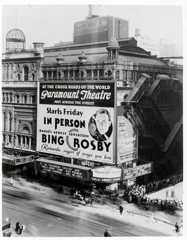 November 6–12, Friday–Thursday. Bing begins acine-variety type engagement at the Paramount Theater, New York, whichcontinues until February 11, 1932. He is said to be paid $2,500 per week for fourappearances a day.Rubinoff leads the orchestra and Mr. and Mrs.Jesse Crawfordplay the theater organ. Bing also continues his daily radio appearances.
Crosby is on stage twice anda third time sings off-stage as accompanist for a dance production. There’s nochance for anyone to forget that he’s the big man this week. Not a bad method,either, especially when the central figure stands up under the plugging strain.Crosby does.
. . . Stage show opens and closes on Crosby as the center ofthe picture. Starter is an interior set lighted from the rear for silhouetteeffect. Crosby is singing to a girl. When the traveler closes Crosby steps upto the apron for the customary ‘I’m glad to be here’ hoke. His second song isdelivered while seated on the rising organ, played by Mrs. Crawford. He stepsback to the apron for his third vocal, this bringing the show into full stageand the first girl number.
. . . Cafe set for the finish, with Crosby called on twice tosing. His stuff is carried through a mike wherever he stands, making it seemthe stage is flooded with microphones. Two are in the open.
In Crosby the Paramount has a single who entertains and perhapsa name that will attract a little money.
(Variety, November 10, 1931)
The real, special,knockout treat at the Paramount was Bing Crosby in person. If Rudy Vallee madea hit—which is undeniable—Bing will wow them! He’s star of Boris Petroff’srevue singing “Just One More Chance,” “I Surrender Dear,” “As Time Goes By,” “WrapUp Your Troubles in Dreams” and “Diana.” (sic-assume it's "Dinah")You’ll enjoy Bing and every one of his tunes.
(Daily News (New York), November 7, 1931)
Ittook a whole building to carry the Paramount Theatre’s announcement of thepersonal appearance of Bing Crosby, Mack Sennett’s two-reel comedy star. Knownto 50,000,000 persons through the microphone, his name now becomes one of thegreatest marquee names in films.
(Motion Picture Herald, November 14,1931)
Nothing more orless than a Bing Crosby field day is the stage show current at the Paramount. Asidefrom the radio crooner, it offers but little in the way of unusual entertainment.Bing garners applause in generous gobs and sings a number of his etherfavorites, including “Just One More Chance” and “I Surrender Dear”. The rest ofthe show is concerned with Vanessi, well known stage dancer, who is fine, andother items which are not so good. The contributors are the Danny Dare Girls,Kinney and Lewis and Jimmy Conlin. Crosby will be held for a second week.
(Film Daily, November 8, 1931)
Bing Crosby is the leaderamong the current flock of popular song baritones on radio. And the first to berecognized as possessing sufficient importance to rate stage headlines. Crosbyin about two months on the New York air for CBS has met with some popularity.His disc rep preceded him east. He might mean enough now to bring some moneyinto the Paramount, though not enough to make the entertainment angle secondary.
That Crosby still entertains more than he draws keeps him outof the freak headliner class. He’s as pleasant to hear on a stage as on theradio, for at the Paramount they rigged up a stage full of microphones for him.Crosby isn’t a novice on a stage, another advantage for him over the averageradio name crashing the theatre. He saw an audience before he saw the inside ofa radio studio, so he must know audiences. When with Whiteman’s Rhythm Boys hestruck a battered cymbal for emphasis with a drumstick and made a noise like agoose.
Crosby is also at home in a tux, and fronts okay. At theParamount, in a presentation constructed around him, he sings five numbers, twoin person and one offstage as accompaniment for a ballet. He didn’t register awallop way with his picture house audience, but they liked him enough toqualify the booking.
The baricrooner is booked for an indef run between New York andBrooklyn Pars.
(‘New Acts’ section of Variety, November 10, 1931)
November 7,Saturday. During his broadcast for the West Coast radio audience, Bing is saidto have broken “down completely and the orchestra volume saved the day bysnowing him under.”
November 13–19,Friday–Thursday.The Mills Brothers join Bing on the bill at the Paramount.
Thisis the second week of Bing Crosby’s engagement here, and though he is not an apparentbox-office draw as yet, he is entertaining. The stage-show in which he isfeatured is a Boris Petroff production entitled “Stardust,” and is produced inseven beautiful scenes.
TheHarriet Hoctor Ballet of 16 nice-looking and accomplished dancers opens with awell-performed routine as Crosby sings “Shine On, Harvest Moon,” from thewings. After this he enters and sings “Good Night Sweetheart,” as the girlsassemble around him. As a special attraction (for Friday only) Richard Arlenand Regis Toomey, stars of the week’s feature picture, appear in person andafter being introduced by Crosby, who acts as m.c. throughout the show, enterto a real ovation. After their departure, Armida, beautiful little Spanishgirl, sings a song about “buying cigarettes,’’ as she goes through the audienceand distributes cigs.
Armida’svoice is rather weak for a house as large as this and from the good hand herdancing got, she would do better by giving more dancing than singing. A mostentertaining and novel ballet routine was next presented by Harriet Hoctor andher girls. Miss Hoctor is the personification of grace and her dancing is beautifullydone. The audience showed their appreciation of real dancing. In the next sceneCrosby sang “I Apologize” and “Call Me Darling,” to Armida. The Mills Brothers,four colored boys who have gained fame over the air, stopped the show cold withtheir pleasing harmonizing. They were forced to encore twice. Paul Hakon didwell with his Russian dancing routine. The closing scene is beautifully laidout and in it Bing Crosby sings “Stardust,” as the ballet ensemble offers asprightly dance. Miss Hoctor also does a ballet routine in this scene that isoutstanding.
(Motion Picture Herald, November 21,1931)
...Crosby has one solo spotfor a couple of songs and at other times is theme singing for the otherspecialties. He does ‘Star Dust’ whileMiss Hoctor toe dances in thefinale...Some rearranging brought the Mills boys on later after the first showFriday, the reason being apparent at the evening performances. They tied thingsup and forced a walk-on by Crosby to get the show going again.
(Variety, November 17, 1931)
There’s crackerjackentertainment on the stage at the Paramount this week in a Boris Petroff showlabelled “Stardust.” Bing Crosby, in his second week, gets over strong, but thereal smash of the presentation is the Mills Brothers Quartet, Negro entertainers,who score loudly. Harriet Hoctor and her ballet, especially Miss Hoctor, helpmatters considerably.
(Film Daily, November 15, 1931)
November 15,Sunday. Mack Sennett releases the film shortOne More Chance starring Bing.
Featuring Bing Crosby, theradio crooner, in a slight story that jumps all over the map and is verydisconnected. The “plot” is pretty hazy, if any. Bing is a happy-go-luckysalesman for an electric washing machine who depends on his songs to sell hiswares. He has the usual trouble holding his wife from the other fellow, butwins her back in the last sequence by crooning his song. Bing’s crooning isokay, but as a comedian there is little to be said in his favor. Or was it thefault of the material?
(Film Daily, November 1, 1931)
Second of the two-reelers bythe radio crooner, also bearing as title one of the torch numbers he uses, thefirst being “I Surrender Dear.” New subject is first rate, Crosby revealing asplendid camera presence, remarkable to those who have seen his mild personalappearances on the Paramount stage....Crosby displays a capital comedy sense,plays with assurance and certainty. Subject is worth minor featuring in lieu ofair popularity. Used here in conjunction with world premiere of the new GloriaSwanson feature, “Tonight or Never.” Short a solid click with the premierecrowd.
(Variety, December 22, 1931)
(10:45 p.m.-12:00 a.m.). Bing takes part in anationwide radio program “Parade of Stars” broadcast jointly by NBC and CBS.The program is to aid the Unemployment Relief Program and various starscontribute from Los Angeles, Chicago, and New York. Others in New York withBing are Douglas Fairbanks, Morton Downey, and Eddie Cantor.
November 20–26,Friday–Thursday. Bing and Mills Brothers again top the bill at the Paramount. The ballerinaHarriet Hoctoris also featured. The film being shown isTouchdown.
November 22, Sunday. Loyce Whiteman marries Harry Barris at the Cocoanut Grove.
November 23,Monday. (4:00–5:00 p.m.) Bing records “Where the Blue of the Night” for thefirst time at a session in New York City. The Brunswick Studio Orchestra isdirected byBenny Krueger.
November 26, Thursday. Russ Columbo opens at the Paramount Theater in Brooklyn.
November 27–December 3, Friday–Thursday. Bing and the Mills Brothers are joined by Kate Smith at theParamount, New York, for the week.
...Anyhow, the radio namesare the show, Kate Smith being brought in this week to the support of BingCrosby, whose fifth week finds his novelty waning, even if the charm of hiscrooning is unimpaired. Astuteness of the Smith booking is self-evident in herreception. Crosby did nicely, but his returns paled beside the other. Thebaritone doesn’t live who can rival Miss Smith’s ‘St. Louis Blues’ in fair andopen competition.
The Crosby routine undergoes weekly changes and revisions, wisehandling for a run feature. This week he does his torch song and another, thengoing into a crossfire session with a trim flap falling for the dumbbell line.But it’s the tear stained ballad that turns the trick for this radio ace.
(Variety,December 1, 1931)
December 3,Thursday. (1:30–2:30 p.m.) Records “I’m Sorry Dear” in New York with theBrunswick Studio Orchestra. Meanwhile, Warner Brothers Pictures (the owners ofBrunswick Records) license the label to American Record Corporation (asubsidiary of Consolidated Film Industries).
December 4–10,Friday–Thursday. Bing’s support at the Paramount is the act of Jans and Whalenwith Rubinoff continuing to lead the orchestra.The presentation is titled "Say It with Songs". Mr. and Mrs. Jesse Crawfordplay the new stage organs. Russ Columbo continues at the Brooklyn Paramount.
Important items over herethis week seem to be that they’ve made an ordinary baton-waving m.c. out ofBing Crosby and the laughs provoked by that standard comedy team Jans andWhalen....You can’t call Crosby a colorless m.c. Not with that baritone andflair for handling flip dialog. But the faster he can get away from swingingthat right arm in front of a bunch of musicians the better for the formerrhythm of the Three Rhythm Boys. A case of a lad coming in from the coast,developing almost overnight on the air—then Publix makes an m.c. of him. ...Asa matter of fact, if Crosby cares to pay some attention to that waistline, hemay not always be spending his time between a microphone and the film and vaudehouses. Flashes of the way he handles patter are the spark to the idea thatthis youngster is promising legit juvenile material...Crosby, anyway, isalready a candidate for a revue, and that he can be developed into a lightcomedian who can carry love interest for a book show is plausible from whathe’s showing over here.
If anyone happens to think this is an out-and-out plug forCrosby such is not the intent. Especially for a guy who can break 85. Rather isit an attempt to show what can and may happen to a youth withprospects...Crosby should figure on presenting himself as a specialist for hisown good.
(Variety, December 8, 1931)
…Another shot inthe right direction bagged Bing “Bang” Crosby, one of the better baritones, beggingby way of WABC for someone to “Call Me Darling.” As you probably have heard,this fair-haired lad of the melody world is the king pin of the baritones (oris it Russ Columbo?) and his style is unique (besides Columbo). He never does(or hardly ever does) a song as it is written, but improvises a few notes ofhis own. He roams all over the scale for an effect that is odd but pleasing, perhapsbecause of its novelty.
(David Bratton,Brooklyn Times Union, December 9, 1931)
December 11–17,Friday–Thursday. Another week at the Paramount and the presentation is calledRomantic Rhythm. Support is fromBuck& Bubbles, the dance team ofVeloz and Yolanda, andEleanor Powell.
…Bing Crosby, now in hisfifth week or so, still gets all the billing, but is only incidental in theproceedings, singing three numbers cold and straight and making vague gesturesof leading the stage band and the item handled entirely without build-up ofshowmanly parade. Even the dressing is blah, with the radio star standingmotionless before a stage-center mike dressed in what apparently is a whiteyachting suit.
The numbers for thisappearance are “Time on My Hands,” “River, Stay Away from My Door” and “CubanLove Song,” with the Bines girls easing in at the tail end of the last-named tocomplete the effect of blurring the whole appearance. Crosby makes anotherperfunctory showing for the finale, walking on from the first entrance to astand again at his ubiquitous mike. Tepid handling of this feature leaves itall up to his voice, and the fact that he does get returns in spite ofeverything against him is the best testimony to the Crosby vocal lure.
(Variety, December 15, 1931)
“Romantic Rhythm,” featuring Bing Crosby andstaged and devised by Boris Petroff, had little in it to make it outstanding.Though it was entertaining it was not up to the usual standard of this house.The show opens cleverly with the 16 David Bines Girls going into a snappy danceroutine after making their entrance from an Austin which was driven on the stage.Eleanor Powell’s tap-body wiggle dance routine was presented with the greatestof ease and in an unusually showmanly manner. Miss Powell’s work was one of theoutstanding bits of this show and she deserved the encore the audiencerequested. Buck and Bubbles, colored comedians, held up the comedy end of thebill with their droll actions, and gained a good hand at the finish. The 16Bines Girls, neatly costumed, offer a routine of body-wiggles just beforeCrosby’s entrance and then serve as a background for him as he sings “Time onMy Hands,” “River Stay ‘way from My Door,” and “Call Me Darling.” Crosby’s finevoice, which is known to millions, is proving a box-office attraction here, butit is a wonder to this reviewer why Crosby does not show the audiences thathappy smile and pleasing personality that we know he has.
A clever entrance, serving as introductionfor Yolanda and Velez, is effected by the Bines girls who, in pairs, dancedifferent type waltzes just before the famous dance team’s entrance. Theiroffering consists of three types of waltzing which they do with the greatest ofease and smoothness. Without a doubt they are the personification of grace, andit is a privilege to see them dance. The finale was a beautiful scene in whichCrosby sang “As Time Goes By,” as the ensemble and Yolanda and Velez stand by.
(Motion Picture Herald,December 19, 1931)
Another holdover for BingCrosby, plus a good collection of variety acts, makes this Paramount stage showthoroughly enjoyable. The presentation is called “Romantic Rhythm,” and wasdevised and staged by Boris Petroff. Buck and Bubbles, the colored funsters;Veloz and Yolanda, class dancers, and Eleanor Powell, songstress are thesupporting principals, along with a contingent of David Bines Girls. Rubinoffdirects the Paramount Orchestra in “St. Louis Blues,” while Mr. and Mrs. JesseCrawford perform at the twin organs on the stage in a group of “OrganReveries.”
(Jack Harrower,Film Daily, December 13, 1931)
When I was emceeing theParamount stage show in the early 1930s, there was an act I introduced. ThenI’d stand in the wings and watch them every show, five times a day during theirtwo-week engagement. There were about twenty violins in the string section ofthe orchestra and they played “Toujours l’amour” as the two attractivepeople—he in white tie and tails and she in a lovely evening gown —movedgracefully about the stage while I stood bewitched. Their names were Veloz andYolanda.
Then there was the great team of Buck and Bubbles, particularlythe dancing member of the team, Bubbles. He was considered by Fred Astaire (andmany others) to be the greatest soft shoe, buck and wing, or tap dancer whoever lived. At every performance we had visiting dancers in the wings who haddropped in from other vaudeville circuits or motion picture presentation houses,who came over to watch and learn. People like Eleanor Powell and Hal Le Roy.Five times a day, seven days a week, Bubbles never danced the same routinetwice, but always an inspired improvisation. Later he went on to play “Sportin’Life” in Porgy and Bess.
(Bing Crosby, writing inCall Me Lucky, pages 331-332)
December 15,Tuesday.(5:15–5:30 p.m.) Bing is interviewed by Bob Taplinger for his "Meet the Artist" program on the CBS stationWABC in New York. (7:15–7:30 p.m.) Bingmakes his daily radio show broadcast as “The Cremo Singer”. Later, he isthought to have appeared at the Radio Ball for Christmas Fund.
December 16,Wednesday. (4:40–5:35 p.m.) Bing records “Dinah” with the Mills Brothers and anorchestra directed by Benny Krueger.
Those American Brunswickpeople are certainly generous. Bing Crosby and the Mills Brothers must be hugesellers each by themselves, but Brunswick have gone the whole hog and put themall into one record of the haunting “Dinah” (Bruns. 1271). The result is anorgy. Bing sings the first chorus. Here is the old Bing back again. No galleryfetching punk, no exaggerated sentimentalism, and what a conception of thesong, what style. Later the Mills Brothers come in—same sort of thing as their“Nobody’s Sweetheart”—and later everyone joins up. Bing nearly spoils the showand his own reputation with some bobba-bobba-bobba business, but it doesn’tlast long, and, anyway, it will go well with the crowd. The whole thing is wellconstructed, and never lacks interest or effectiveness from beginning to end.Put this in your “must” list, and don’t forget it. . . . The backing is BingCrosby singing “Can’t We Talk It Over”—one of Bing’s sex appeal stunts. Just aswell I’m a trousers, for I’m sure I’d fall.
(The Gramophone, April, 1932)
December 18–24, Friday–Thursday.Bing is joined byLillian Roth andLina Basquette on the Paramount bill.
Lilian Roth does four songsand a dance in what technically may be called the No. 2 spot...Crosby this weekplays a first part on the moving platform with two piano accompanists beforemoving down to the apron. Two more tunes down there slide the show into itsdancing and scenic flash finale.
(Variety, December 22, 1931)
... Bing Crosby and a livelygroup of assistants lend a more appropriate holiday flavor to the stage side ofthe festivities.
(Part of review of filmHusband’s Holiday,The New York Times, December 25, 1931)
And here’s asidelight on another WABC star, Bing Crosby, booked for 7:15 this evening. Whenhe comes to the studio these nights, no matter how cold, Bing is attired insummer clothes and sports shoes. The reason? He has but fifteen minutes to getfrom there to a Broadway movie palace, where he is playing…and his stage appearancescall for this costume.
(Ben Gross,Daily News, December 19, 1931)
December 21,Monday. (4:00–5:15 p.m.) Bing, in Brunswick Studio Number Two at 799 SeventhAvenue, records two songs accompanied by Helen Crawford on the Wurlitzer pipeorgan in the Paramount Theater. The organ music is piped to the recordingstudio by a remote line.
December 22,Tuesday.(7:15–7:30 p.m.) Bingmakes his daily radio show broadcast as “The Cremo Singer”.Wasscheduled to appear in the Brooklyn Daily Eagle's benefit concert atthe Clover Gardens in Grand Central Palace, New York. However becauseof the inclement weather, there is only a small crowd and he isnotified by telephone not to appear.
December 25–30, Friday–Wednesday.Cab Callowayshares top billing at the Paramount with Bing. Others featured areBarto and Mann andFrances Faye.Bing is still making his daily radio appearances as “The Cremo Singer.”
Plentyof good talent on the bill at the Paramount this week, with Bing Crosby heldover as one of the name draws, augmented by Cab Calloway and his Cotton ClubOrchestra.
Theproduction, titledCheerio, has hadnice staging by Boris Petroff, with the other specialty artists, including Bartoand Mann, Dick and Edith Barstow, Frances Faye and a Dave Gould Ensemble of 16girls and 8 boys, who offer several nicely set dance routines. Miss Faye is thefirst specialty artist to appear. She registered a genuine knockout, playingher own accompaniments to several popular numbers…
…BingCrosby held the next position, doing his first number,Too Late, with a special set, in which a story is told in pantomimeby members of the chorus. Miss Faye then returned to accompany him on the pianoinWhy Did It Have To Be?, with thepianist coming in for a few catch lines. The final number wasSleepy Time Down South…
…CabCalloway closed the show and registered as heavily as he did the first time atthis house. His program includedI'll BeGlad When You're Dead, You Rascal, You; Minnie, the Moocher, andTiger Rag for a finish, leading into thefinale bringing on the group dancers.
(Billboard, January 2, 1932)
December 31–January 7, 1932, Thursday–Thursday. The Boswell Sisters join Bing on the billat the Paramount, New York. Bing’s songs are advertised as “You’re MyEverything,” “Mississippi Mud,” and “As Time Goes By.”
This time they’ve concentratedon Bing Crosby himself, with a neat introduction, the singer appearing on anentirely dark stage, standing on what is apparently a “boom” which moves himabout from side to side and up and down as he sings his characteristic torchesinto the mike, which follows along at his elbow. Only the singer’s face isvisible....
Boswell Sisters, also from radio, are introduced from a darkstage in the midst of a bower of flowers built on the movable platform and concealingthe piano they use for their hot-cha harmonising. Open in a trio; two girls areoff while Connie does a sympathetic ballad solo in her nice contralto. Absentsisters return for “Mississippi Mud”, with a reference to its having beenintroduced by Crosby. They go into the number and Crosby joins them, standingbehind them but on the platform, and singing as a background for theirharmonising.
(Variety,January 5, 1931)
Since my 1932engagement at the Paramount lasted twenty-nine weeks, they strove to devisesomething spectacular every week in the way of a production number. One weekthey had me perched on a giant crane. The machinery for the crane was in thepit, and when the mechanism reached for me on the stage, I climbed into theseat. The crane swung me out over the heads of the audience with a spot focusedon me, dangling in space, and I sang my song which was probably somethingsuitable like “Penthouse Serenade.”
I did this cranenumber on New Year’s Eve when the place was full of drunks and sailors. As thecrane swooped low, the sailors reached up, held it and took off my shoes andsocks. They were working on my pants when the crane operator switched on enoughpower to bring me back to the stage, where I finished my song in my bare feet,clutching my belt. It was a big smash, but the rest of the week I imposed afifty-foot ceiling on the boys backstage.
(Bing Crosby, writing inCall Me Lucky, pages 113-114)
During the year, Bing participated infour Gus Arnheim records that became chart hits: “I Surrender Dear,” “One MoreTime,” “Ho Hum!” and “The Little Things in Life.” In addition, he had no lessthan eleven hits under his own name.
1932
January 8–14, Friday–Thursday.Bing again tops the bill at the Paramount. His pay rises to$4,000 per week and he is contracted by the Paramount for another tenweeks. The revue this week is a Boris Petroff production called"Variations" with Frances Faye and theRuth St. Denisballet troupe.
...Crosby is again hooked infor an appearance with a turn that has appeared earlier, this time working withFrances Faye, returning as his accompanist after opening the show solo. Havingclicked on her own, Miss Faye’s second appearance is worked as a build-up forCrosby. He uses a bit of comedy repartee for a change of pace from straightcrooning, but his cold entrance and his finish, which amounts to an m.c.announcement of the St. Denis interlude, do little to help him. The croonerhasn’t been well handled throughout his stay at the Paramount, but he seems tohave made friends among the regulars.
(Variety, January 12, 1932)
…Crosby, who wasgreeted with a fine hand at his entrance, offers as his part of the program,the singing of “Let's Talk It Over, Dear,” first, alone in a pin spot and then“You Try Somebody Else” and “River Stay 'Way from My Door,” with Frances Fayeaccompanying with hot rhythms on the piano. Special lyrics for the secondchorus are sung both by Miss Faye and then by Bing. After good applause, Crosbyannounces that Miss St. Denis and her Ballet will offer her well-known Javanese “Nautch”dance. The entire number is beautiful and most gracefully performed but as afinale for a stage show it is most weak.
(Motion PictureHerald, January 16, 1932)
January 9,Saturday.Dream House, anotherSennett two-reeler featuring Bing, is released.
One of the series of six MackSennett shorts Bing Crosby made on the coast, before coming east for CBS. Inthis, as in its predecessors, Crosby goes through his paces with ease andnaturalness and shows a good sense of comedy value.
Fault here isthat the singing portion has been relegated to the background. Crosby has lesswarbling to do in this than in either of his former releases. It hurts some,inasmuch as Crosby’s rep is built on his ability as a warbler, not as acomedian, although he does not disappoint from the latter standpoint. He hasbut three brief vocal bits, the first of which means nothing along singinglines as it is interrupted by the action. Other two are also brief. Closingsong is ‘Dream House’ after which this short is titled.
Two songs usedprevious to the titular number are both noticeable passé pops. This is naturalsince this series was produced last spring.
Story opens in asmall town with Crosby as a plumber. Girl he loves is taken to Hollywood by hermother, who resents Crosby’s attention. Latter follows the girl to the coastand gets mixed up in a studio scene, where he gets into blackface.
With theexception of the last bit, about a lion, which is given too much time, short isfast and contains enough comedy to get over anywhere. Besides which the Crosbybilling should help.
(Variety, February 16, 1932)
Bing Crosby, the radiocrooner, is starred in this Featurette Comedy. Bing is a young plumber who hashis troubles with a future mother-in-law who is trying hard to separate himfrom her daughter after they are engaged. She spirits the girl off to Hollywood,where Bing follows to find her on the studio set with a sheik making love toher. Bing busts into the scene in black face, and crabs the sheik’s act withhis crooning. Plenty of snap, and well gagged.
(Film Daily, December 17, 1931)
This is anotherone of the comedies featuring the famous radio crooner, Bing Crosby. Bing seemsmore at ease in this quite amusing skit than in previous years. You’ll like hissongs.
(Photoplay, March1932)
Bing Crosby who demonstratinghis talent as a purveyor of melody, but lack of histrionic ability has the leadin this Sennett comedy effort. Several comedy situations of the slapstickvariety draw a fair portion of laughs. Bing plays a small-town plumber, whosegirl, after going to Hollywood, is successful. Her mother writes to Bing,telling him the engagement is off. Unsuccessful in getting on the set, hedisguises himself as a colored boy and gets an extra bit. His voice isrecognized by the girl, but the mother and a lion chase him, with fairlyamusing results. All in all, a fairly good comedy—Running time, 19 minutes.
(Motion Picture Herald, January 9, 1932)
January 10,Sunday.Cardinal O’Connell, in addressing one thousand members of Boston’s HolyNames Society, denounces crooning.
“Idesire to speak earnestly about a degenerate form of singing which is called crooning.No true American man would practice this base art.
“Ilike to use my radio when weary. I can’t turn the dial without hearing thesewhiners, crying vapid words to impossible tunes.
Ifyou will listen closely, when you are unfortunate enough to get one of them,you will discern the basest appeal to sex emotion in the young. They are nottrue love songs. They profane the name. They are ribald and revolting to truemen. If you will have music, have good music. Not the immoral and imbecileslush.”
(The Evening News, Wilkes-Barre,Pennsylvania, January 11, 1932)
Meanwhile, Bing writes to a fan, a Mr. A. C. Collins.
In response to yourkind letter, I want to thank you very much for your interest in mybroadcasting. Having no contact with our unseen audience, any applause orcritical comment is greatly welcomed and appreciated.
Both Mrs. Crosby (Dixie Lee) and myself wish tothank you for your kind invitation to spend a vacation in Canada, as we canthink of nothing that would be more pleasant. However, I feel, as you must knowfrom your experience, that the luck I am having right now will not hold upforever, and I want to take advantage of it and make all I can while I can, anddo not think I will get a vacation until late in the summer, at which time Iexpect to go back to California and do some picture work.
January 15–21,Friday–Thursday.Burns and Allen with Bing and the Boswell Sisters at theParamount for one week.
Thothe picture,Two Kinds of Women, atthe Paramount this week is only an ordinary programmer, the stage show is sogood that this house should be able to hold the SRO signs all week The stage showincludes Burns and Allen, the Boswell Sisters; Lowe, Bernoff and Wensley: BingCrosby, Three Little Words and a Dave Gould Ensemble of eight boys and girls.
Therevue is titledHome, Sweet Home, andwas devised and staged by Jack Partington.Home,one of the newer popular numbers, forms the basis of the revue, with BingCrosby singing it thru the “mike” before the curtains part. Then the various scenestake us to homes on the Bowery, Harlem. Westchester and an old Colonial mansionin the South, the finale scene being a penthouse in New York.
Thefirst scene introduces the dancing ensemble in a novelty number, followed bythe Boswell sisters presented in a Southern setting offering firstStay Out of the South. Connie, thepersonable soloist of the trio, follows withFaded Summer Love, which was show-stopping.Love Goes on Just the Same follows by the trio for the close in. Twoencore, were responded to, the girls going even stronger at the start, eachnumber building to a terrific hand at the finish.
ThreeLittle Words, three youthful colored lads, did some mean stepping to excellentreturns in a Harlem setting, followed by Burns and Allen, who need nointroduction, but who tied the old show up in a knot, which was nothing morethan anticipated. Surefire always and bigger and better than ever here.
Crosbyfollowed with a series of numbers leading up to the finale, which introducedLowe, Bernoff and Wensley, two men and a girl who make an entrance and start aballroom waltz, only to go into some comedy stunts that are not onlyexcruciating, but an innovation in this type of work. It is the originality ofthis bit that makes the number one of the biggest show-stoppers ever seen atthis house.
(Billboard, January 23, 1932)
Crosby, who tails the JesseCrawford organ recital, with a bit over the mike, has the mike in his hat forone number in the full stage scene. Later a standing amplification receiver isbrought on. At first his voice comes over hoarsely, but later it’s OK.
(Variety, January 19, 1932)
And then someone glances atthe clock—twelve forty-five and he’s due for his first appearance at theParamount Theater at one. It’s a mad dash in a taxi, horns honking, a rush, ascramble and just as the orchestra is playing the final chords of the tune thatsays “the gold of her hair crowns the blue of her eyes, Bing Crosby steps outto wild applause.
A snatch of lunch and anotherperformance later in the afternoon and then to the broadcasting station on therun for a bit of rehearsal and Eastern broadcast at seven. Another wild taxiride back for more shows at the theater and if he is making a Westernbroadcast, another dash back to the broadcasting station at eleven.
Sometimes, with traffic congestion he’ll arrive just as theorchestra has played the lastnote ofhis song and he’ll begin his “surrendering, dear” almost at the door. Andseveral times they’ve shoved the printed words of his song in his hand as heentered and half way through “Too Many Tears” he’d feel unsure of a word,glance down at the pages and discover to his horror he was holding the words of“I’ll Be Glad When You’re Dead, You Rascal, You”.
Or in his rush, he’d find himself with a frog in his throatwith no time to clear it and go through the entire song of “Paradise” expectingto get as far as “she takes me to...” and then croak like a frog or leap like atoad. It’s awful.
(Lois Shirley, writing in anunidentified magazine in 1932. Reproduced inBing’s Friends & Collectors Society Newsletter, February /March 2002)
January 15,Friday. A suit in federal court is filed against Bing and others alleging thatthe song “At Your Command” is identical to the song “Jealous” copyrighted eightyears earlier. The suit is unsuccessful. Bing continuesto make a further broadcast at 11:00 p.m. each night forthe West Coast audiences.
8 p.m. – KHJ. BingCrosby (CBS). If he has weathered a severe cold he will sing “You Try SomebodyElse,” “I Wouldn’t Change You for the World,” and “Call Me Darling.”
(Los AngelesTimes, January 15, 1932)
January 21,Thursday. (2:15–2:45 p.m.) Bing records “Snuggled on Your Shoulder” in New Yorkwith the ARC Brunswick Orchestra directed by Benny Krueger. (7:00–7:15 p.m.)Bing presents his Cremo Show broadcast on CBS. (8:30–9:00 p.m.) Bing isinterviewed by Bob Grannis on the radio programFast Stepping broadcast by stationWOR. He sings his new theme song “Wherethe Blue of the Night”. Other guests includeConnie Boswell and Nell Roy.Musical accompaniment is byWill Osborne & His Orchestra. The program issponsored by L. Miller & Sons, creators of fine footwear for women, whoalso advertise the show in theNew YorkTimes.
January 22–28,Friday–Thursday. Bing and the Boswell Sisters continue at theParamount. Bing is advertised to sing "At Your Command" and "All of Me"as well as other hits.
...On the stage end theCinderella theme is carried out, wedding n’all, with the choristers in whitesatin before a throne room set into which strolls the Crosby arrayed in greytrousers, blue coat and shirt, red tie and a stiff straw hat. You figure it outif it’s Crosby or the other half of Laurel and Hardy...Crosby mikes it a coupleof times and that about washes everything up. ..However, there doesn’t seem anyparticular reason for Crosby’s careless costuming.
(Variety, January 26, 1932)
Asurvey made by Variety representing nation-wide opinion results in the naming of11 stars as the 1931 crop of radio entertainers that attained the heights.
Theyare the Boswell Sisters, Bing Crosby, Russ Columbo, Mills Brothers, Goldbergs (GertrudeBerg), Eddie Cantor, Walter Winchell, Guy Lombardo, Ben Bernie, Cab Callowayand Sisters of the Skillet.
DespiteBing Crosby’s rating, it is rumored that he is slated to be dropped by hissponsor late next month. This action on the part of the sponsor is thought tobe caused partially by a peeve resulting from a kidding given by ColonelStoopnagle and Budd about the 10 o’clock dance hour on the NBC sponsored by thesame tobacco firm.
(Dorothy Doran,The Akron Beacon Journal, January 28, 1932)
January 29–February 4, Friday–Thursday.Lilyan Tashman joins Bing at the Paramount. It is advertised that Bing will sing "Human Thing to Do" and "Blue of the Night" amomgst others.
Bing Crosby in the stage showat the Paramount again this week (his steenth) continues to prove he can takeit. In one spot the radio crooner sits at his mike in the center of the stageand croons modestly, or doesn’t croon at all, while a group of dancing girlsobscures him from the audience. Only excuse for the girls being on stage at allis Crosby’s number “Cuban Love Song” and the case is unique as representing a“name” attraction behind a row of prancing Coryphees.
Later on in the entertainment Crosby, together withSidSilvers, works with Lilyan Tashman, and it is constantly an issue whether it’sBing or Silvers who is functioning as general stooge for the turn. Whatever thecase may be, Crosby doing a quiet line of clowning here shows up well enough asthe imprudent reporter, even if they do dress him up like a racetrack tout.Maybe the crooner takes it out in kind—his subjection to unimportance, thatis—for a chance to work in a plug for his Cremo hour on CBS. Anyhow, he slipsin the plug with great distinctiveness and éclat. Maybe that makes it even forwhat this house has done to muffle his personality.
(Variety, February 2, 1932)
…Number four spot opens to a dark stagewith a pin spot played on Bing Crosby, who sings "Cuban Love Song."As he sings, the stage is slowly lighted and behind him appear the 16 DannyDare girls, posed on the slowly rising stage-elevator. After it reaches thelevel of the stage the girls, dressed in colorful costumes, go into asimplified rumba routine, and, at the finish of the song, make their exit thesame way that they came on. Bing offers two more numbers, "Spend anEvening in Caroline," and "Is That the Human Thing to Do." Thesewere sung before a plain drop curtain with Bing using a guitar accompanist.
The show closed with "TheInterview," a spicy, wise-cracking comedy skit, featuring Lilyan Tashman,Bing Crosby and Sid Silvers.
Miss Tashman has an opportunity to liveup to her reputation of being the "screen's best dressed woman," forshe is dressed in most beautiful gowns. Crosby surprised (at least thisreviewer) by showing actual human traits and an ability to portray a characterother than that of a crooner. The cross-fire wise-cracking between MissTashman, Crosby and Sid Silvers certainly proved entertaining.
(Motion Picture Herald, February 6, 1932)
January 30,Saturday. “Dinah” is the number one record in the various charts.
January 31,Sunday.Thought to have appeared in the 69th annual benefit performance of theTheatrical Mutual Association at Erlanger's Theater.
The Paramountpeople declined to renew the Russ Columbo contract and the “Romeo of Song”concludes his Brooklyn Paramount engagement within the week. And he is to befollowed by none other than his rival in song, Bing (bang) Crosby, the boy who wearsthe yellow ties, green hats and sings “Blue of the Night.” The style of singingadopted by these boys is peculiarly alike. But that is where the sameness ends ifone were to compare. Columbo is almost conservative in dress and is of the “sheik”type while Crosby’s clothes are flamboyant and appears more like a collegiate flamingyouth than the college boys themselves. Both are fine chaps though, and yourreporter likes them.
(Tim Marks,Brooklyn Times Union, January 31, 1932)
February 3, Wednesday. Bing is still continuing as The Cremo Singer.
8 p.m. – KHJ. BingCrosby reaches for your heart (if it is romantic) with “Great Day” and “I’llSee You in My Dreams.” (Los Angeles Times,February 3, 1932)
February 5–11,Friday–Thursday. Bing closes at the Paramount, New York, after fourteen weeks.Lilyan Tashman and Sid Silvers are on the bill.
February 6,Saturday. Bing appears in a “Spectacular Radio Artists Ball” at the Newark Armoryin Newark, New Jersey, on a bill with the Boswell Sisters,Nick Lucas, and theMills Brothers accompanied by Benny Krueger and the Brunswick RecordingOrchestra. Admission is $1.
February 11,Thursday. (Late evening) Records “St. Louis Blues” with Duke Ellington. Thesession finishes at 1:20 a.m. on February 12.
“St. Louis Blues” featuresBing Crosby, and to such an extent that no one will quarrel because it has beenlabeled Bing Crosby with Duke Ellington and His Orchestra. After the balladperformances to which Bing has been devoting most of his time lately thebrilliance of his rhythmic style will be surprising, even to those who rememberthe days when, with Harry Barris and Al Rinker, under the name of PaulWhiteman‘s Rhythm Boys, he created quite a sensation as a hot singer.
(The Gramophone, December 1932)
Betweenmidnight and one, they recorded two Ellington arrangements of W. C. Handy’s“St. Louis Blues.” Although they admiredand liked each other (Duke created his concerto version of “Frankie and Johnny”for Bing’s radio show in 1941; the last recording Bing made in the UnitedStates was for a memorial tribute to Duke in 1977), this was the only time Bingformally recorded as asoloist with Ellington and one of the few times he recorded the blues. A pity on both counts, for the result is gem- or, more precisely, two gems.
The second (B) take was initiallyreleased and remains the best known of the two, beginning with a slap-tongueintroduction by baritone saxophonist Harry Carney and proceeding with glowingchoruses by trumpeter Cootie Williams and trombonist Joe Nanton. After a shortpiano transition, Bing sings two twelve-bar choruses, backed by a covey ofclarinetist Barney Bigard, Carney, and guitarist Fred Guy, whose dynamicstrumming suggests a banjo. Bing continues with the two sixteen-bar refrains(Ellington dispenses with the tango rhythm of the original), backed at first byNanton and then by the previously noted trio. He coolly improvises phrases withsuch authority that when he forgets the lyric, he is able to unhesitatinglyfake - in true blues tradition - a closing refrain. At which point the tempo isdoubled as the great alto saxophonist Johnny Hodges wails a chorus, setting upa stirring passage by Bing, one of the finest examples of scat singing in thatera. He concludes at half tempo with the beautifully modulated line “And I lovemy baby [critic J. T. H. Mize astutely singled out the “slow and deliberatetilt onbaby”]tillthe day I die.”
That closing phrase probablyclinched the choice of take B, but the verdict was actually settled on aquestion of gender; in Bing’s first try, the St. Louis woman pulled “that galaround,” instead of the man she was supposed to be pulling. The A take hasrewards of its own, beginning with an orchestral introduction and a ferociousCootie Williams solo that establishes a far earthier mood, peaking with one ofBing’s headiest jazz moments on record. Before Hodges completes his double-timechorus, Bing - Louislike - leaps in and commands the saxophonist’s last fourbars as a scat runway for his own elated chorus. In neither version does Bingmake an effort to mimic expressive blues techniques. He enjoyed, as didEllington, the contrast between his level tones and the band’s idiosyncratictimbres.
(Gary Giddins,A Pocketful of Dreams, pages 275-276)
February 12–18,Friday–Thursday. Bing opens at the Paramount, Brooklyn, with Lilyan Tashman andSid Silvers. The newspaper advertisement states “Brooklyn’s First Chance to SeeHim! He’s Hot—He’s Torrid! He’s your Favorite Torch Singer of Songs you Love!”The accompanying film isWaywardstarring Nancy Carroll and Richard Arlen.
…Heading thisportion of the bill is Bing Crosby, the baritone “rhythm singer” (crooner toyou), who comes to the local Publix house for an indefinite engagement followinghis extended run at the Paramount in Manhattan. Sharing the spotlight is LilyanTashman, the screen star, in a highly amusing skit in which she is assisted notonly by Crosby, who is revealed as a surprisingly accomplished comedian, but bySid Silvers, who displays his widely acknowledged talent as a “stooge” in theorchestra pit.
(Martin Dickstein,Brooklyn Daily Eagle, February 13, 1932)
The rounds ofapplause which greeted his every performance last week have caused Bing Crosby,radio and stage star, to be held over at the local Paramount Theater for asecond week beginning today. Those lucky 30 persons who won Home Talk theater courtesiesfor the Paramount, and who saw him with Lilyan Tashman last week, were won overby his delightful mannerisms.
(The Brooklyn Daily Eagle, February 19,1932)
February 16,Tuesday. Records “Starlight” and “How Long Will It Last?” with the ARCBrunswick Orchestra directed by Victor Young. Tommy and Jimmy Dorsey are in theorchestra.
Bing Crosby, whois singing at the Brooklyn Paramount Theatre, does not use the studio there asdid Vallee, the Mills Brothers and Columbo, but hops over to Manhattan for hisWABC program at 7:15 and again for his repeat for the Far West at 11 eachevening.
(David Bratton,Brooklyn Times Union, February 18, 1932)
February 19–25,Friday–Thursday. Bing heads the bill for a second week at the BrooklynParamount. Advertisements say, “Held over to satisfy the demands of the thousandswho will thrill again to Radio’s greatestSTAR!” Others on the bill include Vox& Walters and the film isNice Womenstarring Sidney Fox and Frances Dee.
The stage showthis week, entitled “Sweethearts,” features Bing Crosby, radio baritone, heldover from last week. Crosby introduces several new song numbers for which hereceived much applause at last evening’s final show.
(TheBrooklynCitizen, February 20, 1932)
…Under theleadership of Bing Crosby, Brooklyn audiences will again find much to provetheir wisdom in deciding that he be retained for a second week. Crosby’sparticular adeptness in singing sweet tunes as well as rhythmic melodies,coupled with his ability as a light comedian, stopped almost every show in hisperformances at the Paramount last week.
(The Brooklyn Daily Times, February 21,1932)
February 20,Saturday. Is the guest of honor of the Friars at a midnight dinner in New York whereGeorge M. Cohan presents him with a solid gold life membership card. Speakersinclude Jack Benny, George Burns, Irving Berlin, Rudy Vallee, andDamon Runyon.
February 23,Tuesday. (10:00 a.m.–1:30 p.m.) Bing records “Love You Funny Thing” and “My Woman”with a studio orchestra.
My Woman
BingCrosby has turned not only discoverer but song-writer! The story, as Iunderstand it, on this particular song is that Bing was approached by a coupleof amateurs with an unusual melody and an unusual idea. However, it remainedfor Bing himself to finish the lyrics, and he has certainly done an excellentjob of it. Not since Fannie Brice introduced and made famous the song for whichshe is best known, namely, “My Man,” a song which has gone down through theyears, pleasing hundreds of thousands of people, has there been a song whichthe man might sing about his woman but here it is.
Infact, it is strangely and hauntingly reminiscent of the “My Man” song. Crosbyhas made a most excellent record of it, with Lennie Haydn’s(sic) background arrangement giving hima clear field for his vocal accomplishment. The first syllable of the word “Woman”gives Bing on the record, an excellent chance to utilise his exaggeratedglissando, which is typical of his style, and like “My Man” the song goes on totell you how she lies, makes a fool of him, never treats him well, but still heloves her. You’ve got to hear it-its minor vein makes one think of “Deep Night.”…Ihope for Bing’s sake, that it becomes a big success.
(Rudy Vallee, writing in Radio Digest,May1932, page 24)
Folks have agreedthat Bing Crosby is as entertaining a film comedian as he is a microphonecrooner. Bing still has that contract with Mack Sennett for whom he made twoshorts out of a scheduled six and if Paramount executives can fix it up withSennett, Crosby will be starred in a picturization of the current stage play “WildWaves.”
(Irene Thirer,Daily News (New York), February 25, 1932)
February 26–March 3, Friday–Thursday. Bing again tops the bill at the Brooklyn Paramount withthe publicity stating “3rd Big Week By Popular Demand. Nothing Like It Before.Now In His Own Show! Written By Bing Himself!” He shares the bill with TheCollette Sisters and Burns & Kissen amongst others. The accompanying filmisBroken Lullaby starring LionelBarrymore and Nancy Carroll.
…In the currentstage presentation, “Bing! Bang!” at the Brooklyn Paramount, Bing’s riotousacting, his humorous “lines” and situations which provoke hilarity, are all theproduct of his creative mind. Although he has written a script for the entirestage production, Crosby seldom finishes one show in the same manner as its predecessor,his penchant for “ad-libbing” prompting many admirers to sit through two orthree shows at a time
(The Brooklyn Daily Times, February 28,1932)
…Now he’s at the BrooklynParamount duplicating his Broadway success. The show depends upon his moods,but he never sends the audience away feeling that they did not get their money’sworth. He insists on putting on his own show regardless of how the scriptreads. When he’s supposed to wax romantic, he might suddenly feel the urge todo something humorous. You can’t tell about that Crosby feller—he’s just what Brooklynseems to want. He’s a “surprise boy.”
(The BrooklynCitizen, March 2, 1932)
February 27, Saturday.(7:15–7:30 p.m.) Bing's last appearance as the Cremo Singer on radio. He isbilled to appear the following week on a sustaining basis (i.e.without a sponsor).
Wasteful Merchandising
Oneof the silliest perversions of advertising is a gargling crooner of “torchsongs” intended to cause a flutter among the women and girls, attempting bythat appeal to popularize or sell a cigar. The foolish part is that women andgirls who hang enraptured on the crooner’s lays do not as a rule smoke cigars. That’snot the worst of it. Men who do smoke cigars as a rule are inclined disgustedlyto tune-out when the crooner starts his gulping imitation of an impassionedtummy ache.
Hencethe separation of the adorable “Bing” Crosby from the radio hours of an otherwisewell advertised cigar. This is but one case where wrong merchandising has hadto be corrected. The cigar company seeing a crooner emerge with individualstardom at the cigar company’s expense, and seeing the futility of advertisingcigars to women and girls, was constrained to conclude that radio advertisingis far from being an infallible go-getter.
(Lafayette Journal and Courier, March 4,1932)
His cancellation ofCremo Presents Bing Crosby perplexed meand it was not until two years later that Hill gave me an explanation. Itinvolved the fact that the Cremo cigar was advertised and sold as amachine-made cigar, which supposedly had a big advantage over the handmadevariety because no worker’s saliva would touch the cigar wrapper in making thecigar. Cremo was known, if you please, as the “no-spit cigar.” But the cigarssold so well that his production manager, without informing Hill, had toaugment the machine-made production with handmade cigars and, of course, “spit”was involved. So, George Washington Hill’s ad slogan had become a lie. Fearingexposure for deceiving the public, he had just canceled the program and leftCBS without an explanation.
(Bill Paley writing inAs It Happened, A Memoir)
February 29,Monday. (1:30–6:15 p.m.) Bing and the Mills Brothers record “Shine” in NewYork.
The tie-up between the MillsBrothers and Bing Crosby, which resulted so happily in “Dinah,” has beenrepeated with even greater success in a revival of “Shine” (Brunswick 1316).Bing sings just as he did in the days of the Rhythm Boys, before he became allsex-appeal and sugar, and the Mills Brothers are as neat and musical as ever.The whole construction of the record is good, and it is difficult to imagine aconception that would have suited these artistes better.
(The Gramophone, August, 1932)
Among the several small vocalensembles with which Bing Crosby has appeared is The Mills Brothers, threebrothers and their father, who have achieved unusual success as a male quartet,especially in their ability to simulate instruments vocally. In 1932 Bingrecorded several sides with this superior foursome, including theeasy-listenin’ MY HONEY’S LOVIN’ ARMS (C0-4304-M). As one of the demonstratorshere, we have chosen SHINE, a Mack-Brown-Dabney song which was made famous byjazz singer Louis Armstrong; and the Crosby version of it demonstrates well hisscat singing ability and his pretty choices of intervals in obbligato:
Four measures of muted bluestrombone precede a measure of scat singing by Bing . . . And then for the firstchorus the Mills Brothers take over for the opening chorus, with the bass voiceof Mr. Mills, Sr., booming out, a simulated tuba sounds as the three othersharmonize on the words; it should be noted, critically, that certain passageshere are not in the best harmony, notably the chord choices for the Itakethese troubles all with a smilephrase ... For an extended interlude thequartet simulates instruments (three muted trumpets and a tuba) in a simple, plaintivemelody ... The tempo is slowed down and the orchestra enters to accompanyBing’s statement of the words, with deviations from the straight melody ...Over an organ point by muted trombone, Bing, somewhat like Louis Armstrong,sings a beautiful passage onOh, chocolate drop, that’s me... Thenwhile one of the Mills solos on the straight melody with a resonant voice andSouthern dialect, Bing adds some delightful melodic commentaries with cleverwordage and pretty intervals, such as the lusciousAh, keep on smilin’ thru...Bing takes a solo break and then proceeds to “scat like mad” while the Millsaccompany him with orchestra-like rhythm figures ... Over the extendedinterlude material Bing improves slightly and lightly and politely, to closethe recording, a presentation of Bing’s scat singing in one of its very bestsamples.
(Dr. J. T. H. Mize,Bing Crosby and the Bing Crosby Style,page 133)
March (undated).Said to have strained his vocal cords so that he seeks medical attention fromDr. Simon Ruskin again. Bing is offered the opportunity to see ChevalierJackson for possible surgery to remove a node on his vocal cords but instead hedecides to rest his voice completely for a period.
March 1,Tuesday.(6:30-6:45 p.m.). Commences evening radio shows on threenights a week for CBS on stationWABC, on a sustaining basis, withFreddieRich’sOrchestra. Three nights a week instead of six has been chosen toreduce the strain on Bing's voice. The first week the shows air on theEast Coast onTuesday, Thursday, andSaturday in the 6:30-6:45 p.m. time slot before switching to a Monday,Wednesday, and Friday format at 6:45p.m. However, the time switch is not acceptableto the West Coast and station KHJ in Los Angeles declines to take itexcept on Saturday afternoons at 3:30 pm.
Bing Crosby, now asustaining feature (WABC – 6:30) sings better since he isn’t on a commercial.Why? Don’t ask me!
(Ben Gross,Daily News, (New York), March 4, 1932)
March 2, Wednesday. The twenty-month-old son ofCharles Lindbergh is kidnapped.
March 4, Friday.It is rumored that Bing has signed to make a film for Paramount in HollywoodcalledWild Waves. The title is laterchanged toThe Big Broadcast.
March 4–10,Friday–Thursday. Bing tops the bill at the Brooklyn Paramount with Yorke &King and Rubinoff in support. His act is described as “New Kind of Fun - Even aNew Kind of Love - Bing Crosby in ‘Time Goes By’ His own idea of musical comedynewer than next year’s ‘Follies’.” The accompanying film stars Fredric March inStrangers in Love.
…Bing Crosby joinsthe celebration with a whoopee musical comedy idea on the stage in which Yorkeand King, internationally comic favorites, play an important part…In the stageshow, a musical comedy idea has been developed in which Bing Crosby takes theentire show under his wing as master of ceremonies.
(The BrooklynDaily Eagle, March 4, 1932)
March 8, Tuesday.(9:50–11:25 a.m.) Bing records "Face the Music medley" and "Shadows on the Window" with the ARC Brunswick Orchestradirected by Victor Young.
March 11–17,Friday–Thursday. Bing at the Paramount Theater, Brooklyn, with musical comedy starJohnny Burke insupport. The advertising says, “Have a fling with Bing in Big Whoopee Show.”Claudette Colbert stars in the accompanying filmThe Wiser Sex.
“In the Bag” is thetitle of the stage presentation at the Brooklyn Paramount. Bing Crosby drawsdown a large share of the plaudits in several new songs.
(The BrooklynDaily Times, March 12, 1932)
March 14,Monday. Bing's radio show is switched to a Monday,Wednesday, and Friday slot at 6:45p.m., andin addition he starts broadcasting a show on Thursdays at 11:45 p.m. for the West Coast to replace the Saturday broadcast.
March 15,Tuesday.(9:30–11:30 a.m.) Records “Paradise” and “You’re Still in My Heart”with a studio orchestra directed by Victor Young. In the evening,Bing leads the Brooklyn Paramount bowling team as they defeat theBrooklyn Times-Standard Union team in a match at Dwyer's BowlingAcademy.
March 18–24,Friday–Thursday. Ends his appearances at the Brooklyn Paramount. Bing sharesthe bill withPola Negri and the ‘Revue International’. Miriam Hopkins and JackOakie star in the supporting filmDancersin the Dark.
…Firstly, you’ll see theglamorous Pola Negri in a skit. Also on the stage will be seen the youthfulradio idol Bing Crosby, who is to be seen in his sixth and last week on theParamount stage. His own gags, his own humor, and his own productions haveaided in making this lad one of the most enjoyable personalities yet to bepresented on the stage of the Brooklyn Paramount.
(The Brooklyn Daily Eagle, March 18, 1932)
March 19,Saturday.(9:30 p.m. onwards) Is one of many stars taking part in the Israel OrphanAsylum at Madison Square Garden. Others featured are Beatrice Lillie,WilliamGaxton and Russ Columbo.
March 20, Sunday.Another Mack Sennett short starring Bing—BillboardGirl—is released.
A Featurette Comedy with Bing Crosby. Bing falls in love with a billboard girlhe has never met, and finally meets up with her in a college town where sheattends the co-ed institution. The girl’s brother dresses up like his sisterand has Bing do a pash love scene with all the class as hidden audience. Thegirl also hidden, sees it, and falls in love with Bing’s singing. Business ofparental opposition and also a big goof who is engaged to the girl, but lovetriumphs. The comedy is fair, but the singer’s crooning puts it over.
(Film Daily, March 6, 1932)
The reputed popularity of Bing Crosby will perhaps make this comedy effort successful, though it cannot be accurately stated that the crooner is an actor. The short concerns Crosby falling in love with the picture of a girl
on a billboard. His letters to the girl at college are intercepted by her brother, who, upon the crooner's arrival, masquerades as his sister and stages a love scene and elopement rendezvous. The girl, Margie Kane, discovers
the plot and it all comes out in the end. Crosby renders two numbers in fairly effective style for those who like his type of vocal rendition. —
Running time, 21 minutes.
(Motion Picture Herald, March 26, 1932)
March 22,Tuesday.Variety carries an itemstating that Bing is attempting to buy himself out of his contract with RogerMarchetti. He is frustrated because Marchetti is based on the West Coast andcannot help Bing in New York although he is taking 20 percent of his income.Marchetti seeks $100,000
March 25–31,Friday–Thursday. Bing opens at the Paramount in New York inGeorge Jessel’sshowJoy Jamboree. Burns and Allen,Lilian Roth and Rubinoff are also on the bill.
Crosby as a gendarme shows aflair for comedy that has cropped out in his [film] shorts, but not up to nowon the stage. . . . Those countless microphone users in vaudeville at presentcould take a tip from Crosby on the use of that instrument. Instead of standingthe mike on the stage and hiding behind it while singing, Crosby has it plantedin the pit several feet in front of him, and in that way the audience can seeCrosby as well as hear him.
(Variety,March 29, 1932)
GeorgeJessel’s “Joy Jamboree,” current stage-show, devised and produced by Boris Petroff,is a typical Broadway musical show, full of wit, snappy gags, good music andfine dancing, and is by far the most entertaining presentation ever offered onthe boards of this house.
Openingwith a snappy rhythmic dance routine by the David Bines Girls, which starts theshow off well, Jessel then appears and as master of ceremonies introducesLillian Roth, who does a great job of singing “Between the Devil and the Deep BlueSea,” and encored with “You’re My Everything,” singing it to Jessel, who nearlybroke her up with his comedy.
Burnsand Allen, the most entertaining comedy team in show business, offered theirregular routine, but using a number of new gags and a new men’s hat storesetting. This team always “clicks” and they did great here. Jessel next introducesMr. and Mrs. Jesse Crawford, who, on their stage organ consoles, play themusical accompaniment for the dancing of Dorothy Paige and the Bines Ballet, ina most attractive setting.
Mrs.Crawford then plays the accompaniment for Bing Crosby’s singing of “Snuggled onYour Shoulder,” and a hot rendition of “Dinah.” The popular Bing has a qualityand nonchalance in his singing that is lacking in most other singers and thisaudience’s reaction is representative of his popularity all over the country.Bing then sang “My Woman,” with Lillian Roth playing the part and appearing ina “dive” scene, and singing “Falling in Love Again,” as an interpolation. Thiswas only one of the great bits of this show and audience reaction to it wastremendously favorable. A “restaurant” bit by George Jessel and Burns and Allenwas also most entertaining. The Trainor brothers did well with their routine ofeccentric rhythm dancing. A special sketch written by Jessel and Eddie Cantor,in which Miss Roth, Bing Crosby and two others enacted their bits in French,from the stage, with Jessel interpreting into English for the audience and inJewish for his “mother,” had the laughs coming so fast that the audience couldhardly keep up with them. This, without a doubt, was the best part of the show.
Jesselsings only one song in the entire production and that one is Eddie Cantor’s “Now’sthe Time to Fall in Love.” The finale was a burlesque on the opera “Rigoletto,”with the entire company participating. Show caught Sunday night, to packedhouse. Feature picture was “Broken Wings,” featuring Lupe Velez and LeoCarrillo.
(Motion Picture Herald,April 2, 1932)
March 27, Sunday.A Merrie Melodies film cartoon calledCrosby,Columbo, and Vallee is released. Mack Sennett’s Educational Picturesannounces an exploitation tie-up between them and Bing with Lion Brand Shirts(who have named one of their best sellers “The Bing Crosby Harmony ChordShirt”) and the Washington Hat Company (who are selling “The Bing Crosby ThreeHat Ensemble”).
March 29,Tuesday. An update about Bing and Roger Marchetti is published inVariety. This indicates that Bing hashad to pay only $15,000 to secure his release from the contract, thanks tonegotiations carried out by attorney, John O’Melveny, who subsequentlyrepresents Bing for the rest of his life.
Bing Crosby affirms RogerMarchetti’s statement that the latter hasn’t been collecting from Crosby foralmost two months. Both split up in late January, when Marchetti received a$15,000 settlement in lieu of a $100,000 claim he had as a one-third partner inBing Crosby, Inc. Marchetti, Coast lawyer, had organized the corporation withHarry Barris and Crosby as the other two equal partners. Crosby incorporating himself on the Coastcame about at the time the Three Rhythm Boys were in a jam with both themusicians’ union and Abe Frank of the Hotel Ambassador, L. A., for theirwalkout on the Cocoanut Grove. It was Marchetti’s suggestion that the boys incorporateand that he’d handle their legal affairs and other business details in returnfor a 33 1/3 cut. The $15,000 was compromised as the value of his legalservices and Crosby is now the sole owner of his name. Everett Crosby, hisbrother, now handles Bing’s business affairs.
(Variety, March 29, 1932)
April 1–7,Friday–Thursday. Bing, Anna May Wong, andWalter O’Keefe star at the Paramount,New York in a show called "Springtime in the Orient".
Crosby continues to get theproduction works. This has been going on for so long now, it is taken as amatter of course that the radio crooner will be kicked around. Frame-up thisweek puts him in the capacity of a stooge for O’Keefe in a rough-and-tumblecomedy session...Crosby comes down front to the mike for three numbers, “LoversNo More,” “Human Thing to Do,” and “Auf Wiedersehn.” This was the bestappearance he has made so far, because they left him alone to manage hisappearance in the simplest manner possible.
(Variety,April 5, 1932)
April 3, Sunday.Bing performs at a testimonial dinner forEddie Jackson at the Hotel Commodorewith other stars including Cab Calloway.
April 8–14,Friday–Thursday. Completes his run at the Paramount, New York, in the companyof George Jessel, Burns and Allen, and Lilian Roth.
The Crosby influence with themikes must have had an unostentatious P.A. system planted all over the stage,as everything reached across the foots into the balcony. Crosby clicked withthree numbers. ‘My Woman’ being produced for flash effect and getting it. It’san answer song to the famous ‘My Man’ and constructed similarly with a goodchance for popular impression.
(Variety, April 12, 1932)
April 13,Wednesday. (9:30 a.m.–12:20 p.m.) Records “Lawd, You Made the Night Too Long” withthe Boswell Sisters in New York.Don Redman and his Orchestra provide support.He then departs for a personal appearances tour accompanied by Dixie plus Eddieand Kitty Lang. Bing continues to deliver his fifteen-minute radio show fromeach location on the tour but only on Tuesdays and Wednesdays. The show now airsat 6:45 p.m. and 11.45 p.m. EST.
April 15–21,Friday–Thursday. Stars at Detroit for the week in a cine-variety show. The film isThe Misleading Lady with Claudette Colbert.
Bing Crosby is also doinghimself no harm as working here. A little improvement in the songs used willhelp his act a little. He carries a guitar player and musical director, whodoubles at the piano. Guitar player could be dispensed with very easily. Crosbytakes a couple of songs to get warmed, but when he started using hispersonality he was over for the best sock any personal appearance has made hereall season. . . . Bing Crosby on next and stopped the show after three numbers,and came back for one more. Doing 13 minutes, he could have stayed as long ashe wanted in a long show.
(Variety,April 19, 1932)
BingCrosby, a quiet-mannered young fellow who croons through an amplifier,heads the stage show, but a great share of the applause goes to Gordon,Reed and King, three nimble fellows whose dancing is the best to comealong the circuit in some time.
(James S. Pooler,The Detroit Free Press, April 16, 1932)
April 22–28,Friday–Thursday. Has a week’s engagement at the Oriental Theater in Chicago aspart of a cine-variety show. The film being shown isMisleading Lady starring Claudette Colbert. Bing arrives in theearly hours of April 22 and later in the day is one hour late for a pressconference. He stays at the Morrison Hotel whereJackie Cooper and his motherare also staying. He tells the press “Meeting the Coopers was like a familyreunion.”
April 23/24,Saturday/Sunday. Records five songs, including “Sweet Georgia Brown,” withIsham Jones and his Orchestra in Chicago.
In Chicago Bingrecorded five tunes with Isham Jones’s orchestra during the first stopover, andfour with a Frankie Trumbauer unit during the second. Those sides producedCrosby’s classic versions of two of the most indelible and rhythmicallyenergized songs in the American canon, both created by black songwriters. MaceoPinkard’s hugely popular “Sweet Georgia Brown” was written in 1925and was introduced by bandleader BenBernie. The song is disarmingly fluent given its distinct qualities.Structurally, it avoids the prevalentaabaformat in favor ofabac;harmonically,it employs a cycle of fifths but averts the tonic chord until midway;melodically, it is uncannily buoyant, making a slow treatment virtuallyimpossible. Bing’s performance with Isham Jones, whose dance band was studdedwith jazz players (including Woody Herman), is jubilant. Lang strums a two-bartransition to introduce Bing, who is loose, unhurried, letter-perfect. Bingrarely begins phrases on the one, preferring to coollysyncopate them against the ensemble rhythm. No singer of that eraunderstood as well as Bing Louis Armstrong’s proclivity for superimposingimplied rhythms over stated ones. But where Armstrong flows, Bing inclinestoward a two-beat lockstep, underscored by his practice of adding words toheighten swing; for example, in the space of the phrase, “I’ll tell you why andyou know I don’t lie, not much,” he songs, “And I’ll tell you just why, youknow that I do not lie, not much.” A Bixlike solo by trumpeter Chelsea Quealeyand Jack Jenny’s graceful trombone precede his scat solo and handsomelyembellished reprise.
(Gary Giddins,Bing Crosby, A Pocketful of Dreams, TheEarly Years, 1903-1940, page 283-284)
April 27,Wednesday.(9:00–9:30 p.m.) Takes part in the Chicago Theater Show that is broadcast overWIBO. Others taking part areVincent Lopez and Jackie Cooper.
April 28,Thursday.(2:00–2:15 p.m.) Interviewed by Eddie and Fannie Cavanaugh on their RadioGossip program on WIBO.
April 29–May 5,Friday–Thursday. Appears in a cine-variety show at Shea’s Buffalo in Buffalo,New York, for the week. During his time in Buffalo, Bing visits the Wheel ChairHome in Kenmore and entertains the ladies. His rendition of “My Wild IrishRose” is said to be the highlight of the show he puts on for them.
Somewho are a little lax about keeping up on such affairs did not become BingCrosby-conscious until last winter. Then came a report from New York that foundits way into the news columns. It told how a girl’s club in that center ofculture, organised to do honor to Rudy Vallee, had switched its allegiance toBing Crosby.
Mr.Crosby is appearing at Shea’s Buffalo this week and is disclosed as an agreeable youngman in a conventional tuxedo who sings into a microphone, and, no doubt,astonishes a good many of his hearers by sounding exactly like Bing Crosby.
Hesings “Was That the Human Thing to Do?” his familiar theme song about the blueof the night, and one or two other numbers, the words of which seem singularlyalike. As Mr. Crosby sings them, they run largely to “do-do-doodle-ee-do,” tothe great delight of his public. He conducts himself without the great affectationsof many of these radio magnificoes, but he goes up to the mike in the center ofthe stage with a funny little trot which you will probably have to misfortuneto hear described as “cute” before the week is over. But in the main his contribution to theprogram is pleasing, in good taste and lacking in brazen ballyhoo.
(RollinPalmer,The Buffalo News, April 30,1932)
Right off the ether wavescomes Bing Crosby, crooning baritone, to stop shows at the Buffalo. Singingthree songs in that particular husky baritone of his own, and much imitated,the young man from Washington found his audience hadn’t enough. He had to dotwo more, in the course of which he introduced a guitarist as accompanist.Charles Manning’s background music makes the program all the more enjoyable.Crosby will grow on this town.
(Buffalo Courier Express, April 30, 1932)
Talked HisContract
BingCrosby, radio singer, recorded the first contract ever made via talkingpictures. While cameras ground and microphones recorded every word, Crosby readhis contract with the Paramount Publix corporation, thus giving both Paramountand himself a permanent talking picture of their agreement. More perfect than asignature or a fingerprint, the film document was termed legal by Paramountattorneys and will be filed away in proper film vaults.
Crosby’sunusual style of singing has made him the new center of attention and his fanmail is surpassing all records. Crosby is at Shea’s Buffalo this week for a personalappearance.
(The Buffalo News, April 30,1932) (This may have been a spurious publicity piece. If he could read it, why didn't he just sign it?)
May 3, Wednesday(evening). Bing is the guest at the monthly meeting of the Press Club ofBuffalo at the Hotel Markeen. He is accompanied by Eddie Lang and LennieHayton.
May 6–12,Friday–Thursday. Bing’s personal appearances tour brings him to theMetropolitan, Boston, for a week. During his stay, he is photographed signingthe guest book at City Hall with MayorJames Michael Curley. Later says that heentered a Crooners Contest in Boston and was not placed.
Bing Crosby, assisted by the‘mike’ and an accompanist on the guitar, sang several of the songs he has madefamous on the radio including ‘Was That the Human Thing to Do?’ and a new numberentitled ‘My Woman’. His welcome from the crowded house was a very warm one.
(Boston Post, May 7, 1932)
The MetropolitanTheatre this week presents one of the most attractive programs seen there inweeks. As its stellar attraction it presents Bing Crosby—latest sensation ofradio—in person, and also offers a dainty and handsomely mounted revue, supplementedby an excellent variety of vaudeville talent…As for Mr. Crosby, he is ascharming a singer in person as he is over the ether and furthermore he is awilling worker. Appreciative applause—and there was plenty of it yesterday—isrewarded with song. Despite the long show he gives all that his audience asks.
(Boston Globe, May 7, 1932)
While Bing Crosby was playing a vaudevilleengagement in Boston recently there was held a radio contest for the bestimitation of the CBS baritone. None of the competitors was announced, merelybeing identified by numbers. Bing himself took part and when the returns camein it was found that he hadn’t even placed.
(Los Angeles Evening Herald Express, May 25, 1932)
May 7,Saturday. (8:45–9:00p.m.) Bing is interviewed by Eleanere Geer on the Boston station WAAB.
May 8, Sunday.Said to have appeared in “Friars Frolic” at the Metropolitan Opera House in NewYork with George M. Cohan and Jack Benny amongst many others. An old-fashionedminstrel act is recreated.
May 9, Monday.Bing plays golf each morning at Woodland Golf Club, Auburndale, with FredAuger, New England manager for Leo Feist Inc., the music publishers.
May 11,Wednesday. (6:45–7:00 p.m.) Bing again broadcasts his radio show from stationWAAB and it is then piped to the rest of the CBS network.
May 12, Thursday. The body of Charles Lindbergh’s kidnapped baby son is found in woodsfive miles from his home.Meanwhile in his morning golf game, Bing beats Carl Moore 8 up and wins $2.
May 13–19,Friday–Thursday. Bing undertakes a week’s engagement at the Paramount, NewHaven in Connecticut alongside the filmSky Bridestarring Richard Arlen.
Only one day left for you tosee and hear that king of crooners and prince of good fellows, Bing Crosby, whois appearing in person on the stage of the Paramount this week. Also appearingin person on the stage as master of ceremonies is the well-known, youthfulscreen actorArthur Lake. Lake has a fine time introducing the acts and atleast trying to keep out of the way. The stage show is composed of some reallaugh provoking acts and ingenious stunts of every manner and description.
(New Haven Register, May 18, 1932)
May 20–26,Friday–Thursday. Returns to the Oriental in Chicago for another week as part ofa cine-variety show. The film isNightCourt starring Walter Huston.
Bing Crosby has returned tothe Oriental Theater. So enthusiastic was the response to the radio singerduring his last engagement that Balaban & Katz arranged immediately for asecond appearance, which started Friday. Bing has prepared an entirely newgroup of songs made up of the many hundreds of requests he has received. Thesuggestions came from members of the Oriental audience who expressed theirpreferences after word of Crosby’s return was announced.
No radio singer, it is said, has a wider variety of songs thanBing Crosby. In addition to the hundreds of popular songs he has offered on theair, he sings comedy songs, hill-billy, cowboy ballads and Negro spirituals.
(Chicago Herald and Examiner, May 22, 1932)
Crosby is singing two songsas his regular turn, the second being backed by Eddie Lang and his guitar. Foran encore, Crosby makes the error of sending the mike back into the pit andtrying to get across the footlights without mechanical aid, but sans the mikehis voice is lacking and doesn’t even sound like Crosby.
(Variety, May 24, 1932)
May 25, Wednesday.Records “Cabin in the Cotton” and “With Summer Coming On” with Lennie Haytonand his Orchestra in Chicago. (9:00–9:30 p.m.) Takes part in the ChicagoTheater Show that is broadcast over WIBO. Others taking part are Sara AnnMcCabe andArt Kahn.
May 26,Thursday.Another recording session with Lennie Hayton in Chicago. Bing records “Love MeTonight” and “Some of These Days.”
SOME OF THESE DAYS • C0-4305-M
SOME OF THESE DAYS is associatedwith Sophie Tucker, “the last of the red hot mamas” but whose vocalizing is relativelycorny and uninteresting to the slightly more sophisticated public musicaudience of today. But practically since its composition in 1910 by SheltonBrooks, SOME OF THESE DAYS has been in the repertoire of jazz musicians as aperennial, programmed more frequently than occasionally. Bing does this song onC0-4305-M and thereon examples his scat singing style:
At bright tempo the accompanists,with prominent guitar, play a four measure introduction ... With slight changesof the melody Bing states the first chorus…The entire second chorus is devotedto his scat singing ofdeanddoanddweetandtweet.After a mediocre jazzsingle-string guitar solo, a muted trumpet plays a fair jazz solo ... The firsthalf of the next chorus, with the guitarist continuing to strum 8/8accompaniment, is Frankie Trumbauer’s C-melody saxophone improvisations ...Bing enters at the half-way mark, to sing the words in an improvised manner,resolving intoda daandtweet tweetsyllabilizations on theclosing.
(Dr. J. T. H. Mize,Bing Crosby and the Bing Crosby Style,page 133)
May 27–June 2,Friday–Thursday. Stars in a cine-variety show at the Minnesota Theater inMinneapolis performing at 1:30, 3:45, 7:30 and 10:10. He misses the evening performances on June 2. The film isSinners in the Sunstarring Carole Lombard. Bing’s radio program now airs at 7:45 p.m. EST.
Your very own Bing Crosby is at the Minnesota thisweek, and, if the applause of audiences so far is any criterion, you’ll likehim as much as the theater men say and hope you will. Bing stands behind amicrophone and croons several of the current popular tunes, then tries to bowhimself from the stage. The procedure fails, and he tries it again. And again.So after several encores, the feature picture goes on in the midst of continuedCrosby applause. The show – a good one throughout – is his, as might beexpected.
(The MinneapolisTribune, May 30, 1932)
Bing Crosby broadcast CBSsustaining for months without being paid by that company. He is under weeklyguarantee of about $400 per week to CBS. If Crosby has a commercial and isn’tbooked in a theatre, CBS is forced to pay this sum out of its own pocket.However, if Crosby is playing theatre dates the salary is much more than theguaranteed $400 and CBS doesn’t have to shell out for Crosby at all, besideswhich the network discounts its commission for booking him in vaudeville.
Bing Crosby refused to fly from Minneapolis to St. Louis for hisnext stand, and, as a result, lost both evening shows at the Minneapolistheatre on his last day. Publix wanted to send him by special plane to theMissouri metropolis after the second night show, but the crooner objected. Hehas sworn off air transportation after Knute Rockne’s death and hasn’t been upsince.
(Variety, ‘Inside Stuff — Radio’, 14 June, 1932. p51:2/3).
June 1,Wednesdaymorning. Golfs at Interlachen Country Club at Edina, Minnesota withJimmy Johnston against Totton Heffelfinger and Ted Erringer. Bing hasan 80 and he and his partner win on the last green.
June 2, Thursday.Agent Edward Small files suit against Bing for $20,000 claiming that the amountis due under a contract signed in June 1930 giving him 10 percent of Bing’searnings. Bing is in Minneapolis and expresses surprise at the developments. Hehad understood that Small had released him verbally from the contract and hadagreed to await Bing’s arrival in California, when a settlement was to bereached.
Eddie Small’s (Hollywoodagent) 10% attachment for $20,000 against Bing Crosby in New York last week isthe second time the crooner has been jammed with commish claims. Once before,Roger Marchetti, coast lawyer, and one third partner in Bing Crosby, Inc., wentafter the singer. This resulted in a settlement for about $15,000.
Marchetti, Crosby and HarryBarris were co-partners in Crosby, Inc. Barris was one of the three PaulWhiteman Rhythm Boys, later the Three Ambassadors at the Cocoanut Grove of thehotel Ambassador, L. A. with Crosby and Al Rinker comprising the other two.Rinker was not made a partner in but was employed by Crosby, Inc. Barris withhis wife Loyce Whiteman, also a radio songstress, have since come east for NBCunder contract. Small’s 10% is predicated on an alleged $200,000 earning power.
Another coast crooner, RussColumbo, also got himself involved. He is still being sued by Jack Gordean, thelatter claiming a co-managerial interest with Con Conrad, Columbo’s presentmanager.
(Variety, June 7, 1932)
June 3–9,Friday–Thursday. Bing appears in a cine-variety show at the Ambassador, St.Louis, for the week. The film isLove Is a Racket starring Douglas Fairbanks Jr. Bing's radio show is broadcast on Tuesdays and Wednesdays overCBS at 7:45 and 11:45 Central.
Bing Crosby is not a crooner.That is, not entirely. He croons, occasionally, of course but he contends he isa singer.
“A crooner,” he said on his arrival in St. Louis for a week ofpersonal appearances at a local movie house, “is someone who always singssoftly, never raises his voice to its full strength. You know how people talkabout mothers crooning to their babies to put them to sleep? Well, anyone whoalways sings that way is a true crooner. I raise my voice to the full pitchwhenever it’s suited to the song.”
But he is used to being called a crooner by almost everyone.There’s nothing to be done about it, he says, and if his listeners like to hearhim just as well under the name of crooner as of singer, it’s all right withhim.
“I used to get sort of worked up about it, and make a kick whenthey called me a crooner, but I’ve got over that now.”
He was accompanied here by Mrs. Crosby and their wire-hairedterrier, “Cremo” and was pretty nervous. Something had gone wrong with themikes at the first performance, because they had not arrived in time for arehearsal, and a temperamental mike is an awful thing for a croo—for a singer.On top of that, when they wanted to rush all the way out to the Park Plazabetween shows, their taxi got tied up between two big trucks, at the stageentrance.
It was all pretty upsetting, but there was nothing for Bing todo except to pace up and down, with his sad blue eyes watching “Cremo” take in everypuddle of water within the limits of his leash. “Cremo” was having a grand timewhat with auto cushions to get on next, and Bing was too perturbed to rebukehim. . . .
Finally the stage door traffic tangle was straightened out withthe aid of “the law” and once in the taxi with “Cremo” trying to fall out of awindow to avoid missing anything, Bing was more composed, ready to talk.
One of the subjects that came up was the recent criticism ofthe radio crooners by William Cardinal O’Connell of Boston, who asserted theyare “Whiners and bleaters defiling the air.”
“Yes, I remember that,” Bing said casually. “And he probablymeant me, along with the others, because people usually think of me when theythink of crooners. I don’t agree with him. There’s nothing degenerating ordemoralizing about sentimental songs. I think myself they are a benefit to thepublic, because the American people like music and like simple themes, and thekind of songs we sing are the kind they like. And whatever is said about radiosingers ‘defiling the air,’ the greater part of the public doesn’t seem toagree with it.”
(The St. Louis Post-Dispatch, June 4, 1932)
June 12, Sunday.Bing and Dixie (plus their wire-haired terrier, “Cremo”) arrive back in Los Angelesand Bing is welcomed at Union Station by Charles Kaley and his Band from theBiltmore Hotel playing “California Here I Come” as part of a Paramountpublicity stunt.
June 13,Monday.His radio show continues to be broadcast over the CBS networkon Monday and Wednesday afternoons from 3:45 p.m. to 4:00 p.m. Pacific time.Bing uses the studios at station KNX which are located on the fringe of theParamount lot and the program is produced and announced by Lindsay MacHarrie.Wilbur Hatch and his Orchestra provide support. Bing and Dixie lease the Fowler residence at Cromwell and Edgemont in LosFeliz.Sue Carol is their next door neighbor.
June 17, Friday.Commences filmingSing, Bing, Sing,(original titleThe Girl in the Transom)withFlorine McKinney,Franklin Pangborn, andArthur Stone, the first of twofinal shorts under his contract with Sennett.
Bing Crosby, your favorite crooner, and yours and yours, called at the MackSennett Studio yesterday. Bing is out to try to get as big a reputation as ascreen hero as he now has on the radio. Mack has been helping him by trying tolocate an appropriate comedy. I don’t know how appropriateThe Girl in the Transom is, but it’s Bing’s next and it goes intoproduction today.
(Louella O. Parsons,Los Angeles Examiner, June 17, 1932)
Bing Crosby this Wednesdaywill sing “Star Dust,” “Between the Devil and the Deep Blue Sea,” and “Paradise.”(KHJ-KNX at 3:45 p.m. Wednesday.)
(Los Angeles Times, June 21, 1932)
June 26, Sunday.Bing is at an “informal tea” given by Mr. and Mrs.James Gleason in theirBeverly Hills home. Others attending include Marion Davies, Marie Dressler,Zasu Pitts, Frank McHugh, Carle Laemmle Jr., Edward Everett Horton, GeorgeCukor, Frank Lloyd, Reginald Denny, Hoot Gibson, Robert Montgomery, TayGarnett, Elliott Nugent, Frank Borzage, James Cagney, David Butler, PatO’Brien, Douglas Fairbanks Jr., William Powell, Stuart Erwin, Lew Ayres, andLaurence Olivier.
June 27,Monday. (3:45-4:00 p.m.) Continues with his radio show.
…the following ofBing Crosby will hear their favorite in the following repertoire: “Three on aMatch,” “Hummin’ to Myself,” and “Lullaby of the Leaves.” Incidentally, EddieLang who picks a wicked guitar, is to entertain on this special. KHJ-KNX arethe stations, 3:45 is the time.
(Los Angeles Times, June 27, 1932)
June 28, Tuesday.(6:15-6:30 p.m.) Bing is interviewed by Lorna Ladd on station KHJ.
July 1,Friday. Bing and Dixie are at the Olympic Arena to watch the sectional boxing tryouts for the Olympic Games.
July 2, Saturday.Filming starts onBlue of the Night(original title “Honey Crooners”), Bing’s final film for Sennett.Babe Kane,Franklin Pangborn, andToby Wing are also featured.
July 5, Tuesday.Begins filmingThe Big Broadcast forParamount-Publix for five weeks and is said to receive $35,000 for hisservices. The film features Burns and Allen, Kate Smith, The Mills Brothers,The Boswell Sisters,Arthur Tracy,Stuart Erwin,Leila Hyams and others. Manyof the stars film their contributions on the east coast at the Paramount LongIsland studios. The director isFrank Tuttle.
July (undated).Films a Paramount shortHollywood onParade No. A-2 (1932) which is rushed out to help promoteThe Big Broadcast.
July (undated).Bing rents a house on Cromwell Street in Hollywood and hires his eldest brotherLarry to handle his public relations.
July 10,Sunday. (8:30-9:00 p.m.) Guests on theCalifornia Melodiesshow. Raymond Paige directs the orchestra.
July 12, Tuesday.Variety carries a review of Bing’sradio show.
With a new corking musicalbackground, Bing Crosby was at his best overWABC from a Hollywood pickup. . .. He had Eddie Lang (unannounced) effectively getting in some telling inningswith that mean guitar while Lennie Hayton’s nifty piano-ologing manifesteditself brilliantly in an excellent orchestral background with Bill Hatch’smerry men, probably the studio combination named as the outfit. Crosby was infine voice. He mentioned his Paramount pictureBig Broadcast mission on the coast and rang the bell with a numberof ballads including a swell version of “Paradise.”
July 15,Friday. Bing and Dixie are at the Friday night fights at the Hollywood American Legion Stadium.
July 18,Monday. Bing is advertised to sing three songs on his radio show at 3:45 p.m. but pulls out of the show at the last moment,
July 20,Wednesday. TheLos Angeles Times states that Bing will not be singing at 3:45 pm. on KHJ-KNX from now on.
July 22,Friday. Bing and Dixie are at the Hollywood Stadium to watch the Jack Beasley vs. Harry Thomas bout. Beasley wins on points.
July 25, Monday.Bing and CBS cannot agree on a new contract, which apparently imposes a 35percent pay cut on him.
Crosby walks out on CBS.
Hollywood, July 25th. Failingto get together on a new contract, Bing Crosby is currently divorced from CBS.Crosby says he won’t go on the air again until September at the earliest andafter completion of his Paramount pictureBigBroadcast will go fishing off the coast of Mexico. Singer and CBS called itquits by telegraph within an hour of a scheduled program Monday 18th. Crosbycontract expired July 15th. with agreement Crosby would waive the raise calledfor in the option and take a 20% cut. When contract arrived from New York,Crosby objected to clauses tabbing a high percentage for booking through CBS’sartists' bureau and telegraph crossfire followed with the calling off of futurebroadcasts.
(Variety, July 26, 1932)
July 30–August 14, Saturday–Sunday. The Olympic Games take place at the Memorial Coliseum inLos Angeles. The most remarkable athlete is an eighteen-year-old Texan typistcalledMildred “Babe” Didrikson who wins medals in the three events she isallowed to enter.
July 31,Sunday. (8:30–9:00 p.m.) Bing appears for free on theCalifornia Melodies program on KHJ (a CBS outlet) apparently in anattempt to show that CBS cannot manage without him. Music is again supplied by Raymond Paige and his Orchestra.
August 1,Monday.Further details emerge of EdwardSmall’s case against Bing. Bing eventually settles out of court.
Revealing the high cost ofcrooning, a suit was on file today in the Superior Court against Bing Crosby,crooner de luxe, for a total of $105,000 based on his crooning contracts. Itwas stated that in the two years from June 26, 1930, to June 26, 1932, Crosbycrooned $250,000 worth and that he now is working under a new contract underwhich he will receive $800,000.
The suit was filed in the form of anattachment by Grace Dobish, acting as assigned for the Edward Small Co.,theatrical agents. It was alleged the agents obtained the two-year contract forhim and that he was to pay the agency 10 percent of his earnings, and on thisassertion $25,000 was asked. The contents of the complaint were revealed whenthe sheriff made a return to L. E. Lampton, County Clerk, stating that he hadfound about $3,000 owing Crosby from the Paramount Publix Corp., and washolding that pending the outcome of the suit.
(Los Angeles Evening Herald Express, August 1, 1932)
August 7, Sunday.(9:00 a.m.–12 noon) Records a Paramount publicity disc at Victor on which hesings “Please” and “Here Lies Love” to publicize the filmThe Big Broadcast.(8:30-9:30 p.m.) Bing again appears without charge on theCalifornia Melodies program on CBS singing two songs with Raymond Paige and the Orchestra. Ken Murray is another guest on the show.
Crosby’s gratis hour has convincer for CBS.
Los Angeles August 8th. - BingCrosby is giving his services gratis once a week to KHJ, the CBS outlet here.Hopes to show that CBS can’t do without him. He has sung a couple of songs inthe last two Saturday programs of ‘California Melodies’ which goes over the CBScoast chain. Will continue indefinitely on this hour without asking for a paycheck. Everett Crosby, brother and manager of the singer, left for New YorkFriday the 5th to negotiate a new deal with CBS.
(Variety, August 9, 1932)
August 12,Friday. Finishes work onThe BigBroadcast and leaves on vacation.
August 13–30,Saturday–Tuesday. Cruises south along the Mexican coast on M.V. Kamika,deep-sea fishing with Lew Ayres,Nick Stuart, Lennie Hayton, and Eddie Lang.Bing returns sporting a moustache.
September 2,Friday, Bing attends the boxing at the American Legion Stadium in Los Angeles.
September 3,Saturday.(8:30–9:00 p.m.) Appears on theCaliforniaMelodies radio program with Raymond Paige and the Orchestra. Lennie Hayton and Eddie Lang also accompany Bing.
September 5,Monday. Hollywood on Parade No. 2 is released nationwide.
Stuart Erwin acts as masterof ceremonies in this variety skit, the second in the series produced by LewisLewyn for Paramount release. Erwin introduced Bing Crosby, who engages in somecomedy byplay with George Burns and Gracie Allen, after which the crooner singsa number. The rest of the short is devoted to Olsen and Johnson, the comedyheadliners, who do some nutty stuff on the beach with the support of a bunch ofbathing beauties.
(Film Daily, August 5, 1932)
September 9–15,Friday–Thursday. Stars at the Fox Theater, San Francisco, in a cine-varietybill.Conchita Montenegro is also on the bill. The takings for the week are $40,000, a record for the venue, beating theprevious figure achieved by Al Jolson by $6,000.
TheBing Crosby craze came to San Francisco in person yesterday. The radio idolwhose crooning has captured the fancy of the nation arrived on the Lark yesterdaywith Conchita Montenegro, tempestuous film player. Both are appearing on theFox Theater stage.
Crosbybelieves crooning is here to stay—for few years at least. “Chiefly,” he says, “becauselow, soft tones come over the air to the best advantage.”
(The San Francisco Examiner, September10, 1932)
…Bing Crosby wascalled back again and again. He sang half a dozen songs. The audience cheeredand whistled. But my favorite on the stage there this week is still the traineddonkey.
(Ada Hanifin, The San Francisco Examiner, September 10,1932)
A Bing with a better voice thanhe’s displayed in the past held Fox stage (this) Saturday night, drawing fourencores, in addition to his previously rendered five tunes. Singing old tunes,breaking music publishers’ hearts by the score as he chanted “Song in MyHeart,” “Dinah,” “Paradise,” “Human Thing,” “It Must Be True.” “Surrender,” and“Some of These Days.” More than his own singing, Crosby also gave ‘em the aceguitaring of Eddie Lang, who accompanied him on all tunes, and the equallyhotcha pianoing of Lenny Hayton, who was in the pit.
(Variety, September 13, 1932)
September 13,Tuesday.Variety reports that Binghas rejected an offer to do a “sustaining” radio show for $250 per week pendinga sponsor being found.
September 16,Friday. Records “Please” in San Francisco withAnson Weeks and his Orchestra.Eddie Lang provides the guitar accompaniment. Bing also rushes over to Berkeleyduring the evening to attend the grand opening of the new United Artists Theatre inShattuck Avenue.
Bing probably holds therecord for the fastest disc session of all time on his famous version of“Please,” which was made while Bing was appearing at the RKO Pantages Theater[sic] in San Francisco. Bing ran out of the theater into a waiting cab, droveto the Decca(sic) offices on Mission Street, rode up three floors to the recordingstudio, made the record with Eddie Lang and Anson Weeks’ orchestra, thenhurried back to the theater. Time elapsed: one and a half hours. “Please” wasone of Crosby’s most popular records. As with dozens of his songs, Bing’sinherent sense of phrasing gave it the unique Crosby stamp, hurry or no hurry.
(From an article inModern Screen magazine, April, 1951).
September 16–19,Friday–Monday. Stars in a cine-variety show at the Fox Theater, Oakland. Bingappears at 1:05, 4:15, 7:05, and 9:30 p.m. each day. Conchita Montenegro is in support again.
Crosby, to dispose of theadvertised headliner first, is a mild-mannered, personable young fellow with agift of comedy and a soft singing voice that strikes immediate response in hislisteners. He sang half a dozen songs over the stage microphone and the housetrembled with show-stopping applause.
(Oakland Tribune, September 17, 1932)
BingCrosby, that fellow whose crooning causes gals of all ages to get moon-eyed andwander about in a daze, surrendered himself into several thousand more heartsin his first personal appearances at the Fox Oakland theater yesterday.
Asmallish, good-looking chap, bubbling over with personality, Bing received atremendous ovation when he took the spotlight.
Ofcourse most of the clapping was by feminine hands, but that was because themere men present were trampled when the lady friends started their rush for seatsdown front.
Theobjective of these center rushing ga-ga females seemed to be to get where theycould look up into Bing’s eyes when he crooned. One plump lady was working herway down front by dashes. At the third show she was bearing up well, but stillhad 12 rows to go. Asomewhat plumper lady, who had apparently planned things beforehand, sandwichedthrough the milling crowd at the door, collapsed into the last seat and thelastrow and immediately whipped out opera glasses and an ear trumpet. Bing wasgoing to sing to her alone, crowd or no crowd!
Bingwas right generous with his songs yesterday. His “With a Song in My Heart,”“Dinah” and others got the gals to screaming for more. When he swung into his“I Surrender, Dear,” even the Prince of Wales would have been cold-shoulderedby the ladies present.
(HowardWaldorf,The Oakland Post Enquirer, September17, 1932)
Possiblyyou are a Bing Crosby fan. Maybe you don’t like him. It makes no difference. Youshould see and hear him at the Fox Oakland. There need be no beating around thebush.
Bingwill convince you that he’s a great. And the wave of applause which follows hissinging will assure you that everyone in the theatre is sure of it.
TheKing of the Crooners sings the numbers which have brought him fame, to the accompanimentof an amazing guitarist, Eddie Lang, whom you have heard with the Dorsey brothers. The pianist and arrangements will alsoexcite you. Bing works with a mike, isat ease on the stage, tied the show into knots.
Offthe stage, he’s as regular as can be. Adoring females of all ages werefollowing him from Broadway to the Hotel Leamington…
(J.E. Doyle,The Oakland Post Enquirer,September 17, 1932)
Onlytoday and tomorrow remain for those who wish to see Bing Crosby in person atthe Fox-Oakland Theater. While the regular show on stage and screen willcontinue the usual full week, Bing Crosby is called to Los Angeles after hisconcluding performance here tomorrow night. Judging by the immense crowds thathave packed the Fox-Oakland Theater, Crosby is one of the most popular attractionsthis theatre has ever presented.
(The Oakland Editionof The San Francisco Examiner, September 18, 1932)
The first time I ever sawBing in person was in 1932. He was making a P. A. tour and it was at the FoxOakland theatre that I had the good fortune to catch him. Eddie Lang was withhim and was his sole musical accompaniment. I will always consider it one ofthe “privileges” of my life to have seen and heard Eddie Lang as well asBing. They really went together likesalt and pepper. Just listen to any of Bing’s early Brunswicks (before Eddie’sdeath) and you’ll be convinced. If you’re interested in the songs he sang atthat show, I’ll list them: “Was That the Human Thing to Do?”, “Love MeTonight”, “Some of These Days”, “Dinah”, “It Must Be True”, “Fool Me Some More” and “I Surrender, Dear”. Andthat’s the order he sang them in, too.
(Helen Tolton, writing inBINGANG, summer 1996)
September 22–28,Thursday–Wednesday. Heads the bill at the Paramount Theater in Los Angeles and receivesa fee of $4,500. Helps produce a “very big” gross of $23,000 for the week.Georgie Stoll leads the orchestra.
Bing Crosby returned to thestage of the Paramount after a year, during which time he rose from a $150singer at the Cocoanut Grove to a $4,500 a week headliner, and proved to be amatinee draw opening day, but night business was average. A little morereserved than when here last, the crooner sticks to his better known numbers,doing only one current tune, his own “Love Me Tonight” during the 15 minutes heis on stage. This did not prevent him from wringing the audience dry ofapplause.
(Variety,September 28, 1932)
The Paramount Theater comesforward with a splendiferous one and only Bing Crosby, heaven’s gift to radiolisteners who are addicted to crooners. Crosby gives an unstinted performance,and, judging from the uproarious ovation which greets his appearance on thestage, his popularity is on the increase in person as well as over the mike.
(Eleanor Barnes,Los Angeles Illustrated Daily News,September 23, 1932).
Bing Crosby, the boy who madecrooning what it is today, no matter what angle you look at it, received agrand reception yesterday at the Paramount Theater. And he didn’t disappointhis host of admirers, for he worked hard for them and answered each encore withpopular songs done in his own style.
(Los Angeles Evening Herald Express, September 23, 1932)
September 24,Saturday.(8:00–8:30 p.m.) Again appears on theCaliforniaMelodies radio program with Raymond Paige and the Orchestra. He is assisted by Eddie Lang and Lennue Hayton.
Bing Crosby, who has thedistinction of having more imitators than any other current crooner, is heardtonight on KHJ’s California Melodies at 8 to 8:30. This most popular of singingstylists sings two numbers, “Love Me Tonight,” and “I Guess I’ll Have to ChangeMy Plan,” his most recent singing successes. This program, of course, will goover the entire coast-to-coast Columbia network, and thus finds Crosby singinggratis for the same company which recently would not renew his contract.
(Kenneth Frogley,Los Angeles Illustrated Daily News,September 24, 1932)
September 25,Sunday.(9:00–10:00 p.m.) Bing takes part in the Union Oil Dominos radio program fromstationKFI and sings three songs accompanied by Lennie Hayton and Eddie Lang. JackSheehan is the host. Ray West's band provides orchestral support.
September 27,Tuesday.Entertains at the luncheon meeting of the Advertising Club. (7:00-7:15pm.) Interviewed by Eleanor Barnes on station KRKD.
October 1,Saturday. Plays two evening shows in between the film "Tiger Shark" at the Fox-Alexander house in Glendaleaccompanied by Eddie Lang and Lennie Hayton. Also gives two shows at the Fox Colorado, Pasadena.
October 2,Sunday.Bing gives two performances at the Fox Theater, San Bernardino at 3 p.m. and 8:30 p.m.Does the same at nearby Fox Riverside at 3:55 and 9:20 pm. He is again accompanied by Eddie Lang and Lennie Hayton.
October 3,Monday. Three more shows at the Fox Theater, Pomona, again accompaniedby Eddie Lang and Lennie Hayton. A matinee at 2:15 p.m. andtwice at night, 7:00 and 9:00 p.m. before the film "Back Street".
Los Angeles, Oct. 3. Bing Crosby wentout over the week end, cutting his old price when booked on Friday (30) by SidSchallman of Fanchon & Marco vaude department. He played the Fox house inGlendale, also Pasadena, two shows each Saturday night, getting $175 for theday. Same figure for Sunday, playing two shows each at the Fox house,Riverside, and Fox, San Bernardino, on Monday night. He’s booked to do twoshows at Pomona for some figure.
(Variety,October 4, 1932)
October 4, Tuesday (evening).Bing and Dixie leave Hollywood for New York.
October (undated). Changes agent from Paramount-Publix to Mills-Rockwell.
October 8,Saturday. Bing’s recording of “Please” enters the various charts and quicklyreaches number one where it remains for six weeks.
October 9,Sunday.(Starting at 2 p.m.) Bing is at Ebbets Field to see the Staten IslandStapletons surprisingly beat the Brooklyn Dodgers 7-6.
October 14,Friday. (9:00 a.m.–12:05 p.m.) Records three songs with the ARC BrunswickStudio Orchestra in New York. Bing’s filmTheBig Broadcast opens in New York. Reviewers praise Bing’s presence and poisein the film.
The film is a credit toCrosby as a screen juve possibility, although he has a decidedly dizzy anduncertain role which makes him behave as no human being does.
(Variety, October 19, 1932)
.... Bing Crosby croons severalattractive songs which seem destined to enjoy wide popularity. For that matter,he needn’t be ashamed of his acting either. Burns and Allen have several goodcomedy sequences, and Cab Calloway and his orchestra are excellent in onesequence. All the radio stars are heard much as you hear them on the air. Thenovelty of seeing them may be an attraction. But Tuttle has not relied upon thedrawing power of that novelty. He has injected little touches of fantasy, hintsof satire, moments of slapstick comedy and a general impression of jolly goodhumor. He tells you frankly that this picture is not to be taken seriously andI think that most audiences will believe him and thereby enjoy it.
(Hollywood Citizen News, October 14, 1932)
Bing Crosby is the star, makeno mistake about it. The “Blue of the Night” boy is a picture personality, ashe demonstrated in his two-reelers. He has a camera face and a camera presence.Always at ease, he troupes like a veteran.
(The New York American)
October (undated). Bing meetsBob Hope for the first time near the Friars Club at 110 West48th Street, New York.
October 25,Tuesday. (9:00 a.m.–12:30 p.m.) Records four songs including “Brother, Can YouSpare a Dime” in New York with Lennie Hayton and his Orchestra.
The sessiongrew suddenly serious for the next selection, a song from a new Broadway revue,Americana,with a melody by Jay Gorney and an emphatic lyric by E. Y.(“Yip”) Harburg. Instead of trite metaphors, “Brother, Can You Spare a Dime?”paints vivid images of veterans (“half a million boots went slogging throughhell”), laborers, and farmers who believed they were “building a dream,” onlyto find themselves destitute and forgotten. Bing recorded his version threeweeks afterAmericanaopened. Brunswick rushed the platter to stores,and within two weeks it was the best-selling record in the nation - the one TinPan Alley hit that addressed the darkness in American life. Columbia quicklyissued a version by Rudy Vallee that with a spoken introduction (he describes thesong as “poignant and different”), and Jolson sang it on his radio show. Butother versions pale beside Bing’s, a perfectly pitched statement of protest andempathy, dignified but not somber, rueful but not bitter, heroic but notoverwrought. As Studs Terkel would later note, he “understates [the song]beautifully,” all the better to allow the words to “explode.” Bing’s recordemerged as an emblem of the era.
(Gary Giddins,Bing Crosby, A Pocketful of Dreams, TheEarly Years, 1903-1940, pages 283-284)
October 28,Friday. (12:40–2:40 p.m.) Another recording session in New York when “Let’s PutOut the Lights” and “I’ll Follow You” are recorded with the studio orchestra
November 4,Friday. (12:50–3:00 p.m.) Records “Just an Echo in the Valley” and “Some DayWe’ll Meet Again” in New York with a studio orchestra.
He certainly knows how tomake the most of these modern love songs, and even if you despise the cheapnessof the material, you must own that the singer has a good deal of artistry aswell as sex-appeal.
(The Gramophone, March, 1933)
November 8, Tuesday. Franklin D. Roosevelt is elected president of the United Statesfor the first time, defeating the sitting Republican president, Herbert Hoover.
November 19,Saturday. Bing’s recording of “Brother, Can You Spare a Dime” is a hit and soonreaches number one in the charts.
November 21,Monday. Bing and Nick Stuart watch theBen Jeby - Chick Devlin fight at St, Nicholas Rink, New York. Jeby wins on points.
November 22,Tuesday. It is announced that Bing has signed with Paramount to make a filmcalledCollege Humor.
November 25–December 1, Friday–Thursday. Bing heads the bill in a cine-variety show at the CarmanTheater, Philadelphia, for a week and in his fifteen-minute spot he isaccompanied by Eddie Lang and sings “Brother Can You Spare a Dime” amongstother songs. He receives $3,500 for the week, giving three shows each day at2:15, 6:30, and 9:15 p.m. There is an extra show on Saturday. The crowds are sogreat in the opening days that it is decided to open the doors a littleearlier.
The Carmenpresented Bing Crosby yesterday as its headliner for the current stage show.Making his first appearance in this city, Bing gave a very pleasing performanceat the North Philadelphia house, where he sang many songs that pleased a largeopening audience that kept demanding encores vociferously. The first appearanceof this most popular of all the crooners in Philadelphia proved to be asuccess. He won his audience as soon as he came on the stage singing hiswell-known “Blue of the Night.” Eddie Lang, a native of this city, assistedBing with his mandolin.
(The Philadelphia Enquirer, November 26,1932)
November 29,Tuesday.Visits the Tubercular Hospital at Lakeland, New Jersey and sings several songs for the patients.(12:30p.m.) Bing puts on a short show in the second floor auditoriumat Gimbels store in Philadelphia. (11:45 p.m.-12:15 a.m.) Appears onthe United campaign program on station WCAU. Meanwhile, Everett Crosbyworks out a newthirteen-week radio contract for Bing on CBS with Chesterfield for$2,000 fortwo broadcasts per week, to begin in January 1933.
December 2–8,Friday–Thursday. Bing tops the bill in a cine-variety show at the CapitolTheater, New York, with Bob Hope (ofBallyhoo)in support. Sings and ad-libs with Hope. Abe Lyman's Californians provide musical support.
On the stage atthe Capitol, Bing Crosby leads the show and stops it. Bob Hope is a ratheramusing master of ceremonies.
(Daily News, December 4, 1932)
The vaudeville portion of thecurrent vaude/film is Bu-bu-bu-Bing Crosby, while the Abe Lyman band in its 8thweek here in recent months of doubling between pit and stage is featured. BobHope who grabbed himself a Broadway rep in going from the 4-a-day to “Ballyhoo”runs through the bill as m.c. Crosby was in good voice Friday night baritoning hisway over easily, later repeating in the finale with the Lyman band. He’scarrying a guitarist whose swell strumming detracts at first but eventuallyhelps out the Crosby singing.
(Variety, December 6, 1932)
Binggets a nice hand and sings “Love Me Tonight,” after which he introduces EddieLang, well known steel guitarist, who accompanies Crosby for the remainder ofhis act, the songs being “Dinah” and “How Deep Is the Ocean.” In an encoreCrosby offers “Please,” which he introduced in “The Big Broadcast.”
(Motion Picture Herald, December 10, 1932)
The big electric sign hangingbefore the Capitol spelled out BING CROSBYAND BOB HOPE, just as it hasspelled out many times since on the marquee of the Paramount and on othertheaters. I was emcee, and after Bing sang his songs, we clowned together. Wedid our impression of two orchestra leaders meeting in the street. Each of uspulled out a baton and led the other while we talked as if we were leading anorchestra. Next we did our impression of two farmers meeting. One of us asked,“How are things down on the farm?” The other said, “It’s pretty cold in thereading room.” Real Noel Coward! Then we milked each other’s thumbs. It was thebeginning of a long, pleasant and profitable association.
(Bob Hope inHave Tux, Will Travel, page 103)
December 3,Saturday. Thought to have sung at a Friars' Club dinner in honor of Burns & Allen.
December 9,Friday. (11:00 a.m.–1:10 p.m.) Bing records “Street of Dreams” and “It’s WithinYour Power” in New York with a studio orchestra.
“Street of Dreams”
There never was and probablynever will be a light singer of the calibre of Bing Crosby. He is as unique in hisown sphere as was Caruso; there is a feeling and sensitivity for the value ofwords, and in this recording he again proves himself to be unsurpassed.
(Roger Wimbush,The Gramophone, 1933)
December 14,Wednesday. Bing and Dixie have checked in at the Biltmore Hotel, Miami, for ashort vacation. He is later photographed at the Roney Plaza Sun Club with hishalf pint pup, Bingo.
December 16,Friday. The Crosbys lunch with friends atthe Roney Plaza Sun Club.
December 21,Wednesday. Golfs on the Miami Biltmore links with Joe Hurst.
December 23–29,Friday–Thursday. Bing stars in a cine-variety show at Loew’s Century Theater,Baltimore alongside the Sylvia Sidney / Cary Grant filmMadameButterfly.Variety notes that thetakings of $16,700 were good for holiday week.
Bing Crosby headsthe program at the Century, singing several numbers, assisted by Eddie Lang,playing a guitar, and Lenny Hayton at the piano. Crosby does some clowningbetween songs.
(The Baltimore Sun, December 27, 1932)
During the year, Bing has had fifteenrecords that became chart hits.
1933
January 4,Wednesday. (9:00–9:15 p.m. EST) Starts a new radio programMusic ThatSatisfies on CBS, originating from stationWABC in New York. Sponsored byChesterfield Cigarettes, the show is broadcast each night (except Sundays) withBing appearing on Wednesdays and Saturdays. On other nights,Ruth Etting andTom Howard and George Shelton star. The show comes from New York withNormanBrokenshire as announcer and Lennie Hayton conducting the orchestra. Eddie Langaccompanies Bing, who uses “Just an Echo” as his closing theme song.
Tom Howard, Bing Crosby, andRuth Etting are the new singers of the new Chesterfield quarter hours withLennie Hayton the new orchestral backup in place of Nat Shilkret. It’s a savingfor Chesterfield and a great break for Hayton thanks principally to Crosby whohad the present singing account’s maestro with him on tour as pianist/arrangerand also during the making of the Paramount picture “Big Broadcast.” As far asthis quarter hour is concerned, it is highly palatable stuff if notparticularly distinguished. Crosby and Hayton are both adept but thepresentation is quite formula featuring Crosby in three and a half songs notcounting the “Please” vamp-in. Hayton’s orchestra in an OK rendition of “Let’sPut Out The Lights” and Norman Brokenshire’s rather saccharine overly benignwordage in between. “Echo in The Valley” which was scheduled for the thematicis the sign off instead and was broken into by time limitation. “Please” afterthe opening bars (in itself not a bad association in view of the Paramountpicture from which it comes) gives way to “Love Me Tonight.” “Please” is laterrendered in full as is “How Deep Is the Ocean.” Finally “Echo.” In takingGuy Lombardo—Burns & Allen’s time Wednesday night’s at 9 p.m. EasternStandard Time, it’s a break for this program.
(Variety, January 10, 1933)
...On Wednesday night, BingCrosby made his initial appearance and traveled along in leisurely style, ingood voice and pleasing tunes. As in the case with Miss Etting, the HaytonOrchestra obliged with a slow tune "Let’s Put out The Lights”, rendered inexcellent rhythm, but not in a way that can jazz up a program.
(Billboard, January 14, 1933)
Chesterfield'sBing Crosby (Wednesday, Jan. 4, 8 p. m. CST on CBS) in new series with LeonardHayton's orchestra. The great crooner, in top form and more listenable afterhis long absence than I imagined he would be, was supported by one of the halfdozen-aye, two or three-best bands it has been my pleasure to hear. Where didthe sponsor find this Layton outfit? Watch it go places. The combination wasplumful.
(Radio and Amusement Guide, January 15, 1933)
Bing Crosby’s 1933 inauguralbroadcast for Columbia over the Chesterfield program had all the scintillatingsidelights of an opening night ... Visitors fought for studio passes ... forthe first time more than a score of Crosby worshippers were admitted to thestudio ... fair women pleaded for a handshake or an autograph ... ushersguarded stairways and passages ... and Crosby, informally garbed in greytrousers, belted blue jacket, warm-tinted tie, and a pleasantly antique brownfedora sang on ... with his old friend and former accompanist, Lennie Hayton,conducting the orchestra ... afterwards the deluge of messages and callsincluding a tribute from an invalid friend who welcomed him back to the air.
(Broadcast Weekly, Week of 22nd-28th January, 1933 - p8:1“Microphone Gossip”)
“Echo in the Valley” was written in London by the trio,Woods, Campbell and Connelly. I do not believe it was written with Bing Crosbyin mind, but it has become his signature, and was sung by him for the firsttime on Wednesday last, January 4th. I did not catch Bing’s first rendition ofit, but did the closing part of his exceptionally fine Chesterfield program,and I thought he was in excellent voice and did more than full justice to everysong he sang. … By the time this copy reaches your eyes, those of you who havebeen fortunate enough to catch Mr. Crosby on the Chesterfield Hour, have notonly heard the song, but have probably become captivated by it.
(Rudy Vallee, writing inRadio Digest, February, 1933)
The twice-weekly Chesterfield show that Bing headed wasthe first to give someinkling of his script-reading and ad-libbinggifts. He chose his own script writers; and though theselatter hardly caught the twinkle in the larynx and the light on the lipsand the shine of the words that later made so much of theKraft Music Hallprogram, some of the genuine Crosby personalityemerged in the huskyintroductions to songs sung by Bing or played by the studioorchestra under Lennie Hayton.
Lennie had been one of the pianists with Paul Whitemanwhen Bing was one of Pops’ fixtures. He knew how to play forBing, how to arrangefor him, decorating his simple, tastefulscores with pianointerludes on the same level,of the same quality. His dark eyes,his soft voice,the warm thrusts and twists of his hirsutehead commanded the musicians under him with unmistakable authority.
“A moody man,” Bingsummed up Lennie to another dark-eyed, soft-voicedmusician, Eddie Lang. “A brooder, but a considerable musician, orshould I sayanda musician?”
As on all his previousCBS series,Eddiesat behind Bing, marking the keys for him, striking the changes of chord andtonality, giving his singing a lovely guitar background and his personality asecure resting place.
(The IncredibleCrosby, pages 101-102)
I’m afraid I’m not going to be very useful to youinyour search for data inconnection with some of the old radio programs.
I can’t remember who the announcer was. I don’tthink it was Brokenshire. I knew him, but I don’t think I did many shows withhim.
I wouldn’t be able to recall definitely anymembers of the band, but we generally worked with Lang and Venuti, TommyDorsey, Artie Shaw, Arnold Brilhart – people like that, but I suppose it variedfrom week to week. I’m sure when Raymond Page took over the orchestra it wasoccasioned by the switch to Hollywood, and I don’t remember any of thepersonnel or who the announcer was.
I don’t know who the series was for, the sponsoror anything else about it.
I believe we did change, for a short time, from“The Blue of the Night” as a theme song to “Just an Echo in the Valley”.
I don’t know how long we used it, but for anappreciable period of time, and the format of the show, I’m sure, was just likethe Cremo show. It reads like it, from the data you furnished me, and it’squite likely that we did indeed do a show for the East Coast and one for theWest. That was standard procedure in those days.
I hope some of this is useful to you, and I wish Icould supply a little more details -
Sincerely yours,
Bing
(Bing, writing in a letter to recordproducer Larry Kiner, March 10, 1975).
January 6,Friday. The Mack Sennett shortBlue ofthe Night starring Bing is released by Paramount.
With Bing Crosby singing 3 ofhis most popular numbers, “Auf Wiedersehen,” “Every Time My Heart Beats” and“Blue of the Night,” this catchy Sennett film looks to be one of those thatwill draw in about as much money as the regular feature. Given a prominentadvertising break, which includes tie-ups with music stores and radio stations,it should be booked at a time when you need a particularly attractive shortsubject. Outside of Crosby’s singing, the story is simple—a case of mistakenidentity, “Babe” Kane and Bing being taken as bride and groom by passengers ona transcontinental train. Use showmanship with Bing’s name in the lights, adsand lobby displays.
(Motion Picture Herald, September 10, 1932)
January 7,Saturday. Bing’sMusic That Satisfiesshow is not broadcast due to a radio concert by the Philadelphia Orchestrataking precedence.
January 9,Monday. (11:00 a.m.–1:00 p.m.) Records “I’m Playing with Fire” and “Try aLittle Tenderness” in New York with the ARC Brunswick Studio Orchestra.
January 11,Wednesday. (9:00–9:15 p.m.) Bing stars in theMusic That Satisfies radio show.
The baritone crooner of the cinema success, ‘The Big Broadcast’ and thepet of feminine listeners some ten months ago - Bing Crosby, of course -will open a fifteen minute broadcast on the Columbia network and KOL, tonight at 6 o’clock, with the current ballad, ‘Just A Little HomeFor The Old Folks’. The powerful song, ‘Brother, Can You Spare A Dime?,’ introducedlast year by Lawrence Tibbett, will be Crosby’s second number. He will close his offering with ‘Let’s Put Out the Lights’.
(Seattle Post, 11th January 1933)
January 12,Thursday. (1:00–2:40 p.m.) Again records in New York including “You’re Gettingto Be a Habit with Me” and two other songs withGuy Lombardo and his RoyalCanadians.
January 14–20,Saturday–Friday. Bing appears at the Albee, Brooklyn, in a cine-variety billwithWeber and Fields earning $3,000 for the week.
Bing Crosby bringshis crooning voice to the stage of the Albee in a triumphant return toBrooklyn. Crosby is the show’s headliner, entertaining with a well selectedgroup of songs. But Bing is well supported in the stage presentation by thosetwo old comic favorites of a former generation, Weber and Fields.
(Brooklyn Times Union, January 14, 1933)
Inside stuff - The inefficiency of the salary agreements among thecircuits is exemplified by Bing Crosby’s $3000 now from Loew’s et al after a$2250 to $2500 figure had been set on the former $3500 act. Publix paid thecrooner that largish figure for some 20 weeks last summer and fall. When Crosbywas offered less, Irving Mills, his new Manager, refused until Loew’s suddenlyneeded an act and the $3000 was thus established demonstrating anew the old lawof supply and demand.
(Variety, January 31, 1933)
January 14/18/21/25, (9:00–9:15 p.m.). Bing stars in theMusicThat Satisfies radio show.
Following hiswitnessing of the “Big Broadcast” in London, the Prince of Wales stopped at a phonographshop and purchased a dozen of Bing Crosby’s records, according to the London DailyTimes.
(David Bratton,Jr.,Brooklyn Times Union, January 25,1933)
January 17,Tuesday (2:30 p.m.). Bing makes a personal appearance at Loeser’s Music Shop inBrooklyn to sign autographs etc.
January 26, Thursday. Paramount-Publix goes into receivership and is later reorganizedas Paramount Pictures. (12:45–3:15 p.m.) Bing has a recording session with theDorsey Brothers andtheir Orchestra and also sings “My Honey’s Lovin’ Arms” with the MillsBrothers.
Yet thesession’s highlight turned out to be the last record by Bing and the MillsBrothers, “My Honey’s Lovin’ Arms.” Bing vigorously romps the first chorus, thebrothers imitateinstruments in the second,and Bing ad-libs against the scrim of their harmonies in the third. This savoryperformance boasts a rapid-fire in-joke that Crosby expert Fred Reynolds hasnoticed: in the third chorus (of take A), Bing does an easily overlooked butunmistakable Jolson imitation on the line “I know that I belong.” Bing’steaming with the Mills Brothers had been initiated by the singers, not Kapp,and from now on it would continue only on the radio.
(Gary Giddins,Bing Crosby, A Pocketful of Dreams, TheEarly Years, 1903-1940, pages 283-284)
January 28,Saturday. (9:00–9:15 p.m.) Bing stars in theMusic That Satisfies radio show.
January 30, Monday. Adolf Hitler becomes chancellor of Germany.
February 1/4/8/11/15/18/22/25, (9:00–9:15 p.m.). Bing stars inMusic That Satisfies radio shows on CBS.
The vivacious and talentedJane Froman, contralto, was introduced to Chesterfield listeners, last evening,for the first time in a new set up of six weekly broadcasts over the Columbiasystem. The full Chesterfield schedule is now: Ruth Etting on Monday andThursday; Jane Froman, Tuesday and Friday and Bing Crosby, Wednesday andSaturday - all at 9 p.m. on WNAC, effective last evening.
(Boston Post, February 22, 1933)
February (undated).Bing’s voice is insured for $100,000 by Lloyd’s of London. Emphasis is placedon the “growth on his vocal cords which affects his voice.”
…Singing as Bing did, constantly andarduously, and often with his throat and vocal cords slightly inflamed, Bingacquired what is known as a “singer’s node.” The membrane of the vocal cords isknown as epithelium, and what Bing did was to develop, if you’ll pardon us forbeing callous about it, a corn on his epithelium, where his vocal cords rubtogether. If Bing’s node is ever removed, he has the word of his doctor, Dr.Simon Ruskin, famous New York throat specialist who has cared for many notedsingers, that it would materially affect his voice, and that it would certainlyraise it in pitch from the rich baritone which delights the ears of radiolisteners.
Do you think Bing doesn’t value hisnode? If you do, you’re very, very wrong; for he has insured himself against thepossibility of ever having to have it removed, with Lloyd’s of London, for$100,000. Bing tried to get a quarter ofa million dollars’ worth of insurance on it, but one hundred thousand was ashigh as Lloyd’s would go. And the interest on that node more than pays thepremiums!
(Knute K. Hansen,Radio Digest,February 1933)
February 2,Thursday. Dixie announces that she is pregnant.
February 9,Thursday. (11:50 a.m.–1:20 p.m.) Bing makes two recordings in New York, “WhatDo I Care, It’s Home” and “You’ve Got Me Crying Again,” with a studioorchestra.
February 14,Tuesday. (5:00-5:15 p.m.) Bing is interviewed by Bob Taplinger on the "Meet the Artist" program on CBS.
When Bing Crosbyad libbed on the ‘Meet the Artist’ program: ‘And I play a hell-of-a-game ofpool,’ squawks were received from ‘holier than thou’ listeners.
(Variety, February 21, 1933)
February 23,Thursday. It is reported that Bing had won $1,600 on the horses in the previousweek.
March 1,Wednesday. (9:00–9:15 p.m.) Bing stars in theMusic That Satisfies radio show on CBS.
Bing Crosby will reveal the 1933 version of Dancing with Tears in My Eyeswhen he sings You’ve Got Me Crying Again. He will open his program at 6 o’clockwith the plea, Why Can’t This Night Go On Forever? and will conclude with MyHoney’s Lovin’ Arms.
(The Fresno Bee, March 1, 1933)
March 3, Friday.Paramount releases another Sennett shortSing,Bing, Sing.
…Perhapsit goes without saying that Bing sings a lot in this short. In the openingscene he’s at a radio station crooning “My Hideaway” into one of those massive,boxy microphones of the day. When he concludes, we learn that he and hisgirlfriend Helen are planning to elope. We learn this, along with all of Bing’slisteners, because he simply addresses her at home, where she’s listening tohis broadcast, and unfolds the plan. Unfortunately for the lovers Helen’scrabby father is also listening. He wants to marry his daughter off to a callowyoung man named Herbert, played by the one and only Franklin Pangborn, so it’sno wonder Helen is keen to run off with somebody else. Bing shows up that nightat Helen’s home to whisk her away but Dad and Herbert are waiting, along withtwo detectives in standard issue derby hats. But Bing is unflappable, and whenthe elopement is thwarted he simply tries again in the morning. The runawaysare pursued over a mountain highway in a zany car chase, but Bing and Helen winout in the end—and Bing, naturally, has time for one more song. That’sreally all the plot this breezy little short has to offer, which is fine.Story-wise this could have been a Sennett production of 1912…
(An extract from a review by Charles Morrow, (aka wmorrow59) on the Internet Movie Database,September 27, 2008)
March 3–9,Friday–Thursday. Appears at Loew’s Journal Square Theater in Jersey City withEddie Lang.
Bing Crosby, oneof the most popular stars of the air, who is headlining the stage bill at Loew’sJersey this week, is continuing to win tremendous applause at each and everyperformance. He is nothing short of a sensation. Bing sings several of thesongs which made him famous, and he also offers a number of song hits of thisseason.
(The Record, March 7, 1933)
On a fateful eveningtogether, Frank [Sinatra] took Nancy to see his idol Bing Crosby in aperformance at Loew’s Journal Square, an old vaudeville theater in downtownJersey City. It was a night that changed his life forever. “I was a big fan ofBing’s,” he recalled. “He was the first real troubadour that any of us hadheard. After seeing him that night, I knew I had to be a singer. But I neverwanted to sing like him, because every kid on the block was boo-boo-booing likeCrosby. My voice was up higher, and I said, ‘That’s not for me. I want to be adifferent kind of singer.’”
(Frank Sinatra—An American Legend,pages 23–24)
It was a very excitingevening for both of us, but for Frank it was the biggest moment of his life.Bing had always been his hero, and he had listened to all his records, butwatching him perform in person seemed to make it all come alive for him. Imean, he loved to sing; he’d sing at parties, he sang for me all the time, andhe used to take me along on some of his appearances around town. But I don’tthink he really believed it would really happen for him, until that night.“Someday,” he told me on the way home, “that’s gonna be me up there.”
(Nancy Sinatra Sr., as quotedinFrank Sinatra—An American Legend)
March 4,Saturday. Bing’s recording of “You’re Getting to Be a Habit with Me” reachesthe top of the pop charts. (9:00–9:15 p.m.) Bing stars in theMusic That Satisfies radio show on CBS.
March 8,Wednesday. (9:00–9:15 p.m.) Bing again stars in theMusic That Satisfies radio show on CBS.
Bing Crosby who got his name as an Injun scout in his Tacoma backyard, willintroduce a new song entitled, ‘Shuffle Off to Buffalo’ as a feature ofhis program with Norman Brokenshire. Bing will also sing, ‘Try aLittle Tenderness’ and ‘More Than You Know’ while Leonard Hayton strikesup the band in ‘I Gotta Right To Sing he Blues’ (WJSV 9 pm).”
(The Washington Post, 8th March 1933)
March 9,Thursday.Dixie leaves New York for California, travelling by the Dollar Liner, President Van Buren, to Cuba and then backvia the Panama Canal. She is accompanied by Everett’s wife, Naomi, SueCarol, and byBillie Dove. Dixie stays with Sue Carol on her arrival in Hollywood.
March 10–16,Friday–Thursday. Bing tops the bill at the Capitol, New York, withMilton Berleand theEddy Duchin Central Park Casino Orchestra.
They liked Crosby’s mikecrooning for which he carries a guitar accompanist, and demanded an encore.Later Crosby returned along with Berle to finish off the Duchin band turn andthey clowned the show to a strong finale.
(Variety, March 14, 1933)
...Berle was on the sceneagain with a couple of gags and then introduced Bing Crosby, who created a mildfurore with his crooning via the familiar mike. It was not until he brought onhis guitar accompanist that his contribution to the evening’s festivitiesreally got started, but nevertheless he garnered plenty of applause.
(Billboard, March 18, 1933)
March 11,Saturday. (9:00–9:15 p.m.) Bing stars in theMusic That Satisfies radio show on CBS.
March 12, Sunday. President Roosevelt makes the first of his “fireside chats” to aradio audience of sixty million people. Bing attends a welcome home party for Abe Lyman at the Paradise Restaurant on Broadway together with many other stars such asJack Dempsey, Jack Benny,George Raft and Milton Berle.
March 13, Monday. Harry Barris files a voluntary bankruptcy petition in Hollywood.
March 14,Tuesday. (Starting at 10:15 a.m.) Bing records three songs for Brunswick in NewYork with the Dorsey Brothers orchestra.
March 15, Wednesday. (9:00–9:15 p.m.) Bing stars in theMusic That Satisfies radio show on CBS.
March 17–23,Friday–Thursday. Bing appears at the Valencia Theater in Queens, New York.
March 18, Saturday.Bing is unable to take part in theMusicThat Satisfies radio show as “something unexpected has happened.”
March 22,Wednesday. (9:00–9:15 p.m.) Bing in theMusicThat Satisfies radio show on CBS.
Bing Crosby to sing newsongs
Bing Crosby will introduce a new song, “Somebody Stole Gabriel’s Horn,”during his broadcast at 6 tonight over KFRC and the Columbia network. His othernumbers will be “What Have We Got to Lose?” and “Maybe I Love You too Much.”Leonard Hayton’s orchestra will play a scintillating version of “Meet Me In theGloaming.”
(The Sacramento Union, March 22, 1933)
March 25,Saturday. (9:00–9:15 p.m.) Bing stars in theMusic That Satisfies radio show on CBS.
Theshow for March 25 had been recorded on what was described as a flexible acetateand the library staff had had great difficulty in extracting the contents andputting them on a CD. I held my breath as the CD began to play and then I heardNorman Brokenshire say:
“Let’sforget about the week, it’s the weekend, it’s Chesterfield Time!”
ThenBing is heard singing the first few lines of “You Are Too Beautiful” andBrokenshire comes back to talk about Bing who is subsequently heard singing“What Do I Care, It’s Home”, a version that was fairly similar to hiscommercial recording of the previous month. A guitar accompaniment is apparent andpresumably this was Eddie Lang.
Theannouncer then comes in to tell us about the virtues of smoking ChesterfieldCigarettes prior to the orchestral interlude, which was a rumba called “Tony’sWife” and features some fancy clarinet playing (Artie Shaw?). After theorchestra has concluded, Bing and Norman Brokenshire exchange some dialogueabout Bing changing the mood of the show with his next song, which turns out tobe a full version of “You Are Too Beautiful”. Bing sings a verse first withguitar accompaniment then launches into the chorus powerfully and with realfeeling. A great performance! Another commercial from the announcer has to beendured before Bing returns to sing “Moon Song (That Wasn’t Meant for Me)”. Apleasant ballad with guitar prominent. The needle had jumped once or twice whenthe CD was created from the acetate. Bing then speaks saying “My show is over,all that’s left is...” and then he segues into “Just an Echo” before whistlingas Brokenshire talks over him to tell us that “Chesterfield Time” will returnon Monday on CBS.
I waslimp as a rag by now. A real “Music That Satisfies” show dredged up from thelong lost ether! …Interesting that the show was known as “Chesterfield Time” bythen. Presumably the previous title was too cumbersome. At last, we can confirmthat “Just an Echo” was used as a theme at the end of Bing’s appearances. Wehad thought that it was used as an opening signature tune like “Where the Blueof the Night” but judging from the show I heard there was just an announcementfollowed by Bing singing a few bars from the featured song of the evening.
(MalcolmMacfarlane, writing in BING magazine, spring 2003)
March 26, Sunday(afternoon). Bing’s closest friend, Eddie Lang, dies at the Park West Hospital,New York, when a blood clot forms following a routine tonsillectomy. Bing istelephoned at the Friars Club and races over to the hospital to be with KittyLang. He accompanies the body to Philadelphia and attends the funeral at HolyCross Cemetery, Yeadon, on March 30. The crowds mob Bing and turn the funeralinto a circus.
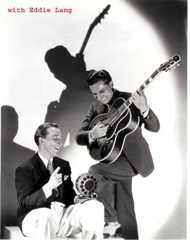 A Medical History
Lang’s preoperative diagnosis is difficult to discern. In the fewreferences that exist on the topic, Lang has been described as having “achronically inflamed sore throat,” “laryngitis,” and “disorders of....thedigestive system that tormented him his whole life.” Could Lang’s hoarse voicehave been a sequela of undiagnosed gastroesophageal reflux? We may never know.Regardless, a tonsillectomy was advised. Lang’s family was assured that it wasto be “an extremely simple operation.” On Lang’s death certificate, under theheading of “diagnosis during last illness,” are written the words “operationfor recurrent tonsillitis/chronic tonsillitis.”
The tonsillectomy wasperformed the morning of Sunday, March 26, 1933, at Park West Hospital at 170West 76th Street in Manhattan. Presumably, general anesthesia was used. Lang’swife Kitty (a former Ziegfeld Follies dancer) was present in the hospital atthe time of the operation. In the immediate postoperative period, the operationappeared to have been a success. The surgeon reportedly left, stating thateverything had gone well. Kitty Lang recalls being told by the doctor thatEddie had been given a sedative and would sleep for a while. According to onepublished reference, Kitty left to get something to eat, and on her returnfound that Eddie Lang had died. However, in another source, Kitty claims that,despite the doctor telling her to go home and come back later, she remained atEddie Lang’s bedside throughout the entire postoperative period, waiting forhim to awaken and see her. Eddie Lang never woke up. According to Kitty, aftera nurse checked Lang’s pulse around 5:00 p.m., a doctor was rapidly called, andKitty was escorted out of the room, being told soon thereafter that Eddie haddied. Bing Crosby, who reportedly had been at the nearby Friar’s Club, rushedto the hospital after being notified of Lang’s death. According to Kitty, “whenBing found out, he cried in my arms like a baby.”
The mechanism of death isuncertain. In a 1992 interview of some of Eddie Lang’s living relatives byItalian jazz critic Adriano Mazzoletti, it was stated that Lang had “suffocatedon his own blood.” One relative suggested that Lang was allowed to bleed todeath because of inattention by the nursing staff. Could there have been a lackof staff because of the operation being performed on a weekend? Anotherpossible contributory factor to Lang’s death may have been a narcotic overdose,as the patient apparently never did regain consciousness after having beengiven a postoperative sedative. Yet another theory as to the cause of deathcenters around Kitty Lang’s claim that she had been told that Eddie haddeveloped “a blood clot that formed in the lung.” Indeed, on Lang’s deathcertificate, under the heading “Contributory,” the words “coronary embolus” arewritten and scratched out with a single line, followed by the words “pulmonaryembolus.” However, the accuracy of such a diagnosis cannot be confirmed, as anautopsy was never performed. According to Kitty, “I didn’t want them to cut himup anymore. Whatever had gone wrong, I felt I didn’t want to know.” Lang’s bodywas transported to his hometown of Philadelphia, where the funeral was held onThursday, March 30, 1933. The event, which drew more than 2000 guests,including many members of the jazz community, was documented by a smallobituary in the Philadelphia Record. Eddie Lang’s death drifted into distantmemory as rapidly as Bing Crosby’s career rocketed toward uncharted heights.Legal action was never taken. “I feel that a mistake was made,” said Kitty,“but I don’t know for sure.”
On review of the limited dataregarding the death of Eddie Lang, several questions emerge. First, where arethe medical records? New York City’s Park West Hospital, where the surgery wasperformed, no longer exists; the site is now occupied by an apartment complex.The hospital had been a small (64- to 72-bed), private, for-profit institutionestablished in 1926. During the time of Eddie Lang, the hospital was reportedlyfrequented by celebrities who required medical treatment and wished to protecttheir anonymity (personal telephone communication with E. Massaro, nephew ofEddie Lang, November 27, 2000).
In May 1976, 43 years afterthe death of Eddie Lang, Park West Hospital, along with its sister institutionPark East Hospital, filed for bankruptcy. The hospitals were officially closedby July 1977, following repeated New York State Health Department citations forhealth, change of ownership, and building safety violations. After Park WestHospital was shut down, all medical records were retained by a lawyer. Theserecords were destroyed in a Brooklyn warehouse fire, the exact cause of whichwas never determined (S. Weinbaum, personal communication by written letter tothe author, January 17, 2001).
Another unsolved mystery regardingthe death of Eddie Lang is the identity of the operating surgeon. Kitty Langonce recalled the doctor’s last name during an interview, “Wolf,” but thedoctor’s first name has remained undisclosed. A 1934 American MedicalAssociation physician roster lists 12 Manhattan physicians with the last nameof Wolf, one of whom is identified as an otolaryngologist, but a connectionbetween any of these physicians and Eddie Lang remains unproved.
Finally, why was theoperation performed on a Sunday, and not during the regular work week? Theanswer appears to be related to the work schedule of Lang and Crosby. Accordingto a relative, Lang and Crosby had to return to Los Angeles the followingWednesday and had already reserved a train compartment. Lang was to have theoperation on Sunday, leave the clinic by Monday, spend Tuesday with his niecewho would have just celebrated her fifth birthday, then leave for California onWednesday. Needless to say, events did not go according to plan.
(Taken fromJazz and Otolaryngology: The Death ofGuitarist Eddie Lang, an article by David L. Mandell MD, from theDepartment of Otolaryngology, Mount Sinai School of Medicine, New York, andpublished in the magazine ofThe AmericanLaryngological, Rhinological & Otalogical Society, Inc., Volume 111(11)November 2001 pp 1980-1983)
Eddie’s passing hit me hard.He had a chronically inflamed sore throat and felt bad for a year or eighteenmonths before his death. He mistrusted doctors and medicine. Like many peoplewho came from backgrounds similar to his and who had had no experience withdoctors or hospitals, he had an aversion to them. But his throat was so bad andit affected his health to such a point that I finally talked him into seeing adoctor. Many times afterward I wished I hadn’t. The doctor advised atonsillectomy. And Eddie never came out from under the general anesthetic theygave him.
(Bing Crosby,Call Me Lucky, pages 91–92)
March 29,Wednesday. (9:00–9:15 p.m.) Bing’s finalMusicThat Satisfies show from New York.
Crosby Re-Adjusts Film Contracts - Plans One-Niters
Bing Crosby has re-adjustedhis contract with Paramount and leaves for Hollywood this Thursday (30th). Thesinger refused to take a cut on his picture salary but agreed to concessionsregarding his broadcast, line charge and band obligations. Paramount hadoriginally agreed to pay Crosby’s radio hook-up bills and also furnish him withan orchestra for his broadcasts over a period of eight weeks. Line chargesfigure around $1800 a week and the band about $2300 weekly. Under the revisedarrangement the producer will only have to foot these bills for two weeks or,the balance of Crosby’s contract with Chesterfield. Program goes off the airApril 15th; concessions to Paramount also mean that the plan for Crosby doing asustaining series on CBS after that date is out. Crosby will be off the airfollowing the Chesterfield finale for at least thirteen weeks. After he’sfinished his picture he lands a vaudeville bill and orchestra around him for across country tour of one-niters.
(Variety, March 28, 1933)
March 30,Thursday. Bing attends Eddie Lang's funeral in Philadelphia and then leaves for California.
Oncethe news broke of Eddie’s death, the radio networks marked the solemn occasionwith a moment of broadcast silence. On March 29, Bing returned to broadcasting Music That Satisfies. He must have haddifficulty stifling his sorrow while singing the opening song, “Have You EverBeen Lonely? (Have You Ever Been Blue?).”
Ed Massaro depicted for me the funeral proceedings which took place thevery next day: “My father, Tom Massaro, oversaw the arrangements. My uncle’sbody was transported to Philadelphia, where the funeral was held on Thursday,March 30. There were more than 20,000 guests. Ruth Etting’s husband, Norman ‘TheGimp’ Snider, controlled the overflowing traffic. Bing rode to the funeral inthe lead car with Joe Venuti. When he arrived, he was mobbed. My grandfatherwas still in a state of shock at the funeral. Bing paid for the tombstone.”
Giddins’ report lays bare the tumultuous circumstances: “Kitty waived theautopsy. Eddie’s father Tom paced the floor for days while Kitty sat in atrance. She lost thirty pounds. ‘I remember someone touching my shoulderand telling me that Bing had arrived to take me to the funeral. Poor dear Bing,my heart went out to this great man who was sitting on top of the world as thegreatest singer the world had ever known, and yet he lost the one companion whohad been instrumental in putting him there.’ The service was hell for Bing, hisfirst taste of the madness of celebrity. He was accustomed to autograph seekersin person and through letters; these he efficiently answered. At Eddie’s service,people closed in on him and turned the ceremony into a circus. In their haste, ‘justto touch him,’ in Kitty’s words, they overturned pews and the appalled priestwas forced to implore mourners to take their seats. Bing was already phobicabout hospitals and doctors, but this was unendurable, an intrusion on his andthe family’s grief, and he resolved never to let it happen again. Awelterweight named Marty Collins volunteered to protect Bing, who was impressedwith his manner and effectiveness.”
(Martin McQuade,writing in GuitarPlayer magazine, October 21,2016)
April 1,Saturday. Bing’sMusic That Satisfiesshow is not broadcast.
April 2, Sunday.Bing arrives at Pasadena on the “Santa Fe Chief” and is met by Dixie. MaryPickford and Nick Stuart have also been on the train with him.
April 3–May 4,Monday–Thursday. FilmsCollege Humorfor Paramount Pictures withJack Oakie,Mary Carlisle,Mary Kornman, andRichard Arlen. The director isWesley Ruggles.
Arthur (Johnston) and I had learnedthat the studio was preparing, as Crosby’s first solo starring vehicle, alavish filmization ofCollege Humor,adapted from the popular novelBachelorof Artsby Dean Pales, a book we had read and knew to be sprinkled withlogical, spots for numbers. That was the script we wanted. Crosby had by nowbecome a real powerhouse as a songmaker. The combined impact of his radioappearances, the eagerly awaited monthly recordings on Brunswick’s release list,and now the big musical films planned for him, were enough to catapult any goodsong to the top of the charts. We were well aware that theCollege Humorscorewas a prize that every songsmith in the land coveted. I say this without fearof contradiction, for aside from the five Crosby films I worked on, otherCrosby scores were later written by such immortals as Irving Berlin, ColePorter and Rodgers and Hart.
As much as we wanted to doCollegeHumor,at Paramount you just didn’t ask for an assignment, any more than adoctor goes after a wealthy patient. The accepted thing to do was to just sitthere and wait for it. Sometimes you got the one you wanted. Other times thedice came up with someone else’s number. So we did just that - sat there andwaited, making a pretense of reading the other scripts that had been sent tous. Sat there and just hoped that the studio heads would see the obviousjustice and good sense of giving the plum to the team that had turned outBing’s biggest-selling song hit. Day after day, we sat around waiting for news.The suspense was something awful.
The anxiety ended one morning atOblath’s Diner across the street from the studio. I was having breakfast andreading Louella Parsons’ column in theLos Angeles Examiner.Right therein her column was the item we were waiting for. Louella revealed that she hadlearned through the grapevine that Paramount was assigning the score of Bing’sfirst starrer to the writers of his popular hit, “Just One More Chance.”
Arthur and I went to the Grove thatnight and opened a bottle of champagne. We were so elated that we forgot to besore at the studio for telling Louella before us. In fact, that night weweren’t mad at anybody.
College Humor,as we expected, was a juicy,gratifying assignment. The picture, directed by Wesley Ruggles, establishedBing as a film superstar and was one of the top grossers of 1933. Three of ourCollegeHumorsongs achieved hit status: “Learn to Croon,” “Down the Old Ox Road,”and “Moonstruck” - all remembered to this day as early Crosby standards.
“Learn to Croon,” in fact, containeda vocal trick for Bing which he capitalized on forever after. The middlesection of the chorus goes:
You murmur “Boo boo boo, boo boo”
-And when you do,
She’ll murmur “Boo boo boo, boo boo”
And whisper love words to you.
The “Boo boo boo” sound has been thefamiliar Crosby trademark throughout the years.
“Down the Old Ox Road” was a sneakybit of lyrical quasi-pornography which somehow got by the censors. I’ll neverknow why. Especially in those Victorian movie days, when the Motion PictureProducers Association rules did not even permit a word like “damn” to be used.In the script, it was brought out that when a college boy seduced a girl intosexual fulfillment, he was taking her “down the old ox road.” Girls who hadbeen down the ox road were the ones most likely to succeed with college lads,as we were reminded throughout the story. The short chorus of the song reallyleft nothing to the imagination if you knew the code words, which apparentlythe MPPA censors didn’t. I was almost sure it would be deleted from the finalcut of the film when I wrote:
Down the old ox road,
Though you’ll never find out where it is by looking in
maps,
With a little investigation you’ll discover perhaps
That this old tradition’s not a place, but just a
proposition
On the old ox road, the old ox road.
The lyric got by that way, and hasnever been changed.
(Sam Coslow, Cocktails for Two)
April 5, Wednesday.(6:00–6:15 p.m.) TheMusic That Satisfiesshow has moved to Hollywood to accommodate Bing’s filming activities and thefirst broadcast from there takes place using the studios of station KHJ.PaulDouglas is the new announcer, Raymond Paige becomes conductor. Press reportsstate that the orchestration for “Just an Echo” has been left in New York andBing has to sing it using headphones while accompanied by the Lennie HaytonOrchestra in New York.
Bing Crosby sang from the West Coast last night, accompanied by Lennie Hayton’s Orchestrain the New York studio. Bing had lost the orchestration of‘Echo In the Valley’, prepared for a coast band. So, putting onthe earphone, as Hayton did here, Crosby sang, with both wires open,perfectly, with the band 3,000 miles from him, affording his background.
(New York Evening Journal, 6th April 1933)
April 8,Saturday. (6:00–6:15 p.m.)Music That Satisfies radio show on CBS.
Los Angeles once againbecomes the center of the nation’s attendance (KHJ-6p.m.) when Radio StationKHJ snatches Bing Crosby from the film studios to put him on the Columbia network.With Raymond Paige’s orchestra weaving a sympathetic pattern of accompaniment,Bing will sing “Linger a Little Longer,” “Farewell to Arms” and “You’reBeautiful Tonight, My Dear.”
(Los Angeles Times, April 8, 1933)
April 12, Wednesday. (6:00–6:15 p.m.) Bing stars in anotherMusic That Satisfies radio show on CBS.
Still in Southern California, Bing Crosby saunters into KHJ tonight, toopen up with ‘I Wake Up Smiling’. He will be accompanied byRaymond Paige and his Orchestra, Bing’s second selection will be, ‘Try a LittleTenderness’ and he will conclude with ‘Night and Day’ and his familiar theme,‘Just an Echo in the Valley’”
(Los Angeles Times, 12th April 1933)
April 13,Thursday.(9:15-10:00 p.m.) Bing takes part in the KHJ Birthday Party broadcast.
Congratulations to KHJ, oneof the outstanding stations on the Pacific coast. It has only 11 candles on itsbirthday cake today, but that does not mean it is a youngster. In radio, thatnumber, small as it is, indicates that the station is one of the pioneers ofthe country. In its short existence, KHJ has had its power increased tenfold,has added modern television equipment, has become the key station of the DonLee Broadcasting System, and an associate of the Columbia Broadcasting System.Morton Downey, Bing Crosby, Burns and Allen, Norman Nielson, Hazel Warner,Uncle John Daggett and many other radio entertainers will help KHJ celebrateits birthday anniversary tonight by presenting a program which will bebroadcast at 9:15. Ken Niles will be master of ceremonies. A limited number ofguests have been invited to the studios for this performance.
(Zuma Palmer,Hollywood Citizen News, April 13, 1933)
April 15,Saturday. (6:00–6:15 p.m.) The finalMusicThat Satisfies show is broadcast.
BingCrosby will ring down the curtain on the ‘Music That Satisfies’ broadcastseries tonight, when he appears on the Columbia network and KOL at 6 o’clockwith a fifteen minute song recital. The popular series which has brought to themicrophone such entertainers as, Ruth Etting, Crosby, Jane Froman, the BoswellSisters, Arthur Tracy, Alex Gray and Leonard Hayton’s Orchestra, will bediscontinued for the summer months. Crosby will close his engagement tonightwith the two ballads, ‘Why Can’t This Night Go on Forever?’ and ‘Maybe I LoveYou Too Much’ (sic). He will also sing ‘Darkness on the Delta’, a melody of theSouthland. Raymond Paige’s Orchestra will accompany the singer and play‘Syncopated Love Song’”
(Seattle Post, 15th April 1933)
Later, starting at midnight,Bing attends the annual benefit stagedby the Temple Israel at the Pantages Theater but after waiting for two hours tosing, gives up and goes home. Bebe Daniels, Chico Marx, Gus Arnheim, PhilHarris, and Ken Murray are also advertised to take part.
April 20,Thursday. (6:45-7:00 p.m.) Bing takes part in a radio program from station KFWB whenhe is interviewed by Ray De O’Fan. Bing sings “Just One More Chance.”
April 21, Friday.Said to have auditioned via a 3000-mile leased wire to New York for a proposed newChesterfield show for CBS with Richard Arlen andMary Brian. It is subsequentlyannounced that the half-hour program will commence on May 15 but in fact, thereare no further developments because of the high weekly line charges from LosAngeles to New York amounting to $1,200 per week.
April (undated).Bing goes to Palm Springs for a rest.
April 26,Wednesday.Bing and Dixie join a party at the home of Sue Carol and Nick Stuartfor what is described as beer and sandwiches. Then the twenty-fivepeople present are driven to the circus in four separate cars wherethey enjoy the performance by cheering on every act. The party includedGinger Rogers, Lew Ayres, Charlie Farrell, Jimmie Fidler, Ken Murrayand Johnny Mack Brown. After the circus, they return to Sue Carol'shome and play bridge until 3 a.m.
May 4,Thursday.Vaudeville returns to the Warner Bros. Hollywood Theater. Bing is one ofseveral stars who attend the show, which is accompanied by the Warren Williamfeature picture,The Mind Reader.Thebest of the offerings is said to be the Egyptianized solo dance ofEddieAnderson, colored comedian, who appears with Earl Dancer’s musical aggregation,the Harlem Entertainers. Eddie later becomes well known as “Rochester” in theJack Benny radio show.
May 11, Thursday.(3:00–6:00 p.m.) Makes promotional records for his filmCollege Humorwith the Paramount Orchestra.
May 13,Saturday.Golfs at Midwick in the Scotch foursomes. Bing and his partner arebeaten and after the match is decided, Bing has a hole-in-one at thethirteenth.
May 15, Monday.Paramount signs Bing to a two-year contract that calls for two pictures ayear.
May 18, Thursday.Bing and Dixie rent the home of Sue Carol and Nick Stuart while the owners areaway on a personal appearance tour. The Paul Whiteman film King of Jazz is re-released nationwide in view of the success ofBing, John Boles, and others on radio.
May 24,Wednesday. Commences filming shortsPleaseandJust an Echo (both with MaryKornman andVernon Dent) for Paramount with exteriors being done at YosemitePark until June 2. Arvid E. Gillstrom directs both shorts.
May 29, Monday. Bing and Dick Arlen watchJimmy McLarnin knock outYoung Corbett III in the first round to win the world welterweight title at Wrigley Field.
June 5, Monday. Mary Rose Peterson (Bing’s sister) gives birth to daughterCarolyn.
June 6, Tuesday.(6:00-6:30 p.m.) Sings “Learn to Croon” and “Moonstruck” from the filmCollege Humor on theCalifornia Melodies program broadcast byCBS from station KHJ. This is the first time these songs have been heard on theair. Jack Oakie is also on the show and Raymond Paige and his orchestra provide the musical accompaniment.
June 9, Friday.Records “Learn to Croon” and “I’ve Got to Pass Your House” plus two other songsin Los Angeles with Jimmie Grier and his Orchestra underJack Kapp’ssupervision. Many fans consider this session to represent the best of the“young” Bing.
“When a Bing Crosby movieever came to Steubenville, I would stay there all day and watch. And that’swhere I learned to sing, ‘cause it’s true I don’t read a note,” he [DeanMartin] would say. “I learned from Crosby, and so did Sinatra, and Perry Como.We all started imitatin’ him. He was the teacher for us all.”
In the 1933 movieCollegeHumor, Crosby sang ‘Learn to Croon.’. . . His Brunswick recording of itbecame a hit that summer, and with it, Crosby’s way of singing, slow and lowand cool, became irrevocably known as crooning. Many years later, there wouldbe fancy talk of Crosby’s “discreet use of appoggiaturas, mordents, and slurs,”and theNew York Times would describehim as “a bel-canto baritone whose art disguises art.” But back then, it wascrooning pure and simple. He worked the microphone as if it were a broad,weaving songs whose melodies seemed magically to merge with his natural breath.Young Dino was not alone. No singer who came after Crosby would ever approach amicrophone or a song without passing through his shadow.
(Dino, Living High in the Dirty Business of Dreams, page 76)
June 12, Monday.(8:00–8:30 p.m.) Stars in “Hollywood on the Air” over KECA-NBC. The programpreviewsCollege Humor.
June 13, Tuesday.Recording session in Los Angeles with Jimmie Grier and his Orchestra. Four songsare recorded including “Shadow Waltz” and “Blue Prelude”.
“I’ve Got to Pass Your House”– “Blue Prelude”
Everything in this record is absolutelyace high, and it must surely rank as one of the finest vocal discs ever issued.Bing is at the top of his form, and the grand recording brings out everyinflection of his splendid voice. Both numbers are of the blue type, and Bingrenders them perfectly, backed up by an able and artistic accompaniment. Theseperformances are very moving, and it is a thrill of a lifetime to hear the wayBing finishes the first number. What a climax!
(Melody Maker, October 7, 1933)
June (undated).Bing starts building his first home, on Forman Avenue in the Toluca LakeDistrict. Dixie’s father, Evan Wyatt supervises the work withHarold Grieve andhis wife,Jetta Goudal, handling the decorating arrangements. Grieve was aformer art and technical director in the movies who set up his own internaldecorating business, often working for clients from the film industry.
June 16, Friday.President Roosevelt signs the NationalIndustry Recovery Act and a new agency, the National Recovery Administration, isset up to administer it. Meanwhile, Bing records three more songs with Jimmie Grier and his Orchestra in Hollywood. Bing’s filmCollege Humor is prereleased in four different locations and is ahuge hit. The main release takes place on June 30.
Onthe campus of Mid-West University the girls are charming, the faculty istolerant and the romantic problems of Jack Oakie and Richard Arlen have areminiscent appearance. “College Humor,” at the Paramount, is a musical comedytour of Mid-West during the four semesters when Professor Bing Crosby is givinghis informal course on the history of the drama.
Burnsand Allen are there, too, as caterers, and Miss Allen is still preserving anuncommonly foolish attitude to the facts of life. And there are songs—“Learn toCroon,” “Moonstruck,” “Play Ball” and “The Old Ox Road.” And a football game,Mid-West vs. that Eastern college, and the score 13—7 in the last minute.
“CollegeHumor” is funny in spurts and agreeable most of the time. There are delightfulmoments when it seems to be on the verge of satirizing all the drearycollegiate films of the last decade. Mr. Crosby turns out to have a sense ofhumor and his subterranean blue notes are easy to listen to. Burns and Allen,hilarious clowns, have too little catering to do, for one thing. And the storywanders off the deep end about the time Mr. Arlen is kicked out of school forgetting drunk and trying to punch Mr. Crosby in the nose.
Lookedat as a whole, it emerges as an unsteady entertainment, with no verydiscernible intent, theme or goal, but with a modest fund of humor and two orthree heartily amusing patches. The story would seem to indicate that Mondrake(Mr. Arlen) is in love with Barbara Shirrel (Mary Carlisle), sister of hisroom-mate, Barney Shirrel (Mr. Oakie). Barbara, a capricious girl, lovesProfessor Danvers (Mr. Crosby), who doesn’t realize it. Mondrake is expelledfor making a spectacle of himself and Barney is forced to bear the brunt of thebig football game all by himself.
Mr.Oakie’s owlish efforts to assimilate an education help the comedy along andMiss Carlisle is a very model of a model musical comedy co-ed. Mr. Arlen isreliably pleasant.
(New York Times, June 23, 1933)
A choppy cutting job that givesthe story’s progress a jerky, uneven appearance went a long way toward tearingdownCollege Humor’s best points, butfortunately there was enough left after the scissor-man got through for anentertaining picture. A light, frothy musical that doesn’t give the customersmuch of a mental workout, it’s nice summer fare on timely release that shouldturn in satisfactory business in general…The leading boy, as usual, is thefresh guy freshman, but the uncommon angle is a professor (Crosby) who croonshis lessons and croons the campus belle away from the star footballer, and thencroons himself into a star crooner on the radio…“Learn to Croon” is the mostcatchy of the Coslow-Johnston score but the picture, under its musical ratingcould have used a more outstanding lead tune. Crosby does the singing.
Between Crosby for romance and Oakie for laughs, the picturehas a strong pair of male leads. . . Crosby makes his best showing to date witha chance to handle both light comedy and romance. His pale face makeup is theonly flaw so it looks like all he needs is a new paint job and another goodrole.
(Variety, June 27, 1933)
“College Humor”, by the way,is drawing the longest lines that have been seen in some time and people aregetting all excited over a new discovery—Bing Crosby. They’ve suddenlydiscovered what a grand personality the lad has, even when he isn’t singing.The public is sometimes slow, but always proud of its discoveries.
(The Hollywood Reporter, June 30, 1933)
June 19, Monday.(9:30 p.m.) Bing and other members of the cast from the filmCollege Humor make personal appearances on the stage at the Paramount Theater in Los Angeles to publicize their movie.
June 20, Tuesday.(8:15-8:30 p.m.) Bing appears on radio station KFWB to interview Harry Bassler, theLakeside golf professional, who in turn gives him advice on how to use a spoon(a type of golf club).
June 23–29,Friday–Thursday. Appears live at the Paramount in Los Angeles on four occasionsand sings songs from the filmCollegeHumor, which is also being shown at the theatre.
June 26, Monday. TheKraftMusic Revue makes its debut on NBC. AlJolson and Paul Whiteman star in the opening show. The name of the program ischanged to theKraft Music Hall in1934.
June 27, Tuesday.Dixie gives birth toGary Evan Crosby at Cedars of Lebanon Hospital. The babyweighs seven pounds, six ounces and he is named after Bing’s friend Gary Cooperand Dixie’s father, Evan Wyatt.
July 1, Saturday.“Shadow Waltz” enters the charts and subsequently reaches number one.
July 3–mid-August. Bing filmsToo Much Harmony forParamount withJudith Allen, Jack Oakie,Skeets Gallagher, and Lilyan Tashman.The film is directed by A. Edward Sutherland. Bing also films anotherHollywood On Parade, aneleven-minute short, with Jack Oakie and Skeets Gallagher in order to promoteToo Much Harmony.
July 4, Tuesday.(6:15-6.45 p.m.) Appears on theCaliforniaMelodies radio program singing three songs fromCollege Humor.
Bing Crosby willfurnish the pyrotechnics on the Melodies program this evening, singing threetunes from his latest motion picture.
(The Fresno Bee, July 4, 1933)
July 8,Saturday.Bing is thought to have golfed at Lakeside in a competition called TheBeringTrophy. Dixie is reported to have suffered a slight relapse at theCedars of Lebanon hospital following some minor surgery after havinggiven birth on June 27.
July 9,Sunday.Bing (handicap 6) defeatsHorace Heidt, band leader, 1 up, at the Rancho Country Club, towin the “musical golf championship of America.” Each had a medal score of 79,with Bing coming from behind after being two down in the first five holes towin the match.
July 20,Thursday.Bing filmsHollywood on Parade No. A-4(1933), a twelve-minute short film with Mary Pickford in which he promotes hissong “Down the Old Ox Road” fromCollegeHumor.
July 25, Tuesday.Bob Crosby marries Marie Grounitz (age 19) in Oakland. (6:00–6:45 p.m.) Again appears on theCaliforniaMelodies radio show and sings “Blue Prelude” and “I Would If I Could, But ICan’t.” It is announced that Bing has hired a bodyguard, Marty Collins, toprotect his wife and new baby in his Hollywood home. Permission is given forthe bodyguard to wear a special officer badge.
The currentedition of “California Melodies” over KHJ at 6 pm. gives promise of being a winner,especially with the women, as it marks the reappearance of Bing Crosby andbrings John Boles, singing film star, to the microphone for an interview.
(The Los Angeles Times, July 25, 1933)
July (undated).Bing signs a contract to make three films for Paramount in 1935 for $250,000 intotal.
August 3,Thursday, onwards. Bing goes to Catalina Island on a fishing trip and he and RichardArlen andGary Cooper cruise down to Mexican waters in Arlen’s boat, the JobynaR.
August 16,Wednesday. Dixie Lee is back in Cedars of Lebanon hospital having fallen at homeand broken her elbow. Bing rushes back from Catalina Island to take her tohospital.
August 21,Monday. Bing asks Paramount to remove his star billing forToo Much Harmony and co-feature him with Jack Oakie and SkeetsGallagher.
Crosby doesn’t want star billing by Par.
Hollywood August 21. BingCrosby has requested Paramount to kill the star billing the studio has givenhim on ‘Too Much Harmony’. He requested that he be co-featured with Jack Oakieand Skeets Gallagher. Studio has all the paper on the picture printed and feelsthat it can’t afford to dig new paper. Crosby is insistent. Player claims thattoo many actors have been killed by top billing and he is not going to take achance. Studio says that the crooner’s name is one of its best assets atpresent and should be used for all its worth. Situation has Crosby in the frontoffice daily demanding that the studio pull his name down on the picture’sadvertising while the studio is attempting to sell him that he is big enough tocarry a picture.
(Variety, August 22, 1933)
August 22,Tuesday.Bing catches a 188-pound marlin sword fish in 45 minutes at Catalina Islandand is photographed with his catch.
August 27,Sunday. Bing plays in the Los Angeles Examiner Golf Championship at the MidwickCountry Club but has a poor round, scoring a ninety-five! Partnered withChicoMarx, they lose to radio writers Kenneth Frogley and Ray De O’Fan. Bingsubsequently writes to Ray De O’Fan of theLosAngeles Examiner as follows:
I am in receipt of a billfrom the management of Midwick Golf Club covering Flit and other deodorant usedin expurgating their lovely fairways following my debacle of last Sunday.Although I am ready and willing to assume some portion of this expense, itseems only right that the Messrs. Marx and Frogley are equally liable for thedamage done and should accordingly be assessed. I hope at some early date I canget you at Lakeside. There I am confident of at least a 92 or 93.
(Los Angeles Examiner, September 1, 1933)
Bing later records four songs from thefilmToo Much Harmony in Los Angeleswith Jimmie Grier and his Orchestra. (6:45-7:45 p.m.) Takes part in a majorjoint NBC and CBS broadcast which is designed “to help pep things up for theNational Recovery Administration.” Other artists in the studio with Bing areWill Rogers, Eddie Cantor, and Ruth Etting.
Crosby and Grier Make Recordings for Brunswick Co.
Among the bestphonograph records produced of late are four recordings made by Jimmie Grierand his orchestra with Bing Crosby. The tunes are “Black Moonlight,” “It Had toBe That Way,” “The Day You Came along,” and “Thanks.” They are from Crosby’snew picture. The recording was done at Recordings, Inc., at the Melrose Avenuestudio for Brunswick.
All the numberswere done in concert style from arrangements by Grier. “Black Moonlight” isparticularly outstanding from the standpoint of voicing and originality.
(Tempo, September 15, 1933)
August 28, Monday. During the afternoon and evening, Bing and Dixie attend a reception atthe Westwood home of Mr. and Mrs.Skeets Gallagherfollowing the christening of the Gallagher’s baby daughter, Pam. Thechristening was solemnized at the Little Church of St. Paul, the Apostle. Otherguests include the CharlesErwins, the LeoMcCareys, the WesleyRuggles, theFrankCapras and JackOakie.
August 30–October. FilmsGoing Hollywood withMarion Davies forWilliam Randolph Hearst’s Cosmopolitan Pictures using theMGM facilities. Preliminary rehearsalstake place at Hearst’s San Simeon castle. Bing sings “Temptation” and fourother songs, earning $2,000 weekly above and beyond a lump sum. The film alsofeaturesFifi D’Orsay and Stuart Erwin. The producer isWalter Wanger and the directorisRaoul Walsh. Some outdoor locations are shot at Walsh’s Encino ranch.LennieHayton is the musical director. Production is delayed in September by theillness of co-star Marion Davies and the film wraps several weeks late. The endof picture party is held at Marion Davies’ lavish bungalow at Santa Monica andBing sings a parody called “Rollicking Rockaway Raoul.”
SPENDFIVE DAYS FILMING ONE SONG
Fivefull days of music and melody—40 full hours of singing and dancing—boiled down tothree brief minutes of tuneful entertainment for the screen!
Thiswas the production miracle accomplished for one of the five song hits introducedin Marion Davies’ new Cosmopolitan production for Metro-Goldwyn-Mayer, “Going Hollywood.”And this time element does not include the weeks of preparation, nor the longperiod of dance rehearsals, It involved the picturization of one song. “GoingHollywood,” sung by Bing Crosby, Miss Davies’ leading man in the picture, and whichis presented, critics have stated, in one of the most novel, tunefularrangements ever brought to the screen.
The songis offered during Bing Crosby’s flight through New York's Grand Central Station,on his start for Hollywood and a picture career, and continues from the momenthe appears on the grand stairway until he reaches the observation platform forhis westward journey.
It wasnot the filming of those scenes alone that necessitated the five days of labor.A hundred other tasks were necessary to boil the five-day program down to threeminutes of actual footage.
Therewere the rehearsals by the augmented orchestra, led by Lenny Hayton, America’syoung musical director.
Therewere the song rehearsals of the vocalists, and the varied choruses, supervisedby Herb Nacio Brown and Arthur Freed, composers of "Going Hollywood"song numbers.
Therewere those aching hours of dance rehearsals, directed by Albertina Rasch, by thehundred and more sprightly tap-dancers.
Thehours required for limbering-up by the colored porters’ dancing chorus.
Thehours spent in synchronizing the many voices, including Bing Crosby’s, with theorchestrations.
(The Washington Herald, November 22, 1933)
Bing Crosby was a very fineman to work with. He was always in a very happy mood and he never paid anyattention to anybody—he just paid attention to his work. What amazed me wasthat when he started to sing before the orchestra, he could sing perfectly finewith a pipe or a cigarette in his mouth. I said to him one day, “How can you dothat when you’re smoking.”
“It gives me that sort of husky quality.”
He was very cute and very sweet, and he was crazy about hiswife Dixie. And she was a darling. Every time he’d be doing a scene, his eyeswould be sort of. . . He had big blue eyes and you knew his mind would be wayoff. I knew where it was. He was wondering where Dixie was and what she wasdoing. He’d stay by himself and read a newspaper, and then he’d go to the phoneand call up Dixie.
(Marion Davies, writing inher bookThe Times We Had—Life withWilliam Randolph Hearst)
Despite the overwhelmingly positive reviews afforded to Marion in 1932,with the success ofPolly and the CircusandBlonde of the Follies, in 1933 Marionfound herself back in unidimensional roles.GoingHollywood in which she co-starred with Bing Crosby, would be something of astep backward in her quest for more substantial roles.Going Hollywood was originally written by Frances Marion asPaid to Laugh with Marie Dressler cast asMarion’s mother. Frances was off contract at the time, and MGM paid her $10,000for the rights before handing the material over to Donald Ogden Stewart, who cutout the role of Marion’s mother and retitled the projectGoing Hollywood. RaoulWalsh, a veteran director of dramas, signed on to be the director, and it wouldbe his first musical.
The story is one of Marion’s stranger films and more convolutedplot lines. InGoing Hollywood, Marionplays a young boarding school teacher who yearns for freedom, deciding tofollow her favorite singer (played by Bing Crosby) across the country. Going Hollywoodis noteworthy for introducing the song “Temptation,” which became a Crosby standard,and as one of the movies in which Marion was able to do her biting, spot-onimpression of co-star Fifi D’Orsay. Marion’s alcoholism was beginning to affecther health, and it is noticeable inGoingHollywood. Her face was slightly puffier, and she had gained weight. Thisincrease in Marion’s drinking was exacerbated by Crosby’s, as the two of themclowned around on the set. Since W.R. was not watching Marion, they felt free tolet the alcohol flow.
(Lara Gabrielle,Captain of Her Soul: The Life ofMarion Davies, page 127)
September 2, Saturday.Bing and Dixie go to a dinner party at the Toluca Lake home of Mr. and Mrs.Richard Arlen.
September 10, Sunday. Bing and Dixie attend areception given by actor Nick Stuart and Dave Kay in their new businessquarters in West Hollywood. Nick has opened an agency.
September 11,Monday. (8:00-8:30 p.m.) Bing, Jack Oakie, and Skeets Gallagher appear on theHollywood on the Air radio program fromstation KECA and promote their filmTooMuch Harmony.
September 12,Tuesday.It is announced that Bing will commence weekly broadcasts on CBS forWoodbury Soap on October 7. He will be paid $1750 per show.
September 15,Friday.Bing records the song “Going Hollywood” for the soundtrack of the film of thesame name.
September 18,Monday. Bing and Dixie move into their new home at 4326 Forman Avenue.
September 19,Tuesday.Variety states that Bing “isthe present-day disc best-seller.” Under his Brunswick contract, he receives$200 a side plus royalties. Victor is said to be flirting with Crosby andoffering $1,000 per recording. (6:00-6:30 p.m.) Bing appears on theCalifornia Melodies radio program fromstation KHJ singing songs fromToo MuchHarmonyaccompanied by Raymond Paige and his Orchestra. English actorCliveBrook is interviewed on the same show.
September 20,Wednesday. Bing and Dixie are again entertained to dinner at Richard Arlen’shome. Other guests are Sue Carol andKen Murray.
September 22,Friday. Bing’s filmToo Much Harmonyis released.
The film bears the title ofToo Much Harmony and those who arepartial to crooning will find plenty of it in this production...Even personswho delight in Mr. Crosby’s peculiar ballads may be somewhat disappointed in hisattempts to register admiration and affection, for, although he is one of themost popular singers in his line, his acting is often apt to make one uneasy.
(New York Times, September 23, 1933)
Pretty weak on the story end,but there’s enough incidental matter to carry this one through. It’s a musicalwith accent on the music and the song and cast should bring it pleasant returnsall over… Between Bing Crosby and Jack Oakie, the literary deficiencies aremodified. Crosby for the singing and Oakie for the comedy; a strong combo. . .At least one of the several songs should make the best-seller grade in thecompetent hands of Crosby. His singing ability he always had, but Crosby nowhas also found himself in the trouping department. It makes him a cinch.
(Variety, September 26, 1933)
In this, as in other films,the Crosby voice records as if microphones were invented for it. Bing hasdefinite personality besides, and he grows steadily more at ease in his acting.
(Los Angeles Evening Herald Express, September 29, 1933)
College Humor and Crosby’s third picture,Too Much Harmony, both received some excellent critical reviews aswell as some bad ones. The main topic of most of these notices was, of course,Crosby. Most critics found him a strong contender for stardom; however, somereviewers were less than impressed with his as yet undiscovered abilities as anactor. Most of these critics commented that Crosby could not yet sustain abelievable characterization. This is basically true; however, there is no denyingthat Crosby’s roles in these films were very weakly written and understandablydifficult for him to make believable, As a result, his acting in these earlyfilms is distinctly limited, lacking in the style and credibility he brought tomost of his later characterizations. Nearly all critics did agree that Bing’ssinging, voice was one of the mostoriginal and pleasant sounds ever to emerge from a motion picture.
(The Films of Bing Crosby, page 22)
September 27, Wednesday.Bing records four songs including “The Last Round-Up” and “Home on the Range”in Los Angeles with Lennie Hayton and his Orchestra. Later in the day, herecords the song “Temptation” for theGoingHollywood soundtrack.
…Bing’s singing becomes moreand more impressive, and though he is referred to more often than not as acrooner, he is definitely nothing of the sort. The virility and richness of hisvoice make him incomparable as a singer of popular songs, whether it be with orwithout the medium of the microphone. His recent Brunswick record of theLast Round-up is sung so powerfully andrichly that it looks like being the hit record of the season, bigger even thanPlease which was his furore in theBig Broadcast film.
(Melody Maker, November 18, 1933)
In contrast to theprosaicness of the accompaniment of Lennie Hayton’s orchestra on the coupling,[Home on the Range] the four-measureintroduction here is superbly effective, including Hayton’s meaty violinunisonals and prominent guitar. The slightly lachrymose effect used onHome on the Range is peculiarlyeffective here with the tear in Bing’s voice being exactly appropriate to thethought and theme ofThe Last Round-Up.With his personalizing and vitalizing every phrase, with unobtrusive andcomplementing accompaniment, and with Bing whistling the bridge of the secondchorus, this is practically a perfect rendition of this well-nigh perfectlittle song, an adjudication with which there can be little disagreement.
(Dr. J. T. H. Mize,Bing Crosby and the Bing Crosby Style,page 107)
Bing's version of "Home on theRange" turned a little-known saddle song into the most renowned westernanthem of all time. In November 1933, when his record was issued, the origin of"Home on the Range" was obscure and widely debated. Folklorist JohnLomax, who said he learned if from a black saloonkeeper in Texas, published itin 1910, in Cowboy Songs and Other Frontier Ballads. In 1925 a sheet-music arrangement found modestpopularity; two years later Vernon Dalhart, the operatic tenor turned hillbillysinger, recorded it for Brunswick. California's radio cowboys picked it up fromhim, and in 1930 the movies' first crooning western star, Ken Maynard, recorded a version. Not untilBing sang it, however, was the song embraced as a national hymn, so popular asto generate a farcical plagiarism suit that had the unintended benefit ofspurring an inquiry into the song’s history. It was traced to a poem,"Western Home," written in the 1870s (without the chorus or thephrase "home on the range") by Dr. Brewster Higley, whose neighbor,Dan Kelley, set it to music. Bing's stirring performance transforms a nostalgiclament into an ode to pioneering, a dream of shared history, a vaguelyreligious affirmation of fortitude in the face of peril. He made it aDepression song that ignores the Depression, expressing longing, awe, andgrace. Bing's subtle embellishments enhance the melody, and his projection andcontrol are unfailingly dramatic, particularly during the soaring eight-barrelease. His record offered a transcendent secularity, a well from which allAmericans could drink. More prosaically, it anticipated the golden age ofgentle-voiced singing cowboys and the Irish sentiment of the John Ford westernsthat followed on their heels. FDR acknowledged "Home on the Range" ashis favorite song.
(Gary Giddins,A Pocketful of Dreams, pages 338-339)
The year had witnessed ashortage of finance of the most acute character. The summer of 1933 had beenexceptionally hot and the record industry had continued to dwindle. We were,however, consolidating our position in the industry and our American contractswere showing the promise of great things in the future. Already we wereachieving bigger sales than our American friends. Whereas in the U.S.A. a saleof 25,000 copies of any one record was regarded as exceptional, in Britain BingCrosby’s record ofPlease went over60,000 and ofThe Last Roundup 80,000copies.
(E. R. Lewis, founder ofDecca, writing in his bookNo C.I.C,page 44)
September 30,Saturday. (6:15 to 6:30 p.m.) Bing stars inParadeof Champions on CBS with the Raymond Paige Orchestra. This is the first ofa series of six broadcasts sponsored by Studebaker to promote their fourmodels. He sings “Thanks,” “Don’t Blame Me,” and “I Guess It Had to Be ThatWay.” (8:30-9:00 p.m.) Bing is interviewed byJimmie Fidler on theHollywood on the Air radio program andagain sings “Thanks”.
September (undated). Everett Crosby is involved in negotiations for Bing to appear as the MockTurtle in the Paramount film ofAlice inWonderland. It is said that his demands for a week’s salary for Bing andfor Bing to have permission to do one picture outside the studio areunacceptable and the part goes toCary Grant.
Bing Crosby has not yetaccepted the role of the Mock Turtle inAlicein Wonderland. The part requires but a few days’ work, and Crosby, I hear,has demanded payment for a full picture in return for playing this brief role.Perhaps Crosby doesn’t fancy the elaborate disguise he would have to don,either. Paramount wants as many big names as possible for this picture, intowhich so much money already has been poured. Radio crooners are big box officeattraction, so if Crosby won’t sing the ditties of the Mock Turtle, it’spossible that Russ Colombo may be engaged. Colombo is working at Universal, buthe is not working there at this time. And with his first picture,Broadway Through a Keyhole, nowreleased, he will be building film popularity.
(Elizabeth Yeaman,Hollywood Citizen News, November 2,1933)
October 2,Monday. Bing and Dixie attend the premiere of the play “Louder Please” at theBelasco Theater. The play features Ken Murray and Sheila Terry.
October 5,Thursday. (6:15–7:15 p.m.) Appears on the final show of theParade of Champions radio series withEthelBarrymore,Morton Downey,Willie and Eugene Howard, Ruth Etting, and theRaymond Paige Orchestra. Bing is advertised to sing "The Day You Came Along" and “This Time It’s Love”.
Crosby, Etting and Downeywith their several vocal styles need no reviewing. Suffice that each confirmedprevious judgments by socko song-peddling. First two broadcast from L.A.
(Variety, October 10, 1933)
October 8,Sunday.Gary Evan Crosby (aged 3½ months) and RichardRalston Arlen (aged 4½ months) are christened in a double ceremony at St.Charles Church, North Hollywood. Afterwards ahuge party is held at Bing’s new home. Several hundredguests are there, including Bing’s parents, and they overflow into the garden.Russ Columbo is also one of those present.
Bing Crosby and Russ Columbohave buried the hatchet. Not, as you might surmise, in each other’s skull, butin six feet of soil where the weapons of warfare was planted without ceremony.The “battle of the baritones” has ended and the boys have made up. They realizethere is enough money, enough following for both and they will enjoy it.
It all happened when Columbo attended the christening ofCrosby’s young son last Sunday and of course “Ears” O’Fan was on the job, threefeet away, when greetings were exchanged.
“Hello, Russ,” came the hoarse, familiar voice of Crosby.
“Hya, Bing,” returned the good-looking Columbo.
They chatted for a few minutes until both paid respects toother guests. Of course I wanted a picture of that handshake but the powersinsisted that the time was not ripe for photographs. Columbo was one of thelast guests to leave.
Others lifted their eyebrows in amazement to see the twocrooners talking together. Sam Coslow, himself one of the crooning troupe andone whose voice has a Crosby and Columbo twang, was stupefied. “If I hadn’tseen it with my own eyes I’d never believe it,” he said.
Throughout the afternoon, air buzzed with “Columbo’s here.”There was no sign of strained relations. In fact one of the Crosby contingentvolunteered, “Everything is going to be alright between those fellows.”
The story of their break dates back to the time when both wereaffiliated with Gus Arnheim. Later both bucked the portals in New York City andagain they clashed. Those who know say that “advisors” whispered poisonouswords into the ears of Bing and Russ.
(Ray De O’Fan,Los Angeles Examiner, October 11, 1933)
October 10,Tuesday. Variety carries the following item.(It did not come to pass!)
Bing Crosby opensat the Paramount, New York, Nov. 10, for a five-weeks run in the one house at$5,000 per. Deal is on a straight salary basis, without percentage. Crosby, whohas been on the Coast for Paramount and doubling on the air, had intended to dohis first 26 broadcasts for Woodbury from Hollywood. Broadway booking will necessitate hiscoming east and transfer of the program to CBS' New York studio.
(Variety, October10, 1933)
October 14,Saturday.Press reports indicate that Bing has joined the Screen Actors Guild.
FILM WORKERS WILL MEET TO PROTESTCODE
Upon the outcome of a hugemass meeting of film workers and actors at 8pm tomorrow at the El CapitanTheater rests the turn of the approaching crisis with which the film industry isthreatened because of dissension over the NRA film code’s regulations.
A large attendance isexpected at the gathering, sponsored by the Screen Actors Guild and the ScreenWriters’ Guild, when “definite action” against the tentative film codeprovisions will be taken, according to Guild officials.
WALKOUTS THREATENED
The vigor of the protests maybe such that strikes and walkouts of film talent will be discussed, accordingto reports which were prompted by statements of Eddie Cantor, president of theactors’ guild, who said that “reputable actors would not work for producers whoimpose the unfair and un-American provisions of the code articles.”
Kenneth Thomson, secretary ofthe Actors’ Guild, announced today that a flood of new members has beenreceived into the Guild, which now numbers almost 700 actors and actresses.
Those who signed yesterdaywere Marion Davies, Richard Arlen, June Collyer, Stuart Erwin, Charles Farrell,Bing Crosby, Thomas Mitchell, Gregory Ratoff, Nella Walker, Toby Wing, ClaudeGillingwater and Frank Sheridan.
WORD TO COWAN
Executives of the Academy ofMotion Picture Arts and Sciences today wired Lester Cowan, executive secretary,now in Washington, D.C., concerning information a report that he would leavethe capital probably tonight by airplane to return to Hollywood to continue theAcademy fight for modification of the drastic regulations in the code.
Sections drawing the talentfire include blacklisting of talent, the registrar’s control of talentactivities, a limited open season in which producers may bid for services, theopen negotiations between producers and talent after expiration of contracts.
(Hollywood Citizen News, October 14, 1933)
October 16, Monday. (5:30–6:00 p.m.) Bing returns to CBS, now on Mondays, forWoodburySoap with Lennie Hayton’sorchestra and withKen Niles as announcer. The guest is eighteen-year-oldsongstress, Mary Lou Raymond. Bing is paid $1,750 per broadcast for a minimumof 13 weeks plus a figure to be agreed for a further six broadcasts.
The show has a 25.1 rating for theseason putting it in 14th. position for evening programs. The highest ratedevening program as assessed by the Co-operative Analysis of Broadcasting forthe 1933-34 season was the Eddie Cantor show (with aCrossley rating of 50.2)with Rudy Vallee coming in at 39.0.
Bing Crosby, the baritonesensation of two years back, returns to the air on a series of weeklybroadcasts over the Columbia network, beginning at 5:30 o’clock tonight. Smartmanagement and Crosby’s success in motion pictures brings the star crooner backinto the good graces of fickle fandom. A nightly spot in 1931 wore down bothBing and his following. His conspicuous absence since that time has againraised a demand for the Crosby talents.
Crosby will share his opening broadcast with the 18-year-oldCalifornia songstress, Mary Lou Raymond. The pair will be supported in thethirty-minute program by Leonard Hayton’s Orchestra.
(Press release)
Selling a product to thewomen must of necessity use a program of definite appeal to them and in Crosby,Woodbury Soap has chosen wisely. For Bing is in the middle of a brilliantcareer and the motion picture successes in which he appears add to his strengthas a radio draw. Further, he has not been heard too often of late and hisperformance is better than ever as to both voice and choice of selections. Onthis particular program he neither whistled nor dabbled in his famous impromptuobbligatos.
Lennie Hayton, an able accompanist, arranger and conductor, hasalways shown a distinctive style about his work and Crosby, through pastassociation, naturally feels at home when Hayton wields the baton or is at thepiano. All of which makes for efficiency.
With Crosby and Hayton is a chorus of mixed voices that comesin occasionally, while a good piece of showmanship was a solo by a femininevocalist about the middle of the program which seemed to offer the precise bitof relief and contrast. Hayton also injected some piano parts played by himselffor further diversity of the musical end of the half-hour. Crosby himselfoffered an excellent selection of ballads, mostly of the romantic type and closedwith ‘The Last Round-Up’ for good measure. Orchestral interludes were welldone, smooth and soft, plus plenty of rhythm.
Show originated on the Coast, where Crosby, of course, ismaking pictures. Credits, done against a partly faded-out musical backgroundwith the theme ‘Beautiful Lady’, leaned towards the lower price of the productand its value as a complexion requisite. These were not overdone consideringthe background of Woodbury, which was used by many grandmothers of today whenthey were girls
(Billboard,October 28, 1933)
The debut was October 16,1933, with Ken Niles saying: “Bing Crosby entertains” followed by a word ofwelcome from Crosby and an opening song. After that Niles would intone amessage from Woodbury whose slogan: “For the skin you love to touch,”represented considerable esthetic improvement for Crosby over coughlesscigarettes and saliva-free cigars.
The Woodbury program is significant for it gave Crosby somedialogue for the first time, his personality emerging in light banter withNiles and introductions to his songs. It also began the system ofcross-promoting his own work which he would refine to a degree never before orsince approximated. He featured songs and guest stars from his own films andsang songs he had recorded.
(Norman Wolfe, Troubadour)
October 17,Tuesday. Press comments indicate that Bing has reached the semi-finals of the Canada Dry tournament at Lakeside.
October 18,Wednesday.(8:00 p.m.) Bing is thought to have entertained atthe Temple of Los Angeles Lodge No. 99, B.P.O.E. in a benefit designed toobtain clothing and food for the needy. Others advertised to appear are MaeWest, Jack Oakie, Jimmy “Schnozzle” Durante, Lupe Velez, Johnny Weissmuller andGeorge Raft. Harry Owens is in charge of the program. The price of admission,per person, is a bundle of old clothing, or imperishable food items. Music isprovided by Harry Casey and his orchestra from Paramount studios.
October 22,Sunday.Loses one down to Bill Davidson in the semi-finals of the Lakeside ClubChampionship. Later, Bing records three songs, including “Temptation,”from the filmGoing Hollywood in Los Angeles withLennie Hayton and his Orchestra.
October 23,Monday. (5:30–6:00 p.m.) Bing hosts anotherWoodburyshow. The guest is again Mary Lou Raymond.
Bing Crosby’s new Columbiaseries, originating at KHJ on Mondays, hasn’t set the world afire. It lacksunction and zip—or something. Anyway. Ed Lowry has been recruited to spice itup in the role of guest master of ceremonies. He appears next Monday.
(Carroll Nye,Los Angeles Times, October 28, 1933)
October (undated).Bing organises a golf tournament for municipal golfers at Griffith Park in Los Angeles, which isspread over several weeks. There are 82 entries.
October 26–November 1, Thursday–Wednesday. Appears at the Paramount Theater in Los Angeles in acine-variety bill. He receives a standing ovation for his rendition of “TheLast Round-Up.” He is said to be paid $5,000 for his services.
Naturally,Bing Crosby in person is the real attraction at the Paramount this week. Thepopular crooner takes part in a special sketch, designed to show off recent songhits in Paramount pictures.
Followingthis, Crosby sings request numbers, even the much-maligned “Headin’ tor theLast Round-Up” being included. Incidentally, you should hear Crosby warble thisone. It’s as different from the rendition given by a thousand so-called croonersas day and night. Georgie Stoll and an unnamed guitar player assist the singerin many of the tunes.
Itmight have been a “plant,” but anyway yesterday afternoon a young lady from theaudience, rushed onto the stage and kissed the apparently surprised Crosby, whothen muttered, cheerfully enough, something about a sorority initiation, andthe wish that she’d get her pin all right.
Thecrooner is the popular man of the hour, right enough, yet withstanding his hatband remains the same size and he appears ready to grant as many request numbersas time allows.
(John Scott,The Los Angeles Times, October 28, 1933)
Crosby is introduced in aproduction number, the classroom scene out of “College Humor.” Wows them withit supported ably by the girl line and Vicki Joyce. Then he gives them ‘LastRoundup’ for another volley of applause and winds up with some old favs, backedby Stoll’s violin andBobbySherwood,a la Joe Venuti and the late Eddie Lang. His 14 minutes not enough for theopening mob, which insisted on another number.
(Variety,October 31,1933)
Bing Crosby was mobbed bywomen and children yesterday at the Paramount, and he crooned. One woman grew soenthusiastic when he sang “Please” that she jumped on the stage, threw her armsaround him, kissed him fervently and cried, “Oh, Bing—you’re marvelous.”
Bing was all of that. From a sartorial standpoint he was a livingsymbol of N.R.A. in white trousers, blue coat, and red and white striped tie.From a singing standpoint he was at his best, for never in the history of theParamount Theater has there been such a demonstration.
(Eleanor Barnes,Los Angeles Illustrated Daily News,October 27, 1933)
October 30,Monday. A complaint at the Los Angeles Municipal Court alleges that Bing hireda limousine from a Violet Wildey at $75 per month and used it from April toSeptember but has not paid the hire charge. A judgment of $450 is asked againstBing. (5:30–6:00 p.m.) AnotherWoodburyshow. Guests are Ed Lowry andJoan Marsh.
Spice is added to Bing Crosby’s weekly program over KHJ when Ed Lowry,vaudeville comedian appears as master of ceremonies and Joan Marsh is recruitedfrom the motion picture colony to sing a number with radio’s ace crooner. Anaugmented choral ensemble and Lennie Hayton’s Orchestra roundout the bill.
(Los Angeles Examiner, 30th October 1933)
Controversy between BingCrosby and Woodbury Soap over what theme song shall prevail in that commercialMonday night session over CBS, has been settled. Commercial and its agency,Lennon & Mitchell, yielded to the baritone and henceforth, ‘In (sic) TheBlue of the Night’ stays in the program and ‘Loveliness’ is out. Crosby arguedthat the logical theme for the stanza was ‘Blue of the Night’, on the groundsthat the song had been identified with him ever since he’s been on the air.Sponsor and agency’s contention was that the ‘Loveliness’ tune has always beenthe theme of the Woodbury programs, no matter what name was connected with themand for this reason the old bars should stick. In answer to this, Crosbypointed out, that even though there were some listeners who associated the‘Loveliness’ melody with the product, it seemed to him that the listenerassociation of ‘Blue Of The Night’ and himself at the opening of the programwould be of greater benefit all round. Crosby and the combo headed by LennieHayton will broadcast the Woodbury affair from New York starting November 13th,with the December 4th program, the origin will again be the West coast. Entryof Dale Winbrow as Woodbury’s producer last week started with a verbal set-tobetween Crosby and Winbrow, who had been sent out to the West coast from NewYork by the Lennon & Mitchell agency. After introducing himself, Winbrowlistened to the program that Crosby and his combo pilot, Lennie Hayton, hadprepared for the next broadcast and gave voice to an opinion that rounded nocorners. The flare up that was provoked from Crosby wound up with the warblerand Hayton declaring themselves out of the show. The baritone’s managementlater prevailed upon him to hold on while the situation was being straightenedout with the agency on the New York end. Winbrow’s previous air connection wasas MC and plug-reader on the Crisco Chipao show.
(Variety, October 31, 1933)
November 1,Wednesday. (8:00–8:30 p.m.) Bing takes part in a nationwide radio programlaunching a new CBS station (WBBM) in Chicago.
November 2,Thursday. (Starting at 11:42 a.m.) Playing with Harry Bassler, Bing comes joint third with a 67 in a pro-am prior tothe Southern California Open at Fox Hills Golf Course, Los Angeles.
November 3,Friday. The Paramount shortPlease opens at the Paramount Theater in Los Angeles. It is released nationwide onDecember 15.
Two shorts, Bing Crosby inPlease and a Popeye cartoon almost runthe main feature off the screen. Crosby sings and clowns with Vernon Dent and,although he has just completed a week at the Paramount, the audience reacted asif he had been off the screen for ages.
(Los Angeles Evening Herald Express, November 3, 1933)
Between Bing Crosby’s severalvocal numbers and the intervening comedy sequences this Arvid E. Gillstromtwo-reeler manages to be consistently entertaining. Crosby, driving along theroad, does a little flirting with Mary Kornman, who turns out to be a voiceteacher. So he stops at her place for lessons. A rival, Vernon Dent, pullsvarious pranks to eliminate Crosby, but only makes things worse for himself,with Crosby finally coming through, not only as the star crooner, but also in aromantic way.
(Film Daily, November 13, 1933)
For those amongthe motion picture audience who find the crooning Bing Crosby engaging as performerand vocalist, this short subject probably will be judged entertaining. In acomedy effort, Crosby comes upon a young vocal teacher in the country andconcealing his identity, becomes her pupil in an effort to persuade her to lookupon him with favor. In a singing contest before the townfolk, Crosby wins overthe other swain seeking the teacher's hand. There are a few laughs, but theCrosby fans
should like it.His name is worth selling space in the advertising and on the marquee. — Runningtime, 20 minutes.
(Motion Picture Herald,November 18, 1933)
November 4,Saturday. Bing is in Palm Springs at what is described as the Crosby-Arlenhouse on the hill overlooking the El Mirador Hotel. He hosts a cocktail party thatincludes Gary Cooper andJohn Gilbertas guests.
November 6,Monday.(5:30–6:00 p.m.) Bing’s radio show forWoodburySoap on CBS.
“Going Hollywood,” hit melody from the new motion-picture of the samename, which he has just completed with Marion Davies, will be the featurednumber of Bing Crosby’s program over WFBM and the Columbia network Monday from7:30 to 8:00 p.m.
(The Indianapolis Times, November 6, 1933)
November 8,Wednesday. Bing is back in Palm Springs and is photographed playing baseball onthe Diamond at the Desert Inn.
November 13,Monday. (5:30–6:00 p.m.) Bing hosts anotherWoodburyshow.
Those two old friends and musical partners, Bing Crosby and LennieHayton will combine their talents for another half hour presentation of melodyand song over an international network and The Bee radio at 5:30 o’clock. The popularbaritone of radio, stage and screen will offer three or four characteristicselections.
(The Fresno Bee, November 13, 1933)
November 18,Saturday. Bing and Dixie are seen at the Colony Club together with othercelebrities.
November 19,Sunday. Bing is at the Beverly Wilshire Hotel and is persuaded to mount theorchestra platform and sing three songs with Gus Arnheim.
November 20,Monday. (5:30–6:00 p.m.) Bing’s radio show forWoodburySoap on CBS.Bing sings four songs accompanied by Lennie Hayton and his Orchestra. KayThompson and the Three Rhythm Kings begin an extended run as guest stars. (TheThree Rhythm Kings compriseHal Hopper, Woody Newbury and Chuck Lowry)
The unusually improved Bing Crosby, whose crooning hasbeen displaced by a baritone voice of magnetic appeal, sings the latest inpopularities via WABC at 8:30. He will be assisted, of course, by that cleverconductor, Lennie Hayton, who does much to help Crosby maintain his rhythms.
(Brooklyn TimesUnion, November 20, 1933)
Meanwhile,big things afoot at KHJ. Bing Crosby, then the most popular voice on radio andthe seventh biggest box-office star, was hired by Woodbury Soap to host a newCBS series beginning October 16, 1933. In order for Bing to continue his dayjob at movie studios in Hollywood, the network agreed to base the series at KHJwhere it would be written and directed by staffers Pat Weaver and Jack VanNostrand.
Practicallyovernight,The Bing Crosby–Woodbury Showbecame one of the top programs in the country, and to Kay’s delight, Binginvited her and the Three Rhythm Kings to be his guests on the November 20installment. When asked by the Los Angeles Times how thingswent, Thompson said she was most proud of the fact that “Bing tapped his foot” when she sang.
Thefoot tapping must have been sincere, because Kate and her boys were invitedback the following two weeks, and then, “as a result of listeners’ response” signed as regulars for a 13 week commitment throughMarch 5 1934–far and away Thompson's most important national exposure to date.
Andyet,she didn’t have much in the bank to show for it. WhileCrosby was raking in $1,750 per show (plus additional earnings for movies and records)Kay was limited to her all-inclusive salary of $200 as a KHJ staff artist.
(SamIrvin,Kay Thompson: From Funny Face toEloise, pages 35-36)
November 25, Saturday.Olive Kathryn Grandstaffis born in West Columbia, Texas. Shelater becomes Kathryn Grant and marries Bing in 1957.
November 27,Monday. (5:30–6:00 p.m.) Bing’s radio show forWoodburySoap on CBS.
A halfhour serenade from California will go on the air from 7:30 to 8 o'clock,the singers and players being Bing Crosby and Lennie Hayton and his orchestra.Crosby will be heard in four selections, accompanied by the orchestra, andHayton will leave the podium at one stage of the recital and play a piano soloof his own.
(The Courier Journal,27th November 1933)
Bing Crosby planned to go to NewYork earlier this month but changed his mind and remained in the Southland, torest at Palm Springs, between his weekly nation-wide broadcasts which originateat KHJ at 5.30 pm. His assistants on today’s program are Kay Thompson,the Three Rhythm Kings and Lennie Hayton and his Orchestra.
(LosAngeles Examiner, 27th November 1933)
Burt McMurtrie, CBScommercial program mgr., is due back in New York, this week from his rush tripto Los Angeles to put Woodbury Soap's Bing Crosby-Lennie Hayton stanza on an evenkeel. Network flew McMurtrie out to the coast three weeks ago when friction betweenthe agency’s (Lennon and Mitchell) producer on the program developed air performancesthat weren’t to the commercial’s like.
(Variety, November 28, 1933)
November 30,Thursday. Press reports indicate that Bing is having a little trouble with histhroat and has had to pass up two weeks at the New York Paramount at $5,000 perweek
December 4,Monday. (5:30–6:00 p.m.) Bing hosts theWoodburyshow on CBS. The guests are Kay Thompson and the Three Rhythm Kings.
Bing Crosby, having discardedhis plan to head eastward in November, will continue to present his weekly singingaffair from Los Angeles, thus costing his sponsors extra shekels forline-reversal charges. He’ll again have the snappy Rhythm Kings trio and KayThompson as musical accoutrements, plus the incomparable Lennie Hayton, pianistextraordinary. Hear the lot at 5:30pm on KHJ.
(Los Angeles Illustrated Daily News, December 4, 1933)
December 5, Tuesday. Prohibition ends as Utah becomes the last state to ratify theTwenty-first Amendment.
December 11,Monday. Bing interrupts a Palm Springs vacation to record “Did You Ever See aDream Walking” and “Let’s Spend an Evening at Home” with Lennie Hayton and hisOrchestra in Los Angeles. (5:30–6:30 p.m.) Bing broadcasts hisWoodbury show. Kay Thompson and theThree Rhythm Kings are again featured.
Bing Crosby will offer his interpretation of ‘The Last Round-Up’, inhis program tonight (KFRC 5.30 to 6 pm). Kay Thompson and the RhythmKings will be, hereafter, heard regularly with Crosby and Lennie Hayton’s Orchestra. Crosby’sother songs tonight will be ‘Bless Your Heart’, ‘Beautiful Girl’, ‘My (sic) Temptation’ and ‘Thanks’. Hayton’s Orchestrawill be heard in ‘Dinner at Eight’, ‘The Cashmir (sic) Song’ and ‘Tea forTwo’. Miss Thompson and the Rhythm Kings will present twospecialities, ‘Not for All the Rice in China’ and ‘By a Waterfall’.
(San Francisco Chronicle, 11th December 1933)
Bert McMurtrie, ofCBS, left for Hollywood late last week to remain as long as the Woodbury broadcasts emanate from there. That will probably beuntil about Feb. 3. Woodbury show consists of Bing Crosby and Lenny Hayton orchestra.The Network feels that the presentation needs personal handling locally.
(Variety, December 12, 1933)
December 13,Wednesday. (Evening)At McHuron's Grill in Hollywood, Bing presents the trophy to JohnnyRoss, the winner of the first Griffith Park Golf Championship.
December 14,Thursday. Starting at 10:52 a.m., plays in the amateur-pro prior to the California State Open with Harry Basslerat the Lakewood course in Long Beach.They have a 71 and are unplaced.
December 15, Friday.Bing sings at the Los Angeles Examiner Christmas Benefit Show at the ShrineAuditorium. Many other stars such as Will Rogers, Jimmy Durante, Ethel Merman,and Rudy Vallee also perform.
. . . Ted Healy was special masterof ceremonies for theMGM delegation, that included such famous stars as MayRobson, Polly Moran, Jeanne and Jimmy Durante, and, of course, the HealyStooges, Larry Fine, Moe Howard and Jerry Howard.
Paramount-Publix contributed a galaxy of noted artists, withRoscoe Karns as master of ceremonies. and everything on the bill down fromcomedy to drama, the list of stars included Burns and Allen, radio’s famouspair; Ethel Merman, from Broadway; Baby LeRoy, Jack Haley, Ida Lupino, DorothyDell and Buster Crabbe, along with Leroy Prinz’s Paramount Beauties.
Then there was Bing Crosby himself, Paramount’s star loaned toCosmopolitan, crooning his best. The Mills Brothers, famous quartet, alsoappeared on the bill. . .
(Los Angeles Examiner, December 16, 1933)
December 18,Monday. (5:30–6:00 p.m.) Bing’s radio show forWoodburySoap on CBS.Guests include the Mills Brothers and Kay Thompson and the Three Rhythm Kings.
Lured to the coast bylucrative motion picture contracts, the Mills Brothers, amazing exponents ofharmony, with the ability to simulate orchestral effects with the vocal chords,enter a new phase of their radio career as entertainers on Bing Crosby’sColumbia program which originates at KHJ at 5.30 pm. They will offertheir novelty arrangements of ‘Dinah’ and ‘Lazybones’. Crosby isbilled to sing ‘Heaven Only Knows’, ‘Goodnight Little Girl of MyDreams’ and ‘Thanks’. Lennie Hayton’s Orchestra providesthe orchestral features and Kay Thompson and the Three Rhythm Kings continue tolend their talents to the show.
(LosAngeles Examiner, 18th December 1933)
Few are aware ofhow active [Crosby] was in the fight for racial equality in the United States.Crosby was one of the first white performers to appear on an equal basis withblack performers. His recordings with the Mills Brothers . . . are earlyexamples of his commitment. Also, the brothers were regulars on Crosby’s radioshow—an important step toward more racial equality on the radio and the musicbusiness in general.
(Douglas E.Friedman,Four Boys and a Guitar: TheStory and Music of the Mills Brothers)
December 22,Friday. Starting at 11:25 a.m., plays in the first round of the Pasadena Open at Brookside Park but finishes up with an 84.
…Bing Crosbysmashed a mashie iron on a rock early on the first nine. The loss of the clubeffected his game and he was out of the picture with an 84.
(Max Colwell,The Pasadena Post, December 23, 1933)
December 23,Saturday. The filmGoing Hollywoodhas its premiere at the Capitol, New York.
Blended properly with theholiday humors,Going Hollywood hasenough basic liveliness to produce a sprightly and jocular mood at the Capitol.The overwhelming magnitude of the latter-day musical picture is gratefullyabsent from this one. It is warm, modest and good-humored. Bing Crosby has amanner and a voice, both pleasant, and the songs that Nacio Brown and ArthurFreed provide have a tinkle and a lilt. From the competent routine sentimentsof “Our Big Love Scene” and the pleasing little pastoral lyric “We’ll Make LoveWhen It Rains” they range down to that brooding song which Mr. Crosby, loadedwith whisky and sorrow, sings across a Mexican bar while the glamorous MissDavies is far away.
(The New York Times, December 23, 1933)
Pretentious musical withclass in every department but one. It has names, girls and good music, but itsstory is weak from hunger and the script will prevent a big click. Fair is itsrating.
Marion Davies is starred and Bing Crosby featured, but Crosby willdraw the bulk of what this one gets. Other assets are the music, the fact thatit’s good, and that it has girls and plenty of them . . . From start to finish Crosby is constantlysinging. It must be good singing because it doesn’t get tiresome, despite thatit’s laid on so heavy. . . . At leastthree songs in the generally excellent score, as played by Lennie Hayton’sorchestra, sound promising. With Crosby there to sing ‘em the songs get abreak, too.
(Variety, December 26, 1933)
Bing Crosby, who plays themovie star, is in his best voice. “Going Hollywood” will make Bing more popularthan ever with his fans. Not only is his voice thrilling, but he moreeffectively demonstrates his personality than in any picture in which he hasyet appeared.
(Louella Parsons, writing intheLos Angeles Examiner, January 26,1934)
“Stupendous! Gigantic!Colossal! Superb!”
This is the blurb growled by Ned Sparks, as the motion picturedirector, in Marion Davies’ latest vehicle,GoingHollywood. And it expresses the tone of the film most accurately in thosefour extravagant, worn-out adjectives. It is all that—and nothing more.
A stupendous, gigantic, colossal and superb background for MissDavies, who seems to possess a new and amazing loveliness as the years roll by.A stupendous, gigantic, colossal and superb stage-setting for Bing Crosby tocroon his ditties and express an arrant dilettantism that will thrill theladies...However, you’ll want to seeGoingHollywood. It is a marvelous agglomeration of luxurious entertainment...
(The Washington Post, December 23, 1933)
Sometimes when Mama went into Smithfield to do the big grocery shop on a Saturday, Virginia and I would goto the movies. She wasn’t allowed to sit downstairs, that was whites only, so Iwas the only little white thing, a white blond child, up in the balcony withthe blacks. I remember seeing one movie with Bing Crosby and Marion Davies.You’ll have to check what it was called and what year that was. (Going Hollywood, 1933). I must have beenten or eleven years old. Virginia and I came home and acted out the wholething; one time I’d be Davies and she would be Crosby, then we’d switch around
(Ava Gardner quoted inAva Gardner: The Secret Conversations,p46.)
December 25,Monday. (5:30–6:00 p.m.) Bing’s radio show forWoodburySoap on CBS.Guests include the Mills Brothers.
A gala array of talent will be heard will be heard with Bing Crosby at 5:30p.m. Lennie Hayton’s Orchestra, the Mills Brothers, Kay Thompson and the ThreeRhythm Kings will be heard.
(The Fresno Bee, December25, 1933).
Lennie Hayton stymied by L. A. Union Rules LosesWoodbury Acct.
Broadcast of Jan.9 will be the last for Lennie Hayton on the Tuesday night Woodbury show over NBC. Account's dissatisfaction with thedance combo under his direction is the cause. In agreeing to the withdrawalHayton admitted that he has found it difficult to maintain a first rate danceunit from among the pickup men available to him in Los Angeles. Pick of thetown's musicians, the leader pointed out, had permanent berths and the rules ofthe local union banned them from doubling into other jobs.
(Variety, December 26, 1933)
December 27, Wednesday. Larry and Elaine Crosby have a daughter, Molly.
December 31,Sunday, (5:30-7:00 p.m.) CBS broadcasts "Kaleidoscope of 1933" overtheir network. This looks at high spots from the theatrical andamusement calendar of 1933 and Bing, the Mills Brothers plus RaymondPaige's orchestra contribute a joint performance from the West Coast.
During the year, Bing has had sixteenrecords that became chart hits. His parents have moved to Hollywood and Binghas rented a bungalow for them at 4405 Mariota, North Hollywood. He later buys them a house at 4366 Ponca Avenue in Toluca Lake.
1934
January 1,Monday. Bing attends the Rose Bowl game between Stanford and Columbia; he sees Columbia win 7-0. Hedescribes the game on hisWoodburySoap show that night when the guests arethe Mills Brothers plus Kay Thompson and the Three Rhythm Kings.
Bing Crosby’s “noodling,” in the cupboard of forgotten accomplishments for solong, has returned prominently since Bing and the Mills Brothers joined companyfor the Monday evening broadcast. “Dinah” last week and “Shine” this week showCrosby as a fellow who sings anything and sings it well. I remember when heeither dared not or cared not to hit high notes. Now he goes one or two noteshigher than necessary at the finish of a song and his expression seems toexpress a satisfaction which might be interpreted as “Well, Mr. Note, you wereHIT. Right on the nose.”
(Ray De O’Fan,Los Angeles Examiner, January 3, 1934)
January 3,Wednesday. (7:00-7:15 p.m.) Bing is interviewed on radio station KMTR by theLos Angeles Times drama critic - Edwin Schallert - and is askedabout his plans for the future and his views on the ultimate place of croonersin radio’s firmament.
January 5,Friday. Bing attends the Friday night boxing in Los Angeles.
January 8,Monday. Acts as guest announcer for theLosAngeles Examiner at the Los Angeles Open Golf Championship at the Los Angeles Country Club. (5:30–6:00p.m.) Bing hosts theWoodbury show.Guests include the Mills Brothers and Kay Thompson and the Three Rhythm Kings.
CBS brings startling informationin headline manner that Bing Crosby will broadcast from California. Where hashe been? Mills Brothers continue to form an important part of the program.Bing’s reading of the football summary last week was given in a manner whichmade numerous announcers blush. Stumbling and confusion were conspicuous bytheir absence. He had all the self-assurance of a Husing. The Crosby broadcastis heard at the usual hour, 5:30pm, through KHJ.
(Los Angeles Examiner, January 8, 1934)
January 10,Wednesday. Dixie Lee tests for the feminine lead in a new Paramount filmMelody in Spring. She eventually takes arole inManhattan Love Song, aMonogram Studios production.
January 11,Thursday.Just an Echo, atwenty-minute short film is released by Paramount.
BINGCROSBY ‘Just anEcho’Musical Sketch 22 Mins. Paramount, N. Y. CroonerBingCrosby, nowalso ActorCrosby, is cast thistime as a forestry trooper with a yen for vocal calisthenics and pretty girls,in particular the niece of his superior who arrives at camp for a vacation. Inbetween the light romantic plot developments, Crosby croons a couple ofnumbers, with ‘Just an Echo’ the tune featured. Lacks the punch of a triphammer but agreeable shorts diversion for all.
Background is the outdoors of some spot in the westthat looks like a forest preserve with campers around. Bing is on horsebackpart of the time riding around the mountains, among other things stoppingpeople from smoking cigs, the how he first meets up with the girl; a type whoscreens none too well. Later, when a dance is given for her by her Captainpapa, Bing is called upon to render a pop croon special.
When his attentions to the leading lady are stubbornlyrestrained, the girl goes to jump into the lake under heat of conceit, anddoes, Bing follows for the rescue. The two end up on horseback, Bing closingthings up with more of ‘Just an Echo.’ Two girls supporting are Mary Kornmanand Alice Ardell, mistress and maid respectively.
Arvid E. Gillstrom is the producer and director.
(Variety,January 23, 1934)
In the latest of the Arvid E.Gillstrom two-reelers, Bing Crosby plays the role of an officer in a governmentpark reservation where no smoking is allowed. Mary Kornman and a frienddrive through,with Mary toting a lighted cigarette, so Bing takes it from her. Later at parkheadquarters it develops that the girl is a niece of Bing’s superior officer.She has him assigned to do things for her, such as unpacking her baggage,shining her boots, etc., while Vernon Denttakes to her girl friend. And so on, with various comedy results, plus some agreeablecrooning by Crosby.
(FilmDaily, February 8, 1934)
For the film feature, BingCrosby, after a fashion, rides a horse. Dressed in a wide-brimmed hat and aflannel shirt, Crosby croons. This was too much for the audience yesterday.They snickered. But Crosby for a crooner isn’t such a poor actor. Crooners canbe a lot worse. You remember Rudy Vallee.
(Los Angeles Post Record, January 12, 1934)
For those amongthe motion picture audience who have a fondness for Bing Crosby, of the radioand screen voice, this may be found reasonably effective as comedy with music. Ratherunfortunately Mr. Crosby, in the role of a state trooper, is several timesastride a horse. To say the least, he does not ride in a manner comparable toour better western stars. In fact, he is occasionally laughable. The music hasits moments, however, and the comedy is at least fair. — Running time, 20 minutes.
(Motion Picture Herald, February 24, 1934)
January 13,Saturday. Bing “stops the show” with his performance at the Screen Actors’Guild Ball at the Biltmore Hotel. Rudy Vallee is billed as the MC and starssuch asJeanette MacDonald, John Boles, andJames Cagney also take part.
. . . Rudy Vallee, as masterof ceremonies, introduced the artists and kept the show moving at a fast pace.When Jeanette MacDonald sang the Italian Street Song fromNaughty Marietta, we caught a glimpse of the anticipatedMGM production of the famousmusical with Jeanette in the leading role. Bing Crosby stopped the show, as didthe handsome John Boles. Pert Kelton’s imitation of Charlie Chaplin was a riotand simply out-Chaplined Charlie. When Jimmy Cagney danced, we were reminded ofthe fact that before he became a “socker” of beautiful ladies on the screen, hewas a popular New York hoofer. And then there was Eddie Cantor, wise-crackingfrom New York via the telephone, and Jimmy Durante, George Raft, Ted Healy andhis stooges, Frank McHugh, Dick Powell, Hal LeRoy and—oh, well, you just shouldhave been there. . .
(Los Angeles Examiner, January 14, 1934)
Rudy Vallee, billed as masterof ceremonies, was not present. Dick Powell, master of ceremonies fromPittsburgh, took his place. Bing Crosby, Charlie Butterworth and Frank McHugh“panicked ‘em” with an imitation of the Boswell Sisters.
(Associated Press, January 14, 1934)
The high-spot of the eveningwas the impersonation of the Boswell Sisters given by Bing Crosby, CharlesButterworth and Frank McHugh, in their lavender gowns and bonnets. Somebodyshould really make a reel of that.
(The Hollywood Reporter, January 15, 1934)
January 15,Monday. (5:30–6:00 p.m.) Bing’s radio show forWoodburySoap on CBS.Guests include the Mills Brothers and Kay Thompson and the Three Rhythm Kings.Gus Arnheim and his Orchestra take over from Lennie Hayton.
TheBing Crosby broadcast is a pip to watch—not only for its entertainment but inthat the entire program is presented in an easy-going informal fashion. Thehigh pitched tension that has so long been a part of the nation-wide networkshow is lacking in this sparking production of Paul Rickenbacker.
Crosbyis a striking “just folks” type and his singing and dialogue are done in a matter-of-factstyle that’s restful to the eye as well as the ear. Dressed informally in brownand with his short collar open, America’s ace crooner does his bit, walks outof the studio to hear the Mills Brothers, and then saunters back to continue hispart of the show.
Thedirecting of Gus Arnheim’s Band by Lou Kosloff was a thing of beauty and theand the clever, dark-haired maestro was a hit with the musicians as well as theKHJ officials, who have signed him to wave the baton until Gus returns from hisbrief sojourn in Hawaii some two weeks hence.
Afterwatching Bing and company go through their paces before the mike with everybodytapping their feet to the uncanny rhythm and instrumental noises created by thedusky four boys and a guitar, it is easy to see why his half-hour variety broadcast,ably announced by Kenny Niles, is a roaring success over the air waves.
Bingappeared to have writer’s cramp. Judging by his hasty exit down the back stairwayto escape an autograph-hungry crowd waiting outside.
(Carroll Nye,Los Angeles Times, January 18, 1934)
This is the night when BingCrosby and Gus Arnheim’s Orchestra enjoy their radio homecoming. Apart for thepast three years, since both were featured in a nightly broadcast, thecombination is revived on Crosby’s coast-to-coast program at 5:30 o’clock,released here through KHJ. Much water has flowed beneath the bridge since theCrosby-Arnheim rhythm team last ruled the airialto. Bing has gone to a perchatop the crooning field. Arnheim has gone to dazzling heights in the orchestralworld. There is sentiment attached to the reunion. It may be noticeable. Itwould be gross negligence to fail to mention the Mills Brothers, who are partof the show. Originally signed for three weeks as guest artists, they proved sopopular that they were made a regular feature.
One can speak of Crosby and Russ Columbo in the same breathnowadays. In New York they seldom saw each other and reports had it that theycared little if meetings were never arranged. We’ve heard Crosby’s story andwe’ve had Columbo’s. Apparently outside influence tried to build a bitter feudbetween them. Since neither saw nor talked to the other, each believed that hewas the victim of disparaging remarks. Not long ago they talked things over andfound that the “battle of the baritones” was a fight in which neither tookpart.
Both are fine fellows, successes in radio and in motionpictures. Crosby is pleasantly aggressive and a wit. Columbo, on the otherhand, is a listener, who allows the other fellow to talk. Both are goodlooking, but widely different in type. Bing is of medium height and stocky,with light complexion. Columbo is typically Latin. About 6 feet tall, heresembles the late Rudolph Valentino. His olive complexion is inherited fromItalian forbears.
(Ray De O’Fan,Los Angeles Examiner, January 15, 1934)
Asthe popularity of the series grew, Bing rapidly gained enormous amount of powerand for better or worse, took control of all creative aspects. He also demandedthat the station pay him the entire $5,800 weekly budget, from which he wouldpay all salaries and expenses, then pocket the rest. Although Crosby had beenoffered the use of conductor Raymond Paige and the KHJ Orchestra, he insisted on hiring his own, cheaper accompanists.The first was LennieHayton and his 16-piece band. Musically, LennieandKay’s arranging styles melded perfectly and theybecame instant friends. Unfortunately, the collaboration was cut short inJanuary 1934 when Lennie was offered more money by NBC in New York to conductTown Hall Tonight starring Fred Allen.Lennie’s replacement was none other than Gus Arnheim, with whom Bing and Kayhad worked (separately) at the Cocoanut Grove. However, the network wasunhappy, not only with the change of orchestras but with Crosby’s mismanagementand ever-increasing demands. The behind-the-scenes drama got so bad, William S.Paley, chairman of CBS, finally intervened, sending in one of his big guns,Burt McMurtrie, to handle the situation.
Bothnatives of the state of Washington, Burt and Bing had worked together beforeBing was a star. But now the dynamics of their relationship had changed andCrosby was not about to take any orders from his old friend.
(SamIrvin,Kay Thompson: From Funny Face toEloise, pages 35-36)
January 20,Saturday.Emanuel Cohen holds a dinner dance at his home on Misty Mountain in honor of Gary Cooper and Sandra Shawwho had married in New York in December. Bing sings at the party andW. C. Fields, Jack Oakie,andLanny Ross also entertain.
January 22,Monday. (5:30–6:00 p.m.) Bing’s radio show forWoodburySoap on CBS.Guests include the Mills Brothers and Kay Thompson and the Three Rhythm Kings.Elsewhere, an eleven-minute shortHollywoodon Parade (No. 7–1933) is part of the program at the Paramount Theater inLos Angeles. In it, Bing is seen with John Barrymore and Harry Langdon in acomedy skit on the golf course.
Bing Crosby features anothersong from Marion Davies’ latest Cosmopolitan production,Going Hollywood,which opens Thursday at Loew’s State Theater, when he takes theair with Gus Arnheim’s Orchestra today (5:30pm, KHJ). Songs from thispicture are among the finest in Bing’s repertoire, and little wonder, since heis the leading man in the production. This time it will be “We'll Make HayWhile the Sun Shines,” a tuneful score by Nacio Herb Brown and ArthurFreed.
(Los Angeles Examiner, 22nd January 1934)
January26,Friday. Bing and golf pro Charles Guest stumble on a robbery atLakeside Golf Club during the morning as they arrive for a round ofgolf.
CROSBY FREESTHUG VICTIMS
Bing Crosby, screen and radiocrooner and ardent golfer, today played a role in a melodrama in real life.
While two bandits fled the office of the Lakeside Golf Club thismorning with $200 loot from the safe, Crosby freed Membership Manager S.E.Handbury and Secretary Helen Baier, who lay gagged and bound up in long stripsof black adhesive tape like mummies. The two bandits, who had posed as golfersseeking memberships, ran from the clubhouse as Crosby entered. They got away intheir auto too quickly for Crosby to pursue them, he said, and he rushed to theassistance of the pair on the floor behind a telephone booth.
Manager Handbury told Van Nuys police that the bandits appliedyesterday for memberships and when they returned today drew revolvers andordered him and Miss Baier to lie on the floor. They then draped tape abouttheir bodies and over their mouths. Thus helpless the victims could only watchthe bandits loot the safe.
(Los Angeles Post Record,January 26, 1934)
January 28,Sunday. Thought to have been at Wrigley Field to see the National All-Stars lose to the Chicago Bears 23-0.
January 29,Monday. (5:30–6:00 p.m.) Bing’s radio show forWoodburySoap on CBS.Guests include the Mills Brothers plus Kay Thompson and the Three Rhythm Kings.Later, Bing is thought to have entertained at a welcome party forEarl Carrollin the Blossom Room of the Hollywood Roosevelt Hotel. The proceedings arebroadcast over KMTR at 10:30 p.m. W.C. Fields acts as master of ceremonies.
Bing Crosby will head another variety show to be broadcast from LosAngeles with Gus Arnheim’s Orchestra and the Mills Brothers,tonight. Crosby will sing a group of solo numbers and will alsoserve as Master of Ceremonies.
(SanFrancisco Chronicle, 29th January 1934)
January 29–March. FilmsWe’re Not Dressing for ParamountwithCarole Lombard,Ethel Merman, Burns and Allen, andRay Milland. The filmis directed byNorman Taurog. Location shooting takes place on Catalina Islandfor several days at the end of February and early March. The cast stays at the St. Catherine Hotel.
A lot of old maidsand widows living on smallpensions or small fixed incomeswere staying on Catalina at the St. CatherineHotel.It wasa family-type hostelry,and our moviecompany was an exciting experience to the guests.I imagine they wrote to their friends and relatives,“We have a number of Bohemians stopping with us.” Our movie companyateat two or three huge tables in the dining room. The smaller tables wereoccupied by the regulars, who strained their ears to drink in the racy thingstheywere sure we were saying.Carole(Lombard) was annoyed with this constant surveillance and eavesdropping. Wewere eating breakfast one morning when she came slinking inwith that feline walk of hers. All eyes swiveled around to watch her, and shedecided that this was the time to make up something shocking. She was the girlwho could do it. She had an inventive turn of mind.
She called across the dining room, “Bing!”“What?” Iasked.
“Did I leave mynightie in your room last night?”
Thespinstersalmost dropped their teeth.I’ve never heardsuch tch, tch, tching and gaspsin my life.After thatthey gaveusawide berth. Some of them even stoppedeating in thediningroom.
(Bing Crosby,Call Me Lucky,page 127)
...Referring to one of his earlier films, “We’reNot Dressing”, Bing related the real story behind “Droopy” the bear, who playeda part in that film. It seems that Norman Taurog, who directed this movie, hada pretty tight budget and an even tighter schedule. He managed to find ananimal trainer who possessed a tame black bear. The trainer convinced Taurogthat the bear would get along with Bing, with Carole and the rest of the cast,and would be able to perform the tricks necessary without any bother at all.Came the day of shooting and the bear was hopeless - quite incapable ofperforming what was required. Taurog, in a fury, held up the production andtold the trainer to take away the bear and bring it back when it could performthe scenes that Taurog required. As time went on, Taurog realised that he wasgetting nowhere with the bear and his impatience began to get very evident. Somuch so, that on one occasion, his assistant director slapped the “dumb bear”on the jaw ... whereupon, Bing said (giving a perfect imitation) the bearstarted to cry. Eventually, as Bing explained, they managed to get some footageof the bear. Not much and not good, but enough to carry Taurog through the sceneshe needed. By the end of the movie, Taurog was thoroughly annoyed about thebear and couldn’t (pardon the pun) bear the sight of the animal.
The picture ended and Bing, Carole, Taurog and the restof the cast threw an end-of-the-movie “cast party” (a necessary habit of thoseearly movie days) and when the party ended and Norman Taurog returned to hishouse in the early hours of the morning, what should be chained to his frontporch but ... “Droopy” the bear. It seems that Carole Lombard, who had awonderful turn of humour, purchased the bear from the trainer and presented itto Taurog (without his knowledge) as a gift. Taurog was stuck with the bear.And Bing, wisely, never did go on to tell us the fate of poor old “Droopy”...
(Ralph Harding, “The Crosby-Harding 80-minute Chat Show”.As printed inThe Crosby Collector,June/July/August 1972 Issue)
February 3,Saturday. (7:30–9:00 p.m.) Bing is one of several artistes featured inaspecial coast-to-coast radio program "CBS Radio Playhouse" marking theopening of the Columbia Playhouse (formerly the Hudson Theatre) inNew York. He makes his conttibution from Columbia's LosAngeles studio.
February 5,Monday. (5:30–6:00 p.m.) Bing’sWoodburyshow. The Mills Brothers together with Kay Thompson and the Three Rhythm Kingscontinue as Bing’s guests.
Topping the variety show to be broadcast from California will be BingCrosby singing with Gus Arnheim’s orchestra, while the Mills Brothers willcontribute their special variations of musical numbers over WFBM and the Columbianetwork Monday from 7:30 to 8 p.m.
(The Indianapolis Times, February 5, 1934)
February 7,Wednesday.Bing has arranged a golf tournament to be played at Lakeside and adinner and Calcutta Pool takes place prior to it starting. One round is to take place eachweek. Bing subsequently plays with Duke Hinnau but they lose in the second round tothe McCray brothers 7 and 6.
February 10,Saturday.The New York World Telegram publishesthe results of a nationwide poll that places Bing at the top of the “popularmale singer” category with Lanny Ross and Morton Downey.
February 12,Monday. (5:30–6:00 p.m.) Bing’sWoodburyshow. The Mills Brothers together with Kay Thompson and the Three Rhythm Kingscontinue as Bing’s guests.
Bing Crosby, Gus Arnheim’s Orchestraand the Mills Brothers will contribute their special type of entertainment ontheir program tonight, from Los Angeles. Crosby’s solos will be‘Last Year’s Girl’, ‘Day You Came Along’ and ‘On the Wrong Side ofthe Fence’. Other tunes on the program are ‘Dancing In theMoonlight’, ‘Smoke Rings’, ‘Mine’, ‘My Old Man’, ‘Dutch Mill’ (sic) and‘Going To Heaven on a Mule’.
(SanFrancisco Chronicle, 12th February 1934)
February 14,Wednesday. Dixie Lee films her part inManhattanLove Song until February 23.
February 18, Sunday. Marie Crosby (nee Grounitz- age 22), Bob’s wife, gives birth to adaughter Elizabeth Ann.
February 19, Monday.(5:30–6:00 p.m.) Bing’s radio show forWoodburySoap on CBS. Guests include the MillsBrothers.
A group of love songswill be sung by Bing Crosby with Gus Arnheim’s Orchestra and theMills Brothers, broadcasting from Los Angeles, tonight. ‘So Shy’,‘Our Big Love Scene’ and ‘Love Locked Out’ are Crosby’s solo numbers and withthe Mills Brothers, he will offer, ‘Stay on the Right Side of theRoad’. The Mills boys will harmonise on ‘Blue Mood’ (sic) and‘Got the Jitters’.
(SanFrancisco Chronicle, 19th February 1934)
February 24,Saturday.Bing and Dixie sing at a party given by Mr.and Mrs. Raoul Walsh. Bing's recording of "Rollickin' Rockaway Raoul" is played.
Snapshots of Hollywood collected at random.
...the Raoul Walshes entertaining50 or more guests at a highly successful cocktail party; Bing Crosby singing originalsongs and everybody applauding.
(Louella O. Parsons,Courier-Post, March 12, 1934)
February 25,Sunday. In Los Angeles, Bing records four songs from the filmWe’re Not Dressing with Nat W. Finstonand his Paramount Orchestra.
February 26,Monday. (5:30–6:00 p.m.) Bing’s radio show forWoodburySoap on CBS.Guests include the Mills Brothers.
Bing Crosby, Gus Arnheim’s Orchestra, and the FourMills Brothers will again entertain the nation with a half hour vocalinstrumental, and quartet selections at 5:30 p.m.
(The SacramentoBee, February 26, 1934)
March 1,Thursday. Press reports seen about Bing's continuing golf tournament at LakesideGolf Club. Contestants include Jack Oakie, Leon Errol, Wesley Ruggles, DickArlen, John Montague, W. C. Fields, Mack Sennett, and Randolph Scott.
The Bing Crosby-Lakeside GolfTournament is progressing. Bing has donated several trophies and, according to latestreports, the popular crooner lost the first match. Alibiing, he said: “It wouldhave been a breach of etiquette for me to win the first in my own tournament.”
(Los Angeles Express, March 1, 1934)
March 5, Monday.(5:30–6:00 p.m.) Bing hosts theWoodburyshow. The Mills Brothers are the guests. The musical support is provided byCarol Lofner’s Beverly Wilshire Orchestra.
Into the Bing Crosby Monday evening program, there enters another orchestra.This time it is Carol Lofner, the mustachioed wand-waver, who undertakes thetask of accompanying the crooner, as well as co-featuring with special musicalnumbers. Lofner bows into the picture today, KHJ, 5:30, as Gus Arnheim and histroupe bow out. It is an assignment on which Lofner will bend his best efforts,for it is a Coast-to-Coast assignment, and such things often lead to other—andremunerative—calls. As far as Crosby is concerned, Arnheim filled the bill tosatisfaction. But Gus is called to San Francisco, and contracts there have beensigned, he is on his way.
(Ray De O’Fan,Los Angeles Examiner, March 5, 1934)
March 10,Saturday. Records “Little Dutch Mill” (which has been written by Harry Barris)and “Shadows of Love” in Los Angeles with Jimmie Grier and his Orchestra. TheRadio Guide magazine for the week ending10 March states, “Bing Crosby is second in popularity among the stars. Bingagain has dropped from his leadership, to give his place toJoe Penner.” Pennerwas a radio comedian with a Sunday night variety show. He died in 1941 at theage of 36.
March 12, Monday.(5:30–6:00 p.m.) Bing’s radio show forWoodburySoap on CBS. The guests are again theMills Brothers.
Bing Crosby took the sevenweeks’ contract from Woodbury at $2,500 per broadcast in preference to the$3,000 offer made by Studebaker. Term insisted upon by the motorcar maker was aminimum of 13 weeks. Warbler thumbed this angle on the ground that he wanted tobe free for a tour of personal appearances immediately on the expiration of hisParamount contract, the end of May. It was Studebaker’s intention to step intothe Monday night niche held by Woodbury on CBS. Had not Crosby renewed the soappacker would have called it quits for the season with the April 9 broadcast.
(Variety, March 13, 1934)
March 13,Tuesday. Another recording session with Jimmie Grier and his Orchestra. Bingsings “She Reminds Me of You” and “Ridin’ Around in the Rain.” (9:00–9:30 p.m.)Dixie Lee guests on the Ben Bernie radio show.
March 14,Wednesday.Bing attends the opening of Al Jolson’s filmWonder Bar at the Warner Brothers Hollywood Theater.Ruby Keeler, Burns andAllen also attend.
March 17,Saturday. Bing attends the races at Agua Caliente, Tijuana, Mexico.
March 18,Sunday.Bing crowns the winner of the winner of the Agua Caliente Handicap -Gallent Sir - at Agua Caliente. Press report seen about a cocktail andsupper party given recently byLadyCarlisle in honor of Mrs. Jack Heywood. Bing and Dixie are listed amongtheguests.
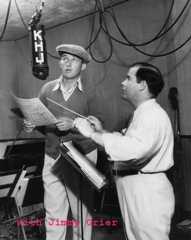 March 19, Monday.A plot to kidnap Bing and/or his son Gary is overheard and Bing is warned aboutthis by police. (5:30–6:00 p.m.) Bing’s radio show forWoodburySoap on CBS. Theguests are Kay Thompson and the Three Rhythm Kings. Jimmie Grier and hisOrchestra take over from Carol Lofner’s Beverly Wilshire Orchestra.
Kay Thompson and the RhythmKings go back to the Bing Crosby program tonight at 5.30 pm on KHJ, due to theabsence of the Mills Brothers, who are in San Francisco.
(Los Angeles Illustrated Daily News, 19th March 1934)
March 22,Thursday. Bing and his brother Everett have obtained permits to carry guns andthey do so in view of the kidnap plot.
Police abandoned hope todayof making an arrest in connection with a reputed extortion plot against SpencerTracy. Although Tracy denied such a plot detectives said Tracy received twoletters, threatening to abduct him, one of his two small children or an unnamedactress friend unless he paid over $8,000.
Bing Crosby alsowas notified his baby had been marked in a kidnap plot, His informant todaydisclosed receipt of a threatening letter.
“Do you knowwhat happens to rats and stoolies?” the letter demanded. “You ain’t hurt nobodybut yourself for shooting off your mouth.”
(Associated Press,March 26, 1934)
Bing Crosby Urges Baring of Threats
HOLLYWOOD.April 16.—Bing Crosby, who with his wife and baby son is under constant guardbecause of purported kidnap threats, believes the police and public should betold by all other Hollywood stars who receive similar threats.
“Alarge percentage of Hollywood folk who have received kidnaping and extortionthreats have adopted the attitude of silence,” the singer and actor said. “AnnHarding. Mae West, Marlene Dietrich and a number of other film stars have madeknown threats against their homes and lives, and I think they have been wise.”
Crosbysaid he believed there would be fewer threats “if the unvarnished truth weretold about Hollywood income—if the correct figures, and not the phony andhighly colored ones, were actually stated, after deducting income taxes,commissions and living expenses necessary for the peculiar positions in whichour work places us.”
(FortWorth Star-Telegram, April 16, 1934)
March 24,Saturday (starting at midnight).Bing performs at the Sixth Annual Hollywood Temple Israel Benefit at thePantages Theater and withFrank McHugh andCharles Butterworth does “theirinimitable ‘Boswell’ act.” Other stars appearing are Grace Moore, Will Rogers,Ted Lewis and his band, Carole Lombard, Ben Bernie, Burns and Allen, RubyKeeler, Dick Powell, W. C. Fields and Russ Columbo.
It certainly didmy heart good to see Bing Crosby at the recent Temple Israel Benefit. Thisgrand trouper, who turns down thousands of dollars for public appearances, andwho dislikes too much limelight, did not consider himself when asked to appearon the bill. Not only did he keep his word and make his appearance, buttogether with Charles Butterworth and Frank McHugh, took time to plan andrehearse and costume an act that was a remarkable imitation of the Boswell sisters.This act stopped the show cold and was one of the highlights of a grandprogram.
(Vivian Denton,Hollywood Filmograph, March 31, 1934)
March 26, Monday.(5:30–6:00 p.m.) Bing’s radio show forWoodburySoap on CBS. The Mills Brothers arebilled to appear but do not do so as they are rushing to finish a film prior toa European tour.
The husky young daddy known as Jimmie Grier was placed on the Bing Crosbyprogram last week (with his orchestra, of course) as an experiment. In oneprogram he was told to “make the grade.” So successful was his debut that the sponsornot only signed him for the remaining three weeks of the broadcast but extendedthe broadcast eight additional weeks and gave Grier the entire eleven weeks’work. Four string instruments were added to the Grier orchestra for thisoccasion. The Crosby weekly, therefore, instead of leaving the air early inApril, continues to May 27—at so many thousand per week. The combination isavailable this evening at 5:30 through KHJ.
(Ray De O’Fan,Los Angeles Examiner, March 26, 1934)
Highlights - 5:30pm KHJ—BingCrosby and Jimmie Grier’s orchestra (D.L. CBS). Jimmie Grier’s orchestra wasn’tup to snuff on the Bing Crosby broadcast last Monday...Perhaps the dance leaderwill whip his boys into shape for today’s program
(Carroll Nye,Los Angeles Times, March 26, 1934)
April 1,Sunday.The final of the Bing Crosby Tournament is played at Lakeside with Dr.L. D. Rankin and John Monk Saunders beating Harry Hughes and Bud McCray4 and 3. Bing presents the trophy.
April 2, Monday.(5:30–6:00 p.m.) Bing’s radio show forWoodburySoap on CBS. Bing’s principal guestis Carole Lombard.
Tonight’s Bing Crosbybroadcast will present a scene from his forthcoming starring picture,We’re Not Dressing which will bereenacted by Carole Lombard and the crooner. Four songs from the same picturewill be included in this program from KHJ at 5.30 pm. Jimmie Grier’s band, ofcourse, provide the musical background for Crosby’s crooning.
(Los Angeles Times, April 2, 1934)
April 3, Tuesday.A party is held at the Cafe de Paris in Movietone City forFrank Lloyd’sdaughter, Alma, and Bing attends with many other stars.
April 9, Monday.Arranges to hire Leo Lynn (who has been working for Clive Brook) as hischauffeur. Leo remains close to the family and serves as Bing’s factotum andstand-in for movie cameramen until Bing’s death. (5:30–6:00 p.m.) Bing’s radioshow forWoodburySoap on CBS. The Mills Brothers are theguests.
April–May. BingfilmsShe Loves Me Not for ParamountPictures withKitty Carlisle andMiriam Hopkins. The film is directed byElliott Nugent. While filming Bing refuses to have his ears glued back anylonger. Location shots are taken at Occidental College, Los Angeles and Bing laterpresents the college with two cups for their annual golf match to thank themfor their co-operation.
In 1934, halfway through theshooting ofShe Loves Me Not, one ofthe scenes had to be more heavily lighted than the others. During one numberthe heat of the lights loosened the spirit gum and out popped Bing’s left ear.This happened no less than ten times. After the tenth time, Bing furiouslyrefused to allow the errant ear to be stuck back. Wally [Westmore] was quicklysummoned in the crisis. He burst out laughing when he saw Crosby’s lopsidedhead, one ear flapping like an angry elephant’s. Wally went to the head of thestudio, then Emanuel Cohen, who agreed that Bing’s ears had nothing to do withhis extraordinary voice. Both Crosby ears thereafter were allowed to flapuntrammeled.
(The Westmores of Hollywood, page 82)
And do you know anotherdoll was Bing Crosby. Oh my God! We didShe Loves Me Not. Now I thought I was adramatic actress, you see, and I want to rehearse everything first. . . . Well,there was one scene inShe Loves. Isaid: “Bing, I’d like to rehearse this with you.” He says . . ., “Now, you knowvery well, you’ve been in the theater and New York, and I’m just a guy whodropped a load of pumpkins.” I said, “What do you mean, ‘dropped a load ofpumpkins?” And that was the famous line, “I’m just a guy who dropped a load ofpumpkins,” you know. Oh, but so darling!
(Miriam Hopkins, as quoted inthe bookPeople Will Talk, page 361)
The next picture wasShe Loves Me Not, with Bing Crosby andMiriam Hopkins. Miriam Hopkins had the reputation of being a termagant. To meshe was the most generous of colleagues, offering to rehearse before eachscene, run lines, and in every way help a beginner.
Bing Crosby’s star was rising, and it was quite a coup to besinging with him. But any flirtatious notions I might have had were quicklydispelled when it turned out that he was considerably shorter than I was. Binghad to stand on a box in all our love scenes. It was death to romance. Bing andI didn’t have much in common. He was a natural movie actor, whereas I, who camefrom the stage, had to struggle for film technique. The only remotely personalconversation that I remember was when he showed me a modest diamond necklacehe’d bought for his wife, Dixie Lee, and asked me if I thought she would likeit.
His singing constantly astonished and delighted me. Into therecording studio he would come, chewing gum, eating chocolate and drinkingmilk, all things considered taboo before performing. Then out of his throatwould come that heavenly golden sound. One day I asked him which would be thehit song in our movie. “If I could predict that,” he said, “I’d be amillionaire music publisher, and I wouldn’t be putting on this toupee. I’d beout on the golf course every day and never go to work again.”
There was a hit song, “Love in Bloom,” and Bing and I sang ittogether. It was the last song I ever sang that wasn’t pretaped. We filmed itdirectly on the set with the orchestra, at nine in the morning, and I was sonervous that every time I watch the movie I can see the muscle twitching in mycheek. I thought eventually it might be my theme song; but soon after it waspublished Jack Benny picked it up, and when I sang it people laughed, becauseall they could remember was Jack Benny scratching it out on his violin.
(Kitty Carlisle Hart, writinginKitty: An Autobiography)
Miriam Hopkins suffers an injuryduring filming and Bing has two weeks off during which he finds and eventuallyarranges to buy a block of old Rancho Santa Fe, twenty-fivemiles north of San Diego.
April 13,Friday. Bing and Dixie are at the Friday night fights.April 14,Saturday. Bing’s recording of “Little Dutch Mill” reaches number one in thecharts and remains there for five weeks.
April 15,Sunday.Bing is thought to have sung at the Masquers Easter Event at their clubhouse on North Sycamore.Charles Butterworth and Frank McHugh are also said to have appeared.
April 16, Monday. Golfs with Duke Hinnau at Lakeside. (5:30–6:00 p.m.) Bing’s radio show forWoodburySoap on CBS.
April 17,Tuesday.We’re Not Dressing has itsLos Angeles premiere at Grauman’s Chinese Theater.
Thosesterling radio entertainers, Bing Crosby and Alexander Woollcott, are nowsharing the Rivoli screen in different pictures. Mr. Crosby lends his vocaltalent to a crooning and clowning mixture labeled “We’re Not Dressing” and Mr.Woollcott makes his film bow in a short subject bearing the title of “Mr. W.’sLittle Game.”
Eventhough some visitors to this theatre may decide that there is a trifle too muchof “We’re Not Dressing” and scarcely enough of “Mr. W.’s Little Game,” thefeature production stirred up laughter and occasional applause from an audienceyesterday morning. This musical tale appears to have been inspired to a certainextent by the Barrie play “The Admirable Crichton,” but it is merely a fluffybundle of laughter and chansons d’amour.
Thecrooning Mr. Crosby is supported by a variety of performers, including GracieAllen, George Burns, Carole Lombard, Ethel Merman and Leon Errol. It has allthe plausibility and romantic flavor of the average musical comedy. It isnicely photographed and cleverly directed, the sort of thing that, while it mayhave too many moaning melodies, is invariably diverting.
Withall due respect to Mr. Crosby’s earnest rendition of the song “Love ThyNeighbor,” the fun afforded by the dependable Miss Allen and the unstable Mr.Errol wins the honors. Other melodies sung by Mr. Crosby are “Good Night,Lovely Little Lady,” “May I?” “She Reminds Me of You” and “Once in a BlueMoon.”
Hereone finds Mr. Crosby cast as a singing sailor named Stephen Jones and MissLombard as the fabulously wealthy Doris Worthington. Alas! Jones is little morethan a deck hand on Doris’s yacht, but Hubert (Mr. Errol), Edith (Miss Merman)and the effete Princes Alexander and Michael Stofani are passengers. When theyacht is wrecked, as one expects it will be when Hubert takes the helm, severalof those aboard swim to a Pacific island and it is not long afterward thatJones, like Crichton, rules the roost. Often one may find him in the earlymorning hours busy fishing from a rock and crooning away to his heart’scontent. There is never the least doubt concerning his love for Doris, but, likemost heroines of such affairs, she hesitates to tell him that she reciprocateshis affection, which gives the gallant sailor a chance to pretend that he doesnot believe her when the time comes for the two to indulge in the inevitableembrace.
Asfor Miss Allen and Mr. Burns, they carry on their nonsense in another sectionof the island. Here Miss Allen evinces a desire to emulate Frank Buck by heringenuity in inventing traps for wild beasts. They are extraordinarilycomplicated affairs. She thinks that flora and fauna are a vaudeville team and,believing that Mr. Burns has by some miracle disguised himself as a lion, sheshoos the animal away. The Burns and Allen team assuredly serves this filmvaliantly.
MissLombard is attractive and competent. Ethel Merman sings “It’s a New SpanishCustom” quite agreeably and Mr. Errol, never very far from a cocktail shaker ora bar, makes the most of his rôle.
(Mordaunt Hall,New York Times, April 26, 1934)
‘We’re Not Dressing’ in plotis an unofficial remake of Par’s ‘Male and Female’ (nee Sir James Barrie’s ‘TheAdmirable Crichton’), but at least Par has taken its musicals out of thebackstage-tin pan alley atmosphere. Where it’s light and familiar on the storyit’s heavy on sturdy croonology by Bing Crosby, who makes the footage a vocaldelight. . . All in all a cinch audiencepicture—any audience… The vocalizing is all Crosby’s. While he may be crooningconstantly he does it so well (and not too implausibly because he is discoveredas a naturally singing desk washer) that it’s forgivable. What’s more, a littleeffective business is introduced with the bear, who responds only to the ‘MayI?’ song. That number, along with ‘Love thy Neighbor,’ ‘Once in a Blue Moon,’‘She Reminds Me of You,’ ‘Good Night, Lovely Little Lady,’ and ‘Riding Aroundin the Rain,’ already are being well aired on the ether waves and will continueso to be, particularly ‘Neighbor,’ ‘May’ and ‘Lady.’. . . Crosby himself ismost of the picture. He screens his best and sings better.
(Variety, May 1, 1934)
Perhaps it is hisuncompromising masculinity and obvious inability to overplay anything thatmakes him so innocuous to his own sex. Unlike most of the other radio names, henever seems to be trying to be charming. . . . He borrows something from theold deadpan school of slapstick comedy and something from the insouciant ogleof the professional masher to produce an effect of being congenitally at homeand sure of himself anywhere—not working hard in the least, just taking it asit comes.
(New York Herald Tribune, May 6, 1934)
April 23, Monday.(5:30–6:00 p.m.)Woodbury show on CBShosted by Bing with Jimmie Grier and his Orchestra. Ken Niles continues asannouncer.
April 24,Tuesday. Bing lunches with the tobacco heiressDoris Duke at Paramount.
April 30,Monday.Dixie’s filmManhattan Love Song is released.(4:30–5:00 p.m.) Another Woodburyshow is hosted by Bing.
There’s an extra strong castin this indie, and a zippy story, but the brutal direction and poor storyadaptation k.o. it for serious consideration. . . But film shows the potential valueof Dixie Lee and Helen Flint, both of whom can go places if properly handled,especially Miss Flint. . . One song, reprised by Miss Lee twice, isn’t bad butwon’t mean anything.
(Variety, September 4, 1934)
May (undated).Bingwrites to his brother Ted.
I am three weeks along intoShe Loves Me Not a collegiate comedywith a couple of songs, from the play now current in New York. It has aterrific script, great dialogue, and grand situation. I don’t see how it can failto be a great laugh picture and fine for me.
Dad had some teeth out theother day and was a little out of line for a bit, but is okay now. I have beenso busy I haven’t seen much of mother or anyone else for that matter, but atlast reports she was in good health and spirits. Everett is, of course, livingthe life of Riley, and his family are well.
I finish the picture inanother week, the radio May 26th, and following this plan on resting forpossibly a couple months. Feeling a little tired, and further income in May& June will put me in a very disagreeable income tax bracket. So I might aswell rest as give it back to Uncle Sam. I am trying to pick up a ranch near SanDiego, not too elaborate, and if successful, you can come down and start me offrite on some intensive gentleman farming.
May 7, Monday.(4:30–5:00 p.m.) Bing’s radio show forWoodburySoap on CBS.
BingCrosby, who sang “Goodnight Lovely Little Day” on a local screen last week,will feature the number at 8:30 this evening over WGR. Also “Love Me” and “TheHouse Is Haunted.”
(The Buffalo News, May 7,1934)
May 8,Tuesday.Purchases a half interest in welterweightFreddie Steele for $7500.
May 12, Saturday. Bing plays in the annual Agua Caliente golf tournament. TheLos Angeles Times states that Bingand Everett have been sworn in as deputy sheriffs and carry guns.
May 13,Sunday. The second round of the Agua Caliente tournament.It is announced that Bing has purchased the 44-acre Rancho Santa Fe and hacienda formerly owned by Don Mario Osuna.He employsLilian Rice to restore the adobe house andadd modern facilities such as tennis courts and swimming pools.
Soearly this summer Bing up and bought a good sized chunk of the Rancho Santa Feholdings in San Diego County. It is near the Orange County Line, a two and a halfhour ride from Los Angeles, and less than a dozen kilometers from the Pacificocean.
Thereare 44 acres all told . . . count ‘em. In the early days of the conquistadoresthe valley was a barren wilderness. In the days of the Spanish land grantsthousands of acres were given to Don Mario Osuna. ‘Tis said by those who knowtheir history that the ranch buildings once sheltered General Pico’s Mexicanrangers in the war between Mexico and the United States. In the hey day of romanticCalifornia days it became the center for the Estudillos, the Alvarados, Picos,Bandinis and other pioneer social families.
Afew years ago a real estate development dubbed the place Rancho Santa Fe andbegan to sell country estates. Bing not only bought some land, he went theothers one better. He bought the part that has the original hacienda of DonOsuna, historic old adobe dwelling that was built in 1840. Don Jose Crosbyplans to restore the place to the charm of earlier days with some tile roofs,straw-stuffed dobe bricks, wide verandahs, whitewashed walls and such.
Duringthe warm summer months he has been busy looking the place over, supervising theplanting of a few crops, putting up some buildings for the help, and takingsome week-end holidays in the rolling valleys and commanding knolls.
(Radio Mirror, September1934)
May 14, Monday.(4:30–5:00 p.m.) Bing’s radio show forWoodburySoap on CBS with Jimmie Grier and hisOrchestra. Ken Niles continues as announcer.
May 18, Friday. Catherine Anne and Helen Dolores, twin daughters of Ted and HazelCrosby, are born.
May 18–20,Friday–Sunday. Bing is one of many stars appearing in the “Film Stars Frolic”at the Gilmore Stadium in Hollywood.
May 21, Monday.(4:30–5:00 p.m.) Bing’s radio show forWoodburySoap on CBS.
Woodbury soap has expresseditself as anxious to recontract Bing Crosby for a minimum of 26 weeks, startingin the early fall, but the warbler prefers to refrain from making a new deal untillater in the summer. Meanwhile he will consider the proposition made by a Sundaynight food account and also one from a femme accessories manufacturer, for whomit’s to be a debut in radio. Crosby has decided not to come East this summerfor nighters and deluxe picture house stands.
(Variety, May 22, 1934)
May 24, Thursday.Press comment says that Bing “has scarcely left his wife’s bedside during thepast week; she’s been quite ill.” X-rays show that Dixie is pregnant withtwins, with one in a complicating position, and, as a result, she is suffering chronicback pain.
It was not longafterWe’reNot Dressingthat DixieandI became the parents oftwins.We didn’t conform to the customfollowed bysomein theHollywoodsof letting thegossipcolumnistsknow about thehoped-for advent eight months in advance.We were old-fashioned enough to announce the arrivalof our sons only upon delivery.
But when our twins werein theoffing complicationsset inwhichwecouldn’t control.About the sixth month,Dixie had asiege of falselabor and the doctorwasalarmedfor fearshe would lose the baby.He thought she ought to havesomeX-rays,and theX-rays disclosedthat therewere going to be twins. Somehow or otherthis news leakedout,asthingswillleakout in a hospitalwhere there are nurses,telephone operators, andX-raytechnicians.
The news-leak didn’tannoymeas much as it otherwise might have done for I hadsomething more important toworryabout. TheX-rayshowedthat one of the twins had his body arranged in sucha position that itwasinterferingwith the functioning of oneof Dixie’skidneys. Sheclaimed later that it wasDennis.Andwhen he grew older and she kidded him about being cantankerous,she added,“You started outthat way.”
(CallMe Lucky, page 130)
May 28, Monday.(4:30–5:00 p.m.) Bing’s finalWoodburySoap show of the season.
Items of interest abound in thelineup of broadcasts tonight. For one thing, Bing Crosby, KHJ at 4:30 p.m., windsup his current series. He’ll take a rest from radio throughout the summermonths with current plans calling for his return some time in September.
(Homer Canfield,Monrovia News-Post,May 28, 1934)
Bing’s the boss on new Woodbury show
Woodbury Soapthrough Lennen & Mitchell signatured Bing Crosby last week to a 39-weekcontract, which gives the singer complete authority over the program. Accounthas set aside $6,000 for the program’s cast, writing and production, withCrosby free to do his own picking of the other entertainers and the band. Account’snew series will take a Tuesday evening spot (9 to 9:30 EST), with Sept. 18 thestarting date. Talent for the stanza will be booked through the Rockwell-O’Keefeoffice which represents Crosby.
(Variety, July 3, 1934)
May 29, Tuesday(onwards). Bing works alongside the laborers working on his Rancho Santa Feproperty for a while and returns to Hollywood with blisters on his hands.June 17/18,Saturday/Sunday. Bing and Dixie spend the weekend in the yachting party ofRalph Goetz and Frank Kerwin aboard their 110-foot cruiser, Conquista, in honorof the Walter Winchells. The Conquista, which was a submarine chaser untilconverted into a luxuriant pleasure craft, weighs anchor at the CaliforniaYacht Club on Saturday at noon, and sets sail for Catalina. The party goes tothe St. Catherine Hotel on Catalina Island for dinner and dancing. Sunday isdevoted to tennis at the hotel, bathing from the yacht and dancing on deck.Others present include Ruth Etting, Mack Gordon, Harry Revel, and Eddie Cantor.
June 25, Monday.Bing is thought to have taken part in the Marion Davies Foundation benefit atthe Biltmore Bowl with a host of stars.
July (undated).Forms Bing Crosby, Incorporated. Bing’s brother Larry is put in charge ofpublic relations while his father becomes treasurer. John O’Melveny, of thefirm O’Melveny, Tuller, and Meyer, is the lawyer to the company.
July (undated).Press reports indicate that Bing recently hooked and landed a 197-pound Marlinswordfish off Catalina Island.
July (undated).Bing is said to have invited some of his friends to take part in an informalgolf tournament at the 12-hole Old Brockway course at Kings Beach, North LakeTahoe. This is said to become an annual get-together and eventually result inBing’s annual pro-am tournament. It has not been possible to confirm that thisactually happened.
July 3, Tuesday.Dr. Samuel S. Pasetto sues Bing for $1,000 in respect of physician’s servicesperformed for Gary.
July 5, Thursday.Bing records “Love in Bloom” and three other songs withIrving Aaronson and hisCommanders in Los Angeles to conclude his contract with Brunswick Records.
“Love in Bloom” and “Straightfrom the Shoulder” (Brunswick 01850). Crosby’s usual crooning, delightful ornauseating, according to your tastes. Mixture as before, with accompaniment byIrving Aaronson’s Commanders in the style of a good theater pit band.
(The Gramophone, October 1934)
July 6, Friday.The British entrepreneur,Ted Lewis, founder of theDecca Record CompanyLimited of England, dines with Jack Kapp, Bing’s record producer and aBrunswick Records executive at the house of attorney Milton Diamond in NewYork. The three men had been negotiating to buy Columbia Records but the dealhad just fallen through as the American Record Corporation had agreed topurchase Columbia. Kapp says that several Brunswick executives will leave tojoin a new record company if the financial incentives are right. Kapp says thathe can bring Bing with him and Lewis immediately decides to form Decca RecordsInc., which is actually incorporated on August 4.
We decided there and then toform a new record company. Jack Kapp was certain that he could bring over BingCrosby and there was, I believe, a clause in his contract under which if Kappceased to be associated with the Brunswick Company the contract would becomenull and void. Obviously the new company must be a Decca company, with theDecca label, which we believed would become quickly known provided BingCrosby’s recordings appeared on it, to say nothing of other leading popularartists, including Guy Lombardo, The Boswell Sisters, The Mills Brothers, andThe Casa Loma Orchestra. Jack Kapp explained that there was a possibility ofmaking a deal with Warners to take over their record plant on West 54th Street,with about 35 presses and ancillary equipment, recording studios and offices at799 Seventh Avenue. Only a small production was being carried out at the plantin transcriptions for radio stations on 16-inch discs.
The problem of personnel could be readily solved, with E. F.Stevens, Junr., who he believed was ready to leave Columbia and join as salesmanager, and Milton Rackmil from Brunswick as treasurer and productionsupervisor. Other experienced men were available for key posts, including thoseof branch managers in Chicago, Los Angeles and New Orleans. Never had thepossibility occurred before of starting a record company with so many pieces inthe jigsaw fitting so perfectly into position.
Thequestion then arose as to the price or prices at which the new Decca recordswould be marketed. Jack Kapp wanted to follow the existing pattern with 75, 35and 25 cent records and argued vehemently for this set-up. I could see no hopeof success for such a policy. The total sales of records in America were thenno greater than ten million and for us to succeed we had not only to capturesome of those sales but also to increase the total volume. I insisted that onlyon the basis of a one price 35 cent record could we agree to go ahead; and aswe were to supply the trademark and the finance it could never have been formedwithout us. I argued that at 35 cents not only would we take business from competitorsbut would almost inevitably increase the over-all turnover of the industry atthe very moment when it seemed that it might well have touched bottom. Therewas in those days a small, gross profit on a 35 cent record, and whilst it wasunlikely that Victor, Columbia or Brunswick would cut their first line recordsto 35 cents, even if they did we would be fighting them on equal terms, withtop line artists. The possibility of our being undercut was out of thequestion, for the 25 cent record was only a commercial proposition throughchain stores with non-royalty artists.
...Although most people thought that radio had killed therecord industry which in the U.S.A. had slumped from a total of over100,000,000 records in 1928 to some 10,000,000 by 1933, 1 doubt whether anycompany started at such a propitious moment. Most new companies are formed inthe last stage of a boom. American Decca was started at the end of anunparalleled slump
...Of the 20,000 shares which the English company subscribed forat $1 each, we arranged to give 1,250 to Jack Kapp and 750 to Stevens, each ofwhom signed a service agreement.
(E. R. Lewis, writing in hisbookNo C.I.C)
July 8, Sunday.Bing attends a pre-opening sports tea at Nick Stuart’s new Bath and TennisClub at Brentwood.
July 12,Thursday.Starting at 11:25 a.m., plays in an amateur-pro competition with HarryBassler prior to The Santa Monica Open. They have a 66 but are unplaced.
July 13, Friday.Starting at 10:45 a.m., Bing shoots a 78 at the Santa Monica Open played at the municipal course atClover Field. Meanwhile, Dixie gives birth to twins: Phillip Lang and DennisMichael in Cedars of Lebanon Hospital shortly after 6:00 a.m. The babies arepremature and weigh between four and five pounds each. They are placed inincubators and are not released from hospital until August 18.Phillip is namedfor Eddie Lang whileDennis is named after Bing’s grandfather, Dennis Harrigan.
Herdoctor put her to bed, kepther quiet,and sent herto the hospital at the end ofseven and a half months, so he could keep an eye on her well in advance of delivery, because hewanted the babies to grow as much as possible before birth.
I checked in at the hospital every day, but as luck would have it the dayI left the hospital and went to Santa Monica to play in agolf tournament, the twins were born. It wasno surprise to Dixie that Iwas on the golfcoursethen.That’swhereI spend most of my timeanyhow.But itgaveher a beautifulopening ifanybodyasked her if I played muchgolf.
“Hewasn’teven there when the twins were born. Hewas out playing golf,”she’d say, giving it thefull Eleonora Duse-Sarah Bernhardttreatment.
Sometimes,after shewas through needlingme,I noticedpeoplewho didn’t knoweither of us very well looking at me asifI were the jerk of theworld.
(Bing Crosby, CallMe Lucky, page 130)
July 18,Wednesday.Plays in the Hollywood Invitational Golf Tournament but has a 'no return' in the qualifying round.
July 31, Tuesday.Bing’s filmShe Loves Me Not has itsLos Angeles premiere at the Paramount.
Crosby, in the role of achivalrous senior, gives a nice acting performance and sings as only he can.
(Los Angeles Evening Herald Express, August 1, 1934)
It is indeed a strange group of charactersthat are introduced during the hectic proceedings in the film version of lastseason’s play, “She Loves Me Not.” Mixed up with Princeton students are theuniversity dean, his daughter, a fiery-tempered cabaret dancer, a couple ofcool gunmen and an energetic motion picture press agent and his persistentcamera men. As on the stage, this adaptation is a swift-paced piece ofhilarity, with occasional romantic interludes during which Bing Crosby andKitty Carlisle contribute some tuneful melodies.
Some of the farcical episodes in thisParamount offering are apt to recall that famous old comedy, “Charley’s Aunt,”but in the present production, instead of having a varsity student in skirts,they dress up a cabaret girl in male attire after she has invaded a dormitoryroom. It has many madcap exploits, such as when the urbane Dean Mercer isfelled unconscious by one of the students, just after a thug has been treatedsimilarly. It gives the producers the opportunity to present the thug and thecollege dean bound together on a sofa. And not the least humorous aspect ofthis incident is the fact that that excellent actor, Henry Stephenson,impersonates the unfortunate dean.
The story slips from a night club inPhiladelphia to Princeton, thence to New York and back to the university.Miriam Hopkins appears as Curly Flagg, a dancer who flees from a nightclub—where she was a witness to a killing—to Princeton, where she takes refugein one of the students’ rooms. She is a constant source of worry to twostudents, Paul Lawton and Buzz Jones, even when she is garbed as a young man.Then the gangster chief decides that Curly will probably squeal about themurder and he dispatches two hirelings to “take her for a ride.”
A motion picture producer hears about thegirl being hidden in the Princeton students’ room and his imaginative publicityman conceives the notion of employing Curly as a star, after getting as muchpublicity as possible in discovering her.
Lawton, who is acted by Bing Crosby,becomes infatuated with Midge Mercer, the dean’s daughter, and their romanceoffers opportunity for the singing of several songs, which include “Love inBloom,” “I’m Hummin’,” “I’m Whistlin’,” “I’m Singin’” and “Straight From theShoulder, Right From the Heart.” These are rendered quite effectively by Mr.Crosby and Miss Carlisle.
Miriam Hopkins gives a vivaciousperformance as Curly and Warren Hymer adds to the fun by his portrayal of agangster. Lynne Overman is splendid as the publicity man and George Barbier isin his element in the rôle of a motion picture magnate. Mr. Stephenson makesthe most of the rôle of the unfortunate Dean Mercer.
(Mordaunt Hall,New York Times, September 8, 1934)
‘She Loves Me Not’ (the play)is still current on Broadway in its 47th week and the film version holds BingCrosby and Miriam Hopkins. That’s plenty for the marquee and virtuallyunderwrites its economic returns for the exhib and distrib. But Par’s ‘SheLoves Me Not’ leaves considerably wanting…
…But apart from this possible captiousness Par’s ‘She Loves’holds plenty for the gate. Crosby is most of it. He looks better than ever(somehow his stature has been built up although the faintest suggestion ofembonpoint doesn’t quite jell with a Princeton undergrad), but he actsintelligently and sings those tunes. The songs will be no small asset to thefilm. There are three outstanders, two by Revel and Gordon—‘Straight from theShoulder (Right from the Heart),’ and ‘I’m Hummin’, (I’m Singin’, I’mWhistlin’) and one by Robin and Rainger (‘Love in Bloom’)—and the latter is thesmash hit of the flicker and currently Tin Pan Alley’s No. 1 song, so it’s easyto figure out the b.o. reaction. The others too are plenty in the air…
On the other hand the distinguished Crosby vocalizing (MissCarlisle is the vis-à-vis in most of it) more than offsets these portions. Thebit with the pair doing cross-patter in song to hoodwink the dean is one ofthose outstanding bright moments.
(Variety, September 11, 1934)
August 3, Friday.Press reports praise Bing and Jimmie Grier for “working twelve hours recordingnumbers for the National Welfare Association program.” (See October 22, 1934)
August 4,Saturday. Bing’s record of “Love in Bloom” starts to attract attention and soonbecomes number one in the charts. It stays in the top position for six weeks.
August 6, Monday. Dixie Lee returns home from hospital. The twins are kept in hospital and now weigh 5 and a half pounds each.
August 8,Wednesday. Bing records the first songs for the new Decca Records Company atthe Decca Studios at 5505 Melrose Avenue, Hollywood, withGeorgie Stoll and hisOrchestra. The songs are “I Love You Truly,” “Let Me Call You Sweetheart,”“Someday Sweetheart,” and “Just A-wearyin’ for You.” Bing’s exclusive contractswith Decca eventually run to December 31, 1955. During the day, Bing golfs at Lakeside and has a 79.
Bing’s record is a remarkablepiece of virtuosity. He sings ‘Let Me Call You Sweetheart’ as a ballad and thenyou turn over the record and hear him sing ‘Someday, Sweetheart’ in a stylethat is “hotter than hot”; what an artist, but I hope he isn’t falling betweentwo stools here and that people who like one side of the record won’t behorrified at the other. Still, it’s a grand experiment.
(The Gramophone, April 1935)
Jack Kapp leftBrunswick Records in 1933 when that company refused toelevate him to itspresidency. Hehad reached theeminence of the position of recordingdirector withBrunswick in 1930, at the age of twenty-nine.After fouryearshe felt another movewas indicated,and the onlymoveavailablewasto the very top of theorganization.Jackate, slept, walked, and talked records. Recordsalesman son of a recordsalesman father,he was a shrewd record merchandiser byhis earlytwenties. When heleft Brunswick hehadenoughexperiencebehind him as atraveling salesman of the grooved disc and asa director of recordingsto makeauspicious plansfor his owncompany.
Thefirst big step Jack Kapp took when heformed American Deccawasto concentrateproduction on 35-cent records.His secondwas to move the bulk of hismanufacturing facilities behind oneartist, Bing Crosby. He had other hit artistswhen he started,notablyLombardo; he added othersinthe year tocome;butalwaystheleadingDeccanamewasBingCrosby, andJackdideverythingto maintainapolicythatwouldensurethat position for Bing andassureDecca’s No.1 position asthe firmthat owned theworld’sNo.1 voice. HisloyaltytoBing wasreciprocated; inspite of fantastic offersfromother companies,in theface of remarkable opportunitiesto form his ownrecordingoutfit,Bingremainedwith Decca and Jack Kapp.
(The IncredibleCrosby, pages 116-117)
August 9,Thursday.Plays in a "Nassau Derby" golf tournament at Oakmont Country Club inGlendale. Bing has an 82 in the qualifying round and falls by thewayside.
August (undated). Thought to have won the Pasadena Open Golf Trophy Plate. This may havebeen a private golf match involving Bing, Jimmy Hines, Harry Bassler, and Leo Diegel.The trophy lists Bing as winner and also bears the inscription “Ex High ChiefJack V. Bare Trophy Golf Champion.”
August 16,Thursday.Together with Joe Penner and Lanny Ross, gives a banquet at Levy'sTavern for the radio critics of the local newspapers. More than 30attend.
August 18,Saturday.Bing and Dixie are allowed to take the twins home from hospital, as they nowweigh over seven pounds.
August 23,Thursday. Press comment indicates that Bing may have to have his appendixremoved.
August 27,Monday. Commences filmingHere Is MyHeart with Kitty Carlisle,Roland Young, andWilliam Frawley. Filming iscompleted in November and the director isFrank Tuttle.
August (undated). Seriously considers retiring from radio and films.
August 29,Wednesday. Press reports indicate that Bing is having to alter his diet inorder to correct his appendix problems. Leo Lynn has to have an appendectomy.
BingCrosby has Hollywood's most obliging standee. Bing was supposed to have hisappendix removed, but doctors put him on a diet and nixed the op. Bing'sstand-in, Leo Lynn, had an appendectomy instead.
(Variety, September 4, 1934)
August 30, Thursday. Jack Kapp writes to Bing.
After listening to "Just a-Wearyin' for You," there can be no doubt ofyour ability to do songs of a semi-classical nature as well, if not better,than any singer in the country today. I feel our judgment in this regardis wholly justifiable. There is one thing I'd like to call to your attention.The public today wants an unadulterated Bing Crosby, without anyfrills.They think that the combination of his voice tinged with a naturalfeeling which he possesses, is unsurpassed. I agree with them andI think that the frills should be avoided, as well as "hot" songs. Youhave in your grasp the opportunity to be the John McCormackof thisgeneration. You can achieve that much more easily than you think. Bydoing what we are discussing and by following thru both onrecordsand on radio, you will reach a popularity, which, in my opinion,will beas great as ever enjoyed by any singer in this country. Think it overBing. I do not mean to be presumptuous, but the masses want melodycombined with soul, which is yours. Nobody can touch you there.
September 2, Sunday. Russ Columbo dies following a bizarre shooting accident.
September 6,Thursday. (10:00 a.m.) Bing is a pallbearer at Russ Columbo’s funeral atBlessed Sacrament Church, 6661 Sunset Boulevard, Los Angeles.
BING CROSBY, RADIO RIVAL,WILL BE PALLBEARER AT RITES FOR RUSS COLUMBO
Bing Crosby, whom he rivaledas a radio crooner, will be one of the pallbearers at the funeral for Russ Columbo,to be held tomorrow at 10am at the Blessed Sacrament Church, 6661 SunsetBoulevard.
The other pallbearers will beSheldon Keate Callaway, Gilbert Roland, Walter Lang, Stewart Peters and LowellSherman. Following requiem mass, the body will be returned to the Delmer A.Smith chapel to await final burial arrangements.
This morning at 9:30 o’clock,an inquest into Columbo’s death will be held at the coroner’s office. Witnesseswill include Lansing V. Brown Jr., Hollywood portrait photographer, who heldthe gun which was accidentally discharged and killed Columbo at Brown’s homeSunday. Brown was under the care of physicians yesterday, after his collapseupon word of Columbo’s death.
Other witnesses will be JohnColumbo, a brother, who will identify the body; Virginia Brissac, Columbo’ssecretary, who will tell of arranging the meeting between Brown and Columbo,and Dr. A.F. Wagner, who will describe the fatal wound.
Brown was showing Columbo anancient cap and ball dueling pistol when a forgotten charge of powder in thegun was exploded as Brown lighted a match under the pistol’s hammer. The leadball ricocheted from a table and struck Columbo over the left eye, penetratinghis brain and shattering his skull at the back.
Mrs. Julio Columbo, mother ofthe singer, who has been dangerously ill at the Santa Monica hospital, will notbe told of her son’s death until her condition is strong enough to withstandthe shock.
Posthumously, Columbo’s nameappeared yesterday on the docket of Superior Court. Listed for trial beforeSuperior Judge Marshall McComb, but shortly thereafter ordered off calendar,was a suit in which Irving D. Lipowitz, New York attorney, demanded $9,000 fromColumbo for fees. Columbo had disclaimed any obligation.
(Los Angeles Illustrated Daily News, September 5, 1934)
September 9,Sunday. Thought to have been at Wrigley Field for theJack LeliveltDay ceremonies.
September 15, Saturday. TheMutual Broadcasting System comes into being following analliance between several radio stations includingWOR in New York.
September 18,Tuesday. (5:00–5:30 p.m. Pacific Time) Bing returns to CBS radio andWoodburySoap, now for a half hour onTuesdays, with a contract that pays him $6,000 a week as a package with totalcontrol. Georgie Stoll leads the orchestra as Jimmie Grier has been signedexclusively by another program. The Boswell Sisters are guests on the openingshow having been signed on a thirteen-week contract. Claude Binyon writes thescripts and Ken Niles is the announcer. The audience share during the season is15.5.
The program which Bing Crosbyarranged all by himself takes the air this evening for the approval oflisteners from one coast to the other. Under the title “Bing CrosbyEntertains,” the crooner will be heard in several vocal selections and inaddition he will present the famous Boswell Sisters, Connie, Martha and Vet.George Stoll’s orchestra has its first big-time opportunity during the halfhour, which is heard through KHJ at 5 o’clock. Departing from his usualpractice of singing popular songs of ballad and torch nature, Crosby includeson this evening’s broadcast the popular “Just a-Wearyin’ for You.” Each week heplans to present one of this type. Others will be “I Love You Truly,” “Let MeCall You Sweetheart,” and songs in that vein.
(Ray De O’Fan,Los Angeles Examiner, September 18,1934)
Two types of delivery, both the finest in their line and a first rate orchestrato round it out. This one sounded sure-fire on paper and lives up to allexpectations on the air. Crosby is Crosby and calls for no comment. His foursongs on this initial program rang the bell. The Boswells are more torrid thanever in their close harmony. This sister combination has withstood thecompetitive radio gaff for a long while now and there is no indication of themweakening. The Georgie Stoll Orchestra, a Coast aggregation (program emanatesfrom there), is capable in both accompaniment and its own moments. Woodburyhere, has a Tuesday evening show that’s bound to be tuned in on.
(Variety, September 25, 1934)
Crosby and Boswells
(Fair)
Woodbury soap with Bing Crosby, the BoswellSisters, Georgie Stoll’s orchestra, half hour, Tuesday eve, WABC.
Musicianship—Not much change in this as when lastheard excepting the addition of the Boswell Sisters and the switching oforchestras. Crosby has never been quite satisfied with the musical backing he receivedsince Lennie Hayton established headquarters in the East. Having worked withhim since the early days, Hayton knew all his tricks. After making somephonograph records on the west coast with Georgie Stoll, Crosby tied up withhis outfit for the air series and judging by the first broadcast, he’s a betterbet than Jimmie Grier. Although the band lacks body in some of the rhythmical things,the vocal arrangements show pleasing touches. The Boswells give a good accountof themselves and are a distinct addition.
Showmanship—Crosby is still an ace attraction as asinger but the day for those who just step up to the mike and warble a fewsongs is decidedly on the wane. According to present standards, songs inthemselves don’t suffice, it’s the setting, the song and the story idea thatfits the fashion. A love interest injected into this would round it out. Otherwiseit’s just the same old routine. This is the first time that Crosby and the Boswellshave worked together on one spot although they have been together on alternatenights by the same sponsor.
Commercial—Nothing new or particularly refreshing onthis end. The situation skit is used an opening wedge and the heavy ammunitionis reserved till last. Is one of the last renovated of all the fall openings.
(Doron K. Antrim,Metronome, October 1934)
Bing Crosby may have takenall the singing glory for himself on last Tuesday’s opening broadcast, but hedistributed ample honors in other directions. Georgie Stoll was introduced as a“swell band leader.” Announcer Ken Niles was given recognition and the Boswellswere affectionately introduced. Crosby overlooked no one, not even the twins.He spent so much time telling the audience what fine people others were that heplumb forgot to build up himself.
(Ray De O’Fan,Hollywood Citizen News, September 21,1934)
In late 1934 and through a big part of 1935,Bing continued tobroadcast for Woodbury soap, at the handsome weekly stipend of$6,000and with the pleasant knowledgethat his weekly halfhour was all his to do with as he wanted. He used the bands of Georgie Stoll, a little man with a largeshock of hair who was making a movie career for himself, and Jimmie Grier (sic), with whom Bing had workedin the Gus Arnheim days. On the Woodbury program, Bing first became aware ofthe intelligentuse that could be made of small vocal groups back of him.Heusedboth the Boswell Sisters and the Mills Brothers forthis harmonizing purpose, striking a semijazz note in his work with thethreegirls from New Orleans and the four boys who made a nation jump totheir vocal impressions of a small instrumental jazz combination.
(Barry Ulanov,TheIncredible Crosby, pages 117-118)
September 20,Thursday (8:30-9:30 p.m. Pacific time). Bing makes a short guestappearance on theDorsey Brothers opening radio show of the season, which comes from BenMarden's Riviera Club in Fort Lee, New Jersey. The Dorseys arebroadcastingfrom New Jersey on station WEAF with Bob Crosby. Bing is linked in fromHollywood with the Boswell Sisters and Georgie Stoll. Bing sings, “LoveinBloom.”
Bob Crosby, who sang with Anson Weeks on W-G-N duringthe summer, will have a coming out party on NBC at 10:30 tonight. A parade ofradio stars including his brother Bing will salute the younger Crosby when heand the Dorsey Brothers orchestra begin an engagement at a well known New Yorknight spot tonight. The Boswell Sisters, singing from Los Angeles; Anson Weeks,playing in New York; Buddy Rogers from Chicago, and the Mills Brothers fromDetroit will contribute to the one hour show.
(LarryWolters,Chicago Tribune, September20, 1934)
September 22,Saturday. Press coverage about a competition between Richard Arlen and Bing tosee which one could pick up the most foreign radio stations during a one-weekperiod. Both are said to be shortwave fans. Bing wins the contest and betweenthem they pick up 122 stations. This may have been a publicity press release.Radio Guide for the week ending 22September lists Bing as second in their readers’ poll for the Star Of Stars Election.The top five were: Joe Penner, Bing Crosby, Eddie Cantor, Jack Benny, and RudyVallee. During the day, Bing visits Gary Cooper on the set of the ParamountfilmLives of a Bengal Lancer and isphotographed with him.
September 23,Sunday. Bing andPat O’Brien entertain at a lavish party atLloyd Bacon’shouse.
The Lloyd Bacons on Sun. wentABSOLUTELY lavish with a Spanish dinner party (those hot peppers still haveme!) embellished with genuine high-kicking Spanish dancers, singers and thelike. The highlight of the affair was when Bing Crosby and Pat O’Brienpresented their burlesque of the adagio and other light fantasticthingamuhjigs. Pat and the cook finally ended up doing an Irish reel (somebodySHOULD have made a movie of that). Barbara and Bill Koenig, Matt Allen, Joe E.Brown and others went in for badminton between courses. Dixie Crosby and PhilRegan CROONED at each other. Just to give you an IDEA of how long Ruby Bacon, aperfect hostess, fluttered about–the thing started at 2 in the afternoon andfinished at 2 in the morning!
(Jimmy Starr,Los Angeles Evening Herald Express,September 25, 1934)
September 25,Tuesday. (5:00–5:30 p.m.) Bing’s guests on theWoodbury show are the Boswell Sisters. Goes on to see Vincent Lopez and his band at the Gold Room of the Beverly-Wilshire.
Bing Crosby and the BoswellSisters will offer a rhythmic half-hour during the second of their new seriesof the program at 7 o’clock through WDSU. Crosby will sing five newsongs, the New Orleans trio will offer three tunes and Eddie (sic) Stoll’sOrchestra will play several numbers, including, ‘My Old Flame’.
(NewOrleans Times-Picayune, 25th September 1934)
September (undated). Bing and Dixie celebrate four years of marriage at a party given for themat the Beverly Hills home of Frank Tuttle, film director. The occasion endswith a midnight swimming party.
October 2,Tuesday. (6:00–6:30 p.m.) Bing’sWoodburyshow. Guests are the Boswell Sisters.
Bing Crosby,supported by the popular harmony trio, the Boswell Sisters, will be heard inanother stanza of West Coast melody and harmony Tuesday night at 8 o’clock overWBBM, Chicago. Georgie Stoll and hisorchestra, newcomers to network broadcasting, support the singers.
(Belvidere Daily Republican, October 2,1934)
October 5,Friday. Recording session in Hollywood with Georgie Stoll and his Orchestra.Four songs are recorded including “The Very Thought of You.”
October 9,Tuesday. (6:00–6:30 p.m.) Bing’sWoodburyshow with the Boswell Sisters as featured guests.
Bingsie Wingsie Crosby and Georgie-Worgie Stoll and Kensie-Wensie Niles, intheir weekly broadcast from coast to coast, are fast becoming favorites withthe children. Stoll’s interpretation of a new musical score from a motionpicture was the best musical work on the program thus far. Stoll admitted hisfirst broadcast with Crosby was not up to expectation, but charged it tonervousness. Eastern network moguls have announced themselves as satisfied withthe work of the orchestra.
(Ray De O’Fan,Los Angeles Examiner, October 9, 1934)
October 12,Friday. Bing sings at a banquet in honor of Emanuel Cohen (Paramount vicepresident) in the Indian Room at the Ambassador Hotel.
EMANUEL COHEN BANQUET
J.P. McEvoy, noted author andplaywright, was master of ceremonies, while Mae West, film star, and Cecil B.DeMille, veteran director, were the main speakers of the evening lauding theirchief’s achievements. DeMille left a sick bed at the Cedars of Lebanon Hospitalto attend.
Movie stars by daytime, but just entertainers for the banquetwere such figures as Bing Crosby, Lyda Roberti, Paul Gerrits, David Holt, JackOakie, Lois Maybelle, Julian Madison, Colin Tanley, Alfred Delcambre, CarlBrisson, Joe Morrison, W.C. Fields, Lanny Ross, Sam Coslow, Arthur Johnston,Marian Mansfield, Diana Lewis, Queenie Smith, Mack Gordon and Harry Revel.
The entire College Rhythm chorus, directed by Le Roy Prinz,staged a dance number from the production. Among the guests were ClaudetteColbert, Kitty Carlisle, Gary Cooper, Katherine De Mille, Marlene Dietrich,Frances Drake, Cary Grant, Roscoe Karns, Elissa Landi, Charles Laughton,Gertrude Michael, Charlie Ruggles, Randolph Scott, Lou Sheridan, Sylvia Sidney,Alison Skipworth, Sir Guy Standing, Kent Taylor, Lee Tracy, Evelyn Venable,Henry Wilcoxon, and Toby Wing.
The banquet was arranged under the direction of a committeeconsisting of DeMille, Mae West, Gary Cooper, Benjamin Glazer, Grover Jones andVictor Milner. Robert Sparks was in charge of program arrangements.
(Hollywood Citizen News, October 13, 1934)
October 14,Sunday. Bing and Dixie serve as best man and maid of honor at the wedding of Kitty Lang and Dr. William Sexton.
October 15,Monday. Decca launches an energetic promotional campaign built around its stableof stars (led by Bing) and its unprecedented thirty-five cent (or three for adollar) record prices. Other companies’ records sell for seventy-five cents.Jack Kapp also targets the growing jukebox market.
With Decca slated to debut on the counters at35c per 10-inch platter around Oct. 15, both Brunswick and Victor have decidedon a policy of watchful waiting. Neither Brunswick nor Victor intends for thetime being to meet Decca competition with a general slashing of the pricelists. Victor will stand pat as far as its 75c library is concerned, while theonly price changes contemplated by Brunswick (American Record) involves thoseartists and bands that have let the latter catalogs for Decca.
Decca, which has over 200 platters ready for release,will retail the 10-inch stencil for 35c (3 for $1), and the l2-inch disc for 55c.Profit allowed the dealer in either case will amount to 40%, or from 12c to 14cper record.
(Variety, October 2, 1934)
Bingwas big in a way that’s hard to grasp these days. In 1931, when I wassix and just beginning to listen to the radio in Queens, he hadten of thetop thirty songs of the year, including “I Found a Million Dollar Baby (in a Fiveand Ten Cent Store).” By 1936, he was hosting the Kraft Music Hall (opening theshow with “Where the Blue of the Night Meets the Gold of the Day”—people all overAmerica could sing those lines like they do commercial jingles now) and was makingthree films a year, includingPenniesfrom Heaven, which featured the song that became a Depression-era ballad.
Bing alsomade what would become a typically wise business decision. Singles cost a dollarin those days. A dollar is usually what it costs to download a single song in thesemodern, much more expensive times. But few people could afford to pay a dollar formusic during the Depression. Record sales plummeted.
Jack Kapp,the founder of Decca Records, decided, in so many words, that if you can’t sellyour salami for a dollar, lower the price until it moves. He decided to charge 35cents for a single and pay performers and composers a royalty for each record sold,rather than a flat fee for recording. A lotof artists balked; it might lower their incomes (or increase them, of course, dependingon sales). But Bing saw that there would be no market for music if people couldn’tafford to buy records. Radio was already bringing music into their homes forfree. Bing stayed with Decca and supported Jack Kapp’s idea, and, given that hewas the number one selling recording artist in America, he essentially rescuedthe recording industry. And did pretty well for himself, too.
(Tony Bennett with Scott Simon,Just Getting Started, pages 18-19)
October 16,Tuesday. (6:00–6:30 p.m.) Bing’sWoodburyshow, with the Boswell Sisters as featured guests again. Press comment aroundthis time indicates that Bing is receiving 3000 fan letters a month which areall answered by his staff of four at a cost to him of 50 cents each ($1500 amonth). Any photographs requested are sent free of charge.
Bing Crosby andthe Boswell Sisters, reigning rhythm potentates, will hold court again over theColumbia network and the Bee Radio Station, KFBK, from 6 to 6:30 p.m. This popular West Coast feature, originatingin Hollywood, also will present the syncopation of Georgie Stoll’s orchestra.
(The Sacramento Bee, October 16, 1934)
October 22,Monday. Bing and Jimmie Grier’s orchestra have made an electrical transcriptionfor the Community Chest that is broadcast by various Los Angeles radiostations as follows: KMTR, 6:35 p.m., KHJ at 6:45 p.m., KECA and KNX at 8:00p.m. (see August 3, 1934). Bing sings “Fare Thee Well to Harlem” and “With MyEyes Wide Open I’m Dreaming”.
October 23,Tuesday. (6:00–6:30 p.m.) Bing’sWoodburyshow. Guests include the Boswell Sisters. Georgie Stoll and his Orchestracontinue to provide the musical support.
October 24,Wednesday. Bing andJohn Monk Saunders finance Joe Ezar, Lakeside golfer, on atrip to Australia to compete in a golf tournament.
October 29,Monday. Bing and Dixie attend a dinner party at the Beverly Hills home of filmdirector Raoul Walsh.
October 30,Tuesday. (6:00–6:30 p.m.) Bing’sWoodburyshow with the Boswell Sisters as featured guests.
Bing Crosby and the BoswellSisters are back again this evening to sing for you on KHJ. Producers of theprogram are still making Bing do a lot of talking, and Bing sings so muchbetter than he talks.
(Kenneth Frogley,Los Angeles Illustrated Daily News.October 30, 1934)
October 31,Wednesday. Bing and Dixie plus the Richard Arlens leave Los Angeles to motor toSan Francisco. En route, they golf at Cypress Point and Pebble Beach whilststaying at Del Monte Lodge on the Monterey Peninsula.
November 4,Sunday. In San Francisco, Bing sits on the Gonzaga bench and watches GonzagaUniversity play football against the University of San Francisco. Gonzaga lose28–0. After the game, Bing brings the entire team back to Hollywood and acts asits host.
November 5,Monday.Bing entertains the 40-strong Gonzaga football squad on the Paramount set wherethey are shownHere Is My Heart andgiven lunch.
November (undated). Bing is said to have made a surprise guest appearance on the Rudy Valleeradio program.
November 6,Tuesday. (6:00–6:30 p.m.) Bing’sWoodburyshow has the Boswell Sisters plus the Three Rhythm Kings as guests.
November 7,Wednesday.Plays in the first round of the Canada Dry competition at Lakeside andbeats Ed Kennedy 1 up. He is eventually knocked out of the competitionin the quarter-finals by Jack Woody.
November 9,Friday. In Hollywood, records three songs, including “Love Is Just Around theCorner” and “June in January,” from the filmHere Is My Heart with Georgie Stoll and his Orchestra.
Are you one of those peoplewho have always secretly regretted the day that Bing Crosby became famous andforgot that he could ever be happy? If so, you will be delighted with his newrecord (Brunswick 01952) of “Love Is Just Around the Corner.” It isstylish—almost hot—and shows that Bing can be at the top of the class all thetime if only his public will allow it. Bing is happy and his admirers shouldshare his feelings. On the other side is “Maybe I’m Wrong Again.” Oh no you’renot, sir!
(The Gramophone, January 1935)
November (undated). Films a short appearance inStarNight at the Cocoanut Grove, a short forMGM. Introduced by Mary Pickford, hesings “With Every Breath I Take.”
November 11,Sunday.Plays in the annual Paramount Golf Tournament at Altadena in LosAngeles County and finishes with an 80. The winner, Bert McKee, has a 76
November 13, Tuesday.Starting at 10:30 a.m. plays in an amateur-pro competition at WestwoodHills with Eddie Loos. They come joint third with a 65. (6:00–6:30 p.m.) Bing’sWoodburyshow. The guests are the Boswell Sisters. It is a matter of conjecture that thelater ‘Kraft Music Hall University’ routine, attributed toCarroll Carroll, hadits beginnings here. For this and the next six programs, after the openingtheme, the orchestra launches into ‘Boola Boola’ and the listener istransported to the ivy-covered walls of ‘Woodbury Prep’. Ken Niles is presidentof the student body and Bing, the venerable Dean. The Boswell Sisters areco-eds. It is worth explaining that ‘Prep’ is not an abbreviation for‘Preparatory’ but ‘is short for preparation and Woodbury’s is the finestpreparation of its type on the market’!
Bing Crosby raises his voice tosing, ‘If I Had a Million Dollars’, on his program with The Boswell Sisters,tonight. ‘Alexander’s Ragtime Band’ and ‘Stay as Sweet as You Are’will be sung by the Boswell’s. Other Crosby numbers will include‘Love in Bloom’, ‘Out in the Cold Again’ and ‘Dinah’ (KFRC 6 to 6.30pm).
(SanFrancisco Chronicle, 13th November 1934)
November 14,Wednesday. Teeing off at 9:30 a.m., Bing has an 81 in the first round of the Westwood Hills Open.
November 15,Thursday.Bing has an 80 in the second round of the Westwood Hills Open and witha score of 161 just qualifies for the final 36 holes. In the event,heavy rain forces the postponement of the final for several days and itappears that Bing does not take part.
November 18,Sunday.Bing attends the annual ‘little-big’ football game between Santa Clara and St.Mary’s of Moraga at Kezar Stadium in San Francisco. It rains throughout thegame and Bing does a lot of shouting in support and loses his voice. The 60,000spectators see St. Mary’s win 7-0.
November 20,Tuesday. (6:00–6:30 p.m.) Bing’sWoodburyshow. The guests are the Boswell Sisters. At the beginning of the show, Bingannounces, in an extremely hoarse voice, that he will not be able to sing as a resultof attending the football game at the weekend. The Boswell Sisters and theGeorgie Stoll orchestra have to carry the program.
Did you hearBing Crosby apologise last night for his inability to sing on his program? Bing,it seems, went to the Santa Clara-St. Mary’s football game Saturday (sic) and shoutedhimself hoarse. Which, we’re sure, means that Bing will keep away from footballgames if the soap company which sponsors him has anything to say about it.
(Ray Fitzpatrick,TheWaterbury Democrat, November 21, 1934)
November 23,Friday. For some time, Bing has been negotiating unsuccessfully withFamousMusic (owned by Paramount) to share in the royalties of songs written for hisfilms. The dispute has led to a breakdown in relationships between Bing and thehead of Famous Music, Lou Diamond. On this day, Bing is irritated by the layoutof the sheet music issued by Famous and writes to Diamond in New York (with acopy to Emanuel Cohen) as follows:
Dear Mr. Diamond:
I would like to know who is responsiblefor the last three lines on the bottom of the song cutouts. This is typical ofthe kind of consideration I’ve been generally accorded by the Famous MusicCorporation, in spite of my consistent cooperation with this firm.
It is beginning to appear that the onlyeffective method of maintaining a harmonious relationship with you fellows isto repay you in kind, which I am loath to do. However, I am only marking timeto witness your handling of the new score, and if it is treated in the samemanner as heretofore, you can consider my relations with your firm at an end. Idon’t know why I give myself headaches wrangling with Famous when I get alongso well with Crawford and Vocco.
I hate to be arbitrary about these things,but I don’t see what other course you have left for me to pursue.
Sincerely yours,
Bing
November 25,Sunday.Bing plays baseball in Palm Springs as part of the “Go-Getters” teamthat also includes Richard Arlen, Spencer Tracy, and Skeets Gallagher.
![sep21[1].jpg](/image.pl?url=https%3a%2f%2fwww.bingmagazine.co.uk%2fbingmagazine%2f1903-1935_files%2fimage036.jpg&f=jpg&w=240) November 26–January 19, 1935. FilmsMississippi with W. C. Fields,Joan Bennett, andGail Patrick. Thefilm is directed byA. Edward Sutherland. Weighing 190 pounds, Bing wears a girdleto enable him to fit into the tight period costumes.
November 26–January 19, 1935. FilmsMississippi with W. C. Fields,Joan Bennett, andGail Patrick. Thefilm is directed byA. Edward Sutherland. Weighing 190 pounds, Bing wears a girdleto enable him to fit into the tight period costumes.
November 27,Tuesday. (6:00–6:30 p.m.) Bing’sWoodburyshow. Guests include the Boswell Sisters,Marian Mansfield, and Kitty Carlisle.
Bing Crosby (barring throattrouble) is to croon numbers from the Rainger and Robin score for the film,Here Is My Hearton his currentbroadcast over KHJ at 6 p.m. Special guests on the program are Kitty Carlisleand Marian Mansfield, Paramount featured players. The Boswells will sing ‘Lost ina Fog’.”
(Los Angeles Times, November 27, 1934)
December 4,Tuesday. (6:00–6:30 p.m.) Bing’sWoodburyshow. Guests include the Boswell Sisters.
Bing Crosby will sing ‘June in January’, the hit tune fromhis forthcoming picture, ‘Here Is My Heart’, during his half-hour with TheBoswell Sisters, tonight. He will continue with ‘Have a LittleDream on Me’ and ‘One Night of Love’. The Boswell Sisters have chosen‘Here Come the British’ and ‘Stars Fell on Alabama’ (KFRC 6 to 6.30pm).
(San Francisco Chronicle, 4th December 1934)
December 8,Saturday. Bing’s recording of “June In January” is a hit and reaches number onewhere it stays for seven weeks. At night, Bing and Dixie are part of CaroleLombard’s party in the Mayfair Cocktail Room and the Florentine Room at theMayfair Club’s first dinner dance of the season at the Beverly-Wilshire Hotel.Bing entertains the audience during the evening.
December 11,Tuesday. (6:00–6:30 p.m.) Bing’sWoodburyshow. The guests are the Boswell Sisters.
When Bing Crosby’s eye fellon the Boswells while he was crooning soulfully at a recent broadcast, healmost forgot to finish the song. Connie had blacked out two of Martha’s andVet’s front teeth, had done the same for herself, and the three of them weregrinning loathsome smiles at Bing. Tonight Bing sings, “One Night of Love,” andthe Boswells grit their teeth to offer “You Ain’t Been Livin’ Right,” KHJ, at 6o’clock.
(Eugene Inge,Los Angeles Evening Herald Express,December 11, 1934)
December 14,Friday. Bing sings at theLos AngelesExaminer benefit at the Shrine Auditorium.
December 18,Tuesday. (6:00–6:30 p.m.) Bing’sWoodburyshow. The guests are Marian Mansfield andPinky Tomlin.
A local lad and a local ladywill sing to the nation this evening, as Bing Crosby’s program begins athree-week series of “guest artist” shows (KHJ, 6:00). The lad is Oklahoma’sfair-haired one, the affectionate Pinky Tomlin. With him will be MarianMansfield, who, between radio and motion pictures, is quite a busy songstressthese days. Gone are the Boswells from Bing’s half hour, their contract havingrun its course. On the way to the program are the four boys and a guitar, theMills Brothers. It is due to their delay in reaching the Coast that theguest-artist series is being presented.
(Ray De O’Fan,Los Angeles Examiner, December 18, 1934)
December 21,Friday. Bing’s filmHere Is My Hearthas its New York premiere.
Sincethe appearance of two superior photoplays on the same day has a tendency tomake a reviewer overcautious, this one had better declare at once that the newBing Crosby film at the Paramount is a witty, lyrical and debonair farce, and afirst-rate addition to the holiday bounties. “Here Is My Heart” began itslunatic career as a rewrite of “The Grand Duchess and the Waiter.” During theprocess of adaptation Harlan Thompson and Edwin Justus Mayer have managed todevise a new and highly diverting superstructure for the original framework.For Mr. Crosby’s high-priced croon the tunesmiths have composed three swingingnumbers, “Love Is Just Around the Corner,” “With Every Breath I Take” and “It’sJune in January.”
Mr.Crosby, who has already shown that his talents include a gift for light comedy,emerges this time as a celebrated songbird who, having made his way in theworld, decides to take his million dollars and satisfy all the frustratedambitions which he had brooded over as a boy. Having fished from the middle ofthe Atlantic, hunted buried treasure and generally eased his juvenileinhibitions, he arrives finally at Monte Carlo, where the schedule calls forhim to fall in love with a real princess.
“HereIs My Heart” roars into top speed when it sets Mr. Crosby in pursuit ofPrincess Alexandra, a bored and haughty expatriate. Those hilarious people,Alison Skipworth, Roland Young and Reginald Owen, are the members of herentourage. The photoplay, in its satirical study of these pompous and indigentaristocrats, jabs with urbane skill at the arrogant and useless members of anout-moded royalty. Mr. Crosby, having been icily spurned by the Princess,insinuates himself into their hotel suite by posing as a waiter. Thereafter, inhis frantic efforts to keep the impoverished aristocrats from being kicked intothe street for non-payment of bills, he is forced to buy the hotel himself andto stuff the imperial wallets with large quantities of francs.
Thisis the best of fun, both in the writing and the acting, and Frank Tuttleprovides the show with an admirable technical finish. Kitty Carlisle, acharming and gifted young woman who promises to make her mark in the cinema, iscreditably bored as the Princess, and she makes a pretty partner for Mr. Crosbyin his lyrical duets. “Here Is My Heart” is a bright and funny entertainment,deftly produced and happily performed.
(The NewYork Times, December 22, 1934)
A setup for the Crosby fansand an excellent example of musical comedy picture making.Here Is My Heart should have an easy time of it most anywhere.Crosby is in fine voice, the songs he was handed are honies, and the storyserves nicely as something to hang the singing and the songs on. . . Crosbygets a music cue every few feet, and always answers, but never tires. He canmake a songalog into a feature picture because he gives the vocalizingsomething more than just a voice. To change the pace the director has himsinging while doing anything but hanging from a chandelier. One well planned departurehas Crosby in a duet with himself with a phonograph for a teammate.
(Variety, December 25, 1934)
At night, back in Hollywood, Bing entertains at aChristmas basket party hosted byJoe E. Brown at the Beverly-Wilshire Hotel.Dick Powell and Al Jolson also perform before the audience of 800. The event issponsored by the Rotary Club of Beverly Hills and is designed to provide Yulecheer for the needy of Beverly Hills.
December 25,Tuesday. Santa Anita race track at Arcadia has its first meeting fortwenty-five years. Bing has invested $10,000 in it in order to obtain a choicebox seat and attends regularly for the next two months. (6:00–6:30 p.m.) Bingsings “Silent Night” at the conclusion of hisWoodbury show. Guest stars areIrene Taylor and Charles Bourne. Healso forecasts the result of the forthcoming Rose Bowl game between Stanfordand Alabama saying “Stars will fall on Alabamy in the Rose Bowl on New Year’sDay—I hope.”
Irene Taylor, who sang withPaul Whiteman’s orchestra when Bing Crosby was one of the conductor’s RhythmBoys, will appear on the crooner’s program to be released at 6 by KHJ. MissTaylor, with Charlie Bourne at the piano, will sing “Just Like Looking for aNeedle in the Haystack.” Mr. Bourne will have a solo spot, his number to be“Ol’ Man River”...
(Hollywood Citizen News, December 25, 1934)
By 1936 (sic)we thought it was time to try “Silent Night” on the Christmas radio show.Perhaps some of you remember that show. As a finale, it had a short play, seton a college campus. I was supposed to be a professor bidding the studentsgood-by for the holidays. The problem was that I had no home of my own to go toand would have to face Christmas alone. After a brief sequence of events,during which I cheered up another lonely soul, I heard “Silent Night” beingsung outside my quarters, the students having come back to serenade me. Iopened the door and joined in, singing a solo as the show ended. We receivedthousands of enthusiastic letters, and “Silent Night” has been part of theChristmas show ever since.
(Bing Crosby,writing inGood Housekeepingmagazine, circa 1956)
Bing sang “Silent Night”there for the first time. All by himself. He sang it like nobody—I mean, nobody,had ever sung it before. And all of us watching him stood stone still. It wasunbelievable. So moving. Bing shouldn’t have worried about it. Everything wentoff so beautifully, and even before we went off the air, the telephones startedringing.
(Burt McMurtrie, producer oftheWoodbury show, speaking in 1979.As reproduced inBing Crosby—The HollowMan, page 177)
December 27, Thursday. Larry Crosby’s one-year old daughter, Molly,is reported to be recovering rapidly from cuts in her throat caused by anattempt to eat a glass ornament from a Christmas tree. She was rushed to theeye and ear hospital and three pieces of glass were removed from her throat,after which she returned to the Larry Crosby home at 3660 Boyce Avenue.
For the first time, Bing is in the topten box office stars in the U.S.A. for 1934. He is seventh with Will Rogerscoming out on top. During the year, Bing has had eleven records that becamechart hits.
1935
January 1, Tuesday.Alabama beat Stanford 29-13 in the Rose Bowl game. Bing loses heavily on thevarious bets he made. He is also said to have made a New Year's resolution togo on a reducing diet. (6:00–6:30 p.m.) Bing hosts theWoodbury show on CBS. Guests areGingerRogersand Eddie McGill’s Negro Choir.
In Hollywood today they arereversing the title of the popular song and warbling: “Alabama Fell on theStars.” The film colony, which backed Stanford heavily to win against DixieHowell and his team-mates in the Rose Bowl classic, is paying off and mourningthe most disastrous betting season in years. Hollywoodites lost plenty on thebad year of the Trojans of Southern California. Stanford’s defeat just aboutfinished them.
Heading the list is Bing Crosby. The star’s brother andmanager, Ev Crosby, was busy yesterday ordering $1000 worth of ping pongequipment and pen-and-pencil desk sets to pay off Bing’s wagers with his radiofans. In addition, the star lost about $750 in cash.
Bing gave $100 to Gail Patrick to bet with the Alabama team,who knew their own strength. Hearing of it, Dixie Howell, the southerner’spassing ace, was amazed.
“Does Mr. Crosby think we are going to lose this game?” heasked.
DonHutson, ‘Bama’s tall end, who can catch ‘em about as well as Howell can throw‘em, grinned widely.
“Well, if he don’t,” he drawled, “he’s doinga mighty peculiar thing.”
(Harrison Carroll,Los Angeles Evening Herald Express,January 3, 1935)
Eddie McGill’s Negro Choir and Bing Crosby will offer a special arrangement ofStephen Foster’s “Swanee River” at 6 over KHJ. The choir sang with Mr. Crosbyin his new moving pictureMississippi.Vocal solos will include “I Love You Truly” and “June in January.”
(Zuma Palmer,Hollywood Citizen News, January 1, 1935)
January(undated).Dixie Lee filmsLove in Bloom forParamount.
Dixie Lee’s return to films –her first since the arrival of the famous Crosby twins five months ago – is ina picture with Joe Morrison, a new crooner. Odd, you think, that Mrs. BingCrosby should be opposite one of her husband’s rivals, if Joe can be calledthat?
“Not at all,” says Dixie, who is as blonde today, and as breezynatural, as she was when she first came from the Broadway stage to Hollywood inthe early talkie days.
“I can’t work when Bing’s around me, makes me self-conscious,”she says. “I won’t even let him on the set – say, if he comes over here, Ithink I’ll show my authority and have him thrown off. Oh, no, he doesn’t mindwhen I go over and watch him, but that’s different. But Crooner–that’s Bing–andI will never work in the same picture.” Somebody told Dixie she was lookingwell. “Not at all as if you’d had even one child,” was the compliment. “Say,”Dixie retorted, “don’t tell me that. I want to look at least a little maternal.Oh, but there’s a swell cameraman on this picture. He makes me look like twoother people.” And then Mrs. Bing Crosby made a statement which, coming from amovie actress-mother, was nothing short of startling.
“I can’t say that I’ve experienced any great surge of gloryover this motherhood–the sort of thing you read about and people talk about.”Moreover, she confessed, or rather mentioned casually, that now she is workingshe doesn’t get to see the twins much. What – none of thisrushing-home-to-see-the-children, breaking away from the set, no-matter-what,to bill and coo with the little darlings? No, none of that. Dixie Lee’s aworking girl.
She is not so sure, however, how much she wants to work. Justoccasionally, she thinks. Certainly not a contract. “Just as soon as I’d signone, I’d have to work while Crooner was free, and he’d go away some place and Icouldn’t go – and would I be sore?” Bing–or Crooner–tells it around that he putDixie to work to help feed the two extra mouths in the family. That’s what hetold Gary Evan, 17 months old, their first-born, when he cried the first dayDixie went to the studio.
(Robbin Coons, writing in theHollywood Citizen News, January 2,1935)
January (undated).There are plans for a major three-partseries of articles to be written byGrover Jones about Bing’s life forpublication byCollier’s magazine.Paramount are also interested in making a film about Bing’s life and Bing writesto his brother Ted about this. Nothing comes of the plan and eventually a bookabout Bing by Ted and Larry Crosby is published in March 1937.
…Inasmuch asthe studio has expressed a desire to make a picture covering my career, I seehow we can mutually profit in the following manner. Before the articles inColliersare released, Jones proposes to get a title okayed by the company: Afterthe story appears there is no reason why it can’t be sold to Paramount for$15,000 or even $20,000, as a starring vehicle for me, and I can urge itspurchase.... I figure if [Grover] could take this material you are writing andrevise and rewrite to suit his purposes, release it toCollier’s,withholding,of course, picture and book rights, we would be in a much better position tocollect on the latter two. Of course, any money coming to me I would assign toyou. But for the business angle of the whole thing, I should appear. This dealwithCollier’sis already set, so your chance is on picture and bookrights, where I have every reasonable belief you would be successful.
I have no clearrecollection of the interesting events prior to my going into show business andnaturally rely on your material to supply these. What has happened in themeantime he and I can concoct. He plans the whole thing in story form, not anarticle, and in real down-to-earth fashion, not the stilted biographical thingsthat have appeared in the various film and radio magazines.
I would like totry and arrange the thing so some of the professional credit redounds to you,in addition to the financial gain for yourself if everything works out asplanned.
What he isinterested in chiefly are the minor incidents that happened around Spokane, andin school, that are real and interesting, These to be fictionized and colored abit, and woven into a good tight story that avoids the cut and dried and makesgood reading. The only parts of the yarn that need to be factual are the highpoints, such as marriage, the children, places of employment etc.
January 8, Tuesday. (6:00–6:30 p.m.) Bing hoststheWoodbury show on CBS. The MillsBrothers begin an extended run on the show.
The Mills Brothers,‘Four Boys and a Guitar’, return to the Bing Crosby on Columbia programs byKHJ. They appeared with America’s ace crooner in his first picture,‘The Big Broadcast’ and offered their unique harmonies on his network series,last year.
(LosAngeles Examiner, 8th January 1935)
January 11,Friday. Bing is again at the Hollywood Stadium for the Friday night boxing.
January 13,Sunday.Bing and Dixie are at Agua Caliente for the horseracing.
January 15,Tuesday. (6:00–6:30 p.m.) Bing’sWoodburyshow with the Mills Brothers as featured guests.
Last week in New York, whileBing Crosby’s program was on, a young lady called up CBS requesting Bing toinclude ‘One Night of Love’ in the half hour.The production department explained that Bing was in Los Angeles. ‘Oh, that’sall right,’ she replied a la Gracie Allen. ‘When you phone, just be sure to askhim to sing the chorus three times.’ Tonight Bing sings “I Woke up Too Soon,” and the Mills Brothers offer, “It’s My Night to Howl”. KHJ at 6.
(Los Angeles Evening Herald Express, 15thJanuary 1934)
January 16,Wednesday. (7:00-7:15 p.m.) Bing and Dixie guest on the Jimmie Fidler radio show overKFI (an NBC outlet) with several otherstars, includingJean Harlow.
January 19,Saturday. Filming ofMississippi iscompleted.
January (undated). Bing and Dixie attend the Trocadero together with many other stars.
January 22,Tuesday. (6:00–6:30 p.m.) Bing’sWoodburyshow. The guests are the Mills Brothers.
He sings on the radio. He isat the top, largely because his name appears in most radio and motion picturecolumns daily. One would imagine he hires a high-salaried staff of publicitymen. On the contrary, there is no one to ballyhoo his name. His office staffconsists of a few secretaries, a business manager, a check-signer, a buffer. Ifhe never had his name in a column it would suit him perfectly. One of my mostgrievous offenses would be to miss his name for a day. Now, should I or not?His feelings, I imagine, would be injured were I to neglect him for atwenty-four hours. ‘I am slipping,’ he probably would say. ‘Ray doesn’t carefor my stuff any longer.’ I am not cruel; I would not harm a flea, much lesshim. Therefore, to keep everyone satisfied, even those who write and say ‘Is hethe only man on the air?’ I maintain my policy of each day squeezing in amention for the fellow who doesn’t really care two hoots: Bing Crosby.
(Los Angeles Examiner, January 22, 1935)
January 26,Saturday. Thought to have entertained at the Mt. Sinai All Star Show of 1935 atthe Shrine Auditorium with Burns and Allen, the Mills Brothers, and manyothers.
January 27,Sunday. Bing and Dixie plus the children go to his ranch at Rancho Santa Fe.
January 29,Tuesday. (6:00–6:30 p.m.) Bing’sWoodburyshow. The Mills Brothers continue as the only guests. Georgie Stoll and hisOrchestra are still in support and Ken Niles remains as announcer.
Bing Crosby is scheduledto have a new bag of vocal tricks for the CBS-WDSU audience during hisbroadcast at 8 pm. The Mills Brothers, not to be outdone, willemulate a four-piece orchestra in rhythm and blues numbers. Georgie Stolland his Orchestra complete the program.
(NewOrleans Times-Picayune, 29th January 1935)
January 30,Wednesday. Takes part in the huge charity fundraising celebrations for PresidentRoosevelt’s birthday at Warner Brothers studio. Other stars present includeNelson Eddy, Dick Powell, and Jackie Cooper.
…The President wasthe unseen host and a legion of pale, tragedy-wracked children were his guestsin spirit as 2000 persons sat table-to-table for dinner and entertainment onthe vast sweep of a Warner Brothers sound stage, and another 8000 threadedtheir way in dance across the floor of the Palomar ballroom…
(The Los Angeles Times, January 31, 1935)
February (undated). Buys his first racehorse called “Zombie” adopting blue and gold as hisracing colors.
February 2,Saturday.Bing goes to the races at Santa Anita.
February 5,Tuesday. (6:00–6:30 p.m.) Bing’sWoodburyshow with the Mills Brothers as guests.
February 7,Thursday. Bing’s horse "Zombie" comes in second in a race at Santa Anita.
February 8,Friday. Bing and other stars including Johnny Weissmuller are at the HollywoodStadium for the Friday night boxing.
February 10,Sunday. Bing is at the Riviera Inns withAdolphe Menjou,Sam Goldwyn,LeoMcCarey, and Johnny Weissmuller.
February 11,Monday.Bing is named as top male popular singer in the poll of radio editors taken bythe New York World-Telegram. The Mills Brothers are the top harmony team.
February 12,Tuesday. (6:00–6:30 p.m.) Bing’sWoodburyshow. The guests are Joan Bennett and the Mills Brothers. Bing and Joan Bennettpresent a scene from their filmMississippiand Bing sings several songs from the picture.
February 15, Friday.The eighteen-minuteMGM short,Star Night atthe Cocoanut Grove, is released.
Photographed inTechnicolor, this musical revue is a grand buy for any showman. This famousnight club, the Cocoanut Grove in Los Angeles, is presented on Star Night, whenall the Hollywood stars attend. Sell this to the fans as the same entertainmentthat nightly thrills the stars. Entertainers include Ted Fio Rito and his orch,Eduardo Durant’s tango band, the Fanchon and Marco Sunkist Beauties. Leo Carrillois the master of ceremonies, and introduces a galaxy of stars from the tables. Severalof them come to the mike and do a bit. Among these are Mary Pickford, JackOakie, Arline Judge, Bing Crosby, Gary Cooper. Here is a chance for the fans towatch the stars at play, being entertained by others. Gorgeously produced, withsmartness, class and snap.
(Film Daily, March 25, 1935)
February 17,Sunday.Bing and Dixie attend a party at the new Brentwood Heights home of PatO’Brien. Bing sings several songs as well as assisting with theserving. Many showbusiness personalities are present.
In a facetious moment, BingCrosby shook up a musical cocktail, and accompanied the business with a songmedley, then poured it to “Cocktails for Two,” with Joe E. Brown, Lyle Talbotand Bert Wheeler joining in with effective, if somewhat dubious harmony.
(Los Angeles Examiner, February 19, 1935)
February 18,Monday.Bing is thought to have been at the races at Santa Anita.
February 19, Tuesday.(6:00–6:30 p.m.) Bing’sWoodburyshow. The guests are the Mills Brothers.
Bing Crosby croonswith the Mills Brothers again tonight on KHJ at 6. He sings “I’ll Follow MySecret Heart,” “Easy to Remember” “Way Down Upon the Swanee River.” The FourBoys and their Guitar ask “What’s the Reason I’m Not Pleasin’ You?” and “TellMe What You Mean.” Georgie Stoll’s orchestra plays “Carlo,” “Gilded Lily” and “Lostin a Fog.”
(Los Angeles Evening Post Record, February19, 1935)
February 21,Thursday. Records four songs fromMississippiwith Georgie Stoll and his Orchestra including “It’s Easy to Remember” and“Soon.” Completes the session with “Silent Night” for the St. Columban ForeignMissionary Society.
Bing Crosby’s record of “It’sEasy to Remember” (Brunswick 01993), complete with a chorus of angels, willsell without any help from me, but my own preference is for “Down by the River”on 01995, backed with “Soon.” “Down by the River” is a perfect example ofmicrophone art; Crosby’s voice has been amplified and made too, too intimate byturns in the past, but here he has taken the microphone into his confidencewith immense success.
(The Gramophone, May 1935)
Late that year (1934), a missionarypriest, FatherRichardRanaghan, came into theoffice of Crosby Enterprises. A member of the St. Columban Missionary Fathers,he had just come from their mission in China with a film showing the work donethere. He planned to travel over the United States, showing the film in parishauditoriums to raise funds, and wanted to borrow some sound equipment to recorda narration. No problem to this, and in the ensuing discussion, my brotherLarry came up with an idea.
“Bing,” hesuggested, “why don’t you sing a couple of songs for the narration soundtrack?” Who suggested “Silent Night” and “Adeste Fideles” I do not know, only Ido know it was not I. Very possibly it was the good padre himself. In anyevent, the whole incident was just that casual. No special vocal arrangementswere worked out, no particular method of styling devised. I just sang the way Isang other songs. That the hymns were a far cry from the romantic ballads andpopular tunes I was accustomed to singing and that they might possibly havecalled for a different approach never occurred to us.
The sound trackturned out pretty well, and Father was enthusiastic. Then Larry hit uponanother bright idea—that we cut some records of “Silent Night” and “AdesteFideles” from the sound track for Father to take along with him. He figuredthat some members of the audience might buy them and thus add to the fund.
The recordssold well, and both sides were played over the radio in several of the townswhere the film was shown. Record shops began to get inquiries. Decca, learningof these requests, suggested I cut a master record of the two hymns for them. Isang the songs in exactly the same way, but with fuller orchestral backing.
The record hadan immediate sale. Letters began to come in, both congratulatory and critical.Not to my knowledge, however, were there ever any complaints from religiousgroups or from the clergy of any denomination. Most of the protests came frommusic teachers and music critics. They said that neither my voice nor mystyling was suited to such spiritual songs. In answering the letters, I toldthe simple truth—that I had intended no sacrilege by singing in my usual balladmanner. I added that the record’s sale must have brought those two beautifulsongs closer to many people who had not known them too well before. Theexplanation evidently satisfied the critics, for all but one wrote backfriendly and understanding notes…
…When, in 1935,we cut the master record for Decca, we established a fund,in perpetuum,to which all royalties from the records were to go. The money was to be usedsolely for charity. The fund grew to such proportions that for several years around$50,000 a year, the entire royalty, was distributed among charities of manydifferent religious denominations. Schools, orphanages, hospitals, and oldpeople’s homes also shared. At present the net royalties are closer to $5,000annually, because a tax ruling now requires that personal income tax be paid onthem even though they are used for charity.
Also from thisfund came the financing of the North Hollywood Marching and Chowder ClubClambake Follies. That bit of a tongue twister was the name of a troupe thattraveled all during the war years to camps throughout the West, from Californiato Oklahoma. We had top talent and entertained more than a million servicepeople. We gave shows in theatres, hangars, and on open fields to crowds offrom 1,200 to 32,000, with an average attendance of nearly 7,000 per show.
(Bing Crosby,writing inGood Housekeepingmagazine, circa 1956)
February (undated). Hires trainerAlbert Johnson in order to establish a string of racehorses. Johnson was once a star jockey for the stable of Col. E. R. Bradley.Bing goes on to build stables and an exercise track at Rancho Santa Fe.
February 23,Saturday. At Santa Anita racetrack for the $100,000 handicap, which is won by a horse called Azucar.
February 25,Monday. Bing is at Santa Anita again to see his horse "Zombie" come third in itsrace.
February 26,Tuesday. Bing buys two more horses, increasing his stable to four. (6:00–6:30p.m.) Bing’sWoodbury show. Theguests are the Mills Brothers.
February 27, Wednesday.The annual Academy Awards ceremony takes place at the Biltmore Bowl and for thefirst time an Oscar is awarded for the Best Song. Bing’s song “Love in Bloom”from his filmShe Loves Me Notisnominated but the Oscar goes to “The Continental” from the Astaire/Rogers filmThe Gay Divorcee.
February 28,Thursday. Bing's horse "Zombie" wins its first race at Santa Anita.Bing says that apart from the $700 prize money, he also had a'sentimental wager' on Zombie's nose..
March 2,Saturday. Bing is thought to have been at the racing at Santa Anita.Starting at 8:15 p.m., Bing takes part in the “Screen, Stage and Radio StarsGambol” for the benefit of the Loyola High School Scholarship at Carthay CircleTheater.
March 5, Tuesday.(6:00–6:30 p.m.) Bing’sWoodburyshow. The guests are the Mills Brothers. Bing reprises “Just One More Chance”.
Only a few years ago,three young fellows known as, ‘The Rhythm Boys’ were broadcasting during danceintermissions at The Cocoanut Grove. One song, in particular, wasrequested chiefly because of the throaty, rhythmic intonations of one member ofthe trio. The singer was Bing Crosby: the song, ‘Just One MoreChance’. Bing revives it on his current Columbia over KHJ at 6 pm.
(LosAngeles Examiner, 5th March 1935)
March 9,Saturday. (7:30-8:00 p.m.) Dixie Lee and Joe Morrison appear on theCalifornia Melodies show on CBS.
March 11, Monday.Dixie Lee records “You’ve Got Me Doing Things,” a song she introduced in thefilmLove in Bloom. This is her firstrecord and she backs it with “My Heart Is an Open Book.”
March 12,Tuesday. (6:00–6:30 p.m.) Bing’sWoodburyshow. Again, the guests are the Mills Brothers. Bing sings, “My Heart Is an OpenBook.” The Mills Brothers depart on a tour and are replaced each week by various guest artists.
March 15, Friday.The filmLove in Bloom starring Burnsand Allen with Dixie Lee and Joe Morrison in featured roles is released byParamount.
I’m happy to report thatDixie Lee has established a foundation for a successful new career. She isbeautiful to see, very pleasant to hear and very convincing in the role of aformer carnival girl who loves a naive lad.
(Los Angeles Examiner, April 19, 1935)
Thisone is pretty sad film fare and is no credit to Paramount or the stars, GeorgeBums and Gracie Allen. The comics try to get some laughs out of the script, butthey just aren’t there. The story concerns a young boy and gal in a carnivalcompany. They run away to be married but the gal’s father comes along .andspoils the works. The lad writes a hit song and gets together enough money tobuy a half interest in the carnival and incidentally win the girl.
DixieLee (Mrs. Bing Crosby) is the girl and Joe Morrison is the romantic young man.Neither player ever has a chance to get started since the story is too thin tobe spread over a feature length film.
Thepicture will do no good for Burns and Allen in future productions and it isdifficult to understand how they permitted themselves to be featured in such a weakvehicle.
Thismight get by on a double bill.
(Billboard,May 4, 1935)
March (undated).Dixie Lee returns to the Fox film studios as part of the cast ofRedheads on Parade.
March 17,Sunday.Bing plays in a competition at Lakeside Golf Club and comes second toRichard Arlen. He promises his caddy a new suit of clothes if he breaks70 but he finishes up with a 72.
March 19,Tuesday. (6:00–6:30 p.m.) Bing’sWoodburyshow. The guests are Marian Mansfield and Charles Erwin.
BingCrosby tonight escorts to the microphone the first of a parade of Hollywoodguest artists to be heard on his program. (KHJ, 6.) Marian Mansfield, Bing’ssister in “Here Is My Heart,” will sing “Clouds” and “Going Shopping With You.”Comedian Charlie Erwin will discuss some of the generally neglected phases ofhorse racing.
(LosAngeles Evening Post-Record, March 19, 1935)(NOTE: Miss Mansfield sang a different song.)
March 26,Tuesday. (6:00–6:30 p.m.) AnotherWoodburyshow. The guests areJoy Hodges and pianistJoe Sullivan.
March 28,Thursday. The Los Angeles premiere ofMississippiat the Paramount Theater.
AlthoMarch 8 is set for the release date onMississippi,there is every reason to believe that the picture will not be ready forexhibitors until April 1. Following this preview Bing Crosby stormed Paramountand demanded revisions on certain parts of the picture and such revisions arenow before the cameras.
Aspreviewed the picture is highly entertaining, altho somewhat under the averageCrosby picture. Crosby has little to do and walks on and off from time to timewhile W. C. Fields in a role of captain of a Mississippi showboat, has a part richin material for his particular type or comedy and he delivers solidly. Fieldssteals every inch of the picture from Crosby.
Storyfails to follow a straight course and jumps from place to place and from scenesto scenes with little or no continuity. Crosby has the part of a boy who singshis way to success thru three numbers:Soon,Easy to Remember andDown by the River.Tunes are not exactly the type best suited to the Crosby personality andplainly show they were written for Lanny Ross and not Bing Crosby. JoanBennett, playing opposite, is in for the first 15 minutes of the picture andthen fades until in the closing shots. Gail Patrick, as the girl who married anear maniac is excellent, and Claude Gillingwater, as the father of the twogirls, fills the bill remarkably well. John Miljan has his usual type of “heel”role and gets over nicely. Queenie Smith, Paramount’s new rave, doesn’t get a chanceto demonstrate her abilities thru the small part assigned.
Retakesof the Crosby parts will no doubt improve the picture ad make it a highly acceptableprogram picture.
(Billboard, March 9, 1935)
Amidan atmosphere of magnolia, crinoline and Kentucky whisky, the boozy genius ofMr. Fields and the subterranean croon of Mr. Crosby strike a happy compromise in“Mississippi,” the new film at the Paramount Theatre. Having its money on Mr.Fields, this column considered the photoplay only pleasant when he wasn’taround, preferring during those interludes to remember how the Commodore of theRiver Queen shuddered with ecstasy in the grip of a mint julep or how he lookedwhen he drew the five aces. But that, as Jimmy Durante would say, isingratitood. “Mississippi” is a tunefuland diverting show even when it isn’t being particularly hilarious, and it ismadly funny at sufficient length to satisfy us Fields idolators. The Paramounthas served its Easter Week clientele generously.
Naturally,it is Bill Fields, the beery aristocrat of the river, the bogus Indian fighter,the prodigious quaffer of rum, the greatest liar afloat, who provides theentertainment with its memorable moments. You ought to be told about thatmarvelous poker game in which the Commodore, surrounded by Southern gentlemenand primed pistols, deals himself five aces and then makes desperate and fruitlessefforts to reduce his holding to the more orthodox four. Then there are somehoary but reliable monkeyshines about the cigar-store Indians who invade thedazed vision of the Commodore like a tribe of authentic redskins in quest ofscalps, causing him to seek a hasty refuge in a bottle of bourbon, which hedilutes with two timid spurts of soda.
Agood-natured burlesque of the old Mississippi dueling code, freely adapted fromBooth Tarkington’s “Magnolia,” the film tells about the soft-spoken lad from Philadelphiawho is about to marry into a Kentucky family. When he declines to fight a duelfor his lady’s honor he is sent off scornfully into the night, despite hissensible plea that the proposed affair of honor is somewhat lacking inmotivation. So he joins Commodore Jackson’s showboat troupe on the River Queen.Under that gentleman’s tutelage he acquires a considerable paper reputation asa dead shot and soon is being billed as The Notorious Colonel Blake, theSinging Killer. Then he falls in love with Miss Joan Bennett, the sympatheticyounger sister of his former fiancée, and finally bullies the Kentuckyaristocracy into a cocked hat.
Mr.Crosby, who is a personable light comedian as well as a husky-voiced master ofthe croon, makes an excellent partner for Mr. Fields. Richard Rodgers andLorenz Hart have composed some appropriate romantic numbers for him. MissBennett, modest and charming in her pantalettes, is admirably suited to thedemure requirements of her part Queenie Smith appears rather too briefly as oneof the belles of the River Queen. Concealed behind goatees, ten-gallon hats,stogies and itching pistols, you will find such reliable performers as ClaudeGillingwater, Fred Kohler, John Miljan and Ed Pawley. But the spot news inForty-Third Street concerns Mr. Fields. “Women,” he proclaims in one of hisnumerous oratorical flights, “are like elephants to me. They are all right tolook at, but I wouldn’t like to own one.”
(Andre Sennwald,New York Times, April 18, 1935)
Paramount obviously couldn’tmake up its mind what it wanted to do with this film; it’s rambling and hokey.For a few moments it’s sheer farce, for a few moments, it’s romance. And itnever jells. Viewing in New York suggests that it may have been severely cutafter completion because some bits and sequences are not even followed through,but left in thin air. . . None of it is convincing, for even a moment. TheCrosby part was written with Lanny Ross in mind and even when he’s singing,it’s no go. They’ve pasted a bit of a mustache on Crosby’s lip, which doesn’thelp either.
Three songs in the film and all good, although leavingsomething to be desired. That, too, is a production fault and not traceable toRodgers and Hart. All three numbers are slow, dreamy tunes for Crosby to sing.That was according to production dictate, but certainly a fast tune by someoneelse to change pace would have made a difference. Songs are ‘Soon,’ ‘Easy toRemember’ and ‘Down by the River.’ First two are doing oke on the etheralready.
(Variety, April 24, 1935)
The anachronism of a crooneron a Mississippi showboat in the middle of the last century would have been oflittle importance had “Mississippi” been a more solid piece of work than it is,but Mr. W. C. Fields and Mr. Bing Crosby, although appearing to work together,are actually engaged in a tug-of-war, and the film is nearly wrecked in theirstruggle. The struggle was inevitable and not in the least their fault, forthat part of the audience which delights in watching Mr. W .C. Fields trying toget rid of a fifth ace when he is engaged in a game of poker with someparticularly murderous-looking ruffians are hardly likely to appreciate Mr.Crosby’s crooned version of “Swanee River” - and vice versa
Mr. Crosby makesdetermined efforts to prove that he is something more than a crooner, and,after a misunderstanding over the ethics of duelling with his fiancée’s father,he joins Commodore Jackson’s showboat and gains a reputation thanks largely tothe Commodore’s unrivalled powers of rhetoric and invention, as the “SingingKiller”. In the end, he carries off Lucy Rumford (Miss Joan Bennett) in themost approved fashion of melodrama, but, although he acts with simple andsentimental sincerity as he sings, it is Mr. Fields who wins the day. His Commodoreis a glorious creation, and he can, from the audience’s point ofview, never tell too often the story ofhow, armed only with a bowie-knife and surrounded by hostile Indians, he“carved his way through a wall of solid flesh” to safety.
(The Times, [London] April 22, 1935)
In innumerable films Fieldsplayed a con man, a bunko artist, or a card shark and there is a deliciousmoment in “Mississippi” when, playing a game of five card draw poker, he finds tohis delight that he has dealt himself four aces. Then comes the tremor when hediscovers that his fifth card is also an ace. He tosses it aside and draws yetanother ace. He uses every subterfuge he can summon to rid himself of theoffending card, but every new one that he smuggles into his .hand is also anace. Eventually, one of his table-mates calls, setting a pistol on the greenbaize at the same time. “Oh, just a little old pair,” says Fields, hastilyfolding his cards, “I’m afraid I was only bluffing.” Breathes there a man withsoul so dead that he has never enjoyed seeing a con man get his come-uppance?Fields had mastered the art of being insincere in earnest …
(The Films of W. C. Fields)
The business ofscene-stealing represented total war to Fields. He had no scruples abouttricking his closest friends. His behavior was much like that of an amiable butefficient prize fighter; during the rounds he was occupied in trying tofracture his opponents’ skulls; at the bell he was ready to embrace andexchange amenities. W. C. Fields had real affection for Bing Crosby, hisneighbor and occasional companion. In turn, Crosby had an idolatrous, filialattitude towards Fields, whom he always called ‘Uncle Bill’. They were bothgratified when they were both cast together in the picture “Mississippi” whichEddie Sutherland directed. Fields was never in better form. His accounts to hisgambler friends of “cutting a swath” through a living wall of Indians; hismanipulation of the riverboat’s wheel, absently tilting his cigar as each spokecane by, his poker games - all these were sequences that pleased him, and hecapered along in his most larcenous style.
Crosby playedthe scenes with his usual quiet competence, satisfied to let the director worryabout where the emphasis was falling. He sang and he made love to Joan Bennett,though he was consistently interrupted by the overpowering rasp of the film’scomedian, who jumped the gun on nearly every cue and covered the sets like aGreat Dane. In a calm way, Crosby is a hard man to steal scenes from (he couldscarcely have survived a string of co-starring pictures with Bob Hopeotherwise); he gives the impression of abetting the thefts, but in doing so heradiates such disarming geniality that the felon is caught red-handed … When“Mississippi” was released, Fields went to see it in one of his cockiesthumors. He was happy to note that, as predicted, the ferocity of the comedianwas the dominant chord in the over-all production. Toward the end, however, hegot the uneasy notion that somehow none of this was detracting from Crosby. Inthe lobby afterward (he told a friend) he heard a girl say to her companion,“Wasn’t he wonderful?” Fields coughed modestly, and she added, “I could listento him sing forever.” Thereafter, Fields implied to several people that Crosbywas a pretty underhanded sort of fellow, who churlishly relied on theillegitimate device of singing. The complainant’s tone suggested that thepractice ought to be stopped.
(W. C. Fields: His Follies and Fortunes)
Even in his thirties, Crosby had a paternal air; and Norma(Peggy Lee), who clung to paternalfigures, was hooked. “I literally saved pennies to go to see his movies,” sheexplained. “Tears rolled down my cheeks if the leading lady didn’t treat himright.” A hymn to lost love that he sang inMississippi,“Down by the River”, haunted her: “Once we walked alone, down by the river/Allthe world our own…” His intimate delivery profoundly inspired her sense of howa song should be sung.
(James Gavin, Is That All There Is? The Strange Life ofPeggy Lee,page 35)
March 29, Friday.Bing is at the Hollywood Stadium watching the boxing in the company ofMaeWest, George Raft and Pat O’Brien.
April 1, Monday.Bing is one of several Hollywood stars financing the tour of the HollywoodAll-Stars basketball team to Japan.
April 2, Tuesday.(6:00–6:30 p.m.) Bing’sWoodburyshow. The Rhythmette Trio are guests and the Georgie Stoll Orchestra’saccordion player, Johnny Kiado, is given a solo. Bing reprises “Please.” Justafter the completion of the show, a fire badly damages the control room at thebroadcasting studio. Repairs are rushed through in order to make the studiousable for the following week’s broadcast.
The song BingCrosby made famous, “Please,” will be his first offering at 8 p.m. today overWBT and WHAS. His other numbers will be “Ifthe Moon Turns Green,” “Down By the River,” and “Words Are in My Heart.”
(The Birmingham Post, April 2, 1935)
April 4,Thursday. Bing plays in the Lakeside Invitational Golf Tournament but iseliminated in the first round 4 and 3 by Vic Kelly Jr.
April 5, Friday. Press coverage seen about Bing’s efforts to lose weight. At night, Bing is again atthe boxing at the Hollywood Stadium in the company of Johnny Weissmuller andPat O’Brien.
April 6,Saturday.Bing is asked to judge a beauty contest at Baker University in Kansasfrom photographs and he writes to the Editor of the student magazine.
You asked for it,and I don’t mind being the goat when it comes to enjoying the photographs ofsome pretty young ladies. It’s a difficult task but here goes:
First – Miss RobertaAllen
Second – Miss LucilleFries
And you shouldreally permit me to name one more –
Third – Miss RuthMcDaniels
This is my bestjudgement with only photos to judge by.
And if I maycomment, Misses Allen and McDaniels appear to be very true types, while MissFries is more classic and probably capable for a professional career. Distancegives me safety, but you are there where you must “take it” for my judgement.
Best wishes,
Sincerely yours, Bing
April 9, Tuesday.(6:00–6:30 p.m.) Bing’sWoodburyshow. The Mills Brothers return as guests. Bing again sings, “My Heart Is anOpen Book.”
Withthe Mills Brothers returned from their theatrical tour of the Northwest, Bing Crosbyobserves “Old Home Week” by singing “Let Me Call You Sweetheart.” (KHJ, 6) TheRhythmettes, girl trio, join Bing in a neat arrangement of “Just an OrdinaryHuman.” Crosby’s other numbers will be “My Heart Is an Open Book,” “Soon” and “ThrowingStones at the Sun.”
(LosAngeles Evening Post-Record, April 9, 1935)
April 11,Thursday.The Crosby twins have their fingerprints taken by Captain H. L. Barlow,Superintendent of the Bureau of Records at Los Angeles Police Department. Presscoverage suggests that this is so that the twins will not be mixed up but theremay have been a more sinister reason in view of the danger of kidnapping.
April 13,Saturday. “It’s Easy to Remember” is at number one in the charts.
April 14, Sunday.Severe dust storms sweep across the USA’s “breadbasket.”
April 16,Tuesday. (6:00–6:30 p.m.) Bing’sWoodburyshow. The guests are the Randall Sisters.
Bing Crosby’sguests tonight are the Randall Sisters, trio which has been featured with suchsomebodies as Paul Whiteman, Rudy Vallee and Jimmy Grier. Bing sings “Thanks,” “Lullabyof Broadway,” “Let Me Sing You to Sleep with a Love Song” and “Restless.”
(LosAngeles Evening Post-Record, April 16, 1935)
April 17,Wednesday. Bing films a brief spot inTheBig Broadcast of 1936 and sings “I Wished on the Moon.” There are plans forDixie and the children to appear in the film with Bing but he vetoes this.
April 20,Saturday. (8:30–9:00 a.m.) In the NBC Studios in Hollywood, Bing sings foursongs in an “International Week-End” radio program which is broadcast toEngland by shortwave and transmitted by theBBC at 5:30 p.m. their time as “Six HoursBack.” Georgie Stoll and the orchestra provide instrumental backing. Meanwhile,Bing’s recording of “Soon” takes over as number one record.
April 23,Tuesday. (6:00–6:30 p.m.) Bing’sWoodburyshow. The guest isWini Shaw.
As anadded feature of his weekly program, Bing Crosby will present Winnie Shaw,singing star of “Gold Diggers of 1935,” as his guest on KHJ at 6. Supported byGeorgie Stoll’s orchestra, Crosby will sing a quartet of popular melodies, “SomeDay, Sweetheart,” “Night Wind,” “Lost My Rhythm” and “Solitude.”
(LosAngeles Evening Post-Record, April 23, 1935)
April 25,Thursday. Bing takes Dixie to Palm Springs in an attempt to help her get rid ofa stubborn cold.
April 27,Saturday.Collier’s magazinepublishes a major article about Bing called “The Kid from Spokane” byQuentinReynolds. Elsewhere, newspapers report that Bing has lost fourteen pounds inweight.
April 28, Sunday.Bing is at Agua Caliente and sees his horse 'Saragon' come second in one of the races.
April 30,Tuesday. (5:00–5:30 p.m.) Bing’sWoodburyshow. The guests are the Williams Sisters (a vocal trio from Tacoma) and MildredStone. Bing reprises “Stardust.”
Revival of Bing Crosby’s interpretation of “StarDust” and the appearance of the Williams Sisters, vocal trio, are major featuresof the Crosbian program over KHJ at 6. Bing will put his famous baritone alsointo “I Lost My Rhythm,” “Clouds” and “Easy to Remember.”
The Williams Sisters, Ethelyn, Laura and Alice (threecomely misses from Tacoma, whose triple-voiced harmony has been aired nation-wideon previous occasions) will be heard in their own arrangement of “Around About aQuarter to Nine.”
Also much in evidence will be Georgie Stoll’s violinand orchestra.
(LosAngeles Evening Post-Record, April 30, 1935)
May 1,Wednesday.Bing is thought to have been at Agua Caliente, the resort area of Tijuana,Mexico, for the horseracing.
May 2, Thursday.A newspaper report states that Bing has recently been given a ticket for speeding.
May (undated).Bing signs a new three-year contract with Paramount that calls for him to makethree films a year for $125,000 a picture plus $15,600 for each week over eightspent on any one film. It also gives him the right to make one film each yearfor another company.
No Starring for Bing
Bing Crosby may beone of the ten biggest box-office attractions on the screen – as he has beenever since he came to Hollywood – but he definitely is not going to be astar. Before the singer signed his newParamount contract, which runs for three years, he insisted upon a non-starringclause. He will submit to featuredbilling, or co-starring with some other player, if necessary, but the studio isdefinitely restrained from starring him in any film without his writtenconsent.
(Los Angeles Times, May 26, 1935)
May 7, Tuesday.(5:00–5:30 p.m.) Bing hosts hisWoodburyshow with guestHenry Busse. Bing sings “I Surrender Dear” amongst other songs.
Gueststar of Bing Crosby’s program, broadcast by KHJ and the Columbia network, from5 to 5:30 tonight, will be Henry Busse, orchestra leader and trumpet playerextraordinary. The Williams Sisters trio will sing “Emmaline.”
(LosAngeles Evening Post-Record, May 7, 1935)
May 14,Tuesday.(5:00–5:30 p.m.) Bing’sWoodbury showwith the Williams Sisters as guests again.
Mostappropriately (for a famous young man whose unusual vocal talents have rocketedhim to the top, and kept him there), Bing Crosby’s feature song on tonight’snation-wide presentation will be “Life Is a Song.” (KHJ, 5) Punctuating theprogram will be numbers by the Williams Sisters and Georgie Stoll’s orchestra.Bing’s other songs will be “Heavenly Thing,” “Lost My Rhythm” and “The Words Arein My Heart.”
(LosAngeles Evening Post-Record, May 14, 1935)
Crosby, Woodbury Ideas Disagree
Woodbury has not renewed withBing Crosby for the fall. Primarily, standing in the way of a new contract isthe refusal of the account to again allow the singer to have full control overthe program. Under the past season’s arrangement, Crosby picked his ownsupporting cast and numbers. Crosby has turned down other propositions becausethey call for his being part of a variety show.
(Variety, May 15, 1935)
May 15,Wednesday.Bing is listed together with many other stars who are expected toattend a charity performance that night at Carthay Circle Theater forthe benefit of the Jewish Community Center Clubhouse. It is not knownwhether he actually attended.
May 19, Sunday.Bing is said to have spent the weekend in Agua Caliente withAndy Devine,Oliver Hardy, and others.
May 21, Tuesday.(5:00–5:30 p.m.) Bing’sWoodburyshow. Georgie Stoll and his Orchestra continue to provide musical support. Theguest isMartha Tilton.
MarthaTilton, wistful crooning star of Hal Grayson’s Orchestra, will appear as guestartist in Bing Crosby’s weekly program over Columbia at 6. The two singers andGeorgie Stoll’s Orchestra will provide a fast-paced program comprise mainly ofpopular music. Miss Tilton will give her interpretations of “Love Dropped infor Tea” and “Pardon My Love.” Bing is scheduled to sing “Lost My Rhythm,” “Everything’sBeen Done Before,” “There’s a Little Picture Playhouse in My Heart,” “Solitude”and “Down by the River,” and the orchestra will give its versions of “Lovely toLook At” and “I Won’t Dance.”
(Star-Phoenix,May 21, 1935)
May 24,Friday. ActorChester Morris and his wife entertain the committees of the Screen Actors Guildin the garden of their home. Bing is one of many celebrities attending.
May 28, Tuesday. (5:00–5:30 p.m.) Bing’sWoodbury show is advertised to takeplace with guest Andy Devine but, due to a row with the sponsors, this nearly does not take place. The script for theshow indicates thatValerie Hobson was to be a guest also.
Sharing the spotlight withBing Crosby on his weekly nationwide feature, this evening, will be AndyDevine, the youthful screen comedian with the “gravel-throated” voice. Theprogram, starring the popular Crosby voice, Devine and Georgie Stoll’sorchestra will be broadcast by KHJ and the Columbia network, from 5 to 5:30.
The fun begins when Stoll discovers some excess baggage in theorchestra in the persons of Devine, erstwhile drummer. In other words, Devine,in loafing on the job, has gone “high hat” for the moment, and thinks he shouldbe starred as a singer. Crosby’s songs, the episode featuring Devine and abrace of numbers by the orchestra round out the half-hour.
(Los Angeles Evening Post Record, May 28, 1935)
LosAngeles, June 4. For a time it looked as if Bing Crosby was about to walk onhis Woodbury Soap CBS program last week with three broadcasts to go,but crooner won his point and the walkout was soon followed by a walkback.Crosby and Woodbury have not gotton together for next season and are not expectedto.
Crosby,now having virtually complete control on the Coast emanator, got into a wordybattle over last week’s program four hours before due to go on. Scrap was onthe manner in which he was to present Andy Devine, his film guest star. Notgetting anywhere with words, Crosby announced he was through and plans wereimmediately formulated to substitute Georgie Stoll’s orchestra with DaveBroekman’s combo and have John Boles in the crooning spot.
Justas rehearsals were being set, hot wires from New York to the Coast instructedthe adv agency and CBS officials to let Crosby have his way, so program went onas per schedule.
(Variety, June 5, 1935)
May 29,Wednesday.Bing, Richard Arlen and Joe Penner are in Indianapolis to watch theMemorial 500-mile race at the Indianapolis Motor Speedway.
June 1, Saturday.Bing again at Agua Caliente racetrack, just over the Mexican border.
June 4, Tuesday.(5:00–5:30 p.m.) Bing’sWoodburyshow. The guests are Mildred Stone and the Williams Sisters.
MildredStone, young California songstress who was recently signed to appear in severalpictures, will be the guest singer on Bing Crosby’s program, broadcast by KHJand the Columbia network from 5 to 5:30 tonight.
(LosAngeles Evening Post-Record, June 4, 1935)
June 6,Thursday.Press comment seen stating that Bing is at Rancho Santa Fe resting up prior tomaking a film calledTwo for Tonight.
June–July 27. FilmsTwo for Tonight for Paramount with JoanBennett,Mary Boland, andLynne Overman. The film is directed byFrank Tuttle.
The New Deal wouldn’t have to worryabout new methods of taxation to aid the unemployed if there were more BingCrosbys in the United States. And there is more than a mere figure of speech inthis observation. Paramount statisticians are prepared to prove that every timeBing sings before the motion picture camera it means jobs for 54 other persons.A word picture of the payroll represented while Crosby sang a single solo inhis latest picture, “Two for Tonight,” with Joan Bennett, is presented by thestudio business office as follows: Director Frank Tuttle is in charge ofoperations, with two assistants. Cameraman Karl Struss has two cameras, withcomplete crews for each, trained on the singer. Sound Man J. A. Goodrich isdoing the recording of the song with the help of three assistants. Song writersMack Gordon and Harry Revel are standing off stage following Crosby’s renditionof their new composition. Nat Finston, head of the music department, and one ofhis aides are also in attendance. Georgie Stoll is directing an 18-pieceorchestra which is accompanying Crosby. The production unit business managerand film cutler are interested observers in another corner of the set. Allaround, and in studio rafters above, are numerous grips, carpenters, electriciansand property men totaling 54 persons by official count.
(SchenectadyGazette, September 6, 1935)
June 11, Tuesday.(5:00–5:30 p.m.) Bing’s finalWoodburyshow. The guest is Martha Tilton. Bing sings “I Wished on the Moon” amongstother songs.
Taking leave of his radio friends for the summermonths, Bing Crosby tonight closes his current series, featuring an unusual presentationof “Wishing on the Moon.” Bing will sing the lead, supported by four trios(evenly distributed as to masculine and feminine gender) and Georgie Stoll’s orchestra.(KHJ, 5)
Other numbers to be done by Bing will be “You SavedMy Life,” “Seeing Is Believing” and a medley of Gypsy songs.
Martha Tilton, guest vocalist, will be heard in “ISee You Every Time I Close My Eyes.” Stoll’s violin speciality will be “Flowersfor Madame.”
(LosAngeles Evening Post-Record, June 11, 1935)
June 14, Friday.A Walt Disney cartoonWho Killed CockRobin is released and features a Crosby soundalike.
June 16, Sunday.Bing celebrates Father’s Day at his ranch
June (undated).It is announced that Bing’s brothers, Larry and Ted, have written a book abouthim and this is eventually published in March 1937.
June 26,Wednesday. Bing attends a cocktail and buffet supper party in the new playroomofHarry Revel’s Franklin Avenue home. The wall of the playroom has beendecorated with life-size caricatures of the whole Crosby family, Bing, Dixie,Gary, and the twins, all crooning at microphones, plus other stars. Otherspresent include George Burns and Gracie Allen, Jack Benny, Ida Lupino, GeorgieStoll, Andy Devine, Gus Arnheim, Cary Grant, and Jack Oakie.
June 29,Saturday. Bing and Dixie and the Andy Devines enjoy a day of tennis atBing’s Rancho Santa Fe home. They then go to theCalifornia Pacific International Exposition at Balboa Park, SanDiego where they visit the Bavarian beer garden and entertain those present withan informal sing-song.
July 1,Monday.(1:00-1:30 p.m.) Bing takes part in a nationwide radio hook-up over CBScelebrating the opening of the new Los Angeles Times building at thecorner of First and Spring streets. Will Rogers is the m.c. Raymond Paige's orchestra provides musical support.
Bing Crosbycaptivated the audience with his singing of “It’s Easy to Remember, but So Hardto Forget.” Shortage of time and the necessity of returning immediately to theParamount studio prevented a response to an insistent demand for an encore.
(TheLos Angeles Times, July 2, 1935)
July6, Saturday.(5:30–6:30 p.m.) Dixie Lee appears on the Shell Chateau radio program on NBChosted by Al Jolson.
July 20,Saturday. Bing and Dixie attend a party in the private dining room at the Trocaderohosted byGene Markey and his wife Joan Bennett. Many top stars are there.
July 27,Saturday. Finishes the filming ofTwo for Tonightduring the afternoon.
July 31, Wednesday.Leaves on the Golden State Ltd for a vacation with Dixie at Saratoga Springs, New York State (for the racing).
August 2,Friday. Arriving at Saratoga Springs, they stay with Mr. and Mrs.Robert H. Crawford at their Fifth Avenue cottage. Whilst at Saratoga,Bingpurchases nine horses there, increasing his stable to fifteen horses.
August 8,Thursday.Bing and Dixie are photographed at the evening yearling auction at SaratogaSprings where Bing acquires several yearlings.
August 14, Wednesday.Records in New York with the Dorsey Brothers. The event marked the end of theirorchestra as the brothers went their separate ways having had a major row someweeks before. Bing records songs from the filmTwo for Tonight then has an argument with Jack Kapp over the styleof recording for the song “I Wished on the Moon.” A factor in the row is that“I Wished on the Moon” is to be published by Famous Music and Bing is still onacrimonious terms with Lou Diamond. Ultimately, Bing’s wishes prevail.
While Jimmycarried on and Tommy remained incommunicado, radio stars and program executiveswere figuring out plans for the upcoming season. Kraft wanted to buy BingCrosby. Along with Bing, the Rockwell-O’Keefe office wanted to sell Jimmy andthe Dorsey Brothers band, which was, de facto, the Jimmy Dorsey band. Beforethe band could be sold to the advertising agency and sponsor, it was necessaryto sell it to Bing. Bing had not heard the band, because, in those days, the“remotes” —i.e., the broadcasts from hotels and clubs —did not reachCalifornia. But the horses were running at Saratoga in August and Bing would bethere. He didn’t want to go to Glen Island—he didn’t want to get into crowdsand, besides, he would have to wear the hairpiece. Cork O’Keefe suggested theydo a record date. This would give Bing a chance to hear the band. This was okaywith Bing. He would come to New York from Saratoga. In the aftermath of“Separation Day,” Bing was impartial. He wanted to hear the band with bothTommy and Jimmy. The situation had to be handled adroitly. Every band in thebusiness was hustling the job, wanting to work with Bing. Cork located Tommyand persuaded him to do the record date. “For you I’ll do it,” Tommy said, “andfor Bing, but not for that ____.” It was a hot August day when they assembledat Decca. Bing listened to the band, liked it….
(HerbSanford, writing inTommy and Jimmy: The Dorsey Years)
The song he sings from thisfilm[Two for Tonight] is “Takes Twoto Make a Bargain,” and for the first time he falls into the trap of lettinghis sense of rhythm and phrasing run away with him to the detriment of thediction. But it’s no wonder when you realize that he has the Dorsey BrothersOrchestra to back him up. By the way, there is no mention of this fact on thelabel, only in the printed list; this is remarkable as in “I Wished on theMoon” there is more Dorsey Brothers than Bing! The record is little more than adance record with Bing singing the vocal chorus. But it is all very good andyou must make a note of the number, Brunswick 02070.
(The Gramophone, October 1935)
August 15,Thursday. (10:00–11:00 p.m.) Appears on Paul Whiteman’sKraft Music Hall in New York (for NBC from station WEAF) singingsongs from the filmTwo for Tonight.Bing carries on to Ben Marden’s Riviera Club (just over the George WashingtonBridge), Fort Lee, New Jersey for Paul Whiteman’s opening night where he is the guest star. Renewshis friendship with Bob Hope there. It is said that Bing does both shows fornothing “in friendly memory of the days when he was one of Paul’s boys.”Whiteman presents Bing with a humidor made by Alfred Dunhill and inscribes itinside: “To Bing, In deep admiration, Paul, August 15, 1935.”
Old home week at PaulWhiteman’s with Bing Crosby (one of the three original Whiteman Rhythm Boys)and the Dorsey Brothers, also from the same stomping ground, returning forpersonals on Kraft’s weekly broadcast last Thursday (15). Principal attractionof course was Crosby’s appearance, though the Dorseys acquitted themselves intop fashion with their expert saxophonology.
“Two for Tonight,” Crosby’sforthcoming Paramount pix with Joan Bennett, was given heavy plug through achanting of all six songs (all hummable). Also terse re-enactment of picture’sclinch scenes were given.
Crosby was up to the musicalbackground provided by the Whiteman band. Themer from the Paramount picture ofthe same title given heaviest plug and reprised.
Dorseys, spotted after aliberal Crosby spread, demonstrated their mellow tooting to good results.Guesting was paced neatly in both cases, with Whiteman cross-firing in generalstyle and gracious as always in his introductory remarks and backward glances.
(Variety, August 21, 1935)
Paul Whiteman’s opening at the Riviera last night attractedso many persons that a new record has been set. ... Harry Richman’s famous markwas topped by an increase in attendance that spurted above 500…Night club fans justdon’t seem able to pass up Bing Crosby either, since he was probably responsiblefor a great number who were present…Whiteman is nearly always close toBroadway, while Bing hasn’t been in these parts in a long, long time.
The affair brought practically every news concern’s cameraman,something unusual, since film editors don’t relish the thought of giving night clubspublicity… but the fact that Bing Crosby was singing in front of his old boss’sorchestra was adjudged sufficiently newsy to photograph…Several times during the night Whiteman shouted at thephotographers not to take pictures, since he has a film short contract with a movieconcern, and if his band appears in flickers while playing music it nullifies thecontract ... Crosby walked into the place so nonchalantly that old-timers were evensurprised....
The crowd “oohed and ahhed” as Bing pressed his way throughthe surging throng that wished to touch him, shake hands with him, get hisautograph, or speak a few words to him … but Bing kept on as though he were goingto the aid of a drowning man.
When he got up to sing, he forgot quite a few words tohis songs and substituted his well-known“boo-bee-boo” phrases, which pleased the fans immensely, although anothersinger probably would have had groceries thrown at him .... and Bing had to stopWhiteman during the middle of “Love in Bloom” and request it in another key,since he practically cracked on one or the high notes.
They shouted, they huzzahed, they applauded, theyknocked on plates and glasses with wooden clappers … and it reminded this writerof how fickle the public is … A few years ago Bing Crosby was just anotherperson, just another singer—just another … He loved to have a good time with theboys and live an easy life … At that time no crowd would stand up and cheer forhim until it sounded like Lindbergh’s ovation returning from Paris.
(“Sceneon Broadway” by Justin Gilbert,TheRecord (Hackensack), August 16, 1935)
August 16, Friday. It is announced that Will Rogers andWiley Post have been killedin a plane crash during the night of August 15.Bing is at the Arrowhead Inn in SaratogaSprings where Guy Lombardo is playing when the news comes through. (10:00-11:00p.m.) A radio tribute over the NBC Blue Network takes place and at short noticeBing is asked to sing, “Home on the Range” from the inn. Having attended a TurfWriters dinner earlier in the evening, he has had a fair amount to drink andhas trouble remembering the words at first. Bing later says that it was theonly time he was really nervous when performing. George M. Cohan andWill Haysalso take part in the tribute.
August 17,Saturday.Sophie Tucker opens at the Piping Rock in Saratoga Springs.Jock Whitney celebrates his birthday there with a party of 30 including Bing, Ben Bernie and theDavid Selznicks.
August 30,Friday. Bing’s filmTwo for Tonightis released in New York. Bing and Dixie leave Saratoga Springs to return to the West Coast.
IfTwo For Tonight the new Bing Crosby film at the Paramount, had asecond act as richly comic as its first, there is little doubt but that itwould be hailed this morning as one of the merriest comedies of the season.Unfortunately for us all, the battery of writers neglected to bring up theirreserves and permitted their lunatic script to walk, rather than run, to thenearest exit....Still, not even an unsatisfactory finale can efface the memoryof several hugely amusing moments, and it is with these in mind that one marksdown the new photoplay as a diverting, agreeable light comedy...The songs byGordon And Revel are not up to standard, with the possible exception of “Fromthe Top of Your Head” which is tuneful.
(New York Times, August 31, 1935)
Despite its relatively shortfootage—clocked at 60 minutes at the Broadway Paramount screening—Two for Tonightis still a rather loose affair.Not up to Bing Crosby’s best and will have to be carried solely by the crooner,Joan Bennett and the rest of the marquee names. . . Producer Douglas Maclean recognized the basicscript deficiencies apparently and sought to offset that by a light romanticapproach, punctuated quite a bit—a bit too much, in fact—by Crosby warbling. Hehas five numbers, virtually all solos since Miss Bennett is not a vocalizingvis-à-vis…The songs, the competent cast, the fetching title and mostly Crosbywill have to offset the other deficiencies inTwo for Tonight.
(Variety, September 4, 1935)
If you are one of those wholike Bing Crosby’s crooning, you will likeTwofor Tonight, for Crosby has abundant opportunity to croon in the picture. .. . If you are looking for anything more, I am afraid you are going to bedisappointed, becauseTwo for Tonightconsidered as a screen play, is not among today’s better pictures.
(James Francis Crow,Los Angeles Evening Herald Express,October 4, 1935)
September 5,Thursday. Bing and Dixie arrive back in Los Angeles.
September 9,Monday.Press reports state that Bing is financing Milton Stern, a young Los Angelesinventor, who is developing a new type of television set.
September 13,Friday.The Big Broadcastof 1936 has its world premiere at theParamount, New York.
Bing Crosby gets an exteriorlog cabin set for his song “I Wished on the Moon” with choral accompaniment.It’s just Crosby and just singing and that couldn’t be bad.
(Variety, September 18, 1935)
The Big Broadcast of 1936 is as uneven an entertainment as an evening on theradio - except you can’t turn it off... Bing Crosby, in a mercifully briefappearance, sings a likeable ballad, “I Wished on the Moon”.
(The New York Times, September 16, 1935)
The Fox filmRedheads on Parade starring John Boles and Dixie Lee is releasedbut the reviews are mediocre.
Hardly living up to theexcellence of its title and exploitation possibilities, ‘Redheads on Parade’ isrelegated to subsequent-run assignments by its weak and unexciting story. . .Interwoven with this is the love story affecting Boles and Dixie Lee, extremelymuddled and placing Mrs. Bing almost solely in the role of a good listenerexcept for a couple of songs. . . Picture doesn’t contain an outstandingperformance or moment, though each member of the cast contributes his best.
(Variety, September 4, 1935)
September 14,Saturday.The Big Broadcast of 1936has its first showing at the Paramount Theater in Los Angeles. Bing,EthelMerman, andFrances Langford are in attendance. The proceedings are broadcastnationally on the NBC Red Network through the “Lucky Strike Hit Parade” programbetween 4:00 and 5:00 p.m.
September 17,Tuesday. Bing arranges to sell his Foreman Avenue house to Al Jolson and RubyKeeler for occupation by Mrs. Keeler, mother of Ruby, and her family.
September 18,Wednesday. Buys seven acres in Toluca Lake on Camarillo Street on which tobuild a home closer to the Lakeside golf course. The house is completed in 1936and is number 10500 Camarillo Street. It is built in the Colonial Revival styleand there are twenty rooms, ten bathrooms, a tennis court, and a swimming pool.The interiors are designed byHarold Grieve.
September 22, Sunday.Bing and Dixie attend a surprise birthday party forGrace Bradley along with HaroldLloyd, Betty Grable, and Jack Oakie.
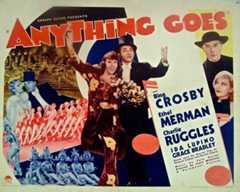 September–November. FilmsAnything Goes with Ethel Merman,Charles Ruggles, andIda Lupino.The film is directed byLewis Milestone.
There were a few stories emanatingfrom Paramount, too. The studio was busy givingAnything Goes the treatment at the same timeBorn to Dance was being filmed. ForAnything Goes, Ethel Merman was swaggering through her originalrole, joined by Ida Lupino, Charles Ruggles and Cole’s less than favoriteperformer, Bing Crosby. Cole had nothing against him personally, but he didn’tlike the singer’s style. Crosby, it might be said, subtracted a dimension from“You’re the Top” by crooning it. Not that Crosby’s crooning the tune made a greatdeal of difference since only “You’re the Top,” “I Get a Kick Out of You” and“Anything Goes” (with additional cleansed lyrics by Cole’s distant cousin TedFetter) were retained in the film. Instead there was a clutch of new songs byLeo Robin, Richard A. Whiting, Frederick Hollander, Edward Heyman and HoagyCarmichael.
(Cole Porter, a biography, page 153)
September 29,Sunday. Bing gives Dixie a Swiss watch set in wood for their fifth weddinganniversary.
October 1,Tuesday. A newspaper article says that Bing and opera singerGladys Swarthouthave recorded two duets “Thunder Over Paradise” and “Home on the Range” atParamount as a test for a possible film. It was intended to star Bing in a filmversion of Hermann Bahr’s operettaTheYellow Nightingale but Bing is said to have indicated that his voice wasnot appropriate.
October 4,Friday. Bing is stopped by police when driving at forty-two miles an hour on N.Highland Avenue (a twenty-five-mile zone) and is given a speeding ticket. Thisis Bing’s second ticket in six months. The officer notices that Bing has arevolver and when Bing cannot produce his gun permit, he is asked to drive toHollywood police station. His explanation that he had forgotten to carry hispermit is accepted and Bing is then allowed to continue to Paramount Studios.
October 17,Thursday. Bing rents Marion Davies’ house in Benedict Canyon for $1,200 permonth pending completion of his new home.
October (undated).Bingbeats G. W. Schweinhard in the first round of the Alphonzo E. Bellcompetition at Bel-Air but is beaten in the next round the followingweek by Steve Cunningham 3 and 2.
October 25,Friday.(8:15-8:30 p.m.) Bob Crosby and hisOrchestra are due to commence a radio series on NBC-WJZ but Bob is taken illwith a respiratory infection, which threatens to develop into pneumonia. He ishospitalized at St. Vincent’s Hospital in Toledo, Ohio. Bing offers to take his place onthe opening broadcast but Bob refuses, defies his doctor's orders and travels to New York to complete the broadcast..
November 11,Monday.(2:15 p.m.) Attends the Southern Methodist University Mustangs vs. UCLABruins football match at the Los Angeles Memorial Coliseum and sees theMustangs win 21-0. At night, he andDixieplus the Joe E. Browns, Jack Benny, the Jack Haleys, the James Cagneys,the Frank McHughs and many others descend unannounced on Pat O’Brien’shome for a surpriseparty to celebrate O'Brien's birthday.
Beertrucks have more than one use. They may also be loaded with a crowd of Pat O’Brien’sfriends on their way to surprise him on his birthday anniversary!
Patreally was surprised Monday evening when one of the huge drays chugged up hisdriveway and a howling mob piled out. The group brought all its own talent andinformed the pleased Mr. O’Brien that they could sing, croon, yodel or dance toadd a dash of zest to the occasion.
Beer-truckerswere Bing Crosby, Jack Benny, the Joe E. Browns, Ted Healy, the Jack Haleys,Mr. and Mrs. James Cagney, the Frank McHughs, Allen Jenkins, Dr. Charles Solier,John Rice, Lucile and Jimmy Gleason, Mr, and Mrs. Joe Breen, Ben Bard, MertBlum and Mrs. Wallace Beery.
(Marshall Kester,The Los Angeles Times, November 17,1935)
November 12,Tuesday. Records five songs in Hollywood with Victor Young and his Orchestraincluding “Red Sails in the Sunset.” During the sessions, Bing also records“Adeste Fideles” and “Silent Night” as commercial waxings but with the earningsassigned to charity.
Quite the most remarkablerecord of the month, however, is Bing Crosby’s attempt at “Adeste Fidelis” and“Still Night, Holy Night” (Brunswick 02054). If it were not rather pathetic itwould be utterly laughable to hear this singer who is acknowledged to be kingof the crooners making such an awful and complete mess of these two beautifulairs; all his little tricks are here, but they are so utterly out of place thatinstead of being fascinating they are merely irritating and in bad taste. No,we prefer Bing in the sort of thing he can do well, such as ‘On TreasureIsland’, ‘Take Me Back to My Boots and Saddle’ (02100) and ‘Red Sails in theSunset’, or the reissued ‘Star Dust’ on 02101.
(The Gramophone, January 1936)
At night, Bing and Dixie plus the JoeE. Browns again descend unannounced on a friend’s home for a surprise party. Thistime the unsuspecting host is Jack Oakie.
November 13,Wednesday. Records three songs from the filmAnything Goes with Georgie Stoll and his Orchestra.
Plenty bullish on the vocalsin the current disk crop, with the cinematic stars featured. Bing Crosbydelivers “Moonburn” (Hoagy Carmichael-Eddie Heyman) from the forthcoming“Anything Goes,” a peach of a tune, with a novelty Georgie Stoll trioaccompaniment on which Joe Sullivan’s hot pianology stands out. It’s backed onDecca 617 with “Treasure Island,” the Victor Young orchestra assisting. Samecombo on Decca 616 with “Red Sails in the Sunset,” a No. 2 “Isle of Capri”idea, paired with “Boots and Saddle.” Crosby has been compelled to deviate fromthe 100% self-introduced picture songs and essay pop song material throughbeing so long between pictures. Besides he’s too good boxoffice and Jack Kapp,the Decca prez has been clamoring for more releases.
(Abel Green,Variety, December 11, 1935)
Bing sings all three withease and assurance and all those little tricks that every crooner since hefirst burst upon an unsuspecting world has tried to copy and for the most part,lamentably failed. There is nothing he doesn’t know about putting over thesesentimental ditties of our degenerate generation. That they die and areforgotten in the briefest moment of time is of no account; the singer does thejob in hand superbly, and as such justifies the enormous salary he receivesfrom the hardheaded magnates of the American film industry.
(The Gramophone, March 1936)
During the week, Bing plays in thesemi-final of the annual Canada Dry Tournament at Lakeside against Johnny DePaolo. The result is not known.
November 23,Saturday. Press reports seen regarding Bing and Dixie’s recent visit to theCentury Club with Dr. and Mrs. William Sexton (Kitty Lang). Meanwhile Bing and Dixie are inthe San Francisco area.
Mr. and Mrs. Crosby PeninsulaVisitors
Interesting visitors on thePeninsula over the week-end were Mr. and Mrs. Bing Crosby, who were the house guestsof Mr. and Mrs. Lindsay Howard in Burlingame. On Saturday evening Mr. and Mrs.Howard took their guests to the dinner dance at the Burlingame Country Club.Others at the Howard table included Mr. and Mrs. Dana Fuller, Mr. and Mrs.Charles Howard and Mr. and Mrs. Robert Six.
(San Francisco Chronicle, November 26, 1935)
November (undated). Bing buys a horse called Khayyam and says he will enter it in the 1936Kentucky Derby. He promises to croon to the horse before the race.
November 30, Saturday. Bing is at Santa Anita with trainer Albert Johnson watching his horse "Friend Andy" work out. (6:30-7:30 p.m.) Dixie Lee appears on theChateauprogram from stationKFI (an NBC outlet). The MC isWallace Beery.
December 1,Sunday.(8:15 p.m.)A memorial benefit,entitledShow of Shows, for the lateWill Rogers takes place at the Shrine Auditorium in front of a crowd exceeding 6000. 85 stage, screen and radiostars take part. Bing opens the show and sings, “Home on the Range”.
December 3,Tuesday.(9:30 a.m.-12:30 p.m.) Bing rehearses the songs for his forthcomingKraft broadcast with Jimmy Dorsey and his orchestra. Inconjunction with Harry Revel,Mack Gordon, and Paramount, Bing is suedfor $500,000 by a woman who claims that the song “Without a Word of Warning” isbased on a song she has written.
December 5,Thursday. (5:00-7:00 p.m.) Rehearses for his Kraft broadcast. (7:00–8:00 p.m.) Bing appears on theKraft Music Hallprior to taking over as host. Paul Whiteman hosts the program from New Yorkwith Bing being “cut-in” from Hollywood. Bing is accompanied by theJimmyDorsey Orchestra and is paid $3,000 weekly. Murdo MacKenzie is the soundengineer in Hollywood and stays with Bing throughout the latter’s radio careereventually becoming coproducer of his shows.
WithBing Crosby and Jimmy Dorsey’s orchestra entertaining from Hollywood, and PaulWhiteman and his regular troupe from New York, the Music Hall will present one ofthe most impressive talent lineups in its long program history beginning withthe broadcast at 9 p. m. over WBAP. The date marks the first time that Crosbywill be heard as a regular star of the Music Hall series. He and Whiteman willbe co-starred on the program for four weeks--until Jan. 2--when Bing will takeover the Music Hall entirely from Hollywood.
Crosbyand the Dorsey band are now in Hollywood, where Bing is working on the movielots. Their portion of the program will originate in NBC’s studies at the film capital.Bing will act as master-of-ceremonies for the Hollywood part of the show.
Whiteman will continue to be master-of-ceremoniesof the entertainment in New York, presenting the orchestra and various members ofhis troupe, including Ramona. singing pianist; Bob Lawrence, baritone; theKing’s Men, quartet; Durelle and Jack Teagarden.
When the entire show moves to Hollywood, BobBurns, bazooka-tooting comedian, will move with it. Heard infrequently on previousprograms from New York, Burns has signed a 26-week contract which establisheshim as a regular Music Hall performer. With Burns and Jimmy Dorsey’s orchestraas regular features of his program, Crosby will present as guest artists each weekfamous personages of the film colony.
(Fort Worth Star-Telegram, December 5,1935)
December 7,Saturday. (7:30-10:00 p.m.) Al Jolson introduces Bing on a gala radio show celebrating the NBCHollywood Studio opening. Bing sings “On Treasure Island” accompanied by VictorYoung and his Orchestra.
Network pushed off its newhalf-million dollar studio with an air opus that ran the gamut. Al Jolson keptthe show moving. He was in top form both in voice and wit. His biggest laughcame when he ribbed Will Hays for his overlong oration…Bing Crosby, eager foran early getaway, crooned “Treasure Island,” with Victor Young on the dais.
(Variety, December 11, 1935)
December 8, Sunday. Bing and Dixie join in the floor show at the Century Club withPaulDraper much to the audience’s delight.
Fortunate were the Century Club customers who selected last Sunday night inwhich to do their night-clubbing, for they were rewarded with a million-dollarimpromptu show, when Bing Crosby sang “Dinah” and “I Kiss Your Hand, Madame,”Dixie Lee sang “Lucky Star,” George E. Stone danced, as did that ace-stepper,Paul Draper, Jimmy Dorsey played his celebrated clarinet, and then Bing, stillin festive mood, joined Billy Gray and Jerry Bergen, the club’s m.c. andcomedian, in a comedy act. Bing and Dixie were making one of the very rarenight-spot appearances, and in their party were Joe Venuti and EddieSutherland. Others were the Zeppo Marxes, Gene Town and Walter Kane.
(Reine Davies,LosAngeles Examiner, December 12, 1935)
December 10,Tuesday. Bing and Dixie are at the dinner-dance at the Palomar to see Joe Venuti and his orchestra.
December 12,Thursday.(5:00-7:00 p.m.) Rehearses for his Kraft broadcast.(7:00–8:00 p.m.) Bing again appears as a guest on theKraft Music Hall.
December 14,Saturday. Bing’s song “Red Sails in the Sunset” is a hit and soon reaches thetop of the charts.
December 19,Thursday.(5:00-7:00 p.m.) Rehearses for his Kraft broadcast.(7:00–8:00 p.m.) Bing again appears as a guest on theKraft Music Hall.
Cork [O’Keefe]] cameout from New York in December to make sure all was ready for that Januarystart. Paul Whiteman was still doing the Kraft show from the east. To promotethe new Bing Crosby show, Bing and Jimmy did “cut—ins” from Hollywood duringDecember. Christmas was approaching. Cork was preparing to go home to be withhis wife, Marge. Bing didn’t want Cork to leave. “Why go back to New York?”
“To be with mywife for Christmas.”
“What's the phonenumber?” Bing called Marge and persuaded her to come to Hollywood. The O’Keefesenjoyed a jolly Christmas with the Crosbys.
(HerbSanford, writing inTommy and Jimmy: The Dorsey Years)
Compliments came fastthe day after the first program byBingCrosby and Paul Whiteman,onein Hollywoodand the otherinNew York,because of the instantswitch-over fromone tothe other.It wasatwo-linebroadcastcosting the sponsors $1,200 addition toobliterate thesilent period. During thisbroadcast,a saving of 30secondsis made,long enoughfor a sponsor to drive a message to millions ofhomes, a fact that mighthave influenced theexpenditure.Listento KFIat 7 andyouwill hear BingandPaul respond to eachother’squestions as thoughthey were talking over the samemicrophone,and not3,000 miles apart,asis the case.
From the eastern studio,Mr.Whiteman willpresent AnnaHamlin,soprano,as gueststar,and Bing, accompaniedby JimmieDorsey'sorchestra, willsing from Hollywood, several currentlypopulartunes.
(Gene Inge,LosAngeles Evening Herald Express, December 19, 1935)
December 20,Friday.(12:30 p.m.) Plays in an amateur-pro event at Oakmont, Glendale and he and hispartner, Bob Woods, come equal third with a best-ball 66. Bing receives a trophy for low gross.
December 21,Saturday. Starting at 10:30 a.m., plays in the first round of the Southern California Open at Oakmont and has a 76.
December 22,Sunday. Has an 81 in the second roundof the Southern California Open and fails to qualify for the final round.
December 23, Monday. Starting at 11:00 a.m.,Walter Hagenteams up with Richard Arlen and Bing in a "Fallen Angels Flight" atOakmont as part of the Southern California Open Golf Championship.
December 25,Wednesday.Bing is at the Santa Anita racetrack for the opening of its season.
December 26,Thursday.(5:00-7:00 p.m.) Rehearses for his Kraft broadcast.(7:00–8:00 p.m.) Bing again appears as a guest on theKraft Music Hall singing a medley andthree other songs with backing from Jimmy Dorsey and his Orchestra.Bob Burnsjoins Bing during the broadcast and plays “Jingle Bells” on his bazooka.
It'salways difficult to say goodbye to an old friend—but that's what it'll betonight when Paul Whiteman and orchestra come to the Music Hall microphone at 10:00p.m. over NBC-WIOD. Paul and his troupe of entertainers will be making their lastappearance on this show. But there are two facts that make it easier for us, wholisten. One is that Paul and his troupe will undoubtedly be back on the air beforelong—after they've had a bit of a vacation. The other is that the show has anable star to carry on.
Thatstar is Bing Crosby who has been featured on the Music Hall program for the pastfew weeks. And in addition, Bob Burns, the Arkansas Traveler, has been signedup for a 26-week contract to appear as regular star. Bob will make his initial appearanceon next week’s broadcast.
(The Miami News,December 26, 1935)
Bing is later revealed to have earned$318,907 from Paramount in 1935. He places12th in the Motion Picture Herald's box-office survey for 1934-35. Shirley Temple comes out on top.During the year, Bing has had ninerecords that became chart hits.
 The International ClubCrosby is pleased to be able to place this continually updated version of theground-breaking book by Malcolm Macfarlane on to the Internet for all to see. Originallypublished by Scarecrow Press in 2001, all copies of the book have now been soldalthough it is still possible to obtain second-hand copies. The book looks atBing’s activities virtually on a day-to-day basis and is an incredible recordof an incredible life.
![102058237[1]](/image.pl?url=https%3a%2f%2fwww.bingmagazine.co.uk%2fbingmagazine%2f1903-1935_files%2fimage003.jpg&f=jpg&w=240) Contents
Contents![bing_3[1].jpg](/image.pl?url=https%3a%2f%2fwww.bingmagazine.co.uk%2fbingmagazine%2f1903-1935_files%2fimage027.jpg&f=jpg&w=240)