What does the future hold for Scotland's giant cranes?

The 'Titan' crane at Clydebank has been shut to visitors since 2018
- Published
Once they lowered engines, boilers or heavy cargoes like steam locomotives into the belllies of ships. Now they are rusting monuments to Scotland's industrial past.
The four giant cantilever cranes beside the River Clyde are iconic structures.
Twenty years ago the oldest surviving example, the Titan Crane at Clydebank, had millions spent on it, transforming it into an award-winning visitor attraction.
But it has been shut since 2018, and now it's emergedthere are no firm plans to reopen it or carry out repairs.
So what's the story of these cranes - and how secure is their future?
A Scottish design that conquered the world
Giant cantilever cranes date from the beginning of the 20th Century, when Scotland led the world in shipbuilding and engineering.
Although similar to the German "Hammerkran" cranes, they had a distinct design.
Research by the late industrial historian Brian Newman concluded the first was built in 1904 by the Glasgow Crane and Electric Hoist Company for a shipyard in Sunderland.
Their selling point was their ability not only to lift great weights but the precision with which they could move them.
"If you got one of these, you'd really made it as a shipyard," explained Miles Oglethorpe, former head of industrial heritage at Historic Environment Scotland.

The Scottish-built giant cantilever crane in the Japanese city of Nagasaki survived the dropping of an atomic bomb in 1945
Over the next 70 years, nearly 50 giant cantilever cranes were built worldwide, with about half of them involving companies based in or near Glasgow.
Today it is believed only about a dozen survive, including three in Japan.
One of them in Nagasaki survived the 1945 atomic bomb blast and is still in working order, 117 years after it was fabricated and shipped from Scotland.
The Clydebank 'Titan'
The "Clydebank Titan" is the oldest surviving example worldwide, built in 1907 for the John Brown shipyard, birthplace of great ships like HMS Hood, the Queen Mary, Queen Elizabeth and the QE2.
It was also the first of the giant cantilever cranes built by the renowned Glasgow engineering firm Sir William Arrol & Co whose previous projects included the Forth Bridge, Tower Bridge in London and the Tay Bridge.

The Clydebank crane can be seen on the left of this photo of the Queen Mary being completed in 1936
During the 1941 Clydebank Blitz, only seven out of 12,000 properties in the town are said to have escaped damage from German bombing but the giant crane was unscathed.
When shipbuilding finally ended at the site in the 1970s, it was used to build oil rigs for a time before the yard finally closed in 2001.
Six years later it was back in action as a visitor attraction with an elevator installed, strengthened walkways and an exhibition charting the town's shipbuilding past.
But despite winning accolades - including being declared a worldMechanical Engineering Landmark alongside structures such as the Eiffel Tower - visitor revenue failed to cover the running costs.
The attraction closed in 2018 and its owner Clydebank Property Company, which is linked to the local council, currently has no firm plans to reopen. It says it is conducting a "strategic review" of the options.
One obstacle is the cost of repainting it, with estimates gathered two years ago ranging from £1.2m to £7.3m.
The 'Finnieston crane'

The Finnieston Crane has become one of Glasgow's most recognisable landmarks
Glasgow's coat of arms includes a tree, a bird, a fish and a bell - but this giant steel latticed structure beside the Clyde has become an unofficial emblem of the city.
Its proper name is Clyde Navigation Trustees Crane No. 7 and it is sometimes called the Stobcross Crane, but the 175ft (53m) structure is best known as the Finnieston Crane, after the crane it replaced and the nearby quay.
Completed in 1931, one of its main uses was loading steam locomotives from the St Rollox works into cargo holds before they were exported around the world.
The story goes that it used to interfere with TV reception in parts of Glasgow depending on which way its huge jib was left pointing, and Govan residents used to offer the operator "incentives" to ensure they were unaffected.

Glasgow's Finnieston Crane was originally named Clyde Navigation Trustees Crane No 7
Ironically, this Scottish icon was built by two English firms (although the foundations and some design work came from Sir William and Arrol & Co Ltd).
It is now the responsibility ofThe Big Cran Co,, external a public interest company, which six years ago announced £7m plans for a restaurant, museum and visitor centre.
While some funding has been secured and spent replacing stairways, little progress has yet been made on the wider ambition, despite its prime location beside the Scottish Event Campus.
James Watt Dock and Barclay Curle cranes

Plans have been submitted to run a zip wire from Greenock's James Watt Dock crane
The giant cantilever crane at Greenock's James Watt Dock, built in 1917 in the midst of World War One, was another project led by the engineering firm Arroll.
It was used for fitting out ships for the Greenock Dockyard Company, lowering heavy objects into their hulls, particularly engines from the nearby Kincaid works.
In late 2024, the crane wascordoned off after reports of debris falling onto yachts in the nearby marina, but an inspection found no major structural problems.
- Image source,Transient Places
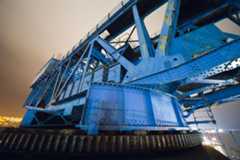
Image caption, The James Watt Dock crane, photographed some years ago. Images courtesy ofTransient Places., external All images are copyrighted.


1 of 4
Planning permission is currently being sought to use the crane foran urban zipline attractionrunning along the dock behind the town's listed "Sugar Shed" buildings.
The businessman behind the plan, Bradley Mitchell, also hopes to offer thrill seekers a 115ft (35m) freefall experience with a belay system slowing their descent before they hit the ground.
Mitchell already owns the fourth surviving giant crane on the Clyde, at the site of the former Barclay Curle shipyard at Whiteinch in Glasgow.

The Barclay Curle crane at Whiteinch stands next to the former North British Diesel Engine Works building
Dating from 1920, it stands beside the former North British Diesel Engine Work building, one of the earliest examples of modernist industrial architecture in Scotland.
But its location, in an industrial site with storage units and other businesses, makes it the least accessible of the cranes, best viewed from the south side of the river.
How can the cranes be preserved?
The four surviving giant cranes in Scotland are all category A-listed, meaning their history and architecture are deemed of national or international importance.
Owners have a legal requirement to seek consent for any changes and to maintain them - but the often damp climate makes that an expensive obligation.
In 2011, a10-year project to repaint the Forth Bridge with an epoxy-based treatment was completed, promising 25 years of protection, but it cost £130m.
Repainting the far smaller cranes would cost much less - but as the owners of the Clydebank crane have discovered, it is still a daunting outlay.
The Barclay Curle crane is now looking quite rusty, although Mitchell says he hopes to start repainting it later this year.
He believes part of the answer is looking for commercial opportunities, like the zip-wire plan he has for the Greenock crane, so they can pay for their own upkeep.
"People go, it's iconic, it's got to stay. But the government or council can't pay for it because it's that much money for the upkeep," he said.
Glasgow MSP Paul Sweeney, who is interested in industrial heritage, is working to bring together the various crane owners to explore more cost-effective ways of maintaining them.
"They're all very similar in structure, so if we could come up with a standard set of maintenance protocols, then we could take a collective approach and that would help reduce the costs," he explained.
Sweeney also believes there is potential for sponsorship or advertising revenue.
Miles Oglethorpe, formerly of Historic Environment Scotland, is hopeful that advances in paint and steel-coating technology could bring down the cost of preservation and maintenance.
"These iconic cranes are an important part of Scotland's history and cultural identity," he said.
"As such, Glasgow's Giants should be seen as monuments in much the same way as more conventional heritage such as our ancient castles.
"I think their conservation and long-term future depends on people better appreciating their significance and value, something that is already reflected in their A-listed status."