

Image credit:(Getty Images)
For the Baseball America Prospect Handbook, BA authors speak to hundreds of scouts over the course of the year to report on prospects and write the scouting reports enclosed. While none of the authors is a scout, we use scouts’ terminology to accurately report how the industry views and projects players. This includes the 20-80 scouting scale, the industry standard for grading players and their tools.
Many of these grades are measurable data, such as fastball velocity and speed (usually timed from home to first or in workouts over 60 yards). A fastball grade doesn’t stem solely from its velocity—command and life are crucial elements as well. A 100 mph fastball with poor movement characteristics may grade below a 97 mph fastball with elite movement. Secondary pitches are graded in a similar fashion. The more swings and misses a pitch induces from hitters and the sharper the bite of the movement, the better the grade.
Velocity steadily has increased over the past two decades. Not long ago, an 88-91 mph fastball was considered major league average. Now, major league starting pitchers sit 93 mph on average. You can reduce the scale by 1 mph for lefthanders, whose velocities are usually slightly lower. Fastballs earn their grades based on the average range of the pitch over the course of a typical outing, not their peak velocity.
A move to the bullpen complicates in another direction. Pitchers airing it out for one inning should throw harder than someone trying to last six or seven innings, so add 1-2 mph for relievers.
Hitting ability is as much a skill as it is a tool, but the physical elements of hand-eye coordination, swing mechanics and bat speed are key factors in how it is graded. Raw power generally is measured by how far a player can hit the ball, but game power is graded by how many home runs the hitter projects to hit in the majors, preferably an average over the course of a career. We have tweaked our power grades based on the recent rise in home run rates to reflect changing industry standards.
Arm strength can be evaluated by observing the velocity and carry of throws, measured in workouts with radar guns or measured in games for catchers with pop times—the time it takes from the pop of the ball in the catcher’s mitt to the pop of the ball in the fielder’s glove at second base. Defense takes different factors into account by position but starts with proper footwork and technique, incorporates physical attributes such as hands, short-area quickness and fluid actions, then adds subtle skills such as instincts and anticipation.
Not every team uses the wording below. Some use a 2-to-8 scale without half-grades, and others use above-average and plus synonymously.
20: As bad as it gets for a big leaguer. ThinkMyles Straw’s power orDaniel Vogelbach’s speed.
30: Well below-average, but not unplayable, such asKyle Hendricks’ fastball.
40: Below-average, such asRafael Devers’ defense orDylan Cease’s control.
45: Fringe-average.Matt Chapman’s hitting ability andMike Zunino’s arm qualify.
50: Major league average.Jeff McNeil’s speed.
55: Above-average.Randy Arozarena’s power.
60: Plus.Marcus Semien’s defense orZac Gallen’s control.
70: Plus-Plus. Among the best tools in the game, such asFreddie Freeman’s hitting ability,Blake Snell’s curveball andRonald Acuña Jr.’s arm.
80: Top of the scale. Some scouts consider only one player’s tool in all of the major leagues to be an 80. Think ofShohei Ohtani’s power,Corbin Carroll’s speed orDevin Williams’ changeup.
(Note: The following scales were created in conjunction with major league teams to best reflect overall industry standards. Individual teams’ scales may differ.)
Grade Batting Avg
80. . . . . . . . .315+
70. . . . . .295-.314
60. . . . . .275-.294
55. . . . . .265-.274
50. . . . . .255-.264
45. . . . . .245-.254
40. . . . . .235-.244
30. . . . . .215-.234
20. . . . . . . . <.215
Grade Home Runs
80. . . . . . . . . . . 40+
70. . . . . . . . . 34-39
60. . . . . . . . . 28-33
55. . . . . . . . . 23-27
50. . . . . . . . . 19-22
45. . . . . . . . . 14-18
40. . . . . . . . . 10-13
30. . . . . . . . . . . . 5-9
20. . . . . . . . . . . . 0-4
Home-First (In Secs.)
RHH—LHH
80. . . . 4.00—3.90
70. . . . 4.10—4.00
65. . . . 4.15—4.05
60. . . . 4.20—4.10
55. . . . 4.25—4.15
50. . . . 4.30—4.20
45. . . . 4.35—4.25
40. . . . 4.40—4.30
30. . . . 4.50—4.40
20. . . . 4.60—4.50
Velocity (Starters)
Grade Velocity
80. . . . . . . .98+ mph
70. . . . . . . . . . . . 97
65. . . . . . . . . . . . 96
60. . . . . . . . . . . . 95
55. . . . . . . . . . . . 94
50. . . . . . . . . . . . 93
45. . . . . . . . . . . . 92
40. . . . . . . . . .90-91
30. . . . . . . . . .88-89
20. . . . . . .87 or less
Catcher: Pop
Times To Second
Base (In Seconds)
80. . . . . . . . . < 1.90
70. . . . . . 1.90-1.94
60. . . . . . 1.95-1.99
50. . . . . . 2.00-2.04
40. . . . . . 2.05-2.09
30. . . . . . 2.10-2.14
20. . . . . . . . . > 2.15
Comments are closed.

Baseball America is tracking College Baseball Top 25 upsets on Opening Day.
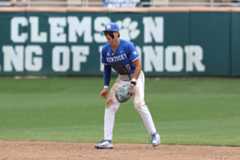
Kentucky sophomore shortstop Tyler Bell is “out indefinitely” after injuring his left shoulder on Opening Day, a team spokesperson told Baseball America. Ranked 14th in…

From Tyce Armstrong’s historic night to Jackson Flora’s dominance, here’s everything you need to know.

On this week’s Fantasy Podcast, Geoff and Ian break down the Caleb Durbin trade before digging through a laundry list of recent injuries.

With college baseball season here, Geoff Pontes dives into 10 more top college pitchers with analytical markers worth paying attention to.

In this week’s Future Projection, we conduct our annual amateur player draft by picking the best 2026 college and high school players.

J.J. Cooper & Ben Badler take an in-depth look at the Brewers’ farm system entering the 2026 season.

On this week’s Hot Sheet Show, we dig into BA’s recent farm system talent rankings and break down the trade sending Caleb Durbin to Boston.

In this week’s College Baseball Podcast, we preview the most exciting opening weekend matchups and prospects to know for 2026.
In this week’s Future Projection mailbag, Ben and Carlos examine how modern high school scouting has changed and talk about 2027 draft prospects.

Geoff Pontes & Jesús Cano take an in-depth look at the Rockies’ farm system entering the 2026 season.
Read the newest magazine issue right on your phone


Join our social media community