Bangladeshhas a health crisis in the making. The lack of preparation in theUnited States and Europe that has spawned the ongoing crisis there still exceeds thepreparedness of developing countries such as Bangladesh, which will have tobattle the COVID-19 pandemic with limited financial resources and a legacy ofpoor healthcare infrastructure, especially for the urban poor. Already one ofthe most densely populated countries in the world, Bangladesh also hasthousands ofstateless Rohingya housed in sprawling refugeecamps in the southeastern region of thecountry, in conditions prime for rapid spread. Given its proximity to China anda large migrant population living in severely affected countries such as Italy,Bangladesh’s Ministry of Health and Family Welfare should have takenpreventative measures when theChinese government first shared news of the deadly virus. Unfortunately, precious time wassquandered.
After the first reported death in Bangladesh from COVID-19, there was amass religious gathering in the southern part of the country attended by tens of thousands of people. Such events have beendiscouraged by authorities but communications need to be clearer and more forceful to be effective. Currently there is aten-day nationwide holiday from March 26 to April 4, during which the army is enforcing social distancing across the nation. There are several potential policies the Bangladeshi government can use in its response strategy to blunt the COVID-19 pandemic’s health and economic impact on Bangladesh.
The current situation
TheBangladeshi research institute spearheading the fight to test and detectcoronavirus is theInstitute of Epidemiology Disease Control andResearch (IEDCR), a body under the Ministry ofHealth. TheIEDCR has recommended thatcitizens avoid mass public gatherings. Yet, for the March 17 birth centenary ofthe country’s founder, Sheikh Mijibur Rahman, the governmentarranged two major public events in Dhaka. Theseevents were supposedly more scaled down from their original intended size, but even so they wasstill packed withthousands of celebrants, live music, andfireworks.
Unlike in neighboring Nepal where thearmy set up a quarantine facility in Kathmandu as per the World HealthOrganization’s (WHO) recommendation upon the first positive COVID-19 test, the handling ofquarantine measures in Bangladesh was inadequate. When the first batch ofmass returnees arrived from China in February, they were all quarantined at the Ashkana HajjCamp in Dhaka. The returnees complained about subpar conditions, including poorhygienic conditions and being crammed in small spaces. However, the authoritiesignored the situation and the health risks it posed to those in quarantine.Subsequently, in mid-March when the second batch of foreign returnees—over ahundredand forty Bangladeshis evacuated from Italy—arrived, confusion ensued when they weretaken to the same inadequatequarantine spot. These returnees protested and were ultimately allowed to leavewith the promise of “home quarantine.”
On March 18,tens ofthousands of people gathered in Raipur in the southern district of Lakshmipurto pray “healing verses” from the Quran. This event was organized by aninfluential local religious leader who urged people to join this event,promising a way to be “free from the coronavirus.” The same week,school holidays were announced to support the quarantine, but domestic touristdestinations such as the coastal areas ofChittagongandCox’s Bazarwere all bustling with people and activity. On March 20, theIslamicFoundationallowed congregational prayers to go on albeit for a shortened length.
Such contradiction in policy guidance andlack-luster enforcement has wasted precious time for the government to shore upits limited public health system and to implement best practices for maximizingsocial distancing and minimizing community transmission of the novelcoronavirus. The impact on Bangladesh’s economy due to these missteps is likelyto be significant.
The Asian Development Bank (ADB) estimates that export industries will suffer and the country willlose 1.1% of its gross domestic product (GDP) growth due to the pandemic. The ready-made garments sector which accounts for more than 80 percent of Bangladesh’s manufacturing income has alreadysuffered a loss of $3 billion as major export destinations such as the United States, United Kingdom, and European Union are cancelling orders. In addition,foreign remittances representing over 5 percent of GDP (close to $17 billion in fiscal year 2019) will be affected as half a million migrant workers have returned home since the outbreak. The majority of these migrant workers were based in Middle Eastern countries which have been hit by declining oil prices. Furthermore,daily wage laborers, such as rickshaw-pullers, are the hardest hit as the closure of schools and colleges have led to lower demand for their services. For these workers—who survive hand to mouth daily—the consequences of quarantines and lockdowns, however medically necessary, are dire without robust government provision of food and supplementary income.
Some encouraging news
Bangladesh’s government is hardly alonein not tackling the pandemic early enough. Fortunately, after a slow start, thegovernment has begun to show signs of urgency. Following the mass religiousgathering in southern Bangladesh, the government started enforcing socialdistancing measures. Local administrations have been toldto punish violators of thehome-quarantine rules in line with Section 269of the Penal Code. Additionally, an emergencylockdown has been imposed in the sub-district ofShibchar since March 19 where many returnees from Italy are based. The general secretaryof the ruling party Awami League,Obaidul Quader, said that in the future there may be a possibility of further lockdowns in otherareas. Most recently, thegovernment declared aten-daynationwide holidayfrom March 26 to April 4, wherein all government and private offices have beenclosed, and with the army mobilized to enforce social distancing across thenation. Almost allinternational flights havebeen suspended until April 7 and the country’sMarch 26 IndependenceDay celebrations were subdued.
Thegovernment encouragedlow-income peopleto return to their villages where they would be provided with government aid ortotakerefuge in Bhashanchar,an island in the Bay of Bengal originally built to house Rohingya refugees. On March 20, the government authorized the Bangladesh Armytorun two quarantine centers in Dhaka. One quarantine facility remains the same Ashkona Hajj Campthat has proved inadequate before. The other is a new one at Rajuk ApartmentProject near Diyabari in Uttara.
In the medical arena, there has been progress as well. Isolation wards to treat COVID-19 patientshave been set up in district-level hospitals across the country. Students and teachers of theFaculty of Pharmacy at the University of Dhaka have started making low-cost hand sanitizers due to market shortages in the wake of coronavirus fears. And,Gonoshasthaya Kendra, a public health center in Dhaka,received approval from the country’s Directorate of Drug Administration (DGDA) to mass-produce COVID-19 detection kits, eachcosting around $3.
Recommendations for tackling the situation
Policymakers in Bangladesh should gear up in anticipation of a deterioration of the situation. While the Asian Development Bank (ADB) haspromised a $6.5 billion package to address the immediate needs of developing member countries (DMCs), and India’s Prime MinisterNarendra Modi has pledged $10 million toward a special emergency fund to set up a rapid response team for the South Asian Association for Regional Cooperation (SAARC), Bangladesh will have to face this battle largely on its own. Over the past ten days, the South Asia Center has consulted broadly with public health professionals and social scientists who study Bangladesh. Those conversations lead us to offer the following healthcare, social, and economic recommendations:
Health Care
- Support initiatives to increase the local production of medical gloves, masks, and other medical kits for health care practitioners who, as the front line defenders, are the most vulnerable. According to Health and Family Welfare Minister Zahid Maleque, as of now,Bangladesh has adequate testing kits and personal protective equipment (PPE), numbering around two hundred thousand units. On March 26, a large consignment ofemergency medical supplies provided by the Chinese government arrived. This shipment included 10,000 testing reagents, 15,000 surgical masks, 10,000 medical protective equipment, and 1,000 infrared thermometers. But, as the grim lessons from other countries make clear, in the case of a mass outbreak, even more PPE will be required and more testing needs to be done.
- COVID-19 testing facilities should be made available across both public and private medical centers with immediate effect. Once locally produced full-scale standardized and accurate kits are available, testing capabilities should be distributed to other locations in Dhaka and across the country. Bangladesh should commit to mass testing on about one percent of its population to identify community spread of COVID-19. As of March 29,Bangladesh’s official COVID-19 tracker confirms forty-eight cases and five deaths.A press conference that day stated that 1,185 tests have been conducted thus far. This number is much lower in comparison to India and Pakistan, who as of March 29, have tested 27,688 and 14,336 cases respectively.
- Implement awareness campaigns for the general public. Unless an individual is over sixty-five and/or has pre-existing health conditions, symptoms should be followed by a six to seven-day quarantine period and individuals should not go to health care facilities. If an individual’s health condition continues to deteriorate, they should then go for COVID-19 testing.
- Emotional and mental health services, as well as financial support, should be provided for health workers. The medical community of the nation at this point are severely athigh risk and are fearful.
Social
- The Ministry of Religious Affairs should endorse thefatwa of the Council of Senior Scholars at Al-Azhar, one of the Muslim world’s top Islamic institutions, where it is permitted under Sharia Law to suspend congregational prayers to counter the spread of the virus. Many Muslim-majority countries in the Middle East including Saudi Arabia have banned gatherings such as in theholy cities of Mecca and Medina.
- Restaurants and public locations should remain closed after April 4 for a period of at least another ten days, and citizens should be prepared for even longer disruptions of daily life. There must be tougher self-quarantine norms—and if needed lockdown measures—in certain areas of the country with higher concentrations of Bangladeshi expatriates.Sri Lanka had instituted a stay-at-home curfew in eight districts of the country, where violation of this measure has led to the arrest of over 1,600 people. Now that the army has been summoned in Bangladesh, certain districts across the country can be asked to impose curfew-like restrictions, with violations leading to strict punishment and fines.
- The government must utilize television, radio, and social media tocounter the spread offraudulent treatmentmethods through disinformation channels, and to raise appropriate awareness of COVID-19’s dangers for even otherwise healthy victims.
- Village community leaders such as Imams and village elders should be involved in spreading information on countering COVID-19. Local non-governmental organizations (NGOs) and government officials have a list of such leaders and can centrally coordinate their response.
- Private universities should be mobilized to provide premises for quarantine facilities and temporary hospitals, given that many of them have campuses located right outside Dhaka. Similar initiatives have been taken byhigher educational institutions in the United States.
Economic
- In concurrence with theCentre for Policy Dialogue (CPD), one of Bangladesh’s leading economic think tanks,leniency should be provided for loans to small and medium sized-businesses and extended pay back periods granted. Prime Minister Sheikh Hasina announced astimulus package of Tk 5,000 crore ($590 million) for the export-oriented industries. However, it is also imperative that the government provide smaller entrepreneurs with fiscal support so that they can maintain production and pay workers’ wages.
- To protect daily wage laborers who have not left Dhaka to return to their hometowns,tougher lockdown measures accompanied by supportive humanitarian measures should be implemented in slum areas where daily wage workers are concentrated. As in the Rohingya camps, daily wage laborers should be provided with rations for two weeks so that they can observe social distancing measures without risk of starvation or malnutrition. Such a policy could build on the precedent by the neighboring Indian state of West Bengal, whichwill provide free rations to the poor until September. Additionally, as the month of Ramadan is approaching,zakat funds should be collected by both the government and NGOs for this purpose
- The government mustprovide the necessary financing to allow Gonoshasthaya Kendra and other health care organizations to produce their COVID-19 testing kits at requisite volumes and support distributional channels to allow medical facilities around the country to access these kits.
- The government must help catalyze the funding required toenable the local production of hand sanitizers and PPEs, which are being made byuniversity students andsmall tech companies. This will disincentivize counterfeiting and fraud.
- Over the next six months,the government must ensure that strategies suggested by the ADB and other international organizations are implemented without delay to minimize the inevitable economic slowdown that will follow even a successful fight against the novel coronavirus.
Theglobal COVID-19 pandemic is caused by a once-in-a-generation pathogen that hasproven capable of bringing the health systems of the richest countries of theworld to their knees. The damage that will be wrought on developing countrypopulations if their governments delay implementation of aggressive countermeasuresis unimaginable. Living in densely populated areas with large sections ofsociety reliant on daily wages to make ends meet—and served by public healthsystems that have been deprived of investment for decades—Bangladeshi citizensare among the world’s most vulnerable to the unchecked spread of this disease.But the situation is not hopeless, and Dhaka must utilize every tool in itsarsenal to serve its citizens. The policy checklist presented above is a good placeto start.
Dr Irfan Nooruddin, Ph.D., is the director of the South AsiaCenter at the Atlantic Council and professor in the School of Foreign Serviceat Georgetown University.
Dr Rudabeh Shahid, Ph.D., is a nonresident senior fellow of the South Asia Center at the Atlantic Council and a postdoctoral research fellow at the University of York.
Further reading:
Event:
Related Experts:Irfan Nooruddin andRudabeh Shahid
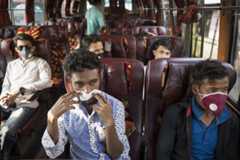
Image: Passengers waits inside an intercity bus wearing a face mask amid concerns of corona virus pandemic in Dhaka, Bangladesh on March 23, 2020. Bangladesh has confirmed 30 cases, with 4 deaths due to corona virus (COVID-19), According to IEDCR officials. (Photo by Salahuddin Ahmed/Sipa USA)
