




The Asian Scientist 100
Every year since 2016, Asian Scientist Magazine compiles a list of Asia’s most outstanding researchers.
Now into its eighth edition, the Asian Scientist 100 list celebrates the success of the region’s best and brightest, highlighting their achievements across a range of scientific disciplines.
To be acknowledged on this list, the honouree must have received a national or international prize in the preceding year for his or her research. Alternatively, he or she must have made a significant scientific discovery or provided leadership in academia or industry.
Asian Scientist 100
Category+-
Biomedical Science
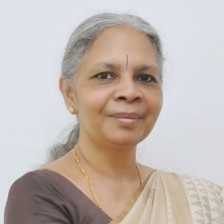
Annapurni Subramaniam
Indian Institute of AstrophysicsIndia
Annapurni won the Vigyan Shri Award, one of the top science honors in India, for making pioneering contributions to physics of single and binary stars, blue stragglers, star clusters, star formation, galactic structure and Magellanic clouds. (Photo:Deccan Herald)
Annapurni won the Vigyan Shri Award, one of the top science honors in India, for making pioneering contributions to physics of single and binary stars, blue stragglers, star clusters, star formation, galactic structure and Magellanic clouds. (Photo:Deccan Herald)
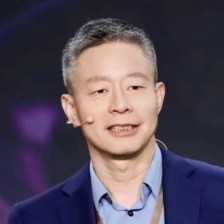
Di Li
National Astronomical Observatories of the Chinese Academy of SciencesChina
Li received the Marcel Grossmann Award for his pioneering contributions in the field of fast radio bursts. Li is the first scientist in China to receive this prize for research conducted within China. (Photo:The Paper)
Li received the Marcel Grossmann Award for his pioneering contributions in the field of fast radio bursts. Li is the first scientist in China to receive this prize for research conducted within China. (Photo:The Paper)

Kana Moriwaki
The University of TokyoJapan
The grand prize winner of the Third Marie Sklodowska Curie Award, Moriwaki was the first to emphasize observing oxygen spectral lines over traditional hydrogen lines to understand the early universe's large-scale structure. She also developed a machine learning-based signal separation method, significantly enhancing the detection efficiency of distant galaxy clusters. (Photo:Japan Science and Technology Agency)
The grand prize winner of the Third Marie Sklodowska Curie Award, Moriwaki was the first to emphasize observing oxygen spectral lines over traditional hydrogen lines to understand the early universe's large-scale structure. She also developed a machine learning-based signal separation method, significantly enhancing the detection efficiency of distant galaxy clusters. (Photo:Japan Science and Technology Agency)

Sarah Qureshi
Aero Engine CraftPakistan
Qureshi was awarded Tamgha-e-Imtiaz, one of Pakistan's highest civilian awards, for her contributions to the field of aerospace engineering, particularly in the development of environmentally friendly aviation technologies. (Photo:PSTD)
Qureshi was awarded Tamgha-e-Imtiaz, one of Pakistan's highest civilian awards, for her contributions to the field of aerospace engineering, particularly in the development of environmentally friendly aviation technologies. (Photo:PSTD)
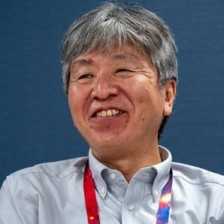
Satoshi Miyazaki
National Astronomical Observatory of JapanJapan
Miyazaki developed the Hyper Suprime-Cam (HSC), an ultra-wide field-of-view camera mounted on top of the Subaru Telescope in Hawaii. HSC is currently the world’s largest camera used in surveying the universe; it has been instrumental in helping researchers map the distribution of dark matter across the universe. (Photo:Yokohoma Japan)
Miyazaki developed the Hyper Suprime-Cam (HSC), an ultra-wide field-of-view camera mounted on top of the Subaru Telescope in Hawaii. HSC is currently the world’s largest camera used in surveying the universe; it has been instrumental in helping researchers map the distribution of dark matter across the universe. (Photo:Yokohoma Japan)
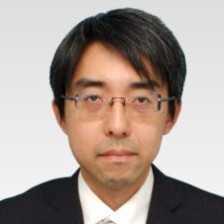
Masamune Oguri
Chiba UniversityJapan
Oguri utilized data from the HSC, analyzing it to create a 3-dimensional dark matter map over an unprecedentedly vast region of the universe. His findings suggested that the current model of cosmic expansion might not align with results from cosmic microwave background radiation, which is regarded as the prevailing theory of cosmology. (Photo:The Japan Academy)
Oguri utilized data from the HSC, analyzing it to create a 3-dimensional dark matter map over an unprecedentedly vast region of the universe. His findings suggested that the current model of cosmic expansion might not align with results from cosmic microwave background radiation, which is regarded as the prevailing theory of cosmology. (Photo:The Japan Academy)
Acga Cheng
Universiti MalayaMalaysia
Cheng received the L'Oréal-UNESCO For Women in Science Award 2023 for her research on the interaction between aerobic rice and soil microbes. Her work seeks to uncover how aerobic rice adapts to warmer, drier conditions through microbial interactions, offering Malaysian farmers an alternative, sustainable farming strategy to boost self-sufficiency in rice production. (Photo:China Press)
Cheng received the L'Oréal-UNESCO For Women in Science Award 2023 for her research on the interaction between aerobic rice and soil microbes. Her work seeks to uncover how aerobic rice adapts to warmer, drier conditions through microbial interactions, offering Malaysian farmers an alternative, sustainable farming strategy to boost self-sufficiency in rice production. (Photo:China Press)
Boon Chin Tan
Universiti MalayaMalaysia
Tan received the 2024 Distinguished Scientist Award from the Malaysian Society for Molecular Biology and Biotechnology. Tan has made significant contributions to agricultural research, specializing in plant molecular biology and biochemistry. (Photo:Universiti Malaya)
Tan received the 2024 Distinguished Scientist Award from the Malaysian Society for Molecular Biology and Biotechnology. Tan has made significant contributions to agricultural research, specializing in plant molecular biology and biochemistry. (Photo:Universiti Malaya)
C. Anandharamakrishnan
National Institute for Interdisciplinary Science and TechnologyIndia
Anandharamakrishnan won the 2024 Tata Transformation Prize for his research in food security that addresses the nutrient deficiencies, hunger and metabolic dysfunction faced by India’s underserved and the two billion people globally affected by micronutrient malnutrition. (Photo:Government of India, Press Information Bureau)
Anandharamakrishnan won the 2024 Tata Transformation Prize for his research in food security that addresses the nutrient deficiencies, hunger and metabolic dysfunction faced by India’s underserved and the two billion people globally affected by micronutrient malnutrition. (Photo:Government of India, Press Information Bureau)
Dissanayake D.C.T.
University of Sri JayewardenepuraSri Lanka
Dissanayake was honored with the Presidential Award for Inventors 2024 by the Sri Lanka Inventors Commission for her contributions to the field of food technology. (Photo:University of Sri Jayewardenepura)
Dissanayake was honored with the Presidential Award for Inventors 2024 by the Sri Lanka Inventors Commission for her contributions to the field of food technology. (Photo:University of Sri Jayewardenepura)
Ghulam Muhammad Ali
Pakistan Agricultural Research CouncilPakistan
Ali received the Sitara-i-Imtiaz award, a civilian honour, for his contributions in the field of agricultural science. (Photo:Daily Parliament Times)
Ali received the Sitara-i-Imtiaz award, a civilian honour, for his contributions in the field of agricultural science. (Photo:Daily Parliament Times)
Rachma Wikandari
Universitas Gadjah MadaIndonesia
Wikandari won the 2024 L’Oréal-UNESCO For Women in Science Award for her research on creating a protein- and mineral-rich plant-based food using filamentous fungi (Rhizopus oligosporus). This innovation repurposes tempeh production waste, contributing to the circular economy while addressing stunting and nutritional deficiencies in Indonesia through fortified, affordable vegan diets. (Photo:Universitas Gadjah Mada)
Wikandari won the 2024 L’Oréal-UNESCO For Women in Science Award for her research on creating a protein- and mineral-rich plant-based food using filamentous fungi (Rhizopus oligosporus). This innovation repurposes tempeh production waste, contributing to the circular economy while addressing stunting and nutritional deficiencies in Indonesia through fortified, affordable vegan diets. (Photo:Universitas Gadjah Mada)
Sithichoke Tangphatsornruang
National Center for Genetic Engineering and BiotechnologyThailand
Tangphatsornruang and his team won the 2024 National Research Council of Thailand’s Excellent Research Award in Agriculture and Biotechnology for their research project titled “Comparative genomics analysis and population genetics explain speciation and evolutionary changes in population structure in Rhizophoraceae. (Photo:National Center for Genetic Engineering and Biotechnology)
Tangphatsornruang and his team won the 2024 National Research Council of Thailand’s Excellent Research Award in Agriculture and Biotechnology for their research project titled “Comparative genomics analysis and population genetics explain speciation and evolutionary changes in population structure in Rhizophoraceae. (Photo:National Center for Genetic Engineering and Biotechnology)
Chang-Hsien Yu
Taitung Mackay Memorial HospitalTaiwan
Yu was honored in Taiwan’s 32nd Medical Dedication Awards with Transnational Clinical-Academic Practices for his commitment and consideration in providing quality medical care for patients, specifically in the treatment of pediatric heart disease. (Photo:Taitung Mackay Memorial Hospital)
Yu was honored in Taiwan’s 32nd Medical Dedication Awards with Transnational Clinical-Academic Practices for his commitment and consideration in providing quality medical care for patients, specifically in the treatment of pediatric heart disease. (Photo:Taitung Mackay Memorial Hospital)
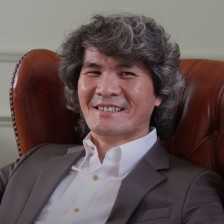
Changjoon Justin Lee
Institute for Basic ScienceSouth Korea
Lee was a recipient of the 2024 ASAN Award in basic medicine for his studies on astrocytes in the brain to provide therapeutic targets for brain diseases such as dementia and Parkinson's disease. (Photo:University of Luebeck)
Lee was a recipient of the 2024 ASAN Award in basic medicine for his studies on astrocytes in the brain to provide therapeutic targets for brain diseases such as dementia and Parkinson's disease. (Photo:University of Luebeck)
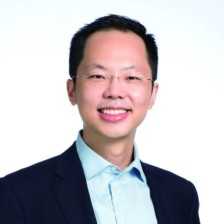
Charles Pin-Kuang Lai
Institute of Atomic and Molecular Sciences, Academia SinicaTaiwan
Lai received the 2024 Outstanding Research Award from the National Science and Technology Council (NSTC), Taiwan, for his research which focuses on molecular bioimaging, cell-to-cell communication and gene therapy. (Photo:National Science and Technology Council)
Lai received the 2024 Outstanding Research Award from the National Science and Technology Council (NSTC), Taiwan, for his research which focuses on molecular bioimaging, cell-to-cell communication and gene therapy. (Photo:National Science and Technology Council)
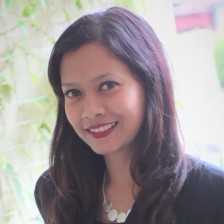
Elena Azizan
Universiti Kebangsaan MalaysiaMalaysia
Azizan received the L'Oréal-UNESCO For Women in Science Award 2023 for her research which explores the broader implications of inhibiting aldosterone synthase (CYP11B2), proposing it could induce programmed cell death, offering a novel approach beyond hypertension treatment, with potential to reduce medication reliance. (Photo:International Society for Heart Research)
Azizan received the L'Oréal-UNESCO For Women in Science Award 2023 for her research which explores the broader implications of inhibiting aldosterone synthase (CYP11B2), proposing it could induce programmed cell death, offering a novel approach beyond hypertension treatment, with potential to reduce medication reliance. (Photo:International Society for Heart Research)
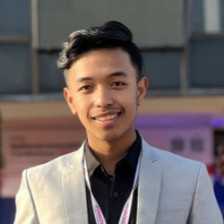
Frienson Pradhan
Kathmandu UniversityNepal
Pradhan won the Falling Walls Lab Kathmandu 2024 award for his concept titled “Breaking the wall of pestilence: From invasive weed to eco-friendly mosquito control.” (Photo:Frienson Pradhan ResearchGate)
Pradhan won the Falling Walls Lab Kathmandu 2024 award for his concept titled “Breaking the wall of pestilence: From invasive weed to eco-friendly mosquito control.” (Photo:Frienson Pradhan ResearchGate)
Govindarajan Padmanabhan
Indian Institute of ScienceIndia
Padmanabhan received the Vigyan Ratna Award 2024 for his lifetime achievement and contributions in the field of biotechnology. Padmanabhan has been instrumental in creating the Biotechnology Industry Assistance Council that supports 1800 incubatees. (Photo:Indian Agricultural Research Institute)
Padmanabhan received the Vigyan Ratna Award 2024 for his lifetime achievement and contributions in the field of biotechnology. Padmanabhan has been instrumental in creating the Biotechnology Industry Assistance Council that supports 1800 incubatees. (Photo:Indian Agricultural Research Institute)

Harishankar Das
Bangabandhu Sheikh Mujib Medical UniversityBangladesh
Das was one of the recipients of the 2024 Independence Award for his contribution to the field of medicine.
Das was one of the recipients of the 2024 Independence Award for his contribution to the field of medicine.
Hei Ming Lai
The Chinese University of Hong KongHong Kong
Lai won the 2024 Croucher Tak Wah Mak Innovation Award for leading research in creating a 3D spatial multi-omics platform for clinical diagnostics and spatial biology research. (Photo:The Chinese University of Hong Kong)
Lai won the 2024 Croucher Tak Wah Mak Innovation Award for leading research in creating a 3D spatial multi-omics platform for clinical diagnostics and spatial biology research. (Photo:The Chinese University of Hong Kong)
Inkyung Jung
Korea Advanced Institute of Science and TechnologySouth Korea
Jung was awarded the 2024 ASAN Award for Young Medical Scientists for investigating the 3D genome in disease-specific gene regulation. (Photo:ASAN Foundation)
Jung was awarded the 2024 ASAN Award for Young Medical Scientists for investigating the 3D genome in disease-specific gene regulation. (Photo:ASAN Foundation)
Jia Wern Pan
Cancer Research MalaysiaMalaysia
Pan was honored with the Young Investigator Award at the World Immunotherapy Congress-Asia in 2024 for his work in cancer immunotherapy in the Asian region. (Photo:Tatler Asia)
Pan was honored with the Young Investigator Award at the World Immunotherapy Congress-Asia in 2024 for his work in cancer immunotherapy in the Asian region. (Photo:Tatler Asia)

Malini Olivo
A*STAR Skin Research LabsSingapore
Olivo, Gurpreet, Bi and Tee received the President’s Technology Award 2024 for the development of Respiree–an optical wearable that measures respiratory and lung physiological parameters. The technology can be used to improve clinical decision-making from post-operative care and general wards to home settings. (Photo:Agency for Science, Technology and Research)
Olivo, Gurpreet, Bi and Tee received the President’s Technology Award 2024 for the development of Respiree–an optical wearable that measures respiratory and lung physiological parameters. The technology can be used to improve clinical decision-making from post-operative care and general wards to home settings. (Photo:Agency for Science, Technology and Research)
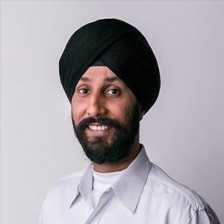
Gurpreet Singh
A*STAR Skin Research LabsSingapore
Olivo, Gurpreet, Bi and Tee received the President’s Technology Award 2024 for the development of Respiree–an optical wearable that measures respiratory and lung physiological parameters. The technology can be used to improve clinical decision-making from post-operative care and general wards to home settings. (Photo:SGInnovate)
Olivo, Gurpreet, Bi and Tee received the President’s Technology Award 2024 for the development of Respiree–an optical wearable that measures respiratory and lung physiological parameters. The technology can be used to improve clinical decision-making from post-operative care and general wards to home settings. (Photo:SGInnovate)
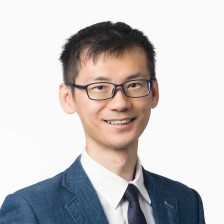
Renzhe Bi
A*STAR Skin Research LabsSingapore
Olivo, Gurpreet, Bi and Tee received the President’s Technology Award 2024 for the development of Respiree–an optical wearable that measures respiratory and lung physiological parameters. The technology can be used to improve clinical decision-making from post-operative care and general wards to home settings. (Photo:Agency for Science Technology and Research)
Olivo, Gurpreet, Bi and Tee received the President’s Technology Award 2024 for the development of Respiree–an optical wearable that measures respiratory and lung physiological parameters. The technology can be used to improve clinical decision-making from post-operative care and general wards to home settings. (Photo:Agency for Science Technology and Research)
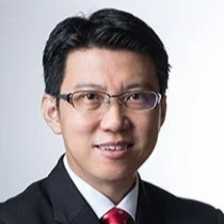
Augustine Tee
Changi General HospitalSingapore
Olivo, Gurpreet, Bi and Tee received the President’s Technology Award 2024 for the development of Respiree–an optical wearable that measures respiratory and lung physiological parameters. The technology can be used to improve clinical decision-making from post-operative care and general wards to home settings. (Photo:Changi General Hospital)
Olivo, Gurpreet, Bi and Tee received the President’s Technology Award 2024 for the development of Respiree–an optical wearable that measures respiratory and lung physiological parameters. The technology can be used to improve clinical decision-making from post-operative care and general wards to home settings. (Photo:Changi General Hospital)
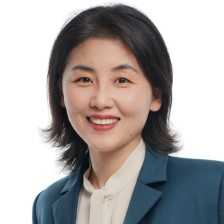
Nieng Yan
Tsinghua UniversityChina
Yan won the 2024 L’Oréal–UNESCO for Women in Science International Awards for Asia and the Pacific. She is recognized for discovering the atomic structure of multiple membrane proteins that mediate the traffic of ions and sugars across the cell membrane, revealing principles that govern cross-membrane transport. (Photo:Kyoto University)
Yan won the 2024 L’Oréal–UNESCO for Women in Science International Awards for Asia and the Pacific. She is recognized for discovering the atomic structure of multiple membrane proteins that mediate the traffic of ions and sugars across the cell membrane, revealing principles that govern cross-membrane transport. (Photo:Kyoto University)
Rohit Srivastava
Indian Institute of Technology BombayIndia
Srivastava received the 2024 Vigyan Shri Award for his groundbreaking work in biomedical engineering, particularly in the development of affordable medical diagnostic devices and nanotechnology-based healthcare solutions. (Photo:Indian Institute of Technology Bombay)
Srivastava received the 2024 Vigyan Shri Award for his groundbreaking work in biomedical engineering, particularly in the development of affordable medical diagnostic devices and nanotechnology-based healthcare solutions. (Photo:Indian Institute of Technology Bombay)
Tak Kyu Oh
Seoul National University Bundang HospitalSouth Korea
Oh was a recipient of the 2024 ASAN Award for Young Medical Scientists for his research on opioid misuse and the need for prescription guidelines for opioids. (Photo:ASAN Foundation)
Oh was a recipient of the 2024 ASAN Award for Young Medical Scientists for his research on opioid misuse and the need for prescription guidelines for opioids. (Photo:ASAN Foundation)
Weang Kee Ho
University of Nottingham MalaysiaMalaysia
Ho was awarded the Wellcome Trust Career Development Award for refining breast cancer risk assessment in the Asian population, developing innovative methods to harness insights from existing datasets in underrepresented populations. (Photo:Vulcan Post)
Ho was awarded the Wellcome Trust Career Development Award for refining breast cancer risk assessment in the Asian population, developing innovative methods to harness insights from existing datasets in underrepresented populations. (Photo:Vulcan Post)
Won Young Kim
University of Ulsan College of MedicineSouth Korea
Kim received the 2024 ASAN Award in clinical medicine for his contributions to enhancing survival in emergency critical care for cardiac arrest, sepsis, ischemic brain injury and acute respiratory failure. (Photo:ASAN Foundation)
Kim received the 2024 ASAN Award in clinical medicine for his contributions to enhancing survival in emergency critical care for cardiac arrest, sepsis, ischemic brain injury and acute respiratory failure. (Photo:ASAN Foundation)
Hairong Lyu
Chinese University of Hong KongHong Kong
Lyu won the 2024 Croucher Tak Wah Mak Innovation Award for her work in addressing global demand for fine chemicals, which are crucial in drug discovery. (Photo:The Chinese University of Hong Kong)
Lyu won the 2024 Croucher Tak Wah Mak Innovation Award for her work in addressing global demand for fine chemicals, which are crucial in drug discovery. (Photo:The Chinese University of Hong Kong)
Jer-Lai Kuo
Institute of Atomic and Molecular Sciences, Academia SinicaTaiwan
Kuo received the NSTC 2024 Outstanding Research Award for the development of theoretical frameworks and computational algorithms to explore and understand the potential energy surface for molecular systems. (Photo:National Taiwan University)
Kuo received the NSTC 2024 Outstanding Research Award for the development of theoretical frameworks and computational algorithms to explore and understand the potential energy surface for molecular systems. (Photo:National Taiwan University)
Junichiro Yamaguchi
Waseda UniversityJapan
Yamaguchi was named one of the winners of the Mukaiyama Award 2024. His research focuses on a new trend in synthetic organic chemistry, including common functional group-cleavage couplings, bond exchange reactions and catalytic dearomatization functionalization using unique molecular catalysts. (Photo:Yamaguchi Group)
Yamaguchi was named one of the winners of the Mukaiyama Award 2024. His research focuses on a new trend in synthetic organic chemistry, including common functional group-cleavage couplings, bond exchange reactions and catalytic dearomatization functionalization using unique molecular catalysts. (Photo:Yamaguchi Group)
Kei Ota
Kindai UniversityJapan
Ota is the Inspiration Prize winner of the Third Marie Sklodowska Curie Award. She pioneered a new field of elemental chemistry by using boron and nitrogen to synthesize novel inorganic aromatic compounds without carbon in their frameworks and developed compounds with unique bonding motifs. (Photo:Japan Science and Technology Agency)
Ota is the Inspiration Prize winner of the Third Marie Sklodowska Curie Award. She pioneered a new field of elemental chemistry by using boron and nitrogen to synthesize novel inorganic aromatic compounds without carbon in their frameworks and developed compounds with unique bonding motifs. (Photo:Japan Science and Technology Agency)
Xiang David Li
The University of Hong KongHong Kong
Li won the 2024 Tetrahedron Young Investigator Award in the field of bioorganic and medicinal chemistry for his research that aims at deciphering the landscape of histone post-translational modifications using chemical approaches. (Photo:Tetrahedon Chem)
Li won the 2024 Tetrahedron Young Investigator Award in the field of bioorganic and medicinal chemistry for his research that aims at deciphering the landscape of histone post-translational modifications using chemical approaches. (Photo:Tetrahedon Chem)
Angelo Earvin Sy Choi
De La Salle UniversityPhilippines
Choi received the 2024 NAST Outstanding Young Scientists Award for his contributions to the field of chemical engineering, particularly adsorption and oxidation. (Photo:De La Salle University)
Choi received the 2024 NAST Outstanding Young Scientists Award for his contributions to the field of chemical engineering, particularly adsorption and oxidation. (Photo:De La Salle University)

Deog-Kyoon Jeong
Seoul National UniversitySouth Korea
Jeong won the IEEE Donald O. Pederson Award in Solid-state Circuits for his leadership in the technology development for digital video interface and high-definition multimedia interface. (Photo:Seoul National University)
Jeong won the IEEE Donald O. Pederson Award in Solid-state Circuits for his leadership in the technology development for digital video interface and high-definition multimedia interface. (Photo:Seoul National University)
Jiyun Lee
Korea Advanced Institute of Science and TechnologySouth Korea
Lee is the 2024 Colonel Thomas L. Thurlow Award winner in recognition of her achievements in the field of satellite navigation. She is the first Korean researcher to win this award. (Photo:Korea Advanced Institute of Science and Technology)
Lee is the 2024 Colonel Thomas L. Thurlow Award winner in recognition of her achievements in the field of satellite navigation. She is the first Korean researcher to win this award. (Photo:Korea Advanced Institute of Science and Technology)
Kim Meow Liew
City University of Hong KongHong Kong
The first Asian recipient of the Carl-Zeiss-Humboldt Research Award, Liew was honored for his research on the fracture behavior of solids, which is critical for constructing technical components and developing new materials. His research team is also studying fireproof construction materials and exploring recycling methods for construction materials like decommissioned wind turbines. (Photo:Academia Europaea)
The first Asian recipient of the Carl-Zeiss-Humboldt Research Award, Liew was honored for his research on the fracture behavior of solids, which is critical for constructing technical components and developing new materials. His research team is also studying fireproof construction materials and exploring recycling methods for construction materials like decommissioned wind turbines. (Photo:Academia Europaea)
Prasanti Widyasih Sarli
Institut Teknologi BandungIndonesia
Sarli received the 2024 L’Oréal-UNESCO For Women in Science Award for her artificial intelligence-driven research on assessing earthquake vulnerability in urban buildings. Her work aids the government in designing disaster-resistant buildings, reducing the risks and casualties associated with seismic events. (Photo:Prasanti Widyasih Sarli LinkedIn)
Sarli received the 2024 L’Oréal-UNESCO For Women in Science Award for her artificial intelligence-driven research on assessing earthquake vulnerability in urban buildings. Her work aids the government in designing disaster-resistant buildings, reducing the risks and casualties associated with seismic events. (Photo:Prasanti Widyasih Sarli LinkedIn)
Samia Subrina
Bangladesh University of Engineering and TechnologyBangladesh
Subrina is the winner of the 2024 TWAS-Fayzah M. Al Kharafi Award. Her work in nanomaterials and nanoelectronic device modelling aligns with the sustainable development goals for affordable and clean energy as well as climate action. (Photo:Bangladesh Academy of Sciences)
Subrina is the winner of the 2024 TWAS-Fayzah M. Al Kharafi Award. Her work in nanomaterials and nanoelectronic device modelling aligns with the sustainable development goals for affordable and clean energy as well as climate action. (Photo:Bangladesh Academy of Sciences)
Tsai Ming-Kai
MediaTek IncTaiwan
Tsai was awarded the 2024 IEEE Robert N. Noyce Medal for his leadership in the global semiconductor industry. He played a pivotal role in developing the mobile phone System-on-Chip market and introduced the “Turnkey Solutions” business model, making mobile communication technologies affordable to nearly everyone. (Photo:IEEE Awards)
Tsai was awarded the 2024 IEEE Robert N. Noyce Medal for his leadership in the global semiconductor industry. He played a pivotal role in developing the mobile phone System-on-Chip market and introduced the “Turnkey Solutions” business model, making mobile communication technologies affordable to nearly everyone. (Photo:IEEE Awards)
Tsutomu Miyasaka
Toin University of YokohamaJapan
Miyasaka won the 2024 Japan Academy Prize for his outstanding contribution to the field of solar energy by discovering organo-lead halide compounds as absorbers for perovskite solar cells, which exhibit energy conversion efficiencies comparable to those of the most efficient crystalline silicon solar cells. His research focuses on the development of new perovskite materials to enhance efficiency and device stability.His work in perovskite solar cells has spurred global research efforts, leading to rapid improvements in efficiency of the solar cells. Miyasaka has shown that a key factor in enhancing the efficiency of solar cells is the solution- based crystallization process, which improves the quality of perovskite polycrystalline films. Miyasaka’s work is expected to significantly contribute to the realization of a carbon-neutral society. (Photo:Toin University of Yokohama)
Miyasaka won the 2024 Japan Academy Prize for his outstanding contribution to the field of solar energy by discovering organo-lead halide compounds as absorbers for perovskite solar cells, which exhibit energy conversion efficiencies comparable to those of the most efficient crystalline silicon solar cells. His research focuses on the development of new perovskite materials to enhance efficiency and device stability.His work in perovskite solar cells has spurred global research efforts, leading to rapid improvements in efficiency of the solar cells. Miyasaka has shown that a key factor in enhancing the efficiency of solar cells is the solution- based crystallization process, which improves the quality of perovskite polycrystalline films. Miyasaka’s work is expected to significantly contribute to the realization of a carbon-neutral society. (Photo:Toin University of Yokohama)
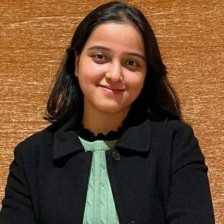
Brinda Kashyap
Wildlife ResearcherIndia
Kashyap won UNESCO’s Man and the Biosphere Young Scientist Award for her innovative work, leveraging geospatial data and complex modeling to support the conservation of rhinoceros’ habitats in Manas National Park, India. (Photo:The Shillong Times)
Kashyap won UNESCO’s Man and the Biosphere Young Scientist Award for her innovative work, leveraging geospatial data and complex modeling to support the conservation of rhinoceros’ habitats in Manas National Park, India. (Photo:The Shillong Times)
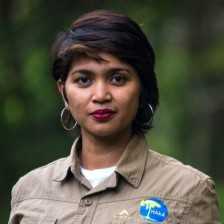
Farwiza Farhan
Yayasan Hutan Alam dan Lingkungan Aceh (HAkA)Indonesia
Farhan was conferred the 2024 Ramon Magsaysay Award for leading HAkA’s efforts to protect Sumatra's Leuser Ecosystem and empower local communities and women to safeguard their future. Despite being named a UNESCO World Heritage Site in 2004, the Leuser Ecosystem has continued to be ravaged by deforestation, infrastructure, commercialization and weak law enforcement.Instead of depending solely on the government, HAkA believed in the power of local people, especially women, to safeguard the ecosystem through a vigorous advocacy campaign, forest monitoring and community empowerment. HAka has even helped to achieve a court verdict that led to USD 26 million in fines against a palm oil company that burned forests in the Leuser Ecosystem, and stopped a hydroelectric dam that would have threatened the elephant’s habitat. The money was used by the local government to rehabilitate the damaged areas. In HAkA’s programs, women are given paralegal and citizen-journalism training. Women also lead ranger groups that patrol forest areas to monitor poaching and illegal logging. (Photo:One Earth)
Farhan was conferred the 2024 Ramon Magsaysay Award for leading HAkA’s efforts to protect Sumatra's Leuser Ecosystem and empower local communities and women to safeguard their future. Despite being named a UNESCO World Heritage Site in 2004, the Leuser Ecosystem has continued to be ravaged by deforestation, infrastructure, commercialization and weak law enforcement.Instead of depending solely on the government, HAkA believed in the power of local people, especially women, to safeguard the ecosystem through a vigorous advocacy campaign, forest monitoring and community empowerment. HAka has even helped to achieve a court verdict that led to USD 26 million in fines against a palm oil company that burned forests in the Leuser Ecosystem, and stopped a hydroelectric dam that would have threatened the elephant’s habitat. The money was used by the local government to rehabilitate the damaged areas. In HAkA’s programs, women are given paralegal and citizen-journalism training. Women also lead ranger groups that patrol forest areas to monitor poaching and illegal logging. (Photo:One Earth)
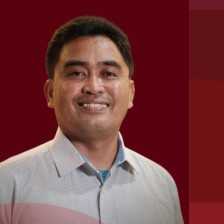
Hernando P. Bacosa
Mindanao State University-Iligan Institute of TechnologyPhilippines
Bacaso was a recipient of the 2024 NAST Environmental Science Award for his outstanding research on suspended microplastics in the atmosphere in Metro Manila. (Photo:Mindanao State University - Iligan Institute of Technology)
Bacaso was a recipient of the 2024 NAST Environmental Science Award for his outstanding research on suspended microplastics in the atmosphere in Metro Manila. (Photo:Mindanao State University - Iligan Institute of Technology)
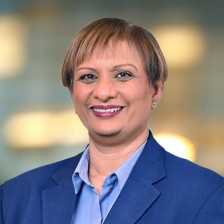
Joy Jacqueline Pereira
Malaysian Network for Research on Climate, Environment and DevelopmentMalaysia
Pereira received the Merdeka Award for Outstanding Contribution to Environment and Planetary Health 2024 for her work and extensive research on climate change, and for spearheading international collaborations to safeguard environments and communities. (Photo:Merdeka Award)
Pereira received the Merdeka Award for Outstanding Contribution to Environment and Planetary Health 2024 for her work and extensive research on climate change, and for spearheading international collaborations to safeguard environments and communities. (Photo:Merdeka Award)
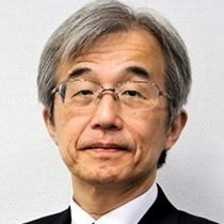
Kazushige Obara
University of TokyoJapan
Obara was awarded the Imperial Prize and Japan Academy Prize in 2024 for his discovery of a new phenomenon known as slow earthquakes. His work reshaped the understanding of seismic activity and led to the emergence of a new research field known as the "science of slow earthquakes." (Photo:Nippon.com)
Obara was awarded the Imperial Prize and Japan Academy Prize in 2024 for his discovery of a new phenomenon known as slow earthquakes. His work reshaped the understanding of seismic activity and led to the emergence of a new research field known as the "science of slow earthquakes." (Photo:Nippon.com)
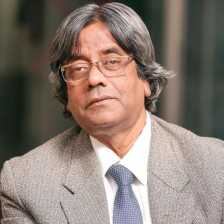
Mubarak Ahmad Khan
Bangladesh Academy of SciencesBangladesh
Khan received the 2024 Independence Award for his contribution to the field of science and technology. Khan is known for his research on jute and for developing products such as helmets, bags and tiles made from jute. (Photo:Mubarak Ahmad Khan Facebook)
Khan received the 2024 Independence Award for his contribution to the field of science and technology. Khan is known for his research on jute and for developing products such as helmets, bags and tiles made from jute. (Photo:Mubarak Ahmad Khan Facebook)
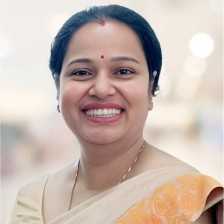
Purabi Saikia
Banaras Hindu UniversityIndia
Saikia won the 2024 Vigyan Yuva-Shanti Swarup Bhatnagar Award for her remarkable contributions in the field of environmental science. Her research focuses on plant ecology, biodiversity conservation and soil ecology. (Photo:Purabi Saikia LiveDNA)
Saikia won the 2024 Vigyan Yuva-Shanti Swarup Bhatnagar Award for her remarkable contributions in the field of environmental science. Her research focuses on plant ecology, biodiversity conservation and soil ecology. (Photo:Purabi Saikia LiveDNA)
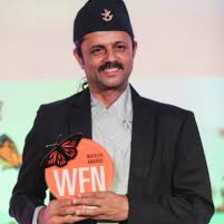
Raju Acharya
Friends of NatureNepal
Acharya was a recipient of the 2024 Whitley Award for his work on safeguarding the habitat of owls and protecting them from hunting and illegal trade. (Photo:Raju Acharya Facebook)
Acharya was a recipient of the 2024 Whitley Award for his work on safeguarding the habitat of owls and protecting them from hunting and illegal trade. (Photo:Raju Acharya Facebook)
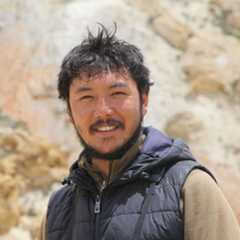
Rinzin Phunjok Lama
Independent Conservation BiologistNepal
Lama received the 2024 Future for Nature Award for his conservation efforts involving local communities to protect the endangered snow leopards in the remote mountains of Nepal. (Photo:Ukali)
Lama received the 2024 Future for Nature Award for his conservation efforts involving local communities to protect the endangered snow leopards in the remote mountains of Nepal. (Photo:Ukali)
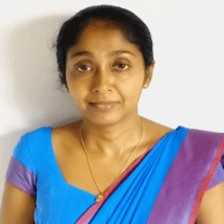
Shirani Manel Kumari Widana Gamage
University of RuhunaSri Lanka
Shirani won the 2024 OWSD-Elsevier Foundation Award for Early-Career Women Scientists in the Developing World for her innovative research in identifying and detecting harmful cyanobacterial blooms and developing biological control methods that degrade the bacteria’s toxins. (Photo:OWSD-Elsevier Foundation)
Shirani won the 2024 OWSD-Elsevier Foundation Award for Early-Career Women Scientists in the Developing World for her innovative research in identifying and detecting harmful cyanobacterial blooms and developing biological control methods that degrade the bacteria’s toxins. (Photo:OWSD-Elsevier Foundation)
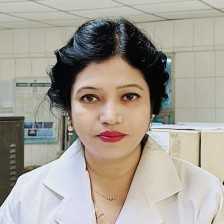
Tasrina Rabia Choudhury
Bangladesh Atomic Energy CommissionBangladesh
Choudhury was a recipient of the 2024 OWSD-Elsevier Foundation Award for Early-Career Women Scientists in the Developing World for her groundbreaking investigations into heavy metal contamination in river water systems along the coastal regions of Bangladesh, providing insights into the sources and impacts of pollutants and catalyzing the formulation of effective mitigation strategies. (Photo:OWSD-Elsevier Foundation)
Choudhury was a recipient of the 2024 OWSD-Elsevier Foundation Award for Early-Career Women Scientists in the Developing World for her groundbreaking investigations into heavy metal contamination in river water systems along the coastal regions of Bangladesh, providing insights into the sources and impacts of pollutants and catalyzing the formulation of effective mitigation strategies. (Photo:OWSD-Elsevier Foundation)
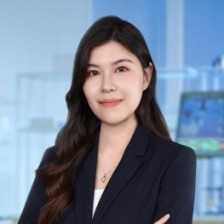
Xin Ying Kong
Nanyang Technological UniversitySingapore
Kong was named one of MIT Technology Review’s Innovators Under 35 Asia Pacific Award 2024 for her research in converting plastic waste into fuels and versatile chemicals using catalysts at ambient conditions. She is also a recipient of the 2023 Merdeka Award Grant for her pioneering research in photocatalytic upcycling of plastics. (Photo:Xin Ying Kong LinkedIn)
Kong was named one of MIT Technology Review’s Innovators Under 35 Asia Pacific Award 2024 for her research in converting plastic waste into fuels and versatile chemicals using catalysts at ambient conditions. She is also a recipient of the 2023 Merdeka Award Grant for her pioneering research in photocatalytic upcycling of plastics. (Photo:Xin Ying Kong LinkedIn)

Bolor-Ujin Badraa
Khan Bank MongoliaMongolia
As one of the Top 50 Asia Women Tech Leaders 2024, Badraa is a pioneering figure in Mongolia's information security sector and has plans to lead initiatives in data intelligence, artificial intelligence and machine learning, robotic process automation and sustainability. As a champion for women in technology in Mongolia, she is dedicated to empowering young girls with the confidence and skills needed to pursue careers in technology. (Photo:Bolor-Ujin Badraa LinkedIn)
As one of the Top 50 Asia Women Tech Leaders 2024, Badraa is a pioneering figure in Mongolia's information security sector and has plans to lead initiatives in data intelligence, artificial intelligence and machine learning, robotic process automation and sustainability. As a champion for women in technology in Mongolia, she is dedicated to empowering young girls with the confidence and skills needed to pursue careers in technology. (Photo:Bolor-Ujin Badraa LinkedIn)
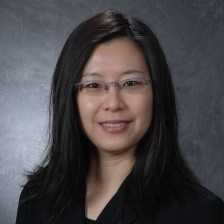
Fiona Fui-Hoon Nah
City University of Hong KongHong Kong
Nah was named one of the Top 50 Asia Women Tech Leaders 2024 for her research in human-AI collaboration, neuro-information-system and the metaverse. (Photo:City University of Hong Kong)
Nah was named one of the Top 50 Asia Women Tech Leaders 2024 for her research in human-AI collaboration, neuro-information-system and the metaverse. (Photo:City University of Hong Kong)
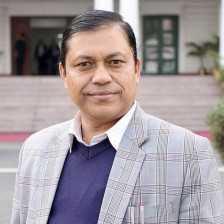
Shailendra Giri
Rapti Engineering CollegeNepal
Giri received the ICT Excellence Award 2024 for his contributions to the development and expansion of communications and information technology in Nepal. (Photo:Rapti Engineering College)
Giri received the ICT Excellence Award 2024 for his contributions to the development and expansion of communications and information technology in Nepal. (Photo:Rapti Engineering College)
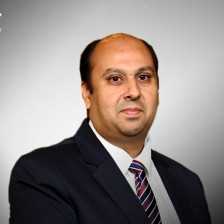
Usman Qamar
National University of Sciences and TechnologyPakistan
Qamar was awarded Tamgha-e-Imtiaz, one of Pakistan's highest civilian awards, for exceptional achievement in the field of data science and artificial intelligence. (Photo:National University of Sciences and Technology)
Qamar was awarded Tamgha-e-Imtiaz, one of Pakistan's highest civilian awards, for exceptional achievement in the field of data science and artificial intelligence. (Photo:National University of Sciences and Technology)
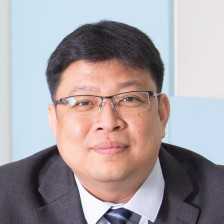
Chee-Onn Leong
AGTC GenomicsMalaysia
Leong, Founder and CEO of AGTC Genomics, led the company to win the Malaysia Technology Excellence Award 2023 for its groundbreaking contributions to precision diagnostics, particularly through the development of liquid biopsy technology. (Photo:Malaysian Dieticians' Association)
Leong, Founder and CEO of AGTC Genomics, led the company to win the Malaysia Technology Excellence Award 2023 for its groundbreaking contributions to precision diagnostics, particularly through the development of liquid biopsy technology. (Photo:Malaysian Dieticians' Association)
Emi Ito
Osaka UniversityJapan
Ito was awarded the 2023 JSPS Ikushi Prize by the Japan Society for the Promotion of Science for her research on unraveling the role of host-derived metabolites in the development of innate-type T cells. (Photo:Osaka University)
Ito was awarded the 2023 JSPS Ikushi Prize by the Japan Society for the Promotion of Science for her research on unraveling the role of host-derived metabolites in the development of innate-type T cells. (Photo:Osaka University)

Lilian P. Villamor
Philippine Carabao CenterPhilippines
Villamor received the Prof. Yoo Hang Kim Young Women Scientists Award 2024 for her research exploring the genetic divergence and phylogenetic relationship of Philippine Carabao (Bubalus bubalis) and other swamp buffalo populations in neighboring countries using the mitochondrial DNA D-loop region. (Photo:Philippine Carabao Center)
Villamor received the Prof. Yoo Hang Kim Young Women Scientists Award 2024 for her research exploring the genetic divergence and phylogenetic relationship of Philippine Carabao (Bubalus bubalis) and other swamp buffalo populations in neighboring countries using the mitochondrial DNA D-loop region. (Photo:Philippine Carabao Center)
Purnima Devi Barman
Avifauna Research and Conservation DivisionIndia
Barman won the Whitley Gold Award 2024 for her work to protect the Greater Adjutant stork and its wetland habitat. There were just about 450 storks or “hargila” as the birds are locally known in Assam, India, before Barman started working to save them.Their natural habitats were destroyed by the building of roads and mobile phone towers. Barman and her team worked with local communities, especially women, to create the “Hargila Army” to safeguard storks’ nests. The army rehabilitates injured storks which have fallen from their nests and arranges “baby showers” to celebrate the arrival of newborn chicks. The effort led to an increase in the number of storks, which have now quadrupled to more than 1,800. Barman aims to double the global population of the bird to 5,000 by 2030, working across the stork’s range in India and Cambodia. (Photo:Rewilding Academy)
Barman won the Whitley Gold Award 2024 for her work to protect the Greater Adjutant stork and its wetland habitat. There were just about 450 storks or “hargila” as the birds are locally known in Assam, India, before Barman started working to save them.Their natural habitats were destroyed by the building of roads and mobile phone towers. Barman and her team worked with local communities, especially women, to create the “Hargila Army” to safeguard storks’ nests. The army rehabilitates injured storks which have fallen from their nests and arranges “baby showers” to celebrate the arrival of newborn chicks. The effort led to an increase in the number of storks, which have now quadrupled to more than 1,800. Barman aims to double the global population of the bird to 5,000 by 2030, working across the stork’s range in India and Cambodia. (Photo:Rewilding Academy)
Siddhesh Kamat
Indian Institute of Science Education and ResearchIndia
Kamat was awarded the Infosys Prize 2024 in the life sciences category for his discoveries concerning bioactive lipids and their receptors, and their metabolic and signaling pathways. His research using advanced methods to understand the function of lipids has important implications for understanding the role of these molecules in a range of cellular functions and human diseases. (Photo:Infosys Science Foundation)
Kamat was awarded the Infosys Prize 2024 in the life sciences category for his discoveries concerning bioactive lipids and their receptors, and their metabolic and signaling pathways. His research using advanced methods to understand the function of lipids has important implications for understanding the role of these molecules in a range of cellular functions and human diseases. (Photo:Infosys Science Foundation)
Tomoko Sakai
Kyoto UniversityJapan
Sakai received the 2023 JSPS Prize awarded by the Japan Society for the Promotion of Science for her anthropological study of conflict and disaster experiences and memories, with a focus on their physical and everyday dimensions. (Photo:Kyoto University)
Sakai received the 2023 JSPS Prize awarded by the Japan Society for the Promotion of Science for her anthropological study of conflict and disaster experiences and memories, with a focus on their physical and everyday dimensions. (Photo:Kyoto University)
Wanilada Rungrassamee
National Center for Genetic Engineering and BiotechnologyThailand
Rungrassamee and her team won the 2024 NRCT Excellent Research Award in agriculture and biology for their studies on “Interactions between gut microbiota and their host immune system in shrimp.” (Photo:International Joint Research Center on Food Security)
Rungrassamee and her team won the 2024 NRCT Excellent Research Award in agriculture and biology for their studies on “Interactions between gut microbiota and their host immune system in shrimp.” (Photo:International Joint Research Center on Food Security)
Abu Bakar Suleiman
IMU UniversityMalaysia
Abu Bakar was honored with the Merdeka Award 2024 in the health, science and technology category for his exceptional contributions to advancing Malaysia’s healthcare policies and services. (Photo:IMU University)
Abu Bakar was honored with the Merdeka Award 2024 in the health, science and technology category for his exceptional contributions to advancing Malaysia’s healthcare policies and services. (Photo:IMU University)
Myung-Ju Ahn
Sungkyunkwan University School of MedicineSouth Korea
Ahn was conferred the 2024 ESMO Women for Oncology Award for her research in developing predictive and prognostic markers for personalized lung cancer therapy and her efforts to mentor and support the next generation of doctors and researchers. (Photo:Sungkyunkwan University School of Medicine)
Ahn was conferred the 2024 ESMO Women for Oncology Award for her research in developing predictive and prognostic markers for personalized lung cancer therapy and her efforts to mentor and support the next generation of doctors and researchers. (Photo:Sungkyunkwan University School of Medicine)
Nguyen Thi Ngoc Phuong
Tu Du Obstetrics and Gynecology HospitalVietnam
Phuong won the 2024 Ramon Magsaysay Award for championing the fight against the devastating effects of Agent Orange used in the Vietnam War, seeking justice for victims while pioneering reproductive health solutions and offering hope to affected families. Phuong, who became a doctor during the war, was deeply affected by witnessing severe birth defects in newborns. This led her to dedicate her life to uncovering the truth about Agent Orange, aiding the afflicted through her research and working with the Vietnam Association of Victims of Agent Orange/Dioxin.For Phoung, the battle has not only been in the laboratory but also on the international stage. She has taken up the cause of Agent Orange victims with the American Public Health Association, among other forums, and supported legal action to seek compensation from chemical companies. (Photo:Raymond Magsaysay Award Foundation)
Phuong won the 2024 Ramon Magsaysay Award for championing the fight against the devastating effects of Agent Orange used in the Vietnam War, seeking justice for victims while pioneering reproductive health solutions and offering hope to affected families. Phuong, who became a doctor during the war, was deeply affected by witnessing severe birth defects in newborns. This led her to dedicate her life to uncovering the truth about Agent Orange, aiding the afflicted through her research and working with the Vietnam Association of Victims of Agent Orange/Dioxin.For Phoung, the battle has not only been in the laboratory but also on the international stage. She has taken up the cause of Agent Orange victims with the American Public Health Association, among other forums, and supported legal action to seek compensation from chemical companies. (Photo:Raymond Magsaysay Award Foundation)
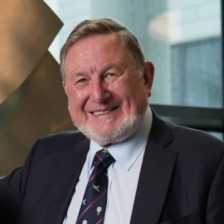
Richard Parker
Singapore Aerospace Programme, A*STARSingapore
Parker was awarded the President’s Science and Technology Medal 2024 for his contributions to the establishment of corporate research and development capabilities in Singapore. He has been instrumental in developing effective collaborations between research practitioners and industry. (Photo:Agency for Science, Technology and Research)
Parker was awarded the President’s Science and Technology Medal 2024 for his contributions to the establishment of corporate research and development capabilities in Singapore. He has been instrumental in developing effective collaborations between research practitioners and industry. (Photo:Agency for Science, Technology and Research)
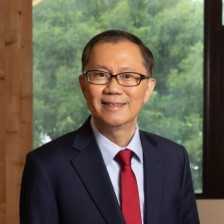
Teck Hua Ho
Nanyang Technological UniversitySingapore
Ho was a recipient of the President’s Science and Technology Medal 2024 for his significant contributions in nurturing top talent, fostering collaboration and building Singapore’s research and development ecosystems. (Photo:Nanyang Technological University)
Ho was a recipient of the President’s Science and Technology Medal 2024 for his significant contributions in nurturing top talent, fostering collaboration and building Singapore’s research and development ecosystems. (Photo:Nanyang Technological University)
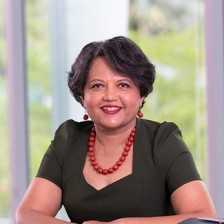
Vishna Devi Nadarajah
Newcastle University Medicine MalaysiaMalaysia
Vishna received the 2024 Ian Hart Ottawa award for Innovation in Medical Education, an accolade which celebrates individuals who have made remarkable contributions to medical education through exceptional creativity, diligence, adaptability, leadership and effective communication. (Photo:Newcastle University)
Vishna received the 2024 Ian Hart Ottawa award for Innovation in Medical Education, an accolade which celebrates individuals who have made remarkable contributions to medical education through exceptional creativity, diligence, adaptability, leadership and effective communication. (Photo:Newcastle University)
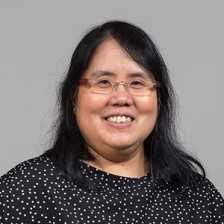
Wynne Hsu
National University of SingaporeSingapore
Hsu was named one of the Top 50 Asia Women Tech Leaders 2024. Her work is focused on developing new machine learning techniques for real-world applications. She facilitates collaboration between healthcare institutions, clinicians and data scientists for innovative healthcare solutions. (Photo:National University of Singapore)
Hsu was named one of the Top 50 Asia Women Tech Leaders 2024. Her work is focused on developing new machine learning techniques for real-world applications. She facilitates collaboration between healthcare institutions, clinicians and data scientists for innovative healthcare solutions. (Photo:National University of Singapore)
Ai Serizawa
Shibaura Institute of TechnologyJapan
Serizawa received the 2023 JSPS Prize awarded by the Japan Society for the Promotion of Science for her work on super eco-friendly steam-derived multifunctionalization of aluminum alloys. (Photo:Ochanomizu University)
Serizawa received the 2023 JSPS Prize awarded by the Japan Society for the Promotion of Science for her work on super eco-friendly steam-derived multifunctionalization of aluminum alloys. (Photo:Ochanomizu University)
Bin Liu
National University of SingaporeSingapore
Liu was awarded the 2024 President’s Science Award for her discovery of the role of carbazole isomers in room temperature phosphorescence of carbazole and subsequent revelation of the transformative impact of isostructural doping on the optical properties of organic semiconductors, opening new avenues of study and application. She specializes in bringing organic semiconductors into aqueous media, with a focus on the exploration of their unique applications in biomedical research, security and electronic devices.In recent years, she has worked on biocompatible luminogens that serve as highly sensitive light-up molecular probes and nanoparticle probes, opening up new horizons for non-invasive tracking of analytes and biological processes in real time. Liu is also passionate about nurturing the next generation research leaders and encouraging more women to pursue careers in engineering and science. (Photo:National University of Singapore)
Liu was awarded the 2024 President’s Science Award for her discovery of the role of carbazole isomers in room temperature phosphorescence of carbazole and subsequent revelation of the transformative impact of isostructural doping on the optical properties of organic semiconductors, opening new avenues of study and application. She specializes in bringing organic semiconductors into aqueous media, with a focus on the exploration of their unique applications in biomedical research, security and electronic devices.In recent years, she has worked on biocompatible luminogens that serve as highly sensitive light-up molecular probes and nanoparticle probes, opening up new horizons for non-invasive tracking of analytes and biological processes in real time. Liu is also passionate about nurturing the next generation research leaders and encouraging more women to pursue careers in engineering and science. (Photo:National University of Singapore)
Tie Jun Cui
Southeast UniversityChina
Cui won the 2024 Tan Kah Kee Science Award in information sciences. Cui is known for proposing the concept of information metamaterial in 2017, which can merge the electromagnetic world and the digital world, resulting in the birth of a new metamaterial system. (Photo:Southeast University)
Cui won the 2024 Tan Kah Kee Science Award in information sciences. Cui is known for proposing the concept of information metamaterial in 2017, which can merge the electromagnetic world and the digital world, resulting in the birth of a new metamaterial system. (Photo:Southeast University)
Zhisheng Zhao
Yanshan UniversityChina
Zhao received the 2024 Tan Kah Kee Young Scientist Award in technological sciences for his research on superhard materials and structural ceramics. His current research focuses on carbon materials, which has been a cutting-edge scientific issue in materials research. (Photo:Tan Kah Kee Science Award Foundation)
Zhao received the 2024 Tan Kah Kee Young Scientist Award in technological sciences for his research on superhard materials and structural ceramics. His current research focuses on carbon materials, which has been a cutting-edge scientific issue in materials research. (Photo:Tan Kah Kee Science Award Foundation)
Binyong Sun
Zhejiang UniversityChina
Sun won the 2024 Future Science Prize in the mathematics and computer science category for his significant contributions to the representation theory of Lie groups, focusing particularly on the multiplicity one theorems for classical groups, the theory of theta correspondence and the non-vanishing hypothesis in Rankin-Selberg convolutions. (Photo:Future Science Prize)
Sun won the 2024 Future Science Prize in the mathematics and computer science category for his significant contributions to the representation theory of Lie groups, focusing particularly on the multiplicity one theorems for classical groups, the theory of theta correspondence and the non-vanishing hypothesis in Rankin-Selberg convolutions. (Photo:Future Science Prize)
Neena Gupta
Indian Statistical InstituteIndia
Gupta was awarded the Infosys Prize 2024 in mathematical sciences for her work on the Zariski Cancellation Problem, a fundamental problem in algebraic geometry, a version of which was first posed in 1949 by Oscar Zariski, one of the founders of modern algebraic geometry. (Photo:Infosys Science Foundation)
Gupta was awarded the Infosys Prize 2024 in mathematical sciences for her work on the Zariski Cancellation Problem, a fundamental problem in algebraic geometry, a version of which was first posed in 1949 by Oscar Zariski, one of the founders of modern algebraic geometry. (Photo:Infosys Science Foundation)
Renier G. Mendoza
University of the Philippines DilimanPhilippines
Mendoza received the 2024 NAST Outstanding Young Scientist Award in mathematics, particularly for developing biological model controls through evolutionary computation, investigating Wolbachia's effects on controlling vector-borne diseases, and optimizing electric vehicle charging station placements using metaheuristic algorithms. (Photo:University of the Philippines Diliman)
Mendoza received the 2024 NAST Outstanding Young Scientist Award in mathematics, particularly for developing biological model controls through evolutionary computation, investigating Wolbachia's effects on controlling vector-borne diseases, and optimizing electric vehicle charging station placements using metaheuristic algorithms. (Photo:University of the Philippines Diliman)
Ruochuan Liu
Peking UniversityChina
Liu won the 2024 Ramanujan Prize for young mathematicians from developing countries for his fundamental contributions to p-adic Hodge theory, especially his foundational study of relative p-adic Hodge theory and his work on rigidity and the Riemann-Hilbert correspondence for p-adic local systems.Liu’s current research interests are arithmetic geometry and algebraic number theory, with a focus on p-adic aspects of number theory and arithmetic geometry. He is considered to be one of the foremost arithmetic geometers working in China. Liu’s work has received a number of recognitions, including the 2020 China Youth Science and Technology Award, the 2019 Tencent Xplorer prize and the 2017 National Science Fund Award for Distinguished Young Scholars. (Photo:Peking University)
Liu won the 2024 Ramanujan Prize for young mathematicians from developing countries for his fundamental contributions to p-adic Hodge theory, especially his foundational study of relative p-adic Hodge theory and his work on rigidity and the Riemann-Hilbert correspondence for p-adic local systems.Liu’s current research interests are arithmetic geometry and algebraic number theory, with a focus on p-adic aspects of number theory and arithmetic geometry. He is considered to be one of the foremost arithmetic geometers working in China. Liu’s work has received a number of recognitions, including the 2020 China Youth Science and Technology Award, the 2019 Tencent Xplorer prize and the 2017 National Science Fund Award for Distinguished Young Scholars. (Photo:Peking University)
Yoshiko Ogata
Kyoto UniversityJapan
Ogata was awarded the 2024 Saruhashi Prize for her pioneering work in the mathematical study of quantum many-body systems. The prize honors both her groundbreaking research and her dedication to mentoring fellow women scientists. (Photo:Oberwolfach Photo Collection)
Ogata was awarded the 2024 Saruhashi Prize for her pioneering work in the mathematical study of quantum many-body systems. The prize honors both her groundbreaking research and her dedication to mentoring fellow women scientists. (Photo:Oberwolfach Photo Collection)
Atsuko Ichikawa
Tohoku UniversityJapan
Ichikawa won the 2023 Nishina Memorial Prize for her role in the Tokai-to-Kamioka (T2K) experiment to study the violation of symmetry between particles and antiparticles, in the neutrino oscillation phenomena. (Photo:Tohoku University)
Ichikawa won the 2023 Nishina Memorial Prize for her role in the Tokai-to-Kamioka (T2K) experiment to study the violation of symmetry between particles and antiparticles, in the neutrino oscillation phenomena. (Photo:Tohoku University)
Avesh Kumar Tyagi
Bhabha Atomic Research CentreIndia
Tyagi was a recipient of the Vigyan Shri Award in the field of atomic energy for his groundbreaking contributions to the advancement of the Indian Atomic Energy Program. (Photo:Homi Bhabha National Institute)
Tyagi was a recipient of the Vigyan Shri Award in the field of atomic energy for his groundbreaking contributions to the advancement of the Indian Atomic Energy Program. (Photo:Homi Bhabha National Institute)
Deleg Sangaa
Mongolian Academy of SciencesMongolia
Sangaa was awarded the title of Honored Scientist of Mongolia in recognition of his significant contribution in solid state physics, condensed matter physics and materials science. (Photo:Joint Institute for Nuclear Research)
Sangaa was awarded the title of Honored Scientist of Mongolia in recognition of his significant contribution in solid state physics, condensed matter physics and materials science. (Photo:Joint Institute for Nuclear Research)
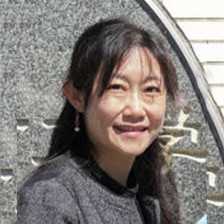
Haruka Tanji
University of Electronic CommunicationsJapan
Tanji received the 2023 JSPS Prize awarded by the Japan Society for the Promotion of Science for her research on the interaction between atoms and photons, achieved by confining laser-cooled neutral gas phase atoms in an optical resonator. (Photo:The University of Electro-Communications)
Tanji received the 2023 JSPS Prize awarded by the Japan Society for the Promotion of Science for her research on the interaction between atoms and photons, achieved by confining laser-cooled neutral gas phase atoms in an optical resonator. (Photo:The University of Electro-Communications)
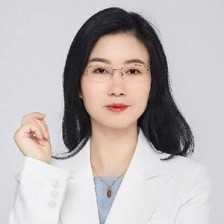
Ping Xu
National University of Defense TechnologyChina
Xu was a recipient of the 2024 Tan Kah Kee Science Award in technological sciences for her research on lithium niobate photonic quantum chips. (Photo:Tan Kah Kee Science Award Foundation)
Xu was a recipient of the 2024 Tan Kah Kee Science Award in technological sciences for her research on lithium niobate photonic quantum chips. (Photo:Tan Kah Kee Science Award Foundation)
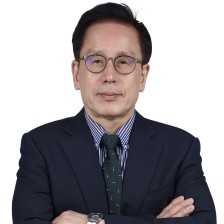
Se-Young Jeong
Pusan National UniversitySouth Korea
Jeong was awarded the 2024 Science Prize from POSCO TJ Park Foundation. He is best known for elucidating the operating principle of metal oxidation at the atomic level for the first time in the world. Jeong has successfully produced copper single crystals into the thinnest atomic monolayer (0.2nm) level of ultra-flat films using self-developed technology. (Photo:POSCO TJ Park Foundation)
Jeong was awarded the 2024 Science Prize from POSCO TJ Park Foundation. He is best known for elucidating the operating principle of metal oxidation at the atomic level for the first time in the world. Jeong has successfully produced copper single crystals into the thinnest atomic monolayer (0.2nm) level of ultra-flat films using self-developed technology. (Photo:POSCO TJ Park Foundation)
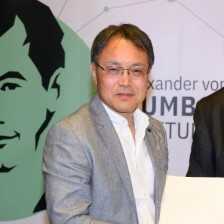
Xin-Nian Wang
Central China Normal UniversityChina
Wang won the 2024 Humboldt Research Award for his research in theoretical high-energy nuclear physics to explore a new state of matter in ultra-relativistic heavy-ion collisions at the Relativistic Heavy-ion Collider at the Brookhaven National Lab, and the Large Hadron Collider at CERN. With his colleagues he has pioneered the study of quark-gluon plasma (QGP) properties using energetic particles referred to as “jets,” which are produced together with QGP in high-energy heavy-ion collisions. QGP is a state of matter that is believed to have existed in the early universe only a few microseconds after the Big Bang and is thought to currently exist at the core of some of our Universe’s compact stellar objects such as neutron stars.His recent work focuses on developing a technique called jet tomography, which uses jets and the supersonic sound waves they generate to shed light on the thermodynamic and transport properties of QGP. (Photo:Central China Normal University)
Wang won the 2024 Humboldt Research Award for his research in theoretical high-energy nuclear physics to explore a new state of matter in ultra-relativistic heavy-ion collisions at the Relativistic Heavy-ion Collider at the Brookhaven National Lab, and the Large Hadron Collider at CERN. With his colleagues he has pioneered the study of quark-gluon plasma (QGP) properties using energetic particles referred to as “jets,” which are produced together with QGP in high-energy heavy-ion collisions. QGP is a state of matter that is believed to have existed in the early universe only a few microseconds after the Big Bang and is thought to currently exist at the core of some of our Universe’s compact stellar objects such as neutron stars.His recent work focuses on developing a technique called jet tomography, which uses jets and the supersonic sound waves they generate to shed light on the thermodynamic and transport properties of QGP. (Photo:Central China Normal University)
Yi Yang
University of Hong KongHong Kong
Yang received the 2024 Croucher Tak Wah Mak Innovation Award for his research aiming to realise strong free-electron-light interaction by interfacing slow nonrelativistic electrons with judiciously designed photonic environments. (Photo:University of Hong Kong)
Yang received the 2024 Croucher Tak Wah Mak Innovation Award for his research aiming to realise strong free-electron-light interaction by interfacing slow nonrelativistic electrons with judiciously designed photonic environments. (Photo:University of Hong Kong)
Alok Shukla
Chhattisgarh Bachao AandolanIndia
Shukla won the prestigious Goldman Prize 2024 for leading a community campaign that saved 445,000 acres of biodiversity-rich forests from 21 planned coal mines in Chhattisgarh, a state in central India.As a convenor with Chhattisgarh Bachao Andolan (the Save Chhattisgarh Movement), an informal alliance of grassroots movements across the state, Shukla closely works with Adivasi or indigenous communities to empower them about their forest rights. Growing up in the mineral-rich state of Chhattisgarh, Shukla witnessed the environmental and social devastation wrought by extractive industries, so he dedicates his life to protecting the water, forests and land of central India, as well as supporting the Adivasi tribes who are the traditional stewards of the land. (Photo:Goldman Prize)
Shukla won the prestigious Goldman Prize 2024 for leading a community campaign that saved 445,000 acres of biodiversity-rich forests from 21 planned coal mines in Chhattisgarh, a state in central India.As a convenor with Chhattisgarh Bachao Andolan (the Save Chhattisgarh Movement), an informal alliance of grassroots movements across the state, Shukla closely works with Adivasi or indigenous communities to empower them about their forest rights. Growing up in the mineral-rich state of Chhattisgarh, Shukla witnessed the environmental and social devastation wrought by extractive industries, so he dedicates his life to protecting the water, forests and land of central India, as well as supporting the Adivasi tribes who are the traditional stewards of the land. (Photo:Goldman Prize)
Amartya Mukhopadhyay
Indian Institute of Technology BombayIndia
Mukhopadhyay was awarded the 2024 Tata Transformation Prize for his work on advancing Na-ion battery technologies. His battery prototype is approximately 30 percent cheaper than Li-ion batteries, operates in a broader temperature range and is safer to store by creating air- and water-stable sodium-transition metal oxide cathodes and alloy-based anodes. (Photo:Indian Institute of Technology (BHU))
Mukhopadhyay was awarded the 2024 Tata Transformation Prize for his work on advancing Na-ion battery technologies. His battery prototype is approximately 30 percent cheaper than Li-ion batteries, operates in a broader temperature range and is safer to store by creating air- and water-stable sodium-transition metal oxide cathodes and alloy-based anodes. (Photo:Indian Institute of Technology (BHU))
Chin Wei Lai
Universiti MalayaMalaysia
Lai was one of the winners of Ten Outstanding Young Malaysians Award by the Junior Chamber International Malaysia for his work on using durable photocatalysis technology with nanomaterials to combat global warming and reduce environmental impacts. (Photo:Shanghai Jiao Tong University)
Lai was one of the winners of Ten Outstanding Young Malaysians Award by the Junior Chamber International Malaysia for his work on using durable photocatalysis technology with nanomaterials to combat global warming and reduce environmental impacts. (Photo:Shanghai Jiao Tong University)
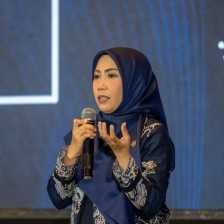
Deliana Dahnum
National Research and Innovation AgencyIndonesia
Dahnum received the 2024 L’Oréal-UNESCO For Women in Science Award for her research on producing bio-jet fuel from coconut using metal-organic framework catalysts. This sustainable innovation supports carbon reduction, strengthens Indonesia’s connectivity and leverages local resources to drive sustainable economic growth. (Photo:L'Oréal-UNESCO For Women in Science)
Dahnum received the 2024 L’Oréal-UNESCO For Women in Science Award for her research on producing bio-jet fuel from coconut using metal-organic framework catalysts. This sustainable innovation supports carbon reduction, strengthens Indonesia’s connectivity and leverages local resources to drive sustainable economic growth. (Photo:L'Oréal-UNESCO For Women in Science)
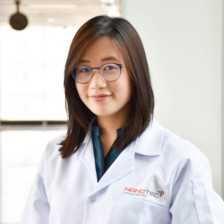
Pongkarn Chakthranont
National Science and Technology Development AgencyThailand
Chakthranont was awarded the L’Oréal Thailand “For Women in Science” fellowship in physical sciences for her research on developing an electrochemical cell that converts carbon dioxide emissions into valuable chemicals, addressing environmental challenges and promoting sustainability. (Photo:Pongkarn Chakthranont LinkedIn)
Chakthranont was awarded the L’Oréal Thailand “For Women in Science” fellowship in physical sciences for her research on developing an electrochemical cell that converts carbon dioxide emissions into valuable chemicals, addressing environmental challenges and promoting sustainability. (Photo:Pongkarn Chakthranont LinkedIn)
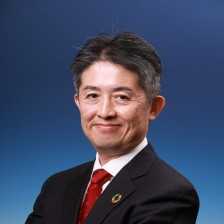
Taikan Oki
The University of TokyoJapan
Oki was awarded the 2024 Stockholm Water Prize Laureate for his outstanding contributions to global water balance studies, global virtual water flows, and the spatial and temporal variability of annually renewable water.As a globally recognized hydrologist, Oki has advanced sustainable water management through practical climate adaptation strategies, integrating human activity into water cycle models, and enhancing the accuracy of global river flow simulations. He developed the Total Runoff Integrating Pathways (TRIP) system, a global river routing model widely used for climate studies and water resources assessments. Oki also pioneered the accurate measurement of virtual water, deepening our understanding of how food imports influence virtual water trade and impact water scarcity.Oki's work envisioned the future development of hydrology by emphasizing linkages between scientific aspects of hydrology and water policy, social issues and interdisciplinary research. (Photo:Future Earth)
Oki was awarded the 2024 Stockholm Water Prize Laureate for his outstanding contributions to global water balance studies, global virtual water flows, and the spatial and temporal variability of annually renewable water.As a globally recognized hydrologist, Oki has advanced sustainable water management through practical climate adaptation strategies, integrating human activity into water cycle models, and enhancing the accuracy of global river flow simulations. He developed the Total Runoff Integrating Pathways (TRIP) system, a global river routing model widely used for climate studies and water resources assessments. Oki also pioneered the accurate measurement of virtual water, deepening our understanding of how food imports influence virtual water trade and impact water scarcity.Oki's work envisioned the future development of hydrology by emphasizing linkages between scientific aspects of hydrology and water policy, social issues and interdisciplinary research. (Photo:Future Earth)
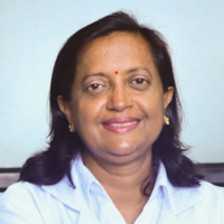
Tista Prasai Joshi
Nepal Academy of Science and TechnologyNepal
Joshi is the winner of the 2024 TWAS-Samira Omar Innovation for Sustainability Award for her pioneering work in improving drinking water quality, particularly in addressing arsenic contamination of groundwater in Nepal. (Photo:The World Academy of Sciences)
Joshi is the winner of the 2024 TWAS-Samira Omar Innovation for Sustainability Award for her pioneering work in improving drinking water quality, particularly in addressing arsenic contamination of groundwater in Nepal. (Photo:The World Academy of Sciences)

Waleeporn Donphai
Kasetsart UniversityThailand
Donphai received the L’Oréal Thailand “For Women in Science” fellowship in physical sciences for pioneering nanotechnology-based solutions to utilize greenhouse gases. Her work reduces pollution and lowers waste disposal costs, helping industries to reduce emissions while supporting a circular economy by repurposing materials like sugarcane bagasse ash. This aligns with Thailand’s net-zero emissions goal and addresses economic, social and environmental challenges. (Photo:Kasetsart University)
Donphai received the L’Oréal Thailand “For Women in Science” fellowship in physical sciences for pioneering nanotechnology-based solutions to utilize greenhouse gases. Her work reduces pollution and lowers waste disposal costs, helping industries to reduce emissions while supporting a circular economy by repurposing materials like sugarcane bagasse ash. This aligns with Thailand’s net-zero emissions goal and addresses economic, social and environmental challenges. (Photo:Kasetsart University)
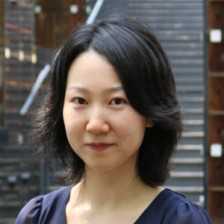
Hiroko Miyahara
Musashino Art UniversityJapan
To better understand fluctuations in the sun’s magnetic field, Miyahara and her team extracted individual rings from long-lived trees and estimated the strength of cosmic radiation and solar activity by measuring the amount of carbon-14 contained within. She discovered long-term changes in the basic cycle of solar activity occurring in tandem with the sun’s internal circulation speed. The growth rings on the trees were also useful to measure temperature at the time of their growth. Such data collected with accurate carbon-14 measurements could help reconstruct the 11-year solar cycle with almost the same accuracy as direct observations of the solar surface. Miyahara was awarded the 43rd Saruhashi Prize for her work.(Photo:Project for Solar-Terrestrial Environment Prediction)
To better understand fluctuations in the sun’s magnetic field, Miyahara and her team extracted individual rings from long-lived trees and estimated the strength of cosmic radiation and solar activity by measuring the amount of carbon-14 contained within. She discovered long-term changes in the basic cycle of solar activity occurring in tandem with the sun’s internal circulation speed. The growth rings on the trees were also useful to measure temperature at the time of their growth. Such data collected with accurate carbon-14 measurements could help reconstruct the 11-year solar cycle with almost the same accuracy as direct observations of the solar surface. Miyahara was awarded the 43rd Saruhashi Prize for her work.(Photo:Project for Solar-Terrestrial Environment Prediction)
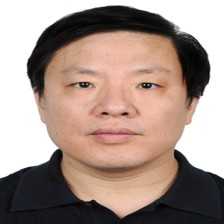
Jinbin Cao
Beihang UniversityChina
Cao was elected to be a member of the Chinese Academy of Science in 2023.(Photo:Beihang University)
Cao was elected to be a member of the Chinese Academy of Science in 2023.(Photo:Beihang University)
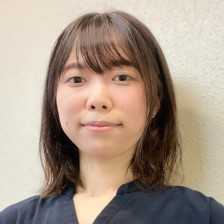
Mayu Tominaga
The University of TokyoJapan
Tominaga was chosen as the winner of the 18th L’Oréal-UNESCO For Women in Science Japan Fellowship Awards for her work developing observational methods to research the beginnings of the universe, the diffusion process of elements and the final stage of the evolution of matter.(Photo:The University of Tokyo)
Tominaga was chosen as the winner of the 18th L’Oréal-UNESCO For Women in Science Japan Fellowship Awards for her work developing observational methods to research the beginnings of the universe, the diffusion process of elements and the final stage of the evolution of matter.(Photo:The University of Tokyo)
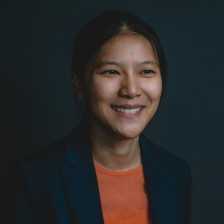
Reinabelle Reyes
University of the Philippines DilimanPhilippines
Reyes won the 2023 NAST (The National Academy of Science and Technology) The Outstanding Young Scientist Award.(Photo:Reina Reyes)
Reyes won the 2023 NAST (The National Academy of Science and Technology) The Outstanding Young Scientist Award.(Photo:Reina Reyes)
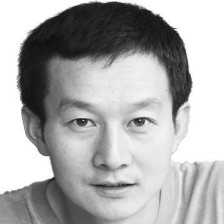
Xu Xing
Institute of Vertebrate Paleontology and PaleoanthropologyChina
Xu received the 2024 2024 TWAS Award in Earth, Astronomy and Space Sciences for his fundamental contribution to the understanding of the evolutionary transition from dinosaurs to birds.(Photo:Shandong Zhucheng Dinosaur National Geopark)
Xu received the 2024 2024 TWAS Award in Earth, Astronomy and Space Sciences for his fundamental contribution to the understanding of the evolutionary transition from dinosaurs to birds.(Photo:Shandong Zhucheng Dinosaur National Geopark)
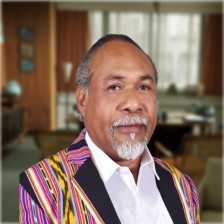
Eugenio Lemos
Permakultura Timor Lorosa’e (Permatil)Timor-Leste
Lemos received the 2023 Ramon Magsaysay Award in recognition of his vision and passion in safeguarding the environment and indigenous culture of Timor-Leste, paving the way for a sustainable and independent food supply. He champions not just “food security” or access to food, but “food sovereignty”. In other words, the country’s capacity to produce its own food, focusing on what is local, natural and nutritious. In 2001, Lemos established Permatil which runs programs for youths, schools and the community. Since 2008, Permatil has trained more than 5,000 youths, and since 2015, implemented a school garden program as part of the national public school curriculum. All 13 administrative districts of Timor-Leste have implemented Permatil’s Water and Natural Resource Management Program, benefiting over 400,000 residents or almost a third of the country’s population.(Photo:Ramon Magsaysay Award Foundation)
Lemos received the 2023 Ramon Magsaysay Award in recognition of his vision and passion in safeguarding the environment and indigenous culture of Timor-Leste, paving the way for a sustainable and independent food supply. He champions not just “food security” or access to food, but “food sovereignty”. In other words, the country’s capacity to produce its own food, focusing on what is local, natural and nutritious. In 2001, Lemos established Permatil which runs programs for youths, schools and the community. Since 2008, Permatil has trained more than 5,000 youths, and since 2015, implemented a school garden program as part of the national public school curriculum. All 13 administrative districts of Timor-Leste have implemented Permatil’s Water and Natural Resource Management Program, benefiting over 400,000 residents or almost a third of the country’s population.(Photo:Ramon Magsaysay Award Foundation)
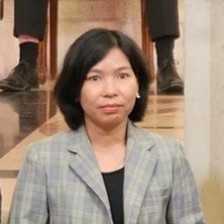
Hoang Thi Giang
Vietnam Institute of Agricultural GeneticsVietnam
Hoa received the French Academy of Sciences for his research on genetic characteristics of high-quality rice varieties that are resilient to climate change.(Photo:Nhan Dan Online)

Hoa received the French Academy of Sciences for his research on genetic characteristics of high-quality rice varieties that are resilient to climate change.(Photo:Nhan Dan Online)
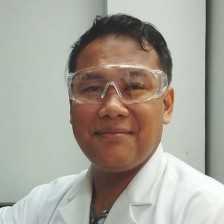
Khalisanni Khalid
Malaysian Agricultural Research and Development InstituteMalaysia
Khalid was awarded the 2023 Japan International Award for Young Agricultural Researchers for his work in developing nanofertilizers using flexible nanoparticle catalysis technology.(Photo:Japan International Award for Young Agricultural Researchers)

Khalid was awarded the 2023 Japan International Award for Young Agricultural Researchers for his work in developing nanofertilizers using flexible nanoparticle catalysis technology.(Photo:Japan International Award for Young Agricultural Researchers)
Renuka Attanayake
University of KelaniyaSri Lanka
Attanayake was one of the recipients of the 2023 OWSD-Elsevier Foundation Award for Early Career Women Scientists in the Developing World. She was recognized for her work on crop disease identification and management. Her projects include the optimization of a rapid detection method of coconut phytoplasma in Sri Lanka.(Photo:University of Kelaniya)

Attanayake was one of the recipients of the 2023 OWSD-Elsevier Foundation Award for Early Career Women Scientists in the Developing World. She was recognized for her work on crop disease identification and management. Her projects include the optimization of a rapid detection method of coconut phytoplasma in Sri Lanka.(Photo:University of Kelaniya)
Saqib Arif
Pakistan Agricultural Research CouncilPakistan
Arif the 2023 International Innovation Award for his research on the potential of composite flour, which combines underused grains, as a response to the worldwide rise in wheat prices and increasing sustainability concerns.(Photo:The AZB)

Arif the 2023 International Innovation Award for his research on the potential of composite flour, which combines underused grains, as a response to the worldwide rise in wheat prices and increasing sustainability concerns.(Photo:The AZB)
Swati Nayak
International Rice Research Institute, South Asia headquartersIndia
Nayak was awarded the Norman E. Borlaug Award for Field Research and Application in 2023. She was recognized for her innovative approach to engaging smallholder farmers in rice seed systems, from testing and deployment to equitable access and adoption of climate-resilient and nutritious rice varieties. Nayak is the current lead for cereal seed systems under the key initiative SeedEqual of CGIAR, a worldwide research partnership focused on agricultural food systems. Nayak has organized more than 10,000 extensive on-farm trials for more than 500 rice varieties, working with thousands of smallholder farmers across diverse ecosystems in different countries across Asia and Africa. Her grassroots experience paved the way for her to be appointed to head the first-ever dedicated Indian government initiative for women farmers. This process has empowered farmers, women and men, to maximize their yields, minimize their environmental footprint, and secure their economic future. She promotes rural innovation models that emphasize sustainable agricultural technologies and enterprise development.(Photo:International Rice Research Institute)

Nayak was awarded the Norman E. Borlaug Award for Field Research and Application in 2023. She was recognized for her innovative approach to engaging smallholder farmers in rice seed systems, from testing and deployment to equitable access and adoption of climate-resilient and nutritious rice varieties. Nayak is the current lead for cereal seed systems under the key initiative SeedEqual of CGIAR, a worldwide research partnership focused on agricultural food systems. Nayak has organized more than 10,000 extensive on-farm trials for more than 500 rice varieties, working with thousands of smallholder farmers across diverse ecosystems in different countries across Asia and Africa. Her grassroots experience paved the way for her to be appointed to head the first-ever dedicated Indian government initiative for women farmers. This process has empowered farmers, women and men, to maximize their yields, minimize their environmental footprint, and secure their economic future. She promotes rural innovation models that emphasize sustainable agricultural technologies and enterprise development.(Photo:International Rice Research Institute)
Anurag Singh Rathore
Indian Institute of Technology in DelhiIndia
Rathore received the 2023 Tata Transformation Prize in Healthcare for his ongoing work aiming to significantly reduce manufacturing costs and increase global accessibility for lifesaving biotherapeutics used to treat complex diseases including cancer and autoimmune diseases.(Photo:Indian Institute of Technology)

Rathore received the 2023 Tata Transformation Prize in Healthcare for his ongoing work aiming to significantly reduce manufacturing costs and increase global accessibility for lifesaving biotherapeutics used to treat complex diseases including cancer and autoimmune diseases.(Photo:Indian Institute of Technology)
Aung Tin
Singapore National Eye CentreSingapore
Aung was listed as one of the 100 most influential ophthalmologists for Asia Pacific in 2023 and is currently leading a multi-disciplinary and multicenter effort awarded by Singapore’s National Medical Research Council to reduce glaucoma blindness with emerging technologies.(Photo:Singapore National Eye Centre)

Aung was listed as one of the 100 most influential ophthalmologists for Asia Pacific in 2023 and is currently leading a multi-disciplinary and multicenter effort awarded by Singapore’s National Medical Research Council to reduce glaucoma blindness with emerging technologies.(Photo:Singapore National Eye Centre)
Jang-Soo Chun
Gwangju Institute of Science and TechnologySouth Korea
Jang-Soo was awarded the 2023 Asan Award in basic medicine for his contributions to molecular mechanisms of osteoarthritis pathogenesis.(Photo:Gwangju Institute of Science and Technology)
Jang-Soo was awarded the 2023 Asan Award in basic medicine for his contributions to molecular mechanisms of osteoarthritis pathogenesis.(Photo:Gwangju Institute of Science and Technology)
Hiroaki Suga
University of TokyoJapan
Suga won the 2023 Wolf Prize in Chemistry for his work developing RNA-based catalysts that revolutionized the discovery of bioactive peptides.(Photo:University of Tokyo)

Suga won the 2023 Wolf Prize in Chemistry for his work developing RNA-based catalysts that revolutionized the discovery of bioactive peptides.(Photo:University of Tokyo)
Yoon-Koo Kang
Asan Medical CenterSouth Korea
Yoon-Koo was awarded the 2023 Asan Award in clinical medicine for leading the anticancer treatment for gastric cancer and gastrointestinal stromal tumor through clinical trials and research.(Photo:AiroMedical)

Yoon-Koo was awarded the 2023 Asan Award in clinical medicine for leading the anticancer treatment for gastric cancer and gastrointestinal stromal tumor through clinical trials and research.(Photo:AiroMedical)
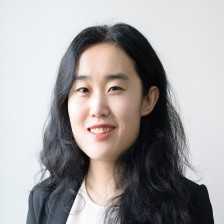
Lan Wang
Hong Kong University of Science and TechnologyHong Kong
Wang is a recipient of the 2023 Croucher Tak Wah Mak Innovation Award for her research investigating mechanisms in the mitochondria that regulate protein translation.(Photo:Hong Kong University of Science and Technology)

Wang is a recipient of the 2023 Croucher Tak Wah Mak Innovation Award for her research investigating mechanisms in the mitochondria that regulate protein translation.(Photo:Hong Kong University of Science and Technology)
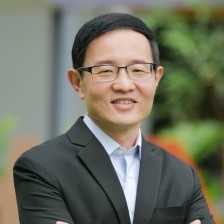
Chwee Teck Lim
National University of SingaporeSingapore
Lim and his team were awarded the IES Prestigious Engineering Achievement Award 2022 by the Institution of Engineers, Singapore, as well as the third prize in the ShanghaiTech Innovation and Entrepreneurship Summit 2023 International Session on Biomed for their ‘HaptGlove’ project. The HaptGlove was developed under Lim’s Haptics Enhanced Medical Training in Extended Reality project and is a lightweight glove that offers users both skin-like and movement sensations when interacting with a virtual object. Existing technologies in the space have not yet been able to offer users a realistic sense of touch. The HaptGlove contains one haptic feedback module on each finger allowing users to sense the shape, size and stiffness of a VR object. Such realistic VR has applications in medicine and education–offering surgeons the opportunity to prepare for an operation in a hyper-realistic simulation.(Photo:National University of Singapore)

Lim and his team were awarded the IES Prestigious Engineering Achievement Award 2022 by the Institution of Engineers, Singapore, as well as the third prize in the ShanghaiTech Innovation and Entrepreneurship Summit 2023 International Session on Biomed for their ‘HaptGlove’ project. The HaptGlove was developed under Lim’s Haptics Enhanced Medical Training in Extended Reality project and is a lightweight glove that offers users both skin-like and movement sensations when interacting with a virtual object. Existing technologies in the space have not yet been able to offer users a realistic sense of touch. The HaptGlove contains one haptic feedback module on each finger allowing users to sense the shape, size and stiffness of a VR object. Such realistic VR has applications in medicine and education–offering surgeons the opportunity to prepare for an operation in a hyper-realistic simulation.(Photo:National University of Singapore)
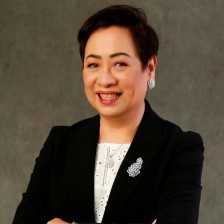
Lourdes Capito
Philippines
Capito won the 2023 FIGO (The International Federation of Gynecology and Obstetrics) Award given to women scientists, predominantly from low and middle-income countries, for making a special contribution to promote the development of science and scientific research in the fields of gynecology and obstetrics.(Photo:Women in Global Health)

Capito won the 2023 FIGO (The International Federation of Gynecology and Obstetrics) Award given to women scientists, predominantly from low and middle-income countries, for making a special contribution to promote the development of science and scientific research in the fields of gynecology and obstetrics.(Photo:Women in Global Health)
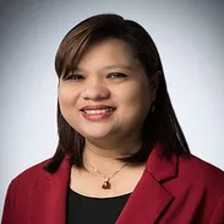
Maria Corazon De Ungria
University of the Philippines DilimanPhilippines
In 2023, De Ungria was awarded the rank of Academician and perpetual member by the National Academy of Science and Technology in the Philippines, the highest scientific recognition given by the academy.(Photo:Philippine Genome Center)

In 2023, De Ungria was awarded the rank of Academician and perpetual member by the National Academy of Science and Technology in the Philippines, the highest scientific recognition given by the academy.(Photo:Philippine Genome Center)
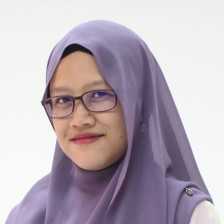
Mariatulqabtiah Abdul Razak
Universiti Putra MalaysiaMalaysia
Razak received the L’Oreal-Unesco For Women In Science Award 2022 for her research on monkeypox. She aims to develop a fast and cost-effective method for monkeypox virus detection.(Photo:International Veterinary Vaccinology Network)

Razak received the L’Oreal-Unesco For Women In Science Award 2022 for her research on monkeypox. She aims to develop a fast and cost-effective method for monkeypox virus detection.(Photo:International Veterinary Vaccinology Network)
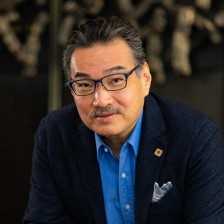
Masashi Yanagisawa
University of TsukubaJapan
Yanagisawa was awarded the 2023 Breakthrough Prize in Life Sciences for discovering that narcolepsy is caused by an individual losing a small population of brain-cells that produce a wake-promoting substance.(Photo:International Institute for Integrative Sleep Medicine)

Yanagisawa was awarded the 2023 Breakthrough Prize in Life Sciences for discovering that narcolepsy is caused by an individual losing a small population of brain-cells that produce a wake-promoting substance.(Photo:International Institute for Integrative Sleep Medicine)
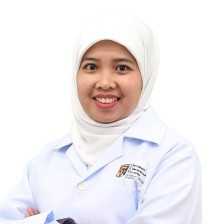
Nadiah Abu
Universiti Kebangsaan MalaysiaMalaysia
Abu was awarded the L’Oreal-Unesco For Women In Science Awards 2022 for her cancer research. Her project focused on a method for early detection of cancer using a person’s bodily fluids.(Photo:Universiti Kebangsaan Malaysia)

Abu was awarded the L’Oreal-Unesco For Women In Science Awards 2022 for her cancer research. Her project focused on a method for early detection of cancer using a person’s bodily fluids.(Photo:Universiti Kebangsaan Malaysia)
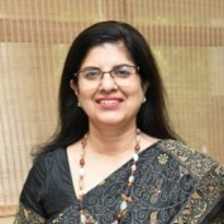
Neerja Bhatla
All India Institute of Medical Sciences in New DelhiIndia
The International Agency for Research on Cancer (IARC) awarded the 2023 IARC Award for Women in Cancer Research to Bhatla for her exemplary contributions in the field of cancer prevention research. For the past 35 years, her career has been devoted to the elimination of cervical cancer, with a particular focus on low-resource settings.(Photo:LinkedIn)
The International Agency for Research on Cancer (IARC) awarded the 2023 IARC Award for Women in Cancer Research to Bhatla for her exemplary contributions in the field of cancer prevention research. For the past 35 years, her career has been devoted to the elimination of cervical cancer, with a particular focus on low-resource settings.(Photo:LinkedIn)
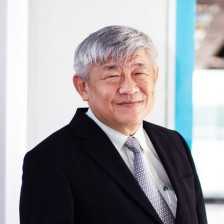
Prasit Palittapongarnpim
Mahidol UniversityThailand
Palittapongarnpim has made extensive contributions to tuberculosis research, particularly in the development of genotyping tools of Mycobacterium tuberculosis, and the molecular epidemiology of the bacterium. His work in applying genomics to track and predict the spread of tuberculosis has offered new perspectives on outbreak management and public health interventions.(Photo:Mahidol University)

Palittapongarnpim has made extensive contributions to tuberculosis research, particularly in the development of genotyping tools of Mycobacterium tuberculosis, and the molecular epidemiology of the bacterium. His work in applying genomics to track and predict the spread of tuberculosis has offered new perspectives on outbreak management and public health interventions.(Photo:Mahidol University)
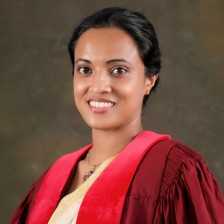
Samawansha Harsheni Tennakoon
Sri Jayewardenepura UniversitySri Lanka
Tennakoon received the Organization for Women in Science for the Developing World's 2023 Early Career Fellowship award for her research project on investigating chemical and biological properties of a plant-based treatment used in Sri Lanka to treat cancer patients.(Photo:Xi'an Jiaotong-Liverpool University)

Tennakoon received the Organization for Women in Science for the Developing World's 2023 Early Career Fellowship award for her research project on investigating chemical and biological properties of a plant-based treatment used in Sri Lanka to treat cancer patients.(Photo:Xi'an Jiaotong-Liverpool University)
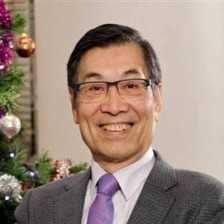
Fu-Chan Wei
Chang Gung Memorial HospitalTaiwan
Wei was awarded the 2024 TWAS Award in Medical Sciences for his essential contribution to saving lives and restoring human dignity, bringing about a paradigm shift in the surgical treatment of cancer, trauma and congenital anomalies through innovations and excellency. He is also the innovator of the osteoseptocutaneous fibula flap, which revolutionized the reconstruction of composite bone and soft tissue defects in the jaw and extremities. He established microsurgical center at Chang Gung Memorial Hospital and has been recognized as one of the “twenty most important innovators in plastic surgery over the past 400 years” by the American Society of Plastic Surgery and “10 most influential reconstructive surgeons in the 21st century” by the American Council of Academic Plastic Surgeons. Wei is also recognised for his vision, leadership, and teaching.(Photo:Chang Gung Memorial Hospital)

Wei was awarded the 2024 TWAS Award in Medical Sciences for his essential contribution to saving lives and restoring human dignity, bringing about a paradigm shift in the surgical treatment of cancer, trauma and congenital anomalies through innovations and excellency. He is also the innovator of the osteoseptocutaneous fibula flap, which revolutionized the reconstruction of composite bone and soft tissue defects in the jaw and extremities. He established microsurgical center at Chang Gung Memorial Hospital and has been recognized as one of the “twenty most important innovators in plastic surgery over the past 400 years” by the American Society of Plastic Surgery and “10 most influential reconstructive surgeons in the 21st century” by the American Council of Academic Plastic Surgeons. Wei is also recognised for his vision, leadership, and teaching.(Photo:Chang Gung Memorial Hospital)
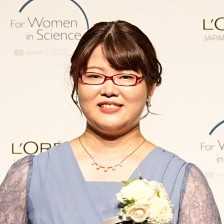
Yumi Tsutsumi
Osaka UniversityJapan
Tsutsumi won the 18th L’Oréal-UNESCO Female Scientist Japan Encouragement Award for her research into the neural mechanisms behind the sensation of chewing.(Photo:Osaka University)

Tsutsumi won the 18th L’Oréal-UNESCO Female Scientist Japan Encouragement Award for her research into the neural mechanisms behind the sensation of chewing.(Photo:Osaka University)
Hongping He
Chinese Academy of ScienceChina
He was elected to be a member of the Chinese Academy of Science in 2023. Serving as the director of Guangzhou Institute of Geochemistry, He has served as Chairman of the Asian Clay Society and vice-president of Chinese Society for Mineralogy, Petrology, and Geochemistry.(Photo:Chinese Academy of Sciences)

He was elected to be a member of the Chinese Academy of Science in 2023. Serving as the director of Guangzhou Institute of Geochemistry, He has served as Chairman of the Asian Clay Society and vice-president of Chinese Society for Mineralogy, Petrology, and Geochemistry.(Photo:Chinese Academy of Sciences)
Imalka Munaweera
University of Sri JayewardenepuraSri Lanka
Munaweera received the 2023 TWAS-Atta-ur-Rahman Award in Chemistry, for her contributions to the development of engineered inorganic nanostructures and nanofiber composites that may have multidisciplinary applications.(Photo:University of Sri Jayewardenepura)

Munaweera received the 2023 TWAS-Atta-ur-Rahman Award in Chemistry, for her contributions to the development of engineered inorganic nanostructures and nanofiber composites that may have multidisciplinary applications.(Photo:University of Sri Jayewardenepura)
Jyotirmayee Mohanty
Bhabha Atomic Research Centre, MumbaiIndia
Mohanty was one of the recipients of IUPAC 2023 Distinguished Women in Chemistry or Chemical Engineering. Given by the International Union Of Pure And Applied Chemistry, the award recognises outstanding contributions by women in the field of chemistry and chemical engineering. Mohanty is the first woman scientist from India to receive this award.(Photo:DishaBytes)

Mohanty was one of the recipients of IUPAC 2023 Distinguished Women in Chemistry or Chemical Engineering. Given by the International Union Of Pure And Applied Chemistry, the award recognises outstanding contributions by women in the field of chemistry and chemical engineering. Mohanty is the first woman scientist from India to receive this award.(Photo:DishaBytes)
Naoya Kumagai
Keio UniversityJapan
Kumagai was awarded the 2023 Mukaiyama Award for his research on the development of novel metal-based cooperative catalytic systems.(Photo:Kumagai Lab)

Kumagai was awarded the 2023 Mukaiyama Award for his research on the development of novel metal-based cooperative catalytic systems.(Photo:Kumagai Lab)
Sri Fatmawati
Institut Teknologi Sepuluh NopemberIndonesia
Fatmawati is a natural product chemist who specializes in analyzing the medical and pharmaceutical potential of plant and fungi extracts used in herbal medicine. Her work has been recognized by a number of awards including the Timmerman Award in 2021, the Elsevier Foundation Award for Early-Career Women Scientist in 2016 and the L’Oreal – UNESCO For Women in Science Award in 2013.(Photo:Global Young Academy)

Fatmawati is a natural product chemist who specializes in analyzing the medical and pharmaceutical potential of plant and fungi extracts used in herbal medicine. Her work has been recognized by a number of awards including the Timmerman Award in 2021, the Elsevier Foundation Award for Early-Career Women Scientist in 2016 and the L’Oreal – UNESCO For Women in Science Award in 2013.(Photo:Global Young Academy)
Subhangi Subedi
Tribhuvan UniversityNepal
Subedi received the Organization for Women in Science for the Developing World's 2023 Early Career Fellowship award for her research on carbon quantum dot as a next-generation smart fluorescent probe to scrutinize and control environmental threats.(Photo:Falling Walls)

Subedi received the Organization for Women in Science for the Developing World's 2023 Early Career Fellowship award for her research on carbon quantum dot as a next-generation smart fluorescent probe to scrutinize and control environmental threats.(Photo:Falling Walls)
Suojiang Zhang
Institute of Process EngineeringChina
Zhang co-received the 2024 TWAS Award in Chemistry for his essential and outstanding contributions to fundamental scientific research and green technology development in the field of ionic liquids and chemical engineering.(Photo:Institute of Process Engineering)
Zhang co-received the 2024 TWAS Award in Chemistry for his essential and outstanding contributions to fundamental scientific research and green technology development in the field of ionic liquids and chemical engineering.(Photo:Institute of Process Engineering)
Ahmad Fauzi Ismail
Universiti Teknologi MalaysiaMalaysia
Ismail was a recipient of the Mustafa (pbuh) Prize Laureates 2023 in the basic and engineering sciences category. He was recognized for his contributions to membrane technology research and its diverse applications.(Photo:Universiti Teknologi Malaysia)

Ismail was a recipient of the Mustafa (pbuh) Prize Laureates 2023 in the basic and engineering sciences category. He was recognized for his contributions to membrane technology research and its diverse applications.(Photo:Universiti Teknologi Malaysia)
Can Li
University of Hong KongHong Kong
Li is a recipient of the 2023 Croucher Tak Wah Mak Innovation Award for his research exploring the limitations of digital computers in performing tasks accomplished by the human brain, including recognising faces, reasoning based on vague information, and learning from experience.(Photo:University of Hong Kong)

Li is a recipient of the 2023 Croucher Tak Wah Mak Innovation Award for his research exploring the limitations of digital computers in performing tasks accomplished by the human brain, including recognising faces, reasoning based on vague information, and learning from experience.(Photo:University of Hong Kong)
Charlle Sy
De la Salle UniversityPhilippines
Charlle Sy, was one of the winners of the Underwriters Laboratories-ASEAN-U.S. Science Prize for Women in the mid-career scientist category for her innovative research to enable micro-hydro systems to generate electricity more efficiently.(Photo:De la Salle University)

Charlle Sy, was one of the winners of the Underwriters Laboratories-ASEAN-U.S. Science Prize for Women in the mid-career scientist category for her innovative research to enable micro-hydro systems to generate electricity more efficiently.(Photo:De la Salle University)
Jagath Manatunge
University of MoratuwaSri Lanka
Manatunge received the “Most Outstanding Senior Researcher in the field of Technology and related Science” award offered by the Committee of Vice-Chancellors and Directors Sri Lanka (CVCD). Once every two years, CVCD awards the most prolific academics in Sri Lanka to honor their outstanding contributions.(Photo:University of Moratuwa)

Manatunge received the “Most Outstanding Senior Researcher in the field of Technology and related Science” award offered by the Committee of Vice-Chancellors and Directors Sri Lanka (CVCD). Once every two years, CVCD awards the most prolific academics in Sri Lanka to honor their outstanding contributions.(Photo:University of Moratuwa)
Hiroyuki Matsunami
Kyoto UniversityJapan
Hiroyuki is the fourth Japanese researcher to receive the IEEE Edison Medal for his contributions to the development of silicon carbide materials and their applications in electronic power devices.(Photo:Kyoto University)

Hiroyuki is the fourth Japanese researcher to receive the IEEE Edison Medal for his contributions to the development of silicon carbide materials and their applications in electronic power devices.(Photo:Kyoto University)
Mohd Sapuan Salit
Universiti Putra MalaysiaMalaysia
Salit is the recipient of the 2024 TWAS Award in Engineering Sciences. He received this award for his contribution to the properties, conceptual design and materials selection of tropical natural-fiber composites, based on in-depth experimental and design-based investigations.(Photo:TWAS Directory)

Salit is the recipient of the 2024 TWAS Award in Engineering Sciences. He received this award for his contribution to the properties, conceptual design and materials selection of tropical natural-fiber composites, based on in-depth experimental and design-based investigations.(Photo:TWAS Directory)
Yuichi Ikuhara
University of TokyoJapan
Ikuhara and Shibata were co-awarded the Japan Academy Prize for their design and creation of new materials for state-of-the-art electron microscopy as well as their contribution to nano interface technology.(Photo:University of Tokyo)

Ikuhara and Shibata were co-awarded the Japan Academy Prize for their design and creation of new materials for state-of-the-art electron microscopy as well as their contribution to nano interface technology.(Photo:University of Tokyo)
Naoya Shibata
University of TokyoJapan
Ikuhara and Shibata were co-awarded the Japan Academy Prize for their design and creation of new materials for state-of-the-art electron microscopy as well as their contribution to nano interface technology.(Photo:University of Tokyo)

Ikuhara and Shibata were co-awarded the Japan Academy Prize for their design and creation of new materials for state-of-the-art electron microscopy as well as their contribution to nano interface technology.(Photo:University of Tokyo)
Pornnapa Kasemsiri
Khon Kaen UniversityThailand
Kasemsiri was awarded the L'Oréal-UNESCO “For Women in Science” fellowship program 2023 for her work in converting cassava starch waste (an affordable agricultural by-product) into bioactive injectable hydrogels, with the aim of increasing treatment accessibility for patients.(Photo:Khon Kaen University)

Kasemsiri was awarded the L'Oréal-UNESCO “For Women in Science” fellowship program 2023 for her work in converting cassava starch waste (an affordable agricultural by-product) into bioactive injectable hydrogels, with the aim of increasing treatment accessibility for patients.(Photo:Khon Kaen University)
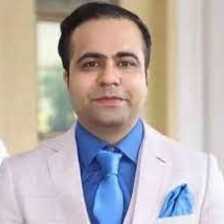
Sohaib Manzoor
Mirpur UniversityPakistan
Manzoor and Imran Aziz co-received the Pakistan Innovation Fund Award 2023 for Tech Startup for their proposal to advance wireless communication technology in the country.(Photo:Mirpur University)

Manzoor and Imran Aziz co-received the Pakistan Innovation Fund Award 2023 for Tech Startup for their proposal to advance wireless communication technology in the country.(Photo:Mirpur University)
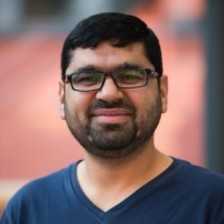
Imran Aziz
Mirpur UniversityPakistan
Manzoor and Imran Aziz co-received the Pakistan Innovation Fund Award 2023 for Tech Startup for their proposal to advance wireless communication technology in the country.(Photo:LinkedIn)
Manzoor and Imran Aziz co-received the Pakistan Innovation Fund Award 2023 for Tech Startup for their proposal to advance wireless communication technology in the country.(Photo:LinkedIn)
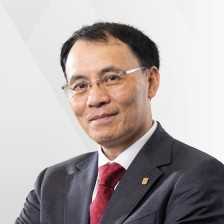
Xiao Lin Zhao
Hong Kong Polytechnic UniversityHong Kong
Zhao was conferred the Humboldt Research Award 2023 and elected as a member of the European Academy of Sciences and Arts for his groundbreaking research in composite materials as well as structural and mechanical engineering.(Photo:Hong Kong Polytechnic University)

Zhao was conferred the Humboldt Research Award 2023 and elected as a member of the European Academy of Sciences and Arts for his groundbreaking research in composite materials as well as structural and mechanical engineering.(Photo:Hong Kong Polytechnic University)
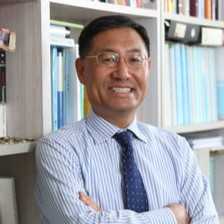
Yang-Kook Sun
Hanyang UniversitySouth Korea
Sun received the 2023 HoAM Prize in engineering. He is a world-renowned engineer and a pioneer in the research of cathode materials for secondary batteries. He developed “concentration gradient cathode materials," which contributed to the commercialization of electric cars with significantly increased driving range and lifespan. He introduced the core-shell structure which increases the energy density by increasing the nickel content at the center of a cathode particle while encapsulating the core particle with manganese, resulting in an extended lifespan and improved safety. Dr. Sun's concentration gradient cathode material technology was transferred to domestic companies, directly contributing to cost reduction, increased driving range, and extended service life of electric cars. With the boom of secondary batteries in the rapidly growing electric vehicle market, Sun's concentration gradient cathode technology has had a huge impact on both academia and industry.(Photo:Hanyang University)

Sun received the 2023 HoAM Prize in engineering. He is a world-renowned engineer and a pioneer in the research of cathode materials for secondary batteries. He developed “concentration gradient cathode materials," which contributed to the commercialization of electric cars with significantly increased driving range and lifespan. He introduced the core-shell structure which increases the energy density by increasing the nickel content at the center of a cathode particle while encapsulating the core particle with manganese, resulting in an extended lifespan and improved safety. Dr. Sun's concentration gradient cathode material technology was transferred to domestic companies, directly contributing to cost reduction, increased driving range, and extended service life of electric cars. With the boom of secondary batteries in the rapidly growing electric vehicle market, Sun's concentration gradient cathode technology has had a huge impact on both academia and industry.(Photo:Hanyang University)
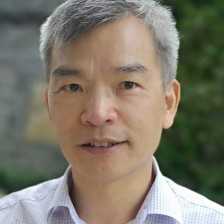
Fang-Jie Zhao
Nanjing Agricultural UniversityChina
Zhao co-received the 2024 TWAS Award in agricultural sciences for his discovery of the mechanisms controlling the accumulation of essential and toxic elements in crops, and the development of technical solutions to enhance food safety and improve nutrition.(Photo:International Plant Nutrition Council)

Zhao co-received the 2024 TWAS Award in agricultural sciences for his discovery of the mechanisms controlling the accumulation of essential and toxic elements in crops, and the development of technical solutions to enhance food safety and improve nutrition.(Photo:International Plant Nutrition Council)
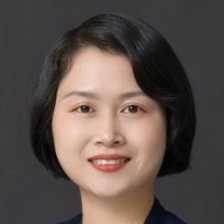
Juan Liu
Peking UniversityChina
Liu was one of the winners of the 18th Chinese Young Women in Science Award for advancing research on the reactions at the microbial-nanomineral-water interface.
Liu was one of the winners of the 18th Chinese Young Women in Science Award for advancing research on the reactions at the microbial-nanomineral-water interface.
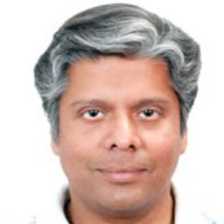
Purnananda Guptasarma
Indian Institute of Science Education and Research in MohaliIndia
Guptasarma was awarded the 2023 Tata Transformation Prize in Sustainability for his work on developing new and more effective methods for the degradation of polyethylene terephthalate plastic waste to its most fundamental building blocks, terephthalic acid and ethylene glycol.
Guptasarma was awarded the 2023 Tata Transformation Prize in Sustainability for his work on developing new and more effective methods for the degradation of polyethylene terephthalate plastic waste to its most fundamental building blocks, terephthalic acid and ethylene glycol.
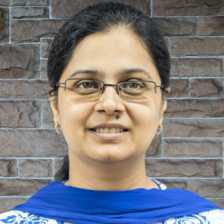
Shilpi Sharma
Indian Institute of Technology in DelhiIndia
Sharma received the 2023 Tata Transformation Prize Winner in Food Security for her research on the various biotic and abiotic factors shaping microbial diversity in different ecosystems and then developing strategies to support environmental sustainability.
Sharma received the 2023 Tata Transformation Prize Winner in Food Security for her research on the various biotic and abiotic factors shaping microbial diversity in different ecosystems and then developing strategies to support environmental sustainability.
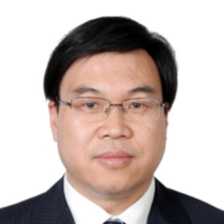
Shuichang Zhang
Research Institute of Petroleum Exploration and DevelopmentChina
Shuichang Zhang was elected to be a member of the Chinese Academy of Science in November 2023. He has been recognized for his contribution to application of marine deep hydrocarbon systems and exploring the age and depth limits of hydrocarbon generation.
Shuichang Zhang was elected to be a member of the Chinese Academy of Science in November 2023. He has been recognized for his contribution to application of marine deep hydrocarbon systems and exploring the age and depth limits of hydrocarbon generation.
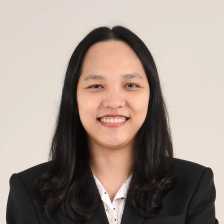
Theeranun Siritanon
Suranaree University of TechnologyThailand
Siritanon received the L'Oréal Women in Science Award 2023 for her contributions in developing advanced photocatalysts. Her work includes enhancing Bi2WO6 for dye degradation, improving BiOCl for air pollution reduction and boosting Bi2O2CO3's efficiency in water purification.
Siritanon received the L'Oréal Women in Science Award 2023 for her contributions in developing advanced photocatalysts. Her work includes enhancing Bi2WO6 for dye degradation, improving BiOCl for air pollution reduction and boosting Bi2O2CO3's efficiency in water purification.
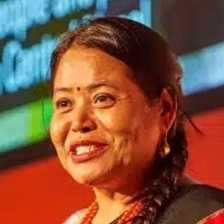
Tulshi Laxmi Suwal
Small Mammals Conservation and Research FoundationNepal
Suwal won the 2023 Whitley Award for her work to protect pangolins — the most trafficked mammal in the world — and their habitat.
Suwal won the 2023 Whitley Award for her work to protect pangolins — the most trafficked mammal in the world — and their habitat.
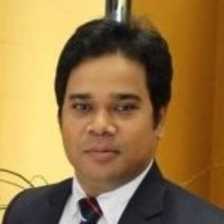
Anwarul Islam
Dhaka UniversityBangladesh
Islam was awarded the 2023 Lois Lunin Award, which recognizes individuals who have made noteworthy contributions to the practice of Information Science and Technology through leadership, mentoring and innovation.
Islam was awarded the 2023 Lois Lunin Award, which recognizes individuals who have made noteworthy contributions to the practice of Information Science and Technology through leadership, mentoring and innovation.
Christopher P. Monterola
Asian Institute of ManagementPhilippines
Monterola is a leader in the field of data science and has mentored over 100 young scientists in his career in the Philippines and Singapore. He is also a technical advisor to various enterprises on Artificial Intelligence. He sits on the board of Xurpas, Inc, a publicly listed technology company that has offered innovative IT products and services for the past twenty years. Monterola has been conferred the rank of academician, the highest recognition by the National Academy of Science and Technology in the Philippines.
Monterola is a leader in the field of data science and has mentored over 100 young scientists in his career in the Philippines and Singapore. He is also a technical advisor to various enterprises on Artificial Intelligence. He sits on the board of Xurpas, Inc, a publicly listed technology company that has offered innovative IT products and services for the past twenty years. Monterola has been conferred the rank of academician, the highest recognition by the National Academy of Science and Technology in the Philippines.
Jianhua Zhang
Beijing University of Posts and TelecommunicationsChina
Zhang was one of the winners of the 18th Chinese Young Women in Science Award for advancing research on signal processing, wireless Communication, radio channel Measurement and Modelling and channel simulation.
Zhang was one of the winners of the 18th Chinese Young Women in Science Award for advancing research on signal processing, wireless Communication, radio channel Measurement and Modelling and channel simulation.
Masataka Nakazawa
Tohoku UniversityJapan
Nakazawa and Hagimoto were jointly awarded the 2023 Japan Prize for Electronics, Information and Communication for their development of a semiconductor laser pumped optical amplifier that advanced the global long-distance, high-capacity optical fiber network.
Nakazawa and Hagimoto were jointly awarded the 2023 Japan Prize for Electronics, Information and Communication for their development of a semiconductor laser pumped optical amplifier that advanced the global long-distance, high-capacity optical fiber network.
Kazuo Hagimoto
National Institute of Information and Communications TechnologyJapan
Nakazawa and Hagimoto were jointly awarded the 2023 Japan Prize for Electronics, Information and Communication for their development of a semiconductor laser pumped optical amplifier that advanced the global long-distance, high-capacity optical fiber network.
Nakazawa and Hagimoto were jointly awarded the 2023 Japan Prize for Electronics, Information and Communication for their development of a semiconductor laser pumped optical amplifier that advanced the global long-distance, high-capacity optical fiber network.
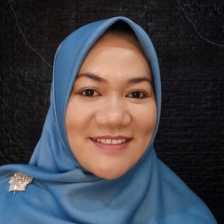
Nurdahalia Lairing
University of Muhammadiyah EnrekangIndonesia
Lairing received the IAMCR-FAO Rural Communication Services (RCS) Research Award 2023. She developed an Android-based learning platform that encouraged rural farmers to exchange up-to-date information on sustainable farming practices and health information.
Lairing received the IAMCR-FAO Rural Communication Services (RCS) Research Award 2023. She developed an Android-based learning platform that encouraged rural farmers to exchange up-to-date information on sustainable farming practices and health information.
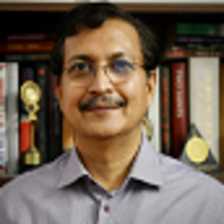
Sachchida Nand Tripathi
Indian Institute of Technology, KanpurIndia
Tripathi received The Infosys Prize 2023 in Engineering and Computer Science for the deployment of large-scale sensor-based air quality network and mobile laboratory for hyper local measurements of pollution, data generation and analysis for effective air quality management and citizen awareness, and for the discovery of new pathways of aerosols formation and growth that provide mechanistic understanding of haze formation.
Tripathi received The Infosys Prize 2023 in Engineering and Computer Science for the deployment of large-scale sensor-based air quality network and mobile laboratory for hyper local measurements of pollution, data generation and analysis for effective air quality management and citizen awareness, and for the discovery of new pathways of aerosols formation and growth that provide mechanistic understanding of haze formation.
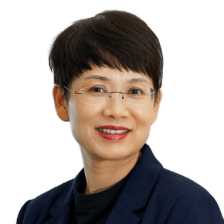
Sumei Sun
Institute for Infocomm ResearchSingapore
Sun was awarded the 2023 IEEE Vehicular Technology Society Women’s Distinguished Career Award for her contributions to wireless communications and the wireless community. She is also an active member of several telecommunication panels and committees including the chair of the Infocomm Media Development Authority’s Special 5G Strategy Task Force.
Sun was awarded the 2023 IEEE Vehicular Technology Society Women’s Distinguished Career Award for her contributions to wireless communications and the wireless community. She is also an active member of several telecommunication panels and committees including the chair of the Infocomm Media Development Authority’s Special 5G Strategy Task Force.
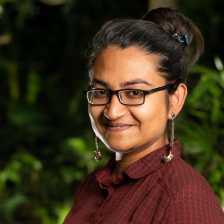
Alifa Bintha Haque
Dhaka UniversityBangladesh
Haque received the WINGS Women of Discovery Award 2023 for her critical work focusing on conserving sharks and rays. Haque and her team have established the largest regional dataset on diversity, fisheries and trade, discovering highly threatened species of sharks and rays.
Haque received the WINGS Women of Discovery Award 2023 for her critical work focusing on conserving sharks and rays. Haque and her team have established the largest regional dataset on diversity, fisheries and trade, discovering highly threatened species of sharks and rays.
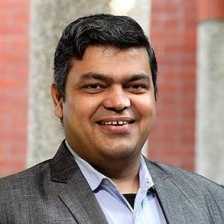
Arun Kumar Shukla
Indian Institute of Technology, KanpurIndia
Shukla won the Infosys Prize 2023 in Life Sciences for his outstanding contributions to the biology of G-protein coupled receptors (GPCRs), a key component of cell function. His studies have elegantly illustrated mechanisms that selectively activate signaling pathways downstream of GPCRs.
Shukla won the Infosys Prize 2023 in Life Sciences for his outstanding contributions to the biology of G-protein coupled receptors (GPCRs), a key component of cell function. His studies have elegantly illustrated mechanisms that selectively activate signaling pathways downstream of GPCRs.
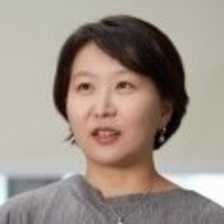
Jiyoung Park
Ulsan National Institute of Science and TechnologySouth Korea
Park was awarded the 2023 Korean Society For Molecular And Cellular Biology (KSMCB) Award for Women in Life Science.
Park was awarded the 2023 Korean Society For Molecular And Cellular Biology (KSMCB) Award for Women in Life Science.
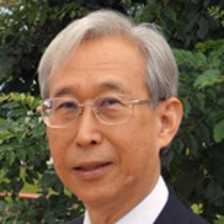
Kazuo Shinozaki
RIKEN Center for Sustainable Resource ScienceJapan
Shinozaki and Yamaguchi Shinozaki were co-awarded the Japan Academy Prize for their joint research on the regulatory network involved in environmental stress responses and tolerance in plants.
Shinozaki and Yamaguchi Shinozaki were co-awarded the Japan Academy Prize for their joint research on the regulatory network involved in environmental stress responses and tolerance in plants.
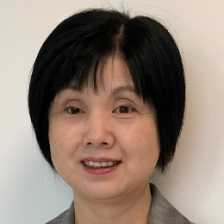
Kazuko Yamaguchi-Shinozaki
Tokyo NODAI Research InstituteJapan
Shinozaki and Yamaguchi Shinozaki were co-awarded the Japan Academy Prize for their joint research on the regulatory network involved in environmental stress responses and tolerance in plants.
Shinozaki and Yamaguchi Shinozaki were co-awarded the Japan Academy Prize for their joint research on the regulatory network involved in environmental stress responses and tolerance in plants.
Pantana Tor-Ngern
Chulalongkorn UniversityThailand
Tor-Ngern was awarded the L’Oréal-UNESCO International Rising Talent Award 2022 for her research into the impacts of climate variability and change on water and carbon cycles in the forests of Southeast Asia.
Tor-Ngern was awarded the L’Oréal-UNESCO International Rising Talent Award 2022 for her research into the impacts of climate variability and change on water and carbon cycles in the forests of Southeast Asia.
Supriya Sharma
Tribhuvan UniversityNepal
Sharma received the Organization for Women in Science for the Developing World's 2023 Early Career Fellowship award for her research on antibiotic resistance.
Sharma received the Organization for Women in Science for the Developing World's 2023 Early Career Fellowship award for her research on antibiotic resistance.
Suyanee Thongchot
Siriraj Hospital, Mahidol UniversityThailand
Thongchot was honored with the L'Oréal Women in Science Award 2023 for her work in combating triple-negative breast cancer (TNBC). Using a treatment method called chimeric antigen receptor or CAR T-cells, Thongchot’s research explored using the patients’ own modified white blood cells to efficiently target and eradicate TNBC type cancer cells.
Thongchot was honored with the L'Oréal Women in Science Award 2023 for her work in combating triple-negative breast cancer (TNBC). Using a treatment method called chimeric antigen receptor or CAR T-cells, Thongchot’s research explored using the patients’ own modified white blood cells to efficiently target and eradicate TNBC type cancer cells.

Yi-Fang Tsay
Institute of Molecular BiologyTaiwan
Tsay co-received the 2024 TWAS Award in Biology for her breakthrough research on the transport, signalling and utilization efficiency of nitrate, which changed plant biology.
Tsay co-received the 2024 TWAS Award in Biology for her breakthrough research on the transport, signalling and utilization efficiency of nitrate, which changed plant biology.
Raghavan Varadarajan
Indian Institute of ScienceIndia
Sharing the The World Academy of Sciences (TWAS) 2024 Award in Biology with Tsay, Varadarajan was recognized for his contributions to understanding the relationship between protein sequence, structure and stability, and its application to design immunogens that elicit protective antibodies against HIV-1, influenza and SARS-CoV-2.
Sharing the The World Academy of Sciences (TWAS) 2024 Award in Biology with Tsay, Varadarajan was recognized for his contributions to understanding the relationship between protein sequence, structure and stability, and its application to design immunogens that elicit protective antibodies against HIV-1, influenza and SARS-CoV-2.
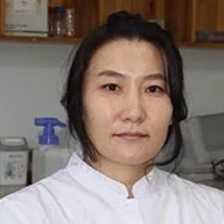
Tserendorj Munkhjargal
Mongolian University of Life SciencesMongolia
Munkhjargal was one of the OWSD-Elsevier Foundation Awardees for Early Career Women Scientists in the Developing World in 2023 for her research on the diagnosis and treatment of animal diseases.
Munkhjargal was one of the OWSD-Elsevier Foundation Awardees for Early Career Women Scientists in the Developing World in 2023 for her research on the diagnosis and treatment of animal diseases.
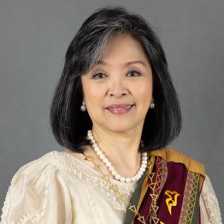
Carmencita M. David-Padilla
University of the PhilippinesPhilippines
In 2023, Padilla was conferred the Order of National Scientist by the President Bongbong Marcos for her contributions to the field of medicine. Padilla established the country’s first-ever Medical Genetics Unit at the University of the Philippines College of Medicine. The unit later developed into the Institute of Human Genetics and became a significant part of the National Institutes of Health–UP Manila. Under her leadership, the institute has made significant contributions in the development of genetic technology and research in the country.
In 2023, Padilla was conferred the Order of National Scientist by the President Bongbong Marcos for her contributions to the field of medicine. Padilla established the country’s first-ever Medical Genetics Unit at the University of the Philippines College of Medicine. The unit later developed into the Institute of Human Genetics and became a significant part of the National Institutes of Health–UP Manila. Under her leadership, the institute has made significant contributions in the development of genetic technology and research in the country.
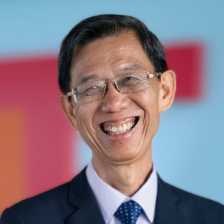
Gim Pew Quek
Ministry of DefenceSingapore
Quek was awarded the 2023 President’s Science and Technology Medal for his leadership in key roles that developed Singapore’s research ecosystem across various sectors including artificial intelligence, defense, high-performance computing, quantum engineering and space technology.
Quek was awarded the 2023 President’s Science and Technology Medal for his leadership in key roles that developed Singapore’s research ecosystem across various sectors including artificial intelligence, defense, high-performance computing, quantum engineering and space technology.
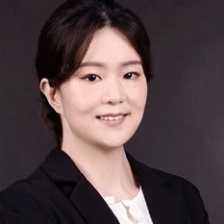
Kai Leng
Hong Kong Polytechnic UniversityHong Kong
Leng is a recipient of the 2023 Croucher Tak Wah Mak Innovation Award for her pioneering research on molecularly thin 2D organic-inorganic hybrid perovskites.
Leng is a recipient of the 2023 Croucher Tak Wah Mak Innovation Award for her pioneering research on molecularly thin 2D organic-inorganic hybrid perovskites.
Bin Liu
National University of SingaporeSingapore
Liu received the Public Administration Medal (Silver), National Day Awards 2023 for her contributions to the field of organic functional materials. She has made significant breakthroughs in polymer chemistry and applications of organic nanomaterials for biomedical, environmental and energy research.
Liu received the Public Administration Medal (Silver), National Day Awards 2023 for her contributions to the field of organic functional materials. She has made significant breakthroughs in polymer chemistry and applications of organic nanomaterials for biomedical, environmental and energy research.
Zheng Liu
Nanyang Technological UniversitySingapore
Liu was awarded the 2023 APEC Science Prize for Innovation, Research and Education. Liu was recognized for his work in the field of 2D materials synthesis, engineering and applications as well as his commitment to collaboration with other scientists in the region.
Liu was awarded the 2023 APEC Science Prize for Innovation, Research and Education. Liu was recognized for his work in the field of 2D materials synthesis, engineering and applications as well as his commitment to collaboration with other scientists in the region.
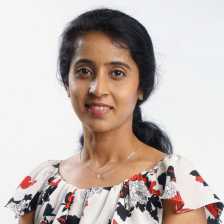
Madhavi Srinivasan
Nanyang Technological UniversitySingapore
Srinivasan was the 2023 honorable mention recipient of the Underwriters Laboratories-ASEAN-U.S. Science Prize for Women. She was recognised for her research on improving the performance of batteries in electric vehicles using energy efficient design principles. Her current focus is on advanced energy storage and circular economy–specifically novel energy storage solutions and recycling e-waste and lithium-ion batteries. Her work involves the synthesis, fabrication and application of nanoscale materials and architectures to improve the performance of electrochemical energy storage devices. To accomplish a circular economy, she also explores the possibility of recycling lithium ion battery waste using novel hydrometallurgical techniques.
Srinivasan was the 2023 honorable mention recipient of the Underwriters Laboratories-ASEAN-U.S. Science Prize for Women. She was recognised for her research on improving the performance of batteries in electric vehicles using energy efficient design principles. Her current focus is on advanced energy storage and circular economy–specifically novel energy storage solutions and recycling e-waste and lithium-ion batteries. Her work involves the synthesis, fabrication and application of nanoscale materials and architectures to improve the performance of electrochemical energy storage devices. To accomplish a circular economy, she also explores the possibility of recycling lithium ion battery waste using novel hydrometallurgical techniques.
Xiaohong Qin
Donghua UniversityChina
Xiaohong was one of the winners of the 18th Chinese Young Women in Science Award for her contributions to advancing research on textile materials.
Xiaohong was one of the winners of the 18th Chinese Young Women in Science Award for her contributions to advancing research on textile materials.
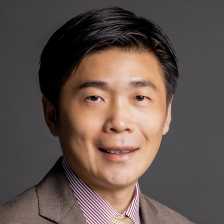
Cheng-Wei Qiu
National University of SingaporeSingapore
Qiu was awarded the 2023 President’s Science Award for his breakthroughs in topological thermal materials and diffusion physics, as well as his work identifying the fundamental framework in structured thermal metamaterials, quantum heat transport, advanced cooling technologies and nonreciprocal thermal photonics.
Qiu was awarded the 2023 President’s Science Award for his breakthroughs in topological thermal materials and diffusion physics, as well as his work identifying the fundamental framework in structured thermal metamaterials, quantum heat transport, advanced cooling technologies and nonreciprocal thermal photonics.
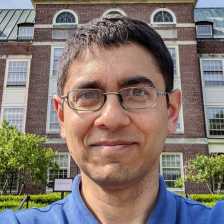
Apoorva Khare
Indian Institute of Science, BangaloreIndia
Khare was awarded the 2023 Shanti Swarup Bhatnagar Prize in Mathematical Sciences by the Indian government. Khare works in several fields of mathematics including matrix analysis and representation theory.
Khare was awarded the 2023 Shanti Swarup Bhatnagar Prize in Mathematical Sciences by the Indian government. Khare works in several fields of mathematics including matrix analysis and representation theory.
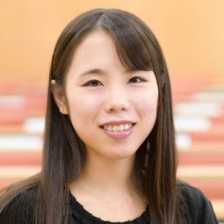
Mayuko Yamashita
Kyoto UniversityJapan
Yamashita won the 2024 Maryan Mirzakhani New Frontiers Prize awarded by the Breakthrough Prize for her significant contributions to mathematical physics and index theory.
Yamashita won the 2024 Maryan Mirzakhani New Frontiers Prize awarded by the Breakthrough Prize for her significant contributions to mathematical physics and index theory.
Suntharalingam Thirukkanesh
Eastern UniversitySri Lanka
Thirukkanesh received the President’s Awards for Scientific Research 2023 for best 100 papers published in prestigious journals.
Thirukkanesh received the President’s Awards for Scientific Research 2023 for best 100 papers published in prestigious journals.
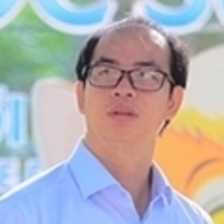
Tran Quang Hoa
Hue University of EducationVietnam
Hoa received the French Academy of Sciences award for his contributions to commutative algebra and related topics in algebraic geometry.
Hoa received the French Academy of Sciences award for his contributions to commutative algebra and related topics in algebraic geometry.
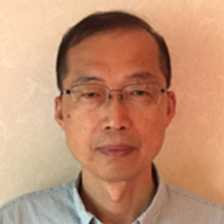
Jiangong You
Nanjing UniversityChina
You won The World Academy of Sciences (TWAS) 2024 Award in Mathematics for his contributions to the development of the Kolmogorov-Arnold-Moser theory and applications in differential equations, dynamics systems and the spectral theory of quasi-periodic Schrödinger operators.
You won The World Academy of Sciences (TWAS) 2024 Award in Mathematics for his contributions to the development of the Kolmogorov-Arnold-Moser theory and applications in differential equations, dynamics systems and the spectral theory of quasi-periodic Schrödinger operators.
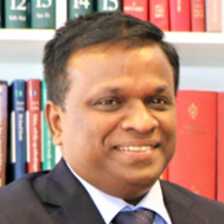
Punniamoorthy Ravirajan
University of JaffnaSri Lanka
Ravirajanhas received the President’s Award for Excellence in Research six times and the prestigious Committee of Vice Chancellors and Directors Award for his outstanding research on the fabrication and characterization of nanostructured optoelectronic devices.
Ravirajanhas received the President’s Award for Excellence in Research six times and the prestigious Committee of Vice Chancellors and Directors Award for his outstanding research on the fabrication and characterization of nanostructured optoelectronic devices.
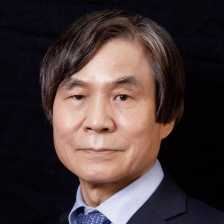
Jisoon Ihm
Pohang University of Science and Technology (POSTECH)South Korea
Ihm received the 2023 HoAm Prize for his contributions to theoretical physics. He pioneered the research branch of “Computational Materials Physics”, which studies fundamental properties of solids such as semiconductors, metals and insulators using computational methods.
Ihm received the 2023 HoAm Prize for his contributions to theoretical physics. He pioneered the research branch of “Computational Materials Physics”, which studies fundamental properties of solids such as semiconductors, metals and insulators using computational methods.
Jueinai Kwo
National Tsing Hua UniversityTaiwan
Kwo co-received the 2024 TWAS Award in Physics for her outstanding work in condensed matter research, with the invention of novel thin films for magnetism, superconductivity, nano-electronics and spintronics; and for her pioneering work in the field of artificial magnetic superlattices.
Kwo co-received the 2024 TWAS Award in Physics for her outstanding work in condensed matter research, with the invention of novel thin films for magnetism, superconductivity, nano-electronics and spintronics; and for her pioneering work in the field of artificial magnetic superlattices.
Mukund Thattai
National Centre for Biological SciencesIndia
Thattai was awarded The Infosys Prize 2023 in Physical Sciences in recognition of his groundbreaking contributions to evolutionary cell biology. He has explored the origins of endomembrane organelles, shedding new light on how they emerged from ancient, primordial cells.
Thattai was awarded The Infosys Prize 2023 in Physical Sciences in recognition of his groundbreaking contributions to evolutionary cell biology. He has explored the origins of endomembrane organelles, shedding new light on how they emerged from ancient, primordial cells.
Thiti Bovornratanaraks
Chulalongkorn UniversityThailand
Bovornratanaraks received the National Outstanding Researcher Awards 2024 from the National Research Council of Thailand (NRCT) for his contributions in the fields of physical sciences and mathematics.
Bovornratanaraks received the National Outstanding Researcher Awards 2024 from the National Research Council of Thailand (NRCT) for his contributions in the fields of physical sciences and mathematics.
Vijay B Shenoy
Indian Institute of Science, BangaloreIndia
Shenoy received the 2023 JC Bose Fellowship award in Physical Sciences for making distinguished contributions to theoretical condensed matter physics.
Shenoy received the 2023 JC Bose Fellowship award in Physical Sciences for making distinguished contributions to theoretical condensed matter physics.
Yasunobu Nakamura
RIKEN Center for Quantum ComputingJapan
Nakamura was co-awarded the Japan Academy Prize for his pioneering work achieving quantum-bit operation on superconducting circuits, contributing significantly to the development of superconducting quantum computers.
Nakamura was co-awarded the Japan Academy Prize for his pioneering work achieving quantum-bit operation on superconducting circuits, contributing significantly to the development of superconducting quantum computers.
Jaw Shen Tsai
RIKEN Center for Quantum ComputingJapan
Nakamura and Tsai were jointly awarded the Japan Academy Prize for their pioneering work achieving quantum-bit operation on superconducting circuits, contributing significantly to the development of superconducting quantum computers.
Nakamura and Tsai were jointly awarded the Japan Academy Prize for their pioneering work achieving quantum-bit operation on superconducting circuits, contributing significantly to the development of superconducting quantum computers.
Zhong Lin Wang
Beijing Institute of Nanoenergy and NanosystemsChina
Wang was awarded the 2023 Global Energy Prize in the Non-Conventional Energy category for the invention of triboelectric nanogenerators as a new energy technology for autonomous systems, the internet of things, robotics, artificial intelligence and large-scale blue energy harvesting. Wang’s discovery and breakthroughs in developing nanogenerators establish the principle and technological road map for harvesting mechanical energy from the environment and biological systems for powering mobile sensors.
Wang was awarded the 2023 Global Energy Prize in the Non-Conventional Energy category for the invention of triboelectric nanogenerators as a new energy technology for autonomous systems, the internet of things, robotics, artificial intelligence and large-scale blue energy harvesting. Wang’s discovery and breakthroughs in developing nanogenerators establish the principle and technological road map for harvesting mechanical energy from the environment and biological systems for powering mobile sensors.
Alison Kim Shan Wee
University of Nottingham MalaysiaMalaysia
Wee received the L’Oreal-Unesco For Women In Science Award 2022 in recognition of her environmental work in conserving the country’s natural coastal habitats. Using environmental DNA or eDNA, which is the metabarcoding of fish, Wee’s research helps detect overfishing and pollution in mangrove swamps.
Wee received the L’Oreal-Unesco For Women In Science Award 2022 in recognition of her environmental work in conserving the country’s natural coastal habitats. Using environmental DNA or eDNA, which is the metabarcoding of fish, Wee’s research helps detect overfishing and pollution in mangrove swamps.
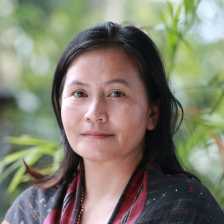
Delima Silalahi
Community Initiative Development and Study Group (KSPPM)Indonesia
An environmental activist from Sumatra, Silalahi is the winner of the Goldman Environmental Prize 2023. Dubbed the “Green Nobel”, the award was given to Silalahi and KSPPM for their efforts in fighting for the preservation of customary forests, which the Batak Toba indigenous communities depend on for their cultural and economic way of life. She began her advocacy for the Batak Toba people as a KSPPM volunteer in 1999; today Silalahi is KSPPM’s executive director. Between 2019 and 2022, Silalahi’s efforts helped six Batak communities gain customary forest recognition spanning over 7,000 hectares of indigenous land. Silalahi continues to advocate for the rights of other indigenous communities still fighting for the recognition of their customary forests.
An environmental activist from Sumatra, Silalahi is the winner of the Goldman Environmental Prize 2023. Dubbed the “Green Nobel”, the award was given to Silalahi and KSPPM for their efforts in fighting for the preservation of customary forests, which the Batak Toba indigenous communities depend on for their cultural and economic way of life. She began her advocacy for the Batak Toba people as a KSPPM volunteer in 1999; today Silalahi is KSPPM’s executive director. Between 2019 and 2022, Silalahi’s efforts helped six Batak communities gain customary forest recognition spanning over 7,000 hectares of indigenous land. Silalahi continues to advocate for the rights of other indigenous communities still fighting for the recognition of their customary forests.
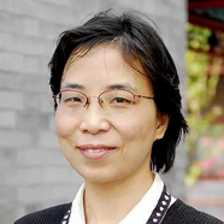
Yaohui Zhao
Peking UniversityChina
Zhao received the 2024 TWAS-Siwei Cheng Award for her pioneering studies on the Chinese labour market and the economics of healthy ageing.
Zhao received the 2024 TWAS-Siwei Cheng Award for her pioneering studies on the Chinese labour market and the economics of healthy ageing.

Byrana Nagappa Suresh
Indian Institute of Space Science and TechnologyIndia
Suresh was elected to the US National Academy of Engineering as an international member for his contributions to technologies that advance space exploration as well as his leadership promoting peaceful uses of outer space.(Photo:Indian Institute of Space Science and Technology)

Suresh was elected to the US National Academy of Engineering as an international member for his contributions to technologies that advance space exploration as well as his leadership promoting peaceful uses of outer space.(Photo:Indian Institute of Space Science and Technology)
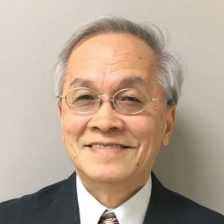
Wing-Huen Ip
National Central UniversityTaiwan
Ip was co-awarded the 2022 The World Academy of Sciences (TWAS) award for Earth Astronomy and Space Sciences for researching dynamic models of orbital migration of outer planets during the formation of a solar system. He was also recognized for his work with cometary ionospheres and satellite-magnetosphere interaction.(Photo:Asia-Pacific Conference on Giftedness)
Ip was co-awarded the 2022 The World Academy of Sciences (TWAS) award for Earth Astronomy and Space Sciences for researching dynamic models of orbital migration of outer planets during the formation of a solar system. He was also recognized for his work with cometary ionospheres and satellite-magnetosphere interaction.(Photo:Asia-Pacific Conference on Giftedness)
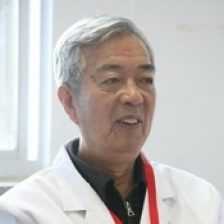
Zhusheng Liu
China Academy of Launch Vehicle TechnologyChina
Liu was one of the recipients of the 2022 IAF Hall of Fame award for his pioneering work in the field of space technology, especially in enhancing the reliability and safety of China manned rockets. Liu was the chief designer on the first manned space mission in China.(Photo:International Astronautical Federation)

Liu was one of the recipients of the 2022 IAF Hall of Fame award for his pioneering work in the field of space technology, especially in enhancing the reliability and safety of China manned rockets. Liu was the chief designer on the first manned space mission in China.(Photo:International Astronautical Federation)
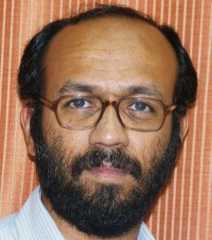
Nissim Kanekar
Tata Institute of Fundamental ResearchIndia
Kanekar was awarded the 2022 Infosys Prize in Physical Sciences for his study of galaxies in the “high noon” era when stars were being formed at a maximum rate. His careful astronomical investigations have placed the strongest limit on possible secular variation of the fine structure constant and the electron-to-proton mass ratio.(Photo:Tata Institute of Fundamental Research)

Kanekar was awarded the 2022 Infosys Prize in Physical Sciences for his study of galaxies in the “high noon” era when stars were being formed at a maximum rate. His careful astronomical investigations have placed the strongest limit on possible secular variation of the fine structure constant and the electron-to-proton mass ratio.(Photo:Tata Institute of Fundamental Research)
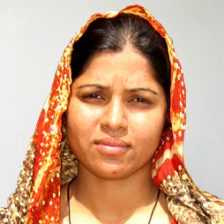
Riffat Shamshad
Space and Upper Atmosphere Research CommissionPakistan
Shamshad was confer red the Tamgha-e-Imtiaz civil award for her work advancing satellite technology.(Photo:National Center of Excellence in Geology)

Shamshad was confer red the Tamgha-e-Imtiaz civil award for her work advancing satellite technology.(Photo:National Center of Excellence in Geology)
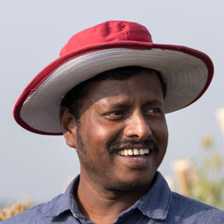
Mahalingam Govindaraj
Consultative Group for International Agricultural ResearchIndia
Govindaraj won the Norman Borlaug Field Award in 2022. The award was given by the World Food Prize Foundation for his consistent research on biofortified crops, especially iron-rich pearl millet, which have helped improve the health of rural communities and small holder farmers.(Photo:HarvestPlus)

Govindaraj won the Norman Borlaug Field Award in 2022. The award was given by the World Food Prize Foundation for his consistent research on biofortified crops, especially iron-rich pearl millet, which have helped improve the health of rural communities and small holder farmers.(Photo:HarvestPlus)
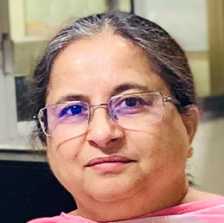
Parveen Chhuneja
Punjab Agricultural UniversityIndia
Chhuneja won the 2022 Mentor Award by Borlaug Global Rust Initiative for mentoring more than 30 young women researchers in India, and for her research on identification and introgression of novel genetic variation from wild wheat species into cultivated wheat leading to wheat gene pool enrichment.(Photo:Borlaug Global Rust Initiative)
Chhuneja won the 2022 Mentor Award by Borlaug Global Rust Initiative for mentoring more than 30 young women researchers in India, and for her research on identification and introgression of novel genetic variation from wild wheat species into cultivated wheat leading to wheat gene pool enrichment.(Photo:Borlaug Global Rust Initiative)

Phung Le Thi Kim
Ho Chi Minh City University of TechnologyVietnam
Phung received the Best Innovation Award at the Hitachi Global Foundation Asia Innovation Awards for her project that harnesses agricultural waste for water treatment.(Photo:Ho Chi Minh City University)
Phung received the Best Innovation Award at the Hitachi Global Foundation Asia Innovation Awards for her project that harnesses agricultural waste for water treatment.(Photo:Ho Chi Minh City University)
Roel R. Suralta
Philippine Rice Research InstitutePhilippines
Suralta was one of the recipients of the Achievement Award at the 2021 National Research Council of the Philippines’ (NCRP) awards for his significant contributions to understanding root science leading to robust high-value crops in the face of climate change.(Photo:Philippine Rice Research Institute)
Suralta was one of the recipients of the Achievement Award at the 2021 National Research Council of the Philippines’ (NCRP) awards for his significant contributions to understanding root science leading to robust high-value crops in the face of climate change.(Photo:Philippine Rice Research Institute)
Umara Sahara Rana
University of AgriculturePakistan
Rana received the 2022 Early Career Winners Award by The Borlaug Global Rust Initiative (BGRI) for her research on identifying genes resistant to fusarium head blight, and for developing and characterizing wheat germplasm for durable rust resistance and reduced fungicide use.(Photo:Borlaug Global Rust Initiative)
Rana received the 2022 Early Career Winners Award by The Borlaug Global Rust Initiative (BGRI) for her research on identifying genes resistant to fusarium head blight, and for developing and characterizing wheat germplasm for durable rust resistance and reduced fungicide use.(Photo:Borlaug Global Rust Initiative)
Daoxin Xie
Tsinghua UniversityChina
Xie was conferred the 2022 The World Academy of Sciences (TWAS) award in agricultural science for his contributions in plant hormone signaling. He notably contributed to unlocking important signaling mechanisms involving two plant hormones, jasmonate, and strigolactone.(Photo:Tsinghua University)

Xie was conferred the 2022 The World Academy of Sciences (TWAS) award in agricultural science for his contributions in plant hormone signaling. He notably contributed to unlocking important signaling mechanisms involving two plant hormones, jasmonate, and strigolactone.(Photo:Tsinghua University)

Adeeba Kamarulzaman
University of MalayaMalaysia
Adeeba received the 2022 Merdeka Award for Health, Science and Technology for her impact on the prevention, treatment and research of infectious diseases and HIV/AIDS. In addition to heading Malaysia’s efforts to combat the COVID-19 pandemic, Adeeba has consistently pushed for harm reduction and HIV prevention programs for people who use drugs. In 2005, she drove a Needle Syringe Exchange Program that dropped the rate of new HIV/AIDS infections by 50 percent over 10 years. Over a 30-year career, she has established herself as a leader and committee member of various prestigious regional and international organizations.(Photo:International AIDS Society)

Adeeba received the 2022 Merdeka Award for Health, Science and Technology for her impact on the prevention, treatment and research of infectious diseases and HIV/AIDS. In addition to heading Malaysia’s efforts to combat the COVID-19 pandemic, Adeeba has consistently pushed for harm reduction and HIV prevention programs for people who use drugs. In 2005, she drove a Needle Syringe Exchange Program that dropped the rate of new HIV/AIDS infections by 50 percent over 10 years. Over a 30-year career, she has established herself as a leader and committee member of various prestigious regional and international organizations.(Photo:International AIDS Society)

Beverly Lorraine Ho
Department of HealthPhilippines
Ho was named one of the 2022 Outstanding Women in Nation’s Service awardees for her work in public health. Her research has contributed to policies like the sugar- sweetened beverage tax, universal health care and the implementation of health technology assessment processes.(Photo:Department of Health)

Ho was named one of the 2022 Outstanding Women in Nation’s Service awardees for her work in public health. Her research has contributed to policies like the sugar- sweetened beverage tax, universal health care and the implementation of health technology assessment processes.(Photo:Department of Health)

Chathuranga Ranasinghe
University of ColomboSri Lanka
Ranasinghe received the 7th Sheikh Fahad Hiroshima-Asia Sports Medicine and Science Award in 2022. This award is given once in four years to a medical expert from Asia for their contribution to sports medicine.(Photo:University of Colombo)

Ranasinghe received the 7th Sheikh Fahad Hiroshima-Asia Sports Medicine and Science Award in 2022. This award is given once in four years to a medical expert from Asia for their contribution to sports medicine.(Photo:University of Colombo)
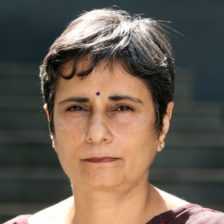
Gagandeep Kang
Christian Medical CollegeIndia
Kang was elected as a member of the National Academy of Medicine in 2022 for her outstanding contributions to improve child health through her research in enteric infectious diseases and vaccinology benefiting children in low- and middle-income countries, and more recently to vaccine science, vaccination policy, and communication during the COVID-19 pandemic.(Photo:International Congress on Infectious Diseases)

Kang was elected as a member of the National Academy of Medicine in 2022 for her outstanding contributions to improve child health through her research in enteric infectious diseases and vaccinology benefiting children in low- and middle-income countries, and more recently to vaccine science, vaccination policy, and communication during the COVID-19 pandemic.(Photo:International Congress on Infectious Diseases)
Tadashi Hattori
Asia-Pacific Prevention of Blindness AssociationJapan
Hattori, an ophthalmologist, won the Ramon Magsaysay Award in 2022. He divides his time between Japan and Vietnam treating patients living with eye disorders. Hattori has trained more than thirty doctors in Vietnam who can now do sophisticated eye surgeries. His team has treated over 20,000 patients in the country. Hattori has even donated medical equipment to remote and under-resourced hospitals in Vietnam. In 2005, Hattori founded the Asia-Pacific Prevention of Blindness Association to train doctors and conduct free treatment and surgeries. In 2014, with the help of investors and colleagues, he founded the Japan International Eye Hospital in Hanoi. The funds earned through this hospital are used for free outreach programs. The Ramon Magsaysay Award Foundation was touched by Hattori’s “simple humanity and extraordinary generosity.(Photo:Ramon Magsaysay Award Foundation)
Hattori, an ophthalmologist, won the Ramon Magsaysay Award in 2022. He divides his time between Japan and Vietnam treating patients living with eye disorders. Hattori has trained more than thirty doctors in Vietnam who can now do sophisticated eye surgeries. His team has treated over 20,000 patients in the country. Hattori has even donated medical equipment to remote and under-resourced hospitals in Vietnam. In 2005, Hattori founded the Asia-Pacific Prevention of Blindness Association to train doctors and conduct free treatment and surgeries. In 2014, with the help of investors and colleagues, he founded the Japan International Eye Hospital in Hanoi. The funds earned through this hospital are used for free outreach programs. The Ramon Magsaysay Award Foundation was touched by Hattori’s “simple humanity and extraordinary generosity.(Photo:Ramon Magsaysay Award Foundation)
Wanjin Hong
Agency for Science, Technology and ResearchSingapore
Hong was awarded the President’s Science and Technology Medal for his work on building up the biomedical sciences research ecosystem in Singapore. Over the course of his career, he has fostered partnerships between the public, academic and clinical research sectors as well as nurtured scientific talent and encouraged innovation.(Photo:Agency for Science, Technology and Research)

Hong was awarded the President’s Science and Technology Medal for his work on building up the biomedical sciences research ecosystem in Singapore. Over the course of his career, he has fostered partnerships between the public, academic and clinical research sectors as well as nurtured scientific talent and encouraged innovation.(Photo:Agency for Science, Technology and Research)
Hailan Hu
Zhejiang UniversityChina
Hu was selected as one of the 2022 L’Oréal-UNESCO For Women in Science International Awards for elucidating the biochemical mechanism of depression.(Photo:L'Oréal For Women in Science)

Hu was selected as one of the 2022 L’Oréal-UNESCO For Women in Science International Awards for elucidating the biochemical mechanism of depression.(Photo:L'Oréal For Women in Science)
Kaori Sugihara
University of TokyoJapan
Sugihara received the Japan Science and Technology (JST) President Award for excellence in science by female researchers for her work on lipids in cell membranes and biosensors.(Photo:The University of Tokyo, Institute of Industrial Sciences)
Sugihara received the Japan Science and Technology (JST) President Award for excellence in science by female researchers for her work on lipids in cell membranes and biosensors.(Photo:The University of Tokyo, Institute of Industrial Sciences)
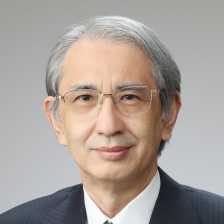
Haruo Kasai
International Research Center for NeurointelligenceJapan
Kasai received the Imperial Prize and Japan Academy Prize in 2022 for discovering the principles of structural plasticity in brain spine synapses.(Photo:The University of Tokyo)

Kasai received the Imperial Prize and Japan Academy Prize in 2022 for discovering the principles of structural plasticity in brain spine synapses.(Photo:The University of Tokyo)
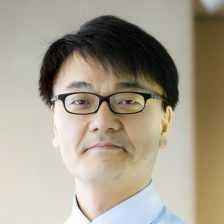
Jeong Min Lee
Seoul National UniversitySouth Korea
Lee won the 2022 Asan Award in Clinical Medicine for his contributions to Image-based diagnosis and prognosis prediction of hepatocellular carcinoma, and validation of therapeutic effect of “No-Touch” radiofrequency ablation for small hepatocellular carcinoma.(Photo:Seoul National University College of Medicine)
Lee won the 2022 Asan Award in Clinical Medicine for his contributions to Image-based diagnosis and prognosis prediction of hepatocellular carcinoma, and validation of therapeutic effect of “No-Touch” radiofrequency ablation for small hepatocellular carcinoma.(Photo:Seoul National University College of Medicine)

Muhammad Iqbal Choudhury
University of KarachiPakistan
Choudhury won the 2022 Mustafa Prize International, which is awarded to the top researchers of the Islamic world. He received the honor for his contributions in the field of natural product chemistry, and for discovering anti-epileptic and anti-leishmanial compounds from indigenous medicinal plants, which are in various stages of clinical trials.(Photo:Pride of Pakistan)
Choudhury won the 2022 Mustafa Prize International, which is awarded to the top researchers of the Islamic world. He received the honor for his contributions in the field of natural product chemistry, and for discovering anti-epileptic and anti-leishmanial compounds from indigenous medicinal plants, which are in various stages of clinical trials.(Photo:Pride of Pakistan)
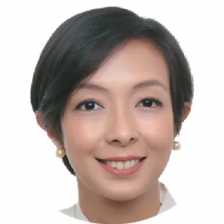
Pia Bagamasbad
University of the Philippines-DilimanPhilippines
Bagamasbad has been recognized as one of the 2022 Outstanding Women in the Nation’s Service awardees for spearheading an RT-PCR training program for the detection of SARS- CoV-2, to support the Department of Health’s COVID-19 response.(Photo:University of Philippines Diliman)

Bagamasbad has been recognized as one of the 2022 Outstanding Women in the Nation’s Service awardees for spearheading an RT-PCR training program for the detection of SARS- CoV-2, to support the Department of Health’s COVID-19 response.(Photo:University of Philippines Diliman)
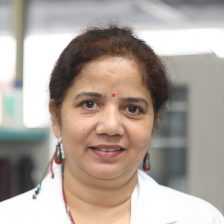
Ritu Trivedi
Central Drug Research InstituteIndia
Trivedi won the National Tech Excellence Award for Women-2022 given by India’s Department of Science and Technology. Trivedi received this award for her research on metabolic bone disorders, specifically post-menopausal osteoporosis and osteoarthritis. Her work has led to a pipeline of potential products including Reunion which helps in rapid fracture healing.(Photo:Central Drug Research Institute)

Trivedi won the National Tech Excellence Award for Women-2022 given by India’s Department of Science and Technology. Trivedi received this award for her research on metabolic bone disorders, specifically post-menopausal osteoporosis and osteoarthritis. Her work has led to a pipeline of potential products including Reunion which helps in rapid fracture healing.(Photo:Central Drug Research Institute)
Eui-Cheol Shin
Korea Advanced Institute of Science and TechnologySouth Korea
Shin received the 2022 Asan Award in Basic Medicine for his research on characterization of human immune responses against hepatitis viruses and corona viruses.(Photo:Korea Advanced Institute of Science and Technology)

Shin received the 2022 Asan Award in Basic Medicine for his research on characterization of human immune responses against hepatitis viruses and corona viruses.(Photo:Korea Advanced Institute of Science and Technology)
Erwei Song
Sun Yat-sen University of Medical SciencesChina
Song was co-awarded the 2022 TWAS award in Medical Sciences for his research on the influence of non-coding RNAs in regulating tumor plasticity.(Photo:Tidetron R&D)
Song was co-awarded the 2022 TWAS award in Medical Sciences for his research on the influence of non-coding RNAs in regulating tumor plasticity.(Photo:Tidetron R&D)
Uzma Batool
Shaafi International HospitalPakistan
Batool was conferred the 2022 Tamgha-e-Imtiaz civilian award for medicine recognizing her contributions to the field of gastroenterology.(Photo:Oladoc)

Batool was conferred the 2022 Tamgha-e-Imtiaz civilian award for medicine recognizing her contributions to the field of gastroenterology.(Photo:Oladoc)
Yasuka Toda
Meiji UniversityJapan
Toda won the 2022 Japan Science and Technology (JST) Prize for excellence in science by female researchers. She received the award for her research on the evolution in taste receptors of birds and primates.(Photo:Meiji University)

Toda won the 2022 Japan Science and Technology (JST) Prize for excellence in science by female researchers. She received the award for her research on the evolution in taste receptors of birds and primates.(Photo:Meiji University)
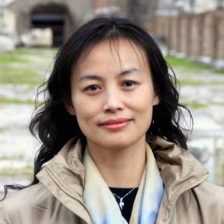
Chunying Chen
National Center for Nanoscience and TechnologyChina
Chen was the co-recipient of The World Academy of Sciences (TWAS) award in 2020 for her work exploring the interactions between nanoparticles and biological systems. Her work has implications for potentially designing new systems for biomedical applications.(Photo:National Center for Nanoscience and Technology China)

Chen was the co-recipient of The World Academy of Sciences (TWAS) award in 2020 for her work exploring the interactions between nanoparticles and biological systems. Her work has implications for potentially designing new systems for biomedical applications.(Photo:National Center for Nanoscience and Technology China)
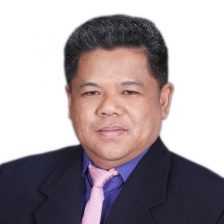
David P. Penaloza, Jr.
De La Salle UniversityPhilippines
Penaloza, Jr. was named the Achievement Awardee for the NRCP Division of Chemical Sciences for his notable contributions in polymer chemistry research.(Photo:ResearchGate)
Penaloza, Jr. was named the Achievement Awardee for the NRCP Division of Chemical Sciences for his notable contributions in polymer chemistry research.(Photo:ResearchGate)

Ganapati Dadasaheb Yadav
Institute of Chemical Technology MumbaiIndia
Yadav was elected to the US National Academy of Engineering as an international member for his work advancing research, innovation and education in green chemistry, catalysis, nanotechnology and chemical engineering.(Photo:Institute of Chemical Technology Mumbai)

Yadav was elected to the US National Academy of Engineering as an international member for his work advancing research, innovation and education in green chemistry, catalysis, nanotechnology and chemical engineering.(Photo:Institute of Chemical Technology Mumbai)
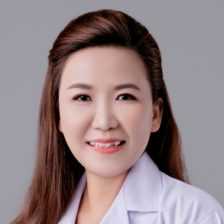
Ho Thi Thanh Van
Ho Chi Minh City University of Natural Resources and EnvironmentVietnam
Ho was awarded the L’Oréal-UNESCO International Rising Talent Award in 2022 for her developing new materials for the production of green hydrogen.(Photo:Ho Thi Thanh Van)

Ho was awarded the L’Oréal-UNESCO International Rising Talent Award in 2022 for her developing new materials for the production of green hydrogen.(Photo:Ho Thi Thanh Van)
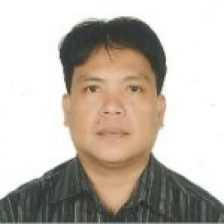
Joseph Auresenia
De La Salle UniversityPhilippines
Auresenia was awarded the Korean Society for Biotechnology and Bioengineering (KSBB) Research Exchange Award for his contributions and supporting role to further the collaboration among Asian researchers in the field of biotechnology research.(Photo:De La Salle University)

Auresenia was awarded the Korean Society for Biotechnology and Bioengineering (KSBB) Research Exchange Award for his contributions and supporting role to further the collaboration among Asian researchers in the field of biotechnology research.(Photo:De La Salle University)
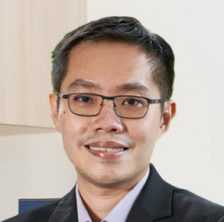
Ming Joo Koh
National University of SingaporeSingapore
Koh is a recipient of the Young Scientist Award as part of the President’s Science and Technology Awards. He was recognized for his breakthroughs in sustainable base metal catalysis and radical-based chemical technologies.(Photo:National University of Singapore)

Koh is a recipient of the Young Scientist Award as part of the President’s Science and Technology Awards. He was recognized for his breakthroughs in sustainable base metal catalysis and radical-based chemical technologies.(Photo:National University of Singapore)
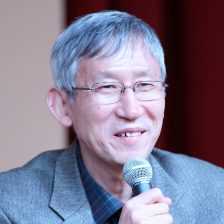
Sukbok Chang
Institute for Basic ScienceSouth Korea
Chang won the 2022 HO-AM Prize in Chemistry and Life Sciences for his contributions in the field of transition metal catalysis for organic transformations and for developing a range of new and impactful C-H bond functionalization reactions.(Photo:Wikipedia)
Chang won the 2022 HO-AM Prize in Chemistry and Life Sciences for his contributions in the field of transition metal catalysis for organic transformations and for developing a range of new and impactful C-H bond functionalization reactions.(Photo:Wikipedia)

Ashani Savinda Ranathunga
University of MoratuwaSri Lanka
Ranathunga is the recipient of 2022 OWSD-Elsevier Foundation Award for turning industrial and agricultural waste into value-added products and using them as raw materials for eco-friendly construction and development projects.(Photo:Organization for Women in Science for the Developing World)

Ranathunga is the recipient of 2022 OWSD-Elsevier Foundation Award for turning industrial and agricultural waste into value-added products and using them as raw materials for eco-friendly construction and development projects.(Photo:Organization for Women in Science for the Developing World)

Athanasia Amanda Septevani
National Research and Innovation AgencyIndonesia
Septevani was awarded the Merck Award for Young Indonesian Scientists for her research on lignin derived from biomass black liquor sludge as an eco-friendly flame retardant.(Photo:ResearchGate)

Septevani was awarded the Merck Award for Young Indonesian Scientists for her research on lignin derived from biomass black liquor sludge as an eco-friendly flame retardant.(Photo:ResearchGate)
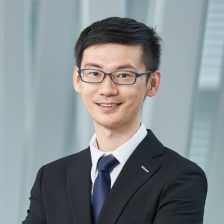
Renzhe Bi
Agency for Science, Technology and ResearchSingapore
Bi is a recipient of the Young Scientist Award for developing and translating bio-optical technologies and medical innovations.(Photo:Agency for Science, Technology and Research)

Bi is a recipient of the Young Scientist Award for developing and translating bio-optical technologies and medical innovations.(Photo:Agency for Science, Technology and Research)
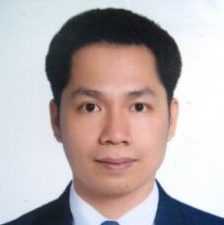
Bui Xuan Thanh
Vietnam National University Ho Chi Minh CityVietnam
Bui was awarded the Outstanding Innovation Award at the Hitachi Global Foundation Asia Innovation Awards for the development of a wetland roof system for domestic wastewater treatment and sustainable cities.(Photo:Asia-Pacific Network for Global Change Research)

Bui was awarded the Outstanding Innovation Award at the Hitachi Global Foundation Asia Innovation Awards for the development of a wetland roof system for domestic wastewater treatment and sustainable cities.(Photo:Asia-Pacific Network for Global Change Research)

Erika Fille Legara
Asian Institute of ManagementPhilippines
Legara was named one of the 2022 Outstanding Women in the Nation’s Service awardees in recognition of her work advancing the field of data science in the Philippines. She is the program director of the country’s pioneering graduate data science program.(Photo: Erika Fille Legara)
Legara was named one of the 2022 Outstanding Women in the Nation’s Service awardees in recognition of her work advancing the field of data science in the Philippines. She is the program director of the country’s pioneering graduate data science program.(Photo: Erika Fille Legara)
Daining Fang
Beijing Institute of TechnologyChina
Fang was elected to the US National Academy of Engineering as an inter national member for his contributions to the understanding of the mechanics of ferroelectric and ferromagnetic materials as well as light weight multifunctional structures under extreme conditions.(Photo:Beijing Institute of Technology)

Fang was elected to the US National Academy of Engineering as an inter national member for his contributions to the understanding of the mechanics of ferroelectric and ferromagnetic materials as well as light weight multifunctional structures under extreme conditions.(Photo:Beijing Institute of Technology)
Gurumoorthy Bhuvaneswari
Indian Institute of Technology DelhiIndia
Bhuvaneswari was elected to the US National Academy of Engineering as an international member for her work advancing power converters to improve power quality and her leadership in using advanced technologies for education.(Photo:National Academy of Engineering)
Bhuvaneswari was elected to the US National Academy of Engineering as an international member for her work advancing power converters to improve power quality and her leadership in using advanced technologies for education.(Photo:National Academy of Engineering)

Keisha Alena Mayuga
Life CyclesPhilippines
Mayuga was named one of the 2022 Outstanding Women in the Nation’s Service awardees for her work on transport planning and improving mobility in Manila.(Photo:LinkedIn)
Mayuga was named one of the 2022 Outstanding Women in the Nation’s Service awardees for her work on transport planning and improving mobility in Manila.(Photo:LinkedIn)
Wook Hyun Kwon
Seoul National UniversitySouth Korea
Kwon was elected to the US National Academy of Engineering for his contributions to the development and commercialization of model-predictive controls.(Photo:The World Academy of Sciences)
Kwon was elected to the US National Academy of Engineering for his contributions to the development and commercialization of model-predictive controls.(Photo:The World Academy of Sciences)
Ravindra Kulkarni
Elkay Chemicals Private LimitedIndia
Kulkarni was elected to the US National Academy of Engineering as an international member for his innovation-centric business and technology development as an engineer, entrepreneur and environmentalist.(Photo:National Academy of Engineering)
Kulkarni was elected to the US National Academy of Engineering as an international member for his innovation-centric business and technology development as an engineer, entrepreneur and environmentalist.(Photo:National Academy of Engineering)

Rinlee Butch M. Cervera
University of the Philippines-DilimanPhilippines
Cervera received the David M. Consunji Award for Engineering Research from the Philippine Association for the Advancement of Science and Technology for advancing research on energy storage and conversion devices, waste to energy applications and green materials.(Photo:The World Academy of Sciences)

Cervera received the David M. Consunji Award for Engineering Research from the Philippine Association for the Advancement of Science and Technology for advancing research on energy storage and conversion devices, waste to energy applications and green materials.(Photo:The World Academy of Sciences)
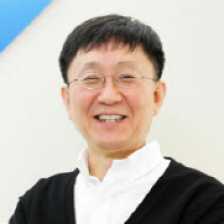
Sang Kyun Cha
Seoul National UniversitySouth Korea
Cha won the 2022 HO-AM prize in engineering for his innovative research in the database industry. Cha has developed the first commercial in-memory database engine, SAP HANA, that can store large scale data in DRAM memory.(Photo:Seoul National University)

Cha won the 2022 HO-AM prize in engineering for his innovative research in the database industry. Cha has developed the first commercial in-memory database engine, SAP HANA, that can store large scale data in DRAM memory.(Photo:Seoul National University)

Sanghamitra Bandyopadhyay
Indian Statistical InstituteIndia
Bandyopadhyay received the Padma Shri award in the science and engineering category for her continued research on data mining, pattern recognition and biological data analysis, which has led to important discoveries such as genetic markers for breast cancer.(Photo:Infosys Prize)

Bandyopadhyay received the Padma Shri award in the science and engineering category for her continued research on data mining, pattern recognition and biological data analysis, which has led to important discoveries such as genetic markers for breast cancer.(Photo:Infosys Prize)

Siriwan Suebnukarn
Thammasat UniversityThailand
Suebnukarn received an honorable mention in the 2022 Underwriters Laboratories- ASEAN-U.S. Science Prize for Women, which recognized of her research that uses AI technology for early detection of oral cancer and other jaw tumors.(Photo:Thammasat University)

Suebnukarn received an honorable mention in the 2022 Underwriters Laboratories- ASEAN-U.S. Science Prize for Women, which recognized of her research that uses AI technology for early detection of oral cancer and other jaw tumors.(Photo:Thammasat University)
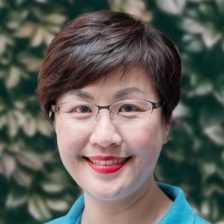
Ching Cheong Sok
Digital Health Research Unit of Cancer ResearchMalaysia
Sok is one of two winners of the 2022 Underwriters Laboratories- ASEAN-U.S. Science Prize for Women for her research that advances early detection of oral cancer using AI.(Photo: Ching Cheong Sok)
Sok is one of two winners of the 2022 Underwriters Laboratories- ASEAN-U.S. Science Prize for Women for her research that advances early detection of oral cancer using AI.(Photo: Ching Cheong Sok)

Supiya Charoensiriwath
National Electronics and Computer Technology Centre ThailandThailand
Charoensiriwath won the 2022 Underwriters Laboratories-ASEAN-U.S. Science Prize for Women for her extensive work in developing mobile applications on national digital platforms to promote nutritional health in children.(Photo:The ASEAN)
Charoensiriwath won the 2022 Underwriters Laboratories-ASEAN-U.S. Science Prize for Women for her extensive work in developing mobile applications on national digital platforms to promote nutritional health in children.(Photo:The ASEAN)
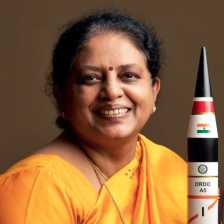
Tessy Thomas
Defense Research and Development OrganizationIndia
Thomas was awarded the APJ Abdul Kalam award for her pioneering work developing indigenous missile systems.(Photo:Fortune India)
Thomas was awarded the APJ Abdul Kalam award for her pioneering work developing indigenous missile systems.(Photo:Fortune India)
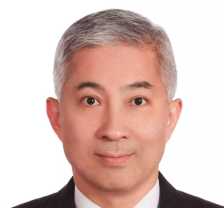
Keh-Chyuan Tsai
National Taiwan UniversityTaiwan
Tsai was elected to the US National Academy of Engineering as an international member for his global leadership and research that advanced earthquake engineering and steel structure design. Tsai is a prolific researcher in the fields of design, testing and analysis of seismic building structures. Throughout his career, he has developed several seismic- protective technologies like metallic energy dissipating elements and buckling restrained braces.As an educator and leader, he has supervised over 150 Masters and Doctoral students from Taiwan and abroad. More recently, his work investigates the relationship between stiffness and cracking in order to keep structures stable and people safe in the event of an earthquake.(Photo:National Academy of Engineering)
Tsai was elected to the US National Academy of Engineering as an international member for his global leadership and research that advanced earthquake engineering and steel structure design. Tsai is a prolific researcher in the fields of design, testing and analysis of seismic building structures. Throughout his career, he has developed several seismic- protective technologies like metallic energy dissipating elements and buckling restrained braces.As an educator and leader, he has supervised over 150 Masters and Doctoral students from Taiwan and abroad. More recently, his work investigates the relationship between stiffness and cracking in order to keep structures stable and people safe in the event of an earthquake.(Photo:National Academy of Engineering)
Hsiao-Wen Zan
National University of Yang Ming ChiaoTaiwan
Zan was co-awarded the 2022 Franco-Taiwanese prize for her work with French researcher, Dr. Olivier Soppera, advancing laser materials and processes for the development of metal-oxide-based sensors used for health applications.(Photo:National University Yang Ming Chiao)

Zan was co-awarded the 2022 Franco-Taiwanese prize for her work with French researcher, Dr. Olivier Soppera, advancing laser materials and processes for the development of metal-oxide-based sensors used for health applications.(Photo:National University Yang Ming Chiao)
Ayako Abe-Ouchi
The University of TokyoJapan
Abe-Ouchi was one of the recipients of the Japan Academy Prize for her research contributions to understanding the mechanism of the 100,000 year period glacial cycle.(Photo:European Geosciences Union)

Abe-Ouchi was one of the recipients of the Japan Academy Prize for her research contributions to understanding the mechanism of the 100,000 year period glacial cycle.(Photo:European Geosciences Union)

Aletta Yñiguez
University of the PhilippinesPhilippines
Yñiguez was named one of the 2022 Outstanding Women in Nation’s Service awardees for her contributions to marine science research. Yñiguez works with local communities to advocate sustainable fishing practices and has most recently collaborated with the local fishing and agricultural bureau to propose the use of artificial intelligence as an early-warning system for harmful algal blooms. Interestingly, her systems make use of accessible and inexpensive components like underwater cameras, lasers, depth sensors and global positioning devices to gather and process data. Yñiguez believes it is important to educate local fisherfolk and provide the infrastructure and support necessary to enable sustainable fishing.(Photo:Daily Guardian)
Yñiguez was named one of the 2022 Outstanding Women in Nation’s Service awardees for her contributions to marine science research. Yñiguez works with local communities to advocate sustainable fishing practices and has most recently collaborated with the local fishing and agricultural bureau to propose the use of artificial intelligence as an early-warning system for harmful algal blooms. Interestingly, her systems make use of accessible and inexpensive components like underwater cameras, lasers, depth sensors and global positioning devices to gather and process data. Yñiguez believes it is important to educate local fisherfolk and provide the infrastructure and support necessary to enable sustainable fishing.(Photo:Daily Guardian)

Allan Gil S. Fernando
University of the PhilippinesPhilippines
Fernando was awarded the 2022 National Research Council of the Philippines’ Achievement Award in recognition of his contributions to earth and space sciences.(Photo:University of the Philippines/a>)
Fernando was awarded the 2022 National Research Council of the Philippines’ Achievement Award in recognition of his contributions to earth and space sciences.(Photo:University of the Philippines/a>)

Anna Oposa
Save Philippine SeasPhilippines
Oposa is a recipient of the 2022 TOWNS Award for her work in marine ecology conservation. Through SPS, she has organized the Save Sharks Network Philippines to lobby a roadmap for shark and ray protection in the Philippines.(Photo:De La Salle Santiago Zobel School)

Oposa is a recipient of the 2022 TOWNS Award for her work in marine ecology conservation. Through SPS, she has organized the Save Sharks Network Philippines to lobby a roadmap for shark and ray protection in the Philippines.(Photo:De La Salle Santiago Zobel School)

Kasturi Devi Kanniah
University of Technology MalaysiaMalaysia
Kanniah was listed as one of the World’s Top 2 percent Scientists in the field of Environment and Surveying by Stanford University. She received the accolade for the impact of her work that examines changes in terrestrial carbon stock and low-carbon cities.(Photo:University of Technology, Malaysia)

Kanniah was listed as one of the World’s Top 2 percent Scientists in the field of Environment and Surveying by Stanford University. She received the accolade for the impact of her work that examines changes in terrestrial carbon stock and low-carbon cities.(Photo:University of Technology, Malaysia)

Mario Juan A. Aurelio
University of the PhilippinesPhilippines
Aurelio was conferred the Gregorio Y. Zara Award for Basic Research by the Philippine Association for the Advancement of Science and Technology (PhilAAST) for his contributions to structural geology and geodynamics education. Aurelio is also a prolific researcher in the field of tectonics.(Photo:University of the Philippines)

Aurelio was conferred the Gregorio Y. Zara Award for Basic Research by the Philippine Association for the Advancement of Science and Technology (PhilAAST) for his contributions to structural geology and geodynamics education. Aurelio is also a prolific researcher in the field of tectonics.(Photo:University of the Philippines)
Naohiko Ohkouchi
Research Institute for Marine Resources UtilizationJapan
Ohkouchi received the Duke of Edinburgh Prize in 2022 from the Japan Academy for his research on development and application of a method for analyzing changes in the biological world using advanced analysis of compound-specific isotope ratios.(Photo:Progress in Earth and Planetary Science)

Ohkouchi received the Duke of Edinburgh Prize in 2022 from the Japan Academy for his research on development and application of a method for analyzing changes in the biological world using advanced analysis of compound-specific isotope ratios.(Photo:Progress in Earth and Planetary Science)
P.S. Biju
Meteorological Centre, ThiruvananthapuramIndia
Biju was awarded the Best Atmospheric Scientist Award in 2022 by India’s Ministry of Earth Sciences for developing weather forecasting instruments at the nation’s airports and observational instruments for cyclonic winds at coastal observatories.(Photo:The Hindu)

Biju was awarded the Best Atmospheric Scientist Award in 2022 by India’s Ministry of Earth Sciences for developing weather forecasting instruments at the nation’s airports and observational instruments for cyclonic winds at coastal observatories.(Photo:The Hindu)
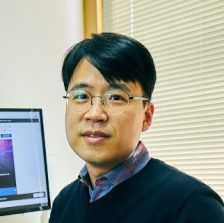
Suk-ju Kang
Sogang UniversitySouth Korea
Kang was awarded the Merck Young Scientist Award in South Korea for his contributions to research on image and video enhancement systems as well as AI-based architectural design.(Photo:Sogang University)

Kang was awarded the Merck Young Scientist Award in South Korea for his contributions to research on image and video enhancement systems as well as AI-based architectural design.(Photo:Sogang University)

Suman Chakraborty
Indian Institute of TechnologyIndia
Chakraborty won the 2022 Infosys Prize in Engineering and Computer Science for his pioneering work in elucidating the interaction of fluid mechanics, interfacial phenomena, and electromechanics at the micro- and nanoscale. He has used his research to help advance healthcare in resource limited settings through the invention of novel low-cost medical devices for sensing, diagnostics and therapeutics.(Photo:Infosys Prize)

Chakraborty won the 2022 Infosys Prize in Engineering and Computer Science for his pioneering work in elucidating the interaction of fluid mechanics, interfacial phenomena, and electromechanics at the micro- and nanoscale. He has used his research to help advance healthcare in resource limited settings through the invention of novel low-cost medical devices for sensing, diagnostics and therapeutics.(Photo:Infosys Prize)
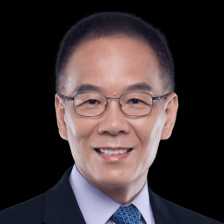
Hongjiang Zhang
The Carlyle GroupChina
Zhang was elected to the US National Academy of Engineering as an international member for his work and leadership in the field of multimedia computing.(Photo:Source Code Capital)

Zhang was elected to the US National Academy of Engineering as an international member for his work and leadership in the field of multimedia computing.(Photo:Source Code Capital)
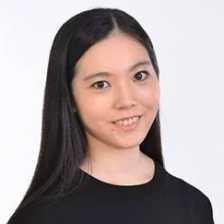
Asako Noguchi
The University of TokyoJapan
Noguchi was one of the recipients of the 2022 L’Oréal-UNESCO For Women in Science Japan Fellowship for explaining the mechanism that amplifies the diversity of neural activity, contributing to the understanding of the nervous system.(Photo:L’Oréal Group)

Noguchi was one of the recipients of the 2022 L’Oréal-UNESCO For Women in Science Japan Fellowship for explaining the mechanism that amplifies the diversity of neural activity, contributing to the understanding of the nervous system.(Photo:L’Oréal Group)
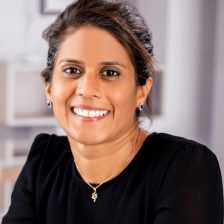
Asha DeVos
OceanswellSri Lanka
DeVos is a marine biologist, educator and a leader in the field of blue whale research. She is the first Sri Lankan to receive a PhD in marine mammal research and the first National Geographic explorer from the country. For her contributions in the field and for mentoring young scientists in Sri Lanka, DeVos has received numerous awards including the Maxwell-Hanrahan Award in Field Biology, Vanithabhimana Lifetime Achievement Award, and the Global Teacher Prize. De Vos, who is also a TED Fellow, founded Oceanswell, Sri Lanka’s first marine conservation research and education organization.(Photo:The Ismaili)

DeVos is a marine biologist, educator and a leader in the field of blue whale research. She is the first Sri Lankan to receive a PhD in marine mammal research and the first National Geographic explorer from the country. For her contributions in the field and for mentoring young scientists in Sri Lanka, DeVos has received numerous awards including the Maxwell-Hanrahan Award in Field Biology, Vanithabhimana Lifetime Achievement Award, and the Global Teacher Prize. De Vos, who is also a TED Fellow, founded Oceanswell, Sri Lanka’s first marine conservation research and education organization.(Photo:The Ismaili)
Lanfen Chen
Xiamen UniversityChina
Chen was one of the recipients of the For Women In Science (FWIS) International Awards for advancing the understanding of the pathophysiology of autoimmune diseases.(Photo:Xiamen University)

Chen was one of the recipients of the For Women In Science (FWIS) International Awards for advancing the understanding of the pathophysiology of autoimmune diseases.(Photo:Xiamen University)
Ruey-Hwa Chen
Academia SinicaTaiwan
Chen was awarded The World Academy of Sciences (TWAS) 2022 Award for Biology for her contributions to the understanding of how cell signalling and protein post-translational modifications control cancer progression, cell death and autophagy.(Photo:Academia Sinica)

Chen was awarded The World Academy of Sciences (TWAS) 2022 Award for Biology for her contributions to the understanding of how cell signalling and protein post-translational modifications control cancer progression, cell death and autophagy.(Photo:Academia Sinica)

Dennis Lo
The Chinese University of Hong KongHong Kong
Lo was awarded the 2022 Lasker-DeBakey Clinical Medical Research Award for his discovery of fetal DNA in maternal blood that led to non- invasive prenatal testing for Down Syndrome and other chromosomal abnormalities.(Photo:Hong Kong Genome Centre)

Lo was awarded the 2022 Lasker-DeBakey Clinical Medical Research Award for his discovery of fetal DNA in maternal blood that led to non- invasive prenatal testing for Down Syndrome and other chromosomal abnormalities.(Photo:Hong Kong Genome Centre)
Edwin Atabay
Philippine Carabao CentrePhilippines
Atabay was conferred the National Research Council of the Phillippines (NRCP) Achievement Award in the field of veterinary medicine. He oversaw the implementation of Intensified Reproductive Management Program, which promotes technological advancements to improve the reproductive efficiency of livestock.(Photo:Philippine Carabao Centre)
Atabay was conferred the National Research Council of the Phillippines (NRCP) Achievement Award in the field of veterinary medicine. He oversaw the implementation of Intensified Reproductive Management Program, which promotes technological advancements to improve the reproductive efficiency of livestock.(Photo:Philippine Carabao Centre)
Haruka Sasaki
Tohoku UniversityJapan
Sasaki was one of the recipients of the 2022 L’Oréal-UNESCO For Women in Science Japan Fellowship for uncovering the mechanisms behind melatonin’s involvement in asthma pathogenesis, thus helping to establish a drug discovery platform for new therapies.(Photo:LinkedIn)
Sasaki was one of the recipients of the 2022 L’Oréal-UNESCO For Women in Science Japan Fellowship for uncovering the mechanisms behind melatonin’s involvement in asthma pathogenesis, thus helping to establish a drug discovery platform for new therapies.(Photo:LinkedIn)
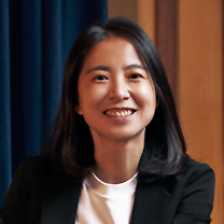
Hsueh Yen-Ping
Academia SinicaTaiwan
Hsueh received the Taiwan Outstanding Women in Science (TOWIS) 2022 Most Promising Young Scientist Award. Her research explores the molecular interactions and coevolution between C. elegans and the nematophagous fungi.(Photo:Academia Sinica)

Hsueh received the Taiwan Outstanding Women in Science (TOWIS) 2022 Most Promising Young Scientist Award. Her research explores the molecular interactions and coevolution between C. elegans and the nematophagous fungi.(Photo:Academia Sinica)
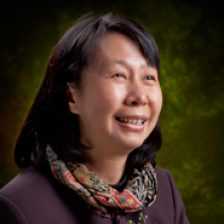
Hsou-min Li
Academia SinicaTaiwan
Li received the 2022 Taiwan Outstanding Women in Science Award. Her work aims to shed light on how proteins are imported into plant plastids.(Photo:Academia Sinica)

Li received the 2022 Taiwan Outstanding Women in Science Award. Her work aims to shed light on how proteins are imported into plant plastids.(Photo:Academia Sinica)
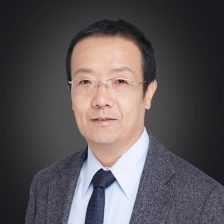
Wenhui Li
National Institute of Biological SciencesChina
Li was the recipient of the 2022 Future Science Prize in the Life Sciences, awarded for establishing sodium taurocholate cotransporting polypeptide (NTCP) as the receptor of hepatitis B and D in humans. This breakthrough discovery has positive implications for the future of designing therapeutics for these viral diseases.(Photo:Future Science Prize)

Li was the recipient of the 2022 Future Science Prize in the Life Sciences, awarded for establishing sodium taurocholate cotransporting polypeptide (NTCP) as the receptor of hepatitis B and D in humans. This breakthrough discovery has positive implications for the future of designing therapeutics for these viral diseases.(Photo:Future Science Prize)
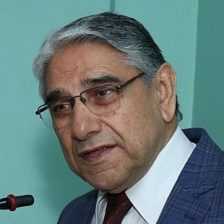
Moti Lal Madan
Indian Council of Agricultural ResearchIndia
Madan was one of the recipients of Padma Shri award, which recognized his three-decade-long contributions in the field of livestock reproduction in India. Madan’s team had carried out the world’s first in vitro fertilization of a buffalo calf in 1990.(Photo:wikimedia)
Madan was one of the recipients of Padma Shri award, which recognized his three-decade-long contributions in the field of livestock reproduction in India. Madan’s team had carried out the world’s first in vitro fertilization of a buffalo calf in 1990.(Photo:wikimedia)
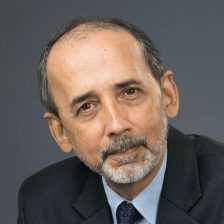
Rohan Pethiyagoda
-Sri Lanka
Pethiyagoda won the 2022 Linnean Medal in zoology, and became the first Sri Lankan to receive the medal. He was recognized for his consistent research, writing and advocacy in biodiversity conservation in Sri Lanka.(Photo:LMD Sri Lanka)

Pethiyagoda won the 2022 Linnean Medal in zoology, and became the first Sri Lankan to receive the medal. He was recognized for his consistent research, writing and advocacy in biodiversity conservation in Sri Lanka.(Photo:LMD Sri Lanka)
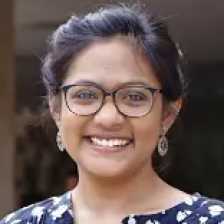
Senjuti Saha
Child Health Research FoundationBangladesh
Saha is one of the leading young female scientists in Bangladesh who has been championing the cause of equity in global health research. Saha’s team was the first to sequence the genome of SARS-CoV-2 in Bangladesh, and the first in the world to show that the chikungunya virus could cross the blood-brain barrier and cause meningitis in Bangladeshi children.(Photo:University of Toronto)

Saha is one of the leading young female scientists in Bangladesh who has been championing the cause of equity in global health research. Saha’s team was the first to sequence the genome of SARS-CoV-2 in Bangladesh, and the first in the world to show that the chikungunya virus could cross the blood-brain barrier and cause meningitis in Bangladeshi children.(Photo:University of Toronto)
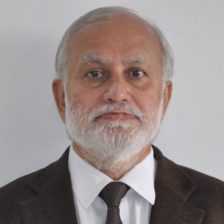
Subbanna Ayyappan
Karnataka Science and Technology AcademyIndia
Ayyappan is one of the recipients of Padma Shri award for playing a key role in leading India’s Blue Revolution.(Photo:Karnataka Science and Technology Academy)

Ayyappan is one of the recipients of Padma Shri award for playing a key role in leading India’s Blue Revolution.(Photo:Karnataka Science and Technology Academy)
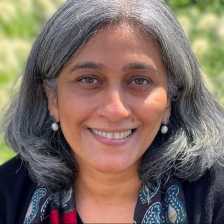
Vidita Vaidya
Tata Institute of Fundamental ResearchIndia
Vaidya won the 2022 Infosys Prize in Life Sciences for her seminal contributions to understanding brain mechanisms that underlie mood disorders such as anxiety and depression, including signals engaged by the neurotransmitter serotonin in causing persistent changes in behavior induced by early life stress and the role of serotonin in energy regulation in brain cells. Vaidya is also a fellow of the Indian National Science Academy and Indian Academy of Sciences. She received the Shanti Swarup Bhatnagar Award in 2015, and a Nature award for excellence in mentoring in 2019.(Photo:The Print)
Vaidya won the 2022 Infosys Prize in Life Sciences for her seminal contributions to understanding brain mechanisms that underlie mood disorders such as anxiety and depression, including signals engaged by the neurotransmitter serotonin in causing persistent changes in behavior induced by early life stress and the role of serotonin in energy regulation in brain cells. Vaidya is also a fellow of the Indian National Science Academy and Indian Academy of Sciences. She received the Shanti Swarup Bhatnagar Award in 2015, and a Nature award for excellence in mentoring in 2019.(Photo:The Print)
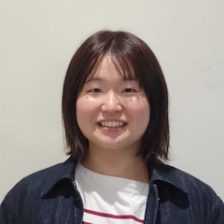
Ai Kohata
The University of TokyoJapan
Kohata was one of the recipients of the 2022 L’Oreal-UNESCO Women in Science Award for her research on the practical application and expansion of the scope of using nucleic acid drugs, which are said to be effective in treating intractable diseases.(Photo:The University of Tokyo)

Kohata was one of the recipients of the 2022 L’Oreal-UNESCO Women in Science Award for her research on the practical application and expansion of the scope of using nucleic acid drugs, which are said to be effective in treating intractable diseases.(Photo:The University of Tokyo)
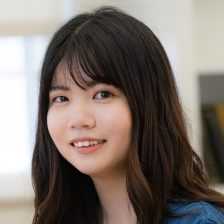
Haruna Katayama
Japan
Katayama was one of the recipients of the 2022 L’Oreal-UNESCO Women in Science Award for proposing a novel “black hole laser” design to observe Hawking radiation, a type of particle emitted outside of black holes. When applied to quantum computers, her work can further the realization of next- generation information processing and communications.(Photo:Hiroshima University)
Katayama was one of the recipients of the 2022 L’Oreal-UNESCO Women in Science Award for proposing a novel “black hole laser” design to observe Hawking radiation, a type of particle emitted outside of black holes. When applied to quantum computers, her work can further the realization of next- generation information processing and communications.(Photo:Hiroshima University)
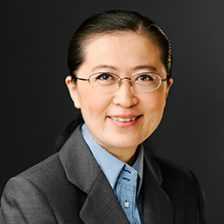
Bin Liu
National University of SingaporeSingapore
Liu was elected to the US National Academy of Engineering as an international member for her research that brought organic electronic materials into aqueous media—opening new avenues for biomedicine, environmental monitoring, sensors and electronic devices.(Photo:National University of Singapore)

Liu was elected to the US National Academy of Engineering as an international member for her research that brought organic electronic materials into aqueous media—opening new avenues for biomedicine, environmental monitoring, sensors and electronic devices.(Photo:National University of Singapore)

Yong-Young Noh
PostechSouth Korea
Noh was awarded the 2022 Merck Award for his research on semiconducting materials. He developed the first high- performance p-type thin-film transistor (TFT) by harnessing tin-based metal halide perovskites and copper iodine-based metal halide transparent semiconductors.(Photo:Postech)

Noh was awarded the 2022 Merck Award for his research on semiconducting materials. He developed the first high- performance p-type thin-film transistor (TFT) by harnessing tin-based metal halide perovskites and copper iodine-based metal halide transparent semiconductors.(Photo:Postech)
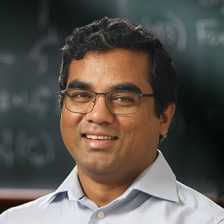
Mahesh Kakde
Indian Institute of ScienceIndia
Kakde won the 2022 Infosys Prize in Mathematics for his contributions to algebraic number theory. His research on the non-commutative Iwasawa main conjecture, Gross-Stark conjecture and the Brumer-Stark conjecture resolves outstanding conjectures at the core of modern number theory.(Photo:Infosys Prize)

Kakde won the 2022 Infosys Prize in Mathematics for his contributions to algebraic number theory. His research on the non-commutative Iwasawa main conjecture, Gross-Stark conjecture and the Brumer-Stark conjecture resolves outstanding conjectures at the core of modern number theory.(Photo:Infosys Prize)
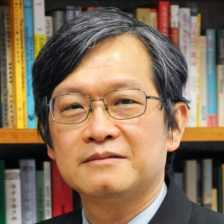
Ngaiming Mok
University of Hong KongHong Kong
Mok was awarded the 2022 Future Science Prize in Mathematics and Computer Science for his work in varieties of minimal rational tangents in algebraic geometry as well as his proof of Ax-Schanuel’s conjecture for Shimura varieties. He is renowned in the mathematical community for his global perspective in Pure Mathematics and for his work unravelling significant conjectures and problems with a variety of analytic, algebraic and geometric methods.(Photo:University of Hong Kong)

Mok was awarded the 2022 Future Science Prize in Mathematics and Computer Science for his work in varieties of minimal rational tangents in algebraic geometry as well as his proof of Ax-Schanuel’s conjecture for Shimura varieties. He is renowned in the mathematical community for his global perspective in Pure Mathematics and for his work unravelling significant conjectures and problems with a variety of analytic, algebraic and geometric methods.(Photo:University of Hong Kong)
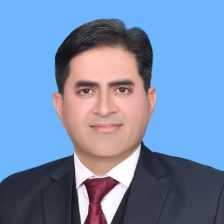
Sohail Nadeem
Quaid-i-Azam UniversityPakistan
Nadeem won the 2022 Obada Prize in the distinguished scientist category for his continued contributions in the field of applied mathematics and for his excellent teaching proficiency. Nadeem has supervised over 100 graduate students and researchers.(Photo:ResearchGate)

Nadeem won the 2022 Obada Prize in the distinguished scientist category for his continued contributions in the field of applied mathematics and for his excellent teaching proficiency. Nadeem has supervised over 100 graduate students and researchers.(Photo:ResearchGate)
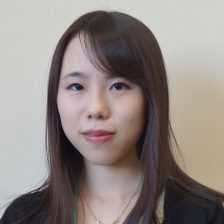
Mayuko Yamashita
Research Institute of Mathematical Science, Kyoto UniversityJapan
Yamashita won the Grand Marie Sklodowska Curie Award for her work on non-commutative geometry. The award recognized her strong contributions not only in mathematics but also in physics field theory.(Photo:European Girls' Mathematical Olympiad)

Yamashita won the Grand Marie Sklodowska Curie Award for her work on non-commutative geometry. The award recognized her strong contributions not only in mathematics but also in physics field theory.(Photo:European Girls' Mathematical Olympiad)
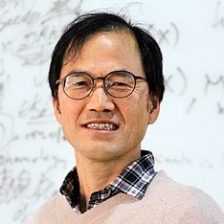
Yong-Guen Oh
Institute for Basic ScienceSouth Korea
Oh won the HO-AM Prize in Physics and Mathematics in 2022. He is a leading mathematician in the field of symplectic geometry and topology. Oh set up the theoretical foundation of Floer homology theory and developed important methodologies of applying the theory to various problems in symplectic topology. Oh is one of the first few Koreans who were invited as a speaker in the International Congress of Mathematicians. He is a member of Korean Mathematical Society and National Academy of Science of the Republic of Korea.(Photo:wikimedia)

Oh won the HO-AM Prize in Physics and Mathematics in 2022. He is a leading mathematician in the field of symplectic geometry and topology. Oh set up the theoretical foundation of Floer homology theory and developed important methodologies of applying the theory to various problems in symplectic topology. Oh is one of the first few Koreans who were invited as a speaker in the International Congress of Mathematicians. He is a member of Korean Mathematical Society and National Academy of Science of the Republic of Korea.(Photo:wikimedia)

Chandana Jayaratne
University of ColomboSri Lanka
Jayaratne was confer red the National Apex Award 2022 bythe Sri Lankan President for his consistent professional excellence in the field of science and technology in the country.(Photo:University of Colombo)

Jayaratne was confer red the National Apex Award 2022 bythe Sri Lankan President for his consistent professional excellence in the field of science and technology in the country.(Photo:University of Colombo)
Kimiko Sekiguchi
Tokyo Institute of TechnologyJapan
Sekiguchi received the 2022 Saruhashi Prize, which is given to female researchers who have made remarkable achievements in the field of natural sciences. Sekiguchi was rewarded for her work on “three- body nuclear force” among the nucleons inside atoms.(Photo:Saruhashi Award)

Sekiguchi received the 2022 Saruhashi Prize, which is given to female researchers who have made remarkable achievements in the field of natural sciences. Sekiguchi was rewarded for her work on “three- body nuclear force” among the nucleons inside atoms.(Photo:Saruhashi Award)
Xueming Yang
Chinese Academy of SciencesChina
Yang was named the 2022 Future Science Prize in Physical Sciences for the development of new-generation molecular beam instruments that can be used to further the understanding of chemical reactions’ dynamics.(Photo:Future Science Prize)

Yang was named the 2022 Future Science Prize in Physical Sciences for the development of new-generation molecular beam instruments that can be used to further the understanding of chemical reactions’ dynamics.(Photo:Future Science Prize)
Chhim Sotheara
Transcultural Psychosocial OrganizationCambodia
Sotheara is a recipient of the 2022 Ramon Magsaysay Award for his work driving public mental health facilities, programs and services. In the mid-1970s, Sotheara spent his childhood living in the midst of a war and genocidal rule. After Phnom Penh was liberated, he was among the first Cambodian psychiatrists to graduate from Phnom Penh’s University of Health Sciences. In the wake of years of war, roughly 40 percent of Cambodians were suffering from mental health problems. Sotheara took on a leading role and became the executive director of Cambodia’s Transcultural Psychosocial Organization in 2002. In the last 20 years, he has continued to drive community-based, psychosocial, capability-building and integrative mental health support.(Photo:ResearchGate)

Sotheara is a recipient of the 2022 Ramon Magsaysay Award for his work driving public mental health facilities, programs and services. In the mid-1970s, Sotheara spent his childhood living in the midst of a war and genocidal rule. After Phnom Penh was liberated, he was among the first Cambodian psychiatrists to graduate from Phnom Penh’s University of Health Sciences. In the wake of years of war, roughly 40 percent of Cambodians were suffering from mental health problems. Sotheara took on a leading role and became the executive director of Cambodia’s Transcultural Psychosocial Organization in 2002. In the last 20 years, he has continued to drive community-based, psychosocial, capability-building and integrative mental health support.(Photo:ResearchGate)
Gary Bencheghib
Sungei WatchIndonesia
Bencheghib is a recipient of the 2022 Ramon Magsaysay Award for his contributions to the fight against marine plastic pollution.(Photo:Sant Eshwer Foundation)

Bencheghib is a recipient of the 2022 Ramon Magsaysay Award for his contributions to the fight against marine plastic pollution.(Photo:Sant Eshwer Foundation)

Gawsia Wahidunnessa Chowdhury
University of DhakaBangladesh
Chowdhury won the OWSD-Elsevier Foundation Award in 2022 for her contributions in conserving aquatic ecosystems and vulnerable species in Bangladesh. Chowdhury focuses on risk of plastic pollution in the country’s waterways. She is also empowering women from poor and marginalized communities to turn discarded fishing nets into products such as carpets to help create alternative sources of income for women while protecting the aquatic habitats. She is a member of the Zoological Society of Bangladesh and has been the co-chair of the South Asian Invertebrate Specialist Group of the International Union for Conservation of Nature (IUCN).(Photo:Organization for Women in Science for the Developing World)

Chowdhury won the OWSD-Elsevier Foundation Award in 2022 for her contributions in conserving aquatic ecosystems and vulnerable species in Bangladesh. Chowdhury focuses on risk of plastic pollution in the country’s waterways. She is also empowering women from poor and marginalized communities to turn discarded fishing nets into products such as carpets to help create alternative sources of income for women while protecting the aquatic habitats. She is a member of the Zoological Society of Bangladesh and has been the co-chair of the South Asian Invertebrate Specialist Group of the International Union for Conservation of Nature (IUCN).(Photo:Organization for Women in Science for the Developing World)

Glenn Banaguas
Environmental and Climate Change Research InstitutePhilippines
Banaguas received the United Nations’ (UN) Sasakawa Award for Disaster Risk Reduction Award in 2022 for his work with Climate Smart Philippines, a centralised, multi-stakeholder platform that supplies data for an evidence-based approach to reduce disaster risk.(Photo:Environmental and Climate Change Research Institute)

Banaguas received the United Nations’ (UN) Sasakawa Award for Disaster Risk Reduction Award in 2022 for his work with Climate Smart Philippines, a centralised, multi-stakeholder platform that supplies data for an evidence-based approach to reduce disaster risk.(Photo:Environmental and Climate Change Research Institute)
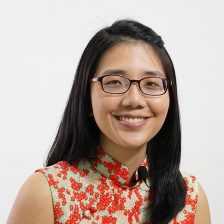
Ka Yi Ling
Shiok MeatsSingapore
Ling and Sriram were co-recipients of the Nikkei Asia Award for their work developing stem-cell based alternative seafood with their company Shiok Meats. Founded in 2018, the company also addresses overfishing and environmental damage caused by fish farm construction. Formerly scientists at Singapore’s Agency for Science, Technology and Research, both Sriram and Ling hope to use their technology to offer sustainable, environment-friendly, cruelty-free healthy food to people all over the world. So far, the team has been able to raise about S$30 million in investments from across Asia. The company hopes to scale up and reduce the cost of its products to provide accessible alternative meat.(Photo: Shiok Meats)
Ling and Sriram were co-recipients of the Nikkei Asia Award for their work developing stem-cell based alternative seafood with their company Shiok Meats. Founded in 2018, the company also addresses overfishing and environmental damage caused by fish farm construction. Formerly scientists at Singapore’s Agency for Science, Technology and Research, both Sriram and Ling hope to use their technology to offer sustainable, environment-friendly, cruelty-free healthy food to people all over the world. So far, the team has been able to raise about S$30 million in investments from across Asia. The company hopes to scale up and reduce the cost of its products to provide accessible alternative meat.(Photo: Shiok Meats)
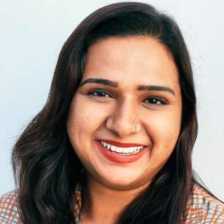
Sandhya Sriram
Shiok MeatsSingapore
Ling and Sriram were co-recipients of the Nikkei Asia Award for their work developing stem-cell based alternative seafood with their company Shiok Meats. Founded in 2018, the company also addresses overfishing and environmental damage caused by fish farm construction. Formerly scientists at Singapore’s Agency for Science, Technology and Research, both Sriram and Ling hope to use their technology to offer sustainable, environment-friendly, cruelty-free healthy food to people all over the world. So far, the team has been able to raise about S$30 million in investments from across Asia. The company hopes to scale up and reduce the cost of its products to provide accessible alternative meat.(Photo:Shiok Meats)

Ling and Sriram were co-recipients of the Nikkei Asia Award for their work developing stem-cell based alternative seafood with their company Shiok Meats. Founded in 2018, the company also addresses overfishing and environmental damage caused by fish farm construction. Formerly scientists at Singapore’s Agency for Science, Technology and Research, both Sriram and Ling hope to use their technology to offer sustainable, environment-friendly, cruelty-free healthy food to people all over the world. So far, the team has been able to raise about S$30 million in investments from across Asia. The company hopes to scale up and reduce the cost of its products to provide accessible alternative meat.(Photo:Shiok Meats)
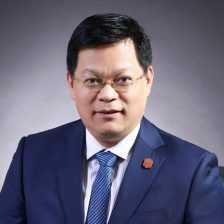
Yong-Guan Zhu
Chinese Academy of SciencesChina
Environmental geologist Zhu was conferred the 2022 International Union of Soil Sciences (IUSS) Von Liebig Award in recognition of his contributions to soil science research.(Photo:Chinese Academy of Sciences)

Environmental geologist Zhu was conferred the 2022 International Union of Soil Sciences (IUSS) Von Liebig Award in recognition of his contributions to soil science research.(Photo:Chinese Academy of Sciences)
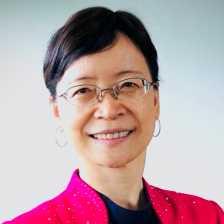
Rong Wang
Nanyang Technological University, SingaporeSingapore
Wang was awarded the President’s Technology Award for her work in the field of membrane science and technology, in pursuit of sustainable energy-efficient liquid purification and desalination.(Photo: Rong Wang)
Wang was awarded the President’s Technology Award for her work in the field of membrane science and technology, in pursuit of sustainable energy-efficient liquid purification and desalination.(Photo: Rong Wang)
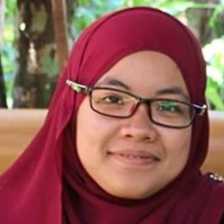
Nur Adlyka Binti Ainul Annuar
Universiti Kebangsaan MalaysiaMalaysia
Adlyka was selected as one of Southeast Asia’s Women of the Future (Science, Technology and Digital) 2021 for helping discover a hidden supermassive black hole in a nearby galaxy.(Photo:The Star)
Adlyka was selected as one of Southeast Asia’s Women of the Future (Science, Technology and Digital) 2021 for helping discover a hidden supermassive black hole in a nearby galaxy.(Photo:The Star)
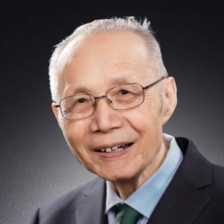
Gu Songfen
Aviation Industry Corporation of ChinaChina
Gu received the 2020 Preeminent Science and Technology Award, the nation’s top scientific award, for his significant contributions to aviation science and technology in China. Notably, Gu established the country’s aerodynamic aircraft design system, leading the design of three generations of local aircraft. He was also the chief designer of China’s first high-speed, high-altitude interceptor fighter jets and carried out strategic research to bolster national aviation efforts. For his leadership, Gu was inducted into both the Chinese Academy of Sciences and Chinese Academy of Engineering.(Photo:CGTN)
Gu received the 2020 Preeminent Science and Technology Award, the nation’s top scientific award, for his significant contributions to aviation science and technology in China. Notably, Gu established the country’s aerodynamic aircraft design system, leading the design of three generations of local aircraft. He was also the chief designer of China’s first high-speed, high-altitude interceptor fighter jets and carried out strategic research to bolster national aviation efforts. For his leadership, Gu was inducted into both the Chinese Academy of Sciences and Chinese Academy of Engineering.(Photo:CGTN)
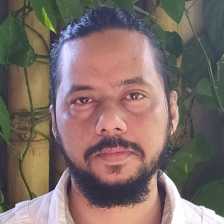
Kanak Saha
Inter-University Centre for Astronomy and AstrophysicsIndia
Saha received the 2021 Shanti Swarup Bhatnagar Prize (Physical Sciences) for his breakthrough discovery of a faint galaxy at high redshift, which was made possible through observations at AstroSat—India’s first space observatory.(Photo:News by Careers360)
Saha received the 2021 Shanti Swarup Bhatnagar Prize (Physical Sciences) for his breakthrough discovery of a faint galaxy at high redshift, which was made possible through observations at AstroSat—India’s first space observatory.(Photo:News by Careers360)
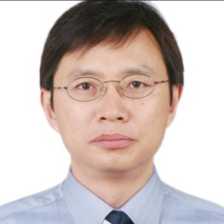
Shen Yanan
University of Science and Technology of ChinaChina
Shen was elected as an international honorary member of the American Academy of Arts and Sciences for his efforts to understand Earth’s history, from its earliest moments to the present day.(Photo:American Academy of Arts and Sciences)
Shen was elected as an international honorary member of the American Academy of Arts and Sciences for his efforts to understand Earth’s history, from its earliest moments to the present day.(Photo:American Academy of Arts and Sciences)
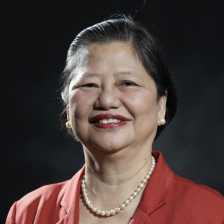
Lucille V. Abad
Philippine Nuclear Research InstitutePhilippines
Abad won the 2021 Ceferino Follosco Award for Product and Process Innovation for developing the environmentally friendly carrageenan plant growth promoter, which has improved the productivity of farmlands across the Philippines.(Photo:Department of Science and Technology)
Abad won the 2021 Ceferino Follosco Award for Product and Process Innovation for developing the environmentally friendly carrageenan plant growth promoter, which has improved the productivity of farmlands across the Philippines.(Photo:Department of Science and Technology)
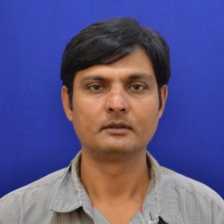
Sahadev Sharma
Universiti MalayaMalaysia
Sharma was awarded the 15th Japan International Award for Young Agricultural Researchers for his research into mangrove forests as an effective nature-based solution for mitigating climate change in Asia.(Photo:IntechOpen)
Sharma was awarded the 15th Japan International Award for Young Agricultural Researchers for his research into mangrove forests as an effective nature-based solution for mitigating climate change in Asia.(Photo:IntechOpen)

Adrian Ybañez
Cebu Technological UniversityPhilippines
Ybañez received the 2021 Leads Agri Award for Agricultural Research for advancing animal parasitology and the study of vector-borne diseases in animals in the Philippines.(Photo:ResearchGate)
Ybañez received the 2021 Leads Agri Award for Agricultural Research for advancing animal parasitology and the study of vector-borne diseases in animals in the Philippines.(Photo:ResearchGate)
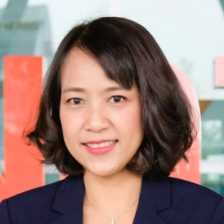
Suwussa Bamrungsap
National Science and Technology Development AgencyThailand
Bamrungsap is a recipient of the 2020 L’Oréal Thailand For Women In Science Fellowship for her work exploring nanoparticle development for medical diagnosis.(Photo:Asian Institute of Technology)
Bamrungsap is a recipient of the 2020 L’Oréal Thailand For Women In Science Fellowship for her work exploring nanoparticle development for medical diagnosis.(Photo:Asian Institute of Technology)

Cheong Sok Ching
Cancer Research MalaysiaMalaysia
Cheong is one of the recipients of the 2022 TWAS medal for her contributions to cancer research in Malaysia.(Photo:TWAS)
Cheong is one of the recipients of the 2022 TWAS medal for her contributions to cancer research in Malaysia.(Photo:TWAS)
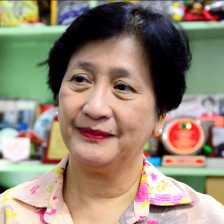
Nina G. Gloriani
University of the Philippines ManilaPhilippines
Gloriani received the 2021 Paulo Campos Award for Health Research for her national leadership during the COVID-19 pandemic as well as for her pioneering research on epidemiology, diagnosis and vaccine development for infectious diseases ranging from Hantaan virus infection to leptospirosis.(Photo:University of the Philippines)
Gloriani received the 2021 Paulo Campos Award for Health Research for her national leadership during the COVID-19 pandemic as well as for her pioneering research on epidemiology, diagnosis and vaccine development for infectious diseases ranging from Hantaan virus infection to leptospirosis.(Photo:University of the Philippines)
Sir Peter Gluckman
Agency for Science, Technology and ResearchSingapore
Gluckman and Ng were co-awarded the 2021 President’s Science and Technology Medal for their collective efforts to advance Singapore’s research landscape and mentor the next generation of young scientists. With a distinguished career in early life research, Gluckman is the scientific architect behind groundbreaking birth cohort studies in the Republic. These studies have shed a much-needed light on how conditions in pregnancy and early childhood influence the health and development of mothers and their children, positively impacting local healthcare policy. Today, he continues to nurture scientific talent and lead research in health and human potential as the Chief Scientific Officer of the Singapore Institute for Clinical Sciences (SICS).Meanwhile, Ng played a pivotal role in transforming SingHealth, the country’s largest public healthcare cluster, into a leading academic medical center. Her leadership has helped expand the research and education talent pool in academic medicine, ensuring that Singapore has the right infrastructure and talent in place to pursue innovation in biomedical research and healthcare delivery.(Photo:The University of Auckland)
Gluckman and Ng were co-awarded the 2021 President’s Science and Technology Medal for their collective efforts to advance Singapore’s research landscape and mentor the next generation of young scientists. With a distinguished career in early life research, Gluckman is the scientific architect behind groundbreaking birth cohort studies in the Republic. These studies have shed a much-needed light on how conditions in pregnancy and early childhood influence the health and development of mothers and their children, positively impacting local healthcare policy. Today, he continues to nurture scientific talent and lead research in health and human potential as the Chief Scientific Officer of the Singapore Institute for Clinical Sciences (SICS).Meanwhile, Ng played a pivotal role in transforming SingHealth, the country’s largest public healthcare cluster, into a leading academic medical center. Her leadership has helped expand the research and education talent pool in academic medicine, ensuring that Singapore has the right infrastructure and talent in place to pursue innovation in biomedical research and healthcare delivery.(Photo:The University of Auckland)
Ivy Ng
SingHealthSingapore
Gluckman and Ng were co-awarded the 2021 President’s Science and Technology Medal for their collective efforts to advance Singapore’s research landscape and mentor the next generation of young scientists. With a distinguished career in early life research, Gluckman is the scientific architect behind groundbreaking birth cohort studies in the Republic. These studies have shed a much-needed light on how conditions in pregnancy and early childhood influence the health and development of mothers and their children, positively impacting local healthcare policy. Today, he continues to nurture scientific talent and lead research in health and human potential as the Chief Scientific Officer of the Singapore Institute for Clinical Sciences (SICS).Meanwhile, Ng played a pivotal role in transforming SingHealth, the country’s largest public healthcare cluster, into a leading academic medical center. Her leadership has helped expand the research and education talent pool in academic medicine, ensuring that Singapore has the right infrastructure and talent in place to pursue innovation in biomedical research and healthcare delivery.(Photo:Agency for Science, Technology and Research)
Gluckman and Ng were co-awarded the 2021 President’s Science and Technology Medal for their collective efforts to advance Singapore’s research landscape and mentor the next generation of young scientists. With a distinguished career in early life research, Gluckman is the scientific architect behind groundbreaking birth cohort studies in the Republic. These studies have shed a much-needed light on how conditions in pregnancy and early childhood influence the health and development of mothers and their children, positively impacting local healthcare policy. Today, he continues to nurture scientific talent and lead research in health and human potential as the Chief Scientific Officer of the Singapore Institute for Clinical Sciences (SICS).Meanwhile, Ng played a pivotal role in transforming SingHealth, the country’s largest public healthcare cluster, into a leading academic medical center. Her leadership has helped expand the research and education talent pool in academic medicine, ensuring that Singapore has the right infrastructure and talent in place to pursue innovation in biomedical research and healthcare delivery.(Photo:Agency for Science, Technology and Research)
Toshiaki Hisada
University of TokyoJapan
Hisada and Sugiura were co- awarded the 2021 Japan Academy Prize for their work on the multi- scale multi-physics simulation of the human heart.(Photo:UT-Heart Research Institute)
Hisada and Sugiura were co- awarded the 2021 Japan Academy Prize for their work on the multi- scale multi-physics simulation of the human heart.(Photo:UT-Heart Research Institute)
Seiryo Suguira
University of TokyoJapan
Hisada and Sugiura were co-awarded the 2021 Japan Academy Prize for their work on the multi-scale multi-physics simulation of the human heart.(Photo:Loop)
Hisada and Sugiura were co-awarded the 2021 Japan Academy Prize for their work on the multi-scale multi-physics simulation of the human heart.(Photo:Loop)
Hu Hailan
Zhejiang UniversityChina
Hu received the 2022 L’Oréal-UNESCO For Women In Science International Award for her research on the underlying neurobiology of mental health disorders like depression.(Photo:Zhejiang University)
Hu received the 2022 L’Oréal-UNESCO For Women In Science International Award for her research on the underlying neurobiology of mental health disorders like depression.(Photo:Zhejiang University)
Truong Thanh Huong
Hanoi Medical UniversityVietnam
Huong was awarded the 2020 Kovalevskaia Prize for leading cardiovascular disease research and management in Vietnam.(Photo:VTC News)
Huong was awarded the 2020 Kovalevskaia Prize for leading cardiovascular disease research and management in Vietnam.(Photo:VTC News)
Hidenori Ichijo
University of TokyoJapan
Ichijo received the 2021 Japan Academy Prize for elucidating the stress response mechanism driven by the apoptosis signal-regulating kinase catalyst.(Photo:Japan Academy Prize)
Ichijo received the 2021 Japan Academy Prize for elucidating the stress response mechanism driven by the apoptosis signal-regulating kinase catalyst.(Photo:Japan Academy Prize)
Kazuhiro Iwai
Kyoto UniversityJapan
Iwai received the 2021 Japan Academy Prize for his discovery of linear ubiquitin chains and analyzing their role in the inflammatory response.(Photo:Kyoto University)
Iwai received the 2021 Japan Academy Prize for his discovery of linear ubiquitin chains and analyzing their role in the inflammatory response.(Photo:Kyoto University)
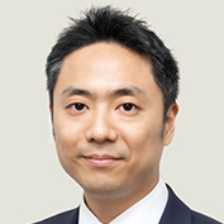
Kim Jin-Hong
Seoul National UniversitySouth Korea
Kim was co-awarded the 2021 Asan Award for Young Medical Scientists for his efforts to develop regenerative strategies for osteoporosis treatment.(Photo:Asan Foundation)
Kim was co-awarded the 2021 Asan Award for Young Medical Scientists for his efforts to develop regenerative strategies for osteoporosis treatment.(Photo:Asan Foundation)
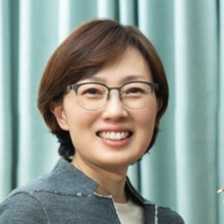
V. Narry Kim
Seoul National UniversitySouth Korea
Kim was elected as the one of two foreign members of the UK’s Royal Society from South Korea for her pioneering contributions to elucidating microRNA biogenesis.(Photo:Royal Society)
Kim was elected as the one of two foreign members of the UK’s Royal Society from South Korea for her pioneering contributions to elucidating microRNA biogenesis.(Photo:Royal Society)
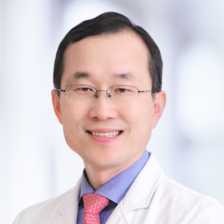
Koo Bon-Kwon
Seoul National UniversitySouth Korea
Koo received the 2021 Asan Award in Clinical Medicine for developing novel machine learning and computer simulation tools to assess coronary heart disease.(Photo:Asan Foundation)
Koo received the 2021 Asan Award in Clinical Medicine for developing novel machine learning and computer simulation tools to assess coronary heart disease.(Photo:Asan Foundation)
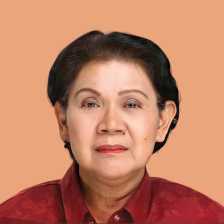
Lydia R. Leonardo
University of the Philippines ManilaPhilippines
Leonardo won the 2021 Lourdes Campos Award for Public Health for her contributions to parasitology, notably her work on the control and treatment of schistosomiasis, a disease caused by parasitic flatworms.(Photo:University of the East)
Leonardo won the 2021 Lourdes Campos Award for Public Health for her contributions to parasitology, notably her work on the control and treatment of schistosomiasis, a disease caused by parasitic flatworms.(Photo:University of the East)
Jeemon Panniyammakal
Sree Chitra Tirunal Institute for Medical Sciences and TechnologyIndia
Panniyammakal was co-awarded the 2021 Shanti Swarup Bhatnagar Prize (Medical Sciences) for his public health contributions in improving the primary care, prevention and control of cardiovascular disease and diabetes in India.(Photo:ACROSS Global Health Network)
Panniyammakal was co-awarded the 2021 Shanti Swarup Bhatnagar Prize (Medical Sciences) for his public health contributions in improving the primary care, prevention and control of cardiovascular disease and diabetes in India.(Photo:ACROSS Global Health Network)
Firdausi Qadri
International Centre for Diarrhoeal Disease ResearchBangladesh
Qadri was awarded the 2021 Ramon Magsaysay Award for her key role in developing affordable vaccines that combat cholera and typhoid.(Photo:Ramon Magsaysay Award)
Qadri was awarded the 2021 Ramon Magsaysay Award for her key role in developing affordable vaccines that combat cholera and typhoid.(Photo:Ramon Magsaysay Award)
Juthamas Ratanavaraporn
Chulalongkorn UniversityThailand
Ratanavaraporn is a recipient of the 2020 L’Oréal Thailand For Women In Science Fellowship for leveraging Thai silk cocoons for biomedical applications like drug delivery systems and scaffolds for tissue repair.(Photo:TheReporter.Asia)
Ratanavaraporn is a recipient of the 2020 L’Oréal Thailand For Women In Science Fellowship for leveraging Thai silk cocoons for biomedical applications like drug delivery systems and scaffolds for tissue repair.(Photo:TheReporter.Asia)
Too Heng-Phon
National University of SingaporeSingapore
Too received the 2021 President’s Technology Award for helping pioneer the development of a method for early disease detection using microRNA biomarkers.(Photo:National University of Singapore)
Too received the 2021 President’s Technology Award for helping pioneer the development of a method for early disease detection using microRNA biomarkers.(Photo:National University of Singapore)
Yoo Changhoon
Asan Medical CenterSouth Korea
Yoo was co-awarded the 2021 Asan Award for Young Medical Scientists for developing new drugs against hepatobiliary and pancreatic cancers.(Photo:Asan Medical Center)
Yoo was co-awarded the 2021 Asan Award for Young Medical Scientists for developing new drugs against hepatobiliary and pancreatic cancers.(Photo:Asan Medical Center)
Bai Chunli
Chinese Academy of SciencesChina
The former president of The World Academy of Sciences (TWAS) and Chinese Academy of Sciences, Bai was awarded the 2022 TWAS- Abdus Salam Medal for his contributions to promoting science in developing countries.(Photo:Royal Society)
The former president of The World Academy of Sciences (TWAS) and Chinese Academy of Sciences, Bai was awarded the 2022 TWAS- Abdus Salam Medal for his contributions to promoting science in developing countries.(Photo:Royal Society)
Baik Mu-Hyun
Korea Advanced Institute of Science and TechnologySouth Korea
Baik was awarded the 2021 POSCO TJ Park Science Prize for exploring the chemical reactions activated by transition metal catalysts, leveraging computational techniques to predict and design better chemical reactions.(Photo:Institute for Basic Science)
Baik was awarded the 2021 POSCO TJ Park Science Prize for exploring the chemical reactions activated by transition metal catalysts, leveraging computational techniques to predict and design better chemical reactions.(Photo:Institute for Basic Science)
Kanishka Biswas
Jawaharlal Nehru Centre for Advanced Scientific ResearchIndia
Biswas was co-awarded the 2021 Shanti Swarup Bhatnagar Prize (Chemical Sciences) for his work on novel thermoelectric materials.(Photo:Edexlive)
Biswas was co-awarded the 2021 Shanti Swarup Bhatnagar Prize (Chemical Sciences) for his work on novel thermoelectric materials.(Photo:Edexlive)

Thimmaiah Govindaraju
Jawaharlal Nehru Centre for Advanced Scientific ResearchIndia
Govindaraju was co-awarded the 2021 Shanti Swarup Bhatnagar Prize (Chemical Sciences) for his contributions to the development of small molecule diagnostics and therapeutics.(Photo:Report Odisha)
Govindaraju was co-awarded the 2021 Shanti Swarup Bhatnagar Prize (Chemical Sciences) for his contributions to the development of small molecule diagnostics and therapeutics.(Photo:Report Odisha)
Zubair Hasan
East West UniversityBangladesh
Hasan received the 2021 TWAS- Atta-ur-Rahman Award for using metal organic frameworks to remove emerging contaminants in pharmaceutical and personal care products.(Photo:East West University)
Hasan received the 2021 TWAS- Atta-ur-Rahman Award for using metal organic frameworks to remove emerging contaminants in pharmaceutical and personal care products.(Photo:East West University)
Kyoko Nozaki
University of TokyoJapan
Nozaki received the 2021 L’Oréal-UNESCO For Women in Science International Award for herpioneering efforts in synthetic chemistry, specifically in designing molecular catalysts for manufacturing useful molecules in environmentally friendly ways.To improve car manufacturing as well as fuel efficiency, Nozaki is developing a high-performing, recyclable polar polypropylene that can be produced without adding harsh chemicals. In the realm of sustainability, she has also worked on synthesizing plastics from renewable resources like carbon dioxide. For her contributions, Nozaki was also elected as an international member of the American Academy of Arts and Sciences.(Photo:The Vallee Foundation)
Nozaki received the 2021 L’Oréal-UNESCO For Women in Science International Award for herpioneering efforts in synthetic chemistry, specifically in designing molecular catalysts for manufacturing useful molecules in environmentally friendly ways.To improve car manufacturing as well as fuel efficiency, Nozaki is developing a high-performing, recyclable polar polypropylene that can be produced without adding harsh chemicals. In the realm of sustainability, she has also worked on synthesizing plastics from renewable resources like carbon dioxide. For her contributions, Nozaki was also elected as an international member of the American Academy of Arts and Sciences.(Photo:The Vallee Foundation)
Wong Chi-Huey
Institute of Biotechnology and Medicine IndustryTaiwan
Wong is the first Taiwanese winner of the 2021 Welch Award in Chemistry for his breakthrough contributions to enzyme technology—pioneering the successful synthesis of complex polysaccharides, the most abundant carbohydrates found in food.(Photo:Taiwan News)
Wong is the first Taiwanese winner of the 2021 Welch Award in Chemistry for his breakthrough contributions to enzyme technology—pioneering the successful synthesis of complex polysaccharides, the most abundant carbohydrates found in food.(Photo:Taiwan News)
Boonyawan Yoosuk
National Science and Technology Development AgencyThailand
Yoosuk is a recipient of the 2020 L’Oréal Thailand For Women In Science Fellowship for exploring how Thai palm oil can be transformed into sustainable high- value products, like clean fuels and biolubricants.(Photo:TheReporter.Asia)
Yoosuk is a recipient of the 2020 L’Oréal Thailand For Women In Science Fellowship for exploring how Thai palm oil can be transformed into sustainable high- value products, like clean fuels and biolubricants.(Photo:TheReporter.Asia)
Anthony James Bautista
University of Santo TomasPhilippines
Bautista won the 2021 Gregorio Y. Zara Award for developing the Logistic Indoor Service Assistant (LISA) telepresence robot. It allows for teleconsultations and medicine delivery, minimizing exposure of Filipino frontliners to the coronavirus.(Photo:University of Santo Tomas)
Bautista won the 2021 Gregorio Y. Zara Award for developing the Logistic Indoor Service Assistant (LISA) telepresence robot. It allows for teleconsultations and medicine delivery, minimizing exposure of Filipino frontliners to the coronavirus.(Photo:University of Santo Tomas)
Chen Xiaodong
Nanyang Technological UniversitySingapore
Chen received the 2021 President’s Science Award for his contributions to advancing soft bioelectronics with the potential to digitalize the human senses.(Photo:ACS Axial)
Chen received the 2021 President’s Science Award for his contributions to advancing soft bioelectronics with the potential to digitalize the human senses.(Photo:ACS Axial)
Chin Daeje
SkyLake Investment Co.South Korea
Chin was elected as an international member of the US National Academy of Engineering for innovations and industry leadership in semiconductor technology.(Photo:US National Academy of Engineering)
Chin was elected as an international member of the US National Academy of Engineering for innovations and industry leadership in semiconductor technology.(Photo:US National Academy of Engineering)
Pawan K. Goenka
Mahindra & Mahindra Ltd.India
Goenka was elected as an international member of the US National Academy of Engineering for expanding Mahindra’s automotive business in India and his contributions to automotive engine lubrication.(Photo:US National Academy of Engineering)
Goenka was elected as an international member of the US National Academy of Engineering for expanding Mahindra’s automotive business in India and his contributions to automotive engine lubrication.(Photo:US National Academy of Engineering)
Jeong Han
i3 SystemsSouth Korea
Jeong was awarded the 2021 POSCO TJ Park Technology Prize for pioneering the development of infrared image sensors in South Korea, helping make the country only the seventh in the world to mass produce such sensors.(Photo:POSCO TJ Park)
Jeong was awarded the 2021 POSCO TJ Park Technology Prize for pioneering the development of infrared image sensors in South Korea, helping make the country only the seventh in the world to mass produce such sensors.(Photo:POSCO TJ Park)
Philip T. Krein
Zhejiang UniversityChina
Krein was recognized with the 2021 IEEE Transportation Technologies Award for his contributions to electric vehicle battery management and hybrid system optimization.(Photo:Zhejiang University)
Krein was recognized with the 2021 IEEE Transportation Technologies Award for his contributions to electric vehicle battery management and hybrid system optimization.(Photo:Zhejiang University)
Lee Sang Yup
Korea Advanced Institute of Science and TechnologySouth Korea
Lee was elected as one of the two first-ever South Korean members of the Royal Society in the UK for his pioneering contributions to systems metabolic engineering.(Photo:AlChe)
Lee was elected as one of the two first-ever South Korean members of the Royal Society in the UK for his pioneering contributions to systems metabolic engineering.(Photo:AlChe)
Joey D. Ocon
University of the Philippines DilimanPhilippines
Ocon received the 2021 David M. Consunji Award for Engineering Research for developing novel materials and processes in clean energy technologies.(Photo:International Forum for High Potentials in Sustainable Development)
Ocon received the 2021 David M. Consunji Award for Engineering Research for developing novel materials and processes in clean energy technologies.(Photo:International Forum for High Potentials in Sustainable Development)
Aditya Sadhanala
Indian Institute of ScienceIndia
Sadhanala received the 2021 Early Career Scientist Award (Asia) from the International Science Council for developing one of the world’s most sensitive absorption measurement techniques, along with his contributions to energy and optoelectronics research.(Photo:International Science Council)
Sadhanala received the 2021 Early Career Scientist Award (Asia) from the International Science Council for developing one of the world’s most sensitive absorption measurement techniques, along with his contributions to energy and optoelectronics research.(Photo:International Science Council)
Rohit Srivastava
Indian Institute of Technology BombayIndia
Srivastava was co-awarded the 2021 Shanti Swarup Bhatnagar Prize (Medical Sciences) for his contributions to developing affordable medical devices.(Photo:Indian Institute of Technology Bombay)
Srivastava was co-awarded the 2021 Shanti Swarup Bhatnagar Prize (Medical Sciences) for his contributions to developing affordable medical devices.(Photo:Indian Institute of Technology Bombay)
Su Guaning
Nanyang Technological UniversitySingapore
Su was elected as an international member of the US National Academy of Engineering for his contributions to regional security and defense, as well as his academic leadership as president emeritus of Nanyang Technological University, Singapore.(Photo:US National Academy of Engineering)
Su was elected as an international member of the US National Academy of Engineering for his contributions to regional security and defense, as well as his academic leadership as president emeritus of Nanyang Technological University, Singapore.(Photo:US National Academy of Engineering)
Simon Sze
National Yang Ming Chiao Tung UniversityTaiwan
Sze was awarded the 2021 Mathematics and Computer Science Prize for his pioneering contributions to inter-metal and semiconductor carrier transports. His discoveries established both the scientific basis and practical guidelines for implementing modern semiconductor devices, enabling the scaling of integrated circuits over the past half-century. Sze also co- discovered the floating gate memory effect, which laid the groundwork for the invention of non-volatile memories such as flash memory.(Photo:Future Science Prize)
Sze was awarded the 2021 Mathematics and Computer Science Prize for his pioneering contributions to inter-metal and semiconductor carrier transports. His discoveries established both the scientific basis and practical guidelines for implementing modern semiconductor devices, enabling the scaling of integrated circuits over the past half-century. Sze also co- discovered the floating gate memory effect, which laid the groundwork for the invention of non-volatile memories such as flash memory.(Photo:Future Science Prize)
Guillermo Q. Tabios III
University of the Philippines DilimanPhilippines
Tabios received the 2021 Michael R. I. Purvis Award for Sustainability Research for his advocacy in linking sustainability science, policy and management with a transdisciplinary approach in sustainable water resources development.(Photo:National Academy of Science and Technology Philippines)
Tabios received the 2021 Michael R. I. Purvis Award for Sustainability Research for his advocacy in linking sustainability science, policy and management with a transdisciplinary approach in sustainable water resources development.(Photo:National Academy of Science and Technology Philippines)
Dian Burhani
Indonesian Institute of ScienceIndonesia
Burhani received the 2021 UNESCO Man and the Biosphere (MAB) Young Scientist Award for her work exploring macroalgae from Central Java’s Karimunjawa-Jepara-Muria Biosphere Reserve as a substitute for conventional mask materials. Typically, the materials in single-use masks produce microplastics that are harmful to the environment, spurring Burhani to look for more sustainable alternatives. Her research shows that mask filters made from macroalgae- based nanofibers not only provide optimal comfort, but are also highly efficient in removing bioaerosols—a step forward in promoting the green economy for the reserve’s local community.(Photo:Indonesian Institute of Sciences)
Burhani received the 2021 UNESCO Man and the Biosphere (MAB) Young Scientist Award for her work exploring macroalgae from Central Java’s Karimunjawa-Jepara-Muria Biosphere Reserve as a substitute for conventional mask materials. Typically, the materials in single-use masks produce microplastics that are harmful to the environment, spurring Burhani to look for more sustainable alternatives. Her research shows that mask filters made from macroalgae- based nanofibers not only provide optimal comfort, but are also highly efficient in removing bioaerosols—a step forward in promoting the green economy for the reserve’s local community.(Photo:Indonesian Institute of Sciences)
Asuncion B. De Guzman
Mindanao State University Naawan Foundation for Science and Technology DevelopmentPhilippines
De Guzman received the 2021 Gregorio Y. Zara Award for Basic Research for her exploring the vulnerability of small pelagic fish to climate change and the socioeconomic impact of subsistence fisheries.(Photo:ResearchGate)
De Guzman received the 2021 Gregorio Y. Zara Award for Basic Research for her exploring the vulnerability of small pelagic fish to climate change and the socioeconomic impact of subsistence fisheries.(Photo:ResearchGate)
Guo Huadong
Chinese Academy of SciencesChina
Guo received the 2021 Science for Sustainability Award from the International Science Council for his active contributions to international efforts to achieve the UN's Sustainable Development Goals, with a focus on global Big Earth Data.(Photo:International Science Council)
Guo received the 2021 Science for Sustainability Award from the International Science Council for his active contributions to international efforts to achieve the UN's Sustainable Development Goals, with a focus on global Big Earth Data.(Photo:International Science Council)
Li Hongying
Agency for Science, Technology and ResearchSingapore
Li was awarded with the 2021 Underwriters Laboratories-ASEAN-US Science Prize for Women for designing a novel water treatment system that protects marine life from water pollution, as well as for her computational work in predicting COVID-19 transmission risk through droplet dispersion.(Photo:Agency for Science, Technology and Research)
Li was awarded with the 2021 Underwriters Laboratories-ASEAN-US Science Prize for Women for designing a novel water treatment system that protects marine life from water pollution, as well as for her computational work in predicting COVID-19 transmission risk through droplet dispersion.(Photo:Agency for Science, Technology and Research)
Lin Yi-Yi
National Taiwan UniversityTaiwan
Lin received the Most Outstanding Researcher Award at the 14th Taiwan Outstanding Women in Science ceremony for her contributions to typhoon forecasting.(Photo:Tatler Asia)
Lin received the Most Outstanding Researcher Award at the 14th Taiwan Outstanding Women in Science ceremony for her contributions to typhoon forecasting.(Photo:Tatler Asia)
Narendra Ojha
Physical Research LaboratoryIndia
Ojha was awarded the 2021 ICTP Prize for his contributions to understanding the influence of human-driven and biomass-burning emissions on Southeast Asia's air quality.(Photo:Physical Research Laboratory)
Ojha was awarded the 2021 ICTP Prize for his contributions to understanding the influence of human-driven and biomass-burning emissions on Southeast Asia's air quality.(Photo:Physical Research Laboratory)
Binoy Kumar Saikia
North East Institute of Science and TechnologyIndia
Saikia received the 2021 Shanti Swarup Bhatnagar Prize (Earth, Atmosphere, Ocean and Planetary Sciences) for developing fluorescent carbon quantum dots from Indian coal.(Photo:time8)
Saikia received the 2021 Shanti Swarup Bhatnagar Prize (Earth, Atmosphere, Ocean and Planetary Sciences) for developing fluorescent carbon quantum dots from Indian coal.(Photo:time8)
Neni Sintawardani
Indonesian Institute of SciencesIndonesia
Sintawardani was awarded the 2021 Underwriters Laboratories-ASEAN-US Science Prize for Women for using biogas from processed wastewater to increase clean water availability and improve community sanitation systems.(Photo:ASEAN-US Science Prize for Women)
Sintawardani was awarded the 2021 Underwriters Laboratories-ASEAN-US Science Prize for Women for using biogas from processed wastewater to increase clean water availability and improve community sanitation systems.(Photo:ASEAN-US Science Prize for Women)
Chen Yun-Nung
National Taiwan UniversityTaiwan
Chen was recognized as a Young Scientist of Excellence at the 14th Taiwan Outstanding Women in Science ceremony for her contributions to spoken dialogue systems and natural language processing, among others.(Photo:ResearchGate)
Chen was recognized as a Young Scientist of Excellence at the 14th Taiwan Outstanding Women in Science ceremony for her contributions to spoken dialogue systems and natural language processing, among others.(Photo:ResearchGate)
Kunihiko Fukushima
Fuzzy Logic Systems InstituteJapan
Fukushima was awarded the 2021 C&C Prize for his inventing the neocognitron, a hierarchical neural network model of the brain's visual cortex.(Photo: Kunihiko Fukushima)
Fukushima was awarded the 2021 C&C Prize for his inventing the neocognitron, a hierarchical neural network model of the brain's visual cortex.(Photo: Kunihiko Fukushima)
Debdeep Mukhopadhyay
Indian Institute of Technology, KharagpurIndia
Mukhopadhyay received the 2021 Shanti Swarup Bhatnagar Prize (Engineering Sciences) for his research on micro-architectural security and crypto-engineering that bridges mathematical theory with practical cyberattack scenarios.(Photo:LinkedIn)
Mukhopadhyay received the 2021 Shanti Swarup Bhatnagar Prize (Engineering Sciences) for his research on micro-architectural security and crypto-engineering that bridges mathematical theory with practical cyberattack scenarios.(Photo:LinkedIn)
Zhang Hanwang
Nanyang Technological University, SingaporeSingapore
Zhang was awarded the 2021 Young Scientist Award for his pioneering group theory in building a framework that describes what artificial intelligence learns, how it learns and where its knowledge can be transferred.(Photo:Nanyang Technological University)
Zhang was awarded the 2021 Young Scientist Award for his pioneering group theory in building a framework that describes what artificial intelligence learns, how it learns and where its knowledge can be transferred.(Photo:Nanyang Technological University)
Andrew Chi-Chih Yao
Tsinghua UniversityChina
Yao received the 2021 Kyoto Prize in Advanced Technology for his contributions to computer science and their impact on cybersecurity and big data processing, among others.(Photo:Kyoto Prize)
Yao received the 2021 Kyoto Prize in Advanced Technology for his contributions to computer science and their impact on cybersecurity and big data processing, among others.(Photo:Kyoto Prize)
Raymond W. Yeung
Chinese University of Hong KongHong Kong
The first Asian researcher to receive the IEEE Richard W. Hamming Medal since its establishment in 1988, Yeung was awarded for co-founding the field of network coding and pioneering the development of the BATS code.(Photo:Chinese University of Hong Kong)
The first Asian researcher to receive the IEEE Richard W. Hamming Medal since its establishment in 1988, Yeung was awarded for co-founding the field of network coding and pioneering the development of the BATS code.(Photo:Chinese University of Hong Kong)
Sudkate Chaiyo
Chulalongkorn UniversityThailand
Chaiyo was recognized under Thailand's Young Scientist Awards 2021 for inventing new sensors for biochemical analysis with applications in food and agriculture to clinical laboratories. Chaiyo was recognized under Thailand's Young Scientist Awards 2021 for inventing new sensors for biochemical analysis with applications in food and agriculture to clinical laboratories.(Photo:Chulalongkorn University)
Chaiyo was recognized under Thailand's Young Scientist Awards 2021 for inventing new sensors for biochemical analysis with applications in food and agriculture to clinical laboratories. Chaiyo was recognized under Thailand's Young Scientist Awards 2021 for inventing new sensors for biochemical analysis with applications in food and agriculture to clinical laboratories.(Photo:Chulalongkorn University)
Guan Yi
University of Hong KongHong Kong
Guan and Peiris were jointly awarded the 2021 John Dirks Canada Gairdner Global Health Award for their significant contributions to understanding the origins of emerging infectious disease outbreaks in Asia, notably zoonotic influenza and severe acute respiratory syndrome (SARS). The pair started collaborating in the wake of Hong Kong’s H5N1 avian flu outbreak, initiating foundational studies on the virus’ evolution and developing a highly effective monitoring and surveillance program. During the 2003 SARS outbreak, Peiris led the team that first identified the virus responsible for the syndrome, SARS-CoV-1, while Guan traced the virus’ origins to the wild animal markets in Guangdong, China. Together, their pioneering investigations into emerging infectious diseases have provided critical insights in subsequent outbreaks, including the ongoing COVID-19 pandemic.(Photo:University of Hong Kong)
Guan and Peiris were jointly awarded the 2021 John Dirks Canada Gairdner Global Health Award for their significant contributions to understanding the origins of emerging infectious disease outbreaks in Asia, notably zoonotic influenza and severe acute respiratory syndrome (SARS). The pair started collaborating in the wake of Hong Kong’s H5N1 avian flu outbreak, initiating foundational studies on the virus’ evolution and developing a highly effective monitoring and surveillance program. During the 2003 SARS outbreak, Peiris led the team that first identified the virus responsible for the syndrome, SARS-CoV-1, while Guan traced the virus’ origins to the wild animal markets in Guangdong, China. Together, their pioneering investigations into emerging infectious diseases have provided critical insights in subsequent outbreaks, including the ongoing COVID-19 pandemic.(Photo:University of Hong Kong)
Joseph Sriyal Malik Peiris
University of Hong KongHong Kong
Guan and Peiris were jointly awarded the 2021 John Dirks Canada Gairdner Global Health Award for their significant contributions to understanding the origins of emerging infectious disease outbreaks in Asia, notably zoonotic influenza and severe acute respiratory syndrome (SARS). The pair started collaborating in the wake of Hong Kong’s H5N1 avian flu outbreak, initiating foundational studies on the virus’ evolution and developing a highly effective monitoring and surveillance program. During the 2003 SARS outbreak, Peiris led the team that first identified the virus responsible for the syndrome, SARS-CoV-1, while Guan traced the virus’ origins to the wild animal markets in Guangdong, China. Together, their pioneering investigations into emerging infectious diseases have provided critical insights in subsequent outbreaks, including the ongoing COVID-19 pandemic.(Photo:University of Hong Kong)
Guan and Peiris were jointly awarded the 2021 John Dirks Canada Gairdner Global Health Award for their significant contributions to understanding the origins of emerging infectious disease outbreaks in Asia, notably zoonotic influenza and severe acute respiratory syndrome (SARS). The pair started collaborating in the wake of Hong Kong’s H5N1 avian flu outbreak, initiating foundational studies on the virus’ evolution and developing a highly effective monitoring and surveillance program. During the 2003 SARS outbreak, Peiris led the team that first identified the virus responsible for the syndrome, SARS-CoV-1, while Guan traced the virus’ origins to the wild animal markets in Guangdong, China. Together, their pioneering investigations into emerging infectious diseases have provided critical insights in subsequent outbreaks, including the ongoing COVID-19 pandemic.(Photo:University of Hong Kong)
Kaang Bong-Kiun
Seoul National UniversitySouth Korea
Kaang received the 2021 Ho-am Prize in Chemistry and Life Sciences for his work exploring the molecular mechanisms that underlie how our brains store and retrieve information at the synaptic level.(Photo:Seoul National University)
Kaang received the 2021 Ho-am Prize in Chemistry and Life Sciences for his work exploring the molecular mechanisms that underlie how our brains store and retrieve information at the synaptic level.(Photo:Seoul National University)
Yuji Kamiya
RIKENJapan
Kamiya received the 2021 Japan Academy Prize for studying the biosynthesis and regulation of plant growth hormones.(Photo:Japan Academy Prize)
Kamiya received the 2021 Japan Academy Prize for studying the biosynthesis and regulation of plant growth hormones.(Photo:Japan Academy Prize)
Kang Le
Hebei UniversityChina
Kang was elected as an international member of the National Academy of Science for his contributions to entomology and ecology genomics.(Photo:Chinese Academy of Sciences)
Kang was elected as an international member of the National Academy of Science for his contributions to entomology and ecology genomics.(Photo:Chinese Academy of Sciences)
Sarah Luo
Agency for Science, Technology and ResearchSingapore
Luo was awarded the 2021 Young Scientist Award for discovering a novel neural circuit that regulates appetite, bridging the fields of neuroscience and metabolic research.(Photo:Agency for Science, Technology and Research)
Luo was awarded the 2021 Young Scientist Award for discovering a novel neural circuit that regulates appetite, bridging the fields of neuroscience and metabolic research.(Photo:Agency for Science, Technology and Research)
Atsushi Miyawaki
RIKENJapan
Miyawaki received the 2021 Japan Academy Prize for enhancing bioimaging technology to better understand cellular signaling mechanisms.(Photo:RIKEN Center for Brain Science)
Miyawaki received the 2021 Japan Academy Prize for enhancing bioimaging technology to better understand cellular signaling mechanisms.(Photo:RIKEN Center for Brain Science)
Arun Kumar Shukla
Indian Institute of Technology, KanpurIndia
Shukla is one of the recipients of the 2021 Shanti Swarup Bhatnagar Prize (Biological Sciences) for deepening our understanding of the activation, signaling and regulation of G protein-coupled receptors.(Photo:Indian Institute of Technology, Kanpur)
Shukla is one of the recipients of the 2021 Shanti Swarup Bhatnagar Prize (Biological Sciences) for deepening our understanding of the activation, signaling and regulation of G protein-coupled receptors.(Photo:Indian Institute of Technology, Kanpur)
Amit Singh
Indian Institute of Science, BengaluruIndia
Singh is one of the recipients of the 2021 Shanti Swarup Bhatnagar Prize (Biological Sciences) for his contributions to the understanding host-pathogen interactions in tuberculosis and HIV/AIDS.(Photo:India Alliance)
Singh is one of the recipients of the 2021 Shanti Swarup Bhatnagar Prize (Biological Sciences) for his contributions to the understanding host-pathogen interactions in tuberculosis and HIV/AIDS.(Photo:India Alliance)
Mikiko Tanaka
Tokyo Institute of TechnologyJapan
Tanaka received the 41st Saruhashi Prize for her research on the development and evolution of vertebrate limbs, with her studies on sharks shedding a light on the evolutionary origin of limb muscles.(Photo:Tokyo Institute of Technology)
Tanaka received the 41st Saruhashi Prize for her research on the development and evolution of vertebrate limbs, with her studies on sharks shedding a light on the evolutionary origin of limb muscles.(Photo:Tokyo Institute of Technology)
Tsay Yi-Fang
Academia SinicaTaiwan
Tsay was elected as an international member of the National Academy of Science for her work on nitrate transport, signaling and utilization efficiency in plants.(Photo:Overseas Community Affairs Council)
Tsay was elected as an international member of the National Academy of Science for her work on nitrate transport, signaling and utilization efficiency in plants.(Photo:Overseas Community Affairs Council)
Wang Linfa
Duke-NUS Medical SchoolSingapore
Wang received the 2021 President's Science Award for his foundational work in bat biology, such as his team's discovery that bats are a SARS-CoV-1 reservoir— paving the way for a more effective response to the COVID-19 pandemic.(Photo:Agency for Science, Technology and Research)
Wang received the 2021 President's Science Award for his foundational work in bat biology, such as his team's discovery that bats are a SARS-CoV-1 reservoir— paving the way for a more effective response to the COVID-19 pandemic.(Photo:Agency for Science, Technology and Research)
Yuen Kwok-Yung
University of Hong KongHong Kong
Yuen, alongside Peiris, was co-awarded the 2021 Life Science Prize for their seminal contributions to public understanding of emerging infectious diseases, including SARS in 2003 and the ongoing COVID-19 outbreak.(Photo:University of Hong Kong)
Yuen, alongside Peiris, was co-awarded the 2021 Life Science Prize for their seminal contributions to public understanding of emerging infectious diseases, including SARS in 2003 and the ongoing COVID-19 outbreak.(Photo:University of Hong Kong)
Liu Bin
National University of SingaporeSingapore
Liu was awarded the 2021 Centenary Prize for the innovative design and synthesis of organic molecules and nanomaterials in biomedicine, as well as for excellence in communication.(Photo:Royal Society of Chemistry)
Liu was awarded the 2021 Centenary Prize for the innovative design and synthesis of organic molecules and nanomaterials in biomedicine, as well as for excellence in communication.(Photo:Royal Society of Chemistry)
Imalka Munaweera
University of Sri JayewardenepuraSri Lanka
Munaweera is one of the winners of the 2021 OWSD-Elsevier Foundation Award for Early-Career Women Scientists in the Developing World. She was recognized for her research that focusing on fabricating different functionalized materials, nanoparticles and nanocomposites for industrial applications—ranging from drug delivery to water filtration and even minimizing the post-harvest losses of fruits and vegetables.(Photo:The Morning)
Munaweera is one of the winners of the 2021 OWSD-Elsevier Foundation Award for Early-Career Women Scientists in the Developing World. She was recognized for her research that focusing on fabricating different functionalized materials, nanoparticles and nanocomposites for industrial applications—ranging from drug delivery to water filtration and even minimizing the post-harvest losses of fruits and vegetables.(Photo:The Morning)
Vinich Promarak
Vidyasirmedhi InstituteThailand
Nanomaterials researcher Promarak was awarded Thailand's Outstanding Scientist Award 2021 for developing next-generation solar cell and lighting technology.(Photo:Vidyasirimedhi Institute)
Nanomaterials researcher Promarak was awarded Thailand's Outstanding Scientist Award 2021 for developing next-generation solar cell and lighting technology.(Photo:Vidyasirimedhi Institute)
Thirumalai Venkatesan
National University of SingaporeSingapore
Venkatesan was elected as a Fellow of the Royal Society for inventing the pulsed laser deposition process and pioneering its application to thin films of complex oxides and multi-component materials.(Photo:National University of Singapore)
Venkatesan was elected as a Fellow of the Royal Society for inventing the pulsed laser deposition process and pioneering its application to thin films of complex oxides and multi-component materials.(Photo:National University of Singapore)
Wu Hsin-Jay
National Yang Ming Chiao Tung UniversityTaiwan
Wu was recognized as a Young Scientist of Excellence at the 14th Taiwan Outstanding Women in Science ceremony for her contributions to high-efficiency thermoelectric materials, with applications in advancing green energy.(Photo:National Yang Ming Chiao Tung University)
Wu was recognized as a Young Scientist of Excellence at the 14th Taiwan Outstanding Women in Science ceremony for her contributions to high-efficiency thermoelectric materials, with applications in advancing green energy.(Photo:National Yang Ming Chiao Tung University)

Khongorzul Dorjgotov
National University of MongoliaMongolia
Dorjgotov is one of the winners of the 2021 OWSD-Elsevier Foundation Award for Early-Career Women Scientists in the Developing World. She was recognized for her contributions to financial mathematics and mathematical modeling.(Photo:University of Science and Technology)
Dorjgotov is one of the winners of the 2021 OWSD-Elsevier Foundation Award for Early-Career Women Scientists in the Developing World. She was recognized for her contributions to financial mathematics and mathematical modeling.(Photo:University of Science and Technology)
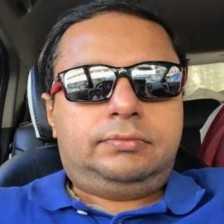
Anish Ghosh
Tata Institute of Fundamental ResearchIndia
Ghosh was co-awarded the 2021 Shanti Swarup Bhatnagar Prize (Mathematical Sciences) for his leading contributions to the field of Ergodic theory.(Photo:Hindustan Times)
Ghosh was co-awarded the 2021 Shanti Swarup Bhatnagar Prize (Mathematical Sciences) for his leading contributions to the field of Ergodic theory.(Photo:Hindustan Times)
Neena Gupta
Indian Statistical InstituteIndia
The third woman and fourth Indian to receive the DST-ICTP-IMU Ramanujan Prize for young mathematicians from developing countries, Gupta was awarded for her work in affine algebraic geometry and commutative algebra. In particular, she was recognized for her solution to the Zariski cancellation problem for affine spaces—a fundamental problem in algebraic geometry that was first posed by the field’s founder Oscar Zariski in 1949. Gupta also received the Indian National Science Academy Young Scientist Award in 2014 and the Shanti Swarup Bhatnagar Prize (Mathematical Sciences) in 2019 for her breakthrough contributions.(Photo:Scroll.in)
The third woman and fourth Indian to receive the DST-ICTP-IMU Ramanujan Prize for young mathematicians from developing countries, Gupta was awarded for her work in affine algebraic geometry and commutative algebra. In particular, she was recognized for her solution to the Zariski cancellation problem for affine spaces—a fundamental problem in algebraic geometry that was first posed by the field’s founder Oscar Zariski in 1949. Gupta also received the Indian National Science Academy Young Scientist Award in 2014 and the Shanti Swarup Bhatnagar Prize (Mathematical Sciences) in 2019 for her breakthrough contributions.(Photo:Scroll.in)
June Huh
Korea Institute for Advanced StudySouth Korea
Huh received the 2021 Ho-am Prize in Physics and Mathematics for using breakthrough methods from algebraic geometry to prove unsolved problems like Read's conjecture and the Rota-Heron-Welsh conjecture.(Photo:Princeton University)
Huh received the 2021 Ho-am Prize in Physics and Mathematics for using breakthrough methods from algebraic geometry to prove unsolved problems like Read's conjecture and the Rota-Heron-Welsh conjecture.(Photo:Princeton University)
Shihoko Ishii
University of TokyoJapan
Ishii was awarded the 2021 Imperial Prize and Japan Academy Prize for her multilateral studies on singularities.(Photo:University of Tokyo)
Ishii was awarded the 2021 Imperial Prize and Japan Academy Prize for her multilateral studies on singularities.(Photo:University of Tokyo)
Takuro Mochizuki
Kyoto UniversityJapan
Mochizuki was awarded the 2022 Breakthrough Prize in Mathematics for deepening the understanding of the theory of bundles with flat connections over algebraic varieties, including the case of irregular singularities.(Photo:Kyoto University)
Mochizuki was awarded the 2022 Breakthrough Prize in Mathematics for deepening the understanding of the theory of bundles with flat connections over algebraic varieties, including the case of irregular singularities.(Photo:Kyoto University)
Makiko Sasada
University of TokyoJapan
Sasada was awarded the 3rd Brilliant Female Researchers Award (Jun Ashida Award) for her mathematical contributions to interacting particle systems.(Photo:Center for Advanced Intelligence Project)
Sasada was awarded the 3rd Brilliant Female Researchers Award (Jun Ashida Award) for her mathematical contributions to interacting particle systems.(Photo:Center for Advanced Intelligence Project)
Saket Saurabh
Tata Institute of Fundamental ResearchIndia
Saurabh was co-awarded the 2021 Shanti Swarup Bhatnagar Prize (Mathematical Sciences) for his leading contributions to parameterized complexity.(Photo:University of Bergen)
Saurabh was co-awarded the 2021 Shanti Swarup Bhatnagar Prize (Mathematical Sciences) for his leading contributions to parameterized complexity.(Photo:University of Bergen)
Teerapong Suksumran
Chiang Mai UniversityThailand
Suksumran was recognized under Thailand's Young Scientist Awards 2021 for developing a methodology for gyrogroup, an abstract mathematical concept related to Einstein's special theory of relativity.(Photo:Chiang Mai University)
Suksumran was recognized under Thailand's Young Scientist Awards 2021 for developing a methodology for gyrogroup, an abstract mathematical concept related to Einstein's special theory of relativity.(Photo:Chiang Mai University)
Yvonne Gao
National University of SingaporeSingapore
Gao was awarded the 2021 Young Scientist Award for her research revolving around the development of key hardware building blocks for quantum computers.(Photo:Asian Scientist Magazine)
Gao was awarded the 2021 Young Scientist Award for her research revolving around the development of key hardware building blocks for quantum computers.(Photo:Asian Scientist Magazine)
Hahm Taik Soo
Seoul National UniversitySouth Korea
Hahm is the 8th Laureate of the S. Chandrasekhar Prize of Plasma Physics for broadening our understanding of turbulence and confinement physics in tokamak plasmas as well as pioneering the development of modern nonlinear gyrokinetic theories. At the Seoul National University, his research group focuses on the theoretical study of plasmas in magnetic fusion devices, including its instabilities as well as the anomalous transport of magnetically confined plasmas.(Photo:Seoul National University)
Hahm is the 8th Laureate of the S. Chandrasekhar Prize of Plasma Physics for broadening our understanding of turbulence and confinement physics in tokamak plasmas as well as pioneering the development of modern nonlinear gyrokinetic theories. At the Seoul National University, his research group focuses on the theoretical study of plasmas in magnetic fusion devices, including its instabilities as well as the anomalous transport of magnetically confined plasmas.(Photo:Seoul National University)
Kenichi Iga
Tokyo Institute of TechnologyJapan
Iga received the 2021 IEEE Edison Medal for pioneering the development of the vertical-cavity surface-emitting laser.(Photo:Tokyo Institute of Technology)
Iga received the 2021 IEEE Edison Medal for pioneering the development of the vertical-cavity surface-emitting laser.(Photo:Tokyo Institute of Technology)
Hidetoshi Katori
RIKENJapan
Katori was co-awarded the 2022 Breakthrough Prize in Fundamental Physics along with Jun Ye of the US for their invention and development of the optical lattice clock, enabling precision testing of nature's most fundamental laws.(Photo:University of Tokyo)
Katori was co-awarded the 2022 Breakthrough Prize in Fundamental Physics along with Jun Ye of the US for their invention and development of the optical lattice clock, enabling precision testing of nature's most fundamental laws.(Photo:University of Tokyo)
Shunsuke Kobayashi
Tokyo University of Science YamaguchiJapan
Kobayashi and Uchida were co-awarded the 2021 Japan Academy Prize for elucidating the physical properties of liquid crystals and studying high-performance liquid crystal displays.(Photo:Shunsuke Kobayashi)
Kobayashi and Uchida were co-awarded the 2021 Japan Academy Prize for elucidating the physical properties of liquid crystals and studying high-performance liquid crystal displays.(Photo:Shunsuke Kobayashi)
Tatsuo Uchida
Tohoku UniversityJapan
Kobayashi and Uchida were co-awarded the 2021 Japan Academy Prize for elucidating the physical properties of liquid crystals and studying high-performance liquid crystal displays.(Photo:Tohoku University)
Kobayashi and Uchida were co-awarded the 2021 Japan Academy Prize for elucidating the physical properties of liquid crystals and studying high-performance liquid crystal displays.(Photo:Tohoku University)
Wang Dazhong
Chinese Academy of SciencesChina
Wang was conferred the 2020 Preeminent Science and Technology Award in recognition of decades leading nuclear energy research in China and his work on advancing nuclear energy systems with inherent safety features.(Photo:Tsinghua University)
Wang was conferred the 2020 Preeminent Science and Technology Award in recognition of decades leading nuclear energy research in China and his work on advancing nuclear energy systems with inherent safety features.(Photo:Tsinghua University)
Haruki Watanabe
University of TokyoJapan
Watanabe was co-awarded the 2022 New Horizons in Physics Prize for his pioneering theoretical work formulating novel phases of non-equilibrium quantum matter, including time crystals.(Photo:University of Tokyo)
Watanabe was co-awarded the 2022 New Horizons in Physics Prize for his pioneering theoretical work formulating novel phases of non-equilibrium quantum matter, including time crystals.(Photo:University of Tokyo)
Yao Wang
University of Hong KongHong Kong
The 2021 Nishina Asia Award was given to Yao for his exceptional contributions to valleytronics in two-dimensional semiconductors and van der Waals heterostructures.(Photo:University of Hong Kong)
The 2021 Nishina Asia Award was given to Yao for his exceptional contributions to valleytronics in two-dimensional semiconductors and van der Waals heterostructures.(Photo:University of Hong Kong)
Zhang Jie
Chinese Academy of SciencesChina
Zhang was awarded the 2021 Physical Science Prize for developing laser-based fast electron beam technologies and their applications.(Photo:Future Science Prize)
Zhang was awarded the 2021 Physical Science Prize for developing laser-based fast electron beam technologies and their applications.(Photo:Future Science Prize)
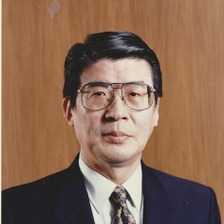
Tomifumi Godai
Japan Aerospace Exploration Agency (JAXA)Japan
Godai was inducted into the International Astronautical Federation Hall of Fame for his significant contributions to Japan’s aerospace industry.(Photo:International Astronautical Federation)
Godai was inducted into the International Astronautical Federation Hall of Fame for his significant contributions to Japan’s aerospace industry.(Photo:International Astronautical Federation)
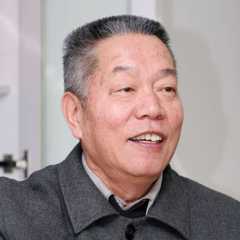
Meng Zhizhong
Chinese Academy of EngineeringChina
Meng was inducted into the International Astronautical Federation Hall of Fame for his contributions as a pioneer of China’s aerospace industry.(Photo:International Astronautical Federation)
Meng was inducted into the International Astronautical Federation Hall of Fame for his contributions as a pioneer of China’s aerospace industry.(Photo:International Astronautical Federation)
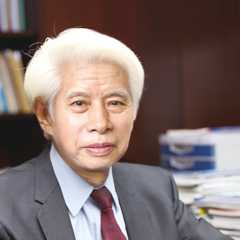
Yu Menglun
Chinese Academy of ScienceChina
Yu was inducted into the International Astronautical Federation Hall of Fame for his contributions as a pioneer of China’s aerospace industry.(Photo:International Astronautical Federation)
Yu was inducted into the International Astronautical Federation Hall of Fame for his contributions as a pioneer of China’s aerospace industry.(Photo:International Astronautical Federation)
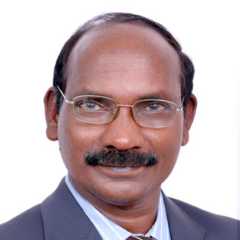
Kailasavadivoo Sivan
Indian Space Research OrganizationIndia
Sivan was awarded the Institute of Electrical and Electronics Engineers (IEEE) Simon Ramo Medal for developing pioneering space technology and his leadership of the Indian Space Research Organization (ISRO) as chairman. Under his guidance, India launched its second mission to the moon—Chandrayaan 2—to conduct orbital experiments.(Photo:International Astronautical Federation)
Sivan was awarded the Institute of Electrical and Electronics Engineers (IEEE) Simon Ramo Medal for developing pioneering space technology and his leadership of the Indian Space Research Organization (ISRO) as chairman. Under his guidance, India launched its second mission to the moon—Chandrayaan 2—to conduct orbital experiments.(Photo:International Astronautical Federation)
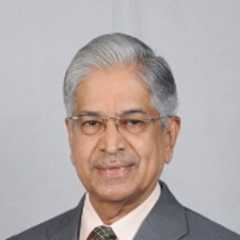
Byrana Nagappa Suresh
Indian Space Research OrganizationIndia
Suresh was awarded the Institute of Electrical and Electronics Engineers (IEEE) Simon Ramo Medal for developing pioneering space technology and his leadership of the Indian Space Research Organization (ISRO) as an honorary distinguished professor. Under his guidance, India launched its second mission to the moon—Chandrayaan 2—to conduct orbital experiments.(Photo:Indian Institute of Space Science and Technology)
Suresh was awarded the Institute of Electrical and Electronics Engineers (IEEE) Simon Ramo Medal for developing pioneering space technology and his leadership of the Indian Space Research Organization (ISRO) as an honorary distinguished professor. Under his guidance, India launched its second mission to the moon—Chandrayaan 2—to conduct orbital experiments.(Photo:Indian Institute of Space Science and Technology)
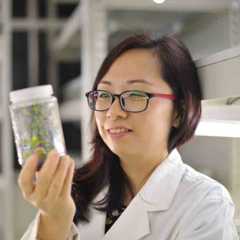
Chew Bee Lynn
University of Science MalaysiaMalaysia
Chew was awarded the 2020 Women of the Future Award (Southeast Asia) for her work introducing practical agricultural technologies to local farmers and food growers.(Photo:University of Science Malaysia)
Chew was awarded the 2020 Women of the Future Award (Southeast Asia) for her work introducing practical agricultural technologies to local farmers and food growers.(Photo:University of Science Malaysia)
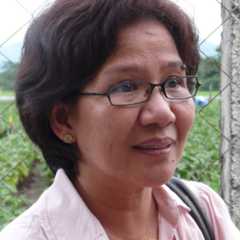
Desiree M. Hautea
University of the Philippines Los BañosPhilippines
Hautea was conferred the 2020 Leads Agriculture Award by the Philippine Association for the Advancement of Science and Technology for her research into the adoption of the genetically modified Bt eggplant in the Philippines.(Photo:ResearchGate)
Hautea was conferred the 2020 Leads Agriculture Award by the Philippine Association for the Advancement of Science and Technology for her research into the adoption of the genetically modified Bt eggplant in the Philippines.(Photo:ResearchGate)
Salma Sultana
Model Livestock Advancement FoundationBangladesh
Sultana was awarded the 2020 Norman E. Borlaug Award for Field Research and Application by the World Food Prize Foundation for her work with small-scale farmers in Bangladesh, particularly her efforts involving veterinary outreach, treatment and education.(Photo:World Food Prize Foundation)
Sultana was awarded the 2020 Norman E. Borlaug Award for Field Research and Application by the World Food Prize Foundation for her work with small-scale farmers in Bangladesh, particularly her efforts involving veterinary outreach, treatment and education.(Photo:World Food Prize Foundation)
Tran Thi Thu Ha
Thái Nguyên UniversityVietnam
Tran was awarded the Vietnamese Kovalevskaia Award 2019 for her research on the breeding and intensive cultivation of trees, the propagation and rearing of non-timber forest products and medicinal herbs, and the development of local medicinal plants.(Photo:Thái Nguyên University)
Tran was awarded the Vietnamese Kovalevskaia Award 2019 for her research on the breeding and intensive cultivation of trees, the propagation and rearing of non-timber forest products and medicinal herbs, and the development of local medicinal plants.(Photo:Thái Nguyên University)
Rajeev Kumar Varshney
International Crops Research Institute for the Semi-Arid TropicsIndia
Varshney received the Indian Council of Agricultural Research’s 2020 Rafi Ahmed Kidwai Award for his work in the area of plant genomics and genomics-assisted crop breeding.(Photo:ResearchGate)
Varshney received the Indian Council of Agricultural Research’s 2020 Rafi Ahmed Kidwai Award for his work in the area of plant genomics and genomics-assisted crop breeding.(Photo:ResearchGate)
Ritesh Agarwal
Postgraduate Institute of Medical Education and ResearchIndia
Agarwal is a recipient of the 2020 Shanti Swarup Bhatnagar Prize for Science and Technology in medical sciences for his contributions to the field of allergic bronchopulmonary aspergillosis, the immune system’s exaggerated response toAspergillus fungi.(Photo:Shanti Swarup Bhatnagar Prize)
Agarwal is a recipient of the 2020 Shanti Swarup Bhatnagar Prize for Science and Technology in medical sciences for his contributions to the field of allergic bronchopulmonary aspergillosis, the immune system’s exaggerated response toAspergillus fungi.(Photo:Shanti Swarup Bhatnagar Prize)
Bushra Ateeq
Indian Institute of Technology KanpurIndia
Ateeq is one of the recipients of the 2020 Shanti Swarup Bhatnagar Prize for Science and Technology in the field of medical sciences for her research on the consequences of androgen deprivation therapy for prostate cancer patients.(Photo:Indian Institute of Technology Kanpur)
Ateeq is one of the recipients of the 2020 Shanti Swarup Bhatnagar Prize for Science and Technology in the field of medical sciences for her research on the consequences of androgen deprivation therapy for prostate cancer patients.(Photo:Indian Institute of Technology Kanpur)
Dario Campana
National University of SingaporeSingapore
Campana was awarded the 2020 President’s Technology Award for his work converting immune cells into effective cancer therapies, which has revolutionized the treatment of leukemia.(Photo:A*STAR)
Campana was awarded the 2020 President’s Technology Award for his work converting immune cells into effective cancer therapies, which has revolutionized the treatment of leukemia.(Photo:A*STAR)

Ananlada Chotimongkol
National Science and Technology Development AgencyThailand
Chotimongkol received the L’Oréal Thailand COVID-19 Solidarity Prize in the field of technology for developing a smartphone application that enables the Department of Disease Control to monitor the health of people under self-isolation.(Photo:Carnegie Mellon School of Computer Science)
Chotimongkol received the L’Oréal Thailand COVID-19 Solidarity Prize in the field of technology for developing a smartphone application that enables the Department of Disease Control to monitor the health of people under self-isolation.(Photo:Carnegie Mellon School of Computer Science)

Salvacion Gatchalian
Research Institute for Tropical MedicinePhilippines
Gatchalian was posthumously honored with the Dr. Lourdes Espiritu Campos Award for Public Health for her advocacy for tobacco control and the immunization of children.(Photo:Philippine Pediatric Society)
Gatchalian was posthumously honored with the Dr. Lourdes Espiritu Campos Award for Public Health for her advocacy for tobacco control and the immunization of children.(Photo:Philippine Pediatric Society)
Ju Young Seok
Korea Advanced Institute of Science and TechnologySouth Korea
Ju is a recipient of the 13th Asan Award in Medicine for Young Medical Scientists for his research on lung cancer-related genes.(Photo:Asan Award in Medicine)
Ju is a recipient of the 13th Asan Award in Medicine for Young Medical Scientists for his research on lung cancer-related genes.(Photo:Asan Award in Medicine)
Tadamitsu Kishimoto
Osaka UniversityJapan
Kishimoto is one of three awardees of the 2020 Tang Prize in Biopharmaceutical Science for his discovery and cloning of the protein known as interleukin-6 (IL-6), which regulates antibody production. After identifying IL-6, Kishimoto and his team cloned its receptor to demonstrate its role in inflammatory diseases like arthritis—revolutionizing the treatment of rheumatoid and juvenile arthritis.(Photo:Japan Prize Foundation)
Kishimoto is one of three awardees of the 2020 Tang Prize in Biopharmaceutical Science for his discovery and cloning of the protein known as interleukin-6 (IL-6), which regulates antibody production. After identifying IL-6, Kishimoto and his team cloned its receptor to demonstrate its role in inflammatory diseases like arthritis—revolutionizing the treatment of rheumatoid and juvenile arthritis.(Photo:Japan Prize Foundation)
K. Ranga Rama Krishnan
National Medical Research CouncilSingapore
Krishnan was awarded the 2020 President’s Science and Technology Medal for his efforts in advancing academic medicine, translational and clinical research, and technology transfer and entrepreneurship in Singapore.(Photo:A*STAR)
Krishnan was awarded the 2020 President’s Science and Technology Medal for his efforts in advancing academic medicine, translational and clinical research, and technology transfer and entrepreneurship in Singapore.(Photo:A*STAR)

Vuong Thi Ngoc Lan
Ho Chi Minh City University of Medicine and PharmacyVietnam
Lan is one of three recipients of the 2020 Ta Quang Buu Awards for her research comparing the transfer of fresh and frozen embryos forin vitro fertilization.(Photo:Ta Quang Buu Prize)
Lan is one of three recipients of the 2020 Ta Quang Buu Awards for her research comparing the transfer of fresh and frozen embryos forin vitro fertilization.(Photo:Ta Quang Buu Prize)

Tsering Landol
Sonam Norboo Memorial Government HospitalIndia
Landol is one of the recipients of the Padma Bhushan Awards 2020 for distinguished service. She was honored for her dedication to women’s health by providing medical care to women through difficult terrain and freezing temperatures.(Photo:Padma Bhushan Award)
Landol is one of the recipients of the Padma Bhushan Awards 2020 for distinguished service. She was honored for her dedication to women’s health by providing medical care to women through difficult terrain and freezing temperatures.(Photo:Padma Bhushan Award)
Le Thi Quynh Mai
National Institute of Hygiene and EpidemiologyVietnam
Mai leads a team of women who were awarded the 2019 Vietnamese Kovalevskaia Award for their successful isolation of a new strain of SARS-CoV-2, making Vietnam one of the first four countries to successfully isolate the virus in 2020. Her team has spent the last two decades fighting deadly diseases, most notably SARS, A/H5N1 bird flu and H1N1.(Photo:Sức Khỏe & Dời Sống)
Mai leads a team of women who were awarded the 2019 Vietnamese Kovalevskaia Award for their successful isolation of a new strain of SARS-CoV-2, making Vietnam one of the first four countries to successfully isolate the virus in 2020. Her team has spent the last two decades fighting deadly diseases, most notably SARS, A/H5N1 bird flu and H1N1.(Photo:Sức Khỏe & Dời Sống)
Lee Jae Won
University of UlsanSouth Korea
Lee received the 13th Asan Award in Medicine for Clinical Medicine for pioneering a new surgical approach for heart disease and establishing a robotic cardiac surgery center in Korea.(Photo:Asan Award in Medicine)
Lee received the 13th Asan Award in Medicine for Clinical Medicine for pioneering a new surgical approach for heart disease and establishing a robotic cardiac surgery center in Korea.(Photo:Asan Award in Medicine)
Lee Won Jae
Seoul National UniversitySouth Korea
Lee received the 13th Asan Award in Medicine for Basic Medicine for his research on the impact microbiomes have on animal growth and physiology.(Photo:Asan Award in Medicine)
Lee received the 13th Asan Award in Medicine for Basic Medicine for his research on the impact microbiomes have on animal growth and physiology.(Photo:Asan Award in Medicine)
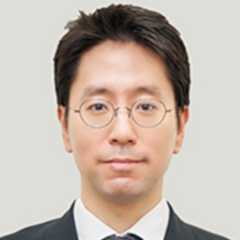
Lee Yong-ho
Yonsei UniversitySouth Korea
Lee is a recipient of the 13th Asan Award in Medicine for Young Medical Scientists for identifying the loss of muscle tissue as a risk factor for non-alcoholic fatty liver disease.(Photo:Asan Award in Medicine)
Lee is a recipient of the 13th Asan Award in Medicine for Young Medical Scientists for identifying the loss of muscle tissue as a risk factor for non-alcoholic fatty liver disease.(Photo:Asan Award in Medicine)
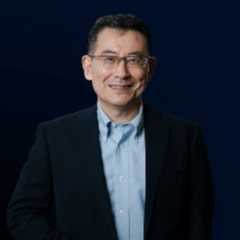
Liu Jianjun
Genome Institute of Singapore, A*STARSingapore
Liu is a recipient of the 2020 President’s Science Award for his contributions to biomedical research and precision medicine through genetic studies of Asian populations.(Photo:A*STAR)
Liu is a recipient of the 2020 President’s Science Award for his contributions to biomedical research and precision medicine through genetic studies of Asian populations.(Photo:A*STAR)
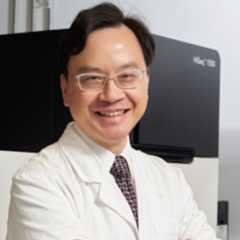
Dennis Lo Yuk Ming
Chinese University of Hong KongHong Kong
Lo is one of four recipients of the 2021 Breakthrough Prize in Life Sciences for discovering that fetal DNA is present in maternal blood and that it can be used to test for genetic disorders.(Photo:Chinese University of Hong Kong)
Lo is one of four recipients of the 2021 Breakthrough Prize in Life Sciences for discovering that fetal DNA is present in maternal blood and that it can be used to test for genetic disorders.(Photo:Chinese University of Hong Kong)
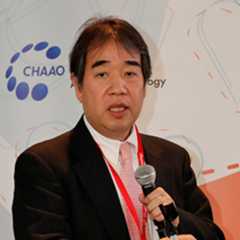
Hiroyuki Mano
National Cancer Center Research InstituteJapan
Mano is one of the recipients of the 2020 Japan Academy Prize for his discovery of the EML4-ALK oncogene, a cancer growth driver, as well as his promotion of cancer genomic medicine.(Photo:Comprehensive Academy for Advanced Oncology)
Mano is one of the recipients of the 2020 Japan Academy Prize for his discovery of the EML4-ALK oncogene, a cancer growth driver, as well as his promotion of cancer genomic medicine.(Photo:Comprehensive Academy for Advanced Oncology)
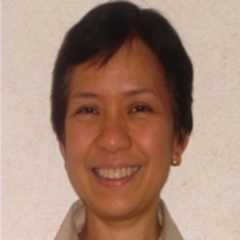
Sandra Teresa V. Navarra
University of Santo Tomas HospitalPhilippines
Navarra was awarded the Dr. Paulo C. Campos Award for Health Research by the Philippine Association for the Advancement of Science and Technology for her research on lupus.(Photo:ResearchGate)
Navarra was awarded the Dr. Paulo C. Campos Award for Health Research by the Philippine Association for the Advancement of Science and Technology for her research on lupus.(Photo:ResearchGate)
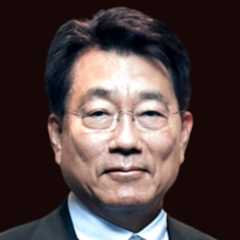
Park Seung-jung
University of UlsanSouth Korea
Park was awarded the 2020 Ho-Am Prize in Medicine for his contributions to the field of interventional cardiology.(Photo:Ho-Am Foundation)
Park was awarded the 2020 Ho-Am Prize in Medicine for his contributions to the field of interventional cardiology.(Photo:Ho-Am Foundation)
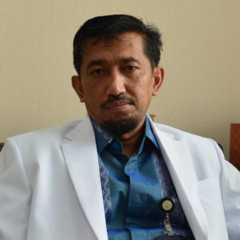
Andani Eka Putra
Andalas UniversityIndonesia
Andani was awarded the 2020 Indonesia Award in the Professional Figure category for his work conducting pooled testing to break the chain of transmission of COVID-19 in West Sumatra.(Photo:Radio Idola Semarang)
Andani was awarded the 2020 Indonesia Award in the Professional Figure category for his work conducting pooled testing to break the chain of transmission of COVID-19 in West Sumatra.(Photo:Radio Idola Semarang)
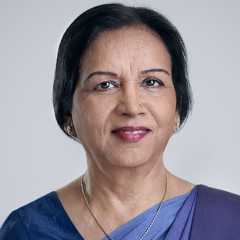
Firdausi Qadri
International Centre for Diarrhoeal Disease and ResearchBangladesh
Qadri is a laureate of the 2020 L’Oréal-UNESCO For Women in Science Award for her work on understanding and preventing infectious diseases affecting children in developing countries as well as her advocacy of early diagnoses and global vaccination.(Photo:UNESCO)
Qadri is a laureate of the 2020 L’Oréal-UNESCO For Women in Science Award for her work on understanding and preventing infectious diseases affecting children in developing countries as well as her advocacy of early diagnoses and global vaccination.(Photo:UNESCO)
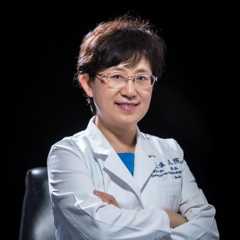
Qiao Jie
Peking UniversityChina
Qiao was elected in 2020 as an international fellow of the American Academy of Arts & Sciences for her extensive work on reproductive biology and the pathology of infertility.(Photo:Peking University)
Qiao was elected in 2020 as an international fellow of the American Academy of Arts & Sciences for her extensive work on reproductive biology and the pathology of infertility.(Photo:Peking University)
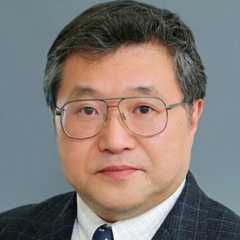
Eiichi Saitoh
Fujita Health UniversityJapan
In 2020, Saitoh was elected as an international member of the National Academy of Medicine for his groundbreaking research in the fields of physical medicine, rehabilitation and dysphagia.(Photo:ResearchGate)
In 2020, Saitoh was elected as an international member of the National Academy of Medicine for his groundbreaking research in the fields of physical medicine, rehabilitation and dysphagia.(Photo:ResearchGate)
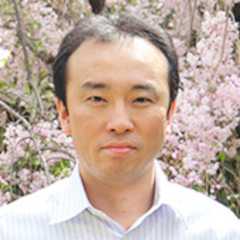
Mitinori Saitou
Kyoto UniversityJapan
Saitou is a recipient of the Imperial Prize and the Japan Academy Prize for his work on the mechanism andin vitro reconstitution of germ-cell development.(Photo:Kyoto University)
Saitou is a recipient of the Imperial Prize and the Japan Academy Prize for his work on the mechanism andin vitro reconstitution of germ-cell development.(Photo:Kyoto University)
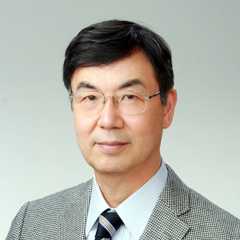
Shimon Sakaguchi
Osaka UniversityJapan
Sakaguchi was awarded the 2020 Robert Koch Award for his discovery of regulatory T-cells that modulate the immune system, maintain tolerance to self-antigens, and prevent autoimmune disease.(Photo:Wikimedia Commons)
Sakaguchi was awarded the 2020 Robert Koch Award for his discovery of regulatory T-cells that modulate the immune system, maintain tolerance to self-antigens, and prevent autoimmune disease.(Photo:Wikimedia Commons)

Arunee Thitithanyanont
Mahidol UniversityThailand
Thitithanyanont received the L’Oréal Thailand COVID-19 Solidarity Prize in the field of life sciences for her research projects addressing the COVID-19 pandemic, including diagnostic methods, treatments and vaccines. In an early study of 217 recovered COVID-19 patients, Thitithanyanont and her team at the department of microbiology at Mahidol University were able to identify viral clearance as well as the pattern of antibody responses with SARS-CoV-2. This understanding of natural host defenses and antibody duration provides a foundation for further research into controlling the spread of the virus.(Photo:Loop)
Thitithanyanont received the L’Oréal Thailand COVID-19 Solidarity Prize in the field of life sciences for her research projects addressing the COVID-19 pandemic, including diagnostic methods, treatments and vaccines. In an early study of 217 recovered COVID-19 patients, Thitithanyanont and her team at the department of microbiology at Mahidol University were able to identify viral clearance as well as the pattern of antibody responses with SARS-CoV-2. This understanding of natural host defenses and antibody duration provides a foundation for further research into controlling the spread of the virus.(Photo:Loop)
Wang Chen
Chinese Academy of Medical SciencesChina
In 2020, Chen was elected as an international member of the National Academy of Medicine for his clinical research, medical reform and leadership of three leading medical bodies: the Chinese Academy of Medical Sciences, Peking Union Medical College, and the Center for Respiratory Diseases of China-Japan Friendship Hospital.(Photo:Chinese Academy of Medical Sciences)
In 2020, Chen was elected as an international member of the National Academy of Medicine for his clinical research, medical reform and leadership of three leading medical bodies: the Chinese Academy of Medical Sciences, Peking Union Medical College, and the Center for Respiratory Diseases of China-Japan Friendship Hospital.(Photo:Chinese Academy of Medical Sciences)
Wong Tien Yin
Singapore National Eye CenterSingapore
Wong was elected in 2020 as an international member of the National Academy of Medicine for his contributions to the diagnosis and prevention of major eye diseases. (Photo:Duke-NUS Medical School)
Wong was elected in 2020 as an international member of the National Academy of Medicine for his contributions to the diagnosis and prevention of major eye diseases. (Photo:Duke-NUS Medical School)
Zhong Nanshan
The First Affiliated Hospital of Guangzhou Medical UniversityChina
Zhong was conferred the Medal of the Republic for his contributions to the field of respiratory disease research and his transparency in the wake of the COVID-19 pandemic.(Photo:Journal of Thoracic Disease)
Zhong was conferred the Medal of the Republic for his contributions to the field of respiratory disease research and his transparency in the wake of the COVID-19 pandemic.(Photo:Journal of Thoracic Disease)
Biman Bagchi
Indian Institute of ScienceIndia
Bagchi was elected as a 2020 fellow of the American Academy of Arts & Sciences and the 2021 recipient of the Joel Henry Hildebrand Award in theoretical and experimental chemistry of liquids for his studies on statistical mechanics. (Photo:Indian Institute of Science)
Bagchi was elected as a 2020 fellow of the American Academy of Arts & Sciences and the 2021 recipient of the Joel Henry Hildebrand Award in theoretical and experimental chemistry of liquids for his studies on statistical mechanics. (Photo:Indian Institute of Science)
Chen Xiao-Ming
Sun Yat-Sen UniversityChina
Chen is a laureate of the 33rd Khwarizmi International Award for his research on the synthesis and crystal engineering of functional coordination compounds and coordination polymers.(Photo:ResearchGate)
Chen is a laureate of the 33rd Khwarizmi International Award for his research on the synthesis and crystal engineering of functional coordination compounds and coordination polymers.(Photo:ResearchGate)
Jyotirmayee Dash
Indian Association for the Cultivation of ScienceIndia
Dash is a recipient of the 2020 Shanti Swarup Bhatnagar Prize for Science and Technology in the field of chemical sciences for designing enhanced drug delivery systems based on the organic synthesis of molecules.(Photo:Indian Association for the Cultivation of Science)
Dash is a recipient of the 2020 Shanti Swarup Bhatnagar Prize for Science and Technology in the field of chemical sciences for designing enhanced drug delivery systems based on the organic synthesis of molecules.(Photo:Indian Association for the Cultivation of Science)
Subi Jacob George
Jawaharlal Nehru Centre for Advanced Scientific ResearchIndia
George is a recipient of the 2020 Shanti Swarup Bhatnagar Prize for Science and Technology in the field of chemical sciences for his research on the properties and applications of supramolecular polymers.(Photo:Jawaharlal Nehru Centre for Advanced Scientific Research)
George is a recipient of the 2020 Shanti Swarup Bhatnagar Prize for Science and Technology in the field of chemical sciences for his research on the properties and applications of supramolecular polymers.(Photo:Jawaharlal Nehru Centre for Advanced Scientific Research)
Kim Dong-ho
Yonsei UniversitySouth Korea
Kim was awarded the 29th Sudang Award in the category of basic sciences. He is known for his spectroscopy research, particularly time-resolved and single-molecule spectroscopy.(Photo:Yonsei University)
Kim was awarded the 29th Sudang Award in the category of basic sciences. He is known for his spectroscopy research, particularly time-resolved and single-molecule spectroscopy.(Photo:Yonsei University)
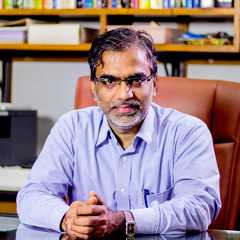
Thalappil Pradeep
Indian Institute of Technology MadrasIndia
For his work developing nanotechnology-enabled water filters, Pradeep was awarded the 25th Nikkei Asia Prize (Science and Technology). Pradeep, who leads the International Centre for Clean Water at the Indian Institute of Technology, Madras, is also a recipient of a 2020 Padma Shri Award in the field of Science and Engineering. From pesticide to arsenic removal technology, his work has benefitted over ten million Indians, providing them with clean and safe drinking water. His nanochemistry-based water filters consist of a first layer that kills bacteria and viruses with silver nanoparticles and a second layer that traps iron and arsenic.(Photo:Indian Institute of Technology Madras)
For his work developing nanotechnology-enabled water filters, Pradeep was awarded the 25th Nikkei Asia Prize (Science and Technology). Pradeep, who leads the International Centre for Clean Water at the Indian Institute of Technology, Madras, is also a recipient of a 2020 Padma Shri Award in the field of Science and Engineering. From pesticide to arsenic removal technology, his work has benefitted over ten million Indians, providing them with clean and safe drinking water. His nanochemistry-based water filters consist of a first layer that kills bacteria and viruses with silver nanoparticles and a second layer that traps iron and arsenic.(Photo:Indian Institute of Technology Madras)
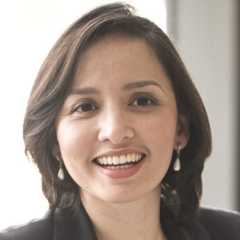
Kathleen B. Aviso
De La Salle UniversityPhilippines
Aviso was awarded the 2020 Dr. Michael Purvis Award for Sustainability Research for her important contributions to environmental systems engineering as well as developing novel optimization models to guide national and global environmental decisionmaking.(Photo:ResearchGate)
Aviso was awarded the 2020 Dr. Michael Purvis Award for Sustainability Research for her important contributions to environmental systems engineering as well as developing novel optimization models to guide national and global environmental decisionmaking.(Photo:ResearchGate)
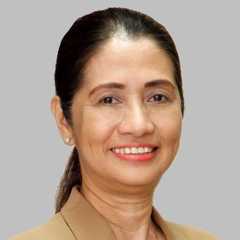
Annabelle V. Briones
Department of Science and TechnologyPhilippines
Briones was awarded the 2020 Gregorio Y. Zara Award for Applied Science Research for designing a mosquito ovicidal/larvicidal trap system aimed at reducing the incidence of dengue fever.(Photo:Department of Science and Technology)
Briones was awarded the 2020 Gregorio Y. Zara Award for Applied Science Research for designing a mosquito ovicidal/larvicidal trap system aimed at reducing the incidence of dengue fever.(Photo:Department of Science and Technology)
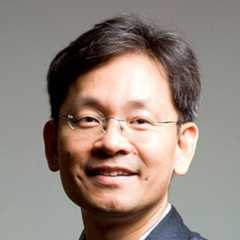
Choi Haecheon
Seoul National UniversitySouth Korea
Choi received the 29th Sudang Award in the category of Applied Sciences. He is known for his work in the fields of bio-mimetic engineering and aerodynamics.(Photo:Seoul National University)
Choi received the 29th Sudang Award in the category of Applied Sciences. He is known for his work in the fields of bio-mimetic engineering and aerodynamics.(Photo:Seoul National University)
Kinshuk Dasgupta
Bhabha Atomic Research CentreIndia
Dasgupta is a recipient of the 2020 Shanti Swarup Bhatnagar Prize for Science and Technology in the field of engineering sciences for his role in developing a light and low-cost bullet-proof jacket currently used by the police.(Photo:Shanti Swarup Bhatnagar Prize)
Dasgupta is a recipient of the 2020 Shanti Swarup Bhatnagar Prize for Science and Technology in the field of engineering sciences for his role in developing a light and low-cost bullet-proof jacket currently used by the police.(Photo:Shanti Swarup Bhatnagar Prize)
Huang Xuhua
Chinese Academy of SciencesChina
Huang, chief designer of the country’s first-generation nuclear submarines, was honored with the 2019 Highest Science and Technology Award.(Photo:Shen Hong/Xinhua)
Huang, chief designer of the country’s first-generation nuclear submarines, was honored with the 2019 Highest Science and Technology Award.(Photo:Shen Hong/Xinhua)
Champika Ellawala Kankanamge
University of RuhunaSri Lanka
Kankanamge is a recipient of the 2020 OWSD-Elsevier Foundation Award for Early-Career Women Scientists in the Developing World for her research on aquatic ecosystem conservation and pollution control. She is currently researching the effectiveness of restoring native plants to control invasive aquatic plants in river ecosystems—work that will help prevent ecosystem degradation. She is also studying the levels of heavy metals in edible fish and shellfish in Sri Lanka’s Batticaloa lagoon, a primary source of seafood for the local community.(Photo:University of Ruhuna)
Kankanamge is a recipient of the 2020 OWSD-Elsevier Foundation Award for Early-Career Women Scientists in the Developing World for her research on aquatic ecosystem conservation and pollution control. She is currently researching the effectiveness of restoring native plants to control invasive aquatic plants in river ecosystems—work that will help prevent ecosystem degradation. She is also studying the levels of heavy metals in edible fish and shellfish in Sri Lanka’s Batticaloa lagoon, a primary source of seafood for the local community.(Photo:University of Ruhuna)
Amol Arvindrao Kulkarni
National Chemical LaboratoryIndia
Kulkarni is a recipient of the 2020 Shanti Swarup Bhatnagar Prize for Science and Technology in the field of engineering sciences for developing India’s first microreactor lab.(Photo:Shanti Swarup Bhatnagar Prize)
Kulkarni is a recipient of the 2020 Shanti Swarup Bhatnagar Prize for Science and Technology in the field of engineering sciences for developing India’s first microreactor lab.(Photo:Shanti Swarup Bhatnagar Prize)
Jun Murai
Keio UniversityJapan
Murai is one of two recipients of the NEC C&C Foundation’s 2020 C&C Prize for leading the development of the internet in Japan as the founder of the Japan University NETwork (JUNET).(Photo:Rakuten)
Murai is one of two recipients of the NEC C&C Foundation’s 2020 C&C Prize for leading the development of the internet in Japan as the founder of the Japan University NETwork (JUNET).(Photo:Rakuten)

Shin Mikyung
Sungkyunkwan UniversitySouth Korea
Shin is a recipient of the L’Oréal-UNESCO For Women in Science International Rising Talent Award for her development of nature-inspired adhesive micro-formulations for 3D and 4D bioprinting. Inspired by nature, Shin and her team are exploring the use of biomaterials, such as mussel-inspired catechol, for drug delivery. These hemostatic materials have the ability to control external and internal bleeding, which also makes them useful in wound treatment as a coating on medical tools.(Photo:Sungkyunkwan University)
Shin is a recipient of the L’Oréal-UNESCO For Women in Science International Rising Talent Award for her development of nature-inspired adhesive micro-formulations for 3D and 4D bioprinting. Inspired by nature, Shin and her team are exploring the use of biomaterials, such as mussel-inspired catechol, for drug delivery. These hemostatic materials have the ability to control external and internal bleeding, which also makes them useful in wound treatment as a coating on medical tools.(Photo:Sungkyunkwan University)
Samia Subrina
Bangladesh University of Engineering and TechnologyBangladesh
Subrina is a recipient of the 2020 OWSD-Elsevier Foundation Award for Early-Career Women Scientists in the Developing World for her research on the properties and uses of nanomaterials.(Photo:Organization for Women in Science for the Developing World)
Subrina is a recipient of the 2020 OWSD-Elsevier Foundation Award for Early-Career Women Scientists in the Developing World for her research on the properties and uses of nanomaterials.(Photo:Organization for Women in Science for the Developing World)
Subra Suresh
Nanyang Technological UniversitySingapore
Suresh received the 2020 American Society of Mechanical Engineers Medal for his contributions to mechanical engineering through multidisciplinary research and leadership at the national level.(Photo:Nanyang Technological University)
Suresh received the 2020 American Society of Mechanical Engineers Medal for his contributions to mechanical engineering through multidisciplinary research and leadership at the national level.(Photo:Nanyang Technological University)
Francis Aldrine Uy
Mapua UniversityPhilippines
Uy is the recipient of the 2020 David M. Consunji Award for Engineering Research for his engineering and innovation projects, including a sensor that monitors the structural integrity of buildings.(Photo:School of Civil, Environmental and Geological Engineering, Mapua University)
Uy is the recipient of the 2020 David M. Consunji Award for Engineering Research for his engineering and innovation projects, including a sensor that monitors the structural integrity of buildings.(Photo:School of Civil, Environmental and Geological Engineering, Mapua University)
Edgardo G. Vazquez
Vazbuilt TechnologyPhilippines
Vazquez, known for inventing sturdy, prefabricated modular housing, won the 2020 Ceferino Follosco Award for Product and Process Innovation.(Photo:San Beda College Grade School ’65, High School ’69)
Vazquez, known for inventing sturdy, prefabricated modular housing, won the 2020 Ceferino Follosco Award for Product and Process Innovation.(Photo:San Beda College Grade School ’65, High School ’69)
Huh Youm
Silicon MitusSouth Korea
Huh was awarded the 2020 POSCO TJ Park Technology Prize for developing power management integrated semiconductor chips that control the power supply to electronic devices.(Photo:POSCO TJ Park Foundation)
Huh was awarded the 2020 POSCO TJ Park Technology Prize for developing power management integrated semiconductor chips that control the power supply to electronic devices.(Photo:POSCO TJ Park Foundation)
Tsuneo Okada
University of TokyoJapan
Okada is a recipient of the 2020 Japan Academy Prize for his research on seismic performance evaluation and solutions to upgrade vulnerable buildings.(Photo:Japan Academy)
Okada is a recipient of the 2020 Japan Academy Prize for his research on seismic performance evaluation and solutions to upgrade vulnerable buildings.(Photo:Japan Academy)
Suryendu Dutta
Indian Institute of Technology BombayIndia
Dutta is one of the recipients of the 2020 Shanti Swarup Bhatnagar Prize for Science and Technology for his studies on the evolution of plant terpenoids, a class of organic chemicals that contribute to the scent, flavor and color of plants.(Photo:Department of Earth Sciences, Indian Institute of Technology Bombay)
Dutta is one of the recipients of the 2020 Shanti Swarup Bhatnagar Prize for Science and Technology for his studies on the evolution of plant terpenoids, a class of organic chemicals that contribute to the scent, flavor and color of plants.(Photo:Department of Earth Sciences, Indian Institute of Technology Bombay)
Hong Song-You
Korea Institute of Atmospheric Prediction SystemsSouth Korea
Hong, an internationally renowned atmospheric modeling expert, was awarded the 2020 POSCO TJ Park Science Prize for leading the development of a numerical weather prediction model designed specifically for Korea.(Photo:POSCO TJ Park Foundation)
Hong, an internationally renowned atmospheric modeling expert, was awarded the 2020 POSCO TJ Park Science Prize for leading the development of a numerical weather prediction model designed specifically for Korea.(Photo:POSCO TJ Park Foundation)
Abhijit Mukherjee
Indian Institute of Technology KharagpurIndia
Mukherjee is one of the recipients of the 2020 Shanti Swarup Bhatnagar Prize for Science and Technology for his studies of the quality and quantity of groundwater in India that is suitable for drinking.(Photo:ResearchGate)
Mukherjee is one of the recipients of the 2020 Shanti Swarup Bhatnagar Prize for Science and Technology for his studies of the quality and quantity of groundwater in India that is suitable for drinking.(Photo:ResearchGate)
Minoru Ozima
University of TokyoJapan
Ozima is a recipient of the 2020 Japan Academy Prize for his work on noble gas chemistry, which has shed light on the early evolution of Earth.(Photo:University of Tokyo)
Ozima is a recipient of the 2020 Japan Academy Prize for his work on noble gas chemistry, which has shed light on the early evolution of Earth.(Photo:University of Tokyo)
Zeng Qingcun
Chinese Academy of SciencesChina
Zeng is one of two awardees of the 2019 Highest Science and Technology Award for his pioneering work on modern atmospheric science, meteorology-numerical prediction and meteorological satellite remote sensing.(Photo:Chinese Academy of Sciences)
Zeng is one of two awardees of the 2019 Highest Science and Technology Award for his pioneering work on modern atmospheric science, meteorology-numerical prediction and meteorological satellite remote sensing.(Photo:Chinese Academy of Sciences)
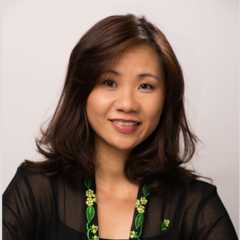
Chan Yoke-Fun
University of MalayaMalaysia
Chan was awarded the 2020 ASEAN-US Science Prize for Women for developing vaccines, antivirals and education tools to prevent enterovirus A71—the virus that causes hand, foot and mouth disease.(Photo:ASEAN-US Science Prize for Women)
Chan was awarded the 2020 ASEAN-US Science Prize for Women for developing vaccines, antivirals and education tools to prevent enterovirus A71—the virus that causes hand, foot and mouth disease.(Photo:ASEAN-US Science Prize for Women)
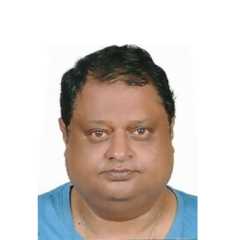
Shubhadeep Chatterjee
Centre for DNA Fingerprinting and DiagnosticsIndia
Chatterjee is one of the recipients of the 2020 Shanti Swarup Bhatnagar Prize for Science and Technology for his study of bacterial social communication systems during plant disease.(Photo:Shanti Swarup Bhatnagar Prize)
Chatterjee is one of the recipients of the 2020 Shanti Swarup Bhatnagar Prize for Science and Technology for his study of bacterial social communication systems during plant disease.(Photo:Shanti Swarup Bhatnagar Prize)
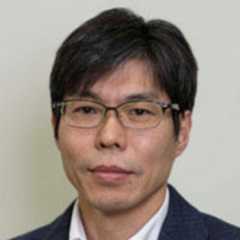
Kenya Honda
Keio UniversityJapan
Honda was awarded the Carlos J. Finlay UNESCO Prize for Microbiology for his research on the impact of microbiota on the immune system.(Photo:Keio University)
Honda was awarded the Carlos J. Finlay UNESCO Prize for Microbiology for his research on the impact of microbiota on the immune system.(Photo:Keio University)
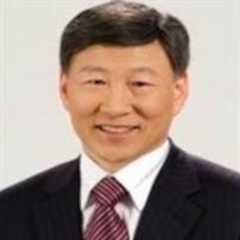
Kim Se-Kwon
Pukyong National UniversitySouth Korea
Kim is one of the recipients of the 33rd Khwarizmi International Award for his research and development of medicinal drugs and supplements from marine organisms.(Photo:Loop)
Kim is one of the recipients of the 33rd Khwarizmi International Award for his research and development of medicinal drugs and supplements from marine organisms.(Photo:Loop)
Kiyoshi Kita
Nagasaki UniversityJapan
Kita was awarded the 2020 Duke of Edinburgh Prize for his studies on the survival and expansion of tropical pathogenic microorganisms.(Photo:Nagasaki University)
Kita was awarded the 2020 Duke of Edinburgh Prize for his studies on the survival and expansion of tropical pathogenic microorganisms.(Photo:Nagasaki University)
Atsushi Miyawaki
RIKEN Center for Brain ScienceJapan
Miyawaki, recognized for his contributions to molecular imaging, is one of two recipients of the 25th Keio Medical Science Prize. He is the inventor of ScaleS, a clearing reagent that reveals the structural details of cells and organs, and AkaBLI, a bioluminescence imaging system that glows and sheds light on the structures and cell activities within living cells and animals. Miyawaki’s imaging technology has allowed researchers around the world to observe microscopic molecular activity within cells, providing the foundation for recent breakthroughs in the field of life sciences.(Photo:RIKEN Center for Brain Science)
Miyawaki, recognized for his contributions to molecular imaging, is one of two recipients of the 25th Keio Medical Science Prize. He is the inventor of ScaleS, a clearing reagent that reveals the structural details of cells and organs, and AkaBLI, a bioluminescence imaging system that glows and sheds light on the structures and cell activities within living cells and animals. Miyawaki’s imaging technology has allowed researchers around the world to observe microscopic molecular activity within cells, providing the foundation for recent breakthroughs in the field of life sciences.(Photo:RIKEN Center for Brain Science)
Rui Bai
Westlake UniversityChina
Rui is a recipient of the 2020 L’Oréal-UNESCO For Women in Science International Rising Talent Award for her research on RNA splicing.(Photo:UNESCO)
Rui is a recipient of the 2020 L’Oréal-UNESCO For Women in Science International Rising Talent Award for her research on RNA splicing.(Photo:UNESCO)
Jonel Saludes
University of San AgustinPhilippines
Saludes was awarded the 2020 Gregorio Y. Zara Award for Basic Science Research for his research into the chemical biology of natural products from organisms.(Photo:Loop)
Saludes was awarded the 2020 Gregorio Y. Zara Award for Basic Science Research for his research into the chemical biology of natural products from organisms.(Photo:Loop)
Teruo Sano
Hirosaki UniversityJapan
Sano is a recipient of the 2020 Japan Academy Prize for his studies detecting and isolating viroids—a virus-like pathogen that causes disease in plants.(Photo:Japan Academy)
Sano is a recipient of the 2020 Japan Academy Prize for his studies detecting and isolating viroids—a virus-like pathogen that causes disease in plants.(Photo:Japan Academy)
Kazuo Shinozaki
RIKEN Center for Sustainable Resource ScienceJapan
Shinozaki, internationally renowned for his work studying plant responses to environmental stresses, was awarded the 36th International Prize for Biology.(Photo:Japan Society for the Promotion of Science)
Shinozaki, internationally renowned for his work studying plant responses to environmental stresses, was awarded the 36th International Prize for Biology.(Photo:Japan Society for the Promotion of Science)
Masatoshi Takeichi
Kyoto UniversityJapan
Takeichi is one of the awardees of the 2020 Canada Gairdner Awards for his identification of cadherins and their role in animal cell adhesion and signaling.(Photo:RIKEN)
Takeichi is one of the awardees of the 2020 Canada Gairdner Awards for his identification of cadherins and their role in animal cell adhesion and signaling.(Photo:RIKEN)
Vatsala Thirumalai
National Centre for Biological SciencesIndia
Thirumalai is one of the recipients of the 2020 Shanti Swarup Bhatnagar Prize for Science and Technology for her research on neural circuits that generate movement.(Photo:National Centre for Biological Sciences)
Thirumalai is one of the recipients of the 2020 Shanti Swarup Bhatnagar Prize for Science and Technology for her research on neural circuits that generate movement.(Photo:National Centre for Biological Sciences)
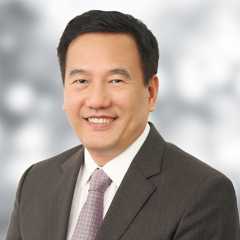
Wang Xiaodong
National Institute of Biological Sciences BeijingChina
Wang was awarded the 2020 King Faisal Prize for Biology. His laboratory is known for discovering the role mitochondria plays in apoptosis, or cell death, in multicellular organisms.(Photo:King Faisal Prize)
Wang was awarded the 2020 King Faisal Prize for Biology. His laboratory is known for discovering the role mitochondria plays in apoptosis, or cell death, in multicellular organisms.(Photo:King Faisal Prize)
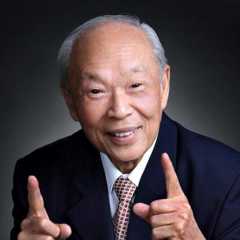
Wang Zhenyi
Shanghai Jiaotong UniversityChina
Wang was awarded the 2020 Future Science Prize (Life Science Prize) for his discoveries of the use of arsenic trioxide and all trans-retinoic acid to treat acute promyelocytic leukemia.(Photo:Future Science Prize)
Wang was awarded the 2020 Future Science Prize (Life Science Prize) for his discoveries of the use of arsenic trioxide and all trans-retinoic acid to treat acute promyelocytic leukemia.(Photo:Future Science Prize)
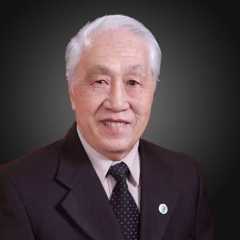
Zhang Tingdong
Harbin Medical UniversityChina
Zhang was awarded the 2020 Future Science Prize (Life Science Prize) for his discovery of the use of arsenic trioxide and all trans-retinoic acid to treat acute promyelocytic leukemia.(Photo:Future Science Prize)
Zhang was awarded the 2020 Future Science Prize (Life Science Prize) for his discovery of the use of arsenic trioxide and all trans-retinoic acid to treat acute promyelocytic leukemia.(Photo:Future Science Prize)
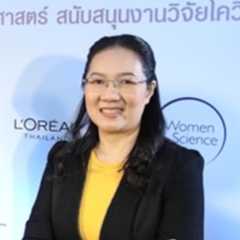
Naruporn Monmaturapoj
National Science and Technology Development AgencyThailand
Monmaturapoj received the L’Oréal Thailand COVID-19 Solidarity Prize for her work manufacturing innovative face masks that protect against virus particles and other particulate matter. The four-ply masks are coated with a unique composite—hydroxyapatitetitanium dioxide. The hydroxyapatite attracts the virus to the outer surface of the mask while the titanium dioxide deactivates microorganisms. Looking ahead, Monmaturapoj intends to use the funds from this award to manufacture the masks.(Photo:National Science and Technology Development Agency)
Monmaturapoj received the L’Oréal Thailand COVID-19 Solidarity Prize for her work manufacturing innovative face masks that protect against virus particles and other particulate matter. The four-ply masks are coated with a unique composite—hydroxyapatitetitanium dioxide. The hydroxyapatite attracts the virus to the outer surface of the mask while the titanium dioxide deactivates microorganisms. Looking ahead, Monmaturapoj intends to use the funds from this award to manufacture the masks.(Photo:National Science and Technology Development Agency)
Lu Ke
Chinese Academy of SciencesChina
Lu is the winner of the 2020 Future Science Prize (Physical Science Prize) for discovering and synthesizing a superior nanotwinned structure and gradient nanostructure.(Photo:Future Science Prize)
Lu is the winner of the 2020 Future Science Prize (Physical Science Prize) for discovering and synthesizing a superior nanotwinned structure and gradient nanostructure.(Photo:Future Science Prize)
Shobhana Narasimhan
Jawaharlal Nehru Centre for Advanced Scientific ResearchIndia
In 2020, Narasimhan was elected as an international honorary member of the American Academy of Arts & Sciences for her work designing practical nanomaterials.(Photo:Jawaharlal Nehru Centre for Advanced Scientific Research)
In 2020, Narasimhan was elected as an international honorary member of the American Academy of Arts & Sciences for her work designing practical nanomaterials.(Photo:Jawaharlal Nehru Centre for Advanced Scientific Research)
Wang Weihua
Chinese Academy of SciencesChina
Wang is a laureate of the 33rd Khwarizmi International Award for his work on the relaxation property relationships in metallic glasses.(Photo:Iranian Research Organization for Science and Technology)
Wang is a laureate of the 33rd Khwarizmi International Award for his work on the relaxation property relationships in metallic glasses.(Photo:Iranian Research Organization for Science and Technology)
U. K. Anandavardhanan
Indian Institute of Technology BombayIndia
Anandavardhanan is one of the recipients of the 2020 Shanti Swarup Bhatnagar Prize for Science and Technology for his contributions to representation theory.(Photo:Shanti Swarup Bhatnagar Prize)
Anandavardhanan is one of the recipients of the 2020 Shanti Swarup Bhatnagar Prize for Science and Technology for his contributions to representation theory.(Photo:Shanti Swarup Bhatnagar Prize)
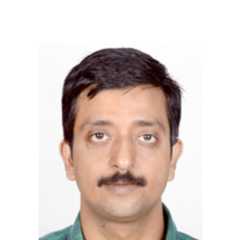
Rajat Subhra Hazra
Indian Statistical Institute KolkataIndia
Hazra is one of the recipients of the 2020 Shanti Swarup Bhatnagar Prize for Science and Technology for his contributions to probability theory, in particular, random matrices with dependent entries, random fields and random graphs, as well as themes of interest to physics like sandpile models and membranes.(Photo:Indian Academy of Sciences)
Hazra is one of the recipients of the 2020 Shanti Swarup Bhatnagar Prize for Science and Technology for his contributions to probability theory, in particular, random matrices with dependent entries, random fields and random graphs, as well as themes of interest to physics like sandpile models and membranes.(Photo:Indian Academy of Sciences)
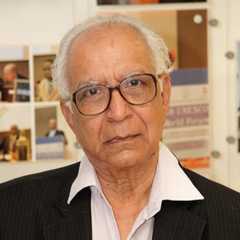
M. S. Narasimhan
Tata Institute of Fundamental ResearchIndia
Narasimhan is one of two recipients of the 2020 Spirit of Abdus Salam Award for his dedication to supporting early-career mathematicians in developing countries.(Photo:International Centre for Theoretical Sciences)
Narasimhan is one of two recipients of the 2020 Spirit of Abdus Salam Award for his dedication to supporting early-career mathematicians in developing countries.(Photo:International Centre for Theoretical Sciences)
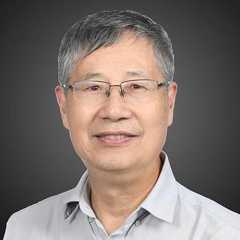
Peng Shige
Shandong UniversityChina
Peng is the winner of the 2020 Future Science Prize (Mathematics & Computer Science Prize) for his groundbreaking work on the theory of backward stochastic differential equations, the nonlinear Feynman-Kac formula, and the theory of nonlinear expectations.(Photo:Future Science Prize)
Peng is the winner of the 2020 Future Science Prize (Mathematics & Computer Science Prize) for his groundbreaking work on the theory of backward stochastic differential equations, the nonlinear Feynman-Kac formula, and the theory of nonlinear expectations.(Photo:Future Science Prize)
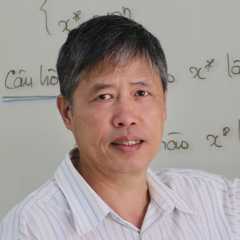
Pham Tien Son
Da Lat UniversityVietnam
Pham is one of three recipients of the 2020 Ta Quang Buu Awards for his studies on the generic properties for semialgebraic programs.(Photo:Ta Quang Buu Prize)
Pham is one of three recipients of the 2020 Ta Quang Buu Awards for his studies on the generic properties for semialgebraic programs.(Photo:Ta Quang Buu Prize)
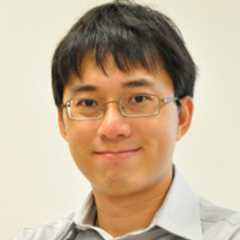
Chong Yidong
Nanyang Technological UniversitySingapore
Chong is one of the recipients of the President’s Science Award for his international leadership and contributions to topological nanophotonics research.(Photo:Nanyang Technological University)
Chong is one of the recipients of the President’s Science Award for his international leadership and contributions to topological nanophotonics research.(Photo:Nanyang Technological University)
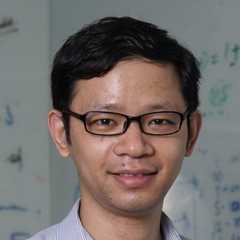
Zhang Baile
Nanyang Technological UniversitySingapore
Zhang is one of the recipients of the President’s Science Award for his international leadership and contributions to topological nanophotonics research.(Photo:Nanyang Technological University)
Zhang is one of the recipients of the President’s Science Award for his international leadership and contributions to topological nanophotonics research.(Photo:Nanyang Technological University)
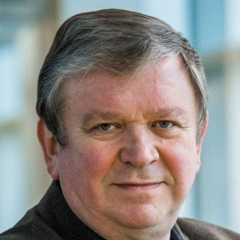
Nikolay Zheludev
Nanyang Technological University Singapore and University of Southampton, UKSingapore
Zheludev is one of the recipients of the President’s Science Award for his international leadership and contributions to topological nanophotonics research.(Photo:Nanyang Technological University)
Zheludev is one of the recipients of the President’s Science Award for his international leadership and contributions to topological nanophotonics research.(Photo:Nanyang Technological University)
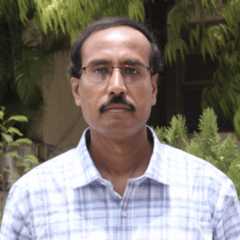
Surajit Dhara
University of HyderabadIndia
Dhara is one of the recipients of the 2020 Shanti Swarup Bhatnagar Prize for Science and Technology for his research on liquid crystals, complex fluids and soft matter photonics.(Photo:University of Hyderabad)
Dhara is one of the recipients of the 2020 Shanti Swarup Bhatnagar Prize for Science and Technology for his research on liquid crystals, complex fluids and soft matter photonics.(Photo:University of Hyderabad)
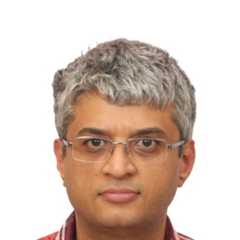
Rajesh Ganapathy
International Centre for Material ScienceIndia
Ganapathy is one of the recipients of the 2020 Shanti Swarup Bhatnagar Prize for Science and Technology for his research on experimental soft condensed matter physics.(Photo:Shanti Swarup Bhatnagar Prize)
Ganapathy is one of the recipients of the 2020 Shanti Swarup Bhatnagar Prize for Science and Technology for his research on experimental soft condensed matter physics.(Photo:Shanti Swarup Bhatnagar Prize)
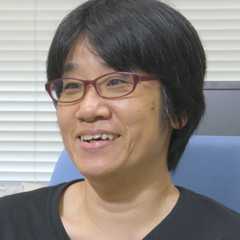
Atsuko Ichikawa
Kyoto UniversityJapan
Ichikawa was awarded the 40th Saruhashi Prize for her contributions to our understanding of the nature of neutrinos.(Photo:NHK)
Ichikawa was awarded the 40th Saruhashi Prize for her contributions to our understanding of the nature of neutrinos.(Photo:NHK)
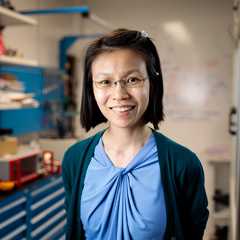
Loh Huanqian
National University of SingaporeSingapore
Loh is a recipient of the L’Oréal-UNESCO For Women in Science International Rising Talent Award for her work on single-molecule quantum control.(Photo:National University of Singapore)
Loh is a recipient of the L’Oréal-UNESCO For Women in Science International Rising Talent Award for her work on single-molecule quantum control.(Photo:National University of Singapore)
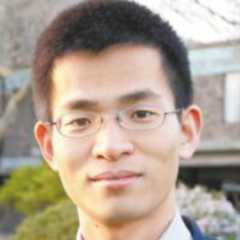
Lu Chao-Yang
University of Science and Technology of ChinaChina
Lu is the 2021 recipient of the Rolf Landauer and Charles H. Bennett Award in Quantum Computing for his work on solid-state quantum light sources, quantum teleportation and optical quantum computing. Lu also received the 2020 Optical Society Adolph Lomb Medal for his contributions to optical quantum information technologies.(Photo:University of Science and Technology of China)
Lu is the 2021 recipient of the Rolf Landauer and Charles H. Bennett Award in Quantum Computing for his work on solid-state quantum light sources, quantum teleportation and optical quantum computing. Lu also received the 2020 Optical Society Adolph Lomb Medal for his contributions to optical quantum information technologies.(Photo:University of Science and Technology of China)
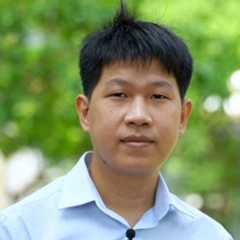
Nguyen Truong Thanh Hieu
Ton Duc Thang UniversityVietnam
Nguyen is one of three recipients of the 2020 Ta Quang Buu Awards for his project determining electron inelastic mean free paths in materials.(Photo:Ta Quang Buu Prize)
Nguyen is one of three recipients of the 2020 Ta Quang Buu Awards for his project determining electron inelastic mean free paths in materials.(Photo:Ta Quang Buu Prize)
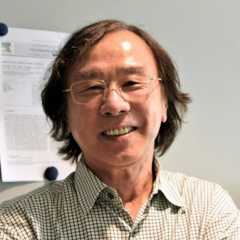
Hyeon K. Park
Ulsan National Institute of Science and TechnologySouth Korea
Park was awarded the 2020 S. Chandrasekhar Prize of Plasma Physics. He is known for his research in fusion plasma diagnostics.(Photo:Ulsan National Institute of Science and Technology)
Park was awarded the 2020 S. Chandrasekhar Prize of Plasma Physics. He is known for his research in fusion plasma diagnostics.(Photo:Ulsan National Institute of Science and Technology)
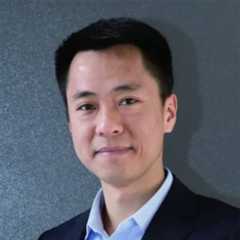
Jiang Ying
Peking UniversityChina
Jiang was awarded the 2020 Nishina Asia Award for his research on the structure and dynamics of interfacial water at the atomic scale.(Photo:Nishina Memorial Foundation)
Jiang was awarded the 2020 Nishina Asia Award for his research on the structure and dynamics of interfacial water at the atomic scale.(Photo:Nishina Memorial Foundation)

Akira Chiba
Tokyo Institute of TechnologyJapan
Chiba was awarded the 2020 IEEE Nikola Tesla Award for his contributions to bearingless and reluctance motors for application in hybrid and pure electrical vehicles.(Photo:Tokyo Institute of Technology)
Chiba was awarded the 2020 IEEE Nikola Tesla Award for his contributions to bearingless and reluctance motors for application in hybrid and pure electrical vehicles.(Photo:Tokyo Institute of Technology)

Dishant Mayurbhai Pancholi
Institute of Mathematical SciencesIndia
Pancholi received the 2019 Shanti Swarup Bhatnagar Prize for Science and Technology (Mathematical Sciences) for his research in the area of symplectic geometry and topology.(Photo:The Institute of Mathematical Sciences)
Pancholi received the 2019 Shanti Swarup Bhatnagar Prize for Science and Technology (Mathematical Sciences) for his research in the area of symplectic geometry and topology.(Photo:The Institute of Mathematical Sciences)
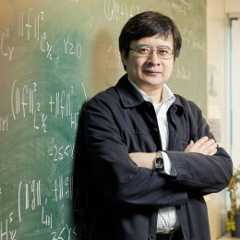
Yang Tong
City University of Hong KongHong Kong
Yang was elected a fellow of the European Academy of Sciences. He is known for his work on partial differential equations and kinetic theories in the area of hyperbolic conservation laws.(Photo:European Academy of Science)
Yang was elected a fellow of the European Academy of Sciences. He is known for his work on partial differential equations and kinetic theories in the area of hyperbolic conservation laws.(Photo:European Academy of Science)

Qian Qihu
Chinese Academy of EngineeringChina
Qian received the Highest Science and Technology Award 2018 for his contributions to China’s maritime radar system.(Photo:Visual China Group)
Qian received the Highest Science and Technology Award 2018 for his contributions to China’s maritime radar system.(Photo:Visual China Group)

Yasuhiko Arakawa
University of TokyoJapan
Arakawa was awarded the IEEE Jun-Ichi Nishizawa Medal 2019 for his contributions to the development and commercialization of quantum dot lasers.(Photo:The University of Tokyo)
Arakawa was awarded the IEEE Jun-Ichi Nishizawa Medal 2019 for his contributions to the development and commercialization of quantum dot lasers.(Photo:The University of Tokyo)
Qi Faren
Beihang UniversityChina
The chief designer for Chinese spacecraft, Qi was awarded the 2019 IAF Hall of Fame Award for his contributions to the progress of space science and technology.(Photo:Institutes of Science and Development, Chinese Academy of Sciences)
The chief designer for Chinese spacecraft, Qi was awarded the 2019 IAF Hall of Fame Award for his contributions to the progress of space science and technology.(Photo:Institutes of Science and Development, Chinese Academy of Sciences)
Wang Xiaoyun
Tsinghua UniversityChina
Wang won the 2019 Future Science Prize (Mathematics and Computer Science Prize) for developing new cryptoanalysis methods to reveal the weaknesses of widely used hash functions, enabling a new generation of cryptographic hash function standards. (Photo: Wang Xiaoyun)
Wang won the 2019 Future Science Prize (Mathematics and Computer Science Prize) for developing new cryptoanalysis methods to reveal the weaknesses of widely used hash functions, enabling a new generation of cryptographic hash function standards. (Photo: Wang Xiaoyun)

Kiran Mazumdar-Shaw
Biocon LimitedIndia
Mazumdar-Shaw received the Lifetime Achievement award from the Indian Chambers of Commerce & Industry for her contributions to the field of healthcare and society at large.(Photo:Wikimedia Commons)
Mazumdar-Shaw received the Lifetime Achievement award from the Indian Chambers of Commerce & Industry for her contributions to the field of healthcare and society at large.(Photo:Wikimedia Commons)

Neena Gupta
Indian Statistical InstituteIndia
Gupta received the 2019 Shanti Swarup Bhatnagar Prize for Science and Technology (Mathematical Sciences) for her contributions in affine algebraic geometry, in particular, her proposal of a solution to the Zariski Cancellation Problem.(Photo:Scroll.in)
Gupta received the 2019 Shanti Swarup Bhatnagar Prize for Science and Technology (Mathematical Sciences) for her contributions in affine algebraic geometry, in particular, her proposal of a solution to the Zariski Cancellation Problem.(Photo:Scroll.in)
Akira Yoshino
Asahi Kasei CorporationJapan
Yoshino won the 2019 Nobel Prize in Chemistry for creating the world’s first commercially viable lithium-ion battery in 1985. He shares the prize with Professor John B. Goodenough of the University of Texas, US and Professor M. Stanley Whittingham of the State University of New York, US. While employed at the then- Asahi Chemical Industry Co., Yoshino paired polyacetylene anodes with Goodenough’s cobalt oxide cathode design to overcome a critical safety barrier in lithium-ion batteries. He further improved the battery’s performance by developing an aluminium foil current collector and strategically designing its coil-wound structure. Today, lithium-ion batteries are used in a wide range of modern technologies, from smartphones to electric cars. (Photo: Tomohiro Ohsumi/Bloomberg/Getty Images)
Yoshino won the 2019 Nobel Prize in Chemistry for creating the world’s first commercially viable lithium-ion battery in 1985. He shares the prize with Professor John B. Goodenough of the University of Texas, US and Professor M. Stanley Whittingham of the State University of New York, US. While employed at the then- Asahi Chemical Industry Co., Yoshino paired polyacetylene anodes with Goodenough’s cobalt oxide cathode design to overcome a critical safety barrier in lithium-ion batteries. He further improved the battery’s performance by developing an aluminium foil current collector and strategically designing its coil-wound structure. Today, lithium-ion batteries are used in a wide range of modern technologies, from smartphones to electric cars. (Photo: Tomohiro Ohsumi/Bloomberg/Getty Images)

Pham Nam Hai
Tokyo Institute of TechnologyJapan
Pham received the 2019 Gottfried Wagener Prize for Digitalization and Mobility for his work on the giant spin Hall effect in topological insulators and its application to ultralow-power magnetoresistive random-access memory.(Photo:Tokyo Institute of Technology)
Pham received the 2019 Gottfried Wagener Prize for Digitalization and Mobility for his work on the giant spin Hall effect in topological insulators and its application to ultralow-power magnetoresistive random-access memory.(Photo:Tokyo Institute of Technology)
Toh Kim Chuan
National University of SingaporeSingapore
Toh was conferred the President’s Science Award 2019 for his fundamental contributions to the theory, algorithms and applications of convex optimization.(Photo:National University of Singapore)
Toh was conferred the President’s Science Award 2019 for his fundamental contributions to the theory, algorithms and applications of convex optimization.(Photo:National University of Singapore)

Pham Hoang Hiep
Vietnam Academy of Science and TechnologyVietnam
Pham won the Ramanujan Prize 2019 for his outstanding research in the field of complex analysis, specifically pluripotential theory, complex Monge-Ampère equations and log canonical thresholds. The prize also recognizes his contributions to the advancement of mathematics in his home country, Vietnam. Pham has the honor of being the first Vietnamese mathematician to publish in mathematics’ most prestigious journal, Acta Mathematica. He is also known in his home country as one of its youngest and most productive professors. (Photo: Pham Hoang Hiep)
Pham won the Ramanujan Prize 2019 for his outstanding research in the field of complex analysis, specifically pluripotential theory, complex Monge-Ampère equations and log canonical thresholds. The prize also recognizes his contributions to the advancement of mathematics in his home country, Vietnam. Pham has the honor of being the first Vietnamese mathematician to publish in mathematics’ most prestigious journal, Acta Mathematica. He is also known in his home country as one of its youngest and most productive professors. (Photo: Pham Hoang Hiep)

Shivaani Mariapun
University of Nottingham MalaysiaMalaysia
Mariapun received the 2019 L’Oréal-UNESCO Fellowship For Women in Science National Award (Malaysia)for her research on mammographic density and breast cancer risk in Asian women to formulate effective screening strategies for early detection of the disease.(Photo:L'Oréal Malaysia)
Mariapun received the 2019 L’Oréal-UNESCO Fellowship For Women in Science National Award (Malaysia)for her research on mammographic density and breast cancer risk in Asian women to formulate effective screening strategies for early detection of the disease.(Photo:L'Oréal Malaysia)

Cheon Jung-Hee
Seoul National UniversitySouth Korea
Cheon was awarded the POSCO TJ Park Foundation Science Prize 2019 for developing ‘HeaAn,’ a homomorphic encryption software program that decrypted for the first time the multiple linear function, the biggest challenge in the field of cryptology.(Photo:Dong-A Science)
Cheon was awarded the POSCO TJ Park Foundation Science Prize 2019 for developing ‘HeaAn,’ a homomorphic encryption software program that decrypted for the first time the multiple linear function, the biggest challenge in the field of cryptology.(Photo:Dong-A Science)

Sankaralingam Nambi Narayanan
Formerly Indian Space Research Organisation (ISRO)India
Narayanan was awarded the 2019 Padma Bhushan for introducing liquid fuel rocket technology in India.(Photo:Outlook India)
Narayanan was awarded the 2019 Padma Bhushan for introducing liquid fuel rocket technology in India.(Photo:Outlook India)

Yang Chen-Ning
Tsinghua UniversityChina
Yang was awarded the 2019 Qiu Shi Lifetime Achievement Award for his lifetime contributions to theoretical physics. Yang received the 1957 Nobel Prize in Physics for his work on parity nonconservation of weak interactions.(Photo:Chinese University of Hong Kong)
Yang was awarded the 2019 Qiu Shi Lifetime Achievement Award for his lifetime contributions to theoretical physics. Yang received the 1957 Nobel Prize in Physics for his work on parity nonconservation of weak interactions.(Photo:Chinese University of Hong Kong)

Raghavan B. Sunoj
Indian Institute of Technology BombayIndia
Sunoj received the 2019 Shanti Swarup Bhatnagar Prize for Science and Technology (Chemical Sciences) for his contributions to the field of chemistry, which explain how phenomenon such as handedness or enantioselectivity operate at the molecular level.(Photo:Indian Institute of Technology Bombay)
Sunoj received the 2019 Shanti Swarup Bhatnagar Prize for Science and Technology (Chemical Sciences) for his contributions to the field of chemistry, which explain how phenomenon such as handedness or enantioselectivity operate at the molecular level.(Photo:Indian Institute of Technology Bombay)
Rie Umetsu
Tohoku UniversityJapan
Umetsu received the 2019 Saruhashi Prize for her studies on the physical properties of Heusler-type functional magnetic materials, which are expected to have a variety of applications such as high-performance hard disks.(Photo:Tohoku University)
Umetsu received the 2019 Saruhashi Prize for her studies on the physical properties of Heusler-type functional magnetic materials, which are expected to have a variety of applications such as high-performance hard disks.(Photo:Tohoku University)

Makoto Nagao
Kyoto UniversityJapan
Nagao received the 2019 Okawa Prize for his pioneering achievements in the field of image processing, machine translation and digital library systems, as well as his contributions to academic leadership.(Photo:Kyoto University)
Nagao received the 2019 Okawa Prize for his pioneering achievements in the field of image processing, machine translation and digital library systems, as well as his contributions to academic leadership.(Photo:Kyoto University)

Govindasamy Mugesh
Indian Institute of Science BangaloreIndia
Mugesh received the 2019 Infosys Prize for Physical Sciences for his research into the chemical synthesis of small molecules and nanomaterials for biomedical applications.(Photo:The Royal Society of Chemistry)
Mugesh received the 2019 Infosys Prize for Physical Sciences for his research into the chemical synthesis of small molecules and nanomaterials for biomedical applications.(Photo:The Royal Society of Chemistry)
Yoshio Okamoto
Nagoya UniversityJapan
Okamoto won the 35th Japan Prize (2019) for his contributions to the precision synthesis of helical polymers and the development of practical chiral materials for separating chiral drugs.(Photo:The Japan Prize Foundation)
Okamoto won the 35th Japan Prize (2019) for his contributions to the precision synthesis of helical polymers and the development of practical chiral materials for separating chiral drugs.(Photo:The Japan Prize Foundation)

Liu Yongtan
Chinese Academy of SciencesChina
Liu received the Highest Science and Technology Award 2018 for his contributions to radar technology and signal processing.(Photo:Weibo)
Liu received the Highest Science and Technology Award 2018 for his contributions to radar technology and signal processing.(Photo:Weibo)

Tapas Kumar Maji
Jawaharlal Nehru Centre for Advanced Scientific ResearchIndia
Maji received the 2019 Shanti Swarup Bhatnagar Prize for Science and Technology (Chemical Sciences) for developing functional porous, soft and hybrid materials.(Photo:Jawaharlal Nehru Centre for Advanced Scientific Research)
Maji received the 2019 Shanti Swarup Bhatnagar Prize for Science and Technology (Chemical Sciences) for developing functional porous, soft and hybrid materials.(Photo:Jawaharlal Nehru Centre for Advanced Scientific Research)
Lim Tae-won
Hyundai Motor CompanySouth Korea
Lim won the POSCO TJ Park Foundation Technology Prize 2019 for his work that led to the first mass production of hydrogen fuel cell vehicles.(Photo:POSCO)
Lim won the POSCO TJ Park Foundation Technology Prize 2019 for his work that led to the first mass production of hydrogen fuel cell vehicles.(Photo:POSCO)

Ho Thi Thanh Van
Ho Chi Minh City University of Natural Resources and EnvironmentVietnam
Ho received the 2019 L’Oréal-UNESCO For Women in Science National Fellowship for synthesizing novel nanomaterials to enhance the efficiency of fuel cells.(Photo:Báo Mói)
Ho received the 2019 L’Oréal-UNESCO For Women in Science National Fellowship for synthesizing novel nanomaterials to enhance the efficiency of fuel cells.(Photo:Báo Mói)

Frank Wang
SZ DJI Technology Co. Ltd.China
Li and Wang were awarded the 2019 IEEE Robotics and Automation Award for their contributions to the development and commercialization of civilian drones, aerial imaging technology and robotics.(Photo: dpreview)
Li and Wang were awarded the 2019 IEEE Robotics and Automation Award for their contributions to the development and commercialization of civilian drones, aerial imaging technology and robotics.(Photo: dpreview)

Wang Yifang
Institute of High Energy Physics, Chinese Academy of SciencesChina
Wang won the 2019 The Future Science Prize (Physical Science Prize) for the experimental discovery of a new type of neutrino oscillation, which opens the door for new theories beyond the Standard Model of particle physics. His work is said to potentially be the key to understanding the Universe’s matter-antimatter asymmetry. Wang, along with his colleague Dr. Luk Kam-Biu, led the Daya Bay Rector Neutrino Experiment, where they made their ground-breaking discovery. He is presently serving as the director of the Institute for High-Energy Physics, Chinese Academy of Sciences.(Photo:Institute of High Energy Physics, Chinese Academy of Sciences)
Wang won the 2019 The Future Science Prize (Physical Science Prize) for the experimental discovery of a new type of neutrino oscillation, which opens the door for new theories beyond the Standard Model of particle physics. His work is said to potentially be the key to understanding the Universe’s matter-antimatter asymmetry. Wang, along with his colleague Dr. Luk Kam-Biu, led the Daya Bay Rector Neutrino Experiment, where they made their ground-breaking discovery. He is presently serving as the director of the Institute for High-Energy Physics, Chinese Academy of Sciences.(Photo:Institute of High Energy Physics, Chinese Academy of Sciences)

Maki Kawai
Institute for Molecular ScienceJapan
Kawai received the 2019 L’Oréal-UNESCO For Women in Science Award (Asia Pacific) for her work in manipulating molecules at the atomic level to transform and create innovative materials.(Photo:Fondation L'Oréal)
Kawai received the 2019 L’Oréal-UNESCO For Women in Science Award (Asia Pacific) for her work in manipulating molecules at the atomic level to transform and create innovative materials.(Photo:Fondation L'Oréal)

Hirotomo Nishihara
Tohoku UniversityJapan
Nishihara received the 2019 Gottfried Wagener Prize for Materials and Energy for developing advanced template techniques to make functional carbon materials.(Photo:German Chamber of Commerce and Industry in Japan)
Nishihara received the 2019 Gottfried Wagener Prize for Materials and Energy for developing advanced template techniques to make functional carbon materials.(Photo:German Chamber of Commerce and Industry in Japan)
Saku Tsuneta
National Institutes of Natural SciencesJapan
Tsuneta received the 2019 Japan Academy Prize for his studies of solar magnetohydrodynamic phenomena by satellite observations.(Photo:National Astronomical Observatory of Japan)
Tsuneta received the 2019 Japan Academy Prize for his studies of solar magnetohydrodynamic phenomena by satellite observations.(Photo:National Astronomical Observatory of Japan)

Soumen Basak
National Institute of ImmunologyIndia
Basak received the 2019 Shanti Swarup Bhatnagar Prize for Science and Technology (Biological Sciences) for his research on the NF-KB signalling system.(Photo: Soumen Basak)
Basak received the 2019 Shanti Swarup Bhatnagar Prize for Science and Technology (Biological Sciences) for his research on the NF-KB signalling system.(Photo: Soumen Basak)

Li Zexiang
Hong Kong University of Science and TechnologyHong Kong
Li and Wang were awarded the 2019 IEEE Robotics and Automation Award for their contributions to the development and commercialization of civilian drones, aerial imaging technology and robotics.(Photo:The Hong Kong University of Science and Technology)
Li and Wang were awarded the 2019 IEEE Robotics and Automation Award for their contributions to the development and commercialization of civilian drones, aerial imaging technology and robotics.(Photo:The Hong Kong University of Science and Technology)

Masahiro Hirama
Tohoku UniversityJapan
Hirama received the 2019 Japan Academy Prize for his work on the total synthesis of ciguatoxins and structurally complex bioactive natural products.(Photo:The Japan Academy)
Hirama received the 2019 Japan Academy Prize for his work on the total synthesis of ciguatoxins and structurally complex bioactive natural products.(Photo:The Japan Academy)

Tran Thi Hong Hanh
Vietnam Academy for Science and TechnologyVietnam
Tran received the 2019 L’Oréal-UNESCO for Women in Science National Fellowship for her research on using finger chromatography to assess the quality of medicinal herbs sold commercially in Vietnam.(Photo:Báo Mói)
Tran received the 2019 L’Oréal-UNESCO for Women in Science National Fellowship for her research on using finger chromatography to assess the quality of medicinal herbs sold commercially in Vietnam.(Photo:Báo Mói)

Sherry Aw
Institute of Molecular and Cell BiologySingapore
Aw was recognized as an International Rising Talent (Asia Pacific) by the 2019 L’Oréal-UNESCO International Awards For Women in Science for her research into the genetics of neurodegenerative disease using fruit flies.(Photo:Fondation L'Oréal)
Aw was recognized as an International Rising Talent (Asia Pacific) by the 2019 L’Oréal-UNESCO International Awards For Women in Science for her research into the genetics of neurodegenerative disease using fruit flies.(Photo:Fondation L'Oréal)

Yasuhiko Yasuda
University of TokyoJapan
Hatori and Yasuda were awarded the 2019 C&C Prize for their pioneering research and development in the field of image processing, which formed the foundations of broadcasting and communication engineering.(Photo:The NEC C&C Foundation)
Hatori and Yasuda were awarded the 2019 C&C Prize for their pioneering research and development in the field of image processing, which formed the foundations of broadcasting and communication engineering.(Photo:The NEC C&C Foundation)

Masahide Yamaguchi
Tokyo Institute of TechnologyJapan
Suyama and Yamaguchi were both awarded the 2019 Yukawa-Kimura Prize for their studies of non-Gaussianity in primordial fluctuations of the universe.(Photo:12th Asia Pacific Physics Conference)
Suyama and Yamaguchi were both awarded the 2019 Yukawa-Kimura Prize for their studies of non-Gaussianity in primordial fluctuations of the universe.(Photo:12th Asia Pacific Physics Conference)

Alicia Aguinaldo
University of Santo TomasPhilippines
Aguinaldo received the Philippine Federation of Chemistry Societies Shimadzu Achievement Award for Chemical Research for her studies into the anti-tuberculosis and anti-diabetic properties of Philippine plants.(Photo:University of Santo Tomas)
Aguinaldo received the Philippine Federation of Chemistry Societies Shimadzu Achievement Award for Chemical Research for her studies into the anti-tuberculosis and anti-diabetic properties of Philippine plants.(Photo:University of Santo Tomas)

Emma Sales
University of Southern MindanaoPhilippines
Sales received the LEADS AgriAward for Agricultural Research 2019 for establishing the first tissue culture and biotechnology laboratory in the Philippines’ Region XII (SOCCSKSARGEN) and developing diagnostic tools for the identification of durian, rubber and mango varieties.(Photo:University of Southern Mindanao)
Sales received the LEADS AgriAward for Agricultural Research 2019 for establishing the first tissue culture and biotechnology laboratory in the Philippines’ Region XII (SOCCSKSARGEN) and developing diagnostic tools for the identification of durian, rubber and mango varieties.(Photo:University of Southern Mindanao)

Lim Way Foong
Universiti Sains MalaysiaMalaysia
Lim received the 2019 L’Oréal-UNESCO Fellowship For Women in Science National Award (Malaysia) for her research on an alternative light-emitting diode that emits violet light instead of the more harmful blue light.(Photo:L'Oréal Malaysia)
Lim received the 2019 L’Oréal-UNESCO Fellowship For Women in Science National Award (Malaysia) for her research on an alternative light-emitting diode that emits violet light instead of the more harmful blue light.(Photo:L'Oréal Malaysia)

Mitsutoshi Hatori
University of TokyoJapan
Hatori and Yasuda were awarded the 2019 C&C Prize for their pioneering research and development in the field of image processing, which formed the foundations of broadcasting and communication engineering.(Photo:The NEC C&C Foundation)
Hatori and Yasuda were awarded the 2019 C&C Prize for their pioneering research and development in the field of image processing, which formed the foundations of broadcasting and communication engineering.(Photo:The NEC C&C Foundation)

Kayarat Saikrishnan
Indian Institute of Science Education and Research PuneSaikrishnan received the 2019 Shanti Swarup Bhatnagar Prize for Science and Technology (Biological Sciences) for his contributions to the field of structural biology.(Photo:PuneMirror)
Saikrishnan received the 2019 Shanti Swarup Bhatnagar Prize for Science and Technology (Biological Sciences) for his contributions to the field of structural biology.(Photo:PuneMirror)

Teruaki Suyama
Tokyo Institute of TechnologyJapan
Suyama and Yamaguchi were both awarded the 2019 Yukawa-Kimura Prize for their studies of non-Gaussianity in primordial fluctuations of the universe.(Photo: Teruaki Suyama)
Suyama and Yamaguchi were both awarded the 2019 Yukawa-Kimura Prize for their studies of non-Gaussianity in primordial fluctuations of the universe.(Photo: Teruaki Suyama)

Dhiraj Kumar
International Centre for Genetic Engineering and BiotechnologyIndia
Kumar received the 2019 Shanti Swarup Bhatnagar Prize for Science and Technology (Medical Sciences) for his research on the immune response to tuberculosis and strategies for intervention.(Photo:Shanti Swarup Bhatnagar Prize)
Kumar received the 2019 Shanti Swarup Bhatnagar Prize for Science and Technology (Medical Sciences) for his research on the immune response to tuberculosis and strategies for intervention.(Photo:Shanti Swarup Bhatnagar Prize)

Lee Eun Ji
Seoul National UniversitySouth Korea
Lee was awarded the 12th Asan Award in Medicine for Young Medical Scientists for establishing a treatment for glaucoma based on optic nerve head imaging.(Photo:Seoul National University Hospital)
Lee was awarded the 12th Asan Award in Medicine for Young Medical Scientists for establishing a treatment for glaucoma based on optic nerve head imaging.(Photo:Seoul National University Hospital)

Aninda Sinha
Indian Institute of Science BangaloreIndia
Sinha received the 2019 Shanti Swarup Bhatnagar Prize for Science and Technology (Physical Sciences) for his research and contributions to theoretical physics, in particular, string theory.(Photo:The Record)
Sinha received the 2019 Shanti Swarup Bhatnagar Prize for Science and Technology (Physical Sciences) for his research and contributions to theoretical physics, in particular, string theory.(Photo:The Record)

Han Buhm
Seoul National UniversitySouth Korea
Han was awarded the 12th Asan Award in Medicine for Young Medical Scientists for identifying the risk factors for autoimmune diseases through genomic big data analysis.(Photo:Seoul National University)
Han was awarded the 12th Asan Award in Medicine for Young Medical Scientists for identifying the risk factors for autoimmune diseases through genomic big data analysis.(Photo:Seoul National University)

Manjula Reddy
Centre for Cellular and Molecular BiologyIndia
Reddy received the 2019 Infosys Prize for Life Sciences for her ground-breaking discoveries concerning the structure of bacterial cell walls.(Photo:Infosys Limited)
Reddy received the 2019 Infosys Prize for Life Sciences for her ground-breaking discoveries concerning the structure of bacterial cell walls.(Photo:Infosys Limited)

Tadamitsu Kishimoto
Osaka UniversityJapan
Kishimoto was awarded the 2019 Keio Medical Science Prize for his discovery of interleukin-6 and research into its implications in biology and medicine.(Photo:The Japan Prize Foundation)
Kishimoto was awarded the 2019 Keio Medical Science Prize for his discovery of interleukin-6 and research into its implications in biology and medicine.(Photo:The Japan Prize Foundation)

Goh Eng Lim
Hewlett Packard EnterpriseSingapore
Goh was awarded the Exceptional Technology Achievement Medal 2019 for his technology contributions to the National Aeronautics and Space Administration, and for successfully demonstrating the first commercial supercomputing platform in the International Space Station.(Photo:Business Wire, Inc.)
Goh was awarded the Exceptional Technology Achievement Medal 2019 for his technology contributions to the National Aeronautics and Space Administration, and for successfully demonstrating the first commercial supercomputing platform in the International Space Station.(Photo:Business Wire, Inc.)

Suvrat Raju
Tata Institute of Fundamental ResearchIndia
Raju won the ICTP Prize 2019 for his work on black holes and the development of tools and concepts that extend to conformal field theories, holographic correspondence, quantum error corrections and algebraic quantum field theory.(Photo:International Centre for Theoretical Sciences)
Raju won the ICTP Prize 2019 for his work on black holes and the development of tools and concepts that extend to conformal field theories, holographic correspondence, quantum error corrections and algebraic quantum field theory.(Photo:International Centre for Theoretical Sciences)
John Wong
National University of SingaporeSingapore
Wong was elected to the United States’ National Academy of Medicine in recognition of his contributions to the advancement of the medical sciences and healthcare.(Photo:Sidra Medicine)
Wong was elected to the United States’ National Academy of Medicine in recognition of his contributions to the advancement of the medical sciences and healthcare.(Photo:Sidra Medicine)

Yozo Fujino
Yokohama National UniversityJapan
Fujino received the 2019 Japan Academy Prize for his studies on vibration and how it can be controlled in large civil structures.(Photo:International Association for Bridge and Structural Engineering)
Fujino received the 2019 Japan Academy Prize for his studies on vibration and how it can be controlled in large civil structures.(Photo:International Association for Bridge and Structural Engineering)
Mika Nomoto
Nagoya UniversityJapan
Nomoto was recognized as an International Rising Talent (Asia Pacific) by the 2019 L’Oréal-UNESCO International Awards For Women in Science for her work on plant-specific immunity, which can be used to promote sustainable pest management.(Photo:Fondation L'Oréal)
Nomoto was recognized as an International Rising Talent (Asia Pacific) by the 2019 L’Oréal-UNESCO International Awards For Women in Science for her work on plant-specific immunity, which can be used to promote sustainable pest management.(Photo:Fondation L'Oréal)
Kim Jong Sung
University of UlsanSouth Korea
Kim received the 12th Asan Award in Clinical Medicine (2019) for developing treatments for stroke in South Korea.(Photo:Asan Medical Center)
Kim received the 12th Asan Award in Clinical Medicine (2019) for developing treatments for stroke in South Korea.(Photo:Asan Medical Center)

Kanetada Nagamine
High Energy Accelerator Research OrganizationJapan
Nagamine received the 2019 Japan Academy Prize for his work on muon beams and the non-destructive muon radiography of large-scale objects.(Photo:The Japan Academy)
Nagamine received the 2019 Japan Academy Prize for his work on muon beams and the non-destructive muon radiography of large-scale objects.(Photo:The Japan Academy)

Hiroshi Takayanagi
University of TokyoJapan
Takayanagi received the 2019 Japan Academy Prize for his studies on osteoimmunology, an interdisciplinary field that combines bone biology and immunology.(Photo:The University of Tokyo)
Takayanagi received the 2019 Japan Academy Prize for his studies on osteoimmunology, an interdisciplinary field that combines bone biology and immunology.(Photo:The University of Tokyo)

Tan Sze Tiong
Housing & Development BoardSingapore
Folianto, Koh, Poh and Tan were part of the team that was conferred the President’s Technology Award 2019 for developing the Integrated Environmental Modeler, an advanced modeling tool that is capable of integrating the effects of environmental factors such as wind, solar, and noise in urban settings.(Photo:Agency for Science, Technology and Research Singapore)
Folianto, Koh, Poh and Tan were part of the team that was conferred the President’s Technology Award 2019 for developing the Integrated Environmental Modeler, an advanced modeling tool that is capable of integrating the effects of environmental factors such as wind, solar, and noise in urban settings.(Photo:Agency for Science, Technology and Research Singapore)

Takashi Nagasawa
Osaka UniversityJapan
Nagasawa received the 2019 Japan Academy Prize for revealing how microenvironments are essential for maintaining the stem cell potential of blood cells and bone. (Photo:Osaka University)
Nagasawa received the 2019 Japan Academy Prize for revealing how microenvironments are essential for maintaining the stem cell potential of blood cells and bone. (Photo:Osaka University)

Emil Q. Javier
Formerly the University of the Philippines SystemPhilippines
A pioneering plant geneticist and agronomist, Javier was conferred the rank of National Scientist of the Philippines in recognition of his contributions to the field of agriculture. He spearheaded the Institute of Plant Breeding in Los Baños, which popularized high-yielding crops and disease-resistant plant varieties in Asia. Javier also served as the 17th president of the Philippines’ top-ranked university system, the University of the Philippines.Beyond research and academic leadership, Javier is also recognized for promoting sound agricultural policies and programs, utilizing climate-resilient and environmentally-friendly agricultural innovations, and improving governance to enhance the livelihood of Filipino farmers and fisherfolk. Beyond research and academic leadership, Javier is also recognized for promoting sound agricultural policies and programs, utilizing climate-resilient and environmentally-friendly agricultural innovations, and improving governance to enhance the livelihood of Filipino farmers and fisherfolk.(Photo:University of the Philippines Los Baños)
A pioneering plant geneticist and agronomist, Javier was conferred the rank of National Scientist of the Philippines in recognition of his contributions to the field of agriculture. He spearheaded the Institute of Plant Breeding in Los Baños, which popularized high-yielding crops and disease-resistant plant varieties in Asia. Javier also served as the 17th president of the Philippines’ top-ranked university system, the University of the Philippines.Beyond research and academic leadership, Javier is also recognized for promoting sound agricultural policies and programs, utilizing climate-resilient and environmentally-friendly agricultural innovations, and improving governance to enhance the livelihood of Filipino farmers and fisherfolk. Beyond research and academic leadership, Javier is also recognized for promoting sound agricultural policies and programs, utilizing climate-resilient and environmentally-friendly agricultural innovations, and improving governance to enhance the livelihood of Filipino farmers and fisherfolk.(Photo:University of the Philippines Los Baños)

Gagandeep Kang
Translational Health Science and Technology InstituteIndia
Kang is the first Indian woman to be elected as a fellow of the Royal Society, United Kingdom. She is known for her inter-disciplinary public health research on enteric infections and their sequelae in children in India. In 2016, she was awarded the prestigious Infosys Prize in Life Sciences for her pivotal contributions to understanding the natural history of rotavirus and other enteric diseases, with broad implications for the treatment of these diseases. Her work has shown that the Indian population has a lower natural immunity to rotavirus infection compared to other populations. In addition to basic research, Kang has also built national rotavirus and typhoid surveillance networks and established laboratories to support local vaccine trials in India.(Photo:Social News XYZ)
Kang is the first Indian woman to be elected as a fellow of the Royal Society, United Kingdom. She is known for her inter-disciplinary public health research on enteric infections and their sequelae in children in India. In 2016, she was awarded the prestigious Infosys Prize in Life Sciences for her pivotal contributions to understanding the natural history of rotavirus and other enteric diseases, with broad implications for the treatment of these diseases. Her work has shown that the Indian population has a lower natural immunity to rotavirus infection compared to other populations. In addition to basic research, Kang has also built national rotavirus and typhoid surveillance networks and established laboratories to support local vaccine trials in India.(Photo:Social News XYZ)

Lu Chao-Yang
University of Science and Technology of ChinaChina
Lu was awarded the 2019 (7th) Nishina Asia Award for his contributions to quantum information science using single photons.(Photo: Lu Chao-Yang)
Lu was awarded the 2019 (7th) Nishina Asia Award for his contributions to quantum information science using single photons.(Photo: Lu Chao-Yang)

Liao I-Chiu
National Taiwan Ocean UniversityTaiwan
Liao received the 24th Nikkei Asia Prize for Science and Technology for his pioneering contributions to the development of Taiwan’s aquaculture industry. (Photo: Toshiyuki Kumagai)
Liao received the 24th Nikkei Asia Prize for Science and Technology for his pioneering contributions to the development of Taiwan’s aquaculture industry. (Photo: Toshiyuki Kumagai)
Wan Iryani Wan Ismail
Universiti Malaysia TerengganuMalaysia
Ismail received the 2019 L’Oréal-UNESCO Fellowship For Women in Science National Award (Malaysia) for her research on honey consumption in controlling obesity.(Photo:L'Oréal Malaysia)
Ismail received the 2019 L’Oréal-UNESCO Fellowship For Women in Science National Award (Malaysia) for her research on honey consumption in controlling obesity.(Photo:L'Oréal Malaysia)

Shao Feng
National Institute of Biological SciencesChina
Shao won the 2019 The Future Science Prize (Life Science Prize) as well as the 2019 Qiu Shi Outstanding Scientist Award for discovering how cells recognize and respond to pathogenic bacteria.(Photo:European Cell Death Organization)
Shao won the 2019 The Future Science Prize (Life Science Prize) as well as the 2019 Qiu Shi Outstanding Scientist Award for discovering how cells recognize and respond to pathogenic bacteria.(Photo:European Cell Death Organization)

Mohammad Javed Ali
L.V. Prasad Eye InstituteIndia
Ali received the 2019 Shanti Swarup Bhatnagar Prize for Science and Technology (Medical Sciences) for his research contributions to dacryology and lacrimal systems.(Photo:Friedrich-Alexander-Universität Erlangen-Nürnberg)
Ali received the 2019 Shanti Swarup Bhatnagar Prize for Science and Technology (Medical Sciences) for his research contributions to dacryology and lacrimal systems.(Photo:Friedrich-Alexander-Universität Erlangen-Nürnberg)

Poh Hee Joo
Institute of High Performance ComputingSingapore
Folianto, Koh, Poh and Tan were part of the team that was conferred the President’s Technology Award 2019 for developing the Integrated Environmental Modeler, an advanced modeling tool that is capable of integrating the effects of environmental factors such as wind, solar, and noise in urban settings.(Photo:Ministry of National Development)
Folianto, Koh, Poh and Tan were part of the team that was conferred the President’s Technology Award 2019 for developing the Integrated Environmental Modeler, an advanced modeling tool that is capable of integrating the effects of environmental factors such as wind, solar, and noise in urban settings.(Photo:Ministry of National Development)

Yoshihiro Iwasa
University of TokyoJapan
Iwasa was awarded the 2019 (65th) Nishina Memorial Prize for his discovery of electric-field-induced two-dimensional superconductivity.(Photo:The University of Tokyo)
Iwasa was awarded the 2019 (65th) Nishina Memorial Prize for his discovery of electric-field-induced two-dimensional superconductivity.(Photo:The University of Tokyo)

V. Narry Kim
Seoul National University/Institute for Basic ScienceSouth Korea
Kim received the 12th Asan Award in Basic Medicine (2019) for her discovery of the microRNA biogenesis pathway and RNA tailing control. Her trailblazing research has contributed to the improvement of RNA interference technologies. In 2013,Kim, along with Professor Kim Jin-Soo, also developed a new technique to eliminate specific microRNAs, which has potential applications in cancer treatment. For her pioneering contributions to the field of RNA biology, Kim has received multiple awards, including the 2008 L’Oreal-UNESCO Award For Women in Science and the 2009 Ho-Am Prize in Medicine.(Photo:Wikimedia Commons)
Kim received the 12th Asan Award in Basic Medicine (2019) for her discovery of the microRNA biogenesis pathway and RNA tailing control. Her trailblazing research has contributed to the improvement of RNA interference technologies. In 2013,Kim, along with Professor Kim Jin-Soo, also developed a new technique to eliminate specific microRNAs, which has potential applications in cancer treatment. For her pioneering contributions to the field of RNA biology, Kim has received multiple awards, including the 2008 L’Oreal-UNESCO Award For Women in Science and the 2009 Ho-Am Prize in Medicine.(Photo:Wikimedia Commons)

Akira Isogai
University of TokyoJapan
Isogai received the 2019 Japan Academy Prize for his studies on completely dispersed cellulose nanofibers originating from plants.(Photo:The University of Tokyo)
Isogai received the 2019 Japan Academy Prize for his studies on completely dispersed cellulose nanofibers originating from plants.(Photo:The University of Tokyo)
Cleotilde Hidalgo-How
University of the Philippines ManilaPhilippines
Hidalgo-How received the Dr. Paulo Campos Award for Health Research 2019 for her work in the understanding, management and diagnosis of tuberculosis among children and adolescents.(Photo:NA)
Hidalgo-How received the Dr. Paulo Campos Award for Health Research 2019 for her work in the understanding, management and diagnosis of tuberculosis among children and adolescents.(Photo:NA)
Shigeru Yoshida
Chiba UniversityJapan
Ishihara and Yoshida were jointly awarded the 2019 (65th) Nishina Memorial Prize for their discovery of ultra-high energy cosmic neutrinos.(Photo:Chiba University)
Ishihara and Yoshida were jointly awarded the 2019 (65th) Nishina Memorial Prize for their discovery of ultra-high energy cosmic neutrinos.(Photo:Chiba University)
Sadao Ota
University of TokyoJapan
Horisaki and Ota were awarded the 2019 Gottfried Wagener Prize for Life Sciences for their work on developing ghost cytometry technologies.(Photo:German Chamber of Commerce and Industry in Japan)
Horisaki and Ota were awarded the 2019 Gottfried Wagener Prize for Life Sciences for their work on developing ghost cytometry technologies.(Photo:German Chamber of Commerce and Industry in Japan)

Koh Wee Shing
Institute of High Performance ComputingSingapore
Folianto, Koh, Poh and Tan were part of the team that was conferred the President’s Technology Award 2019 for developing the Integrated Environmental Modeler, an advanced modeling tool that is capable of integrating the effects of environmental factors such as wind, solar, and noise in urban settings. (Photo: Koh Wee Shing)
Folianto, Koh, Poh and Tan were part of the team that was conferred the President’s Technology Award 2019 for developing the Integrated Environmental Modeler, an advanced modeling tool that is capable of integrating the effects of environmental factors such as wind, solar, and noise in urban settings. (Photo: Koh Wee Shing)

Raul Destura
National Institutes of Health, University of the Philippines ManilaPhilippines
Destura was awarded the 2019 Presidential Lingkod Bayan Award for his creation of the award-winning Biotek-M dengue aquakit for faster, more affordable and accessible dengue diagnosis.(Photo:Raul Destura)
Destura was awarded the 2019 Presidential Lingkod Bayan Award for his creation of the award-winning Biotek-M dengue aquakit for faster, more affordable and accessible dengue diagnosis.(Photo:Raul Destura)

Carlo Arcilla
Philippine Nuclear Research InstitutePhilippines
Arcilla received the Gregorio Y. Zara Award for Basic Research 2019 for his contributions to resolving sensitive issues on mineral resource development, water management, and developing peaceful applications for nuclear energy in the Philippines.(Photo:International Atomic Energy Agency)
Arcilla received the Gregorio Y. Zara Award for Basic Research 2019 for his contributions to resolving sensitive issues on mineral resource development, water management, and developing peaceful applications for nuclear energy in the Philippines.(Photo:International Atomic Energy Agency)

Ryoichi Horisaki
Osaka UniversityJapan
Horisaki and Ota were awarded the 2019 Gottfried Wagener Prize for Life Sciences for their work on developing ghost cytometry technologies.(Photo:German Chamber of Commerce and Industry in Japan)
Horisaki and Ota were awarded the 2019 Gottfried Wagener Prize for Life Sciences for their work on developing ghost cytometry technologies.(Photo:German Chamber of Commerce and Industry in Japan)
Aya Ishihara
Chiba UniversityJapan
Ishihara and Yoshida were jointly awarded the 2019 (65th) Nishina Memorial Prize for their discovery of ultra-high energy cosmic neutrinos.(Photo:Chiba University)
Ishihara and Yoshida were jointly awarded the 2019 (65th) Nishina Memorial Prize for their discovery of ultra-high energy cosmic neutrinos.(Photo:Chiba University)

Saw Seang Mei
Singapore Eye Research InstituteSingapore
Beuerman, Chia, Saw and Tan were part of the team that was conferred the President’s Science Award 2019 for three decades of research in the field of myopia, which resulted in public health strategies and interventional myopia control therapies to help decrease the rates of myopia and myopia-related blindness in Singapore.(Photo:Duke-NUS Medical School)
Beuerman, Chia, Saw and Tan were part of the team that was conferred the President’s Science Award 2019 for three decades of research in the field of myopia, which resulted in public health strategies and interventional myopia control therapies to help decrease the rates of myopia and myopia-related blindness in Singapore.(Photo:Duke-NUS Medical School)

Manik Varma
Microsoft Research IndiaIndia
Varma received the 2019 Shanti Swarup Bhatnagar Prize for Science and Technology (Engineering Sciences) for his contributions to machine learning and computer vision. (Photo:Microsoft Corporation)
Varma received the 2019 Shanti Swarup Bhatnagar Prize for Science and Technology (Engineering Sciences) for his contributions to machine learning and computer vision. (Photo:Microsoft Corporation)

Joselito R. Chavez
National Kidney and Transplant InstitutePhilippines
Chavez was awarded the 2019 Presidential Lingkod Bayan Award for his trailblazing work on the use of extracorporeal membrane oxygenation in severe leptospirosis. (Photo:Clipside)
Chavez was awarded the 2019 Presidential Lingkod Bayan Award for his trailblazing work on the use of extracorporeal membrane oxygenation in severe leptospirosis. (Photo:Clipside)

Shankar Ghosh
Tata Institute of Fundamental ResearchIndia
Ghosh received the 2019 Shanti Swarup Bhatnagar Prize for Science and Technology (Physical Sciences) for his work on how friction can be used to help soft matter self-organize. (Photo:Tata Institute of Fundamental Research)
Ghosh received the 2019 Shanti Swarup Bhatnagar Prize for Science and Technology (Physical Sciences) for his work on how friction can be used to help soft matter self-organize. (Photo:Tata Institute of Fundamental Research)

Audrey Chia
Singapore Eye Research InstituteSingapore
Beuerman, Chia, Saw and Tan were part of the team that was conferred the President’s Science Award 2019 for three decades of research in the field of myopia, which resulted in public health strategies and interventional myopia control therapies to help decrease the rates of myopia and myopia-related blindness in Singapore. (Photo:Singapore National Eye Centre)
Beuerman, Chia, Saw and Tan were part of the team that was conferred the President’s Science Award 2019 for three decades of research in the field of myopia, which resulted in public health strategies and interventional myopia control therapies to help decrease the rates of myopia and myopia-related blindness in Singapore. (Photo:Singapore National Eye Centre)

Fachmin Folianto
Institute for Infocomm ResearchSingapore
Folianto, Koh, Poh and Tan were part of the team that was conferred the President’s Technology Award 2019 for developing the Integrated Environmental Modeler, an advanced modeling tool that is capable of integrating the effects of environmental factors such as wind, solar, and noise in urban settings.(Photo:Agency for Science, Technology and Research Singapore)
Folianto, Koh, Poh and Tan were part of the team that was conferred the President’s Technology Award 2019 for developing the Integrated Environmental Modeler, an advanced modeling tool that is capable of integrating the effects of environmental factors such as wind, solar, and noise in urban settings.(Photo:Agency for Science, Technology and Research Singapore)

Zhou Yan
Nanyang Technological UniversitySingapore
Zhou won the 2019 ASEAN-US Science Prize for Women for her research into energy-efficient water treatment and reclamation for industrial and daily use, which has benefited communities in Asia. (Photo: Zhou Yan)
Zhou won the 2019 ASEAN-US Science Prize for Women for her research into energy-efficient water treatment and reclamation for industrial and daily use, which has benefited communities in Asia. (Photo: Zhou Yan)

Oh Uhtaek
Korea Institute of Science and TechnologySouth Korea
Oh won the 2019 Ho-Am Prize in Medicine for his discovery of the ion channel genes ANO1 and TTN3,which may help in the development of treatments for diseases caused by ion channel defects.(Photo:Korea Institute of Science and Technology)
Oh won the 2019 Ho-Am Prize in Medicine for his discovery of the ion channel genes ANO1 and TTN3,which may help in the development of treatments for diseases caused by ion channel defects.(Photo:Korea Institute of Science and Technology)

Muhammad Faryad
Lahore University of Management SciencesPakistan
Faryad received the ICO/ICTP Gallieno Denardo Award 2019 for his contributions to the understanding of how light interacts with nanostructured materials, with applications in the area of optical surface waves, solar cells and optical metamaterials.(Photo:International Centre for Theoretical Physics)
Faryad received the ICO/ICTP Gallieno Denardo Award 2019 for his contributions to the understanding of how light interacts with nanostructured materials, with applications in the area of optical surface waves, solar cells and optical metamaterials.(Photo:International Centre for Theoretical Physics)

Roger Beuerman
Singapore Eye Research InstituteSingapore
Beuerman, Chia, Saw and Tan were part of the team that was conferred the President’s Science Award 2019 for three decades of research in the field of myopia, which resulted in public health strategies and interventional myopia control therapies to help decrease the rates of myopia and myopia-related blindness in Singapore.(Photo:SingHealth Research)
Beuerman, Chia, Saw and Tan were part of the team that was conferred the President’s Science Award 2019 for three decades of research in the field of myopia, which resulted in public health strategies and interventional myopia control therapies to help decrease the rates of myopia and myopia-related blindness in Singapore.(Photo:SingHealth Research)

Donald Tan
Singapore Eye Research InstituteSingapore
Beuerman, Chia, Saw and Tan were part of the team that was conferred the President’s Science Award 2019 for three decades of research in the field of myopia, which resulted in public health strategies and interventional myopia control therapies to help decrease the rates of myopia and myopia-related blindness in Singapore.(Photo:FV Hospital)
Beuerman, Chia, Saw and Tan were part of the team that was conferred the President’s Science Award 2019 for three decades of research in the field of myopia, which resulted in public health strategies and interventional myopia control therapies to help decrease the rates of myopia and myopia-related blindness in Singapore.(Photo:FV Hospital)

Tang Ching Wan
Hong Kong University of Science and TechnologyHong Kong
Tang won the 2019 Kyoto Prize for Advanced Technology for his pioneering contributions to the birth of high-efficiency organic light-emitting diodes and their widespread application in displays and lighting.(Photo:The University of Hong Kong)
Tang won the 2019 Kyoto Prize for Advanced Technology for his pioneering contributions to the birth of high-efficiency organic light-emitting diodes and their widespread application in displays and lighting.(Photo:The University of Hong Kong)

Subimal Ghosh
Indian Institute of Technology BombayIndia
Ghosh received the 2019 Shanti Swarup Bhatnagar Prize for Science and Technology (Earth, Atmosphere, Ocean and Planetary Sciences) for his contributions to our understanding of how land-surface processes are coupled to the Indian monsoon, which has helped to improve regional monsoon predictions.(Photo:Gubbi Labs LLP)
Ghosh received the 2019 Shanti Swarup Bhatnagar Prize for Science and Technology (Earth, Atmosphere, Ocean and Planetary Sciences) for his contributions to our understanding of how land-surface processes are coupled to the Indian monsoon, which has helped to improve regional monsoon predictions.(Photo:Gubbi Labs LLP)

Alonzo Gabriel
University of the Philippines DilimanPhilippines
Gabriel received the Eduardo A. Quisumbing Medal for his research into microbial stress adaptation on food safety and quality.(Photo:Japan International Research Center for Agricultural Sciences)
Gabriel received the Eduardo A. Quisumbing Medal for his research into microbial stress adaptation on food safety and quality.(Photo:Japan International Research Center for Agricultural Sciences)

Robert Dizon
Metals Industry Research and Development CenterPhilippines
Dizon received the Mario Cruel Award for Advanced Engineering Technology Application for developing the torque mode configuration for multiple variable frequency drives used in the Automated Guideway Transit System, Hybrid Electric Road Train and Hybrid Electric Train.(Photo:Department of Science and Technology, Republic of the Philippines)
Dizon received the Mario Cruel Award for Advanced Engineering Technology Application for developing the torque mode configuration for multiple variable frequency drives used in the Automated Guideway Transit System, Hybrid Electric Road Train and Hybrid Electric Train.(Photo:Department of Science and Technology, Republic of the Philippines)

Basudeb Dasgupta
Tata Institute of Fundamental ResearchIndia
Dasgupta won the ICTP Prize 2019 for his innovative theoretical contribution to neutrino and dark-matter physics, in particular, our understanding of collective neutrino oscillations.(Photo:Tata Institute of Fundamental Research)
Dasgupta won the ICTP Prize 2019 for his innovative theoretical contribution to neutrino and dark-matter physics, in particular, our understanding of collective neutrino oscillations.(Photo:Tata Institute of Fundamental Research)

Raymond Tan
De La Salle UniversityPhilippines
Tan received the Gregorio Y. Zara Award for Advanced Research 2019 for his contributions to the development of novel computational techniques for the design of sustainable industrial systems.(Photo:De La Salle University)
Tan received the Gregorio Y. Zara Award for Advanced Research 2019 for his contributions to the development of novel computational techniques for the design of sustainable industrial systems.(Photo:De La Salle University)

Susan Gallardo
De La Salle UniversityPhilippines
Gallardo received the David M. Consunji Award for Engineering Research 2019 for her work in environmental engineering and catalysis, as well as industrial and hazardous waste treatment and management.(Photo:De La Salle University)
Gallardo received the David M. Consunji Award for Engineering Research 2019 for her work in environmental engineering and catalysis, as well as industrial and hazardous waste treatment and management.(Photo:De La Salle University)

Pham Thi Thu Ha
Ton Duc Thang UniversityVietnam
Pham received the L’Oréal-UNESCO For Women in Science National Fellowship for using molecular markers to develop high-yielding salt-tolerant rice varieties in affected areas along the Mekong Delta.(Photo:Báo Mói)
Pham received the L’Oréal-UNESCO For Women in Science National Fellowship for using molecular markers to develop high-yielding salt-tolerant rice varieties in affected areas along the Mekong Delta.(Photo:Báo Mói)

Sunita Sarawagi
Indian Institute of Technology BombayIndia
Sarawagi received the 2019 Infosys Prize for Engineering and Computer Science for her research in databases, data mining, machine learning and natural language processing. Specifically, she was recognized for being one of the earliest researchers to develop information extraction techniques for the unstructured data commonly found on the World Wide Web. Sarawagi was previously a visiting scientist at Google, where her projects included optimizing deep learning models for personalized Youtube recomendations. Currently, she is the Institute Chair Professor in Computer Science and Engineering at IIT-Bombay.(Photo:Indian Institute of Technology Bombay)
Sarawagi received the 2019 Infosys Prize for Engineering and Computer Science for her research in databases, data mining, machine learning and natural language processing. Specifically, she was recognized for being one of the earliest researchers to develop information extraction techniques for the unstructured data commonly found on the World Wide Web. Sarawagi was previously a visiting scientist at Google, where her projects included optimizing deep learning models for personalized Youtube recomendations. Currently, she is the Institute Chair Professor in Computer Science and Engineering at IIT-Bombay.(Photo:Indian Institute of Technology Bombay)
Makoto Fujita
University of TokyoJapan
Fujita received the 2019 Imperial Prize and Japan Academy Prize for developing the crystalline sponge method, which is used in the field of X-ray crystallography.(Photo:Japan Science and Technology Agency)
Fujita received the 2019 Imperial Prize and Japan Academy Prize for developing the crystalline sponge method, which is used in the field of X-ray crystallography.(Photo:Japan Science and Technology Agency)

Son Young-Woo
Korea Institute for Advanced StudySouth Korea
A theoretical physicist, Son won the 2018 POSCO TJ Park Prize (Science Prize) for showing that graphene nanoribbons have magnetic properties not found in normal graphene.(Photo:Korea Institute for Advanced Study)
A theoretical physicist, Son won the 2018 POSCO TJ Park Prize (Science Prize) for showing that graphene nanoribbons have magnetic properties not found in normal graphene.(Photo:Korea Institute for Advanced Study)

Urbasi Sinha
Raman Research InstituteIndia
Sinha is the recipient of the 2018 ICO/ICTP Gallieno Denardo Award given out by the International Commission for Optics (ICO) and the Abdus Salam International Centre for Theoretical Physics (ICTP). She was recognized for her contributions to the field of quantum photonics as well as her outreach activities to popularize science in India.Sinha runs the Quantum Information and Computing Lab at the Raman Research Institute, India’s first lab dedicated to research on quantum information processing and its applications. The lab has been chosen to represent India in an international collaboration with Canada to explore using entangled photons for quantum satellite communication.(Photo:Raman Research Institute)
Sinha is the recipient of the 2018 ICO/ICTP Gallieno Denardo Award given out by the International Commission for Optics (ICO) and the Abdus Salam International Centre for Theoretical Physics (ICTP). She was recognized for her contributions to the field of quantum photonics as well as her outreach activities to popularize science in India.Sinha runs the Quantum Information and Computing Lab at the Raman Research Institute, India’s first lab dedicated to research on quantum information processing and its applications. The lab has been chosen to represent India in an international collaboration with Canada to explore using entangled photons for quantum satellite communication.(Photo:Raman Research Institute)
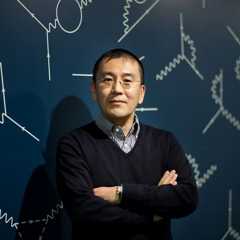
Hirosi Ooguri
University of TokyoJapan
For his research on string theory, Ooguri was awarded the Hamburg Prize for Theoretical Physics, one of the most sought-after science prizes in Germany.(Photo:Caltech)
For his research on string theory, Ooguri was awarded the Hamburg Prize for Theoretical Physics, one of the most sought-after science prizes in Germany.(Photo:Caltech)
Ng Kwan Hoong
University of MalayaMalaysia
Ng is the first scientist from a developing country to receive theMarie Sklodowska-Curie Award, a prize that honors scientists for their contributions towards the training of aspiring medical physicists.(Photo:University of Malaya)
Ng is the first scientist from a developing country to receive theMarie Sklodowska-Curie Award, a prize that honors scientists for their contributions towards the training of aspiring medical physicists.(Photo:University of Malaya)

Gao Hongjun
Institute of Physics, Chinese Academy of SciencesChina
Gao was awarded the 2018 Tan Kah Kee Science Award (Mathematics & Physics) for his research on the assembly of molecular machines. (Photo:Institute of Physics)
Gao was awarded the 2018 Tan Kah Kee Science Award (Mathematics & Physics) for his research on the assembly of molecular machines. (Photo:Institute of Physics)

Xu Zongben
Xi’an Jiaotong UniversityChina
Xu is a recipient of the 2018 Tan Kah Kee Science Award (Information Sciences). He developed a theory that allows for the reconstruction of sparse signals, with applications in radar imaging and machine vision, among others.(Photo:Xi’an Jiaotong University)
Xu is a recipient of the 2018 Tan Kah Kee Science Award (Information Sciences). He developed a theory that allows for the reconstruction of sparse signals, with applications in radar imaging and machine vision, among others.(Photo:Xi’an Jiaotong University)

Wu Yirong
Institute of Electronics, Chinese Academy of SciencesChina
Wu is a recipient of the 2018 Tan Kah Kee Science Award (Information Sciences). He developed a theory that allows for the reconstruction of sparse signals, with applications in radar imaging and machine vision, among others.(Photo:Institute of Electronics)
Wu is a recipient of the 2018 Tan Kah Kee Science Award (Information Sciences). He developed a theory that allows for the reconstruction of sparse signals, with applications in radar imaging and machine vision, among others.(Photo:Institute of Electronics)

Oh Hee
Korea Institute for Advanced StudySouth Korea
Oh was awarded the 2018 Ho-Am Prize for Science for her work on Apollonian circle packings, a concept that can be used to interpret fractals found in nature. (Photo:Korea Institute for Advanced Study)
Oh was awarded the 2018 Ho-Am Prize for Science for her work on Apollonian circle packings, a concept that can be used to interpret fractals found in nature. (Photo:Korea Institute for Advanced Study)

Hasibun Naher
BRAC UniversityBangladesh
Naher received the2018 OWSD-Elsevier Foundation Awards for Early-Career Women Scientists in the Developing World for her research on non-linear partial differential equations, which has applications in tsunami simulations.(Photo:BRAC University)
Naher received the2018 OWSD-Elsevier Foundation Awards for Early-Career Women Scientists in the Developing World for her research on non-linear partial differential equations, which has applications in tsunami simulations.(Photo:BRAC University)

Ritabrata Munshi
Tata Institute of Fundamental ResearchIndia
Munshi received the2018 Ramanujan Prize for Young Mathematicians from Developing Countries, an annual award given to researchers less than 45 years of age. He was recognized for his outstanding work in number theory, a branch of pure mathematics that studies the properties of integers, or numbers that do not have a fractional part. No stranger to the AS100 list having first appeared in the2018 edition, Munshi’s research has previously been recognized with accolades such as the Infosys Award in 2017, the Shanti Swarup Bhatnagar Prize in 2015 and the Birla Science Prize in 2013.(Photo:Tata Institute of Fundamental Research)
Munshi received the2018 Ramanujan Prize for Young Mathematicians from Developing Countries, an annual award given to researchers less than 45 years of age. He was recognized for his outstanding work in number theory, a branch of pure mathematics that studies the properties of integers, or numbers that do not have a fractional part. No stranger to the AS100 list having first appeared in the2018 edition, Munshi’s research has previously been recognized with accolades such as the Infosys Award in 2017, the Shanti Swarup Bhatnagar Prize in 2015 and the Birla Science Prize in 2013.(Photo:Tata Institute of Fundamental Research)

Shigeo Kusuoka
University of TokyoJapan
Kusuoka was conferred the 2018 Japan Academy Prize for expanding the field of stochastic analysis by developing methods of infinite dimensional analysis.(Photo:University of Tokyo)
Kusuoka was conferred the 2018 Japan Academy Prize for expanding the field of stochastic analysis by developing methods of infinite dimensional analysis.(Photo:University of Tokyo)

Masaki Kashiwara
Kyoto UniversityJapan
In 2018, Kashiwara was awarded theKyoto Prize as well as the Chern Medal for his research on algebraic analysis and the concept of D-modules.(Photo:Kyoto University)
In 2018, Kashiwara was awarded theKyoto Prize as well as the Chern Medal for his research on algebraic analysis and the concept of D-modules.(Photo:Kyoto University)

Akira Yoshino
Asahi Kasei CorporationJapan
Considered to be the ‘father of the modern lithium-ion battery,’Yoshino is a Japanese chemist, fellow of Asahi Kasei Corporation and professor of Meijo University. In recognition of his contributions to battery technology, he was awarded the2018 Japan Prize, which is given to individuals whose achievements are scientifically impressive and promote peace and prosperity for all mankind. Apart from the fundamental technology for lithium-ion battery, Yoshino has also developed technology for fabricating electrodes, assembling batteries and making the batteries small and rechargeable. These efforts have been instrumental to the success and commercialization of lithium-ion batteries.(Photo:Asahi Kasei Corporation)
Considered to be the ‘father of the modern lithium-ion battery,’Yoshino is a Japanese chemist, fellow of Asahi Kasei Corporation and professor of Meijo University. In recognition of his contributions to battery technology, he was awarded the2018 Japan Prize, which is given to individuals whose achievements are scientifically impressive and promote peace and prosperity for all mankind. Apart from the fundamental technology for lithium-ion battery, Yoshino has also developed technology for fabricating electrodes, assembling batteries and making the batteries small and rechargeable. These efforts have been instrumental to the success and commercialization of lithium-ion batteries.(Photo:Asahi Kasei Corporation)

Wang Jianfang
Chinese University of Hong KongHong Kong
Wang was selected as the 31st Laureate of the Khwarizmi International Award in recognition of his achievements in the field of colloidal plasmonic metal nanocrystals.(Photo:Chinese University of Hong Kong)
Wang was selected as the 31st Laureate of the Khwarizmi International Award in recognition of his achievements in the field of colloidal plasmonic metal nanocrystals.(Photo:Chinese University of Hong Kong)

Tian Yongjun
Yanshan UniversityChina
Tian received the 2018 Tan Kah Kee Science Award (Technological Sciences) for his research on the hardening of covalent materials.(Photo:Yanshan University)
Tian received the 2018 Tan Kah Kee Science Award (Technological Sciences) for his research on the hardening of covalent materials.(Photo:Yanshan University)

Anjan Soumyanarayanan
A*STAR Institute of Materials Research and Engineering & National University of SingaporeSingapore
In 2018, Soumyanarayanan received theYoung Scientist Award and the IEEE Magnetics Society Early Career Award for his research on quantum materials.(Photo:Institute of Materials Research and Engineering)
In 2018, Soumyanarayanan received theYoung Scientist Award and the IEEE Magnetics Society Early Career Award for his research on quantum materials.(Photo:Institute of Materials Research and Engineering)

Thalappil Pradeep
Indian Institute of Technology MadrasIndia
Pradeep was awarded the 2018 The World Academy of Sciences (TWAS) Prize for Chemistry for developing nanomaterials that can be used as ultrasensitive sensors and to purify water.(Photo:Indian Institute of Technology Madras)
Pradeep was awarded the 2018 The World Academy of Sciences (TWAS) Prize for Chemistry for developing nanomaterials that can be used as ultrasensitive sensors and to purify water.(Photo:Indian Institute of Technology Madras)

Marissa Paglicawan
Department of Science and TechnologyPhilippines
For her research on turning Manila hemp or abaca into an engineering material, Paglicawan was awarded the 2018 Gregorio Zara Award for Applied Science Research.(Photo:Department of Science and Technology, the Philippines)
For her research on turning Manila hemp or abaca into an engineering material, Paglicawan was awarded the 2018 Gregorio Zara Award for Applied Science Research.(Photo:Department of Science and Technology, the Philippines)

Yukiko Ogawa
National Institute of Materials ScienceJapan
Ogawa received the 2018 L’Oréal-UNESCO for Women in Science International Rising Talent award for creating a metal alloy with shape-memory.(Photo:National Institute of Materials Science)
Ogawa received the 2018 L’Oréal-UNESCO for Women in Science International Rising Talent award for creating a metal alloy with shape-memory.(Photo:National Institute of Materials Science)

Nguyen Thi Hiep
Vietnam National UniversityVietnam
Nguyen received the 2018 L’Oréal-UNESCO for Women in Science International Rising Talent award for developing a smart nanoparticle gel that can accelerate tissue regeneration. (Photo: Nguyen Thi Hiep)
Nguyen received the 2018 L’Oréal-UNESCO for Women in Science International Rising Talent award for developing a smart nanoparticle gel that can accelerate tissue regeneration. (Photo: Nguyen Thi Hiep)

Luo Huixia
Sun Yat-sen UniversityChina
Luo received the 2018 International Association of Advanced Materials Scientist Medal for her work on functional inorganic materials and condensed matter physics.(Photo:Sun Yat-sen University)
Luo received the 2018 International Association of Advanced Materials Scientist Medal for her work on functional inorganic materials and condensed matter physics.(Photo:Sun Yat-sen University)
Liu Zheng
Nanyang Technological UniversitySingapore
Liu was one of three researchers recognized with the2018 Young Scientist Award for his research on two-dimensional materials.(Photo:Nanyang Technological University)
Liu was one of three researchers recognized with the2018 Young Scientist Award for his research on two-dimensional materials.(Photo:Nanyang Technological University)

Hideo Hosono
Tokyo Institute of TechnologyJapan
Hosono received the2018 Von Hippel Award from the Materials Research Society for developing transparent oxide semiconductors that are now widely used in liquid crystal displays.(Photo:Tokyo Institute of Technology)
Hosono received the2018 Von Hippel Award from the Materials Research Society for developing transparent oxide semiconductors that are now widely used in liquid crystal displays.(Photo:Tokyo Institute of Technology)

Takuzo Aida
University of TokyoJapan
Aida received the 2018 Japan Academy Prize for developing innovative soft materials such as a hydrogel named ‘aquamaterial’ which is mechanically robust and moldable.(Photo:University of Tokyo)
Aida received the 2018 Japan Academy Prize for developing innovative soft materials such as a hydrogel named ‘aquamaterial’ which is mechanically robust and moldable.(Photo:University of Tokyo)

Xue Shifeng
Institute of Molecular and Cell BiologySingapore
Xue received the2018 Young Scientist Award for her research on how genes are controlled during development.(Photo:Institute of Molecular and Cell Biology)
Xue received the2018 Young Scientist Award for her research on how genes are controlled during development.(Photo:Institute of Molecular and Cell Biology)

Chikashi Toyoshima
University of TokyoJapan
Toyoshima was awarded the 2018 Imperial Prize and Japan Academy Prize for his determination of the crystal structures of key ion pumps which are crucial for maintaining concentration gradients across cell membranes.(Photo:University of Tokyo)
Toyoshima was awarded the 2018 Imperial Prize and Japan Academy Prize for his determination of the crystal structures of key ion pumps which are crucial for maintaining concentration gradients across cell membranes.(Photo:University of Tokyo)
Gen Suwa
University of TokyoJapan
Suwa was conferred the 2018 Duke of Edinburgh Prize for his contributions to our understanding of human evolution through the analysis of the 4.4 million-year-oldArdipithecus ramidus and other hominin fossils.(Photo:University of Tokyo)
Suwa was conferred the 2018 Duke of Edinburgh Prize for his contributions to our understanding of human evolution through the analysis of the 4.4 million-year-oldArdipithecus ramidus and other hominin fossils.(Photo:University of Tokyo)

Susumu Seino
Kobe UniversityJapan
Seino received the 2018 Japan Academy Prize for using molecular biology to investigate the mechanisms of insulin secretion from pancreatic β-cells.(Photo:Kobe University)
Seino received the 2018 Japan Academy Prize for using molecular biology to investigate the mechanisms of insulin secretion from pancreatic β-cells.(Photo:Kobe University)

Wirulda Pootakham
National Center for Genetic Engineering and BiotechnologyThailand
Pootakham was awarded the 2018 L’Oréal-UNESCO For Women in Science National Fellowship for her work in identifying heat-tolerant coral species for marine ecosystem restoration.(Photo:National Center for Genetic Engineering and Biotechnology)
Pootakham was awarded the 2018 L’Oréal-UNESCO For Women in Science National Fellowship for her work in identifying heat-tolerant coral species for marine ecosystem restoration.(Photo:National Center for Genetic Engineering and Biotechnology)

Nguyen Thanh Liem
Vinmec Research Institute of Stem Cell and Gene TechnologyVietnam
A leading pediatric endoscopic surgeon,Nguyen was the first in Vietnam to perform a laparoscopic surgery on a child in 1997 and the first to carry out kidney and liver transplantations in Vietnam’s children’s hospitals. Apart from his surgical career, Nguyen is the director of the Vinmec Research Institute of Stem Cell and Gene Technology where he pioneers stem cell therapies for diseases such as cerebral palsy and autism. For his notable medical contributions over the years, Nguyen was awarded the2018 Nikkei Asia Prize for Science and Technology.(Photo:Vinmec Research Institute of Stem Cell and Gene Technology)
A leading pediatric endoscopic surgeon,Nguyen was the first in Vietnam to perform a laparoscopic surgery on a child in 1997 and the first to carry out kidney and liver transplantations in Vietnam’s children’s hospitals. Apart from his surgical career, Nguyen is the director of the Vinmec Research Institute of Stem Cell and Gene Technology where he pioneers stem cell therapies for diseases such as cerebral palsy and autism. For his notable medical contributions over the years, Nguyen was awarded the2018 Nikkei Asia Prize for Science and Technology.(Photo:Vinmec Research Institute of Stem Cell and Gene Technology)

Tetsuo Nagano
University of TokyoJapan
Nagano was awarded the 2018 Japan Academy Prize for developing powerful general principles for the rational design of bioimaging fluorescent probes.(Photo:University of Tokyo)
Nagano was awarded the 2018 Japan Academy Prize for developing powerful general principles for the rational design of bioimaging fluorescent probes.(Photo:University of Tokyo)

Louis Tan
National Neuroscience InstituteSingapore
Louis Tan received the2018 President’s Science Award for identifying clinical biomarkers, developing novel models and transforming patient care in Parkinson’s Disease.(Photo:National Neuroscience Institute)
Louis Tan received the2018 President’s Science Award for identifying clinical biomarkers, developing novel models and transforming patient care in Parkinson’s Disease.(Photo:National Neuroscience Institute)

Tan Eng King
National Neuroscience InstituteSingapore
Tan Eng King received the2018 President’s Science Award for identifying clinical biomarkers, developing novel models and transforming patient care in Parkinson’s Disease.(Photo:National Neuroscience Institute)
Tan Eng King received the2018 President’s Science Award for identifying clinical biomarkers, developing novel models and transforming patient care in Parkinson’s Disease.(Photo:National Neuroscience Institute)

Ng Huck Hui
Genome Institute of SingaporeSingapore
Ng received the2018 President’s Science Award for identifying clinical biomarkers, developing novel models and transforming patient care in Parkinson’s Disease.(Photo:Genome Institute of Singapore)
Ng received the2018 President’s Science Award for identifying clinical biomarkers, developing novel models and transforming patient care in Parkinson’s Disease.(Photo:Genome Institute of Singapore)

Lim Kah Leong
National University of SingaporeSingapore
Lim received the2018 President’s Science Award for identifying clinical biomarkers, developing novel models and transforming patient care in Parkinson’s Disease.(Photo:National University of Singapore)
Lim received the2018 President’s Science Award for identifying clinical biomarkers, developing novel models and transforming patient care in Parkinson’s Disease.(Photo:National University of Singapore)

Li Jiayang
Institute of Genetics and Developmental BiologyChina
Li received the 2018 Tan Kah Kee Science Award (Life Sciences) for characterizing key genes regulating rice plant architecture, which is crucial for grain yield.(Photo:Institute of Genetics and Developmental Biology)
Li received the 2018 Tan Kah Kee Science Award (Life Sciences) for characterizing key genes regulating rice plant architecture, which is crucial for grain yield.(Photo:Institute of Genetics and Developmental Biology)

Lee Sang Yup
Korea Advanced Institute of Science and TechnologySouth Korea
In 2018, Lee received both the2018 Eni Advanced Environmental Solutions Prize and the George Washington Carver Award for his research on biofuels.(Photo:Korea Advanced Institute of Science and Technology)
In 2018, Lee received both the2018 Eni Advanced Environmental Solutions Prize and the George Washington Carver Award for his research on biofuels.(Photo:Korea Advanced Institute of Science and Technology)

Ho Weang Kee
University of Nottingham MalaysiaMalaysia
Ho received the 2018 L’Oréal-UNESCO for Women in Science International Rising Talent award for developing a statistical tool to predict breast cancer risk in women.(Photo:University of Nottingham Malaysia)
Ho received the 2018 L’Oréal-UNESCO for Women in Science International Rising Talent award for developing a statistical tool to predict breast cancer risk in women.(Photo:University of Nottingham Malaysia)

Charissa Marcaida Ferrera
University of the Philippines DilimanPhilippines
For her research on improving water quality in marine environments, Ferrera was awarded the 2018 L’Oréal-UNESCO For Women in Science National Fellowship.(Photo:University of the Philippines Diliman)
For her research on improving water quality in marine environments, Ferrera was awarded the 2018 L’Oréal-UNESCO For Women in Science National Fellowship.(Photo:University of the Philippines Diliman)

Kenji Doya
Okinawa Institute of Science and TechnologyJapan
Doya was awarded the2018 Donald O. Hebb Award for developing artificial neural networks to understand the role of striatal neurons.(Photo:Okinawa Institute of Science and Technology)
Doya was awarded the2018 Donald O. Hebb Award for developing artificial neural networks to understand the role of striatal neurons.(Photo:Okinawa Institute of Science and Technology)

Bang Yung-Jue
Seoul National UniversitySouth Korea
Bang received the2018 Asan Award in Clinical Medicine for developing targeted agents and immune oncology drugs for gastric cancer.(Photo:Seoul National University)
Bang received the2018 Asan Award in Clinical Medicine for developing targeted agents and immune oncology drugs for gastric cancer.(Photo:Seoul National University)

Zakri Abdul Hamid
Islamic Development BankMalaysia
Apart from being appointed to the scientific advisory board of the Islamic Development Bank, Zakri was also named a winner of the MIDORI Prize for Biodiversity in 2018.(Photo:Islamic Development Bank)
Apart from being appointed to the scientific advisory board of the Islamic Development Bank, Zakri was also named a winner of the MIDORI Prize for Biodiversity in 2018.(Photo:Islamic Development Bank)

Hiroshi Yamakawa
Japan Aerospace Exploration AgencyJapan
In 2018, Yamakawa assumed his position as president of the Japan Aerospace Exploration Agency (JAXA), one of Asia’s leading space agencies.(Photo:JAXA)
In 2018, Yamakawa assumed his position as president of the Japan Aerospace Exploration Agency (JAXA), one of Asia’s leading space agencies.(Photo:JAXA)
Shih Choon Fong
National University of SingaporeSingapore
Shih received the2018 Harvard Centennial Medal for his research on fracture mechanics, as well as his leadership of two global universities, namely the National University of Singapore and King Abdullah University of Science and Technology.(Photo:National University of Singapore)
Shih received the2018 Harvard Centennial Medal for his research on fracture mechanics, as well as his leadership of two global universities, namely the National University of Singapore and King Abdullah University of Science and Technology.(Photo:National University of Singapore)

Hiroki Nakatani
Keio UniversityJapan
Formerly assistant director general of the World Health Organization, Nakatani was named board chair of theGlobal Health Innovative Technology Fund in 2018.(Photo:Keio University)
Formerly assistant director general of the World Health Organization, Nakatani was named board chair of theGlobal Health Innovative Technology Fund in 2018.(Photo:Keio University)

N. R. Narayana Murthy
InfosysIndia
Murthy, co-founder of telecommunications giant Infosys, makes his second appearance on the AS100 list for winning the 2018 Institute of Electrical and Electronics Engineers (IEEE) Founders Medal.(Photo:Infosys)
Murthy, co-founder of telecommunications giant Infosys, makes his second appearance on the AS100 list for winning the 2018 Institute of Electrical and Electronics Engineers (IEEE) Founders Medal.(Photo:Infosys)

Judith Swain
National University of SingaporeSingapore
Swain was awarded the2018 President’s Science and Technology Medal for raising Singapore’s global reputation in clinical and translational research.(Photo:National University of Singapore)
Swain was awarded the2018 President’s Science and Technology Medal for raising Singapore’s global reputation in clinical and translational research.(Photo:National University of Singapore)

Lam Khin Yong
Nanyang Technological UniversitySingapore
For his role in shaping Singapore’s pool of scientific talent and pushing for research that impacts society, Lam was awarded the2018 President’s Science and Technology Medal.(Photo:Nanyang Technological University)
For his role in shaping Singapore’s pool of scientific talent and pushing for research that impacts society, Lam was awarded the2018 President’s Science and Technology Medal.(Photo:Nanyang Technological University)

Ravi Kuchimanchi
Association for India’s DevelopmentIndia
Kuchimanchi received the 2018 Andrei Sakharov Prize for his continued research in physics while simultaneously advocating for human rights and social justice issues in India.(Photo:Association for India’s Development)
Kuchimanchi received the 2018 Andrei Sakharov Prize for his continued research in physics while simultaneously advocating for human rights and social justice issues in India.(Photo:Association for India’s Development)

Chang Meemann
Institute of Vertebrate Paleontology and PaleoanthropologyChina
In 2018, Chang was awarded the Ho Leung Ho Lee Foundation Achievement Prize and named a laureate of theL’Oréal-UNESCO For Women in Science. Both prizes recognize her seminal contributions to our understanding of how aquatic vertebrates made the transition from sea to land. Chang, who became the first woman to become head of the Institute of Vertebrate Paleontology and Paleoanthropology in 1983, has three species named in her honor: the extinct sarcopterygian fishMeemannia; the theropod dinosaurSinovenator changii; and the extinct birdArchaeornithura meemannae. She was also featured in a children’s book series highlighting outstanding scientists from Asia titledAsian Scientist Junior.(Photo:Institute of Vertebrate Paleontology and Paleoanthropology)
In 2018, Chang was awarded the Ho Leung Ho Lee Foundation Achievement Prize and named a laureate of theL’Oréal-UNESCO For Women in Science. Both prizes recognize her seminal contributions to our understanding of how aquatic vertebrates made the transition from sea to land. Chang, who became the first woman to become head of the Institute of Vertebrate Paleontology and Paleoanthropology in 1983, has three species named in her honor: the extinct sarcopterygian fishMeemannia; the theropod dinosaurSinovenator changii; and the extinct birdArchaeornithura meemannae. She was also featured in a children’s book series highlighting outstanding scientists from Asia titledAsian Scientist Junior.(Photo:Institute of Vertebrate Paleontology and Paleoanthropology)
Zhao Guochun
University of Hong KongHong Kong
Zhao won the 2018 The World Academy of Sciences (TWAS) Prize for Earth, Astronomy and Space Sciences for shedding light on continental collisional tectonics in Earth’s early history.(Photo:University of Hong Kong)
Zhao won the 2018 The World Academy of Sciences (TWAS) Prize for Earth, Astronomy and Space Sciences for shedding light on continental collisional tectonics in Earth’s early history.(Photo:University of Hong Kong)

Khadg Singh Valdiya
Jawaharlal Nehru Centre for Advanced Scientific ResearchIndia
Valdiya received the Indian Ministry of Earth Sciences 2018 Lifetime Excellence Award for his major contributions in the field of geodynamics, particularly in active faults, natural hazards and geo-hydrology of springs.(Photo:Jawaharlal Nehru Centre for Advanced Scientific Research)
Valdiya received the Indian Ministry of Earth Sciences 2018 Lifetime Excellence Award for his major contributions in the field of geodynamics, particularly in active faults, natural hazards and geo-hydrology of springs.(Photo:Jawaharlal Nehru Centre for Advanced Scientific Research)

Vikram Chandra Thakur
Indian Academy of SciencesIndia
Thakur, an expert on Himalayan geology, received the 2018 Padma Shri for Science and Engineering for his work on structure tectonics.(Photo:Indian Institute of Science)
Thakur, an expert on Himalayan geology, received the 2018 Padma Shri for Science and Engineering for his work on structure tectonics.(Photo:Indian Institute of Science)

Toshiko Terakawa
Nagoya UniversityJapan
Terakawa received the 38th Saruhashi Prize for developing a new method to rationally estimate the pattern of stress fields that cause earthquakes.(Photo:Nagoya University)
Terakawa received the 38th Saruhashi Prize for developing a new method to rationally estimate the pattern of stress fields that cause earthquakes.(Photo:Nagoya University)

Kusala Rajendran
Indian Institute of ScienceIndia
Rajendran received the inaugural National Award for Women Scientists from the Indian Ministry of Earth Sciences for her work on understanding earthquakes in India.(Photo:Indian Institute of Science)
Rajendran received the inaugural National Award for Women Scientists from the Indian Ministry of Earth Sciences for her work on understanding earthquakes in India.(Photo:Indian Institute of Science)

Gay Jane Perez
University of the Philippines DilimanPhilippines
Perez is the first Filipino to win the ASEAN-US Science Prize for Women, an award to encourage promising female scientists working in Southeast Asia. She was recognized for her research using satellite data to improve agriculture for precision farming. Perez, who did her postdoctoral studies at the NASA Goddard Space Flight Center, was responsible for leading the Department of Science and Technology’s microsatellite program that successfully sent the Philippines’ first microsatellite—Diwata-1—into space in 2016.(Photo:University of the Philippines Diliman)
Perez is the first Filipino to win the ASEAN-US Science Prize for Women, an award to encourage promising female scientists working in Southeast Asia. She was recognized for her research using satellite data to improve agriculture for precision farming. Perez, who did her postdoctoral studies at the NASA Goddard Space Flight Center, was responsible for leading the Department of Science and Technology’s microsatellite program that successfully sent the Philippines’ first microsatellite—Diwata-1—into space in 2016.(Photo:University of the Philippines Diliman)

Sekhar Muddu
Indian Institute of ScienceIndia
Muddu received the 2018 National Award for Geoscience & Technology from India’s Ministry of Earth Sciences for his extensive work in the field of water resources and environmental engineering.(Photo:Indian Institute of Science)
Muddu received the 2018 National Award for Geoscience & Technology from India’s Ministry of Earth Sciences for his extensive work in the field of water resources and environmental engineering.(Photo:Indian Institute of Science)

Dai Jinxing
Chinese Academy of SciencesChina
Dai was conferred the 2018 Tan Kah Kee Science Award (Earth Sciences) for his research on petrochemicals. His work has led to the discovery of several giant gas fields, changing China from a gas-poor to a gas-rich country.(Photo:Chinese Academy of Sciences)
Dai was conferred the 2018 Tan Kah Kee Science Award (Earth Sciences) for his research on petrochemicals. His work has led to the discovery of several giant gas fields, changing China from a gas-poor to a gas-rich country.(Photo:Chinese Academy of Sciences)

Wang Zeshan
Nanjing University of Science and TechnologyChina
Wang, sometimes called the ‘Chinese Alfred Nobel’ for his research on explosives, received the2017 Pre-eminent Science and Technology Award alongside Hou Yunde.(Photo:Nanjing University of Science and Technology)
Wang, sometimes called the ‘Chinese Alfred Nobel’ for his research on explosives, received the2017 Pre-eminent Science and Technology Award alongside Hou Yunde.(Photo:Nanjing University of Science and Technology)

Rajagopalan Vasudevan
Thiagarajar College of EngineeringIndia
Known as the ‘plastic man of India,’ Vasudevan received the 2018 Padma Shri for Science and Engineering for developing a method to put plastic waste to use in road construction.(Photo:Thiagarajar College of Engineering)
Known as the ‘plastic man of India,’ Vasudevan received the 2018 Padma Shri for Science and Engineering for developing a method to put plastic waste to use in road construction.(Photo:Thiagarajar College of Engineering)

Surapa Thiemjarus
National Electronics and Computer Technology CenterThailand
Thiemjarus received the 2018 L’Oréal-UNESCO For Women in Science National Fellowship for her research onInternet of Things (IoT) technology for the elderly.(Photo:National Electronics and Computer Technology Center)
Thiemjarus received the 2018 L’Oréal-UNESCO For Women in Science National Fellowship for her research onInternet of Things (IoT) technology for the elderly.(Photo:National Electronics and Computer Technology Center)

Amitava Roy
Department of Atomic Energy, IndiaIndia
Roy was conferred the 2018 Padma Shri for Science and Engineering for his work on fuel reprocessing and radioactive nuclear waste management.(Photo:Department of Atomic Energy)
Roy was conferred the 2018 Padma Shri for Science and Engineering for his work on fuel reprocessing and radioactive nuclear waste management.(Photo:Department of Atomic Energy)

Park Nam-Gyu
Sungkyunkwan UniversitySouth Korea
Park was awarded the 2018 Ho-Am Prize for Engineering in recognition of his pioneering research on solid-state perovskite solar cells. Unlike conventional solar cells, solid-state perovskite solar cells are both highly efficient and stable in the long term. Park was also previously named apotential recipient of the Nobel Prize in 2017 by Clarivate Analytics, which mines millions of citations in the Web of Science to identify influential researchers. Park, the only Korean researcher to have been nominated to date, was singled out alongside Tsutomu Miyasaka of Toin University of Yokohama, Japan, for his work on perovskites.(Photo:Sungkyunkwan University)
Park was awarded the 2018 Ho-Am Prize for Engineering in recognition of his pioneering research on solid-state perovskite solar cells. Unlike conventional solar cells, solid-state perovskite solar cells are both highly efficient and stable in the long term. Park was also previously named apotential recipient of the Nobel Prize in 2017 by Clarivate Analytics, which mines millions of citations in the Web of Science to identify influential researchers. Park, the only Korean researcher to have been nominated to date, was singled out alongside Tsutomu Miyasaka of Toin University of Yokohama, Japan, for his work on perovskites.(Photo:Sungkyunkwan University)

Hwang Cheol-Ju
Juseong EngineeringSouth Korea
Hwang was awarded the 2018 POSCO TJ Park Technology Prize for driving research and innovation in South Korea’s semiconductor industry.(Photo:Juseong Engineering)
Hwang was awarded the 2018 POSCO TJ Park Technology Prize for driving research and innovation in South Korea’s semiconductor industry.(Photo:Juseong Engineering)

He Jinliang
Tsinghua UniversityChina
He won the2018 IEEE Herman Halperin Electric Transmission and Distribution Award for improving lightning protection in high-power transmission lines.(Photo:Tsinghua University)
He won the2018 IEEE Herman Halperin Electric Transmission and Distribution Award for improving lightning protection in high-power transmission lines.(Photo:Tsinghua University)

Elmer Dadios
De La Salle UniversityPhilippines
Dadios received the 2018 David M. Consunji Award for Engineering Research for his work on swarm robotics and artificial intelligence.(Photo:De La Salle University)
Dadios received the 2018 David M. Consunji Award for Engineering Research for his work on swarm robotics and artificial intelligence.(Photo:De La Salle University)

James C. C. Chan
University of Hong KongHong Kong
Chan received the 2018 IEEE Transportation Technologies Award for the theoretical analysis and optimization of electric vehicles to enable clean and efficient transportation methods.(Photo:University of Hong Kong)
Chan received the 2018 IEEE Transportation Technologies Award for the theoretical analysis and optimization of electric vehicles to enable clean and efficient transportation methods.(Photo:University of Hong Kong)

Tseng Yu-Chee
National Chiao Tung UniversityTaiwan
Tseng received the 2018 The World Academy of Sciences (TWAS) Prize for Engineering Sciences for his contributions to wireless and mobile networks, including the discovery of ‘broadcast storms’ which are used in denial of service attacks.(Photo:National Chiao Tung University)
Tseng received the 2018 The World Academy of Sciences (TWAS) Prize for Engineering Sciences for his contributions to wireless and mobile networks, including the discovery of ‘broadcast storms’ which are used in denial of service attacks.(Photo:National Chiao Tung University)

Sanghamitra Bandyopadhyay
Indian Statistical InstituteIndia
Bandyopadhyay received the 2018 The World Academy of Sciences (TWAS) Prize for Engineering Sciences. Bandyopadhyay, the first woman director of the Indian Statistical Institute, previously appeared on the AS100 list in2018.(Photo:Indian Statistical Institute)
Bandyopadhyay received the 2018 The World Academy of Sciences (TWAS) Prize for Engineering Sciences. Bandyopadhyay, the first woman director of the Indian Statistical Institute, previously appeared on the AS100 list in2018.(Photo:Indian Statistical Institute)

Ricardo Balog
University of Santo TomasPhilippines
Balog was awarded the 2018 Mario Cruel Award for Advanced Engineering Technology Application for his research on low-cost medical devices.(Photo:University of Santo Tomas)
Balog was awarded the 2018 Mario Cruel Award for Advanced Engineering Technology Application for his research on low-cost medical devices.(Photo:University of Santo Tomas)

Chularat Wattanakit
Vidyasirimedhi Institute of Science and TechnologyThailand
Wattanakit won the 2018 L’Oréal-UNESCO For Women in Science National Fellowship for her work on the synthesis of chiral molecules.(Photo:Vidyasirimedhi Institute of Science and Technology)
Wattanakit won the 2018 L’Oréal-UNESCO For Women in Science National Fellowship for her work on the synthesis of chiral molecules.(Photo:Vidyasirimedhi Institute of Science and Technology)

Rosalinda Torres
Department of Science and Technology, the PhilippinesPhilippines
For her research on the larvicidal ability of Philippine medicinal plants, Torres received the 2018 Gregorio Zara Award for Basic Science Research.(Photo:Department of Science and Technology, the Philippines)
For her research on the larvicidal ability of Philippine medicinal plants, Torres received the 2018 Gregorio Zara Award for Basic Science Research.(Photo:Department of Science and Technology, the Philippines)
Keiji Maruoka
Kyoto UniversityJapan
Maruoka was awarded the 2018 Japan Academy Prize for developing a metal-free organocatalyst that utilizes water as a solvent, a world’s first.(Photo:Kyoto University)
Maruoka was awarded the 2018 Japan Academy Prize for developing a metal-free organocatalyst that utilizes water as a solvent, a world’s first.(Photo:Kyoto University)

Loh Teck Peng
Nanyang Technological UniversitySingapore
In recognition of his contributions to green chemistry, Loh received the2018 President’s Science Award.(Photo:Nanyang Technological University)
In recognition of his contributions to green chemistry, Loh received the2018 President’s Science Award.(Photo:Nanyang Technological University)

Witri Wahyu Lestari
Sebelas Maret UniversityIndonesia
Lestari, who was previously featured on theAS100 2017 list, makes a second appearance for winning the2018 OWSD-Elsevier Foundation Award for Early-Career Women Scientists in the Developing World.(Photo:Sebelas Maret University)
Lestari, who was previously featured on theAS100 2017 list, makes a second appearance for winning the2018 OWSD-Elsevier Foundation Award for Early-Career Women Scientists in the Developing World.(Photo:Sebelas Maret University)

Makoto Fujita
University of TokyoJapan
For his groundbreaking research usingmetal–organic frameworks (MOFs) to promote the formation of supramolecular structures, Fujita was awarded the2018 Wolf Prize in Chemistry. MOFs are metal ions that can be linked by organic molecules to form multi-dimensional frameworks. One of the key applications of Fujita’s method, termed metal-directed self-assembly, is to capture proteins in a regular orientation, thereby allowing X-ray crystallography without the need for protein crystallization. Fujita shared the 2018 Wolf Prize in Chemistry with Omar Yaghi of the University of California, Berkeley, who was recognized for his work on MOFs and covalent–organic frameworks (COFs).(Photo:University of Tokyo)
For his groundbreaking research usingmetal–organic frameworks (MOFs) to promote the formation of supramolecular structures, Fujita was awarded the2018 Wolf Prize in Chemistry. MOFs are metal ions that can be linked by organic molecules to form multi-dimensional frameworks. One of the key applications of Fujita’s method, termed metal-directed self-assembly, is to capture proteins in a regular orientation, thereby allowing X-ray crystallography without the need for protein crystallization. Fujita shared the 2018 Wolf Prize in Chemistry with Omar Yaghi of the University of California, Berkeley, who was recognized for his work on MOFs and covalent–organic frameworks (COFs).(Photo:University of Tokyo)
Bao Xinhe
University of Science and Technology of ChinaChina
Bao was awarded the 2018 Tan Kah Kee Science Award (Chemistry) for studying the structural and electronic properties of catalytically active centers in nano-confined systems.(Photo:University of Science and Technology of China)
Bao was awarded the 2018 Tan Kah Kee Science Award (Chemistry) for studying the structural and electronic properties of catalytically active centers in nano-confined systems.(Photo:University of Science and Technology of China)

Chihaya Adachi
Kyushu UniversityJapan
Adachi was awarded the2018 Nagoya Silver Medal of Organic Chemistry for his research on semiconductors used in organic light-emitting diodes and organic lasers.(Photo:Kyushu University)
Adachi was awarded the2018 Nagoya Silver Medal of Organic Chemistry for his research on semiconductors used in organic light-emitting diodes and organic lasers.(Photo:Kyushu University)

Wan Yue
Genome Institute of SingaporeSingapore
In 2018,Wan was named aCIFAR Azrieli Global Scholar in the Molecular Architecture of Life program. The program funds and supports researchers within five years of their first academic position by helping them build research networks and develop essential skills needed to become leaders in global research. Wan was recognized for her work on the role of RNA structures in human health and infectious diseases. Previously, Wan was elected as anEMBO Young Investigator in 2017 and received theL’Oréal Singapore for Women in Science National Fellowship in 2016.(Photo:Genome Institute of Singapore)
In 2018,Wan was named aCIFAR Azrieli Global Scholar in the Molecular Architecture of Life program. The program funds and supports researchers within five years of their first academic position by helping them build research networks and develop essential skills needed to become leaders in global research. Wan was recognized for her work on the role of RNA structures in human health and infectious diseases. Previously, Wan was elected as anEMBO Young Investigator in 2017 and received theL’Oréal Singapore for Women in Science National Fellowship in 2016.(Photo:Genome Institute of Singapore)

Rody Sy
University of the Philippines ManilaPhilippines
Sy received the 2018 Dr. Paulo Campos Award for Health Research for his leading role in the field of cardiology in the Philippines.(Photo:University of the Philippines Manila)
Sy received the 2018 Dr. Paulo Campos Award for Health Research for his leading role in the field of cardiology in the Philippines.(Photo:University of the Philippines Manila)

Pankaj Manubhai Shah
Gujarat Cancer SocietyIndia
Shah was awarded the 2018 Padma Shri for his work on breast cancer awareness.(Photo:Gujarat Cancer Society)
Shah was awarded the 2018 Padma Shri for his work on breast cancer awareness.(Photo:Gujarat Cancer Society)

M. R. Rajagopal
Pallium IndiaIndia
Rajagopal was conferred the 2018 Padma Shri, India’s fourth highest civilian honor, for his pioneering role in the country’s palliative care landscape.(Photo:Pallium India)
Rajagopal was conferred the 2018 Padma Shri, India’s fourth highest civilian honor, for his pioneering role in the country’s palliative care landscape.(Photo:Pallium India)

Varisa Pongrakhananon
Chulalongkorn UniversityThailand
Pongrakhananon was recognized for her research on lung cancer with the 2018 L’Oréal-UNESCO For Women in Science National Fellowship.(Photo:Chulalongkorn University)
Pongrakhananon was recognized for her research on lung cancer with the 2018 L’Oréal-UNESCO For Women in Science National Fellowship.(Photo:Chulalongkorn University)

Chanchao Lorthongpanich
Siriraj Center of Excellence for Stem Cell ResearchThailand
Lorthongpanich won the 2018 L’Oréal-UNESCO For Women in Science National Fellowship for her work on using stem cells to produce donor-independent platelets.(Photo:Siriraj Center of Excellence for Stem Cell Research)
Lorthongpanich won the 2018 L’Oréal-UNESCO For Women in Science National Fellowship for her work on using stem cells to produce donor-independent platelets.(Photo:Siriraj Center of Excellence for Stem Cell Research)

Kazutoshi Mori
Kyoto UniversityJapan
Mori received the2018 Breakthrough Prize for his discovery of the unfolded protein response—a cellular quality-control system that detects disease-causing unfolded proteins and directs cells to take corrective measures.(Photo:Kyoto University)
Mori received the2018 Breakthrough Prize for his discovery of the unfolded protein response—a cellular quality-control system that detects disease-causing unfolded proteins and directs cells to take corrective measures.(Photo:Kyoto University)

Koh Gou Young
Institute for Basic ScienceSouth Korea
Koh won the 2018 Ho-Am Prize in medicine for his work on the role of vascularization in tumors and eye diseases.(Photo:Institute for Basic Science)
Koh won the 2018 Ho-Am Prize in medicine for his work on the role of vascularization in tumors and eye diseases.(Photo:Institute for Basic Science)
Kim Ho Min
Korea Advanced Institute of Science and TechnologySouth Korea
Kim was awarded the2018 Asan Award for Young Medical Scientists for medical scientists under the age of 40.(Photo:Korea Advanced Institute of Science and Technology)
Kim was awarded the2018 Asan Award for Young Medical Scientists for medical scientists under the age of 40.(Photo:Korea Advanced Institute of Science and Technology)

Kim Beom Kyung
Yonsei UniversitySouth Korea
Kim was awarded the2018 Asan Award for Young Medical Scientists for medical scientists under the age of 40.(Photo:Yonsei University)
Kim was awarded the2018 Asan Award for Young Medical Scientists for medical scientists under the age of 40.(Photo:Yonsei University)

Kim Eunjoon
Institute for Basic ScienceSouth Korea
Kim, director of the Institute of Basic Science’s Center for Synaptic Brain Dysfunctions, received the2018 Asan Award in Basic Medicine for his research on synaptic adhesion proteins.(Photo:Institute for Basic Science)
Kim, director of the Institute of Basic Science’s Center for Synaptic Brain Dysfunctions, received the2018 Asan Award in Basic Medicine for his research on synaptic adhesion proteins.(Photo:Institute for Basic Science)

Hou Yunde
Chinese Academy of EngineeringChina
Hou, who is known as the ‘father of China’s interferon’ for producing China’s first human-grade antivirals, was awarded the2017 Pre-eminent Science and Technology Award.(Photo:Ministry of Science and Technology of the People’s Republic of China)
Hou, who is known as the ‘father of China’s interferon’ for producing China’s first human-grade antivirals, was awarded the2017 Pre-eminent Science and Technology Award.(Photo:Ministry of Science and Technology of the People’s Republic of China)

Tasuku Honjo
Kyoto UniversityJapan
Honjo was honored with the2018 Nobel Prize in Physiology or Medicine for his discovery of programmed cell death protein 1 (PD-1), a key regulator of the immune response against tumors. He shares the award with Professor James P. Allison, who pioneered research on CTLA-4, another major pathway allowing cancer cells to evade the immune system. The discoveries of PD-1 and CTLA-4 have paved the way for powerful new cancer therapies that use the body’s own immune system to target tumors. Drugs targeting PD-1 and CTLA-4, calledcheckpoint inhibitors, are currently being used to treat advanced skin, lung and other cancers. Honjo and Allison were previously recognized for their pioneering role in immunotherapy with the2014 Tang Prize.(Photo:Kyoto University Institute for Advanced Study)
Honjo was honored with the2018 Nobel Prize in Physiology or Medicine for his discovery of programmed cell death protein 1 (PD-1), a key regulator of the immune response against tumors. He shares the award with Professor James P. Allison, who pioneered research on CTLA-4, another major pathway allowing cancer cells to evade the immune system. The discoveries of PD-1 and CTLA-4 have paved the way for powerful new cancer therapies that use the body’s own immune system to target tumors. Drugs targeting PD-1 and CTLA-4, calledcheckpoint inhibitors, are currently being used to treat advanced skin, lung and other cancers. Honjo and Allison were previously recognized for their pioneering role in immunotherapy with the2014 Tang Prize.(Photo:Kyoto University Institute for Advanced Study)

Christiani Jeyakumar Henry
National University of SingaporeSingapore
Henry received the 2018 Niigata International Food Award Grand Prix for his research on rice as functional food to prevent diabetes. (Photo:Clinical Nutrition Research Centre)
Henry received the 2018 Niigata International Food Award Grand Prix for his research on rice as functional food to prevent diabetes. (Photo:Clinical Nutrition Research Centre)

Stuart Cook
Duke-NUS Medical SchoolSingapore
Cook won the President’s Technology Award 2018 for advancing research in human genetics and cardiovascular disease.(Photo:Duke-NUS Medical School)
Cook won the President’s Technology Award 2018 for advancing research in human genetics and cardiovascular disease.(Photo:Duke-NUS Medical School)

Zhang Dabing
Shanghai Jiao Tong UniversityChina
Zhang was awarded the 2018 The World Academy of Sciences (TWAS) Prize for Agricultural Sciences for his research on the molecular mechanisms of flowering in higher plants such as rice.(Photo:Shanghai Jiao Tong University)
Zhang was awarded the 2018 The World Academy of Sciences (TWAS) Prize for Agricultural Sciences for his research on the molecular mechanisms of flowering in higher plants such as rice.(Photo:Shanghai Jiao Tong University)
Xu Minggang
Chinese Academy of Agricultural SciencesChina
Xu received the 2018 Kingenta Agricultural Science Award for his contributions to agriculture in China, particularly in soil research.(Photo:Chinese Academy of Agricultural Sciences)
Xu received the 2018 Kingenta Agricultural Science Award for his contributions to agriculture in China, particularly in soil research.(Photo:Chinese Academy of Agricultural Sciences)

Artemio Salazar
University of the Philippines Los BañosPhilippines
Salazar received the 2018 Leads Agri Award for Agricultural Research for his work on high protein corn.(Photo:University of the Philippines Los Baños)
Salazar received the 2018 Leads Agri Award for Agricultural Research for his work on high protein corn.(Photo:University of the Philippines Los Baños)

Takeshi Horie
Kyoto UniversityJapan
Horie was conferred the 2018 Japan Academy Prize for his research on the impact of climate change on food production.(Photo:Kyoto University)
Horie was conferred the 2018 Japan Academy Prize for his research on the impact of climate change on food production.(Photo:Kyoto University)

Soichi Arai
Tokyo University of AgricultureJapan
Arai was awarded the 2018 Niigata International Food Award Grand Prix for coining the concept of functional foods and developing the global food science industry.(Photo:Tokyo University of Agriculture)
Arai was awarded the 2018 Niigata International Food Award Grand Prix for coining the concept of functional foods and developing the global food science industry.(Photo:Tokyo University of Agriculture)

Amitha Bentota
Department of Agriculture, Sri LankaSri Lanka
Bentota received the 2018 Senadhira Rice Research Award for her contribution to rice genetics in Sri Lanka.(Photo:Department of Agriculture)
Bentota received the 2018 Senadhira Rice Research Award for her contribution to rice genetics in Sri Lanka.(Photo:Department of Agriculture)
Tamal Lata Aditya
Bangladesh Rice Research InstituteBangladesh
Aditya received the 2018 Senadhira Rice Research Award for her contribution to rice genetics in Bangladesh.(Photo:Bangladesh Rice Research Institute)
Aditya received the 2018 Senadhira Rice Research Award for her contribution to rice genetics in Bangladesh.(Photo:Bangladesh Rice Research Institute)

Michael Ming-Chiao Lai
Academia SinicaTaiwan
Recognized as the ‘father of coronaviruses,’Lai received the 2017 Nikkei Asia Prize for his role in preventing an outbreak of severe acute respiratory syndrome (SARS) in 2003. Apart from serving as vice president of Academia Sinica between 2003 and 2006, Lai was awarded Taiwan’s 2013 Presidential Science Prize, an honor he shares with mathematician Peng Shie-Ming and semiconductor pioneer Lu Chih-Yuan.(Photo:Michael Ming-Chiao Lai)
Recognized as the ‘father of coronaviruses,’Lai received the 2017 Nikkei Asia Prize for his role in preventing an outbreak of severe acute respiratory syndrome (SARS) in 2003. Apart from serving as vice president of Academia Sinica between 2003 and 2006, Lai was awarded Taiwan’s 2013 Presidential Science Prize, an honor he shares with mathematician Peng Shie-Ming and semiconductor pioneer Lu Chih-Yuan.(Photo:Michael Ming-Chiao Lai)

Ajoy Kumar Ray
Indian Institute of Engineering Science and TechnologyIndia
An alma mater of the school himself, Ray was awarded the 2017 Padma Shri for converting the Bengal Engineering and Science University into the Indian Institute of Engineering Science and Technology.(Photo: Biswarup Ganguly)
An alma mater of the school himself, Ray was awarded the 2017 Padma Shri for converting the Bengal Engineering and Science University into the Indian Institute of Engineering Science and Technology.(Photo: Biswarup Ganguly)
Chandrakant Pithawa
Electronics Corporation of India LimitedIndia
Pithawa was awarded the 2017 Padma Shri, the fourth highest civilian award in the Republic of India, in recognition of his distinguished service in science and engineering. Currently the Raja Ramanna Fellow of the Electronics Corporation of India, a government-owned corporation under the Department of Atomic Energy, Pithawa has played a key role in many of India’s strategic nuclear programs, including the development of indigenous high temperature neutron detectors for a prototype fast breeder nuclear reactor.(Photo:Department of Atomic Energy)
Pithawa was awarded the 2017 Padma Shri, the fourth highest civilian award in the Republic of India, in recognition of his distinguished service in science and engineering. Currently the Raja Ramanna Fellow of the Electronics Corporation of India, a government-owned corporation under the Department of Atomic Energy, Pithawa has played a key role in many of India’s strategic nuclear programs, including the development of indigenous high temperature neutron detectors for a prototype fast breeder nuclear reactor.(Photo:Department of Atomic Energy)

S. Suresh Babu
Vikram Sarabhai Space CentreIndia
Babu was awarded the 2017 Shanti Swarup Bhatnagar Prize for his research on black carbon aerosols and their impact on the stability of the atmosphere.(Photo: S. Suresh Babu)
Babu was awarded the 2017 Shanti Swarup Bhatnagar Prize for his research on black carbon aerosols and their impact on the stability of the atmosphere.(Photo: S. Suresh Babu)

Jitendra Nath Goswami
Physical Research LaboratoryIndia
The chief scientist for India’s Chandrayaan satellite mission, Goswami received the 2017 Padma Shri in science and engineering for his contributions to the country’s aerospace efforts.(Photo: Harsh Vardhan)
The chief scientist for India’s Chandrayaan satellite mission, Goswami received the 2017 Padma Shri in science and engineering for his contributions to the country’s aerospace efforts.(Photo: Harsh Vardhan)

Rogel Mari Sese
National Space Development ProgramPhilippines
Sese, the head of the Philippines’ space program, was commended for his outreach efforts at the Department of Science and Technology’s Science Educational Institute’s 30th Anniversary Celebrations.(Photo:Asian Scientist Magazine)
Sese, the head of the Philippines’ space program, was commended for his outreach efforts at the Department of Science and Technology’s Science Educational Institute’s 30th Anniversary Celebrations.(Photo:Asian Scientist Magazine)
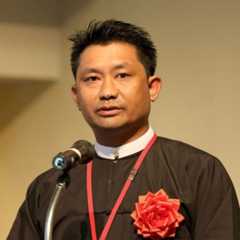
Min Aung
University of Veterinary ScienceMyanmar
Aung was awarded the 2017 Japan International Award for Young Agricultural Researchers for his work on dietary supplementation to increase milk yield and decrease methane production from dairy cows.(Photo:Japan International Research Center for Agricultural Sciences)
Aung was awarded the 2017 Japan International Award for Young Agricultural Researchers for his work on dietary supplementation to increase milk yield and decrease methane production from dairy cows.(Photo:Japan International Research Center for Agricultural Sciences)
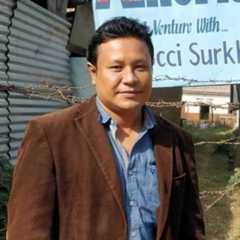
Rajan Man Bajracharya
Db2MapNepal
Bajracharya received the 2017 Data-Driven Farming Prize for his GeoKrishi program which integrates satellite, government and crowdsourced data into actionable advice for farmers and agricultural entrepreneurs.(Photo:GeoKrishi)
Bajracharya received the 2017 Data-Driven Farming Prize for his GeoKrishi program which integrates satellite, government and crowdsourced data into actionable advice for farmers and agricultural entrepreneurs.(Photo:GeoKrishi)
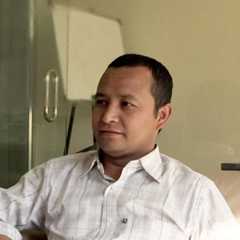
Hari Krishna Dhonju
Db2MapNepal
Dhonju received the 2017 Data-Driven Farming Prize for his GeoKrishi program which integrates satellite, government and crowdsourced data into actionable advice for farmers and agricultural entrepreneurs.(Photo:GeoKrishi)
Dhonju received the 2017 Data-Driven Farming Prize for his GeoKrishi program which integrates satellite, government and crowdsourced data into actionable advice for farmers and agricultural entrepreneurs.(Photo:GeoKrishi)

Chandra Siddaiah Nayaka
University of MysoreIndia
For developing biotechnological approaches to plant disease management, Nayaka won the 2017 Japan International Award for Young Agricultural Researchers.(Photo:Japan International Research Center for Agricultural Sciences)
For developing biotechnological approaches to plant disease management, Nayaka won the 2017 Japan International Award for Young Agricultural Researchers.(Photo:Japan International Research Center for Agricultural Sciences)

Kalvakuntla Chandrashekhar Rao
Government of TelanganaIndia
Rao received the 2017 Agriculture Leadership Award from the Indian Council of Food and Agriculture for his role in launching irrigation and agricultural initiatives.(Photo:Government of Telangana)
Rao received the 2017 Agriculture Leadership Award from the Indian Council of Food and Agriculture for his role in launching irrigation and agricultural initiatives.(Photo:Government of Telangana)
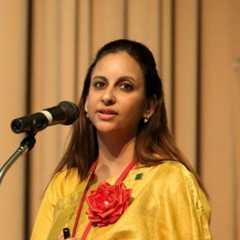
Sheetal Sharma
International Rice Research InstituteIndia
Sharma won the 2017 Japan International Award for Young Agricultural Researchers for her work on Crop Manager for India, a tool that provides site-specific nutrient recommendations to farmers.(Photo:Japan International Research Center for Agricultural Sciences)
Sharma won the 2017 Japan International Award for Young Agricultural Researchers for her work on Crop Manager for India, a tool that provides site-specific nutrient recommendations to farmers.(Photo:Japan International Research Center for Agricultural Sciences)
Hiroshi Uchino
Tohoku Agricultural Research CenterJapan
Uchino was awarded the 2017 Organic Farming Innovation Award Science Prize for his research on using cover crops as an alternative to pesticides for weed suppression.(Photo credit: Hiroshi Uchino)
Uchino was awarded the 2017 Organic Farming Innovation Award Science Prize for his research on using cover crops as an alternative to pesticides for weed suppression.(Photo credit: Hiroshi Uchino)
Chen Wen
Tianjin Medical UniversityChina
Chen received the DSM Science & Technology Award Asia 2017 for her research on iodine nutrition in children from areas with varying iodine levels in drinking water.(Photo:DSM)
Chen received the DSM Science & Technology Award Asia 2017 for her research on iodine nutrition in children from areas with varying iodine levels in drinking water.(Photo:DSM)
Amit Dutt
Tata Memorial CentreIndia
Dutt received the 2017 Shanti Swarup Bhatnagar Prize for Science and Technology for his outstanding contributions to cancer genetics, in particular the role of novel mutations in Indian lung cancer patients.(Photo:Shanti Swarup Bhatnagar Prize)
Dutt received the 2017 Shanti Swarup Bhatnagar Prize for Science and Technology for his outstanding contributions to cancer genetics, in particular the role of novel mutations in Indian lung cancer patients.(Photo:Shanti Swarup Bhatnagar Prize)
Tamao Endo
Tokyo Metropolitan Geriatric Hospital and Institute of GerontologyJapan
Endo received the 2017 Japan Academy Prize for his research that has helped to identify the cause of Fukuyama congenital muscular dystrophy, an autosomal-recessive genetic disorder found almost exclusively in Japan.(Photo:Tokyo Metropolitan Institute of Gerontology)
Endo received the 2017 Japan Academy Prize for his research that has helped to identify the cause of Fukuyama congenital muscular dystrophy, an autosomal-recessive genetic disorder found almost exclusively in Japan.(Photo:Tokyo Metropolitan Institute of Gerontology)
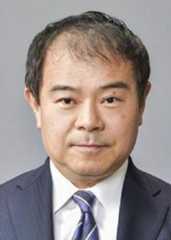
Tatsushi Toda
Kobe UniversityJapan
Toda received the 2017 Japan Academy Prize for his research that has helped to identify the cause of Fukuyama congenital muscular dystrophy, an autosomal-recessive genetic disorder found almost exclusively in Japan.(Photo:Japan Academy)
Toda received the 2017 Japan Academy Prize for his research that has helped to identify the cause of Fukuyama congenital muscular dystrophy, an autosomal-recessive genetic disorder found almost exclusively in Japan.(Photo:Japan Academy)
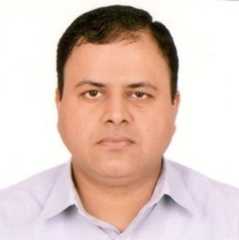
Deepak Gaur
Jawaharlal Nehru UniversityIndia
For his contributions to our understanding of how the malaria parasite infects red blood cells, Gaur was awarded the 2017 Shanti Swarup Bhatnagar Prize for Science and Technology.(Photo:Shanti Swarup Bhatnagar Prize)
For his contributions to our understanding of how the malaria parasite infects red blood cells, Gaur was awarded the 2017 Shanti Swarup Bhatnagar Prize for Science and Technology.(Photo:Shanti Swarup Bhatnagar Prize)

Edward Holmes
National University of SingaporeSingapore
Holmes won the 2017 President’s Science and Technology Medal for his role in developing Singapore’s health and biomedical sciences system.(Photo:Agency for Science, Technology and Research)
Holmes won the 2017 President’s Science and Technology Medal for his role in developing Singapore’s health and biomedical sciences system.(Photo:Agency for Science, Technology and Research)
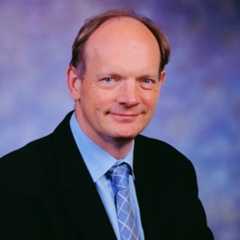
Sir David Lane
Agency for Science, Technology and ResearchSingapore
Sir David received the 2017 President’s Science and Technology Medal for his role in the development of Singapore’s biomedical sciences sector and contributions to cancer therapeutics and research.(Photo:Agency for Science, Technology and Research)
Sir David received the 2017 President’s Science and Technology Medal for his role in the development of Singapore’s biomedical sciences sector and contributions to cancer therapeutics and research.(Photo:Agency for Science, Technology and Research)

Li Jingmei
Genome Institute of SingaporeSingapore
For her work on mammographic density and its impact on women’s health, Li received the 2017 Young Scientist Award at the President’s Science and Technology Awards. In 2014, Li won the L’Oréal-UNESCO For Women in Science National Fellowship. More recently, the senior research scientist at theGenome Institute of Singapore was inducted as a class of 2018 National Research Foundation Fellow, an award that offers early career researchers up to S$3 million in funding over five years.(Photo:L’Oréal-UNESCO For Women in Science)
For her work on mammographic density and its impact on women’s health, Li received the 2017 Young Scientist Award at the President’s Science and Technology Awards. In 2014, Li won the L’Oréal-UNESCO For Women in Science National Fellowship. More recently, the senior research scientist at theGenome Institute of Singapore was inducted as a class of 2018 National Research Foundation Fellow, an award that offers early career researchers up to S$3 million in funding over five years.(Photo:L’Oréal-UNESCO For Women in Science)
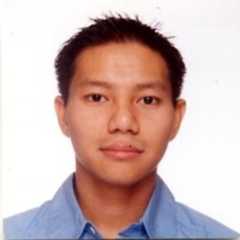
Mario Antonio Jiz II
Research Institute for Tropical MedicinePhilippines
Jiz was recognized as a 2017 National Academy of Science and Technology Outstanding Young Scientist for his contributions to the understanding of immunity to schistosomiasis, a parasitic infection affecting millions of Filipinos.(Photo: Mario Antonio Jiz II)
Jiz was recognized as a 2017 National Academy of Science and Technology Outstanding Young Scientist for his contributions to the understanding of immunity to schistosomiasis, a parasitic infection affecting millions of Filipinos.(Photo: Mario Antonio Jiz II)

V. Narry Kim
Seoul National UniversitySouth Korea
Kim, the director of theInstitute for Basic Science atSeoul National University, received the 2017 Chen Award for Distinguished Academic Achievement in Human Genetic and Genomic Research for her studies into the role of microRNAs in development and cancer.(Photo:Institute for Basic Science)
Kim, the director of theInstitute for Basic Science atSeoul National University, received the 2017 Chen Award for Distinguished Academic Achievement in Human Genetic and Genomic Research for her studies into the role of microRNAs in development and cancer.(Photo:Institute for Basic Science)

Tadamitsu Kishimoto
Osaka UniversityJapan
Kishimoto, a group leader at the Immunology Frontier Research Center and Emeritus Professor at Osaka University, was recognized for his role in developing biologic therapies for autoimmune diseases with the2017 King Faisal International Prize.(Photo:Japan Prize Foundation)
Kishimoto, a group leader at the Immunology Frontier Research Center and Emeritus Professor at Osaka University, was recognized for his role in developing biologic therapies for autoimmune diseases with the2017 King Faisal International Prize.(Photo:Japan Prize Foundation)

Seiji Ogawa
Tohoku Fukushi UniversityJapan
For his pioneering work in establishing the basic principles underlying functional magnetic resonance imaging (fMRI), Ogawa was awarded the2017 Keio Medical Science Prize.(Photo:Tohoku Fukushi University)
For his pioneering work in establishing the basic principles underlying functional magnetic resonance imaging (fMRI), Ogawa was awarded the2017 Keio Medical Science Prize.(Photo:Tohoku Fukushi University)

Paik Soonmyung
Yonsei UniversitySouth Korea
Paik received the 2017 Ho-Am Prize for developing Oncotype DX, the first multi-gene prognostic test for breast cancer patients that spares them from the side effects of chemotherapy.(Photo:San Antonio Breast Cancer Symposium)
Paik received the 2017 Ho-Am Prize for developing Oncotype DX, the first multi-gene prognostic test for breast cancer patients that spares them from the side effects of chemotherapy.(Photo:San Antonio Breast Cancer Symposium)

Shimon Sakaguchi
Osaka UniversityJapan
Together with Fred Ramsdell and Alexander Rudensky, Sakaguchi was awarded the2017 Crafoord Prize in Polyarthritis for his discovery of regulatory T-cells.(Photo:Osaka University)
Together with Fred Ramsdell and Alexander Rudensky, Sakaguchi was awarded the2017 Crafoord Prize in Polyarthritis for his discovery of regulatory T-cells.(Photo:Osaka University)

Paul Kwong Hang Tam
The University of Hong KongHong Kong
Tam, the Li Shu-Pui Professor in Surgery at the Li Ka Shing Faculty of Medicine at the University of Hong Kong, received the2017 Denis Browne Gold Medal for his contributions to pediatric surgery.(Photo:British Association of Paediatric Surgeons)
Tam, the Li Shu-Pui Professor in Surgery at the Li Ka Shing Faculty of Medicine at the University of Hong Kong, received the2017 Denis Browne Gold Medal for his contributions to pediatric surgery.(Photo:British Association of Paediatric Surgeons)

Tu Youyou
China Academy of Traditional Chinese MedicineChina
Tu, who won the2015 Nobel Prize in Physiology or Medicine, was awarded the 2017 Preeminent Science and Technology Award, the top award for science in China.(Photo:Lasker Foundation)
Tu, who won the2015 Nobel Prize in Physiology or Medicine, was awarded the 2017 Preeminent Science and Technology Award, the top award for science in China.(Photo:Lasker Foundation)
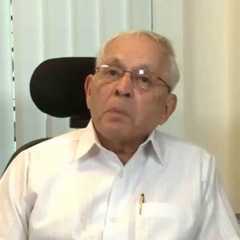
Tehemton Erach Udwadia
Breach Candy Hospital and PD Hinduja HospitalIndia
Udwadia, who received the Padma Shri Award in 2006, was conferred the Padma Bhushan in 2017 for his contributions to the field of laparoscopic surgery.(Photo:Parsi Khabar)
Udwadia, who received the Padma Shri Award in 2006, was conferred the Padma Bhushan in 2017 for his contributions to the field of laparoscopic surgery.(Photo:Parsi Khabar)

Yu Nam-Kyung
Seoul National UniversitySouth Korea
Yu was recognized as a 2017 L’Oréal-UNESCO For Women in Science International Rising Talent for her work on Rett syndrome, a genetic neurological disorder.(Photo:L'oréal Foundation)
Yu was recognized as a 2017 L’Oréal-UNESCO For Women in Science International Rising Talent for her work on Rett syndrome, a genetic neurological disorder.(Photo:L'oréal Foundation)

Lucille V. Abad
Philippine Nuclear Research InstitutePhilippines
Abad received the Julian A. Banzon Medal as a 2017 Outstanding Research and Development Awardee for her research on using irradiated seaweed as a plant growth supplement.(Photo:Civil Service Commission of the Philippines)
Abad received the Julian A. Banzon Medal as a 2017 Outstanding Research and Development Awardee for her research on using irradiated seaweed as a plant growth supplement.(Photo:Civil Service Commission of the Philippines)
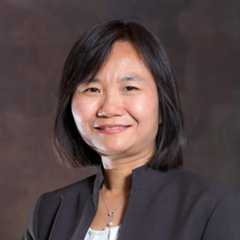
Pimchai Chaiyen
Mahidol UniversityThailand
Chaiyen, who won the 2003 L’Oréal Thailand For Women in Science Award, received the 2017 L’Oréal Woman Scientist Crystal Award for her research into a cleaner way to produce chemicals.(Photo:Mahidol University)
Chaiyen, who won the 2003 L’Oréal Thailand For Women in Science Award, received the 2017 L’Oréal Woman Scientist Crystal Award for her research into a cleaner way to produce chemicals.(Photo:Mahidol University)

Pussana Hirunsit
National Science and Technology Development AgencyThailand
Hirunsit won the 2017 L’Oréal-UNESCO For Women in Science National Award for her research on environmentally friendly nanocatalysts.(Photo: Pussana Hirunsit)
Hirunsit won the 2017 L’Oréal-UNESCO For Women in Science National Award for her research on environmentally friendly nanocatalysts.(Photo: Pussana Hirunsit)

Kim Myung-hwan
LG ChemSouth Korea
Kim, who is head of the Battery Research Institute at LG Chem, received the 2017 POSCO TJ Park Technology Prize for his role in developing lithium ion batteries.(Photo:University of Akron)
Kim, who is head of the Battery Research Institute at LG Chem, received the 2017 POSCO TJ Park Technology Prize for his role in developing lithium ion batteries.(Photo:University of Akron)

Ganpathi Naresh Patwari
Indian Institute of Technology BombayIndia
Naresh Patwari received the 2017 Shanti Swarup Bhatnagar Prize for Science and Technology for his research on vibrational spectroscopy in the gas phase.(Photo:Indian Institute of Technology Bombay)
Naresh Patwari received the 2017 Shanti Swarup Bhatnagar Prize for Science and Technology for his research on vibrational spectroscopy in the gas phase.(Photo:Indian Institute of Technology Bombay)

Long Ran
University of Science and Technology of ChinaChina
Long won the 2017 L’Oréal UNESCO For Women in Science International Rising Talent award for her research on photocatalysts for carbon dioxide reduction.(Photo:L'oréal Foundation)
Long won the 2017 L’Oréal UNESCO For Women in Science International Rising Talent award for her research on photocatalysts for carbon dioxide reduction.(Photo:L'oréal Foundation)

Phan Thanh Sơn Nam
Ho Chi Minh City University of TechnologyVietnam
Phan was one of two scientists awarded the 2017 Tạ Quang Bửu Awards for his work on molecular catalysts in organic transformation.(Photo:Ho Chi Minh City University of Technology)
Phan was one of two scientists awarded the 2017 Tạ Quang Bửu Awards for his work on molecular catalysts in organic transformation.(Photo:Ho Chi Minh City University of Technology)

Mitsuo Sawamoto
Kyoto UniversityJapan
A pioneer in the field of polymer science, Sawamoto received the 2017 Benjamin Franklin Medal in Chemistry for developing living polymers that can be reactivated. His technique of introducing free radical deactivators to the polymerization process allows scientists to control the reaction, and has been used to make improved coatings, dispersants and composites for commercial, biomedical and environmental applications.(Photo:Franklin Institute)
A pioneer in the field of polymer science, Sawamoto received the 2017 Benjamin Franklin Medal in Chemistry for developing living polymers that can be reactivated. His technique of introducing free radical deactivators to the polymerization process allows scientists to control the reaction, and has been used to make improved coatings, dispersants and composites for commercial, biomedical and environmental applications.(Photo:Franklin Institute)
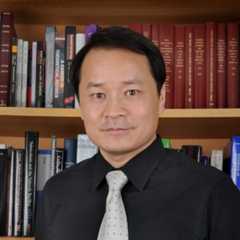
Xie Xiaoliang Sunney
Peking UniversityChina
Xie, the director of the Beijing Advanced Innovation Center for Genomics and the Biodynamics Optical Imaging Center, received the 2017 Qiu Shi Outstanding Scientist Award for his work on single-molecule enzymes.(Photo: Xie Xiaoliang Sunney)
Xie, the director of the Beijing Advanced Innovation Center for Genomics and the Biodynamics Optical Imaging Center, received the 2017 Qiu Shi Outstanding Scientist Award for his work on single-molecule enzymes.(Photo: Xie Xiaoliang Sunney)
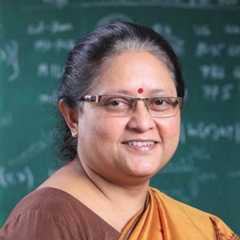
Sanghamitra Bandyopadhyay
Indian Statistical InstituteIndia
Bandyopadhyay received the Infosys Prize 2017 in Engineering and Computer Science for her research in algorithmic optimization, which has led to the discovery of a genetic marker for breast cancer and the role of white blood cells in Alzheimer’s disease.(Photo:Infosys Science Foundation)
Bandyopadhyay received the Infosys Prize 2017 in Engineering and Computer Science for her research in algorithmic optimization, which has led to the discovery of a genetic marker for breast cancer and the role of white blood cells in Alzheimer’s disease.(Photo:Infosys Science Foundation)

Cha Hyung Joon
Pohang University of Science and TechnologySouth Korea
Cha, who developed a protein-based adhesive inspired by mussels, received theInventor of the Year Award from the Korean Intellectual Property Office. Unlike commonly used medical adhesives, the mussel-inspired bioadhesive is biocompatible and strongly adhesive even when wet. Cha has been listed as the inventor of 135 intellectual properties, including 23 international patents, 47 domestic patents, 34 international patent applications and 31 domestic patent applications.(Photo:Pohang University of Science and Technology)
Cha, who developed a protein-based adhesive inspired by mussels, received theInventor of the Year Award from the Korean Intellectual Property Office. Unlike commonly used medical adhesives, the mussel-inspired bioadhesive is biocompatible and strongly adhesive even when wet. Cha has been listed as the inventor of 135 intellectual properties, including 23 international patents, 47 domestic patents, 34 international patent applications and 31 domestic patent applications.(Photo:Pohang University of Science and Technology)

James C. C. Chan
University of Hong KongHong Kong
For his contributions to the advancement of electric vehicle technologies,Chan has been selected to receive the 2018 IEEE Transportation Technologies Award.(Photo:Hong Kong Academy of Engineering Sciences)
For his contributions to the advancement of electric vehicle technologies,Chan has been selected to receive the 2018 IEEE Transportation Technologies Award.(Photo:Hong Kong Academy of Engineering Sciences)

He Jinliang
Tsinghua UniversityChina
He will receive the 2018 IEEE Herman HaLperin Electric Transmission and Distribution Award for his contributions to lightning protection of power transmission systems including advancing analytic methods and innovation in line surge arresters.(Photo:International Conference on Lighting Protection)
He will receive the 2018 IEEE Herman HaLperin Electric Transmission and Distribution Award for his contributions to lightning protection of power transmission systems including advancing analytic methods and innovation in line surge arresters.(Photo:International Conference on Lighting Protection)
Jang Jin
Kyung Hee UniversitySouth Korea
Jang received the Ho-Am Prize 2017 for his role in developing thin-film transistor displays, including flexible active-matrix organic light-emitting diode (AMOLED) displays and active-matrix liquid crystal displays (AMLCD).(Photo:Young Samsung)
Jang received the Ho-Am Prize 2017 for his role in developing thin-film transistor displays, including flexible active-matrix organic light-emitting diode (AMOLED) displays and active-matrix liquid crystal displays (AMLCD).(Photo:Young Samsung)
Anchalee Manonukul
National Science and Technology Development AgencyThailand
For her work on powder metallurgy, Manonukul received the 2017 L’Oréal Woman Scientist Crystal Award, a special award commemorating the 15th anniversary of the L’Oréal-UNESCO for Women in Science Awards in Thailand.(Photo:National Metal and Materials Technology Center)
For her work on powder metallurgy, Manonukul received the 2017 L’Oréal Woman Scientist Crystal Award, a special award commemorating the 15th anniversary of the L’Oréal-UNESCO for Women in Science Awards in Thailand.(Photo:National Metal and Materials Technology Center)

Neelesh B. Mehta
Indian Institute of ScienceIndia
Mehta received the 2017 Shanti Swarup Bhatnagar Prize for Science and Technology for his research on wireless communications, energy-harvesting wireless networks, interference modeling and co-operative communications.(Photo: Neelesh B. Mehta)
Mehta received the 2017 Shanti Swarup Bhatnagar Prize for Science and Technology for his research on wireless communications, energy-harvesting wireless networks, interference modeling and co-operative communications.(Photo: Neelesh B. Mehta)

Takashi Mimura
Fujitsu LaboratoriesJapan
Mimura was recognized for his invention of high electron mobility transistors (HEMTs) with the2017 Kyoto Prize. By constraining electrons within an ultrathin layer, HEMTs have contributed to the study of electrons with reduced dimensions.(Photo:Kyoto Prize Foundation)
Mimura was recognized for his invention of high electron mobility transistors (HEMTs) with the2017 Kyoto Prize. By constraining electrons within an ultrathin layer, HEMTs have contributed to the study of electrons with reduced dimensions.(Photo:Kyoto Prize Foundation)

Lanndon A. Ocampo
Cebu Technological UniversityPhilippines
Ocampo received the 2017 Outstanding Young Scientist Award from the National Academy of Science and Technology for his contributions to manufacturing sustainability and risk analysis.(Photo: Lanndon A. Ocampo)
Ocampo received the 2017 Outstanding Young Scientist Award from the National Academy of Science and Technology for his contributions to manufacturing sustainability and risk analysis.(Photo: Lanndon A. Ocampo)

Pack Sangheon
Korea UniversitySouth Korea
Pack, who is currently leading a global study developing a software-based networking system, won the 2017 IEIE/IEEE Joint Award for Young IT Engineer of the Year for his work on wireless communication.(Photo:IEEE Xplore)
Pack, who is currently leading a global study developing a software-based networking system, won the 2017 IEIE/IEEE Joint Award for Young IT Engineer of the Year for his work on wireless communication.(Photo:IEEE Xplore)
Tang Ching Wan
Hong Kong University of Science and TechnologyHong Kong
Tang received the 2017 IEEE Jun-ichi Nishizawa Medal for his pioneering work in organic light-emitting diodes (OLEDs) that has paved the way for the first commercial full-color OLED displays.(Photo:The Academy of Sciences of Hong Kong)
Tang received the 2017 IEEE Jun-ichi Nishizawa Medal for his pioneering work in organic light-emitting diodes (OLEDs) that has paved the way for the first commercial full-color OLED displays.(Photo:The Academy of Sciences of Hong Kong)

Jackie Y. Ying
Institute of Bioengineering and NanotechnologySingapore
In 2017, Ying became the first woman to receive theAbdeali Tayebali Lifetime Achievement Award, which recognized her contributions to nanotechnology research. She was also named a fellow of the US National Academy of Inventors that year.(Photo:Agency for Science, Technology and Research)
In 2017, Ying became the first woman to receive theAbdeali Tayebali Lifetime Achievement Award, which recognized her contributions to nanotechnology research. She was also named a fellow of the US National Academy of Inventors that year.(Photo:Agency for Science, Technology and Research)

Kenneth Mei-yee Leung
The University of Hong KongHong Kong
In 2017, Leung received theBiwako Prize for Ecology and was made a fellow of the Society of Environmental Toxicology and Chemistry for his work on marine biodiversity and conservation.(Photo:The University of Hong Kong)
In 2017, Leung received theBiwako Prize for Ecology and was made a fellow of the Society of Environmental Toxicology and Chemistry for his work on marine biodiversity and conservation.(Photo:The University of Hong Kong)
Jeffrey S. Perez
Philippine Institute of Volcanology and SeismologyPhilippines
Perez received the 2017 National Academy of Science and Technology Outstanding Young Scientist award for helping to update the active fault map of the Philippines.(Photo:Philippine Institute of Volcanology and Seismology)
Perez received the 2017 National Academy of Science and Technology Outstanding Young Scientist award for helping to update the active fault map of the Philippines.(Photo:Philippine Institute of Volcanology and Seismology)
Yan Ning
National University of SingaporeSingapore
For his research on harvesting materials from waste through rational catalytic design, Yan was awarded the 2017 Environment, Sustainability and Energy Division Early Career Award.(Photo:National University of Singapore)
For his research on harvesting materials from waste through rational catalytic design, Yan was awarded the 2017 Environment, Sustainability and Energy Division Early Career Award.(Photo:National University of Singapore)
Aletta Concepcion T. Yñiguez
University of the Philippines DilimanPhilippines
Yñiguez won the 2017 National Academy of Science and Technology Outstanding Young Scientist Award for her work on modeling the dynamics of the ocean ecosystem to build early warning systems.(Photo:University of Philippines Diliman)
Yñiguez won the 2017 National Academy of Science and Technology Outstanding Young Scientist Award for her work on modeling the dynamics of the ocean ecosystem to build early warning systems.(Photo:University of Philippines Diliman)

Shigeki Goto
Waseda UniversityJapan
In 2017, Goto was inducted into the Internet Hall of Fame as a Global Connector for his role in expanding the internet in the Asia Pacific and promoting multilingual domain name standards.(Photo:Asia Pacific Advanced Network)
In 2017, Goto was inducted into the Internet Hall of Fame as a Global Connector for his role in expanding the internet in the Asia Pacific and promoting multilingual domain name standards.(Photo:Asia Pacific Advanced Network)

Tanzima Hashem
Bangladesh University of Engineering and TechnologyBangladesh
Hashem was awarded the 2017 Elsevier Foundation Awards for Early-Career Women Scientists in the Developing World for her work in developing computational approaches to privacy protection.(Photo: Tanzima Hashem)
Hashem was awarded the 2017 Elsevier Foundation Awards for Early-Career Women Scientists in the Developing World for her work in developing computational approaches to privacy protection.(Photo: Tanzima Hashem)

N. R. Narayana Murthy
InfosysIndia
Murthy, co-founder of global software consulting company Infosys, was awarded the 2017 Thomas Jefferson Foundation Medal in Global Innovation. Under his leadership, Infosys laid the foundation for India’s success in IT services outsourcing. In addition to being appointed a Commander of the Most Excellent Order of the British Empire in 2007, Murthy received the Padma Vibhushan and was made an officer in the French Legion of Honor in 2008.(Photo:Infosys)
Murthy, co-founder of global software consulting company Infosys, was awarded the 2017 Thomas Jefferson Foundation Medal in Global Innovation. Under his leadership, Infosys laid the foundation for India’s success in IT services outsourcing. In addition to being appointed a Commander of the Most Excellent Order of the British Empire in 2007, Murthy received the Padma Vibhushan and was made an officer in the French Legion of Honor in 2008.(Photo:Infosys)
Wu Jianping
Tsinghua UniversityChina
Wu is a 2017 inductee of the Internet Hall of Fame and the only Chinese person on the list. He was recognized for advancing internet technology in China and strengthening the country’s ties with the global internet community.(Photo:Tsinghua University)
Wu is a 2017 inductee of the Internet Hall of Fame and the only Chinese person on the list. He was recognized for advancing internet technology in China and strengthening the country’s ties with the global internet community.(Photo:Tsinghua University)
Chang Meemann
Institute of Vertebrate Paleontology and Paleoanthropology (IVPP)China
The first woman to head China’s Institute of Vertebrate Paleontology and Paleoanthropology, Chang received the2018 L’Oréal-UNESCO For Women in Science Award for her pioneering work on fossil records leading to insights on how aquatic vertebrates adapted to life on land.(photo:St Louis University)
The first woman to head China’s Institute of Vertebrate Paleontology and Paleoanthropology, Chang received the2018 L’Oréal-UNESCO For Women in Science Award for her pioneering work on fossil records leading to insights on how aquatic vertebrates adapted to life on land.(photo:St Louis University)

Lam Khin Yong
Nanyang Technological University, SingaporeSingapore
Lam was made aknight in the French Legion of Honor in 2017 for fostering academic and industry collaborations between Singapore and France.(Photo:Asian Scientist Magazine)
Lam was made aknight in the French Legion of Honor in 2017 for fostering academic and industry collaborations between Singapore and France.(Photo:Asian Scientist Magazine)

Jenny Huey-Jen Su
National Cheng Kung UniversityTaiwan
Su, president of National Cheng Kung University, was recognized with the2017 Harvard T. H. Chan School of Public Health’s Leadership Award for her timely and effective response to two emergency events in Taiwan: a dengue fever outbreak in Tainan City in 2015 and a magnitude 6.4 earthquake in 2016. An air pollution researcher, Su has conducted research on airborne microbial hazards and helped to shape policies at the national and international level.(Photo:National Cheng Kung University)
Su, president of National Cheng Kung University, was recognized with the2017 Harvard T. H. Chan School of Public Health’s Leadership Award for her timely and effective response to two emergency events in Taiwan: a dengue fever outbreak in Tainan City in 2015 and a magnitude 6.4 earthquake in 2016. An air pollution researcher, Su has conducted research on airborne microbial hazards and helped to shape policies at the national and international level.(Photo:National Cheng Kung University)

Subra Suresh
Nanyang Technological University, SingaporeSingapore
Previously the director of the US National Science Foundation and president of Carnegie Mellon University, theincoming Nanyang Technological University president was awarded the university’s inaugural Distinguished University Professorship in 2017.(Photo:Nanyang Technological University)
Previously the director of the US National Science Foundation and president of Carnegie Mellon University, theincoming Nanyang Technological University president was awarded the university’s inaugural Distinguished University Professorship in 2017.(Photo:Nanyang Technological University)
Phillip A. Alviola
University of the Philippines Los BañosPhilippines
Alviola, who has described at least ten new species in the Philippines, received the 2017 National Academy of Science and Technology Outstanding Young Scientist Award for his research on biodiversity and bat virology.(Photo:University of the Philippines Los Baños)
Alviola, who has described at least ten new species in the Philippines, received the 2017 National Academy of Science and Technology Outstanding Young Scientist Award for his research on biodiversity and bat virology.(Photo:University of the Philippines Los Baños)

Upinder Singh Bhalla
National Centre for Biological SciencesIndia
Bhalla was awarded the 2017 Infosys Prize in Life Sciences for his pioneering contributions to the understanding of the brain’s computational machinery.(Photo:Infosys Science Foundation)
Bhalla was awarded the 2017 Infosys Prize in Life Sciences for his pioneering contributions to the understanding of the brain’s computational machinery.(Photo:Infosys Science Foundation)

Varodom Charoensawan
Mahidol UniversityThailand
Charoensawan received the 2017 Young Scientist Award from the Foundation for the Promotion of Science and Technology under the Patronage of His Majesty the King for his bioinformatics research.(Photo:Medical Research Council)
Charoensawan received the 2017 Young Scientist Award from the Foundation for the Promotion of Science and Technology under the Patronage of His Majesty the King for his bioinformatics research.(Photo:Medical Research Council)
Sanjeev Das
National Institute of ImmunologyIndia
The 2017 Shanti Swarup Bhatnagar Prize for Science and Technology was conferred on Das for his discoveries relating to the function of sirtuins and the p53 tumor suppressor protein.(Photo:Shanti Swarup Bhatnagar Prize)
The 2017 Shanti Swarup Bhatnagar Prize for Science and Technology was conferred on Das for his discoveries relating to the function of sirtuins and the p53 tumor suppressor protein.(Photo:Shanti Swarup Bhatnagar Prize)
Tetsuya Higashiyama
Nagoya UniversityJapan
Higashiyama, vice director of theInstitute of Transformative Bio-Molecules, won the 2017 Kihara Memorial Foundation Academic Award for his discovery of the molecules that guide pollen tube formation.(Photo:Institute of Transformative Bio-Molecules)
Higashiyama, vice director of theInstitute of Transformative Bio-Molecules, won the 2017 Kihara Memorial Foundation Academic Award for his discovery of the molecules that guide pollen tube formation.(Photo:Institute of Transformative Bio-Molecules)
Deepak Thankappan Nair
Regional Centre for BiotechnologyIndia
Nair won the 2017 Shanti Swarup Bhatnagar Prize for Science and Technology for his work on DNA and RNA polymerases and their role in genome replication.(Photo:Shanti Swarup Bhatnagar Prize)
Nair won the 2017 Shanti Swarup Bhatnagar Prize for Science and Technology for his work on DNA and RNA polymerases and their role in genome replication.(Photo:Shanti Swarup Bhatnagar Prize)
Shigetou Namba
University of TokyoJapan
Namba was awarded the 2017 Japan Academy Prize for his pioneering crystallographic research that has helped to shed light on the flagella and secretion systems of medically important bacteria.(Photo:University of Tokyo)
Namba was awarded the 2017 Japan Academy Prize for his pioneering crystallographic research that has helped to shed light on the flagella and secretion systems of medically important bacteria.(Photo:University of Tokyo)

Marisa Ponpuak
Mahidol UniversityThailand
Ponpuak received the 2017 L’Oréal-UNESCO For Women in Science Fellowship for her research on autophagy aimed at finding new drugs for malaria and tuberculosis.(Photo:Mahidol University)
Ponpuak received the 2017 L’Oréal-UNESCO For Women in Science Fellowship for her research on autophagy aimed at finding new drugs for malaria and tuberculosis.(Photo:Mahidol University)

Shi Yigong
Tsinghua UniversityChina
A structural biologist, Shi received the2017 Future Science Prize for his studies that produced high-resolution structures of the spliceosome, a protein complex essential for mRNA processing. Using cryo-electron microscopy, Shi was able to observe the active site of the spliceosome and thereby determine how mRNA matures in the spliceosome.(Photo:Rita Allen Foundation)
A structural biologist, Shi received the2017 Future Science Prize for his studies that produced high-resolution structures of the spliceosome, a protein complex essential for mRNA processing. Using cryo-electron microscopy, Shi was able to observe the active site of the spliceosome and thereby determine how mRNA matures in the spliceosome.(Photo:Rita Allen Foundation)

Son Young-Sook
Kyung Hee UniversitySouth Korea
Son received the 2017 L’Oréal Korea-UNSECO Award for Women in Life Science for her research on the ability of stem cells to self-heal.(Photo:Kyung Hee University)
Son received the 2017 L’Oréal Korea-UNSECO Award for Women in Life Science for her research on the ability of stem cells to self-heal.(Photo:Kyung Hee University)
Yasuhiko Arakawa
University of TokyoJapan
Arakawa won the 2017 Japan Academy Prize for his pioneering research on quantum dots, which are semiconductor nanostructures that are now being used in lasers and photonic devices.(Photo:International Commission for Optics)
Arakawa won the 2017 Japan Academy Prize for his pioneering research on quantum dots, which are semiconductor nanostructures that are now being used in lasers and photonic devices.(Photo:International Commission for Optics)

Napida Hinchiranan
Chulalongkorn UniversityThailand
Hinchiranan was awarded the 2017 L’Oréal-UNESCO For Women in Science Fellowship for her studies on using natural rubber to create value-added products.(Photo:Chulalongkorn University)
Hinchiranan was awarded the 2017 L’Oréal-UNESCO For Women in Science Fellowship for her studies on using natural rubber to create value-added products.(Photo:Chulalongkorn University)
Lee Jong-Heun
Korea UniversitySouth Korea
Lee was recognized with the 2017 POSCO TJ Park Science Prize for his research on self-assembling nanoblocks and gas-detecting semiconductors.(Photo:International Meeting on Chemical Sensors)
Lee was recognized with the 2017 POSCO TJ Park Science Prize for his research on self-assembling nanoblocks and gas-detecting semiconductors.(Photo:International Meeting on Chemical Sensors)
Aloke Paul
Indian Institute of ScienceIndia
Paul received the 2017 Shanti Swarup Bhatnagar Prize for Science and Technology for generating insights into multi-component solid state diffusion with important implications for the development of complex high-performance alloys.(Photo:Indian Institute of Science)
Paul received the 2017 Shanti Swarup Bhatnagar Prize for Science and Technology for generating insights into multi-component solid state diffusion with important implications for the development of complex high-performance alloys.(Photo:Indian Institute of Science)
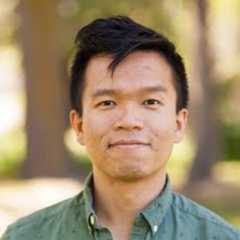
Justin C. W. Song
Institute of High Performance ComputingSingapore
Song, who is a National Research Foundation Fellow and an affiliate of Nanyang Technological University, received the 2017 Young Scientist Award for his research on quantum materials.(Photo:Institute of High Performance Computing)
Song, who is a National Research Foundation Fellow and an affiliate of Nanyang Technological University, received the 2017 Young Scientist Award for his research on quantum materials.(Photo:Institute of High Performance Computing)

Toshimitsu Yokobori
Tohoku UniversityJapan
Yokobori was awarded the 2017 Japan Academy Prize for developing theories that can be used to predict metal fatigue as well as estimate blood vessel elasticity.(Photo:Tohoku University)
Yokobori was awarded the 2017 Japan Academy Prize for developing theories that can be used to predict metal fatigue as well as estimate blood vessel elasticity.(Photo:Tohoku University)
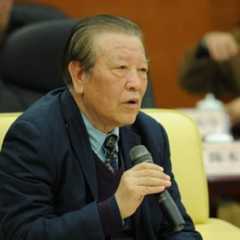
Zhao Zhongxian
Chinese Academy of SciencesChina
A physicist with over four decades of experience with superconductors, Zhao was presented the Preeminent Science and Technology Award by President Xi Jinping at a ceremony in 2017. Zhao, the director of the National Laboratory for Superconductivity, is known for his research on low temperature physics, where matter starts to display quantum properties such as the quantum Hall effect, as well as for his research on high temperature superconductors.(Photo:Qiu Shi Science and Technologies Foundation)
A physicist with over four decades of experience with superconductors, Zhao was presented the Preeminent Science and Technology Award by President Xi Jinping at a ceremony in 2017. Zhao, the director of the National Laboratory for Superconductivity, is known for his research on low temperature physics, where matter starts to display quantum properties such as the quantum Hall effect, as well as for his research on high temperature superconductors.(Photo:Qiu Shi Science and Technologies Foundation)
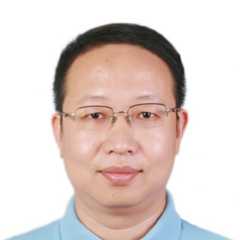
Zhu Yanwu
University of Science and Technology of ChinaChina
Zhu received the 2017 Asia-Pacific Economic Cooperation Science Prize for Innovation, Research and Education for his cross-border research on graphene-based materials.(Photo:Xiamen University)
Zhu received the 2017 Asia-Pacific Economic Cooperation Science Prize for Innovation, Research and Education for his cross-border research on graphene-based materials.(Photo:Xiamen University)

Gan Wee Teck
National University of SingaporeSingapore
Gan, who lends his name to the Gan-Gross-Prasad conjecture, received the 2017 President’s Science Award for his contributions to number theory, geometry and the Langlands program.(Photo:National University of Singapore)
Gan, who lends his name to the Gan-Gross-Prasad conjecture, received the 2017 President’s Science Award for his contributions to number theory, geometry and the Langlands program.(Photo:National University of Singapore)

Ritabrata Munshi
Tata Institute of Fundamental ResearchIndia
Munshi was awarded the 2017 Infosys Prize in Mathematics for his contributions to the Diophantine problem and estimates of the sub-convexity bounds for a large class of L-functions.(Photo:Infosys Science Foundation)
Munshi was awarded the 2017 Infosys Prize in Mathematics for his contributions to the Diophantine problem and estimates of the sub-convexity bounds for a large class of L-functions.(Photo:Infosys Science Foundation)
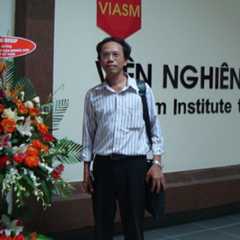
Sum Nguyễn
Quy Nhon UniversityVietnam
Sum was recognized with the 2017 Tạ Quang Bửu Award for his research on the Peterson hit problem, an open problem in polynomial algebra.(Photo:Vietnam National University)
Sum was recognized with the 2017 Tạ Quang Bửu Award for his research on the Peterson hit problem, an open problem in polynomial algebra.(Photo:Vietnam National University)
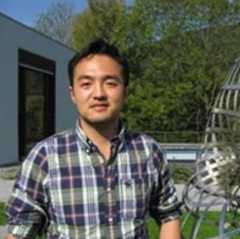
Xu Chenyang
Beijing International Center of Mathematics ResearchChina
Xu was one of three recipients of the2017 Future Science Prize for his contributions to birational algebraic geometry, a specific branch of mathematics that has applications in statistics, geometric modeling and computing.(Photo:Institute for Advanced Study)
Xu was one of three recipients of the2017 Future Science Prize for his contributions to birational algebraic geometry, a specific branch of mathematics that has applications in statistics, geometric modeling and computing.(Photo:Institute for Advanced Study)
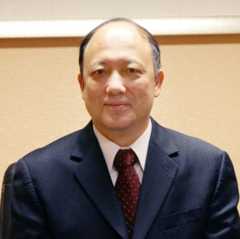
Chen Shiyi
South University of Science and TechnologyChina
Chen received the 2017 Qiu Shi Outstanding Scientist Award for his record-breaking numerical simulations of turbulence in hydrodynamics and fluid mechanics.(Photo:South University of Science and Technology)
Chen received the 2017 Qiu Shi Outstanding Scientist Award for his record-breaking numerical simulations of turbulence in hydrodynamics and fluid mechanics.(Photo:South University of Science and Technology)

Choi Sookyung
Gyeongsang National UniversitySouth Korea
A renowned particle physicist, Choi received the 2017 Ho-Am Prize for her discovery of a new class of subatomic particles named XYZ mesons. Together with her colleagues in the Belle experiment, Choi was the first to observe the X(3872) meson, a subatomic particle made of quarks and gluons. Although such exotic hadrons were first proposed over 50 years ago, they were only found by experimentalists in 2003 and subsequently confirmed by seven other experimental groups, making them the first and most well-understood type of XYZ meson.(Photo:Ho-am Foundation)
A renowned particle physicist, Choi received the 2017 Ho-Am Prize for her discovery of a new class of subatomic particles named XYZ mesons. Together with her colleagues in the Belle experiment, Choi was the first to observe the X(3872) meson, a subatomic particle made of quarks and gluons. Although such exotic hadrons were first proposed over 50 years ago, they were only found by experimentalists in 2003 and subsequently confirmed by seven other experimental groups, making them the first and most well-understood type of XYZ meson.(Photo:Ho-am Foundation)

Gao Weibo
Nanyang Technological University, SingaporeSingapore
Gao received the 2017 Young Scientist Award at the President’s Science and Technology Awards for his research on quantum information and quantum photonics.(Photo:Nanyang Technological University)
Gao received the 2017 Young Scientist Award at the President’s Science and Technology Awards for his research on quantum information and quantum photonics.(Photo:Nanyang Technological University)

Vinay Gupta
National Physical LaboratoryIndia
Gupta was awarded the 2017 Shanti Swarup Bhatnagar Prize for Science and Technology for his work in the fields of organic solar cells and carbon nanotube arrays.(Photo:Shanti Swarup Bhatnagar Prize)
Gupta was awarded the 2017 Shanti Swarup Bhatnagar Prize for Science and Technology for his work in the fields of organic solar cells and carbon nanotube arrays.(Photo:Shanti Swarup Bhatnagar Prize)

Nathaniel P. Hermosa II
University of the Philippines DilimanPhilippines
In addition to the 2017 National Academy of Science and Technology Outstanding Young Scientist Award,Hermosa also received the 2017 Eduardo A. Quisumbing Medal for his research on the fundamental properties of light and light-matter interactions.(Photo: Nathaniel P. Hermosa II)
In addition to the 2017 National Academy of Science and Technology Outstanding Young Scientist Award,Hermosa also received the 2017 Eduardo A. Quisumbing Medal for his research on the fundamental properties of light and light-matter interactions.(Photo: Nathaniel P. Hermosa II)
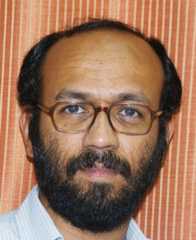
Nissim Kanekar
Tata Institute of Fundamental ResearchIndia
Kanekar, who has defined stringent observational bounds on the evolution of the electron proton mass ratio, was awarded the 2017 Shanti Swarup Bhatnagar Prize for Science and Technology for his contributions to astrophysics.(Photo:Tata Institute of Fundamental Research)
Kanekar, who has defined stringent observational bounds on the evolution of the electron proton mass ratio, was awarded the 2017 Shanti Swarup Bhatnagar Prize for Science and Technology for his contributions to astrophysics.(Photo:Tata Institute of Fundamental Research)
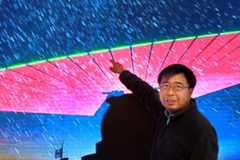
Pan Jianwei
University of Science and Technology of ChinaChina
The2017 Future Science Prize in Physics was awarded to Pan in honor of his work on quantum optical technology.(Photo:The State Council of the People's Republic of China)
The2017 Future Science Prize in Physics was awarded to Pan in honor of his work on quantum optical technology.(Photo:The State Council of the People's Republic of China)

David Ruffolo
Mahidol UniversityThailand
Ruffolo received the 2017 Outstanding Scientist Award from the Foundation for the Promotion of Science and Technology under Royal Patronage for his research on global radiation and cosmic rays, including a computer program that can predict the effects of solar storms on Earth.(Photo:Mahidol University)
Ruffolo received the 2017 Outstanding Scientist Award from the Foundation for the Promotion of Science and Technology under Royal Patronage for his research on global radiation and cosmic rays, including a computer program that can predict the effects of solar storms on Earth.(Photo:Mahidol University)

Fumihiko Takasaki
High Energy Accelerator Research OrganizationJapan
A central figure in the B-factory accelerator project at the High Energy Accelerator Research Organization, Takasaki was awarded the 2017 Japan Academy Prize for providing experimental proof of the asymmetry between particles and antiparticles.(Photo: Reidar Hahn)
A central figure in the B-factory accelerator project at the High Energy Accelerator Research Organization, Takasaki was awarded the 2017 Japan Academy Prize for providing experimental proof of the asymmetry between particles and antiparticles.(Photo: Reidar Hahn)

Adeeb Hayyan
University of MalayaMalaysia
Hayyan received the 2017 UNESCO MAB Young Scientists Award from the International Coordinating Council of UNESCO’s Man and the Biosphere program for his research on alternative natural oils for the food industry.(Photo:University of Malaya)
Hayyan received the 2017 UNESCO MAB Young Scientists Award from the International Coordinating Council of UNESCO’s Man and the Biosphere program for his research on alternative natural oils for the food industry.(Photo:University of Malaya)
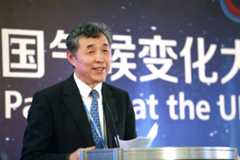
Li Junfeng
Energy Research Institute of the National Development and Reform CommissionChina
A chief architect of China’s renewable energy policy, Li was recognized with a lifetime achievement award at the 2017 Zayed Future Energy Prize for his role in reducing the country’s reliance on coal and strengthening its capabilities in renewable energy.(Photo:International Institute for Sustainable Development)
A chief architect of China’s renewable energy policy, Li was recognized with a lifetime achievement award at the 2017 Zayed Future Energy Prize for his role in reducing the country’s reliance on coal and strengthening its capabilities in renewable energy.(Photo:International Institute for Sustainable Development)

Ng Wun Jern
Nanyang Technological University, SingaporeSingapore
Ng received the 2017 President’s Technology Award for his research on wastewater management and resource recovery that has been used in industrial applications.(Photo:Nanyang Technological University)
Ng received the 2017 President’s Technology Award for his research on wastewater management and resource recovery that has been used in industrial applications.(Photo:Nanyang Technological University)

Felycia Edi Soetaredjo
Widya Mandala Catholic University SurabayaIndonesia
For her work on using biomass for environmental remediation,Soetaredjo was awarded the 2017 Elsevier Foundation Awards for Early-Career Women Scientists in the Developing World. In her research, Soetaredjo converts biomass and clay into absorbents that can be used to remove hazardous compounds such as antibiotics, heavy metals and dyes from wastewater. She is also in the process of patenting a method using Fenton reagents that can be used to degrade 98 percent of the pollutants in wastewater.(Photo:Widya Mandala Catholic University Surabaya)
For her work on using biomass for environmental remediation,Soetaredjo was awarded the 2017 Elsevier Foundation Awards for Early-Career Women Scientists in the Developing World. In her research, Soetaredjo converts biomass and clay into absorbents that can be used to remove hazardous compounds such as antibiotics, heavy metals and dyes from wastewater. She is also in the process of patenting a method using Fenton reagents that can be used to degrade 98 percent of the pollutants in wastewater.(Photo:Widya Mandala Catholic University Surabaya)

Xie Zhenhua
National Development and Reform CommissionChina
China’s chief negotiator at the Paris Agreement, Xie received the 2017 LUI Che Woo Prize in Sustainable Development for his efforts in resisting climate change.(Photo:International Institute for Sustainable Development)
China’s chief negotiator at the Paris Agreement, Xie received the 2017 LUI Che Woo Prize in Sustainable Development for his efforts in resisting climate change.(Photo:International Institute for Sustainable Development)
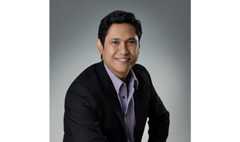
Aristotle T. Ubando
De La Salle UniversityPhilippines
Ubando, who designs and integrates algal systems for the development of algal biorefineries, was recognized with the2016 Philippines Promising Star Award.(Photo: Aristotle T. Ubando)
Ubando, who designs and integrates algal systems for the development of algal biorefineries, was recognized with the2016 Philippines Promising Star Award.(Photo: Aristotle T. Ubando)

Reasmey Tan
Institute of Technology of CambodiaCambodia
Tan was named a finalist of the 2016 ASEAN-US Science Prize for Women for her efforts at turning fatty acids and biomass into renewable energy resources.(Photo:USAID Cambodia)
Tan was named a finalist of the 2016 ASEAN-US Science Prize for Women for her efforts at turning fatty acids and biomass into renewable energy resources.(Photo:USAID Cambodia)

Thi Thi Soe
Ministry of Science and TechnologyMyanmar
Soe, who wants to use wind energy to power rural Myanmar, was a finalist of the 2016 ASEAN-US Science Prize for Women.(Photo: Hla Myo Aung/USAID)
Soe, who wants to use wind energy to power rural Myanmar, was a finalist of the 2016 ASEAN-US Science Prize for Women.(Photo: Hla Myo Aung/USAID)

Worajit Setthapun
Chiang Mai Rajabhat UniversityThailand
Setthapun, who develops sustainable energy systems that could benefit the livelihoods of those in small and rural communities, was named the winner of the 2016 ASEAN-US Science Prize for Women.(Photo:USAID)
Setthapun, who develops sustainable energy systems that could benefit the livelihoods of those in small and rural communities, was named the winner of the 2016 ASEAN-US Science Prize for Women.(Photo:USAID)
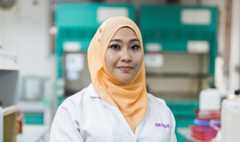
Fatehah Mohd Omar
University of Science MalaysiaMalaysia
Fatehah was recognized in 2016 with a L'Oréal-UNESCO For Women in Science Malaysia Fellowship for investigating nano-pollutants in palm oil mill effluent. By studying the fundamental characteristics of these pollutants, including their stability and dispersion properties, she hopes to contribute to a long-term, sustainable wastewater treatment for palm oil industries and help to reduce the pollution in Malaysia's rivers.(Photo: Fatehah Mohd Omar)
Fatehah was recognized in 2016 with a L'Oréal-UNESCO For Women in Science Malaysia Fellowship for investigating nano-pollutants in palm oil mill effluent. By studying the fundamental characteristics of these pollutants, including their stability and dispersion properties, she hopes to contribute to a long-term, sustainable wastewater treatment for palm oil industries and help to reduce the pollution in Malaysia's rivers.(Photo: Fatehah Mohd Omar)
Supawadee Namuangruk
National Nanotechnology Center, National Science and Technology Development AgencyThailand
Namuangruk received the 2016 L'Oréal-UNESCO For Women in Science Thailand Fellowship for developing nanomaterials which have sustainable energy and environmental applications.(Photo:National Nanotechnology Center, French Ministry of Foreign Affairs and International Development)
Namuangruk received the 2016 L'Oréal-UNESCO For Women in Science Thailand Fellowship for developing nanomaterials which have sustainable energy and environmental applications.(Photo:National Nanotechnology Center, French Ministry of Foreign Affairs and International Development)
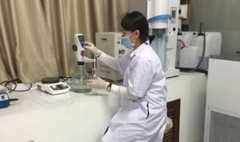
Latsamy Phounvisouk
National Agriculture and Forestry Research InstituteLaos
Phounvisouk, a researcher who develops biogas technologies for those living off the grid in rural areas, was a finalist of the 2016 ASEAN-US Science Prize for Women.(Photo: Khamtha/USAID)
Phounvisouk, a researcher who develops biogas technologies for those living off the grid in rural areas, was a finalist of the 2016 ASEAN-US Science Prize for Women.(Photo: Khamtha/USAID)
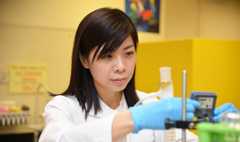
Ho Ghim Wei
National University of SingaporeSingapore
Ho, who develops sustainable solar technologies to meet Singapore’s energy demands, was a finalist of the 2016 ASEAN-US Science Prize for Women.(Photo:National University of Singapore/USAID)
Ho, who develops sustainable solar technologies to meet Singapore’s energy demands, was a finalist of the 2016 ASEAN-US Science Prize for Women.(Photo:National University of Singapore/USAID)
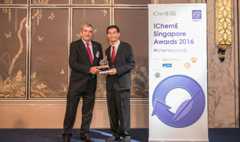
Chua Kian Jon
National University of SingaporeSingapore
Chua, who invented, foil-like membranes to sieve out water molecules in air-conditioning systems and reduce energy consumption, won the Institution of Chemical Engineers' Research Project of the Year Award in 2016.(Photo:National University of Singapore)
Chua, who invented, foil-like membranes to sieve out water molecules in air-conditioning systems and reduce energy consumption, won the Institution of Chemical Engineers' Research Project of the Year Award in 2016.(Photo:National University of Singapore)
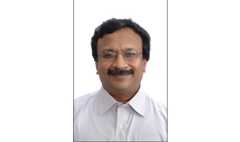
Rajasekhar Balasubramanian
National University of SingaporeSingapore
For his novel waste treatment technology that converts urban waste streams into biofuels and other useful products, Balasubramanian was awarded the 2016 Institution of Chemical Engineers’ Energy Award(Photo:National University of Singapore)
For his novel waste treatment technology that converts urban waste streams into biofuels and other useful products, Balasubramanian was awarded the 2016 Institution of Chemical Engineers’ Energy Award(Photo:National University of Singapore)
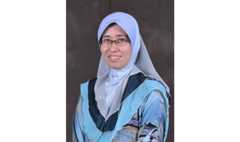
Sharifah Rafidah Wan Alwi
University of Technology MalaysiaMalaysia
Alwi was recognized with an honorable mention at the 2016 ASEAN-US Science Przie for Women for her research into carbon dioxide emission reduction, maximixing energy efficiency for industry and buildings, and creating bioenergy from biomass.(Photo:University of Technology Malaysia)
Alwi was recognized with an honorable mention at the 2016 ASEAN-US Science Przie for Women for her research into carbon dioxide emission reduction, maximixing energy efficiency for industry and buildings, and creating bioenergy from biomass.(Photo:University of Technology Malaysia)
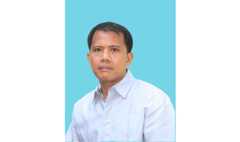
Menandro N. Acda
University of the Philippines Los BañosPhilippines
Acda, whose work on alternative sources for bioenergy spans chicken feathers to waste paper sludge, was recognized with the2016 Philippines Promising Star Award.(Photo:University of the Philippines Los Baños)
Acda, whose work on alternative sources for bioenergy spans chicken feathers to waste paper sludge, was recognized with the2016 Philippines Promising Star Award.(Photo:University of the Philippines Los Baños)
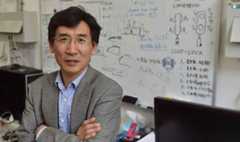
Xue Qikun
Tsinghua UniversityChina
Xue was a recipient of theFuture Science Award in 2016, referred to as China’s Nobel Prize, for his pivotal role in the discovery of the quantum anomalous Hall effect.(Photo:Tsinghua University)
Xue was a recipient of theFuture Science Award in 2016, referred to as China’s Nobel Prize, for his pivotal role in the discovery of the quantum anomalous Hall effect.(Photo:Tsinghua University)
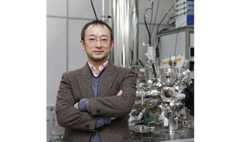
Yeom Han-Woong
Institute for Basic ScienceSouth Korea
Yeom won aKorea Science Award in 2015 for observing the existence of chiral solitons on indium atomic wires, a discovery that could one day lead to the development of single-electron information storage devices.(Photo:Institute for Basic Science)
Yeom won aKorea Science Award in 2015 for observing the existence of chiral solitons on indium atomic wires, a discovery that could one day lead to the development of single-electron information storage devices.(Photo:Institute for Basic Science)
Wen Liangjian
Institute of High Energy Physics, Chinese Academy of SciencesChina
The particle physicist won theInternational Union of Pure and Applied Physics Young Scientist Award 2016 for his role in the discovery of the non-zero neutrino mixing angle θ13.(Photo:Chinese Academy of Sciences)
The particle physicist won theInternational Union of Pure and Applied Physics Young Scientist Award 2016 for his role in the discovery of the non-zero neutrino mixing angle θ13.(Photo:Chinese Academy of Sciences)
Umesh Waghmare
Jawaharlal Nehru Center for Advanced Scientific ResearchIndia
Waghmare’s theories and modeling of topological insulators, ferroelectrics, multiferroic and 2D materials like graphene won him the Infosys Prize 2015.(Photo:Infosys Science Foundation)
Waghmare’s theories and modeling of topological insulators, ferroelectrics, multiferroic and 2D materials like graphene won him the Infosys Prize 2015.(Photo:Infosys Science Foundation)
S. Anantha Ramakrishna
Indian Institute of Technology KanpurIndia
Ramakrishna, a condensed matter physicist who studies the photonic properties of nano- and micro-structured materials, was awarded the 2016 Shanti Swarup Bhatnagar Prize for Science and Technology in the physical sciences category.(Photo:Indian Institute of Technology Kanpur)
Ramakrishna, a condensed matter physicist who studies the photonic properties of nano- and micro-structured materials, was awarded the 2016 Shanti Swarup Bhatnagar Prize for Science and Technology in the physical sciences category.(Photo:Indian Institute of Technology Kanpur)
G. Ravindra Kumar
Tata Institute of Fundamental ResearchIndia
An experimental physicist, Kumar has been recognized with an Infosys Prize 2015 for his research into high-intensity laser-matter interactions.(Photo:Infosys Science Foundation)
An experimental physicist, Kumar has been recognized with an Infosys Prize 2015 for his research into high-intensity laser-matter interactions.(Photo:Infosys Science Foundation)
Kim Yang-Hann
Korea Advanced Institute of Science and TechnologySouth Korea
Kim’s long, illustrious career spanning 25 years of acoustics, vibration and noise research won him the2015 Rossing Prize in Acoustics Education.(Photo:Korea Advanced Institute of Science and Technology)
Kim’s long, illustrious career spanning 25 years of acoustics, vibration and noise research won him the2015 Rossing Prize in Acoustics Education.(Photo:Korea Advanced Institute of Science and Technology)
Kim Myungshik
Korea Institute for Advanced StudySouth Korea
World-renowned in the field of quantum optics, Kim’s theoretical work could one day lead to the development of a quantum computer. He received theHo-Am Prize in 2016.(Photo:Ho-Am Foundation)
World-renowned in the field of quantum optics, Kim’s theoretical work could one day lead to the development of a quantum computer. He received theHo-Am Prize in 2016.(Photo:Ho-Am Foundation)
Kim Kwanpyo
Ulsan National Institute of Science and TechnologySouth Korea
Kim was conferred a2016 Chung-Am (TJ Park) Science Fellowship for the synthesis of emerging 2D nanomaterials beyond graphene.(Photo:Ulsan National Institute of Science and Technology)
Kim was conferred a2016 Chung-Am (TJ Park) Science Fellowship for the synthesis of emerging 2D nanomaterials beyond graphene.(Photo:Ulsan National Institute of Science and Technology)

Peng Shige
Shandong UniversityChina
Peng was recognized with the Qiu Shi Outstanding Scientist Award in 2016 for his work in the fields of probability theory and stochastic control research.(Photo:Shanghai Jiao Tong University)
Peng was recognized with the Qiu Shi Outstanding Scientist Award in 2016 for his work in the fields of probability theory and stochastic control research.(Photo:Shanghai Jiao Tong University)
Mahan MJ
Tata Institute of Fundamental ResearchIndia
MJ was recognized with an Infosys Prize 2015 for his contributions to geometric group theory, low-dimensional topology and complex geometry.(Photo:Infosys Science Foundation)
MJ was recognized with an Infosys Prize 2015 for his contributions to geometric group theory, low-dimensional topology and complex geometry.(Photo:Infosys Science Foundation)
Joseph M. Pasia
University of the Philippines DilimanPhilippines
Pasia, whose research involves analysis, design and implementation of evolutionary algorithms, received a2016 Philippines Promising Star Award.(Photo:University of the Philippines,National Academy of Science and Technology)
Pasia, whose research involves analysis, design and implementation of evolutionary algorithms, received a2016 Philippines Promising Star Award.(Photo:University of the Philippines,National Academy of Science and Technology)
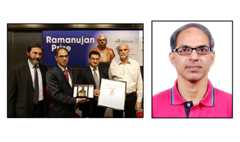
Amalendu Krishna
Tata Institute of Fundamental ResearchIndia
Krishna, who won the Ramanujan Prize in 2015, was one of two recipients of the 2016 Shanti Swarup Bhatnagar Prize for Science and Technology in the mathematical sciences category.(Photo:International Center for Theoretical Physics)
Krishna, who won the Ramanujan Prize in 2015, was one of two recipients of the 2016 Shanti Swarup Bhatnagar Prize for Science and Technology in the mathematical sciences category.(Photo:International Center for Theoretical Physics)
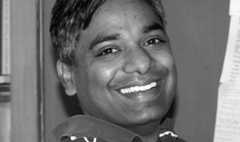
Naveen Garg
Indian Institute of Technology DelhiIndia
For his work into algorithms and complexity theory, Garg was one of two recipients of the 2016 Shanti Swarup Bhatnagar Prize for Science and Technology in the mathematical sciences category.(Photo:Indian Institute of Technology Delhi)
For his work into algorithms and complexity theory, Garg was one of two recipients of the 2016 Shanti Swarup Bhatnagar Prize for Science and Technology in the mathematical sciences category.(Photo:Indian Institute of Technology Delhi)
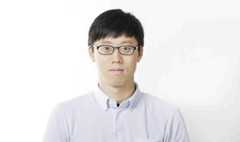
Choi Kyudong
Ulsan National Institute of Science and TechnologySouth Korea
Choi was awarded a2016 Chung Am (TJ Park) Science Fellowship for his mathematical analyses of partial differential equations in fluid dynamics.(Photo:Ulsan National Institute of Science and Technology)
Choi was awarded a2016 Chung Am (TJ Park) Science Fellowship for his mathematical analyses of partial differential equations in fluid dynamics.(Photo:Ulsan National Institute of Science and Technology)
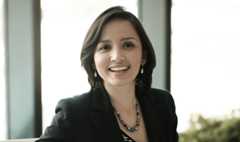
Kathleen Aviso
De La Salle UniversityPhilippines
Aviso's mathematical models for environmental decision-making earned her recognition as a finalist of the 2016 ASEAN-US Science Prize for Women.(Photo:De La Salle University)
Aviso's mathematical models for environmental decision-making earned her recognition as a finalist of the 2016 ASEAN-US Science Prize for Women.(Photo:De La Salle University)
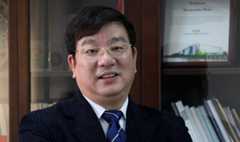
Zhao Dongyuan
Fudan UniversityChina
Zhao was awarded the2016 TWAS-Lenovo Science Prize for his work into mesoporous materials, structures that have microscopic holes and which have many nanoscale applications.(Photo:International Mesostructured Materials Association)
Zhao was awarded the2016 TWAS-Lenovo Science Prize for his work into mesoporous materials, structures that have microscopic holes and which have many nanoscale applications.(Photo:International Mesostructured Materials Association)
Takuo Sugano
University of TokyoJapan
Sugano received the 2016 IEEE Robert N. Noyce Medal for his trailblazing contributions to our understanding of III-V semiconductors, superconducting devices, and single-electron transistors.(Photo:IEEE)
Sugano received the 2016 IEEE Robert N. Noyce Medal for his trailblazing contributions to our understanding of III-V semiconductors, superconducting devices, and single-electron transistors.(Photo:IEEE)
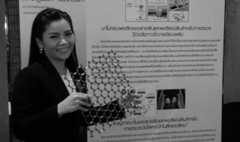
Nadnudda Rodthongkum
Chulalongkorn UniversityThailand
Rodthongkum, who develops nanomaterials for use in medical diagnosis and the detection of environmental pollutants, was awarded the 2016 L'Oréal-UNESCO For Women in Science Thailand Fellowship.(Photo:Metallurgy and Materials Science Research Institute)
Rodthongkum, who develops nanomaterials for use in medical diagnosis and the detection of environmental pollutants, was awarded the 2016 L'Oréal-UNESCO For Women in Science Thailand Fellowship.(Photo:Metallurgy and Materials Science Research Institute)
Liu Xiaogang
National University of SingaporeSingapore
Liu was recognized with thePresident's Science Award in 2016 for his research on luminiscent, biocompatible nanomaterials, which are used in bioimaging applications such as the tracking of cancer cells.(Photo:National University of Singapore)
Liu was recognized with thePresident's Science Award in 2016 for his research on luminiscent, biocompatible nanomaterials, which are used in bioimaging applications such as the tracking of cancer cells.(Photo:National University of Singapore)
Jiang Lei
Technical Institute of Physics and ChemistryChina
In 2016, Jiang was recognized with aNikkei Asia Prize in the science and technology category for his research in the fields of bioinspired and biomimetic multiscale interface materials. An award-winning chemist, Jiang has published hundreds of research papers in internationally-renowned journals, and developed over 30 patents. In addition to the Nikkei Asia Prize, Jiang has won two national awards in his native China: the National Thousands of Experts Project in the New Century in 2004 and the National Natural Science Award in 2005.(Photo: Jiang Lei)
In 2016, Jiang was recognized with aNikkei Asia Prize in the science and technology category for his research in the fields of bioinspired and biomimetic multiscale interface materials. An award-winning chemist, Jiang has published hundreds of research papers in internationally-renowned journals, and developed over 30 patents. In addition to the Nikkei Asia Prize, Jiang has won two national awards in his native China: the National Thousands of Experts Project in the New Century in 2004 and the National Natural Science Award in 2005.(Photo: Jiang Lei)
Hiroshi Kawazoe
Tokyo Institute of TechnologyJapan
Hosono, Kamiya, Kawazoe were co-awarded the2016 Ceramics Grand Prize for opening up a new field of transparent oxide electronics.(Photo:Tokyo Institute of Technology)
Hosono, Kamiya, Kawazoe were co-awarded the2016 Ceramics Grand Prize for opening up a new field of transparent oxide electronics.(Photo:Tokyo Institute of Technology)
Toshio Kamiya
Tokyo Institute of TechnologyJapan
Hosono, Kamiya, Kawazoe were co-awarded the2016 Ceramics Grand Prize for opening up a new field of transparent oxide electronics.(Photo:Tokyo Institute of Technology)
Hosono, Kamiya, Kawazoe were co-awarded the2016 Ceramics Grand Prize for opening up a new field of transparent oxide electronics.(Photo:Tokyo Institute of Technology)
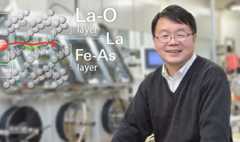
Hideo Hosono
Tokyo Institute of TechnologyJapan
Hosono has pioneered new realms in materials science with the development of energy-efficient liquid crystal displays and large organic light-emitting diode displays used in tablets and televisions. Based on his discovery of iron-based superconductors, Hosono developed transparent oxide semiconductors that are widely used in the computer monitors and flat-screen TVs of today. In 2015, Hosono was awarded the Imperial Prize of the Japan Academy, and in 2016, the Japan Prize and Ceramics Grand Prize.(Photo:Tokyo Institute of Technology)
Hosono has pioneered new realms in materials science with the development of energy-efficient liquid crystal displays and large organic light-emitting diode displays used in tablets and televisions. Based on his discovery of iron-based superconductors, Hosono developed transparent oxide semiconductors that are widely used in the computer monitors and flat-screen TVs of today. In 2015, Hosono was awarded the Imperial Prize of the Japan Academy, and in 2016, the Japan Prize and Ceramics Grand Prize.(Photo:Tokyo Institute of Technology)
Jackie Ying
Institute of Bioengineering and NanotechnologySingapore
Ying, whose research has led to many breakthroughs in the realms of drug delivery, cell and tissue engineering, and biosensing, among others, received the Mustafa Prize Top Scientific Award in 2015, an AAAS Fellowship in 2015, and aSingapore National Academy Science Fellowship in 2016.(Photo:IBN)
Ying, whose research has led to many breakthroughs in the realms of drug delivery, cell and tissue engineering, and biosensing, among others, received the Mustafa Prize Top Scientific Award in 2015, an AAAS Fellowship in 2015, and aSingapore National Academy Science Fellowship in 2016.(Photo:IBN)
Hiroshi Matsumoto
RIKENJapan
The president of RIKEN, Matsumoto was awarded the rank ofChevalier in the French Legion of Honor in 2016 for spearheading the creation of an accord for the mutual recognition of academic degrees between Japan and France.(Photo:Embassy of France in Tokyo)
The president of RIKEN, Matsumoto was awarded the rank ofChevalier in the French Legion of Honor in 2016 for spearheading the creation of an accord for the mutual recognition of academic degrees between Japan and France.(Photo:Embassy of France in Tokyo)
Chiels Liu Chen-Kun
Medecins Sans Frontieres Hong KongHong Kong
Medecins Sans Frontieres was awarded the inaugural LUI Che Woo Prize 2016 for its key role in controlling the 2010 Haiti cholera outbreak and the 2014 West African Ebola epidemic. Liu, president of MSF Hong Kong, accepted the prize on behalf of the international humanitarian aid non-governmental organization.(Photo:LUI Prize)
Medecins Sans Frontieres was awarded the inaugural LUI Che Woo Prize 2016 for its key role in controlling the 2010 Haiti cholera outbreak and the 2014 West African Ebola epidemic. Liu, president of MSF Hong Kong, accepted the prize on behalf of the international humanitarian aid non-governmental organization.(Photo:LUI Prize)
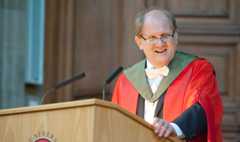
Bertil Andersson
Nanyang Technological UniversitySingapore
In 2016, Andersson received a Singapore National Academy of Science Fellowship and the prestigious President's Science and Technology Award for leading Singapore's Nanyang Technological University to greater heights as its president, and for building up the city-nation into a global R&D hub.(Photo:Nanyang Technological University)
In 2016, Andersson received a Singapore National Academy of Science Fellowship and the prestigious President's Science and Technology Award for leading Singapore's Nanyang Technological University to greater heights as its president, and for building up the city-nation into a global R&D hub.(Photo:Nanyang Technological University)
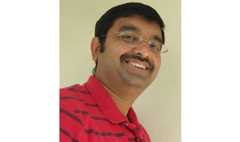
Venkata Narayana Padmanabhan
Microsoft Research IndiaIndia
Padmanabhan, whose research work spans sensor systems, computer systems, mobile computing, and wireless networking, was one of two recipients in the engineering sciences category of the 2016 Shanti Swarup Bhatnagar Prize for Science and Technology.(Photo:Microsoft)
Padmanabhan, whose research work spans sensor systems, computer systems, mobile computing, and wireless networking, was one of two recipients in the engineering sciences category of the 2016 Shanti Swarup Bhatnagar Prize for Science and Technology.(Photo:Microsoft)
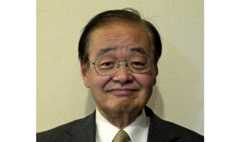
Takao Nishitani
Tokyo Metropolitan UniversityJapan
Nishitani was named a co-recipient of the 2017 IEEE Donald O. Peterson Award in Solid-State Circuits for developing the first single-chip, real-time programmable digital signal processors, which revolutionized communications networks.(Photo:IEEE Xplore Digital Library)
Nishitani was named a co-recipient of the 2017 IEEE Donald O. Peterson Award in Solid-State Circuits for developing the first single-chip, real-time programmable digital signal processors, which revolutionized communications networks.(Photo:IEEE Xplore Digital Library)
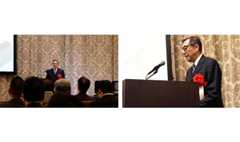
Masaki Yamamoto
Keysight TechnologiesJapan
Chung, Endoh and Yamamoto won in 2016 thePrime Minister's Award for Contribution to Industry-Academia-Government Collaboration for developing high tech equipment for manufacturing and evaluating spin transfer torque magnetic RAM, or STT-MRAM.(Photo:Tohoku University)
Chung, Endoh and Yamamoto won in 2016 thePrime Minister's Award for Contribution to Industry-Academia-Government Collaboration for developing high tech equipment for manufacturing and evaluating spin transfer torque magnetic RAM, or STT-MRAM.(Photo:Tohoku University)
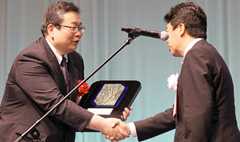
Tetsuo Endoh
Tohoku UniversityJapan
Chung, Endoh and Yamamoto won in 2016 thePrime Minister's Award for Contribution to Industry-Academia-Government Collaboration for developing high tech equipment for manufacturing and evaluating spin transfer torque magnetic RAM, or STT-MRAM.(Photo:Tohoku University)
Chung, Endoh and Yamamoto won in 2016 thePrime Minister's Award for Contribution to Industry-Academia-Government Collaboration for developing high tech equipment for manufacturing and evaluating spin transfer torque magnetic RAM, or STT-MRAM.(Photo:Tohoku University)
Gishi Chung
Tokyo Electron LimitedJapan
Chung, Endoh and Yamamoto won in2016 the Prime Minister's Award for Contribution to Industry-Academia-Government Collaboration for developing high tech equipment for manufacturing and evaluating spin transfer torque magnetic RAM, or STT-MRAM.(Photo:Tohoku University)
Chung, Endoh and Yamamoto won in2016 the Prime Minister's Award for Contribution to Industry-Academia-Government Collaboration for developing high tech equipment for manufacturing and evaluating spin transfer torque magnetic RAM, or STT-MRAM.(Photo:Tohoku University)
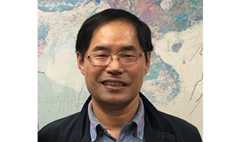
Zhao Guochun
University of Hong KongHong Kong
Zhao won the2016 Khwarizmi International Award for two significant research feats: the recognition of two million-year-old collisional belts, and the collisional events that assembled nearly all the continents on Earth to form a single supercontinent in the Paleo-Mesoproterozoic Period.(Photo:University of Hong Kong)
Zhao won the2016 Khwarizmi International Award for two significant research feats: the recognition of two million-year-old collisional belts, and the collisional events that assembled nearly all the continents on Earth to form a single supercontinent in the Paleo-Mesoproterozoic Period.(Photo:University of Hong Kong)
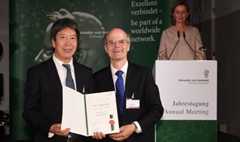
Yang Xiaoping
Institute of Geology and GeophysicsChina
Yang won the Humboldt Research Award in 2016 for his work into the dynamic process and interaction of water and sand in arid areas.(Photo:Institute of Geology and Geophysics)
Yang won the Humboldt Research Award in 2016 for his work into the dynamic process and interaction of water and sand in arid areas.(Photo:Institute of Geology and Geophysics)
Sunil Kumar Singh
Physical Research LaboratoryIndia
Singh, who studies the biogeochemistry of trace elements and isotopes in the Indian and Southern Oceans, was awarded the 2016 Shanti Swarup Bhatnagar Prize for Science and Technology in the Earth, Atmosphere, Ocean and Planetary Sciences category.(Photo:Physical Research Laboratory)
Singh, who studies the biogeochemistry of trace elements and isotopes in the Indian and Southern Oceans, was awarded the 2016 Shanti Swarup Bhatnagar Prize for Science and Technology in the Earth, Atmosphere, Ocean and Planetary Sciences category.(Photo:Physical Research Laboratory)
Augustus C. Resurreccion
University of the Philippines DilimanPhilippines
Resurreccion, who conducts research in soil physics and gas transport in porous media, was one of the 12 recipients of the2016 Philippines Promising Star Awards.(Photo:University of the Philippines)
Resurreccion, who conducts research in soil physics and gas transport in porous media, was one of the 12 recipients of the2016 Philippines Promising Star Awards.(Photo:University of the Philippines)
Neo Mei Lin
Tropical Marine Science Institute, National University of SingaporeSingapore
Neo's work into the conservation of wild giant clams, a marine species that is evolutionarily distinct and globally endangered, earned her the2015 L'Oréal-UNESCO For Women in Science Singapore Fellowship.(Photo: Neo Mei Lin)
Neo's work into the conservation of wild giant clams, a marine species that is evolutionarily distinct and globally endangered, earned her the2015 L'Oréal-UNESCO For Women in Science Singapore Fellowship.(Photo: Neo Mei Lin)
Chong Song
Korea Advanced Institute of Science and TechnologySouth Korea
Yi and Chong won the2016 IEEE William R. Bennett Prize for proposing an original method to effectively offload the cellular network and maximize Wi-Fi network usage. They are only the second recipients to have won the Prize twice since its inception in 1994.(Photo:Korea Advanced Institute of Science and Technology)
Yi and Chong won the2016 IEEE William R. Bennett Prize for proposing an original method to effectively offload the cellular network and maximize Wi-Fi network usage. They are only the second recipients to have won the Prize twice since its inception in 1994.(Photo:Korea Advanced Institute of Science and Technology)
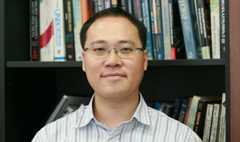
Yi Yung
Korea Advanced Institute of Science and TechnologySouth Korea
Yi and Chong won the2016 IEEE William R. Bennett Prize for proposing an original method to effectively offload the cellular network and maximize Wi-Fi network usage. They are only the second recipients to have won the Prize twice since its inception in 1994.(Photo:Korea Advanced Institute of Science and Technology)
Yi and Chong won the2016 IEEE William R. Bennett Prize for proposing an original method to effectively offload the cellular network and maximize Wi-Fi network usage. They are only the second recipients to have won the Prize twice since its inception in 1994.(Photo:Korea Advanced Institute of Science and Technology)
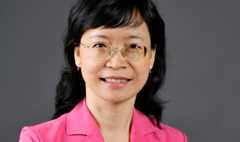
Wang Rong
Nanyang Technological UniversitySingapore
In 2016, Wang and colleague Anthony G. Fane were recognized with theAlternative Water Resources Prize, part of the Prince Sultan Bin Abdulaziz International Prize for Water, for developing a membrane that can reduce membrane fouling and scaling during water reclamation and recycling processes.(Photo:Nanyang Technological University)
In 2016, Wang and colleague Anthony G. Fane were recognized with theAlternative Water Resources Prize, part of the Prince Sultan Bin Abdulaziz International Prize for Water, for developing a membrane that can reduce membrane fouling and scaling during water reclamation and recycling processes.(Photo:Nanyang Technological University)
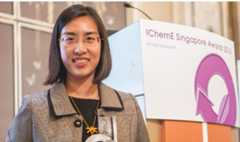
Betty Tsai
Procter & GambleSingapore
Tsai's research on the innovation process behind skincare consumer products won her the Institution of Chemical Engineers' 2016 Young Chemical Engineer in Industry Award.(Photo:Institution of Chemical Engineers)
Tsai's research on the innovation process behind skincare consumer products won her the Institution of Chemical Engineers' 2016 Young Chemical Engineer in Industry Award.(Photo:Institution of Chemical Engineers)
Akira Toriumi
University of TokyoJapan
Toriumi was awarded the 2016 IEEE Cledo Brunetti Award for his pioneering contributions to the understanding of advanced gate dielectrics and device physics, which are driving the continued miniaturization of electronic device components.(Photo:University of Tokyo)
Toriumi was awarded the 2016 IEEE Cledo Brunetti Award for his pioneering contributions to the understanding of advanced gate dielectrics and device physics, which are driving the continued miniaturization of electronic device components.(Photo:University of Tokyo)
Sul Seung Ki
Seoul National UniversitySouth Korea
Sul's innovations in sensorless control techniques have improved the reliability and reduced the cost of motor drive systems, which earned him the 2017 William E. Newell Power Electronics Award.(Photo:Seoul National University)
Sul's innovations in sensorless control techniques have improved the reliability and reduced the cost of motor drive systems, which earned him the 2017 William E. Newell Power Electronics Award.(Photo:Seoul National University)
Show Pau Loke
University of Nottingham Malaysia CampusMalaysia
Show was conferred the Institution of Chemical Engineers’ 2016 Young Chemical Engineer in Research Award for his work in bioseparation engineering, the large-scale separation and purification of biological products.(Photo: Show Pau Loke)
Show was conferred the Institution of Chemical Engineers’ 2016 Young Chemical Engineer in Research Award for his work in bioseparation engineering, the large-scale separation and purification of biological products.(Photo: Show Pau Loke)
Oh Jun-Ho
Korea Advanced Institute of Science and TechnologySouth Korea
Oh developed one of the world's most advanced humanoid robot platforms, theDRC-HUBO, which won the prestigious DARPA Robotics Challenge 2015. With wheels in its knees, the robot was able to transform from a walking robot to one that could roll on four wheels, just by bending over—which was how it conquered the task of climbing stairs. Considered a world leader in the field of humanoid robotics, Oh was also recognized with theHo-Am Prize in 2016.(Photo:Ho-Am Foundation)
Oh developed one of the world's most advanced humanoid robot platforms, theDRC-HUBO, which won the prestigious DARPA Robotics Challenge 2015. With wheels in its knees, the robot was able to transform from a walking robot to one that could roll on four wheels, just by bending over—which was how it conquered the task of climbing stairs. Considered a world leader in the field of humanoid robotics, Oh was also recognized with theHo-Am Prize in 2016.(Photo:Ho-Am Foundation)
He Jinsong
National University of SingaporeSingapore
He was awarded the Institution of Chemical Engineers' Young Chemical Engineer in Research in 2016 for successfully developing a full-scale production system for decontaminating water using metallic oxide nanoparticles and membranes.(Photo:American Institute of Chemical Engineers,National University of Singapore)
He was awarded the Institution of Chemical Engineers' Young Chemical Engineer in Research in 2016 for successfully developing a full-scale production system for decontaminating water using metallic oxide nanoparticles and membranes.(Photo:American Institute of Chemical Engineers,National University of Singapore)

Masayoshi Esashi
Tohoku UniversityJapan
A pioneer of micro-electro-mechanical systems (MEMS) technology, Esashi received the 2016 IEEE Junichi Nishizawa Medal for his MEMS innovations, which are used in automobiles, mobile phones, industrial equipment and medical devices.(Photo:Tohoku University)
A pioneer of micro-electro-mechanical systems (MEMS) technology, Esashi received the 2016 IEEE Junichi Nishizawa Medal for his MEMS innovations, which are used in automobiles, mobile phones, industrial equipment and medical devices.(Photo:Tohoku University)
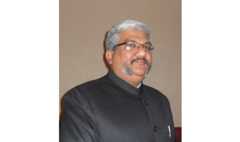
Avinash Kumar Agarwal
Indian Institute of Technology KanpurIndia
A mechanical engineer focusing on combustion visualization, alternative fuels and biodiesel development, Avinash was one of two recipients in the engineering sciences category of the 2016 Shanti Swarup Bhatnagar Prize for Science and Technology.(Photo:Indian Institute of Technology Kanpur)
A mechanical engineer focusing on combustion visualization, alternative fuels and biodiesel development, Avinash was one of two recipients in the engineering sciences category of the 2016 Shanti Swarup Bhatnagar Prize for Science and Technology.(Photo:Indian Institute of Technology Kanpur)
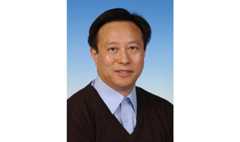
Wu Yundong
Peking UniversityChina
An academician of the Chinese Academy of Sciences, Wu received a 2016 Humboldt Research Award for his work into reaction mechanisms and drug design.(Photo:Peking University)
An academician of the Chinese Academy of Sciences, Wu received a 2016 Humboldt Research Award for his work into reaction mechanisms and drug design.(Photo:Peking University)

Mitsuo Sawamoto
Kyoto UniversityJapan
Sawamoto received a 2016 Humboldt Research Award for his work into the preparative and physical chemistry of polymers, and is a co-recipient of the 2017 Benjamin Franklin Medal in Chemistry.(Photo:Franklin Institute)
Sawamoto received a 2016 Humboldt Research Award for his work into the preparative and physical chemistry of polymers, and is a co-recipient of the 2017 Benjamin Franklin Medal in Chemistry.(Photo:Franklin Institute)
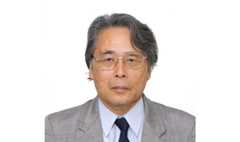
Hiroyuki Ohshima
Tokyo University of ScienceJapan
Ohshima was recognized for his work on the theory of colloid and interfacial electric phenomena with the 2016 Khwarizmi International Award, a prize given out by the Iranian Research Organization for Science and Technology.(Photo:Khwarizmi International Award)
Ohshima was recognized for his work on the theory of colloid and interfacial electric phenomena with the 2016 Khwarizmi International Award, a prize given out by the Iranian Research Organization for Science and Technology.(Photo:Khwarizmi International Award)
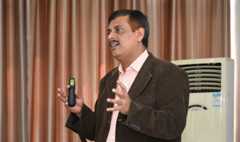
Partha Sarathi Mukherjee
Indian Institute of ScienceIndia
Mukherjee was awarded the 2016 Shanti Swarup Bhatnagar Prize for Science and Technology in the chemistry category for his work into supramolecular and organometallic materials.(Photo:Indian Institute of Science)
Mukherjee was awarded the 2016 Shanti Swarup Bhatnagar Prize for Science and Technology in the chemistry category for his work into supramolecular and organometallic materials.(Photo:Indian Institute of Science)
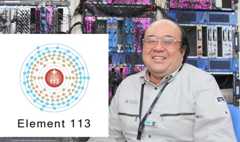
Kosuke Morita
RIKENJapan
In 2012, Morita and his research team discoveredelement 113, the first chemical element ever discovered in Asia. Their discovery was formally accepted in 2015 and Morita named the superheavy element Nihonium in tribute to his native Japan.(Photo:RIKEN)
In 2012, Morita and his research team discoveredelement 113, the first chemical element ever discovered in Asia. Their discovery was formally accepted in 2015 and Morita named the superheavy element Nihonium in tribute to his native Japan.(Photo:RIKEN)

Liu Bin
National University of SingaporeSingapore
Liu, who has developed water-dispersible organic nanoparticles that are brighter and more accurate than commercial quantum dots, was recognized with the2016 President’s Technology Award.(Photo:National University of Singapore)
Liu, who has developed water-dispersible organic nanoparticles that are brighter and more accurate than commercial quantum dots, was recognized with the2016 President’s Technology Award.(Photo:National University of Singapore)
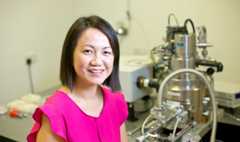
Ling Xing Yi
Nanyang Technological UniversitySingapore
Ling received the 2015 L’Oréal-UNESCO For Women in Science Singapore Fellowship for developing an ultrasensitive environmental sensing platform that quickly detects trace contamination in water and soil by environmental toxins.(Photo:Nanyang Technological University)
Ling received the 2015 L’Oréal-UNESCO For Women in Science Singapore Fellowship for developing an ultrasensitive environmental sensing platform that quickly detects trace contamination in water and soil by environmental toxins.(Photo:Nanyang Technological University)
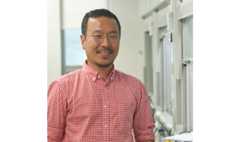
Kee Jung-Min
Ulsan National Institute of Science and TechnologySouth Korea
Kee was awarded a 2016 Chung-Am (TJ Park) Science Fellowship to support his efforts to develop a new molecular tools for studying post-translational modifications of proteins in the body.(Photo:Ulsan National Institute of Science and Technology)
Kee was awarded a 2016 Chung-Am (TJ Park) Science Fellowship to support his efforts to develop a new molecular tools for studying post-translational modifications of proteins in the body.(Photo:Ulsan National Institute of Science and Technology)
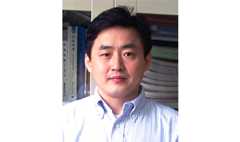
Ding Kuiling
State Key Laboratory of Organometallic Chemistry, Chinese Academy of SciencesChina
Ding received a 2016 Humboldt Research Award for his combinatorial approaches to asymmetric catalysis and the development of new strategies for chiral catalyst immobilization.(Photo:Chinese Academy of Sciences)
Ding received a 2016 Humboldt Research Award for his combinatorial approaches to asymmetric catalysis and the development of new strategies for chiral catalyst immobilization.(Photo:Chinese Academy of Sciences)
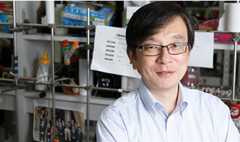
Takahiko Akiyama
Gakushuin UniversityJapan
Akiyama won a 2016 Humboldt Research Award for his work in synthetic organic chemistry, particularly in extending the synthetic utility of chiral phosphoric acid and developing novel chiral Bronsted acid catalysts.(Photo:Gakushuin University)
Akiyama won a 2016 Humboldt Research Award for his work in synthetic organic chemistry, particularly in extending the synthetic utility of chiral phosphoric acid and developing novel chiral Bronsted acid catalysts.(Photo:Gakushuin University)
Hiroshi Iwasaki
Tokyo Institute of TechnologyJapan
Iwasaki was recognized with the2016 Kihara Prize for his work into homologous recombination, which involves the exchange of sequences between two homologous DNA molecules, using fission yeast models.(Photo:Tokyo Institute of Technology)
Iwasaki was recognized with the2016 Kihara Prize for his work into homologous recombination, which involves the exchange of sequences between two homologous DNA molecules, using fission yeast models.(Photo:Tokyo Institute of Technology)
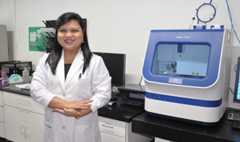
Maria Corazon A. De Ungria
University of the Philippines DilimanPhilippines
De Ungria won the2016 Philippines Promising Star Award for using forensic DNA technology to improve the Philippine criminal justice system and help in disaster victim identification.(Photo:University of the Philippines Diliman)
De Ungria won the2016 Philippines Promising Star Award for using forensic DNA technology to improve the Philippine criminal justice system and help in disaster victim identification.(Photo:University of the Philippines Diliman)

Sumitra Thongprasert
Chiang Mai UniversityThailand
A founding member of the Thai Society of Clinical Oncology, Thongprasert was honored with the European Society for Medical Oncology’sWomen for Oncology Award in 2016 for being a role model to other female oncologists in Thailand.(Photo:European Society for Medical Oncology)
A founding member of the Thai Society of Clinical Oncology, Thongprasert was honored with the European Society for Medical Oncology’sWomen for Oncology Award in 2016 for being a role model to other female oncologists in Thailand.(Photo:European Society for Medical Oncology)
Tsay Yi-Fang
Academia SinicaTaiwan
Tsay received the 2016 Khwarizmi International Award for her role in isolating the first nitrate transporter gene in higher plants, a landmark achievement that paves the way for understanding how plants’ primary source of nitrogen is transported into and around the plant.(Photo:Institute of Molecular Biology)
Tsay received the 2016 Khwarizmi International Award for her role in isolating the first nitrate transporter gene in higher plants, a landmark achievement that paves the way for understanding how plants’ primary source of nitrogen is transported into and around the plant.(Photo:Institute of Molecular Biology)
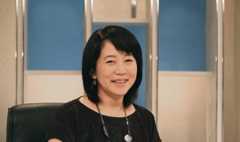
Masayo Takahashi
RIKENJapan
Takahashi has been recognized for her trailblazing work with the inaugural Ogawa-Yamanaka Stem Cell Prize 2015. She led the world’s first clinical trial to use induced pluripotent stem cells in humans, with the intent totreat retinal diseases.(Photo: Masayo Takahashi/RIKEN)
Takahashi has been recognized for her trailblazing work with the inaugural Ogawa-Yamanaka Stem Cell Prize 2015. She led the world’s first clinical trial to use induced pluripotent stem cells in humans, with the intent totreat retinal diseases.(Photo: Masayo Takahashi/RIKEN)
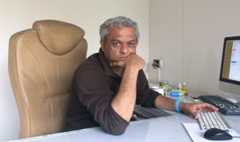
Amit Sharma
International Center for Genetic Engineering and BiotechnologyIndia
Sharma won the Infosys Prize 2015 for his work detailing the structural features of numerous malaria parasite proteins, and which is now informing the search for novel anti-parasite drug.(Photo: Amit Sharma)
Sharma won the Infosys Prize 2015 for his work detailing the structural features of numerous malaria parasite proteins, and which is now informing the search for novel anti-parasite drug.(Photo: Amit Sharma)
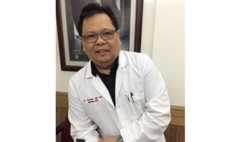
Raymond L. Rosales
Pontifical and Royal University of Santo TomasPhilippines
Rosales, a professor who has led a number of international, multi-center clinical trials, was awarded the2016 Philippines Promising Star Award for his work in neurology and behavioral science.(Photo:University of Santo Tomas)
Rosales, a professor who has led a number of international, multi-center clinical trials, was awarded the2016 Philippines Promising Star Award for his work in neurology and behavioral science.(Photo:University of Santo Tomas)

Windell L. Rivera
University of the Philippines DilimanPhilippines
One of the Philippines’ most prominent parasitologists, Rivera was recognized with aPhilippines Promising Star Award in 2016.(Photo:University of the Philippines Diliman)
One of the Philippines’ most prominent parasitologists, Rivera was recognized with aPhilippines Promising Star Award in 2016.(Photo:University of the Philippines Diliman)
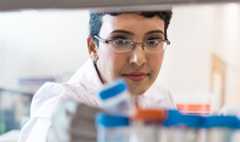
Reena Rajasuriar
University of MalayaMalaysia
Rajasuriar was awarded the 2016 L'Oréal For Women in Science Malaysia Fellowship for her research into immunological aging, specifically the potential drivers of premature aging in HIV and cancer survivors.(Photo:L’Oréal Malaysia)
Rajasuriar was awarded the 2016 L'Oréal For Women in Science Malaysia Fellowship for her research into immunological aging, specifically the potential drivers of premature aging in HIV and cancer survivors.(Photo:L’Oréal Malaysia)
Yoshinori Ohsumi
Tokyo Institute of TechnologyJapan
Ohsumi was awarded the2016 Nobel Prize in Medicine for his research into autophagy, the process used by cells to break down damaged parts and recycle unused proteins. Since Ohsumi first identified the genes controlling autophagy in the 1990s, it has been established that this cell recycling process is essential for maintaining cell equilibrium. Furthermore, defects in autophagy have been linked to diseases ranging from Alzheimer's disease to cancer. Also in 2016, Ohsumi received the2016 Breakthrough Prize, the Paul Janssen Award for Biomedical Research, the45th Rosentiel Award and the 15th Wiley Prize in Biomedical Sciences.(Photo:Tokyo Institute of Technology)
Ohsumi was awarded the2016 Nobel Prize in Medicine for his research into autophagy, the process used by cells to break down damaged parts and recycle unused proteins. Since Ohsumi first identified the genes controlling autophagy in the 1990s, it has been established that this cell recycling process is essential for maintaining cell equilibrium. Furthermore, defects in autophagy have been linked to diseases ranging from Alzheimer's disease to cancer. Also in 2016, Ohsumi received the2016 Breakthrough Prize, the Paul Janssen Award for Biomedical Research, the45th Rosentiel Award and the 15th Wiley Prize in Biomedical Sciences.(Photo:Tokyo Institute of Technology)
Sudjit Luanpitpong
Siriraj Center of Excellence for Stem Cell ResearchThailand
Luanpitpong was awarded the 2016 L'Oréal-UNESCO For Women in Science Thailand Fellowship for her research into targeting cancer stem cells as a novel type of cancer therapy.(Photo:Siriraj Center of Excellence for Stem Cell Research)
Luanpitpong was awarded the 2016 L'Oréal-UNESCO For Women in Science Thailand Fellowship for her research into targeting cancer stem cells as a novel type of cancer therapy.(Photo:Siriraj Center of Excellence for Stem Cell Research)
Dennis Lo
Chinese University of Hong KongHong Kong
Lo was awarded the2016 Future Science Award for developing non-invasive prenatal diagnostics tests widely used around the world today. Thanks to his two decades of research, which has benefited millions of pregnant mothers around the world, it is possible to not only uncover the sex of an unborn baby but also to detect chromosomal abnormalities such as Down's, Edwards and Patau syndromes. Lo was also the first Chinese scholar to be awarded the prestigious 2015 Wallace H. Coulter Lectureship Award from the American Association for Clinical Chemistry.(Photo: Dennis Lo)
Lo was awarded the2016 Future Science Award for developing non-invasive prenatal diagnostics tests widely used around the world today. Thanks to his two decades of research, which has benefited millions of pregnant mothers around the world, it is possible to not only uncover the sex of an unborn baby but also to detect chromosomal abnormalities such as Down's, Edwards and Patau syndromes. Lo was also the first Chinese scholar to be awarded the prestigious 2015 Wallace H. Coulter Lectureship Award from the American Association for Clinical Chemistry.(Photo: Dennis Lo)
Nethia Mohana Kumaran
University of Science MalaysiaMalaysia
Kumaran was awarded the 2016 L'Oréal-UNESCO For Women in Science Malaysia Fellowship for her research into developing treatments for nasopharyngeal cancer, a type of head and neck cancer.(Photo:L’Oréal Malaysia)
Kumaran was awarded the 2016 L'Oréal-UNESCO For Women in Science Malaysia Fellowship for her research into developing treatments for nasopharyngeal cancer, a type of head and neck cancer.(Photo:L’Oréal Malaysia)
Nicholas Plachta
Institute of Molecular and Cell BiologySingapore
Plachta is one of three recipients of the 2016 American Society for Cell Biology-GibcoEmerging Leaders Prize for his research into the shape, position and fate of cells during early development.(Photo:ASCB)
Plachta is one of three recipients of the 2016 American Society for Cell Biology-GibcoEmerging Leaders Prize for his research into the shape, position and fate of cells during early development.(Photo:ASCB)

Tasuku Honjo
Kyoto UniversityJapan
For his discovery of activation-induced cytidine deaminase, the enzyme responsible for antibody class switching, Honjo was awarded the Keio Medical Science Prize and Kyoto Prize in 2016, among other honors.(Photo:Kyoto Prize)
For his discovery of activation-induced cytidine deaminase, the enzyme responsible for antibody class switching, Honjo was awarded the Keio Medical Science Prize and Kyoto Prize in 2016, among other honors.(Photo:Kyoto Prize)
Emmanuel P. Estrella
University of the Philippines ManilaPhilippines
Estrella, an orthopedic surgeon, was awarded the2016 Philippines Promising Star Award for his contributions to clinical medicine.(Photo:UP Philippine General Hospital)
Estrella, an orthopedic surgeon, was awarded the2016 Philippines Promising Star Award for his contributions to clinical medicine.(Photo:UP Philippine General Hospital)
Chen Hualan
Herbin Veterinary Research InstituteChina
The Asia Pacific winner of theL'Oréal-UNESCO For Women in Science Award in 2016, Chen was recognized not only for her research into the biology of the bird flu virus, but also for her contributions to the development and use of effective vaccines for avian influenza control.(Photo:L'Oréal Foundation)
The Asia Pacific winner of theL'Oréal-UNESCO For Women in Science Award in 2016, Chen was recognized not only for her research into the biology of the bird flu virus, but also for her contributions to the development and use of effective vaccines for avian influenza control.(Photo:L'Oréal Foundation)
Suvendra Nath Bhattacharyya
CSIR Indian Institute of Chemical BiologyIndia
Bhattacharyya was recognized with the 2016 Shanti Swarup Bhatnagar Prize for Science and Technology 2016 for his work into molecular cell biology and epigenetics.(Photo:Indian Institute of Chemical Biology)
Bhattacharyya was recognized with the 2016 Shanti Swarup Bhatnagar Prize for Science and Technology 2016 for his work into molecular cell biology and epigenetics.(Photo:Indian Institute of Chemical Biology)
Niyaz Ahmed
University of HyderabadIndia
Ahmed’s research, which delves into the functional epidemiology of enteropathogenetic bacteria, earned him the 2016 Shanti Swarup Bhatnagar Prize for Science and Technology in the medical sciences category.(Photo:University of Hyderabad)
Ahmed’s research, which delves into the functional epidemiology of enteropathogenetic bacteria, earned him the 2016 Shanti Swarup Bhatnagar Prize for Science and Technology in the medical sciences category.(Photo:University of Hyderabad)

Maria Czarina Acelajado
University of the Philippines ManilaPhilippines
Acelajado was recognized with a2016 Philippines Promising Star Award for her world-class publications in hypertension research as indexed in the Thomson Reuters Web of Science Core Collection.(Photo:OB Montessori)
Acelajado was recognized with a2016 Philippines Promising Star Award for her world-class publications in hypertension research as indexed in the Thomson Reuters Web of Science Core Collection.(Photo:OB Montessori)

Yuan Longping
Chinese Academy of EngineeringChina
Yuan, the ‘father of hybrid rice,’ was awarded the2016 LUI Che Woo Prize in the sustainability category for developing high-yielding hybrid rice.(Photo:LUI Prize)
Yuan, the ‘father of hybrid rice,’ was awarded the2016 LUI Che Woo Prize in the sustainability category for developing high-yielding hybrid rice.(Photo:LUI Prize)

Witri Wahyu Lestari
Sebelas Maret UniversityIndonesia
Lestari, whose research focuses on the conversion of palm oil and other natural resources into biofuel, was named a finalist of the 2016 ASEAN-US Science Prize for Women.(Photo:Qonita Awwaliya/USAID)
Lestari, whose research focuses on the conversion of palm oil and other natural resources into biofuel, was named a finalist of the 2016 ASEAN-US Science Prize for Women.(Photo:Qonita Awwaliya/USAID)
Phung Le
Ho Chi Minh City University of TechnologyVietnam
Le was named a finalist of the ASEAN-US Science Prixe for Women for creating biofuel out of agricultural waste such as rubber seed oil, ground coffee beans and fruit.(Photo:USAID)
Le was named a finalist of the ASEAN-US Science Prixe for Women for creating biofuel out of agricultural waste such as rubber seed oil, ground coffee beans and fruit.(Photo:USAID)

G. Satheesh Reddy
Defense Research and Development OrganizationIndia
Reddy, a renowned aerospace and navigation scientist, received the 2015 RAeS Silver Medal from the Royal Aeronautical Society, London, as well as the inaugural 2015 IEI-IEEE Award for Engineering Excellence for his significant contributions towards avionics, missiles and aerospace technologies in India. Since 1986, Reddy has led the conceptualization, design and development of sensors, navigation systems and satellite navigation receivers, and spearheaded the flight testing of avionics systems in India. He was also appointed scientific adviser to India’s minister of defense in 2016.(Photo:Syed Akbar)
Reddy, a renowned aerospace and navigation scientist, received the 2015 RAeS Silver Medal from the Royal Aeronautical Society, London, as well as the inaugural 2015 IEI-IEEE Award for Engineering Excellence for his significant contributions towards avionics, missiles and aerospace technologies in India. Since 1986, Reddy has led the conceptualization, design and development of sensors, navigation systems and satellite navigation receivers, and spearheaded the flight testing of avionics systems in India. He was also appointed scientific adviser to India’s minister of defense in 2016.(Photo:Syed Akbar)

Udupi Ramachandra Rao
Physical Research LaboratoryIndia
Rao was instrumental to India's satellite industry since the 1970s, beginning with the first Indian satellite Aryabhata in 1975. He was given an International Astronautical Federation Hall of Fame Award in 2016.(Photo:Indian Space Research Organization)
Rao was instrumental to India's satellite industry since the 1970s, beginning with the first Indian satellite Aryabhata in 1975. He was given an International Astronautical Federation Hall of Fame Award in 2016.(Photo:Indian Space Research Organization)
Ong Kien Soo
ST ElectronicsSingapore
Ong, together with researchers and engineers from ST Electronics, the National University of Singapore, Nanyang Technological University and DSO National Laboratories were jointly recognized with a President's Technology Award in 2016 for their contributions to the development of TeLEOS-1, a one-meter resolution satellite.(Photo:A*STAR)
Ong, together with researchers and engineers from ST Electronics, the National University of Singapore, Nanyang Technological University and DSO National Laboratories were jointly recognized with a President's Technology Award in 2016 for their contributions to the development of TeLEOS-1, a one-meter resolution satellite.(Photo:A*STAR)
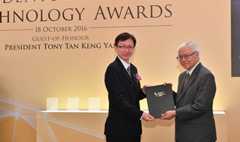
Lim Wee Seng
Nanyang Technological UniversitySingapore
Lim, together with researchers and engineers from ST Electronics, the National University of Singapore, Nanyang Technological University and DSO National Laboratories were jointly recognized with a President's Technology Award in 2016 for their contributions to the development of TeLEOS-1, a one-meter resolution satellite.(Photo:Nanyang Technological University)
Lim, together with researchers and engineers from ST Electronics, the National University of Singapore, Nanyang Technological University and DSO National Laboratories were jointly recognized with a President's Technology Award in 2016 for their contributions to the development of TeLEOS-1, a one-meter resolution satellite.(Photo:Nanyang Technological University)
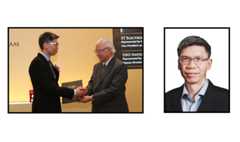
Desmond Lim
DSO National LaboratoriesSingapore
Lim, together with researchers and engineers from ST Electronics, the National University of Singapore, Nanyang Technological University and DSO National Laboratories were jointly recognized with a President's Technology Award in 2016 for their contributions to the development of TeLEOS-1, a one-meter resolution satellite.(Photo:ISTANA,A*STAR)
Lim, together with researchers and engineers from ST Electronics, the National University of Singapore, Nanyang Technological University and DSO National Laboratories were jointly recognized with a President's Technology Award in 2016 for their contributions to the development of TeLEOS-1, a one-meter resolution satellite.(Photo:ISTANA,A*STAR)
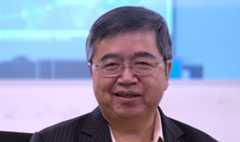
Kwoh Leong Keong
National University of SingaporeKwoh, together with researchers and engineers from ST Electronics, the National University of Singapore, Nanyang Technological University and DSO National Laboratories were jointly recognized with a President's Technology Award in 2016 for their contributions to the development of TeLEOS-1, a one-meter resolution satellite.(Photo:A*STAR)
Kwoh, together with researchers and engineers from ST Electronics, the National University of Singapore, Nanyang Technological University and DSO National Laboratories were jointly recognized with a President's Technology Award in 2016 for their contributions to the development of TeLEOS-1, a one-meter resolution satellite.(Photo:A*STAR)
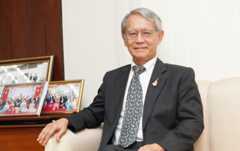
Yongyuth Yuthavong
Government of ThailandThailand
Yuthavong, a former professor in biochemistry at Mahidol University, was appointed deputy prime minister of Thailand in 2014, becoming one of the few practicing scientists to attain such a high ranking political office. Clickhere to read our exclusive interview with him on how he went from papayas to parasites and finally, politics.(Photo: Yongyuth Yuthavong)
Yuthavong, a former professor in biochemistry at Mahidol University, was appointed deputy prime minister of Thailand in 2014, becoming one of the few practicing scientists to attain such a high ranking political office. Clickhere to read our exclusive interview with him on how he went from papayas to parasites and finally, politics.(Photo: Yongyuth Yuthavong)

Wang Yifang
Institute of High Energy Physics, CASChina
For leading a large international collaboration that carried out the Daya Bay neutrino oscillation experiment in China, Wang received the2015 Nikkei Asia Prize in the science, technology and environment category.(Photo:Institute of High Energy Physics, Chinese Academy of Sciences)
For leading a large international collaboration that carried out the Daya Bay neutrino oscillation experiment in China, Wang received the2015 Nikkei Asia Prize in the science, technology and environment category.(Photo:Institute of High Energy Physics, Chinese Academy of Sciences)
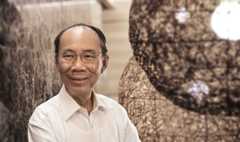
Tan Gee Paw
Public Utilities BoardSingapore
Tan, chairman of the Public Utilities Board (PUB), Singapore’s national water agency, won the2015 President’s Science and Technology Medal, Singapore’s highest science and technology honor, for his central role in developing a sustainable water supply for Singapore, and for building Singapore into a water and environmental R&D hub. His achievements include writing Singapore’s first water plan in 1972, and introducing two water sources for Singapore: recycled sewage water and desalinated water.(Photo: Asian Scientist/Bryan van der Beek)
Tan, chairman of the Public Utilities Board (PUB), Singapore’s national water agency, won the2015 President’s Science and Technology Medal, Singapore’s highest science and technology honor, for his central role in developing a sustainable water supply for Singapore, and for building Singapore into a water and environmental R&D hub. His achievements include writing Singapore’s first water plan in 1972, and introducing two water sources for Singapore: recycled sewage water and desalinated water.(Photo: Asian Scientist/Bryan van der Beek)

Tan Chorh Chuan
National University of SingaporeSingapore
Tan, the president of the National University of Singapore, was elected as a lifetime member of theUS National Academy of Medicine in 2015. He has the honor of being the organization’s first Singaporean member.(Photo: Asian Scientist Magazine/Cyril Ng)
Tan, the president of the National University of Singapore, was elected as a lifetime member of theUS National Academy of Medicine in 2015. He has the honor of being the organization’s first Singaporean member.(Photo: Asian Scientist Magazine/Cyril Ng)
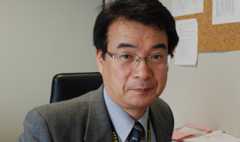
Eisuke Tada
International Thermonuclear Experimental Reactor (ITER)Japan
In 2015, Tada was appointed to one of twodeputy director-general positions at the International Thermonuclear Experimental Reactor (ITER), the world’s largest experimental fusion facility.(Photo:ITER)
In 2015, Tada was appointed to one of twodeputy director-general positions at the International Thermonuclear Experimental Reactor (ITER), the world’s largest experimental fusion facility.(Photo:ITER)

M. R. Srinivasan
Nuclear Power Corporation of IndiaIndia
Thechief architect of India’s nuclear power program won the 2015 Padma Vibhushan Award, India’s second highest civilian award.(Photo: M. R. Srinivasan)
Thechief architect of India’s nuclear power program won the 2015 Padma Vibhushan Award, India’s second highest civilian award.(Photo: M. R. Srinivasan)

C. N. R. Rao
Government of IndiaIndia
Rao was conferred with the Order of the Rising Sun, Gold and Silver Star, Japan’s highest civilian award, for his contributions to science and Indo-Japanese science cooperation. He is the only Indian to be elected as a foreign member of the Japan Academy.(Photo:Royal Society of Chemistry)
Rao was conferred with the Order of the Rising Sun, Gold and Silver Star, Japan’s highest civilian award, for his contributions to science and Indo-Japanese science cooperation. He is the only Indian to be elected as a foreign member of the Japan Academy.(Photo:Royal Society of Chemistry)
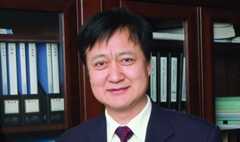
Li Jinghai
Chinese Academy of SciencesChina
In 2014, the vice-president of CAS was elected as one of two vice-presidents of theInternational Council for Science, a nongovernmental organization representing 122 national scientific bodies and 31 international scientific unions.(Photo:EMMS Group)
In 2014, the vice-president of CAS was elected as one of two vice-presidents of theInternational Council for Science, a nongovernmental organization representing 122 national scientific bodies and 31 international scientific unions.(Photo:EMMS Group)
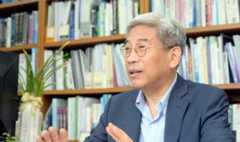
Lee Jae Kyu
KAISTSouth Korea
In 2014, Lee, HHI Chair Professor in the College of Business at KAIST was appointedpresident of the Association for Information Systems, a professional association for the research, teaching, practice and study of information systems.(Photo:KAIST)
In 2014, Lee, HHI Chair Professor in the College of Business at KAIST was appointedpresident of the Association for Information Systems, a professional association for the research, teaching, practice and study of information systems.(Photo:KAIST)
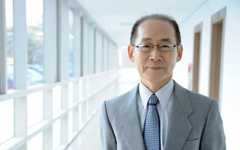
Lee Hoesung
Intergovernmental Panel on Climate Change (IPCC)South Korea
The South Korean economist, who specializes in climate and energy policy, was elected as head of the Switzerland-based Intergovernmental Panel on Climate Change (IPCC) in 2015. Lee is also a professor at the Graduate School of Energy and Environment, Korea University, South Korea.(Photo:United Nations)
The South Korean economist, who specializes in climate and energy policy, was elected as head of the Switzerland-based Intergovernmental Panel on Climate Change (IPCC) in 2015. Lee is also a professor at the Graduate School of Energy and Environment, Korea University, South Korea.(Photo:United Nations)
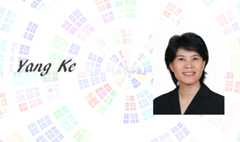
Yang Ke
Peking UniversityChina
Yang, the executive vice president of Peking University, won the 2015 Prince Mahidol Award for reforming research and medical education in China.(Photo:Peking University)
Yang, the executive vice president of Peking University, won the 2015 Prince Mahidol Award for reforming research and medical education in China.(Photo:Peking University)

Bai Chunli
Chinese Academy of SciencesChina
Bai, a nanotechnology pioneer and president of the Chinese Academy of Sciences, was elected a foreign member of the UK’sRoyal Society in 2014.(Photo:The World Academy of Sciences)
Bai, a nanotechnology pioneer and president of the Chinese Academy of Sciences, was elected a foreign member of the UK’sRoyal Society in 2014.(Photo:The World Academy of Sciences)
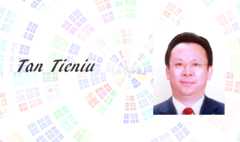
Tan Tieniu
Chinese Academy of SciencesChina
Tan’s work into computer vision and pattern recognition helped him get elected as an international fellow of theRoyal Academy of Engineering in 2014.(Photo:Center for Biometrics and Security Research)
Tan’s work into computer vision and pattern recognition helped him get elected as an international fellow of theRoyal Academy of Engineering in 2014.(Photo:Center for Biometrics and Security Research)

Agachai Sumalee
King Mongkut’s Institute of Technology LadkrabangThailand
Sumalee was awarded the APEC Science Award for Innovation, Research and Education (ASPIRE) Science Award 2014 for combining traffic-flow algorithms with highway sensors to create an intelligent transportation system that reduces highway congestion.(Photo:Agachai Sumalee)
Sumalee was awarded the APEC Science Award for Innovation, Research and Education (ASPIRE) Science Award 2014 for combining traffic-flow algorithms with highway sensors to create an intelligent transportation system that reduces highway congestion.(Photo:Agachai Sumalee)
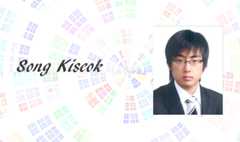
Song Kiseok
KAISTSouth Korea
Song was awarded the2014 Marconi Society Paul Baran Young Scholar Award for developing biomedical patch systems connected to smart phones.(Photo:KAIST)
Song was awarded the2014 Marconi Society Paul Baran Young Scholar Award for developing biomedical patch systems connected to smart phones.(Photo:KAIST)

Jayant Haritsa
Indian Institute of ScienceIndia
Haritsa won the Infosys Prize 2014 in Engineering and Computer Science for the design and optimization of database engines that form the core of modern enterprise information systems.(Photo:Infosys Science Foundation)
Haritsa won the Infosys Prize 2014 in Engineering and Computer Science for the design and optimization of database engines that form the core of modern enterprise information systems.(Photo:Infosys Science Foundation)
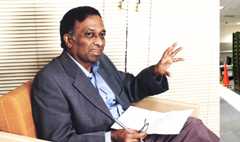
Vijay P. Bhatkar
India International Multiversity (IIMv)India
Aside from being the founder of the India International Multiversity (IIMv), Bhatkar is known as the architect of India’s supercomputer program. He won the 2015 Padma Vibhushan Award, India’s second highest civilian award.(Photo:Vijay P. Bhatkar)
Aside from being the founder of the India International Multiversity (IIMv), Bhatkar is known as the architect of India’s supercomputer program. He won the 2015 Padma Vibhushan Award, India’s second highest civilian award.(Photo:Vijay P. Bhatkar)
Manindra Agrawal
Indian Institute of Technology KanpurIndia
Agrawal was elected a member of the US National Academy of Sciences in 2015 for his research into cryptography, complex analysis and combinatorics.(Photo:Infosys Science Foundation)
Agrawal was elected a member of the US National Academy of Sciences in 2015 for his research into cryptography, complex analysis and combinatorics.(Photo:Infosys Science Foundation)
Yu Kyoungsik
KAISTSouth Korea
Yu was honored as a 2015 Young Scientist of the World Economic Forum for his research into nanophotonics.(Photo:KAIST)
Yu was honored as a 2015 Young Scientist of the World Economic Forum for his research into nanophotonics.(Photo:KAIST)

Yu Chengzhong
The University of QueenslandChina
Yu received the2015 Le Févre Memorial Prize for developing nanoparticles with applications in vaccine delivery and water treatment.(Photo:University of Queensland)
Yu received the2015 Le Févre Memorial Prize for developing nanoparticles with applications in vaccine delivery and water treatment.(Photo:University of Queensland)
Benjamin Tee
Agency for Science, Technology and ResearchSingapore
MIT Technology Review namedTee as one of their35 Innovators Under 35 for developing flexible and stretchable electronic skin-like sensors.(Photo:Benjamin Tee)
MIT Technology Review namedTee as one of their35 Innovators Under 35 for developing flexible and stretchable electronic skin-like sensors.(Photo:Benjamin Tee)
Yosiro Oono
Kyushu UniversityJapan
Oono’s studies into classical circuit theory won him the 2015 IEEE Gustav Robert Kirchhoff Award.(Photo:IEEE)
Oono’s studies into classical circuit theory won him the 2015 IEEE Gustav Robert Kirchhoff Award.(Photo:IEEE)
Andrew Nee
National University of SingaporeSingapore
Nee, an expert on the use of computer-aided design in precision engineering as well as an augmented reality pioneer, received theUS Society of Manufacturing Engineers Gold Medal in 2014 for his lifetime contributions to manufacturing research.(Photo:National University of Singapore)
Nee, an expert on the use of computer-aided design in precision engineering as well as an augmented reality pioneer, received theUS Society of Manufacturing Engineers Gold Medal in 2014 for his lifetime contributions to manufacturing research.(Photo:National University of Singapore)

Masayoshi Nakashima
Kyoto UniversityJapan
Nakashima was elected to the US National Academy of Engineering in 2015 for his research into the large-scale dynamic testing of buildings.(Photo:Kyoto University)
Nakashima was elected to the US National Academy of Engineering in 2015 for his research into the large-scale dynamic testing of buildings.(Photo:Kyoto University)

Lu Chih-Yuan
Macronix InternationalTaiwan
Lu receivedThe World Academy of Sciences 2014 prize in engineering for his work in semiconductor device physics and semiconductor integrated circuits technology.(Photo:National Chiao Tung University)
Lu receivedThe World Academy of Sciences 2014 prize in engineering for his work in semiconductor device physics and semiconductor integrated circuits technology.(Photo:National Chiao Tung University)
Lim Chwee Teck
National University of SingaporeSingapore
Lim won the Vladimir K. Zworykin Award 2015 for developing microfluidics devices for the detection and diagnosis of cancer. In 2016, he was elected to theAmerican Institute for Medical and Biological Engineering (AIMBE) College of Fellows.(Photo:National University of Singapore)
Lim won the Vladimir K. Zworykin Award 2015 for developing microfluidics devices for the detection and diagnosis of cancer. In 2016, he was elected to theAmerican Institute for Medical and Biological Engineering (AIMBE) College of Fellows.(Photo:National University of Singapore)
Lee Sung-Hee
KAISTSouth Korea
Lee was honored as a 2015 Young Scientist of the World Economic Forum for his work in computer graphics, animations and humanoid robotics.(Photo:KAIST)
Lee was honored as a 2015 Young Scientist of the World Economic Forum for his work in computer graphics, animations and humanoid robotics.(Photo:KAIST)

Viswanathan Kumaran
Indian Institute of Science, BangaloreIndia
Kumaran receivedThe World Academy of Sciences 2014 prize in engineering for his work on the laminarturbulent transition of flow through soft-walled tubes and channels.(Photo:Shanti Swarup Bhatnagar Prize for Science and Technology)
Kumaran receivedThe World Academy of Sciences 2014 prize in engineering for his work on the laminarturbulent transition of flow through soft-walled tubes and channels.(Photo:Shanti Swarup Bhatnagar Prize for Science and Technology)
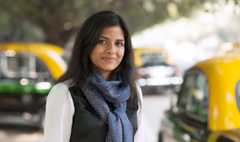
Neeti Kailas
Nestle Purina North AmericaUS
Kailas was a 2014 Young Laureate (science & health) of theRolex Awards for Enterprise for developing a non-invasive medical device to screen for hearing impairment in newborns.(Photo:Rolex Awards for Enterprise)
Kailas was a 2014 Young Laureate (science & health) of theRolex Awards for Enterprise for developing a non-invasive medical device to screen for hearing impairment in newborns.(Photo:Rolex Awards for Enterprise)

Gao Huijun
Harbin Institute of TechnologyChina
Thomson Reuters named Gao as one of themost influential scientific minds in 2014 for publishing many “hot papers” that year.(Photo:University of Auckland)
Thomson Reuters named Gao as one of themost influential scientific minds in 2014 for publishing many “hot papers” that year.(Photo:University of Auckland)
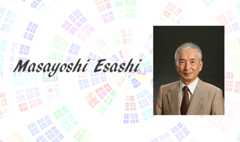
Masayoshi Esashi
Tohoku UniversityJapan
Esashi received the 2015 IEEE Andrew S. Grove Award for developing micro-electro mechanical systems (MEMS) used in transportation and industrial electronics.(Photo:Tohoku University)
Esashi received the 2015 IEEE Andrew S. Grove Award for developing micro-electro mechanical systems (MEMS) used in transportation and industrial electronics.(Photo:Tohoku University)

Ahn Byung Min
Ajou UniversitySouth Korea
Ahn won the 2015 Young Scientist Award from the Korea Institute of Metals and Materials for developing strong and lightweight structural metal-based nanomaterials.(Photo:Ajou University)
Ahn won the 2015 Young Scientist Award from the Korea Institute of Metals and Materials for developing strong and lightweight structural metal-based nanomaterials.(Photo:Ajou University)

Zong Chuanming
Peking UniversityChina
Zong was co-awarded the2015 Levi L. Conant Prize by the American Mathematical Society for his article, “Mysteries in Packing Regular Tetrahedra.”(Photo:American Mathematical Society)
Zong was co-awarded the2015 Levi L. Conant Prize by the American Mathematical Society for his article, “Mysteries in Packing Regular Tetrahedra.”(Photo:American Mathematical Society)
Yuan Yaxiang
Academy of Mathematics and Systems Science, Chinese Academy of Sciences (CAS)China
Yuan receivedThe World Academy of Sciences 2014 prize in mathematics for developing numerical methods for nonlinear optimization.(Photo:Yuan Yaxiang)
Yuan receivedThe World Academy of Sciences 2014 prize in mathematics for developing numerical methods for nonlinear optimization.(Photo:Yuan Yaxiang)
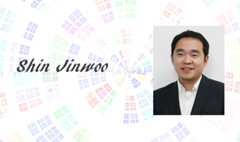
Shin Jinwoo
KAISTSouth Korea
Shin is the recipient of the 2015 ACM SIGMETRICS Rising Star Research Award for developing distributed, high-performance algorithms for stochastic queueing networks and graphical models.(Photo:KAIST)
Shin is the recipient of the 2015 ACM SIGMETRICS Rising Star Research Award for developing distributed, high-performance algorithms for stochastic queueing networks and graphical models.(Photo:KAIST)

Dang Thi Oanh
Thái Nguyên University of Information and Communications TechnologyVietnam
Dang won the2015 Elsevier Foundation Award for Early-Career Women Scientists in the Developing World for developing algorithms to solve problems that are normally too complicated for computers.(Photo:The Elsevier Foundation)
Dang won the2015 Elsevier Foundation Award for Early-Career Women Scientists in the Developing World for developing algorithms to solve problems that are normally too complicated for computers.(Photo:The Elsevier Foundation)

Shinichi Mochizuki
Kyoto UniversityJapan
In 2012, Mochizuki published a 500-page-long proof of the ABC conjecture. Two years later, he released a new report explaining his theory further, but fellow mathematicians remain baffled.(Photo:Kyoto University)
In 2012, Mochizuki published a 500-page-long proof of the ABC conjecture. Two years later, he released a new report explaining his theory further, but fellow mathematicians remain baffled.(Photo:Kyoto University)

Zhao Zhongxian
Institute of Physics, Chinese Academy of SciencesChina
Zhao won the2015 Bernd T. Matthias Prize for discovering new materials that demonstrated the limit of the transition temperature in bulk Fe-based superconductors.(Photo:Institute of Physics, Chinese Academy of Sciences)
Zhao won the2015 Bernd T. Matthias Prize for discovering new materials that demonstrated the limit of the transition temperature in bulk Fe-based superconductors.(Photo:Institute of Physics, Chinese Academy of Sciences)
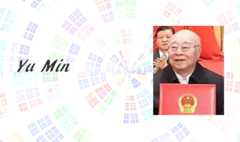
Yu Min
Chinese Academy of SciencesChina
Yu was given the 2014 National Highest Science and Technology Award, China’s top science award, for his research into hydrogen bombs.(Photo:Peking University)
Yu was given the 2014 National Highest Science and Technology Award, China’s top science award, for his research into hydrogen bombs.(Photo:Peking University)
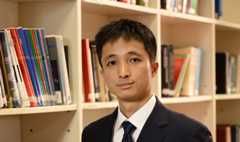
Yao Wang
University of Hong KongHong Kong
A recipient of the2014 Robert T. Poe Prize, Yao studies the physics of spin and valley pseudospin in two-dimensional transition metal dichalcogenides.(Photo:University of Hong Kong)
A recipient of the2014 Robert T. Poe Prize, Yao studies the physics of spin and valley pseudospin in two-dimensional transition metal dichalcogenides.(Photo:University of Hong Kong)
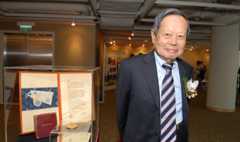
Yang Chen Ning
Tsinghua UniversityChina
Yang received a 2015 Marcel Grossman Award for deepening Einstein’s geometrical approach to physics in the best tradition of Paul Dirac and Hermann Weyl.(Photo:Chinese University of Hong Kong)
Yang received a 2015 Marcel Grossman Award for deepening Einstein’s geometrical approach to physics in the best tradition of Paul Dirac and Hermann Weyl.(Photo:Chinese University of Hong Kong)
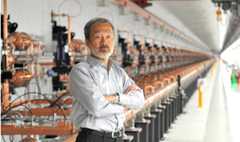
Tsumoru Shintake
Okinawa Institute of Science and TechnologyJapan
Shintake led the design, construction and operation of the SACLA X-ray free electron laser, a feat that won him the2014 Gersch Budker Prize. In 2015, he was awarded the Optics and Quantum Electronics Achievement Award (Takuma Award) from the Japan Society of Applied Physics.(Photo:Okinawa Institute of Science and Technology)
Shintake led the design, construction and operation of the SACLA X-ray free electron laser, a feat that won him the2014 Gersch Budker Prize. In 2015, he was awarded the Optics and Quantum Electronics Achievement Award (Takuma Award) from the Japan Society of Applied Physics.(Photo:Okinawa Institute of Science and Technology)

Hideo Ohno
Tohuku UniversityOhno won the 5th Compound Semiconductor Electronics Achievement Award 2015 (Isamu Akasaki Award) for his research into semiconductor spintronics.(Photo:Tohoku University)
Ohno won the 5th Compound Semiconductor Electronics Achievement Award 2015 (Isamu Akasaki Award) for his research into semiconductor spintronics.(Photo:Tohoku University)
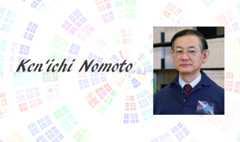
Ken’ichi Nomoto
Kavli Institute for the Physics and Mathematics of the UniverseJapan
Nomoto received a2015 Marcel Grossman Award for discovering the role of binary systems in the evolution of massive stars.(Photo:Kavli Institute for the Physics and Mathematics of the Universe)
Nomoto received a2015 Marcel Grossman Award for discovering the role of binary systems in the evolution of massive stars.(Photo:Kavli Institute for the Physics and Mathematics of the Universe)

Takaaki Kajita
University of TokyoJapan
Kajita is the co-recipient of the2015 Nobel Prize in Physics for discovering that neutrinos from the atmosphere switch between two identities as they make their way to Earth. His findings helped physicists explain why two-thirds of neutrinos go missing during experimental calculations. It also led to the far-reaching conclusion that neutrinos, which for a long time were considered massless, must have some mass, however small.(Photo:University of Tokyo)
Kajita is the co-recipient of the2015 Nobel Prize in Physics for discovering that neutrinos from the atmosphere switch between two identities as they make their way to Earth. His findings helped physicists explain why two-thirds of neutrinos go missing during experimental calculations. It also led to the far-reaching conclusion that neutrinos, which for a long time were considered massless, must have some mass, however small.(Photo:University of Tokyo)
Han Yilong
Hong Kong University of Science and TechnologyHong Kong
The International Organization of Chinese Physicists and Astronomers gave Han the2014 Robert T. Poe Prize for using colloids to solve three classical problems in crystal melting and glass transitions.(Photo:Hong Kong University of Science and Technology)
The International Organization of Chinese Physicists and Astronomers gave Han the2014 Robert T. Poe Prize for using colloids to solve three classical problems in crystal melting and glass transitions.(Photo:Hong Kong University of Science and Technology)
Chen Xianhui
University of Science and Technology of ChinaChina
Chen received the2015 Bernd T. Matthias Prize for discovering new materials for superconducting studies.(Photo:University of Science and Technology of China)
Chen received the2015 Bernd T. Matthias Prize for discovering new materials for superconducting studies.(Photo:University of Science and Technology of China)
Shuji Nakamura
University of California, Santa BarbaraJapan
Isamu Akasaki, Hiroshi Amano andShuji Nakamura shared the 2014 Nobel Prize in Physics “for the invention of efficient blue light-emitting diodes which has enabled bright and energy-saving light sources.”(Photo:Shuji Nakamura)
Isamu Akasaki, Hiroshi Amano andShuji Nakamura shared the 2014 Nobel Prize in Physics “for the invention of efficient blue light-emitting diodes which has enabled bright and energy-saving light sources.”(Photo:Shuji Nakamura)
Hiroshi Amano
Nagoya UniversityJapan
Isamu Akasaki, Hiroshi Amano andShuji Nakamura shared the 2014 Nobel Prize in Physics “for the invention of efficient blue light-emitting diodes which has enabled bright and energy-saving light sources.”(Photo:Nagoya University)
Isamu Akasaki, Hiroshi Amano andShuji Nakamura shared the 2014 Nobel Prize in Physics “for the invention of efficient blue light-emitting diodes which has enabled bright and energy-saving light sources.”(Photo:Nagoya University)
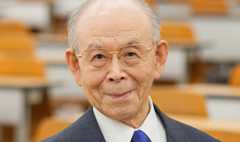
Isamu Akasaki
Nagoya UniversityJapan
Isamu Akasaki, Hiroshi Amano andShuji Nakamura shared the 2014 Nobel Prize in Physics “for the invention of efficient blue light-emitting diodes which has enabled bright and energy-saving light sources.”(Photo:National Academy of Engineering)
Isamu Akasaki, Hiroshi Amano andShuji Nakamura shared the 2014 Nobel Prize in Physics “for the invention of efficient blue light-emitting diodes which has enabled bright and energy-saving light sources.”(Photo:National Academy of Engineering)
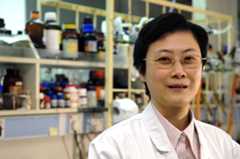
Vivian Yam
University of Hong KongHong Kong
Yam won theLudwig Mond Award 2015 from the Royal Society of Chemistry for her work in inorganic and organometallic chemistry. In the same year, she was also elected as a foreign member of theAcademia Europaea, an international, non-governmental association of individual scientists and scholars from all disciplines.(Photo:University of Hong Kong)
Yam won theLudwig Mond Award 2015 from the Royal Society of Chemistry for her work in inorganic and organometallic chemistry. In the same year, she was also elected as a foreign member of theAcademia Europaea, an international, non-governmental association of individual scientists and scholars from all disciplines.(Photo:University of Hong Kong)
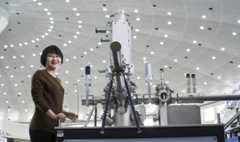
Xie Yi
University of Science and Technology of ChinaChina
Xie was honored with aL’Oréal-UNESCO For Women in Science Award in 2015 for creating new nanomaterials with promising applications in the conversion of heat or sunlight into electricity.(Photo:L'Oréal)
Xie was honored with aL’Oréal-UNESCO For Women in Science Award in 2015 for creating new nanomaterials with promising applications in the conversion of heat or sunlight into electricity.(Photo:L'Oréal)
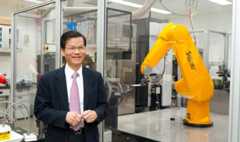
Wong Chi-Huey
Academia SinicaTaiwan
Wong, the president of Taiwan’s Academia Sinica received theRobert Robinson Award 2015 from the Royal Society of Chemistry for his lifetime contributions to organic chemistry.(Photo:Academia Sinica)
Wong, the president of Taiwan’s Academia Sinica received theRobert Robinson Award 2015 from the Royal Society of Chemistry for his lifetime contributions to organic chemistry.(Photo:Academia Sinica)
Jiro Tsuji
Tokyo Institute of TechnologyJapan
Tsuji’s co-discovery of transition metal-catalyzed transformations, widely used in several important industrial processes, won him the 2014 Tetrahedron Prize.(Photo:Elsevier)
Tsuji’s co-discovery of transition metal-catalyzed transformations, widely used in several important industrial processes, won him the 2014 Tetrahedron Prize.(Photo:Elsevier)

You Shuli
Shanghai Institute of Organic ChemistryChina
You received the Royal Society of Chemistry Merck Award 2015 for the development of catalytic asymmetric dearomatization reactions, opening elegant access routes to complex molecular architectures.(Photo:Foreign & Commonwealth Office UK)
You received the Royal Society of Chemistry Merck Award 2015 for the development of catalytic asymmetric dearomatization reactions, opening elegant access routes to complex molecular architectures.(Photo:Foreign & Commonwealth Office UK)
Peng Shie-Ming
National Taiwan UniversityTaiwan
Peng won theLuigi Tartufari International Prize in Chemistry in 2014 for the synthesis and structure of transition metal complexes.(Photo:Academia Sinica)
Peng won theLuigi Tartufari International Prize in Chemistry in 2014 for the synthesis and structure of transition metal complexes.(Photo:Academia Sinica)
Seo Myungeun
KAISTSouth Korea
Seo, an Ewon assistant professor at KAIST, won the 2015 Wiley-PSK JPS Young Scientist Award for synthesizing novel triarylamine monomers.(Photo:KAIST)
Seo, an Ewon assistant professor at KAIST, won the 2015 Wiley-PSK JPS Young Scientist Award for synthesizing novel triarylamine monomers.(Photo:KAIST)
Max Lu
University of Queensland, AustraliaChina
The Chemical Society of Japan gave Lu theColloid and Surface Chemistry Lectureship Award 2015 for developing advanced materials in the areas of clean energy, the environment and healthcare.(Photo:University of Surrey)
The Chemical Society of Japan gave Lu theColloid and Surface Chemistry Lectureship Award 2015 for developing advanced materials in the areas of clean energy, the environment and healthcare.(Photo:University of Surrey)
Masako Yudasaka
National Institute of Advanced Industrial Science and Technology (AIST)Japan
Sumio Iijima, Akira Koshio and Masako Yudasaka shared the European Inventor Award 2015 in the non-European countries category for their ground-breaking discovery of carbon nanotubes and for developing a sustainable process to produce them.(Photo:AIST)
Sumio Iijima, Akira Koshio and Masako Yudasaka shared the European Inventor Award 2015 in the non-European countries category for their ground-breaking discovery of carbon nanotubes and for developing a sustainable process to produce them.(Photo:AIST)
Akira Koshio
Mie UniversityJapan
Sumio Iijima, Akira Koshio and Masako Yudasaka shared the European Inventor Award 2015 in the non-European countries category for their ground-breaking discovery of carbon nanotubes and for developing a sustainable process to produce them.(Photo: EPO)
Sumio Iijima, Akira Koshio and Masako Yudasaka shared the European Inventor Award 2015 in the non-European countries category for their ground-breaking discovery of carbon nanotubes and for developing a sustainable process to produce them.(Photo: EPO)
Sumio Iijima
Meijo University/AISTJapan
Sumio Iijima, Akira Koshio and Masako Yudasaka shared the European Inventor Award 2015 in the non-European countries category for their ground-breaking discovery of carbon nanotubes and for developing a sustainable process to produce them.(Photo:Sumio Iijima)
Sumio Iijima, Akira Koshio and Masako Yudasaka shared the European Inventor Award 2015 in the non-European countries category for their ground-breaking discovery of carbon nanotubes and for developing a sustainable process to produce them.(Photo:Sumio Iijima)

Itaru Hamachi
Kyoto UniversityJapan
Hamachi won theNagoya Medal of Organic Chemistry in 2014 (silver medal) for his research into live-cell organic chemistry and supramolecular biomaterials.(Photo:Institute of Transformative Bio-Molecules, Nagoya University)
Hamachi won theNagoya Medal of Organic Chemistry in 2014 (silver medal) for his research into live-cell organic chemistry and supramolecular biomaterials.(Photo:Institute of Transformative Bio-Molecules, Nagoya University)

Srivari Chandrasekhar
CSIR-Indian Institute of Chemical Technology (IICT)India
Chandrasekhar won the Infosys Prize 2014 in Physical Sciences for his research into the synthesis of complex molecules from natural sources and was appointed director of the CSIR-Indian Institute of Chemical Technology (IICT) in 2015.(Photo:Infosys Science Foundation)
Chandrasekhar won the Infosys Prize 2014 in Physical Sciences for his research into the synthesis of complex molecules from natural sources and was appointed director of the CSIR-Indian Institute of Chemical Technology (IICT) in 2015.(Photo:Infosys Science Foundation)

Yang Yuanqing
Lenovo GroupChina
Yang, chairman and CEO of Lenovo Group, received the Edison Achievement Award 2014 for helping to grow the PC manufacturer into a global technology leader.(Photo: Natalie Behring,World Economic Forum)
Yang, chairman and CEO of Lenovo Group, received the Edison Achievement Award 2014 for helping to grow the PC manufacturer into a global technology leader.(Photo: Natalie Behring,World Economic Forum)
Kiran Mazumdar-Shaw
Biocon LtdIndia
Mazumdar-Shaw won the Kiel Institute’s2014 Global Economy Prize for Business for growingBiocon into one of India’s largest biopharmaceutical companies.(Photo:Biocon)
Mazumdar-Shaw won the Kiel Institute’s2014 Global Economy Prize for Business for growingBiocon into one of India’s largest biopharmaceutical companies.(Photo:Biocon)
Olivia Lum
Hyflux LtdSingapore
Hyflux’s founder had a good run in 2014, winning Frost & Sullivan’s Asia Pacific Water Technology Company of the Year Award and Global Water Intelligence UK’s Desalination Plant of the Year for its Tuaspring seawater reverse osmosis plant in Singapore.(Photo:Yale-NUS College)
Hyflux’s founder had a good run in 2014, winning Frost & Sullivan’s Asia Pacific Water Technology Company of the Year Award and Global Water Intelligence UK’s Desalination Plant of the Year for its Tuaspring seawater reverse osmosis plant in Singapore.(Photo:Yale-NUS College)
Zhang Feng
Massachusetts Institute of TechnologyUS
A pioneer in the sizzling new field of genome editing,Zhang has developed accurate and specific genome editing technology for application in eukaryotic cells—including human cells—from natural microbialCRISPR systems.Awards have come aplenty, with the 2015 Robertson Stem Cell Prize, Cell’s “40 under 40” in 2014, andMIT Technology Review’s 10 Breakthrough Technologies in 2014. Before CRISPR, Zhang was also widely recognized for developing another breakthrough technology calledoptogenetics, in which neuronal activity can be controlled with light.(Photo: Len Rubenstein/Broad Institute Communications)
A pioneer in the sizzling new field of genome editing,Zhang has developed accurate and specific genome editing technology for application in eukaryotic cells—including human cells—from natural microbialCRISPR systems.Awards have come aplenty, with the 2015 Robertson Stem Cell Prize, Cell’s “40 under 40” in 2014, andMIT Technology Review’s 10 Breakthrough Technologies in 2014. Before CRISPR, Zhang was also widely recognized for developing another breakthrough technology calledoptogenetics, in which neuronal activity can be controlled with light.(Photo: Len Rubenstein/Broad Institute Communications)
Tu Youyou
China Academy of Traditional Chinese MedicineChina
Tu, a traditional Chinese medicine expert, received one half of the 2015 Nobel Prize in Physiology or Medicine for developing an anti-malarial drug,artemisinin, based on ancient herbal medicine. Tu is the first Chinese woman to win a Nobel Prize in Physiology or Medicine. Artemisinin rapidly kills malaria parasites at an early stage of their development, which explains its unprecedented potency in the treatment of severe malaria. When used in combination therapy, artemisinin is estimated to reduce mortality from malaria by more than 20 percent overall and by more than 30 percent in children.(Photo:China Academy of Traditional Chinese Medicine)
Tu, a traditional Chinese medicine expert, received one half of the 2015 Nobel Prize in Physiology or Medicine for developing an anti-malarial drug,artemisinin, based on ancient herbal medicine. Tu is the first Chinese woman to win a Nobel Prize in Physiology or Medicine. Artemisinin rapidly kills malaria parasites at an early stage of their development, which explains its unprecedented potency in the treatment of severe malaria. When used in combination therapy, artemisinin is estimated to reduce mortality from malaria by more than 20 percent overall and by more than 30 percent in children.(Photo:China Academy of Traditional Chinese Medicine)
Shubha Tole
Tata Institute of Fundamental Research (TIFR)India
Tole was awarded the Infosys Prize 2014 in Life Sciences for her work on the mammalian nervous system, which revealed genetic mechanisms critical to the formation of the cerebral cortex, hippocampus and amygdala.(Photo:TIFR)
Tole was awarded the Infosys Prize 2014 in Life Sciences for her work on the mammalian nervous system, which revealed genetic mechanisms critical to the formation of the cerebral cortex, hippocampus and amygdala.(Photo:TIFR)
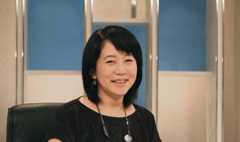
Masayo Takahashi
RIKEN Center for Developmental BiologyJapan
Takahashi was placed onNature magazine’s “Nature’s 10 2014” for carrying out thefirst-ever induced pluripotent stem cell clinical study for the treatment of age-related macular degeneration. Since the surgery in 2014, the patient hasshown no tumor formation, Takahashi’s team says.(Photo:RIKEN)
Takahashi was placed onNature magazine’s “Nature’s 10 2014” for carrying out thefirst-ever induced pluripotent stem cell clinical study for the treatment of age-related macular degeneration. Since the surgery in 2014, the patient hasshown no tumor formation, Takahashi’s team says.(Photo:RIKEN)
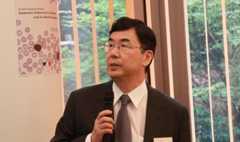
Shimon Sakaguchi
Osaka UniversityJapan
For his discovery and characterization of regulatory T cells in autoimmune diseases and cancer, Sagakuchi received the Canada Gairdner International Award 2015.(Photo:Immunology Frontier Research Center, Osaka University)
For his discovery and characterization of regulatory T cells in autoimmune diseases and cancer, Sagakuchi received the Canada Gairdner International Award 2015.(Photo:Immunology Frontier Research Center, Osaka University)
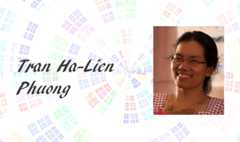
Tran Ha-Lien Phuong
Vietnam National UniversityVietnam
A2015 L’Oréal-UNESCO Women in Science International Rising Talent, Phuong develops fucoidan-based polymeric micelles for cancer treatment and diagnosis.(Photo:Vietnam National University Ho Chi Minh City)
A2015 L’Oréal-UNESCO Women in Science International Rising Talent, Phuong develops fucoidan-based polymeric micelles for cancer treatment and diagnosis.(Photo:Vietnam National University Ho Chi Minh City)

Satoshi Omura
Kitasato UniversityOmura, professor emeritus at Kitasato University, shared one-half of the 2015 Nobel Prize in Medicine for his discovery of an anti-roundworm parasite drug, avermectin. Ivermectin, which is a newer derivative of avermectin, has radically lowered the incidence of river blindness and lymphatic filariasis, among other parasitic diseases.(Photo:Satoshi Omura)
Omura, professor emeritus at Kitasato University, shared one-half of the 2015 Nobel Prize in Medicine for his discovery of an anti-roundworm parasite drug, avermectin. Ivermectin, which is a newer derivative of avermectin, has radically lowered the incidence of river blindness and lymphatic filariasis, among other parasitic diseases.(Photo:Satoshi Omura)
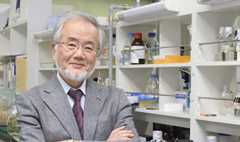
Yoshinori Ohsumi
Tokyo Institute of TechnologyIn 2015, Ohsumi received both the Canada Gairdner International Award and the Keio Medical Science Prize for his pioneering research into autophagy and its role in diseases such as neurodegeneration, cancer and infection.(Photo:Tokyo Institute of Technology)
In 2015, Ohsumi received both the Canada Gairdner International Award and the Keio Medical Science Prize for his pioneering research into autophagy and its role in diseases such as neurodegeneration, cancer and infection.(Photo:Tokyo Institute of Technology)

Irene Ng Oi Lin
University of Hong KongHong Kong
Ng receivedThe World Academy of Sciences 2014 prize in medical sciences for her research into liver cancer.(Photo:Croucher Foundation)
Ng receivedThe World Academy of Sciences 2014 prize in medical sciences for her research into liver cancer.(Photo:Croucher Foundation)
Shigekazu Nagata
Osaka UniversityJapan
In 2015, Nagata was elected as foreign associate of the US National Academy of Sciences for helping to understand the role of apoptosis and phagocytosis in autoimmune diseases.(Photo:Immunology Frontier Research Center, Osaka University)
In 2015, Nagata was elected as foreign associate of the US National Academy of Sciences for helping to understand the role of apoptosis and phagocytosis in autoimmune diseases.(Photo:Immunology Frontier Research Center, Osaka University)

Kazutoshi Mori
Kyoto UniversityJapan
Mori won the 2014 Shaw Prize in Life Sciences and Medicine—“Asia’s Nobel Prize”—and the 2014 Lasker Basic Medical Research Award— “America’s Nobel Prize”—for his work on the unfolded protein response, a quality control system which prevents the accumulation of misfolded proteins in the cell.(Photo:Mori Research Laboratory)
Mori won the 2014 Shaw Prize in Life Sciences and Medicine—“Asia’s Nobel Prize”—and the 2014 Lasker Basic Medical Research Award— “America’s Nobel Prize”—for his work on the unfolded protein response, a quality control system which prevents the accumulation of misfolded proteins in the cell.(Photo:Mori Research Laboratory)

Satyajit Mayor
National Centre for Biological Sciences (NCBS)India
Mayor, director of India’sNational Centre for Biological Sciences (NCBS) was elected as foreign associate of the US National Academy of Sciences in 2015 for his work on the molecular mechanisms of endocytosis in metazoan cells.(Photo:Infosys Science Foundation)
Mayor, director of India’sNational Centre for Biological Sciences (NCBS) was elected as foreign associate of the US National Academy of Sciences in 2015 for his work on the molecular mechanisms of endocytosis in metazoan cells.(Photo:Infosys Science Foundation)
Lee Jeong Ho
KAISTSouth Korea
Lee’s research into intractable epilepsy won him acclaim with the 2015 Pediatric Epilepsies Research Award from the non-governmental organization Citizens United for Research in Epilepsy (CURE).(Photo:Korea Advanced Institute of Science and Technology)
Lee’s research into intractable epilepsy won him acclaim with the 2015 Pediatric Epilepsies Research Award from the non-governmental organization Citizens United for Research in Epilepsy (CURE).(Photo:Korea Advanced Institute of Science and Technology)
Hiroshi Kimura
Tokyo Institute of TechnologyKimura won theRobert Feulgen Prize 2015 for developing novel methods to measure the dynamics of post-translational modifications in endogenous proteinsin vivo.(Photo:Tokyo Institute of Technology)
Kimura won theRobert Feulgen Prize 2015 for developing novel methods to measure the dynamics of post-translational modifications in endogenous proteinsin vivo.(Photo:Tokyo Institute of Technology)
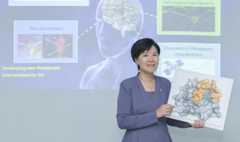
Nancy Ip
Hong Kong University of Science and Technology (HKUST)In 2015,Ip was elected as foreign associate of the US National Academy of Sciences. An academician of the Chinese Academy of Sciences and the dean of science at Hong Kong University of Science and Technology (HKUST), Ip has furthered our understanding into brain development and synaptic plasticity, and dysregulation in neurological disorders such as Alzheimer’s and Parkinson’s diseases. Awards include the National Natural Science Awards, China’s highest honor in the natural sciences, and the L’Oréal-UNESCO for Women in Science Award.(Photo: Nancy Ip/HKUST)
In 2015,Ip was elected as foreign associate of the US National Academy of Sciences. An academician of the Chinese Academy of Sciences and the dean of science at Hong Kong University of Science and Technology (HKUST), Ip has furthered our understanding into brain development and synaptic plasticity, and dysregulation in neurological disorders such as Alzheimer’s and Parkinson’s diseases. Awards include the National Natural Science Awards, China’s highest honor in the natural sciences, and the L’Oréal-UNESCO for Women in Science Award.(Photo: Nancy Ip/HKUST)

Tasuku Honjo
Kyoto UniversityJapan
Honjo was awarded theinaugural Tang Prize in Biopharmaceutical Sciences in 2014 for discovering CTLA-4 and PD-1—immune inhibitory molecules with applications in cancer immunotherapy.(Photo: Tang Prize Foundation)
Honjo was awarded theinaugural Tang Prize in Biopharmaceutical Sciences in 2014 for discovering CTLA-4 and PD-1—immune inhibitory molecules with applications in cancer immunotherapy.(Photo: Tang Prize Foundation)

Hiroshi Hamada
Osaka UniversityJapan
Hamada won the2014 Keio Medical Science Prize for his 1996 discovery of a gene calledLefty that determines the differences between left and right.(Photo:Osaka University)
Hamada won the2014 Keio Medical Science Prize for his 1996 discovery of a gene calledLefty that determines the differences between left and right.(Photo:Osaka University)

Akira Endo
Tokyo University of Agriculture and TechnologyJapan
Endo won the Prince Mahidol Prize 2014 in the medicine category for discovering the first statin (compactin), a major milestone in the prevention and treatment of coronary heart disease.(Photo:Prince Mahidol Award Foundation)
Endo won the Prince Mahidol Prize 2014 in the medicine category for discovering the first statin (compactin), a major milestone in the prevention and treatment of coronary heart disease.(Photo:Prince Mahidol Award Foundation)
Chang Tse Wen
Academia SinicaTaiwan
Chang receivedThe World Academy of Sciences 2014 prize in medical sciences for developing treatments for asthma.(Photo: Chinese University of Hong Kong)
Chang receivedThe World Academy of Sciences 2014 prize in medical sciences for developing treatments for asthma.(Photo: Chinese University of Hong Kong)
Chan Yoke-Fun
University of MalayaMalaysia
Chan received a 2015 L’Oréal-UNESCO for Women in Science fellowship for developing therapeutic peptides that target enterovirus A71 in hand, foot and mouth disease.(Photo: Chan Yoke-Fun)
Chan received a 2015 L’Oréal-UNESCO for Women in Science fellowship for developing therapeutic peptides that target enterovirus A71 in hand, foot and mouth disease.(Photo: Chan Yoke-Fun)
Takuo Aoyagi
Nihon Kohden CorporationJapan
Aoyagi received the 2015 IEEE Medal for Innovations in Healthcare Technology for his research into pulse oximetry.(Photo:Engineering and Technology History Wiki)
Aoyagi received the 2015 IEEE Medal for Innovations in Healthcare Technology for his research into pulse oximetry.(Photo:Engineering and Technology History Wiki)

Khadg Singh Valdiya
Jawaharlal Nehru Centre for Advanced Scientific Research (JNCASR)India
Valdiya received the Padma Bhushan Award 2015, the third highest civilian award in India, for his research into the geodynamics of the Kumaon Himalayas.(Photo:Wikipedia)
Valdiya received the Padma Bhushan Award 2015, the third highest civilian award in India, for his research into the geodynamics of the Kumaon Himalayas.(Photo:Wikipedia)

Gavino Cajulao Trono Jr.
University of the Philippines Marine Science InstitutePhilippines
Trono was conferred the honor of National Scientist of the Philippines in 2014 for his research into tropical marine phycology with a focus on seaweed biodiversity.(Photo: Presidential Communications Operations Office, the Philippines)
Trono was conferred the honor of National Scientist of the Philippines in 2014 for his research into tropical marine phycology with a focus on seaweed biodiversity.(Photo: Presidential Communications Operations Office, the Philippines)

Yutaka Takahasi
University of TokyoJapan
Takahasi won the 2015 Japan Prize for his research into river basin management and water-related disasters.(Photo: The Japan Prize Foundation)
Takahasi won the 2015 Japan Prize for his research into river basin management and water-related disasters.(Photo: The Japan Prize Foundation)

Alfredo Mahar Lagmay
University of the Philippines Diliman, National Institute of Geological SciencesPhilippines
Lagmay, a professor at the National Institute of Geological Sciences, University of the Philippines Diliman, received the 2015 Plinius Medal from the European Geosciences Union for his research into natural hazards and disasters in the Philippines, in particular volcanic hazards, earthquakes, typhoons, landslides and floods. He is also executive director of the Department of Science and Technology Nationwide Operational Assessment of Hazards (NOAH), a flagship program for disaster risk reduction and management in the Philippines.(Photo: University of Philippines Diliman)
Lagmay, a professor at the National Institute of Geological Sciences, University of the Philippines Diliman, received the 2015 Plinius Medal from the European Geosciences Union for his research into natural hazards and disasters in the Philippines, in particular volcanic hazards, earthquakes, typhoons, landslides and floods. He is also executive director of the Department of Science and Technology Nationwide Operational Assessment of Hazards (NOAH), a flagship program for disaster risk reduction and management in the Philippines.(Photo: University of Philippines Diliman)

Edgardo D. Gomez
University of the Philippines Marine Science InstitutePhilippines
Gomez led the world’s first national-scale assessment of damage to coral reefs, work which led to him being conferred the title of National Scientist of the Philippines in 2014.(Photo: Gil Jacinto/University of the Philippines, Marine Science Institute)
Gomez led the world’s first national-scale assessment of damage to coral reefs, work which led to him being conferred the title of National Scientist of the Philippines in 2014.(Photo: Gil Jacinto/University of the Philippines, Marine Science Institute)
Chung Sun-Lin
Academia SinicaTaiwan
Chung wonThe World Academy of Sciences 2014 prize in earth sciences for his research into continental tectonics and magma generation.(Photo: TWAS/Flickr/CC)
Chung wonThe World Academy of Sciences 2014 prize in earth sciences for his research into continental tectonics and magma generation.(Photo: TWAS/Flickr/CC)

Angel C. Alcala
Silliman UniversityPhilippines
Alcala was named a National Scientist of the Philippines in 2014 for his research into Philippine amphibians and reptiles, as well as the conservation of marine-protected areas.(Photo: Silliman University)
Alcala was named a National Scientist of the Philippines in 2014 for his research into Philippine amphibians and reptiles, as well as the conservation of marine-protected areas.(Photo: Silliman University)
Zhang Fusuo
China Agricultural UniversityChina
Zhang receivedThe World Academy of Sciences 2014 prize in the agricultural sciences for establishing the principle and technology of integrated nutrient management in China.(Photo: Institute of Hydrobiology, Chinese Academy of Sciences)
Zhang receivedThe World Academy of Sciences 2014 prize in the agricultural sciences for establishing the principle and technology of integrated nutrient management in China.(Photo: Institute of Hydrobiology, Chinese Academy of Sciences)
Li Jiayang
Chinese Academy of Agricultural SciencesChina
Li was elected a foreign member of the UK’s Royal Society in 2015 for establishing forward genetics approaches in rice, which have led to the development of improved rice varieties.(Photo: Australian Society for Biochemistry and Molecular Biology)
Li was elected a foreign member of the UK’s Royal Society in 2015 for establishing forward genetics approaches in rice, which have led to the development of improved rice varieties.(Photo: Australian Society for Biochemistry and Molecular Biology)
C. L. Laxmipathi Gowda
International Crops Research Institute for the Semi-Arid Tropics (ICRISAT)India
Gowda, deputy director-general of the International Crops Research Institute for the Semi-Arid Tropics (ICRISAT), received the 2014 Sano Touzaburo Special Prize—“Asia’s World Food Prize”—for developing chickpea cultivars with high yield and resistance to diseases and pests.(Photo:ICRISAT)
Gowda, deputy director-general of the International Crops Research Institute for the Semi-Arid Tropics (ICRISAT), received the 2014 Sano Touzaburo Special Prize—“Asia’s World Food Prize”—for developing chickpea cultivars with high yield and resistance to diseases and pests.(Photo:ICRISAT)
Ramon Cabanos Barba
University of the Philippines Los BanosPhilippines
Barba was named a National Scientist of the Philippines in 2014 for inventing a way to induce flowering in mango trees regardless of season, boosting the local mango industry.(Photo: World Intellectual Property Office/Flickr/CC)
Barba was named a National Scientist of the Philippines in 2014 for inventing a way to induce flowering in mango trees regardless of season, boosting the local mango industry.(Photo: World Intellectual Property Office/Flickr/CC)
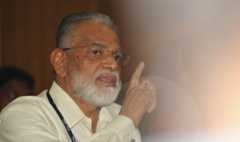
K. Radhakrishnan
Indian Space Research Organisation (ISRO)India
Radhakrishnan is the recently retired chairman of theIndian Space Research Organisation (ISRO). He spearheaded India’s Mangalyaan mission, the first Asian space probe to successfully orbit Mars. Radhakrishnan was named byNature magazine as one of theten people who mattered in 2014. That year, he also received the Padma Bhushan award, India’s third highest civilian award. He is chairman of the Indian Institutes of Engineering Science and Technology and the Indian Institute of Space Science and Technology.(Photo: K. Radhakrishnan/LinkedIn)
Radhakrishnan is the recently retired chairman of theIndian Space Research Organisation (ISRO). He spearheaded India’s Mangalyaan mission, the first Asian space probe to successfully orbit Mars. Radhakrishnan was named byNature magazine as one of theten people who mattered in 2014. That year, he also received the Padma Bhushan award, India’s third highest civilian award. He is chairman of the Indian Institutes of Engineering Science and Technology and the Indian Institute of Space Science and Technology.(Photo: K. Radhakrishnan/LinkedIn)
P. C. Agrawal
Tata Institute of Fundamental Research (TIFR)India
Agrawal was one of the lead scientists involved in thelaunch of India’s first astronomy satellite,Astrosat, on September 28, 2015.(Photo:Tata Institute of Fundamental Research)
Agrawal was one of the lead scientists involved in thelaunch of India’s first astronomy satellite,Astrosat, on September 28, 2015.(Photo:Tata Institute of Fundamental Research)