Look Inside Judy Garland's Rustic Home in Bel Air

This article originally appeared in the April 1992 issue of Architectural Digest.
Maria Callas, who knew about such things, said that the lady had the most superb voice she had ever heard. Bing Crosby, who was also something of an expert, said that when she was in form, no other singer could be compared to her. But Judy Garland was more than a singer, more than an actress, more than a movie star: She was probably the greatest American entertainer of the twentieth century.
She had an early start, and she could scarcely remember a time when she was not on stage. Her parents were both professional performers. Frank Gumm had been singing since he was a boy in Tennessee, and his wife, Ethel, had been playing the piano since she was a girl in Michigan. After they married in 1914 and settled down in Grand Rapids, Minnesota, they continued to perform at Frank's movie house, providing a live addition to the silent films.


As their three daughters came along, they were also inducted, one by one, into the act. Judy, born Frances, who was the youngest, made her debut at Christmastime 1924. She was just two and a half when she belted out the words to “Jingle Bells”— over and over again—until her father finally pulled her off the stage. The applause thrilled her, and she was hooked on it for life. There is nothing so exciting, she would later say, as the sound of clapping hands.
In 1926 the family moved West. Frank and Ethel had hoped to buy a movie house in Los Angeles, but they had to settle for one in Lancaster, two and a half hours away in the Mojave Desert. By the late 1920s the Gumm sisters had become an act, and Ethel, a tirelessly ambitious stage mother, toured with them throughout the West and as far east as Chicago, where they sang at the World's Fair in 1934. According to Garland, the theater in which they were performing had inadvertently spotlighted them as “the Glum Sisters,” and comedian George Jessel, who was on the same bill, suggested that they drop Gumm —which, he quipped, rhymed with words like crumb and dumb—in favor of Garland. Little Frances came up with Judy on her own. From then on she was Judy Garland.
Like a thousand other stage mothers, Ethel Gumm had been pounding on studio doors for years. At last, in September 1935, her efforts paid off when Judy, who was the real star of the Garland trio, signed a contract with MGM. Judy had everything she —or, at least, her mother—wanted, but happiness crumbled just a few weeks later when her father, whom she worshiped, died suddenly of spinal meningitis. It was a tragedy that shadowed the rest of her life.
Though MGM knew that it had acquired an unusual talent, it had no idea what to do with a chubby thirteen-year-old with a grown-up voice. In fact, Garland did her first feature film,Pigskin Parade (1936), on loan to Twentieth Century-Fox. MGM never loaned her out again, and during the next couple of years she was given increasingly important roles in such pictures asThoroughbreds Don't Cry (1937)—the first of the many films she made with Mickey Rooney—Everybody Sing (1938) andListen, Darling (1938). The picture that made her a star, of course, wasThe Wizard of Oz (1939). To millions all over the world she will be remembered forever as the lovable Dorothy, wistfully searching for happiness somewhere over the rainbow. A 1939 special Oscar honored her for her “outstanding performance as a screen juvenile.”
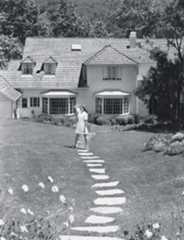
It was during the making of the picture that Garland and her mother planned their new house on one of Bel Air's most bucolic streets. Though she was still a teenager, Garland was deeply involved in the project, and she probably provided much of its inspiration. During the years in Lancaster her mother had forced her to spend much of her time on the road, going from audition to audition, job to job; later, in Los Angeles, there had been a series of apartments and rented houses. The house in Bel Air was to be the first permanent home she had had since leaving Minnesota twelve years earlier.
It was thus not just a house but a romantic vision of what home was meant to be. And like the studio art directors of the thirties and forties, Garland identified that platonic ideal not with the sun-drenched houses she saw around her in California but rather with the Christmas-card images of New England, where, as everyone who had ever been to the movies knew, there was always snow on the ground for the holidays and, inside, happy families drank hot chocolate around a fire. The Bel Air house, with its warm brick exterior, its covered front porch, its rustic shingles and its understated dormers, almost looked as if it had been transported from Connecticut.
The interior was decorated by Mabel Cooper, the mother of another famous child star, Jackie Cooper, and it was everything a teenage girl could want. Garland had her own suite on the second floor, with a private bath, a dressing room and a spacious bedroom. It was there that she often entertained her friends, boys as well as girls, listening to records and talking about the studio—they were, after all, all movie kids.
Ironically, Garland's new home was no more permanent than any other she had lived in. On June 15, 1941, her mother set up yellow beach umbrellas on the back lawn, and before six hundred guests she announced Garland's engagement to composer David Rose, the first of her five husbands. Bride and groom soon found a residence of their own.
The rest of the Garland story is one of great success and great failure. She went on to make some of the most glorious musicals in film history, fromMeet Me in St. Louis (1944), directed by her second husband, Vincente Minnelli, andEaster Parade (1948) toA Star Is Born (1954), for which she was nominated for Best Actress. (She also received a Best Supporting Actress nomination for her performance in 1961'sJudgment at Nuremberg.) But she was plagued by emotional problems and an addiction to prescription pills, and her failure to report to work caused MGM to fire her in 1950. A year later she emerged into bright sunlight with a sensational concert at the Palladium in London. Such ups and downs continued until her death in London on June 22,1969, the result of an accidental overdose of drugs. She had just turned forty-seven.
To millions she will be remembered as Dorothy, searching for happiness over the rainbow.
Related:See More Celebrity Homes inAD


