Download the free Kindle app and start reading Kindle books instantly on your smartphone, tablet, or computer -no Kindle device required.
Read instantly on your browser with Kindle for Web.
Using your mobile phone camera - scan the code below and download the Kindle app.



Follow the author
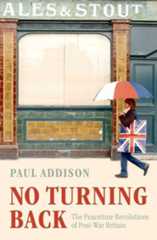
No Turning Back: The Peaceful Revolutions of Post-War Britain 1st Edition
- ISBN-100192192671
- ISBN-13978-0192192677
- Edition1st
- PublisherOxford University Press
- Publication dateAugust 15, 2010
- LanguageEnglish
- Dimensions9.46 x 1.14 x 6.44 inches
- Print length464 pages

Discover the latest buzz-worthy books, from mysteries and romance to humor and nonfiction.Explore more
Frequently purchased items with fast delivery



Editorial Reviews
Book Description
About the Author
Product details
- Publisher : Oxford University Press
- Publication date : August 15, 2010
- Edition : 1st
- Language : English
- Print length : 464 pages
- ISBN-10 : 0192192671
- ISBN-13 : 978-0192192677
- Item Weight : 1.85 pounds
- Dimensions : 9.46 x 1.14 x 6.44 inches
- Best Sellers Rank: #11,636,312 in Books (See Top 100 in Books)
- #16,411 inEuropean History (Books)
- #36,439 inGreat Britain History (Books)
- #58,934 inHistorical Study (Books)
- Customer Reviews:
About the author

Discover more of the author’s books, see similar authors, read book recommendations and more.
Customer reviews
Customer Reviews, including Product Star Ratings help customers to learn more about the product and decide whether it is the right product for them.
To calculate the overall star rating and percentage breakdown by star, we don’t use a simple average. Instead, our system considers things like how recent a review is and if the reviewer bought the item on Amazon. It also analyzed reviews to verify trustworthiness.
Learn more how customers reviews work on Amazon

Top reviews from other countries
- WALSHYReviewed in the United Kingdom on August 27, 2010
5.0 out of 5 stars'No Turning Back; Paul Addison
Format: HardcoverVerified PurchaseThis is a book, like its forerunners, long in gestation. Professor Addison's first work on wartime social policy - 'The Road to 1945' - was published back in 1975. The second instalment, 'Now the War is Over', covering the life and times of the Attlee government, came out in 1985 - a year where Margaret Thatcher was pondering a new system of local government finance, Osama Bin Laden was fighting the Red Army with weapons courtesy of the CIA, an obscure Labour back bencher called Tony Blair had just managed to succeed to a lowly shadow junior ministerial post and the internet was something used solely by the US Department of Defence and scientific institutions like CERN.
However, it is worth waiting for. True, of recent years there have been somewhat of a boom in books covering the history of the UK between 1950 and the 1980's but these all seem to have been angled by their authors in particular ways. Dominic Sandbrook relies much on the hidden aspects of social history, Peter Hennessy confines himself solely to the making of government policy in the small geographical axis between Victoria Street, Parliament Square and Whitehall whilst David Kynaston uses the letters and diaries of people living in unfashionable northern towns and prosaic London suburbs as a foil against which the grand sweep of unfolding events can be compared and contrasted.
Paul Addison's volume avoids these foibles, concentrating on a solid narrative of events and the staples of daily life as they were experienced by people living in the heyday of the post war social settlement. In that sense it adds little to what one knows already, but it does order facts in a way which make the enjoyment of the bulkier volumes I have mentioned much easier.
Still, there are odd nuggets scattered around. I vividly remember being educated as an 11+ failure in a large wooden building called a 'Horsa Hut'. When I asked the meaning of this name, I was fobbed off with a teacher's story that Hengist and Horsa had fought a battle on the very ground our school was sited on. Now, courtesy of Professor Addison, I have finally discovered the name was just an acronym for the 'Hutting Operation for the Raising of the School Leaving Age' (from 14 to 15).
Another problem is the end period selected by Professor Addison. Sure, every narrative has to have a cut off date, but this book seems to peter out around 2003 with doubts being expressed about Iraq and whether, under New Labour things had, in fact, 'got better'. Obviously it is still far too early to come to any real conclusions on both the Blair years and the Brown interregnum, a short period which saw the UK hit by the biggest worldwide economic crash since 1929, the Brown / Darling response to this, and the advent of the present Cameron / Clegg coalition, but even a brief couple of paragraphs on all this might have given us a more satisfactory finale.
Professor Addison's book, however, may serve a more far reaching purpose. We are now beginning to see the genesis of a debate on whether the years he covers, and the baby boomers who lived in those times, were simply inhabiting a land of lotus eaters, living for the enjoyment of the day, with little or no thought for the fortunes of the generations following. On the basis of this book, the answer is 'no'. True, there was much frivolity in those days, but the evidence is that most of those in charge of economic and social policy making did sincerely believe that their prescriptions would lead to, and sustain, a land of steady improvement and growth.
The tragedy was that they were all blinded to one reality - that the UK economy was an entity which, despite the wobbles and the ups and downs, was safe from the great catastrophes of the past. They overlooked the way in which finance capital had become a plaything of global speculators and the sheer speed of capital movements which meant that once the bacillus was in the bloodstream (in this case a bacillus spawned by dodgy dealings in mortgages in the US hick backwoods) the disease would spread rapidly and fatally. The tragedy of our tine is that instead of treating this disease with regulatory antibiotics we seem to be retreating to the deflationary measures of the 1930's simply so as to appease the very people who caused the crisis. The irony is that the post war society that Professor Addison so well describes was one specifically constructed as a concious antithesis to the misery and despair that those measures engendered
David Walsh - Archie B. ManvellReviewed in the United Kingdom on August 25, 2015
5.0 out of 5 starsAn essential volume.
Format: HardcoverVerified PurchaseThis is easily the best single volume monograph on Britain in the period 1945-1997. It is clear, sufficiently detailed and written in a fluent style which encourages fast progress.