10 Airmen Make History as the First U-28 Crews to Receive Distinguished Flying Crosses
Airmen who operate the U-28 Draco spy plane usually do so in the shadows, providing intelligence, surveillance, and reconnaissance (ISR) in support of special operations ground troops, search and rescue, and humanitarian missions.
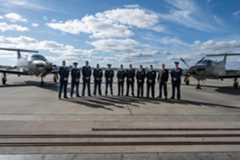
But 10 Airmen made history Nov. 17 by becoming the first Draco crews to receive the Distinguished Flying Cross. The awards recognize the crews’ efforts duringOperation Allies Refuge, the 2021 effort to evacuate 124,000 people from Afghanistan during the final weeks of the U.S. presence there. The Airmen narrowly dodged enemy fire, remained airborne until the last drop of gas, and nearly died several times so they could help provide intelligence and coordination for troops on the ground amid the chaos.
“For its entire existence, the U-28 community has lived in the shadows of recognition, but today there are no shadows,” Col. Allison Black, commander of the 1st Special Operations Wing, said at a ceremony at Hurlburt Field, Fla. on Nov. 17,according to a press release.
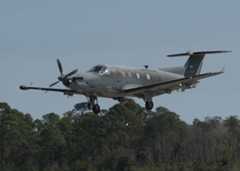
By Aug. 15, 2021, U.S. Army helicopters had begun evacuating the U.S. embassy in Kabul as the Taliban arrived in the capital, sparking panic among the city’s five million residents. Lt. Col. Samuel McIntyre, Capt. Maxwell Arnold, and Staff Sgt. Zachary Schweigl were about to take off to serve as eyes in the sky when just 100 meters away, Afghan security forces opened fire on one of their own pilots to try to commandeer an aircraft out, according to an award citation.
The three Airmen decided to carry on with the mission anyway, “agreeing that their duty to protect United States citizens superseded their own safety,” according to a citation, though they had to avoid unidentified vehicles on the taxiway trying to ram fleeing Afghan planes on the way to takeoff.
Once over the embassy, Schweigl saved the lives of everyone onboard by spotting a rocket fired at them from a nearby mountain peak. Schweigl’s warning gave McIntyre and Arnold the time they needed to dodge the rocket without putting the aircraft in a stall. The rocket streaked by just 200 feet overhead, and the crew continued to receive small-arms fire as they worked with ground troops, drone operators, and others to provide command and control and flag approaching Taliban forces.
But the real challenge was yet to come. By nightfall, the Draco crew was running out of gas, but thousands of fleeing Afghans had stormed the runway at the airport. With no more emergency fuel and no divert options, the crew used night-vision goggles and various sensors to pick out a gap in the crowd and pull off a miraculous landing just before “imminent fuel starvation,” according to a citation.
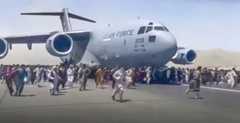
The battle was not over—within a few hours, the exhausted Draco crew was back in the air providing more ISR for the embassy evacuation and then for ground troops at the Kabul airport. They nearly ran out of fuel again, then landed again at the still-unsecured runway, where they had to taxi near burning vehicles and dead bodies.
“The sounds of the gunfire and the situation at the embassy only made us more eager to get after it and make sure we did our jobs,” Arnold said in the press release. “All of our training and instinct kicked in and we almost did our jobs subconsciously at that point.”
The crew of the second U-28 faced similar challenges: aircraft commander Capt. Daniel Slade and mission pilot Capt. Patrick Knittle had to dodge anti-aircraft fire right after takeoff. Slade, Knittle, and combat system officer Capt. Nicklaus Lutz flagged enemy gunmen and perimeter breaches for troops on the ground. When local airport air traffic controllers left the tower, Slade took up control responsibility himself.
“That’s not a conversation you expect to have after takeoff, especially after you’ve already been shot at,” Lutz said in the press release about the empty air traffic control tower. “One situation we thought about was that when we landed we were going to be on our own.”
Despite being nearly out of fuel, the second Draco crew stayed aloft so they could direct C-17s carrying “desperately needed quick reaction forces” to land. The C-17 crews thought the airfield had fallen and were planning to turn back, so the Draco Airmen’s decision to stay and direct them in was crucial to U.S. troops reopening the airfield and paving the way for themassive evacuation effort to follow.
“It dawned on us that we almost died,” Lutz recalled. “It was a dire situation. There were so many variables. Getting shot at on takeoff, losing your landing base, not knowing who is hostile or who is a refugee, and then the possibility of getting shot at again. I was lucky to be on the crew I was on.”
The next day brought a similar mission for the third Draco crew, Lt. Col. Scott Hardman, Capt. Pedro Barrientes Jr., Capt. James Ryan, and Senior Airman Max Sohlberg, which also had to zigzag to avoid getting shot right after takeoff. They identified breaches in the airfield perimeter and directed friendly troops to respond. Despite flying an unarmed aircraft, the crew even managed to scare off a group of gunmen who had taken up overwatch in a nearby tower.
Sohlberg was not trained to coordinate defense of an airfield perimeter, but he stepped up to the plate, synthesized information coming into the aircraft, then used it to help identify enemy combatants hiding among the refugees and build situational awareness for ground troops.
Like the previous flights, this Draco nearly ran out of fuel and almost landed on the taxiway before a gap in the fresh crowd of people on the runway opened up. The crew pulled off a last-second sidestep maneuver to land on the runway, but there were still so many people nearby that they had to cut the engine shortly after landing to avoid hurting anyone with the propeller. After that, all they could do was barricade the aircraft door and ready their personal weapons until help arrived.
“It was really when I got back and got to listen to our tapes from the flights that some of the more serious moments really resonated with me,” Ryan said in the press release, adding that the crews sounded surprisingly calm under the circumstances.
The Airmen were proud to have pulled through such difficult moments together.
“In those moments, you could tell that training kicked in,” Ryan said in the release. “We were well-prepared and we worked well together. Every part of the U-28A mission set is a crew effort, and I’m incredibly fortunate and proud to have been surrounded by such outstanding aviators.”