

…
7 pages


AI
First draft expose of a lecture given at summer course: THE ORIGINS OF AL-ANDALUS, CONQUEST, ISLAMIZATION, AND ARABIZATION, CASA ARABE 17-22 July 2017 CORDOBA. A case study on material evidence and "EARLY ISLAM Completed 14 th / April 2018. The author intends at some future time to expand and convert this draft based on a lecture into a fully annotated paper. Critical comments accepted. For more on Umayyad seals: http://www.andalustonegawa.50g.com/Seals.html
Cette rare monnaie d'or datant de la conquête arabe de la narbonnaise a été découverte sur la commune de saint-nazaire (66), à quelques kilomètres à l'est du tronçon de la voie Domitienne reliant elne à ruscino ( ). mis à part de légers coups sur sa surface, elle est dans un très bon état de conservation.
Coinage and History in the Seventh Century Near East 4, 2015
This paper combines the results of the previous research on the gold coinage of the Byzantine mint in Carthage and the Islamic mint in North Africa, together with new LA-ICP-MS analyses of 25 coins in the BnF and 92 SG measurements conducted by T. Jonson in various collections. It includes a comparison of the various methods used. The changes in metallic composition observed before and after the Muslim takeover are outlined. A tentative interpretation of the process of debasement of the first Arab series in North Africa (ca. 79-84/698-703) is offered.
The coinage with the standing Caliph stands between those coin types without any recognisable imperial iconography and those with the Word of God as iconic symbol of the Islamic empire and religion on the reformed epigraphic coinage of the years 77/696-7 to 78/697-8. Although the standing caliph was not the definite answer to the question of an appropriate representation of the new empire and its state religion, he represents for the first time the power of this empire like the Byzantine basileos or the Sasanian shahanshah on their coins before him. The iconographic symbols on the opposite sides of the standing - or in the case of the dirham half-figure - caliph vary: a ‘globe on a pole on steps’, a ‘portrait of the shahanshah’, a ‘lance under an arch’, or a phi-shaped object on steps. While the meaning of the standing figure is sufficiently confirmed by inscriptions as the representation of ‘Abd al-Malik; the related enigmatic objects on the reverse of the gold and copper coins are barely treated in the literature.
2004
PREFACE HRH Princess Haifa al-Faisal, Chairman, Board of Trustees The Mosaic Foundation In 756, 'Abd al-Rahman, an Arab prince from Damascus, became governor of the Iberian Peninsula, the westernmost province of the Islamic world, thereby decisively changing the direction of European history and culture.
Revue Suisse de numismatique, 1986
Relying on the rich archaeological documentation of the last decades this paper brings into context the development of the Carthage mint, hardly active between 146 BC and its revival under the Vandal. It offers new insights on the province finances, its monetisation and exports, the distribution of gold and other metals coins within and beyond its frontiers.
A survey of Arab-Byzantine coinage including historical background, a summary of recent research and problems plus a catalogue of all major types. This is the introductory chapter of Goodwin and Gyselen 'Arab Byzantine Coins from the Irbid Hoard', but it is intended to also stand alone as a general survey of the coinage

Loading Preview
Sorry, preview is currently unavailable. You can download the paper by clicking the button above.
AI
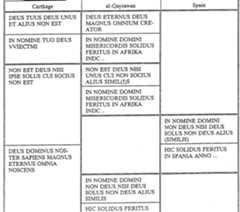
The initial series includes three types of Arab coins released from 695 to 715, comprising coins with Byzantine imperial images and Latin inscriptions, Latin-only inscriptions from Ifriqiya, and those featuring province names like SPAN1A.
The transition involved continuity in physical fabric and weight standards, with early Arab coins mirroring Roman designs, while the earliest Muslim versions retained local styles, indicating a mix of practices from both cultures.
Early coins featured difficult-to-decipher Latin inscriptions, indicating a progression from simple monotheistic phrases to the translation of the shahadda, highlighting the evolving religious context after conquest.
Coins were minted in two possible locations: Carthage, known for image coins, and al-Qayrawan, which produced non-image coins, suggesting flexible minting operations to accommodate regional governance.
The study notes that the solidus from North Africa weighed 4.29 grams, aligning closely with the 4.25 grams of Damascus dinars, indicating a localized adaptation in coin production after the Muslim conquest.
2014
This dissertation uses all of the available evidence provided by coins to construct a numismatic history of the early Islamic precious metal coinage of North Africa and the Iberian Peninsula. The dissertation begins with a review of the analysis undertaken by earlier scholars, followed by an explanation of the adopted methodology, including the approach to the primary and secondary sources and the description of the methods used in the metrological, metallurgical, and die estimation analyses. The balance of the dissertation is divided into three sections. The first section is the typology, which divides the coinage into four series: Series 1, the Two Imperial Bust type; Series 2, the Latin Epigraphic type; Series 3, the Bilingual type; and Series 4, the Post-Reform type. The typology analyses each series in detail. This section also discusses the iconographical elements of the coinage, with a further chapter providing an analysis of certain anomalous examples that do not readily fit into the typology. The second section encompasses the analysis of the metrological and metallurgical aspects of the coinage and the estimation of the number of dies for each series. The final section combines the numismatic evidence and the historical record provided by a variety of secondary sources into a numismatic history of the two regions. This section includes a discussion of the historical context prior to, during, and after the Muslim conquest of North Africa and the Iberian Peninsula, as well as a discussion of find spots and circulation. The dissertation concludes with a comparison of the evolution of the precious metal coinage in North Africa and the Iberian Peninsula to the evolution of Islamic coinage in other regions of the Umayyad Caliphate and an exploration of the underlying nature of the coinage (i.e. regional, Imperial, etc.).
This dissertation uses all of the available evidence provided by coins to construct a numismatic history of the early Islamic precious metal coinage of North Africa and the Iberian Peninsula. The dissertation begins with a review of the analysis undertaken by earlier scholars, followed by an explanation of the adopted methodology, including the approach to the primary and secondary sources and the description of the methods used in the metrological, metallurgical, and die estimation analyses. The balance of the dissertation is divided into three sections. The first section is the typology, which divides the coinage into four series: Series 1, the Two Imperial Bust type; Series 2, the Latin Epigraphic type; Series 3, the Bilingual type; and Series 4, the Post-Reform type. The typology analyses each series in detail. This section also discusses the iconographical elements of the coinage, with a further chapter providing an analysis of certain anomalous examples that do not readily fit into the typology. The second section encompasses the analysis of the metrological and metallurgical aspects of the coinage and the estimation of the number of dies for each series. The final section combines the numismatic evidence and the historical record provided by a variety of secondary sources into a numismatic history of the two regions. This section includes a discussion of the historical context prior to, during, and after the Muslim conquest of North Africa and the Iberian Peninsula, as well as a discussion of find spots and circulation. The dissertation concludes with a comparison of the evolution of the precious metal coinage in North Africa and the Iberian Peninsula to the evolution of Islamic coinage in other regions of the Umayyad Caliphate and an exploration of the underlying nature of the coinage (i.e. regional, Imperial, etc.).
Les opinions exprimées dans ce livre sont celles de leurs auteurs et ne peuvent, en aucun cas, être imputées au Centre International des Sciences de l'Homme (CISH).
The purpose of this paper is to establish the current state of knowledge regarding the first issuances of Islamic gold coins in the Maghreb by means of a thorough critical analysis and a synthesis of the available information which also takes into account the latest contributions on the subject. Among other aspects, the paper provides new perspectives on the analysis of the legends of the coins and their development. In this way, it offers new approaches and lines of research that can contribute to a better understanding of the evolution of coins in the global context of the Islamic issuances. El presente artículo pretende abordar el estado actual de nuestros conocimientos sobre las primeras emisiones áureas musulmanas en el Magreb, desde el análisis crítico y la sistematización de la información, incorporando las más recientes contribuciones sobre el tema. Entre otros aspectos, el análisis de las leyendas monetales y su evolución desde una perspectiva inédita, aportará nuevos planteamientos que esperan contribuir a una mayor comprensión de la evolución de numerario en el contexto global de las emisiones islámicas, abriendo nuevas líneas de investigación.
2017
En este trabajo presentamos un estudio histórico-numismático de una serie de monedas halladas de forma aislada en distintas localizaciones de la provincia de Jaén (Andalucía, España). Son cuatro dinares epigráficos latinos del tipo Indicción-Estrella, uno de ellos el de mayor peso hasta ahora conocido de esta tipología.
How did the theology of Islam and its idea of an empire evolve, based on the Hellenistic Romano-Iranian foundation, in the face of Christianity, Judaism, Neo-Platonism and Zoroastrianism? This much debated question has once again raised much scepticism and polemic against ‘established’ knowledge and its sources. The extreme points of view taken in this controversy at large are possible to maintain because there are few undisputed Arabic sources on the first decades of Islam. In this discourse, imagery and text messages on coins became more important than ever, because the knowledge of these coinages has grown tremendously since the 1990s. Coins offer the only continuous and contemporary independent and primary source for the period of the genesis of the new religion and its empire from Spain to Central Asia. Frequently interpretations of the Islamic coin imagery by political and art historians disregard the proper numismatic context of the seventh century AD. The present contribution attempts to provide a brief overview on the development of the coin imagery, as it is discussed today.
Latin-Arabic Entanglement: A Short History, 2019
Open access download: https://doi.org/10.17885/heiup.448. The present contribution recounts the entangled history of Latin and Arabic from a macro-historical perspective. This entangled history can be divided into three phases. In Phase One, both linguistic systems came into contact in the ancient Roman Near East, in a time in which Arabic as a standardized supraregional language had not yet fully emerged. In Phase Two, the Arabic-Islamic expansion into the western Mediterranean, dominated linguistically by Latin and Romance, ushered in a period of intensive Latin-Arabic entanglement. Lasting approximately from the seventh to the fifteenth century, this period was particularly dynamic: the expansion of so-called “Latin-Christian societies” into Mediterranean regions hitherto under Muslim rule considerably transformed the geopolitical equilibrium of linguistic interaction. In Phase Three, i.e. from the late medieval and early modern periods onwards, the interaction of Latin and Arabic progressively receded into the sphere of academic endeavours.
Between 711 (92 AH), when Muslim armies conquered much of the Iberian peninsula, and 1492 (897 AH), when Granada, the last Muslim emirate surrendered, Islamic Spain (al-Andalus) produced a prolific, diverse, often beautiful, and historically significant coinage. Although the language barrier of Arabic script makes this coinage relatively opaque to Western collectors, there is an extensive numismatic literature in Spanish and other Western languages.
The volume gathers the Proceedings of the Second International Symposium “Simone Assemani” on Islamic Numismatics (Trieste, 29-31 August 2008). The papers, by Italian and international scholars, deal with various domains of the Numismatic research covering a wide chronological and geographical span. Seals, coins from archaeological excavations, Arabic coins with Persian legends or with Chinese characters and contributions on Islamic coin collections in Italy are some of the themes of the fourteen papers published. Moreover these papers examine, among other topics, the Islamic and Norman Sicily, the coinage of the Mamluk and post-Ottoman conquest Egypt, the great export of silver from Europe to Islamic lands at the beginning of the XIIIth century.

 Michael L Bates