

…
20 pages


AI
The paper discusses the significance of Alan B. Lloyd's contributions to Egyptology and the establishment of a thriving Egyptological community in Britain, particularly through his work in academia and the Egypt Exploration Society. Additionally, it delves into the contextual background of the Herdsman Tale, exploring its earlier versions and connections to the Western frontier of Egypt, and highlights unique features shared with other mythological texts.
AI
2015
e Archaeological Review om Cambridge (ARC) is a biannual journal of archaeology. It is run on a non-pro t, voluntary basis by postgraduate research students at the University of Cambridge.
2024
Throughout her career, Ann Macy Roth has regularly returned to well-known ancient Egyptian material and visual culture and shed new light on it by employing different approaches and methodologies. In this way, her research has led to new interpretations and readings of ancient Egyptian beliefs and practices while illustrating the importance of and need for continual questioning and re-examination within Egyptology. This volume brings together papers from around the world that follow her tradition of rethinking, reassessing, and innovating. It is intended to honour Roth's significant career as a scholar, mentor, and teacher and to celebrate and continue her dedication to analyzing ancient Egypt from novel perspectives.
G. Miniaci, C. Greco, P. Del Vesco, M. Mancini, C. Alù (eds), Egypt in Ancient and Modern Tales, Travels and Explorations. Studies Presented to Marilina Betrò, Egittologia 5, Pisa, Pisa University Press 2024, 2024
https://www.pisauniversitypress.it/scheda-libro/autori-vari/egypt-in-ancient-and-modern-tales-travels-and-explorations-9791256080434-577056.html Egypt has long captivated the imagination through its literature, tales, and accounts from ancient and modern explorers. In antiquity, it served as the realm of pharaohs, steeped in myths that intertwined gods and humanity. Herodotus marveled at its wonders, while Napoleon’s expedition unearthed its mysteries. The stories passed down to us also offer insights into various facets of everyday life in ancient Egypt–human emotions, connection with nature, and the desire to discover unknown lands. This volume, presented to prof. Marilina Betrò, delves into Egypt’s history, weaving ancient and modern narratives. It explores Egypt not only as a land of wonders but also as a place that resonates with its ancient societies and their perspectives. – Introduction Gianluca Miniaci, Christian Greco, Paolo Del Vesco, Mattia Mancini, Cristina Alù – Shaping life as a journey and displaying it in biographies and tales John Baines – A new reading of an Old Kingdom administrative title (Hry-Szp) related to quarry expeditions Andrés Diego Espinel – Specialisti di viaggi nel deserto: gli jʿȝ.ww e i nw.w, intermediari e guide per le spedizioni minerarie faraoniche Cristina Alù – ‘The mouth of the two ways’: Ezbet Rushdi, a crossroads between Sinai and the Levant in the Middle Kingdom Francesco Missiroli – In the Heart of the Sea: The Island As Chronotope in the Tale of the Shipwrecked Sailor Angelo Colonna – ‘Fiori lapislazzuli’: una nota filologica e archeobotanica ad una lirica amorosa del vaso di Deir el-Medina Flora Andreozzi – Representations on animals in Ancient Egypt: parallel traditions through the millennia. The example of the donkey in the Teaching of ‘Onchsheshonqy Mathilde Prévost – Priests Carrying ‘Osiris-Canopus/Hydreios’: from Alexandria to the Imperial Isea outside Egypt. Preliminary considerations Rosanna Pirelli – Il Romanzo di Cambise: alcune osservazioni sulla fortuna di un genere e una nuova proposta di datazione Paola Buzi – First Archaeological Hints: Early Birds in Iraqi Kurdistan Dlshad Aziz Marf, Jesper Eidem – “Lo so, ma preferisco non dirlo”. Silenzi e strategie etnografiche in Hdt. II Andrea Taddei – The Adventurous Life of Giuseppe Ferlini Gianluca Miniaci – Assassinio nel Museo egizio: The Scarab Murder Case (S.S. Van Dine, 1930) Domitilla Campanile – Le notizie di Simēon Lehac’i sugli Armeni, ottomani e no Alessandro Orengo
Near Eastern Archaeology 75:1, 2010
2012
An introduction to the book regarding daily life in Old Kingdom Egypt and its representation in tomb art.
A diligent account of the development of Egyptology would be a substantial gain for the history of humanities. The book under review is the first of a planned three-volume series that aims to be "the first comprehensive history of the study and understanding of ancient Egypt, from ancient times to the twenty-first century." This volume presents the earliest slice of the selected chronological sequence, covering the Old Kingdom to the death of Auguste Mariette in 1881.
For our second symposium the chosen theme was 'Nationality, Authority, Individuality in Ancient Egypt', a topic which attracted a full programme of speakers and a capacity audience thereby ensuring a convivial atmosphere for fruitful discourse. Birmingham Egyptology takes this opportunity to thank the organizing committee, chaired by Eleanor Simmance and Luke McGarrity, and all members who helped in whatever way to bring about what proved to be a most successful event.
A British Egyptological Tribute to Alan B. Lloyd on the Occasion of His Retirement.
Edited by
Thomas Schneider and Kasia Szpakowska
A British Egyptological Tribute to Alan B. Lloyd on the Occasion of His Retirement.
Edited by
Thomas Schneider and Kasia Szpakowska
“But concerning Egypt, I am going to speak at length, because it has the most wonders, and everywhere presents works beyond description”
Egyptian Stories as the title for the Festschrift to honour Alan Lloyd’s achievements is particularly apt because it encapsulates the main strands of his interests and academic tenets, and is equally pertinent to the character of this gathering of papers. It is an obvious reference to the histories of Herodotus, and to Alan’s seminal commentary on the Greek historian’s Egyptian logos as a scholar dedicated to both the Classical Civilizations of the Mediterranean and Egypt. It also emphasizes Alan’s interest in the past, his insistence on scientific scrutiny (the basic meaning of history), and his profound love of (hi)stories, of literature. Following Herodotus’ motto, the present volume of Egyptian Stories wishes to speak at length about Egypt, and to present modern inquiries into its wonders and works beyond description. It explores Egypt from the Saqqara Necropolis to the Red Sea, from Sais in the Western Delta to festive Thebes, and reaches to the Greek Mainland and the Levant. It offers to the recipient water, honey, flint, amethyst and gold. It investigates the belief in Amun, in the jackal god, in the gods of the Western and Eastern deserts, and sacred animals. It unfolds stories about women, goddesses and queens, about priests and kings, and reflects about the acquisition of knowledge, the prediction of dreams, erotic gestures, and the purchase of arms. It also writes in new facets on the page of how Ancient Egypt was recreated in modern Britain.
Thus, it is fitting that this be a British tribute to Alan, as he has always been a champion of Egyptology in this country. For years he has dedicated himself as Chairman of the Egypt Exploration Society, engaged in expanding the scope of our knowledge of Ancient Egypt through the Society’s excavations and publications. He has made Ancient Egypt come alive for the British public as well, through the numerous lectures he generously gives for societies and universities throughout the UK. The University of Wales Swansea has particularly benefited from Alan’s expertise for over four decades. As Pro-ViceChancellor he helped shape the profile of the university as a whole, and as Head of Department of Classics and Ancient History for many years, Alan cultivated the Egyptological component by teaching undergraduate courses and supervising research students. As a teacher, Alan has always emphasised the importance of teaching and the transmission of knowledge, and this is
clearly recognised by his students who flock to his lectures. Building on the work of J. Gwyn Griffiths and Kate Bosse-Griffiths, he helped to establish a campus Museum of Egyptian Antiquities: The Egypt Centre. Finally, it was largely through the foresight and endeavours of Alan Lloyd that the field of Egyptology was established as an integral component of the department that now is formally called ‘Classics, Ancient History, and Egyptology’. Through all his efforts, Wales is now home to a thriving Egyptological community that is composed of large numbers of local and international students, scholars and researchers. Alan’s devotion to British Egyptology is reflected by the willingness and alacrity with which his colleagues have contributed here.
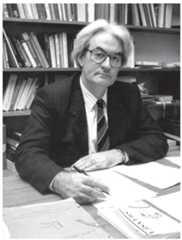
This collection of articles would not have been possible without the most generous financial support of the Egypt Exploration Society (to whom we are also grateful for permission to use the photograph of Alan as our frontispiece), and a contribution by the School of Humanities of The University of Wales Swansea. We are grateful to the series editors of Alter Orient und Altes Testament for agreeing to publish the Festschrift, and to Steven Snape and Rutherford Press Limited for facilitating the production of the volume. A note concerning style: as Egyptologists approach their subject through a variety of sub-disciplines, in this volume each contributor’s individual and appropriate transliteration and citation style has been retained. The editors and the contributors hope that Alan accepts this tome as a sincere token of recognition and esteem for his achievements as a scholar and a promoter of British Egyptology.
Foreword … vii
C. A. R. Andrews, Eponymous Priests Old and New in Unpublished Frag- mentary Demotic British Museum Papyri (P. BM EA 76271, 76269A, 10992 and 10540) … 1
D. A. Aston, A Taste of Honey: mnt- and mdqt-Vessels in the Late Eighteenth Dynasty … 13
M. Collier, Facts, Situations and Knowledge Acquisition: gmi with iw and-ḍd in Late Egyptian … 33
A. M. Dodson, Legends of a Sarcophagus … 47
T. DuQuesne, Private Devotion and Public Practice: aspects of Egyptian art and religion as revealed by the Salakhana stelae … 55
R. Enmarch, What the Ancestors Foretold: Some References to Prediction in Middle Egyptian Texts … 75
D. W. J. Gill, Arsinoe in the Peloponnese: the Ptolemaic base on the Methana peninsula … 87
C. Graves-Brown, Flint and the Northern Sky … 111
K. Griffin, An sh ikr Stela from the collection of the Egypt Centre, Swansea … 137
K. A. Kitchen, Festivity in Ramesside Thebes and Devotion to Amun and his City … 149
I. Mathieson, Recent Results of Geophysical Survey in the Saqqara Necropolis … 155
R. G. Morkot, War and the Economy: the International ‘arms trade’ in the Late Bronze Age and after … 169
E. F. Morris, Sacred and Obscene Laughter in The Contendings of Horus and Seth, in Egyptian Inversions of Everyday Life, and in the Context of Cul- tic Competition … 197
G. Mumford, Egypto-Levantine relations during the Iron Age to early Per- sian periods (Dynasties late 20 to 26) … 225
E. J. Owens, The Waters of Alexandria … 289
R. B. Parkinson, ‘Une cantilène de Pentaour’: Marguerite Yourcenar and Middle Kingdom Literature … 301
T. Schneider, Contextualising the Tale of the Herdsman … 309
I. Shaw, Late Roman Amethyst and Gold Mining at Wadi el-Hudi … 319
H. S. Smith and S. Davies, The Sacred Animal Necropolis at North Saqqara yet again! Some Late Period inscribed offering-tables from the site … 329
K. Spence, Topography, Architecture and Legitimacy: Hatshepsut’s founda- tion deposits at Deir el-Bahri … 353
N. Spencer, A Theban Statue Base from the reign of Nekhtnebef … 373
K. Szpakowska, Flesh for Fantasy: Reflections of Women in Two Ancient Egyptian Dream Manuals … 393
J. H. Taylor, The earliest Egyptian hippocampus … 405
A. P. Thomas, The Barefoot Aristocrats and the Making of an Egyptian Collection … 417
P. Wilson, A Cult of Amasis and ‘The Procession of Two Gods’ at Saïs … 437
T. Schneider
The Tale of the Herdsman has been labelled the most tantalizing fragmentary tale of Egyptian Middle Kingdom literature, or straightforward a text of unknown purpose-the frank but yet discomforting judgment in the most recent introduction to Egyptian literature. It gives me great pleasure to offer to Alan B. Lloyd this reappraisal of the Herdsman in recognition of his life-long interest in Ancient Egyptian literature which would never leave him satisfied with such assertions. The Tale of the Herdsman, a story of just 25 columns (or 34 verses) probably from the early 12th dynasty imposes a bulk of the most intricate problems onto its interpreters, with the effect that only the three basic stages of the tale will find common agreement: (1) a herdsman is deeply frightened by the appearance of a female, possibly a goddess, met in the marshes; (2) he informs his colleagues who are herding cattle whereupon actions of debated nature and purpose are taken; (3) the herdsman prepares to face the goddess again. Beyond this basic outline, there is not much that remained undisputed or uncontroversial since its single copy, papyrus Berlin 3024, became known to Egyptology in the mid-19th century. The debate starts well below the level of the text itself with the state of preservation of the story as four columns preceding the first preserved column of the tale have been wiped off, and equally four columns after the last preserved column 25 . The sheet itself had been glued to a different papyrus roll which contains the main text of papyrus Berlin 3024, the Dialogue of a man and his soul. According
I should like to thank the Department of Near Eastern Languages and Civilizations at Yale University and the organizers of the conference on Sex and Gender in Ancient Egypt, the Egypt Centre at the University of Wales Swansea, for the opportunity of presenting preliminary versions of my ideas in the course of 2005.
R. Parkinson, Poetry and Culture in Middle Kingdom Egypt: A Dark Side to Perfection, London 2002.
G. Burkhard/H.-J. Thissen, Einfübrung in die ägyptische Literaturgeschichte. I: Altes und Mittleres Reich, Münster/Hamburg/London 2003, 156.
P. Vernus, Future at Issue, 1990, 185, followed by Parkinson, Poetry and Culture, 300.
5 A.H. Gardiner, Die Erzäblung des Sinube und die Hirtengeschichte (Hieratische Papyrus [sic] aus den Königlichen Museen zu Berlin V: Literarische Texte des Mittleren Reiches II), Berlin 1909, p. 15, pls. 16-17.
On the history of the “Berlin library” of manuscripts see R.B. Parkinson, The Missing Beginning of ‘The Dialogue of a Man and his Ba’: P. Amherst III and the History of the ‘Berlin Library’, ZÄS 130(2003), 120-33, and ib. ‘A Note on the ‘Berlin Library’ and the British Museum’, GM 197 (2003), 93-7.↩︎
to Richard Parkinson, this would indicate that the papyrus sheet with the tale served to strengthen the end of the roll and has, therefore, been accidentally preserved; beginning and end of the story would probably be lost. Although this seems reasonable from the outset, the counterposition was advocated by Ludwig Morenz who argued that it was not due to technical requirements but a coherence of contents that the Herdsman sheet was added to the role with the Dialogue-it would, then, have been intentionally preserved because of its thematic affinity to the Dialogue, and the story would be complete as it stands. This divergence does not affect the fact that the original context of the tale prior to the sheet transfer is lost to modern scrutiny. Contrary views have also been pronounced on other general facets of the text. Common opinion ascribes the writing of the manuscript to a skilled scribe, whereas Hans Goedicke considered it written by an apprentice, not an experienced copyist, with the lines allegedly abounding in mistakes. Let alone these general assessments, the text contains a number of palaeographical, lexical, and grammatical problems that still defy a definite understanding of its plot and its purpose. The female character the herdsman meets and who frightens him is-depending upon the individual scholar’s conviction-either a beautiful, naked woman with depilated skin, or quite the contrary, a terrible female covered with thick hair. The central part of the tale has been read in conflicting ways as to who speaks (the herdsman? his colleagues?), who is addressed (the colleagues? the bulls?), and who acts (the herdsman? the colleagues? the bulls?). It has been considered anything but obvious how the so-called water spell in the middle of the tale suits the episode about the female, or whether this indicates a lack in coherence. Moreover, meaning and setting of the story are still taken for obscure-was it a kind of folkloristic or pastoral tale? Or a religious text? A reappraisal of the disputed palaeographical and lexical issues of the tale is therefore mandatory before we can hope for an appropriate understanding and contextualizing of the story.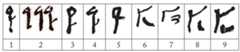
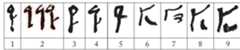
Figure 1: Individual hieratic signs.
7 R.B. Parkinson, Poetry and Culture in Middle Kingdom Egypt, 72 n. 10.
8 L.D. Morenz, Beiträge zur Schriftlichkeitskultur im Mittleren Reich und in der 2. Zwischenzeit (ÄAT 29), Wiesbaden 1996, 124-41.
9 R. Parkinson, Poetry and Culture in Middle Kingdom Egypt.
10 H. Goedicke, ‘The Story of the Herdsman’, CdE 45 (1970), 244-66.
11 I am very indebted to Richard Parkinson for photographs of the text and his willingness to discuss with me problems relating to the tale.↩︎
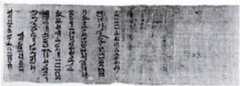
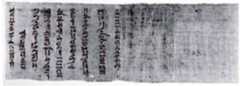
Figure 2: Herdsman, columns 1-9.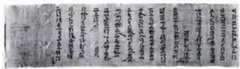
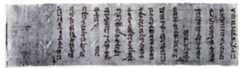
Figure 3: Herdsman, columns 10-25.
| 1 | Look, I had descended to (= I was down in) the marsh/swamp | |
|---|---|---|
| 2 | mh | which is close by this low-lying land/pasture. |
| 3 | And I saw a female in it (the marsh) - | |
| 4 | ParseError: KaTeX parse error: Expected 'EOF', got '̌' at position 7: n n s ̲̌ j m twt? rmtw | she was not of the appearances of human beings! |
| 5 | šny-j dddf.w | My hair stood on end |
| 6 | šrw.w | as I could see her bristles - |
| her appearance was not smooth. |
The beginning of the tale (after the four erased lines) where the herdsman gives the place of his encounter is unambiguous: “Look, I had descended to (= I was down in) the marsh/swamp, which is close by this low-lying land/pasture.” mhr is one of the rare words attested in this text, meaning “low-lying land, pasture” (cf. pWestcar 12,24 [“ground”], pEbers 49,6 [“sediment”], and possibly mhr [same meaning; First Intermediate Period (Urk. I 77, 11) and later]). He then relates an incident: “And I saw a woman in it (the marsh)”, followed by a first astonished remark about her nature. The crucial word in his remark-written as in Figure 1.1 (followed by the ideographical stroke and the plural strokes)—has defied a definite reading. Earlier proposals suggested Figure 1.2 (allegedly "body"12), Figure 1.3 wd “command”, or Figure 1.4
12 This meaning is an Egyptological phantom postulated in order to bring together the sig-↩︎
| Verses 7-11 | ||
|---|---|---|
| 7 | dd. | Never will I do what she said, |
| 8 | šfšf.t=s hthh | as dread of her is throughout my limbs! |
| 9 | I (want to) say to you: | |
| 10 | So let us make the bulls go off course, | |
| 11 | bhs. | then the calves will cross over |
“wish”, all of which pose palaeographical, lexical or semantic difficulties. My own suggestion is to read Figure 1.5 I “appearance” and to translate “she was not of the appearances of human beings!” The text is very clear on the point that seeing the female was a terrifying experience to the herdsman: “My hair stood on end”. It then goes on with stating what in the female’s appearance caused the protagonist’s terror, again a crucial and much disputed wording. Some scholars propose a tentative translation as: “as I saw her bracelets (and?) because of the smoothness of her skin” (L. Morenz). They refer to the fact that Egyptian brides until today have there skin depilated before their wedding. There is not only a lexical difficulty here-a word śrw “bracelet” does not seem to exist-and the strange grammar of the phrase, one wonders if the view of a naked woman would inspire the degree of fear that the herdsman says to have felt. The certain references of the word śrw denote the meaning of “bristle”, or the thick hair of animals. This entails that the following assertion-the skin cannot be said to have been both hairy and smooth-is introduced by the negation ’ ', not the preposition ’ '. Both signs differ by a mere dot in hieratic and can interchange in the texts. We thus reach the coherent description: “My hair stood on end as I saw her bristles; her appearance was not smooth”. The female appears to have made a startling proposal to the herdsman who shrank back from it; “Never will I do what she said, as dread of her is throughout my limbs!”
After this retrospective account given to his fellow-herdsmen, the herdsman seems to give advice what actions be taken (“I (want to) say to you.”). This central part has caused its translators numerous difficulties from the very outset. They took the particle h for an interjection “oh!” which, however, is not attested in Egyptian, or for the introductory particle “then, thus” with an exclamation “bulls” referring either to the real bulls in the herd or, as a metaphor,
nificance of the homonyms hm “servant” and hm “majesty” (which seem, however, to be related to two different Afroasiatic lexemes, Semitic "amm “folk”, and hām “patron”, respectively). Neither of the two meanings is suitable here although Richard Parkinson upholds, in a personal communication, that is still the most probable reading of the sign in question.
P. Derchain, ‘La perruque et le cristal’, SAK 2 (1975), 55-74: pp. 69-72.
The attempt by Morenz to infer the meaning of “bracelets” by referring to the Semitic root swr to “surround” can be disregarded both for semantic and phonological reasons (different sibilants).
Cf. Wb. IV 191, 4 (and the feminine śr.t, 191.5) for the short hair of animals (e.g., donkey, giraffe, bull) and the discussion by H. Goedicke, ‘The Story of the Herdsman’, 248f. The word is likely to be related to the female noun śr.t “thorn” (Wb. IV 190, 24-191,2).
In this point, I follow Goedicke’s suggestion.↩︎
| Verses 12-15 | ||
|---|---|---|
| 12 | so that the herd may spend the night in the area of the paddock (or: pasture). | |
| 13 | The herdsmen are/shall be behind them | |
| 14 | Our skiff is for leading the bulls away | |
| 15 | together with the guards placed on its stern. |
to the herdsmen. In either case, the exclamation separates the particle from the verb introduced by it. The herdsman would, then, address his cattle and give them advice, or else his fellow-herdsmen, but with a metaphor “bulls” not attested elsewhere. Both proposals do not inspire confidence. A possible solution turns up if we compare a roughly contemporary sentence from the First Intermediate Period (Siut I, 270f.) where the direct object is given a specific focus through extraposition-placing it after the concluding particle and before the verb that governs it, after which it is resumed by a pronoun:
“So every word concerning the things I gave them you let it hear (your son, your heir…)”
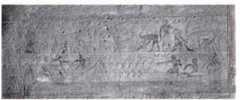
I would, then, suggest that we are dealing with a similar case of object anticipation in this instance. It is unfortunate that the verb ( ?) occurring in the sentence introduced by is a technical term of navigation and as such not very well attested, although there is new evidence in a vocabulary of nautical terms in pCarlsberg 180 from Tebtunis, frag. J, 11,15 from the 2nd cent. AD. Nevertheless, the meaning the term conveys is fairly obvious that of deviating/going off course, or of making (a ship) deviate or go off course. An advice given in the Middle Kingdom literary text of the Eloquent Peasant (B1 158 = Parkinson 189) says “beware deviating ( ) while at the tiller”, and in a nautical scene in the tomb of Pepiankh called Heni at Meir (V, pl. 22) one reads the command: "Well to starboard! Do not deviate ( ), steersmen!"The transitive meaning is suggested in vs. 14 of our text where is used with as an object. We can therefore translate the verse in question and the next one as follows: “So the bulls let’s make go off course, then the calves will cross over.” How to understand this? The herdsmen who traverse a sheet of shallow water in a boat in front of the herd, alter their course, make the leaders of the herd go off the conventional route, and subsequently the rest of the herd follows them, so that, as the text continues, “the herd might spend the night in the area of the paddock/pasture”. An apt illustration to this driving of the herd and the subsequently alluded to threat by crocodiles is a relief in the mastaba of Ti :
I owe this example to W. Schenkel, Tübinger Einfübrung in die klassisch-ägyptische Sprache und Schrift, Tübingen 2005, p. 341 (“substantivisches Topic”).
18 J. Osing, Hieratische Papyri aus Tebtunis I (The Carlsberg Papyri 2), Kopenhagen 1998.↩︎
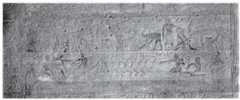
Figure 4: Driving the Cattle in the Tomb of Ti.
The advice given by the herdsman is to bring the herd to a safe place for the night instead of exposing them to danger. It is inferable from the beginning that this danger could have threatened the herd on the traditional route where the terrific female had startled the tale’s protagonist. A most welcome corroboration of the use of the word msh “paddock” as a safe haven for cattle comes from the Middle Kingdom tomb of Thothotep at el-Bershe, where a paddock is part of a description of the good life imported Asiatic cattle can expect in Egypt.
This aspect of safety is also predominant in the next three verses describing the drift. “The herdsmen are behind them, our skiff is for leading the bulls away, together with the guards (?) placed on its stern”. A sign of unclear interpretation occurs both here and in vs. 18 (Figure 1.6). It is generally understood as a notation of the bull which is, however, written in a very different way in our text (Figure 1.7) and must be rejected here. Palaeographically, only the post of balance, Figure wts, or the lashed pieces of wood, Figure rsj, seem plausible. Hans Goedicke wanted to read here wts “pole, support, the gear of a ship, mast-crutch” (for which an additional reference can be found in the contemporary list of ship’s parts in pReisner II, 38, 9 [B 16 and 17]) but this does not make any good sense here. My proposal is to read “guards” in the context of the cattle’s protection against predatory animals that is obvious from the next passage.
Columns 19-22 (introduced by verses 16-18)—still part of the advice given by the herdsman-contain a water incantation ( ) which has an interesting parallel in CT spell 836 (coffin CG 28027). What has not been fully appreciated in many a study on the tale is that it is not directed against the water itself but the beasts, in particular crocodiles, that threaten the cattle driven
19 P. E. Newberry et al., El Bersheh I: The Tomb of Tebuti-Hetep, London 1894), pl. 18; cf. also Edfu IV 337,5-6: flocks are on msh where the flood nourishes them.
H. Goedicke, ‘The Story of the Herdsman’, 252.
J.R. Ogdon, ‘Return to Coffin Texts Spell 836 and the Hirtengeschichte’, Cabiers caribéens d’égyptologie 6 (2004), 117-35.↩︎
| Verses 16-28 | ||
|---|---|---|
| 16 | rh.w-jh.t mnj.w hr | The ritualists among the herdsmen are reciting a water incantation |
| 17 | dd | by saying this spell of his (the water’s) - |
| 18 | mnj.w tzy.w | so that my spirits will rejoice, herdsmen and men: |
| 19 | wn śrwj m šs | "There will be no driving me away from this marsh |
| 20 | rnp.t h | in a year of a high inundation |
| 21 | wd wd.t? s3.w | that gives order to the ridges of the hills, |
| 22 | tn | so that a lake cannot be told from the river! |
| 23 | wds rk hnw pr | Go on to the interior of your dwelling, |
| 24 | jw rsj.w mn m s.t. | while the guards are firm on their post. |
| 25 | jj jw śnd sk.w | Just come! Fear of you has vanished, |
| 26 | šfšf.t rwj.tj | dread of you is gone away, |
| 27 | r sk.t nšnj Wšr.t | until the rage of the Mighty Goddess passes |
| 28 | sndw nb.t ts.wj | and the fear of the Lady of the Two Lands." |
through the water. An illustration of this is provided by depictions of the Old Kingdom such as one in the tomb of Ti where the herdsmen cast a water spell onto crocodiles hiding in the water and preparing to attack cattle driven past them. If the high water table is particularly emphasized in this tale (and the speaker’s firmness not to retreat), then because it was the inundation which exposed settlements and paddocks not under threat in normal circumstances to crocodile attacks.
The intention of verses seems rather elusive. If we presume (as will be clearer from the following) that it is the protagonist’s goal to pacify the goddess and to secure her ongoing protection, the idea would be that the preliminary measures taken against the water beasts would be superseded by the goddess’s protection once the latter is made benevolent.
The final section is situated in the morning when the plot continues, describing the encounter of the tale’s protagonist with the female deity. A difficulty constitutes the wording h3.t š as the composite expression ®dj.t h3.t does not seem to be attested elsewhere. “While he had turned his face” would regularly demand the suffix pronoun after the lexeme denoting the body part. A possible solution is to assume that the protagonist embarked on his mission in his boat and that it is the boat’s bow which is directed towards the lake. After the appearance of the goddess-naked, her hair disordered-is described, the text breaks off without explicitly stating what happened next.
Attempts to embed this tale have been numerous. Some scholars like Hellmut Brunner and Laszlo Kakosy believed it to be a folkloristic story about a mermaid or water-nymph. The majority of Egyptologists who have commented
H. Brunner, Grundzüge einer Geschichte der ägyptischen Literatur, Darmstadt 1986; L. Käko-↩︎
| Columns 29-34 | ||
|---|---|---|
| 29 | When it was getting light, at dawn in the morning, | |
| 30 | jw jrj mj dd | one acted on his instruction. |
| 31 | ParseError: KaTeX parse error: Expected 'EOF', got '̌' at position 11: h p r f s ̲̌ w n t r . t t … | And this goddess approached him - |
| 32 | while he had turned the front (bow ?) to the lake. | |
| 33 | ParseError: KaTeX parse error: Expected 'EOF', got '̌' at position 9: j j-n-s ̲̌ h s-s ̌ j m h … | She came, stripped naked of her clothes |
| 34 | thth=s ̌ šnw=s ̌ | and was disordered, (namely) her hair. |
on the tale seem now to be of the view that the female protagonist is a Hathorlike deity, on account of both the erotic allusions of the text but also the fear inspired by her. It seems clear that the text stresses the twofold nature of the female who can appear both as a woman-in the final passage, where she strips naked of her clothes and her hair is disordered-and a predatory animal-in the beginning, where her skin is said to have bristles and not to be smooth (t.i., a fur), and where seeing her terrifies the protagonist. This would suggest more precisely that we are dealing with a form of the ferocious or distant goddess who can appear both as a lioness and a woman, and whom the Egyptians labelled, due to a convergence of myths, Hathor, Sakhmet, Mut, or Tefnut. Best known from Ptolemaic and Demotic sources that locate the myth’s event in Nubia and at Egypt’s Southern border, this belief in a raging goddess who has to be pacified and to be brought back to the North to Egypt has most often be viewed as a reflection of the seasonally shifting position of the sun. It is essential to realize that an earlier version of this myth sets it on the Western frontier of Egypt, and that this variant shares remarkable features with the Herdsman Tale. This version was reconstructed by Ursula Verhoeven and Philippe Derchain in when they edited a text preserved in the Mut ritual of pBerlin 3053, dating to the 22nd dynasty, and on blocks from Elkab dating to the 26th dynasty. Supposed to antedate the New Kingdom, it displays the distant goddess not as residing in Nubia, but the Libyan desert, and accounts her reception in the Western delta. Allusions to this reception can equally be found in the Book of the Heavenly Sky from the aftermath of the Amarna period where reference is made to the reception of Sakhmet in Imaw at the edge of the Western Delta. The text edited by Verhoeven/Derchain shares a number of features with the Herdsman tale which have not yet been pointed out.
szy, ‘The Nile, Eutheria and the Nymphs’, JEA 68 (1982), 290-8: 294.
R. Parkinson, Poetry and Culture in Middle Kingdom Egypt, 300 n. 8.
C. Desroches-Noblecourt, Amours et fureurs de La Lointaine. Clés pour la comprébension des symboles égyptiens, Paris 1995; A. van Lieven, ‘Wein, Weib und Gesang: Rituale für die Gefährliche Göttin’, Rituale in der Vorgeschichte, Antike und Gegenwart, Berlin 2003, 47-55.
A. van Lieven, ‘Wein, Weib und Gesang’; J.C. Darnell, ‘Hathor Returns to Medamud’, SAK 22 (1995), 47-94.
U. Verhoeven/P. Derchain, Le voyage de la déesse libyque. Ein Text aus dem “Mutritual” des Pap. Berlin 3053 (Rites égyptiens V), Bruxelles 1985.
E. Hornung, Der ägyptische Mythos von der Himmelskub. Eine Ätiologie des Unvollkommenen (OBO 46), ed. 1991.↩︎
The Libyan goddess has a double appearance as either a woman or a lioness. The goddess is “ferocious, raging” ( ). She is happy in her “thicket” (jhi) where she lives when she is not in the desert. She comes out of the “marshes”, her believers wait for her on the “fields/meadows” (sh.wt) where they spend the night in order to see her in the morning. Her believers sail all over the Delta lakes to make her known to all towns of Lower Egypt and to secure for themselves her protection through offerings and dance. This dance is said to be performed by Libyans or “in the fashion of the Libyans”, and ostrich feathers play an important part in it. The goddess has to be pacified and should, at any rate, not come too close to their believers. She presents to the believers “a sea of milk”, an intriguing motif which has not been commented upon in the text edition but is obviously a gesture of loyalty and protection (see below).
This belief in a ferocious goddess of Egypt’s Western border has recently found astonishing archaeological support in a C-group votive offering of ostrich feathers dedicated to Hathor (one of the Egyptian names of the distant goddess) uncovered by Renée Friedman at Inselberg Hk64 at Hierakonpolis and a graffito published by John Darnell from the Wadi el-Hol (depicting Libyans and a Hathor cow).
Common features of both narratives are the idea of a goddess who appears (unexpectedly) in the marshes whereas normally she lives in a more remote place, that her believers from the rural population cannot dare approach her too closely but that once she is pacified she extends her protection over them.
There is another, non-Egyptian narrative which might shed light on the two texts mentioned so far, the Tale of the Herdsman and the episode about the Libyan goddess from the Mut ritual. This narrative is attested from the entire Libyan-Berber realm, from Siwa in Egypt to the Atlantic coast. This distribution is conclusive evidence of an old narrative layer predating the Islamic conquest of North Africa that fragmented its linguistic and literary area. It has been suggested that the female of this Berber narrative, more than being just a folkloristic character, could be the relic of a pre-Islamic goddess reduced to the rank of a demon when the Islam suppressed pagan worship. This narrative reminiscent of folk-tale motifs reflects the belief in a kind of ogress, a man and animal eating demon. She is a big cat or lioness, but appears also as a woman who is thirsty of the blood of the traveller or herdsman. When represented as an old and malicious woman, she still retains her animal char-
R.F. Friedman, ‘Preliminary Report on Field Work at Hierakonpolis: 1996-1998’, JARCE 36 (1999), 1-35.
29 J.C. Darnell, Gebel Tyauti Rock Inscriptions 1-45 and Wadi el-Hol Rock Inscriptions 1-45 (Theban Desert Road Survey in the Egyptian Western Desert), Chicago 2002 (OIP 119), p. 126f. (inscription 15) and pl. 95; cf. J.C. Darnell, ‘Hathor Returns to Medamud’. A separate graffito depicts a man milking a cow.
H. Camps-Fabrer, ‘Génies’, Encyclopédie Berbère XX (1998), 3023-36, esp. p. 3024f.
I am summarizing here the narrative tradition such as given in E. Laoust, ‘Des noms berbères de logre et de logresse’, Hespéris. Archives berbères et Bulletin de l’Institut des Hautes Études Marocaines 34 (1947), 253-65.↩︎
acteristics-her body is covered with a fur, she has a mane, her face is black, she has long teeth or tusks, and hands with claws. Her Berber designation has preserved both aspects. In the majority of Touareg dialects, tamza denotes “ogress, witch”, whereas in the dialect of Ghadames the same word means “big cat, lioness, hyena”. She is often blind or does not see very well. She has two heavy breasts that she bears on her shoulders: the left breast on the right shoulder, the right breast on her left one. She speaks gently to the people she meets and tries to catch them with craftiness. She for her part can be pacified by persuasion and magic. She is of startling wildness, eats human flesh and the animals of farmers and herdsmen. When she is asleep, the bellow of cattle she devoured can be heard in her belly. She lives in caves or the forest. Her enemies are barking dogs and running (not stagnant!) water. If the hero manages to suck milk from her breast she becomes his protector (idea of collactation).
Features this narrative shares with the aforementioned traditions are: the appearance as both a woman and a lion, the fact that her skin is covered with fur, her hunger for cattle (this seems to be behind the herdman’s securing of the cattle), her persuasion (the herdsman is scared to do what she told him), the fact that she appears in shallow and stagnant water (the marshes). The motif of collactation could give a clue to explaining the enigmatic “sea of milk” in the text of the Mut ritual (and is not completely absent from Egyptian beliefs: cf. the king suckling the Hathor cow, or the institution of the milk brother).
It is certainly tempting to read the Tale of the Herdsman against these two narratives, and to infer that the protagonist attempted and most likely succeeded to approach the Libyan goddess and to procure his fellow-herdsmen and their cattle her protection. The Tale of the Herdsman would then constitute a piece of frontier literature-about the challenge of living on the fringe of Egypt and the threat the ferocious goddess from the desert constituted to the existence of the border communities.
For the significance of collactation in Berber tribes cf. M.-L. Gélard, ‘Representations of Kinship. Agnatic Ideology and Uterine Values in a Berber-Speaking Tribe (Southeast Marocco)’, Anthropos 99 (2004), 565-72.
Cf. for the importance of border communities in negotiating culture T. Schneider, ‘Foreigners’, in W. Wendrich (ed.), Archaeology of Ancient Egypt, Oxford (forthcoming), §1.3: Borders.↩︎
AI
Scholars interpret the female figure as either a terrifying beast or a seductive woman. Recent readings suggest she embodies a duality, reflecting both predatory and benevolent qualities of feminine divinity.
The preservation state of the text significantly complicates interpretation, with four columns of context missing. This loss leads to divergent views on its thematic coherence and narrative intent.
The analysis employs palaeographical and lexical investigations to unravel textual ambiguities. Scholars engage in comparative studies with contemporaneous narratives to gain broader cultural insights.
The tale shares motifs with Libyan-Berber narratives featuring ferocious goddesses, suggesting cultural exchanges. Similarities in dual nature and protective themes underscore its potential role in frontier literature.
The tale provides insights into complex Egyptian conceptions of femininity, fear, and protection. It reflects the societal struggles of pastoral communities against predatory threats, both literal and metaphorical.
2024
Egypt has long captivated the imagination through its literature, tales, and accounts from ancient and modern explorers. In antiquity, it served as the realm of pharaohs, steeped in myths that intertwined gods and humanity. Herodotus marveled at its wonders, while Napoleon’s expedition unearthed its mysteries. The stories passed down to us also offer insights into various facets of everyday life in ancient Egypt–human emotions, connection with nature, and the desire to discover unknown lands. This volume, presented to prof. Marilina Betrò, delves into Egypt’s history, weaving ancient and modern narratives. It explores Egypt not only as a land of wonders but also as a place that resonates with its ancient societies and their perspectives.
Histories of Egyptology: Interdisciplinary Measures (edited by William Carruthers), 2014
This book is the start of a conversation. It brings together a disparate group of people who, while working alone, have also begun to ask questions that are of relevance to each other. These people research the history of Egyptology: the disciplined study of ancient Egypt. Yet, this "fi eld" of historical research does not currently coalesce around shared aims or methods, and it is uncertain whether the people working within it would perceive the need for this amalgamation to occur. This volume, then, is an attempt to address this issue. It attempts to ask what a dialogue about the history of Egyptology that is informed by and crosses a variety of disciplinary perspectives can achieve and also attempts to work out how that dialogue might take place. What, in the second decade of the twenty-fi rst century, constitutes the history (or histories) of Egyptology? What does this history consist of, and what (or who) should it be for? How can Interdisciplinary Measures suggest the direction the writing of that history (or those histories) might take?
Herodotus in the Long Nineteenth Century, 2020
By 1830 the famous flashpoints of Napoleonic Egyptomania-the Battle of the Nile and acquisition of the Rosetta Stone-were remembered with pride as evocative tableau in Britain's national narrative. However, they were recognised as belonging to a previous generation. The visions of Egypt (ancient and modern) that survived them were rarely flattering. Through the 1820s and early 1830s most Britons who wrote about Egypt were dismissive at best and at worst hostile: their Egypt was primarily biblical, the oppressor described in Exodus and the prophets. Whether in art, in diverse articles for the periodical press or in books of ancient history tinged with scripture, evangelical angst often bubbled beneath the surface of Egypt's representation. Looming up from amongst 'the wrecks of time' the fate of biblical Egypt was wielded as a warning against hubris and luxury. 1 By 1900, with major British excavations underway, readers consumed a different Egypt. This was still run through with biblical imagery, but it was the civilisation that taught Moses its wisdom, taught the Hebrews the arts of civilisation, and shaped classical Greece. 2 The first generations of institutionally organised British excavators aimed to enthuse their public with unrelentingly sunny visions of the old Egyptians. This chapter explores the impact of Herodotean Egypt in the complex and contested decades between these two moments. It explores a shift from an early Victorian Herodotean Egypt associated with attempts to understand the natures of history and myth, to a late Victorian alternative that coalesced in response to the rediscovery of Naukratis. These are the two Egypts of the title. The decades this chapter covers span a period when Egyptian displays in museums finally began to be taken more seriously and when renderings of Egypt began to diversify. 3 In particular, these decades saw the rise of an Egypt written into classical as much as biblical history. Over this period, nineteenth-century interpretations of Mesopotamia coalesced into two competing, sometimes contradictory traditions, one within a biblical framework, the other classical: mid-century writing on Egypt, however, could rarely be so easily divided. 4 This interest was marked by a refusal, particularly from scholars outside the Anglican establishment, to accept narratives that either overestimated Greek originality or separated out histories of Greece from those of eastern Mediterranean nations. The period was also characterised by tensions between scholars who resisted the influence of Germanic historical criticism and those who argued that the British must learn the 'New Calculus' of German critics and 'enter the lists with them' or else give up any hope of setting scholarly 1 For the idea of Egypt emerging from 'the wrecks of time' see Thomas Carlyle, 'Voltaire' in Critical and Miscellaneous Essays (London, 1839), 1:120-83, first printed as a comparative review in Foreign and Quarterly Review, 6 (1829). For particularly intense warnings concerning hubris, see E. B. Pusey, Minor Prophets (Oxford, 1860). 2 For this argument in full see David Gange, Dialogues with the Dead (Oxford, 2013) chapter 5. 3 e.g.
African Studies Review, 2005
2024
In HIST 404 we will survey the broad sweep of ancient Egyptian history, from the first agricultural settlements on the Nile down to the Roman period (ca. 5,000 BCE to the 4 th c. CE). Our main textbook focuses on ancient Egypt's main phases and major themes, and so will we. We will look at how Egyptian society organized its macro-systems-governmental, legal, economic, military, and religious systems and institutions-and examine micro-systems, i.e., agrarian and urban families and households, as well as the variety of skills and ocupations that formed the building blocks of Egypt's economy (supplementing where needed with chapters and articles from other authors). We will also look at the development of Egyptian cultural ideas and practices, including language, writing, literature (another one of your assigned books), arts and entertainments and, along the way, the cultural influences of Egypt on other societies and vice-versa through colonization and conquest, and through peaceful cultural exchanges in social and commercial contexts.
2003
This is a whimsical survey of the story of Ancient Egypt that was submitted as a term paper for my BA in History degree. I hope you will be amused.
VIIIth European Conference of Egyptologists: CECE8, 2020
The publication provides an overview of current research and its perspectives covering various spheres of interest in present-day Egyptology and a scholarly discussion on various approaches to studies of ancient Egypt in all its aspects and forms. The reader may find 26 papers, including those on pottery, sculpture, language, history, architecture, religion and religious texts, views on empire creation, loyalism and more detailed pieces on amulets, museum collections, household religion and the concept of sin, children’s magical protection, religion mirrored in twenty-first dynasty personal correspondence, Esna, the group-statue of Pendua and Nefertari Kushite architectural programmes, the settlement at Tell Nabasha, the Saite-Persian cemetery at Abusir, project presentation and aegyptiaca in Portugal. Many of the issues were discussed during the Eighth European Conference of Egyptologists. Egypt 2017: Research Perspectives that was hosted by the New University of Lisbon and collaborator institutions in Portugal. The series of European meetings of Egyptologists was initiated in Warsaw in 1999. The Second and Third symposia were also held in Warsaw in 2001 and 2004, and the Fourth conference was organised in Budapest in 2006. The Fifth Conference was organised in Pułtusk in 2009, and the Sixth in Cracow, and the Seventh in Zagreb. The book is edited in co-operation by M.H. Trindade Lopes, J. Popielska-Grzybowska, J. Iwaszczuk and R.G. Gurgel Pereira.

 Thomas Schneider