

…
48 pages


AI
This research profiles the village of Rafid during the Late Roman and Byzantine periods, focusing on its geographical, cultural, and archaeological significance within the context of the Golan region. The paper discusses the physical terrain, agricultural practices, and settlement patterns influenced by the volcanic landscape, along with the historical context of the area, including significant events such as the arrival of Islamic forces in the 7th century and subsequent cultural continuity under Islamic rule.
AI
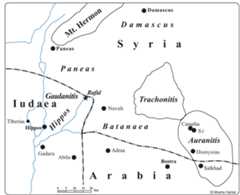
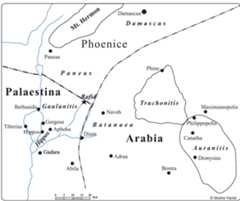
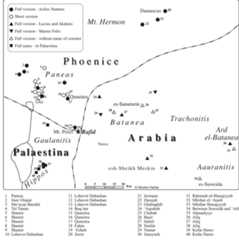
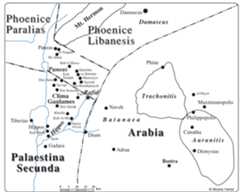
2003
Dafny, E., Gvirtzman, H., Burg, A., Fleischer, L. 2003. The hydrogeology of the Golan basalt aquifer, Israel. Isr. J. Earth Sci. 52: 139-153.
Der Islam, 1999
The two milestones with inscriptions were found in 1968 in the vicinity of the Arab village of Flq (or Afiq) in the Golan, 2 ) and were taken to the Qazrin Museum.
2018
The plateaus of El-Galalah El-Bahariyah (Northern), El-Galalah El-Qibliyah (Southern), and Wadi Araba represent a distinguished geomorphologic region, overlooking the Gulf of Suez, and occupying the NE corner of the Eastern Desert. Both Galalahs rise several hundred meters asl, reaching in some localities more than a thousand meters, while the floor of Wadi Araba rises only 120–250 m asl. The region is structurally dissected by faults of different orientations and is composed of a broad swell, where Wadi Araba represents its axis, and the two Galalahs represent the two flanks of this anticline. Accordingly, this Wadi can be considered an inverted topography. The regional geomorphology is simple, since the Region is composed of three units: the two cuestas of the two Galalahs and the anticlinal Wadi Araba. On the surfaces of these regional morpho-tectonic units, several erosional forms developed, of which fluvial and karst forms are the most widespread due to the presence of carbonat...
2004
The mountain of Jebel Bishri forms a strategically important natural bastion on the Middle Euphrates in Syria. The mountain has been a natural, economical and political border zone for different cultures and empires. The area is environmentally limited with the Syrian desert and the irrigated fields of the river plain. The neighbourhood is the cradle of agriculture: the earliest cultivation at the village of Abu Hureyra on the Euphrates dates to ca. 9000 B.C. Remote sensing methods reveal the character of this natural frontier, which during the past decades has been combating against increasing desertification. Satellite images have been used in mapping and monitoring the area of Jebel Bishri. A 3-D-model of the area has been constructed fusing radar and satellite images. Environment has stimulated different formation processes and spatial patterning of the sites on the mountain compared to those of the riverine zone. The cycle of nomadism and sedentism is reflected on the lifestyle still today. The mountain is exemplified with the flimsy remains of mobile societies detectable only with the satellite images offering high spatial resolution. With the satellite images numerous tells, ruined towns or villages, have been detected in the green river valley that reflects the sedentary way of life and trading activities. Archaeology provides a long-term perspective to subsistence patterns and site development processes that helps to understand and plan enduring development in the area.
First and foremost, my deepest gratitude is to my advisor Prof. David Adan-Bayewitz for his support and guidance. I have benefited greatly from his high research standards, along with the time and energy that he invests in his students. I am forever grateful to him for teaching me to work as an archaeologist and scientist, and cannot adequately acknowledge my ongoing gratitude to him. I am greatly appreciative to Dr. Moshe Wieder for teaching me the skill of micromorphological analysis. I thank Prof. Chaim Ben David, with whom I consulted on various topics related to this research. I take this opportunity to express my gratitude to all of the faculty members and staff at the Martin (Szusz) Department of Land of Israel Studies and Archaeology for their assistance and support during my years of study at Bar-Ilan University. I gratefully acknowledge Dr. Michael Glascock and the staff at the Archaeometry Laboratory at the University of Missouri Research Reactor for their skilled work in analyzing the sampled pottery, and for their hospitality on my visits.
Journal of Archaeological Science: Reports, 2016
Here we present the first results of a new interdisciplinary research project entitled "The Formation of Terraced Landscapes in the Judean Highlands, Israel". The research traces the socio-economic and historical contexts in which terraces were constructed in the rural periphery of Jerusalem, a thriving political, economic and religious center for four millennia, by using optically stimulated luminescence (OSL) dating of terraces fill in combination with careful analyses of related geomorphological and archaeological records. The first sub-region studied is Mount Eitan, an isolated hilly spur located ca. 12 km west of the ancient city, above the Soreq Valley, the main drainage basin of the region. The results demonstrate a complex history of terrace construction and use, beginning with sporadic activity during the Hellenistic and Roman periods and reaching a zenith during the midsecond millennium CE. The results enable to put to test current paradigms regarding the relation between extensive terracing operations and settlement oscillations and the antiquity of the terrace phenomenon in the Eastern Mediterranean.
Levant, 2010
The article presents new evidence for activity of 4th and 3rd millennium BC date, from the basaltic landscape west of the Orontes River, near modern Homs, which provides an indication of the nature and extent of human activity at this time outside the main riverine basins. Through a consideration of the potential of the landscape, an analysis of the form, distribution and function of the main categories of structural evidence, and of the associated material culture, the article seeks to understand the nature of the activity undertaken in the area at this time. The material culture evidence is used to investigate the probable connections linking the communities exploiting this landscape with those in other parts of the Levant, including those occupying the marl landscape on the east side of the Orontes River. A consideration of contemporary activity in the Hauran, Jaulan and Negev, sets activity in the Homs basalts in the context of a region-wide increase in the exploitation of 'sub-optimal' landscapes, which lay beyond the prime agricultural areas.
A profile of a Late Roman and Byzantine village
Edited by
Shimon Dar, Moshe Hartal and Etan Ayalon
BAR International Series 1555
2006
This title published by
Archaeopress
Publishers of British Archaeological Reports
Gordon House
276 Banbury Road
Oxford OX2 7ED
England
bar@archaeopress.com
www.archaeopress.com
Rafid on the Golan: A profile of a Late Roman and Byzantine village
© the estate of D Urman 2006 and the individual authors
ISBN 1841719846
Printed in England by The Basingstoke Press
All BAR titles are available from:
Hadrian Books Ltd
122 Banbury Road
Oxford
0X2 7BP
England
bar@hadrianbooks.co.uk
The current BAR catalogue with details of all titles in print, prices and means of payment is available free from Hadrian Books or may be downloaded from www.archaeopress.com
page 2 - empty
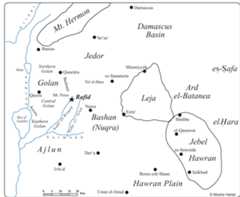
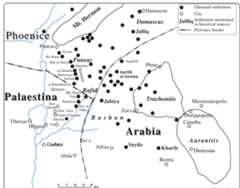
Rafid is situated in a region covered by thick layers of volcanic rock called Lava Lands (Miller 1984:1). The region spreads from south of Damascus to the Yarmukh river and from the Jordan river to the Jebel Hawran (Jebel Druz) and the Syrian desert, and forms the northern part of Transjordan. It is divided into several sub-zones that differ in their geographical characteristics (Map 1):
The Golan (ancient Gaulanitis) - is a plateau that stretches from the Mt. Hermon foothills in the north to the Yarmukh river in the south and between the Jordan river in the west and the Nahr el-Ruqad in the east. The plateau reaches elevations of 1000 m above MSL in the northeast and the cinder cones reach 1200 m and more. The Golan descends gently to an elevation of c. 300 m . In the west it is bounded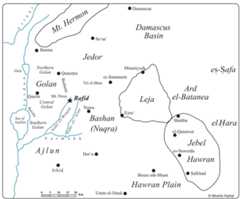
Map 1. Northern Transjordan.
by steep slopes that drop to the Hula valley, the Jordan and the Sea of Galilee, at an elevation of c. 200 m below sea level. The Golan itself can be subdivided into three main units:
The Nuqra (ancient Batanea) is a vast plain east of the Golan, reaching the foot of Jebel Hawran. It is 500-700 m above MSL, and is covered by eroded basalt that created large tracts of fertile, stone-fewer areas, particularly suitable for cereals. Jebel Hawran and the Leja bound the Nuqra from the east and northeast. West of the Leja, the Nuqra extends north to es-Sanamein. In the south it gradually merges into the Jordanian desert. Because the relatively low precipitation (200-350 mm per year) hardly any trees grow there and lack of water is the major obstacle to settlement.
Jedor is the area northwest of es-Sanamein, where the ground rises gradually to a small lava field at the foot of Mt. Hermon. It differs from the Nuqra in the fractured rock landscape and its elevation, which reaches 600-900 m above MSL. Volcanic cinder cones in the area, such as Tel el-Hara reach 1000 m elevations. In many ways this is a continuation of the volcanoes and valleys of northern Golan.
The Leja (ancient Trachonitis) is an area of c. 1000 sq. km between Shahba, Mismiyyeh and Ezra’, covered by solid basalt with hardly any soil, creating alternating patches of large basalt boulders and irregular basalt labyrinths. The region looks like a desert, and has served as shelter to shepherds and as hideout for bandits. At its southern end there are a few basins of fertile agricultural land without stones. The settlements are divided between those that are around the circumference of the Leja, enjoying its protection and the fertile land around, and those that are inside the Leja, especially in its south, near the fertile basins.
Jebel Hawran (Jebel Druz, Jebel el-‘Arab, Hauran, ancient Auranitis) was created by huge lava flows that accumulated to a maximum height of 1860 m above MSL. The mountain is approximately. The summit plateau, at the northern end, is at an elevation of 1500 m and is surrounded by many cinder cones. The steeper sides are on the east and west. South of the summit plateau the slopes are less steep and they descend to Ajlun, the plain of Salkhad and Bosra esh-Sham and south to Umm el-Jimal, which is sometimes called ‘southern Hauran’. This area is suitable both for grazing and for winter crops. On the mountain slopes there is fertile soil, suitable for cultivation. Because of its high elevation, the mountain is wooded and there is much available water on the summit plateau. The mountain slopes are the eastern edge of permanent settlements in the Lava lands and form the boundary with the desert. The western part of Jebel Hawran enjoys high precipitation and is utilized for agriculture. On the western slopes, at elevations of 1000-1300 m there is a belt of oak forests. The growing of vines and orchards is possible from 950 m and upward. At lower elevations cereals and legumes are grown.
Es-Safa and el-Hara are east of Jebel Hawran, also covered by lava flows. This is a desert landscape, where precipitation is less than 200 mm per year and dwindles further eastward. Throughout most periods the area served nomadic or semi-nomadic peoples. Seasonal agriculture is possible in the wadi-beds and in areas close to Jebel Hawran and the Leja (Ard el-Batanea).
Rafid is located at the junction of three geographic units. To the northwest lie the cinder cones of northern Golan, to the west the fractured rocky plateau of central Golan and to east the vast land of the Nuqra. The immediate vicinity of Rafid is rich in small springs and provides rich pasture. In various periods throughout history Rafid and the neighboring villages served as a horse breeding center. Schumacher (1888:89) recounts that the tribe of 'Arab elNu’em, whose summer camp was at Mt. Faras (Tel el-Faras), west of Rafid, which was “country, rich in springs, is well suited for … great herds of cattle” was lately chased off the land by the government, to keep this rich pasture for the horses of its soldiers stationed in Damascus. The two rivers that influence the most in the area are the Nahr el-Ruqad and the Nahr el-'Alan. Both reach the Yarmukh through deep and impressive gorges, difficult to cross and serving as natural boundaries. At their northern ends however, they are no more than shallow rivulets, hardly visible in the landscape. Throughout most of the year their flow is light and there is no difficulty in crossing them. Only during floods they turn into turbulent streams that carry enormous quantities of water and cannot be crossed. Scholars are divided as to which of the two rivers forms the eastern boundary of the Golan. In any case, near Rafid the two are very close to each other ( 3 km ), shallow and hardly noticeable.
Rafid is situated on the road connecting Golan (Golanitis) to Hauran (Auranitis). Though this is not the principal road of the area and there were two Roman roads that passed five and ten km south of it, near the village two roads merge. One
passes through southern Golan and the other descends from Quneitra along the foot of the Bashanit ridge. At Rafid the two merge and continue to Nawa in the Nuqra (Batanea) and to Jebel Hawran (Auranities).
page 6 - empty
Moshe Hartal
Travelers and researchers who passed through the Hauran in the nineteenth and the beginning of the twentieth century were surprised by the multitude of sites that harboured impressive remains of buildings from the Roman and Byzantine periods. The buildings are virtually all constructed of local basalt, which is weather-resistant and was instrumental in their preservation. Another reason for the preservation was the fact that the buildings stood abandoned for hundreds of years and their stones were not reused. The first travelers, including De Vogüé (1865-1877), still found many buildings preserved to a considerable height, sometimes to the roof. During this period visited the area also S. Merrill (1881) and G. Schumacher (1886, 1888). A thorough survey of the Hauran (Auranitis), Bashan (Batanea) and Trachon (Trachonitis) was carried out during 1904-1905 and again in 1909 by the Princeton University Archaeological Expedition to Syria, headed by H.C. Butler, and the results were published in a series of books that are the richest documentation to date of the Hauran style (Butler 1903-1929).
The renewed settlement in the ruins towards the end of the nineteenth century caused deterioration in their state. Some served as dwellings but most were used as source for building stone. The damage continued and increased in the twentieth century.
In the 1970s interest and research into the Hauran style architecture was renewed. In the Hauran and Bashan a French team operates, led by M. Dentzer (1986) and F. Villeneuve (1985). Umm el-Jimal in the southern Hauran, where many buildings were preserved sometimes three stories high, was surveyed by Butler in 1913 and in the years 1972-1981 by B. De Vries (1998). The Golan, which was surveyed in the nineteenth and twentieth century by Schumacher (1888) received much attention and research after its occupation by Israel in 1967 through numerous surveys conducted in it. Rafid was also surveyed and the results of this survey are presented in this volume. C.M. Dauphin and others conducted thorough surveys in four villages that preserve Hauran style architecture: Farj, erRumthaniyeh, Kafr Nafakh and Na’ran (Dauphin 1979, 1980, 1982a, 1982b, 1983a, 1983b). Unfortunately, the results of these surveys have not been fully published, but only as preliminary results. Hauran style buildings have been found also in excavations conducted on the Golan and
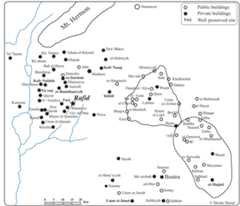
bordering areas (For a bibliography, see Hartal 2005). Following the 1973 war, a survey was conducted in the same year in the Jedor and northern Bashan areas, where additional sites with Hauran style architecture were found. The most important of these is Kafr Nasaj, where imposing buildings survived (Ben-Dov 1975). The distribution of these sites is shown on Map 2.
In the Hauran and Trachon many public buildings survived, including temples, theaters, nymphaea, gates, as well as churches and monasteries. While these buildings were built under the influence of Hellenistic-Roman architecture, they nevertheless have characteristics unique to the Hauran. As often happens, most publications that deal with the region were devoted to the study of the public buildings, and the research of domestic buildings, and especially the rural buildings was, by and large, neglected. Since on the Golan in general, and at Rafid in particular, no public buildings survived, this chapter will deal with the rural architecture. The construction elements were described in detail in the various buildings. Our aim is to present a synoptic picture of the basic components of Hauran style architecture and the various ways in which they were combined. To illustrate the points, the reader is referred to the photographs throughout the book, as well as to several photographs of buildings in the Hauran and Bashan that serve to better illustrate the finds from Rafid.
Northern Transjordan is mostly covered by volcanic rocks, especially basalt. In the basalt covered areas there are plenty of stones that served as raw material for all kinds of construction, from the most modest to the most elaborate. The simplest buildings are constructed of raw field stones that were collected in the field and used ‘as-is’. In many cases however, the stones were prepared for building. Basalt is a very hard stone, but is extracted relatively easily, because basalt rock tends to be fractured. It is also easily worked; its brittleness enables trained workmen to shape it with a few well-placed hammer blows. The main drawback of basalt is its porosity, which varies greatly. Stones with little porosity are best for the cutting of smooth ashlars. These stones served also as the raw material for architectural elements made in relief and carving. The durability of basalt preserved works of art for hundreds of years (see chapter three).
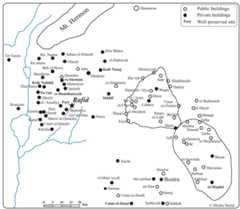
Map 2. Hauran Style Buildings.
Traditional houses in the Middle East are usually roofed with flat roofs made of wooden beams covered by reed mats and earth. In most of northern Transjordan however, the quantity of precipitation is low, and trees are scarce. This necessitated the expensive importation of wood when this was necessary. The inhabitants exploited the tendency of basalt to fracture into columns creating 3-5 m long basalt beams naturally, and these were used for roofing. Thus, stone roofs became one of the characteristics of Hauran style architecture. “The Architecture of the Hauran was the most truly lithic that the world had seen; it was entirely of stones, sometimes even to the doors and windows shutters” (Butler 1909:68).
All construction was with the local basalt. The walls were on the average 0.80 m thick, dry-built without a binding agent of two faces of basalt stones, the core filled with rubble
and earth. Most houses are built of dressed stones (Fig. 241) or ashlars (Fig. 625). In the houses of the wealthy, of which there are examples in Rafid, the front was constructed of high-quality ashlars (Figs. 18-23). Buildings of all three qualities were found in the Hauran and the Bashan as well (Butler 1903:313-314; Ben-Dov 1975:176; De Vries 1998:113, Fig. 64).
The roofing was made of long and narrow basalt beams, usually supported by corbels jutting out of the walls (De Vogüé 1865-1877: Pl. 12:2; Butler 1903:315-316; 1909:62). Most corbels were made of dressed stones (Figs. 59-65), and in some houses of ashlars (Figs. 159-162). The length of the basalt beams limited the spaces that could be bridged to four m wide. This figure could be doubled with the aid of arches: stones were laid across the top of the arches, which projected on either side and served as double-ended corbels (Figs. 82-86; 109-117). The roof beams were laid over the corbels in two layers at right angles to each other (Figs. 6465). In wealthy houses the beams were smoothed (Fig. 605;
Villeneuve 1985: Pl. 6:c) but normally they were only roughly dressed (Figs. 64-65; Ibid.: Pl. 6:b). Over the beams a layer of compacted earth was placed, which waterproofed and insulated the roof (Figs. 15, 89, 200; Ben-Dov 1975:177179, Figs. 11-14; Butler 1909: Ill. 50; De Vries 1998:113117, Figs. 62, 63, 65).
The considerable weight of the stone roof necessitated the construction of massive walls, and this is the reason for the paucity of windows, which weaken the walls. Openings and windows were only in the front wall (Villeneuve 1985:91). The lintels were also made of long beams, and to prevent breaking, were provided with either small windows or relieving arches above (Figs. 244, 245, 403; De Vries 1998: Figs. 75-78). The outside doorways were constructed of ashlars cut as frames, including hinge sockets and recesses for bolts (Figs. 457-459). The doors opened inside and were bolted from inside. The original doors, doubtless made of wood, did not survive, but a good idea of their shape can be gained from the stone doors preserved at Kafr Nafakh (Hartal 2005: Fig. 181). In the Hauran, stone doors served also in houses (De Vogüé 1865-1877: Pl. 14; De Vries 1998:117118, Figs. 71, 72).
The few windows that do exist are small, and are usually constructed above the lintel to relieve stress. The most common windows were created by leaving out a stone in the wall above the lintel or elsewhere in the front wall and are rectangular (Figs. 407, 618, 620). In a few cases the window was constructed with a dressed frame as that of the doorways (Figs. 38, 40, 458, 459). A few of the windows have an arched lintel (Figs. 537, 538, 540, 613) and in a single case a round window was found (Hartal 2005: Fig. 186). In the side and back walls of the house there were no windows usually, so that the interiors were rather dark.
In the more imposing houses sometimes a carved basalt stone lattice was inserted in the window frame. At es-Surman a well-cut lattice was found, made of a stone slab measuring 89 x 84 x 25 cm (Gregg and Urman 1996:217, AF 93; Hartal 2005: Fig. 187). Most of the inner side was carved out, so that an only 5 cm thick lattice remained at front. The front was decorated with a wreath that contained a rosette, and between its petals six perforations were bored, each with a diameter of 8 cm that let light through. The lattice was found in secondary use in a minaret of a mosque. At Jaba, c. 10 km northeast of es-Surman three similar windows were found (Ben-Dov 1975: Figs. 19-21, Pl. 34:3; Hartal 2005: Figs. 188, 189). Stone grilles were found also at sites of the Hauran (De Vogüé 1865-1877: Pls. 13, 14).
At Rafid a few houses were found, where a square (Figs. 393, 394) or arched (Figs. 18, 19, 22) niche was built in the front wall. It seems that in the niches large pithoi with drinking water were placed. This custom prevailed in the Golan villages until the mid-twentieth century (Figs. 569, 570, 689). Such niches are common throughout the Hauran and Bashan (Ben-Dov 1975:176; Villeneuve 1985:94) but were not found at other sites on the Golan.
The front walls sometimes carried stairs leading to the second storey. The steps were made of stone beams
incorporated into the wall and projecting from it without additional support. In many cases two sets of stairs start from the center of the façade (De Vogüé 1865-1877: Pl. 12; Butler 1909: Ills. 48, 53; 1913: Figs. 179, 181; Villeneuve 1985: Pl. 2:b; De Vries 1998:117, Figs. 69, 70). On the Golan, such stairs were found only at Rafid (Figs. 16-20). The stairs led to a doorway on the second storey - if this existed - or to the roof. The same technique was used for the construction of balconies in front of the second storey doorways (Figs. 16, 19, 23 and cf. De Vogüé 1865-1877: Pl. 12).
In front of some of the houses in the Hauran and Bashan porticoes were built with columns in front and roofed with stone slabs (Ben-Dov 1975:179, Figs. 2, 3, 5, 12, Pls. 32:1, 34:1, 2). Such porticoes were not found in Rafid.
The basic unit of these houses included a high front room whose ceiling was supported by a central arch. Behind it were low, narrow rooms creating two semi-storeys and open to the front room (Figs. 289, 365; De Vogüé 1865-1877: Pl. 12:2; Butler 1913: Fig. 181; 1919: Ill. 369; Epstein and Gutman 1972:273; Villeneuve 1985:91, Figs. 8, 9; Tepper 1997: Fig. 19).
The front room was the principal space in the building and it is double or even treble the size of the back rooms. The ceiling is supported by one or more arches, which allow a larger roof in spite of the limitations imposed by the length of the basalt beams (Figs. 109, 110, 112). Sometimes the ceiling is supported by full height built piers or columns (Hartal 2005: Fig. 196). The simple arches are constructed of dressed stones or ashlars of uniform width. They are supported by built piers (Figs. 98, 666, 667), or, in exceptional cases by columns (Figs. 149, 153, 154). In a few buildings impressive arches made of smooth ashlars were found, supported by well-built piers with a carved cornice at the spring of the arch (Figs. 150-152, 312, 313, 461-465; De Vogüé 1865-1877: Pl. 12:2; Ben-Dov 1975: Figs. 4, 9, 11, 12, Pl. 33:3). Such arches were sometimes decorated with reliefs (Butler 1915: Ils. 282, 285; DentzerFeydy 1986: Pl. 12:a-c).
The front and the back rooms are separated by a fenestrated wall. About 0.60-0.70 m above the floor a row of windows was built, separated by monolithic stone piers, and above these the wall continued upward to the ceiling (Figs. 107, 110; Hartal 2005: Figs. 199-203; Villeneuve 1985:94). It seems that the main purpose of the fenestrated walls was to provide illumination and ventilation to the back room, in whose walls there were no windows. The quality of the piers making up the windows is not uniform. Some are built of dressed stones (Figs. 125-127; 599), while others of ashlars (Figs. 50-58).
In addition to their main purpose, the windows served other ends, depending on the function of the back room (BenDov 1975: Pl. 34:3; Villeneuve 1985: Pl. 3:b). In many cases the ground floor of the houses served as a cattle pen or stable. The animals were accommodated in the back room and feeding troughs were constructed in the windows (Figs. 5558, 128, 315-317, 626; Villeneuve 1985:94; Tepper
1997:253-259). In such cases the front room served for storage of fodder and agricultural tools. In the Golan such feeding troughs were found at Rafid and Farj, which are situated in areas suitable for raising horses. On the other hand, at sites north of Quneitra, e.g. Bab el-Hawa (Hartal 2005: Figs. 82-84, 101, 103) and Kh. Namra (Ibid.: Figs. 40,45 ) no troughs were installed, and the windows seem to have been used as cupboards. Plain windows were discovered also at Qasrin (Ma’oz and Killebrew 1988:1213) and Deir Qaruh in central Golan and at Khisfin in southern Golan. The fenestrated wall included also a doorway connecting the front and back rooms, but as it did not have a frame, it apparently had no door (Figs. 55-57,.
The ceiling of the back room is often lower than that of the front room and above it a loft was built, accessed through an opening in the fenestrated wall (Fig. 167; Dauphin and Gibson 1992-1993: Fig. 8; Hartal 2005, Figs. 202, 203). Unlike the doorway to the back room, the doorway to the loft does have a frame, which allowed the addition of a lockable door. The doorway was the only source of light for the loft, and it was rather dark. This space seems to have served as the bedroom of the owners. In a few houses in the Hauran there is an inner staircase giving access to the loft. In most cases stairs were not found, and access seems to have been by a wooden ladder. A unique set of stairs carved in one block of stone was found at Farj, not in its original location (Ibid.: Fig. 204). It may have served to access the loft, but lacking any parallel, this remains a speculation.
In the walls of the buildings cupboards were installed as well, constructed as square niches, similar in size to the windows in the fenestrated wall. Such cupboards are incorporated in the fenestrated walls (Figs. 466-470; Ibid.: Fig. 202) or in one of the other walls (Figs. 547-549; Ibid.: Figs. 67, 178). Mostly the cupboards were constructed of dressed stones, but in imposing buildings, e.g. Building 86 at Rafid, they were constructed of smooth ashlars (Figs. 593-596).
Many buildings are made up of a combination of several basic units (Villeneuve 1985: Figs. 14-21). Sometimes they are built side-by-side, so that each has a separate entrance, and sometimes they are built around a central courtyard. There are two-storied buildings and in the Hauran there are three-storey buildings as well. In the Golan the only twostorey buildings were found at Rafid. The ground floor was used for animals and for the storage and protection of fodder and agricultural produce from the weather and theft. The upper storey was the living quarters of the owners and for guests (Tsafrir 1984:313-315; Villeneuve 1985:99).
The decorations were rather modest, and in fact the majority was unadorned. In some buildings the lintels were decorated with reliefs and crosses (Ibid.: Pl. 5:a; DentzerFeydy 1986: Pls. 20:c, d, 23:a, b). Close to 100 decorated lintels were found in northern Golan (see details in chapter three). In the Hauran and Bashan the windows sometimes had decorated frames (Ibid.: Pl. 23:d), but such were not found on the Golan. In the front rooms of the more impressive buildings the lower part of the arches was
sometimes decorated (Butler 1903:409; 1915: Ills. 282, 285; Villeneuve 1985: Pl. 5:b; Dentzer-Feydy 1986: Pls. 20:a, b, 22:b-e, 23:c), as were the corner corbels supporting the roof (Ben-Dov 1975: Pl. 33:4-6). In the Golan no decorated arch was found in situ, but many such stones were found in secondary use. A cornice decorated with a vine in relief was found in Quneitra (Hartal 2005: Fig. 290) and cornices with crosses were found at er-Rumthaniyeh (Ibid.: Figs. 340, 341). About forty arch stones with superb reliefs, some in front and some as a running trellis around the outer edges were found in northern Golan (Ibid.: Figs. 279-288) and they suggest that this was the principal decorative motif in the houses.
Though stone-roofed buildings characteristic of the Hauran style were found at sites south of Quneitra, not all surviving roofs were built in antiquity. Repairs, and even new roofs, were made in recent times as well. An examination of most roofs at er-Rumthaniyeh shows that ancient and freshly cut stones are used together. Schumacher (1888) found at erRumthaniyeh in 1884 a number of underground rooms roofed with stone slabs, as well as a large building that had been restored shortly before his visit and which he thought dated to the ‘Islamic period’. Today a large number of the extant houses in the village have stone roofs, and it seems therefore that most were built in the twentieth century. At Kafr Nafakh Schumacher (1888) found only ruins of buildings, and it seems that here too most were built only in the twentieth century (Ma’oz 1985:60-61). The situation seems to be similar at Rafid. Some of the stone roofs were built in the Late Roman and Byzantine periods, but many were apparently built in the Mamluk period and recently. Schumacher, who visited the site in 1884, described only small underground structures that were roofed with stone, and noted that above-ground structures were roofless (1888:226-227).
North of Quneitra, at Bab el-Hawa and Kh. Namra, the houses from the Late Roman and Byzantine periods that were excavated and studied preserve the characteristics of the Hauran style architecture. They were functional but not imposing. No carved architectural elements were found, and not even cut and dressed door frames. The main difference however, is that buildings north of Quneitra seem not to have been roofed with stone beams but with wooden beams, reeds and earth. At first glance the reason for this departure would seem to be the abundance of wood suitable for roofing. The Bashanit range however, at whose foot the sites south of Quneitra (see maps 1, 2) were built, was forested as well, yet the houses there were roofed with stone. It would seem thus that the reason was the very different quality of basalt. North of Quneitra the Odem basalt formation is common, which does not naturally break into narrow slabs and is less suitable for roofing. Indeed, at all sites that lie on the Odem basalt, such as Ra‘abane, and at those on its edge,
the use of stone roofs was limited to special cases, such as the tomb at Bab el-Hawa (Hartal 2005: Figs 111-113).
The earliest structure built in the Hauran style is the olive-oil press in the Western Quarter at Gamla, which was roofed with stone beams supported by two arches, and which is dated to the first century CE (Gutman 1994:130-134). In the present state of research this seems to be an exceptional case of a public building and not a domestic one. All other excavated houses at Gamla (including the synagogue) were constructed of dressed or field stones and roofed with wood and earth (Ibid.:111). At Bethsaida, not far from Gamla, domestic buildings of the Hellenistic and Roman periods were excavated, which show no influence whatsoever of Hauran style architecture (Arav 1995).
At Tel Tanim (Tel Wawiyat), a stratigraphic sequence from the Hellenistic through to the Byzantine periods was excavated. In the Hellenistic and Early Roman periods the houses were constructed of field stones and no Hauran style houses were found. This style is evident only after the second century CE and continued into the Late Roman and Byzantine periods. The buildings were constructed with dressed stones with doorways, and fenestrated walls were in use. Only a small number of stone beams was found in the excavation, and it appears that most structures were roofed with wood, as at the sites north of Quneitra (Avshalom-Gorni and Getzov 2001, 2003).
At Kh. Namra a structure was excavated, which included a large front room and a narrow back room, separated by a fenestrated wall. Construction was with dressed stones only, with no ashlars. The building was dated to the second half of the third century CE (Hartal 2005: Figs. 38-45).
At Korazim, several buildings of the Hauran style were excavated, which were built from the third century CE onward and were still in use in the Byzantine period (Yeivin 1993). Hauran style buildings were also built in Qasrin, from the fourth to the eighth centuries CE (Killebrew 1993; Ma’oz and Killebrew 1988:11-15). At Bab el-Hawa a building consisting of three units was excavated, each comprising of a front and back room separated by a fenestrated wall. The building was constructed of dressed stones only, and ashlars were not used even in the doorways. It was built at the end of the fifth or the beginning of the sixth century CE, and was in use until the beginning of the seventh century (Hartal 2005: Figs. 58, 65, 80, 82-84). House 300 at H. Kanaf, also built in the Hauran style, was constructed in the sixth century CE (Ma‘oz 1993f:849). At Deir Qeruḥ a stone-roofed church was excavated, dated to the sixth century CE (Ma‘oz 1993b).
Rafid is the southernmost of a group of sites in the eastern Golan at the foot of the Bashanit range. Three others have been well preserved: Farj, er-Rumthaniyeh and es-Surman.
Farj extends over c. 40 dunams, and many of its buildings are in the Hauran style, including fenestrated walls and stone roofs. The buildings underwent modifications, and architectural elements, inscriptions and reliefs were incorporated in them in secondary use. Some modifications were carried out in the Byzantine period, but most in the Mamlūk period (Epstein and Gutman 1972:273; Dauphin 1982b: Figs. 2-5; 1984:234; 1998:657; Dauphin and Gibson 1992-1993:17; Tepper 1997: 253-259).
At er-Rumthaniyeh many Hauran style buildings survived, and although many were renovated and roofed with stone beams in recent generations, the original walls have survived to a considerable height. In addition to rural houses with fenestrated walls and arches, at this site also a martyrium was found (Epstein and Gutmann 1972:267-268; Dauphin 1988-1989, 1993, 1995, 1998:650-651; Dauphin and Gibson 1992-1993:28-29).
At es-Surman fifteen Hauran style buildings were found, complete with fenestrated walls and stone roofs (Epstein and Gutmann 1972:262; Dauphin 1998:645; Hartal 1989:54; Urman 1995:398-404; Gregg and Urman 1996:215-246).
Apparently other sites in the region, such as Quneitra, Mūmsiyye and Jueizeh were built in the same style. Although these sites yielded architectural elements and inscriptions dating them to the sixth century CE, the buildings themselves have not been preserved.
West of Quneitra two villages in a good state of preservation have been found. At Kafr Nafakh Hauran style buildings were found, though as previously mentioned their roofs are new (Epstein and Gutman 1972:264; Dauphin and Schonfield 1983:194-197; Urman 1995:404-409). Dauphin’s expedition identified at the site a Roman road and a service depot (mutatio; Dauphin and Gibson 1992-1993:12-14). At nearby Na’ran stone-roofed houses were found as well (Dauphin and Gibson 1992-1993:14-16).
Hauran style buildings have been identified south of Rafid as well. At Butmiyye Schumacher (1888) found a fenestrated wall, and at Khisfin several houses with a stone roof were discovered.
A review of the evidence shows that the Hauran style is not attested before the first century CE. This should not surprise, because it was at this time that the Hauran culture crystallized (see discussion in chapter 9). It would seem therefore that until the turn of the era the Golan houses were built according to local traditions, and were little influenced by the Hauran. Greater changes were effected during the second and third centuries CE, when the Hauran, Trachon and Bashan reached a high cultural level and influenced farther areas as well. The domestic houses that evolved there suited well the basalt regions. From the fourth century the Hauran style house became the dominant form in the Golan, both with Jews and gentiles. In the northern Golan this process reached its zenith in the course of the Byzantine period, and the style was apparently used also by the Ghassanids, who settled here in the sixth century (see chapter 9).
page 12 - empty
Moshe Hartal
In the Hauran style tradition, the buildings at Rafid were decorated with architectural elements cut in engraving and relief. Most often it was the lintels that were decorated, but arches and other elements were decorated as well. All decorated elements are made of local basalt.
In northern Golan over two hundred decorated elements have been found, most in the eastern part, where Rafid is located. The decorations include geometric motifs, wreaths, aediculae, vines and palms, animals, human figures, the tree of life, but especially crosses (for a detailed discussion of the decorated elements of northern Golan see Hartal 2005:303-341; for maps see Urman 1995:387; Gregg and Urman 1996: Map 2). Most elements are dated to the Byzantine period, when the area was settled by the Ghassanids (see chapter 9).
Rafid is one of the richest sites in architectural decorations: altogether sixty nine elements were identified, but in contrast to other sites, especially Farj, er-Rumthaniyeh and Quneitra, the repertoire is rather limited and most items are, in fact, crosses. In this chapter the decorations will be described, with references to illustrations in chapters 4-8 and to parallels elsewhere on the Golan.
Geometric motifs appear as either a central motif or a frame for another decoration. The simplest one is an X pattern, decorating a doorjamb in Building 59 (Figs. 413, 414). A similar decoration is found at er-Rumthanīyeh (Hartal 2005: Fig. 229). A doorjamb in Building 40 carries a circle in relief, in which there is a round, raised projection resembling a shield (Figs. 278, 279), but possibly representing the sun disk (cf. the altar from Kh. el-Beida, Ibid.: Fig. 228). A similar design in a wreath ending in a Heracles’ knot was found at Hafar (Ibid.: Fig. 236). A somewhat more complex decoration is a four-rayed star in a circle, found in Building 22 (Figs. 205-206).
In secondary use in Building 106 is a lintel that carries two concentric circles engraved in its center. At both ends of the lintel there is a decoration consisting of a small circle enclosing an X, and a builders’ right angle (Figs. 691-693). This motif is not attested elsewhere in the Golan.
The rosette is a common motif. In its basic form it consists of six petals enclosed in a circle, drawn with the aid of a compass. An example is on lintel fragments with an inscription from Building 15 (Figs. 140-143). On the lintel in Building 90 there are two leaf-less rosettes (Figs. 632, 633).
The rosette is common in architectural decoration from the Second Temple period to the end of the Byzantine period (Turnheim 1987:102-103; Ma‘oz 1995:237). In the Hauran, more naturally rendered rosettes are common (Butler 1903: Ills. 360, 362; 1915: Pl. 20, Ills. 296, 317; 1919: Ill. 387:F), but geometric ones are extant as well (Butler 1909: Pl. 7, Ills. 68, 69; 1915: Fig. 288). In central and southern Golan geometric rosettes are the rule, at Jewish ('Ein Nashot, Yahudiyye, Danikle, Umm el-Qanatir) or pagan and Christian sites (Na’ran, Khisfin, el-‘Al, Fiq). Natural rosettes are more common at pagan and Christian sites, such as Mazra’at Quneitra, Khisfin, el-‘Al, Fiq, Kafr Harib (Kefar Harub), but have been identified at Jewish sites as well, such as Danikle, 'Ein Nashot, Yahudiyye, Umm el-Qanatir and Bethsaida (the data is from the catalogue of the Golan Archaeological Museum at Qasrin).
As rosettes have been in use for a very long time and by many different ethnic groups, they cannot serve as chronological or ethnic indicators.
Amphorae served both as central motifs in the decoration of arch stones, and as a secondary decoration, with vine trellises emerging from it. At Rafid only a single item was found that made use of an amphora in its decoration. A stone slab from Building 88 is decorated with a Greek cross surrounded by a vine trellis emerging from an amphora (Figs. 616, 617).
Amphorae with emerging vine trellises are common in Jewish art in the Golan (Ma‘oz 1995: Pls. 49:4, 135:4; Hachlili 1995: Nos. 3, 52, 53) and in Galilee (Hachlili 1988: 214, Fig. 52: f, g). In the Hauran, where vine trellis reliefs are common, they never emerge from amphorae.
Two stones from Quneitra, one of them found by
Schumacher (1888: Fig. 102) and the other in the Golan museum in Qasrin, appear to be fragments of the same lintel (Hartal 2005: Figs. 255, 256), and are decorated with amphorae with a widening base, round body and a wide, short neck. From the amphorae emerge branches with triangular leaves, perhaps vines. Small animals appear among the branches. An arch stone from er-Rumthaniyeh (Ibid.: Fig. 257) is decorated in relief with an amphora with a high base from which a vine trellis emerges, carved on the following arch stones.
A doorjamb incorporated into Building 69 displays an altar in high relief (Figs. 495-497), similar to others found at several sites in northern Golan (Ibid.: Figs. 403-406). Altar reliefs are common in the Hauran and the Bashan (Butler 1916:26, 87-88, Ills. 68, 69, Pl. 8; Dentzer-Feydy 1986: Pl. 23:d), northern Golan (Hartal 2005: Fig. 260) and southern Golan (Schumacher 1888: Figs. 46, 51, 73). In synagogues on the Golan just one altar was found, on a capital from 'Ein Nashot (Ma‘oz 1995: Pl. 61:3) and in the Galilee this motif is not found at all. It appears therefore that this is a pagan or Christian symbol that did not find acceptance in Jewish art, except in the depiction of the sacrifice of Isaac.
A doorjamb in Building 45 is decorated with an aedicula in high relief, depicted as an arch supported by two columns (Figs. 291, 292). A nearly identical aedicula decorates one side of an interesting capital that was found embedded in the courtyard wall of Building 46 (Fig. 319). A similar aedicula carved on a large ashlar was found at erRumthaniyeh (Hartal 2005: Fig. 261). The motif is common in Jewish art in general and in the Golan synagogues it represents the Torah ark (Ma‘oz 1995:277-278, Pl. 137:7; Hachlili 1995: No. 18), but it is in no way limited to Jewish art. Aediculae appear also in churches of the Hauran (De Vogüé 1865-1877: Pl. 20; Schumacher 1886: Fig. 111; Butler 1909:210; Dentzer-Feydy 1986: Pl. 23:d; Dentzer and Dentzer-Feydy 1991: Pl 23:315).
A common motif in the art of northern Transjordan is a wreath tied at the bottom with a Heracles knot, the end of which is in the form of a vine trellis. The wreath usually surrounds an inscription or a relief, sometimes that of a human head. A lintel fragment found in Building 51 in Rafid carried a wreath in the centre, of which just the knot survives (Figs. 356-357). Fine examples were found at erRumthaniyeh, near Birket Ram, in Quneitra, in Kafr Nafakh and in Kh. Mas‘adeh (Hartal 2005: Figs. 262-268). Wreaths
with a vine trellis were also found at Mashara and Inkhil in the Batanea (Dentzer-Feydy 1986: Pl. 22:b), in a church at el-Umta’iyeh in the Hauran (Butler 1909: Ill. 70), in the Trachon (Butler 1919: Ill. 369, and see also Littman 1915: Insc. 603; 1921: Insc. 763). Wreaths with a Heracles knot but without a vine trellis, often surrounding an inscription, relief or cross are rather common in southern and central Golan in both Jewish (Dabura, Yahudiyye, et-Tayibeh, ed-Dikkeh) and gentile settlements (Fiq, el-'Al, Khisfin) (Gregg and Urman 1996:30, 49, 77). In Jewish settlements the wreath is found on lintels, mostly without the vine trellis (Ma‘oz 1995:278279).
The vine and its various parts is the most common vegetal motif in northern Transjordan. At Rafid only two items were found with such motifs. One, already mentioned, is the stone slab from Building 88 with a vine trellis emerging from a small amphora and creating a frame for a small decorated Greek cross (Figs. 616, 617). The other is the decorated capital found in the courtyard of Building 46, also mentioned above. On one side it carries three grape clusters (Fig. 323).
The vine as a decorative motif is very common in the Near East, in both Hellenistic-Roman and Jewish art (Turnheim 1987:98-100; Ma‘oz 1995:211-212). In the Golan it decorated synagogues (Ibid.: Pls. 10:1-3, 16:2, 23:2, 49:1, 91, 102:1, 2, 108:1, 135:4; Hachlili 1995: Nos. 3, 35, 36, 51, 53). Vine reliefs were found in northern Golan (Hartal 2005: Figs. 276-290) as well as in southern Golan (Epstein and Gutman 1972:283, 289; Schumacher 1888: Figs. 40, 41, 288, 289). Vine trellises were a common decorative motif in the Hauran from the Early Roman until the Byzantine period. They decorated the entrances to temples and churches, lintels, consoles, arches and more (Dunand 1934: Pls. 6:14, 9:15; Butler 1903:317, 329, 346, 349, 363-364, 374, 407; 1909:68-70, Pl. 7; 1915:276, 282, 286, 317; 1919:369, 371, 376, 377; Dentzer-Feydy 1986: Pls. 5:c, 6:a, 15:a, 20:d, 22:b, c, 23:c, d; 1991: Fig. 19; Dentzer and Dentzer-Feydy 1991: Pl. 12:234). The wide distribution of vines as decorative elements does not allow attributing the finds from Rafid to any one ethnos or religion.
On an arch stone in Building 19 there is an engraving of a peacock holding a wreath in its beak (Figs. 191-192). A peacock is engraved also on a lintel from er-Rumthaniyeh (Hartal 2005: Fig. 300) and a peacock in relief is known from a doorjamb in Qasrin (Ma‘oz 1993g:1221; Hachlili 1995: No. 4). Peacocks are common on mosaic floors, both in synagogues and churches, and usually come in pairs (Hachlili 1988:338-389). There are no published examples from the Hauran, but they are well attested in churches of northern Syria (De Vogüé 1865-1877: Pl. 45; Butler 1929: Ill. 287).
Schumacher, who visited Rafid in 1884, published a drawing of a lintel, decorated with a relief of two birds holding in their beaks ribbons attached to a wreath (Schumacher 1888: Fig. 113); unfortunately this lintel was not found in the survey. Birds appear in the art of the Golan usually as a secondary motif, often as a bird pecking at a bunch of grapes (Ibid.: Fig. 102; Hartal 2005: Figs. 265, 303). This same motif is common in the Golan synagogues too (Ma’oz 1995: Pls. 49:4, 91:2, 108:1), and was also found at el-'Al in southern Golan (unpublished) and in the Hauran (De Vogüé 1865-1877: Pl. 3; Dentzer and Dentzer-Feydy 1991: Pls. 3:302, 12:234).
A sarcophagus fragment from Building 69 (Figs. 507, 508) is decorated with a high relief. On the left a male figure is depicted, whose face was deliberately defaced, the upper part of its head is missing and the chest was damaged as well. On the right there are traces of a scene that probably depicted a woman lying on a bed, her body covered by a mantle with only her feet bare. The rest of the sarcophagus was not preserved, including parts of its left side and top. The sarcophagus should probably be dated to the Late Roman period.
One corner of the decorated capital from Building 46 carries a human head in relief (Figs. 319, 320). The head is very schematic, with a prominent nose, eyes and mouth. It may be that on a lintel, a fragment of which is embedded in Building 19, there was a relief of the upper part of a human torso (Figs. 188-190), but the surviving part is insufficient for a reconstruction.
Unquestionably the most common architectural decorative element in northern Golan is the cross, found on over one hundred stone elements. Over ninety were found at sites south of Quneitra, 69 at Rafid. Only 23 crosses were found north of Quneitra, and 35 in central and southern Golan. The crosses are either engraved or in relief, as main or secondary motif, free or surrounded by frames and come in a variety of shapes (Testa 1962; Tzaferis 1971).
Greek Cross - with straight, equal arms (Schick 1894:186; Whitney 1911:1361, No. 7; Morrisroe 1913:538, No. 15; Finney 1997:304). It is modeled by engraving or in relief, as simple lines crossing each other at right angles (Figs. 286, 287, 300, 301, 674, 675) or as an outline (Figs. 611, 612,637 ). Greek crosses have been found almost exclusively at sites south of Quneitra (Rafid, Farj, er-Rumthaniyeh, esŞurman and Quneitra; Hartal 2005: Figs. 307-315) as well as at Khisfin in southern Golan. Similar crosses are found in the Hauran (Littman 1915: Insc. 618, 707, 718, 716A, 723) and the Trachon (Littman 1921: Insc. 784, 797, 802).
Cosmic Cross - a Greek cross surrounded by a circle, representing the cosmos. In Rafid eleven such crosses were found (Figs. 1, 74, 173-175, 245, 246, 281, 282, 527, 528, ). This cross is common in northern Golan (Hartal 2005: Figs. 316-327). Cosmic crosses have been found in southern Golan at Khisfin, Fiq and Squfiyye and in central Golan at 'Ein Samsam, Fiq and ed-Dhashe. In the Hauran only few cosmic crosses were found (Butler 1903:409, 413; Littman 1915: Insc. 603).
Horned Cross (Cross Fourchée) - the end of each arm forks in a V shape (Whitney 1911:1361, No. 11; Morrisroe 1913:538, No. 15). These crosses were only engraved. Twenty three such crosses were found at Rafid, more than any other type (Figs. 10, 202, 218-221, 223-226, 362, 384- ) and is generally rather common in northern Golan (Hartal 2005: Figs. 331-342). Similar crosses have been found in southern Golan at Fiq and Kafr Harib and in central Golan at ed-Dahshe (Gregg and Urman 1996:107). From the Hauran only few such crosses have been published (Littman 1915: Insc. 609, 677; 1921: Insc. 792).
Cross of Golgotha - is a Horned Cross standing over a convex line representing the hill of Golgotha. This type was found engraved on an arch stone from Building 85 (Figs. 583, 584). On a lintel in Building 19 there is a Horned Cross surrounded on top and on the sides with convex lines (Figs. 183-184). It might represent a Cross of Golgotha where lack of space dictated a different arrangement. A Cross of Golgotha decorates also a column at Farj (Hartal 2005: Fig. 343) and at Sukeik a lintel was found with a Horned Cross between two ‘hills’ (Ibid.: Fig. 345). A similar motif is perhaps carved on a lintel from er-Rumthaniyeh and identified there as a Cross of Golgotha (Dauphin 1993:75, Fig. 16). If the drawing is correct then perhaps this is the only example in northern Golan of a Greek cross on the hill of Golgotha.
Maltese Cross - four arms in the form of triangles with convex sides (Whitney 1911:1361, No. 10; Morrisroe 1913:538, No. 8). Thirteen crosses were found at Rafid, all in relief (Figs. 43, 44, 212, 213, 251, 252, 337, 338, 352, ). Some crosses were executed with the aid of a compass, similar to the geometric rosettes, and sometimes it is difficult to tell the two motifs apart (Figs. 537-539). Maltese crosses are common in northern Golan (Hartal 2005: Figs. 347-379). They have been found also in southern Golan at Khisfin, Fiq and Squfiyye as well as in Hauran and Trachon (De Vogüé 1865-1877: Fig. 16, Pl. 21; Butler 1903:413; Littman 1915: Insc. 602, 739; 1921: Insc. 804).
Monogrammatic Cross - a monogram made up of the Greek letter Rho (P) and a cross, short for Christos (Schick 1894:187; Morrisroe 1913:538, No. 40; Tzaferis 1971:5758; Finney 1997:304). A Monogrammatic Cross is carved on a lintel in Building 56 (Figs. 390-392) as well as on a lintel in Building 103 (Figs. 686, 687). Two other examples have been found in northern Golan: at er-Rumthaniyeh and Bab el-Hawa, both at the beginning of an inscription (Hartal
2005: Figs. 381, 413). From the Hauran two similar crosses were published (De Vogüé 1865-1877: Pls. 20, 30, 31).
Crosses decorated with dots - In Building 54 part of an arch stone was found, decorated with a relief of a cosmic cross that has between its arms a series of dots (Figs. 371, 372). At er-Rumthaniyeh two arch stones with a similar design have been found (Hartal 2005: Figs. 383, 414). Maltese crosses were sometimes decorated with a dot at the wide end of each arm (Ibid.: Figs. 245, 275, 384) or between the arms (Ibid.: Figs. 383, 385, 413, 414). It seems that the dots were meant only to fill empty spaces and had no symbolic value. At er-Rumthaniyeh a lintel was found with three crosses in relief, and between their arms dots, crosses, bunches of grapes and letters (Schumacher 1888: Fig. 118).
A common motif in northern Golan, comprising a central trunk from which branches spread diagonally upwards. The leaves are of equal size and do not end at the same height.
In most cases the central trunk does not stand on a base. This design has usually been identified as the ‘tree of life’. It appears on tombstones, corbels and lintels, usually together with crosses (Hartal 2005: Figs. 387-396). At Rafid two lintels decorated with this motif were found. One is on a lintel in Building 40, with Maltese crosses on either side (Figs. 275-277). On a lintel in Building 77 there appears, in addition to the ‘tree of life’, a staff and two cosmic crosses at either end of the lintel (Figs. 550, 551).
The tree of life is common in the art of the ancient East and it was in use up to the Byzantine period. Though it appears in the Golan synagogues (Ma‘oz 1995: Pls. 26:1, 133:2, 3; Hachlili 1995:208), its main distribution is in Christian contexts in the Golan and Hauran (Ma‘oz 1985; 1995:276-277; Dentzer-Feydy 1986: Pl. 20:b, c). Dauphin identified this motif as a lulav or menorah and saw in its appearance together with crosses evidence of JudeoChristian communities in the Golan (Dauphin 1982b, 1993). However, these are quite different from the menorahs known from the Golan sites, including Farj, and there is no compelling reason not to see in them the ‘tree of life’.
page 268 -empty
Moshe Hartal
There is no identification for Rafid, and there are no historical sources that mention it directly. Rafid is situated on the boundary between Golan and Bashan and in antiquity was on the border of three Roman provinces: Palaestina, Syria-Phoenice and Arabia. Thus, in order to reconstruct its history, one must look at the history of the whole region. This chapter deals with the historical processes and settlement dynamics of Northern Transjordan and their influence on the history of Rafid.
During the third century BCE, Palestine and southern Syria were under the control of the Ptolemaic dynasty. Archaeological investigations in Northern Transjordan failed to identify settlements from this period. It seems that the Jordan river served as the easternmost boundary of permanent settlement (Hartal 2005:356). Northern Transjordan was effectively a buffer zone between the Ptolemaic possessions and Damascus, which was ruled by the Seleucids. The entire region was settled mostly by nomadic and semi-nomadic peoples, the best-known among them being the Itureans and the Nabateans. Because the population was small, the Ptolemies saw no need to divide the region into small administrative units and the units were large, according to geographical divisions (Dentzer 1986:395).
The historical sources for the settlement of Northern Transjordan are nearly as meager as the archaeological evidence (Ma’oz 1986:17). Their examination suggests that agricultural settlements existed only in the Yarmukh basin, where forts were erected to control the local population and protect the Ptolemaic kingdom.
The decisive battle between the Ptolemies and the Seleucids took place in 200 BCE. In this battle Antiochus III defeated the Ptolemaic general Scopas and took control of southern Syria and Palestine (Polybius, Historiae xvi, 18-19). The battle took place near Paneion, the sacred cave to Pan (the place in which the city Paneas was established two hundreds years later, see below). The battle had little immediate effect on the settlements in the nearby region, which was still sparsely populated at the time, but the
stability of Seleucid rule had a long term effect on the region. Whereas the Ptolemies took no particular interest in developing the country and saw it as a buffer zone, the Seleucids saw in it an integral part of their kingdom. In spite of political instability, their rule is characterized by flourishing communities and a thriving economy (Smith 1990:123-127). In Galilee, particularly Upper Galilee and the Hula valley, the number of settlements in the late Hellenistic period increased threefold from what it had been in the preceding period (Berlin 1997:26).
In the course of the second century BCE, for the first time in the Hellenistic period, settlements were founded on the Golan. In southern Golan at least ten settlements were founded and it seems that the polis of Hippos/Sussita was founded towards the end of the century. In central and southern Golan small forts were established (Ma’oz 1986:61, 76-77). A sedentarization of the Itureans began in northern Golan, dated by archaeological excavations at Hurvat Zemel to the mid-second century BCE (Hartal 2002). East of the Golan, in Bashan (Batanea), Hauran (Auranitis) and Trachon (Trachonitis), the land was still to be controlled by nomadic peoples for the next century (Map 4).
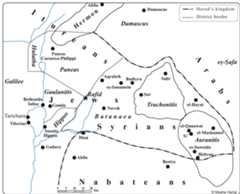
Towards the end of the second, and the beginning of the first centuries BCE the Nabateans in southern Hauran and the Itureans in northern Golan and Lebanon gained power. In between the two peoples there remained a large tract of land that included the Golan, the territory of Hippos, Bashan, Trachon and northern Hauran (Map 4). Most of this area was without permanent settlements and thus became attractive for Jewish settlers in the next 200 years. It would seem that the view expressed by several scholars claiming that this area formed a conflict zone between the Itureans and Nabateans is unfounded (Hartal 2005:381-391, 401, contra Kasher 1988:143-144, n.35).
The second military campaign of the Hasmonean king Alexander Jannaeus during the years 83-80 BCE was of prime importance for the history of the region. In its course, Jannaeus conquered Pella, besieged Gerasa and took it without a fight. "He also demolished Golan, and Seleucia, and what was called the Valley of Antiochus; besides which,
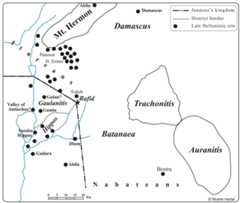
Map 4. Northern Transjordan in the late Hellenistic period.
he took the strong fortress of Gamala, and stripped Demetrius, who was governor therein, of what he had, on account of the many crimes laid to his charge" (Josephus, War I 104-105). In the parallel passage in Antiquities (XIII 393-394), the conquest of Dium is described instead of Pella. Jannaeus thus took southern Golan (the territory of Hippos; see Syncellus, Chronographia:558-559) and central Golan (Gaulanitis), but northern Golan remained under Iturean control (Map 4; Ma‘oz 1986:41; Hartal 2005:388-391).
The destiny of the two regions was not to be the same. Hippos, just as other Hellenistic cities, was captured but not destroyed by Jannaeus and apparently a pagan population remained within and in the surrounding territory; indeed, later it was restored by Pompey as one of the cities of the Decapolis (Josephus, Ant. XIV 75; War I 156). However, Jews settled in its area, as well, as is shown by the ‘list of forbidden villages’ in its territory. The list is evidence of a predominantly pagan area, but with well-established Jewish villages.
The district of Gaulanitis, which was nearly empty of
residents during the conquest of Jannaeus, became a favorite destination of Jewish settlers and soon became a significant Jewish territory. Though this process is not explicitly mentioned in the sources - just as it is not mentioned in relation to the Jewish territories in Galilee - it can be inferred from later developments: no towns in Gaulanitis were restored by Pompey or Gabinius and they appear on the eve of the Jewish War as Jewish cities (Josephus, War II 574). The Jewish settlement process in Gaulanitis has to be observed on the background of the situation in Judaea, where there was a rapid natural population growth in a rather restricted area. On the eve of the Maccabean revolt there was a state of overpopulation, with many landless; it was apparently this overpopulation that led to the expansion wars of the Hasmoneans. The landless were the mass of Hasmonean soldiers and in return for their services received land in the conquered territories (Bar-Kochva 1977:170177). At this time the Jewish settlement in Galilee expanded too (Schalit 1964:15; Bar-Kochva 1977:147-176; AdanBayewitz and Aviam 1997:161).
The Jewish settlement that developed in Gaulanitis was essentially the same as that in Galilee. There are many similarities in material culture and behavior patterns between the two populations (Meyers 1976), and though Gaulanitis was a separate administrative unit, it was considered for all practical purposes as part of Galilee. Thus Josephus, appointed commander of Galilee at the beginning of the Jewish war, was also the commander of Gaulanitis.
It seems that Gaulanitis district was created following Jannaeus’ conquests, in the area between the territory of Hippos/Sussita and the Iturean domains in the northern Golan Heights (Map 4). The Jewish settlement there continued without interruption until the Byzantine period. Because Jewish Gaulanitis bordered on pagan territories north and south of it, its boundaries can be determined by the extent of Jewish settlement as reflected in the distribution of the Byzantine period synagogues, as well as by other material culture, especially the variation and distribution of ceramic vessels within Golan and outside of it (Hartal 2005:271-274).
Both characteristics indicate that Jewish Gaulanitis extended only in the central Golan Heights of today, and the seven hundred year continuous Jewish occupation of the area is a direct result of Jannaeus’ conquests.
Rafid is situated at the eastern edge of Jannaeus’ domains in the Golan. The village had not yet existed in his time, and in the vicinity there are but few settlements dating to the Hellenistic period (Ibid.: Map 3). One of them is ‘Esheh, ca. 2 km northwest of Rafid (Map 4), which yielded evidence of an Iturean settlement, the southernmost in northern Golan. It seems that the settlement at Rafid commenced a few decades after Jannaeus’ conquest, when settlement of Batanea to the east began as well (see below).
From 63 BCE Syria and Palestine were firmly under Roman control. The Roman general Pompey passed through the Iturean principality and reduced its territory. Ptolemy son of Mennaeus, the Iturean ruler, saved himself and secured his rule by paying large sums to Pompey. The fate of the Hasmonean kingdom was harsher. Pompey abolished its independence and reduced its size (Josephus, Ant. XIV 7476; War I 155-157). He tore from Judaea the Hellenistic cities that were captured, and liberated and restored those that were not completely razed by the Jews (Josephus, Ant. XIV 74-76; War I 155-158).
Pompey’s actions in the Golan were different for each district. The Hellenistic city of Hippos, taken by Jannaeus, was torn from the Hasmonean kingdom together with its territory ( ), restored and granted autonomy (Josephus, Ant. XIV 75; War I 156). Later it was reckoned among the cities of the Decapolis. The other towns however, Golan, Seleucia and Gamla are not mentioned among the liberated cities and on the eve of the revolt they are mentioned as Jewish towns (Josephus, War II 574). It seems that contrary to Hippos/Sussita, where the pagan component seems to
have remained significant, in the towns of Gaulanitis the population was completely replaced.
The fact that Gaulanitis was not torn away from Judaea has great importance in understanding the development of the Jewish settlement there, and the statement by Avi-Yonah (1966:81) that Pompey tore Gaulanitis from Judaea is not substantiated by any source.
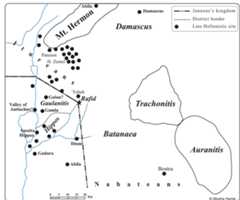
Sometime between 30 and 20 BCE all of Northern Transjordan came under the rule of Herod (Map 5), and most of it remained under the control of the Herodian dynasty until the end of the first century CE. In fact, this was the only period in history when all of Northern Transjordan belonged to a self-contained political unit, and this has implications on the settlement dynamics. This is also the period with the greatest amount of historical information.
In 30 BCE, after his victory at Actium, Octavian granted Herod Hippos and Gadara, in addition to Samaria/Sebaste and other cities in the coastal plain (Josephus, Ant. XV 217; War I 396). The Hellenistic city of Hippos, that had been in the hands of Jannaeus and was ‘liberated’ only 33 years earlier by Pompey, has again lost its independence. The annexation of Hippos to Judaea continued only in the lifetime of Herod and after the king’s death it was again restored to the status of a free city.
Seven years later, in 23 BCE, Augustus further expanded Herod’s territories and annexed to him Trachonitis, Batanea (Bashan) and Auranitis (Hauran) (Josephus, Ant. XV 343; War I 398). The events that led to this annexation were complex. After the death of Lysanias, Ptolemy’s heir (39 BCE), the Iturean principality was split into four smaller units. The ruler of the southernmost unit was Zenodorus, of royal Iturean lineage, who leased Lysanias’ territories from Cleopatra and ruled over a large area: Trachonitis, Batanes and Auranitis, in addition to the territory of Paneas and Hulatha. The apparent size of this unit is misleading, because the total income of this vast land was rather low: it was in fact very sparsely inhabited by nomadic and semi-nomadic peoples, and even the Paneas and Hulatha areas - northern Golan and the Hula valley respectively - were rural and rather poor.
The Romans leased the area to Zenodorus expecting him to impose order and safety, whereas he proceeded to send a group of brigands, whose center was in Trachonitis, against the territories of Damascus and the caravans approaching it. Two independent sources describe the events: Josephus (Ant. XV 343-348; War I 398) and Strabo (Geographica xvi 2, 20). Strabo makes it clear that the brigands were a special problem for the Romans, because not only the rural areas suffered, but also commerce in general. Josephus claims that it was economic conditions and poverty that drove those people to brigandry. Both Josephus and Strabo are explicit about the attacks on Damascus, and neither mentions attacks on villages in Auranitis or Batanea. It seems that at this stage there were no permanent settlements in these regions.
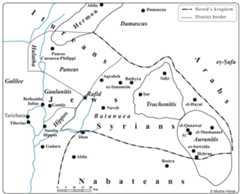
Map 5. Herod’s Kingdom in Northern Transjordan.
Strabo accredits the Romans in the subjugation of the brigands, and it is so in Josephus’ War. In Antiquities the brigands are suppressed by Herod and his army. The version in Antiquities seems to be the right one. The suppression of the brigands necessitated unconventional action and traversing difficult terrain with the aid of local guides. Herod’s army was more suitable and experienced in such operations, following his struggles with the rebels and brigands in Galilee.
It is not completely clear who were the brigands of Trachonitis. Already the first Roman governors were occupied by trying to repel ‘Arabs’ that harassed their neighbors (Appian, Syriacus Liber 51), and these appear not to have been the Nabateans, but Arabs that lived in the Leja (Bowersock 1983:33-34; Dentzer 1986:400). The brigands may have been disintegrating clans, individual refugees or small groups of Trachonitis residents that ‘supplemented’ their meager income by robbing the villages of Damascus and the caravans that passed by (Peters 1977:270, 1978:318; Dentzer 1986:400). According to Josephus they also farmed animals, and to ensure a water supply for them, they prepared in their hideout caves water
reservoirs that were fed from rainwater and were available even in periods of drought.
The epithet ‘brigands’ was generally applied by the Romans to all who did not accept the ordinary lifestyle of the peasants, and especially to nomads, and this label was part of the Romans’ propaganda to justify their actions. In this case however, it seems that the damage caused by the brigands was very real, and they were so well known that their image remained in collective memory down to the days of Philip the Arab (244-249 CE) (Ibid.:399).
During the first years after the annexation of Auranitis, Trachonitis and Batanea to Herod’s domains and the subjugation of the brigands, the latter were afraid of the king and ceased their acts of brigandry. In consequence, Herod was much esteemed by the Romans (Josephus, Ant. XVI 271-272) and so it was only natural that after the death of Zenodorus in 20 BCE Augustus, at the time visiting Syria, “bestowed his country, which was no small one, upon Herod; it lay between Trachonitis and Galilee, and contained Ulatha, and Paneas, and the country round about” (Josephus, Ant. XV 359-360; see also War I 400; Cassius Dio, Historia Romana lxvi, 9, 3). This is taken to be the district of Paneas
and the northern Hula valley, and the annexation of the whole Northern Transjordan to Herod was thus complete. This latest addition was the core area of Zenodorus’ principality and was inhabited by Itureans, and contrary to the situation in Auranitis and Trachonitis, there is no evidence that the inhabitants resisted Herod’s rule in any way.
Thus, Herod’s domains in the north included Hippos, Batanea, Auranitis, Trachonitis and Paneas. There is no mention however, of Gaulanitis ever being annexed to his kingdom, although there can be no doubt that it was included in it, because in his will it is counted among the districts to be given to his son Philip (Josephus, Ant. XVII 189). Although Gaulanitis is not mentioned among the districts approved by Augustus for Philip (Josephus, Ant. XVII 319; War II 95), it is included in his tetrarchy at the end of his life (Ant. XVIII 106). He even founded a city there: he renamed Bethsaida, on the shores of the Sea of Galilee near the estuary of the Jordan river to Iulias (Ant. XVIII 28; War II 168). Gaulanitis is also mentioned as one of the districts of king Agrippa II (War II 249) and was the only district in Northern Transjordan to actively revolt against the Romans in the Jewish war (War II 574, IV 2; Life 185-187).
Why then is its annexation to Herod not mentioned? This district was inhabited predominantly by Jews and included hardly any pagan settlements. It seems that it was this reason that prevented Pompey from tearing it away from Judaea, just as he did not separate Galilee and Idumea - both strongly Jewish in character - from Judaea. Therefore, Gaulanitis remained an integral part of Judaea even after the Roman conquest, and when Herod took over the Hasmonean kingdom, this already included Gaulanitis and its later annexation was not necessary (Ma’oz 1986:49; Hartal 1987:71).
Until the last third of the first century BCE the eastern regions of Batanea, Auranitis and Trachonitis were under complete control of nomadic and semi-nomadic tribes (Schürer 1973:319; Peters 1977:267). In 33 BCE the tribes began the construction of a cultic precinct at, near elQanawat, in northern Hauran. The temple was constructed at the crossroads of three regional roads, where no settlement had existed before (Dentzer 1986:404-405). The reason for the construction of the cultic center at this precise time is not clear, but may indicate the stabilization of the tribes and perhaps even the beginning of a process of sedentarization. The internal security in the region however, was still rather weak.
The Romans expected Herod to enforce security in the region and prevent the continued harassment of the permanent settlements and commerce. Fear of the king caused the brigands to change their ways, and Herod even tried to encourage them to settle down and take up agriculture. But the poor soil could not sustain an income comparable to that from robbery and the semi-nomadic people found it very difficult to settle down to a peasant life. As soon as they thought that Herod was dead and the situation changed, they rebelled and returned to their old ways (Ant. XVI 271-275). In the year 12 BCE, while Herod was in Rome, the inhabitants of Trachonitis rebelled and renewed their banditry (Ant. XVI 130).
When Herod returned from Rome in 10 BCE he turned to deal with the rebels, who found refuge with the Nabateans. At first he swept through Trachonitis and massacred their relatives (Ant. XVI 276-277), and when this move did not help in stopping the rebels, he declared war on the Nabateans (Ant. XVI 271-285).
To stem any future rebellions, Herod strengthened his forces and settled at the edge of Trachonitis 3000 Idumeans, whose duty was to secure safe travel and to prevent the inhabitants to raid their neighbors. The Idumeans however, as either garrison or military colonists, did not last long in the hostile Trachonitis. Augustus’ harsh reaction to Herod’s campaign against the Nabateans in 9 BCE weakened the latter’s position and in fact caused a new rebellion, aimed this time against the Idumeans (Ant. XVI 292). The Arabs who rebelled were not the Nabateans or desert nomads, but the inhabitants of Auranitis (Gracey 1986:316; Macdonald 1993:313-314). Their cooperation with the inhabitants of Trachonitis against the Herodian garrison in Herod’s own territories shows the king’s temporary weakness at this point in time.
Soon after the failure of the Idumean experiment, Herod attempted yet again to control and subdue Trachonitis and ensure safe passage in those parts (Ant. XVII 23-28). In order to prevent raids from Trachonitis it was necessary to keep a military presence nearby, and the most suitable form of such a presence was a military colony (Cohen 1972:91). Herod seems to have learnt a lesson from the Idumeans’ failure and this time he put the colonists in Batanea and not around the fringes of Trachonitis, so as to keep them less exposed to attacks by the brigands. He also founded a large, central settlement which was easier to protect than the small villages of the Idumeans. But most important, he chose a man with the right qualities to lead the colonization. Zamaris was a Jewish aristocrat from Babylon, who moved to Syria with a force of mounted archers, an expertise of the Parthians. By invitation from Herod, he came with his unit to Batanea and founded a military colony (Applebaum 1970; Cohen 1972; Shatzman 1991:175-180). The colony included a large village, Bathyra, and a chain of forts. Daily life was conducted in the village, while the forts served for defense.
Zamaris received from Herod title to the land and exemption from taxes. These incentives attracted many settlers, whose origin and background are not always clear, but they came from all over Herod’s kingdom, and from Babylon (Shatzman 1991:177).
The tasks of Zamaris were manifold. He was required to safekeep the general security in the area and the pilgrim routes from Babylon to Jerusalem, as well as the prevention of brigandry. Zamaris seems to have succeeded where the Idumeans failed. The uprisings of the people of Trachonitis stopped and for the first time in a long time security was achieved. The combination of free land, tax exemption and personal security led to prosperity in Batanea. According to Josephus, the settlers were Jews, and having received so much from Herod they felt obligated to him and remained loyal to him and his successors for a long time.
It would be reasonable to assume that such a large scale resettlement project, involving the transfer of large tracts of land would cause resentment on the part of the former inhabitants, just as had been the case with the reaction of the Nabateans and the inhabitants of Trachonitis to Herod’s earlier actions. The sources however, do not mention any such resentment, and Josephus explained the tax exemptions by that ‘the land is not productive’ (Ant. XVII 25). It seems therefore that the military colonization in Batanea took place in an area that had been only sparsely inhabited until then. This colonization was in fact the ‘watershed’ event in the history of Batanea, Auranitis and Trachonitis. In the next hundred years, when the area was under the control of the Herodian dynasty, it enjoyed peace and security that brought forth the establishment of sedentary settlements and gradually pushed out the nomadic elements (Dentzer 1986:393, 396; Sartre 1997:80-81). Batanea turned into the granary of Syria.
Rafid is situated on the boundary between Gaulanitis and Batanea, but it is not known to which district it belonged. Unfortunately no finds were found in the survey that could determine the exact date of its establishment. Relying on Urman’s dating, it seems to have been founded in the early Roman period and so its founding can be reasonably connected with the settlement process described above. Rafid is in an area with much grazing land and small springs suitable for the raising of horses, and indeed, in many of the surveyed houses remains of stables were identified. Thus it seems that horse breeding was the main economy of the village, horses having been in high demand by the military colonists and the Herodian armies (see below).
Herod himself did not make any significant contribution to Auranitis. The suppression of the residents of Trachonitis, the stabilization of security and the colonization campaign started not long before his death, and most actions were carried out by his successors. Yet the sanctuary at, whose construction started ten years before the annexation of the area to Herod, was mostly built during his lifetime (DentzerFeydy 1991:45-47; Sartre 1991b:29-31) and completed under Philip. Herod undoubtedly contributed to the sanctuary, but his influence on its architectural character was minimal (Dentzer 1986:411). In the temple at $\mathrm{Si}^{+}$the base of a statue was found with a dedication to Herod inscribed on it (Gracey 1986:319; Dentzer and Dentzer 1981:101; Millar 1994:395-396).
Herod did not contribute a thing to Gaulanitis. The area had already been settled by Jews, who arrived during the reign of the Hasmoneans. These, as their brethren in Galilee, did not feel much obliged to Herod and surely remained loyal to the memory of the Hasmonean dynasty. The Jews of Batanea on the other hand, owed their land, villages and good circumstances to Herod and remained loyal to him and his heirs. The difference between the Jews of Gaulanitis and those of Batanea continued in the following generations and reached its climax during the Jewish war.
After the death of Herod in 4 BCE, his kingdom was divided among his three surviving sons. Northern Transjordan was the share of Philip (Josephus, Ant. XVII 189, 318-319; War II 95) and only the Hellenistic city of Hippos/Sussita, annexed to Herod in 30 BCE, was taken away and attached to the province of Syria (Ant. XVII 320; War II 97). The tetrarchy of Philip extended over a large area and included Gaulanitis, Paneas, Batanea, Auranitis and Trachonitis. Its inhabitants were diverse (Schürer 1973:336-338). Its western part, the Golan Heights, was already inhabited by Itureans, Jews and Syrians. Part of Batanea was inhabited by the Babylonian Jews concentrated in the military colony of Bathyra and the surrounding villages. The eastern districts, Huranitis, Batanea and Trachonitis were inhabited by Syrians - Arameans and Arabs - who were in the process of a large scale settlement and sedentarization (Map 5). The insecurity that characterized the region until Herod was replaced by stability and peace that lasted over a hundred years.
Philip ruled his tetrarchy for 37 years (4 BCE-33 CE). He seems to have had the right personal qualities and he succeeded in consolidating a tetrarchy with widely varying populations into a coherent political unit in which peace and order were the rule. There are no echoes of animosity between the various ethnic constituents of his domains (Kasher 1988:175-176).
Philip’s way of governing and his voyages across his tetrarchy, followed by his court and his readiness to set up a tribunal wherever it was necessary (Josephus, Ant. XVIII 106-108), reflects on a reality where most of the population had not yet settled down to a sedentary life. His capital at Paneas was built at the edge of his tetrarchy and was not accessible to most of the population. In his journeys Philip brought government to the people.
The Babylonian military colony in Batanea was exempt from taxes during the lifetime of Herod, and this preferential condition was helpful in creating the settlement boom in the region (Ant. XVII 27). This tax exemption was canceled with the king’s death, probably because his income was low (Ant. XVII 28; Gracey 1986:314; Shatzman 1991:176-177). Philip’s revenues from his tetrarchy were relatively low: 100 talents only, in contrast to 200 talents that Antipas, Herod’s other son received from the Galilee and the Peraia and the 600 talents that went to Archelaus from Judaea and Jericho (Ant. XVII 318-320; War II 93-100). Herod had received 1050 talents. By this time however, the settlements in Batanea were well-established and the imposition of tax did not undermine their economic stability.
The suppression of brigandry removed the obstacles for settlement not only in Batanea, but also in Trachonitis and Auranitis as well. In these regions, and especially in Auranitis, rural communities developed (Dentzer 1986:396).
Most of the population in Philip’s tetrarchy was pagan;
Jews resided in Gaulanitis and Batanea. Itureans settled in the Paneas area and Syrians made up the rest. It seems that the pagan population increased in Batanea as well, following the Babylonian immigration. In spite of his Jewish religion, Philip allowed religious freedom throughout his domains. In addition to the temple to Augustus at his capital - which also appears on his coins - temples were built in his days also at el-Mushennef, el-Qanawat and es-Suweida in Auranitis, at Sahr and Sur in Trachonitis and at 'Aqrabeh in northern Batanea. The sanctuary at was completed during his reign.
Almost as soon as he came to power, Philip founded his capital at Paneas (Ant. XVIII 28; War II 168) and called it Caesara, and to distinguish it from other cities with the same name he added the epithet Philippi. The numismatic and epigraphic evidence suggests a founding date in 2 BCE (Stein 1989; Di Segni 1997:17).
In the Buteiha valley in lower Golan, Philip granted the status of polis to Bethsaida and renamed it Iulias (Ant. XVIII 28; War II 168). The city was apparently dedicated in 31/30 CE (Kindler 1999:245-247). Excavations conducted in recent years on the summit of el-Tel revealed a settlement stratum from the Hellenistic and early Roman periods. The stratum is characterized by houses with large courtyards (Arav 1995).
Philip died at Iulias in 33 CE (Kokkinos 1998:237) “and when he was carried to that monument which he had already erected for himself beforehand, he was buried with great pomp” (Ant. XVIII 108). It is likely that Philip built his tomb at Paneas, which was his capital and residence and where he built large and imposing public structures. Herod too, having died at Jericho, was brought to be buried in the tomb he had prepared for himself at Herodium (Josephus, Ant. XVII 188; War I 673), so Philip’s body was apparently carried with great pomp from Iulias to Paneas and was buried there (Kokkinos 1998:238, n. 121).
As Philip had no heirs, his tetrarchy was annexed to Syria (Ant. XVIII 108), but the emperor Tiberius meant this as a temporary annexation and ordered the tax revenues collected in the tetrarchy to be kept there and not transferred to the provincial capital.
During the first century CE, Northern Transjordan served as a training ground for the Herodian rulers. They received at first small territories and their efficiency was monitored by the Romans. If they were successful, their domains were gradually enlarged (Dentzer 1986:393).
When Philip died, his nephew Agrippa lived in Rome. He lived there a licentious life and was close to Tiberius’ court, but towards the end of Tiberius’ life he was thrown in jail for half a year (Ant. XVIII 143-204). When Caligula became emperor in 37 CE he freed his friend Agrippa and gave him the tetrarchies of Philip and Lysanias (Abila) and conferred on him the title of king (Ant. XVIII 235-237; War II 181; Philo, In Flaccum 25, 40). Agrippa did not hasten to
his new kingdom. Only in Caligula’s second year (38 CE) he left Rome and arrived in his capital Caesarea (Paneas) (Ant. XVIII 238-239). In 39 CE Caligula transferred to Agrippa Antipas’ tetrarchy as well, which included the Galilee and the Peraia (Schwartz 1990:59-62; Kushnir-Stein 2003).
In contrast to Philip, who ruled only over Northern Transjordan, lived there and was active towards its development, Agrippa I ruled over a far larger area with the inclusion of the Galilee and Peraia. His actions within his kingdom, and especially in Northern Transjordan, are by and large unknown. Most of his interests lay in Judaea (Schwartz 1990:67-74), which was added to his kingdom in 41 CE together with Samaria, after Claudius confirmed his rule (Ant. XIX 274-275; War II 215). Agrippa returned to Judaea in 41 CE and spent his last years in Judaea and its capital, Jerusalem. Northern Transjordan remained a remote region and does not appear to have received much attention from the king. Relatively few pieces of evidence have survived in Auranitis from the days of Agrippa I. In an inscription found at el-Qanawat, King Agrippa (it is unclear whether the first or the second) turns to the population to ask them to stop living in caves like animals and move to a sedentary life in real houses (Waddington 1870: No. 2329). This inscription is extremely fragmentary, but if its reconstruction is true, it can proves that the process of sedentarization had not yet been completed and there were still nomads and inhabitants living in caves, just like the inhabitants of Trachonitis.
Agrippa I died in 44 CE, having ruled six years, the last three over his large kingdom (Josephus, War II 219). His son, Agrippa II was too young at the time, so Claudius annexed the kingdom to Syria. A Nabatean inscription found in Hebran and dated in the seventh year of Claudius (47/8 CE), marks the southern boundary of Roman rule in Auranitis and is evidence of the interim period of direct Roman rule from the death of Agrippa I to the accession of Agrippa II (Sartre 1982a:50).
The system of training the Herodian rulers was renewed with the accession of young Agrippa II. In 48 CE he was given the rule of Chalkis (Josephus, Ant. XX 104; War II 104). Four years later, in 53 CE, Chalkis was taken away from him and he was given Philip’s tetrarchy, Lysanias’ kingdom (Abila) and Varus’ tetrarchy ('Aтqa) (Ant. XX 138; War II 247). In 61 CE Nero enlarged his kingdom further, and granted him Tiberias, Tarichaea and the Peraia (Ant. XX 159; War II 252). The career of Agrippa II thus followed that of his father. The outbreak of the revolt interrupted the process of the enlargement of his kingdom, but his loyalty to Rome ensured his continued rule until his death.
Agrippa’s capital was at Paneas, which he enlarged and beautified (Josephus, War III 514). His rule is characterized by stability and prosperity in Northern Transjordan (Dentzer 1986:393; Sartre 1985:193), which led the nomads to take up agriculture and settle down (Villeneuve1985:75), a
process that continued throughout the first century CE (Dentzer 1986:400). The excavations at $\mathrm{Si}^{+}$and Bostra emphasize the importance of the second half of the first century CE in the development of the area. This period of peace was an important one for the development of agriculture and for the building of monuments (Dentzer 1986:398; Dentzer-Feydy 1986:285), and it is in this period that Sur became a nucleus for settlement in Trachonitis (Sartre 1985:193).
In Batanea the Babylonian settlements continued to prosper, but alongside the Jewish settlements a Syrian-pagan population settled as well.
The rule of the house of Herod brought an accelerated Hellenization of Auranitis, Trachonitis and Batanea. During the reign of Agrippa II the temple of Ba‘al-Shamin at was enlarged (Dentzer-Feydy 1986:270, 1991:46) and the $\mathrm{Si}^{+}\mathrm{Si}^{+}$. These structures differ in their façades and their decorations from the Hauranitis tradition. Similar decorations have been discovered on an inscription of Agrippa II, corroborating their dating to the first century CE (Dentzer and Dentzer 1981:101).
Another testimony for the influence of Agrippa in Hauran is the widespread distribution of the name. Of thirty inscriptions from Syria containing the name Agrippa, twenty-five are from the Hauran. It seems therefore that the local population was not indifferent to the king’s actions (Sartre 1985:201, n. 29). Inscriptions of Agrippa II have been found at el-Sanamein, Sur, el-Hayat, Si‘, es-Suweida and 'Aqrabeh (Sartre 1982a:48; Kokkinos 1998:333).
Agrippa’s army, as surely also that of his predecessors, was built around the nucleus of the military colonists of Batanea. During the reign of Herod, when security was low, the Babylonians stayed in the area and were exempt of military duty. During the reign of Agrippa things changed. Philip son of Jacimus, inherited his father’s post as commander of the cavalry of Batanea, and was also a loyal friend of the king (Josephus, Ant. XVII 29-31; Cohen 1972:9192; Shatzman 1991:179-180). The cumulative experience of three generations taught the Babylonians the special problems of the defense of the region. The military colony was the power base of Agrippa and in spite of the taxation on the colony, it was able to supply cavalry for his bodyguard (Gracey 1986:319). We hear about the cavalry during the Jewish War: Agrippa sent 2000 cavalry to Jerusalem, 2000 cavalry and 3000 foot archers to aid Cestius Gallus and 1000 cavalry and 2000 foot archers to join Vespasian’s army. This army’s main purpose however, was to keep internal security and protect the permanent settlements from the nomads in es-Ṣafa or within the kingdom.
The kingdom of Agrippa II in Northern Transjordan was an intricate mosaic of peoples: Itureans in the territory of
Paneas, Jews in Gaulanitis and Batanea and Syrians in Batanea, Trachonitis and Auranitis. The diversity of the population caused each group to react differently to the revolt of the Jews against the Romans. Naturally, the Itureans and Syrians did not participate, but even among the Jews there were two groups with opposite orientation. The Jews of Batanea, led by the Babylonians, were settled in the region with the help of Herod and enjoyed special privileges. It seems that even after the revocation by Philip of the tax exemptions granted by Herod these Jews had remained loyal to the Herodians. They formed the nucleus of Agrippa’s army and led it. Thus, the Jews of Bashan not only avoided joining the revolt, but were among the first forces to try and put it down. In contrast, the Jews of Gaulanitis, descendants of the settlers from the time of Alexander Jannaeus, did not receive any special support from Herod. These Jews were no different in any respect from the Jews living in Galilee and were surely connected there also by marriage ties. They had no special affinity to the Herodians, and the same factors that caused the Galilean Jews to revolt against the Romans caused them to revolt too. It should not surprise therefore that the inhabitants of Gaulanitis were the only ones in Northern Transjordan to join the revolt.
Gaulanitis was not involved in the very first moves of the revolt. Agrippa II apparently trusted the loyalty of the population, and had sent 2000 horsemen from Batanea, led by Darius, to strengthen the ‘peace party’ in Jerusalem. Together with them went Philip son of Jacimus, the king’s general (Josephus, War II 421). The army arrived from areas inhabited by Jewish military colonists and pagans, all loyal to the king. It joined the fight against the rebels in Jerusalem but was unsuccessful and retreated (War II 422-440).
The first phases of the revolt were accompanied by riots and clashes between Jews and pagans. After the murder of the Jews in Caesarea Maritima (War II 457) the Jews went on to retaliate. Bands of Jews attacked the villages of Syria and the Decapolis, including Hippos on the Golan (War II 458-459). As the Gaulanitis was inhabited primarily by Jews, it seems that the villages hit were around its edges, perhaps on the border with the territory of Hippos. As a reaction to the Jewish attacks, Jews living in Hellenistic cities were massacred. The citizens of Hippos and Gadara also killed some of the Jews living in their cities, and arrested the remainder (War II 477-478). Some scholars believe that it is these actions that ended the Jewish population in the territory of Hippos/Sussita (Ma‘oz 1986:82-83).
Agrippa’s kingdom did not emerge unscathed either. According to Josephus (War II 481483), a delegation came to the king from the colonists of Batanea to seek protection in the event that the unrest should spread to their area. The text is not clear about whom they were seeking protection from: the many pagans in the region or contrary, from the rebellious Jews. It seems strange that the delegation from Batanea should go to Paneas to seek military help, considering that the center of the military colony and Agrippa’s horsemen were in their region. It may be that the reason for this was the transport of the cavalry to Jerusalem,
which left Batanea unprotected. In Josephus’ Vita (56-61) the narrative is more detailed. Varus, of the family of the Iturean king of 'Arqa, was appointed by Agrippa to serve as his caretaker at Paneas. Under the influence of the local Syrians he attacked the Jewish population. According to Vita, Varus himself solicited the Batanea delegation, scheming to attack the Babylonians in Ecbatana. According to this version, the Babylonians had not intended to revolt and sent the requested delegation willingly. Having murdered the delegation, Varus intended to join forces with the ‘Trachonites from the Batanea’ and attack Ecbatana. This scheme was revealed to the inhabitants and they fled to Gamla, leaving all their possessions behind. Josephus does not mention whether or not Varus carried out his plan to attack the Jews of Batanea. It is possible that Varus intended to harm Philip’s men, because Philip was a threat to his position in the court of Agrippa (Mason 2001:54, n. 311). The ‘Trachonites from the Batanea’ are reasonably the descendants of the brigands of Trachonitis, who settled in Batanea. These were undoubtedly no great admirers of the Herodians, and surely not of the Babylonians, who campaigned against their forefathers. The request for help on the part of the people of Bashan, described in War, may have been directed against them.
As soon as Agrippa’s rule stabilized after deposing Varus the king proceeded to return the Babylonian refugees from Gamla to their homes in Batanea (Life 179-184). A few stayed behind at Gamla, as “in a sedition they raised against the Babylonians, after the departure of Philip, slew Chares, who was a kinsman of Philip” (Life 177). These events influenced the Jews of Batanea and some of them joined the rebels (War II 520, III 541-542), but there is no evidence that the district as a whole participated in the revolt.
The Batanean cavalry that retreated from Jerusalem was sent by Agrippa to aid Cestius Gallus’ army, in his quest to put down the revolt in Jerusalem (War II 500). It seems that in the battle that Gallus was defeated (War II 540-555) many of Agrippa’s contingent were killed as well, because a year later, when Vespasian arrived in Galilee Agrippa sent him only half the number of troops - 1000 cavalry and 2000 infantry (War III 68).
The defeat of Cestius Gallus (War II 513-555) changed the attitude of the Jews of Gaulanitis to the revolt. Now Josephus was made commander of Galilee and Gaulanitis (War II 571), and at Gamla Joseph, son of the female physician, recruited a group of young people who made the town rise up in revolt (Life 185). Together with Gamla rebelled all the Gaulanitis, as far as Kefar Shalem (Solyma, Life 187), whose location is unknown. Three communities were fortified by Josephus: Gamla, Sogane and Seleucia (War II 574; Life 186-187). At Gamla, the initiative was that of the inhabitants and Josephus only aided them (Life 186).
During the early stages of the revolt, before the arrival of Vespasian to Galilee, Agrippa tried to handle the crisis in the Golan by himself. Initially he tried to capture Gamla with the aid of Aequus Modius, Varus’ successor. But as he
did not have sufficient troops at hand, he only threw a loose siege around the town by placing units at strategic points (Life 114). Later, he tried to block the passage to Gamla and Seleucia near lulias, to prevent supplies from reaching those towns from Galilee (Life 394-406).
The Jews at Paneas did not fare much better. To prevent them from joining the revolt, they were locked in the city. Answering their request, John of Gischala supplied them with kosher olive oil at an inflated price (War II 591-592; Life 74-76). Josephus refers to him as a profiteer, but it seems that John had used the revenues from this transaction to pay for the expenses of the revolt and the fortification of Gischala.
After capturing all of Galilee, Vespasian came to Paneas to rest his army on the request of Agrippa, who hoped to put down the revolt in Golan with the aid of the Romans (War III 443-445). At this stage the struggle in Golan came to its climax. Sogane and Seleucia surrendered to the Romans and Gamla remained alone in its resistance (War IV 2). After capturing Tiberias and Tarichaea, Vespasian marched his army, which included three legions, and besieged Gamla (War IV 11-13). The siege and battles are described in detail by Josephus (War IV 2-83); after two attempts of storming the city, one of which failed, the city was captured and most of its inhabitants were killed either by the Romans or in their attempt to flee (Gutman 1994:67-75).
With the fall of Gamla, the revolt in the Golan was in fact suppressed. There is no information on further battles, because other communities that rebelled had surrendered already before the fall of Gamla. It seems that except for Gamla and its immediate vicinity, Golan did not suffer on the hands of the Romans and remained a densely populated Jewish district afterward.
After the siege of Jerusalem Titus came with his army to rest at Paneas and he “staid there a considerable time, and exhibited all sorts of shows there. And here a great number of the captives were destroyed, some being thrown to wild beasts, and others in multitudes forced to kill one another, as if they were their enemies” (War VII 23-24). It may be that this passage alludes to a theater that was at Paneas but not yet discovered.
After the suppression of the revolt Agrippa continued his rule uninterrupted, but contrary to his father, he did not receive any further additions to his kingdom and did not rule over all of Judaea. There is precious little information on the events of this period, but it seems that the effects of the Jewish war on Northern Transjordan was marginal. The only district to participate in the revolt was Gaulanitis and within it the only town to be captured was Gamla. Other communities were not affected (Ben-David 1999).
Agrippa lived for thirty years after the revolt. Scholars have been divided as to his exact year of death, but lately it has been accepted that he died in 100 CE (Kokkinos 1998:396-400). Agrippa II was one of the last vassal kings
of Rome. Already under Vespasian Emesa and Commagene were transferred under direct Roman rule, and the small tetrarchies of southern Syria vanished under Trajan. The local rulers served as mediators between imperial power and the local population and at this stage their role was not necessary any more (Rey-Coquais 1989:52). A few years later, in 106 CE , the process was complete with the annexation of the Nabatean kingdom and the establishment of the provincia Arabia.
With the end of Agrippa’s rule in Northern Transjordan, whether on his death or a few years earlier, Herodian rule over the region came to an end. The Romans did not pass down the region to his heirs and it came under direct Roman rule. After over a hundred years of being a single political unit, Northern Transjordan was now divided between two provinces. Auranitis, Trachonitis, Batanea and the territory of Paneas were annexed to Syria, while Gaulanitis, Galilee and the Peraia to Judaea (Map 6).
Why did Gaulanitis fare differently from the neighboring districts? Why was it not annexed to Syria as well? There are no extant sources to assert the Roman’s reasons for
treating Gaulanitis differently, but we can presume that the reason was the predominantly Jewish character of this district. This character, coupled with the rebellious tendencies of the Gaulanitis, made it easier to rule as part of Judaea, where most Palestinian Jewry lived. The Jewish minorities in the other districts of Northern Transjordan were mostly loyal to Rome. The Jewish communities of Batanea eventually became a Jewish enclave in a pagan country, as shown also by the Varus affair. The Babylonians were loyal to the house of Herod and to the Romans and there was no problem in annexing them to Syria.
Following the separation of Gaulanitis from the other districts, the boundary between Gaulanitis and Paneas that had been an internal boundary in Agrippa’s kingdom, became a provincial boundary. This transformation sheds light on the Romans’ considerations in fixing their provincial boundaries. In this case it is clear that they related to the demographic situation even in a small district such as the Golan. This is not to say that these considerations were always dominant, but it seems that the determination of the provincial boundaries was not arbitrary. The new boundary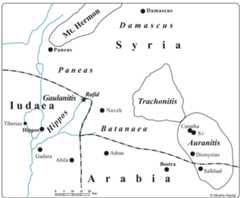
Map 6. Northern Transjordan in the. CE.
between the provinces of Judaea and Syria was the boundary between the Jewish dominated Gaulanitis and the Iturean territory of Paneas. This move had consequences that affected the history of the region in the following centuries. The case of Gaulanitis, which in the first century was part of a large unit and was detached from it at the end of the century, allows us to follow the cultural changes that resulted in this detachment. What began as a political division became in time a barrier that created different material cultures (Hartal 2005:271-274; Forthcoming).
In the second century the Roman empire knew peace and stability, which brought prosperity to Northern Transjordan (Sartre 1991b:31). The region remained untouched by the events in Palestine, chief among them being the Bar-Kokhba revolt (132-135 CE). The empire was ruled close to a hundred years ( ) by the Antonines. The reigns of Nerva, Trajan, Hadrian, Antoninus Pius and Marcus Aurelius ( ) was characterized by a stable regime that was occupied with constant amendments and improvements to justice and public service and acted for the welfare of the provinces. During the reign of Commodus (180-192 CE) the order in the empire was weakened and it came to near anarchy and bankruptcy. Prosperity ended (Herr 1985:1819) and the third century was characterized by internal uprisings and external invasions. Following the murder of Commodus a civil war erupted, which lasted four years. Septimius Severus took the reigns of government after defeating Pescennius Niger, Syria’s governor, and founded the Severan dynasty. To prevent provincial governors from attaining too much power, as was the case with Niger, Severus split some provinces, including Syria (see below). He placed capable governors in the provinces and saw to their welfare. In spite of the Parthian invasion of Syria in 162 and the struggle between Severus and Niger, Syria enjoyed prosperity until the third century. Severus’ heir Caracalla, known for his cruelty, relied on the army, raised its pay and so the treasury dwindled. During the reign of his successors Macrinus and Elagabalus the situation even worsened. Alexander Severus’ attempt to restore civil administration failed because his murder in 235 CE (ReyCoquais 1978:55-56; Herr 1985:23-26).
Following Severus’ murder a period of anarchy followed, which lasted some fifty years (235-284 CE). Emperors changed in quick succession and most did not die a natural death. Among the many, we should mention Philip the Arab, a native of Hauran, who seized control in 244 CE and turned his village Shahba into a Roman city - Philippopolis (Map 7; Rey-Coquais 1989:58). Philip did not last long either, and was murdered in a mutiny of the army in 249 CE. Military discipline deteriorated and the army was loyal to its commanders rather than to the emperor, time and again trying to raise them to the purple. This state of chaos
encouraged outside enemies to invade the empire, devastating the economy. The upkeep of the large army was a huge economic burden and consequently the tax load increased. The desperate need for money caused a sharp decrease in the silver content of the coins and rampant inflation. A by-product of inflation was the increase in payment in kind, taxes were paid in labor and products. The tax burden and conscriptions caused many farmers to leave their land and move to the cities, thus worsening the situation in the cities themselves. Many lost their land ownership and became tenant farmers on their own land. These troubles were accompanied by banditry and natural disasters, droughts and epidemics that decimated the population and further increased the burden on those who remained. City building stopped and the existing ones were surrounded by walls for protection (Levine 1982:120-122; Avi-Yonah 1984:74-97; Herr 1985:38-43; ReyCoquais 1989:57-61; Bar 2001:144-145).
The economic crisis did not affect all parts of the empire, or even neighboring districts, to the same extent (Bar 2001). It is difficult to know how the crisis affected Northern Transjordan. On the one hand, some regions appear to have been little affected. The Northern Golan Survey for example, showed that in the Late Roman period there was a record number of settlements (Hartal 1989:130-132).
The economic crisis may have been one reason for the abandonment of the Jewish communities in the territory of Hippos, but it seems to be the end of a process that began with the damages caused to these communities at the beginning of the Great Revolt. During the mid-second to the mid-third centuries CE, twelve settlements in central Golan were abandoned and three were founded (Ben-David 1999:241). It is tempting to attribute the abandonment to the economic crisis and the founding of new settlements to the stabilization that occurred in the early fourth century, but this cannot be proven unequivocally.
It seems that Auranitis enjoyed prosperity at this time, at least in the reign of Philip the Arab, who turned his birth village into a city and invested large sums in its beautification. But even here there are signs of the crisis. Towards the end of the third century there was an all-out destruction and abandonment of the settlements of Auranitis, yet in the fourth century a new period of prosperity began (Villeneuve 1991:42).
The territories that were in the kingdom of Agrippa II were not immediately integrated in the imperial administration. At many sites the inscriptions are dated according to the regnal years of the emperors, a fact that led Rey-Cocquais (1989:52-53) to conclude that the entire territory was an imperial estate.
In the early second century CE the process of annexation of all vassal kingdoms was complete. In 106 CE the last Nabatean king, Rabbel II died, and his kingdom was annexed without resistance to the Roman empire by Trajan and
became the provincia Arabia (Cassius Dio, Historia Romana lxviii, 14). This province extended from southern Hauran to Sinai and northern Hejaz. Its capital was fixed in Bostra, which had been Rabbel’s capital, and which became the seat of the provincial governor and the Third Legion (Cyrenaica) under his command (Peters 1978:318; Bowersock 1983:7983; Starcky 1985:171-172; Rey-Coquais 1989:53; Sartre 1991b:31; Millar 1994:92-99).
After the creation of provincia Arabia and the annexation of Agrippa’s kingdom, Northern Transjordan was divided among three provinces (Map 7). The territory of Hippos and Gaulanitis were annexed to Judaea, whose name was changed to Palaestina following the suppression of the BarKokhba revolt in 135 CE. The territory of Paneas, Batanea, Trachonitis and Auranitis were included during the second century CE in Syria.
It appears that at the time of its creation, the northern border of Arabia was placed along the course of the old boundary between the Nabatean kingdom and the Herodian domains, i.e. north of Der’a (Adraa), Bostra and Ṣalkhad (Map 6). This
border did not change throughout most of the second century (Sartre 1982b:17, 50-54; Dentzer 1986:395, n. 31).
A change in the structure of the provinces occurred at the end of that century. After his victory over Pescennius Niger, the governor of the province of Syria (195 CE), Septimius Severus divided the province into two: SyriaCoele in the north and Syria-Phoenice in the south.
The most important source for the borders of the Roman provinces in the second century is the geographical guide of Claudius Ptolemaeus, Geographica. This is a guide for the preparation of maps that includes precise location in degrees of longitude and latitude of the various provinces and their capitals (Tsafrir 1984:354). The guide was written in the mid-second century CE and is the first known appearance of the provinces Syria-Coele, Syria-Phoenice, Palaestina and Arabia. Although Ptolemaeus’ information was sometimes inconsistent (the towns of Arabia are included in five different chapters and he uses the anachronistic names Decapolis and Coele-Syria), this is the earliest evidence for the administrative status after the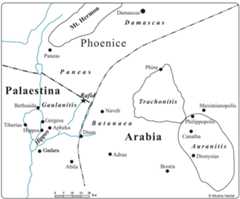
Map 7. Northern Transjordan in the c. CE.
annexation of Agrippa’s kingdom and that of the Nabateans. In Northern Transjordan Ptolemaeus counts Caesarea-Paneas in Syria-Phoenice and Hippos in the Decapolis which is in Coele-Syria. Hippos was in fact in Palaestina, as shown by an inscription found at Fiq. Iulias appears alongside the towns of Galilee in Palaestina and Gaulanitis seems to have been included in it as well (Sartre 1982b; Tsafrir 1984:355357; Ma’oz 1986:53-54).
At the end of the second and beginning of the third century CE the boundaries of Arabia changed, and annexed to it were Auranitis, Btanean and Trachonitis that were separated from Syria-Phoenice (Map 7; Sartre 1982b:54-62). At the end of the process, most of Northern Transjordan was included in Arabia, which now reached north to the territory of Damascus. Only the western part, the territory of Hippos and Gaulanitis remained in Palaestina, while the northwestern area, the territory of Paneas, remained in Syria-Phoenice.
Eusebius’ Onomastikon was written towards the end of the reign of Diocletian, possibly in 293 CE, that is, before the Christianization of Palestine (Isaac 1996:155). Its purpose was identifying and explaining the place names mentioned in the scriptures. Though it does not include all the settlements of his day, but only those identified with places from the scriptures, it is still a major source of information on contemporaneous geography (Tsafrir 1984:361, n. 24). The Onomsatikon reflects also the changes in the provincial borders in Northern Transjordan (Ma’oz 1986:55).
According to Eusebius, Batanea, Auranitis and Trachonitis were included in Arabia. In Phoenice he explicitly includes only Damascus, but Paneas, Hermon and Dan were included in it too. The territory of Hippos, including Apheka, was in Palaestina, and it also included Gergesa (Kursi), Bethsaida and the Decapolis (Ibid.:55-56). Despite the large quantity of information provided by Eusebius, it seems that he was not well acquainted with Northern Transjordan (on Eusebius’ sources and their limitations, see Isaac 1996). This is especially noticeable in the description of Trachonitis which is always made in connection with Bostra, though the two are separated by some 30 km (Map 7). The influence of the Biblical or evangelical text is apparent in the place descriptions. Luke (3:1) describes Philip as “tetrarch of Ituraea and of the region of Trachonitis”, so Eusebius identified Trachonitis with Iturea, though this name is not likely to have been current in his days (Hartal 2005:418-421). It seems that the identification of Golan as a village in Batanea, which gave its name to the district, was also influenced by the Biblical passage referring to “Golan in Bashan” (e.g. Joshua 21:27). As we shall see, in the sixth century Golan district (clima Gaulames) was part of Palaestina secunda, while Batanea was part of Arabia. Considering that there is no other source that mentions “Golan in Batanea”, and that all extant sources mention Golan in the central Golan Heights, there is no
alternative but to assume that Eusebius’ information was incorrect.
At 'Esheh, about two km northwest of Rafid, a boundary stone was found, which, according to Urman is from Rafid. This stone is helpful in reconstructing the provincial boundaries nearby. Because of the importance of this find for the understanding of Rafid’s position in this period, I shall elaborate below on the boundary stones and their contribution to the reconstruction of the provincial boundaries.
Following the economic crisis of the third century, emperor Diocletian, who rose to power in 284 CE, succeeded in stabilizing the empire and created a new form of government - the tetrarchy. At the head of the central government stood four leaders, responsible for the defense of the empire and government. There were two augusti: Diocletian and Maximian and two caesares: Constantius and Galerius. Diocletian drastically reformed the administration: he re-divided the provinces and changed their boundaries, he separated civil from military administration, he changed the status of the provincial governors - who were no longer the commanders of the legions stationed in the province and initiated a more active and positive attitude of the administration (Cameron 1993:36-38; Millar 1994:174-175, 190-195).
One of the more important actions of Diocletian was a tax reform, initiated in 297 CE and extant in an edict found in Egypt (Ibid.:193-194). Its purpose was to soil tax in a more efficient way, and the basic requirement for this is unequivocal information about land ownership and boundaries between adjacent owners and communities. Thus, inseparable from the reform was a re-mapping of the boundaries between communities and their marking with boundary stones (Tate 1989:101; Millar 1994:194-195; Di Segni 1997:159-160). This mapping was apparently carried out all over the empire, but boundary stones have been found only in the limestone massif of Syria, in the region of Damascus, in Bashan and Hauran, in the Hula valley and northern Golan, and in southern Golan. For details of boundary stones in Northern Transjordan see Map 8 (Aharoni 1955:109112; 1959; 1961; Sartre 1982a:66-67; 1992; Millar 1994:536544; Gregg and Urman 1996:13-15, 41-42, 252-253, 285-286; Di Segni 1997: 148-150, 158-170, 184-187; 284-285, 288290; SEG 45:581-584; Hartal 2005:421-427).
The boundary stones differ in their shape and size, and it appears that no great effort was invested in their cutting and the execution of the letters. They can be elongated natural stones or building blocks in secondary use. It may be that the instructions for their placing were given by the censitores after the measurement, and were carried out, partly or wholly, by the local community and especially in places were there was a need for several stones because of lack of natural features (Di Segni 1997:186). The inscriptions vary, but can be easily grouped in two: a full and an abbreviated version.
As an example of the full version I bring a stone found east of Quneitra (Di Segni 1997:158-159, No. 17):
“Diocletianus and Maximianus, the augusti, and Constantius and Maximianus, the caesares, order (this) stone to be set up, marking the boundary of the fields of the villages of Sarisa and Berenice, under the supervision of Aelius Statutus, vir perfectissimus”.
The inscription contains three elements: the first specifies the names of the four tetrarchs; the second specifies that the stone marks the boundary between two villages and the third informs that the action was carried out under the supervision of Aelius Statutus, on whom I will elaborate below.
The abbreviated version contains only the second part, e.g. a stone found north of Quneitra (Hartal 1993; Di Segni 1997:169-170, No. 18):
“Stone marking the boundary (of the fields of the villages) of Achana and Sarisa”.
The first part allows dating the inscriptions securely to the period of the tetrarchy, in 293-305 CE (Ibid.:160). The two other parts however, are more important. The middle part provides information on the names of the communities, but also on the method of tax collecting. The stones were usually placed on the boundary between the lands of two adjacent villages, and sometimes on that of estates or towns; they do not mark individual plots (Ibid.:160). The importance of the village boundary was that the village was communally responsible for its land taxes. It is not clear whether or not villages that were in urban territory paid taxes through the arbitration of the city, but the long list of villages based on the boundary stones shows their importance in the economic system (Millar 1994:196).
The last part of the inscription mentions the censitor, appearing in the Greek inscriptions asParseError: KaTeX parse error: Expected 'EOF', got '́' at position 26: …a \nu \sigma i ̲́ тoроs, the person responsible for the surveying. The censitors were district officials in charge of tax collecting (Aharoni 1955:114; Herr 1985:53; Di Segni 1997:160). On the boundary stones found in Northern Transjordan and Damascus four censitors, or pairs of censitors, are mentioned:
distribution of stones bearing his name leaves no doubt that Statutus worked in Syria-Phoenice and future findings of such stones bearing his name can be used as evidence of the findspot being in that province. Accordingly, the stone from 'Esheh is adduced as evidence for asserting that SyriaPhoenice extended to Mt. Peres.
The boundary stones were erected to mark the agricultural lands of the villages. It seems that the full inscriptions were erected near roads, where they would be seen and they could convey the information about the current ruler (Millar 1994:196). In more remote places, the short versions were deemed sufficient. It is reasonable to assume that thousands of such stones were erected, but so far less than 50 have been found. This could be explained by that they were not placed within the villages proper, and because they are not much different from ordinary field stones, they are not prominent in the landscape and are difficult to spot (Aharoni 1955:114; Millar 1994:356).
Boundary stones were found in four provinces: SyriaCoele, Syria-Phoenicia, Arabia and Palaestina (Map 8). Their distribution is not even, and the difficulty in their identification prevents concluding whether their absence signals that no land-mapping was carried out or that they simply were not found. While they were not meant to mark the provincial borders, and were found at sites far removed from the borders, the names of the censitors on them allow assigning the sites to the provinces and help delineate their borders.
Nearly half of the boundary stones of Northern Transjordan were found in the district of Paneas, that is northern Golan and the Hula valley. They were found near fertile lands at the edges of the Hula valley, the Buq’ata and Quneitra valleys and near Mt. Peres. They were not found in rocky terrain, where arable land is scarce; it seems that in these terrains the land divisions were clear and there was no need for imperial measurements. A similar picture obtains from the districts of Hippos and Batanea. Within Gaulanitis only a single stone was found, at Ahmadiyye, close to the boundary of the Paneas district (Ma’oz 1986:175; Gregg and Urman 1996:91, No. 92). It may be that this lack of stones is connected with the nature of the soil - small plots whose assignment to villages was straightforward, as in the rocky lands of northern Golan (see also Ben-Efraim 2003:16-19).
The extended discussion on boundary stones was presented because of the one found at 'Esheh, ca. 2 km northwest of Rafid (No. 19 on Map 8; Di Segni 1997: No. 26; Ben-Efraim 2003). This boundary stone is important because of three reasons:
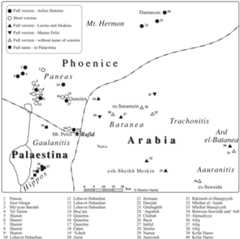
Map 8. Diocletian’s Boundary Stones.
by Aelius Statutus belong in Syria-Phoenice and this stone appears to have been erected at the southern boundary of the province, as it mentions only one village. This assumption is corroborated by the ceramic material found at 'Esheh and north of it, which is similar in composition to that found in the Paneas district, but different from neighboring sites to the south, and especially Butmiyye, where the material is similar to that found at sites in Gaulanitis (Hartal 2005:281-284). Thus, the stone is evidence that Rafid was close to the border of the provinces of Syria-Phoenice and Palaestina and apparently very close to the border of Arabia (Map 8).
3. The name Agrippina reminds strongly of Grofina,
mentioned in the list of fire signal stations which helped communicate the arrival of the new moon to the Jewry of Babylonia (Mishna Rosh-Hashana 2:4; BT Rosh-Hashana 22, 2; Di Segni 1997:186-187; Ben-Efraim 2003). Mt. Peres, west of the site, is eminently suitable for such a signal station.
The importance of the inscription from 'Esheh did not escape the late Dan Urman. He suggested identifying Agrippina in Rafid, and planned to write a chapter on this issue for the present volume, a plan prevented by his untimely death. If we accept this identification, then Rafid is in Phoenice. If we identify Agrippina at 'Esheh, where the stone was found, then Rafid belongs in either Palaestina or Arabia.
In the second century CE there was considerable development in Northern Transjordan because of the peace in Syria (Sartre 1991b:31). The population had settled in permanent settlements and the tribal order broke (Jones 1931:269-270; Altheim and Stiehl 1964:352-353).
In this period information on villages is more abundant in Auranitis, Batanea and Trachonitis, where extant inscriptions tell about the administration and the population. Gaulanitis too had a network of villages (Millar 1994:422), and it stands to reason that the administration was similar to that in Hauran. According to the inscriptions and the architectural remains, the village communities were landowner farmers with no great difference in wealth among them, who largely lived in extended family units with a house to each family (Villeneuve 1991; Graf 1997:453). The villages enjoyed a great degree of self-rule, almost that of cities. They had a council to endorse laws, a common treasury, common land and public buildings (Jones 1931:270).
The veterans of the Roman army who returned to their villages after 20-25 years of service, used their discharge grants to buy land and settle down. They built themselves houses and imposing tombs, and did not hesitate to generously contribute to temples and the erection of public structures. Veterans and their heirs took high ranks in local society and filled positions as judges and so on (Ibid.:269270; Sartre 1991b:31-32).
The village economy was based on crops, according to its geographic situation. In Golan the main produce was the olive, followed by vines (Ben-David 1998), legumes and cereals. In Bashan mainly cereals were grown and in Hauran mostly vines. The grapes were used for the production of wine as well as raisins. Wine was the Hauran’s greatest contribution to ancient trade. In contrast, no olives were grown there and olive oil was imported from other regions, such as Golan. Large scale animal husbandry is proven from the feeding troughs found in many houses (Villeneuve 1991:41-42, 1997:35).
The villages underwent a process of Hellenization. In almost all villages inscriptions in Greek were found (Sartre 1991a:35), but the irregular use of the language indicates that this was a spoken language (Millar 1994:399); village life was conducted in Greek. By the beginning of the fourth century CE official use of Semitic languages had disappeared completely, to be replaced by Greek (Ibid.:422-423), but it seems that in the villages the colloquial use of the Semitic languages continued.
The second century brought a process of urbanization to the Hauran (Ibid.:421-422). The number of cities in Northern
Transjordan was small (Map 7): in the west were Paneas and Hippos, both having existed already in the first century, both having large territories. Paneas, the capital of entire Northern Transjordan in the first century CE, remained now the capital of only the Paneas district. This change did not, however, impact its wealth or splendor, and in the second and early third centuries CE temples were still being built in the scared precinct of Pan (Ma’oz 1993a). Iulias-Bethsaida lost its fame and practically disappeared from the sources. In southern Bashan there were two cities: Bostra and Adraa. Bostra was the capital of the provincia Arabia and thus had a relatively large territory, as evidenced by inscriptions found as much as 30 km distant from it. The terrain south of it was desert, so it seems that its territory extended to the north and east, in lands previously held by Agrippa II. Several cities were founded in Hauran. At el-Qanawat there was a city identified with Canatha of the Decapolis, but was founded as a village not earlier than the last third of the first century CE and it is unclear when it received a city status (Hartal 2005:382-383, 407). At es-Suweida a city was founded in the days of Commodus (180-185 CE), dedicated to the god Dushara, or its Greek counterpart Dionysus, and called accordingly Dionysias. The emperor Philip the Arab granted his birthplace, the village Shahbah a city status in 244 CE and named it Philippopolis. At the end of the third century Maximianopolis was founded at Shaqqa. At the northern edge of the Leja, at Mismiyeh there was a city called Phaina, mentioned in the Byzantine period in the lists of Heraclius and Gregorius. Naveh (Nawa in Bashan) is also mentioned in Gregorius’ list, but it is not known when these two cities received their status (Jones 1931:273-275; Sartre 1991b:32; Millar 1994:422).
The cities were beautified with a host of imposing public buildings: temples, theaters, odeons, baths, gates, arches, tetrapyla, nymphaea, monuments etc. The architectural styles and decorations were influenced by Roman art, instead of the traditional local art that characterized the preprovincial period (Dentzer-Feydy 1986:286). Hellenization spread rapidly. The local inhabitants, especially the well-to-do and those - such as veterans - who had tasted Roman culture in their voyages, adopted Hellenistic ways, such as theater-going and frequenting the baths and gymnasia. But most of the population remained loyal to the Aramaic and Arab traditions in keeping the local names and continued worshipping the local gods in the ancient traditions. Hellenization was only skin deep (Sartre 1985:201-202; 1991a:32).
It seems that Rafid too enjoyed the prosperity of the Late Roman period. In this period the village seems to have been relatively wealthy, as evidenced by the houses, built in the Hauran architectural style. It may be that the few buildings constructed of ashlars found at the site were built in this period.
In the last years of the century or the very first of the century, by imperial edict, Palaestina was divided into three provinces. Palaestina secunda extended over the Jezre’el valley and Galilee west of the Jordan and Golan and Pella east of it (Tsafrir 1984:372). Phoenicia too was divided in two: Phoenice Paralios and Phoenice Libanensis. This information on the administrative divisions is gained mainly from two lists: one of Hierocles, dated in the first half of the sixth century CE and the other that of Georgius Cyprus (Ibid.:372).
The capital of Phoenice Paralios was Tyre, and it included also Sidon, Berytus, Byblus, 'Akko-Ptolemais and Paneas (Hierocles, Synecdemus 715, 7-716, 9; Georgius Cyprus, Descriptio Orbis Romani 967-983). The capital of Phoenice Libanensis was Emesa (modern Homs) and included Heliopolis, Abila, Damascus and Palmyra (Hieroclis, Synecdemus 717, 1-7; Georgius Cyprus, Descriptio Orbis Romani 984-996). According to these data, Phoenice Paralios extended along the Phoenician coast, in the mountains of Lebanon and extended east to Paneas. Phoenice Libanensis included the Beqa‘a valley, the antiLebanon mountains, the Damascus basin and Palmyra. It seems that the relations of Paneas with Galilee and the Phoenician coast were responsible for its inclusion in Phoenice Paralios (Map 9).
The capital of Provincia Arabia was Bostra and the province extended over northern and central Transjordan. Most of the communities, and probably most of the unidentified villages were in Batanea, Auranitis and Trachonitis (Tsafrir 1984:378-380). In Northern Transjordan were included Adraa, Dium, Nilecome, Naveh, Philippopolis, Phaina, Constantia, Dionysias, Canatha and many villages (Hieroclis, Synecdemus 721, 12-723, 5; Georgius Cyprus, Descriptio Orbis Romani 1058-1092).
In Palaestina Secunda were included from Northern Transjordan Hippos-Sussita, Clima Gaulames (Hieroclis, Synecdemus 719, 12-720, 11; Georgius Cyprus, Descriptio Orbis Romani 1028-1041). The territory of Hippos appears as part of Palaestina already in Eusebius’ Onomastikon. Clima Gaulames is apparently the name of Golan district in the Byzantine period (Tsafrir 1984:376; Ma‘oz 1986:56, 64; Di Segni 1997:184, n. 3). The existence of Golan district in the sixth century CE implies the continuation of this administrative unit through the Late Roman period. Eusebius mentions this district as being in Bashan. Since it is not reasonable that the name of the district wandered from the Golan to Bashan and back, it may be that Eusebius was influenced by the biblical description ‘Golan in Bashan’ and that in his days a Golan district existed in central Golan (see above). Ma’oz (1986:57) saw in the seeming disappearance of ‘Golan district’ evidence of a settlement gap in the Golan, but such a gap probably never existed.
In the Byzantine period, the Jewish settlement on the Golan flourished. In at least 25 sites remains of synagogues were discovered, dating to the fifth and sixth centuries CE. This subject has been studied and published in depth, beginning with the early researches of Oliphant and Schumacher (1888), to the in-depth studies by Ma‘oz (1981, 1995), Urman (1995), Ilan (1991) and Ben David (1999), so I shall add only a few remarks.
The Jews lived in villages, without an urban center. The villages were small, probably because of the small springs by which they were built, but the economic condition of the inhabitants was good. This is testified to by the scores of synagogues built in these villages. These were discovered at sites in the western part of the Golan and not all over the area of Golan district. It seems that during the Late Roman period some of the communities in the eastern reaches of Golan district became Christian (Ben-David 1999:294-295).
Urman (1995:383-384) dated the construction of the synagogues to the second-third centuries CE, while Ma’oz (1995:349-351) to the years 451-527 CE. Ben David (1999:247, 303) showed that at all 15 sites within his survey area (Lower Golan) that had existed in the Middle and/or Late Roman periods and which disappeared before 350 CE there were no synagogues. In contrast, except at three sites that contained Christian remains, all 25 sites that were inhabited from 350 CE and later contained synagogues or architectural elements belonging to synagogues. Ben David’s findings corroborate the views of Ma’oz, contra Urman, that the Jewish settlement in the Golan flourished in the fifth and sixth centuries CE.
Christianity penetrated into Northern Transjordan relatively early, but the pace at which it spread varied from district to district. In pagan Auranitis, Christianity was evident already in the second or third century CE, but bishops are first documented only in 325 CE , at Dionysias (es-Suweida) and Maximianopolis (Shaqqa), and slightly later at Canatha (elQanawat) and Philippopolis (Shahba). Just as elsewhere, the population was at first mainly pagan, but by the fifth century there was hardly a village without a church. Most churches were dedicated to the saints popular with the Arabs (Sartre 1991b:33; Sodini 1991).
Christianity penetrated the Golan Heights too. The district of Hippos, pagan to begin with, gradually embraced Christianity. Just as elsewhere, it seems that Christian communities were first established in the Hellenistic cities, and only later, in the fifth and sixth centuries in the rural areas (Geiger 1982; Rubin 1982). At Hippos-Sussita four churches were found (Epstein 1993). The cathedral (excavated) was built in the late sixth century. Two other churches were lately excavated (Segal et al. 2004:51-69). At Khispin two churches were excavated, one built in the late fifth and the second in the early sixth century CE
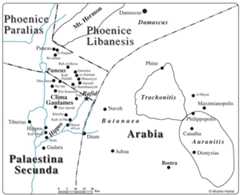
Map. 9. Northern transjordan in the c. CE.
(Tzaferis and Bar-Lev 1976; Ma’oz 1993e). A third church was identified in a survey east of the site (Y. Ben Efraim, pers. comm.). Remains of a church were found also at Duwër el-Löz in the Nahr el-Ruqqad (Ma‘oz 1993d:539). Crosses found at other sites in southern Golan, such as Fiq, Kafr Harib, 'Ayun, Kafr el-Ma and others, clearly indicate that during the Byzantine period Christianity penetrated the rural areas and replaced paganism.
Golan district was inhabited mostly by Jews and Christianity had little effect there. Christian sites, mainly monasteries, were found in the vicinity of Gamla, probably on land that had been confiscated after the Jewish War (BenDavid 1999:235-237). At Deir Qaruh a sixth century monastery was excavated (Ma‘oz 1993b). Christian remains were found in eastern Golan and near its northern boundary, at Na’ran, Deir Saras, and 'Ein Semsem. These settlements seem to represent the southern edge of the Christian communities of the district of Paneas.
Of Christian Paneas only one structure survived - a basilica identified as a fourth century CE church (Tzaferis 1998:13-14). No crosses or religious inscriptions were found in the building, and this should not surprise, because Paneas
fell from its glory in the fifth century, before it became Christian. It seems that Christianity was slow to penetrate the Paneas area too. On Mt. Hermon no Christian remains were found at all, perhaps because in the Byzantine period it was sparsely inhabited. From Quneitra and southward there is evidence of Christian sites. It is possible that this area was inhabited by a community of Judeo-Christians, attested by lintels carrying decorations combining the menorah with crosses (Dauphin 1982, 1984, 1993; Ma’oz 1985:63-65). In this area many tombstones were found, carrying Greek inscriptions, practically all of Christians (Gregg and Urman 1996). North of Quneitra hardly any crosses or tombstones were found. Christian faith penetrated this area only in the sixth century, following a decline in settlement density (see below), probably brought by the Ghassanids, who settled also in the southern area of the district of Paneas.
In the Northern Golan survey, a decline in the number of settlements in the Byzantine period was noted. From 69 sites in the Late Roman period the number went down to only 40
(Hartal 1989:132). This situation is dramatically different from other regions of Palestine, where in the Byzantine period there was a record number of settlements (Tsafrir 1977, 1996; Broshi 1979). In central Golan this was a period of prosperity for the Jewish settlement, and southern Golan was also densely inhabited (Ma’oz 1993d). The Late Roman villas around Paneas, whose inhabitants enjoyed life close to nature while receiving services from the nearby city, disappeared in the Byzantine period. In this period a fortress was erected at el-Naqara, east of Paneas, and Paneas itself was surrounded by a wall. In the past I suggested that the reason was the decline in security (Hartal 1989:132-133). In excavations carried out at Paneas no remains were found that are later than the first half of the fifth century (S. Israeli, pers. comm.). Only in a favissa dug near the temples in the sacred precinct, were some finds recovered that date to the end of the Byzantine period (Magness, forthcoming). It is interesting that no bishops from Paneas come to the councils of the and centuries.
The cause in the decline in security in northern Golan is not known, but it seems that the region suffered from attacks by some enemy, probably nomads. Two tombstones found at Quneitra shed some light on the events. One of them is that of Zenodorus, who fell in a battle while bringing peace to Phoenicia and the other is of his soldiers who fell in the same battle. The second stone bears the date 463 CE according to the era of Paneas (Di Segni 1997:169-174, Nos. 19, 20). Zenodorus, probably the of Phoenice fought against unknown enemy, possibly nomadic tribes that came from the east. A Byzantine street, found in the excavations at Paneas, was destroyed in a great fire in the first half of the fifth century. The cause of the fire is as yet unknown, and could have been the result of an earthquake, enemy attack or other reason. In any case, after the destruction much of the city was abandoned. It could be that at this time the city moved to the southern bank of Nahal Sa’ar, which is the only part enclosed by walls.
The penetration of bandits into the Sinai and the Euphrates valley in the fourth and fifth centuries CE passed over Hauran, which enjoyed at the time the protection of the Arab allies of the Byzantine empire, who agreed to protect the inhabitants in exchange of payment in corn and gold. In the fourth century these were Lakhmide tribes, to be replaced in the fifth century by the emirs of Salih and finally, towards the end of the fifth century by the Ghassanids (Sartre 1991b:34). The Ghassanids were a branch of the 'Azd tribal union that emigrated at the end of the fifth century from south Arabia and settled in the Roman province Arabia, took the Christian faith and agreed to pay taxes. At the beginning of the sixth century (502-503 CE) they received the status of allies (symmachoi) of the Byzantine empire. The relationship between them and the empire was arranged through a treaty (foedos), which stipulated that they receive an annual payment (annonae foedertice) and in return gave
the Byzantine army mounted cavalry units. Their leaders were philarchoi. The Ghassanids contributed many units to the Byzantine army during the wars against the Sassanid Persians and during the war against the Lakhmides, who sided with the Persians and also controlled the desert nomads. The most important Ghassanid leader was el-Harith Ben Jabala, who in 531 CE received the title philarch of all Arabs in the Byzantine empire (Tate 1989:110-111; Sartre 1991b:34; Foss 1997:250; Sharon 2002:39-40).
The Ghassanid tribes counted in the summers thousands of nomads with their animals. These needed areas rich in pasture and water and one such place was at Jabiya (Sartre 1982b:179, 188), about 8 km east of Rafid. The Ghassanids did not settle near the border but in Bashan and in Damascus. The presence of el-Harith and his sons at Jabiya and Jalliq did not necessarily imply that the whole tribe settled there. The monitoring of the borders by the Ghassanid forces could be carried out even without the presence of the philarchs. The Byzantines did not rely on the Ghassanids for the protection of the borders of Arabia; their role was to keep the peace in the agricultural areas and keep an eye on the tribes in transit, and this could be better accomplished from Bashan rather than on the border (Ibid.:187-188).
The Ghassanids enjoyed their service with the Byzantine empire, increased their property and their stay in an agricultural area caused them, at least partially to settle down and to build many buildings (Foss 1997:250-251; Shahîd 2002). Ghassanid settlements existed in the Damascus basin and Bashan: 'Aqrabah, Jabiya, Jalliq, Harith el-Jawlan (elHara) and more (map 9; Sartre 1982b:178-182; Shahîd 2002). The Ghassanid presence in Bashan can explain the prosperity of its villages. The large houses reflect on the wealth of the leader and their architecture on their ways (Foss 1997:251-252).
The Ghassanids played an important role in the history of the monophysite church of Syria. Monophysitism was first advanced by Nestorius, bishop of Constantinople and was propagated by Eutyches, archimandrite of a monastery in the same city (378-454 CE). According to monophysitism, Jesus had a single nature that merges the human and the divine, his human aspects absorbed by the divine substance. Monophysitism was considered a heresy by the dogma fixed in Chalcedon, which claimed that Jesus was one with two natures, and was forbidden to practice under Justin I (518527 CE). In 540 CE, el-Harith Ben Jabala succeeded to ordinate two monophysite bishops with the aid of empress Theodora. These were Theodorus and Jacob Bardaeus, after whom the Jacobite church is named. These two bishops succeeded in creating an alternative monophysite hierarchy in the Church of Syria (Atiya 1968:169-192; Tate 1989:111).
The Ghassanid philarchs became the chief patrons of secular and religious architecture and supporters of churches throughout their domains. Traces of their activities can be seen in the region east of Damascus and north of Bostra (Foss 1997:251; Shahîd 2002). The Ghassanids built churches and monasteries around the large villages of the philarchs, and while not all such extant buildings were built
by them directly, the emirs gave their patronage to the monasteries and helped their well-being (Sartre 1982b:183, 1991b:34).
It seems that the Ghassanids’ support of monophysitism eventually clouded their relationship with the orthodox emperors and brought their downfall. Their last king, Mundir ben el-Harith and his son Nu’man ruled during the years 569-582 CE. Mundir was arrested by emperor Tiberius in 580 CE on charge of treason and was sent in exile. His men rebelled when the emperor cut down corn rations as a measure to control them. The rebels were active in large areas of Arabia and besieged Bostra. They retreated only when Nu’man ben Mundir was allowed to renew the philarchy, but in 584 he too was exiled and the Ghassanid philarchy was divided into several smaller units. Though some of them continued to fight on the side of the Byzantines, their power broke and the land remained without solid protection, something that made it easier for the forces of Islam to conquer (Foss 1997:252; Fahd 1989).
The center of the Ghassanid settlement was in the area of Tel el-Hara (about ten km northeast of Rafid), and to the south of it, very close to the Golan (map 10). It seems that they penetrated also into the territory of Paneas. Evidence of this is found in the letter of the archimandrites (Nöldke 1875; Lami 1898; Shahîd 1995:821-838), which mentions several monasteries in northern Golan (Sartre 1982c:185186; Hartal 2005:363).
Dauphin and Gibson (1992-1993:22) believed that the Ghassanids were influenced by their contact with the Jewish community at Farj (some 6 km west of Rafid), and as a result built imposing houses copied from their neighbors, but with emphasized crosses on their lintels to stress their religious affiliation. Though I accept that there was a Ghassanid community at Farj (see below), the process as described by Dauphin and Gibson appears odd. Though there were Jews at Farj, their remains are very meager in contrast to Christian remains. Dauphin and Gibson describe the Ghassanids as nomads that were influenced by the sedentary population, but, as shown above, the Ghassanid settlement is widespread and their contribution to the architecture of Bashan is considerable (Shahîd 2002). The Ghassanid settlement at Farj has nothing to do with Jewish influence.
At er-Rumthaniyeh (ca. 7 km northwest of Rafid) a foundation inscription was found, belonging to a martyrium of St. John the Baptist, dated by Dauphin 377 CE (Dauphin et al. 1996:325-326, Inscription 25), but lately dated by Di Segni (pers. Comm.) to the century. On top of the hill on which the village is built there is a large structure, partially rebuilt in recent times, which includes many inscriptions and reliefs. Dauphin identified the structure as a late phase of a martyrium and dated it by a large inscription in secondary use to the sixth century CE (Dauphin 1995:696670; Gregg and Urman 1996:188-189, No. 155*; Dauphin et al. 1996:327, Inscription 28). According to Dauphin, at
this stage it served as a pilgrimage center of the Ghassanid tribes, who used to gather at the site on the birthday of St. John and on the anniversary of his execution.
The adduced evidence can assist in reconstructing the Ghassanid settlement in northern Golan. At several sites ecclesiastic inscriptions were found, which mention large scale building activity in the sixth century CE. At Mumsiyye, 13 km northwest of Rafid, a church inscription was found, with a date reading "the tenth year of the indiction, years 534 and 535 " (Ibid.:213-214, No. 174). The authors dated it to 486-487 CE according to the era of Antioch (?!), starting in 49/8 BCE. But “year 534” was the tenth year of indiction only if calculated by the era of Paneas, and being in the territory of Paneas this makes much more sense and thus should be dated 531-533 CE, the floruit of the Ghassanids. At Bab el-Hawa two church inscriptions were found (Ibid.:275-277, No. 235*, 236), one dated in “year 540”, i.e. 537/538 CE according to the era of Paneas. Undated church inscriptions attributed to the sixth century were found also at er-Rumthaniyeh (Ibid.:188-189, No. 155*) and Mumsiyye (Ibid.:212, No. 172). The inscriptions thus show that churches and community buildings were erected during the influential period of the Ghassanids.
Bashanit ridge and its environs on the eastern Golan Heights, where the above-mentioned inscriptions were found, is close to the region of Ghassanid settlement. In this area several villages were identified with Hauran style architecture: Rafid, Farj, er-Rumthaniyeh, es-Surman and Bab el-Hawa. All these sites had existed before the Ghassanids, but extensive building took place mainly in the Byzantine period. The only site excavated is Bab el-Hawa, where the excavated building was constructed at the end of the fifth or early in the sixth century CE, after a period of abandonment (Hartal 2005:86-276). The construction of the building can be thus attributed to the Ghassanids, and from this it follows that the late structures at the other sites can be attributed to them as well. According to the letter of the archimandrites also Ra‘abane and Za‘ura were Ghassanid. It may be that Ghassanids were present also at sites such as Kafr Nafakh and Na’ran in northern Golan and Khisfin in southern Golan; these sites yielded structures and decorated architectural elements similar to those in eastern Golan.
Rafid is in the heart of the Ghassanid settlement and seems to have been inhabited by them. Christian symbols, especially crosses are abundant, and are characteristic of Ghassanid settlements. It is highly likely that a large proportion of the houses described in this book were built and inhabited by the Ghassanids.
The end of the Byzantine period was one of instability. In 542 and 600 CE there were outbreaks of the plague, and the Ghassanids, as well as others in the region, were hit hard (Conrad 1986). Ma’oz (forthcoming) suggested that the epidemics wiped out most of the work force, caused a stoppage of olive oil production in the Golan and corn in
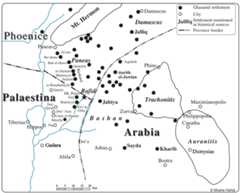
Map 10. Ghassanid Settlements (. CE).
Bashan, and finally brought about the abandonment of the Jewish settlements of the Golan. Sartre (1991b:34) notes the Ghassanids were not hit all that hard and they carried on church building after the 542 CE plague. The Sassanid invasion of Syria (613-630 CE) did not cause severe destruction. In 613 CE the Sassanians won a victory in a battle fought in Hauran, between Adraa and Bostra, and carried away prisoners and booty (Schick 1995:20-21). Some monasteries were damaged, such as the one at Kursi (Tzaferis 1983:4), but there is evidence in Hauran of building and renovating churches at this time (Foss 1997:252-253). When the area was recaptured by emperor Heraclius, no agreement was reached between the imperial administration and the monophysites; the latter opposed any compromise suggested by the administration (Tate 1989:111). The decline in the Ghassanids’ status in 582 CE caused a reduced defense of the empire in the south and east (Sharon 2002:42-43). In April-May 634 CE the first Islamic units arrived in the area and Bostra fell in May 634. After the Byzantine rout in the battle of Yarmukh in July 636 (Sharon 2002) the whole Hauran was lost to the Byzantines (Sartre 1991b:34). In Hauran and Bashan the settlements not only continued, but
even thrived and developed under Islamic rule. There was no perceptible change in activity or cultural patterns under the Umayyad caliphs and there was no dwindling of the population until the Mongol invasion ( ) (Villeneuve 1991:42; Foss 1997:254-258). In the territory of Hippos too, there was a continuity of settlement, including the city of Hippos itself; the road connecting Hauran with Palestine passed through southern Golan. This is testified to by the milestones of the caliph 'Abd el-Malik from the eighth century found at Fiq (Elad 1999). Fragments of a monumental inscription from the Early Islamic period found at Farj induced Dauphin and Gibson (1992-1993:22-23) to assert that Ghassanids continued to live there even after the Islamic conquest, based on the assumption that the script dated the inscription to soon after the conquest itself. But in the publication of the inscription it is stressed that the script cannot be securely dated (Dauphin et al. 1996:328-329). Giv’at Orḥa, some 3 km south of Rafid, was inhabited in the Umayyad and 'Abbasid periods (Ma’oz 1993c). Other settlements in Golan continued their existence in the Early Islamic period. Umm el-Qanatir existed to the end of the Umayyad period and the village at Deir 'Aziz to the 'Abbasid
period. Qasrin too was settled in the eighth century (Ma’oz 1993f; Killebrew 1993). The Golan villages were not destroyed by war, but rather economic reasons caused their desertion, especially the decline in olive oil export to Hauran.
The excavations at Bab el-Hawa proved that the settlement ceased to exist at the beginning of the seventh century CE; no artifacts datable to the Early Islamic period were found. A similar picture obtains in northern Golan: only at four sites were any remains from this period found (Hartal 1989:135). There is no reliable information about Paneas in the first centuries of Islamic rule (Sharon 1999:26). Thus, northern Golan was abandoned close to the Islamic conquest and remained controlled by nomads until the Mamluk period.
In the eighth century the settlement in Hauran ceased as well and Northern Transjordan returned to be the stage for nomadic tribes. This event brought the settlement history a full circle, which began in the second century BCE with the settling of the Golan Heights, expanded under the Herodians over all of Northern Transjordan, reached its zenith under
Roman and Byzantine rule and ended in the Umayyad period with the abandonment of the settlements and the returning rule of nomads. It is one of the circles that characterize the region’s history from prehistoric times to our own days (Hartal 1989:138).
The Rafid area remained without permanent settlements until the early Mamluk period, in the thirteenth century CE, when it flourished again. The survey of northern Golan showed that this was the second densest period in the number of settlements (Ibid.:135-136). Villages were erected over the ruins of Roman and Byzantine period settlements and it seems that Rafid too was resettled then. Though this cannot be ascertained, it seems that the latest construction phase in the houses of the village, described in detail elsewhere in this book, should be dated to the Mamluk period.
The Mamluk period prosperity was short. After about a hundred years the villages were again abandoned and the area returned to the control of Bedouin tribes, a state of affairs that continued until the end of the nineteenth century (Ibid.:136-137).
Appian. Syriacus Liber. H. White transl. Appian’s Roman History II (Loeb Classical Library). London-Cambridge. 1912.
Cassius Dio. Historia Romana. E. Cary transl. Dio’s Roman History VI, VII (Loeb Classical Library). London-Cambridge. 1917-1955.
Claudius Ptolemaeus. Geographia. C.F.A. Nobbe ed. Claudii Ptolomaei Geographia. Hildesheim 1966 (Leipzig 18431845)
Eusebius. Onomastikon. E, Klostermann ed. Eusebius Werke. III.1: Das Onomastikon der biblischen Ortsnamen. Leipzig. 1904.
Georgius Cyprius. Descriptio Orbis Romani. H. Gelzer ed. Georgii Cypri descriptio orbis romani (Bibliotheca Scriptorum Graecorum et Romanorum Teubneriana.). Leipzig. 1890.
Hierocles. A. Burckhardt ed. Hierocles Synecdemos (Bibliotheca Scriptorum Graecorum et Romanorum Teubneriana.). Leipzig. 1893.
Philo. In Flaccum. F.H. Colson transl. Philo IX (Loeb Classical Library). London-Cambridge. 1941.
Polybius. Historiae. W.R. Paton transl. Polybius, The Histories III, V (Loeb Classical Library). London-Cambridge. 19561960.
Strabo. Geographica. H.L. Jones transl. The Geography of Strabo VII (Loeb Classical Library). London-Cambridge. 1954.
Syncellus, Chronographia. W. Dindorf ed. Georgius Syncellus et Nicephorus (CSHB 7). Bonn. 1829.
Adan-Bayewitz A. and Aviam M.
1997 Iotapata, Josephus, and the Siege of 67: Preliminary Report on 1992-94 Seasons. JRA 10:131-165.
Aharoni Y.
1955 Three New Boundary Stones from the Western Golan. 'Atiqot 1:109-114.
1959 Three New Boundary-Stones from the Hula Valley. 'Atiqot 2:186-187.
1961 Two Additional Boundary Stones from the Hule Valley. 'Atiqot 3:152-154.
Alt A.
1955 Augusta Libanensis. ZDPV 71:173-186.
Altheim F. and Stiehl R.
1964 Dir Araber in der alten Welt I. Berlin.
Applebaum Sh.
1970 The Troopers of Zamaris. In A. Gilboa et al. (eds). Studies in the History of the Jewish People and the Land of Israel in Memory of Zvi Avneri. Haifa. Pp. 79-88. (Hebrew with English abstract).
Arav R.
1995 Bethsaida Excavations: Preliminary Report, 19871993. In R. Arav and R.A. Freund (eds). Bethsaida: A City by the North Shore of the Sea Galilee I. Kirksville. Pp. 3-63.
Atiya A.
1968 History of Eastern Christianity. Notre-Dame.
Avi-Yonah M.
1933 Mosaic Pavements in Palestine. QDAP 3:26-74.
1940 Abbreviations in Greek Inscriptions, Jerusalem (QDAP, Supplement to vol. 9).
1955 Christian Archaeology in Israel, 1948-1954, Christian News from Israel 5, 3-4:20-26.
1966 The Holy Land from the Persian to the Arab Consquests (536 B.C. to A.D. 640): A Historical Geography. Grand Rapids, MI.
1984 The Jews under Roman and Byzantine Rule: A Political History of Palestine from the Bar Kokhba War to the Arab Conquest. Jerusalem.
Avshalom-Gorni D. and Getzov N.
2001 Tell el-Wawiyat. Hadashot Arkheologiyot: Excavations and Surveys in Israel 113:1*-3*.
2003 Tell el-Wawiyat - 2001. Hadashot Arkheologiyot: Excavations and Surveys in Israel 115:1*-2*.
Bar D.
2001 The Third Century’s Crisis in the Roman Empire and its Validity in Eretz-Israel. Zion 66:143-170 (Hebrew).
Bar-Kochva B.
1977 Manpower, Economics and Internal Strife in Hasmonean State. Colloques Nationaus Du CNRS: Armées et Fiscalité dans le Monde Antique. Pp. 167-196
Ben-David Ch.
1998 Oil Presses and Oil Production in the Golan in the Mishnaic and Talmudic Periods. 'Atiqot 34:1-61 (Hebrew).
1999 Settlement in “Lower Golan” during the Hellenistic, Roman and Byzantine Periods. Ph.D. Thesis. Bar-Ilan University. Ramat-Gan (Hebrew with English abstract).
Ben-Dov M.
1975 Roman-Byzantine Dwellings at Kafr Nassej. EretzIsrael 12:171-185 (Hebrew with English abstract).
Ben-Efraim Y.
2003 The Boundary Between the Provinces of Palaestina and Phoenicia in the Second and Third Centuries in the Central Golan Heights. M.A. Thesis. Bar-Ilan University. Ramat-Gan (Hebrew).
Berlin A.M.
1997 Between Large Forces: Palestine in the Hellenistic Period. BA 60.1:2-51.
Bowersock G.W.
1983 Roman Arabia. Harvard.
Broshi M.
1979 The Population of Western Palestine in the RomanByzantine Period. BASOR 236:1-10.
Butler H.C.
1903 Architecture and Other Arts (The Publications of an American Archaeological Expedition to Syria in 1899-1900 II). New York.
1909 Ancient Architecture in Syria: The Southern Haurân (PPUAES IIA2). Leyden.
1913 Ancient Architecture in Syria: Umm idj-Djimâl (PPUAES IIA3). Leyden.
1914 Ancient Architecture in Syria: Bosra (PPUAES IIA4). Leiden.
1915 Ancient Architecture in Syria: Haurān Plain and Djebel Haurān (PPUAES IIA5). Leyden.
1916 Ancient Architecture in Syria: Sī (Seeia) (PPUAES IIA6). Leiden.
1919 Ancient Architecture in Syria: The Ledjā (PPUAES IIA7). Leyden.
1929 Early Churches in Syria: Fourth to Seventh Centuries. Princeton.
Cameron A.
1993 The Late Roman Empire, AD 284-430. Cambridge.
Cohen G.M.
1972 The Hellenistic Military Colony: A Herodian Example. Transactions of the American Philological Association 103:83-95.
Colt H.D. (ed.)
1962 Excavation at Nessana I. London.
Conrad L.I.
1986 The Plague in Bilad al-Sham in Pre-Islamic Times. In M. 'A. al-Bakhit and M. 'Asfur (eds). Proceedings of the Symposium on Bilad al-Sham during the Byzantine Period. Amman. Pp. 12-58.
Dauphin C.M.
1979 Golan Survey, 1979. IEJ 29:223-225.
1980 Golan Heights. PEQ 112:68.
1982a Golan Heights. PEQ 114:74.
1982b Jewish and Christian Communities in the Roman and Byzantine Gaulanitis: A Study of Evidence from Archaeological Survey. PEQ 167:129-142.
1983a Golan Survey, 1981-1982. IEJ 33:112-113.
1983b Survey of Roman and Byzantine Sites in the Golan Heights. In D.R. Keller and D.W. Rupp (eds). Archaeological Survey in the Mediterranean Area (BAR Int S. 155). Oxford. Pp. 353-355
1984 Farj en Gaulanitide: Refuge judéo-chretien? ProcheOrient Chrétien 34:233-245.
1988-1989 Er-Ramthaniyye: Surveying an Early Bedouin Byzantine Pilgrimage Center in the Golan Heights. BAIAS 8:82-85.
1993 Encore des judeo-chretiens au Golan? In F. Manns and E. Alliata (eds). Early Christianity in Context (Studium Biblicum Franciscanum Collectio Maior 38). Jerusalem. Pp. 69-79.
1995 Pèlerinage ghassanide au sanctuaire Byzantin Saint Jean-Baptiste à Er-Ramthaniyye en Gaulanitide. Akten des XII Internationaen Kongresse für Christliche Archäologie, Bonn 22-28. September 1991, 2. (JCE 20, 2). Münster. Pp. 667-673.
1998 La Palestine byzantine: Peuplement et Population (BAR Int S. 762). Oxford.
Dauphin C.M., Brock S., Gregg R.C. and Beeston A.F.L.
1996 Païens, juifs, judéo-chrétien, chrétiens et musulmans en Gaulanitide: Les inscriptions de Na’arān, Kafr Naffakh, Farj et er-Ramthâniyye. POC 46:305-340.
Dauphin C.M. and Gibson S.
1992-1993 Ancient Settlements in their Landscapes: The Results of Ten Years of Survey on Golan Heights (19781988). BAIAS 12:7-31.
Dauphin C.M. and Schonfield J.J.
1983 Settlements of the Roman and Byzantine Periods on the Golan Heights: Preliminary Report on Three Seasons of Survey (1979-1981). IEJ 33:189-206.
Dentzer J.-M.
1985 Six campagnes de fouilles à : Développement et culture indigène en Syrie méridional. DM 2:66-83.
1986 Développement et culture de la Syrie du Sud dans la période préprovinciale ( s. avant J.-C. - s. après J.C.). In J.-M. Dentzer (ed). Hauran I,2: Recherches archéologique sur la Syrie du Sud à l’époque hellénistique et romaine. Paris. Pp. 387-420.
Dentzer J.-M and Dentzer J.
1981 Les fouilles de et la phase hellénistique en Syrie du sud. Académie des Inscriptions et Belles-Lettres, Comptes-rendus:78-102.
1991 Le site et le sanctuaire de. In J.-M. Dentzer and J. Dentzer-Feydy (eds). Le djebel al-'Arab: Histoire et patrimoine au Musée de Suweida. Paris. Pp. 4548.
Dentzer-Feydy J.
1986 Décor architectural et développement du Hauran dans l’antiquité (du I s. av. au VII s. de notre ère). In J.M. Dentzer (ed). Hauran I,2: Recherches archéologique sur la Syrie du Sud a l’époque hellénistique et romaine. Paris. Pp. 261-309.
Dentzer-Feydy J., Dentzer J-M. and Blanc P-M. (eds).
2003 Hauran II: Les installations de Si 8. Du sanctuaire à l’établissement viticole. Beyrouth.
De Vogüé M.
1865-1877 Syrie centrale: Architecture civil et religieuse du I au VII siècle. Paris.
De Vries B.
1998 Umm el-Jimal: A Frontier Town and its Landscape in Northern Jordan I: Fieldwork 1972-1981. Rhode Island.
Di Segni L.
1990 Horvat hesheq: The Inscription. In G.C. Bottini, L. Di Segni and E. Alliata (eds). Christian Archaeology in the Holy Land: New Discoveries. (Studium Biblicum Franciscanum, Collectio Maior 36). Jerusalem. Pp. 379-390.
1993 The Greek Inscriptions from the Samaritan Synagogue at El Khirbe, with Some Considerations on the Function of Samaritan Synagogues in the Late Roman Period. In F. Manns (ed). Early Christianity in Context. Monuments and Documents (Studium Biblicum Franciscanum, Collectio Maior 38). Jerusalem. Pp. 231-239.
1994 El ̧̧ 9652 in Palestinian Inscriptions. SCI 13:94-115.
1997 Dated Greek Inscriptions from Palestine from the Roman and Byzantine Periods. Ph.D. diss. The Hebrew University of Jerusalem. Jerusalem.
2004 Two Greek Inscriptions at Horvat Raqit. In Sh. Dar, Raqit. Marinus’ Estate on the Carmel, Israel (BAR Int. S. 1300). Oxford. Pp. 196-198.
Di Segni L. and Patrich J.
1990 The Greek Inscriptions in the Cave Chapel at Horvat Qasra. 'Añqot (Hebrew series) 10:141-154 (Hebrew), (English summary).
Dunand M.
1934 Mission archéologique au Djebel Druze: le musée de Soueïda. Paris.
Epstein C.
1993 Hippos (Sussita). NEAEHL 2:634-637.
Epstein C. and Gutman S.
1972 The Golan. In M. Kochavi (ed). Judea, Samaria and the Golan: Archaeological Survey. Jerusalem. Pp. 244-295 (Hebrew).
Fahd T.
1989 Le Hawrân a la veille de la conquête islamique. In R. Farioli Campanati (ed). La Siria araba da Roma a Bisanzio. Ravenna. Pp. 35-43.
Finney P.C.
1997 Cross. In E. Ferguson (ed). Encyclopedia of Early Christianity I. New York and London. Pp. 303-305.
Foss C.
1997 Syria in Transition, A.D. 550-750; an Archaeological Approach. DOP 51:189-269.
Gatier P.-L.
1986 Inscriptions grecques et latines de la Syrie. Inscriptions de la Jordanie. Tome 2. Région centrale. Paris.
Geiger Y.
1982 The Spreading of Christianity in Eretz-Israel - From its Beginning to the Days of Julian. In Z. Baras, Sh. Safrai, Y. Tsafrir and M. Stern (eds). Eretz Israel from the Destruction of the Second Temple to the Muslim Conquest. Jerusalem. Pp. 218-233 (Hebrew).
Gracey M.H.
1986 The Armies of the Judean Client Kings. In P. Freedman and D.L. Kennedy (eds). The Defense of the Roman and Byzantine East: Proceedings of a Colloquium Held at the University of Sheffield in April 1986. (BAR Int. 5. 297). Oxford. Pp. 311-323.
Graf D.F.
1997 The Syrian Hauran. JRA 5:450-466.
Gregg R.C. and Urman D.
1996 Jews, Pagans and Christians in Golan Heights: Greek and Other Inscriptions of the Roman and Byzantine Eras (South Florida Studies in the History of Judaism 140). Atlanta.
Gutmann S.
1994 Gamla - A City in Rebellion. Tel-Aviv (Hebrew).
Hachlili R.
1988 Ancient Jewish Art and Archaeology in the Land of Israel. Leiden.
1995 Late Antique Jewish Art from the Golan. In J.H. Humphrey (ed). The Roman and Byzantine Near East: Some Recent Archaeological Research (JRA Suppl. Ser. 14). Ann Arbor. Pp. 183-212.
Hartal M.
1987 The History of Golan in the Second Temple Period. In M. Inbar and E. Schiller (eds). Golan Heights. Jerusalem. Pp. 69-76 (Hebrew).
1989 Northern Golan Heights: The Archaeological Survey as a Source of Regional History. Qazrin (Hebrew with English abstract).
1993 Quneitra Valley, Boundary Stone. ESI 13:121.
2002 Excavations at Khirbet Zemel, Northern Golan: An Ituraean Settlement Site. In Z. Gal (ed). Eretz Zafon: Studies in Galilean Archaeology. Jerusalem. Pp. 74*117*.
2005 Land ofItureans: Archaeology and History of Northern Golan in the Hellenistic, Roman and Byzantine Periods. Qazrin (Hebrew with English abstract).
Forthcoming The Use of Pottery as a Tool for the Definition of Provincial Border. Adam Zertal Book. Haifa.
Heikel I.A.
1902
Herr M.D.
1985 The History of Eretz Israel: the Roman Byzantine Period: The Mishna and Talmud Period and the Byzantine Rule (70-640). Jerusalem (Hebrew).
Ilan Z.
1991 Ancient Synagogues in Israel. Tel Aviv (Hebrew).
Isaac B.
1996 Eusebius and the Geography of Roman Provinces. In D.L. Kennedy (ed). The Roman Army in the East (JRA Suppl. Ser. 18) Ann Arbor. Pp. 154-167.
Jalabert J.
1908-1909 Aelius Statutus, gouverneur du Phénicie (ca. 293-305). MUSJ 3:313-322.
Jones A.H.M.
1931 The Urbanization of the Ituraean Principality. JRS 21:265-275.
1992 The Prosopography of the Later Roman Empire I: A.D. 260-395. Cambridge.
Kasher A.
1988 Jews, Idumaeans and Ancient Arabs: Relations of the Jews In Eretz-Israel with the Nations of the Frontier and the Desert During the Hellenistic and Roman Era (332 BCE-70 CE). Tübingen.
Killebrew A.
1993 Qazrin: The Village. NEAEHL:1222-1224.
Kindler A.
1999 The Coins of the Tetrarch Philip and Bethsaida. In R. Arav and R.A. Freund (eds). Bethsaida: A City by the North Shore of the Sea of Galilee II. Kirksville. Pp. 245-249.
Kirk G.E. and Welles C.B.
1962 The Inscriptions. In H.D. Colt (ed). Excavations at Nessana I. London. Pp. 131-197.
Kokkinos N.
1998 The Herodian Dynasty: Origins, Role in Society and Eclipse (Journal for the Study of the Pseudepigrapha Supplement Series 30). Sheffield.
Kushnir-Stein A.
2003 Agrippa I in Josephus. SCI 22:153-161.
Lami M.Th.-J.
1898 Profession de foi, adresse par les Abbe couvents de la province d’Arabie a Jacques Baradée. Actes du XII congrès international des orientalistes, quatrième section. Paris. Pp. 117-137.
Levine I.L.
1982 Eretz Israel in the Third Century. In Z. Baras, Sh. Safrai, Y. Tsafrir and M. Stern (eds). Eretz Israel from the Destruction of the Second Temple to the Muslim Conquest. Jerusalem. Pp. 119-143 (Hebrew).
Littmann E.
1915 Greek and Latin inscriptions in Syria: Hauran Plain and Djebel Hauran (PPUAES IIA3). Leiden.
1921 Greek and Latin Inscriptions in Syria: The Ledja (PPUAES IIA7). Leiden.
Macdonald M.C.A.
1993 Nomads and the Hawran in the Hellenistic and Roman Periods: A Reassessment of the Epigraphic Evidence. Syria 70:302-413.
Magness J.
Forthcoming Pottery from a Seventh Century C.E. Pit L. 243 (Stratum III). In Z.U. Ma’oz. Paneion I: Excavations at the Sanctuary of Pan at Caesarea Philippi - 19881993 (IAA Reports).
Ma’oz Z.U.
1981 The Art and Architecture of the Synagogues of the Golan. In L.I Levine (ed). Ancient Synagogues Revealed. Jerusalem. Pp. 98-115.
1985 Comments on Jewish and Christian Communities in Byzantine Palestine. PEQ 170:59-68.
1986 The Golan Heights in Antiquity: A Study in Geographical History. M.A Thesis. The Hebrew University. Jerusalem (Hebrew).
1993a Banias. NEAEHL 136-143.
1993b Deir Qeruḥ. NEAEHL:348-349.
1993c Giv’at Orba. NEAEHL:521-523.
1993d Golan: Hellenistic Period to the Middle Ages. NEAEHL: 525-527, 534-546.
1993e Haspin. NEAEHL:586-588.
1993f Kanaf, Horvat. NEAEHL:847-850.
1993g Qasrin. NEAEHL 3:1219-1224.
1995 Ancient Synagogues in the Golan: Art and Architecture. Qasrin. Hebrew with English Abstract.
Forthcoming The Decline and Fall of Byzantine Syria-Palestine: A View from the Golan.
Ma’oz Z.U. and Killebrew A.
1988 Ancient Qasrin Synagogue and Village. BA 51:5-19.
Mason S.
2001 Flavius Josephus: Translation and Commentary. 9. Life of Josephus. Leiden.
Meimaris Y.E.
1986 Sacred Names, Saints, Martyrs and Church Officials in the Greek Inscriptions and Papyri Pertaining to the Church of Palestine. Athens.
Merrill S.
1881 East of the Jordan: A Record of Travel and Observation in the Countries of Moab, Gilead, and Bashan. London.
Meyers E.M.
1976 Galilean Regionalism as a Factor in Historical Reconstruction. BASOR 211:93-101.
Millar F.
1994 The Roman Near East, 31 BC - AD 337. London.
Miller D.S.
1984 The Lava Lands of Syria: Regional Urbanism in the Roman Empire. Ph.D. diss. New York University. New York.
Morrisroe P.
1913 Cross and Crucifix. In C.H. Herbermann, E.A. Pace, C.B. Pallen, T.J. Shahan and J.J. Wynne (eds). The Catholic Encyclopedia III. New York. Pp. 517-539.
Naveh J.
1978 On Stone and Mosaic: The Aramaic and Hebrew Inscriptions from Ancient Synagogues. Tel Aviv.
Negev A.
1991 Personal Names in the Nabatean Realm (Qedem 32). Jerusalem.
Nöldke Th.
1875
Topographie und Geschichte des Damascenischen Gebiet und der Haurangegend. ZDMG 29:419-445.
Oliphant L.
1885 Explorations North-East of Lake Tiberias and in Jaulan. PEFQS:82-93.
1886 New Discoveries. PEFQSt:73-81.
1977 The Nabateans in the Hawran. JAOS 97:263-277.
1978 Romans and Bedouin in Southern Syria. JNES 37:315-326.
Piccirillo M.
1980 Le antichità di Rihab dei Bene Hasan. Liber Annuus 30:317-350.
Rey-Coquais J.-P.
1978 Syrie romaine, de Pompée à Dioclétien. JRS 68:4473.
1989 La Syrie, de Pompée à Dioclétien: histoire politique et administrative. In J.-M. Dentzer and W. Orthmann (eds). Archéologie et histoire de la Syrie II. La Syrie de l’époque achéménide a l’avènement de l’Islam. Saarbrücken. Pp. 45-61.
Rubin Z.
1982 The Spread of Christianity in Eretz-Israel - from the Days of Julian to the Justinianic Period. In Z. Baras, Sh. Safrai, Y. Tsafrir and M. Stern (eds). Eretz Israel from the Destruction of the Second Temple to the Muslim Conquest. Jerusalem. Pp. 234-251 (Hebrew).
Sartre M.
1982a Inscriptions grecques et latines de la Syrie 23.1: Bostra. Paris.
1982b Trois études sur l’Arabie romaine et byzantine (Latomus 178). Bruxelles.
1985a Le peuplement et le développement du Hawran antique à lumière des inscriptions grecques et latines. In J.-M. Dentzer (ed). Hauran I,1: Recherches archéologique sur la Syrie du Sud a l’époque hellénistique et romaine. Paris. Pp. 189-202.
1985b Bostra des origines à l’Islam. Paris.
1991a La langue et les inscriptions grecques. In J.-M. Dentzer and J. Dentzer-Feydy (eds). Le djebel al’Arab: Histoire et patrimoine au Musée de Suweidâ’. Paris. Pp. 35-36.
1991b La Syrie du Sud à l’époque gréco-romaine. In J.-M. Dentzer and J. Dentzer-Feydy (eds). Le djebel al’Arab: Histoire et patrimoine au Musée de Suweidâ’. Paris. Pp. 29-34.
1992 Nouvelles bornes cadastrales du Hauran sous la Tétrarchie. Ktema 17:112-131.
1997 Transhumance, économie et société de montagne en Syrie du Sud. Les Annales Archéologiques de Syrie 41:75-86.
Schalit A.
1964 King Herod: Portrait of a Ruler. Jerusalem (Hebrew).
Schick C.
1894 The Jerusalem Cross. PEFQSt:183-189.
Schick R.
1995 The Christian Communities of Palestine from Byzantine to Islamic Rule: A Historical and Archaeological Study (Studies in late Antiquity and Early Islam 2). Princeton.
Schumacher G.
1886 Across the Jordan. London.
1888 The Jaulan. London.
Schürer E.
1973 The History of the Jewish People in the Age of Jesus Christ (175 B.C.-A.D. 135) I. G. Vermes and F. Millar (eds). Edinburgh.
Schwartz D.R.
1990 Agrippa I: The Last King of Judaea. Tübingen.
SEG Supplementum Epigraphicum Graecum.
Segal A. et al.
2004 Hippos-Sussita: Fifth Season of Excavations September-October 2004 and Summary of All Five Seasons (2000-2004). Haifa.
Shahîd I.
1995 Byzantium and the Arabs in the Sixth Century I. Washington D.C.
2002 Byzantium and the Arabs in the Sixth Century, II,1: Toponymy, Monuments, Historical Geography, and Frontier Studies. Washington D.C.
Sharon M.
1999 Corpus Inscriptium Arabicarum Palaestinae (CIAP) II. Leiden.
2002 The Decisive Battles in the Conquest of Syria. Cathedra 104:31-84 (Hebrew with English abstract).
Shatzman I.
1991 The Armies of the Hasmoneans and Herod: From Hellenistic to Roman Frameworks. Tübingen.
Smith R.H.
1990 The Southern Levant in the Hellenistic Period. Levant 22:123-130.
Sodini J.-P.
1991
1985
Stein A.
1989 The Foundation Year of Caesarea-Paneas. In Z. Robinzon (ed). Z. Perlman Book: 33 Studies on the Clasical Culture. Tel Aviv. Pp. 376-378 (Hebrew).
Tate G.
1989 La Syrie à l’époque byzantine: Essai de synthèse. In J.-M Dentzer and W. Orthmann (eds). Archéologie et histoire de la Syrie II: La Syrie de l’époque achéménide a l’avènement de l’Islam. Saarbrücken. Pp. 97-116.
Tepper Y.
1997 Stables in the Land of Israel in the Roman and Byzantine Periods. In S. Dar and Z. Safrai (eds). The Village in Ancient Israel. Tel-Aviv. Pp. 229-274 (Hebrew).
Testa P.E.
1962 Il simbolismo dei Giudeo-Cristiani. Gerusalemme.
Tsafrir Y.
1977 The Archaeological Survey in Judea, Samaria and Golan as a Source of the History of Settlement in Eretz Israel. In Between Hermon and Sinai: Memorial to Amnon. Jerusalem. Pp. 28-37 (Hebrew).
Eretz Israel from the Destruction of the Second Temple to the Muslim Conquest II: Archaeology and Art. Jerusalem (Hebrew).
1996 Some Notes on the Settlement and Demography of Palestine in the Byzantine Period: The Archaeological Evidence. In J.D. Seger (ed). Retrieving the Past: Essays on Archaeological Research and Methodology in Honor of Gus W. Van Beek. Winona Lake, Indiana. Pp. 269-283.
Turnheim Y.
1987 Architectural Decoration in Northern Eretz-Israel in the Roman and Byzantine Periods. Ph.D. diss. TelAviv University (Hebrew with English abstract).
Tzaferis V.
1971 Christian Symbols of the Century and the Church Fathers. Ph.D. diss. The Hebrew University. Jerusalem.
1983 The Excavations of Kursi - Gergesa ('Atiqot 16). Jerusalem.
1998 Ten Years of Archaeological Research at Baniyas. Qadmonior 31:2-17. (Hebrew).
Tzaferis V. and Bar-Lev S.
1976 A Byzantine Inscription from Khisfin. 'Atiqot 11:114115.
Urman D.
1995 Public Structures and Jewish Communities in the Golan Heights. In D. Urman and P.V.M. Flesher (eds). Ancient Synagogues: Historical Analysis and Archaeological Discovery 2. Leiden. Pp. 373-617.
Villeneuve F.
1985 L’économie rurale et la vie des compagnes dans le Hauran antique ( siècle av. J.-C. - VII siècle ap. J.-C.) une approche. In. J.-M. Dentzer (ed). Hauran I,1: Recherches archéologique sur la Syrie du Sud à l’époque hellénistique et romaine. Paris. Pp. 63-136.
1991 L’économie et les villages, de la fin de l’époque hellénistique à la fin de l’époque byzantine. In J.-M. Dentzer and J. Dentzer-Feydy (eds). Le djebel al’Arab: Histoire et patrimoine au Musée de Suweidâ’. Paris. Pp. 37-43.
1997 Économie et société des villages de la Montage Hauranaise à l’époque romaine: L’apport des Données archéologiques. AAS 41:31-37.
Waddington W.H.
1870 Inscriptions Grecques et Latines de la Syrie. Paris. Whitney W.D.
1911 The Century Dictionary II. New York.
Wuthnow H.
1930 Die semitischen Menschennamen in griechischen Inschriften und Papyri des vorderen Orients. Leipzig.
Yeivin Z.
1993 Korazim. NEAEHL:301-304.
page 296 - empty
AI
The study shows that Hauran style buildings primarily utilize local basalt, often with 0.80 m thick dry-built walls and stone roofs, reducing reliance on imported materials.
The research indicates that Rafid's location at the intersection of fertile volcanic lands allowed for diverse agricultural options, including horse breeding, vital for local economies since ancient times.
Excavations reveal that construction in the Hauran style began around the second century CE, with significant findings from sites like Kafr Nasaj and evidences of ongoing modifications into the Byzantine period.
The integration of Rafid into various provincial boundaries reflects its complex history, influenced by Roman governance and later by the nomadic Ghassanids in the Byzantine period.
The analysis highlights the prevalence of Christian symbols like crosses in architectural decorations, indicating the influence of the Ghassanids and the transmission of Christian art in the region during the Byzantine period.
Paléorient, 2010
The archaeological fi eld work conducted in the Golan Heights proves that the region was densely occupied during the Chalcolithic period (Late 5th and Early 4th millennia BC). Some of the archaeological materials from excavations and surveys show similarities with others excavated in the surrounding areas. This presentation will discuss Chalcolithic architecture, fl int industries, pottery vessels, and basalt stands and vessels. In addition, economic and ritual aspects will be discussed.
Earth and Environmental Sciences, 2011
Introduction 1.1 Study area The Golan Heights (GH) is an elevated basalt-covered plateau located at the southwestern tip of the Palmyrides, rising above the Sea of Galilee on the eastern side of the Jordan River (Figures 1a & 1b, Meiler, 2011; Meiler et al., 2011). The Golan Plateau is covered by tens of volcanic cones and comprises the western continuation of an extensive Hauran region-a broad and flat Plio-Pleistocene volcanic province that extends eastward into Syria. The study area is framed by prominent tectonic and geo-morphological elements (Figures 1a & 1b). To the north, the GH is bounded by the Mt. Hermon Anticline, which comprises a southwestern continuation of the Palmyrides transpressive fold belt (Picard, 1943), as well as the right bend of the Dead Sea Fault System (DSFS) (Freund, 1965; 1980). To the west, the GH is delimited by the DSFS and the Jordan Rift Valley (JRV) which in this area extends along nearly 60km from the Yarmouk River in the south to the Mt. Hermon Structure in the north. The DSFS is an active plate boundary separating the Arabian plate to the east from the African plate (Sinai sub-plate) to the west (Garfunkel et al., 1981). To the south, the GH is bordered by the Yarmouk River and the adjacent Jordanian Highlands, which comprises at this area an international border between Israel and Jordan. To the east, the GH is bordered by the Hauran-Jebel Druze depression, which exhibits similar morphology of an elevated plateau with prominent volcanic cones and numerous basaltic sheets. The Hauran-Jebel Druze Plateau comprises the most northwestern part of the wide-scaled Harrat-Ash-Shaam volcanic field, which extends from southern Syria, across Jordan and into Saudi Arabia (Figure 1a). The cumulative stratigraphic column and the general structure of the rocks underlying the Plio-Pleistocene basalt cover were studied by various authors. The syncline nature of the Golan Plateau was pointed out by Michelson (1979), Mor (1985), Hirsch et al. (2001) and Shulman et al. (2004). Meiler et al. (2011) presented first results of an extensive depth-domain seismic analysis according to which the Golan Plateau covers a large structural depression that constitutes the northern and deeper part of the extensive Irbid-Golan Syncline (Figure 2). The syncline has evolved during the Late Cretaceous-Cenozoic amid the Hermon Structure to the north and the Ajlun anticline to the south.
Tel Aviv: Journal of the Institute of Archaeology of Tel Aviv University, 1990
The site of Mujahiya is located on a flat plateau south of Nahal Samach (Wadi Sumak), 80 m. above sea level, some 5 km. east of the Sea of Galilee and some 500 m. northwest of the Mujahiya Springs (CEnMei Geha) (Fig. ). The site lies at the junction of two different rock formations. The surrounding rock is basaltic, of Neogene and Pleistocen formations, but along the banks of Nahal Samach there are Senon and Paleocene limestone exposures. The average annual rainfall in the area today amounts to 500 mm. Mediterranean mountain vegetation currently grows in the area of the site and to its east, including remains of Tabor Oak forests (restricted in this area to heights of 200 m. above sea level). West of the site, on the slope descending to the Sea of Galilee, the conditions are warmer and vegetation is dominated by bushes and grass typical of the Mediterranean bata, and trees such as almond and pistada atlantica. The site was discovered by D. Ben-Ami in the early 1970s, in the course of road construction. A 12metre wide channel had been driven through the site from east to west to a depth of 2-2.5 metres. The displaced material was piled on both sides creating two hillocks on either side of the road. An analysis of the exposed sections showed that the depth of accumulation at the site varies from 1.2 to 1.8 metres. The dispersion of flint and groundstone artifacts indicates that the site covered an area of some tens of dunams, although such methods of assessment need further examination. An excavation was cond ucted here by the author in the summer of 1985on behalf of the Institute of Archaeology of Tel Aviv University. Four areas were excavated, totalling some 60 sq. metres (Fig. ): two sections along the northern edge of the road which bisected the site, Area A -some 20 sq. m., and Area B -4 sq. m.; and two areas north of the road, Area C -24 sq. m. of which only four metres were excavated to depth, and Area D -12sq. m. Excavation was carried out in units of one square metre divided into quarters, with height intervals of 5 cms. All sediments were sieved through a 2-3 mm. mesh. Stratigraphy The occupation levels lie on a topographically discontinuous limestone surface sloping eastwards, scattered with worn basalt boulders, some of which were most likely used for construction. The depth and nature of the strata were not identical in every part of the site.
Journal of African Earth Sciences, 2012
and sharing with colleagues.
Geoarchaeology, 1994
Succint results of recent geomorphological research conducted by a Canadian team from Universite Laval (Quebec city) in the Khabur valley of northeastern Syria confirms the hypothesis put forward by one of the authors concerning the function of the tell 'Atij site during the Early Bronze Age period (3000-2500 B.C.). The detailed study of a stratigraphically controlled cross section of 25 m x 6 m, on the abrupt western side of the main tell of the site, combined with observations made in a trench linking the principal tell to the secondary one showed that these two tells, now forming 'Atij, were small islands on the ancient Khabur River. At the time of their occupation, i.e., the first half of the 3rd millenium, the Khabur was wider, deeper and navigable. Another investigation trench, 400 m N.E. of the main tell, disproved the suggested existence of an ancient irrigation canal in the area.
Survey work on and in the vicinity of Hellenistic Jebel Khalid in northern Syria has revealed evidence for the use of the site during the 4th-7th centuries AD as a laura type monastery and the probable development of nearby Khirbet Khalid as a coenobetic monastery, perhaps to serve the needs of pilgrims. Other important finds include a major dolmen/tumulus field on an adjacent hill and the remains of an Early Islamic nomadic campsite. The area was evidently extensively settled during the Early Islamic period with many settlements producing their own ceramics.
The History and Antiquities of al-Golan: International Conference 2007-2008, 2010

 Moshe Hartal