

2020, ISTRIA BETWEEN PURITY AND HYBRIDITY: THE CREATION OF THE ISTRIAN REGION THROUGH SCIENTIFIC RESEARCH IN THE 19TH CENTURY
https://doi.org/10.19233/AH.2020.29…
41 pages

This article investigates the application of a repertoire of terms used by both Austrian imperial and Istrian-Triestine scientists to categorise forms of cultural diversityand hybridity on the Istrian peninsula. The study spans most of the 19th century (mostlyfrom the 1840s and the First World War), when such a range of categorising terms wasestablished in scientific works in Istria, Trieste/Trst/Triest and the whole HabsburgMonarchy. The development and use of these terms formed the foundations for theprocess of building a new regional order on the Upper-Adriatic coast (Istria) within thegeneral re-ordering of the Habsburg Empire.

AI
English Historical Review, 2021
This book is much more than just a history of daily life in sixteenth-century Istria. A better way to describe it would be a total history of Istrian society, as seen through the angle of its many frontiers. I say frontiers plural because, as becomes immediately evident to anyone flicking through this book, the border between Venetian Istria and Austrian Istria was not the only one in the region, let alone the most consequential. Robert Kurelić’s investigation might have started there, but, as he shows so well when discussing the famous example of Morlak immigrants, ethnic and cultural boundaries were often just as important—if not more so—than state borders. The same could be said for the frontier between urban and rural society, especially since coastal Istria, where Italian influence was most evident, was highly urbanised compared to the inland areas, which would long remain under the domain of a feudal elite of Germanic origin. And this is not to mention the frontiers which cut across Istrian communities, such as those of party lines and social divisions, all aspects which the author treats in great detail. Kurelić does not establish a hierarchy between all these frontiers, nor does he spend much time reflecting on instances where different frontiers shaped each other. Rather, his interest seems to be in providing a comprehensive picture of all spheres of life, as shaped by patterns and dynamics that can either unite or separate. In doing so, he is most certainly successful.
Istria religiosa e civile tra età moderna e contemporanea: miscellanea di studi in memoria di Antonio Miculian, 2020
The aim of this paper is twofold: first, to question the perception of Istria’s cultural backwardness, since the region was all too often considered a peripheral of little importance, regardless of the fact that it was wedged between the Venetian Republic and The Holy Roman Empire, a strategically advantageous position that put it in the center of material and cultural exchange. Secondly, this paper intends to offer a systematic re-evaluation of a small segment of the artistic patrimony which has been preserved in situ, as well as of portable easel paintings from 16th and 17th centuries which have survived and are now kept in private or public collections within and beyond Slovenia’s and Croatia’s borders. The rich and diverse heritage of Istrian coastal towns, especially Koper/Capodistria, Izola/Isola d'Istria, Piran/Pirano, Poreč/Parenzo, Rovinj/Rovigno, Pulj/Pola, in the present-day Republics of Slovenia and Croatia, represents a fairly small, yet extremely important part of the Istrian peninsula’s cultural patrimony. This paper will analyse these important artistic commissions in their social, economic and cultural contexts.
Mediävistik. Internationale Zeitschrift für interdisziplinäre Mittelalterforschung, 2019
Collegium antropologicum, 2016
The paper describes the strategy of an interdisciplinary project on the patterns of transnational interactions and mobility that shaped intercultural dialogue in the south-eastern periphery of the late Austro-Hungarian Empire. Methodologically, it is structured around three interconnected analytic levels of institutions, associations and everyday life, that are mutually constitutive, and the exploration of three dimensions characterizing social spaces: social practices in different domains of life, symbolic system (focusing on language) and the use of artifacts, or material life. Based on secondary sources, the imperial naval port of Pula is analyzed within the methodological frame that goes beyond methodological nationalism.
ISR-Forschungsberichte, 2016
The Northern Adriatic space is a contact zone between several differing macroregions. As much as it is a transit area, state borders have changed several times. Its population shows a wide linguistic variety, but interethnic relations are close. The 20 th century left delimitations, which played and still play an important role for the ethnodemographic development of the region. Changes can systematically be traced back to the fi rst modern census of 1857. In about one and a half century this area has gradually been transformed from a kaleidoscope of ethnic groups across the borders to a multitude of fl uctuating and small ethnic identities. 1 This chapter is a result of the basic research project "Constitution of new national and ethnic identities in the Alps-Adria region with special regard to border areas and the city of Trieste, and to the "community-making" aspects of contemporary media (code: J6-0825)" lead by Dr Marija JURIČ PAHOR from the Institute for Ethnic Studies.
DER DONAURAUM, 2014
the end of the 20th century, Istrians had had the opportunity to experience and be dissatisfied with two distinct ideological regimes, communism and fascism. The major population changes that began after the First World War continued sporadically and culminated in mass migration and border changes during and after the Second World War. This left a historical trauma that only a multicultural, inclusive and post-national regional identity could heal. As a way of dealing with toxic memory, destructive diplomacy and extremist politics, Istrianity (Istrijanstvo/Istrianità) developed a strong regionalist remembrance culture. This new, non-nation oriented perspective of Istrian self-identification achieved political maturity and thrived during the 1990s, representing a novel attempt to come to terms with the past. Economic rebranding of the borderland region helped divert attention from the wars in other parts of South-Eastern Europe, which threatened the image of Istria abroad, a serious drawback considering the importance of tourism to its economy. By choosing geography rather than history, regional identification regularly achieved double digit figures in censuses and emerged as a successful dissonant counterpoint to what many Istrians saw as the overbearing, exclusivist and homogenising policies of the ruling Croatian party HDZ. Yet despite the self-proclaimed open model, Istrianity's self-proclaimed tolerance and multiculturalism has also been criticised for its 'empty rhetoric'. Numerous commentators have criticised the proclaimed virtues of Istrianity as merely superficial cover-ups of a more subtle exclusionary narrative of identity, describing it less as an open model for all but rather a pragmatic peace-making tool between local Italians, Croatians and Slovenes.
The Istrian peninsula, located at the head of the Adriatic Sea, has long been a land of divisions. Shared today between the modern-day countries of Italy, Slovenia, and Croatia, the region during the sixteenth century was divided between an urban coastline dominated by the Republic of Venice and a rural inland that fell under the sway of the Austrian Habsburgs. The subject populations of the peninsula — predominantly Slavic Croatians and Slovenians — thus found themselves split between these rival powers, despite their shared cultural background. The result was frequent and violent clashes over boundary markers, pastures, and forests, which, added to the ravages of war, famine, and plague, led to a severe regional depopulation. This volume also explores the arrival and subsequent social impact of a new wave of immigrants to Istria set against the backdrop of these sixteenth-century tensions. The fearsome Morlaks, Slavic speakers who had fled north from the Balkan hinterlands in the face of the Ottoman threat, were invited into Istria by both Venetians and Habsburgs as a way of replenishing the dwindling population. These new arrivals lived an opportunistic lifestyle that often bordered on banditry, creating inevitable tensions with Istria’s existing population. Even so, some were able to integrate fully into their new homeland. Through a careful analysis of the geographically small, but socially and politically dynamic Istrian frontier, this volume sheds new light on to the complexity of life in a border region, and offers a unique insight into what life was like for ordinary people struggling to live everyday lives at the very end of the Middle Ages.
Croatian Urban Life and Political Sociability in Istria from the 19th to the early 20th century, “Jahrbücher für Geschichte und Kultur Südosteuropas“, 8/2006, 133-152., 2006

UDK/UDC 94(05)
ACTA HISTRIAE 28, 2020, 4, pp. 511-754
ISSN 1318-0185
UDK/UDC 94(05)
Zgodovinsko društvo za južno Primorsko - Koper Società storica del Litorale - Capodistria
28, 2020, 4
ISSN 1318-0185
e-ISSN 2591-1767
Odgovorni urednik/
Direttore responsabile/ Editor in Chief:
Uredniški odbor/
Comitato di redazione/ Board of Editors:
Uredniki/Redattori/ Editors:
Gostujoči uredniki/ Guest Editors:
Prevodi/Traduzioni/ Translations:
Lektorji/Supervisione/ Language Editors:
Izdajatelja/Editori/ Published by:
Sedež/Sede/Address:
Tisk/Stampa/Print:
Naklada/Tiratura/Copies:
Finančna podpora/ Supporto finanziario/ Financially supported by:
Slika na naslovnici/ Foto di copertina/ Picture on the cover:
UDK/UDC 94(05)
Darko Darovec
Gorazd Bajc, Furio Bianco (IT), Stuart Carroll (UK), Angel Casals Martinez (ES), Alessandro Casellato (IT), Flavij Bonin, Dragica Čeč, Lovorka Čoralić (HR), Darko Darovec, Lucien Faggion (FR), Marco Fincardi (IT), Darko Friš, Aleš Maver, Borut Klabjan, John Martin (USA), Robert Matijašić (HR), Darja Mihelič, Edward Muir (USA), Žiga Oman, Jože Pirjevec, Egon Pelikan, Luciano Pezzolo (IT), Claudio Povolo (IT), Marijan Premović (MNE), Luca Rossetto (IT), Vida Rožac Darovec, Andrej Studen, Marta Verginella, Salvator Žitko
Urška Lampe, Gorazd Bajc, Arnela Abdić
Reinhard Johler, Daniela Simon, Francesco Toncich
Urška Lampe (slo.), Gorazd Bajc (it.)
Urška Lampe (angl., slo.), Gorazd Bajc (it.), Arnela Abdić (angl.)
Zgodovinsko društvo za južno Primorsko - Koper / Società storica del Litorale - Capodistria / Institut IRRIS za raziskave, razvoj in strategije družbe, kulture in okolja / Institute IRRIS for Research, Development and Strategies of Society, Culture and Environment / Istituto IRRIS di ricerca, sviluppo e strategie della società, cultura e ambiente
Zgodovinsko društvo za južno Primorsko, SI-6000
Koper-Capodistria, Garibaldijeva 18 / Via Garibaldi 18
e-mail: actahistriae@gmail.com; https://zdjp.si/
Založništvo PADRE d.o.o.
300 izvodov/copie/copies
Javna agencija za raziskovalno dejavnost Republike Slovenije / Slovenian Research Agency, Mestna občina Koper
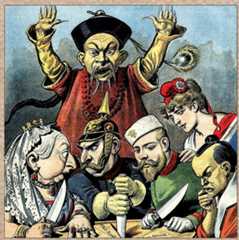
Prikaz novega imperializma in njegovih učinkov na Kitajskem. / Una rappresentazione del nuovo imperialismo e dei suoi effetti sulla Cina. / A portrayal of New Imperialism and its effects in China. Henry Meyer, 1898 (Wikimedia Commons).
Redakcija te številke je bila zaključena 31. decembra 2020.
Revija Acta Histriae je vključena v naslednje podatkovne baze / Gli articoli pubblicati in questa rivista sono inclusi nei seguenti indici di citazione / Articles appearing in this journal are abstracted and indexed in: CLARIVATE ANALYTICS (USA): Social Sciences Citation Index (SSCI), Social Scisearch, Arts and Humanities Citation Index (A&HCI), Journal Citation Reports / Social Sciences Edition (USA); IBZ, Internationale Bibliographie der Zeitschriftenliteratur (GER); International Bibliography of the Social Sciences (IBSS) (UK); Referativnyi Zhurnal Viniti (RUS); European Reference Index for the Humanities and Social Sciences (ERIH PLUS); Elsevier B. V.: SCOPUS (NL); DOAJ.
To delo je objavljeno pod licenco / Quest’opera è distribuita con Licenza / This work is licensed under a Creative Commons BY-NC 4.0.
Navodila avtorjem in vsi članki v barvni verziji so prosto dostopni na spletni strani: https://zdjp.si.
Le norme redazionali e tutti gli articoli nella versione a colori sono disponibili gratuitamente sul sito: https://zdjp.si/it/. The submission guidelines and all articles are freely available in color via website http: https://zdjp.si/en/.
VSEBINA / INDICE GENERALE / CONTENTS
Wolfgang Göderle: Postwar: The Social Transformation of Empire in Century Europe. Scientific Knowledge, Hybridity and the Legitimacy of Imperial Rule … 511
Postwar: trasformazione sociale dell’Impero nell’Europa del XIX secolo. Conoscenza scientifica, ibridismo e legittimità del potere imperiale Povojna socialna transformacija Habsburške monarhije v 19. stoletju. Znanost, hibridnost in zakonitost cesarskih zakonov
Francesco Toncich: Istria between Purity and Hybridity: The Creation of the Istrian Region through Scientific Research in the Century … 541
L’Istria tra purezza e ibridismo: la creazione della regione istriana attraverso l’attività scientifica nel XIX secolo
Istra med čistočo in hibridnostjo: ustvarjanje istrske regije skozi znanstvene raziskave 19. stoletja
Daniela Simon: The “hybrids” and the Re-ordering of Istria, 1870-1914 … 577
Gli «ibridi» e il riordino dell’Istria, 1870-1914
»Hibridi« in reorganizacija Istre, 1870-1914
Bojan Baskar: A Mixture without Mixing: Fears of Linguistic and Cultural Hybridity in the Slovenian-Italian Borderland … 605
Una mescolanza non mescolata: paure dell’ibridismo linguistico e culturale al confine italo-sloveno
Mešanice brez mešanja: bojazni pred jezikovno in kulturnohibridnostjo na slovensko-italijanskem mejnem območju
Marijan Premović: Politički odnosi komuna Budve i Dubrovnika od 1358. do kraja XIV. stoljeća … 623
Le relazioni politiche tra il comune di Budva e il comune di Ragusa dal 1358 alla fine del secolo XIV
Political Relations of Budva and Dubrovnik Communesfrom 1358 until the End of the Century
Jurij Perovšek: O Dr. Milanu Jakliču in prvem prevodu Komunističnega manifesta v slovenski jezik. … 645
Dr. Milan Jaklič e la prima traduzione in sloveno del Manifesto comunista
Dr. Milan Jaklič and the First Translation of the Communist Manifesto into the Slovene Language
Aleš Maver: Med cesarjem in kraljem: lavantinski knezoškof Mihael Napotnik v letu 1918 in po njem … 661
Tra l’imperatore e il re: l’arcivescovo di Maribor
Mihael Napotnik dal 1918 in poi
Between an Emperor and a King: The Prince-bishop
Mihael Napotnik of Lavant in the Year 1918 and Afterwards
Darjan Lorenčič & Andrej Hozjan: Respublika Mörska - Murska Republika, 1919 … 679
Respublika Mörska - la Repubblica di Mura, 1919
Respublika Mörska - The Republic of Mura, 1919
Gorazd Bajc, Mateja Matjašič Friš, Janez Osojnik & Darko Friš: L’intervento italiano in Carinzia dopo la Prima guerra mondiale e i britannici … 711
The Italian Intervention in Carinthia after the First World War and the British
Italijanska intervencija na Koroškem po prvi svetovni vojni in Britanci
Francesco TONCICH
Eberhard-Karls-Universität Tübingen. The Collaborative Research Centre (CRC) 923 "Threatened Order -
Societies under Stress", Keplerstrasse 2, 72074 Tübingen, Germany
e-mail: francescotoncich@gmail.com
This article investigates the application of a repertoire of terms used by both Austrian imperial and Istrian-Triestine scientists to categorise forms of cultural diversity and hybridity on the Istrian peninsula. The study spans most of the century (mostly from the 1840s and the First World War), when such a range of categorising terms was established in scientific works in Istria, Trieste/Trst/Triest and the whole Habsburg Monarchy. The development and use of these terms formed the foundations for the process of building a new regional order on the Upper-Adriatic coast (Istria) within the general re-ordering of the Habsburg Empire.
Keywords: region building, Habsburg Empire, cultural diversity, cultural hybridity, history of science, ethnicization of Istria
Il presente articolo analizza l’uso di un repertorio di termini che furono utilizzati per categorizzare realtà socioculturali della penisola istriana come forme di diversità e ibridismo culturali. In particolare, il presente studio analizza il periodo compreso tra gli anni ’ 40 dell’ 800 e lo scoppio della Prima guerra mondiale, quando questi termini di categorizzazione apparvero e si consolidarono in studi scientifici pubblicati in Istria, Trieste e nell’intera Monarchia asburgica. Tali termini scientifici fornirono le fondamenta del nuovo ordine regionale istriano, che fu sviluppato sulle coste dell’alto Adriatico all’interno del processo di trasformazione generale dell’Impero asburgico.
Parole chiave: costruzione regionale, Monarchia asburgica, diversità culturale, ibridismo culturale, storia della scienza, etnicizzazione dell’Istria
This article aims to investigate the strong relationship between the parallel creation of a new regional political-administrative order (Istria), the general re-ordering of the Austrian imperial structure post-1848 and the very first modern scientific structure in the Austrian Littoral from 1840 to the First World War. The main aim is to understand the influence of political processes on the re-organisation of local Istrian society through a vocabulary of terms about forms of socio-cultural “diversity”, “mixing” and “hybridity” after the “threat” of the March Revolution 1848/49.
These terms do not represent analytical categories for this essay: the aim is not to prove the actual existence of culturally diverse or mixed realities, nor even to support either positive or negative value judgments about them. These terms are considered as objects of this study used under cultural and historical circumstances. The aim is to understand a plausible beginning of the “long-standing purity-hybridity dialectic”, as Pamela Ballinger claims to be the basis of the organisation of society in modern and contemporary Istria (Ballinger, 2003, 249). The co-presence of terms like “purity” and “mixing” will not be seen as a contradictory co-existence of two conflicting poles. On the contrary, “mixing” (equally considered as a threat, a transgression or a resource) will be theoretically considered on the same level of “purity”, as two pivotal parts of the same discourse by creating a new socio-cultural order (Douglas, 2002, 5). Hybridity should be considered as a constitutive concept for defining and establishing homogeneities like the several “nationalities” in the Central European area. In the Habsburg Kingdom this bijective dialogic was used as a basis for the re-ordering after the “March Revolution” of 1848/49 by the Central State itself and the imperial scientific society (Bhatti, 2014).
Categories like “nation” or “nationalism” will not be considered as essentialist, fixed and objective realities: regimented and dusty interpretations of the “national struggle” between two or three national groups (such as the so-called Italian “storia patria”) can no longer help us to understand historical changes in such a multilingual space like Istria and the Austrian Littoral in their complexity. Instead of a simplified, teleological history of nationalisms or nations in Istria, categories like “empire” and “region” will be considered as the main unities of meaning, in which different processes of identification had their development. The “region”, above all the idea of a “border-region”, will be taken into account as the main “living space” (“espace vécu”, Frémont, 1976), which was mostly debated by cultural elites and scholars in Istria during the century.
The challenge of strict ethnocentric and hierarchical interpretations could only be reached through a reconsideration of the term “culture” (Verginella, 2008, 791-792). Instead of monolithic entities (e.g. the absolute categories “to be Italian”, "to be
1 This research was developed within the Collaborative Research Centre 923 “Threatened Orders” at the Eberhard Karls University Tübingen and is part of the project G03 “Istria as ‘Experimental Station’ Hybridity as (Threatened) Order”.↩︎
Slovenian", “to be Croat”), the term “culture” points rather to a shared “space of communication” in precise socio-historical contexts with its own mechanisms of inclusion and exclusion (Csáky, 2014; Suppanz, 2003). In such a never-ending process boarderlines between socio-cultural groups lose their precision (Bhabha, 1994, 1996; Reckwitz, 2008, 15-45). Consequently, terms like “diversity”, “mixing” and “hybridism” acquire a renewed meaning as historically based forms for marking notable mutations in socio-cultural realities.
In this sense, after an initial introduction explaining the use of this dialectic in and on Istria, the text will focus on the ways through which it arose and on the agents who established it in structured discourses in the process of creating a new regional identity: the scientists. On the cultural and scientific level, these terms were developed by both imperial and local scholars in strong connection with the imperial re-ordering after 1848. Referring to the development of science in Western Europe in the last four centuries, Bruno Latour writes about the existence of a “Gordian knot” between “Science”, “Society” and “Politics” (Latour, 1993, 3-5). Due to the lack of a coherent history of science on the Upper Adriatic area, several kinds of sources and literature were used.
The historical development of modern Istria is based on an interesting paradox: Istria in itself represented a small peripheral region within the Habsburg Empire with endemic, continuous deficits like economic and agricultural backwardness, or sanitarian and hygienic problems during the whole century (Brodman, 1821, 29; Hugues, 1889; Del Bello, 1890; Apollonio, 1896). Nevertheless, Istria’s visibility intensified considerably in the cultural and scientific milieu through an incredible concentration of discourses about “culture” in the sense of diversity and amalgamation/mixing during the second half of the century (Nikočević, 2006; Johler, 2012a). Terms like “diversity” (“Vielfalt”, “Mannigfaltigkeit”, “diversità”) “mixture” (“Vermischung”, “mescolanza”) and “ibridismo” or “Hibridismus” were used mostly in German and Italian to refer to the Istrian populations with such a high frequency that they became the basis for the development of new forms of identification (Johler, 2012a). Proof for the use of these terms in Slavic languages (Slovenian or Croatian) has never been found (cf. Bojan Baskar’s text in this same volume about this absence in the Slovenian language).
2 The research is based on materials collected from archives as well as from libraries in Trieste/Trst, Istria, Graz and Vienna: the Triestine State Archive (AST), the Archive of the Triestine Civic Museum of Natural History (CMSN), the Archives under the Triestine Civic Museum of History and Art (CMSA: including the Archive of the Museum itself, the Archive of Society of “Minerva”, the estates of some of the most important scholars of the Littoral), the Diplomatic Archive of the Triestine Civic Library (ADT), the Municipal Archive in Piran (SI PAK PI), the Archive of the Viennese Museum of Natural History (ANHM), the Archive of the Austrian Academy of Sciences (ÖAW), the estate of Hugo Schuchardt in the Archive of the University in Graz (HSA).↩︎
As a first step in this analysis, it is necessary to render a brief overview of the results of the research into the use of such terms. An initial distinction has to be made between the use of terms about “diversity” (“Vielfalt”, “Mannigfaltigkeit”, “diversità”) and “mixture” (“Vermischung”, “mescolanza”) and the specific term “hybridism” (“ibridismo”, “Hibridismus”).
The first group of terms was used primarily in scientific and classification works by the official imperial scientific society from the 1850s. This first discourse about cultural diversity and mixture was part of a bigger project for the imperial re-ordering after the threat of the European Revolution 1848/49, in order to develop a new political-administrative and social structure on the basis of the re-organising paradigm of the “Multinational State” (“Vielvölkerstaat”), “state of contrasts” (“Staat der Contraste”) or “Unity in the Diversity” (“Einheit in der Vielfalt”) during the second half of the century. Such vocabulary about “diversity” hid the tremendous strategic shift in the political legitimacy of the Austrian Empire after the dissolution of the Holy Roman Empire in 1806 and the dawn of new forms of political organisation based on the idea of “Nation” above all after 1848/49 (Kann, 1950, 15-16).
During the 1850s/60s the many states in the Kingdom and their local populations were put under stress by the first ethnic categorizing studies and representations of the Austrian imperial Science and State, when precise demarcations between clear ethnic groups were established. The most exemplifying figure of this important period of ethnic “unmixing” was Karl von Czörnig, president of the Central Office for Administrative Statistics in Vienna and founder of the Ethnology in Austria (Grieshofer, 1999). In his initial studies from the mid-1850s (especially in his Ethnographie der österreichischen Monarchie of 1857), Czörnig (along with other colleagues and scholars) diagnosed an incredible amount of cultural-linguistic diversity and even mixtures in some particular regions of the Habsburg Kingdom: Istria, Vojvodina and Galicia became “miniatures” of such a “typical” Central European diversity and hybridity (Czörnig, 1857). Categorizing practice meant not only a simplified act of diagnosing but it was rather an act of impressing a direct change on the social realities on the local level through a new administrative system. In this sense, state administration should be supported by scientific knowledge (Göderle, 2016, 101). It is no wonder that these categorising studies took place exactly after the quashing of the March Revolution which was the biggest threat the Habsburg imperial order had experienced in the modern time. The decade of the 1850s was indeed a time of utmost “rapid and energetic” change, when the “reorganisation” (“Neugestaltung”) of the Monarchy coincided exactly with the restoration of the imperial order itself (Czörnig, 1958).
In such a small “miniature”-region like Istria, Czörnig counted and arranged in such taxonomic representations an incredible cultural diversity of smaller sub-groups, mostly divided and gathered in the three major groups of “Italians,” “Serbs and Croatians” and “Slovenians”. Furthermore, between these three groups some other tiny ones were interposed: ethnic minorities

Fig. 1: Detail of the Ethnographie der österreichischen Monarchie / Ethnographic map of Austrian Monarchy, Karl von Czörnig, 1855 (Wikimedia Commons).
(like the “Montenegrins” in Peroj and “Tschitschen/C̆iči/Cicci”) or different enclaves of “mixed populations” (Czörnig, 1857, V). The latter, small, local non-categorizable groups of the Istrian population, were collected under a new all-inclusive umbrella definition like “Vermischung(en)” (as well as synonyms like “Mischung”, “Gemisch” etc.).
Categories of “mixing” were put together with “diversity” in a dialogic relationship between purity and hybridity. They were used by the imperial “Habsburg Society” mostly as a positive or neutral analytical term and acquired in general an official scientific status (Kappus, 2002, 324; Johler, 2012, 18). This palette of terms became: 1) pillars for the new system of self-legitimacy for the Habsburg dynasty and Kingdom as a “Vielvölkerstaat”, as a “multinational Empire” (Kann, 1950); 2) the basis for the practice of the science of statistics and more systematic censuses; 3) a public domain also in different languages which was spread around the Kingdom through a long list of official scientific works and representations (cf.: Umlauft, 1876, 1-2).
The concentration of this vocabulary on such a small region showed the status of Istria as a “laboratory” for testing new categories and tools for the re-ordering of itself. Primarily, the concept of “Einheit in der Vielfalt” (“Unity in the Diversity”) and its deriving managing diversity through the so-called “Ethnicizing” of the Empire (Stourzh, 2011). Secondly, regarding the “Vermischung”-term, this vocabulary was crucial for the development of an anti-nationalistic, self-legitimising strategy, which could work as a mechanism against centrifugal forces in the following crisis moments in the post-1848/49 period (Kappus, 2002; Johler, 2012).
A parallel development in finding new categories for a reinterpretation of populations in a political and socio-cultural context, which had been changing even faster since 1848, was represented by the emergence and repeated use of the term “hybridism” on the local level in the Austrian Littoral. The first hint of the use of the term “hybridism” can be dated exactly at the most threatening period for the unity of the Empire in the midst of the revolution in 1848. On September 1848 a discussion took place within the City Council of Piran/Pirano about the incorporation of the former Venetian Istria into the German Confederation (Stenographischer Bericht, 1848, 1, 528; Stenographischer Bericht, 1848, 2, 720, 1569-1570) and the preservation of its own local autonomy. The German historian and deputy in the Paulskirche, Friedrich von Raumer, proposed the embodiment of the entire Istrian peninsula into the German Confederation between the July and the August 1848. It stood in direct connection with the first expansion projects towards the Adriatic Sea by an extended Germany (Großdeutschland). Apparently, in this local space of political and socio-cultural representation in Frankfurt, the term “ibridismo di popolo” (“hybridism of the people”) was used concerning Raumer’s report for the first time. The term “hybridism” signalled an external and offensive definition. According to the stenographic protocol of the Council in Piran/Pirano, the word arose during discussions about the Istrian coastal part in the Paulskirche in Frankfurt am Main in order to discredit the Istrian autonomy of the local elites:
It is indeed curious to see them [the German deputies in Paulskirche] with their furious exclamations and without any regard of the effect that their words can have. They hurl themselves against us and give us the most beautiful praises, by calling our deputies [in the Viennese Parliament] illegitimate and men without brains. They consider us Istrians as a ludicrous jumble of people thrown randomly
3 Supplemento al N. 105 dell’Osservatore triestino, 1. 10. 1848: I. E. Beck, Sulla flotta germanica in avvenire, 797-798.
4 Any direct proof of this use in Frankfurt could not be found in the protocols from the German Confederation.↩︎
onto the Istrian coast, and the entire Province as a monstrous Babel of different descents, idioms and customs, as a hybridism of the people, and other similar gallantries. In this way and with this knowledge these foreigners speak about us, who want us to join Germany (SI PAK PI - UT 1, UA, 31).
Meanwhile, during the summer of 1848, other terms regarding hybridity, like “ein zusammengewürfeltes Gemisch” (“a random conglomerate”), were used by German-speaking journalists in Vienna or Trieste/Trst/Triest in order to attack the legitimacy of such political-cultural autonomy. Since its first use, such a particular term showed its negative meaning: “hybridism” began to stand for an attack, an external threat against the integrity of the autonomist control on the local administration and society by the sub-regional, municipal elite.
Looking at one of the main local newspapers (La Favilla) and several publications about the Littoral and Istria during the decades before 1848, up until this moment the regional elites had seemed to be reluctant to take position and make a clear declaration of either regional or national identification. Connected to this, thematisation of cultural diversity and mixture in Istria was almost absent in works by local scholars in the first half of the century. In 1848 Istrian elites seemed to experience this “hybrid”-attack as a shock, that seemed to trigger the first attempt to define themselves regionally and nationally. It was apparently a sign that the times were changing even faster, in the sense of paradigms of political legitimacy being subjected to radical mutations. The new emerging paradigm was the WestEuropean bourgeoisie concept of “nation”.
According to this research, after this curious but vivid appearance of the term “hybridism” in Istria, no other evidence of its use could be found in reference to Istria until 1893. In any case, the first use of this hybridity-concept on the local level in 1848 seems to have acquired an enormous importance for the Istrian elites. After this first brief appearance in 1848, the regional elites were organising themselves as “Italians in Istria” following the general trend of the so-called “ethnicizing of politics” in the entire Austrian Monarchy (Stourzh, 2011). It meant that the local elites had to adapt themselves to the newly demanded paradigm of cultural-national purity/homogeneity, to which even the Austrian State was adapting itself as a “multinational Empire” in order to safeguard the newly restored imperial order (Kappus, 2002, 324).
On the local level, the shock of 1848 seemed to remain vividly in the minds of the Istrian elite for decades and showed its pervasive influence on the re-ordering of the regional society and politics. The label of “hybridism” could condemn them to political isolation and inactivity, particularly after the opening of the “multinational” Austrian
5 Quotations of sources in Italian were translated into English by the author of this article.
6 Cf.: Journal des österreichischen Lloyd, 27. 7. 1848: Aus Istrien, 556-557; Salata, 1915, 233-235.
7 Cf.: La Favilla, 11. 6. 1837: G., Impressioni di viaggio. Viaggetto a Pirano, 3-4; La Favilla, 25. 6. 1837: A. Madonizza, Polemica, 2-3 (also in: 8. 10. 1837, 49-50).↩︎
Parliament, organised on the basis of unmixed and well defined national groups. In the time of the ethnicisation of the empire, the first generation of Istrian opinion-makers had to decide which kind of national purity they belonged to.
On the other hand, after 1848 forms of cultural diversity in Istria (the nonItalian speaking rural “otherness”) could no longer be ignored by the local elites themselves. The empire itself had now provided the distinctive features of such previously “invisible” social groups through its ethnicising categorization works. The new cultural and scientific activities of the “Italians of Istria” served as a tool for self-definition and consolidation as a homogeneous leading group by separating themselves from other “diverse” and “mixed” groups, now designated “Slavs”.
Additionally, since the 1850s when the imperial official vocabulary was established by the imperial statistics, those terms started to appear in parallel with works by local Istrian Italian-speaking authors. Throughout the entire second half of the century local scholars and scientists (for instance Carlo Combi, Antonio Coiz, Carlo De Franceschi, Giovanni Rosa, as well as later Paolo Tedeschi and Bernardo Benussi) started to use a repertoire of Italian terms, such as “mescolanza” and “diversità”, which were their own Italian versions for the contemporary official German terms from Czönig’s works. The local Italian-speaking opinion-makers accepted quite entirely and immediately the imperial official narration about diversity and mixture in Istria (cf.: Combi, 1858, 39; Rosa, 1860, 11-13). They could not negate the presence of “others” on the peninsula anymore. Furthermore, they also placed the diversity and even the mixed populations in the very same areas where Czöring and the imperial scientists had placed them (Combi, 1858, 25-26).
However, the thematisation of cultural hybridity of the “others” clearly aimed to strengthen the construction of the Istrian Italians’ own purity. The old offensive and threatening definition “to be hybrid” in 1848 was removed dialogically by the local Italian-speaking bourgeoisie by claiming to be socio-politically unique and a culturally pure group. Consequently, instead of rejecting the idea of the existence of hybrid populations in Istria at all, Istrian Italian speaking agents transposed the definition of hybridity to socio-cultural otherness, the rural “Slavs”. So, the old accusation “to be hybrid”, referring to the Istrian elite, became a cultural-political tool for their own supremacy. Due to this re-interpretation of the purity-hybridity dialectic (established by the scholar and journalist Carlo Combi from Capodistria/ Koper; Combi, 1858; Combi, 1860), the claim of their own homogeneity was based even more on the definition of hybridity referring to the “others” rather than that of their own purity. It was a declaration of purity “ex negativo”:
For this time, let’s put an end to it, but not without reminding the reader once again of the fact that the Slavic peoples of Istria are so varied and extraneous not only to their foreigners but also to each other. On the contrary, there is only one Italian population, with all its towns, villages and lands, where all elements of acculturation can be found. Therefore, Istria is also ethnographically an integral part of Italy (Combi, 1860, 397-398).
Francesco TONCICH: ISTRIA BETWEEN PURITY AND HYBRIDITY: THE CREATION OF THE ISTRIAN …, 541-576
After a long dormant phase of this purity-hybridity dialectic among local scholars and scientists, terms like “ibridismo”, “ibrido”, “Hibridismus” (both in Italian and in German) experienced a “renaissance” between 1893 and 1914. They were used again regularly by several authors in studies and publications about the cultural and historical aspects of Istria and Trieste/Trst/Triest.
A first phase of this renaissance can be observed in the 1890s, above all between 1893 and 1903. In a text about the Slavic Liturgy in Istria (La liturgia slava nell’Istria) in the Atti e memorie della Società istriana di archeologia e storia patria in 1893, the Istrian-Triestine professor and historian Bernardo Benussi from Rovigno/Rovinj started with the words “ibridismo etnografico” (“ethnographic hybridism”) referring to the mixing category “Serb-Croat” introduced in the Austrian Statistics from 1880. The rise of this particular term took place in one of the most passionate nationalistic fights between the Istrian parties of the “Italians” and “Croats” in the regional parliament, as well as in the newspapers, when the Croatian speaking priest and deputy Franjo Josip Volarić demanded the state recognition of Slavic as one of the official languages in Istria (Wörsdörfer, 2003, 149-150).
The word “hybridism” by Benussi seemed to have a larger resonance not only in Istria through several articles in the local press but also in other parts of the Monarchy. In 1897 and in 1903 the journalist and writer Josef Stradner from Graz paraphrased the “hybridism”-paragraph from Benussi’s essay in two different German texts, published in Vienna and Graz (Stradner, 1897, 101; 1903, 12). Basically, the first text acquired a decent visibility within the imperial scientific society since it was published in the prestigious Zeitschrift für österreichische Volkskunde, led by the founder of the first Society and Museum for Austrian Folklore, Michael Haberlandt. Both authors, Benussi and Stradner, used this term in a negative manner, even with clear anti-Slavic aims against the formation of southern pan-Slavic movements and parties in the Austrian Littoral: this reiterated the status of the term as a marker for a general crisis or a threat. Otherwise, with such a strong negative connotation, “hybridism” also seemed to experience a kind of circumscribed but intense spread in the local journalism in Istria mainly concerning political or educational questions between the late 1890s and the first decades of the century (above all in Parenzo/Poreč by the liberal-national
8 The Italians always lived within the biggest walled cities, which were less affected by the plague […]. In the smaller villages and in the countryside, all the southern Slavic races seemed to have gathered together: Serbs, Croats, Albanians, Montenegrins were overlapped, mixed, crossed there with each other and with Romanic families coming from the Turkish lands as well as with others from the Morea and the Greek Islands or with Greeks from Monenvasia, Naples, Crete and Cyprus. This conglomeration of different races had to be so varied and disordered that, after more than 200 years when in 1880 the official census was carried out, the absurd term of Serb-Croatian was established (as if it could be possible to name all of them together) in order to express this ethnographic hybridism that still exists in Istria, in particular in the south of Mirna river (Benussi, 1893, 204).
9 Cf.: L’Istria, b, 25. 11. 1893: La liturgia slava nell’Istria, 2.↩︎
newspaper L’Istria, as well as in Pola/Pula by the two irredentist La Fiamma and L’Eco dell’Adriatico and the socialist Il Proletario ).
A second phase of this “hybridism”-renaissance took place from 1909 until 1914. The conditions of the usage of the term seemed quite different than in the previous phase. “Hybridism” partially lost its strict negative connotation in favour of a more neutral use, sometimes even in scientific and literary analyses. This intense but short phase of a more evenhanded use was led by some of the most influential Italian-speaking scholars from the Austrian Littoral, among them the Triestine writer Scipio Slataper in, the lawyer, socialist activist and historian Angelo Vivante in, and the Istrian physician and scientists Bernardo Schiavuzzi in.
In general, “ibridismo”/“Hibridismus” was used as a label for the perception of different crisis situations. As during the March Revolution, the period between the 1890s and the First World War was a time of radical and dramatic changes in Istria, as well as in the whole Upper Adriatic area. The dramatic explosion and spread of
10 L’Istria, b, 1. 1. 1898: Ancora del professore italianofobo alle Magistrali di Capodistria, 2; L’Istria, b, 29. 10. 1898: L’istituto magistrale femminile di Gorizia, 3; L’Istria, b, 31. 12. 1898: Comizio di Parenzo, 3.
11 La Fiamma, 27. 5. 1911: Un paragone che non regge, 1; La Fiamma, 13. 7. 1911: Per fatti personali, ma politici, 7; La Fiamma, 12. 8. 1911: Musa d’Agosto, 3.
12 L’eco dell’Adriatico, 1. 12. 1906: Vita cittadina, 2; L’eco dell’Adriatico, 21. 3. 1907: Fuori dall’equivoco, 1.
13 Il Proletario, 20. 10. 1900: Abbasso il nazionalismo, 1; Il Proletario, 21. 5. 1904: Una scarrettata d’immondizie, 2; Il Proletario, 30. 7. 1904: Il Proletario che ride, 3; Il Proletario, 3. 8. 1904: Appunti di cronistoria cittadina (1869-1904), 3; Il Proletario, 24. 8. 1904: Il nostro commento, 2; Il Proletario, 7. 9. 1904: Le basi e le ragioni del nostro accordo, 2; Il Proletario, 12. 10. 1904: Ancora il “solismo”, 2; Il Proletario, 19. 11. 1904: Il pseudo-giornalismo locale, 2.
14 Since the city joyfully encouraged, in every way, its hybrid development, Trieste did not hesitate to accept new citizens, as Maria Theresia wanted: therefore, the city became a real asylum for criminals. I know that the citizens of Trieste had old Rome as a model!: however it is amusing to observe that in some citizenship applications, published by Giuseppe Caprin, the proof of being in trouble with foreign police was a sufficient reference (Slataper, 1988, 9).
15 Since a vast swallowing urban centre is lacking in Istria, the Istrian Slavs, that are mostly the peasant inhabitants of the countryside, have always been less subjected to the urban influence than those in Trieste: the Italianizing process in Istria has had an absorbing effect on the individuals within the small nearby walled cities or villages. The other ones, which live outside from urban spaces, even a few steps away, have taken a superficial Italian veneer, varying in strength depending on the place. In this way rustic hybridism arose, that is a much more tenacious phenomenon than urban hybridism, which until recently rapidly led to definitive Italianization. Normally, the hybrid is a historically and dialectologically Slav peasant, which understands and speaks the Italian dialect of the nearest centre and usually uses it in service and business relations. Such a hybridism often invades the private sphere too, with bizarre nuances: Slavic language could be spoken among and with old people or between spouses, but they do not always use it with their children, etc…: therefore, it is a form of drowsiness which should lead to the final Italianization, although it does not happen very often (Vivante, 1984, 180-182).
16 In this region, as in all countries on a linguistic border, the four ethnic races constantly stayed in contact over the centuries, largely melted together and produced hybrids. They kept the family name as witness of their race but adopted the language of the other and changed the old nationality in order to assume a new one; however, they kept the physical characteristics and sometimes the stigma of the old race. So, we see Slavs with purely Italian surnames who are convinced that they are Slavs, and, on the other hand, Italians with definite Slavic surnames with very pure national feelings. Likewise, the same can be said for the Germans, not to mention the Romanians, who have not been so since a long time (Schiavuzzi, 1914, 1-2).
plant-diseases (like phylloxera and downy mildew) worsened the already precarious agricultural, economic and health situation in numerous parts of the hinterland of the peninsula (Visintin, 2015). No wonder that in the same 1890s some local scientists mobilised themselves through studies of the dramatic situation, like the agronomist Carlo Hugues, the scholar Nicolò Del Bello and the physician Carlo Apollonio (Hugues, 1889; Del Bello, 1890; Apollonio, 1896). Above all, Apollonio declared in his report about the health and hygienic situation of the countryside in the Istrian hinterland in 1896 that “the municipalities have no money, the order is collapsing” (“I Comuni non hanno denaro: l’ordine crolla.”, Apollonio, 1896, 23). Meanwhile, the end of the Free Port in Trieste/Trst/Triest in 1891 and its transformation into an industrial hotspot led to a massive emigration of a high percentage of the Istrian rural population to the big Upper Adriatic port-city (Cattaruzza, 1979; Cattaruzza, 2012; Breschi, Kalc & Navarra, 2001).
The parallel establishment of the “purity-hybridity dialectic” between local and imperial level since the 1850s, is an interesting example of what the historian Ulrike Hirschhausen calls “shared imperial knowledge” (Hirschhausen, 2015, 720, 743). Moreover, this vocabulary for the re-ordering can be observed as a highly interesting example of an inter-cultural/inter-lingual process of “circulation of knowledge” (Surman, 2015) in the second half of the century, despite the fragmentations in the scientific society within the Habsburg Empire during the so-called “nationalization of knowledge” (Ash & Surman, 2012). In this manner, a challenge (at least partially) of the separation and hierarchisation between centre(s) and periphery(ies) seems to be needed. The circulation of knowledge cannot be assumed as a “topdown” process or even from a centre spreading to the peripheries.
The parallelisation of the use of re-ordering vocabulary in the 1850s could appear, at first glance, as a mimesis and adjustment of the “local” to the “imperial” knowledge. However, taking a closer look and in the long-term view even in the period before 1848/49, we can better evaluate the crucial decade of the 1850s and such circulation of knowledge. It seemed to be depending on the parallel processes both of the stabilisation of the new region Istria and of the development of a scientific discourse in the Austrian Littoral. Istria already revealed, before 1848, its status as a laboratory for testing and adjusting new European cultural concepts.
The first part of the 1840s could be considered as a fundamental “turning point”. An initial attempt to homogenise and incorporate the new Istria into the imperial structure by the Austrian German-speaking bureaucracy in the first half of the century (by the first administrative homologation of Istria in 1825) seemed to have failed already at the end of the 1830s. Large parts of the local society protested, even violently, against the local German-speaking Austrian bureaucrats and state officers because of their inefficiency and cultural distance (Apollonio, 1996). For
this reason, the imperial government of the Littoral under the leadership of Franz Seraph von Stadion began not only to reform the administrative structure of Istria between 1841 and 1846, supporting local political and social regional autonomies, but also to institutionalise and finance the already functioning scientific research societies (Dorsi, 1994, 131-188). This first phase of institutionalisation materialised progressively with the establishment of an official imperial scientific and cultural network on the regional level through the foundation of scientific institutions, newspapers and journals. The aim was to create a cultural connection between the imperial political power and the local elites in order to strengthen the imperial legitimacy on the local level.
The two main cultural and scientific projects were mostly represented by the newspaper La Favilla (between 1836 and 1846 and founded by Antonio Madonizza from Capodistria/Koper) and the journal L’Istria (founded and led by Pietro Kandler between 1846 and 1852). The two editorial projects were both sustained and financed by the Austrian Lloyd and the local Austrian lieutenancy. Although both of them rose to prominence at almost the same period during the establishment of an initial interest for Istria as a united region, they differed considerably from each other. La Favilla represented a forum of social and cultural discussions for the bourgeoisie of the Austrian Littoral. On the other hand, the magazine L’Istria was an official tool, firstly, for collecting the most preeminent local scientists and placing them within a coherent epistemic network and secondly, for implementing a “new” regional identity of “being Istrian”, although in a specific imperial way. This newspaper propagated, from the very first articles, the first imperial idea of Istria under the motto “United in the Diversity”. Under the charismatic leadership of Pietro Kandler, the first versions of cultural, historical and even naturalistic studies about Istria (conceived as a politically united but socioculturally diversified region) appeared.
Within these highly creative cultural projects during the late 1830s and 1840s, the very first descriptions of the cultural diversity on the Istrian peninsula appeared on the local level. Despite the previous absence of representations of different cultural groups (like the “Slavs”) by the local Italian speaking elite (mostly from the coast), starting from the 1840s some individual local agents had started to independently organise anthropological and linguistical research into forms of cultural diversity in Istria under the impulse of this flourishing period of scientific research. These two journals set the aim to collect and organise, in a coherent way, all the first attempts at discourses and studies on Istrian cultural diversity. This was the case with the first texts about the Istrian “Slavs” in La Favilla in the context of a long list of articles about a “romantic” trip through the Istrian peninsula written by Francesco Dall’Ongaro between 1838 and 1840. Secondly, the first series of scientific essays
17 La Favilla, 12. 8. 1838: Dall’Ongaro, Cose Patrie. Viaggetto nell’Istria, 6-7 (also in: 16. 9. 1838, 26; 7. 10. 1838, 38; 14. 10. 1838, 42-43; 16. 12. 1838, 78-79; 4. 8. 1839, 5-6; 11. 8. 1839, 11-13; 6. 10. 1839, 77-79; 26. 4. 1840, 129-132).↩︎
appeared in L’Istria written by Antonio Facchinetti in the spring of Both authors seemed to describe the cultural forms of Slavic speaking groups on the Istrian peninsula in their different ways under the influence of the cultural images and stereotypes about the Dalmatian “Slavs” (“Morlachs” or “Ajduchs”) through a cultural transfer from Dalmatia to the Austrian Littoral during the decade before 1848 (Wolff, 2001; Pirjevec, 2009, 3-10). Even the contemporary scholar Carlo De Franceschi denounced such a transfer in the columns of Osservatore Triestino in September 1843: A famous Italian writer […], who promised to spread the word about the customs of Istria, invented stories that could be applied to Dalmatian Morlaches, but not to the modern Istrians […].
Another paradigmatic case regarding the first phase of the development of a systematic knowledge from local agents was the initial research and construction about the “imagined community” of the “Istro-Rumanians” (also known as “Cicci”, “Čiči”, “Tschitschen”). The scholar Antonio Covaz from Pisino/Pazin started the first collection of data about such “exotic” people, sometimes with the help of his fellow citizen Carlo De Franceschi (Dahmen, 1986). The first results were published in the first issues of Kandler’s L’Istria in January 1846. The publication in L’Istria created an unexpected interest in some scholars and politicians from other parts of the Monarchy. After even less than a month, the Baron Karl von Geringer, exponent of the Viennese Court Chamber, expressed his interest in Covaz’s research about the “Istro-Rumanians”. Also, influenced by Covaz’s essay, the philologist Gheorghe Asachi from Iaşi undertook research in the following months into the Istrian hinterland and a year later published a first article in the Rumanian language about the “Istro-Rumanians” (Dahmen, 1986, 243).
After this first phase of research and spread of knowledge, the construction of scientific discourses about such exotic “primitive” people gained in importance in the second half of the century. The control of these human groups in the Istrian hinterland became an area of dispute between the local Italianspeaking elites, the Croatian-speaking elites and the mostly German-speaking Empire’s scientists also through scientific discourse. For local nationalists the scientific proof of the “real” cultural/ethnic either Latin or Slavic nature of the Istro-Rumanians was fundamental in claiming control of the region through the so-called “right of the first settlers on the region”. At the same time, from the imperial point of view, the development of a coherent scientific discourse about the Istro-Rumanians, considered as one of the “last living primitive populations in Europe” (Ausstellung österreichischer Hausindustrie und Volkskunst, 1905,
18 L’Istria, a, 20.3.1847: D. A. Facchinetti, Degli slavi istriani: 81-82 (also in: 27. 3. 1847, 85-87; 3. 4. 1847, 93-96; 10. 4. 1847, 97-100; 17. 4. 1847, 102-106).
19 About the creation and spread of cultural representations of “Morlachs” in West Europe through Venice in the century, cf.: Wolff, 2001.
20 Osservatore triestino, 10. 9. 1843: Carlo de Franceschi, Intorno alla storia e statistica dell’Istria, 176.
21 L’Istria, a, 3. 1. 1846: Antonio Covaz, Dei Rimigliani o Vlachi d’Istria, con saggio del loro dialetto, 7-8.
22 L’Istria, 31. 1. 1846, 21.↩︎
111-112), played an important role in the establishment of the self-legitimizing propaganda as a supranational “Vielvölkerstaat”. Their nature as a highly mixed population but with its own stable cultural and historical form, could scientifically confirm the concrete possibility of a coherent mixed, multinational identity. The “Tschitschen” were regarded as non-typified “stem”-people for developing a constant hybrid Habsburg identity (Istrien, 1863, 151; Bidermann, 1888; Fischer, 1896).
Such a worthwhile example of transfer from a local to imperial/global level confirms that the news about such studies from the remote province could have been spread around the Monarchy due to a pre-existing and well-functioning imperial scientific network, in which the Littoral and Istria took part, for instance, through the magazine L’Istria. It represented the first systematic institutionalisation of a local Istrian scientific network, through which Kandler (and indirectly the state power represented by Stadion) tried to connect the local scientists and scholars and collect them in a coherent discourse and practice.
Concerning the period after 1848/49, Czörnig’s Ethnography and his first Ethnographische Karte der Österreichischen Monarchie (Czörnig, 1855) can be considered the result of a collective research work which had involved several local personalities and networks. First of all, the work was carried out by a research committee from the Central Office for Administrative Statistics that had undertaken several field studies throughout the Kingdom since 1846 (D’Alessio, 2003, 67-68). However, the collection of data for the preparation of Czörnig’s results required a widespread network of contacts and collaborations on the regional and even sub-regional level. In Istria and the Littoral, Czörnig clearly took advantage of a pre-existing network of personal and professional connections which he had already established during his previous stays in the Littoral. Indeed, Czörnig was not alien to Trieste/Trst/Triest and Istria: he had worked as state officer in Trieste/ Trst/Triest between 1828 and 1831. Moreover, after the March-Revolution, Czörnig was employed in the establishment and organisation of the “Central Maritime Administration” in Trieste/Trst/Triest between 1850 and 1852 (Tonetti, 1992, 2-10). As he wrote in the introduction to his Ethnography in 1857, he received helpful support from some important personalities from the local order. For instance, Count Coronini-Cromberg (from Gorizia/Gorica/Görz) provided “a commission, which accurately recorded and ordered people’s mixture from exactly each place” (Czörnig, 1857, VIII). Furthermore, due to the publication of important correspondence between some of the most pre-eminent scholars and scientists in the Littoral (such as those between Pietro Kandler and Tomaso Luciani), we are able to state that Czörnig took advantage of another personal connection, that is of the former public official in Lupoglav/Lupogliano Giovanni Rosa, who collected and provided data from field research for Czörnig (Radossi, 2014, 80). Rosa may be that “local expert in the spoken languages in Istria” mentioned by Czörnig in the introduction of the Ethnography (Czöring, 1857, IX).
Francesco TONCICH: ISTRIA BETWEEN PURITY AND HYBRIDITY: THE CREATION OF THE ISTRIAN …, 541-576
Fig. 2: Portrait of Karl von Czoernig, 1804-1889, from Wissenschaftlichen Bibliothek der Stadt Trier/Stadtarchiv (Wikimedia Commons).
In this sense, it could be easily stated that the knowledge as well as the relative vocabulary about cultural diversity and mixing in the Kingdom were not just simple results produced in scientific centres but even peripheries like Istria were able to develop their own system of knowledge through internal dynamics. Istria, as a laboratory of diversity and hybridity, was not simply a “sounding board” of developments rising outside of it but was also able to create its own specific ideas, self-reflections and self-representations with its own vocabulary.
Referring back to the shared use of the same vocabulary of the “purity–hybridity dialectic”, the most remarkable thing is that the knowledge and a systematic awareness of the cultural diversity and mixture in Istria was developed in parallel by the nationalised group “Italians of Istria” and was not in conflict with the imperial one a priori. It happened simultaneously and it was connected in mutual synergy. However, the main field of the conflict was the different ways to consider the region and regional identification: either as miniature of the imperial “unity in the diversity” or in a socially-culturally exclusive, politically autonomist and ethnocentric way.
The fact that local agents were able to develop an alternative and competitive way to understand and control the “purity-hybridity dialectic” is confirmed by the rise and repeated use of the term “assimilazione”. It represented their own version of hybridity in the Italian language (connoted positively), which defused the threatening and dreaded concept of “being hybrid” and was used in a productive way for proper cultural-political aims. After the shocking experience of the March Revolution in 1848, the “assimilation” gave the Istrian “Italian” bourgeoisie the dialogical and practical legitimacy to control the mostly Slavic-speaking rural masses through scientific studies and cultural policies (like educational projects) in order to incorporate them into their sphere of influence and control.
In this sense, instead of fighting the idea of hybridisation itself a priori, the first generation of Istrian Italian opinion-makers (principally Michele Fachinetti and Carlo De Franceschi) had established the idea of “assimilation” as an answer to the external label “to be hybrid” exactly since the year 1848. Later, in the 1850s and 1860s (in the same period of Czörnig’s publications), Istrian scholars developed it as a compromise between the imperial concepts of “purity” and “mixing” from an ethnocentric perspective. Particularly through the works of authors like Pacifico Valussi (after his nationalistic "conversion"24), Carlo Combi or Giovanni Rosa, the concept of “assimilation” received a new interpretation: it was not only a way of simple acculturation of an illiterate rural population (as Francesco Dall’Ongaro had thematised on La Favilla already in ). Assimilation progressively became a tool of cultural expansion in a political discourse within the general frame of the “purity-hybridity dialectic.” Firstly, assimilation increasingly adopted the status of a “spontaneous” process subjected to “natural laws”. Pacifico Valussi even called it “the natural law of assimilation” (“la loi naturelle d’assimilation”) in 1861 (Valussi, 1954, 36). Secondly, the assimilation became the central proof of the strength and legitimation of the leading “Italianity” in Istria, e.g. its capacity to attract and embody the otherness which had been even more finely defined as the “Slavs” since 1848.
23 Osservatore triestino, 9. 8. 1848: Michele Fachinetti, Elemento nazionale, 701-702; Osservatore triestino, 23. 9. 1848: Carlo de Franceschi, Appendice, 903 (also in: 24. 9. 1848, 909).
24 Vivante, 1984, 69.
25 La Favilla, 18. 8. 1839: Francesco Dall’Ongaro, Viaggetto nell’Istria. IX. Isola di S. Nicolò. NIZKA, 21.↩︎
The Triestine writer and journalist Alessandro Mauroner declared in 1855: “The Italian nationality has already proved to be invincible, as the conquerors have always been absorbed by it.”
Even the hybrid nature of the so-called “Italians of Istria” was not denied a priori at all in the ethnocentric narrations and historical continuities but was rather transposed back into a mythical ancestral past. This gave the “Italian group” in Istria its fortification and compactness through its assimilating, embodying capacity, whereas the “Slavs” remained highly divided in small, insignificant sub-groups and moved among themselves (Combi, 1858, 38-39; Rosa, 1860, 12-13; Gonan, 1888, 62). Assimilation of the “otherness” paradoxically became the main strategy for the reinforcement of their own “purity” by defining it as a sort of “asymmetric hybridity”. This particular concept could preserve the social, economic and political autonomist supremacy as the leading group of the region. For all these reasons, it can be claimed that the so-called “long-standing purity–hybridity dialectic” became a constitutive basis for developing self-reflection and regional/national identity even of the “Italians in Istria”.
The fact that science played a fundamental role in Istria in the second half of the century could depend on the status of Istria itself as a newly created region within a larger imperialistic project. If we speak about Istria as a unique region, as we know it today, we should admit that it represents a new political and administrative regional entity on the geographical Istrian peninsula. The unified Istrian region had only existed since the Napoleonic era between 1797 and 1813, when a non-pre-existing united region was created through mutations of the European order (Ivetic, 2014, 34-35).
It was not the first time that such a political-administrative regional entity had been created by the Viennese center ex novo after a change of the international order. After the dissolution of Poland-Lithuania and its partition, Vienna provided a completely new regional order called Galicia-Lodomeria, in order to fortify the newly acquired territories. Larry Wolff named this process of “region building” “the creation of Galicia” and used the analytical category of “fantasy” in order to underline the huge effort by the Viennese center and the local elites in constructing a cultural and scientific system of knowledge about the new region Galicia (Wolff, 2010).
After this epochal political shift, the first half of the century was a period of progressive but difficult creation of a new imperial regional order on the Adriatic coast. After 1848, the Viennese government began again to
26 The quotation is Mauroner’s from an article on the Corriere Italiano is available in: Cervani, 1969, 162.↩︎
reinforce the administrative “Küstenland” greater region as an answer to its growing imperial ambitions to become a naval power in the Mediterranean. The newly united Istria was situated strategically between the two main commercial free ports of the Kingdom (Trieste/Trst/Triest and Fiume/Rijeka). Its status as a young and fragile regional order was highlighted during the March Revolution when the first attempt, since 1825, by the imperial order at having a unified, coherent political-administrative and cultural structure, seemed to have failed (AST, IR LL, AP, 50-59).
After the overcoming of the revolutionary forces within the Empire and the war in North Italy, it was clear to the imperial order that its navy could no longer be kept in the arsenal of Venice. A shift of the imperial maritime interests from the unsure Veneto was required and Istria, above all the naturally wellprotected harbor of Pola/Pula, would be the new main maritime base from the mid-1850s (Cova, 2005, 47-148). As the German writer Johann Georg Kohl wrote in 1851, Istria became the “Austrian Crimea”. The political imperial Viennese and Triestine centres needed stabilisation of such maritime order, even by using “culture” and “science” (as had already happened with Galicia some decades before).
However, as an unknown German-speaking writer stated in a travel book about Istria and the Austrian Littoral, still in 1863, Istria was considered as one of the lesser known provinces in the Austrian Kingdom: a “terra incognita”. Such awareness of the lack of knowledge about Istria was expressed both by the imperial state and scientific societies and by local agents. The following wars against Piedmont and Italian Reign in 1859 and 1866 showed the lack of preparation of the Austrian Central State regarding the knowledge of the Adriatic Sea. As the German-Austrian geographer Eduard Brückner declared later (1910), the Austrian secretary of trade Bernhard von Wüllerstorf-Urbair discovered with astonishment in 1865, that the Austrian State did not own a proper map of the Adriatic Sea in German, only English maps (Brückner, 1910, 463). For this reason, the so-called “Adriakommission” was established by the Austrian Academy of Sciences in 1867
27 “Austrian Littoral” was created for the first time in 1749-1776 but it did contain the coastal half of the Istrian peninsula (Faber, 1995).
28 It can be said that the relationship of Istria with Pola and Trieste is similar to that of Crimea with its excellent ports of Sevastopol and Odessa. Sevastopol is Odessa’s war and aid port and as such it is of utmost importance. […] In comparison, Sevastopol has the same function as a protector of the Black Sea trade routes as Pola has in relation to the Adriatic trade routes. The beauty of Crimea can also be compared with that of Istria. One main difference, however, is that the Russians did significantly more for Sevastopol than the Austrians did for Pola, and that the Russians are far more progressive with their fleets and their dominion on Eurinus than the Habsburgs with their fleet and their dominion on the Adriatic (Kohl, 1851, 536-537).
29 Of all the provinces of the Austrian Kingdom there is certainly none that is still so little known as Istria. […] Istria is indeed also usually a terra incognita for historians, statisticians and geographers. We can find some single interesting notes and dates scattered in different works, but nobody has taken the effort to collect them in one picture and to summarise them in one frame (Istrien, 1863, Vorwort).↩︎
as a permanent research institution between Vienna, the Littoral and Dalmatia for the calculation and research of the natural conformation of the Adriatic Sea (ÖAW, AC; Meister, 1947, 95-97).
On the local level, the first generation of Istrian scientists who dealt with the question of the establishment of a coherent epistemic system within Istria expressed, even before 1848, the lack of an Istrian identification as well of their own institutionalised scientific discourse about the Istrian region. Such a lack was expressed by the Triestine journal Archeografo triestino in its first issue in 1837: The absence of works on the history and geography of Istria is due to the lack of printing houses in the province and to the poverty of past centuries (Archeografo triestino, 1837: Prefazione, III). Otherwise, six years later in 1843, even the lawyer, public officer and historian from Gologorica/Moncalvo Carlo De Franceschi expressed the deep lack of unity and a unique identity referring to the region Istria in the Triestine newspaper Osservatore Triestino. In his opinion, this was the main reason of the lack of scientific works about the region.
In such a complex context of giving meaning to a new regional administrative entity, the first issues of Kandler’s L’Istria of 1846 focused on the difficult effort to provide a coherent and unique representation and description of the new geography of Istria. At the same time, through L’Istria, Kandler made the effort to include the several scholars on the regional level into a coherent epistemic network. Therefore, this difficult attempt seems to have obviously failed mainly because not only one “geography of Istria” was possible. On the contrary, the idea of Istria could be described rather in the plural through different perspectives and as a composite representation, e.g. through several kinds of “geographies”, like a “physical” one, a “political” one and a “human-cultural” (so-called “genetic”) one. In February 1846 a journalist described the young, ephemeral and artificial nature of the identification with the term “Istria”:
We have already observed how the name of a province sometimes signifies not only the physical land with borders, but also the land occupied by a people,
30 The Adriakommission established several research and observation stations along the whole Austrian seaboard from Grado until Budva. The Commission had its main quarters in Vienna and Trieste/Trst/Triest and was in direct contact with the Viennese Board of Trade and the Triestine Maritime Government. Otherwise, it received the financial support of the richest part of the Triestine bourgeois elites and private companies. Among the documents of the Adriakommission in the Archive of the Austrian Academy of Sciences some bills show the name of the banker Pasquale Revoltella and the Austrian Lloyd as main private financiers for its research projects (cf.: ÖAW, AC 1: 155, 232, 246, 255; ÖAW, AC 3: 685).
31 Osservatore triestino, 10. 9. 1843: Carlo de Franceschi, Intorno alla storia e statistica dell’Istria, 173.
32 L’Istria, a, 3. 1. 1846: Simone Slavich, Della Geografia dell’Istria, 2-7 (also in: 10. 1. 1846, 9-12; 17. 1. 1846, 13-15; 24. 1. 1846, 17-19; 21. 2. 1846, 37-38); L’Istria, a, 7. 3. 1846: Delle carte geografiche dell’Istria, 47-48.
33 L’Istria, a, 14. 3. 1846: Geografia amministrativa d’Istria, 49-52 (also in: 28. 3. 1846, 62-64; 11. 4. 1846,.
34 L’Istria, a, 28. 2. 1846: Della geografia genetica dell’Istria, 41-42 (also in: 7. 3. 1846, 45-47).↩︎
that have a common language or common origin. This is not the case of Istria, nor was it ever the case, as far as historical information is concerned. On the contrary, it seems that the physical configuration of the internal division and the particular position of the province (it opens, on one side, to the sea, and, on the other side, borders with Alpine provinces) made it easy for two racially and culturally different peoples, to occupy it in the most remote times, like at the time of the centuries-old transmigrations. (L’Istria, a, 28. 2. 1846: Della geografia genetica dell’Istria, 41).
During the publication of the results of the first imperial ethnographic studies (1855-1857), the question of the organisation of scientific knowledge came up among some local scholars in 1856 (like Carlo Combi, Antonio Coiz, Carlo De Franceschi and Paolo Tedeschi). The beginning of the organisation of Istrian science was meant partially as an answer to the disappointing and even threatening results of the imperial science. In its official representations of the imperial policy of ethnicising, like on the Ethnographic Map (Czörnig, 1855), imperial statistics had massively reduced the number of “Italians” in Istria, in which they were represented as a meagre minority living in the tiny coastal part of the peninsula (D’Alessio, 2003, 53-57), marked by a narrow yellow strip surrounded by the green area of the “Slavs” (ct. Fig. 1).
Furthermore, there was also another reason for the need to develop an internal Istrian scientific discourse, as later Paolo Tedeschi confessed. A Milanese journal, Il nipote di Vesta verde, claimed in 1856 that Istrians were lacking their own identity because of their unclear hybrid nature:
I had read in Nipote del Vesta Verde these words: “Istrians are neither meat nor fish”. To me, to me, he [Carlo Combi] immediately added, to us, friends, let prove to them, we are made by hard meat. So, that was the beginning of Porta Orientale (Tedeschi, 1890, IV).
The old external categorizing threat of “being hybrid” appeared again, paradoxically this time from the Italian state, with whom the Istrian elites were trying to identify themselves nationally. The new appearance of the external definition of “hybridity” showed their cultural lack and activated the real need to establish a systematic scientific discourse about the diversity and “mixing” amongst “Istrians”. This renewed attack through the concept of “being mixed” reinforced the alarm of the contemporary development of the imperial, Germanspeaking ethnography, considered by Combi as “foreign” and “slanderous” (Combi, 1860, 388).
After the publication of the very first journal published by “Istrians” such as Porta Orientale under Combi in 1857 (Combi, 1890), a first range of Ethnographies of Istria in Italian was published by Carlo Combi between 1858 and 1860 (Combi, 1858; Combi, 1860). In this sense, the first institutionalisation of a scientific discourse from the local Italian-speaking elites revealed itself to be both
an answer to an external attack (from the Italian peninsula) and an adaption to the contemporary internal transformation process of the Austrian Monarchy. It took place principally through the reception of the vocabulary of the general Habsburg re-ordering. On the basis of these research and editorial projects between 1846 and 1860, a scientific-cultural “Istrian canon” was progressively established from the different generations of local scholars by collecting, selecting and organising previous publications about Istria’s ethnography, linguistics and history in the following decades (Ivetic, 1999, 145-177).
Moreover, this internal organisation and institutionalisation of the local society by creating their own scientific discourse did not seem to be separate from the general context of the Littoral and the Kingdom and should be interpreted in a wider perspective. After the March Revolution, the scientific society of the Littoral followed the general trend of the institutionalisation of science in the Habsburg Monarchy. This was represented by the establishment of the Austrian Academy of Sciences in Vienna in 1847 and the education and university reforms under the ministry of Leo von Thun und Hohenstein between 1849 and 1860. Indeed, since 1850, a second phase of an institutionalisation of science had taken place in the Littoral, above all by the transformation of the first private institution for natural science in Trieste, the “Zoological-Zootomic Cabinet”. This was founded in 1846 and became the “Civic Museum of Natural History” in 1852 (CMSN, 1, 20, Ragguaglio II 1850-1854). This process of institutionalisation on the local level was led by the most pre-eminent exponents of the local (Triestine and Istrian) order and was also supported by the Habsburg dynasty. Exponents of the Habsburg family often visited the museum, which was dedicated to Ferdinand Maximilian of Habsburg in 1855 (Civico Museo Ferdinando Massimiliano in Trieste, 1856, 14).
The archive of the “Museum of Natural History” in Trieste represented a favoured point of observation of changes in the region as well as in the Austrian Kingdom from different perspectives. Concerning the region Istria, this institution became a central core for the development of a regional identity. The museum’s status as official but also as a shared institution permitted the development of multiple forms of identifications through multifaceted and diverse “cultural relationships” (Johler, 2012b, 34). It strengthened regional identity alongside national and imperial identities through scientific research and the organisation of the exhibits. It can be stated that the newly traced political-administrative boundaries of Istria, which created a new region, increasingly became the boundaries of research activities and scientific discourses of the local scientists and scholars too. An authentic “Science of the Littoral” was established in the centre
35 Examples of the progressive creation of an “Istrian canon”: Combi, 1858, 2; Combi, 1864; De Franceschi, 1879, 5-6; Benussi, 1885. Moreover, the long list of titles on Istria, Trieste/Trst/Triest and the whole Austrian Littoral in handwritten notes by Pietro Pervanoglù for a planned study about the “Ethnography of the Adriatic Space” in about 1870 reveal interesting proof of the sedimentation of such a canon already between the late 1860s and 1870s (CMSA, Pervanoglù: Norden. Geschichte, Geographie und Ethnographie der Küsten des adriatischen Meeres, 1870).↩︎
of Trieste for natural sciences, above all botany, humanities, such as archaeology and anthropology, used Istria (together with the County of Gorizia/Gorica/Görz) as a privileged research field.
A fundamental turning point for the development of the configuration as a “regional museum” was the election of the Triestine Carlo de Marchesetti as the museum’s president in 1876 (Marchesetti, 1890; 1896/97). Under his management the museum intensified the naturalistic and anthropological research in the region. Istria became the favoured field of botanic research in order to strengthen the so-called “scienza botanica del Litorale”, “the botanic science of the Littoral” (CMSN, 3, 1871, 5). During research trips around the region the central question about the borderlines of the research itself arose. In some of his botanic works, like Flora of Parenzo or Flora of Trieste, Marchesetti made interesting observations about the tricky question of the overlapping between the borders of scientific practice and those of the political-administrative:
If tracing the boundaries of a botanical district is generally difficult, and uncertain where one wants to abide by political boundaries, it is almost impossible if neither big waterways, nor mountains, nor diversity of geographical formations can establish natural terms. This would be the case with Parenzo if we wanted to consider its flora limited only to its administrative territory. However, it is our job to search for wider natural boundaries, including parts of the surrounding districts of Montona, Pisino and Rovigno. Rounded up in this way, the botanical territory of Parenzo is limited to the north by the Mirna valley, to the west by the sea, to the south by the Leme canal and to the east by the long Canfanaro valley and the surface of the sandstone area between Vermo and the Chervar stream below Visinada. These borders can be considered botanically natural because they indicate as far as possible on a relatively small territory rather clear boundaries for the spread of several species, as we will see later, when we will consider more closely its flora (Marchesetti, 1890, 25-26).
At the same time, by publishing their results of the naturalistic aspects of the region they motivated the “naturalisation” of the borders based on the earlier unstable concept of “geographical Istria” by Kandler’s L’Istria in the 1840s. This challenge was the integration of the earlier representations of Istria in plural between its political, historical and geographical declinations into a unified, scientifically well-founded discourse. Therefore, geography played a central role in the stabilisation of the borders between “Italians”, “Slovenians” and “Croats” in political discourses. The search for “natural boundaries” between different ethnic groups started to take place from the 1860s onwards and geography was needed to legitimise political aims through the “naturalisation” of unstable and disputed ethnic borders. Already in 1861, concerning the overlap of the borders of Istria with the ones of the “Italian nation”, Pacifico Valussi
declared the existence of a real “border traced by Nature” (“les limites tracées par la nature”, Valussi, 1954, 23).
In general, because of both the nationalistic demands and the imperial unmixing politics, the old political border before 1797 was broken down into a myriad of small, sub-regional boundaries and then ethnicised. The “border” and the segmentation between the different ways of thinking of the Istrian region never disappeared as analytical concepts in scientific discourses. For instance, in a letter to Hugo Schuchardt in 1883, the Istrian-Triestine professor Giuseppe Vatova declared that his own homeland (the Northern Istria) was a “border land” (“paese di confine”) where linguistic mixtures were more than common.
The discourse about creating a regional identity through science cannot only be limited to the natural sciences. The humanities also played a decisive role in the process of fortifying the idea of Istria including geography, history, ethnography and folklore, as many works by Bernardo Benussi (cf.: Benussi, 1885) or by the archaeologist and paleoethnographer Marchesetti (ADT, RP MS Misc. 88 A/1; Marchesetti, 1884; Marchesetti, 1903; Mader, 1996; Bandelli & Montagnari Kokely, 2005) have shown since the 1870s and 80s. Thus, Istria remained a polyphonic, open concept resulting from a variety of different inclusive or exclusive representations, depending on the various political and cultural points of view. However, all these patchy versions of Istria could not always be in accordance with each other. Some actors understood “Istria” as a limping, constantly negotiated result of the repeated dialectic between the segmentation of the various Istrian conceptions and their re-composition, as Benussi’s various “geographies” and “histories” show. Benussi’s text La liturgia slava nell’Istria (The Slavic Liturgy in Istria) from 1893 explained this view thus:
Regarding Istria, we must say in advance that we always want to consider the geographical Istria, as it was shaped in the great book of Nature in the form of mountains and seascapes. This is the case of that Istria, which is included among the bays of Trieste and Quarnero, between the Adriatic on the one hand, and the Vena and Caldiera mountains on the other. This excludes Liburnia beyond Mount Maggiore, and the islands of Quarnero, both because they are not part of Istria at all in terms of their geographical position, and because they have a completely different historical and national development from ours: including them in Istria would cause serious confusion, and could be the reason for many errors in the liturgical question that we are now going to study. Liburnia and the Quarnero islands were aggregated to Istria only in the year 1825 (Benussi, 1893, 153).
36 This last question presented by you [Schuchardt] seems to me to be almost completely new. Actually, I can’t say that I ever thought of it: as normal in a border land, some words seem to me to be infiltrated from German or Slavic in my own dialect, which is that of Capodistria and Trieste […] (HSA, A, 12359).↩︎
Such historical and anthropological studies clearly aimed to reinforce the complex patchwork of the “human taxonomies” and the “purity-hybridity dialectic” established by official sciences between the 1840s and 1850s. These first cultural, ethno-linguistic representations needed to be transposed from a “two–dimensional” representation (as in statistic tables or ethnographic maps) to a “three-dimensional” frame (as in cultural and historical narratives), primarily through the creation of historical continuities. At the time when nationalistic and ethnocentric disputes arose between modern national parties at the local level, scientists and scholars began to develop a sort of interdisciplinary model of explanation and representation of the inner cultural diversity and “mixing” on the Istrian peninsula. On the basis of the ethnographic taxonomies from the 1850s/60s, local scholars created a high number of narratives of parallel historical continuities of all ethnic groups by following the previously traced division lines among them. Every ethno-linguistic group received its own historical continuity, even the mixed populations. For this reason, scholars continually used the topic of previous historical “migrations” in their explanations about the ethno-genesis of modern Istria in order to explain the impossible and uncategorizable, like the mixed populations, for instance, by thematising the period of migrations in the and centuries (as a paradigmatic example: Benussi, 1885, 38-43, 116-119). In this sense, Istria was and still is, represented as a peculiar “migration land”. This collective work took the shape of an interdisciplinary scientific activity, where history, linguistics, archaeology and ethnography were often mixed with natural sciences such as botany, agronomy, medicine and geography.
In this way, the Triestine museum was a space for the strengthening the sense of regional belonging by collecting and showing objects from several research fields in an interdisciplinary way. In his numerous manuscripts about the re–organisation of the museum since the late 1870s, Marchesetti clearly aimed to spread the acquired knowledge across the Littoral society, in particular aiming at visitors from mid/low social classes and school teachers (CMSN, 3, 1877, 8; CMSN, 6, giugno 1897).
The question of the interdisciplinarity leads us back to the main question of the modalities and reasons for the concentration of terms like “mixing”, “hybridism” and “assimilation” on the Istrian reality throughout the century. Looking at
37 Marchesetti wrote thus in a manuscript of 1885: A rich quantity also came from the various excursions undertaken for zoological, botanical, geological and paloethnological purposes around our region. No less than 49 castellieri were visited this year, but the majority of them we did not know existed (CMSN, 5, 1885, 1). About the practice of collecting and showing objects in West-European museums for developing new identities during the modern era, cf.: Bleichmar & Mancall, 2011.↩︎
the history of the word “hybridism” (and all its synonyms), the historian Robert Young stated that such a word arose in discourses about humans through a cultural transfer between different scientific disciplines, e.g. from zoology and botany in West European countries (mostly France and United Kingdom) in the first half of the century (Young, 1995, 1-29). The linguist Salvatore Battaglia placed the transfer from France and English into the Italian language between the 1840s and 1870s (Battaglia, 2002, 196-197). Checking the Dictionary of Italian language (Dizionario della lingua italiana) of that time, Tommaseo and Bellini confirm that such terms were already being used in Italian, referring to human and cultural aspects in the late 1860s (Tommaseo & Bellini, 1869, 1263-1264).
In this sense, the establishment of the main Istrian “purity-hybridity dialectic” surely required interdisciplinary transfers “from the biology to the culture” (Ruffié, 1976). This hybrid cultural process seems not to be a coincidence in the Istrian region. Istria based its economy prominently on agriculture, although the region was considered to be one of the poorest lands in the Kingdom (Visintin, 2015). For this reason, botany and agronomy became important as a way for modernising and stabilising the region (Starec, 1998). Trieste became an internationally well-known centre for natural scientific research and Istria got its scientific laboratory already in the first half of the century. This was not only due to the establishment of the Botanical Garden (Orto botanico) in Trieste, that was even visited by the Austrian Emperor in 1832 (ADT, RP MS Misc. 32) and the King of Saxony in 1838 (Biasoletto, 1841). Furthermore, some botanical schools were organised and run by the most pre-eminent botanists of the Littoral, among them Biasoletto originally from the Istrian Dignano/Vodnjan.
Due to their ability to analyse and change socio-economic conditions, science combined with technology was regarded as a practical overcoming strategy in different crisis moments. It regarded mostly the field of botanical and agricultural research, as the agrotechnical essays by the Istrians Pietro Stancovich, Bartolomeo Biasoletto or several articles about botanical topics in La Favilla reveal. The term “botany” was thus used not only to refer to plants and agriculture but also to “society” and “culture”. The intimate relationship and the close exchange between “nature” and “human” or “culture” were explained in several botanical works and newspaper articles by Istrian personalities.
The use of multidisciplinary activity in research seemed to be a normal procedure in several fields. In 1905, Marchesetti exposed his position as a positivist researcher to the Romance philologist Hugo Schuchardt in Graz: The sciences intertwine so variously that one discipline offers its hand to the other and serves as support for
38 Cf.: La Favilla, 5. 7. 1840: Dall’Ongaro, Apertura delle annuali lezioni di botanica tenute dal Dr. Biasoletto, 209-210.
39 Cf.: Stancovich, 1820; Stancovich, 1825; Stancovich, 1840; Stancovich, 1841; Stancovich, 1842.
40 Biasoletto, 1853.
41 Cf.: La Favilla, 15. 4. 1842: P. V., Bibliografia, 111-113; La Favilla, 23. 4. 1843: F. M., Teatro, 61-62.↩︎
the others (HSA, A, 6849). Marchesetti explains to the linguist the ethno-national differences in Istria between “Italians” and “Slavs” through botany. According to his perception of “national traditions” of planting trees, some particular trees could be found in Italian cities or villages, that are, on the contrary, “traditionally” absent in Slavic social public spaces and replaced by other trees: The Italian population […] gave preference to the celtis tree on squares or in front of churches […]; the Slavs prefer the lime tree (lipa) (HSA, A, 6850).
This process of hybridisation of knowledge seems to have its roots in the spread of interest in botany in the Littoral since the first half of the 19th century as well as to the establishment of scientific programs by the Minerva Society (Cf.: Archeografo Triestino; Gentile, 1910). An analysis of the publications of the Istrian botanist and pharmacist Bartolomeo Biasoletto reveals an interdisciplinarity in research and analysis, even between botany and zoology. Botany was perceived as a special hybrid meeting place between the natural and the human sciences (Latour, 1993, 22-25; Descola, 1986), in which the Istrian order, its society and economy could develop. In this sense, botanical terms, which were used in works by Istrian and Triestine botanists, seemed to become central as new analytic categories for the socio-cultural re-ordering in Istria - for instance the term “assimilation” in some Biasoletto’s texts.
The following generations of Istrian opinion-makers after 1848, who partially developed narrations of Italian national continuity on Istria, were often also interested in botanical research. Clear traces of cultural and scientific transfer from the natural sciences to the human sciences can be found in local and imperial scientific works and in cultural productions about the composition of the Littoral’s population. Above all, this took place through the use of a wide range of botanical terms and concepts in the descriptions of Istria’s people. In 1857, the same year that Czörnig published his ethnographic studies, the Istrian prelate and teacher Antonio Coiz used a broader repertoire of botanical terms for his depiction of the ethnogenesis of modern Istria, such as “innesto” (“graft”), “tronco” (“trunk”), “trampianto” (“transplantation”) (Coiz, 1890, 12). One year later, in 1858, an anonymous Istrian writer of articles in the journal of Udine’s journal L’Annotatore friuliano explained the internal fragmentation and diversity of the Slavs of Istria and their difference to the other Slavs through botanical terms and figures of speech: the Slavic populations of Istria had been “scattered” (“dispersa”) such as “separated leaves” (“foglie staccate”) from their original “branch” (“ramo”). Even Pacifico Valussi, one of the fathers of the concept of “assimilazione spontanea”, taught agricultural lessons in Friuli in the late 1850s.
42 Cf.: Biasoletto, 1853, 2.
43 L’annotatore friulano, 8. 8. 1858: Corrispondenza dall’Istria, 152.
44 In the last agricultural lessons, engineer Dr. Locatelli continued to talk about irrigation, pointing out the various ways of obtaining water and Dr. Valussi dealt with the developmental work of the soil, with special regard to the growth of plants. L’annotatore friulano, 1. 4. 1858: Cose urbane e della provincia, 108.↩︎
A pronounced presence of terms related to “hybridity” also appeared in Istrian scientific editorials at the turn of the century. The main question was how Istrian farmers and landowners could protect agriculture at a time when it was strongly affected by some threatening plant diseases. Until the appearance of phylloxera in the 1870s, farmers in particular areas of Istria reached a certain level of prosperity due to the improvement and modernisation of wine production (Cattaruzza, 1979, 21-22). The new and unknown plague (along with other diseases like downy mildew) also threatened this initial meagre success and wealth. A long scientific dispute about the protection of vines against phylloxera and downy mildew lasted from the late 1870s until the 1890s within the network of the main Istrian agricultural research institutes, like the “Istrian Agrarian Society” or the “Agrarian School for Viticulture, Enology and Fruit Growing” (Visintin, 2015).
The period between the end of the 1880s and 1914 (when the “hybridism” term experienced its renaissance) was the time of testing and applying more modern agricultural techniques in Istria for the necessary treatment of affected vineyards. Around 1900, local scientists and agricultural institutes fiercely debated the introduction of grafting techniques for resistant grapevine varieties from France and the United States to Istria (Hugues, 1889, 91-94). As the director of the “Istrian Agrarian Society” Carlo Hugues explained in 1889, the solution to the agricultural problems in the last decades of the century by improving agricultural techniques could prevent the enormous rural exodus from Istria. The agricultural question was regarded as a hybrid field, where agrotechnology, culture and society came together: the solution lay in the middle and should be interdisciplinary (Hugues, 1889, 109).
The newspaper L’Istria from Parenzo/Poreč had indeed reported since the late 1880s about the spread of the use of such modern grafting and hybridisation techniques, where the term “ibridismo” appeared in 1898 (and also in a discussion about the protection of Istrian vineyards during a session of the Istrian Parliament). In addition, the journal L’Istria agricola (from 1908 onwards the main mouthpiece of Istria’s main agricultural institutes) reflected this scientific debate. Terms like “ibrido”, “ibridismo” and “ibridizzazione” were constantly used in debates about the fertility of newly grafted grapevines. Furthermore, the transfer between the natural sciences and the humanities did not seem to take place only in one clear direction. In such articles, even some expressions from the human sciences were used as explanatory terms for processes or phenomena in botany and agriculture. In 1911 the hybrids on grapevines were named “half–blood” (“mezzo sangue”).
45 Cf.: L’Istria, 5. 8. 1887: Un nuovo innesto per la vite, 5; L’Istria, 5. 3. 1898: Cronaca dietale, 2-3.
46 Cf.: L’Istria agricola, 3, 1910: G. C., Gli ibridi produttori diretti, 346-347; L’Istria agricola, 4, 1911: Viti innestate che deperiscono per eccesso di produzione, 5-8; L’Istria agricola, 4, 1911: G. C., Gl’ibridi produttori diretti, 508-510; L’Istria agricola, 6, 1913: G. C., L’ibridazione quale mezzo per aumentare la produttività dei semi,.
47 L’Istria agricola, 4, 1911: G. C., Gl’ibridi produttori diretti, 509.↩︎
Moreover, a popularisation of these words in discourses about humans in local society clearly could also take place through teaching courses about the new grafting techniques for the local rural population. The news in L’Istria about classes concerning the new grafting techniques for women, organised by the “Istrian Agricultural Institute” of Parenzo/Poreč in 1893, shows a wide mobilisation of all possible parts of the local order. In this way, through the spread of new agrotechnical knowledge and including the female population, the local society was considered to have protected and reinvigorated its agriculture.
Furthermore, local scientific institutions like the Triestine “Museum of Natural History” and its appendix, the “Adriatic Society for Natural Sciences” played a fundamental role as research centres for several scientific fields for the Istrian regional order due to a network between Trieste and Istria (cf.: ADT, RP MS Misc. 88/A/1: 210; 211). On some occasions, Istrian agricultural institutions consulted the main Triestine museum about botanical and entomological topics (cf.: CMSN, 4, 1881, 16). Simultaneously, the Museum and the Adriatic Society in Trieste became central meeting and discussion points for several scientific topics, ranging from natural sciences to anthropology. The presence of some influential personalities in these institutions, who used the term “hybridism” referring to the Istrian population, could confirm the interdisciplinary transfer of these terms on the regional level. Bernardo Benussi and Bernardo Schiavuzzi were both members of the “Adriatic Society of Natural Sciences” at the turn of the 20th Century, during the aforementioned “hybridism”-renaissance (cf. the lists of members in: Bollettino della società adriatica di scienze naturali in Trieste). For all these reasons, the crystallisation of a new transfer of the terms “hybridism”, “hybridity” and “hybridisation” from agricultural techniques and botany to human issues seems plausible between Trieste/Trst/Triest and Istria in the decades between 1890 and 1914.
Despite the political unification process of Istria after 1797, the definition of Istrian region as a “borderland” paradoxically remained and even increased in cultural and scientific discussions. Internal borders and cultural-geographic divisions were multiplied, shifted and fortified through scientific activity. In this sense, a scientific discourse in this area can easily be defined as “science of the border(s)”. On the one hand it was determined by the establishment of political borders, on the other the “science of the border” had as its central aim the gradual definition and fortification of the inner borders between Istria’s ethnic groups. In such a complex process of “region building” and “tracing new borders” in the new Istrian region, the main dialectic of its re-ordering (“purity”/“diversity” vs. “mixture”/“hybridity”) emerged both on the imperial and regional levels.
48 L’Istria, 29. 4. 1893: Corso femminile d’innesto delle viti americane, 2-3.
Particularly among Istrian elites, this vocabulary became a marker for radical, threatening mutations, e.g. a symptom of fear of losing one’s own supremacy and control of the socio-economic reality.
Lastly, looking at today’s cultural-historical analyses of the development of the term “hybridism”, current researchers have stated that the words “hybridism”/“hybridity” started to be used to categorise people in Western Europe, mainly in a colonial context from the 1840s (Young, 1995, 15-29; Gruzinski, 1999, 12; Kappus, 2002, 322-323). That was not really the case with Istria. In such a highly interdisciplinary scientific milieu and in a region where agriculture and botany played an essential role for its own subsistence, the transfer of the term “hybridism” from botany to the humanities did easily take place within Istria and the Austrian Littoral. Therefore, the history of the “purity-hybridity dialectic” in Istria is an Istrian history, or at least a Habsburg one: it belongs to the internal dynamics of a periferic region within the Habsburg Monarchy itself. The region of Istria seemed to be able to develop such categories by itself and use them as a basis for a new inclusive and exclusive identification system.
Eberhard-Karls-Universität Tübingen. The Collaborative Research Centre (CRC) 923 “Threatened Order Societies under Stress”, Keplerstrasse 2, 72074 Tübingen, Nemčija
e-mail: francescotoncich@gmail.com
V 19. stoletju zasledimo na istrskem polotoku kompleksen proces grajenja regionalne identitete znotraj Habsburškega cesarstva. Do tega je prišlo skozi obsežno znanstveno kategorizacijo istrskega večjezičnega prostora. Med raznimi znanstvenimi raziskavami o novi regionalni enoti so prišle do izraza kulturne kategorije »drugačnosti« in »hibridnosti«. Lokalni akterji so uporabljali izraz »hibridnost« z zaničljivim predznakom, saj je predpostavljal neko grožnjo. V določenem smislu se v tem kontekstu začne »dialektika dolgega obdobja, razpetega med čistostjo in hibridnostjo« (po analizi Pamele Ballinger), ki predstavlja temelj za razvoj nove istrske regionalne identitete. Raziskava poglablja temo na osnovi znanstvenih virov avstrijskega Primorja (Istre in Trsta) in Habsburškega cesarstva. »Znanost«, »cesarstvo« in »regija« so glavna »področja« nastanka istrske moderne regionalne identitete.
Ključne besede: regionalno grajenje, Habsburško cesarstvo, kulturna raznolikost, hibridna kultura, zgodovina znanosti, etnizacija Istre
ADT, RP MS Misc. 88 - Archivio Diplomatico Triestino, Trieste (ADT), Estate Marchesetti (R.P. MS Misc. 88): Correspondence (A/1); Preistoria (E/9.1).
AST, IR LL, AP - Archivio di Stato di Trieste (AST), I.R. Luogotenenza del Litorale (IR LL), Atti presidiali (1850-1918) (AP): 50, 2/5-19; 59, 2/5-15.
CMSA - Civici Musei di Storia e Arte, Trieste (CMSA), Estate Pervanoglù: Norden. Geschichte, Geographie und Ethnographie der Küsten des adriatischen Meeres, 1870 .
CMSN - Civico Museo di Storia Naturale, Trieste (CMSN), Atti 1, 1846-1858 (1); Atti 2, 1859-1865 (2); Atti 3, 1866-1880 (3); Atti 4, 1881-1883 (4); Atti 5, 1884-1892 (5); Atti 6, 1893-1905 (6); Atti 7, 1906-1915 (7).
ÖAW, AC - Archiv der österreichischen Akademie der Wissenschaften (ÖAW), Wien. Adriakommission, 1-3 (1867-1872) (AC).
SI PAK PI - UT 1, UA - Pokrajinski Arhiv Koper. Arhiv Piran (SI PAK PI), Comune di Pirano, Protocolli delle sedute comunali, 1845-1870 (UT 1, UA).
HSA, A - Hugo-Schuchardt-Archiv, Graz (HSA), Correspondence (A).
Archeografo triestino. Trieste, Società di Minerva, 1829-.
Bollettino della società adriatica di scienze naturali in Trieste. Trieste, Lloyd austriaco, 1875-1914.
Il Proletario. Pola, Matcovich, 1900-1904.
L’annotatore friulano. Udine, Trombetti-Muretti, 1853-1859.
L’eco dell’Adriatico. Pola, Krmpotic, 1906-1907.
La Favilla. Trieste, M. Weiss, 1836-1846.
La fiamma. Pola, Boccasini & Co., 1911-1912.
L’Istria (a). Trieste, Papsch, 1846-1852.
L’Istria (b). Parenzo, Coana, 1882-1903.
L’Istria agricola. Organo dell’Istituto agrario, del Consiglio agrario e della Commissione d’imboscamento. Parenzo, Coana, 1907-1940.
Journal des österreichischen Lloyd. Triest, Lloyd, 1836-1854.
Osservatore triestino. Trieste, J. Papsch, 1784-1933.
Czörnig, K. (1855): Ethnographische Karte der Österreichischen Monarchie (1: 864 000), in 4 Blättern. Wien.
Apollonio, C. (1896): La riorganizzazione del servizio sanitario nell’Istria. Ricerche e proposte fatte per incarico della Camera medica istriana dal dott. Carlo Apollonio, medico comunale in Umago. Parenzo, Gaetano Coana.
Ausstellung österreichischer Hausindustrie und Volkskunst (1905): Wien, Kai-serlich-Königliches Österreichisches Museum für Kunst und Industrie, Reisser.
Benussi, B. (1885): Manuale di geografia, storia e statistica del Litorale. Pola, Bontempo.
Benussi, B. (1893): La liturgia slava nell’Istria. Atti e memorie della società istriana di archeologia e storia patria, 9, 151-283.
Biasoletto, B. (1841): Relazione del viaggio fatto nella primavera dell’anno 1838 dalla Maestà del Re Federico Augusto di Sassonia nell’Istria, Dalmazia e Montenegro. Trieste, Weis.
Biasoletto, B. (1853): Botanica (estratto da: Osservatore triestino). Trieste, Lloyd austriaco.
Bidermann, H. I. (1888): Neuere slavische Siedlungen auf süddeutschem Boden. Forschungen zur deutschen Landes- und Volkskunde, 2, 5, 361-378.
Brodman, J. von [G.d. B-n.] (1821): Memorie politico-economiche della città e territorio di Trieste, della penisola dell’Istria, della Dalmazia fu Veneta, di Ragusi e dell’Albania ora congiunti all’Impero Austriaco. Venezia, Tipografia di Alvisopoli.
Brückner, E. (1910): Das italienisch-österreichische Projekt einer gemeinsamen Erforschung des Adriatischen Meeres. Mitteilungen der kaiserlichen und königlichen Geographischen Gesellschaft in Wien, 53, 7-8, 461-475.
Civico Museo Ferdinando Massimiliano in Trieste: Alto protettorato, cenni storici, e statuto 1846-1856. Trieste, Lloyd austriaco, 1856.
Coiz, A. (1890): L’Istria geografica. In: Combi, C. (ed.): Porta orientale. Strenna istriana per gli anni 1857-58-59. Capodistria, Cobol & Priora, 8-13.
Combi, C. (1858): Cenni etnografici sull’Istria. Trieste, Coen.
Combi, C. (1860): Etnografia dell’Istria. Rivista contemporanea, 8, 21/82, 388-398.
Combi, C. (1864): Saggio di bibliografia istriana. Capodistria, Tondelli.
Combi, C. (1886): Istria. Studi storici e politici. Milano, Bernardoni.
Combi, C. (ed.) (1890): Porta orientale. Strenna istriana per gli anni 1857-58-59. Capodistria, Cobol & Priora.
Czörnig, K. (1857): Ethnographie der österreichischen Monarchie mit einer ethnographischen Karte in vier Blättern, 1. Wien, k. k. Hof- und Staatsdruckerei.
Czörnig, Karl (1858): Oesterreich’s Neugestaltung 1848-1858. Stuttgart, Augsburg, Cotta’scher Verlag.
De Franceschi, C. (1879): L’Istria. Note storiche. Parenzo, Coana.
Del Bello, N. (1890): La provincia dell’Istria. Studi economici. Capodistria, Cobol & Priora.
Fischer, L. H. (1896): Die Tracht der Tschitschen. Zeitschrift für österreichische Volkskunde, 2. Wien, Verlag des Vereines für österreichische Volkskunde,.
Gentile, A. (1910): Il primo secolo della società di Minerva 1810-1909. Trieste, Caprin.
Gonan, L. (1888): La storia istriana in dialoghi famigliari. Trieste, Caprin.
Hugues, C. (1889): L’economia agraria dell’Istria settentrionale. Parenzo, Coana.
Istrien: historische, geographische und statistische Darstellung der Istrischen Halbinsel nebst den Quarnerischen Inseln (1863): Triest, Österreichischer Lloyd.
Kohl, J. G. (1851): Reise nach Istrien, Dalmatien und Montenegro, 2. Dresden, Arnoldische Buchhandlung.
Marchesetti, C. (1884): La necropoli di Vermo presso Pisino dell’Istria. Trieste, Lloyd Astro-ungarico.
Marchesetti, C. (1890): La flora di Parenzo. Atti del Museo Civico di Storia naturale di Trieste, 8, 25-122.
Marchesetti, C. (1896/97): Flora di Trieste e de’ suoi dintorni. Trieste, Lloyd austriaco.
Marchesetti, C. (1903): I castellieri preistorici di Trieste e della regione Giulia. Trieste, Museo civico di storia naturale.
Rosa, G. (1860): La nazionalità degli Istriani. Milano, Colnago.
Salata, F. (1915): Il diritto d’Italia su Trieste e l’Istria. Milano, Torino, Roma, Bocca.
Schiavuzzi, B. (1914): Saggio di ricerche antropologiche eseguite sopra materiale offerto dalle leve militari nel distretto politico di Pola. Trieste, Lloyd.
Slataper, S. (1988): Trieste non ha tradizioni di cultura. In: Slataper, S.: Lettere triestine. Trieste, Dedolibri, 9-14.
Stancovich, P. (1820): L’aratro seminatore ossia metodo di piantare il grano arando. Venezia, Picotti stampatore editore.
Stancovich, P. (1825): Nuovo metodo economico-pratico di fare e conservare il vino. Milano, Giovanni Silvestri.
Stancovich, P. (1840): Spolpoliva e macinocciolo, ossia molino oleario con cui contemporaneamente si separa la carne dal nocciolo e si riduce in farina il nocciolo stesso. Torino, Stamperia reale.
Stancovich, P. (1841): Torchioliva ossia torchio oleario domestico portatile che serve di appendice allo spolpoliva. Firenze, Giovanni Mazzoni.
Stancovich, P. (1842): Il formento seminato senza aratura, zappatura, vangatura, erpicatura e senza letame animale. Padova, Minerva.
Stenographischer Bericht über die Verhandlungen der deutschen constituierenden Nationalversammlung zu Frankfurt am Main (1848): 1, 2. Frankfurt am Main, Sauerländer.
Stradner, J (1897): Zur Ethnographie Istriens. Zeitschrift für österreichische Volkskunde, 3, 97-128.
Stradner, J. (1903): Neue Skizzen von der Adria, 2. Istrien. Graz, Leykam.
Tedeschi, P. (1890): Prefazione alla seconda edizione. In: Combi C. (ed.): Porta orientale. Strenna istriana per gli anni 1857-58-59. Capodistria, Cobol & Priora, III-VI.
Tommaseo, N. & B. Bellini (1869): Dizionario della lingua italiana, 2. Torino, Napoli, Unione tipografico-editrice torinese.
Umlauft, F. (1876): Die österreichisch-ungarische Monarchie. Geographisch-statistisches Handbuch mit besonderer Rücksicht auf die politische und Kultur-Geschichte für Leser aller Stände. Wien, Pest, Hartleben.
Valussi, P. (1954): Trieste et l’Istrie. Leurs droits dans la question italienne. Rocca San Casciano, Cappelli.
Vivante, A. (1984): Irredentismo adriatico. Contributo alla discussione sui rapporti austro-italiani. Trieste, Italo Svevo.
Apollonio, A. (1996): Gli esperimenti d’autogoverno comunale del governatore Francesco Stadion in Istria e nel Goriziano (1844-47). Quaderni Giuliani di Storia, 2, 17, 31-98.
Ash, M. G. & J. Surman (eds.) (2012): The Nationalization of Scientific Knowledge in the Habsburg Empire, 1848-1918. Basingstoke, Palgrave Macmillan.
Ballinger, P. (2003): History in Exile. Memory and Identity at the Borders of the Balkans. Princeton, Princeton University Press.
Bandelli, G. & E. Montagnari Kokely (eds.) (2005): Carlo Marchesetti e i castellieri (1903-2003). Trieste, Editreg.
Battaglia, S. (2002): Grande dizionario della lingua italiana, 7. Torino, UTAT.
Bhabha, H. K. (1994): The Location of Culture. London, New York, Routledge.
Bhatti, A. (2014): Heterogeneities and Homogeneities. On Similarities and Diversities. In: Feichtinger, J. & G. B. Cohen (eds.): Understanding Multiculturalism. The Habsburg Central European Experience. New York/Oxford, Berghahn,.
Bleichmar, D. & P. C. Mancall (eds.) (2011): Collecting Across Cultures. Material Exchanges in the Early Modern Atlantic World. Philadelphia, University of Pennsylvania Press.
Breschi, M., Kalc., A. & E. Navarra (2001): Storia minima della popolazione di Trieste, secc. XVIII-XIX. In: Finzi, R. & G. Panjek (eds.): Storia economica e sociale di Trieste: La città dei gruppi 1719-1918, 1. Trieste, LINT, 69-238.
Cattaruzza, M. (1979): La formazione del proletariato urbano. Immigrati, operai di mestiere, donne a Trieste dalla metà del secolo XIX alla Prima guerra mondiale. Torino, Musolini.
Cattaruzza, M. (2012): Die Migration nach Triest von der Mitte des 19. Jahrhunderts bis dem Ersten Weltkrieg. In: Zala, S. (ed.): Die Moderne und ihre Krisen: Studien von Marina Cattaruzza zur europäischen Geschichte des 19. und 20. Jahrhunderts. Festgabe zu ihrem 60. Geburtstag. Göttingen, V&R unipress, 83-113.
Cervani, G. (1969): La Borghesia Triestina nell’età del Risorgimento. Figure e problemi. Udine, Del Bianco.
Cova, U. (2005): Trieste e il suo hinterland in epoca austriaca. Rapporti economicoistituzionali con Carinzia, Stiria, Carniola, Gorizia, Istria e Veneto. Udine, Del Bianco.
Csáky, M. (2014): Culture as a Space of communication. In: Feichtinger, J. & G. B. Cohen (eds.): Understanding Multiculturalism. The Habsburg Central Europe Experience. New York, Oxford, Berghahn, 187-208.
Dahmen, W. (1986): Das Istrorumänische. In: Holtus, G. & E. Radtke (eds.): Rumänistik in der Diskussion: Sprache, Literatur und Geschichte. Tübingen, Gunter Narr, 242-260.
D’Alessio, V. (2003): Il cuore conteso. Il nazionalismo di una comunità multietnica. L’Istria asburgica. Napoli, Filema.
Descola, P. (1986): La nature domestique. Symbolisme et praxis dans l’écologie des Achuar. Paris, Editions de la Maison des sciences de l’homme.
Dorsi, P. (1994): Il Litorale nel processo di modernizzazione della Monarchia Austriaca. Istituzioni e archivi. Udine, Del Bianco.
Douglas, M. (2002): Purity and Danger. An Analysis of Concept of Pollution and Taboo. London, New York, Routledge.
Faber, E. (1995): Litorale austriaco. Das österreichische und kroatische Küstenland 1700-1780. Trondheim, Graz, Historisk Institutt, Universitetet i Trondheim, Steiermärkisches Landesarchiv.
Frémont, A. (1976): La région, espace vécu. Paris, Presses universitaires de France.
Göderle, W. (2016): Zensus und Ethnizität. Zur Herstellung von Wissen über soziale Wirklichkeiten im Habsburgerreich zwischen 1848 und 1910. Göttingen, Wallstein.
Grieshofer, F. (1999): Karl Freiherr von Czörnig (1804-1889). Ein Wegbereiter der Ethnographie in Österreich. In: Grieshofer, F. & M. Schindler (eds.): Netzwerk Volkskunde. Ideen und Wege. Wien, Verein für Volkskunde, 117-127.
Gruzinski, S. (1999): La pensée métisse. Paris, Fayard.
Hirschhausen, U. (2015): Diskussionsforum. A New Imperial History? Programm, Potenzial, Perspektiven. Geschichte und Gesellschaft, 41, 4, 718-757.
Ivetic, E. (1999): L’Istria moderna. Un’introduzione ai secoli XVI-XVIII. Trieste, Rovigno, Centro di ricerche storiche.
Ivetic, E. (2014): Un confine nel Mediterraneo. L’Adriatico orientale tra Italia e Slavia (1300-1900). Roma, Viella.
Johler, R. (2012a): “Hibridismus”. Istrien, die Volkskunde und die Kulturtheorie. Zeitschrift für Volkskunde, 108, 1, 1-21.
Johler, R. (2012b): Dinge, Kulturen, Museen. Ethnographische Repräsentationen und die Darstellung der deutschsprachigen Minderheuten in der Habsburgermonarchie. Danubiana Carpathica, 6, 53, 21-58.
Kann, R. A. (1950): The Multinational Empire. Nationalism and National Reform in the Habsburg Monarchy 1848-1918. New York, Columbia University Press.
Kappus, E. N. (2002): Imperial Ideologies of Peoplehood in Habsburg. An Alternative Approach to Peoples and nations in Istria. Annales, Series Historia et Sociologia, 12, 2, 321-330.
Latour, B. (1993): We Have Never Been Modern. Cambridge, Harvard University Press.
Mader, B. (1996): Die Zusammenarbeit der naturhistorischen Museen in Wien und Triest im Lichte des Briefwechsels von Josef Szombathy und Carlo de Marchesetti (1885-1920). “Mit besten Grüßen von Haus zu Haus”. Annalen des Naturhistorisches Museums, 145-166.
Meister, R. (1947): Geschichte der Akademie der Wissenschaften in Wien 18471947. Wien, Holzhausen.
Nikočević, L. (2006): State Culture and the Laboratory of Peoples: Istrian Ethnography during the Austro-Hungarian Monarchy. Narodna umjetnost Hrvatski časopis za etnologiju i folkloristiku, 43, 41-57.
Pirjevec, J. (2009): Foibe. Una storia d’Italia. Torino, Einaudi.
Radossi, G. (2014): Il carteggio Pietro Kandler - Tomaso Luciani (1843-1871). Rovigno, Trieste, Centro di Ricerche storiche di Rovigno.
Reckwitz, A. (2008): Unscharfe Grenzen. Perspektive der Kultursoziologie. Bielefeld, Transcript.
Ruffié, J. (1976): De la biologie à la culture. Paris, Flammarion.
Starec, R. (1998): La trattatistica dell’Ottocento sulla viticoltura. Atti del Centro di ricerche storiche di Rovigno, 28, 599-609.
Stourzh, G. (2011): The Ethnicizing of Politics and “National Indifference” in Late Imperial Austria. In: Stourzh, G.: Der Umfang der österreichischen Geschichte. Wien, Böhlau, 283-323.
Suppanz, W. (2003): Transfer, Zirkulation, Blockierung. Überlegungen zum kulturellen Transfer als Überschreiten signifikatorischer Grenzen. In: Celestini, F. & H. Mitterbauer (eds.): Ver-rückte Kulturen. Zur Dynamik kultureller Transfers. Tübingen, Stauffenburg, 21-35.
Surman, J. (2015): The Circulation of Scientific Knowledge in the Late Habsburg Monarchy: Multicultural Perspectives on Imperial Scholarship. Austrian History Yearbook, 46, 163-182.
Tonetti, M. (1992): Carl Czoernig: la vita e le opere. In: Karl Czoernig fra Italia e Austria. Gorizia, Istituto di Storia sociale e religiosa, 1-16.
Verginella, M. (2008): Il paradigma città-campagna e la rappresentazione dualistica di uno spazio multietnico. Contemporanea, 11, 4, 779-792.
Visintin, D. (2015): L’agro istriano nella seconda metà del XIX secolo. Histria, 5,.
Wolff, L. (2001): Venice and the Slavs. Stanford, Stanford University Press.
Wolff, L. (2010): The Idea of Galicia. History and Fantasy in Habsburg Political Culture. Stanford, Stanford University Press.
Wörsdörfer, R. (2003): Cattolicesimo “slavo” e “latino” nel conflitto di nazionalità. La disputa per la lingua liturgia e di insegnamento nelle diocesi adriatiche dell’Austria-Ungheria, dell’Italia e della Jugoslavia (1861-1941). In: Cattaruzza, M. (ed.): Nazionalismi di frontiera: identità contrapposte sull’Adriatico nordorientale. 1850-1950. Soveria Mannelli, Rubbettino, 123-170.
Young, R. J. C. (1995): Colonial Desire. Hybridity in Theory, Culture and Race. London, New York, Routledge.
AI
The study indicates that scientific terms for 'diversity' and 'hybridity' were crucial for creating a new regional identity in Istria as the Habsburg Empire reorganized after 1848.
Czörnig's 1857 Ethnography of the Austrian Monarchy classified Istria's diverse populations, revealing significant cultural-linguistic mixing and influencing local administrative strategies.
Initially, the term 'hybridism' was used derisively to challenge local autonomy and reinforce claims against the regional elites during the political upheaval of 1848.
Local Istrian scholars began using terminologies like 'assimilation' to redefine internal hybridism positively, aiming to consolidate their cultural identity and authority.
The integration of botany and cultural studies in 19th-century Istria allowed for a nuanced understanding of identity, as terms like 'hybridity' were increasingly applied to social contexts.
2020
This article deals with the political strategies related to the diagnosis of a culturally diverse and hybrid Istria. Discussions about hybridity first appeared in the circles of Austrian and Italian experts from the middle of the 19 th century. There, the hybridity discourse was part of a re-ordering of the monarchy after the revolution of 1848. The exploration of Istrian cultural hybridity by imperial science is a good example of how scientific categories in the sense of classifying the population could create social realities. The greatest credit for this was due to the state, science and its institutions. However, apart from these elite circles, regional and local actors in Istria also participated in the negotiation of identity and also used the categorization and classification of the population to achieve their political goals. The archive material and newspapers consulted show that Istrian hybridity was also a guideline for political action at the local level.
Journal of Modern Italian Studies, 2008
"The subject of this paper are the Central European ‘foreigners’ in Istria between the middle of the nineteenth and the first part of the twentieth century. The article investigates the notion and identity of foreigners and their role in the social, intellectual and political development of the north-Adriatic peninsula in the concluding period of the Austrian sovereignty, until and immediately after the annexation by Italy. The people who settled in Istria during the period of Austrian sovereignty in the nineteenth century came from different areas of Central Europe, from Italy and the Balkan Peninsula. Some of them were foreigners and some were Austrian citizens, although citizenship was not the only attribute that measured the level of integration in the local society, especially in the multinational Habsburg Empire. Looking at the cultural and political developments in Istria, and analyzing the voluntary associations, the schools and the clergy, this article examines the presence of foreigners and the national composition and identifications in the little Adriatic peninsula. It explores the phenomena of negotiation and the capacity of the ‘outsiders’ from Central Europe (mainly Slovenes, Germans and Czechs) to deal with the local dynamics and patterns of nationalization, and verifies how Central Europeans identified with and integrated into Italian or Croatian national groups or produced separate channels of social and cultural interaction."
Istrians, Identifications and the Habsburg Legacy. Perspectives on Identities in Istria, “Acta Histriae”, 14/1 2006 (Slovenia)., 2006
The author of this article discusses the problems of identity and identifications in Istria and the difficulties to categorize identity both by scholars (historians, ethnographers, sociologists) and by state authorities (censuses). The author describes his personal research paths and how, from his position of outsider/insider, he found a way to codify the representations and the expressions of people's identity in Istria. D'Alessio stresses the fluidity of ethnic borders and identities. Analyzing the late Habsburg times in Istria, he also describes how the political confrontation along the lines of nationality hardened the ethnic border and the osmotic movement between different forms of identification, and fostered the crystallization of identities. GLI ISTRIANI, LE IDENTIFICAZIONI E IL LASCITO ASBURGICO. PROSPETTIVE SULLE IDENTITÀ IN ISTRIA SINTESI L'articolo discute i problemi dell'identità e dell'identificazione in Istria, e le difficoltà di categorizzare l'identità sia dagli studiosi (storici, etnografi, sociologi) che dalle autorità dello stato (censimenti). L'autore, D'Alessio, descrive i propri percorsi di ricerca e spiega come la sua posizione d'insider/outsider gli ha permesso di trovare il modo per codificare le rappresentazioni e le espressioni dell'identità degli istriani. L'autore pone l'accento sulla fluidità dei confini etnici e dell'identità e, analizzando gli ultimi anni del dominio degli Asburgo in Istria, descrive come lo scontro politico lungo le linee delle nazionalità, irrigidì il confine etnico e il movimento osmotico tra diverse forme d'identificazione, favorendo una cristallizzazione delle identità.
Narodna umjetnost, 1996
The ethnological writings from the late eighteenth century noticed that there were cultural differences among peoples. Those differences were attributed to genetic factors and to innate national spirit of each nation, both of which are responsible for a nation's basic characteristics. The paper deals primarily with the reports on Austrian Istria, written between 1770 and 1815, in which stereotypes about the population are fixed and turned into clichés the same way as about the population of other Slavic countries. This perception of Istria affected the political programmes of all ethnic groups that lived there, as well as the later division of Istria. The subject of 'Volksmoral' 2 concerning both Germans and non-Germans was established as a legitimate area of study in the latter half of the
The Carl Beck Papers in Russian and East European Studies, 2006
This article argues that every culture is hybrid; that some domains are more hybrid than others, especially cuisine, language and music; that some places are more hybrid than others, notably ports and frontier zones; that the process of hybridization is faster or more far-reaching in some places and periods than others; that the process is not always conscious, though it depends on agency; and finally that the phrase 'cultural hybridity' remains a current and perhaps an indispensable one despite the force of some of the objections that have been made to its use.
Who do you think you are? Ethnicity in the Iron Age Mediterranean, F. Saccoccio, E. Vecchi (eds.). Accordia Specialist Studies on the Mediterranean Vol. 8, Accordia Research Institute, London , 2022
The Iron Age landscape of the Eastern Adriatic coast with its immediate hinterland is usually divided into territories aassigned to diverse groups, i.e. the Liburni, Iapodes or Delmates, thought to correspond to ethnic communities. Such divisions are probably more rooted in the traditional interpretations of ancient literary sources than in the actual archaeological record. The problematic bias due to the uneven state of research between different areas is another factor to be considered. This simplistic ethnic identification is however challenged with a new critical analysis of both historical and archaeological sources, allowing us to evaluate the results in the light of more recent theoretical approaches to ethnicity and identity. The picture that emerges is that of a non-homogenous ethnic landscape. The paper will give an overview of the current state of research and possible interpretations for the area of northern and central Eastern Adriatic. Further data from other parts of the Adriatic coast will also be addressed in order to demonstrate how our perspective changes in the light of new information. It will also try to answer the questio as to what challenges the ethnic interpretation of the archaeological record poses and how this diverse data may be integrated, while bearing in mind the traditional views on regional identity markers that are still held today.
it translated into Italian and into Croatian. I was not then attracted to the idea. In the first place I believed that other historical writings in the two languages had already satisfied, with works o f greater weight, the demands o f readers who were interested in Istran historical topics. But the many positive responses and the acknowledgment o f objectivity in the approach adopted -not so always found in scholars who had dealt with this subject in the past -persuadeded me that I should accept with pleasure the challenge o f translating the book first into Italian and then into Croatian. Both o f these translations have given me great enjoyment, but I am particularly honoured that this present English edition has been accepted into the series Archive o f the Littoral o f the Adriatic (Archivio del Littorale Adriático, or ALA). This third edition, which has undergone some revisions, will make it possible fo r the global public to become more easily acquainted with the interesting history, tradition and culture o f the multi-layered Istran peninsula.
2015
This article offers perspectives on Italy in the postwar period as seen from its border to Yugoslavia, and as seen from the life experience of an 'ordinary woman' and her family from Istria. These perspectives will be reconstructed by telling the life story of one Italian-Istrian exile who left Yugoslavia for Italy after the Second World War and later settled down in Trieste, taking part of the larger population movement across the Italo-Yugoslav border known as the Exodus (L'esodo). Following an anthropological approach to history and memory, the narrative will serve to enter a discussion of contested identity in this particular border region, including the rivalling interpretations of World War II events. This will provide an alternative perspective on popular memory construction and identity formation in postwar Italy, and will, finally, point to ongoing reconfigurations of 'Italy' understood as an imagined community.

 Francesco Toncich